EP4486011A1 - Procédé et dispositif de communication dans un système de communication sans fil avec prise en charge de multiples fonctions de commande d'admission de tranche de réseau - Google Patents
Procédé et dispositif de communication dans un système de communication sans fil avec prise en charge de multiples fonctions de commande d'admission de tranche de réseau Download PDFInfo
- Publication number
- EP4486011A1 EP4486011A1 EP23781367.0A EP23781367A EP4486011A1 EP 4486011 A1 EP4486011 A1 EP 4486011A1 EP 23781367 A EP23781367 A EP 23781367A EP 4486011 A1 EP4486011 A1 EP 4486011A1
- Authority
- EP
- European Patent Office
- Prior art keywords
- nsacf
- network slice
- request message
- nsac
- amf
- Prior art date
- Legal status (The legal status is an assumption and is not a legal conclusion. Google has not performed a legal analysis and makes no representation as to the accuracy of the status listed.)
- Pending
Links
Images




Classifications
-
- H—ELECTRICITY
- H04—ELECTRIC COMMUNICATION TECHNIQUE
- H04W—WIRELESS COMMUNICATION NETWORKS
- H04W48/00—Access restriction; Network selection; Access point selection
- H04W48/08—Access restriction or access information delivery, e.g. discovery data delivery
-
- H—ELECTRICITY
- H04—ELECTRIC COMMUNICATION TECHNIQUE
- H04W—WIRELESS COMMUNICATION NETWORKS
- H04W24/00—Supervisory, monitoring or testing arrangements
- H04W24/04—Arrangements for maintaining operational condition
-
- H—ELECTRICITY
- H04—ELECTRIC COMMUNICATION TECHNIQUE
- H04W—WIRELESS COMMUNICATION NETWORKS
- H04W24/00—Supervisory, monitoring or testing arrangements
- H04W24/08—Testing, supervising or monitoring using real traffic
-
- H—ELECTRICITY
- H04—ELECTRIC COMMUNICATION TECHNIQUE
- H04W—WIRELESS COMMUNICATION NETWORKS
- H04W48/00—Access restriction; Network selection; Access point selection
- H04W48/16—Discovering, processing access restriction or access information
-
- H—ELECTRICITY
- H04—ELECTRIC COMMUNICATION TECHNIQUE
- H04W—WIRELESS COMMUNICATION NETWORKS
- H04W48/00—Access restriction; Network selection; Access point selection
- H04W48/18—Selecting a network or a communication service
-
- H—ELECTRICITY
- H04—ELECTRIC COMMUNICATION TECHNIQUE
- H04W—WIRELESS COMMUNICATION NETWORKS
- H04W64/00—Locating users or terminals or network equipment for network management purposes, e.g. mobility management
Definitions
- the disclosure relates to a method and a device for efficient communication in a wireless communication system supporting a network slice.
- 5G mobile communication technologies define broad frequency bands such that high transmission rates and new services are possible, and can be implemented not only in “Sub 6GHz” bands such as 3.5GHz, but also in “Above 6GHz” bands referred to as mmWave including 28GHz and 39GHz.
- 6G mobile communication technologies referred to as Beyond 5G systems
- terahertz bands for example, 95GHz to 3THz bands
- IIoT Industrial Internet of Things
- IAB Integrated Access and Backhaul
- DAPS Dual Active Protocol Stack
- 5G baseline architecture for example, service based architecture or service based interface
- NFV Network Functions Virtualization
- SDN Software-Defined Networking
- MEC Mobile Edge Computing
- multi-antenna transmission technologies such as Full Dimensional MIMO (FD-MIMO), array antennas and large-scale antennas, metamaterial-based lenses and antennas for improving coverage of terahertz band signals, high-dimensional space multiplexing technology using OAM (Orbital Angular Momentum), and RIS (Reconfigurable Intelligent Surface), but also full-duplex technology for increasing frequency efficiency of 6G mobile communication technologies and improving system networks, AI-based communication technology for implementing system optimization by utilizing satellites and AI (Artificial Intelligence) from the design stage and internalizing end-to-end AI support functions, and next-generation distributed computing technology for implementing services at levels of complexity exceeding the limit of UE operation capability by utilizing ultra-high-performance communication and computing resources.
- FD-MIMO Full Dimensional MIMO
- OAM Organic Angular Momentum
- RIS Reconfigurable Intelligent Surface
- the disclosure provides a method and a device for efficient communication in a wireless communication system supporting multiple network slice admission control functions (NSACFs).
- NSACFs network slice admission control functions
- the disclosure also provides a method and a device for efficiently controlling a network slice quota in a wireless communication system supporting multiple NSACFs.
- the disclosure provides a method and a device for supporting continuity of a service in case that an NSACF is changed in a wireless communication system supporting multiple NSACFs.
- a method performed by a network slice admission control function (NSACF) for monitoring and controlling a number of user equipments (UEs) registered per network slice in a wireless communication system supporting multiple NSACFs includes receiving a network slice admission control (NSAC)-related request message from an access and mobility management function (AMF) managing mobility of a UE, identifying whether the received NSAC-related request message includes an indication based on a network slice previously allowed for the UE, and accepting the requesting message in case that the received NSAC-related request message includes the indication.
- NSAC network slice admission control
- AMF access and mobility management function
- an NSACF for monitoring and controlling a number of UEs registered per network slice in a wireless communication system supporting multiple NSACFs includes a communication interface, and a processor configured to receive an NSAC-related request message from an AMF managing mobility of a UE through the communication interface, to identify whether the received NSAC-related request message includes an indication based on a network slice previously allowed for the UE, and to accept the requesting message in case that the received NSAC-related request message includes the indication.
- an AMF for managing mobility of a UE in a wireless communication system supporting multiple NSACFs includes a communication interface, and a processor configured to determine an indication based on a network slice previously allowed for the UE in case that transmission of an NSAC-related request message to an NSACF configured to monitor and control a number of UEs registered per network slice is triggered, and to transmit the NSAC-related request message including the indication to the NSACF through the communication interface.
- each block in the flowchart illustrations may represent a module, segment, or portion of code, which includes one or more executable instructions for implementing the specified logical function(s). It should also be noted that in some alternative implementations, the functions noted in the blocks may occur out of the order. For example, two blocks shown in succession may in fact be executed substantially concurrently or the blocks may sometimes be executed in the reverse order, depending upon the functionality involved.
- the "unit” refers to a software element or a hardware element, such as a Field Programmable Gate Array (FPGA) or an Application Specific Integrated Circuit (ASIC), which performs a predetermined function.
- FPGA Field Programmable Gate Array
- ASIC Application Specific Integrated Circuit
- the "unit” does not always have a meaning limited to software or hardware.
- the “unit” may be constructed either to be stored in an addressable storage medium or to execute one or more processors. Therefore, the "unit” includes, for example, software elements, object-oriented software elements, class elements or task elements, processes, functions, properties, procedures, sub-routines, segments of a program code, drivers, firmware, micro-codes, circuits, data, database, data structures, tables, arrays, and parameters.
- the elements and functions provided by the "unit” may be either combined into a smaller number of elements, or a “unit”, or divided into a larger number of elements, or a “unit”. Moreover, the elements and “units” may be implemented to reproduce one or more CPUs within a device or a security multimedia card. Furthermore, the "unit” in embodiments may include one or more processors.
- 5GS and NR standards which are the standards specified by the 3rd generation partnership project (3GPP) group among the existing communication standards, will be used for the sake of descriptive convenience.
- 3GPP 3rd generation partnership project
- the disclosure is not limited by these terms and names, and may be applied in the same way to systems that conform other standards.
- the disclosure may be applied to the 3GPP 5GS/NR (5th generation mobile communication standards).
- a base station is an entity that allocates resources to a user equipment (UE), and may be at least one of a gNode B, a gNB, an eNode B, an eNB, a Node B, a base station (BS), a radio access network (RAN), a base station controller, and a node on a network.
- UE user equipment
- the base station may be a network entity including at least one of an integrated access and backhaul-donor (IAB-donor) which is a gNB providing network access to a UE(s) via a network of backhaul and access links, and an IAB-node which is an RAN node supporting an NR access link(s) to a UE(s) and supporting NR backhaul links to the IAB-donor or any other IAB-node in an NR system (hereinafter 5G system).
- the UE may be not only cellular phones, mobile stations (MSs), smartphones, computers, NB-IoT devices, and sensors, but also various wireless communication devices.
- a network technology may be referenced in standards (e.g., TS 23.501, TS 23.502, and TS 23.503) defined by the International Telecommunication Union (ITU) or the 3GPP, and components included in a network structure of FIG. 1 may refer to physical entities, software that performs separate functions, or hardware combined with the software.
- ITU International Telecommunication Union
- 3GPP 3rd Generation Partnership Project
- FIG. 1 illustrates a configuration example of a wireless communication system supporting multiple NSACFs according to an embodiment of the disclosure.
- the system of FIG. 1 may include a 5G core network (5GC), a base station 110, and a UE 100.
- the 5GC may include an access and mobility management function (AMF) 120 that manages mobility of the UE 100, a session management function (SMF) 135 that manages a session, a user plane function (UPF) 130 connected to a data network (DN) 175 to perform a data forwarding function, a policy control function (PCF) 140 that provides a policy control function, a user data management (UDM) 145 that provides a function of managing data, such as subscriber data and policy control data, a unified data repository (UDR, not shown) that stores data on various network functions, such as the UDM, a network repository function (NRF) 150 that manages registration information about NFs, a network slice selection function (NSSF) 160 that selects a network slice instance serving the UE 100, a network data analytics function (NWDAF) 165 that provides analytics for operating a 5G system, and a network
- the AMF 120 is an entity that manages access and mobility of the UE 100.
- the AMF 120 may perform a network function, such as registration, connection, reachability, mobility management, access confirmation, authentication, and mobility event generation of the UE 100.
- the SMF 135 may perform a function of managing a protocol data unit (PDU) session of the UE 101.
- the SMF 135 may perform a network function, such as a session management function through establishing, modifying, and releasing a session and maintaining a tunnel between the UPF 130 and the RAN 110, a function of allocating and managing an Internet Protocol (IP) address of the UE 100, and user plane selection and control.
- IP Internet Protocol
- the UPF 130 may perform a data processing function of forwarding data transmitted by the UE 100 to the DN 175, which is an external network, or forwarding data introduced from the DN 175 to the UE 100. Further, the UPF 130 may perform a network function, such as the role of an anchor between radio access technologies (RATs), provision of a connection between a PDU session and the AF 170, packet routing and forwarding, packet inspection, application of a user plane policy, traffic usage report writing, and buffering.
- the PCF 140 may manage operator policy information for providing a service in the 5G system, and the UDM 145 may perform functions of generating authentication information for 3GPP security, managing a list of network functions (NF) supporting the UE 100, and managing subscription information.
- NF network functions
- the NRF 150 may store information per NSACF (e.g., SA information per NSACF, responsible S-NSSAI(s) or DNN(s) information, and NSAC capability information).
- the NSACF 180 may monitor and control the number of registered UEs and the number of PDU sessions in a network slice(s) to be subjected to network slice admission control (NSAC), based on the maximum number of registered UEs and the maximum number of PDU sessions per network slice.
- NSAC network slice admission control
- a conceptual link connecting the foregoing NFs in the 5G system is defined as a reference point.
- Reference points included in a 5G system architecture shown in FIG. 1 are illustrated below.
- the 5G system supports a technology called a session and service continuity (SSC) mode, which supports session continuity to improve the quality of experience (QoE) of a user or to support a mission-critical service.
- SSC session and service continuity
- SSC mode 1 a UPF serving as an anchor in a PDU session is maintained until a UE releases the PDU session.
- SSC mode 2 when an existing PDU session for a UE is released and a new PDU session is established in the 5G system, a UPF serving as an anchor in the previous PDU session may be changed to another UPF in the new PDU session.
- SSC mode 3 a PDU session may be applied only to an IP type, and when a UPF serving as an anchor is changed to a new UPF, a connection to the new UPF is established before a connection to the previous UPF is released.
- SSC mode 3 is a technology called make-before-break, in which when determining to release a PDU session of SSC mode 3 being used by a UE, a network establishes a new PDU session that may replace the PDU session and then releases the existing PDU session, thereby supporting session continuity. The UE may move traffic flows being transmitted/received through the existing PDU session to the new PDU session before the existing PDU session is released, thereby maintaining session continuity.
- network slicing refers to a technology and structure enabling a plurality of independent logical networks virtualized in one physical network.
- the 5G system such as the example of FIG. 1 , supports network slicing (which may alternatively be referred to as a network slice), and traffic relating to different network slices may be processed by different PDU sessions.
- a PDU session may refer to an association between a UE and a data network that provides a PDU connection service.
- a network slice is a set of network functions (NF) for supporting various services with different characteristics, such as a broadband communication service, massive IoT, and a mission-critical service including V2X, and may be understood as a technology for logically configuring a network and separating different network slices.
- NF network functions
- a UE may access a plurality of network slices when provided with various services.
- a network operator may configure a network slice, and may allocate a network resource suitable for a specific service for each network slice or each set of network slices.
- a network resource may refer to an NF, a logical resource provided by the NF, or a radio resource allocated by a base station.
- a network operator may configure a virtual end-to-end network called a network slice to provide a service.
- a network operator may configure network slice A to provide a mobile broadband service, network slice B to provide a vehicular communication service, and network slice C to provide a broadcast service. That is, in the 5G system, each service may be efficiently provided to a UE through a network slice specialized for a characteristic of the service.
- the network slice may be identified by an identifier, which is single-network slice selection assistance information (S-NSSAI).
- S-NSSAI single-network slice selection assistance information
- a network may transmit a set of slices (allowed NSSAI(s)) allowed for a UE in a UE registration procedure (e.g., a UE registration procedure), and the UE may transmit and receive application data through a PDU session generated through one S-NSSAI (i.e., a network slice) among the allowed NSSAI(s).
- a set of slices (allowed NSSAI(s)) allowed for a UE in a UE registration procedure (e.g., a UE registration procedure)
- the UE may transmit and receive application data through a PDU session generated through one S-NSSAI (i.e., a network slice) among the allowed NSSAI(s).
- the UE 100 may transmit identifier information about requested network slices (i.e., requested S-NSSAIs) to the AMF 120, and the AMF 120 may provide the UE 100 with information about network slices available to the UE 100 (allowed NSSAI) in view of the requested S-NSSAIs and subscriber information.
- requested network slices i.e., requested S-NSSAIs
- AMF 120 may provide the UE 100 with information about network slices available to the UE 100 (allowed NSSAI) in view of the requested S-NSSAIs and subscriber information.
- the AMF 120 may provide the UE 100 with the allowed NSSAI, and the allowed NSSAI may include information about default configured slices (default configured NSSAIs) and information about slices configured as the default (i.e., default subscribed S-NSSAIs) among subscribed slices included in subscription information about the UE 100.
- default configured NSSAIs default configured NSSAIs
- slices configured as the default i.e., default subscribed S-NSSAIs
- the AMF 120 may transmit a network registration rejection message to the UE 100 along with a cause code indicating registration rejection due to no available slice.
- whether to allow a network slice may be determined (i.e., whether to include the slice in the allowed NSSAI may be determined) based on the number of UEs currently registered in the network slice and the maximum number of registered UEs allowed for the network slice.
- NSSAA network slice-specific authentication and authorization
- AAA authentication, authorization, and accounting
- NSSAAF NSSAA function
- the UE 100 may select one of the allowed slices, may request the slice to generate a PDU session to a specific data network name (DNN), and may transmit and receive data through the generated PDU session.
- the PDU session may include a plurality of traffic flows, and the traffic flows may be divided into two types, for example, a guaranteed bitrate quality-of-service flow (GBR QoS flow) and a non-GBR QoS flow.
- the following quotas may be managed per network slice through an NSAC procedure.
- quotas such as the number of registered UEs per network slice and the number of established PDU sessions per network slice, may be managed.
- the AMF 120 may include an indication of requesting an increase or decrease in the number of registered UEs in the network slice in a message to be transmitted to the NSACF 180.
- the NSACF 180 may count the number of registered UEs per network slice, and may reject a request to increase the number of UEs in a corresponding network slice from the AMF 120 when the number of registered UEs per network slice reaches a predefined maximum value.
- the SMF 135 may request the NSACF 180 to increase or decrease the number of PDU sessions per network slice.
- the NSACF 180 may count the number of PDU sessions per network slice, and may reject a request to increase the number of PDU sessions for a corresponding network slice from the SMF 135 when the number of PDU sessions per network slice reaches a predefined maximum value.
- a method of supporting a plurality of NSACFs may be considered in the 5G system.
- the maximum number of registered UEs per network slice and the maximum number of PDU sessions per network slice may be configured in each NSACF of the plurality of NSACFs.
- regional information may be defined as the service area (SA) of each NSACF, and an NSAC procedure may be performed only for a UE located within the SA, thereby achieving load distribution.
- SA service area
- FIG. 2 illustrates a location-based NSACF discovery/selection procedure in a wireless communication system supporting multiple NSACFs according to an embodiment of the disclosure.
- a consumer NF may be an AMF and/or SMF, and a basic function of each NF involved in the procedure of FIG. 2 may be referenced in a description of FIG. 1 .
- an NSACF selection function included in the consumer NF may transmit a request message including at least one piece of information of a target NF type indicating an NSACF, a consumer NF type, UE location, a PLMN ID, a DNN(s), S-NSSAI(s), an access type, NSAC capability, the service area of the consumer NF, and the location of the consumer NF to an NRF.
- the NRF may store information about each NSACF (e.g., service area (SA) information about each NSACF, S-NSSAI(s) or DNN(s) information for which each NSACF is responsible, and NSAC capability information).
- SA service area
- S-NSSAI S-NSSAI
- DNN DNN
- NSAC capability information e.g., NSAC capability information.
- PLMN public land mobile network
- SNPN stand-alone non-public network
- the NRF may transmit a response message including at least one of SA information about each NSACF of the candidate NSACFs and NF profile information to the consumer NF.
- the SA information about each NSACF of the candidate NSACFs and the NF profile information may be referred to as information related to the candidate NSACFs.
- the NSACF selection function in the consumer NF may select an NSACF from among the candidate NSACFs, based on information included in the response message, and may store the SA information about each NSACF of the candidate NSACFs and the NF profile information in step 203.
- the NSACF selection function in the consumer NF may consider (use) at least one piece of information among the SA information about each NSACF, the S-NSSAI(s) supported by each NSACF, a DNN(s), the PLNM ID, the SNPN ID, and UE location information.
- the consumer NF may select an NSACF that satisfies the changed UE location among the candidate NSACFs as a new NSACF.
- the consumer NF may transmit the request of step 201 to the NRF again, or may determine that an NSACF fails to be found.
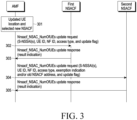
- FIG. 3 is a flowchart illustrating an NSAC exemption procedure performed by an AMF in case that an NSACF is changed in a wireless communication system supporting multiple NSACFs according to an embodiment of the disclosure.
- An example of FIG. 3 illustrates a method for the AMF as a consumer NF to support service continuity in case that an NSACF is changed according to UE location in a procedure of updating the number of registered UEs per network slice.
- a basic function of each NF involved in the procedure of FIG. 3 may be referenced in the description of FIG. 1 .
- a first NSACF is an old NSACF before an NSACF change
- a second NSACF is a new NSACF changed according to UE location.
- step 301 when the UE location is changed to be outside/out of the service area (SA) of the old NSACF (i.e., the previously selected NSACF), the AMF may select the new NSACF according to the UE location of a corresponding UE.
- SA service area
- the AMF transmits a first update request message including at least one of S-NSSAI(s), a UE ID, an NF ID, an access type, and an update flag configured to a decrease with respect to a network slice(s) that requires updating for each UE (i.e., network slices already included in the allowed NSSAI of the UE) to the first NSACF, which is the old NSACF.
- the first NSACF when receiving the first update request message, transmits a first update response message to the AMF.
- the first update response message may include a result indication per network slice, and the first NSACF may configure the result indication to one of values corresponding to "'maximum number of UEs registered per S-NSSAI is reached" or "maximum number of UEs registered per S-NSSAI is not reached” according to the number of UEs per network slice.
- the AMF may determine NSAC exemption for the network slice(s) that requires updating for the UE (e.g., the network slice(s) included in the previous allowed NSSAI). The NSAC exemption is introduced to support service continuity when the NSACF is changed to the new NSACF.
- the previous allowed NSSAI for the UE may be understood to correspond to S-NSSAI with which the UE previously registers in one service area (SA).
- the following indication indicating the NSAC exemption may be understood as indication information determined based on a network slice previously allowed for the UE (i.e., the previous allowed NSSAI).
- the AMF may perform the NSAC exemption for the network slice(s) that requires updating through one of the following methods 1), 2), and 3):
- the term "exemption indication for NSAC exemption” is an example, and may be referred to by various terms corresponding to the indication.
- FIG. 3 illustrates the method 3) in which the AMF transmits the second update request message to the second NSACF in step 304, and the second update request message may include at least one of S-NSSAI(s), a UE ID, an NF ID, an access type, the exemption indication and/or the old NSACF information, and an update flag.
- the second update request message may or may not include the exemption indication. Accordingly, when receiving the second update request message, the second NSACF may identify whether the exemption indication is included, and may perform the following step.
- the AMF receives a second update response message including a result indication from the second NSACF having received the second update request message including the exemption indication. That is, when the second NSACF receives the second update request message including the exemption indication from the AMF in step 304, the second NSACF may accept the request for service continuity, based on the exemption indication.
- the second NSACF having received the exemption indication may include a result indication value corresponding to "maximum number of UEs registered per S-NSSAI not reached" in the second update response message with respect to a network slice(s) corresponding to the S-NSSAI(s) in the second update request message even when the maximum number of registered UEs (i.e., a threshold) is reached.
- the second NSACF having received the exemption indication may include a result indication value corresponding to "maximum number of UEs registered per S-NSSAI is not reached" in the second update response message with respect to a network slice(s) included in the exemption indication among the network slice(s) corresponding to the S-NSSAI(s) in the second update request message even when the maximum number of registered UEs is reached.
- the second NSACF may identify whether the UE is registered through the first NSACF, and may request the first NSACF to decrease the number of registered UEs for the UE and the network slice.
- the AMF may omit step 302 and step 303, in which case the second update request message in step 304 may include the first NSACF information (old NSACF information).
- FIG. 4 is a flowchart illustrating an NSAC exemption procedure performed by an SMF in case that an NSACF is changed in a wireless communication system supporting multiple NSACFs according to an embodiment of the disclosure.
- An example of FIG. 3 illustrates a method for the SMF as a consumer NF to support service continuity in case that an NSACF is changed according to UE location in a procedure of updating the number of PDU sessions per network slice.
- a basic function of each NF involved in the procedure of FIG. 4 may be referenced in the description of FIG. 1 .
- a first NSACF is an old NSACF before an NSACF change
- a second NSACF is a new NSACF changed according to UE location.
- step 401 when the UE location is changed to be outside/out of the service area (SA) of the old NSACF (i.e., the previously selected NSACF), the SMF may select the new NSACF according to the UE location of a corresponding UE.
- SA service area
- the SMF may select the NSACF.
- the SMF transmits a first update request message including at least one of S-NSSAI(s), a UE ID, an NF ID, an access type, and an update flag configured to a decrease with respect to a network slice(s) that requires updating for each UE (i.e., network slices already included in the allowed NSSAI of the UE) to the first NSACF, which is the old NSACF.
- the first NSACF when receiving the first update request message, transmits a first update response message including a result indication to the SMF.
- the first update response message may include a result indication per network slice, and the result indication per network slice may indicate "maximum number of PDU session per S-NSSAI is reached" or "maximum number of PDU sessions per S-NSSAI is not reached”.
- the SMF may determine NSAC exemption in a case of a request for a PDU session for the network slice(s) that requires updating for the UE (e.g., the network slice(s) included in the previous allowed NSSAI), in a case of not requesting generation of a new PDU session, in a case of a request for SSC mode 3 or generation of a PDU session due to SSC mode 3, or in a case of receiving an NSAC exemption request for the network slice(s) from the AMF.
- the SMF may perform the NSAC exemption for the network slice(s) that requires updating through one of the following methods 1), 2), and 3):
- FIG. 4 illustrates the method 3) in which the SMF transmits the second update request message to the second NSACF in step 404, and the second update request message may include at least one of S-NSSAI, a UE ID, a PDU session ID, an access type, the exemption indication or an old NSACF address, and an update flag.
- the SMF receives a second update response message including an update result (e.g., a result indication) from the second NSACF having received the second update request message including the exemption indication.
- the second NSACF having received the exemption indication may include a result indication value corresponding to "maximum number of PDU sessions per S-NSSAI is not reached" in the second update response message with respect to a network slice(s) corresponding to the S-NSSAI(s) in the second update request message even when the maximum number of PDU sessions is reached.
- the second NSACF having received the exemption indication may include a result indication value corresponding to "maximum number of PDU sessions per S-NSSAI is not reached" in the second update response message with respect to a slice(s) included in the exemption indication among the network slice(s) corresponding to the S-NSSAI(s) in the second update request message even when the maximum number of PDU sessions is reached.
- the second NSACF may identify whether a corresponding PDU session UE is registered through the first NSACF, and may request the first NSACF to decrease the number of PDU sessions for the network slice.
- the SMF may omit step 402, in which case the second update request message in step 404 may include the first NSACF information (old NSACF information).
- the RAN transmits an N2 message (N2 parameter, registration request) to the second AMF, which is the new AMF, to request registration of the UE.
- the N2 parameter includes at least one of a selected PLMN ID, UE location information, and a UE context request.
- the second AMF selects an authentication server function (AUSF) for authentication of the UE, based on the UE identifier (SUCI or subscription permanent identifier (SUPI)).
- AUSF authentication server function
- step 505 an authentication procedure for the UE is performed through the selected AUSF.
- the authentication procedure when there is no non-access-stratum (NAS) security context for the UE, a procedure for obtaining the NAS security context is performed.
- NAS non-access-stratum
- the changed second AMF i.e., the new AMF
- the first AMF i.e., the old AMF
- UE context information transmitted by the first AMF to the second AMF in response to the request in step 506 may include information about the NSACF before the AMF change of the UE (i.e., information including at least among the address of the selected NSACF and service area (SA) information, referred to as old NSACF information). Further, the UE context information may include old NSACF information about an NSACF that monitors and controls the number of UEs registered per network slice and old NSACF information about the NSACF that monitors and controls the number of PDU sessions per network slice.
- SA service area
- the second AMF may perform NSACF discovery through an NRF.
- the second AMF may select a UDM, based on the SUPI, which is the UE identifier, and the UDM may select a UDR in which the subscription information about the UE is stored.
- the second AMF may request access and mobility subscription information about the UE from the UDM through a Nudm_SDM_Get Request (SUPI, access and mobility subscription data) message.
- the UDM may transmit the requested subscription information about the UE to the second AMF via a Nudm_SDM_Get Response message in response to the Nudm_SDM_Get Request.
- the UDM may obtain the information to be transmitted to the second AMF from the UDR, and may transmit the information to the second AMF.
- the second AMF may select a new NSACF for the UE as in the embodiment of FIG. 3 .
- the second AMF may store information about the selected NSACF (hereinafter, "NSACF information") (NSACF ID, NSACF address, and NSACF SA) in the UE context.
- NSACF information NSACF ID, NSACF address, and NSACF SA
- the AMF may perform an NSAC procedure on network slices considered as allowed NSSAI of the UE. As described in the embodiment of FIG. 3 , the AMF may determine NSAC exemption for at least one slice among the network slices considered as the new allowed NSSAI of the UE.
- the network slice to be exempted from NSAC may be determined as a network slice(s) included in previous allowed NSSAI in the UE context (or a network slice(s) for which the NSAC procedure has already succeeded) for service continuity.
- the second AMF may perform the NSAC exemption for network slices that require updating through one of the following methods 1), 2), and 3):
- the second AMF may transmit an update request message including at least one of S-NSSAI(s), a UE ID, an NF ID, an access type, the exemption indication or the old NSACF information, and an update flag to the NSACF.
- the AMF receives an update response message including an update result (e.g., a result indication) from the NSACF having received the update request message including the exemption indication.
- an update result e.g., a result indication
- the NSACF having received the exemption indication may not include an indication corresponding to rejection in the update result (result indication) included in the updated response message even though the maximum number of registered UEs is reached.
- the NSACF may identify whether the UE is registered through the old NSACF, and may request the old NSACF to decrease the number of registered UEs for the UE and the network slice.
- the AMF may request a PDU session update from an SMF.
- the AMF may transmit a session update request message including at least one of S-NSSAI, a DNN, UE location, a PDU session ID, an exemption indication, and NSACF information to the SMF.
- the SMF may select a new NSACF for the UE in step 513. Further, when receiving the NSACF information from the AMF through the session update request message, the SMF may select an NSACF corresponding to the NSACF information as the new NSACF.
- the session update request message received from the AMF in step 512 includes the aforementioned exemption indication, the SMF may perform NSAC exemption on a PDU session for the S-NSSAI of the session update request message received from the AMF. The SMF performs the PDU session update based on the session update request message received from the AMF in step 512.
- a corresponding NSACF may be efficiently discovered and selected to efficiently support the multiple NSACFs.
- a UE or a PDU session already accepted for a network slice may be prevented from being rejected as an NSACF is changed and the maximum number of registered UEs and/or the maximum number of PDU sessions per network slice are reached in a new NSACF, thereby providing service continuity for the UE and the PDU session in a multiple NSACF environment and thus improving user experience.
- FIG. 6 illustrates a configuration example of a network entity according to an embodiment of the disclosure.
- the network entity of FIG. 6 may be one of the UE, the base station (RAN), or the network function (NF), such as the AMF, the SMF, the NSACF, or the UDM, described in the embodiments of FIG. 1 to FIG. 5 .
- NF network function
- the transceiver 603 may transmit and receive a signal to and from at least one of other network entities or a UE.
- the signal transmitted and received may include at least one of control information and data.
- the processor 601 may control the overall operation of the network entity to perform an operation according to one of the foregoing embodiments of FIG. 1 to FIG. 5 or a combination of two or more of the embodiments.
- the processor 601, the transceiver 603, and the memory 605 are not necessarily configured as separate modules, but may be configured as a single component in the form of a single chip.
- the processor 601 may be an application processor (AP), a communication processor (CP), a circuit, an application-specific circuit, or at least one processor.
- the transceiver 603 may include at least one communication interface configured to transmit and receive a signal to and from another network entity via a cable/wirelessly.
- the memory 605 may store data, such as a basic program, an application program, and configuration information, for the operation of the network entity.
- the memory 605 may provide the stored data upon request from the processor 601.
- the memory 605 may be configured as a storage medium, such as ROM, RAM, a hard disk, CD-ROM, and a DVD, or a combination of storage media.
- the memory 605 may include a plurality of memories.
- the processor 601 may perform at least one of the foregoing embodiments, based on a program for performing an operation according to at least one of the foregoing embodiments of the disclosure stored in the memory 605.
- a computer-readable storage medium for storing one or more programs (software modules) may be provided.
- the one or more programs stored in the computer-readable storage medium may be configured for execution by one or more processors within the electronic device.
- the at least one program includes instructions that cause the electronic device to perform the methods according to various embodiments of the disclosure as defined by the appended claims and/or disclosed herein.
- These programs may be stored in non-volatile memories including a random access memory and a flash memory, a read only memory (ROM), an electrically erasable programmable read only memory (EEPROM), a magnetic disc storage device, a compact disc-ROM (CD-ROM), digital versatile discs (DVDs), or other type optical storage devices, or a magnetic cassette.
- ROM read only memory
- EEPROM electrically erasable programmable read only memory
- CD-ROM compact disc-ROM
- DVDs digital versatile discs
- any combination of some or all of them may form a memory in which the program is stored.
- a plurality of such memories may be included in the electronic device.
- the programs may be stored in an attachable storage device which can access the electronic device through communication networks such as the Internet, Intranet, Local Area Network (LAN), Wide LAN (WLAN), and Storage Area Network (SAN) or a combination thereof.
- a storage device may access the electronic device via an external port.
- a separate storage device on the communication network may access a portable electronic device.
Landscapes
- Engineering & Computer Science (AREA)
- Computer Networks & Wireless Communication (AREA)
- Signal Processing (AREA)
- Computer Security & Cryptography (AREA)
- Mobile Radio Communication Systems (AREA)
Applications Claiming Priority (2)
| Application Number | Priority Date | Filing Date | Title |
|---|---|---|---|
| KR1020220039243A KR20230140289A (ko) | 2022-03-29 | 2022-03-29 | 다중 nsacf들을 지원하는 무선 통신 시스템에서 통신 방법 및 장치 |
| PCT/KR2023/004210 WO2023191514A1 (fr) | 2022-03-29 | 2023-03-29 | Procédé et dispositif de communication dans un système de communication sans fil avec prise en charge de multiples fonctions de commande d'admission de tranche de réseau |
Publications (2)
| Publication Number | Publication Date |
|---|---|
| EP4486011A1 true EP4486011A1 (fr) | 2025-01-01 |
| EP4486011A4 EP4486011A4 (fr) | 2025-06-18 |
Family
ID=88202843
Family Applications (1)
| Application Number | Title | Priority Date | Filing Date |
|---|---|---|---|
| EP23781367.0A Pending EP4486011A4 (fr) | 2022-03-29 | 2023-03-29 | Procédé et dispositif de communication dans un système de communication sans fil avec prise en charge de multiples fonctions de commande d'admission de tranche de réseau |
Country Status (4)
| Country | Link |
|---|---|
| US (1) | US20250234274A1 (fr) |
| EP (1) | EP4486011A4 (fr) |
| KR (1) | KR20230140289A (fr) |
| WO (1) | WO2023191514A1 (fr) |
Family Cites Families (3)
| Publication number | Priority date | Publication date | Assignee | Title |
|---|---|---|---|---|
| JP2024538732A (ja) * | 2021-10-08 | 2024-10-23 | サムスン エレクトロニクス カンパニー リミテッド | 無線通信システムにおいてネットワークスライス登録を管理する方法及びその装置 |
| WO2023062538A1 (fr) * | 2021-10-11 | 2023-04-20 | Lenovo (Singapore) Pte. Ltd. | Commande d'admission de tranche de réseau et mobilité de terminal |
| WO2023146252A1 (fr) * | 2022-01-26 | 2023-08-03 | Samsung Electronics Co., Ltd. | Procédé et appareil de prise en charge de service d'urgence et de service de priorité dans un système de communication sans fil |
-
2022
- 2022-03-29 KR KR1020220039243A patent/KR20230140289A/ko active Pending
-
2023
- 2023-03-29 EP EP23781367.0A patent/EP4486011A4/fr active Pending
- 2023-03-29 WO PCT/KR2023/004210 patent/WO2023191514A1/fr not_active Ceased
- 2023-03-29 US US18/850,340 patent/US20250234274A1/en active Pending
Also Published As
| Publication number | Publication date |
|---|---|
| WO2023191514A1 (fr) | 2023-10-05 |
| US20250234274A1 (en) | 2025-07-17 |
| KR20230140289A (ko) | 2023-10-06 |
| EP4486011A4 (fr) | 2025-06-18 |
Similar Documents
| Publication | Publication Date | Title |
|---|---|---|
| US20230300667A1 (en) | Communication method and device for xr service in wireless communication system | |
| US20230145512A1 (en) | Method and apparatus for configuring session connection mode using network data analytics function in wireless communications system | |
| US20230239667A1 (en) | Method and apparatus for supporting emergency service and priority service in wireless communication system | |
| US20250212104A1 (en) | Method and device for determining network slice in wireless communication system | |
| US20240155418A1 (en) | Method and apparatus for connecting qos flow based terminal in wireless communication system | |
| US20230319757A1 (en) | Method and device for providing access path in wireless communication system | |
| US20230239736A1 (en) | Method and apparatus for supporting change of network slice in wireless communication system | |
| US12309689B2 (en) | Method and apparatus for supporting network slice in wireless communication system | |
| US12426002B2 (en) | Method and apparatus for providing network slices in wireless communications systems | |
| US20250016870A1 (en) | Method and apparatus for providing service function chain in wireless communication system | |
| US20250227645A1 (en) | Method for providing service through alternative slice | |
| US20250031138A1 (en) | Apparatus and method for managing session in wireless communication system | |
| US20240236832A1 (en) | Method and device for supporting network slice change in consideration of network slice quota | |
| US20240340721A1 (en) | Method and apparatus for supporting service continuity by considering network slice area in a wireless communication system | |
| US12477445B2 (en) | Method and apparatus for supporting monitoring for external services in a wireless communication system | |
| US20240147210A1 (en) | Method and device for collecting data for roaming terminal in wireless communication system | |
| US20240224147A1 (en) | Apparatus and method for inter-plmn handover of home routed session in wireless communication system | |
| US20230125804A1 (en) | Method and apparatus for supporting available services in wireless communications systems | |
| EP4486011A1 (fr) | Procédé et dispositif de communication dans un système de communication sans fil avec prise en charge de multiples fonctions de commande d'admission de tranche de réseau | |
| EP4554167A1 (fr) | Procédé et dispositif de mise à jour de politique de terminal pour la continuité d'un service de tranche de réseau dans un système de communication sans fil | |
| US20240056897A1 (en) | Method and apparatus for managing edge computing service session in wireless communication system | |
| EP4629741A1 (fr) | Procédé et dispositif pour prendre en charge l'établissement d'une session pdu sur une tranche de réseau dans un réseau de communication | |
| US20250365655A1 (en) | Method and apparatus for selection of network supporting energy control in wireless communication system | |
| EP4679932A1 (fr) | Procédé et dispositif pour prendre en charge l'utilisation simultanée de multiples plans utilisateur dans un système de communication sans fil | |
| EP4604595A1 (fr) | Procédé et dispositif de collecte et d'analyse de données de réseau relatives à une application d'une politique d'un terminal dans un système de communication sans fil |
Legal Events
| Date | Code | Title | Description |
|---|---|---|---|
| STAA | Information on the status of an ep patent application or granted ep patent |
Free format text: STATUS: THE INTERNATIONAL PUBLICATION HAS BEEN MADE |
|
| PUAI | Public reference made under article 153(3) epc to a published international application that has entered the european phase |
Free format text: ORIGINAL CODE: 0009012 |
|
| STAA | Information on the status of an ep patent application or granted ep patent |
Free format text: STATUS: REQUEST FOR EXAMINATION WAS MADE |
|
| 17P | Request for examination filed |
Effective date: 20240924 |
|
| AK | Designated contracting states |
Kind code of ref document: A1 Designated state(s): AL AT BE BG CH CY CZ DE DK EE ES FI FR GB GR HR HU IE IS IT LI LT LU LV MC ME MK MT NL NO PL PT RO RS SE SI SK SM TR |
|
| A4 | Supplementary search report drawn up and despatched |
Effective date: 20250519 |
|
| RIC1 | Information provided on ipc code assigned before grant |
Ipc: H04W 24/08 20090101ALI20250513BHEP Ipc: H04W 24/04 20090101ALI20250513BHEP Ipc: H04W 48/16 20090101ALI20250513BHEP Ipc: H04W 48/18 20090101AFI20250513BHEP |
|
| DAV | Request for validation of the european patent (deleted) | ||
| DAX | Request for extension of the european patent (deleted) |