EP4487837A1 - Inhalierbare formulierung von fluticasonpropionat und albuterolsulfat zur behandlung von asthma - Google Patents
Inhalierbare formulierung von fluticasonpropionat und albuterolsulfat zur behandlung von asthma Download PDFInfo
- Publication number
- EP4487837A1 EP4487837A1 EP23186744.1A EP23186744A EP4487837A1 EP 4487837 A1 EP4487837 A1 EP 4487837A1 EP 23186744 A EP23186744 A EP 23186744A EP 4487837 A1 EP4487837 A1 EP 4487837A1
- Authority
- EP
- European Patent Office
- Prior art keywords
- dose
- mcg
- asthma
- patients
- albuterol sulfate
- Prior art date
- Legal status (The legal status is an assumption and is not a legal conclusion. Google has not performed a legal analysis and makes no representation as to the accuracy of the status listed.)
- Pending
Links
- BNPSSFBOAGDEEL-UHFFFAOYSA-N albuterol sulfate Chemical compound OS(O)(=O)=O.CC(C)(C)NCC(O)C1=CC=C(O)C(CO)=C1.CC(C)(C)NCC(O)C1=CC=C(O)C(CO)=C1 BNPSSFBOAGDEEL-UHFFFAOYSA-N 0.000 title claims abstract description 143
- 229940057282 albuterol sulfate Drugs 0.000 title claims abstract description 135
- 208000006673 asthma Diseases 0.000 title claims abstract description 104
- 238000011282 treatment Methods 0.000 title claims abstract description 93
- 239000000203 mixture Substances 0.000 title claims abstract description 76
- 229960000289 fluticasone propionate Drugs 0.000 title claims abstract description 70
- WMWTYOKRWGGJOA-CENSZEJFSA-N fluticasone propionate Chemical compound C1([C@@H](F)C2)=CC(=O)C=C[C@]1(C)[C@]1(F)[C@@H]2[C@@H]2C[C@@H](C)[C@@](C(=O)SCF)(OC(=O)CC)[C@@]2(C)C[C@@H]1O WMWTYOKRWGGJOA-CENSZEJFSA-N 0.000 title claims abstract description 70
- 238000009472 formulation Methods 0.000 title description 34
- 239000000843 powder Substances 0.000 claims abstract description 71
- 238000000034 method Methods 0.000 claims abstract description 69
- 229940127558 rescue medication Drugs 0.000 claims abstract description 24
- 241001602876 Nata Species 0.000 claims abstract description 6
- 239000003814 drug Substances 0.000 claims description 75
- 229940079593 drug Drugs 0.000 claims description 67
- KUVIULQEHSCUHY-XYWKZLDCSA-N Beclometasone Chemical compound C1CC2=CC(=O)C=C[C@]2(C)[C@]2(Cl)[C@@H]1[C@@H]1C[C@H](C)[C@@](C(=O)COC(=O)CC)(OC(=O)CC)[C@@]1(C)C[C@@H]2O KUVIULQEHSCUHY-XYWKZLDCSA-N 0.000 claims description 28
- 208000037874 Asthma exacerbation Diseases 0.000 claims description 21
- 239000003246 corticosteroid Substances 0.000 claims description 21
- 229940125389 long-acting beta agonist Drugs 0.000 claims description 21
- 229960004436 budesonide Drugs 0.000 claims description 20
- VOVIALXJUBGFJZ-KWVAZRHASA-N Budesonide Chemical compound C1CC2=CC(=O)C=C[C@]2(C)[C@@H]2[C@@H]1[C@@H]1C[C@H]3OC(CCC)O[C@@]3(C(=O)CO)[C@@]1(C)C[C@@H]2O VOVIALXJUBGFJZ-KWVAZRHASA-N 0.000 claims description 19
- 230000005713 exacerbation Effects 0.000 claims description 19
- 229950000210 beclometasone dipropionate Drugs 0.000 claims description 18
- 229960002848 formoterol Drugs 0.000 claims description 18
- 229940000425 combination drug Drugs 0.000 claims description 17
- 238000012423 maintenance Methods 0.000 claims description 16
- WSVLPVUVIUVCRA-KPKNDVKVSA-N Alpha-lactose monohydrate Chemical compound O.O[C@@H]1[C@@H](O)[C@@H](O)[C@@H](CO)O[C@H]1O[C@@H]1[C@@H](CO)O[C@H](O)[C@H](O)[C@H]1O WSVLPVUVIUVCRA-KPKNDVKVSA-N 0.000 claims description 15
- -1 low-dose 100-200 mcg Substances 0.000 claims description 15
- 238000009115 maintenance therapy Methods 0.000 claims description 13
- 229960002744 mometasone furoate Drugs 0.000 claims description 13
- 229940110339 Long-acting muscarinic antagonist Drugs 0.000 claims description 12
- WOFMFGQZHJDGCX-ZULDAHANSA-N mometasone furoate Chemical compound O([C@]1([C@@]2(C)C[C@H](O)[C@]3(Cl)[C@@]4(C)C=CC(=O)C=C4CC[C@H]3[C@@H]2C[C@H]1C)C(=O)CCl)C(=O)C1=CC=CO1 WOFMFGQZHJDGCX-ZULDAHANSA-N 0.000 claims description 11
- 230000004044 response Effects 0.000 claims description 11
- 229940122605 Short-acting muscarinic antagonist Drugs 0.000 claims description 10
- 229960003728 ciclesonide Drugs 0.000 claims description 10
- XTULMSXFIHGYFS-VLSRWLAYSA-N fluticasone furoate Chemical compound O([C@]1([C@@]2(C)C[C@H](O)[C@]3(F)[C@@]4(C)C=CC(=O)C=C4[C@@H](F)C[C@H]3[C@@H]2C[C@H]1C)C(=O)SCF)C(=O)C1=CC=CO1 XTULMSXFIHGYFS-VLSRWLAYSA-N 0.000 claims description 10
- 229960001469 fluticasone furoate Drugs 0.000 claims description 10
- 230000009885 systemic effect Effects 0.000 claims description 9
- 230000007423 decrease Effects 0.000 claims description 8
- 206010006482 Bronchospasm Diseases 0.000 claims description 7
- LUKZNWIVRBCLON-GXOBDPJESA-N Ciclesonide Chemical compound C1([C@H]2O[C@@]3([C@H](O2)C[C@@H]2[C@@]3(C[C@H](O)[C@@H]3[C@@]4(C)C=CC(=O)C=C4CC[C@H]32)C)C(=O)COC(=O)C(C)C)CCCCC1 LUKZNWIVRBCLON-GXOBDPJESA-N 0.000 claims description 7
- 208000009079 Bronchial Spasm Diseases 0.000 claims description 6
- 208000014181 Bronchial disease Diseases 0.000 claims description 6
- 229940127225 asthma medication Drugs 0.000 claims description 6
- 230000003247 decreasing effect Effects 0.000 claims description 6
- 230000007774 longterm Effects 0.000 claims description 6
- 230000002441 reversible effect Effects 0.000 claims description 6
- 239000011882 ultra-fine particle Substances 0.000 claims description 4
- 235000017274 Diospyros sandwicensis Nutrition 0.000 claims description 3
- 241000282838 Lama Species 0.000 claims description 3
- 208000027771 Obstructive airways disease Diseases 0.000 claims description 3
- BKLAJZNVMHLXAP-VKGMXUHCSA-N 3-[(1r,5s)-8,8-dimethyl-8-azoniabicyclo[3.2.1]octan-3-yl]-2,2-diphenylpropanenitrile Chemical compound C([C@H]1CC[C@@H](C2)[N+]1(C)C)C2CC(C#N)(C=1C=CC=CC=1)C1=CC=CC=C1 BKLAJZNVMHLXAP-VKGMXUHCSA-N 0.000 claims description 2
- IHOXNOQMRZISPV-YJYMSZOUSA-N 5-[(1r)-1-hydroxy-2-[[(2r)-1-(4-methoxyphenyl)propan-2-yl]azaniumyl]ethyl]-2-oxo-1h-quinolin-8-olate Chemical compound C1=CC(OC)=CC=C1C[C@@H](C)NC[C@H](O)C1=CC=C(O)C2=C1C=CC(=O)N2 IHOXNOQMRZISPV-YJYMSZOUSA-N 0.000 claims description 2
- BPZSYCZIITTYBL-YJYMSZOUSA-N R-Formoterol Chemical compound C1=CC(OC)=CC=C1C[C@@H](C)NC[C@H](O)C1=CC=C(O)C(NC=O)=C1 BPZSYCZIITTYBL-YJYMSZOUSA-N 0.000 claims description 2
- GIIZNNXWQWCKIB-UHFFFAOYSA-N Serevent Chemical compound C1=C(O)C(CO)=CC(C(O)CNCCCCCCOCCCCC=2C=CC=CC=2)=C1 GIIZNNXWQWCKIB-UHFFFAOYSA-N 0.000 claims description 2
- ANGKOCUUWGHLCE-HKUYNNGSSA-N [(3s)-1,1-dimethylpyrrolidin-1-ium-3-yl] (2r)-2-cyclopentyl-2-hydroxy-2-phenylacetate Chemical compound C1[N+](C)(C)CC[C@@H]1OC(=O)[C@](O)(C=1C=CC=CC=1)C1CCCC1 ANGKOCUUWGHLCE-HKUYNNGSSA-N 0.000 claims description 2
- 229950000192 abediterol Drugs 0.000 claims description 2
- SFYAXIFVXBKRPK-QFIPXVFZSA-N abediterol Chemical compound C([C@H](O)C=1C=2C=CC(=O)NC=2C(O)=CC=1)NCCCCCCOCC(F)(F)C1=CC=CC=C1 SFYAXIFVXBKRPK-QFIPXVFZSA-N 0.000 claims description 2
- ASMXXROZKSBQIH-VITNCHFBSA-N aclidinium Chemical compound C([C@@H](C(CC1)CC2)OC(=O)C(O)(C=3SC=CC=3)C=3SC=CC=3)[N+]21CCCOC1=CC=CC=C1 ASMXXROZKSBQIH-VITNCHFBSA-N 0.000 claims description 2
- 229940019903 aclidinium Drugs 0.000 claims description 2
- 229960001692 arformoterol Drugs 0.000 claims description 2
- 229960003060 bambuterol Drugs 0.000 claims description 2
- ANZXOIAKUNOVQU-UHFFFAOYSA-N bambuterol Chemical compound CN(C)C(=O)OC1=CC(OC(=O)N(C)C)=CC(C(O)CNC(C)(C)C)=C1 ANZXOIAKUNOVQU-UHFFFAOYSA-N 0.000 claims description 2
- 229950010713 carmoterol Drugs 0.000 claims description 2
- 229960001117 clenbuterol Drugs 0.000 claims description 2
- STJMRWALKKWQGH-UHFFFAOYSA-N clenbuterol Chemical compound CC(C)(C)NCC(O)C1=CC(Cl)=C(N)C(Cl)=C1 STJMRWALKKWQGH-UHFFFAOYSA-N 0.000 claims description 2
- FVTWTVQXNAJTQP-UHFFFAOYSA-N diphenyl-[1-(2-phenylmethoxyethyl)-1-azoniabicyclo[2.2.2]octan-4-yl]methanol Chemical compound C=1C=CC=CC=1C(C12CC[N+](CCOCC=3C=CC=CC=3)(CC1)CC2)(O)C1=CC=CC=C1 FVTWTVQXNAJTQP-UHFFFAOYSA-N 0.000 claims description 2
- 229960000676 flunisolide Drugs 0.000 claims description 2
- BPZSYCZIITTYBL-UHFFFAOYSA-N formoterol Chemical compound C1=CC(OC)=CC=C1CC(C)NCC(O)C1=CC=C(O)C(NC=O)=C1 BPZSYCZIITTYBL-UHFFFAOYSA-N 0.000 claims description 2
- 229960002462 glycopyrronium bromide Drugs 0.000 claims description 2
- 229960004078 indacaterol Drugs 0.000 claims description 2
- QZZUEBNBZAPZLX-QFIPXVFZSA-N indacaterol Chemical compound N1C(=O)C=CC2=C1C(O)=CC=C2[C@@H](O)CNC1CC(C=C(C(=C2)CC)CC)=C2C1 QZZUEBNBZAPZLX-QFIPXVFZSA-N 0.000 claims description 2
- OEXHQOGQTVQTAT-JRNQLAHRSA-N ipratropium Chemical compound O([C@H]1C[C@H]2CC[C@@H](C1)[N@@+]2(C)C(C)C)C(=O)C(CO)C1=CC=CC=C1 OEXHQOGQTVQTAT-JRNQLAHRSA-N 0.000 claims description 2
- 229960001888 ipratropium Drugs 0.000 claims description 2
- 229960004286 olodaterol Drugs 0.000 claims description 2
- COUYJEVMBVSIHV-SFHVURJKSA-N olodaterol Chemical compound C1=CC(OC)=CC=C1CC(C)(C)NC[C@H](O)C1=CC(O)=CC2=C1OCC(=O)N2 COUYJEVMBVSIHV-SFHVURJKSA-N 0.000 claims description 2
- MIXMJCQRHVAJIO-TZHJZOAOSA-N qk4dys664x Chemical compound O.C1([C@@H](F)C2)=CC(=O)C=C[C@]1(C)[C@@H]1[C@@H]2[C@@H]2C[C@H]3OC(C)(C)O[C@@]3(C(=O)CO)[C@@]2(C)C[C@@H]1O.C1([C@@H](F)C2)=CC(=O)C=C[C@]1(C)[C@@H]1[C@@H]2[C@@H]2C[C@H]3OC(C)(C)O[C@@]3(C(=O)CO)[C@@]2(C)C[C@@H]1O MIXMJCQRHVAJIO-TZHJZOAOSA-N 0.000 claims description 2
- 229960004017 salmeterol Drugs 0.000 claims description 2
- LERNTVKEWCAPOY-DZZGSBJMSA-N tiotropium Chemical compound O([C@H]1C[C@@H]2[N+]([C@H](C1)[C@@H]1[C@H]2O1)(C)C)C(=O)C(O)(C=1SC=CC=1)C1=CC=CS1 LERNTVKEWCAPOY-DZZGSBJMSA-N 0.000 claims description 2
- 229940110309 tiotropium Drugs 0.000 claims description 2
- 229960004258 umeclidinium Drugs 0.000 claims description 2
- 229960004026 vilanterol Drugs 0.000 claims description 2
- DAFYYTQWSAWIGS-DEOSSOPVSA-N vilanterol Chemical compound C1=C(O)C(CO)=CC([C@@H](O)CNCCCCCCOCCOCC=2C(=CC=CC=2Cl)Cl)=C1 DAFYYTQWSAWIGS-DEOSSOPVSA-N 0.000 claims description 2
- PZSMUPGANZGPBF-UHFFFAOYSA-N 4-[5-(dithiolan-3-yl)pentanoylamino]butanoic acid Chemical compound OC(=O)CCCNC(=O)CCCCC1CCSS1 PZSMUPGANZGPBF-UHFFFAOYSA-N 0.000 claims 2
- 235000008247 Echinochloa frumentacea Nutrition 0.000 claims 2
- 240000004072 Panicum sumatrense Species 0.000 claims 2
- 229940112141 dry powder inhaler Drugs 0.000 abstract description 14
- 230000008859 change Effects 0.000 description 26
- 229940126602 investigational medicinal product Drugs 0.000 description 25
- 239000002245 particle Substances 0.000 description 25
- NDAUXUAQIAJITI-UHFFFAOYSA-N albuterol Chemical compound CC(C)(C)NCC(O)C1=CC=C(O)C(CO)=C1 NDAUXUAQIAJITI-UHFFFAOYSA-N 0.000 description 24
- 235000013902 inosinic acid Nutrition 0.000 description 24
- 238000012360 testing method Methods 0.000 description 24
- 229960002052 salbutamol Drugs 0.000 description 23
- 208000024891 symptom Diseases 0.000 description 23
- 238000012216 screening Methods 0.000 description 20
- 238000005259 measurement Methods 0.000 description 17
- 239000002585 base Substances 0.000 description 16
- 230000037361 pathway Effects 0.000 description 16
- 238000004891 communication Methods 0.000 description 15
- 238000002483 medication Methods 0.000 description 15
- 229940071648 metered dose inhaler Drugs 0.000 description 13
- 239000000047 product Substances 0.000 description 13
- 238000009530 blood pressure measurement Methods 0.000 description 12
- 150000005828 hydrofluoroalkanes Chemical class 0.000 description 12
- 239000000523 sample Substances 0.000 description 12
- GUBGYTABKSRVRQ-QKKXKWKRSA-N Lactose Natural products OC[C@H]1O[C@@H](O[C@H]2[C@H](O)[C@@H](O)C(O)O[C@@H]2CO)[C@H](O)[C@@H](O)[C@H]1O GUBGYTABKSRVRQ-QKKXKWKRSA-N 0.000 description 11
- 239000002775 capsule Substances 0.000 description 11
- 229960001375 lactose Drugs 0.000 description 11
- 239000008101 lactose Substances 0.000 description 11
- 239000000546 pharmaceutical excipient Substances 0.000 description 11
- 238000012549 training Methods 0.000 description 11
- 239000012530 fluid Substances 0.000 description 10
- 230000003434 inspiratory effect Effects 0.000 description 10
- 210000004072 lung Anatomy 0.000 description 10
- 230000004199 lung function Effects 0.000 description 10
- 239000004480 active ingredient Substances 0.000 description 9
- 239000000463 material Substances 0.000 description 9
- 238000001386 capillary affinity electrophoresis Methods 0.000 description 8
- 229960001334 corticosteroids Drugs 0.000 description 8
- 229940012484 proair Drugs 0.000 description 8
- 239000010419 fine particle Substances 0.000 description 7
- 239000008186 active pharmaceutical agent Substances 0.000 description 6
- 238000012790 confirmation Methods 0.000 description 6
- 239000008367 deionised water Substances 0.000 description 6
- 239000011521 glass Substances 0.000 description 6
- 229940125369 inhaled corticosteroids Drugs 0.000 description 6
- 230000003287 optical effect Effects 0.000 description 6
- 238000002360 preparation method Methods 0.000 description 6
- 230000009325 pulmonary function Effects 0.000 description 6
- 208000023504 respiratory system disease Diseases 0.000 description 6
- 230000002411 adverse Effects 0.000 description 5
- 230000033228 biological regulation Effects 0.000 description 5
- 229940124630 bronchodilator Drugs 0.000 description 5
- 230000001684 chronic effect Effects 0.000 description 5
- 230000006866 deterioration Effects 0.000 description 5
- 239000006185 dispersion Substances 0.000 description 5
- 230000006872 improvement Effects 0.000 description 5
- HQKMJHAJHXVSDF-UHFFFAOYSA-L magnesium stearate Substances [Mg+2].CCCCCCCCCCCCCCCCCC([O-])=O.CCCCCCCCCCCCCCCCCC([O-])=O HQKMJHAJHXVSDF-UHFFFAOYSA-L 0.000 description 5
- 238000013178 mathematical model Methods 0.000 description 5
- 238000012544 monitoring process Methods 0.000 description 5
- 230000002265 prevention Effects 0.000 description 5
- 125000006850 spacer group Chemical group 0.000 description 5
- 238000013125 spirometry Methods 0.000 description 5
- 238000002560 therapeutic procedure Methods 0.000 description 5
- 230000003442 weekly effect Effects 0.000 description 5
- BLUGYPPOFIHFJS-UUFHNPECSA-N (2s)-n-[(2s)-1-[[(3r,4s,5s)-3-methoxy-1-[(2s)-2-[(1r,2r)-1-methoxy-2-methyl-3-oxo-3-[[(1s)-2-phenyl-1-(1,3-thiazol-2-yl)ethyl]amino]propyl]pyrrolidin-1-yl]-5-methyl-1-oxoheptan-4-yl]-methylamino]-3-methyl-1-oxobutan-2-yl]-3-methyl-2-(methylamino)butanamid Chemical compound CN[C@@H](C(C)C)C(=O)N[C@@H](C(C)C)C(=O)N(C)[C@@H]([C@@H](C)CC)[C@H](OC)CC(=O)N1CCC[C@H]1[C@H](OC)[C@@H](C)C(=O)N[C@H](C=1SC=CN=1)CC1=CC=CC=C1 BLUGYPPOFIHFJS-UUFHNPECSA-N 0.000 description 4
- 208000007934 ACTH-independent macronodular adrenal hyperplasia Diseases 0.000 description 4
- GUBGYTABKSRVRQ-XLOQQCSPSA-N Alpha-Lactose Chemical compound O[C@@H]1[C@@H](O)[C@@H](O)[C@@H](CO)O[C@H]1O[C@@H]1[C@@H](CO)O[C@H](O)[C@H](O)[C@H]1O GUBGYTABKSRVRQ-XLOQQCSPSA-N 0.000 description 4
- 238000013459 approach Methods 0.000 description 4
- 230000008901 benefit Effects 0.000 description 4
- 229940124301 concurrent medication Drugs 0.000 description 4
- 239000013530 defoamer Substances 0.000 description 4
- 238000011156 evaluation Methods 0.000 description 4
- 230000036541 health Effects 0.000 description 4
- 230000003054 hormonal effect Effects 0.000 description 4
- 238000011418 maintenance treatment Methods 0.000 description 4
- 235000010482 polyoxyethylene sorbitan monooleate Nutrition 0.000 description 4
- 229920000053 polysorbate 80 Polymers 0.000 description 4
- 230000008569 process Effects 0.000 description 4
- 238000012552 review Methods 0.000 description 4
- 210000002966 serum Anatomy 0.000 description 4
- 239000000725 suspension Substances 0.000 description 4
- ZFXYFBGIUFBOJW-UHFFFAOYSA-N theophylline Chemical compound O=C1N(C)C(=O)N(C)C2=C1NC=N2 ZFXYFBGIUFBOJW-UHFFFAOYSA-N 0.000 description 4
- 208000025721 COVID-19 Diseases 0.000 description 3
- 241001246910 Saba Species 0.000 description 3
- 239000000556 agonist Substances 0.000 description 3
- 208000037883 airway inflammation Diseases 0.000 description 3
- 238000004458 analytical method Methods 0.000 description 3
- 238000009826 distribution Methods 0.000 description 3
- 230000000694 effects Effects 0.000 description 3
- 230000000977 initiatory effect Effects 0.000 description 3
- 229940065725 leukotriene receptor antagonists for obstructive airway diseases Drugs 0.000 description 3
- 239000003199 leukotriene receptor blocking agent Substances 0.000 description 3
- 235000019359 magnesium stearate Nutrition 0.000 description 3
- 229940014063 qvar Drugs 0.000 description 3
- 238000009118 salvage therapy Methods 0.000 description 3
- 238000007789 sealing Methods 0.000 description 3
- 229940127211 short-acting beta 2 agonist Drugs 0.000 description 3
- 238000009528 vital sign measurement Methods 0.000 description 3
- XLYOFNOQVPJJNP-UHFFFAOYSA-N water Substances O XLYOFNOQVPJJNP-UHFFFAOYSA-N 0.000 description 3
- 230000009471 action Effects 0.000 description 2
- 230000001154 acute effect Effects 0.000 description 2
- 230000000181 anti-adherent effect Effects 0.000 description 2
- 239000003911 antiadherent Substances 0.000 description 2
- 229940126603 auxiliary medicinal product Drugs 0.000 description 2
- 229960004495 beclometasone Drugs 0.000 description 2
- 230000002146 bilateral effect Effects 0.000 description 2
- 239000000168 bronchodilator agent Substances 0.000 description 2
- CJZGTCYPCWQAJB-UHFFFAOYSA-L calcium stearate Chemical class [Ca+2].CCCCCCCCCCCCCCCCCC([O-])=O.CCCCCCCCCCCCCCCCCC([O-])=O CJZGTCYPCWQAJB-UHFFFAOYSA-L 0.000 description 2
- 239000000969 carrier Substances 0.000 description 2
- 239000003153 chemical reaction reagent Substances 0.000 description 2
- 239000003795 chemical substances by application Substances 0.000 description 2
- 239000002131 composite material Substances 0.000 description 2
- 230000003750 conditioning effect Effects 0.000 description 2
- 239000006071 cream Substances 0.000 description 2
- 239000002274 desiccant Substances 0.000 description 2
- 238000013461 design Methods 0.000 description 2
- 201000010099 disease Diseases 0.000 description 2
- 208000037265 diseases, disorders, signs and symptoms Diseases 0.000 description 2
- 239000002270 dispersing agent Substances 0.000 description 2
- 239000011888 foil Substances 0.000 description 2
- 230000006870 function Effects 0.000 description 2
- ZZUFCTLCJUWOSV-UHFFFAOYSA-N furosemide Chemical compound C1=C(Cl)C(S(=O)(=O)N)=CC(C(O)=O)=C1NCC1=CC=CO1 ZZUFCTLCJUWOSV-UHFFFAOYSA-N 0.000 description 2
- 229940088597 hormone Drugs 0.000 description 2
- 239000005556 hormone Substances 0.000 description 2
- JYGXADMDTFJGBT-VWUMJDOOSA-N hydrocortisone Chemical compound O=C1CC[C@]2(C)[C@H]3[C@@H](O)C[C@](C)([C@@](CC4)(O)C(=O)CO)[C@@H]4[C@@H]3CCC2=C1 JYGXADMDTFJGBT-VWUMJDOOSA-N 0.000 description 2
- 238000009169 immunotherapy Methods 0.000 description 2
- 238000010348 incorporation Methods 0.000 description 2
- 231100000546 inhibition of ovulation Toxicity 0.000 description 2
- 238000002347 injection Methods 0.000 description 2
- 239000007924 injection Substances 0.000 description 2
- 230000000670 limiting effect Effects 0.000 description 2
- 239000000314 lubricant Substances 0.000 description 2
- 238000003760 magnetic stirring Methods 0.000 description 2
- 238000007726 management method Methods 0.000 description 2
- 229910052751 metal Inorganic materials 0.000 description 2
- 239000002184 metal Substances 0.000 description 2
- 238000002156 mixing Methods 0.000 description 2
- 238000002663 nebulization Methods 0.000 description 2
- 230000000414 obstructive effect Effects 0.000 description 2
- 229940124624 oral corticosteroid Drugs 0.000 description 2
- 238000009597 pregnancy test Methods 0.000 description 2
- 238000012545 processing Methods 0.000 description 2
- 239000000583 progesterone congener Substances 0.000 description 2
- 238000013102 re-test Methods 0.000 description 2
- 230000009467 reduction Effects 0.000 description 2
- 230000000241 respiratory effect Effects 0.000 description 2
- 230000001568 sexual effect Effects 0.000 description 2
- 230000009747 swallowing Effects 0.000 description 2
- 229960000278 theophylline Drugs 0.000 description 2
- 210000000115 thoracic cavity Anatomy 0.000 description 2
- 230000000699 topical effect Effects 0.000 description 2
- 238000012546 transfer Methods 0.000 description 2
- 210000002700 urine Anatomy 0.000 description 2
- 238000010947 wet-dispersion method Methods 0.000 description 2
- NDAUXUAQIAJITI-LBPRGKRZSA-N (R)-salbutamol Chemical compound CC(C)(C)NC[C@H](O)C1=CC=C(O)C(CO)=C1 NDAUXUAQIAJITI-LBPRGKRZSA-N 0.000 description 1
- IIZPXYDJLKNOIY-JXPKJXOSSA-N 1-palmitoyl-2-arachidonoyl-sn-glycero-3-phosphocholine Chemical compound CCCCCCCCCCCCCCCC(=O)OC[C@H](COP([O-])(=O)OCC[N+](C)(C)C)OC(=O)CCC\C=C/C\C=C/C\C=C/C\C=C/CCCCC IIZPXYDJLKNOIY-JXPKJXOSSA-N 0.000 description 1
- 208000017667 Chronic Disease Diseases 0.000 description 1
- 206010011224 Cough Diseases 0.000 description 1
- 102000018832 Cytochromes Human genes 0.000 description 1
- 108010052832 Cytochromes Proteins 0.000 description 1
- 208000000059 Dyspnea Diseases 0.000 description 1
- 206010013975 Dyspnoeas Diseases 0.000 description 1
- 108010010803 Gelatin Proteins 0.000 description 1
- 101000972489 Homo sapiens Laminin subunit alpha-1 Proteins 0.000 description 1
- 206010020751 Hypersensitivity Diseases 0.000 description 1
- 206010061218 Inflammation Diseases 0.000 description 1
- ROHFNLRQFUQHCH-YFKPBYRVSA-N L-leucine Chemical compound CC(C)C[C@H](N)C(O)=O ROHFNLRQFUQHCH-YFKPBYRVSA-N 0.000 description 1
- 102100022746 Laminin subunit alpha-1 Human genes 0.000 description 1
- ROHFNLRQFUQHCH-UHFFFAOYSA-N Leucine Natural products CC(C)CC(N)C(O)=O ROHFNLRQFUQHCH-UHFFFAOYSA-N 0.000 description 1
- FYYHWMGAXLPEAU-UHFFFAOYSA-N Magnesium Chemical compound [Mg] FYYHWMGAXLPEAU-UHFFFAOYSA-N 0.000 description 1
- 229940123685 Monoamine oxidase inhibitor Drugs 0.000 description 1
- 206010028980 Neoplasm Diseases 0.000 description 1
- 206010035664 Pneumonia Diseases 0.000 description 1
- 239000004743 Polypropylene Substances 0.000 description 1
- 208000037656 Respiratory Sounds Diseases 0.000 description 1
- 235000021355 Stearic acid Nutrition 0.000 description 1
- 229940123445 Tricyclic antidepressant Drugs 0.000 description 1
- 206010047924 Wheezing Diseases 0.000 description 1
- YYAZJTUGSQOFHG-IAVNQIGZSA-N [(6s,8s,10s,11s,13s,14s,16r,17r)-6,9-difluoro-17-(fluoromethylsulfanylcarbonyl)-11-hydroxy-10,13,16-trimethyl-3-oxo-6,7,8,11,12,14,15,16-octahydrocyclopenta[a]phenanthren-17-yl] propanoate;2-(hydroxymethyl)-4-[1-hydroxy-2-[6-(4-phenylbutoxy)hexylamino]eth Chemical compound C1=C(O)C(CO)=CC(C(O)CNCCCCCCOCCCCC=2C=CC=CC=2)=C1.C1([C@@H](F)C2)=CC(=O)C=C[C@]1(C)C1(F)[C@@H]2[C@@H]2C[C@@H](C)[C@@](C(=O)SCF)(OC(=O)CC)[C@@]2(C)C[C@@H]1O YYAZJTUGSQOFHG-IAVNQIGZSA-N 0.000 description 1
- 238000010521 absorption reaction Methods 0.000 description 1
- 208000024716 acute asthma Diseases 0.000 description 1
- 238000011374 additional therapy Methods 0.000 description 1
- 239000000048 adrenergic agonist Substances 0.000 description 1
- 239000000674 adrenergic antagonist Substances 0.000 description 1
- 239000000443 aerosol Substances 0.000 description 1
- 229940010777 albuterol metered dose inhaler Drugs 0.000 description 1
- 230000007815 allergy Effects 0.000 description 1
- 150000001413 amino acids Chemical class 0.000 description 1
- 238000013475 authorization Methods 0.000 description 1
- 229950000321 benralizumab Drugs 0.000 description 1
- 229940124748 beta 2 agonist Drugs 0.000 description 1
- 238000009811 bilateral tubal ligation Methods 0.000 description 1
- 230000005540 biological transmission Effects 0.000 description 1
- 238000001815 biotherapy Methods 0.000 description 1
- 238000004820 blood count Methods 0.000 description 1
- 210000000621 bronchi Anatomy 0.000 description 1
- 230000010083 bronchial hyperresponsiveness Effects 0.000 description 1
- 210000003123 bronchiole Anatomy 0.000 description 1
- 230000007885 bronchoconstriction Effects 0.000 description 1
- 239000008116 calcium stearate Substances 0.000 description 1
- 235000013539 calcium stearate Nutrition 0.000 description 1
- 201000011510 cancer Diseases 0.000 description 1
- 210000000038 chest Anatomy 0.000 description 1
- 238000004140 cleaning Methods 0.000 description 1
- 238000003759 clinical diagnosis Methods 0.000 description 1
- 239000013066 combination product Substances 0.000 description 1
- 229940127555 combination product Drugs 0.000 description 1
- 150000001875 compounds Chemical class 0.000 description 1
- 229960000265 cromoglicic acid Drugs 0.000 description 1
- 230000034994 death Effects 0.000 description 1
- 229940064066 depemokimab Drugs 0.000 description 1
- 230000001419 dependent effect Effects 0.000 description 1
- 229960003662 desonide Drugs 0.000 description 1
- WBGKWQHBNHJJPZ-LECWWXJVSA-N desonide Chemical compound C1CC2=CC(=O)C=C[C@]2(C)[C@@H]2[C@@H]1[C@@H]1C[C@H]3OC(C)(C)O[C@@]3(C(=O)CO)[C@@]1(C)C[C@@H]2O WBGKWQHBNHJJPZ-LECWWXJVSA-N 0.000 description 1
- 238000003745 diagnosis Methods 0.000 description 1
- 235000014113 dietary fatty acids Nutrition 0.000 description 1
- VLARUOGDXDTHEH-UHFFFAOYSA-L disodium cromoglycate Chemical compound [Na+].[Na+].O1C(C([O-])=O)=CC(=O)C2=C1C=CC=C2OCC(O)COC1=CC=CC2=C1C(=O)C=C(C([O-])=O)O2 VLARUOGDXDTHEH-UHFFFAOYSA-L 0.000 description 1
- 229940000406 drug candidate Drugs 0.000 description 1
- 229950003468 dupilumab Drugs 0.000 description 1
- 239000000839 emulsion Substances 0.000 description 1
- 238000005516 engineering process Methods 0.000 description 1
- 230000007613 environmental effect Effects 0.000 description 1
- 229940011871 estrogen Drugs 0.000 description 1
- 239000000262 estrogen Substances 0.000 description 1
- 230000007717 exclusion Effects 0.000 description 1
- 238000000605 extraction Methods 0.000 description 1
- 239000000194 fatty acid Substances 0.000 description 1
- 229930195729 fatty acid Natural products 0.000 description 1
- 150000004665 fatty acids Chemical class 0.000 description 1
- 210000003811 finger Anatomy 0.000 description 1
- 229940043075 fluocinolone Drugs 0.000 description 1
- FEBLZLNTKCEFIT-VSXGLTOVSA-N fluocinolone acetonide Chemical compound C1([C@@H](F)C2)=CC(=O)C=C[C@]1(C)[C@]1(F)[C@@H]2[C@@H]2C[C@H]3OC(C)(C)O[C@@]3(C(=O)CO)[C@@]2(C)C[C@@H]1O FEBLZLNTKCEFIT-VSXGLTOVSA-N 0.000 description 1
- 239000012458 free base Substances 0.000 description 1
- 239000008273 gelatin Substances 0.000 description 1
- 229920000159 gelatin Polymers 0.000 description 1
- 235000019322 gelatine Nutrition 0.000 description 1
- 235000011852 gelatine desserts Nutrition 0.000 description 1
- 238000000227 grinding Methods 0.000 description 1
- 230000000423 heterosexual effect Effects 0.000 description 1
- 239000012456 homogeneous solution Substances 0.000 description 1
- 239000012478 homogenous sample Substances 0.000 description 1
- 229940084986 human chorionic gonadotropin Drugs 0.000 description 1
- 229960000890 hydrocortisone Drugs 0.000 description 1
- 239000001866 hydroxypropyl methyl cellulose Substances 0.000 description 1
- 235000010979 hydroxypropyl methyl cellulose Nutrition 0.000 description 1
- 229920003088 hydroxypropyl methyl cellulose Polymers 0.000 description 1
- UFVKGYZPFZQRLF-UHFFFAOYSA-N hydroxypropyl methyl cellulose Chemical compound OC1C(O)C(OC)OC(CO)C1OC1C(O)C(O)C(OC2C(C(O)C(OC3C(C(O)C(O)C(CO)O3)O)C(CO)O2)O)C(CO)O1 UFVKGYZPFZQRLF-UHFFFAOYSA-N 0.000 description 1
- 238000009802 hysterectomy Methods 0.000 description 1
- 238000002650 immunosuppressive therapy Methods 0.000 description 1
- 208000000509 infertility Diseases 0.000 description 1
- 230000036512 infertility Effects 0.000 description 1
- 231100000535 infertility Toxicity 0.000 description 1
- 208000021267 infertility disease Diseases 0.000 description 1
- 230000004054 inflammatory process Effects 0.000 description 1
- 239000003112 inhibitor Substances 0.000 description 1
- 238000007918 intramuscular administration Methods 0.000 description 1
- 230000001788 irregular Effects 0.000 description 1
- 230000002427 irreversible effect Effects 0.000 description 1
- 238000009533 lab test Methods 0.000 description 1
- 238000002372 labelling Methods 0.000 description 1
- 229960001021 lactose monohydrate Drugs 0.000 description 1
- 235000010445 lecithin Nutrition 0.000 description 1
- 239000000787 lecithin Substances 0.000 description 1
- 229940067606 lecithin Drugs 0.000 description 1
- 229950008204 levosalbutamol Drugs 0.000 description 1
- 230000033001 locomotion Effects 0.000 description 1
- 229940125386 long-acting bronchodilator Drugs 0.000 description 1
- 229910052749 magnesium Inorganic materials 0.000 description 1
- 230000036210 malignancy Effects 0.000 description 1
- 238000013208 measuring procedure Methods 0.000 description 1
- 230000005055 memory storage Effects 0.000 description 1
- 230000009247 menarche Effects 0.000 description 1
- 210000004914 menses Anatomy 0.000 description 1
- 229960005108 mepolizumab Drugs 0.000 description 1
- 239000002899 monoamine oxidase inhibitor Substances 0.000 description 1
- 230000003843 mucus production Effects 0.000 description 1
- 239000002547 new drug Substances 0.000 description 1
- QIQXTHQIDYTFRH-UHFFFAOYSA-N octadecanoic acid Chemical compound CCCCCCCCCCCCCCCCCC(O)=O QIQXTHQIDYTFRH-UHFFFAOYSA-N 0.000 description 1
- OQCDKBAXFALNLD-UHFFFAOYSA-N octadecanoic acid Natural products CCCCCCCC(C)CCCCCCCCC(O)=O OQCDKBAXFALNLD-UHFFFAOYSA-N 0.000 description 1
- 229960000470 omalizumab Drugs 0.000 description 1
- 238000009806 oophorectomy Methods 0.000 description 1
- 238000004806 packaging method and process Methods 0.000 description 1
- 229960000402 palivizumab Drugs 0.000 description 1
- 230000000803 paradoxical effect Effects 0.000 description 1
- 230000036961 partial effect Effects 0.000 description 1
- 230000035515 penetration Effects 0.000 description 1
- 230000002085 persistent effect Effects 0.000 description 1
- 239000002587 phosphodiesterase IV inhibitor Substances 0.000 description 1
- 150000003904 phospholipids Chemical class 0.000 description 1
- 239000004033 plastic Substances 0.000 description 1
- 229920001155 polypropylene Polymers 0.000 description 1
- 230000035935 pregnancy Effects 0.000 description 1
- 230000001737 promoting effect Effects 0.000 description 1
- 238000009256 replacement therapy Methods 0.000 description 1
- 229960003254 reslizumab Drugs 0.000 description 1
- 230000004043 responsiveness Effects 0.000 description 1
- 230000000717 retained effect Effects 0.000 description 1
- 231100000279 safety data Toxicity 0.000 description 1
- 150000003839 salts Chemical class 0.000 description 1
- 238000005070 sampling Methods 0.000 description 1
- 230000035945 sensitivity Effects 0.000 description 1
- 230000001953 sensory effect Effects 0.000 description 1
- 229940125387 short-acting bronchodilator Drugs 0.000 description 1
- 208000013220 shortness of breath Diseases 0.000 description 1
- 238000004088 simulation Methods 0.000 description 1
- 230000000391 smoking effect Effects 0.000 description 1
- 239000000243 solution Substances 0.000 description 1
- 238000001179 sorption measurement Methods 0.000 description 1
- 239000008117 stearic acid Substances 0.000 description 1
- 239000003270 steroid hormone Substances 0.000 description 1
- 150000003431 steroids Chemical class 0.000 description 1
- 230000000638 stimulation Effects 0.000 description 1
- 238000003756 stirring Methods 0.000 description 1
- 238000003860 storage Methods 0.000 description 1
- 238000006467 substitution reaction Methods 0.000 description 1
- 150000003467 sulfuric acid derivatives Chemical class 0.000 description 1
- 238000009121 systemic therapy Methods 0.000 description 1
- 238000010998 test method Methods 0.000 description 1
- 229950008998 tezepelumab Drugs 0.000 description 1
- 210000003813 thumb Anatomy 0.000 description 1
- 230000007704 transition Effects 0.000 description 1
- 238000011269 treatment regimen Methods 0.000 description 1
- 239000003029 tricyclic antidepressant agent Substances 0.000 description 1
- 238000009810 tubal ligation Methods 0.000 description 1
- 238000002604 ultrasonography Methods 0.000 description 1
Images



Classifications
-
- A—HUMAN NECESSITIES
- A61—MEDICAL OR VETERINARY SCIENCE; HYGIENE
- A61K—PREPARATIONS FOR MEDICAL, DENTAL OR TOILETRY PURPOSES
- A61K31/00—Medicinal preparations containing organic active ingredients
- A61K31/56—Compounds containing cyclopenta[a]hydrophenanthrene ring systems; Derivatives thereof, e.g. steroids
-
- A—HUMAN NECESSITIES
- A61—MEDICAL OR VETERINARY SCIENCE; HYGIENE
- A61K—PREPARATIONS FOR MEDICAL, DENTAL OR TOILETRY PURPOSES
- A61K31/00—Medicinal preparations containing organic active ingredients
- A61K31/13—Amines
- A61K31/135—Amines having aromatic rings, e.g. ketamine, nortriptyline
- A61K31/137—Arylalkylamines, e.g. amphetamine, epinephrine, salbutamol, ephedrine or methadone
-
- A—HUMAN NECESSITIES
- A61—MEDICAL OR VETERINARY SCIENCE; HYGIENE
- A61K—PREPARATIONS FOR MEDICAL, DENTAL OR TOILETRY PURPOSES
- A61K45/00—Medicinal preparations containing active ingredients not provided for in groups A61K31/00 - A61K41/00
- A61K45/06—Mixtures of active ingredients without chemical characterisation, e.g. antiphlogistics and cardiaca
-
- A—HUMAN NECESSITIES
- A61—MEDICAL OR VETERINARY SCIENCE; HYGIENE
- A61K—PREPARATIONS FOR MEDICAL, DENTAL OR TOILETRY PURPOSES
- A61K9/00—Medicinal preparations characterised by special physical form
- A61K9/0012—Galenical forms characterised by the site of application
- A61K9/007—Pulmonary tract; Aromatherapy
- A61K9/0073—Sprays or powders for inhalation; Aerolised or nebulised preparations generated by other means than thermal energy
- A61K9/0075—Sprays or powders for inhalation; Aerolised or nebulised preparations generated by other means than thermal energy for inhalation via a dry powder inhaler [DPI], e.g. comprising micronized drug mixed with lactose carrier particles
-
- A—HUMAN NECESSITIES
- A61—MEDICAL OR VETERINARY SCIENCE; HYGIENE
- A61P—SPECIFIC THERAPEUTIC ACTIVITY OF CHEMICAL COMPOUNDS OR MEDICINAL PREPARATIONS
- A61P11/00—Drugs for disorders of the respiratory system
- A61P11/06—Antiasthmatics
Definitions
- This invention relates to an inhalable formulation, and particularly to a fixed-dose composition, of fluticasone propionate and albuterol sulfate for the treatment of asthma.
- Asthma is one of the most common chronic diseases. It is a heterogeneous condition that affects the airways of the lungs and is characterized by airway inflammation and bronchial hyper-responsiveness, resulting in variable reductions in expiratory airflow that vary over time in their occurrence, frequency, and intensity.
- airway inflammation and bronchial hyper-responsiveness resulting in variable reductions in expiratory airflow that vary over time in their occurrence, frequency, and intensity.
- the airway passages become narrower and more obstructed, resulting in coughing, wheezing, tightness of the chest, shortness of breath, and increased mucus production.
- asthma may lead to chronic irreversible changes in airway structure and function, increasing morbidity and mortality.
- Inhaled corticosteroids and ⁇ 2 -agonists represent two classes of active ingredient that have been developed to treat respiratory disorders, particularly asthma. Each class has differing targets and effects.
- ICSs Inhaled corticosteroids
- ICSs are for example beclomethasone dipropionate, budesonide, ciclesonide, fluticasone furoate, fluticasone propionate and mometasone furoate.
- the compounds are all well-known in the art.
- fluticasone propionate is named as S-(fluoromethyl)-6 ⁇ ,9-difluoro-11 ⁇ ,17-dihydroxy-16 ⁇ -methyl-3-oxoandrosta-1,4-diene-17 ⁇ -carbothioate-17-propanoate.
- Short-acting ⁇ 2 -agonists are examples of bronchodilators, and are employed to dilate the bronchi and bronchioles, decreasing resistance in the airways, and thereby increasing the airflow to the lungs.
- Bronchodilators may be short-acting or long-acting.
- Short-acting bronchodilators provide a rapid but short-term relief from acute bronchoconstriction (and are often called "rescue” or "reliever” medicines), whereas long-acting bronchodilators typically help control symptoms over a longer period of time compared to SABAs.
- SABAs are used acutely to provide rapid symptom relief and can be lifesaving, but they do not address underlying airway inflammation. When patients experience worsening asthma symptoms, they gain immediate relief with SABA medication and therefore increase its use. However, patients generally do not increase the use of ICS in a similar manner. SABA overuse, defined as use of ⁇ 3 canisters per year is common and is a risk factor for poor asthma outcomes and severe exacerbation.
- Albuterol (also known as salbutamol) is a short-acting ⁇ 2 -agonist that is indicated for the treatment or prevention of bronchospasm in patients with asthma. It is named as 4-[2-(tert-butylamino)-1-hydroxyethyl]-2-(hydroxymethyl)-phenol.
- Albuterol is the usual bronchodilator used in acute asthma management. It is typically administered as the sulfate salt, the structure of which is well-known in the art.
- ICS-formoterol a long-acting ⁇ 2 adrenoceptor agonist (LABA) with a rapid onset of action.
- LAA ⁇ 2 adrenoceptor agonist
- a maintenance low-dose ICS-formoterol is given.
- this is increased to a medium-dose ICS-formoterol.
- an add on LAMA long-acting muscarinic antagonist
- a high-dose ICS-formoterol is considered.
- the reliever is an as-needed low-dose ICS-formoterol.
- the reliever is an as-needed SABA or an as-needed ICS-SABA.
- Step 1 is to take an ICS whenever the SABA is taken.
- Step 2 adds a low-dose maintenance ICS.
- Step 3 is a low-dose maintenance ICS-LABA.
- Step 4 is a medium/high-dose ICS-LABA.
- an add on LAMA is included, and a high-dose ICS-LABA is considered.
- Step 1 is to take an ICS whenever the SABA is taken.
- Step 2 adds a low-dose maintenance ICS.
- Step 3 is a low-dose maintenance ICS-LABA, or medium-dose maintenance ICS, or very low dose ICS-formoterol maintenance and reliever (MART).
- Step 4 is a medium-dose ICS-LABA or low dose ICS-formoterol maintenance and reliever (MART).
- a high-dose ICS-LABA or add-on therapy is considered.
- the reliever is an as-needed SABA or low-dose ICS-formoterol for MART in steps 3 and 4.
- the present invention provides a method of treatment of asthma comprising a pro re nata (PRN) administration of a fixed-dose dry powder inhalation composition comprising fluticasone propionate and albuterol sulfate as a rescue medication in patients aged from ⁇ 4 years to ⁇ 18 years old.
- PRN pro re nata
- the present invention also provides a fixed-dose dry powder inhalation composition comprising fluticasone propionate and albuterol sulfate for the treatment of asthma administered pro re nata (PRN) as a rescue medication in patients aged from ⁇ 4 years to ⁇ 18 years old.
- PRN pro re nata
- the fixed-dose dry powder inhalation composition consists of fluticasone propionate, albuterol sulfate and lactose.
- the lactose is alpha-lactose monohydrate.
- the method of treatment of the present invention provides a significant improvement in the asthma treatment of pediatric and adolescent patients and is particularly surprising given the failure of the budesonide/albuterol fixed-dose combination in this patient population.
- This invention relates to a method of treating asthma by administering a fixed-dose dry powder inhalation composition containing the APIs, fluticasone propionate and albuterol sulfate.
- the indication being treated is asthma.
- the asthma treatment includes treating or preventing bronchospasm in patients 4 years to ⁇ 18 years old with reversible obstructive airways disease.
- the asthma treatment includes preventing exacerbations in patients 4 years to ⁇ 18 years old.
- the patients are aged 6 years to ⁇ 18 years old.
- the fixed-dose dry powder inhalation composition consists of fluticasone propionate, albuterol sulfate and lactose.
- the lactose is alpha-lactose monohydrate.
- the present invention relates to a fixed-dose combination (FDC), meaning that both APIs are present in the same formulation i.e., dry powder formulation.
- the two APIs can be present in a suspension or solution formulation.
- both medicaments can be contained in a reservoir of the inhaler, in capsules or in blisters.
- the two APIs are formulated together providing a fixed dose dry powder composition contained in the inhaler reservoir.
- the two APIs can be in the same or separate/different capsule/blister pocket as long as they are contained in the same device.
- Such inhalers are well known in the art, and are also described in more detail hereinbelow. It should be noted that when the medicament is contained in previously measured amounts in individual containers, e.g. a capsule or a blister, the metered dose may be termed a "pre-metered" dose.
- the fixed dose combination of the present invention is administered pro re nata (PRN) as a rescue medicine, which means it is not used as maintenance therapy.
- PRN pro re nata
- the patients can separately administer a maintenance dose of any kind of long-term asthma medication such as ICS, LABA, LAMA (long-acting muscarinic antagonist), SAMA (short-acting muscarinic antagonist), various biological medications and combinations thereof.
- the ICS can be the same as in the fixed-dose dry powder inhalation composition, i.e. fluticasone propionate, it can be another ICS, a combination of ICSs, or a combination of ICS with any of the above listed actives.
- an advantage of the present invention is that the present combination may be used as rescue medication with any background asthma maintenance treatment or with no background treatment.
- maintenance therapies which may be used with the present invention include ICSs, such as flunisolide, fluticasone propionate (approved products are the HFA pMDI and DPI e.g. ArmonAir ® /AirDuo ® ), fluticasone furoate (approved product is the DPI), beclomethasone dipropionate (approved products are the DPI e.g. Easyhaler ® and the HFA pMDI, e.g. Qvar ® ), budesonide (approved product is the DPI), mometasone furoate (approved products are the DPI and HFA pMDI), ciclesonide (approved product is the HFA pMDI) and combinations thereof.
- ICSs such as flunisolide, fluticasone propionate (approved products are the HFA pMDI and DPI e.g. ArmonAir ® /AirDuo ® ), fluticasone furoate (approved product is the DPI), beclomethasone
- LABAs examples include formoterol, arformoterol, salmeterol, bambuterol, clenbuterol and combinations thereof.
- Ultra-LABAs may also be used, e.g. abediterol, indacaterol, olodaterol, vilanterol, carmoterol and combinations thereof.
- LAMAs examples include tiotropium, glycopyrronium, umeclidinium, aclidinium, darotropium and combinations thereof.
- SAMA an example is ipratropium.
- biological maintenance therapies examples include tezepelumab, dupilumab, mepolizumab, reslizumab, benralizumab, omalizumab, palivizumab and combinations thereof.
- the maintenance therapy daily metered dose can be low-, medium- or high-dose depending on the type of medicament and patient's age.
- the ICS daily metered doses are as follows: Beclomethasone dipropionate, low-dose is 200-500 mcg, medium-dose is >500-1,000 mcg, high-dose is >1,000 mcg; Beclomethasone dipropionate ultra-fine particle, low-dose is 100-200 mcg, medium-dose is >200-400 mcg, high-dose is >400 mcg; Budesonide, low-dose is 200-400 mcg, medium-dose is >400-800 mcg, high-dose is >800 mcg; Ciclesonide, low-dose is 80-160 mcg, medium-dose is >160-320 mcg, high-dose is >320 mcg; Fluticasone furoate, low-dose and medium-dose are 100 mcg
- the ICS daily metered doses are as follows. Beclomethasone dipropionate, low-dose is 100-200 mcg, medium-dose is >200-400 mcg, high-dose is >400 mcg. Beclomethasone dipropionate ultra-fine particle, low-dose is 50-100 mcg, medium-dose is >100-200 mcg, high-dose is >200 mcg. Budesonide, low-dose is 100-200 mcg, medium-dose is >200-400 mcg, high-dose is >400 mcg.
- Budesonide nebules low-dose is 250-500 mcg, medium-dose is >500-1,000 mcg, high-dose is >1,000 mcg.
- Ciclesonide low-dose is 80 mcg, medium-dose is >80-160 mcg, high-dose is >160 mcg.
- Fluticasone furoate, low-dose and medium-dose are 50 mcg.
- Fluticasone propionate low-dose is 50-100 mcg, medium-dose is >100-200 mcg, high-dose is >200 mcg.
- Mometasone furoate, low-dose and medium-dose are 100 mcg, high-dose is 200 mcg.
- steps 1-2 budesonide-formoterol is given at a metered dose of 200/6 mcg (delivered 160/4.5 mcg) for patients 12 years and above.
- steps 3-4 is aged 6-11 years budesonide-formoterol metered dose of 100/6 mcg (delivered 80/4.5 mcg), aged 12-17 years budesonide-formoterol metered dose of 200/6 mcg (delivered 160/4.5 mcg), aged 18 years and over budesonide-formoterol metered dose of 200/6 mcg (delivered 160/4.5 mcg) or beclomethasone-formoterol metered dose of 100/6 mcg (delivered 84.6/5.0 mcg).
- step 5 is aged 12-17 years budesonide-formoterol metered dose of 200/6 mcg (delivered 160/4.5 mcg), aged 18 years and over budesonide-formoterol metered dose of 200/6 mcg (delivered 160/4.5 mcg) or beclomethasone-formoterol metered dose of 100/6 mcg (delivered 84.6/5.0 mcg).
- the method of treatment of asthma of the present invention comprises PRN administration as rescue medication a fixed dose combination of fluticasone propionate and albuterol sulfate.
- the fluticasone propionate is typically administered at a delivered dose of 22-59 mcg per inhalation and the albuterol sulfate is administered at a delivered dose of 92-124 mcg per inhalation.
- the fluticasone propionate is administered at a delivered dose of 23-56 mcg per inhalation and the albuterol sulfate is administered at a delivered dose of 97-119 mcg per inhalation.
- the fluticasone propionate is administered at a delivered dose of 25-54 mcg per inhalation and the albuterol sulfate is administered at a delivered dose of 103-113 mcg per inhalation.
- the fluticasone propionate is administered at a delivered dose of 26 or 51 mcg per inhalation and the albuterol sulfate is administered at a delivered dose of 108 mcg per inhalation.
- the fluticasone propionate is typically administered at a metered dose of 26-63 mcg per inhalation and the albuterol sulfate is administered at a metered dose of 99-135 mcg per inhalation.
- the fluticasone propionate is administered at a metered dose of 27-61 mcg per inhalation and the albuterol sulfate is administered at a metered dose of 105-129 mcg per inhalation.
- the fluticasone propionate is administered at a metered dose of 29-58 mcg per inhalation and the albuterol sulfate is administered at a metered dose of 111-123 mcg per inhalation.
- the fluticasone propionate is administered at a metered dose of 30 or 55 mcg per inhalation and the albuterol sulfate is administered at a metered dose of 117 mcg per inhalation.
- the maximum daily metered dose does not exceed 6 doses, i.e. 12 inhalations (2 inhalations per dose).
- the terms “metered dose” and “delivered dose” are conventional terms in the art, and have their standard meanings. That is, the metered dose is the mass of active that is available within the aerosol generator per actuation. This is the dose that is metered. The delivered dose is the mass of the active emitted per actuation that is actually available for inhalation at the mouth.
- the method of treating asthma of the present invention in which the fixed-dose combination of fluticasone propionate and albuterol sulfate is used as reliever treatment reduces exacerbations, exposure to systemic corticosteroids, the number of asthma deteriorations, and improves symptoms for patients with asthma. While many patients are treated with ICS or ICS/LABA combinations as part of their maintenance therapy, many are noncompliant with this treatment. Multiple studies have shown that many of the asthma patients are noncompliant with their maintenance therapy. As patients' asthma deteriorates, they become symptomatic which prompts the use of more rescue medication.
- ICS in particular fluticasone propionate, and albuterol sulfate
- the patients gain relief of symptoms, but the combination will also treat the underlying inflammation that is responsible for the increase in symptoms and thus will reduce exacerbations compared to albuterol alone rescue treatment.
- the incorporation of ICS, in particular fluticasone propionate, and albuterol sulfate into a single inhaler minimizes the untoward effect of overuse of albuterol (or the single enantiomer, levalbuterol) administered as the sole rescue therapy (e.g. exacerbation, hospitalization and death).
- a fixed-dose dry powder inhalation composition of the present invention is used in the treatment of asthma, particularly in the treatment or prevention of bronchospasm in patients 4 years to ⁇ 18 years old with reversible obstructive airway disease, and/or the prevention of exacerbations in patients 4 years to ⁇ 18 years old, wherein the fixed dose dry powder inhalation composition is PRN administered as a rescue medication and wherein it comprises fluticasone propionate and albuterol sulfate.
- the present invention provides a method for treating asthma by treating or preventing bronchospasm in patients 4 years to ⁇ 18 years old with reversible obstructive airways disease and/or by preventing exacerbations in patients 4 years to ⁇ 18 years old comprising pro re nata (PRN) administration of a fixed-dose dry powder inhalation composition comprising fluticasone propionate and albuterol sulfate as a rescue medication.
- PRN pro re nata
- the treatment is the prevention of bronchospasm in patients 4 years to ⁇ 18 years old with reversible obstructive airway disease.
- the treatment is the prevention of exacerbations of asthma in patients 4 years to ⁇ 18 years old.
- the patients 4 years to ⁇ 18 years old includes either ⁇ 4 to ⁇ 12-year-old patients, ⁇ 6 to ⁇ 12-year-old patients, ⁇ 12 to ⁇ 18-year-old patients and combination thereof.
- the ⁇ 4 to ⁇ 12-year-old patient age group includes at least one of 4-11 and 6-11 years old.
- the method/composition of the present invention provides one or more of prolonging the time to first severe clinical asthma exacerbation (CAE) when compared to albuterol sulfate rescue treatment, reducing the total annualized systemic corticosteroid (SCS) exposure when compared to albuterol sulfate rescue treatment, and reducing the annualized severe CAE rate when compared to albuterol sulfate rescue treatment.
- the method/composition provides one or more of prolonging the time to first severe CAE when compared to albuterol sulfate rescue treatment, and reducing the total annualized SCS exposure when compared to albuterol sulfate rescue treatment.
- the method/composition provides one or more of reducing the total annualized SCS exposure when compared to albuterol sulfate rescue treatment and reducing the annualized severe CAE rate when compared to albuterol sulfate rescue treatment. In another embodiment, the method/composition provides one or more of prolonging the time to first severe CAE when compared to albuterol sulfate rescue treatment, and reducing the annualized severe CAE rate when compared to albuterol sulfate rescue treatment.
- the method/composition of the present invention prolongs the time to first severe clinical asthma exacerbation (CAE) when compared to albuterol sulfate rescue treatment, and/or reduces the total annualized systemic corticosteroid (SCS) exposure when compared to albuterol sulfate rescue treatment, and/or reduces the annualized severe CAE rate when compared to albuterol sulfate rescue treatment.
- CAE first severe clinical asthma exacerbation
- SCS systemic corticosteroid
- the method/composition of the present invention provides one or more of prolonging the time between severe CAEs when compared to albuterol sulfate rescue treatment and decreasing the amount of time a patient has a severe CAE when compared to albuterol sulfate rescue treatment.
- the method/composition of the present invention providing one or more of prolonging the time to first severe CAE when compared to albuterol sulfate rescue treatment, reducing the total annualized SCS exposure when compared to albuterol sulfate rescue treatment, and reducing the annualized severe clinical asthma exacerbation (CAE) rate when compared to albuterol sulfate rescue treatment also provides one or more of prolonging the time between severe CAEs when compared to albuterol sulfate rescue treatment, and decreasing the amount of time a patient has a severe CAE when compared to albuterol sulfate rescue treatment.
- CAE annualized severe clinical asthma exacerbation
- Albuterol sulfate rescue treatment refers to a PRN administration of albuterol sulfate only, wherein the patient can be also on a separate maintenance treatment of any kind of long-term asthma medication such as ICS, LABA, LAMA, SAMA, various biological medications, and combinations thereof.
- the preferred metered dose of albuterol sulfate is 117 mcg (and a 108 mcg delivered dose). If an ICS is used as maintenance treatment it may be administered as a monoproduct, or in combination with other long-term asthma drugs.
- the ICS can be the same as in the fixed-dose dry powder inhalation composition, i.e. fluticasone propionate, it can be another ICS, or a combination of ICS with any of the above listed actives as described hereinabove.
- the time to first severe CAE is calculated as the time from initiation of the treatment according to the present invention until the start date of the first severe CAE.
- An asthma exacerbation is considered severe if it results in at least one of the following.
- Two severe CAEs must be separated by more than 7 days. If the end date of the first CAE and the start date of the second one is less than 7 days apart, then these are counted as one severe exacerbation.
- the present invention provides also an improvement in asthma as defined by the Asthma Control Questionnaire-5 (ACQ-5) response at week 24, defined as achieving a decrease in score from baseline value of at least 0.5 when compared to albuterol sulfate rescue treatment, and/or an AQLQ+12/PAQLQ (patients aged ⁇ 7 years) response at week 24, defined as achieving an increase in score from baseline of at least 0.5 when compared to albuterol sulfate rescue treatment.
- the improvement in asthma as presented in these questionnaires can be demonstrated for patients aged 6 years and older ( ⁇ 18). In a preferred embodiment the improvement can already be detected at week 12 for patients aged 6 ⁇ 18 years old.
- the present fixed-dose combination is the first ICS-SABA fixed-dose combination to be effective in the pediatric population. That is, in patients aged from ⁇ 4 years to ⁇ 18 years.
- the present fixed-dose combination can be used to treat asthma patients aged from ⁇ 6 years to ⁇ 18 years.
- Pediatric patients are often subdivided into patients aged from ⁇ 4 to ⁇ 12 years and patients aged from ⁇ 12 to ⁇ 18 years. Sometimes, the older age group are referred to as adolescents.
- the present invention may be applied to patients at any of the GINA steps 1-5, i.e. the patients are any one of GINA step 1-5 patients.
- the fixed-dose dry powder inhalation composition of the present invention can be provided for example in two doses.
- One dose product is administered with an exemplified metered dose of 30 mcg fluticasone propionate and 117 mcg albuterol sulfate per inhalation (equivalent to 26 mcg and 108 mcg delivered dose per inhalation, respectively).
- the second dose product is administered with an exemplified metered dose of 55 mcg fluticasone propionate and 117 mcg albuterol sulfate per inhalation (equivalent to 51 mcg and 108 mcg delivered dose per inhalation, respectively).
- the amounts of albuterol sulfate set out herein, e.g.
- 117 mcg metered and 108 mcg delivered are based on the total weight of the salt. These specific values correspond to 97.5 mcg and 90 mcg, respectively, based on the albuterol free base.
- Bioequivalent doses to the doses of the present invention are also included, particularly doses bioequivalent to the delivered doses, as described herein.
- the FDC of budesonide and albuterol sulfate was found not to be effective in treating asthma patients aged from ⁇ 4 years to ⁇ 18 years, and it is therefore surprising that the present invention provides an effective treatment at fluticasone propionate doses of 26-63 mcg metered or 22-59 mcg delivered, e.g. at both exemplified fluticasone propionate doses of 30 mcg metered or 26 mcg delivered and 55 mcg metered or 51 mcg delivered.
- the fixed-dose dry powder inhalation composition of the present invention is a dry powder formulation for inhalation. That means the product is provided with a powder carrier, such as lactose, particularly ⁇ -lactose monohydrate.
- Such carriers are termed “coarse” carriers to distinguish them from fine particles which are entrained into the lung. They are well known in the art and are readily available commercially from a number of sources.
- a coarse carrier usually contains some fine particles of the same material (inherently present and/or deliberately added). Such fine particles assist with the release of the active ingredient(s) from the coarse carrier
- the particle size of the ⁇ -lactose monohydrate carrier should be such that it can be entrained in an air stream but not deposited in the key target sites of the lung. Accordingly, the ⁇ -lactose monohydrate preferably has the following particle size distribution as measured by laser diffraction: d10 is 20-40 ⁇ m; d50 is 55-65 ⁇ m; and d90 is 80-100 ⁇ m.
- the lactose may contain inherent fine content (i.e. fine lactose) or they may also be deliberately added to the formulation.
- Such lactose has a particle size less than 10 ⁇ m in size, more likely 1-5 ⁇ m as measured by laser diffraction.
- the % w/w of the particles that is smaller than 10 ⁇ m is less than 6 as measured by laser diffraction.
- Dry powder inhalable formulations may also contain a ternary excipient.
- Ternary excipients are well-known in the art and are used for example to provide additional stability to the active ingredients. Typically, the additional stability is provided by reducing the amount of water adsorption and by promoting release of the active ingredient from the coarse carrier particles.
- Ternary excipients are also known as force control agents, lubricants or anti-adherents. They use the term "ternary" because they add a third material to the formulation over the active ingredient(s) and the carrier.
- the coarse carrier i.e. ⁇ -lactose monohydrate
- Such fine particles composed of the same material as the coarse carrier are not ternary excipients.
- Ternary excipients are also known as force control agents, lubricants or anti-adherents. They use the term "ternary" because they add a third material to the formulation over the active ingredient(s) and the carrier.
- the coarse carrier i.e. ⁇ -lactose monohydrate
- Such fine particles composed of the same material as the coarse carrier are not ternary excipients.
- the dry powder inhalable formulation of the present invention does not include a ternary excipient.
- the formulation may consist of fluticasone propionate, albuterol sulfate and lactose (e.g. an ⁇ -lactose monohydrate carrier, optionally containing fine ⁇ -lactose monohydrate particles).
- the dry powder inhalable formulation of the present invention further comprises a ternary excipient.
- ternary excipients which may be formulated within the formulation of the present invention include metal stearates (such as magnesium and calcium stearate), fatty acids (e.g. stearic acid), amino acids (such as leucine) and phospholipids (such as lecithin).
- metal stearates such as magnesium and calcium stearate
- fatty acids e.g. stearic acid
- amino acids such as leucine
- phospholipids such as lecithin
- the ternary excipient formulated within the formulation of the present invention is magnesium stearate. It is also preferred wherein the proportion of magnesium stearate contained within the formulation is 0.01-3.0% w/w by weight of the formulation. Ternary excipients can be used to provide additional stability.
- the fixed dose dry powder composition of the present invention is preferably prepared by mixing fluticasone propionate, albuterol sulfate and lactose.
- 99% w/w of the particles of fluticasone propionate and of albuterol sulfate each are less than 10 ⁇ m as measured by laser diffraction, preferably 90% w/w of the fluticasone propionate particles are less than 6 ⁇ m as measured by laser diffraction.
- 90% w/w of the albuterol sulfate particles are smaller than 5 ⁇ m as measured by laser diffraction.
- the particle sizes (mass median aerodynamic diameter, MMAD) of the fluticasone propionate used within the process of the present invention are less than 10 ⁇ m in size, more preferably 1-4 ⁇ m, and most preferably less than 3 ⁇ m.
- MMAD may be measured using a next generation impactor (NGI).
- NTI next generation impactor
- the particle sizes (mass median aerodynamic diameter, MMAD) of the albuterol sulfate used within the process of the present invention are less than 10 ⁇ m in size, more preferably 1-4 ⁇ m and most preferably less than 2 ⁇ m.
- MMAD may be measured using a next generation impactor (NGI).
- NTI next generation impactor
- This particle size ensures that the particles effectively adhere to the carrier during mixing, and also that the particles disperse and become entrained in the air stream and deposited in the lower lung (i.e. upon actuation of an inhaler device).
- the dry powder formulation may be metered and filled into capsules, e.g. gelatin or hydroxypropyl methylcellulose capsules, such that the capsule contains a unit dose of active ingredient.
- capsules e.g. gelatin or hydroxypropyl methylcellulose capsules
- the total amount of composition will depend on the size of the capsules and the characteristics of the inhalation device with which the capsules are being used. However, typical examples of total fill weights of dry powder per capsule are 1-25 mg.
- the formulation may also be filled into blister strips.
- the dry powder composition according to the invention may be filled into the reservoir of a multi-dose dry powder inhaler (MDPI).
- MDPI multi-dose dry powder inhaler
- the multi-dose dry powder inhaler includes a cyclone deagglomerator for breaking up agglomerates of the active ingredients and carrier. This occurs prior to inhalation of the powder by a patient.
- the deagglomerator includes an inner wall defining a swirl chamber extending along an axis from a first end to a second end, a dry powder supply port, two inlet ports, and an outlet port.
- the supply port is in the first end of the swirl chamber for providing fluid communication between a dry powder delivery passageway of the inhaler and the first end of the swirl chamber.
- the inlet port is in the inner wall of the swirl chamber adjacent to the first end of the swirl chamber and provides fluid communication between a region exterior to the deagglomerator and the swirl chamber.
- the outlet port provides fluid communication between the second end of the swirl chamber and a region exterior to the deagglomerator.
- a breath induced low pressure at the outlet port causes air flows into the swirl chamber through the dry powder supply port and the inlet port.
- the air flows collide with each other and with the wall of the swirl chamber prior to exiting through the outlet port, such that the active is detached from the carrier (lactose).
- the deagglomerator further includes vanes at the first end of the swirl chamber for creating additional collisions and impacts of entrained powder.
- a first breath-actuated air flow is directed for entraining a dry powder from an inhaler into a first end of a chamber extending longitudinally between the first end and a second end, the first air flow directed in a longitudinal direction.
- a second breath-actuated airflow is directed in a substantially transverse direction into the first end of the chamber such that the air flows collide and substantially combine.
- a portion of the combined air flows is deflected in a substantially longitudinal direction towards a second end of the chamber, and a remaining portion of the combined air flows is directed in a spiral path towards the second end of the chamber. All the combined air flows and any dry powder entrained therein are then delivered from the second end of the chamber to a patient's mouth.
- the deagglomerator ensures that particles of the actives are small enough for adequate penetration of the powder into a bronchial region of a patient's lungs during inhalation by the patient.
- the deagglomerator of the inhaler device comprises: an inner wall defining a swirl chamber extending along an axis from a first end to a second end; a dry powder supply port in the first end of the swirl chamber for providing fluid communication between a dry powder delivery passageway of the inhaler and the first end of the swirl chamber; at least one inlet port in the inner wall of the swirl chamber adjacent to the first end of the swirl chamber providing fluid communication between a region exterior to the deagglomerator and the first end of the swirl chamber; an outlet port providing fluid communication between the second end of the swirl chamber and a region exterior to the deagglomerator; and vanes at the first end of the swirl chamber extending at least in part radially outwardly from the axis of the chamber, each of the vanes having an oblique surface facing at least in part in a direction transverse to the axis; whereby a breath induced low
- the flow rate of the inhaler at a 4 kPa pressure drop is 59-71 L/min, most preferably 63 L/min.
- the flow resistance is preferably 0.028-0.034 KPa 0.5 /L/min.
- the inhaler preferably has a reservoir for containing the formulation and an arrangement for delivering a metered dose of the formulation from the reservoir.
- the reservoir is typically a pressure system.
- the inhaler preferably includes: a sealed reservoir including a dispensing port; a channel communicating with the dispensing port and including a pressure relief port; a conduit providing fluid communication between an interior of the sealed reservoir and the pressure relief port of the channel; and a cup assembly movably received in the channel and including, a recess adapted to receive formulation when aligned with the dispensing port, a first sealing surface adapted to seal the dispensing port when the recess is unaligned with the dispensing port, and a second sealing surface adapted to sealing the pressure relief port when the recess is aligned with the dispensing port and unseal the pressure relief port when the recess is unaligned with the dispensing port.
- the inhaler preferably has a dose counter.
- the inhaler includes a mouthpiece for patient inhalation, a dose-metering arrangement including a pawl movable along a predetermined path during the metering of a dose of formulation to the mouthpiece by the dose-metering arrangement, and a dose counter.
- the dose counter includes a bobbin, a rotatable spool, and a rolled ribbon received on the bobbin, rotatable about an axis of the bobbin.
- the ribbon has indicia thereon successively extending between a first end of the ribbon secured to the spool and a second end of the ribbon positioned on the bobbin.
- the dose counter also includes teeth extending radially outwardly from the spool into the predetermined path of the pawl so that the spool is rotated by the pawl and the ribbon advanced onto the spool during the metering of a dose to the mouthpiece.
- the preferred inhaler includes a simple, accurate and consistent mechanical dose metering system that dispenses dry powdered formulation in discrete amounts or doses for patient inhalation, a reservoir pressure system that ensures consistently dispensed doses, and a dose counter indicating the number of doses remaining in the inhaler.
- the inhaler used in the present invention may also have electronic connectivity.
- This provides an inhalation monitoring system comprising: an inhaler comprising a medicament delivery apparatus configured to deliver the fixed-dose product of the present invention to a user during an inhalation of the user; an inhalation monitoring apparatus configured to, during said inhalation, gather data for determining a measure of the user's lung function and/or lung health and/or inhalation technique; and a processor configured to receive said data from said inhalation monitoring apparatus and, using the data, determine a measure of the user's lung function and/or lung health and/or inhalation technique. Further details may be found in WO 2016/090260 and WO 2020/222146 .
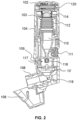
- Figs. 1-4 provide views of an inhaler 100 for administering a dry powder inhalation composition according to any of the embodiments described herein.
- the inhaler 100 may include a top cap 102, a main housing 104, a mouthpiece 106, a mouthpiece cover 108, an air vent 109, and an electronics module 120.
- the mouthpiece cover 108 may be hinged to the main housing 104 so that it may open and close to expose the mouthpiece 106. Although illustrated as a hinged connection, the mouthpiece cover 106 may be connected to the inhaler 100 through other types of connections.
- the electronics module 120 is illustrated as housed within the top cap 102 at the top of the main housing 104, the electronics module 120 may be integrated and/or housed within the main body 104 of the inhaler 100.
- Fig. 2 provides a cross-sectional interior perspective view of the example inhaler 100.
- the inhaler 100 may include a medication reservoir 110 (e.g. a hopper), a bellows 112, a bellows spring 114, a yoke (not visible), a dosing cup 116, a dosing chamber 117, a deagglomerator 10', and a flow pathway 119.
- the medication reservoir 110 may include medication, in particular the dry powder inhalation composition, for delivery to the subject.
- the bellows 112 may compress to deliver a dose of medication from the medication reservoir 110 to the dosing cup 116. Thereafter, a subject may inhale through the mouthpiece 106 in an effort to receive the dose of medication.
- the dosing cup 116 has a capacity of 5-10 mm 3 , and more preferably is a size 3 dose cup 116, which corresponds to a capacity of 7 mm 3 .
- the airflow generated from the subject's inhalation may cause the deagglomerator 10' to aerosolize the dose of medication by breaking down the agglomerates of the medicament in the dosing cup 116.
- the deagglomerator 10' may be configured to aerosolize the medication when the airflow through the flow pathway 119 meets or exceeds a particular rate, or is within a specific range.
- the dose of medication may travel from the dosing cup 116, into the dosing chamber 117, through the flow pathway 119, and out of the mouthpiece 106 to the subject. If the airflow through the flow pathway 119 does not meet or exceed a particular rate, or is not within a specific range, the medication may remain in the dosing cup 116.
- the inhaler 100 may include a dose counter 111 that is configured to be initially set to a number of total doses of medication within the medication reservoir 110 and to decrease by one each time the mouthpiece cover 108 is moved from the open position to the closed position.
- a dose confirmation may be stored in a memory included in the electronics module 120 as dose confirmation information.
- the top cap 102 may be attached to the main housing 104.
- the top cap 102 may be attached to the main housing 104 through the use of one or more clips that engage recesses on the main housing 104.
- the top cap 102 may overlap a portion of the main housing 104 when connected, for example, such that a substantially pneumatic seal 103 exists between the top cap 102 and the main housing 104.
- Fig. 3 is an exploded perspective view of the example inhaler 100 with the top cap 102 removed to expose the electronics module 120.
- the top surface of the main housing 104 may include one or more (e.g. two) orifices 146.
- One or more (e.g. both) of the orifices 146 may be configured to accept a slider 140.
- the slider 140 may protrude through the top surface of the main housing 104 via one of the orifices 146.
- Fig. 4 is an exploded perspective view of the top cap 102 and the electronics module 120 of the example inhaler 100.
- the slider 140 may define an arm 142, a stopper 144, and a distal end 145.
- the distal end 145 may be a bottom portion of the slider 140.
- the distal end 145 of the slider 140 may be configured to abut the yoke that resides within the main housing 104 (e.g. when the mouthpiece cover 108 is in the closed or partially open position).
- the distal end 145 may be configured to abut a top surface of the yoke when the yoke is in any radial orientation.
- the top surface of the yoke may include a plurality of apertures (not shown), and the distal end 145 of the slider 140 may be configured to abut the top surface of the yoke, for example, whether or not one of the apertures is in alignment with the slider 140.
- the top cap 102 may include a slider guide 148 that is configured to receive a slider spring 146 and the slider 140.
- the slider spring 146 may reside within the slider guide 148.
- the slider spring 146 may engage an inner surface of the top cap 102, and the slider spring 146 may engage (e.g. abut) an upper portion (e.g. a proximate end) of the slider 140.
- the slider spring 146 may be partially compressed between the top of the slider 140 and the inner surface of the top cap 102.
- the slider spring 146 may be configured such that the distal end 145 of the slider 140 remains in contact with the yoke when the mouthpiece cover 108 is closed.
- the distal end 145 of the slider 145 may also remain in contact with the yoke while the mouthpiece cover 108 is being opened or closed.
- the stopper 144 of the slider 140 may engage a stopper of the slider guide 148, for example, such that the slider 140 is retained within the slider guide 148 through the opening and closing of the mouthpiece cover 108, and vice versa.
- the stopper 144 and the slider guide 148 may be configured to limit the vertical (e.g. axial) travel of the slider 140. This limit may be less than the vertical travel of the yoke.
- the yoke may continue to move in a vertical direction towards the mouthpiece 106 but the stopper 144 may stop the vertical travel of the slider 140 such that the distal end 145 of the slider 140 may no longer be in contact with the yoke.
- the yoke may be mechanically connected to the mouthpiece cover 108 and configured to move to compress the bellows spring 114 as the mouthpiece cover 108 is opened from the closed position and then release the compressed bellows spring 114 when the mouthpiece cover reaches the fully open position, thereby causing the bellows 112 to deliver the dose from the medication reservoir 110 to the dosing cup 116.
- the yoke may be in contact with the slider 140 when the mouthpiece cover 108 is in the closed position.
- the slider 140 may be arranged to be moved by the yoke as the mouthpiece cover 108 is opened from the closed position and separated from the yoke when the mouthpiece cover 108 reaches the fully open position.
- the movement of the slider 140 during the dose metering may cause the slider 140 to engage and actuate a switch 130.
- the switch 130 may trigger the electronics module 120 to register the dose metering.
- the slider 140 may be regarded in this example as the means by which a use determination system is configured to register the metering of the dose by the dose metering system, each metering being thereby indicative of an inhalation performed by the subject using the inhaler 100.
- Actuation of the switch 130 by the slider 140 may also, for example, cause the electronics module 120 to transition from the first power state to a second power state, and to sense an inhalation by the subject from the mouthpiece 106.
- the electronics module 120 may include a printed circuit board (PCB) assembly 122, a switch 130, a power supply (e.g. a battery 126), and/or a battery holder 124.
- the PCB assembly 122 may include surface mounted components, such as a sensor system 128, a wireless communication circuit 129, the switch 130, and/or one or more indicators (not shown), such as one or more light emitting diodes (LEDs).
- the electronics module 120 may include a controller (e.g. a processor) and/or memory. The controller and/or memory may be physically distinct components of the PCB assembly 122.
- the controller and memory may be part of another chipset mounted on the PCB assembly 122, for example, the wireless communication circuit 129 may include the controller and/or memory for the electronics module 120.
- the controller of the electronics module 120 may include a microcontroller, a programmable logic device (PLD), a microprocessor, an application specific integrated circuit (ASIC), a field programmable gate array (FPGA), or any suitable processing device or control circuit.
- PLD programmable logic device
- ASIC application specific integrated circuit
- FPGA field programmable gate array
- the controller may access information from, and store data in the memory.
- the memory may include any type of suitable memory, such as non-removable memory and/or removable memory.
- the non-removable memory may include random-access memory (RAM), read-only memory (ROM), or any other type of memory storage device.
- the removable memory may include a subscriber identity module (SIM) card, a memory stick, a secure digital (SD) memory card, and the like.
- SIM subscriber identity module
- SD secure digital
- the memory may be internal to the controller.
- the controller may also access data from, and store data in, memory that is not physically located within the electronics module 120, such as on a server or a smart phone.
- the sensor system 128 may include one or more sensors.
- the sensor system 128 may include one or more sensors, for example, of different types, such as, but not limited to one or more pressure sensors, temperature sensors, humidity sensors, orientation sensors, acoustic sensors, and/or optical sensors.
- the one or more pressure sensors may include a barometric pressure sensor (e.g. an atmospheric pressure sensor), a differential pressure sensor, an absolute pressure sensor, and/or the like.
- the sensors may employ microelectromechanical systems (MEMS) and/or nanoelectromechanical systems (NEMS) technology.
- the sensor system 128 may be configured to provide an instantaneous reading (e.g. pressure reading) to the controller of the electronics module 120 and/or aggregated readings (e.g. pressure readings) overtime. As illustrated in Figs. 2 and 3 , the sensor system 128 may reside outside the flow pathway 119 of the inhaler 100, but may be pneumatically coupled to the flow pathway 119.
- the controller of the electronics module 120 may receive signals corresponding to measurements from the sensor system 128.
- the controller may calculate or determine one or more airflow metrics using the signals received from the sensor system 128.
- the airflow metrics may be indicative of a profile of airflow through the flow pathway 119 of the inhaler 100. For example, if the sensor system 128 records a change in pressure of 0.3 kilopascals (kPa), the electronics module 120 may determine that the change corresponds to an airflow rate of approximately 45 liters per minute (Lpm) through the flow pathway 119.
- Lpm liters per minute
- the pressure measurement readings and/or the computed airflow metrics may be indicative of the quality or strength of inhalation from the inhaler 100.
- the readings and/or metrics may be used to categorize the inhalation as a certain type of event, such as a good inhalation event, a low inhalation event, a no inhalation event, or an excessive inhalation event.
- the categorization of the inhalation may be usage parameters stored as personalized data of the subject.
- the no inhalation event may be associated with pressure measurement readings and/or airflow metrics below a particular threshold, such as an airflow rate less than 30 Lpm.
- the no inhalation event may occur when a subject does not inhale from the mouthpiece 106 after opening the mouthpiece cover 108 and during the measurement cycle.
- the no inhalation event may also occur when the subject's inspiratory effort is insufficient to ensure proper delivery of the medication via the flow pathway 119, such as when the inspiratory effort generates insufficient airflow to activate the deagglomerator 10' and, thus, aerosolize the medication in the dosing cup 116.
- the low inhalation event may be associated with pressure measurement readings and/or airflow metrics within a particular range, such as an airflow rate between 30 Lpm and 45 Lpm.
- the low inhalation event may occur when the subject inhales from the mouthpiece 106 after opening the mouthpiece cover 108 and the subject's inspiratory effort causes at least a partial dose of the medication to be delivered via the flow pathway 119. That is, the inhalation may be sufficient to activate the deagglomerator 10' such that at least a portion of the medication is aerosolized from the dosing cup 116.
- the good inhalation event may be associated with pressure measurement readings and/or airflow metrics above the low inhalation event, such as an airflow rate between 45 Lpm and 200 Lpm.
- the good inhalation event may occur when the subject inhales from the mouthpiece 106 after opening the mouthpiece cover 108 and the subject's inspiratory effort is sufficient to ensure proper delivery of the medication via the flow pathway 119, such as when the inspiratory effort generates sufficient airflow to activate the deagglomerator 10' and aerosolize a full dose of medication in the dosing cup 116.
- the excessive inhalation event may be associated with pressure measurement readings and/or airflow metrics above the good inhalation event, such as an airflow rate above 200 Lpm.
- the excessive inhalation event may occur when the subject's inspiratory effort exceeds the normal operational parameters of the inhaler 100.
- the excessive inhalation event may also occur if the inhaler 100 is not properly positioned or held during use, even if the subject's inspiratory effort is within a normal range.
- the computed airflow rate may exceed 200 Lpm if the air vent 109 is blocked or obstructed (e.g. by a finger or thumb) while the subject is inhaling from the mouthpiece 106.
- any suitable thresholds or ranges may be used to categorize a particular event. Some or all of the events may be used. For example, the no inhalation event may be associated with an airflow rate below 45 Lpm and the good inhalation event may be associated with an airflow rate between 45 Lpm and 200 Lpm. As such, the low inhalation event may not be used at all in some cases.
- the pressure measurement readings and/or the computed airflow metrics may also be indicative of the direction of flow through the flow pathway 119 of the inhaler 100. For example, if the pressure measurement readings reflect a negative change in pressure, the readings may be indicative of air flowing out of the mouthpiece 106 via the flow pathway 119. If the pressure measurement readings reflect a positive change in pressure, the readings may be indicative of air flowing into the mouthpiece 106 via the flow pathway 119. Accordingly, the pressure measurement readings and/or airflow metrics may be used to determine whether a subject is exhaling into the mouthpiece 106, which may signal that the subject is not using the inhaler 100 properly.
- the personalized data collected from, or calculated based on, the usage of the inhaler 100 may be computed and/or assessed via external devices as well (e.g. partially or entirely).
- the wireless communication circuit 129 in the electronics module 120 may include a transmitter and/or receiver (e.g. a transceiver), as well as additional circuity.
- the wireless communication circuit 129 may include a Bluetooth chip set (e.g. a Bluetooth Low Energy chip set), a ZigBee chipset, a Thread chipset, etc.
- the electronics module 120 may wirelessly provide the personalized data, such as pressure measurements, airflow metrics, lung function metrics, dose confirmation information, and/or other conditions related to usage of the inhaler 100, to an external device, including a smart phone.
- the personalized data may be provided in real time to the external device to enable an assessment of a status of the subject's respiratory disease to be generated based on real-time data from the inhaler 100 that indicates time of use, how the inhaler 100 is being used, and personalized data about the user of the inhaler, such as real-time data related to the subject's lung function and/or medical treatment.
- the external device may include software for processing the received information and for providing compliance and adherence feedback to users of the inhaler 100 via a graphical user interface (GUI).
- GUI graphical user interface
- the airflow metrics may include personalized data that is collected from the inhaler 100 in real-time, such as one or more of an average flow of an inhalation/exhalation, a peak flow of an inhalation/exhalation (e.g. a maximum inhalation received), a volume of an inhalation/exhalation, a time to peak of an inhalation/exhalation, and/or the duration of an inhalation/exhalation.
- the airflow metrics may also be indicative of the direction of flow through the flow pathway 119. That is, a negative change in pressure may correspond to an inhalation from the mouthpiece 106, while a positive change in pressure may correspond to an exhalation into the mouthpiece 106.
- the electronics module 120 may be configured to eliminate or minimize any distortions caused by environmental conditions. For example, the electronics module 120 may re-zero to account for changes in atmospheric pressure before or after calculating the airflow metrics.
- the one or more pressure measurements and/or airflow metrics may be timestamped and stored in the memory of the electronics module 120.
- the inhaler 100 may use the airflow metrics to generate additional personalized data.
- the controller of the electronics module 120 of the inhaler 100 may translate the airflow metrics into other metrics that indicate the subject's lung function and/or lung health that are understood to medical practitioners, such as peak inspiratory flow metrics, peak expiratory flow metrics, and/or forced expiratory volume in 1 second (FEV1), for example.
- the electronics module 120 of the inhaler may determine a measure of the subject's lung function and/or lung health using a mathematical model such as a regression model.
- the mathematical model may identify a correlation between the total volume of an inhalation and FEV1.
- the mathematical model may identify a correlation between peak inspiratory flow and FEV1.
- the mathematical model may identify a correlation between the total volume of an inhalation and peak expiratory flow.
- the mathematical model may identify a correlation between peak inspiratory flow and peak expiratory flow.
- the battery 126 may provide power to the components of the PCB assembly 122.
- the battery 126 may be any suitable source for powering the electronics module 120, such as a coin cell battery, for example.
- the battery 126 may be rechargeable or non-rechargeable.
- the battery 126 may be housed by the battery holder 124.
- the battery holder 124 may be secured to the PCB assembly 122 such that the battery 126 maintains continuous contact with the PCB assembly 122 and/or is in electrical connection with the components of the PCB assembly 122.
- the battery 126 may have a particular battery capacity that may affect the life of the battery 126.
- the distribution of power from the battery 126 to the one or more components of the PCB assembly 122 may be managed to ensure the battery 126 can power the electronics module 120 over the useful life of the inhaler 100 and/or the medication contained therein.
- the communication circuit and memory may be powered on and the electronics module 120 may be "paired" with an external device, such as a smart phone.
- the controller may retrieve data from the memory and wirelessly transmit the data to the external device.
- the controller may retrieve and transmit the data currently stored in the memory.
- the controller may also retrieve and transmit a portion of the data currently stored in the memory. For example, the controller may be able to determine which portions have already been transmitted to the external device and then transmit the portion(s) that have not been previously transmitted.
- the external device may request specific data from the controller, such as any data that has been collected by the electronics module 120 after a particular time or after the last transmission to the external device.
- the controller may retrieve the specific data, if any, from the memory and transmit the specific data to the external device.
- the data stored in the memory of the electronics module 120 may be transmitted to an external device, which may process and analyze the data to determine usage parameters associated with the inhaler 100.
- a mobile application residing on the mobile device may generate feedback for the user based on data received from the electronics module 120. For example, the mobile application may generate daily, weekly, or monthly report, provide confirmation of error events or notifications, provide instructive feedback to the subject, and/or the like.
- the deagglomerator 10' breaks down agglomerates of dry powder formulation, or formulation and carrier, before the dry powder leaves the inhaler 100 through the mouthpiece 106.
- the agglomerates of dry powder formulation, or formulation and carrier are broken down by the deagglomerator 10' before inhalation of the formulation by a patient.
- the deagglomerator 10' includes an inner wall 12' defining a swirl chamber 14' extending along an axis A' (see Fig. 10 ) from a first end 18' to a second end 20'.
- the swirl chamber 14' includes circular cross-sectional areas arranged transverse to the axis A', that decrease from the first end 18' to the second end 20' of the swirl chamber 14', such that any air flow traveling from the first end of the swirl chamber to the second end is constricted and at least in part collide with the inner wall 12' of the chamber.
- the cross-sectional areas of the swirl chamber 14' decrease monotonically.
- the inner wall 12' is preferably convex, i.e. arches inwardly towards the axis A', as shown best in Fig. 10 .
- the deagglomerator 10' also includes a dry powder supply port 22' in the first end 18' of the swirl chamber 14' for providing fluid communication between a dry powder delivery passageway of an inhaler and the first end 18' of the swirl chamber 14'.
- the dry powder supply port 22' faces in a direction substantially parallel with the axis A' such that an air flow, illustrated by arrow 1' in Fig. 10 , entering the chamber 14' through the supply port 22' is at least initially directed parallel with respect to the axis A' of the chamber.
- the deagglomerator 10' additionally includes at least one inlet port 24' in the inner wall 12' of the swirl chamber 14' adjacent to or near the first end 18' of the chamber providing fluid communication between a region exterior to the deagglomerator and the first end 18' of the swirl chamber 14'.
- the at least one inlet port comprises two diametrically opposed inlet ports 24', 25' that extend in a direction substantially transverse to the axis A' and substantially tangential to the circular cross-section of the swirl chamber 14'.
- entering the chamber 14' through the inlet ports are at least initially directed transverse with respect to the axis A' of the chamber and collide with the air flow 1' entering through the supply port 22' to create turbulence.
- the combined air flows, illustrated by arrow 4' in Figs. 9 and 10 then collide with the inner wall 12' of the chamber 14', form a vortex, and create additional turbulence as they move towards the second end 20' of the chamber.
- the deagglomerator 10' includes vanes 26' at the first end 18' of the swirl chamber 14' extending at least in part radially outwardly from the axis A' of the chamber.
- Each of the vanes 26' has an oblique surface 28' facing at least in part in a direction transverse to the axis A' of the chamber.
- the vanes 26' are sized such that at least a portion 4A' of the combined air flows 4' collide with the oblique surfaces 28', as shown in Fig. 10 .
- the vanes comprise four vanes 26', each extending between a hub 30' aligned with the axis A' and the wall 12' of the swirl chamber 14'.
- the deagglomerator 10' further includes an outlet port 32' providing fluid communication between the second end 20' of the swirl chamber 14' and a region exterior to the deagglomerator.
- a breath induced low pressure at the outlet port 32' causes the air flow 1' through the supply port 22' and the air flows 2',3' through the inlet ports and draws the combined air flow 4' through the swirl chamber 14'.
- the combined air flow 4' then exits the deagglomerator through the outlet port 32'.
- the outlet port 32' extends substantially transverse to the axis A', such that the air flow 4' will collide with an inner wall of the outlet port 32' and create further turbulence.
- substantially transverse is intended to cover the outlet port 32' extending perpendicularly, in other words at 90 degrees, with respect to the axis A', but also the outlet port 32' extending at other angles with respect to the axis A', provided that the above-mentioned further turbulence can be created via collision of the air flow 4' with the outlet port's 32' inner wall.
- the outlet port 32' may extend at an angle of about 15 degrees with respect to a perpendicular of the axis A'.
- patient inhalation at the outlet port 32' causes air flows 1',2',3' to enter through, respectively, the dry powder supply port 22' and the inlet ports.
- the air flow 1' through the supply port 22' entrains the dry powder into the swirl chamber 14'.
- the air flow 1' and entrained dry powder are directed by the supply port 22' into the chamber in a longitudinal direction, while the air flows 2',3' from the inlet ports are directed in a transverse direction, such that the air flows collide and substantial combine.
- the geometry of the swirl chamber 14' causes the combined air flow 4' and the entrained dry powder to follow a turbulent, spiral path, or vortex, through the chamber.
- the decreasing cross-sections of the swirl chamber 14' continuously changes the direction and increases the velocity of the spiraling combined air flow 4' and entrained dry powder.
- particles and any agglomerates of the dry powder constantly impact against the wall 12' of the swirl chamber 14' and collide with each other, resulting in a mutual grinding or shattering action between the particles and agglomerates.
- particles and agglomerates deflected off the oblique surfaces 28' of the vanes 26' cause further impacts and collisions.
- the direction of the combined air flow 4 and the entrained dry powder is again changed to a transverse direction with respect to the axis A', through the outlet port 32'.
- the combined air flow 4' and the entrained dry powder retain a swirl component of the flow, such that the air flow 4' and the entrained dry powder spirally swirls through the outlet port 32'.
- the swirling flow causes additional impacts in the outlet port 32' so as to result in further breaking up of any remaining agglomerates prior to being inhaled by a patient.
- the deagglomerator is preferably assembled from two pieces: a cup-like base 40' and a cover 42'.
- the base 40' and the cover 42' are connected to form the swirl chamber 14'.
- the cup-like base 40' includes the wall 12' and the second end 20' of the chamber and defines the outlet port 32'.
- the base 40' also includes the inlet ports of the swirl chamber 14'.
- the cover 42' forms the vanes 26' and defines the supply port 22'.
- the base 40' and the cover 42' of the deagglomerator are preferably manufactured from a plastic such as ABS for the base and polypropylene for the cover, but may be manufactured from metal or another suitable material.
- the base 40' and the cover 42' can be connected to each other in any suitable manner, for example by the base 40' being ultrasonically welded to the spacer 38', and the cover 42' being push-fitted into the underside of the spacer 38' and held in place.
- the inhaler 100 shown in Figs. 1-4 may include the particular deagglomerator 10' described with reference to Figs. 5-10 .
- the inhaler 100 is not limited to use with the deagglomerator shown in Figs. 1-4 and can be used with other types of deagglomerators or a simple swirl chamber.
- the inhaler 100 having electronic connectivity is not intended to be limiting.
- the present disclosure contemplates the inhaler 100 having the basic mechanical structure described above with reference to Figs. 1-10 , or the mechanical structure described in US 2015/099726 A1 , but with the electronics module 120 being omitted.
- Example 1 fixed dose fluticasone propionate and albuterol sulfate formulations
- Fluticasone propionate was blended together with 7.8240 kg of ⁇ -lactose monohydrate carrier for 10 min at 433 rpm (revolutions per minute) using a PharmaConnect high shear blender providing an 8 kg blend.
- 0.9400 kg of albuterol sulfate (ABS) was blended together with 19.0600 kg of ⁇ -lactose monohydrate carrier for 7 min at 300 rpm using a PharmaConnect high shear blender providing 20 kg of a blend.
- Tween 80 Preparation of 1% (W/V) Tween 80: 30mL of de-ionized water were added into a clean 50 mL glass bottle containing a magnetic stirring bar. 0.3 g of Tween 80 was added to the glass vessel and then stirred for about 10 minutes until a homogeneous solution was obtained.
- Preparation for sampling Approximately 1-10 g of sample was transferred into a glass bottle large enough so that the powder was freely tumbled to assure a homogenous sample throughout the bottle. The capped bottle was gently inverted up and down 10 times, and then rotated 10 times in a clockwise manner.
- Preparation of the sample About 50 mg of the sample powder was transferred with a spatula into a clean 25 mL glass vessel containing a magnetic stirring bar. 10 mL of de-ionized water containing 1% Tween 80 were added into the glass vessel. The suspension was stirred with the magnetic stirrer for 2 minutes at a moderate speed. The sample was then ready to be loaded into the wet dispersion unit.
- the Hydro 2000S dispersion unit tank was manually filled with about 150 mL of de-ionized water.
- the ultrasonics was set at the level of 100% and sonicated for 30 seconds to allow air to dissipate, and then turned off.
- the pump/stirrer speed was turned up to full (3500 rpm), then down to zero to clear any bubbles.
- the sample was mixed for 20 seconds by turning / rotating the sample.
- a suitable transfer container was used to weigh and transfer approximately 5.0 g of the sample from the composite container into the VIBRI funnel of the sample unit. This was then blown by compressed air via the RODOS dry powder dispenser through the measuring zone triggering a measurement.
- This example sets out a randomized, double-blind, multicenter, active-controlled, parallel-group study to evaluate the efficacy and safety of fluticasone propionate/albuterol sulfate fixed-dose combination on severe clinical asthma exacerbations in patients with asthma.
- Fp/ABS eMDPI tered dose dry powder inhaler with an integrated electronic module
- the Fp/ABS eMDPI is evaluated at 2 dose strengths, a HD (55/117 mcg) and a LD (30/117 mcg) to assess severe CAE reduction compared to ABS eMDPI (117 mcg) in adult and pediatric patients ( ⁇ 4 years of age) with asthma (baseline ICS level: low, medium, or high; GINA 2022).
- Patients are 4 years of age or older (or as allowed by local regulation), with a clinical diagnosis of asthma for at least 1 year consistent with GINA 2022 and, as applicable, a smoking history of ⁇ 10 pack-years. Patients have a documented history of at least 1 severe CAE over the past 12 months, demonstrate a ⁇ 12% reversibility (or documented historical reversibility), and have an ACQ-5 score ⁇ 1.5 during the screening assessment (except patients aged 4-5 years), despite taking a stable dose of prescribed inhaled asthma controller medications ⁇ another controller (oral or inhaled).
- Patients continue to use their current prescribed asthma controller medication (not provided by the sponsor) throughout the study and are not permitted to change their controller medication if their asthma is stable, otherwise the change is considered a protocol deviation unless this change is due to formulary changes and the medication is similar (or an equivalent generic substitution) based on ICS dose (low, medium, or high) and after consultation with the medical monitor to gain agreement.
- Patients are randomized in a 1:1:1 ratio to receive either HD Fp/ABS eMDPI, LD Fp/ABS eMDPI, or ABS eMDPI to be used as rescue medication.
- Patients discontinue all other rescue therapies including nebulized SABA or short-acting muscarinic antagonists (SAMA).
- the IMPs are administered by blinded eMDPI oral inhalation (2 inhalations PRN to control asthma symptoms).
- the study consists of a screening period of approximately 2 weeks, a run-in period (approximately 2 to 4 weeks), and a double-blind treatment period. Patients who experience a severe CAE remain on the study and continue to attend their scheduled visits.
- EOS end of study
- Pulmonary function testing is conducted during screening in the morning between 0530 and 1100 hours using the on-site equipment (provided by the sponsor). Patients are required to withhold asthma maintenance medications for approximately 24 hours prior to lung function testing for once daily medications or 12 hours for twice daily, or more frequently dosed, medication. If the patient has taken asthma maintenance medication within 24 ⁇ 2 (daily dosed) or 12 ⁇ 2 hours (dosed twice daily or more frequently) or SABA (run-in rescue medication)/IMP within 6 hours of the planned pulmonary function testing or ICS/long-acting beta agonist (LABA) used as rescue medication within 12 hours of the planned pulmonary function testing, the visit is rescheduled.
- COPA long-acting beta agonist
- Airway reversibility (response to bronchodilator testing), as measured by FEV1, at screening is demonstrated after pre-albuterol pulmonary function testing is completed via central spirometry and then repeating FEV1 measurement after receiving SABA medication. If a patient's FEV1 improves at least 12% between the 2 tests and an increase of 200 mL for patients ⁇ 18 years of age (or has a documented history of ⁇ 12% reversibility within the previous 18 months), that patient is assessed as having airway reversibility and continues the screening process. Note: one re-test is allowed during the screening period if needed to demonstrate the required pre and post albuterol study requirements.
- asthma history including asthma medications and exacerbation history, physical examination, serum chemistry, urine drug screen, vital sign measurements, beta-human chorionic gonadotropin ( ⁇ -HCG) serum pregnancy test (for all females of childbearing potential [CBP]), serum follicle stimulation hormone (FSH) for postmenopausal women only, complete blood count (CBC) with differential, and concomitant medication history is also assessed at screening.
- ⁇ -HCG beta-human chorionic gonadotropin
- FSH serum follicle stimulation hormone
- CBC complete blood count
- concomitant medication history is also assessed at screening.
- documentation of asthma exacerbation within the previous 12 months must be obtained. This includes medical or hospital records or patient provided evidence of prescriptions for SCS used during an exacerbation. Patients who otherwise qualify may enter the run-in period while attempting to collect medical records for documentation of asthma exacerbations but are not randomized at V3 if the records have not been obtained and verified.
- Patients meeting all the eligibility criteria continue with their current prescribed asthma controller medication, but discontinue current rescue medication. Patients are given study-specific rescue medication (ProAir ® RespiClick ® or equivalent) and subsequently enrolled in the run-in period (visit 2 [V2]) of the study. Patients are provided and trained on the use of an electronic diary (eDiary), trained on an empty inhaler device, and trained on a handheld device to measure lung function. During the run-in period, patients measure FEV1 (forced expiratory volume measured during the first second following maximal inhalation) and PEF (peak expiratory flow) each morning using the handheld device prior to the use of run-in rescue medication (whenever possible) and prior to the taking their usual asthma maintenance medication(s).
- eDiary electronic diary
- PEF peak expiratory flow
- asthma daytime or night-time
- rescue i.e. IMP once randomized
- number of inhalations twice daily whether used or not, and confirm each evening if they took their routine asthma maintenance medication (yes or no) that day.
- Patients without a disqualifying event during the run-in period will receive the remaining baseline evaluations.
- Patients may be evaluated at V3 for randomization after a minimum of 14 days and up to 31 days (28 ⁇ 3 days) of participation in the run-in period (V2 to V3).
- baseline procedures and assessments are to be performed prior to randomization in the randomization and trial supply management (RTSM) system, before IMP dispensing and will include a full physical examination; vital sign measurements; review of diary data to confirm eligibility; establishment of baseline pulmonary function testing; training for correct inhaler use with the empty demo eMDPI inhaler device or as specified in the pharmacy manual (training inhaler), and evaluation of use; perform ACQ-5 assessment and confirm ACQ-5 score ⁇ 1.5 (patients aged 4-5 will not complete the ACQ-5); urine pregnancy test (for all female patients of CBP); ECG recording; concomitant medication inquiry (including birth control review); CAE inquiry; and adverse event inquiry.
- RTSM randomization and trial supply management
- Patients who are randomized into the study are randomly assigned in a blinded fashion to 1 of the 3 treatment groups (HD Fp/ABS eMDPI, LD Fp/ABS eMDPI 3, or ABS eMDPI) at the baseline visit. Patients are stratified by geographical region, age group, and number of exacerbations in the prior year at screening (indicative of ongoing controller medications) across all 3 treatment groups to ensure similar distribution of patients. Randomly assigned patients receive IMP to control asthma symptoms, 2 inhalations PRN to relieve asthma symptoms, throughout the treatment period and record daily use in an eDiary, whether used or not, along with daily morning FEV1 and PEF measured at home. Patients return to the investigational center per a pre-specified visit (quarterly [i.e.
- Alert criteria for worsening asthma have been developed to ensure patient safety and are monitored throughout the study from V2 onward. If any of the criteria listed below are met or there has been no data transmitted for 3 consecutive days, the investigator, the clinical research center personnel, and medical monitor at a minimum are notified automatically via the portal. Meeting any of these criteria does not automatically require a patient to be treated with additional therapy, rather it requires a clinical evaluation to determine if the patient's asthma can continue to be managed on the current regimen, requires a change in maintenance medication or represents a severe CAE requiring treatment.
- the alert is generated if any 1 or more of the following occur on at least 2 consecutive days based on the daily diary data:
- patients are contacted approximately monthly (every 4 weeks) by phone to assess CAEs, adverse events, concomitant medications, and to confirm diary compliance after reviewing compliance to diary data in the portal.
- the primary and secondary study objectives and endpoints are: Objectives Endpoints
- the primary objective of the study is to demonstrate the efficacy of high dose (HD) and low dose (LD) fluticasone propionate (Fp)/albuterol sulfate (ABS) integrated electronic module multidose dry powder inhaler (eMDPI) compared to ABS eMDPI in decreasing severe CAEs when used as a rescue medication.
- HD high dose
- LD low dose
- Fp fluticasone propionate
- ABS albuterol sulfate
- the primary efficacy endpoint is the time to first severe CAE (a worsening [deterioration] of asthma) Objectives Endpoints
- a secondary objective of the study is to evaluate the efficacy of Fp/ABS eMDPI 2 inhalations taken as needed (PRN) compared to that with ABS eMDPI 2 inhalations PRN and the effect on systemic corticosteroid (SCS) exposure.
- the secondary efficacy endpoints are: - annualized severe CAE rate - total annualized SCS exposure over the treatment period - Asthma Control Questionnaire-5 (ACQ-5) response at week 24, defined as achieving a decrease in score from baseline value of at least 0.5 (patients aged ⁇ 6 years) - AQLQ+12/PAQLQ response at week 24, defined as achieving an increase in score from baseline of at least 0.5 (patients aged ⁇ 7 years)
- a secondary objective of the study is to evaluate the safety and tolerability of Fp/ABS eMDPI 2 inhalations PRN over 24 weeks.
- the safety/tolerability endpoints are: - occurrence of adverse events during the study - occurrence of serious adverse events during the study - study withdrawal due to treatment-emergent adverse events
- the time to first severe CAE event is a clear clinical measure of benefit relevant to asthmatics at all levels of severity. From a clinical trial perspective, it obviates the potential for individual patients to contribute multiple events to the primary analysis encountered with time weighted event numbers. Its use is consistent with the American Thoracic Society's 2009 statement on asthma control and exacerbations with consensus recommendations on standardized definitions for assessment of asthma exacerbations in clinical trials.
- the primary estimated for the study is defined by the attributes below: Treatment Patients are randomly assigned to receive one of the study treatment regimens shown below in a 1:1:1 ratio: • HD Fp/ABS eMDPI 55/117 mcg • LD Fp/ABS eMDPI 30/117 mcg • ABS eMDPI 117 mcg (active control) Target population Eligible male and female patients ⁇ 4 years of age diagnosed with asthma for at least 1 year Primary outcome measure The primary efficacy measure for the study is the time to first severe CAE. Time to first severe CAE is calculated as the time from randomization until the start date of the first severe CAE.
- An asthma exacerbation is considered severe if it results in at least 1 of the following: - treatment with SCS for at least 3 consecutive days to treat symptoms of asthma worsening.
- a single depo-injection of corticosteroids are considered equivalent to a 3-day course of oral corticosteroids - an urgent care or emergency room visit due to asthma that required SCS for at least 3 consecutive days - a hospitalization (defined as admission to an in-patient facility or observation unit) for ⁇ 24 hours due to asthma
- Intercurrent events strategy The following are considered as intercurrent events (ICEs): - occurrence of COVID-19 pneumonia that is clinically diagnosed and requiring systemic therapy or with chronic respiratory sequelae that might change the natural history of the patient's airway disease - any use of SCS or other biological therapy for other diseases - any change in patients' asthma controller therapy
- Population-level summary The population-level summary of interest is the hazard ratio comparing the time to first severe CAE for HD Fp/ABS eMDPI vs active control and for LD Fp/ABS eMDPI vs active control
- ABS albuterol sulfate
- CAEs clinical asthma exacerbations
- COVID-19 Coronavirus Disease 2019
- eMDPI electronic module multidose dry powder inhaler
- Fp fluticasone propionate
- GINA Global Initiative for Asthma
- HD high dose
- ICE intercurrent events
- LD low dose
- SCS systemic corticosteroid
- the exploratory objective of the study is to characterize the pattern of rescue treatment (i.e. IMP) utilization of HD or LD Fp/ABS eMDPI compared to ABS eMDPI and it will be assessed with the following endpoints:
- IMP pattern of rescue treatment
- the total number of patients planned is approximately 732 patients per treatment group.
- the patient has a documented history of ⁇ 12% airway reversibility of FEV1 within the previous 18 months.
- the IMPs used in this study are defined as the test IMP and the active control.
- the active control is authorized and is used in accordance with the terms of the marketing authorizations in respective countries (although ProAir ® is only presently approved in the US and Canada, and ProAir ® Digihaler ® is only presently approved in the US).
- test IMP is Fp/ABS eMDPI inhalation powder, which is further described in the table hereinbelow.
- the maximum daily dose in the trial is 12 inhalations (6 doses) per day.
- the number of occasions when patients exceed 12 inhalations (6 doses) in a day are reported in the study report.
- ABS eMDPI inhalation powder which is further described in the table hereinbelow. Additional details may be found in the PI (patient information) for ProAir ® Digihaler ® , June 2022 and ProAir ® RespiClick ® , September 2020.
- Patients will receive the active control at a dosing frequency of 2 inhalations PRN (delivered dose is 108 mcg each) to control asthma symptoms.
- the maximum daily dose is 12 inhalations (6 doses) per day.
- the number of occasions when patients exceed 12 inhalations (6 doses) in a day are reported in the study report.
- ProAir ® RespiClick ® albuterol [salbutamol] inhalation powder 117 mcg/inhalation
- rescue medication as allowed by local regulation
- the formulation is the same as the active control for this study.
- the use of this platform during the run-in period (2-4 weeks) will allow the patients to become familiar with proper use of the device after training.
- the same device platform is used during the treatment period of the study where the IMPs are used as rescue medication.
- the use of ProAir ® RespiClick ® during the run-in period also allows for standardization of treatment across the several geographies providing for a consistent study design.
- the inhaler device manufactured by Teva provided for use in this study is the eMDPI (Digihaler) device, as described herein, which contains a built-in eModule that detects, records, and stores data on inhaler events.
- eMDPI Digihaler
- the eModule component will not be used in conjunction with a mobile application.
- the inhalers are returned to a central site and the data are downloaded in compliance with Global Data Privacy.
- All patients are provided training on use of a training inhaler device during V2 and V3. Note: patients must be able to use the device without a spacer device due to incompatibility. Spacers are not allowed for use with the eMDPI device.
- the training is done after the screening visit when the patient has been deemed eligible for inclusion and is commencing the run-in period. Directions for use of the device are reviewed with each patient. Patients are then provided with an inhaler training device.
- the training devices are empty and do not contain active medication. Patients practice using the device and are required to demonstrate their understanding of the correct technique. To ensure the correct technique for the device, it is used over the duration of the study, training procedures are repeated and documented at each clinic visit for patients who demonstrate incorrect technique during the evaluation of inhaler use. Sites are responsible for labeling and storing the training inhaler devices between visits (further detailed in the study reference manual).
- ICS inhaled corticosteroid
- LABA long-acting beta agonist
- pMDI pressurized metered dose inhaler
- SmPC Summary of Product Characteristics
- USPI United States Prescribing Information. Note: any dose including low dose ICS/LABA fixed-dose combinations are allowed. Inhaled long-acting muscarinic antagonist are allowed if part of patients' background medication at the time of screening. Source: GINA 2022.
Landscapes
- Health & Medical Sciences (AREA)
- Chemical & Material Sciences (AREA)
- Medicinal Chemistry (AREA)
- Pharmacology & Pharmacy (AREA)
- Life Sciences & Earth Sciences (AREA)
- Animal Behavior & Ethology (AREA)
- General Health & Medical Sciences (AREA)
- Public Health (AREA)
- Veterinary Medicine (AREA)
- Epidemiology (AREA)
- Pulmonology (AREA)
- Engineering & Computer Science (AREA)
- Bioinformatics & Cheminformatics (AREA)
- Chemical Kinetics & Catalysis (AREA)
- General Chemical & Material Sciences (AREA)
- Nuclear Medicine, Radiotherapy & Molecular Imaging (AREA)
- Organic Chemistry (AREA)
- Otolaryngology (AREA)
- Emergency Medicine (AREA)
- Acyclic And Carbocyclic Compounds In Medicinal Compositions (AREA)
Priority Applications (5)
| Application Number | Priority Date | Filing Date | Title |
|---|---|---|---|
| CN202480045846.9A CN121816176A (zh) | 2023-07-07 | 2024-07-05 | 一种用于治疗哮喘的丙酸氟替卡松和硫酸沙丁胺醇的吸入制剂 |
| PCT/EP2024/068986 WO2025012115A1 (en) | 2023-07-07 | 2024-07-05 | An inhalable formulation of fluticasone propionate and albuterol sulfate for the treatment of asthma |
| KR1020267004002A KR20260049540A (ko) | 2023-07-07 | 2024-07-05 | 천식의 치료를 위한 플루티카손 프로피오네이트 및 알부테롤 술페이트의 흡입가능한 제제 |
| IL324762A IL324762A (en) | 2023-07-07 | 2024-07-05 | An inhalable formulation of fluticasone propionate and albuterol sulfate for the treatment of asthma |
| AU2024294145A AU2024294145A1 (en) | 2023-07-07 | 2024-07-05 | An inhalable formulation of fluticasone propionate and albuterol sulfate for the treatment of asthma |
Applications Claiming Priority (2)
| Application Number | Priority Date | Filing Date | Title |
|---|---|---|---|
| US202363525562P | 2023-07-07 | 2023-07-07 | |
| US202363525601P | 2023-07-07 | 2023-07-07 |
Publications (1)
| Publication Number | Publication Date |
|---|---|
| EP4487837A1 true EP4487837A1 (de) | 2025-01-08 |
Family
ID=87429472
Family Applications (2)
| Application Number | Title | Priority Date | Filing Date |
|---|---|---|---|
| EP23186744.1A Pending EP4487837A1 (de) | 2023-07-07 | 2023-07-20 | Inhalierbare formulierung von fluticasonpropionat und albuterolsulfat zur behandlung von asthma |
| EP23186753.2A Pending EP4487842A1 (de) | 2023-07-07 | 2023-07-20 | Inhalierbare formulierung von fluticasonpropionat und albuterolsulfat zur behandlung von asthma |
Family Applications After (1)
| Application Number | Title | Priority Date | Filing Date |
|---|---|---|---|
| EP23186753.2A Pending EP4487842A1 (de) | 2023-07-07 | 2023-07-20 | Inhalierbare formulierung von fluticasonpropionat und albuterolsulfat zur behandlung von asthma |
Country Status (1)
| Country | Link |
|---|---|
| EP (2) | EP4487837A1 (de) |
Citations (5)
| Publication number | Priority date | Publication date | Assignee | Title |
|---|---|---|---|---|
| US20130125882A1 (en) * | 2011-11-17 | 2013-05-23 | Jonathan Matz | Method and composition for treating asthma and copd |
| US20150099726A1 (en) | 2013-10-07 | 2015-04-09 | Teva Branded Pharmaceutical Products R&D, Inc. | Dry powder inhaler |
| WO2016090260A1 (en) | 2014-12-04 | 2016-06-09 | Microdose Therapeutx, Inc. | Inhalation monitoring system and method |
| WO2020222146A1 (en) | 2019-04-30 | 2020-11-05 | Norton (Waterford) Limited | Inhaler system |
| WO2022034241A1 (en) * | 2020-08-14 | 2022-02-17 | Norton (Waterford) Limited | An inhalable formulation of fluticasone propionate and albuterol sulfate |
-
2023
- 2023-07-20 EP EP23186744.1A patent/EP4487837A1/de active Pending
- 2023-07-20 EP EP23186753.2A patent/EP4487842A1/de active Pending
Patent Citations (5)
| Publication number | Priority date | Publication date | Assignee | Title |
|---|---|---|---|---|
| US20130125882A1 (en) * | 2011-11-17 | 2013-05-23 | Jonathan Matz | Method and composition for treating asthma and copd |
| US20150099726A1 (en) | 2013-10-07 | 2015-04-09 | Teva Branded Pharmaceutical Products R&D, Inc. | Dry powder inhaler |
| WO2016090260A1 (en) | 2014-12-04 | 2016-06-09 | Microdose Therapeutx, Inc. | Inhalation monitoring system and method |
| WO2020222146A1 (en) | 2019-04-30 | 2020-11-05 | Norton (Waterford) Limited | Inhaler system |
| WO2022034241A1 (en) * | 2020-08-14 | 2022-02-17 | Norton (Waterford) Limited | An inhalable formulation of fluticasone propionate and albuterol sulfate |
Non-Patent Citations (6)
| Title |
|---|
| A. PAPI ET AL.: "Albuterol-Budesonide Fixed-Dose Combination Rescue Inhaler for Asthma", THE NEW ENGLAND JOURNAL OF MEDICINE, vol. 386, no. 22, 2022, pages 2071 - 2083 |
| CHIPPS BRADLEY E ET AL: "Efficacy and safety of as-needed albuterol/budesonide versus albuterol in adults and children aged >=4 years with moderate-to-severe asthma: rationale and design of the randomised, double-blind, active-controlled MANDALA study", BMJ OPEN RESPIRATORY RESEARCH, vol. 8, no. 1, 1 December 2021 (2021-12-01), pages e001077, XP093065096, DOI: 10.1136/bmjresp-2021-001077 * |
| DATABASE EMBASE [online] STN; 14 April 2016 (2016-04-14), SETYONINGRUM R A: "Comparative Efficacy of Combination Nebulized Salbutamol and Fluticasone Propionate and Nebulized Salbutamol in Children with Mild Moderate Asthma Attack", XP093169189, Database accession no. EMB-002002901066 * |
| ELIZABETH ESTRADA-REYES: "Co-administration of salbutamol and fluticasone for emergency treatment of children with moderate acute asthma*", PEDIATRIC ALLERGY AND IMMUNOLOGY, vol. 16, no. 7, 18 October 2005 (2005-10-18), GB, pages 609 - 614, XP093169181, ISSN: 0905-6157, DOI: 10.1111/j.1399-3038.2005.00317.x * |
| JUAN CARLOS CARDET: ""As-Needed" Inhaled Corticosteroids for Patients With Asthma", THE JOURNAL OF ALLERGY AND CLINICAL IMMUNOLOGY : AN OFFICIAL JOURNAL OF AAAAI, AMERICAN ACADEMY OF ALLERGY ASTHMA & IMMUNOLOGY, vol. 11, no. 3, 1 March 2023 (2023-03-01), NL, pages 726 - 734, XP093169244, ISSN: 2213-2198, DOI: 10.1016/j.jaip.2023.01.010 * |
| NASHWA EL-GENDY ET AL: "Nanoparticle agglomerates of fluticasone propionate in combination with albuterol sulfate as dry powder aerosols", EUROPEAN JOURNAL OF PHARMACEUTICAL SCIENCES, ELSEVIER AMSTERDAM, NL, vol. 44, no. 4, 13 September 2011 (2011-09-13), pages 522 - 533, XP028101281, ISSN: 0928-0987, [retrieved on 20110921], DOI: 10.1016/J.EJPS.2011.09.014 * |
Also Published As
| Publication number | Publication date |
|---|---|
| EP4487842A1 (de) | 2025-01-08 |
Similar Documents
| Publication | Publication Date | Title |
|---|---|---|
| US11642475B2 (en) | Dry powder inhaler | |
| US5642728A (en) | System for dispensing pharmaceutically active compounds | |
| AU2018204860B2 (en) | Inhalable medicaments | |
| Yang et al. | Drug delivery performance of the mometasone furoate dry powder inhaler | |
| US20250195544A1 (en) | Fluticasone furoate in the treatment of copd | |
| Buhl et al. | A randomized, double-blind study to compare the efficacy and safety of two doses of mometasone furoate delivered via Breezhaler® or Twisthaler® in patients with asthma | |
| KR20230066364A (ko) | 플루티카손 프로피오네이트 및 알부테롤 술페이트의 흡입가능 제제 | |
| KR20150010757A (ko) | 신규한 투약량 및 제형 | |
| EP2983646B1 (de) | Pharmazeutische zusammensetzung mit budesonid und formoterol | |
| EP4487837A1 (de) | Inhalierbare formulierung von fluticasonpropionat und albuterolsulfat zur behandlung von asthma | |
| CN116077471A (zh) | 一种供吸入用的粉雾剂组合物及其制备方法和应用 | |
| AU2024294145A1 (en) | An inhalable formulation of fluticasone propionate and albuterol sulfate for the treatment of asthma | |
| WO2025012114A1 (en) | An inhalable formulation of fluticasone propionate and albuterol sulfate for the treatment of asthma | |
| EP4678170A1 (de) | Pulverinhalationsformulierung mit fester dosierung aus fluticasonpropionat und albuterolsulfat zur behandlung von asthma | |
| WO2026013023A1 (en) | A fixed-dose dry powder inhalation formulation of fluticasone propionate and albuterol sulfate for the treatment of asthma | |
| RU2422144C2 (ru) | Применение солей тиотропия для лечения тяжелых форм персистирующей астмы | |
| EA015353B1 (ru) | Применение солей тиотропия для лечения персистирующей астмы средней тяжести | |
| Mahler et al. | Dry Powder Inhalers | |
| TR2023002207T2 (tr) | İnhalasyon i̇çi̇n kuru toz kompozi̇syonlarinin üreti̇m yöntemi̇ | |
| WO2022146254A1 (en) | A process for the preparation of dry powder compositions for inhalation | |
| WO2023128916A1 (en) | An apparatus with a grid (10) for the preparation of dry powder compositions for inhalation | |
| WO2022045993A1 (en) | A production method of dry powder compositions for inhalation | |
| HK1262834B (en) | Dry powder inhaler | |
| Ruffin et al. | Chlorofluorocarbon-free inhalation devices in asthma: are there clinical implications? | |
| NZ721308B2 (en) | Dry powder inhaler |
Legal Events
| Date | Code | Title | Description |
|---|---|---|---|
| PUAI | Public reference made under article 153(3) epc to a published international application that has entered the european phase |
Free format text: ORIGINAL CODE: 0009012 |
|
| STAA | Information on the status of an ep patent application or granted ep patent |
Free format text: STATUS: THE APPLICATION HAS BEEN PUBLISHED |
|
| AK | Designated contracting states |
Kind code of ref document: A1 Designated state(s): AL AT BE BG CH CY CZ DE DK EE ES FI FR GB GR HR HU IE IS IT LI LT LU LV MC ME MK MT NL NO PL PT RO RS SE SI SK SM TR |