EP4488344A1 - Feuille adhésive moussante et procédé de production d'article - Google Patents
Feuille adhésive moussante et procédé de production d'article Download PDFInfo
- Publication number
- EP4488344A1 EP4488344A1 EP23763496.9A EP23763496A EP4488344A1 EP 4488344 A1 EP4488344 A1 EP 4488344A1 EP 23763496 A EP23763496 A EP 23763496A EP 4488344 A1 EP4488344 A1 EP 4488344A1
- Authority
- EP
- European Patent Office
- Prior art keywords
- adhesive layer
- foaming
- adhesive
- adhesive sheet
- epoxy resin
- Prior art date
- Legal status (The legal status is an assumption and is not a legal conclusion. Google has not performed a legal analysis and makes no representation as to the accuracy of the status listed.)
- Pending
Links
Images




Classifications
-
- C—CHEMISTRY; METALLURGY
- C09—DYES; PAINTS; POLISHES; NATURAL RESINS; ADHESIVES; COMPOSITIONS NOT OTHERWISE PROVIDED FOR; APPLICATIONS OF MATERIALS NOT OTHERWISE PROVIDED FOR
- C09J—ADHESIVES; NON-MECHANICAL ASPECTS OF ADHESIVE PROCESSES IN GENERAL; ADHESIVE PROCESSES NOT PROVIDED FOR ELSEWHERE; USE OF MATERIALS AS ADHESIVES
- C09J5/00—Adhesive processes in general; Adhesive processes not provided for elsewhere, e.g. relating to primers
- C09J5/08—Adhesive processes in general; Adhesive processes not provided for elsewhere, e.g. relating to primers using foamed adhesives
-
- C—CHEMISTRY; METALLURGY
- C09—DYES; PAINTS; POLISHES; NATURAL RESINS; ADHESIVES; COMPOSITIONS NOT OTHERWISE PROVIDED FOR; APPLICATIONS OF MATERIALS NOT OTHERWISE PROVIDED FOR
- C09J—ADHESIVES; NON-MECHANICAL ASPECTS OF ADHESIVE PROCESSES IN GENERAL; ADHESIVE PROCESSES NOT PROVIDED FOR ELSEWHERE; USE OF MATERIALS AS ADHESIVES
- C09J7/00—Adhesives in the form of films or foils
- C09J7/30—Adhesives in the form of films or foils characterised by the adhesive composition
-
- B—PERFORMING OPERATIONS; TRANSPORTING
- B32—LAYERED PRODUCTS
- B32B—LAYERED PRODUCTS, i.e. PRODUCTS BUILT-UP OF STRATA OF FLAT OR NON-FLAT, e.g. CELLULAR OR HONEYCOMB, FORM
- B32B27/00—Layered products comprising a layer of synthetic resin
- B32B27/36—Layered products comprising a layer of synthetic resin comprising polyesters
-
- B—PERFORMING OPERATIONS; TRANSPORTING
- B32—LAYERED PRODUCTS
- B32B—LAYERED PRODUCTS, i.e. PRODUCTS BUILT-UP OF STRATA OF FLAT OR NON-FLAT, e.g. CELLULAR OR HONEYCOMB, FORM
- B32B5/00—Layered products characterised by the non- homogeneity or physical structure, i.e. comprising a fibrous, filamentary, particulate or foam layer; Layered products characterised by having a layer differing constitutionally or physically in different parts
- B32B5/18—Layered products characterised by the non- homogeneity or physical structure, i.e. comprising a fibrous, filamentary, particulate or foam layer; Layered products characterised by having a layer differing constitutionally or physically in different parts characterised by features of a layer of foamed material
- B32B5/20—Layered products characterised by the non- homogeneity or physical structure, i.e. comprising a fibrous, filamentary, particulate or foam layer; Layered products characterised by having a layer differing constitutionally or physically in different parts characterised by features of a layer of foamed material foamed in situ
-
- C—CHEMISTRY; METALLURGY
- C09—DYES; PAINTS; POLISHES; NATURAL RESINS; ADHESIVES; COMPOSITIONS NOT OTHERWISE PROVIDED FOR; APPLICATIONS OF MATERIALS NOT OTHERWISE PROVIDED FOR
- C09J—ADHESIVES; NON-MECHANICAL ASPECTS OF ADHESIVE PROCESSES IN GENERAL; ADHESIVE PROCESSES NOT PROVIDED FOR ELSEWHERE; USE OF MATERIALS AS ADHESIVES
- C09J7/00—Adhesives in the form of films or foils
- C09J7/30—Adhesives in the form of films or foils characterised by the adhesive composition
- C09J7/35—Heat-activated
-
- C—CHEMISTRY; METALLURGY
- C09—DYES; PAINTS; POLISHES; NATURAL RESINS; ADHESIVES; COMPOSITIONS NOT OTHERWISE PROVIDED FOR; APPLICATIONS OF MATERIALS NOT OTHERWISE PROVIDED FOR
- C09J—ADHESIVES; NON-MECHANICAL ASPECTS OF ADHESIVE PROCESSES IN GENERAL; ADHESIVE PROCESSES NOT PROVIDED FOR ELSEWHERE; USE OF MATERIALS AS ADHESIVES
- C09J7/00—Adhesives in the form of films or foils
- C09J7/30—Adhesives in the form of films or foils characterised by the adhesive composition
- C09J7/38—Pressure-sensitive adhesives [PSA]
-
- B—PERFORMING OPERATIONS; TRANSPORTING
- B32—LAYERED PRODUCTS
- B32B—LAYERED PRODUCTS, i.e. PRODUCTS BUILT-UP OF STRATA OF FLAT OR NON-FLAT, e.g. CELLULAR OR HONEYCOMB, FORM
- B32B2266/00—Composition of foam
- B32B2266/02—Organic
- B32B2266/0214—Materials belonging to B32B27/00
- B32B2266/0242—Acrylic resin
-
- B—PERFORMING OPERATIONS; TRANSPORTING
- B32—LAYERED PRODUCTS
- B32B—LAYERED PRODUCTS, i.e. PRODUCTS BUILT-UP OF STRATA OF FLAT OR NON-FLAT, e.g. CELLULAR OR HONEYCOMB, FORM
- B32B2266/00—Composition of foam
- B32B2266/02—Organic
- B32B2266/0214—Materials belonging to B32B27/00
- B32B2266/0271—Epoxy resin
-
- B—PERFORMING OPERATIONS; TRANSPORTING
- B32—LAYERED PRODUCTS
- B32B—LAYERED PRODUCTS, i.e. PRODUCTS BUILT-UP OF STRATA OF FLAT OR NON-FLAT, e.g. CELLULAR OR HONEYCOMB, FORM
- B32B2307/00—Properties of the layers or laminate
- B32B2307/50—Properties of the layers or laminate having particular mechanical properties
- B32B2307/536—Hardness
-
- B—PERFORMING OPERATIONS; TRANSPORTING
- B32—LAYERED PRODUCTS
- B32B—LAYERED PRODUCTS, i.e. PRODUCTS BUILT-UP OF STRATA OF FLAT OR NON-FLAT, e.g. CELLULAR OR HONEYCOMB, FORM
- B32B2307/00—Properties of the layers or laminate
- B32B2307/70—Other properties
- B32B2307/732—Dimensional properties
- B32B2307/737—Dimensions, e.g. volume or area
- B32B2307/7375—Linear, e.g. length, distance or width
- B32B2307/7376—Thickness
-
- C—CHEMISTRY; METALLURGY
- C09—DYES; PAINTS; POLISHES; NATURAL RESINS; ADHESIVES; COMPOSITIONS NOT OTHERWISE PROVIDED FOR; APPLICATIONS OF MATERIALS NOT OTHERWISE PROVIDED FOR
- C09J—ADHESIVES; NON-MECHANICAL ASPECTS OF ADHESIVE PROCESSES IN GENERAL; ADHESIVE PROCESSES NOT PROVIDED FOR ELSEWHERE; USE OF MATERIALS AS ADHESIVES
- C09J2301/00—Additional features of adhesives in the form of films or foils
- C09J2301/10—Additional features of adhesives in the form of films or foils characterized by the structural features of the adhesive tape or sheet
- C09J2301/12—Additional features of adhesives in the form of films or foils characterized by the structural features of the adhesive tape or sheet by the arrangement of layers
- C09J2301/124—Additional features of adhesives in the form of films or foils characterized by the structural features of the adhesive tape or sheet by the arrangement of layers the adhesive layer being present on both sides of the carrier, e.g. double-sided adhesive tape
-
- C—CHEMISTRY; METALLURGY
- C09—DYES; PAINTS; POLISHES; NATURAL RESINS; ADHESIVES; COMPOSITIONS NOT OTHERWISE PROVIDED FOR; APPLICATIONS OF MATERIALS NOT OTHERWISE PROVIDED FOR
- C09J—ADHESIVES; NON-MECHANICAL ASPECTS OF ADHESIVE PROCESSES IN GENERAL; ADHESIVE PROCESSES NOT PROVIDED FOR ELSEWHERE; USE OF MATERIALS AS ADHESIVES
- C09J2301/00—Additional features of adhesives in the form of films or foils
- C09J2301/10—Additional features of adhesives in the form of films or foils characterized by the structural features of the adhesive tape or sheet
- C09J2301/12—Additional features of adhesives in the form of films or foils characterized by the structural features of the adhesive tape or sheet by the arrangement of layers
- C09J2301/124—Additional features of adhesives in the form of films or foils characterized by the structural features of the adhesive tape or sheet by the arrangement of layers the adhesive layer being present on both sides of the carrier, e.g. double-sided adhesive tape
- C09J2301/1242—Additional features of adhesives in the form of films or foils characterized by the structural features of the adhesive tape or sheet by the arrangement of layers the adhesive layer being present on both sides of the carrier, e.g. double-sided adhesive tape the opposite adhesive layers being different
-
- C—CHEMISTRY; METALLURGY
- C09—DYES; PAINTS; POLISHES; NATURAL RESINS; ADHESIVES; COMPOSITIONS NOT OTHERWISE PROVIDED FOR; APPLICATIONS OF MATERIALS NOT OTHERWISE PROVIDED FOR
- C09J—ADHESIVES; NON-MECHANICAL ASPECTS OF ADHESIVE PROCESSES IN GENERAL; ADHESIVE PROCESSES NOT PROVIDED FOR ELSEWHERE; USE OF MATERIALS AS ADHESIVES
- C09J2301/00—Additional features of adhesives in the form of films or foils
- C09J2301/20—Additional features of adhesives in the form of films or foils characterized by the structural features of the adhesive itself
- C09J2301/208—Additional features of adhesives in the form of films or foils characterized by the structural features of the adhesive itself the adhesive layer being constituted by at least two or more adjacent or superposed adhesive layers, e.g. multilayer adhesive
-
- C—CHEMISTRY; METALLURGY
- C09—DYES; PAINTS; POLISHES; NATURAL RESINS; ADHESIVES; COMPOSITIONS NOT OTHERWISE PROVIDED FOR; APPLICATIONS OF MATERIALS NOT OTHERWISE PROVIDED FOR
- C09J—ADHESIVES; NON-MECHANICAL ASPECTS OF ADHESIVE PROCESSES IN GENERAL; ADHESIVE PROCESSES NOT PROVIDED FOR ELSEWHERE; USE OF MATERIALS AS ADHESIVES
- C09J2301/00—Additional features of adhesives in the form of films or foils
- C09J2301/30—Additional features of adhesives in the form of films or foils characterized by the chemical, physicochemical or physical properties of the adhesive or the carrier
- C09J2301/302—Additional features of adhesives in the form of films or foils characterized by the chemical, physicochemical or physical properties of the adhesive or the carrier the adhesive being pressure-sensitive, i.e. tacky at temperatures inferior to 30°C
-
- C—CHEMISTRY; METALLURGY
- C09—DYES; PAINTS; POLISHES; NATURAL RESINS; ADHESIVES; COMPOSITIONS NOT OTHERWISE PROVIDED FOR; APPLICATIONS OF MATERIALS NOT OTHERWISE PROVIDED FOR
- C09J—ADHESIVES; NON-MECHANICAL ASPECTS OF ADHESIVE PROCESSES IN GENERAL; ADHESIVE PROCESSES NOT PROVIDED FOR ELSEWHERE; USE OF MATERIALS AS ADHESIVES
- C09J2301/00—Additional features of adhesives in the form of films or foils
- C09J2301/30—Additional features of adhesives in the form of films or foils characterized by the chemical, physicochemical or physical properties of the adhesive or the carrier
- C09J2301/304—Additional features of adhesives in the form of films or foils characterized by the chemical, physicochemical or physical properties of the adhesive or the carrier the adhesive being heat-activatable, i.e. not tacky at temperatures inferior to 30°C
-
- C—CHEMISTRY; METALLURGY
- C09—DYES; PAINTS; POLISHES; NATURAL RESINS; ADHESIVES; COMPOSITIONS NOT OTHERWISE PROVIDED FOR; APPLICATIONS OF MATERIALS NOT OTHERWISE PROVIDED FOR
- C09J—ADHESIVES; NON-MECHANICAL ASPECTS OF ADHESIVE PROCESSES IN GENERAL; ADHESIVE PROCESSES NOT PROVIDED FOR ELSEWHERE; USE OF MATERIALS AS ADHESIVES
- C09J2301/00—Additional features of adhesives in the form of films or foils
- C09J2301/30—Additional features of adhesives in the form of films or foils characterized by the chemical, physicochemical or physical properties of the adhesive or the carrier
- C09J2301/312—Additional features of adhesives in the form of films or foils characterized by the chemical, physicochemical or physical properties of the adhesive or the carrier parameters being the characterizing feature
-
- C—CHEMISTRY; METALLURGY
- C09—DYES; PAINTS; POLISHES; NATURAL RESINS; ADHESIVES; COMPOSITIONS NOT OTHERWISE PROVIDED FOR; APPLICATIONS OF MATERIALS NOT OTHERWISE PROVIDED FOR
- C09J—ADHESIVES; NON-MECHANICAL ASPECTS OF ADHESIVE PROCESSES IN GENERAL; ADHESIVE PROCESSES NOT PROVIDED FOR ELSEWHERE; USE OF MATERIALS AS ADHESIVES
- C09J2301/00—Additional features of adhesives in the form of films or foils
- C09J2301/40—Additional features of adhesives in the form of films or foils characterized by the presence of essential components
- C09J2301/412—Additional features of adhesives in the form of films or foils characterized by the presence of essential components presence of microspheres
-
- C—CHEMISTRY; METALLURGY
- C09—DYES; PAINTS; POLISHES; NATURAL RESINS; ADHESIVES; COMPOSITIONS NOT OTHERWISE PROVIDED FOR; APPLICATIONS OF MATERIALS NOT OTHERWISE PROVIDED FOR
- C09J—ADHESIVES; NON-MECHANICAL ASPECTS OF ADHESIVE PROCESSES IN GENERAL; ADHESIVE PROCESSES NOT PROVIDED FOR ELSEWHERE; USE OF MATERIALS AS ADHESIVES
- C09J2400/00—Presence of inorganic and organic materials
- C09J2400/20—Presence of organic materials
- C09J2400/24—Presence of a foam
-
- C—CHEMISTRY; METALLURGY
- C09—DYES; PAINTS; POLISHES; NATURAL RESINS; ADHESIVES; COMPOSITIONS NOT OTHERWISE PROVIDED FOR; APPLICATIONS OF MATERIALS NOT OTHERWISE PROVIDED FOR
- C09J—ADHESIVES; NON-MECHANICAL ASPECTS OF ADHESIVE PROCESSES IN GENERAL; ADHESIVE PROCESSES NOT PROVIDED FOR ELSEWHERE; USE OF MATERIALS AS ADHESIVES
- C09J2463/00—Presence of epoxy resin
Definitions
- the present disclosure relates to a foaming adhesive sheet and a method for producing a product using the same.
- an adhesive agent adhering materials has been widely used in a variety of fields.
- an adhesive agent is used when, in a hole, a groove or the like of one member, the other member is fixed.
- an adhesive agent is used when a permanent magnet is fixed in a hole of the core.
- a liquid adhesive agent As an adhesive agent used for a motor, a liquid adhesive agent has been mainly used. However, in the case of the liquid adhesive agent, there are problems such that coating unevenness, extrusion, liquid dripping and the like occur to complicate the adhering step.
- Patent Document 1 Japanese Patent No. 6874867
- the foaming adhesive sheet to be used In the case of fixing the other member in the hole, the groove or the like of one member, a space between the two members tends to be narrow. For this reason, in the foaming adhesive sheet to be used, overall thickness needs to be thin. However, when the thickness of the foaming adhesive sheet is thin, the foaming adhesive sheet easily falls by its own weight at the time of conveyance. For example, when the foaming adhesive sheet is sucked and conveyed, if the thickness of the foaming adhesive sheet is thin, the shape of the foaming adhesive sheet tends to have the both ends falling by its own weight.
- the foaming adhesive sheet when the foaming adhesive sheet is sucked and conveyed, and adhered to the other member, there are problems such that the foaming adhesive sheet may be folded, kinked, bent, and biting of bubbles may occur. Further, when the foaming adhesive sheet in a condition including such a defect is adhered to the other member, a protrusion is generated in the foaming adhesive sheet, and thus there is also a problem that the foaming adhesive sheet may be scratched and peeled off when the other member to which the foaming adhesive sheet is adhered is inserted to the hole, the groove or the like of one member. In such a case, the adhesion after foamed and cured is degraded and it is less reliable.
- the foaming adhesive sheet is adhered to the other member and temporally fixed utilizing the pressure-sensitive adhesion of the foaming adhesive sheet.
- the pressure-sensitive adhesion of the foaming adhesive sheet is high, there is a problem that the inserting property may be degraded when the other member to which the foaming adhesive sheet is adhered is inserted to the hole, the groove or the like of one member.
- First embodiment of the present disclosure has been made in view of the above circumstances and a main object thereof is to provide a foaming adhesive sheet with excellent adhering property and inserting property.
- a foaming adhesive sheet is adhered to the other member to temporally fix, the other member to which the foaming adhesive sheet is adhered is disposed in the hole, the groove, or the like of one member, and then the foaming adhesive sheet is foamed and cured to adhere and fix the two members.
- Patent Document 1 discloses that the expansion rates of the two adhesive layers are made different.
- the foaming adhesive sheet when the two adhesive layers are different, curling may occur. In particular, when the thickness of the adhesive sheet is made thin, curling easily occurs. In this case, there are problems such that the adhering of the foaming adhesive sheet to a member is inhibited, and lifting off or peeling off may be generated in the foaming adhesive sheet. In such a case, the adhesion after foamed and cured is degraded, and it is less reliable.
- the foaming adhesive sheet when the thickness of the foaming adhesive sheet is thin, the foaming adhesive sheet easily falls by its own weight at the time of conveying the foaming adhesive sheet. For example, when the foaming adhesive sheet is sucked and conveyed, if the thickness of the foaming adhesive sheet is thin, the shape of the foaming adhesive sheet tends to have the both ends falling by its own weight. For this reason, when the foaming adhesive sheet is sucked and conveyed, and adhered to a member, there are problems such that the foaming adhesive sheet may be folded, kinked, bent, and biting of bubbles may occur.
- the foaming adhesive sheet in a condition including such a defect is adhered to a member, a protrusion is generated in the foaming adhesive sheet, and thus there is also a problem that the foaming adhesive sheet may be scratched and peeled off when the other member to which the foaming adhesive sheet is adhered is inserted to the hole, the groove or the like of one member. In such a case also, the adhesion after foamed and cured is degraded, and it is less reliable.
- Second embodiment of the present disclosure has been made in view of the above circumstances, and a main object thereof is to provide a foaming adhesive sheet of which curling can be prevented, with excellent adhering property.
- One aspect of the first embodiment of the present disclosure provides a foaming adhesive sheet including a first adhesive layer, a substrate, and a second adhesive layer, in this order, wherein the first adhesive layer and the second adhesive layer contain a curable adhesive agent; at least one of the first adhesive layer and the second adhesive layer further contains a foaming agent; a tack of the first adhesive layer is 0 gf or more and less than 10 gf; a tack of the second adhesive layer is 10 gf or more and 500 gf or less; and a loop stiffness is 50 mN/10 mm or more.
- the other aspect of the first embodiment of the present disclosure provides a foaming adhesive sheet including a first adhesive layer, a substrate, a second adhesive layer, and a pressure-sensitive adhesive layer, in this order, wherein the first adhesive layer and the second adhesive layer contain a curable adhesive agent and a foaming agent; the pressure-sensitive adhesive layer contains a pressure-sensitive adhesive agent or a curable adhesive agent; a tack of the first adhesive layer is 0 gf or more and less than 10 gf; a tack of the pressure-sensitive adhesive layer is 10 gf or more; and a loop stiffness is 50 mN/10 mm or more.
- One aspect of the second embodiment of the present disclosure provides a foaming adhesive sheet including a first adhesive layer, a substrate, and a second adhesive layer, in this order, wherein a composition of the first adhesive layer is different from a composition of the second adhesive layer; the first adhesive layer and the second adhesive layer contain a thermosetting adhesive agent; at least one of the first adhesive layer and the second adhesive layer further contains a foaming agent, and a curvature radius of a curl of the foaming adhesive sheet after placed still at a temperature of 60°C and a humidity of 10 %RH or less for 15 hours is 15 mm or more; and a loop stiffness is 45 mN/10 mm or more.
- Another aspect of the present disclosure provides a method for producing a product, the method including: a disposing step of disposing the above described foaming adhesive sheet between a first member and a second member; and an adhering step of adhering the first member and the second member by foaming and curing the foaming adhesive sheet.
- the foaming adhesive sheet in the first embodiment of the present disclosure exhibits effects such that adhering property and inserting property are excellent.
- the foaming adhesive sheet in the second embodiment of the present disclosure exhibits effects such that the curling is prevented, and adhering property is excellent.
- a "sheet” includes a member called a “film”. Also, the "film” includes a member called a "sheet”.
- the foaming adhesive sheet in the present embodiment has two aspects. In the following, each aspect will be explained.
- the first aspect of the foaming adhesive sheet in the present embodiment is a foaming adhesive sheet including a first adhesive layer, a substrate, and a second adhesive layer, in this order, wherein the first adhesive layer and the second adhesive layer contain a curable adhesive agent; at least one of the first adhesive layer and the second adhesive layer further contains a foaming agent; a tack of the first adhesive layer is 0 gf or more and less than 10 gf; a tack of the second adhesive layer is 10 gf or more and 500 gf or less; and a loop stiffness is 50 mN/10 mm or more.
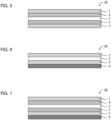
- FIG. 1 is a schematic cross-sectional view exemplifying the foaming adhesive sheet in the present aspect.
- Foaming adhesive sheet 10 in FIG. 1 includes first adhesive layer 1, substrate 2, and second adhesive layer 3, in this order.
- the first adhesive layer 1 and the second adhesive layer 3 contain a curable adhesive agent, and at least one of the first adhesive layer 1 and the second adhesive layer 3 further contains a foaming agent.
- a tack of the first adhesive layer 1 and a tack of the second adhesive layer 3 are respectively in the specified range, and a loop stiffness of the foaming adhesive sheet 10 is in the specified range.
- the second adhesive layer when the tack of the second adhesive layer is in the specified range, the second adhesive layer may have excellent adhesion to a member.
- the other member when the other member is adhered to a hole, a groove or the like of one member and fixed, in the case where the second adhesive layer surface of the foaming adhesive sheet is adhered to the other member, the other member to which the foaming adhesive sheet is adhered is inserted to the hole, the groove or the like of one member, and then the foaming adhesive sheet is foamed and cured to adhere one member with the other member, if the tack of the second adhesive layer is in the specified range, the second adhesive layer surface of the foaming adhesive sheet can be adhered to the other member utilizing the tack of the second adhesive layer, and thereby the adhesion of the second adhesive layer to the member can be improved. In this manner, when the other member to which the foaming adhesive sheet is adhered is inserted to the hole, the groove or the like of one member, a peel off and a positional displacement of the foaming
- the second adhesive layer when the tack of the second adhesive layer is in the specified range, the second adhesive layer may have excellent reworkability. For this reason, for example, in the above described adhering and fixing method, when the second adhesive layer surface of the foaming adhesive sheet is adhered to one member utilizing the tack of the second adhesive layer, the positional displacement of the foaming adhesive sheet can be corrected.
- the second adhesive layer when the tack of the second adhesive layer is in the specified range, for example, in the case the second adhesive layer is formed by a transferring method, a lifting of the second adhesive layer can be inhibited.
- a second separator is disposed on a surface of the second adhesive layer that is opposite side to the first adhesive layer, when the tack of the second adhesive layer is in the specified range, the second separator can be easily peeled off, and the workability can be improved.
- the tack of the first adhesive layer is the specified value or less, and thus the first adhesive layer can be substantially non-pressure-sensitive adhesive (tack free), and the first adhesive layer may have excellent slippage.
- the first adhesive layer can be substantially non-pressure-sensitive adhesive (tack free), and the first adhesive layer may have excellent slippage.
- the other member when positional matching is performed by moving the other member with respect to one member, the other member can be smoothly moved with respect to one member in a state the other member is inserted to the hole, the groove or the like of one member, and the positional matching can be easily done.
- the tack of the first adhesive layer is the specified value or less, and the first adhesive layer is substantially non-pressure-sensitive adhesive (tack-free), and thus the first adhesive layer may have excellent slippage as well as excellent blocking resistance.
- the handling of the foaming adhesive sheet can also be improved.
- the second adhesive layer is excellent in adhesion with a member, and the first adhesive layer is excellent in slippage, and thus the peel-off and the positional displacement of the foaming adhesive sheet can be inhibited.
- the degrade in adhesion of the foaming adhesive sheet after foamed and cured due to the peel-off and the positional displacement of the foaming adhesive sheet can be inhibited, and also the unevenness of the adhesive strength of the foaming adhesive sheet after foamed and cured due to the peel-off and the positional displacement of the foaming adhesive sheet can be decreased. Therefore, usage of the foaming adhesive sheet in the present aspect can realize the adhesion with high adhesive strength, high reliability, and high quality.
- the foaming adhesive sheet to be used overall thickness needs to be thin.
- the foaming adhesive sheet easily falls by its own weight at the time of conveyance.
- the inventors of the present disclosure focused on the rigidity (stiffness) of the foaming adhesive sheet.
- the rigidity tends to be high.
- the thickness of the foaming adhesive sheet needs to be thin, it is not suitable to increase the thickness of the foaming adhesive sheet.
- the foaming adhesive sheet includes adhesive layers on both surfaces of the substrate, if the thickness of the substrate is thick, the rigidity tends to be high.
- the thickness of the substrate is relatively increased while keeping the thickness of the foaming adhesive sheet thin, the thickness of the adhesive layer becomes relatively thin, and there is a risk that adhesion property and foaming property of the adhesive layer may be degraded.
- the foaming adhesive sheet includes an adhesive layer with pressure-sensitive adhesion (tack), the rigidity tends to be low.
- the inventors of the present disclosure have found out that the fall of the foaming adhesive sheet by its own weight can be suppressed when the loop stiffness of the foaming adhesive sheet is in the specified range. Further, they have found out that the rigidity can be improved while improving the inserting property when the first adhesive layer is substantially non-pressure-sensitive adhesive (tack-free), among the first adhesive layer and the second adhesive layer.
- the loop stiffness is a parameter showing a strength of stiffness of a sheet or a film. The larger the value of the loop stiffness, the stronger the stiffness of the sheet or the film.
- the loop stiffness is used as a parameter showing the strength of the stiffness of the sheet or the film used for wrapping materials for example, but it is not generally used in the field of adhesive sheet.
- the loop stiffness is the specified value or more, and thus the stiffness can be strong. For this reason, falling of the foaming adhesive sheet by its own weight at the time of conveying the foaming adhesive sheet can be inhibited.
- problems such that the foaming adhesive sheet may be folded, kinked, bent, and occurrence of biting of bubbles can be inhibited. Therefore, the adhering property can be improved.
- the foaming adhesive sheet since generation of a protrusion in the foaming adhesive sheet due to these defects can be inhibited, when the other member to which the foaming adhesive sheet is adhered is inserted to the hole, the groove or the like of one member, the foaming adhesive sheet is less likely scratched. Thereby, the peel-off of the foaming adhesive sheet during the insertion can be inhibited. Therefore, from these points also, usage of the foaming adhesive sheet in the present aspect can realize the adhesion with high adhesive strength, high reliability, and high quality.
- pressure-sensitive adhesion is a concept included in “adhesion”.
- the pressure-sensitive adhesion is used as a meaning of a temporary adhesion phenomenon, whereas the adhesion is distinguished in some cases from a viewpoint that it is used as a meaning of a practically permanent adhesion phenomenon ( Physical and Chemical Science Dictionary Fifth Edition, published by Iwanami Shoten ).
- Pressure-sensitive adhesion and pressure-sensitive adhesive force indicate a property to adhere by pressure sensing and the adhesive force at that time.
- the pressure-sensitive adhesion of the adhesive layer and “the pressure-sensitive adhesive force of the adhesive layer” refer to the pressure-sensitive adhesion and the pressure-sensitive adhesive force of the adhesive layer before cured, unless otherwise described.
- the adhesion of the adhesive layer and “the adhesive force of the adhesive layer” refer to the adhesion and the adhesive force of the adhesive layer after cured, unless otherwise described.
- the tack of the first adhesive layer is 0 gf or more and less than 10 gf, may be 5 gf or less, and may be 2 gf or less.
- the first adhesive layer can be substantially non-pressure-sensitive adhesive (tack free), and the first adhesive layer with excellent slippage and blocking resistance can be achieved.
- the tack of the second adhesive layer is 10 gf or more, may be 30 gf or more, and may be 50 gf or more.
- the tack of the second adhesive layer is too low, for example, in the above described adhering and fixing method, there is a possibility that the close adhesion of the second adhesive layer and the other member may be degraded at the time of adhering the second adhesive layer surface of the foaming adhesive sheet to the other member utilizing the tack of the second adhesive layer, and there is a possibility that the adhering property of the first adhesive layer and the second adhesive layer after foamed and cured may be degraded and the adhesive strength may vary due to the peel-off of the foaming adhesive sheet and the positional displacement of the foaming adhesive sheet caused by the adhesion defect of the second adhesive layer and the other member at the time of inserting the other member, to which the foaming adhesive sheet is adhered, to the hole, the groove or the like of one member.
- the tack of the second adhesive layer is 500 gf or less, may be 400 gf or less, and may be 300 gf or less.
- the tack of the second adhesive layer is too high, the reworkability is degraded, and there is a possibility that the correction of the positional displacement of the foaming adhesive sheet may be difficult at the time of adhering the second adhesive layer surface of the foaming adhesive sheet to the other member utilizing the tack of the second adhesive layer, for example, in the above described adhering and fixing method.
- the tack of the first adhesive layer and the second adhesive layer can be measured by a probe tack test.
- a probe tack test machine for example, a tacking test machine "TAC-II" from RHESCA CO., LTD can be used.
- TAC-II tacking test machine
- the details of the method for measuring the tack of the first adhesive layer and the second adhesive layer will be described in the section of Examples later.
- the tack of the first adhesive layer can be in the specified range by, for example, adjusting the composition of the first adhesive layer.
- the pressure-sensitive adhesion of the first adhesive layer can be degraded by using the epoxy resin which is solid at a normal temperature, and by using the curing agent which is solid at a normal temperature.
- the pressure-sensitive adhesion of the first adhesive layer can be degraded by including the epoxy resin with high softening temperature, or by including the epoxy resin with large weight average molecular weight.
- the pressure-sensitive adhesion of the first adhesive layer can be degraded by including a plural kinds of epoxy resins with different softening temperature in the first adhesive layer, that is when the first adhesive layer contains one epoxy resin, and the other epoxy resin of which softening temperature is 25°C or more and is higher in 10°C or more than the softening temperature of the one epoxy resin.
- the pressure-sensitive adhesion of the first adhesive layer can be degraded by including a plural of epoxy resins with different weight average molecular weights in the first adhesive layer, that is when the first adhesive layer contains one epoxy resin, and the other epoxy resin of which weight average molecular weight is 370 or more and is larger in 300 or more than the weight average molecular weight of the one epoxy resin.
- a first epoxy resin with low softening temperature and low molecular weight, and a second epoxy resin with high softening temperature and high molecular weight may be included to degrade the pressure-sensitive adhesion of the first adhesive layer.
- the pressure-sensitive adhesion of the first adhesive layer can be degraded by including an acrylic resin soluble with the epoxy resin.
- the tack of the second adhesive layer can be controlled by, for example, adjusting the composition of the second adhesive layer.
- the pressure-sensitive adhesion of the second adhesive layer tends to be high when using the epoxy resin which is liquid at a normal temperature, and when using the curing agent which is liquid at a normal temperature.
- the pressure-sensitive adhesion of the second adhesive layer tends to be high when including the epoxy resin with low softening temperature, or when including the epoxy resin with small weight average molecular weight.
- the pressure-sensitive adhesion of the second adhesive layer tends to be high when a tackifier is added to the second adhesive layer. It should be noted that although the pressure-sensitive adhesion tends to be high when using the curing agent that is liquid at a normal temperature, since there is a possibility that the storage stability may be degraded, the tack of the second adhesive layer is preferably adjusted by adjusting the properties and kinds of components other than the curing agent such as the epoxy resin.
- a static friction coefficient of the surface of the first adhesive layer opposing to the second adhesive layer is, for example, preferably 0.33 or less, may be 0.30 or less, and may be 0.26 or less.
- the static friction coefficient of the first adhesive layer surface is in the above range, the first adhesive layer may have excellent slippage.
- the static friction coefficient may be, for example, 0.16 or more.
- the static friction coefficient of the surface of the first adhesive layer can be obtained in accordance with JIS K7125 corresponding to ISO 8295.
- a static friction coefficient of the first adhesive layer of the foaming adhesive sheet with a metal plate is measured by the following method. First, the foaming adhesive sheet is cut into 80 mm * 200 mm.
- the foaming adhesive sheet is placed still on a metal plate (SUS plate) in a square shape that is horizontally placed still, and a slipping piece (63 mm * 63 mm, 200 g weight, bottom surface: felt) is put on the first adhesive layer of the foaming adhesive sheet, and a friction is measured in the conditions of the test speed of 100 mm/min, the test length of 50 mm, the load cell of 10 N, and the temperature of 23°C to calculate the static friction coefficient.
- a friction measurement machine FRICTION TESTER TR-2 from Toyo Seiki Seisaku-sho, Ltd. can be used.
- the static friction coefficient of the surface of the first adhesive layer can be controlled by, for example, adjusting the composition of the first adhesive layer.
- the static friction coefficient of the surface of the first adhesive layer can be controlled by the average particle size or the content of the foaming agent included in the first adhesive layer.
- the average particle size of the foaming agent increases, the static friction coefficient of the surface of the first adhesive layer tends to decrease.
- the content of the foaming agent increases, the static friction coefficient of the surface of the first adhesive layer tends to decrease.
- the arithmetic average roughness (Ra) of the surface of the first adhesive layer opposing to the second adhesive layer is, for example, preferably 0.3 um or more, may be 0.5 um or more, and may be 0.7 um or more.
- the first adhesive layer may have excellent slippage.
- the Ra of the first adhesive layer may be, for example, 1.5 um or less, may be 1.3 um or less, and may be 1.1 um or less.
- the Ra of the first adhesive layer can be measured using a white interferometer.
- the Ra of the first adhesive layer can be measured using the white interferometer NewView7300 from Zygo Corporation, with observation filed: 0.55 mm * 0.55 mm and sampling space: 0.55 ⁇ m.
- the Ra of the first adhesive layer can be controlled by, for example, adjusting the composition of the first adhesive layer.
- the Ra of the first adhesive layer can be controlled by the average particle size or the content of the foaming agent included in the first adhesive layer.
- the average particle size of the foaming agent increases, the Ra of the first adhesive layer tends to increase.
- the content of the foaming agent increases, the Ra of the first adhesive layer tends to increase.
- the loop stiffness is 50 mN/10 mm or more, preferably 75 mN/10 mm or more, and more preferably 100 mN/10 mm or more.
- the loop stiffness of the foaming adhesive sheet is in the above range, for example, on the occasion of sucking and conveying the foaming adhesive sheet and adhering to a member, the foaming adhesive sheet is prevented from falling by its own weight, and the adhering property can be improved. Meanwhile, there is no upper limit of the loop stiffness.
- the loop stiffness is, as described above, a parameter showing the strength of the stiffness of a film or a sheet.
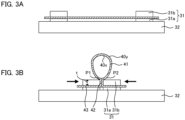
- a method for measuring the loop stiffness will be hereinafter explained with reference to FIGS. 2A to 4C .
- FIG. 2A is a schematic plan view showing a loop stiffness measurement device
- FIG. 2B is a cross-sectional view of A-A line in FIG. 2A
- a test piece of the foaming adhesive sheet 10 is a rectangular having a long side and a short side.
- length L1 of the long side of the test piece of the foaming adhesive sheet 10 is 200 mm
- length L2 of the short side is 10 mm.
- the loop stiffness measurement device 30 Loop Stiffness Tester (registered trademark) from Toyo Seiki Seisaku-sho, Ltd. can be used. Note that the length L1 of the long side of the test piece of the foaming adhesive sheet 10 can be adjusted as long as the test piece of the foaming adhesive sheet 10 can be held by a pair of chuck part 31 described later.
- the loop stiffness measurement device 30 includes a pair of chuck part 31 for holding a pair of end parts of the long side direction of the test piece of the foaming adhesive sheet 10, and supporting member 32 that supports the chuck part 31.
- the chuck part 31 includes first chuck 31a and second chuck 31b.
- the foaming adhesive sheet 10 is disposed on a pair of the first chuck 31a, and the second chuck 31b has not held the foaming adhesive sheet 10 between the first chuck 31a yet. As described later, at the time of the measurement, the foaming adhesive sheet 10 is held between the first chuck 31a and the second chuck 31b of the chuck part 31.
- the second chuck 31b may be connected to the first chuck 31a via a hinge mechanism.
- the test piece of the foaming adhesive sheet 10 is placed on the first chuck 31a of a pair of the chuck part 31 disposed interposing space L3.
- the space L3 is set so that the length of later described loop part 41 (hereinafter also referred to as loop length) becomes 60 mm.
- the test piece of the foaming adhesive sheet 10 is disposed so that inner surface 40x is the surface of the first adhesive layer, and outer surface 40y is the surface of the second adhesive layer.
- the second chuck 31b is disposed on the test piece of the foaming adhesive sheet 10 so that the end part of the long side direction of the test piece of the foaming adhesive sheet 10 is held between the first chuck 31a and the second chuck 31b.
- the test piece of the foaming adhesive sheet 10 shown in FIG. 3B includes the loop part 41 and a pair of intermediate part 42 and a pair of fixing part 43.
- the pair of the fixing part 43 is, among the members in the test piece of the foaming adhesive sheet 10, a member held by the pair of the chuck part 31.
- the pair of the intermediate part 42 is, among the members in the test piece of the foaming adhesive sheet 10, a member positioned between the loop part 41 and the pair of the intermediate part 42.
- the chuck part 31 is slid on the supporting member 32 until the inner surfaces 40x of the pair of the intermediate part 42 of the foaming adhesive sheet 10 contact each other. Thereby, the loop part 41 having the loop length of 60 mm can be formed.
- the loop length of the loop part 41 is a length of the test piece of the foaming adhesive sheet 10 between position P1 where the loop part 41 side surface of one of the second chuck 31b crosses the test piece of the foaming adhesive sheet 10, and position P2 where the loop part 41 side surface of the other of the second chuck 31b crosses the test piece of the foaming adhesive sheet 10.
- the above described space L3 is a value in which 2 * t is added to the length of the loop part 41, when ignoring the thickness of the test piece of the foaming adhesive sheet 10.
- the "t" is a thickness of the second chuck 31b of the chuck part 31.
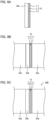
- position of the chuck part 31 is adjusted so that protruding direction Y of the loop part 41 to the chuck part 31 is horizontal direction.
- the position of the chuck part 31 supported by the supporting member 32 is adjusted.
- the protruding direction Y of the loop part 41 matches the thickness direction of the chuck part 31.
- load cell 35 is prepared in a position distanced from the second chuck part 31b.
- the distance Z1 is a distance between the load cell 35 and the second chuck 31b of the chuck part 31.
- the loop part 41 is pushed in the distance Z2 to the chuck part 31 side, by the load cell 35.
- the distance Z2 is 15 mm.
- the load cell 35 is moved to the chuck part 31 side in the distance Z2, and in a state that the load cell 35 pushes in the loop part 41 of the test piece of the foaming adhesive sheet 10, after when the value of the load applied from the loop part 41 to the load cell 35 is stabled, the value of the load is recorded.
- the value of the load obtained in this manner is regarded as the loop stiffness of the foaming adhesive sheet 10.
- the environment at the time of measuring the loop stiffness is temperature 23°C and relative humidity 50%.
- the loop stiffness of the foaming adhesive sheet is measured after peeling off the first separator and the second separator.
- the loop stiffness of the foaming adhesive sheet can be controlled by adjusting, for example, the thickness and the composition of the first adhesive layer, the thickness and the composition of the second adhesive layer, and the thickness and the composition of the substrate.
- the thickness of the substrate is thick
- the loop stiffness tends to increase.
- the thickness of the first adhesive layer is thick
- the loop stiffness tends to increase.
- the thickness of each layer is preferably adjusted so as to obtain the desired loop stiffness.
- the tack of the first adhesive layer is decreased by adjusting the composition of the first adhesive layer, the loop stiffness tends to increase.
- the adhesion of the foaming adhesive sheet in the present aspect after formed and cured is preferably high.
- the shear strength (adhesive strength) based on JIS K6850 corresponding to ISO 4587 at 23°C may be, for example, 1.50 MPa or more, may be 1.80 MPa or more, and may be 2.10 MPa or more.
- the shear strength (adhesive strength) at 130°C may be, for example, 0.50 MPa or more, may be 0.75 MPa or more, and may be 1.00 MPa or more.
- the shear strength (adhesive strength) is approximately 1 MPa or more and 2 MPa or less at ordinary temperature, and is not resistant to 200°C. Therefore, when the shear strength (adhesive strength) at 23°C is in the range described above, it is superior in the strength. Also, when the shear strength (adhesive strength) at 130°C is in the range described above, it may be employed to the use application such as those used in the vicinity of an engine of a vehicle, and those requiring the heat resistance equivalent thereto.
- the foaming adhesive sheet in the present aspect has high electrical insulation after foamed and cured.
- the dielectric breakdown voltage based on JIS C2107 corresponding to IEC 60454-2 is, for example, preferably 3 kV or more, and more preferably 5 kV or more.
- the thermal conductivity is, for example, preferably 0.05 W/mK or more.
- the first adhesive layer in the present aspect contains a curable adhesive agent.
- a curable adhesive agent included in the first adhesive layer in the present aspect a curable adhesive agent commonly used for an adhesive layer of a foaming adhesive sheet can be used.
- the curable adhesive agent may include a thermosetting adhesive agent and a photo curing adhesive agent. Among them, the thermosetting adhesive agent is preferable. The thermosetting adhesive agent may be applied even when the member is not transparent, such as in a case of a metal member.
- examples of the curable adhesive agent may include an epoxy resin-based adhesive agent, an acrylic resin-based adhesive agent, a phenolic resin-based adhesive agent, an unsaturated polyester resin-based adhesive agent, an alkyd resin-based adhesive agent, a urethane resin-based adhesive agent, and a thermosetting polyimide resin-based adhesive agent.
- the curable adhesive agent is preferably the epoxy resin-based adhesive agent. That is, the curable adhesive agent preferably includes an epoxy resin and a curing agent.
- the epoxy resin-based adhesive agent is excellent in properties such as mechanical strength, heat resistance, insulating property and chemical resistance, curing shrinkage is small, so that it may be used in a wide variety of applications.
- curable adhesive agent is the epoxy resin-based adhesive agent
- the epoxy resin in the present aspect is a compound including at least one or more epoxy group or glycidyl group, and cured by causing a cross-linking polymerization reaction by being used in combination with a curing agent.
- the epoxy resin also includes a monomer including at least one or more epoxy group or glycidyl group.
- an epoxy resin generally used for an adhesive layer of a foaming adhesive sheet may be used as the epoxy resin.
- the curable adhesive agent preferably includes a first epoxy resin with softening temperature of 50°C or more and an epoxy equivalent of 5000 g/eq or less, and a second epoxy resin with softening temperature higher than that of the first epoxy resin and a weight-average molecular weight of 20,000 or more.
- the pressure-sensitive adhesion (tack property) of the adhesive layer may be decreased so that a foaming adhesive sheet having excellent slippage may be obtained.
- a first adhesive layer having excellent blocking resistance and excellent adhesion after foamed and cured may be obtained.
- the blocking suppressing effect is not sufficient, or that the pressure-sensitive adhesion (tack property) of the first adhesive layer may be too high. Therefore, when a second epoxy resin with relatively high softening temperature (with relatively low crystallinity) and high molecular weight is further used, the blocking suppressing effect may be improved, and the pressure-sensitive adhesion (tack property) of the first adhesive layer may be kept low.
- the first epoxy resin has softening temperature of 50°C or more, and an epoxy equivalent of 5000 g/eq or less.
- the first epoxy resin has relatively low softening temperature (relatively high crystallinity) as compared with the second epoxy resin to be described later. Since the first epoxy resin has relatively high crystallinity and low molecular weight, it is easy to improve the adhesion after foamed and cured and the blocking resistance. Also, since the first epoxy resin has a low molecular weight, a cross-linking density may be increased so that a first adhesive layer having good mechanical strength, chemical resistance, and curability may be obtained. Also, it is preferable that the first epoxy resin is a solid epoxy resin at ordinary temperature (23°C).
- the softening temperature of the first epoxy resin is usually 50°C or more, may be 55°C or more, and may be 60°C or more. Meanwhile, the softening temperature of the first epoxy resin is, for example, 150°C or less.
- the softening temperature may be measured by a ring and ball method according to JIS K7234.
- the epoxy equivalent of the first epoxy resin is, for example, 5000 g/eq or less, may be 3000 g/eq or less, may be 1000 g/eq or less, and may be 600 g/eq or less. Meanwhile, the epoxy equivalent of the first epoxy resin is, for example, 90 g/eq or more, may be 100 g/eq or more, and may be 110 g/eq or more.
- the epoxy equivalent may be measured by a method according to JIS K7236 corresponding to ISO 3001 (Plastics Epoxy compounds-Determination of epoxy equivalent), and is a number of grams of a resin including an epoxy group of 1 gram equivalent.
- the first epoxy resin may be a monofunctional epoxy resin, may be a bifunctional epoxy resin, may be a trifunctional epoxy resin, and may be an epoxy resin of a tetrafunctional or more.
- the weight-average molecular weight (Mw) of the first epoxy resin is usually lower than the weight-average molecular weight (Mw) of the second epoxy resin to be described later.
- Mw of the first epoxy resin is, for example 6000 or less, may be 4000 or less, and may be 3000 or less. Meanwhile, Mw of the first epoxy resin is, for example, 400 or more.
- Mw is a value in terms of polystyrene when measured with a gel permeation chromatography (GPC).
- the melt viscosity at 150°C of the first epoxy resin is, for example, 0.005 Pa ⁇ s or more, may be 0.015 Pa ⁇ s or more, may be 0.03 Pa ⁇ s or more, may be 0.05 Pa ⁇ s or more, and may be 0.1 Pa ⁇ s or more.
- the melt viscosity is too low, preferable foaming property may not be obtained.
- the melt viscosity of the first epoxy resin is too low (when the crystallinity of the first epoxy resin is too high), the pressure-sensitive adhesion (tack property) of the first adhesive layer to be obtained may be high.
- the melt viscosity of the first epoxy resin is too low (when the crystallinity of first epoxy resin is too high), the crystallinity thereof greatly decreases when it is compatibilized with the second epoxy resin or the acrylic resin so that Tg of the first adhesive layer is decreased.
- the melt viscosity of the first epoxy resin at 150°C is, for example, 10 Pa ⁇ s or less, may be 5 Pa ⁇ s or less, and may be 2 Pa ⁇ s or less.
- the melt viscosity may be determined by measuring with a Brookfield type single cylinder rotary viscosimeter and a thermocell for heating a solution, according to JIS K6862 corresponding to ISO 2555 (Resins in the liquid state or as emulsions or dispersions Determination of Brookfield RV viscosity).
- the first epoxy resin may include an aromatic epoxy resin, an aliphatic epoxy resin, an alicyclic epoxy resin, and a heterocyclic epoxy resin.
- Specific examples of the first epoxy resin may include bisphenol type epoxy resins such as a bisphenol A type epoxy resin and a bisphenol F type epoxy resin; novolac type epoxy resins such as a bisphenol A novolac type epoxy resin and a cresol novolac type epoxy resin; and modified epoxy resins such as a urethane modified epoxy resin and a rubber modified epoxy resin.
- other specific example may include a biphenyl type epoxy resin, a stilbene type epoxy resin, a triphenol methane type epoxy resin, an alkyl-modified triphenol methane type epoxy resin, a triazine nucleus-containing epoxy resin, a dicyclopentadiene-modified phenol type epoxy resin, a naphthalene type epoxy resin, a glycol type epoxy resin, and a pentaerythritol type epoxy resin.
- the first epoxy resin may be one kind, and may be two kinds or more.
- the bisphenol A type epoxy resin may be present in a liquid state at ordinary temperature or in a solid state at ordinary temperature according to the number of repeating units of the bisphenol skeleton.
- the bisphenol A type epoxy resin is preferable in the point of attempting to improve the heat resistance.
- the first epoxy resin is preferably a bisphenol A novolac type epoxy resin represented by the following general formula (1).
- R 1 is a group represented by C m H 2m ("m” is 1 or more and 3 or less)
- R 2 and R 3 are respectively and independently a group represented by C p H 2p+1 ("p" is 1 or more and 3 or less)
- n is 0 or more and 10 or less.
- R 1 is preferably 1, that is, R 1 is preferably -CH 2 -.
- p in R 2 and R 3 is preferably 1, that is, R 2 and R 3 are preferably -CH 3 .
- the hydrogen that bonds to the benzene ring in general formula (1) may be substituted with another element or another group.
- the content of the first epoxy resin when the resin component included in the first adhesive layer is regarded as 100 mass parts is, for example, 1 mass part or more, may be 3 mass parts or more, may be 5 mass parts or more, may be 10 mass parts or more, may be 15 mass parts or more, and may be 25 mass parts or more.
- the content of the first epoxy resin when the resin component included in the first adhesive layer is regarded as 100 mass parts is, for example, 90 mass parts or less, may be 80 mass parts or less, may be 70 mass parts or less, may be 60 mass parts or less, may be 50 mass parts or less, and may be 40 mass parts or less.
- the content of the first epoxy resin is too much, the content of the second epoxy resin and the acrylic resin will be relatively low so that there is a possibility that the non-pressure-sensitive adhesion, the blocking resistance, the close adhesion with respect to the substrate after foamed and cured, the cracking resistance after foamed and cured, and the adhesion after foamed and cured may not be balanced.
- the softening temperature of the second epoxy resin is higher than that of the first epoxy resin and the weight-average molecular weight is 20,000 or more.
- the second epoxy resin has relatively high softening temperature (relatively low crystallinity), compared to the above described first epoxy resin. Since the second epoxy resin has relatively low crystallinity and has high molecular weight, the blocking resistance is easily improved. Further, since the second epoxy resin has relatively low crystallinity and has high molecular weight, the increase of the pressure-sensitive adhesion (tack property) due to the first epoxy resin may be suppressed.
- the second epoxy resin is preferably a solid epoxy resin at ordinary temperature (23°C).
- the weight-average molecular weight (Mw) of the second epoxy resin is usually higher than the weight-average molecular weight (Mw) of the first epoxy resin.
- Mw of the second epoxy resin is usually, 20,000 or more, may be 30,000 or more, and may be 35,000 or more. Meanwhile, Mw of the second epoxy resin is, for example, 100,000 or less.
- the epoxy equivalent of the second epoxy resin may be higher than, less than, or equal to the epoxy equivalent of the first epoxy resin.
- the epoxy equivalent of the second epoxy resin is, for example, 4000 g/eq or more, may be 5000 g/eq or more, and may be 6000 g/eq or more. Meanwhile, the epoxy equivalent of the second epoxy resin is, for example, 20000 g/eq or less.
- the second epoxy resin may be a monofunctional epoxy resin, may be a bifunctional epoxy resin, may be a trifunctional epoxy resin, and may be an epoxy resin of a tetrafunctional or more.
- the softening temperature of the second epoxy resin is usually higher than the softening temperature of the first epoxy resin.
- the difference between the two is, for example, 10°C or more, may be 20°C or more, and may be 30°C or more.
- the softening temperature of the second epoxy resin is, for example, 80°C or more, and may be 90°C or more. Meanwhile, the softening temperature of the second epoxy resin is, for example, 180°C or less.
- the configuration of the second epoxy resin is similar to that of the above describe first epoxy resin; thus, the description herein is omitted.
- the content of the second epoxy resin when the resin component included in the first adhesive layer is regarded as 100 mass parts is, for example, 10 mass parts or more, may be 15 mass parts or more, may be 20 mass parts or more, may be 25 mass parts or more, may be 30 mass parts or more, may be 35 mass parts or more, may be 40 mass parts or more, and may be 45 mass parts or more.
- the content of the second epoxy resin is too low, the close adhesion may be high, and the blocking resistance may be deteriorated.
- the content of the second epoxy resin when the resin component included in the first adhesive layer is regarded as 100 mass parts is, for example, 90 mass parts or less, may be 85 mass parts or less, may be 80 mass parts or less, and may be 75 mass parts or less.
- the content of the second epoxy resin is too much, the content of the first epoxy resin and the acrylic resin will be relatively low so that there is a possibility that the non-pressure-sensitive adhesion, the blocking resistance, the close adhesion with respect to the substrate after foamed and cured, the cracking resistance after foamed and cured, and the adhesion after foamed and cured may not be balanced.
- the proportion of the first epoxy resin with respect to the total of the first epoxy resin and the second epoxy resin is, for example, 5 mass% or more, may be 10 mass% or more, may be 15 mass% or more, and may be 20 mass% or more. Meanwhile, the proportion of the first epoxy resin is, for example, 80 mass% or less, may be 75 mass% or less, and may be 60 mass% or less.
- the proportion of the total of the first epoxy resin and the second epoxy resin with respect to all the epoxy resins included in the first adhesive layer is, for example, 50 mass% or more, may be 70 mass% or more, may be 90 mass% or more, and may be 100 mass%.
- the first adhesive layer may further include an acrylic resin compatible with the epoxy resin.
- the acrylic resin is a resin compatibilized with the epoxy resin. Since the acrylic resin is compatible with the epoxy resin, the toughness of the first adhesive layer is likely to be improved. As the result, the adhesion after foamed and cured may be improved. Further, the acrylic resin is believed to function as a compatibilizing agent of the foaming agent (such as a foaming agent whose shell part is an acrylonitrile copolymer resin), and the adhesion after foamed and cured is improved by being uniformly dispersed and foamed.
- the flexibility due to the acrylic resin is exhibited so that the close adhesion with respect to the substrate after foamed and cured, and cracking resistance after foamed and cured may be improved.
- the hardness of the first adhesive layer surface may be maintained at high level, by the acrylic resin being compatibilized with the epoxy resin. Meanwhile, if the acrylic resin is incompatible with the epoxy resin, a flexible part is formed on the first adhesive layer surface so that the interface with the adherend is not slippery enough, and the workability may be deteriorated.
- the acrylic resin in the present aspect is compatibilized with the epoxy resin.
- the state that the acrylic resin being compatibilized with the epoxy resin may be confirmed by, for example, observing the cross-section of the first adhesive layer of the foaming adhesive sheet with a scanning electron microscope (SEM) or a transmission electron microscope (TEM), to confirm that a micron sized island is not formed.
- the average particle size of the island is preferably 1 um or less. Above all, the average particle size of the island may be 0.5 um or less, and may be 0.3 um or less.
- the number of the samples is preferably large, and is, for example, 100 or more.
- the area of the observed region is in a range of 100 um * 100 um or, when the thickness of the first adhesive layer is 100 um or less, the observation is carried out in a range of thickness * 100 ⁇ m.
- the weight-average molecular weight (Mw) of the acrylic resin is, for example, 50,000 or more, may be 70,000 or more, and may be 100,000 or more.
- the first epoxy resin is relatively high in crystallinity so that the melt viscosity (or dynamic viscoelasticity) upon heating may be too low, and a shrinkage may occur during curing after foaming (the term from the completion of foaming of the foaming agent until the first adhesive layer is cured).
- Mw of the acrylic resin is, for example, 1,500,000 or less.
- the weight-average molecular weight of the acrylic resin may be measured by GPC (eluent: THF, standard substance: PS, sample: 20 ⁇ L, flow: 1 mL/min, column temperature: 40°C).
- the glass transition temperature (Tg) of the acrylic resin is, for example, 90°C or more, and may be 100°C or more. Meanwhile, Tg of the acrylic resin is, for example, 180°C or less. Tg may be measured by a thermal analysis such as differential scanning calorimetry (DSC) according to JIS K7121 corresponding to ISO 3146.
- DSC differential scanning calorimetry
- the storage elastic modulus (E') of the acrylic resin at foaming start temperature may be 1 * 10 6 Pa or less.
- E' being low at the start of the foaming, the flowability is improved so that preferable foaming ability may be obtained.
- E' at foaming start temperature is, for example, 1 * 10 5 Pa or more.
- foaming start temperature is temperature that varies depending on the kind of the foaming agent. Also, when two kinds or more of the foaming agents are used as the foaming agent, start temperature of the main foaming reaction is regarded as the foaming start temperature.
- the storage elastic modulus (E') of the acrylic resin at curing start temperature may be 1 * 10 5 Pa or more.
- the shrinkage may occur during curing after foaming (the term from the completion of foaming of the foaming agent until the first adhesive layer is cured). However, the shrinkage may be suppressed and excellent shape retainability may be obtained by E' being high at curing start temperature.
- curing start temperature is temperature that varies depending on the kind of the curing agent. Also, when two kinds or more of the curing agents are used as the curing agent, start temperature of the main curing reaction is regarded as the curing start temperature.
- the average value of the storage elastic modulus (E') of the acrylic resin at 0°C or more and 100°C or less may be 1 * 10 6 Pa or more.
- An excellent non-pressure-sensitive adhesion and blocking resistance may be obtained by the average value of E' before the foaming being high.
- the average value of the storage elastic modulus (E') at 0°C or more and 100°C or less is, for example, 1 * 10 8 Pa or less.
- the acrylic resin may include a polar group.
- the polar group may include an epoxy group, a hydroxyl group, a carboxyl group, a nitrile group, and an amide group.
- the acrylic resin may be a homopolymer of acrylic acid ester monomers that is a mixture component including two kinds or more of the above described homopolymer; and may be a copolymer of two kinds or more acrylic acid ester monomers that is a component including one or more copolymer. Also, the acrylic resin may be a mixture component of the homopolymer and the copolymer.
- the "acrylic acid" in the acrylic acid ester monomers includes the concept of a methacrylic acid.
- the acrylic resin may be a mixture of the methacrylate polymer and the acrylate polymer, and may be an acrylic acid ester polymer such as acrylate-acrylate, methacrylate-methacrylate, and methacrylate-acrylate.
- the acrylic resin preferably includes a copolymer of two kinds or more acrylic acid ester monomers ((meth)acrylic acid ester copolymer).
- Examples of the monomer component constituting the (meth)acrylic acid ester copolymer may include the monomer component described in Japanese Patent Application Laid-Open ( JP-A) No. 2014-065889 .
- the monomer component may include the above described polar group.
- Examples of the (meth)acrylic acid ester copolymer may include an ethyl acrylate-butyl acrylate-acrylonitrile copolymer, an ethyl acrylate-acrylonitrile copolymer, and a butyl acrylate-acrylonitrile copolymer.
- the "acrylic acid” such as acrylic acid methyl and acrylic acid ethyl include “methacrylic acid” such as (meth)acrylic acid methyl and (meth)acrylic acid ethyl.
- the (meth) acrylic acid ester copolymer a block copolymer is preferable, and an acrylic block copolymer such as a methacrylate-acrylate copolymer is further preferable.
- the (meth) acrylate constituting the acrylic block copolymer may include methyl acrylate, ethyl acrylate, propyl acrylate, butyl acrylate, lauryl acrylate, 2-ethylhexyl acrylate, cyclohexyl acrylate, and benzyl acrylate.
- These "acrylic acid” also includes "methacrylic acid”.
- methacrylate-acrylate copolymer may include acrylic copolymers such as methyl methacrylate-butyl acrylate-methyl methacrylate (MMA-BA-MMA) copolymers.
- MMA-BA-MMA copolymers also include block copolymers of polymethylmethacrylate-polybutylacrylate-polymethylmethacrylate (PMMA-PBA-PMMA).
- the acrylic copolymer may not include a polar group, and may be a modified product wherein the above described polar group is introduced into a part. Since the modified product is easily compatible with an epoxy resin, adhesion is further improved.
- the acrylic resin is preferably a (meth) acrylic acid ester copolymer including a first polymer portion having glass transition temperature (Tg) of 10°C or less, and a second polymer portion having glass transition temperature (Tg) of 20°C or more.
- a (meth) acrylic acid ester copolymer includes a first polymer portion to be a soft segment and a second polymer portion to be a hard segment.
- the expression of the above effect may be estimated as follows.
- an acrylic resin including both of a soft segment and a hard segment such as the above (meth) acrylic acid ester copolymer
- the hard segment contributes to heat resistance
- the soft segment contributes to toughness or flexibility, so that a first adhesive layer having good heat resistance, toughness, and flexibility may be obtained.
- At least one of the first polymer portion and the second polymer portion included in the above (meth) acrylic acid ester copolymer has compatibility with the epoxy resin.
- the first polymer portion has compatibility with the epoxy resin, flexibility may be increased.
- the second polymer portion has compatibility with the epoxy resin, it is possible to enhance the cohesiveness and toughness.
- the (meth) acrylic acid ester copolymer includes a compatible site that is a polymer portion compatible with the epoxy resin and an incompatible site that is a polymer portion not compatible with the epoxy resin.
- the compatible site is compatibilized with the epoxy resin, and the incompatible site is not compatibilized with the epoxy resin, so that fine phase separation occurs. As the result, a fine sea-island structure is developed.
- the sea-island structure varies depending on the type of the (meth) acrylic acid ester copolymer, the compatibility of the first polymer portion and the second polymer portion included in the (meth) acrylic acid ester copolymer, and whether the modification by introducing a polar group is done or not.
- Examples of the sea-island structure may include a sea-island structure wherein a cured product of the epoxy resin and a compatible site of the (meth) acrylic acid ester copolymer are seas, and a non-compatible site of the (meth) acrylic acid ester copolymer is an island; a sea-island structure wherein a non-compatible site of the (meth) acrylic acid ester copolymer is a sea, and a cured product of the epoxy resin and a compatible site of the (meth) acrylic acid ester copolymer are islands; and a sea-island structure wherein the (meth) acrylic acid ester copolymer is a sea, and a cured product of the epoxy resin is an island.
- the (meth) acrylic acid ester copolymer is preferably a block copolymer, and particularly preferably an A-B-A block copolymer including a polymer block A as a compatible site and a polymer block B as a non-compatible site. Further, it is preferable to be a A-B-A block copolymer wherein the first polymer portion is a non-compatible site and the second polymer portion is a compatible site, and the first polymer portion is a polymer block B and the second polymer portion is a polymer block A.
- the island portion may be decreased in the sea-island structure wherein a cured product of the epoxy resin and a compatible site of the (meth) acrylic acid ester copolymer are seas, and a non-compatible site of the (meth) acrylic acid ester copolymer is an island.
- the sea portion may be decreased in the case of the sea-island structure wherein a non-compatible site of the (meth) acrylic acid ester copolymer is a sea, and a cured product of the epoxy resin, and a compatible site of the (meth) acrylic acid ester copolymer are islands; or in the case of the sea-island structure wherein the (meth) acrylic acid ester copolymer is a sea and a cured product of the epoxy resin is an island.
- the above (meth) acrylic acid ester copolymer may be a modified product obtained by introducing the above mentioned polar group into a part of the first polymer portion or the second polymer portion.
- the upper limit of Tg of the first polymer portion included in the (meth) acrylic acid ester copolymer is 10°C or less, and above all, it is 0°C or less, and in particular, it may be -10°C or less. Meanwhile, the lower limit of Tg is -150°C or more, and above all, it is -130°C or more, and in particular, it may be -110°C or more.
- the first polymer portion included in the above (meth) acrylic acid ester copolymer may be a homopolymer, and may be a copolymer; among them, a homopolymer is preferable.
- the monomer component and the polymer component constituting the first polymer portion may be any monomer component and polymer component capable of obtaining a first polymer portion with Tg in a predetermined range, and examples thereof may include acrylic acid ester monomers such as acrylic acid butyl, acrylic acid 2-ethylhexyl, acrylic acid isononyl, and acrylic acid methyl; other monomers such as vinyl acetate, acetal, and urethane; a polar group containing monomer including the above described polar group; and copolymers such as EVA.
- the lower limit of Tg of the second polymer portion included in the (meth) acrylic acid ester copolymer is 20°C or more, and above all, it is 30°C or more, and in particular, it may be 40°C or more. Meanwhile, the upper limit of Tg may be 150°C or less.
- the second polymer portion included in the (meth) acrylic acid ester copolymer may be a homopolymer, and may be a copolymer, but among them, a homopolymer is preferable.
- the monomer component constituting the second polymer portion may be any monomer component capable of obtaining a second polymer portion with Tg in a predetermined range, and examples thereof may include acrylic acid ester monomers such as methyl methacrylate; other monomers such as acrylamide, styrene, vinyl chloride, amide, acrylonitrile, cellulose acetate, phenol, urethane, vinylidene chloride, methylene chloride, and methacrylonitrile; and a polar group containing monomers including the above described polar group.
- (meth) acrylic acid ester copolymer including the first polymer portion and the second polymer portion described above may include the above described MMA-BA-MMA copolymers.
- the content of the acrylic resin when the resin component included in the first adhesive layer is regarded as 100 mass parts is, for example, 1 mass part or more, may be 3 mass parts or more, may be 5 mass parts or more, may be 7 mass parts or more, and may be 10 mass parts or more.
- the content of the acrylic resin is too little, there is a possibility that the close adhesion with respect to the substrate after foamed and cured, the cracking resistance after foamed and cured, and the adhesion after foamed and cured may be deteriorated.
- the content of the acrylic resin when the resin component included in the first adhesive layer is regarded as 100 mass parts is, for example, 60 mass parts or less, may be 50 mass parts or less, may be 40 mass parts or less, may be 35 mass parts or less, and may be 30 mass parts or less.
- the content of the acrylic resin is too much, the content of the first epoxy resin and the second epoxy resin will be relatively low so that there is a possibility that the non-pressure-sensitive adhesion, the blocking resistance, the close adhesion with respect to the substrate after foamed and cured, the cracking resistance after foamed and cured, and the adhesion after foamed and cured may not be balanced.
- the content of the acrylic resin is too much, there is a possibility that the strength of the film may be decreased.
- a curing agent generally used in an epoxy resin based adhesive agent may be used.
- the curing agent is preferably solid at an ordinary temperature (23°C).
- the curing agent that is solid at the ordinary temperature may improve storage stability (pot life), compared to the curing agent that is liquid at the ordinary temperature.
- the curing agent may be a latent curing agent.
- the curing agent may be a curing agent wherein a curing reaction occurs by heat, and may be a curing agent wherein a curing reaction occurs by light.
- a curing agent may be used alone, and two kinds or more thereof may be used.
- Reaction start temperature of the curing agent is, for example, 110°C or more, and may be 130°C or more.
- the reaction start temperature of the curing agent is, for example, 200°C or less.
- reaction start temperature of the curing agent may be, for example, 300°C or less.
- the reaction start temperature of the curing agent may be determined by differential scanning calorimetry (DSC).
- the curing agent may include an imidazole based curing agent, a phenol based curing agent, an amine based curing agent, an acid anhydride based curing agent, an isocyanate based curing agent, and a thiol based curing agent.
- Examples of the imidazole based curing agent may include imidazoles, 2-phenyl-4,5-dihydroxymethylimidazole, 2-phenyl-4-methyl-5-hydroxymethylimidazole, 2-methylimidazole, 2-ethylimidazole, 2-ethyl-4-methylimidazole, 2-isopropylimidazole, 2-phenylimidazole, carboxylates of imidazole compounds, and adducts with epoxy compounds.
- the imidazole based curing agent includes a hydroxyl group. Since it crystallizes by hydrogen bonding between hydroxy groups, reaction start temperature tends to be high.
- Examples of the phenol based curing agent may include phenol resins. Further, examples of the phenol resin may include a resol type phenol resin and a novolac type phenol resin. From the viewpoint of the close adhesion with respect to the substrate after foamed and cured, and cracking resistance after foamed and cured, for example, a phenol type novolac resin having a Tg of 110°C or less is particularly preferable. Also, a phenol based curing agent and an imidazole based curing agent may be used in combination. In this case, it is preferable to use an imidazole based curing agent as a curing catalyst.
- Examples of the amine based curing agent may include aliphatic amines, aromatic amines, alicyclic amines, and polyamidoamines.
- Examples of the aliphatic amines may include diethylenetriamine (DETA), triethylenetetraamine (TETA), and meth-xylylenediamine (MXDA).
- Examples of the aromatic amines may include diaminodiphenylmethane (DDM), m-phenylenediamine (MPDA), and diaminodiphenylsulfone (DDS).
- a dicyandiamide based curing agent such as dicyandiamide (DICY); an organic acid dihydrazide based curing agent; an amine adduct based curing agent; and a ketimine based curing agent may be used.
- Examples of the acid anhydride based curing agent may include alicyclic acid anhydrides (liquid acid anhydrides), and aromatic acid anhydrides.
- Examples of the alicyclic acid anhydrides may include hexahydrophthalic anhydride (HHPA), and methyltetrahydrophhthalic anhydride (MTHPA).
- examples of the aromatic acid anhydrides may include trimellitic anhydride (TMA), pyromellitic dianhydride (PMDA), and benzophenone tetracarboxylic dianhydride (BTDA).
- Examples of the isocyanate based curing agent may include blocked isocyanate.
- Examples of the thiol based curing agent may include an ester binding type thiol compound, an aliphatic ether binding type thiol compound, and an aromatic ether binding type thiol compound.
- the content of the curing agent when the resin component included in the first adhesive layer is regarded as 100 mass parts is, for example, 1 mass part or more and 40 mass parts or less.
- the content of the curing agent when the resin component included in the first adhesive layer is regarded as 100 mass parts is preferably, for example, 1 mass part or more and 15 mass parts or less.
- the content of the curing agent when the resin component included in the first adhesive layer is regarded as 100 mass parts is preferably, for example, 5 mass parts or more and 40 mass parts or less.
- an imidazole based curing agent or a phenol based curing agent as a main component as the curing agent means that the mass proportion of the imidazole based curing agent or the phenol based curing agent is the highest in the curing agent.
- the first adhesive layer in the present aspect may or may not contain a foaming agent, but among them, preferably contains the foaming agent.
- the foaming agent is included, the surface roughness increases and the friction coefficient decreases, and thus the slippage may further improve.
- the foaming agent is preferably included in the first adhesive layer of which tack is lower.
- the foaming agent a foaming agent generally used for an adhesive layer of a foaming adhesive sheet may be used.
- the foaming agent may be a foaming agent wherein a foaming reaction occurs by heat, and may be a foaming agent wherein a foaming reaction occurs by light.
- foaming start temperature of the foaming agent is softening temperature or more of the base resin of the curable adhesive agent such as the epoxy resin and also, activation temperature or less of the curing reaction of the base resin of the curable adhesive agent such as the epoxy resin.
- Foaming start temperature of the foaming agent is, for example, 70°C or more, and may be 100°C or more.
- the foaming start temperature of the foaming agent is, for example, 210°C or less.
- the softening temperature of the main agent of the curable adhesive agent such as the epoxy resin may be measured using the ring and ball type softening temperature testing method specified in JIS K7234.
- the foaming agent may include a microcapsule type foaming agent. It is preferable that the microcapsule type foaming agent includes a thermal expansion agent such as a hydrocarbon as a core, and a resin such as an acrylonitrile copolymer as a shell.
- a thermal expansion agent such as a hydrocarbon as a core
- a resin such as an acrylonitrile copolymer as a shell.
- an organic based foaming agent and an inorganic based foaming agent may be used.
- the organic based foaming agent may include azo foaming agents such as azodicarbonamide (ADCA), azobisformamide, and azobisisobutyronitrile; a fluorinated alkane based foaming agents such as trichloromonofluoromethane; a hydrazine based foaming agents such as paratoluenesulfonylhydrazide; a semicarbazide based foaming agents such as p-toluenesulfonylsemicarbazide; a triazole based foaming agent such as 5-morpholyl-1,2,3,4-thiatriazole; and N-nitroso based foaming agents such as a N,N-dinitrosoterephthalamide.
- examples of the inorganic based foaming agent may include ammonium carbonate, ammonium hydrogen
- the average particle size of the foaming agent may be, for example, 10 um or more, may be 13 um or more, and may be 17 um or more.
- the static friction coefficient of the first adhesive layer surface may be decreased so that the slippage of the first adhesive layer may be excellent.
- the average particle size of the foaming agent is preferably the thickness of the first adhesive layer or less, may be, for example 44 um or less, may be 30 um or less, and may be 24 um or less.
- the average particle size of the foaming agent is a particle size at integrated value of 50% in the particle size distribution determined by a laser diffraction scattering method.
- the foaming agent is separated by dissolving the first adhesive layer in a solvent.
- the solvent is not particularly limited as long as the solvent is capable of dissolving the components other than the foaming agent included in the first adhesive layer, and is appropriately selected according to the type, for example, of the curable adhesive agent included in the first adhesive layer.
- a solvent used for an adhesive composition used to form the first adhesive layer may be used. Specifically, methyl ethyl ketone, ethyl acetate, toluene and the like may be used.
- the content of the foaming agent when the resin component included in the first adhesive layer is regarded as 100 mass parts is, for example, 0.5 mass parts or more, may be 2 mass parts or more, may be 3 mass parts or more, may be 4 mass parts or more, and may be 5 mass parts or more. Meanwhile, the content of the foaming agent when the resin component included in the first adhesive layer is regarded as 100 mass parts is, for example, 25 mass parts or less, may be 20 mass parts or less, and may be 15 mass parts or less.
- the content of the foaming agent is too little, there is a possibility that the static friction coefficient of the first adhesive layer surface may be increased. Also, when the content of the foaming agent is too much, since the content of the curable adhesive agent is relatively decreased, the adhesion after foamed and cured may be deteriorated.
- the first adhesive layer in the present aspect may include only the epoxy resin and the acrylic resin as the resin component, and may further include additional resins.
- the additional resin may include a urethane resin.
- the proportion of the total of the first epoxy resin, the second epoxy resin and the acrylic resin with respect to the resin components included in the first adhesive layer is, for example, 70 mass% or more, may be 80 mass% or more, may be 90 mass% or more, and may be 100 mass%.
- the content of the resin components included in the first adhesive layer is, for example, 60 mass% or more, may be 70 mass% or more, may be 80 mass% or more, and may be 90 mass% or more.
- the first adhesive layer may include, if necessary, for example, additives such as a silane coupling agent, a filler, an antioxidant, a light stabilizer, an ultraviolet absorber, a lubricant, a plasticizer, an antistatic agent, a cross-linking agent, and a colorant.
- additives such as a silane coupling agent, a filler, an antioxidant, a light stabilizer, an ultraviolet absorber, a lubricant, a plasticizer, an antistatic agent, a cross-linking agent, and a colorant.
- the silane coupling agent may include an epoxy based silane coupling agent.
- the filler may include inorganic fillers such as calcium carbonate, aluminum hydroxide, magnesium hydroxide, antimony trioxide, zinc borate, molybdenum compounds, and titanium dioxide.
- the antioxidant may include a phenol based antioxidant and a sulfur based antioxidant.
- the first adhesive layer is capable of foaming at foaming magnification of, for example, 4 times or more and 15 times or less.
- the foaming magnification may be, for example, 5 times or more, may be 7 times or more, and may be 9 times or more.
- the foaming magnification may be, for example, 14 times or less, may be 13 times or less, and may be 12 times or less.
- the foaming magnification may be, for example, 5 times or more, may be 6 times or more, and may be 7 times or more. Also, in the above case, the foaming magnification may be, for example, 14 times or less, may be 12 times or less, and may be 10 times or less. When the foaming magnification is too low and too high, the adhesion after foamed and cured may be decreased.
- the thickness of the first adhesive layer is not particularly limited, but when the first adhesive layer contains the foaming agent, it is preferably average particle size of the foaming agent or more; for example, it is 10 um or more, may be 15 um or more, and may be 20 um or more. When the first adhesive layer is too thin, the close adhesion with respect to the substrate and the adhesion after foamed and cured may not be sufficiently obtained. Meanwhile, the thickness of the first adhesive layer is, for example, 200 um or less, may be 150 um or less, and may be 100 um or less. When the first adhesive layer is too thick, the quality of the surface may be deteriorated.
- the thickness of the first adhesive layer is a value measured from a cross-section in the thickness direction of the foaming adhesive sheet observed with a transmission electron microscope (TEM), a scanning electron microscope (SEM), or a scanning transmission type electron microscope (STEM), and may be an average value of the thickness at 10 locations selected at random. Incidentally, this is similar to a method for measuring the thickness of other layer included in the foaming adhesive sheet.
- TEM transmission electron microscope
- SEM scanning electron microscope
- STEM scanning transmission type electron microscope
- the first adhesive layer may be a continuous layer, and may be a discontinuous layer.
- Example of the discontinuous layer may include patterns such as stripes and dots.
- the surface of the first adhesive layer may have a concavo-convex shape such as emboss.
- the first adhesive layer may be formed, for example, by applying an adhesive composition including the curable adhesive agent, the foaming agent, and the like, and removing a solvent.
- application methods may include roll coating, reverse roll coating, transfer roll coating, gravure coating, gravure reverse coating, comma coating, rod coating, blade coating, bar coating, wire bar coating, die coating, lip coating, and dip coating.
- the adhesive composition may include a solvent and may not include a solvent.
- the solvent in the present descriptions is in a broad sense including not only a strict solvent (a solvent for dissolving a solute) but also a dispersion medium.
- the solvent included in the adhesive composition is volatilized and removed when the adhesive composition is applied and dried to form an adhesive layer.
- the adhesive composition may be obtained by mixing each of the above described components and kneading and dispersing them, if necessary.
- mixing and dispersing methods common kneading dispersers such as twin roll mills, triple roll mills, pebble mills, trommels, Szegvari attritors, high-speed impeller dispersers, high-speed stone mills, high-speed impact mills, Despar, high-speed mixers, ribbon blenders, cokneaders, intensive mixers, tumblers, blenders, dispersers, homogenizers, and ultrasonic dispersers, can be applied.
- common kneading dispersers such as twin roll mills, triple roll mills, pebble mills, trommels, Szegvari attritors, high-speed impeller dispersers, high-speed stone mills, high-speed impact mills, Despar, high-speed mixers, ribbon blenders, cokneaders, intensive mixers, tumblers, blenders, dis
- the second adhesive layer in the present aspect contains a curable adhesive agent.
- the curable adhesive agent included in the second adhesive layer in the present aspect may be the same as the curable adhesive agent used for the first adhesive layer.
- the curable adhesive agent is preferably the epoxy resin-based adhesive agent.
- curable adhesive agent is the epoxy resin-based adhesive agent
- the epoxy resin in the present aspect may be the same as the epoxy resin used for the first adhesive layer.
- An epoxy resin generally used for an adhesive layer of a foaming adhesive sheet may be used as the epoxy resin.
- Examples of the epoxy resin may include an aromatic epoxy resin, an aliphatic epoxy resin, an alicyclic epoxy resin, and a heterocyclic epoxy resin. Specific examples of the epoxy resin may be the same as the specific examples of the first epoxy resin used for the first adhesive layer.
- the epoxy resin may be a monofunctional epoxy resin, may be a bifunctional epoxy resin, may be a trifunctional epoxy resin, and may be an epoxy resin of a tetrafunctional or more.
- epoxy resins that are liquid at an ordinary temperature such as a bisphenol A type epoxy resin and a bisphenol F type epoxy resin, and epoxy resins with low softening point are preferably used.
- the reason therefor is that the tack of the second adhesive layer can be easily adjusted to the specified range by using these epoxy resins.
- the second adhesive layer may further include an acrylic resin compatible with the epoxy resin.
- the film formability can be improved.
- the acrylic resin may be the same as the acrylic resin used for the first adhesive layer.
- the curing agent in the present aspect may be the same as the curing agent used for the first adhesive layer. Also, as the curing agent, a curing agent that is solid at an ordinary temperature, and a curing agent that is liquid at an ordinary temperature may be used, but from the viewpoint of storage stability, it is preferable to use the curing agent that is solid at an ordinary temperature.
- the second adhesive layer in the present aspect may or may not contain a foaming agent, but among them, it is preferable to include the foaming agent.
- the both of the first adhesive layer and the second adhesive layer contain the foaming agent, the adhesion of the first adhesive layer and the second adhesive layer after foamed and cured can be improved.
- the foaming agent may be the same as the foaming agent used for the first adhesive layer.
- the second adhesive layer in the present aspect may include only the epoxy resin and the acrylic resin as the resin component, and may further include additional resins.
- the additional resin may include a urethane resin.
- the proportion of the total of the epoxy resin and the acrylic resin with respect to the resin components included in the second adhesive layer is, for example, 70 mass% or more, may be 80 mass% or more, may be 90 mass% or more, and may be 100 mass%.
- the content of the resin components included in the second adhesive layer is, for example, 60 mass% or more, may be 70 mass% or more, may be 80 mass% or more, and may be 90 mass% or more.
- the second adhesive layer may contain an additive as required.
- the additive may be the same as the additive used for the first adhesive layer.
- the second adhesive layer is capable of foaming at foaming magnification of, for example, 1.5 times or more and 12 times or less.
- the foaming magnification may be, for example, 2 times or more, may be 3 times or more, and may be 4 times or more.
- the foaming magnification may be, for example, 10 times or less, may be 9 times or less, and may be 8 times or less.
- the thickness of the second adhesive layer may be the same as the thickness of the first adhesive layer.
- the second adhesive layer may be a continuous layer, and may be a discontinuous layer. Also, the surface of the second adhesive layer may have a concavo-convex shape such as emboss.
- the method for forming the second adhesive layer may be the same as the method for forming the first adhesive layer.
- the substrate in the present aspect is disposed between the first adhesive layer and the second adhesive layer.
- the substrate preferably has an insulating property. Also, it is preferable that the substrate is in a sheet form.
- the substrate may have a single layer structure, and may have a multiple layer structure. Also, the substrate may or may not have a porous structure inside.
- Examples of the substrate may include a resin substrate and a nonwoven fabric.
- Examples of the resin included in the resin substrate may include polyester resins, polycarbonates, polyarylates, polyurethanes, polyamide resins, polyimide resins, polysulfone resins, polyetherketone resins, polyphenylene sulfides (PPS), and modified polyphenylene oxides.
- polyester resins polycarbonates, polyarylates, polyurethanes, polyamide resins, polyimide resins, polysulfone resins, polyetherketone resins, polyphenylene sulfides (PPS), and modified polyphenylene oxides.
- polyester resins may include polyethylene terephthalate (PET), polybutylene terephthalate, polyethylene naphthalate (PEN), and aromatic polyesters.
- polyamide resins may include polyamides, and polyetheramides.
- polyimide resins may include polyimides, polyetherimides, and polyamideimides.
- polysulfone resins may include polysulfones, and polyethersulfones.
- polyetherketone resins may include polyetherketones, and polyether ether ketones.
- the glass transition temperature of the resin is, for example, 80°C or more, may be 140°C or more, and may be 200°C or more. Also, a liquid crystal polymer (LCP) may be used as the resin.
- LCP liquid crystal polymer
- nonwoven fabric may include nonwoven fabrics including fibers such as cellulose fibers, polyester fibers, nylon fibers, aramid fibers, polyphenylene sulfide fibers, liquid crystal polymer fibers, glass fibers, metal fibers, and carbon fibers.
- fibers such as cellulose fibers, polyester fibers, nylon fibers, aramid fibers, polyphenylene sulfide fibers, liquid crystal polymer fibers, glass fibers, metal fibers, and carbon fibers.
- the surface of the substrate may be subjected to a surface treatment.
- the thickness of the substrate is thinner than the thickness of the first adhesive layer, and thinner than the thickness of the second adhesive layer.
- the thickness of the foaming adhesive sheet can be decreased, and the thickness of the first adhesive layer and the thickness of the second adhesive layer can be relatively increased.
- the inserting property can be improved by making the thickness of the foaming adhesive sheet thin, without degrading the adhering property and the foaming property of the first adhesive layer and the second adhesive layer.
- the thickness of the substrate is 200 um or less, may be 100 um or less, and may be 50 um or less. Also, the thickness of the substrate is, for example, 2 um or more, may be 5 um or more, and may be 9 um or more.
- the foaming adhesive sheet in the present aspect may include a first intermediate layer between the substrate and the first adhesive layer. Also, the foaming adhesive sheet in the present aspect may include a second intermediate layer between the substrate and the second adhesive layer.
- first intermediate layer and the second intermediate layer By disposing the first intermediate layer and the second intermediate layer, the close adhesion of the first adhesive layer and the second adhesive layer with respect to the substrate may further be improved. Further, by disposing the first intermediate layer and the second intermediate layer, for example, the stress applied to a bent portion when the foaming adhesive sheet is bent may be eased, or the stress applied to a cut portion when the foaming adhesive sheet is cut may be eased. As the result, lifting off or peeling off of the first adhesive layer and the second adhesive layer from the substrate may be suppressed when the foaming adhesive sheet is bent or cut.
- first intermediate layer 4 is disposed between the substrate 2 and the first adhesive layer 1
- second intermediate layer 5 is disposed between the substrate 2 and the second adhesive layer 3.
- the foaming adhesive sheet 10 includes both of the first intermediate layer 4 and the second intermediate layer 5, only either one may be included.
- the foaming adhesive sheet may include at least one of the first intermediate layer and the second intermediate layer, and for example, only the first intermediate layer disposed between the substrate and the first adhesive layer may be included, only the second intermediate layer disposed between the substrate and the second adhesive layer may be included, and both of the first intermediate layer disposed between the substrate and the first adhesive layer, and the second intermediate layer disposed between the substrate and the second adhesive layer may be included.
- Materials included in the first intermediate layer and the second intermediate layer are not particularly limited as long as the materials are capable of improving the close adhesion of the substrate and the first adhesive layer and the second adhesive layer, and capable of releasing the stress, and the materials are appropriately selected according to the material and the like of the substrate, the first adhesive layer and the second adhesive layer.
- Examples thereof may include polyester, polyvinyl chloride, polyvinyl acetate, polyurethane, a polymer obtained by copolymerizing at least 2 kinds or more of them, cross-linked material thereof, and mixture thereof.
- the cross-linked material is a cross-linked material wherein the resin described above is cross-linked by a curing agent.
- the curing agent may include an isocyanate based curing agent.
- the isocyanate based curing agent is preferably added at proportion of 0.5 mass% or more and may be 20 mass% or less, with respect to the resin.
- the first intermediate layer and the second intermediate layer preferably include a cross-linked resin.
- the cross-linked resin means those not fused at high temperature.
- the adhesive force under high temperature, that is, the heat resistance may be improved.
- the thickness of the first intermediate layer and the second intermediate layer is respectively not particularly limited, and is, for example, 0.1 um or more, may be 0.5 um or more, and may be 1 um or more.
- the thickness of the first intermediate layer and the second intermediate layer is respectively, for example, 4 um or less, and may be 3.5 um or less. Since the heat resistance of the first intermediate layer and the second intermediate layer themselves is usually not high, when the first intermediate layer and the second intermediate layer are too thick, the heat resistance (adhesive strength under high temperature) may be degraded.
- the first intermediate layer and the second intermediate layer may be formed, for example, by applying a resin composition and removing a solvent.
- application methods may include roll coating, reverse roll coating, transfer roll coating, gravure coating, gravure reverse coating, comma coating, rod coating, blade coating, bar coating, wire bar coating, die coating, lip coating, and dip coating.
- the foaming adhesive sheet in the present aspect may include a separator on a surface of the first adhesive layer that is opposite side to the second adhesive layer. Also, the foaming adhesive sheet in the present aspect may include a second separator on a surface of the second adhesive layer that is opposite side to the first adhesive layer.
- the first separator and the second separator are not particularly limited as long as they may be peeled off from the first adhesive layer and the second adhesive layer, and may have a strength to the extent capable of protecting the first adhesive layer and the second adhesive layer.
- Examples of such first separator and second separator may include a releasing film, and a releasing paper.
- the first separator and the second separator may have a single layer structure, and may have a multiple layer structure.
- Examples of the separator having a single layer structure may include a fluorine resin based film.
- Examples of the separator having a multiple layer structure may include a stacked body including a releasing layer on one surface or both surfaces of a substrate.
- Examples of the substrate layer may include resin films such as polypropylene, polyethylene, and polyethylene terephthalate; and paper such as high-quality paper, coated paper, and impregnated paper.
- the material of the releasing paper is not particularly limited as long as it has releasing property, and examples may include a silicone compound, an organic compound modified silicone compound, a fluorine compound, an amino-alkyd compound, a melamine compound, an acrylic compound, a polyester compound, and a long-chain alkyl compound. Any one of an emulsion type, a solvent type, and a solventless type of these compounds may be used.
- the first separator and the second separator may be the same and may be different. Above all, it is preferable that the first separator has heavy removability, and the second separator has light removability.
- the first adhesive layer is substantially non-pressure-sensitive adhesive (tack free), and the second adhesive layer has a tack.
- peeling off is done from the second separator, and thus, when the first separator has heavy removability and the second separator has light removability, the second separator can be more easily peeled off compared to the first separator.
- light removing and heavy removing refer to the level of force required to peel off the first separator and the second separator from the first adhesive layer and the second adhesive layer, and the light removing means that the peel force is smaller than that of heavy removing.
- the thickness of the foaming adhesive sheet in the present aspect is, for example, 10 um or more, and may be 20 um or more. Meanwhile, the thickness of the foaming adhesive sheet is, for example, 1000 um or less, and may be 200 um or less.
- the application of the foaming adhesive sheet in the present aspect is not particularly limited.
- the foaming adhesive sheet in the present aspect may be used, for example, when two members are adhered to each other by placing the foaming adhesive sheet between the two members, and then, forming and curing the foaming adhesive sheet.
- the foaming adhesive sheet in the present aspect is preferably used when the second member to which the foaming adhesive sheet is disposed is inserted to the hole of the first member after disposing the foaming adhesive sheet in the second member, and the first member and the second member are adhered to each other by foaming and curing the foaming adhesive sheet.
- the method for producing the foaming adhesive sheet in the present aspect is not particularly limited, and appropriately selected depending on the layer structure of the foaming adhesive sheet. For example, below two methods for producing the foaming adhesive sheet can be exemplified.
- an adhesive composition for forming the first adhesive layer is applied on one surface of the substrate, and dried to form the first adhesive layer.
- an adhesive composition for forming the second adhesive layer is applied on the second separator and dried to form the second adhesive layer.
- a stacked body including the substrate and the first adhesive layer, and a stacked body including the second separator and the second adhesive layer are laminated.
- the first intermediate layer and the second intermediate layer may be formed.
- an adhesive composition for forming the first adhesive layer is applied on one surface of the substrate, and dried to form the first adhesive layer.
- an adhesive composition for forming the second adhesive layer is applied on the other surface of the substrate, and dried to form the second adhesive layer.
- the second separator is laminated on the second adhesive layer.
- a foaming adhesive sheet is obtained.
- the first intermediate layer and the second intermediate layer may be formed.
- the second aspect of the foaming adhesive sheet in the present embodiment is a foaming adhesive sheet including a first adhesive layer, a substrate, a second adhesive layer, and a pressure-sensitive adhesive layer, in this order, wherein the first adhesive layer and the second adhesive layer contain a curable adhesive agent and a foaming agent; the pressure-sensitive adhesive layer contains a pressure-sensitive adhesive agent or a curable adhesive agent; a tack of the first adhesive layer is 0 gf or more and less than 10 gf; a tack of the pressure-sensitive adhesive layer is 10 gf or more; and a loop stiffness is 50 mN/10 mm or more.
- FIG. 6 is a schematic cross-sectional view exemplifying the foaming adhesive sheet in the present aspect.
- Foaming adhesive sheet 10 in FIG. 6 includes first adhesive layer 1, substrate 2, second adhesive layer 3, and pressure-sensitive adhesive layer 6, in this order.
- the first adhesive layer 1 and the second adhesive layer 3 contain a curable adhesive agent and a foaming agent
- the pressure-sensitive adhesive layer 6 contains a pressure-sensitive adhesive agent or a curable adhesive agent.
- the tack of the first adhesive layer 1 and the tack of the pressure-sensitive adhesive layer 6 are respectively in the specified range
- the loop stiffness of the foaming adhesive sheet 10 is in the specified range.
- the tack of the pressure-sensitive adhesive layer is in the specified range, and thus the pressure-sensitive adhesive layer may have excellent adhesion to a member.
- the pressure-sensitive adhesive layer surface of the foaming adhesive sheet is adhered to the other member, and the other member to which the foaming adhesive sheet is adhered is inserted to the hole, the groove or the like of one member, and then one member and the other member are adhered by foaming and curing the foaming adhesive sheet, if the tack of the pressure-sensitive adhesive layer is in the specified range, the pressure-sensitive adhesive layer surface of the foaming adhesive sheet can be adhered to the other member utilizing the tack of the pressure-sensitive adhesive layer, and the close adhesion of the pressure-sensitive adhesive layer to the member can be improved. In this manner, when the other member to which the foaming adhesive sheet is adhered is inserted to the hole, the groove or the like of one member, a
- the tack of the first adhesive layer is the specified value or less, and thus the first adhesive layer can be substantially non-pressure-sensitive adhesive (tack free), and the first adhesive layer may have excellent slippage.
- the first adhesive layer can be substantially non-pressure-sensitive adhesive (tack free), and the first adhesive layer may have excellent slippage.
- the other member when positional matching is performed by moving the other member with respect to one member, the other member can be smoothly moved with respect to one member in a state the other member is inserted to the hole, the groove or the like of one member, and the positional matching can be easily done.
- the tack of the first adhesive layer is the specified value or less, and the first adhesive layer is substantially non-pressure-sensitive adhesive (tack-free), and thus the first adhesive layer may have excellent slippage as well as excellent blocking resistance.
- the handling of the foaming adhesive sheet can also be improved.
- the close adhesion of the pressure-sensitive adhesive layer with a member is excellent, and the slippage of the first adhesive layer is excellent, peel-off and the positional displacement of the foaming adhesive sheet can be inhibited.
- the degrade in adhesion of the foaming adhesive sheet after foamed and cured due to the peel-off and the positional displacement of the foaming adhesive sheet can be inhibited, and also the unevenness of the adhesive strength of the foaming adhesive sheet after foamed and cured due to the peel-off and the positional displacement of the foaming adhesive sheet can be decreased. Therefore, usage of the foaming adhesive sheet in the present aspect can realize the adhesion with high adhesive strength, high reliability, and high quality.
- the loop stiffness is the specified value or more, and thus the stiffness can be stronger. For this reason, falling of the foaming adhesive sheet by its own weight at the time of conveying the foaming adhesive sheet can be inhibited.
- problems such that the foaming adhesive sheet may be folded, kinked, bent, and occurrence of biting of bubbles can be inhibited. Therefore, the adhering property can be improved.
- the foaming adhesive sheet since generation of a protrusion in the foaming adhesive sheet due to these defects can be inhibited, when the other member to which the foaming adhesive sheet is adhered is inserted to the hole, the groove or the like of one member, the foaming adhesive sheet is less likely scratched. Thereby, the peel-off of the foaming adhesive sheet during the insertion can be inhibited. Therefore, from these points also, usage of the foaming adhesive sheet in the present aspect can realize the adhesion with high adhesive strength, high reliability, and high quality.
- the tack of the first adhesive layer in the present aspect is the same as the tack of the first adhesive layer in the first aspect.
- the tack of the pressure-sensitive adhesive layer is 10 gf or more, may be 30 gf or more, and may be 50 gf or more. If the tack of the pressure-sensitive adhesive layer is too low, for example, in the above described adhering and fixing method, there is a possibility that the adhesion of the pressure-sensitive adhesive layer and the other member may be degraded at the time of adhering the pressure-sensitive adhesive layer surface of the foaming adhesive sheet to the other member utilizing the tack of the pressure-sensitive adhesive layer, and there is a possibility that, when the other member to which the foaming adhesive sheet is adhered is inserted to the hole, the groove or the like of one member, the adhesion of the first adhesive layer and the pressure-sensitive adhesive layer after foamed and cured may be degraded and the adhesion strength may be uneven due to the peel off of the foaming adhesive sheet and the positional displacement of the foaming adhesive sheet caused by the adhesion defect of the pressure-sensitive adhesive layer and the other member. Also,
- the tack of the second adhesive layer is preferably less than 10 gf. In this case, the tack of the second adhesive layer may be the same as the tack of the first adhesive layer.
- the measurement method for the tack of the first adhesive layer, the second adhesive layer, and the pressure-sensitive adhesive layer is in the same contents as those described in the first aspect.
- controlling method for the tack of the first adhesive layer and the second adhesive layer is in the same contents as those described in the first aspect.
- the static friction coefficient of the surface of the first adhesive layer opposing to the second adhesive layer, and the arithmetic average roughness (Ra) of the surface of the first adhesive layer opposing to the second adhesive layer are in the same contents as those described in the first aspect.
- the loop stiffness of the foaming adhesive sheet of the present aspect is the same as the loop stiffness of the foaming adhesive sheet of the first aspect.
- the test piece of the foaming adhesive sheet when a test piece of the foaming adhesive sheet is placed on the loop stiffness measurement device, the test piece of the foaming adhesive sheet is disposed so that the inner surface is the first adhesive layer surface, and the outer surface is the pressure-sensitive adhesive layer surface.
- the adhesion and the electrical insulation of the foaming adhesive sheet of the present aspect after foamed and cured are in the same contents as those described in the first aspect.
- the first adhesive layer in the present aspect contains a curable adhesive agent and a foaming agent.
- the materials and the constitution of the first adhesive layer may be the same as those of the first adhesive layer in the first aspect.
- the second adhesive layer in the present aspect contains a curable adhesive agent and a foaming agent.
- the materials and the constitution of the second adhesive layer may be the same as those of the first adhesive layer in the first aspect, and may be the same as those of the second adhesive layer in the first aspect.
- the pressure-sensitive adhesive layer in the present aspect is disposed on a surface of the second adhesive layer that is opposite side to the substrate, and contains a pressure-sensitive adhesive agent or a curable adhesive agent. Also, the pressure-sensitive adhesive layer substantially does not contain a foaming agent.
- a general pressure-sensitive adhesive agent may be used as the pressure-sensitive adhesive agent included in the pressure-sensitive adhesive layer in the present aspect.
- the curable adhesive agent included in the pressure-sensitive adhesive layer in the present aspect may be the same as the curable adhesive agent used for the second adhesive layer.
- the thickness of the pressure-sensitive adhesive layer is not particularly limited, and is, for example, 2 um or more and 100 um or less, may be 3 um or more and 75 um or less, and may be 5 um or more and 50 um or less. When the pressure-sensitive adhesive layer is too thin, there is a possibility that the pressure-sensitive adhesion may not be sufficiently obtained.
- the pressure-sensitive adhesive layer may be a continuous layer, and may be a discontinuous layer.
- Example of the discontinuous layer may include patterns such as stripes and dots.
- the surface of the pressure-sensitive adhesive layer may have a concavo-convex shape such as emboss.
- the method for forming the pressures-sensitive adhesive layer may be the same as the method for forming the first adhesive layer and the second adhesive layer.
- the substrate in the present aspect is disposed between the first adhesive layer and the second adhesive layer.
- the substrate is the same as the substrate in the first aspect.
- the foaming adhesive sheet in the present aspect may include a first intermediate layer between the substrate and the first adhesive layer. Also, the foaming adhesive sheet in the present aspect may include a second intermediate layer between the substrate and the second adhesive layer. The first intermediate layer and the second intermediate layer are the same as the first intermediate layer and the second intermediate layer in the first aspect.
- first intermediate layer 4 is disposed between the substrate 2 and the first adhesive layer 1
- second intermediate layer 5 is disposed between the substrate 2 and the second adhesive layer 3.
- the foaming adhesive sheet 10 includes both of the first intermediate layer 4 and the second intermediate layer 5, only either one may be included.
- the foaming adhesive sheet in the present aspect may include a separator on a surface of the first adhesive layer that is opposite side to the second adhesive layer. Also, the foaming adhesive sheet in the present aspect may include a second separator on a surface of the pressure-sensitive adhesive layer that is opposite side to the second adhesive layer. The first separator and the second separator may be the same as the first separator and the second separator in the first aspect.
- the thickness and the applications of the foaming adhesive sheet in the present aspect are the same as those of the first aspect.
- the method for producing the foaming adhesive sheet in the present aspect is not particularly limited, and appropriately selected depending on the layer structure of the foaming adhesive sheet.
- the method for producing a product in the present embodiment includes: a placing step of placing the foaming adhesive sheet described above between a first member and a second member; and an adhering step of adhering the first member and the second member by foaming and curing the foaming adhesive sheet.
- FIGS. 8A to 8C are process drawings illustrating an example of a method for producing a product in the present embodiment.
- second adhesive layer 3 surface of foaming adhesive sheet 10 is adhered to second member 20b.
- the second member 20b on which the foaming adhesive sheet 10 is disposed is inserted to a hole of first member 20a.
- FIG. 8C by heating, for example, the first adhesive layer 1 and the second adhesive layer 3 of the foaming adhesive sheet 10 are foamed and cured.
- the first member 20a and the second member 20b are adhered (joined) by adhesive sheet 13 including first adhesive layer 11 and second adhesive layer 12 after foamed and cured.
- product 100 in which the adhesive sheet 13 is disposed between the first member 20a and the second member 20b is obtained.
- FIGS. 9A to 9C are process drawings illustrating another example of the method for producing a product in the present embodiment.
- the foaming adhesive sheet is adhered to the both sides of the second member 20b. Note that the disposing step and the adhering step are the same as FIGS. 8A to 8C .
- the foaming adhesive sheet described above is used as a foaming adhesive sheet.
- the foaming adhesive sheet includes a first separator and a second separator
- the first separator and the second separator are peeled off from the foaming adhesive sheet at the time of disposing the foaming adhesive sheet between the first member and the second member.
- a method for disposing the foaming adhesive sheet between the first member and the second member is appropriately selected according to the type of the first member and the second member.
- examples of the method may include a method wherein the second adhesive layer surface or the pressure-sensitive adhesive layer surface of the foaming adhesive sheet is adhered to the second member utilizing the tack of the second adhesive layer or the pressure-sensitive adhesive layer of the foaming adhesive sheet, and then the second member to which the foaming adhesive sheet is adhered is disposed in the hole or the groove of the first member; and a method wherein the foaming adhesive sheet is disposed in the hole or the groove of the first member, the second adhesive layer surface or the pressure-sensitive adhesive layer surface of the foaming adhesive sheet is adhered to the hole or the groove of the first member utilizing the tack of the second adhesive layer or the pressure-sensitive adhesive layer
- examples of a method for foaming and curing the foaming adhesive sheet may include a heating and a light irradiation.
- the foaming adhesive sheet is preferably foamed and cured by heating. The method by heating may be applied even when the first member and the second member are not transparent, such as a metal member.
- the heating conditions are appropriately set according to, for example, the type of the curable adhesive agent and foaming agent included in the first adhesive layer and the second adhesive layer, and the type of the substrate.
- the heating temperature may be, for example, 130°C or more, and 200°C or less.
- the heating time may be, for example, 3 minutes or more and 3 hours or less.
- the foaming adhesive sheet in the present embodiment is a foaming adhesive sheet including a first adhesive layer, a substrate, and a second adhesive layer, in this order, wherein a composition of the first adhesive layer is different from a composition of the second adhesive layer; the first adhesive layer and the second adhesive layer contain a thermosetting adhesive agent; at least one of the first adhesive layer and the second adhesive layer further contains a foaming agent, and a curvature radius of a curl of the foaming adhesive sheet after placed still at a temperature of 60°C and a humidity of 10 %RH or less for 15 hours is 15 mm or more; and a loop stiffness is 45 mN/10 mm or more.
- FIG. 1 is a schematic cross-sectional view exemplifying the foaming adhesive sheet in the present embodiment.
- Foaming adhesive sheet 10 in FIG. 1 includes first adhesive layer 1, substrate 2, and second adhesive layer 3, in this order.
- the first adhesive layer 1 and the second adhesive layer 3 contain a thermosetting adhesive agent, and at least one of the first adhesive layer 1 and the second adhesive layer 3 further contains a foaming agent.
- the curvature radius of a curl after placed still at the specified temperature with the specified humidity for the specified time is in the specified range, and the loop stiffness is in the specified range.
- the foaming adhesive sheet to be used when the other member is adhered and fixed in a hole, a groove or the like of one member, as described above, the space between the two members tends to be narrow. For this reason, in the foaming adhesive sheet to be used, overall thickness needs to be thin.
- the foaming adhesive sheet includes the first adhesive layer, the substrate and the second adhesive layer in this order, when the compositions of the first adhesive layer and the second adhesive layer are different and the thickness of the foaming adhesive sheet is thin, curling may easily occur. Also, when the thickness of the foaming adhesive sheet is thin, the foaming adhesive sheet easily falls by its own weight at the time of conveying the foaming adhesive sheet.
- the curvature radius of the curl after placed still at the specified temperature with the specified humidity for the specified time is in the specified range, and thus the foaming adhesive sheet is prevented from curling even when the thickness of the foaming adhesive sheet is thin in the case the compositions of the first adhesive layer and the second adhesive layer are different.
- the inserting property can be improved on the occasion of inserting the foaming adhesive sheet between the two members, on the occasion of inserting the other member to the hole, the groove or the like of one member on which the foaming adhesive sheet is disposed after disposing the foaming adhesive sheet in the hole, the groove or the like of one member, and on the occasion of inserting the other member, on which the foaming adhesive sheet is disposed, to the hole, the groove or the like of one member after disposing the foaming adhesive sheet on the other member.
- the adhesion defect after foamed and cured may be inhibited.
- the inventors of the present disclosure have focused on the rigidity (stiffness) of the foaming adhesive sheet. Since the rigidity tends to increase when the thickness of the foaming adhesive sheet is thick, it is considered that the curing can be inhibited and the falling by its own weight can be inhibited. However, when the space between the two members is narrow, and when the thickness of the foaming adhesive sheet is made thick, the inserting property is degraded. In this manner, since the thickness of the foaming adhesive sheet needs to be thin to begin with, it is not suitable to increase the thickness of the foaming adhesive sheet. Also, since the rigidity tends to increase when the thickness of the substrate is thick, it is considered that the curing can be inhibited and the falling by its own weight can be inhibited.
- the thickness of the substrate when the thickness of the substrate is increased, the thickness of the foaming adhesive sheet increases, and thus the inserting property is degraded similarly to the above case. Also, when the thickness of the substrate is relatively increased while keeping the thickness of the foaming adhesive sheet thin, the thicknesses of the first adhesive layer and the second adhesive layer will be relatively thin, and thus there is a risk that the adhering property and foaming property of the first adhesive layer and the second adhesive layer may be degraded.
- the inventors of the present disclosure have repeatedly studied and found out that the foaming adhesive sheet can be prevented from falling by its own weight when the loop stiffness of the foaming adhesive sheet is set in the specified range.
- the loop stiffness is a parameter showing a strength of stiffness of a sheet or a film. The larger the value of the loop stiffness, the stronger the stiffness of the sheet or the film.
- the loop stiffness is used as a parameter showing the strength of the stiffness of the sheet or the film used for wrapping materials for example, but it is not generally used in the field of adhesive sheet.
- the loop stiffness is the specified value or more, and thus the stiffness can be improved. For this reason, falling of the foaming adhesive sheet by its own weight at the time of conveying the foaming adhesive sheet can be inhibited. Thus, for example, when the foaming adhesive sheet is sucked and conveyed, and adhered to a member, at the time of adhering, occurrence of problems such that the foaming adhesive sheet is folded, kinked, bent, and biting of bubbles are generated, may be inhibited. Therefore, the adhering property can be improved.
- usage of the foaming adhesive sheet in the present embodiment can realize the adhesion with high adhesive strength, high reliability, and high quality.
- pressure-sensitive adhesion is a concept included in “adhesion”.
- the pressure-sensitive adhesion is used as a meaning of a temporary adhesion phenomenon, whereas the adhesion is distinguished in some cases from a viewpoint that it is used as a meaning of a practically permanent adhesion phenomenon ( Physical and Chemical Science Dictionary Fifth Edition, published by Iwanami Shoten ).
- Pressure-sensitive adhesion and pressure-sensitive adhesive force indicate a property to adhere by pressure sensing and the adhesive force at that time.
- the pressure-sensitive adhesion of the adhesive layer and “the pressure-sensitive adhesive force of the adhesive layer” refer to the pressure-sensitive adhesion and the pressure-sensitive adhesive force of the adhesive layer before cured, unless otherwise described.
- the adhesion of the adhesive layer and “the adhesive force of the adhesive layer” refer to the adhesion and the adhesive force of the adhesive layer after cured, unless otherwise described.
- the curvature radius of a curl after placed still at a temperature of 60°C and a humidity of 10 %RH or less for 15 hours is 15 mm or more, preferably 20 mm or more, and more preferably 25 mm or more.
- the curvature radius is in the above range, the curing can be inhibited.
- the inserting property can be improved on the occasion of inserting the foaming adhesive sheet between the two members, on the occasion of inserting the other member to the hole, the groove or the like of one member on which the foaming adhesive sheet is disposed after disposing the foaming adhesive sheet in the hole, the groove or the like of one member, and on the occasion of inserting the other member, on which the foaming adhesive sheet is disposed, to the hole, the groove or the like of one member after disposing the foaming adhesive sheet on the other member.
- the tack of the first adhesive layer is lower than the tack of the second adhesive layer
- the second adhesive layer surface of the foaming adhesive sheet is adhered to a member utilizing the tack of the second adhesive layer
- lifting and peel-off of the foaming adhesive sheet to the member can be inhibited.
- occurrence of problems such that the foaming adhesive sheet is folded, kinked, bent, and biting of bubbles are generated, may be inhibited.
- the adhesion defect after foamed and cured may be inhibited.
- the larger the curvature radius the smaller the curing, and thus there are no particular limitations on the upper limit of the curvature radius.
- the length of the foaming adhesive sheet is often about 100 mm.
- the length of a test piece of the foaming adhesive sheet is made 100 mm, it is presumed that the practical use is possible when the test piece does not make the circuit of the length direction, and thereby the curvature radius is made 15 mm or more.
- thermosetting adhesive agent contraction of curing and thermal contraction occur in the process of curing. A curl is generated by the contractions.
- thermosetting adhesive agent is considered to start contracting at about 60°C.
- the main contraction factor of the thermosetting adhesive agent is a heat
- the conditions in the present embodiment are made 60°C for 15 hours, and the humidity is set to 10 %RH or less.
- the curvature radius of the curl of the foaming adhesive sheet may be measured in the following manners.
- the foaming adhesive sheet is cut in a square of 50 mm * 50 mm, and a test piece for the curl measurement is produced.
- the side directions of the square are regarded as MD direction and TD direction of the foaming adhesive sheet.
- the MD direction of the foaming adhesive sheet refers to a longer direction of the foaming adhesive sheet when the foaming adhesive sheet is produced in a long shape.
- the TD direction of the foaming adhesive sheet refers to the direction orthogonal to the MD direction.
- the MD direction and the TD direction of the foaming adhesive sheet can be specified by the following method. When the foaming adhesive sheet is in a long shape, the longer direction of the foaming adhesive sheet is the MD direction.
- the foaming adhesive sheet is in a sheet shape
- the substrate, the first adhesive layer and the second adhesive layer are known to have isotropy in advance
- the tensile strength and elongation of the substrate, the first adhesive layer and the second adhesive layer are measured, and the MD direction and the TD direction of the foaming adhesive sheet can be specified from the tensile strength and the elongation.
- the foaming adhesive sheet when the isotropy of the substrate, and the isotropy of the first adhesive layer and the second adhesive layer are unclear, the foaming adhesive sheet may be cut into a circle shape having a diameter of about 50 mm to produce a test piece for direction measurement, the test piece for the direction measurement is placed still at a temperature of 60°C, and the direction to which the test piece for the direction measurement curls can be determined as the MD direction of the foaming adhesive sheet.
- the test piece for the curl measurement is placed still at a temperature of 60°C and a humidity of 10 %RH or less for 15 hours.
- the test piece for the curl measurement is in a state the adhesive layer surface including the pressure-sensitive adhesion does not contact the surroundings.
- the test piece for the curl measurement is preferably in a state the own weight is not applied to the curling direction.
- chord length d of a curl of the test piece for the curl measurement is measured.
- curvature radius r is calculated using the below equations.
- the curvature radius of the curl of the foaming adhesive sheet may be controlled by, for example, adjusting the thickness and the hardness of each layer. For example, when the thickness of the substrate is thick, the curvature radius tends to increase. Also, for example, when the hardness of the substrate is high, the curvature radius tends to increase. Also, for example, when the hardness of the first adhesive layer is higher than the hardness of the second adhesive layer, as the thickness of the second adhesive layer increases, the curvature radius tends to increase. Also, in the case the hardness of the first adhesive layer and the second adhesive layer is about the same, when the thickness of the first adhesive layer and the second adhesive layer is made about the same, the curvature radius tends to increase.
- the hardness of the first adhesive layer and the second adhesive layer can be controlled by adjusting the compositions of the first adhesive layer and the second adhesive layer. Also, in the first adhesive layer and the second adhesive layer, when the tack is low, the hardness tends to increase, and when the tack is high, the hardness tends to decrease. Also, in the first adhesive layer and the second adhesive layer, when the storage elastic modulus is high, the hardness tends to increase, and when the storage elastic modulus is low, the hardness tends to decrease. Also, in the first adhesive layer and the second adhesive layer, when the pencil hardness is high, the hardness tends to increase, and when the pencil hardness is low, the hardness tends to decrease. Also, in the first adhesive layer and the second adhesive layer, when the static friction coefficient is low, the hardness tends to increase, and when the static friction coefficient is high, the hardness tends to decrease.
- the loop stiffness is 45 mN/10 mm or more, preferably 75 mN/ 10 mm or more, and more preferably 100 mN/10 mm or more.
- the loop stiffness is, as described above, a parameter showing the strength of the stiffness of a film or a sheet.
- the stiffness of the foaming adhesive sheet can be improved.
- the inserting property can be improved at the time of disposing the foaming adhesive sheet between two members.
- the foaming adhesive sheet is sucked and conveyed, and adhered to a member, the foaming adhesive sheet is prevented from falling by its own weight, and the adhering property can be improved. Meanwhile, there are no particular limitations on the upper limit of the loop stiffness.
- the method for measuring the loop stiffness can be the same as the descriptions in the section "I. First embodiment A. Foaming adhesive sheet ⁇ ) First aspect 1. Characteristics" above; thus, the descriptions herein are omitted.
- the measurement is performed in both cases where the test piece is disposed so that the first adhesive layer surface is the inner surface 40x and the second adhesive layer surface is the outer surface 40y, and where the test piece is disposed so that the second adhesive layer surface is the inner surface 40x and the first adhesive layer surface is the outer surface 40y. Then, the larger value among these cases is adopted as the loop stiffness.
- the loop stiffness of the foaming adhesive sheet is to be measured after peeling off the separator. This is because the separator is peeled off from the foaming adhesive sheet when the foaming adhesive sheet is disposed between two members.
- the loop stiffness of the foaming adhesive sheet may be controlled by, for example, adjusting the thickness and hardness of each layer. For example, when the thickness of the substrate is thick, the loop stiffness tends to increase. Also, for example, when the hardness of the substrate is high, the loop stiffness tends to increase. Also, for example, when the hardness of the first adhesive layer is higher than the hardness of the second adhesive layer, the thicker the thickness of the first adhesive layer, the larger the loop stiffness tends to be. Also, when the hardness of the first adhesive layer and the second adhesive layer is high, the loop stiffness tends to increase.
- the foaming adhesive sheet in the present embodiment has high adhesion after foamed and cured. Also, it is preferable that the foaming adhesive sheet in the present embodiment has high electrical insulation after foamed and cured. Descriptions about these points are the same as the descriptions in the section "I. First embodiment A. Foaming adhesive sheet ⁇ ) First aspect 1. Characteristics" above; thus, the descriptions herein are omitted.
- the first adhesive layer and the second adhesive layer contain a thermosetting adhesive agent. Also, at least one of the first adhesive layer and the second adhesive layer further contains a foaming agent. Also, a composition of the first adhesive layer is different from a composition of the second adhesive layer.
- composition of the first adhesive layer is different from the composition of the second adhesive layer means that at least one of, the kind and the content of the main agent configuring the thermosetting adhesive agent, the kind and the content of the curing agent configuring the thermosetting adhesive agent, the kind and the content of the resin component other than the main agent configuring the thermosetting adhesive agent, the kind and the content of the foaming agent, and the kind and the content of the additives, is different.
- the first adhesive layer and the second adhesive layer contain the thermosetting adhesive agent and the foaming agent, and the composition of the first adhesive layer is different from the composition of the second adhesive layer.
- the hardness differs in the first adhesive layer and the second adhesive layer.
- the hardness differs in the first adhesive layer and the second adhesive layer, a curl is easily generated in the foaming adhesive sheet.
- the present embodiment is effective when the hardness differs in the first adhesive layer and the second adhesive layer.
- the hardness of the first adhesive layer and the second adhesive layer there are no particular limitations as long as the hardness is the parameter that can be measured for the first adhesive layer and the second adhesive layer. Also, as an index of the hardness of the first adhesive layer and second adhesive layer, for example, the tack of the first adhesive layer and the second adhesive layer, and a thermophysical property such as a glass transition temperature of the first adhesive layer and the second adhesive layer, can be used.
- the tack differs in the first adhesive layer and the second adhesive layer.
- the present embodiment is effective when the tack differs in the first adhesive layer and the second adhesive layer.
- the tack of the first adhesive layer is, for example, 0 gf or more and less than 10 gf
- the tack of the second adhesive layer is, for example, 10 gf or more and 500 gf or less.
- the tack of the first adhesive layer is, for example, 5 gf or less, and may be 2 gf or less.
- the tack of the second adhesive layer is, for example, 30 gf or more, and may be 50 gf or more.
- the tack of the second adhesive layer may be, for example, 400 gf or less, and may be 300 gf or less.
- the present embodiment is effective.
- the second adhesive layer may achieve excellent adhesion to a member.
- the other member is adhered to a hole, a groove or the like of one member and fixed
- the other member to which the foaming adhesive sheet is adhered is inserted to the hole, the groove or the like of one member, and then the foaming adhesive sheet is foamed and cured to adhere one member and the other member
- the tack of the second adhesive layer is in the specified range
- the second adhesive layer surface of the foaming adhesive sheet can be adhered to the other member utilizing the tack of the second adhesive layer, and thereby the close adhesion of the second adhesive layer to the member can be improved.
- the second adhesive layer may achieve excellent reworkability.
- the positional displacement of the foaming adhesive sheet can be corrected.
- the separator when the tack of the second adhesive layer is in the above range, for example, in a case the second adhesive layer is formed by a transferring method, lifting of the second adhesive layer can be inhibited. Further, as described later, when the separator is disposed on a surface of the second adhesive layer that is opposite side to the substrate, when the tack of the second adhesive layer is in the specified range, the separator can be easily peeled off, and the workability can be improved.
- the first adhesive layer when the tack of the first adhesive layer is in the above range, the first adhesive layer can be substantially non-pressure-sensitive adhesive (tack free), and the first adhesive layer with excellent slippage can be achieved.
- the other member to which the foaming adhesive sheet is adhered when the other member to which the foaming adhesive sheet is adhered is inserted to the hole, the groove or the like of one member, the other member to which the forming adhesive sheet is adhered can be smoothly inserted, and the inserting property can be improved. Thereby, the peel-off and the positional displacement of the foaming adhesive sheet can be inhibited.
- the other member when positional matching is performed by moving the other member with respect to one member, the other member can be smoothly moved with respect to one member in a state the other member is inserted to the hole, the groove or the like of one member, and the positional matching can be easily done.
- the first adhesive layer is substantially non-pressure-sensitive adhesive (tack free), and thus the first adhesive layer with excellent slippage and also excellent blocking resistance can be achieved.
- the handling of the foaming adhesive sheet can also be improved.
- the second adhesive layer has excellent adhesion to a member, and the first adhesive layer has excellent slippage, and thus the peel-off and the positional displacement of the foaming adhesive sheet can be inhibited.
- the degrade in adhesion of the foaming adhesive sheet after foamed and cured due to the peel-off and the positional displacement of the foaming adhesive sheet can be inhibited, and also the unevenness of the adhesive strength of the foaming adhesive sheet after foamed and cured due to the peel-off and the positional displacement of the foaming adhesive sheet can be decreased. Therefore, in the above case, usage of the foaming adhesive sheet in the present embodiment can realize the adhesion with high adhesive strength, high reliability, and high quality.
- the tack may be the same in the first adhesive layer and the second adhesive layer.
- the tack may be low respectively in the first adhesive layer and in the second adhesive layer.
- the tack of the first adhesive layer and the second adhesive layer is respectively, for example, preferably 0 gf or more and less than 10 gf.
- the tack of the first adhesive layer and the second adhesive layer may be respectively, for example, 5 gf or less, and may be 2 gf or less.
- the first adhesive layer and the second adhesive layer can be substantially non-pressure-sensitive adhesive (tack free), and the first adhesive layer and the second adhesive layer with excellent slippage can be achieved.
- the inserting property can be improved at the time of inserting the other member to which the foaming adhesive sheet is disposed to the hole, the groove or the like of one member after disposing the foaming adhesive sheet on the other member. Thereby, the peel-off and the positional displacement of the foaming adhesive sheet can be inhibited.
- the other member when the positions of the members are matched by moving the other member relative to one member, the other member can be smoothly moved relative to one member in a state the foaming adhesive sheet is disposed between the two members, and the positional matching can be easily done. Also, when the tack of the first adhesive layer and the second adhesive layer is respectively in the above range, the first adhesive layer and the second adhesive layer may also have excellent blocking resistance. Thus, the handling of the foaming adhesive sheet can also be improved.
- the tack of the first adhesive layer and the second adhesive layer can be measured by a probe tack test.
- a probe tack test machine for example, a tacking test machine "TAC-II" from RHESCA CO., LTD can be used.
- TAC-II tacking test machine
- the details of the method for measuring the tack of the first adhesive layer and the second adhesive layer will be described in the section of Examples later.
- the tack of the first adhesive layer and the second adhesive layer can be controlled by, for example, adjusting the composition of each adhesive layer.
- the pressure-sensitive adhesion of the adhesive layer can be degraded by using the epoxy resin which is solid at a normal temperature, and by using the curing agent which is solid at a normal temperature. Meanwhile, in the adhesive layer containing an epoxy resin and a curing agent, the pressure-sensitive adhesion of the adhesive layer tends to increase when the epoxy resin which is liquid at a normal temperature is used, and when the curing agent which is liquid at a normal temperature is used.
- the pressure-sensitive adhesion of the adhesive layer can be degraded by including the epoxy resin with high softening temperature, or by including the epoxy resin with large weight average molecular weight. Meanwhile, in the adhesive layer containing the epoxy resin and the curing agent, the pressure-sensitive adhesion of the adhesive layer tends to increase when the epoxy resin with low softening temperature is included, or when the epoxy resin with small weight average molecular weight is included.
- the pressure-sensitive adhesion of the adhesive layer can be degraded by including a plural kinds of epoxy resins with different softening temperature in the adhesive layer, that is when the adhesive layer contains one epoxy resin, and the other epoxy resin of which softening temperature is 25°C or more and is higher in 10°C or more than the softening temperature of the one epoxy resin.
- the pressure-sensitive adhesion of the adhesive layer can be degraded by including a plural of epoxy resins with different weight average molecular weights in the adhesive layer, that is when the adhesive layer contains one epoxy resin, and the other epoxy resin of which weight average molecular weight is 370 or more and is larger in 300 or more than the weight average molecular weight of the one epoxy resin.
- a first epoxy resin with low softening temperature and low molecular weight, and a second epoxy resin with high softening temperature and high molecular weight may be included to degrade the pressure-sensitive adhesion of the adhesive layer.
- the pressure-sensitive adhesion of the adhesive layer can be degraded by including an acrylic resin soluble with the epoxy resin.
- the curing agent that is liquid at a normal temperature
- the pressure-sensitive adhesion tends to increase, there is a possibility that the storage stability may be degraded, and thus it is preferable to adjust the tack of the adhesive layer by adjusting components other than the curing agent; for example, by adjusting characteristics and kinds of a component such as the epoxy resin.
- the viscoelasticity differs in the first adhesive layer and in the second adhesive layer.
- the present embodiment is effective when the storage elastic modulus differs in the first adhesive layer and in the second adhesive layer.
- the storage elastic modulus differs in the first adhesive layer and in the second adhesive layer
- the storage elastic modulus at 25°C E'(25) of the first adhesive layer is higher than the storage elastic modulus E'(25) of the second adhesive layer
- the storage elastic modulus E'(25) of the first adhesive layer is, for example, 1.0 * 10 6 Pa or more and 1.0 * 10 10 Pa or less
- the storage elastic modulus E'(25) of the second adhesive layer is, for example, 1.0 * 10 3 Pa or more and less than 1.0 * 10 6 Pa.
- the storage elastic modulus E'(25) of the first adhesive layer may be, for example, 1.0 * 10 7 Pa or more.
- the storage elastic modulus E'(25) of the second adhesive layer may be, for example, 1.0 * 10 4 Pa or more and 1.0 * 10 5 or less.
- the second adhesive layer may have excellent close adhesion to a member.
- the close adhesion of the second adhesive layer can be improved by following the concave and convex of the member utilizing the softness of the second adhesive layer. In this manner, when the other member to which the foaming adhesive sheet is adhered is inserted to the hole, the groove or the like of one member, a peel off and a positional displacement of the foaming adhesive sheet can be inhibited.
- the second adhesive layer may achieve excellent reworkability.
- the positional displacement of the foaming adhesive sheet can be corrected at the time of adhering the second adhesive layer surface of the foaming adhesive sheet to a member utilizing the softness of the second adhesive layer.
- the storage elastic modulus of the second adhesive layer when the storage elastic modulus of the second adhesive layer is in the above range, for example, when the second adhesive layer is formed by a transferring method, lifting and deformation of the second adhesive layer can be inhibited.
- the separator is disposed on a surface of the second adhesive layer that is opposite side to the substrate, when the storage elastic modulus of the second adhesive layer is in the specified range, the separator can be easily peeled off, and the workability can be improved.
- the first adhesive layer may have excellent slippage.
- the other member to which the foaming adhesive sheet is adhered when the other member to which the foaming adhesive sheet is adhered is inserted to the hole, the groove or the like of one member, the other member to which the forming adhesive sheet is adhered can be smoothly inserted, and the inserting property can be improved. Thereby, the peel-off and the positional displacement of the foaming adhesive sheet can be inhibited.
- the other member when positional matching is performed by moving the other member with respect to one member, the other member can be smoothly moved with respect to one member in a state the other member is inserted to the hole, the groove or the like of one member, and the positional matching can be easily done.
- the first adhesive layer when the storage elastic modulus of the first adhesive layer is in the above range, the first adhesive layer may have excellent slippage, and may also have excellent blocking resistance. Thus, the handling of the foaming adhesive sheet can also be improved.
- the storage elastic modulus may be the same in the first adhesive layer and in the second adhesive layer.
- the storage elastic modulus of the first adhesive layer and the second adhesive layer may be respectively high.
- the storage elastic modulus at 25°C E'(25) of the first adhesive layer and the second adhesive layer is respectively, for example, preferably 1.0 * 10 6 Pa or more and 1.0 * 10 10 Pa or less.
- the storage elastic modulus E'(25) of the first adhesive layer and the second adhesive layer may be respectively, for example, 1.0 * 10 7 Pa or more.
- the inserting property can be improved, for example, at the time of inserting the foaming adhesive sheet between two members, at the time of inserting the other member to the hole, the groove or the like of one member where the foaming adhesive sheet is disposed after disposing the foaming adhesive sheet in the hole, the groove or the like of one member, and at the time of inserting the other member to which the foaming adhesive sheet is disposed to the hole, the groove or the like of one member after disposing the foaming adhesive sheet on the other member.
- the peel-off and the positional displacement of the foaming adhesive sheet can be inhibited.
- the other member when the positions of members are matched by moving the other member relative to one member, the other member can be smoothly moved relative to one member in a state the foaming adhesive sheet is disposed between the two members, and the positional matching can be easily done. Also, when the E' (25) of the first adhesive layer and the second adhesive layer is respectively in the above range, the first adhesive layer and the second adhesive layer may also have excellent blocking resistance. Thus, the handling of the foaming adhesive sheet can also be improved.
- the storage elastic modulus of the first adhesive layer and the second adhesive layer can be measured by, for example, a dynamic mechanical properties test in accordance with JIS K7244-4:1999.
- a dynamic mechanical properties testing machine for example, a dynamic viscoelasticity measurement device from TA Instruments can be used.
- the measurement conditions may be, attachment mode: compression mode, frequency: 1 Hz, temperature: 25°C, and temperature rising speed: 10°C/min.
- the storage elastic modulus at 25°C of the first adhesive layer and the second adhesive layer can be controlled by, for example, adjusting the composition of each adhesive layer.
- the storage elastic modulus of the adhesive layer can be increased by using the epoxy resin which is solid at a normal temperature, and by using the curing agent which is solid at a normal temperature. Meanwhile, in the adhesive layer including an epoxy resin and a curing agent, the storage elastic modulus of the adhesive layer tends to decrease when an epoxy resin that is liquid at a normal temperature is used, and when a curing agent that is liquid at a normal temperature is used.
- the storage elastic modulus of the adhesive layer can be increased when the epoxy resin with high softening temperature is included, or when the epoxy resin with large weight average molecular weight is included. Meanwhile, in the adhesive layer containing the epoxy resin and the curing agent, the storage elastic modulus of the adhesive layer tends to decrease when the epoxy resin with low softening temperature is included, or when the epoxy resin with small weight average molecular weight is included.
- the storage elastic modulus of the adhesive layer can be increased when a plural kinds of epoxy resins with different softening temperature are included in the adhesive layer, that is when the adhesive layer contains one epoxy resin, and the other epoxy resin of which softening temperature is 25°C or more and is higher in 10°C or more than the softening temperature of the one epoxy resin.
- the storage elastic modulus of the adhesive layer can be increased when a plural of epoxy resins with different weight average molecular weights are included in the adhesive layer, that is when the adhesive layer contains one epoxy resin, and the other epoxy resin of which weight average molecular weight is 370 or more and is larger in 300 or more than the weight average molecular weight of the one epoxy resin.
- a first epoxy resin with low softening temperature and low molecular weight, and a second epoxy resin with high softening temperature and high molecular weight may be included to increase the storage elastic modulus of the adhesive layer.
- the storage elastic modulus of the adhesive layer can be increased by including an acrylic resin soluble with the epoxy resin.
- the storage elastic modulus of the adhesive layer by adjusting components other than the curing agent; for example, by adjusting characteristics and the kind of a component such as the epoxy resin.
- the surface pencil hardness differs in the first adhesive layer and in the second adhesive layer.
- the present embodiment is effective when the surface pencil hardness differs in the first adhesive layer and in the second adhesive layer.
- the surface pencil hardness of the first adhesive layer is, for example, HB or more
- the surface pencil hardness of the second adhesive layer is, for example, less than HB.
- the surface pencil hardness of the first adhesive layer may be, for example, HB or more and 2H or less, and may be F or more and 2H or less.
- the surface pencil hardness of the second adhesive layer may be, for example, B or less. It should be noted that when the surface pencil hardness of the second adhesive layer cannot be measured because the tack of the second adhesive layer is high, the surface pencil hardness of the second adhesive layer is determined as 6B or less.
- the first adhesive layer when the surface pencil hardness of the first adhesive layer is in the above range, the first adhesive layer may have excellent slippage, and may also have excellent blocking resistance. Meanwhile, when the surface pencil hardness of the first adhesive layer is too high, the close adhesion of the first adhesive layer with respect to the substrate may be degraded.
- the surface pencil hardness may be the same in the first adhesive layer and in the second adhesive layer.
- the surface pencil hardness may be high in both the first adhesive layer and the second adhesive layer.
- the surface pencil hardness of the first adhesive layer and the second adhesive layer is respectively, for example, preferably HB or more, may be HB or more and 2H or less, and may be F or more and 2H or less.
- the slippage may be excellent and the blocking resistance may also be excellent.
- the pencil hardness is too high, the close adhesion of the adhesive layer with respect to the substrate may be deteriorated.
- the pencil hardness may be determined in accordance with JIS K5600.
- JIS K5600 In specific, below method is exemplified.
- a foaming adhesive sheet in A4 size is prepared and set onto a glass plate.
- the pencil hardness of a surface where the adhesive layer is disposed in the foaming adhesive sheet that is to be tested is measured by a pencil hardness testing device (with a level). The measurement conditions are, angle from horizontal state of the pencil: 45°, load: 750 g, test speed: 1 mm/sec, test length: 20 mm, and temperature: 23°C.
- the maximum pencil hardness with which the surface of the adhesive layer of the foaming adhesive layer is not scratched when visually confirmed is determined as the pencil hardness.
- the pencil hardness testing device for example, KT-VF2378-12 from TQC can be used.
- the surface pencil hardness of the first adhesive layer and the second adhesive layer in the present embodiment may be controlled by, for example, the compositions and the like of the first adhesive layer and the second adhesive layer.
- the pencil hardness may be controlled by, for example, the average particle size or the content of the foaming agent included in the adhesive layer. More specifically, the pencil hardness may be increased by increasing the average particle size of the foaming agent. Also, the pencil hardness may be increased by increasing the content of the foaming agent. Also, for example, the pencil hardness may be increased by including an inorganic filler in the adhesive layer. Also, for example, the pencil hardness may be increased by including a component having a rigid structure in the adhesive layer. Specifically, in the adhesive layer including an epoxy resin and a curing agent, examples of the component having a rigid structure may include a phenol resin.
- the surface static friction coefficient differs in the first adhesive layer and in the second adhesive layer.
- the lower the surface friction coefficient the harder it tends to be, and the higher the surface friction coefficient, the softer it tends to be.
- the present embodiment is effective when the surface static friction coefficient differs in the first adhesive layer and in the second adhesive layer.
- the surface static friction coefficient of the first adhesive layer is, for example, 0.34 or less, and the surface static friction coefficient of the second adhesive layer is, for example, over 0.34.
- the surface static friction coefficient of the first adhesive layer may be, for example, 0.30 or less, and may be 0.26 or less.
- the surface static friction coefficient of the first adhesive layer may be, for example, 0.16 or more.
- the surface static friction coefficient of the second adhesive layer may be, for example, 0.38 or more.
- the surface static friction coefficient may be the same in the first adhesive layer and in the second adhesive layer.
- the surface static friction coefficient may be high in both the first adhesive layer and in the second adhesive layer.
- the surface static friction coefficient of the first adhesive layer and the second adhesive layer may be respectively, for example, 0.34 or less, may be 0.30 or less, and may be 0.26 or less.
- the static friction coefficient may be, for example, 0.16 or more. When the static friction coefficient is in the above range, the slippage can be improved.
- the static friction coefficient may be determined in accordance with JIS K7125.
- below method is exemplified.
- the foaming adhesive sheet is cut into 80 mm * 200 mm.
- the foaming adhesive sheet is placed still on a metal plate in a square shape that is horizontally placed still, and a slipping piece (63 mm * 63 mm, 200 g weight, bottom surface: felt) is put on a surface where the adhesive layer of the foaming adhesive sheet to be measured is disposed, and a friction is measured in the conditions of the test speed of 100 mm/min, the test length of 50 mm, the load cell of 10 N, and the temperature of 23°C to calculate the static friction coefficient between the surface where the adhesive layer of the foaming adhesive sheet to be measured is disposed, and the metal plate.
- friction measurement machine FRICTION TESTER TR-2 from Toyo Seiki Seisaku-sho, Ltd.
- metal plate for example, a stainless plate of which material is SUS304 and surface roughness Ra is 0.05 um can be used.
- the static friction coefficient of the surfaces of the first adhesive layer and the second adhesive layer can be controlled by, for example, adjusting the compositions of the first adhesive layer and the second adhesive layer, or adjusting the pencil hardness of the surfaces of the first adhesive layer and the second adhesive layer, and the like.
- the static friction coefficient can be controlled by the average particle size or the content of the foaming agent included in the adhesive layer. In more specific, as the average particle size of the foaming agent increases, the static friction coefficient tends to decrease. Also, as the content of the foaming agent increases, the static friction coefficient tends to decrease. Also, as the pencil hardness of the surface of the adhesive layer increases, the static friction coefficient tends to decrease.
- the first adhesive layer and the second adhesive layer in the present embodiment contain a thermosetting adhesive agent. Also, at least one of the first adhesive layer and the second adhesive layer further contains a foaming agent.
- thermosetting adhesive agent included in the first adhesive layer and the second adhesive layer in the present embodiment a thermosetting adhesive agent commonly used for an adhesive layer of a foaming adhesive sheet may be used.
- the thermosetting adhesive agent may be applied even when a member is not transparent, such as in a case of a metal member.
- thermosetting adhesive agent may include an epoxy resin-based adhesive agent, an acrylic resin-based adhesive agent, a phenolic resin-based adhesive agent, an unsaturated polyester resin-based adhesive agent, an alkyd resin-based adhesive agent, a urethane resin-based adhesive agent, and a thermosetting polyimide resin-based adhesive agent.
- the thermosetting adhesive agent is preferably the epoxy resin-based adhesive agent. That is, the thermosetting adhesive agent preferably includes an epoxy resin and a curing agent.
- the epoxy resin-based adhesive agent is excellent in properties such as mechanical strength, heat resistance, insulating property and chemical resistance, curing shrinkage is small, so that it may be used in a wide variety of applications.
- thermosetting adhesive agent is the epoxy resin-based adhesive agent
- the epoxy resin in the present embodiment is a compound including at least one or more epoxy group or glycidyl group, and cured by causing a cross-linking polymerization reaction by being used in combination with a curing agent.
- the epoxy resin also includes a monomer including at least one or more epoxy group or glycidyl group.
- An epoxy resin generally used for an adhesive layer of a foaming adhesive sheet may be used as the epoxy resin.
- thermosetting adhesive agent included in the first adhesive layer with low tack is, as the epoxy resin
- thermosetting adhesive agent included in the first adhesive layer and the second adhesive layer is low
- thermosetting adhesive agent included in the first adhesive layer and the second adhesive layer is low
- the thermosetting adhesive agent preferably includes a first epoxy resin with softening temperature of 50°C or more and an epoxy equivalent of 5000 g/eq or less, and a second epoxy resin with softening temperature higher than that of the first epoxy resin and a weight-average molecular weight of 20,000 or more.
- the first epoxy resin and the second epoxy resin in combination, the pressure-sensitive adhesion (tack property) of the adhesive layer may be decreased so that a foaming adhesive sheet having excellent sliding property may be obtained. Further, an adhesive layer having excellent blocking resistance and excellent adhesion after foamed and cured may be obtained.
- the blocking suppressing effect is not sufficient, or that the pressure-sensitive adhesion (tack property) of the adhesive layer is too high. Therefore, a second epoxy resin with relatively high softening temperature (with relatively low crystallinity) and high molecular weight is further used. Thereby, the blocking suppressing effect may be improved, and the pressure-sensitive adhesion (tack property) of the adhesive layer may be kept low.
- the tack of the first adhesive layer is lower than the tack of the second adhesive layer, in the second adhesive layer with high tack, as the epoxy resin, it is preferable to use an epoxy resin that is liquid at a normal temperature such as a bisphenol A type epoxy resin and a bisphenol F type epoxy resin, and an epoxy resin with low softening point.
- an epoxy resin that is liquid at a normal temperature such as a bisphenol A type epoxy resin and a bisphenol F type epoxy resin, and an epoxy resin with low softening point.
- first epoxy resin and the second epoxy resin are the same as the descriptions in the section "(i-1) First epoxy resin” and “(i-2) Second epoxy resin” in "I. First embodiment A. Foaming adhesive sheet ⁇ ) First aspect 2.
- First adhesive layer (1) Materials of first adhesive layer (a) Curable adhesive agent (i) Epoxy resin"; thus, the descriptions herein are omitted.
- the adhesive layer may further include an acrylic resin compatible with the epoxy resin.
- the acrylic resin is a resin compatibilized with the epoxy resin. Since the acrylic resin is compatible with the epoxy resin, the toughness of the adhesive layer is likely to be improved. As the result, the adhesion after foamed and cured may be improved. Further, the acrylic resin is believed to function as a compatibilizing agent of the foaming agent (such as a foaming agent whose shell part is an acrylonitrile copolymer resin), and the adhesion after foamed and cured is improved by being uniformly dispersed and foamed.
- the flexibility due to the acrylic resin is exhibited so that the close adhesion with respect to the substrate after foamed and cured, and cracking resistance after foamed and cured may be improved.
- the hardness of the adhesive layer surface may be maintained at high level, by the acrylic resin being compatibilized with the epoxy resin. Meanwhile, if the acrylic resin is incompatible with the epoxy resin, a flexible part is formed on the adhesive layer surface so that the interface with the adherend is not slippery enough, and the workability may be deteriorated.
- First adhesive layer (1) Materials of first adhesive layer (a) Curable adhesive agent (ii) Acrylic resin"; thus, the descriptions herein are omitted.
- a curing agent of which curing reaction occurs by heating and generally is used in an epoxy resin based adhesive agent may be used.
- the curing agent is preferably solid at an ordinary temperature (23°C).
- the curing agent that is solid at the ordinary temperature may improve storage stability (pot life), compared to the curing agent that is liquid at the ordinary temperature.
- the curing agent may be a latent curing agent.
- a curing agent may be used alone, and 2 kinds or more thereof may be used.
- a curing agent that is solid at the ordinary temperature and a curing agent that is liquid at the ordinary temperature may be used, but from the viewpoint of storage stability, usage of the curing agent that is solid at the ordinary temperature is preferable.
- First adhesive layer (1) Materials of first adhesive layer (a) Curable adhesive agent (iii) Curing agent"; thus, the descriptions herein are omitted.
- At least one of the first adhesive layer and the second adhesive layer contains a foaming agent.
- the both of the first adhesive layer and the second adhesive layer contain the foaming agent.
- the adhesion of the first adhesive layer and the second adhesive layer after foamed and cured may be improved.
- the foaming agent when the foaming agent is a microcapsule type foaming agent, the foaming agent is presumed to work as a filler. For this reason, it is considered that the adhesive layer containing the foaming agent tends to be hard and the adhesive layer not containing the foaming agent tends to be soft. Thus, when only one of the first adhesive layer and the second adhesive layer contains the foaming agent, a curl is considered to be easily generated in the foaming adhesive sheet. Therefore, when only one of the first adhesive layer and the second adhesive layer contains the foaming agent, the present embodiment is considered to be effective.
- the first adhesive layer with high hardness preferably contains the foaming agent.
- the surface roughness increases, the friction coefficient decreases, and the slippage further improves.
- foaming agent a foaming agent of which foaming reaction occurs by heating and is generally used for an adhesive layer of a foaming adhesive sheet may be used.
- the adhesive layer in the present embodiment may include only the epoxy resin and the acrylic resin as the resin component, and may further include other resins.
- the other resins may include a urethane resin.
- the first adhesive layer and the second adhesive layer contain a foaming agent
- the first adhesive layer and the second adhesive layer are capable of foaming at foaming magnification of, for example, 1.5 times or more and 15 times or less.
- the foaming magnification may be, for example, 3.5 times or more, may be 4 times or more, and may be 4.5 times or more. Also, in the above case, the foaming magnification may be, for example, 9 times or less, may be 8.5 times or less, and may be 8 times or less.
- the foaming magnification may be determined by the following formula.
- Foaming magnification (times) adhesive layer thickness after foamed and cured/adhesive layer thickness before foaming and curing
- the thickness of the first adhesive layer and the second adhesive layer is respectively not particularly limited, but when the adhesive layer contains the foaming agent, it is preferably average particle size of the foaming agent or more; for example, it is 10 um or more, may be 15 um or more, and may be 20 um or more. Meanwhile, the thickness of the first adhesive layer and the second adhesive layer is respectively, for example, 200 um or less, may be 150 um or less, and may be 100 um or less. When the thickness of the adhesive layer is too thin, the close adhesion with respect to the substrate and the adhesion after foamed and cured may not be sufficiently obtained.
- the tack of the first adhesive layer is lower than the tack of the second adhesive layer, when the thickness of the first adhesive layer with low tack is too thin, there is a possibility that the curvature radius of the curl of the foaming adhesive sheet after placed still at the specified temperature and the specified humidity for the specified time may be decreased. Meanwhile, when the thickness of the adhesive layer is too thick, the quality of the surface may be deteriorated.
- the thickness of the first adhesive layer and the second adhesive layer is respectively a value measured from a cross-section in the thickness direction of the foaming adhesive sheet observed with a transmission electron microscope (TEM), a scanning electron microscope (SEM), or a scanning transmission type electron microscope (STEM), and may be an average value of the thickness at 10 locations selected at random. Incidentally, this is similar to a method for measuring the thickness of other layer included in the foaming adhesive sheet.
- TEM transmission electron microscope
- SEM scanning electron microscope
- STEM scanning transmission type electron microscope
- the first adhesive layer and the second adhesive layer may be a continuous layer, and may be a discontinuous layer.
- Example of the discontinuous layer may include patterns such as stripes and dots.
- the surfaces of the first adhesive layer and the second adhesive layer may have a concavo-convex shape such as emboss.
- the first adhesive layer and the second adhesive layer may be formed, for example, by applying an adhesive composition including the thermosetting adhesive agent, the foaming agent, and the like, and removing a solvent.
- application methods may include roll coating, reverse roll coating, transfer roll coating, gravure coating, gravure reverse coating, comma coating, rod coating, blade coating, bar coating, wire bar coating, die coating, lip coating, and dip coating.
- the adhesive composition may include a solvent and may not include a solvent.
- the solvent in the present descriptions is in a broad sense including not only a strict solvent (a solvent for dissolving a solute) but also a dispersion medium.
- the solvent included in the adhesive composition is volatilized and removed when the adhesive composition is applied and dried to form an adhesive layer.
- the adhesive composition may be obtained by mixing each of the above described components and kneading and dispersing them, if necessary.
- mixing and dispersing methods common kneading dispersers such as twin roll mills, triple roll mills, pebble mills, trommels, Szegvari attritors, high-speed impeller dispersers, high-speed stone mills, high-speed impact mills, Despar, high-speed mixers, ribbon blenders, cokneaders, intensive mixers, tumblers, blenders, dispersers, homogenizers, and ultrasonic dispersers, can be applied.
- common kneading dispersers such as twin roll mills, triple roll mills, pebble mills, trommels, Szegvari attritors, high-speed impeller dispersers, high-speed stone mills, high-speed impact mills, Despar, high-speed mixers, ribbon blenders, cokneaders, intensive mixers, tumblers, blenders, dis
- the substrate in the present embodiment is disposed between the first adhesive layer and the second adhesive layer.
- the substrate preferably has an insulating property. Also, it is preferable that the substrate is in a sheet form.
- the substrate may have a single layer structure, and may have a multiple layer structure. Also, the substrate may or may not have a porous structure inside.
- the foaming adhesive sheet in the present embodiment may include a curl adjusting layer on a surface of the second adhesive layer that is opposite side to the substrate.
- a curl is easily generated in the foaming adhesive sheet, but when the curl adjusting layer is disposed on the surface of the second adhesive layer that is opposite side to the substrate, the curl may be prevented.
- curl adjusting layer 7 is disposed on a surface of the second adhesive layer 3 that is opposite side to the substrate 2.
- the curl adjusting layer may be, for example, a separator protecting the second adhesive layer, and may be a fiber layer. Above all, the curl adjusting layer is preferably a separator.
- the separator may be peeled off, and when the foaming adhesive sheet is disposed between two members, by peeling off the separator from the foaming adhesive sheet, the thickness of the foaming adhesive sheet may be decreased, and the inserting property can be improved.
- a separator may be disposed on a surface of the second adhesive layer that is opposite side to the substrate.
- the separator is not particularly limited as long as it may be peeled off from the second adhesive layer, and may have a strength to the extent capable of protecting the second adhesive layer.
- Examples of such separator may include a releasing film, and a releasing paper.
- the separator may have a single layer structure, and may have a multiple layer structure.
- Examples of the separator having a single layer structure may include a fluorine resin based film.
- examples of the separator having a multiple layer structure may include a stacked body including a releasing layer on one surface or both surfaces of a substrate.
- the substrate layer may include resin films such as polypropylene, polyethylene, and polyethylene terephthalate; and paper such as high-quality paper, coated paper, and impregnated paper.
- the material of the releasing paper is not particularly limited as long as it has releasing property, and examples may include a silicone compound, an organic compound modified silicone compound, a fluorine compound, an amino-alkyd compound, a melamine compound, an acrylic compound, a polyester compound, and a long-chain alkyl compound. Any one of an emulsion type, a solvent type, and a solventless type of these compounds may be used.
- a fiber layer may be disposed on a surface of the second adhesive layer that is opposite side to the substrate.
- the fiber layer is a layer capable of transmitting or permeating the thermosetting adhesive agent at the time of foaming the second adhesive layer to expand.
- Examples of the shape of the fiber layer may include a nonwoven fabric, a paper, a felt, a knit, and a fabric.
- Examples of the fiber configuring the fiber layer may include fibers such as basalt fibers, vinylon fibers, polyarylate fibers, polyethylene fibers, polypropylene fibers, silicon carbide fibers, cellulose fibers, polyester fibers, nylon fibers, aramid fibers, polyphenylene sulfide fibers, liquid crystal polymer fibers, and glass fibers.
- fibers such as basalt fibers, vinylon fibers, polyarylate fibers, polyethylene fibers, polypropylene fibers, silicon carbide fibers, cellulose fibers, polyester fibers, nylon fibers, aramid fibers, polyphenylene sulfide fibers, liquid crystal polymer fibers, and glass fibers.
- the density of the fiber layer it is not particularly limited as long as it is capable of transmitting or permeating the thermosetting adhesive agent at the time of foaming the second adhesive layer to expand, and for example, it is 200 g/cm 3 or less, may be 100 g/cm 3 or less, and may be 50 g/cm 3 or less.
- the density of the fiber layer is, for example, 3 g/cm 3 or more, may be 5 g/cm 3 or more, and may be 7 g/cm 3 or more.
- density (g/cm 3 ) of the fiber layer can be calculated by dividing the basis weight (g/cm 2 ) of the fiber layer by the thickness (cm) of the fiber layer.
- the basis weight of the fiber layer can be measured by the following method. First, 10 pieces of the test piece of the fiber layer in a size of 100 mm * 100 mm are collected, and the mass (g) of each test piece is measured. Next, the mass (g) of each test piece is divided by the area (cm 2 ) of each test piece to calculate the basis weight (g/cm 2 ) of each test piece. The average value of the basis weights of total 10 test pieces is calculated and the average value is adopted as the basis weight.
- the density of the fiber layer can be adjusted by the method for producing the fiber layer and the production conditions.
- the thickness of the fiber layer is not particularly limited as long as it is capable of transmitting or permeating the thermosetting adhesive agent at the time of foaming the second adhesive layer to expand, and for example, it is 100 um or less, may be 80 um or less, and may be 60 um or less.
- the thickness of the fiber layer is too thick, the amount of the thermosetting adhesive agent to be transmitted or permeated at the time of foaming the second adhesive layer may be less, and there is a possibility that the adhesive force of the second adhesive layer after foamed and cured may be degraded.
- the thickness of the fiber layer is, for example, 6 um or more, may be 8 um or more, and may be 10 um or more. If the thickness of the fiber layer is too thin, there is a possibility that a blocking may occur when processed into a roll shape.
- Examples of the method for disposing the fiber layer on the surface of the second adhesive layer that is opposite side to the substrate may include a method in which the fiber layer is adhered utilizing the pressure-sensitive adhesion of the second adhesive layer, a method in which the fiber layer is adhered to the second adhesive layer interposing an additional layer including adhesion other than the second adhesive layer, a method in which an adhesive composition diluted by a solvent is applied on the fiber layer and dried, a method in which the second adhesive layer and the fiber layer are heat-laminated, and a method combining these.
- the foaming adhesive sheet in the present embodiment may include a first intermediate layer between the substrate and the first adhesive layer. Also, the foaming adhesive sheet in the present embodiment may include a second intermediate layer between the substrate and the second adhesive layer.
- first intermediate layer and the second intermediate layer By disposing the first intermediate layer and the second intermediate layer, the close adhesion of the first adhesive layer and the second adhesive layer with respect to the substrate may further be improved. Further, by disposing the first intermediate layer and the second intermediate layer, for example, the stress applied to a bent portion when the foaming adhesive sheet is bent may be eased, or the stress applied to a cut portion when the foaming adhesive sheet is cut may be eased. As the result, lifting off or peeling off of the first adhesive layer and the second adhesive layer from the substrate may be suppressed when the foaming adhesive sheet is bent or cut.
- first intermediate layer 4 is disposed between the substrate 2 and the first adhesive layer 1
- second intermediate layer 5 is disposed between the substrate 2 and the second adhesive layer 3.
- the foaming adhesive sheet 10 includes both of the first intermediate layer 4 and the second intermediate layer 5, only either one may be included.
- the foaming adhesive sheet may include at least one of the first intermediate layer and the second intermediate layer, and for example, only the first intermediate layer disposed between the substrate and the first adhesive layer may be included, only the second intermediate layer disposed between the substrate and the second adhesive layer may be included, and both of the first intermediate layer disposed between the substrate and the first adhesive layer, and the second intermediate layer disposed between the substrate and the second adhesive layer may be included.
- the first intermediate layer is disposed between the substrate and the first adhesive layer
- the second intermediate layer is disposed between the substrate and the second adhesive layer.
- the thickness of the foaming adhesive sheet in the present embodiment is, for example, 10 um or more, and may be 20 um or more. Meanwhile, the thickness of the foaming adhesive sheet is, for example, 1000 um or less, and may be 200 um or less.
- the application of the foaming adhesive sheet in the present embodiment is not particularly limited.
- the foaming adhesive sheet in the present embodiment may be used, for example, when two members are adhered to each other by disposing the foaming adhesive sheet between the two members, and then, forming and curing the foaming adhesive sheet by heating.
- the foaming adhesive sheet in the present embodiment may be preferably used when the second adhesive layer surface of the foaming adhesive sheet is adhered to the second member, and then the second member to which the foaming adhesive sheet is adhered is inserted to the hole, the groove or the like of the first member, and the foaming adhesive sheet is foamed and cured by heating to adhere the first member and the second member.
- the foaming adhesive sheet in the present embodiment is preferably used when the foaming adhesive sheet is inserted between the first member and the second member, and then the foaming adhesive sheet is foamed and cured by heating to adhere the first member and the second member; when the foaming adhesive sheet is disposed on the second member, and then the second member to which the foaming adhesive sheet is disposed is inserted to the hole, the groove or the like of the first member and the foaming adhesive sheet is foamed and cured by heating to adhere the first member and the second member; and when the foaming adhesive sheet is disposed in the hole, the groove or the like of the first member, and then the second member is inserted to the hole, the groove or the like of the first member to which the foaming adhesive sheet is adhered, and the foaming adhesive sheet is foamed and cured by heating to adhere the first member and the second member.
- the foaming adhesive sheet in the present embodiment is used for adhering the coil and the
- the method for producing the foaming adhesive sheet in the present embodiment is not particularly limited, and appropriately selected depending on the layer structure of the foaming adhesive sheet.
- the method for producing a product in the present embodiment includes: a disposing step of disposing the foaming adhesive sheet described above between a first member and a second member; and an adhering step of adhering the first member and the second member by foaming and curing the foaming adhesive sheet by heating.
- FIGS. 14A and 14B are process drawings illustrating an example of the method for producing a product in the present embodiment.
- foaming adhesive sheet 10 is disposed between first member 20a and second member 20b.
- the first adhesive layer 1 and the second adhesive layer 3 of the foaming adhesive sheet 10 are formed and cured by heating.
- the first member 20a and the second member 20b are adhered (bonded) by adhesive sheet 15 including the first adhesive layer 11 and the second adhesive layer 13 after foamed and cured.
- product 100 in which the adhesive sheet 15 is disposed between the first member 20a and the second member 20b is obtained.
- FIGS. 9A to 9C are process drawings illustrating an example of another method for producing a product in the present embodiment.
- foaming adhesive sheet 10 is disposed on the second member 20b.
- the foaming adhesive sheet 10 in the case the tack of the first adhesive layer 1 is lower than the tack of the second adhesive layer 3, the second adhesive layer 3 surface of the foaming adhesive sheet 10 is adhered to the second member 20b utilizing the tack of the second adhesive layer 3.
- FIG. 9B the second member 20b on which the foaming adhesive sheet 10 is disposed is inserted to the hole of the first member 20a.
- FIG. 9B the second member 20b on which the foaming adhesive sheet 10 is disposed is inserted to the hole of the first member 20a.
- the first adhesive layer 1 and the second adhesive layer 3 of the foaming adhesive sheet 10 are foamed and cured by heating.
- the first member 20a and the second member 20b are adhered (joined) by adhesive sheet 15 including first adhesive layer 11 and second adhesive layer 13 after foamed and cured.
- product 100 in which the adhesive sheet 15 is disposed between the first member 20a and the second member 20b is obtained.
- the foaming adhesive sheet described above is used as a foaming adhesive sheet.
- the separator is peeled off from the foaming adhesive sheet at the time of disposing the foaming adhesive sheet between the first member and the second member.
- a method for disposing the foaming adhesive sheet between the first member and the second member is appropriately selected according to factors such as the constitution of the foaming adhesive sheet and the type of the first member and the second member. For example, in the case the second member is adhered and fixed in a hole or a groove of the first member, and when the tack of the first adhesive layer is lower than the tack of the second adhesive layer, there is a method in which the second adhesive layer surface of the foaming adhesive sheet is adhered to the second member utilizing the tack of the second adhesive layer of the foaming adhesive sheet, and then the second member to which the foaming adhesive sheet is adhered is disposed in the hole or the groove of the first member; and there is a method in which the second adhesive layer surface of the foaming adhesive sheet is adhered to the hole or the groove of the first member utilizing the tack of the second adhesive layer of the foaming adhesive sheet, and then the second member is disposed in the hole or the groove of the first member to which the foaming adhesive sheet
- the foaming adhesive sheet is disposed between the first member and the second member; there is a method in which the foaming adhesive sheet is disposed on the second member, and then the second member on which the foaming adhesive sheet is disposed is disposed in the hole or the groove of the first member; and there is a method in which the foaming adhesive sheet is disposed in the hole or the groove of the first member, and then the second member is disposed in the hole or the groove of the first member in which the foaming adhesive sheet is disposed.
- the foaming adhesive sheet is foamed and cured by heating.
- the method by heating may be applied even when the first member and the second member are not transparent, such as a metal member.
- the heating conditions are appropriately set according to, for example, the type of the thermosetting adhesive agent and foaming agent included in the first adhesive layer and the second adhesive layer, and the type of the substrate.
- the heating temperature may be, for example, 130°C or more, and 200°C or less.
- the heating time may be, for example, 3 minutes or more and 3 hours or less.
- the present disclosure is not limited to the embodiments.
- the embodiments are exemplification, and any other variations are intended to be included in the technical scope of the present disclosure if they have substantially the same constitution as the technical idea described in the claims of the present disclosure and have similar operation and effect thereto.
- adhesive compositions 1 to 3 having the following compositions were prepared.
- PEN film polyethylene naphthalate
- Teonex Q5100 from Toyobo, thickness: 25 um
- a curing agent polyisocyanate
- a catalyst trisdimethylaminomethyl phenol
- MEK methyl ethyl ketone
- the adhesive composition 1 was applied to the surface of the first intermediate layer, that is opposite to the substrate, using an applicator so that a thickness after application was 50 um. Thereafter, it was dried for 3 minutes at 100°C in an oven to form a first adhesive layer.
- a release film (PET separator PET50 ⁇ 1-J2 from Nippa Co., Ltd., thickness: 50 um) was used, adhesive composition 2 was applied to the release-treated surface of the release film, using an applicator so that a thickness after application was 50 um. Thereafter, it was dried for 3 minutes at 100°C in an oven to form a second adhesive layer.
- the second adhesive layer surface of a stacked body including a second separator and a second adhesive layer was laminated. Thereby, obtained was a foaming adhesive sheet wherein the first adhesive layer, the first intermediate layer, the substrate, the second adhesive layer and the second separator were disposed in this order.
- a foaming adhesive sheet was produced in the same manner as in Example I-1, except that the thickness of the first adhesive layer and the second adhesive layer was made 45 um.
- a foaming adhesive sheet was produced in the same manner as in Example I-1, except that the adhesive composition 3 was used for forming the second adhesive layer, and the thickness of the second adhesive layer was made 45 um.
- a foaming adhesive sheet was produced in the same manner as in Example I-1, except that the adhesive composition 2 was used for forming the first adhesive layer.
- a foaming adhesive sheet was produced in the same manner as in Comparative Example I-1, except that a polyphenylene sulfide (PPS) film (Torelina 25-3030, thickness of 25 um from Toray Industries, Inc.) was used as a substrate.
- PPS polyphenylene sulfide
- a foaming adhesive sheet was produced in the same manner as in Comparative Example I-1, except that the thickness of the substrate (PEN film) was made 50 um.
- a foaming adhesive sheet was produced in the same manner as in Comparative Example I-1, except that a polyethylene terephthalate (PET) film (Lumirror #25-S105 from Toray Industries, Inc., thickness 50 um) was used as the substrate.
- PET polyethylene terephthalate
- a tacking test machine "TAC-II" from RHESCA was used, and a cylindrical probe made of stainless having a diameter of 5 mm was pushed against a surface of the first adhesive layer of the foaming adhesive sheet at a load of 10.0 gf and speed of 30 mm/min, and kept for 1.0 second in the condition of 25°C, then peeled off at the speed of 30 mm/min, and the load at the time of peeling off was measured. This measurement was performed for five times, and the average value was determined as the tack.
- the tack of the second adhesive layer was measured similarly to the tack of the first adhesive layer. On this occasion, the measurement of the tack of the second adhesive layer was performed after peeling off the second separator from the foaming adhesive sheet.
- a test piece in a square shape having 10 mm width and 200 mm length was produced, and the loop stiffness was measured by the above described loop stiffness measurement method.
- the measurement device Loop Stiffness Tester (registered trademark) from Toyo Seiki Seisaku-sho, Ltd. was used. The environment during the measurement was temperature: 23°C and relative humidity: 50%.
- FIGS. 10A and 10B are diagrams explaining the method for measuring the amount the foaming adhesive sheet falls.
- the foaming adhesive sheet 10 was cut into a size having 10 mm width and 100 mm length after peeling off the second separator, and used as a test piece.
- jig 51 was a rectangular parallelepiped shape
- under surface 51a of the jig 51 was a square shape, a flat surface, and horizontal.
- double-sided pressure-sensitive adhesive tape 52 ("Y-4920-25" from 3M) was adhered.
- the foaming adhesive sheet 10 was fixed by adhering the double-sided pressure-sensitive adhesive tape 52 surface of the jig 51 to the center of the foaming adhesive sheet 10.
- the adhesion area was 10 mm * 10 mm.
- the adhesion target surface was the first adhesive layer.
- the adhesion target surface was the second adhesive layer.
- the jig 51 was lifted up vertically upward. At this time, end part 10a of the foaming adhesive sheet 10 fell vertically downward. Then, surface S1 of the double-sided pressure-sensitive adhesive tape 52 of the jig 51 was determined as a reference surface, and a distance in a vertical direction from the reference surface S1 until the end part 10a of the foaming adhesive sheet 10 was measured and determined as a falling amount F. As the falling amount, three pieces of the test piece were produced from the foaming adhesive sheet, the measurement was performed once per the test piece, and the average value of the three test pieces was calculated.
- the foaming adhesive sheet was fixed by adhering the double-sided pressure-sensitive adhesive tape surface of the jig to the center of the test piece of the foaming adhesive sheet, and then the jig was lifted up vertically upward. On this occasion, the double-sided pressure-sensitive adhesive tape surface of the jig was adhered to the first adhesive layer surface of the foaming adhesive sheet. Next, a metal plate was disposed in down side of the foaming adhesive sheet lifted up by the jig, and the jig was lowered vertically downward, and the foaming adhesive sheet was adhered to the metal plate. Then, the state of the foaming adhesive sheet was visually observed to evaluate the adhering property with the below basis.
- the foaming adhesive sheet cut into 5.5 cm * 8.0 cm, a hollow cylinder 1 having outer diameter 22 mm, thickness 1.5 mm and length 60 mm, and a hollow cylinder 2 having outer diameter 18 mm, thickness 1.0 m, and length 80 mm were prepared. Also, the second separator was peeled off from the foaming adhesive sheet, the second adhesive layer surface was adhered to the outer diameter part of the cylinder 2 so that the short side came to the circumferential direction, and thereby the foaming adhesive sheet was disposed. After that, the cylinder 2 was slowly pushed by hands and inserted to the hollow space of the cylinder 1, and the slippage of the first adhesive layer at that time was evaluated. The evaluation basis was as below.
- adhesive compositions A and B having the following compositions were prepared.
- PEN film polyethylene naphthalate
- Teonex Q51 from Toyobo Film Solutions, thickness: 25 um
- a curing agent polyisocyanate
- a catalyst trisdimethylaminomethyl phenol
- MEK methyl ethyl ketone
- a release film PET separator PET50 ⁇ 1-J2 from Nippa Co., Ltd., thickness: 50 um
- adhesive composition B was applied to the release-treated surface of the release film, using an applicator so that a thickness after application was 51 um. Thereafter, it was dried for 3 minutes at 100°C in an oven to form a second adhesive layer.
- the second adhesive layer surface of a stacked body including a separator and a second adhesive layer was laminated. After that, the separator was peeled off. Thereby, obtained was a foaming adhesive sheet wherein the first adhesive layer, the first intermediate layer, the substrate, and the second adhesive layer were disposed in this order.
- a foaming adhesive sheet was respectively produced in the same manner as in Example II-1, except that the thicknesses of the first adhesive layer and the second adhesive layer were respectively made the thicknesses as shown in below Table 2.
- a stacked body including a substrate, a first intermediate layer and a first adhesive layer was obtained in the same manner as in Example II-1. This stacked body was used as the foaming adhesive sheet.
- a stacked body including a substrate, a first intermediate layer and a first adhesive layer was obtained in the same manner as in Example II-3. This stacked body was used as the foaming adhesive sheet.
- a first intermediate layer was formed on a substrate in the same manner as in Example II-1. Also, a second adhesive layer was formed on a separator in the same manner as in Example II-3. Then, on the substrate surface of a stacked body including a substrate and a first intermediate layer, the second adhesive layer surface of a stacked body including a separator and a second adhesive layer was laminated. After that, the separator was peeled off. Thereby, obtained was a foaming adhesive sheet wherein the first intermediate layer, the substrate, and the second adhesive layer were disposed in this order.
- a foaming adhesive sheet was respectively produced in the same manner as in Comparative Example II-3, except that the thickness of the second adhesive layer was respectively made the thickness shown in below Table 2.
- a foaming adhesive sheet was produced in the same manner as in Example II-1, except that the thicknesses of the first adhesive layer and the second adhesive layer were respectively made the thicknesses as shown in below Table 2.
- a tacking test machine "TAC-II" from RHESCA was used, and a cylindrical probe made of stainless having a diameter of 5 mm was pushed against a surface of the first adhesive layer of the foaming adhesive sheet at a load of 10.0 gf and speed of 30 mm/min, and kept for 1.0 second in the condition of 25°C, then peeled off at the speed of 30 mm/min, and the load at the time of peeling off was measured. This measurement was performed for five times, and the average value was determined as the tack.
- the tack of the second adhesive layer was measured similarly to the tack of the first adhesive layer.
- a test piece in a square shape having 10 mm width and 200 mm length was produced from the foaming adhesive sheet, and the loop stiffness was measured by the above described method for measuring the loop stiffness.
- the measurement device Loop Stiffness Tester (D-R) from Toyo Seiki Seisaku-sho, Ltd. was used. The environment during the measurement was temperature: 23°C and relative humidity: 50%.
- FIGS. 10A to 10B are diagrams explaining the evaluation method of adhering property of the foaming adhesive sheet.
- the foaming adhesive sheet 10 was cut into a size of 10 mm width and 100 mm length and used as a test piece.
- jig 51 was a rectangular parallelepiped shape, and under surface 51a of the jig 51 was a square shape, a flat surface, and horizontal.
- double-sided pressure-sensitive adhesive tape 52 ("Y-4920-25" from 3M) was adhered.
- the foaming adhesive sheet 10 was fixed by adhering the double-sided pressure-sensitive adhesive tape 52 surface of the jig 51 to the center of the foaming adhesive sheet 10.
- the adhesion area was 10 mm * 10 mm.
- the double-sided pressure-sensitive adhesive tape 52 surface of the jig 51 was adhered to the first adhesive layer surface of the foaming adhesive sheet 10.
- the jig 51 was lifted up vertically upward.
- a metal plate was disposed in down side of the foaming adhesive sheet lifted up by the jig, the jig was lowered vertically downward, and thereby the foaming adhesive sheet was adhered to the metal plate. Then, the state of the foaming adhesive sheet was visually observed to evaluate the adhering property with the below basis.
Landscapes
- Chemical & Material Sciences (AREA)
- Organic Chemistry (AREA)
- Adhesive Tapes (AREA)
- Laminated Bodies (AREA)
Applications Claiming Priority (3)
| Application Number | Priority Date | Filing Date | Title |
|---|---|---|---|
| JP2022030698A JP7838314B2 (ja) | 2022-03-01 | 2022-03-01 | 発泡性接着シートおよび物品の製造方法 |
| JP2022038255A JP7204971B1 (ja) | 2022-03-11 | 2022-03-11 | 発泡性接着シートおよび物品の製造方法 |
| PCT/JP2023/007587 WO2023167239A1 (fr) | 2022-03-01 | 2023-03-01 | Feuille adhésive moussante et procédé de production d'article |
Publications (2)
| Publication Number | Publication Date |
|---|---|
| EP4488344A1 true EP4488344A1 (fr) | 2025-01-08 |
| EP4488344A4 EP4488344A4 (fr) | 2025-12-03 |
Family
ID=87883885
Family Applications (1)
| Application Number | Title | Priority Date | Filing Date |
|---|---|---|---|
| EP23763496.9A Pending EP4488344A4 (fr) | 2022-03-01 | 2023-03-01 | Feuille adhésive moussante et procédé de production d'article |
Country Status (3)
| Country | Link |
|---|---|
| US (1) | US20250129269A1 (fr) |
| EP (1) | EP4488344A4 (fr) |
| WO (1) | WO2023167239A1 (fr) |
Families Citing this family (1)
| Publication number | Priority date | Publication date | Assignee | Title |
|---|---|---|---|---|
| JP7537603B2 (ja) * | 2021-04-02 | 2024-08-21 | 日産自動車株式会社 | ステータ |
Family Cites Families (7)
| Publication number | Priority date | Publication date | Assignee | Title |
|---|---|---|---|---|
| JP2006311782A (ja) * | 2005-03-30 | 2006-11-09 | Toyota Motor Corp | ロータおよびその製造方法 |
| JP5644896B2 (ja) | 2012-07-04 | 2014-12-24 | 大日本印刷株式会社 | 粘接着層及び粘接着シート |
| CN108410376B (zh) * | 2015-04-10 | 2022-03-18 | 株式会社寺冈制作所 | 粘接片 |
| WO2017195899A1 (fr) * | 2016-05-12 | 2017-11-16 | ソマール株式会社 | Feuille adhésive sensible à la pression et procédé de production d'un stratifié adhérent |
| WO2019155896A1 (fr) | 2018-02-09 | 2019-08-15 | Dic株式会社 | Bande adhésive, article, et procédé de fabrication d'article |
| JP7756485B2 (ja) * | 2020-03-25 | 2025-10-20 | 大日本印刷株式会社 | 発泡性接着シートおよび物品の製造方法 |
| JP2022113240A (ja) * | 2021-01-25 | 2022-08-04 | 大日本印刷株式会社 | 発泡性接着シートおよび回転電機用ステータ |
-
2023
- 2023-03-01 WO PCT/JP2023/007587 patent/WO2023167239A1/fr not_active Ceased
- 2023-03-01 EP EP23763496.9A patent/EP4488344A4/fr active Pending
- 2023-03-01 US US18/841,212 patent/US20250129269A1/en active Pending
Also Published As
| Publication number | Publication date |
|---|---|
| WO2023167239A1 (fr) | 2023-09-07 |
| EP4488344A4 (fr) | 2025-12-03 |
| US20250129269A1 (en) | 2025-04-24 |
| KR20240158242A (ko) | 2024-11-04 |
Similar Documents
| Publication | Publication Date | Title |
|---|---|---|
| US12606721B2 (en) | Foaming adhesive sheet and method for producing product | |
| US20210332274A1 (en) | Adhesive composition and foamable adhesive sheet | |
| US12552968B2 (en) | Foaming adhesive sheet and method for producing product | |
| JP7204971B1 (ja) | 発泡性接着シートおよび物品の製造方法 | |
| EP4488344A1 (fr) | Feuille adhésive moussante et procédé de production d'article | |
| JP7280986B1 (ja) | 物品の製造方法、接着剤組成物および発泡性接着シート | |
| WO2023176134A1 (fr) | Article, procédé de production d'article, feuille adhésive expansible et composition adhésive | |
| JP7838314B2 (ja) | 発泡性接着シートおよび物品の製造方法 | |
| JP7396335B2 (ja) | 発泡性接着シートおよび物品の製造方法 | |
| EP4471101A1 (fr) | Feuille d'adhésif moussant et procédé de fabrication d'un article | |
| EP4711431A1 (fr) | Procédé de production d'un article, composition adhésive et feuille adhésive pouvant être moussée | |
| JP7556489B1 (ja) | 接着シート、接着シートの製造方法、および物品の製造方法 | |
| JP2024098844A (ja) | 発泡性接着シートおよび物品の製造方法 | |
| JP2024080433A (ja) | 発泡性接着シートおよび物品の製造方法 | |
| JP2024163487A (ja) | 発泡性接着シートおよび物品の製造方法 | |
| WO2025022774A1 (fr) | Stator de machine électrique rotative, rotor de machine électrique rotative, feuille adhésive expansible, procédé de fabrication de stator de machine électrique rotative et procédé de fabrication de rotor de machine électrique rotative | |
| CN121487831A (zh) | 物品、物品的制造方法、发泡性粘接片及粘接剂组合物 |
Legal Events
| Date | Code | Title | Description |
|---|---|---|---|
| STAA | Information on the status of an ep patent application or granted ep patent |
Free format text: STATUS: THE INTERNATIONAL PUBLICATION HAS BEEN MADE |
|
| PUAI | Public reference made under article 153(3) epc to a published international application that has entered the european phase |
Free format text: ORIGINAL CODE: 0009012 |
|
| STAA | Information on the status of an ep patent application or granted ep patent |
Free format text: STATUS: REQUEST FOR EXAMINATION WAS MADE |
|
| 17P | Request for examination filed |
Effective date: 20240930 |
|
| AK | Designated contracting states |
Kind code of ref document: A1 Designated state(s): AL AT BE BG CH CY CZ DE DK EE ES FI FR GB GR HR HU IE IS IT LI LT LU LV MC ME MK MT NL NO PL PT RO RS SE SI SK SM TR |
|
| DAV | Request for validation of the european patent (deleted) | ||
| DAX | Request for extension of the european patent (deleted) | ||
| A4 | Supplementary search report drawn up and despatched |
Effective date: 20251031 |
|
| RIC1 | Information provided on ipc code assigned before grant |
Ipc: C09J 7/35 20180101AFI20251027BHEP Ipc: B32B 5/20 20060101ALI20251027BHEP Ipc: B32B 7/022 20190101ALI20251027BHEP Ipc: B32B 27/00 20060101ALI20251027BHEP Ipc: B32B 27/18 20060101ALI20251027BHEP Ipc: C09J 7/30 20180101ALI20251027BHEP Ipc: C09J 11/06 20060101ALI20251027BHEP Ipc: C09J 201/00 20060101ALI20251027BHEP Ipc: C09J 7/38 20180101ALI20251027BHEP Ipc: B32B 27/36 20060101ALI20251027BHEP |