EP4488667A1 - Dispositif d'inspection par rayons x et procédé d'inspection par rayons x - Google Patents
Dispositif d'inspection par rayons x et procédé d'inspection par rayons x Download PDFInfo
- Publication number
- EP4488667A1 EP4488667A1 EP23763753.3A EP23763753A EP4488667A1 EP 4488667 A1 EP4488667 A1 EP 4488667A1 EP 23763753 A EP23763753 A EP 23763753A EP 4488667 A1 EP4488667 A1 EP 4488667A1
- Authority
- EP
- European Patent Office
- Prior art keywords
- battery
- area
- ray
- rays
- reference value
- Prior art date
- Legal status (The legal status is an assumption and is not a legal conclusion. Google has not performed a legal analysis and makes no representation as to the accuracy of the status listed.)
- Pending
Links
Images







Classifications
-
- H—ELECTRICITY
- H01—ELECTRIC ELEMENTS
- H01M—PROCESSES OR MEANS, e.g. BATTERIES, FOR THE DIRECT CONVERSION OF CHEMICAL ENERGY INTO ELECTRICAL ENERGY
- H01M10/00—Secondary cells; Manufacture thereof
- H01M10/04—Construction or manufacture in general
-
- G—PHYSICS
- G01—MEASURING; TESTING
- G01N—INVESTIGATING OR ANALYSING MATERIALS BY DETERMINING THEIR CHEMICAL OR PHYSICAL PROPERTIES
- G01N23/00—Investigating or analysing materials by the use of wave or particle radiation, e.g. X-rays or neutrons, not covered by groups G01N3/00 – G01N17/00, G01N21/00 or G01N22/00
- G01N23/02—Investigating or analysing materials by the use of wave or particle radiation, e.g. X-rays or neutrons, not covered by groups G01N3/00 – G01N17/00, G01N21/00 or G01N22/00 by transmitting the radiation through the material
- G01N23/04—Investigating or analysing materials by the use of wave or particle radiation, e.g. X-rays or neutrons, not covered by groups G01N3/00 – G01N17/00, G01N21/00 or G01N22/00 by transmitting the radiation through the material and forming images of the material
-
- G—PHYSICS
- G01—MEASURING; TESTING
- G01N—INVESTIGATING OR ANALYSING MATERIALS BY DETERMINING THEIR CHEMICAL OR PHYSICAL PROPERTIES
- G01N23/00—Investigating or analysing materials by the use of wave or particle radiation, e.g. X-rays or neutrons, not covered by groups G01N3/00 – G01N17/00, G01N21/00 or G01N22/00
- G01N23/02—Investigating or analysing materials by the use of wave or particle radiation, e.g. X-rays or neutrons, not covered by groups G01N3/00 – G01N17/00, G01N21/00 or G01N22/00 by transmitting the radiation through the material
- G01N23/06—Investigating or analysing materials by the use of wave or particle radiation, e.g. X-rays or neutrons, not covered by groups G01N3/00 – G01N17/00, G01N21/00 or G01N22/00 by transmitting the radiation through the material and measuring the absorption
- G01N23/083—Investigating or analysing materials by the use of wave or particle radiation, e.g. X-rays or neutrons, not covered by groups G01N3/00 – G01N17/00, G01N21/00 or G01N22/00 by transmitting the radiation through the material and measuring the absorption the radiation being X-rays
-
- G—PHYSICS
- G01—MEASURING; TESTING
- G01N—INVESTIGATING OR ANALYSING MATERIALS BY DETERMINING THEIR CHEMICAL OR PHYSICAL PROPERTIES
- G01N23/00—Investigating or analysing materials by the use of wave or particle radiation, e.g. X-rays or neutrons, not covered by groups G01N3/00 – G01N17/00, G01N21/00 or G01N22/00
- G01N23/02—Investigating or analysing materials by the use of wave or particle radiation, e.g. X-rays or neutrons, not covered by groups G01N3/00 – G01N17/00, G01N21/00 or G01N22/00 by transmitting the radiation through the material
- G01N23/06—Investigating or analysing materials by the use of wave or particle radiation, e.g. X-rays or neutrons, not covered by groups G01N3/00 – G01N17/00, G01N21/00 or G01N22/00 by transmitting the radiation through the material and measuring the absorption
- G01N23/18—Investigating the presence of flaws defects or foreign matter
-
- H—ELECTRICITY
- H01—ELECTRIC ELEMENTS
- H01M—PROCESSES OR MEANS, e.g. BATTERIES, FOR THE DIRECT CONVERSION OF CHEMICAL ENERGY INTO ELECTRICAL ENERGY
- H01M10/00—Secondary cells; Manufacture thereof
- H01M10/05—Accumulators with non-aqueous electrolyte
- H01M10/058—Construction or manufacture
-
- H—ELECTRICITY
- H01—ELECTRIC ELEMENTS
- H01M—PROCESSES OR MEANS, e.g. BATTERIES, FOR THE DIRECT CONVERSION OF CHEMICAL ENERGY INTO ELECTRICAL ENERGY
- H01M10/00—Secondary cells; Manufacture thereof
- H01M10/42—Methods or arrangements for servicing or maintenance of secondary cells or secondary half-cells
- H01M10/4285—Testing apparatus
-
- G—PHYSICS
- G01—MEASURING; TESTING
- G01N—INVESTIGATING OR ANALYSING MATERIALS BY DETERMINING THEIR CHEMICAL OR PHYSICAL PROPERTIES
- G01N2223/00—Investigating materials by wave or particle radiation
- G01N2223/10—Different kinds of radiation or particles
- G01N2223/101—Different kinds of radiation or particles electromagnetic radiation
- G01N2223/1016—X-ray
-
- G—PHYSICS
- G01—MEASURING; TESTING
- G01N—INVESTIGATING OR ANALYSING MATERIALS BY DETERMINING THEIR CHEMICAL OR PHYSICAL PROPERTIES
- G01N2223/00—Investigating materials by wave or particle radiation
- G01N2223/40—Imaging
- G01N2223/401—Imaging image processing
-
- G—PHYSICS
- G01—MEASURING; TESTING
- G01N—INVESTIGATING OR ANALYSING MATERIALS BY DETERMINING THEIR CHEMICAL OR PHYSICAL PROPERTIES
- G01N2223/00—Investigating materials by wave or particle radiation
- G01N2223/60—Specific applications or type of materials
- G01N2223/646—Specific applications or type of materials flaws, defects
-
- Y—GENERAL TAGGING OF NEW TECHNOLOGICAL DEVELOPMENTS; GENERAL TAGGING OF CROSS-SECTIONAL TECHNOLOGIES SPANNING OVER SEVERAL SECTIONS OF THE IPC; TECHNICAL SUBJECTS COVERED BY FORMER USPC CROSS-REFERENCE ART COLLECTIONS [XRACs] AND DIGESTS
- Y02—TECHNOLOGIES OR APPLICATIONS FOR MITIGATION OR ADAPTATION AGAINST CLIMATE CHANGE
- Y02E—REDUCTION OF GREENHOUSE GAS [GHG] EMISSIONS, RELATED TO ENERGY GENERATION, TRANSMISSION OR DISTRIBUTION
- Y02E60/00—Enabling technologies; Technologies with a potential or indirect contribution to GHG emissions mitigation
- Y02E60/10—Energy storage using batteries
Definitions
- the present disclosure relates to an X-ray inspection device and an X-ray inspection method, and more specifically, to an X-ray inspection device and an X-ray inspection method detecting battery defects using X-ray.
- a battery may include electrodes and a separator.
- a separator may be disposed between electrodes.
- Electrodes may include at least one cathode and at least one anode.
- defects may be generated in which foreign substances such as electrode pieces and metal parts enter into or remain inside a battery. Metal foreign substances may grow into dendrites and cause a short-circuit of a battery, which may cause problems such as battery failure, damage, or ignition. In a battery manufacturing process, defects may be generated such as folding of electrodes or stacking of fewer or more electrodes than the designed number. To ensure battery stability and improve durability, a technology to quickly and accurately detect battery defects is required.
- the present disclosure is intended to provide an X-ray inspection device and X-ray inspection that can quickly and accurately detect battery defects.
- An X-ray inspection device may include: an X-ray output portion irradiating X-rays to a battery including a plurality of electrode layers and a separator interposed between the plurality of electrode layers; an X-ray detection portion acquiring a plurality of gray values based on intensity of the X-rays that have transmitted through the battery among the X-rays; a signal processing portion acquiring an X-ray image including the plurality of gray values; and an inspection portion determining whether the battery is defective based on a comparison result of gray values included in a selected area of the X-ray image and a reference value corresponding to the selected area.
- An X-ray inspection method may include: a step of irradiating X-rays to a battery; a step of acquiring a plurality of gray values based on transmitted X-rays from the battery; a step of acquiring an X-ray image including the plurality of gray values; and a step of determining whether the battery is defective by comparing each of the gray values included in the selected area of the X-ray image with a reference value corresponding to the selected area.
- An X-ray inspection method may include: a step of irradiating X-rays to a battery; a step of acquiring a plurality of gray values based on transmitted X-rays from the battery; a step of acquiring an X-ray image including the plurality of gray values; and a step of determining whether the battery is defective by comparing an average value of the gray values included in the selected area of the X-ray image with a reference value corresponding to the selected area.
- an X-ray inspection device and an X-ray inspection that can quickly and accurately detect battery defects.
- various defects such as foreign substances contained in a battery, folded electrodes, and mismatch in the number of electrodes can be quickly and accurately detected without destructing the battery.
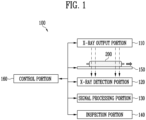
- FIG. 1 shows a diagram for explaining an X-ray inspection device according to one embodiment of the present disclosure.
- an X-ray inspection device 100 may include an X-ray output portion 110, an X-ray detection portion 120, a signal processing portion 130, and an inspection portion 140.
- An X-ray output portion 110 may generate X-rays.
- X-rays may be electromagnetic waves that have the property of transmitting an object.
- X-rays may be electromagnetic waves with a wavelength of 0.01 to 10 nanometers.
- An X-ray output portion 110 may radiate X-rays to a battery 200.
- a battery 200 may be a secondary battery that may be reused through charging even after being discharged.
- a battery 200 may be a lithium ion battery.
- a battery 200 may include a plurality of electrode layers and a separator interposed between the plurality of electrode layers.
- a plurality of electrode layers may include at least one anode layer and at least one cathode layer.
- An X-ray output portion 110 may irradiate X-rays in a specific direction.
- a specific direction may be a direction in which a plurality of electrode layers are stacked.
- a specific direction may be a direction perpendicular to a plurality of electrode layers.
- a specific direction may be a direction that passes through all of a plurality of electrode layers.
- an X-ray output portion 110 may be positioned above or below a battery 200.
- an X-ray output portion 110 may include an X-ray tube, a voltage generator, and a current source.
- An X-ray tube may include an anode, a cathode, and a vacuum tube.
- An anode and a cathode may be disposed within a vacuum tube.
- an anode and a cathode may each be implemented as a metal such as tungsten (W), molybdenum (Mo), chromium (Cr), rhenium (Re), copper (Cu), cobalt (Co), iron (Fe), tantalum (Ta), and zirconium (Zr) and nickel (Ni) or alloys thereof.
- An X-ray tube may be of either a closed type, which has a structure in which the inside of a vacuum tube is sealed in a vacuum state, or an open type, which has a structure that maintains a vacuum state inside a vacuum tube when a separate vacuum pump operates.
- the X-ray output portion 110 may further include a vacuum pump.
- a vacuum pump may create a vacuum inside a vacuum tube.
- a current source may generate thermal electrons at an anode by applying a current to heat a filament of the anode.
- a voltage generator may accelerate thermal electrons by applying a high voltage between an anode and a cathode.
- a high voltage may be a voltage in a kV unit.
- the accelerated thermal electrons may collide with a cathode to generate X-rays.
- the generated X-rays may be irradiated to a subject.
- An X-ray detection portion 120 may detect X-rays that have transmitted through a battery 200. To this end, an X-ray detection portion 120 may be positioned in the direction of travel of the X-rays that have transmitted through a battery 200. An X-ray detection portion 120 may acquire a gray value based on intensity of the X-rays that transmitted through a battery 200. For example, an X-ray detection portion 120 may receive X-rays that have transmitted through a battery 200. An X-ray detection portion 120 may acquire a gray value based on the intensity of the received X-rays.
- An X-ray detection portion 120 may include a plurality of pixels. Each of the plurality of pixels may receive X-rays that have transmitted through a corresponding unit area among unit areas of a battery 200. When X-rays are received, each pixel may convert the X-rays to acquire a sensing signal.
- an X-ray detection portion 120 may acquire a gray value using a time delay integration (TDI) method.
- an X-ray detection portion 120 may include a plurality of line scanners.
- a line scanner may include a plurality of pixels arranged in a row or column direction.
- sensing signals acquired by passing X-rays multiple times in one direction through a unit area of a battery 200 may be accumulated.
- the accumulated sensing signals may be treated as one sensing signal for a unit area.
- a clearer image may be acquired by overlapping sensing signals acquired as many as the number of line scanners to create one image.
- an X-ray detection portion 120 may acquire a gray value using a flat panel detection (FPD) method.
- FPD flat panel detection
- an X-ray detection portion 120 may include a plurality of pixels arranged in row and column directions.
- a signal processing portion 130 may acquire an X-ray image.
- An X-ray image may include a plurality of gray values. Each of the plurality of gray values may be arranged along row and column directions within the X-ray image.
- a signal processing portion 130 may receive gray values from an X-ray detection portion 120 and acquire an X-ray image including the received gray values. For example, when gray values in line units (or area units) are received from an X-ray detection portion 120, a signal processing portion 130 may arrange currently received gray values in another line (or area) so that the gray values that have already been received may not overlap with their arranged line (or area).
- a signal processing portion 130 may generate an X-ray image including gray values arranged in each line (or area).
- a line may represent one row or one column.
- An area may include a plurality of lines.
- a signal processing portion 130 may acquire a plurality of X-ray images and merge the acquired X-ray images to acquire a final X-ray image.
- a final X-ray image acquired by merging a plurality of X-ray images may have clearer contrast in gray values.
- a plurality of X-ray images acquired by a signal processing portion 130 may be acquired from X-rays of different outputs irradiated from an X-ray output portion 110.
- the output of irradiated X-rays may be adjusted by adjusting the voltage and/or current of an X-ray output portion 110. Since the transmittance of X-rays of different outputs may be different, when X-rays of different outputs are irradiated to a battery 200, images at different depths of the battery 200 may be acquired.
- a signal processing portion 130 may perform preprocessing of an X-ray image. For example, a signal processing portion 130 may convert an X-ray image into a binary image. Specifically, a signal processing portion 130 may compare each of the gray values included in an X-ray image with a reference value and convert each of the gray values into pixel values having one of a first value and a second value. Gray values may be compared to different reference values depending on the area containing the gray values. When a gray value is greater than a corresponding reference value, the gray value may be converted to a first value, and when a gray value is smaller than or equal to a corresponding reference value, the gray value may be converted to a second value. A signal processing portion 130 may acquire a binarized image including pixel values. Accordingly, the detection ability to detect defects such as foreign substances may be improved.
- An inspection portion 140 may detect defects in a battery 200.
- a defect may include at least one of a foreign substance defect, an electrode folding defect, an electrode tearing defect, and an electrode layer number defect.
- a foreign substance defect refers to foreign substances such as electrode pieces and metal parts entering or remaining inside a battery 200.
- An electrode folding defect refers to the presence of at least one electrode layer in a folded state inside a battery 200.
- An electrode layer number defect means that the number of electrode layers included in a completely manufactured battery 200 does not match the designed number.
- An electrode tearing defect refers to a part of an electrode being torn or removed. An area where an electrode tearing defect has occurred may be seen as the number of electrode layers being locally smaller than the designed number. A torn electrode part may enter into another battery 200 as a foreign substance.
- An inspection portion 140 may determine whether a battery 200 is defective based on a comparison result between gray values included in a selected area of an X-ray image and a reference value corresponding to the selected area.
- an inspection portion 140 may determine an area of interest in an X-ray image.
- an area of interest may be an area corresponding to a battery 200 in an X-ray image.
- an inspection portion 140 may determine an area of interest based on a preset pattern included in an X-ray image. For example, an area of interest may be set based on a pattern corresponding to an external outline of a battery 200.
- an inspection portion 140 may determine an area of interest based on a change in a gray value in a preset direction within an X-ray image. For example, straight lines may be drawn in each of the directions from top to bottom, bottom to top, left to right, and right to left on a two-dimensional X-ray image, and an area of interest may be set by finding points where a gray value changes drastically in each direction.
- an inspection portion 140 may set a selected area within an area of interest.
- a corresponding reference value may be set for each area of a battery 200. In another embodiment, a reference value corresponding to an entire area of a battery 200 may be set.
- a reference value may be a predetermined value.
- a reference value may be a value determined using gray values of an X-ray image. In other words, an independent reference value may be applied to each X-ray image.
- an inspection portion 140 may sequentially select areas in an X-ray image. For example, when a selected area is a first area, an inspection portion 140 may compare each of the gray values included in the selected area with a first reference value corresponding to the first area. When a selected area is a second area, an inspection portion 140 may compare each of the gray values included in the selected area with a second reference value corresponding to the second area. When a selected area is a third area, an inspection portion 140 may compare each of the gray values included in the selected area with a third reference value corresponding to the third area.
- an inspection portion 140 may select gray values that are greater than a corresponding reference value among the gray values included in a selected area. An inspection portion 140 may extract gray values adjacent to each other as one object, among the selected gray values. An inspection portion 140 may determine whether a battery 200 is defective based on the size and shape of an object.
- an inspection portion 140 may determine that a battery 200 is defective.
- a reference size may be preset to 2x2, 2x1, 1x2, or the lie.
- an inspection portion 140 may determine the object to be noise. In this case, the inspection portion 140 may not determine that the battery 200 is defective.
- an inspection portion 140 may determine that a battery 200 is defective.
- a reference shape may include at least one selected from a triangular shape, a rectangular shape, a circular shape, a ring shape, and an irregular shape.
- an inspection portion 140 may determine that a battery 200 is defective when an average value of gray values included in a selected area is greater than a reference value corresponding to the selected area. In an embodiment, an inspection portion 140 may determine that a battery 200 is defective when an average value of gray values included in a selected area is greater than an upper error limit of a reference value corresponding to the selected area. This indicates an electrode number defect in which more electrode layers are stacked than the designed number.
- An upper error limit may be a preset value.
- an inspection portion 140 may determine that a battery 200 is defective when an average value of gray values included in a selected area is smaller than a reference value corresponding to the selected area. In an embodiment, an inspection portion 140 may determine that a battery 200 is defective when an average value of gray values included in a selected area is greater than a lower error limit of a reference value corresponding to the selected area. This indicates an electrode number defect in which fewer electrode layers are stacked than the designed number. A lower error limit may be a preset value.
- a reference value may be a value determined using gray values of an X-ray image. In other words, an independent reference value may be applied to each X-ray image.
- an inspection portion 140 may determine an average value of gray values included in a preset area of an X-ray image as a reference value.
- a preset area may be a selected area.
- a preset area may be an entire area corresponding to a battery 200.
- An inspection portion 140 may select gray values that are greater than the corresponding reference value among the gray values included in a selected area.
- An inspection portion 140 may extract gray values adjacent to each other as one object, among the selected gray values.
- An inspection portion 140 may determine whether a battery 200 is defective based on the size and shape of an object. In this way, a defect in a battery 200 may be detected using a reference value optimized for each battery.
- An X-ray inspection device 100 may further include at least one of a transfer portion 150 and a control portion 160.
- a reference value may be a preset value.
- a reference value may be a gray value corresponding to a normal battery.
- a gray value corresponding to a normal battery may be a value acquired by measuring a normal battery in advance.
- a gray value corresponding to a normal battery may be a value acquired by measuring each of gray values corresponding to some components included in a normal battery and then summing the measured gray values.
- some components included in a normal battery may include at least one cathode layer, at least one anode layer, at least one separator, and at least one exterior material layer.
- a gray value corresponding to a normal battery may be acquired by summing gray values corresponding to two or more selected from the group consisting of at least one cathode layer, at least one anode layer, at least one separator, and at least one exterior material layer included in a normal battery.
- a transfer portion 150 may move a battery 200 in a specific direction.
- a specific direction may be a horizontal direction.
- a specific direction may be a direction perpendicular to a direction in which X-rays are irradiated.
- a transfer portion 150 may include a conveyor and a transfer motor.
- a transfer motor may transmit a rotational force to a conveyor. When a rotational force is transmitted to a conveyor, a battery 200 positioned at a specific point on the conveyor may be moved to another point.
- a control portion 160 may control overall operation of an X-ray inspection device 100.
- a control portion 160 may control operation of at least one of an X-ray output portion 110, an X-ray detection portion 120, a signal processing portion 130, an inspection portion 140, and a transfer portion 150.
- a control portion 160 may perform data communication operation or data calculation processing operation.
- a control portion 160 may include a single processor or a plurality of processors.
- the first electronic device is in the form of an X-ray inspection facility
- the second electronic device may be implemented in various forms such as a computer, a laptop computer, a tablet computer, a smartphone, or a mobile device.
- an X-ray inspection device 100 may be implemented as a combination of various electronic devices.
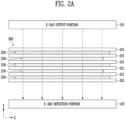
- a battery 200 may include a plurality of electrode layers 220 and 230 and a separator 215.
- a plurality of electrode layers 220 and 230 may include at least one anode layer 220 and at least one cathode layer 230.
- a battery 200 may further include an exterior material layer 210.
- An exterior material layer 210 may seal the interior of a battery 200 and protect the interior of the battery 200 from the external environment.
- the type of battery 200 may be one of various types such as a pouch type, a prismatic type, and a can type.
- a pouch type refers to a form in which electrode layers 220 and 230 and separator 215 stacked in a battery 200 are surrounded with a pouch made of a material such as a film.
- an exterior material layer 210 may include a pouch.
- a prismatic type refers to a form in which a battery 200 is packaged like a rectangular parallelepiped or cube.
- an exterior material layer 210 may be implemented in the form of a rectangular parallelepiped or cube made of a metal material such as aluminum.
- a can type refers to a form in which the battery 200 is packaged like a cylinder.
- an exterior material layer 210 may be implemented as a cylinder made of a metal material such as aluminum.
- a battery 200 may be formed in a layer structure in which a plurality of electrode layers 220 and 230 and a separator 215 are stacked.
- An anode layer 220 and a cathode layer 230 may be alternately stacked along the Z-axis direction, and in this case, a separator 215 may be positioned between the anode layer 220 and the cathode layer 230.
- An exterior material layer 210 is positioned on an outermost side of an anode layer 220, and the interior of a battery 200 may be sealed through the exterior material layer 210.
- An anode layer 220 may include an anode current collector and an anode active material.
- An anode active material may be a material which lithium ions may be inserted to or extracted from.
- an anode active material may be any one of carbon-based materials such as crystalline carbon, amorphous carbon, carbon composite, and carbon fiber, lithium alloy, silicon (Si), and tin (Sn).
- an anode active material may be natural graphite or artificial graphite, but is not limited to a specific example.
- An anode current collector may include, for example, any one of stainless steel, nickel (Ni), aluminum (Al), titanium (Ti), copper (Cu), and alloys thereof, and may be provided in various forms such as film, sheet, and foil.
- a cathode layer 230 may include a cathode current collector and a cathode active material.
- a cathode active material may include a material a material which lithium (Li) ions may be inserted to or extracted from.
- a cathode active material may be a lithium metal oxide.
- a cathode active material may be one of a lithium manganese-based oxide, a lithium nickel-based oxide, a lithium cobalt-based oxide, a lithium nickel manganese-based oxide, a lithium nickel cobalt manganese-based oxide, a lithium nickel cobalt aluminum-based oxide, a lithium iron phosphate-based compound, a lithium manganese phosphate-based compound, a lithium cobalt phosphate-based compound, and a lithium vanadium phosphate-based compound, but is not necessarily limited to a specific example.
- a cathode current collector may include, for example, any one of stainless steel, nickel (Ni), aluminum (Al), titanium (Ti), copper (Cu), and alloys thereof, and may be provided in various forms such as film, sheet, and foil.
- each of an anode layer 220 and a cathode layer 230 may further include a binder and a conductive material.
- a binder mediates bonding between a current collector and an active material layer, thereby improving mechanical stability.
- a conductive materials may improve electrical conductivity.
- a conductive material may include a metal-based material.
- a separator 215 may include a porous polymer film or a porous non-woven fabric.
- a porous polymer film may be formed as a single layer or a multiple layer including a polyolefin-based polymer such as an ethylene polymer, a propylene polymer, an ethylene/butene copolymer, an ethylene/hexene copolymer, and an ethylene/methacrylate copolymer.
- a porous nonwoven fabric may include at least one of high-melting point glass fibers, polyethylene terephthalate fibers, and a highly heat-resistant separator including ceramic (ceramic coated separator; CCS).
- a battery 200 may further include an electrolyte.
- An electrolyte may refer to a material functioning as a mediator that helps the migration of ions such as lithium ions.
- each of an anode layer 220, a cathode layer 230, and a separator 215 may be modified in various ways.
- an X-ray output portion 110 may radiate X-rays in a direction in which a plurality of electrode layers 220 and 230 are stacked.
- a direction in which the plurality of electrode layers 220 and 230 are stacked may be the Z-axis direction.
- an X-ray output portion 110 and an X-ray detection portion 120 may be positioned to face each other, and a battery 200 may be positioned between an X-ray output portion 110 and an X-ray detection portion 120.
- the battery 200 may include a plurality of electrode layers 220 and 230 stacked in the Z-axis direction.
- the X-ray output portion 110 may irradiate X-rays in the Z-axis direction within an error range.
- an X-ray output portion 110 may be position at the top of a battery 200, and an X-ray detection portion 120 may be position at the bottom of the battery 200.
- an X-ray output portion 110 may be position at the bottom of a battery 200, and an X-ray detection portion 120 may be position at the top of the battery 200.
- Each of an X-ray output portion 110 and an X-ray detection portion 120 may be positioned to contact or not contact a battery 200.
- an X-ray detection portion 120 may receive X-rays that have transmitted through a battery 200.
- An X-ray detection portion 120 may acquire a gray value based on the intensity of X-rays that have transmitted through a battery 200.
- FIG. 2B shows a floor plan of a battery according to one embodiment of the present disclosure.
- a battery 200 may include a plurality of areas 210H to 230H.
- a plurality of areas 210H to 230H may be areas on the XY-plane perpendicular to the Z-axis.
- a plurality of areas 210H to 230H may include a first battery area 210H, a second battery area 220H, and a third battery area 230H.
- a first battery area 210H may be an area where a separator 215 is stacked, excluding a second battery area 220H and a third battery area 230H.
- a first battery area 210H may be an area between a boundary of a separator 215 and a boundary of an anode layer 220 on the XY-plane.
- a second battery area 220H may be an area where an anode layer 220 and a separator 215 are stacked together, excluding a third battery area 230H.
- a second battery area 220H may be an area between a boundary of an anode layer 220 and a boundary of a cathode layer 230 on the XY-plane.
- a third battery area 230H may be an area where a cathode layer 230, an anode layer 220, and a separator 215 are stacked together.
- a third battery area 230H may be an area inside a boundary of a cathode layer 230 on the XY-plane.
- the size of an anode layer 220 may be larger than the size of a cathode layer 230. In one embodiment, the size of a separator 215 may be larger than the size of an anode layer 220.
- the size may represent the length in the X-axis direction and the length in the Y-axis direction. As another example, the size may be the area on the XY-plane.
- an X-ray detection portion 120 may use the TDI method.
- a battery 200 may be moved in the X-axis direction while the positions of an X-ray output portion 110 and an X-ray detection portion 120 are fixed.
- the X-ray output portion 110 may irradiate X-rays to the battery 200, and the X-ray detection portion 120 may detect X-rays that have transmitted through the battery 200.
- an X-ray output portion 110 and an X-ray detection portion 120 may be moved in the X-axis direction.
- the X-ray output portion 110 and the X-ray detection portion 120 may irradiate X-rays to the battery 200, and the X-ray detection portion 120 may detect X-rays that have transmitted through the battery 200. Specific details will be described with reference to FIGS. 3 , 4A to 4C , and 5A to 5C .
- FIG. 3 shows a diagram for explaining an X-ray detection portion according to one embodiment of the present disclosure.
- an X-ray detection portion 120 may include a plurality of line scanners 120-1 to 120-3.
- Each of the plurality of line scanners 120-1 to 120-3 may include a plurality of pixels.
- each line scanner 120-1 to 120-3 may include a plurality of pixels arranged in the form of a line along the Y-axis direction.
- each line scanner 120-1 to 120-3 may include pixels arranged in 1 x n.
- n is a natural number.
- a pixel 121 may detect transmitted X-rays that have transmitted through a unit area of a battery 200 and acquire a sensing signal for the transmitted X-rays.
- a sensing signal may be charge, current, or voltage.
- the level of a sensing signal may indicate the intensity of transmitted X-rays.
- a pixel 121 may correspond to a unit area of a battery 200.
- the level of a sensing signal may be inversely proportional to the intensity of X-rays. For example, the lower the intensity of X-rays, a sensing signal of a higher level may be acquired. In another embodiment, the level of a sensing signal may be proportional to the intensity of X-rays.
- a pixel 121 may include a photo-conductor that directly converts X-rays into electrical signals.
- a pixel 121 may include a scintillator that converts X-rays into visible light and a photo-diode that converts visible light into an electrical signal.
- an X-ray detection portion 120 may include a pixel calculation portion.
- the pixel calculation portion may receive a sensing signal and acquire a gray value corresponding to the level of the sensing signal.
- a pixel operation portion may include an analog-to-digital converter that converts an analog signal into a digital signal.
- a plurality of line scanners 120-1 to 120-3 may be arranged along the X-axis direction.
- a plurality of line scanners 120-1 to 120-3 may include a first line scanner 120-1, a second line scanner 120-2, and a third line scanner 130-3.
- a pixel of a first line scanner 120-1 may transmit an acquired sensing signal to a corresponding pixel of a second line scanner 120-2
- a pixel of the second line scanner 120-2 may transmit an acquired sensing signal to a corresponding pixel of a third line scanner 120-3
- a pixel of the third line scanner 120-3 may transmit a final sensing signal to a pixel calculation portion. Specific details will be described with reference to FIGS. 4A to 4C .
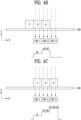
- FIGS. 4A to 4C show diagrams for explaining sensing operation of a line scanner according to one embodiment of the present disclosure.
- FIGS. 4A to 4C briefly show a part of a battery 200 and a plurality of line scanners 120-1 to 120-3 on the XZ-plane, assuming that these are at the same position on the Y-axis.
- a plurality of line scanners 120-1 to 120-3 may be arranged along the X-axis direction.
- Unit areas A to C of a battery 200 may be moved in the X-axis direction by a transfer portion 150.
- a first unit area A of a battery 200 may be positioned at the top of a pixel of a first line scanner 120-1.
- the pixel of the first line scanner 120-1 may receive X-rays that have transmitted through the first unit area A of the battery and acquire a first sensing signal a1 for the transmitted X-rays.
- the pixel of the first line scanner 120-1 may transmit the first sensing signal a1 to a pixel of a second line scanner 120-2 and be reset.
- the battery 200 may move in the X-axis direction so that the first unit area A of the battery 200 is positioned at the top of the pixel of the second line scanner 120-2.
- the pixel of the second line scanner 120-2 may acquire a second sensing signal a1+a2 formed by merging the first sensing signal a1 received from the first line scanner 120-1 and a sensing signal a2 for transmitted X-rays that have transmitted through the first unit area A of the battery 200.
- the pixel of the second line scanner 120-2 may transmit the second sensing signal a1+a2 to a pixel of a third line scanner 120-3 and be reset.
- a battery 200 may move in the X-axis direction so that the first unit area A of the battery 200 is positioned at the top of the third pixel of the third line scanner 120-3.
- the pixel of the third line scanner 120-3 may acquire, as a final sensing signal, a third sensing signal a1+a2+a3 formed by merging the second sensing signal a1+a2 received from the second line scanner 120-2 and a sensing signal a3 for transmitted X-rays that have transmitted through the first unit area A of the battery 200.
- the final sensing signal may be a signal in which the sensing signals a1, a2, and a3, each acquired by the first line scanner 120-1, the second line scanner 120-2, and the third line scanner 120-3, are accumulated (or overlapped).
- the pixel of the third line scanner 120-3 may transmit the final sensing signal to a pixel calculation portion and be reset.
- a pixel calculation portion may process a value corresponding to the level of a final sensing signal in which sensing signals for a first unit area A are accumulated as a gray value corresponding to the first unit area A among a plurality of gray values.
- a pixel calculation portion may receive a final sensing signal for a first unit area A from a pixel of a third line scanner 120-3.
- a pixel calculation portion may process a value obtained by converting a final sensing signal into a digital signal, as a gray value corresponding to a first unit area A.
- an X-ray detection portion 120 may acquire a gray value corresponding to each unit area A, B, and C.
- a signal processing portion 130 may receive gray values corresponding to unit areas A, B, and C from an X-ray detection portion 120 and acquire an X-ray image including the received gray values.
- An X-ray image according to the present disclosure has an effect of merging multiple images taken multiple times, and as a result, the contrast difference among different areas may be maximized, thereby improving the detection ability to detect foreign substances.
- an X-ray inspection device 100 may be more rapidly than a method in which X-rays are irradiated in multiple directions in a rotational manner and may acquire an X-ray image with maximized contrast differences by using the TDI method. Accordingly, an X-ray inspection device 100 according to one embodiment of the present disclosure may accurately detect foreign substances and detect low-density metal foreign substances.
- the number of the above-described line scanners 120-1 to 120-3 may be varied in various ways.
- the above-described line scanners 120-1 to 120-3 have been described as including pixels arranged in 1 x n, but are not limited thereto, and they may be modified in various ways, such as including pixels arranged in m x n.
- m and n are natural numbers.
- a transfer portion 150 may move a battery 200 in the X-axis direction as far as a distance corresponding to m pixels per unit time.
- FIGS. 5A , 5B , and 5C show diagrams for explaining an X-ray detection portion according to another embodiment of the present disclosure.
- an X-ray detection portion 120 may include a flat panel detector.
- a flat panel detector may include a pixel array including a plurality of pixels.
- a pixel array may include pixels arranged in m x n.
- Pixels may each detect transmitted X-rays that have transmitted through a unit area of a battery 200 and acquire a sensing signal for the transmitted X-rays.
- a sensing signal may be charge, current, or voltage.
- the level of a sensing signal may indicate the intensity of transmitted X-rays.
- Pixels may correspond to a unit area of a battery 200.
- the level of a sensing signal may be inversely proportional to the intensity of X-rays. For example, the lower the intensity of X-rays, a sensing signal of a higher level may be acquired. In another embodiment, the level of a sensing signal may be proportional to the intensity of X-rays.
- pixels may include a photo-conductor that directly converts X-rays into electrical signals.
- pixels may include a scintillator that converts X-rays into visible light and a photo-diode that converts visible light into an electrical signal.
- an X-ray detection portion 120 may include a pixel calculation portion.
- the pixel calculation portion may receive a sensing signal and acquire a gray value corresponding to the level of the sensing signal.
- a pixel operation portion may include an analog-to-digital converter that converts an analog signal into a digital signal.
- a first length L1 of a flat panel detector may be shorter than the length L cell in a tab protrusion direction of a battery 200.
- an image for an entire battery 200 may be acquired by acquiring images of the battery 200 multiple times while moving the battery 200 in one direction using a transfer portion.
- an X-ray image of a battery 200 may be obtained by merging a plurality of images acquired while moving the battery 200.
- a first length L1 of a flat panel detector may be longer than a length L cell in a tab protrusion direction of a battery 200.
- a first length L1 of a flat panel detector may be longer than a second length L2 of the flat panel detector.
- a first length L1 and a second length L2 of a flat panel detector may be optimized to fit the shape of a battery 200, and as an X-ray imaging area is thereby increased, an image of the entire battery 200 may be acquired without moving the battery 200. In other words, the number of time of measurement and the measurement time required to acquire an X-ray image of an entire battery 200 may be reduced.
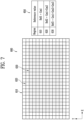
- FIG. 6 shows a diagram for explaining an X-ray image according to one embodiment of the present disclosure.
- an X-ray image 500 may include a plurality of gray values.
- An X-ray image 500 may be generated by a signal processing portion 130.
- Gray values 51 may be arranged according to row and column directions.
- a column direction may be the X-axis direction, and a row direction may be the Y-axis direction.
- the number of gray values 51 included in one column line 50 may be equal to the number of pixels included in one line scanner.
- gray values included in an X-ray image 500 may each correspond to pixels included in a flat panel detector.
- An X-ray image 500 may include a plurality of areas 510 to 530.
- a plurality of areas 510 to 530 may include a first area 510, a second area 520, and a third area 530.
- Each area 510 to 530 may include a plurality of gray values. In other words, each area 510 to 530 may be a set of gray values positioned at different positions.
- a first area 510 may represent a first battery area 210H remaining after excluding a third battery area 230H and a second battery area 220H, among areas in a battery 200 where a separator 215 is stacked.
- a first area 510 may include gray values acquired by detecting X-rays that have transmitted through a first battery area 210H.
- a second area 520 may represent a second battery area 220H remaining after excluding a third battery area 230H, among areas in a battery 200 where an anode layer 220 and a separator 215 are stacked together.
- a second area 520 may include gray values acquired by detecting X-rays that have transmitted through a second battery area 220H.
- a third area 530 may represent a third battery area 230H where a cathode layer 230, an anode layer 220, and a separator 215 are stacked together in a battery 200.
- a third area 530 may include gray values acquired by detecting X-rays that have transmitted through a third battery area 230H.
- FIG. 7 shows a diagram for explaining a reference value according to one embodiment of the present disclosure.
- an inspection portion 140 may compare gray values included in a selected area in an X-ray image 600 with a reference value corresponding to the selected area.
- An X-ray image 600 may include a plurality of areas 610 to 630.
- a plurality of areas 610 to 630 may include a first area 610 to a third area 630.
- a first area 610 may include gray values acquired by detecting X-rays that have transmitted through a first battery area 210H.
- a second area 620 may include gray values acquired by detecting X-rays that have transmitted through a second battery area 220H.
- a third area 630 may include gray values acquired by detecting X-rays that have transmitted through a third battery area 230H.
- an inspection portion 140 may compare each of gray values included in a first area 610 with a first reference value Ref1 corresponding to the first area 610. An inspection portion 140 may select gray values that are greater than a corresponding first reference value Ref1 among gray values included in a first area 610. An inspection portion 140 may extract gray values adjacent to each other among selected gray values as one object. An inspection portion 140 may determine whether a battery 200 is defective based on the size and shape of an object.
- an inspection portion 140 may compare each of gray values included in a second area 620 with a second reference value Ref2 corresponding to the second area 620. An inspection portion 140 may select gray values that are greater than a corresponding second reference value Ref2 among gray values included in a second area 620. An inspection portion 140 may extract gray values adjacent to each other among selected gray values as one object. An inspection portion 140 may determine whether a battery 200 is defective based on the size and shape of an object.
- an inspection portion 140 may compare each of gray values included in a third area 630 with a third reference value Ref3 corresponding to the third area 630. An inspection portion 140 may select gray values that are greater than a corresponding third reference value Ref3 among gray values included in a third area. An inspection portion 140 may extract gray values adjacent to each other among selected gray values as one object. An inspection portion 140 may determine whether a battery 200 is defective based on the size and shape of an object.
- an inspection portion 140 may select gray values that are greater than a corresponding reference value among gray values included in a selected area. An inspection portion 140 may extract gray values adjacent to each other among selected gray values as one object. An inspection portion 140 may determine whether a battery 200 is defective based on the size and shape of an object.
- an inspection portion 140 may determine that a battery 200 is defective.
- a reference size may be preset to 2x2, 2x1, 1x2, or the like.
- an inspection portion 140 may determine the object to be noise. In this case, the inspection portion 140 may not determine that the battery 200 is defective.
- an inspection portion 140 may determine that a battery 200 is defective.
- the shape may be a connection of gray values greater than a corresponding reference value.
- a reference shape may include at least one selected from a triangular shape, a rectangular shape, a circular shape, a ring shape, and an irregular shape.
- an X-ray inspection device 100 may further include a memory.
- a memory is a component storing data.
- a memory may be implemented as a nonvolatile memory, but is not limited thereto, and it may be implemented by being transformed into a volatile memory.
- a memory may store a plurality of reference values Ref1 to Ref3.
- a plurality of reference values Ref1 to Ref3 may respectively correspond to a plurality of areas 610 to 630.
- a memory may store table information 650 indicating the correspondence between reference values and areas.
- An inspection portion 140 may determine one area of a plurality of areas 610 to 630 as a selected area. An inspection portion 140 may compare a reference value corresponding to a selected area among a plurality of reference values Ref1 to Ref3 stored in a memory with a gray value included in the selected area.
- each of a plurality of reference values Ref1 to Ref3 may be a predetermined value based on at least one of the type, number, and density of materials included in each area 610 to 630.
- a first reference value Ref1 may be a predetermined value based on the number of separators 215.
- a second reference value Ref2 may be a predetermined value based on the number of separators 215 and the number of anode layers 220.
- a third reference value Ref3 may be a predetermined value based on the number of separators 215 and the numbers of anode layers 220 and cathode layers 230.
- FIGS. 8A to 8C show diagrams for explaining a method of calculating a reference value according to one embodiment of the present disclosure.
- a first reference value Ref1 may be the same as a first gray value Gm 1.
- a first gray value Gm 1 may be acquired by detecting X-rays that have transmitted through a separator 215.
- an X-ray output portion 110 may irradiate X-rays toward a separator 215.
- the number of separators 215 may be the same as that included in a battery 200.
- an X-ray detection portion 120 may detect the X-rays that have transmitted through the separator 215 and acquire gray values.
- a signal processing portion 130 may acquire a first X-ray image 700-1 including gray values.
- a signal processing portion 130 may acquire an average value of gray values included in an area 710 corresponding to a separator 215 in a first X-ray image 700-1 as a first gray value Gm1.
- a separator 215 is used as an example, but a first gray value Gm1 may be acquired by detecting X-rays that have transmitted through a separator 215 and an exterior material layer 210.
- a second reference value Ref2 may be the sum of a first gray value Gm1 and a second gray value Gm2.
- a second gray value Gm2 may be acquired by detecting X-rays that have transmitted through an anode layer 220.
- an X-ray output portion 110 may irradiate X-rays toward at least one anode layer 220.
- the number of anode layers 220 may be the same as that included in a battery 200.
- an X-ray detection portion 120 may detect the X-rays that have transmitted through the anode layer 220 and acquire gray values.
- a signal processing portion 130 may acquire a second X-ray image 700-2 including gray values.
- a signal processing portion 130 may acquire an average value of gray values included in an area 720 corresponding to an anode layer 220 in a second X-ray image 700-2 as a second gray value Gm2.
- a third reference value Ref3 may be the sum of a first gray value Gm 1, a second gray value Gm2, and a third gray value Gm3.
- a third gray value Gm3 may be acquired by detecting X-rays that have transmitted through a cathode layer 230.
- an X-ray output portion 110 may irradiate X-rays toward at least one cathode layer 230.
- the number of cathode layers 230 may be the same as that included in a battery 200.
- an X-ray detection portion 120 may detect the X-rays that have transmitted through the cathode layer 230 and acquire gray values.
- a signal processing portion 130 may acquire a third X-ray image 700-3 including gray values.
- a signal processing portion 130 may acquire an average value of gray values included in an area 730 corresponding to a cathode layer 230 in a third X-ray image 700-3 as a third gray value Gm3.
- FIG. 9 shows a diagram for explaining a method of calculating a reference value according to another embodiment of the present disclosure.
- a first reference value Ref1, a second reference value (Ref2), and a third reference value Ref3 may be calculated as gray values acquired by irradiating X-rays to a normal battery 200'.
- a normal battery 200' may be, for example, a battery including a preset number of cathode layers 230, anode layers 220, separators 215, and exterior material layers 210.
- a preset number may mean the number of cathode layers 230, anode layers 220, separators 215, and exterior material layers 210 that are determined to be normal.
- an X-ray image 600' corresponding to a normal battery 200' may be acquired.
- An X-ray image 600' may include a plurality of areas 610' to 630'.
- a plurality of areas 610' to 630' may include a first area 610' to a third area 630'.
- the second area 620' may include gray values acquired by detecting X-rays that have transmitted through a second battery area 220H of a normal battery 200'.
- a second reference value Ref2 may be set based on gray values acquired by detecting X-rays that have transmitted through a second battery area 220H of a normal battery 200'. For example, an average value Gm2' of gray values acquired by detecting X-rays that have transmitted through a second battery area 220H of a normal battery 200' may be set as a second reference value Ref2.
- the third area 630' may include gray values acquired by detecting X-rays that have transmitted through a third battery area 230H of a normal battery 200'.
- a third reference value Ref3 may be set based on gray values acquired by detecting X-rays that have transmitted through a third battery area 230H of a normal battery 200'. For example, an average value Gm3' of gray values acquired by detecting X-rays that have transmitted through a third battery area 230H of a normal battery 200' may be set as a third reference value Ref3.
- an X-ray inspection device 100 may further include a memory.
- a memory is a component storing data.
- a memory may be implemented as a nonvolatile memory, but is not limited thereto, and it may be implemented by being transformed into a volatile memory.
- a memory may store a plurality of reference values Ref1 to Ref3.
- a plurality of reference values Ref1 to Ref3 may respectively correspond to a plurality of areas 610' to 630'.
- a memory may store table information 650' indicating the correspondence between reference values and areas.
- An inspection portion may compare a gray value acquired by radiating X-rays to a battery 200 to be inspected with a first reference value Ref1, a second reference value Ref2, and a third reference value Ref3 set as described above 140 to determine whether the battery 200 to be inspected is defective. For example, it is possible to determine a stack number defect of a cathode layer 230, an anode layer 220, a separator 215, and/or an exterior material layer 210.
- FIG. 10 shows a diagram for explaining a battery defect according to one embodiment of the present disclosure.
- a foreign substance 811 may be present inside a first battery 810.
- An X-ray inspection device 100 may irradiate X-rays a the first battery 810.
- An X-ray inspection device 100 may detect X-rays that have transmitted through a first battery 810 and acquire a first X-ray image 820.
- a first X-ray image 820 may include a plurality of gray values.
- a gray value may represent the intensity of X-rays that transmitted through a first battery 810.
- the intensity of X-rays that have transmitted through an area where a foreign substance 811 is present may be lower than the intensity of X-rays that transmitted through a surrounding area.
- gray values included in an area 821 of the first X-ray image 820 corresponding to the foreign substance 811 may have larger values than gray values included in the surrounding area.
- An X-ray inspection device 100 may acquire a first binarized image 830 by comparing a gray value of a first X-ray image 820 with a corresponding reference value.
- a binarized image 830 may include a plurality of pixel values. Each of a plurality of pixel values may have one of a first value and a second value. Each pixel value may be a result of comparing each gray value with a corresponding reference value, and each gray value may be converted to one value of a first value and a second value.
- the gray value when a gray value is greater than a corresponding reference value, the gray value may be converted to a pixel value of a first value, and when a gray value is smaller than or equal to a corresponding reference value, the gray value may be converted to a pixel value of a second value.
- a first value may be a value of 0, and a second value may be a value of 255. The lower a pixel value, the darker.
- gray values of an area 821 corresponding to a foreign substance 811 may be greater than a reference value.
- the corresponding gray values may be converted to pixel values of a first value.
- An X-ray inspection device 100 may identify adjacent pixel values among pixel values of a first value included in a first binarized image 830 as one object 831.
- An X-ray inspection device 100 may determine there is a foreign substance defect in a battery 200 when the size of an object 831 is larger than a reference size. In this case, the battery 200 may be classified as defective and removed. An X-ray inspection device 100 may determine that a battery 200 is normal when the size of an object 831 is smaller than or equal to a reference size and no other defects are present. In this case, the battery 200 may be classified as normal.
- An X-ray inspection device 100 may acquire a second binarized image 860 by comparing a gray value of a second X-ray image 850 with a corresponding reference value.
- a second binarized image 860 may include a plurality of pixel values. Each of a plurality of pixel values may have one of a first value and a second value.
- gray values of an area 851 corresponding to an electrode layer 831 in a folded state may be greater than a reference value.
- the corresponding gray values may be converted to pixel values of a first value.
- An X-ray inspection device 100 may identify adjacent pixel values among the pixel values of a first value included in a second binarized image 860 as one object 861.
- an X-ray inspection device 100 may determine that a battery 200 is defective when the shape of an object 861 is a reference shape.
- a reference shape may be one or more selected from a triangular shape, a rectangular shape, a circular shape, a ring shape, and an irregular shape.
- an X-ray inspection device 100 may determine that a battery 200 is defective when the shape of an object 861 is the reference shape and the size of the object 861 is larger than or equal to the reference size.
- an X-ray inspection device 100 may further include at least one of a display, a speaker, and a communication portion. For example, when an X-ray inspection device 100 determines that a battery 200 is defective, it may display information indicating that the battery 200 is defective on a display. For example, when an X-ray inspection device 100 determines that a battery 200 is defective, it may output information indicating that the battery 200 is defective through a speaker. For example, when an X-ray inspection device 100 determines that a battery 200 is defective, it may transmit information indicating that the battery 200 is defective to another electronic device through a communication portion.
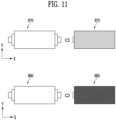
- FIG. 11 shows a diagram for explaining a battery defect according to another embodiment of the present disclosure.
- FIG. 11 it shows a first battery 870 according to another embodiment in which the number of stacked cathode layers and anode layers is normal, and a second battery 880 in which the number of stacked cathode layers and anode layers is defective.
- an X-ray inspection device 100 may irradiate X-rays to a first battery 870.
- An X-ray inspection device 100 may detect X-rays that have transmitted through a first battery 870 and acquire a first X-ray image 875.
- a first X-ray image 875 may include a plurality of gray values.
- a gray value may represent the intensity of X-rays that have transmitted through a first battery 870.
- An average value of gray values included in a selected area in a first X-ray image 875 may be a value within a preset range from a reference value.
- an average value of gray values included in a selected area in a first X-ray image 875 may be smaller than an upper error limit of a reference value and greater than a lower error limit of the reference value. Accordingly, the number of stacked cathode layers and anode layers of a first battery 870 may be determined to be normal.
- an X-ray inspection device 100 may irradiate X-rays to a second battery 880.
- An X-ray inspection device 100 may detect X-rays that have transmitted through a second battery 880 and acquire a second X-ray image 885.
- a second X-ray image 885 may include a plurality of gray values.
- a gray value may represent the intensity of X-rays that have transmitted through a second battery 880.
- An average value of gray values included in a selected area in a second X-ray image 885 may be out of a preset range from a reference value.
- an average value of gray values included in a selected area in a second X-ray image 885 may be greater than an upper error limit of a reference value or smaller than a lower error limit of the reference value. Accordingly, the number of stacked cathode layers and/or anode layers of a second battery 880 may be determined to be defective.
- the number of stacked cathode layers and/or anode layers may be greater than a normal number.
- the number of stacked cathode layers and/or anode layers may be smaller than a normal number.
- FIG. 11 when determining whether a battery is defective, it is explained based on the number of stacked cathode layers and anode layers, but it is not limited thereto, and whether the number of stacks of other components included in a battery, such as a separator and an exterior material layer, is defective may also be considered.
- a reference value may be determined as the sum of gray values of each component included in a battery, as described with reference to FIGS. 8A to 8C .
- a reference value may be a gray value acquired by simultaneously measuring all components of a normal battery, as described in FIG. 9 .
- FIG. 12 shows a diagram for explaining an X-ray inspection method according to one embodiment of the present disclosure.
- an X-ray inspection method of an X-ray inspection device 100 may include a step 910 of irradiating X-rays to a battery 200; a step 920 of acquiring a plurality of gray values based on transmitted X-rays from the battery 200; a step 930 of acquiring an X-ray image including the plurality of gray values; and a step 940 of determining whether the battery 200 is defective by comparing each of the gray values included in the selected area of the X-ray image with a reference value corresponding to the selected area.
- X-rays may be irradiated to a battery 200 (910).
- a battery 200 may include a plurality of electrode layers 220 and 230 and a separator 215 interposed between the plurality of electrode layers 220 and 230.
- the X-rays may be irradiated in a direction in which the plurality of electrode layers 220 and 230 are stacked.
- a direction in which a plurality of electrode layers 220 and 230 are stacked may be the Z-axis direction.
- a plurality of gray values may be acquired based on X-rays that have transmitted from a battery 200 (920). By detecting transmitted X-rays that have transmitted through a unit area of a battery 200, a gray value may be acquired.
- a gray value may represent the intensity of transmitted X-rays.
- a gray value may be a value corresponding to the level of a sensing signal acquired through one pixel. For example, when the FPD method is used, sensing signals each acquired by a plurality of pixels may correspond to gray values.
- a gray value may be a value corresponding to the level of a final sensing signal accumulated from sensing signals acquired through multiple pixels according to the TDI method.
- an X-ray image including a plurality of gray values may be acquired (930).
- An X-ray image may include a plurality of gray values arranged in row and column directions.
- a plurality of gray values may be arranged in p x q.
- p and q are natural numbers.
- the step 930 of acquiring an X-ray image may include: a step of acquiring a plurality of X-ray images based on X-rays irradiated multiple times; and a step of merging the plurality of X-ray images.
- X-rays irradiated multiple times may each have the same output or different outputs.
- each of gray values included in a selected area of an X-ray image may be compared with a reference value corresponding to the selected area to determine whether a battery 200 is defective (940).
- a defect in a battery 200 may be one of a foreign substance defect, an electrode folding defect, and an electrode layer number defect.
- a first reference value corresponding to a first area representing an area where a cathode layer 230, an anode layer 220, and a separator 215 are stacked together and a second reference value corresponding to a second area where an anode layer 220 and a separator 215 are stacked together may be stored.
- a selected area may be one area of a first area and a second area.
- a first reference value may be greater than a second reference value.
- a first area may be an area representing an area where a cathode layer 230, an anode layer 220, and a separator 215 are stacked together.
- the second area may be an area where an anode layer 220 and a separator 215 are stacked together and may represent an area excluding an area where a cathode layer 230, an anode layer 220, and a separator 215 are stacked together.
- a first reference value and a second reference value may be stored in a memory.
- a first reference value may be a predetermined value based on the number of cathode layers 230, the number of anode layers 220, and the number of separators 215.
- a second reference value may be a predetermined value based on the number of anode layers 220 and the number of separators 215.
- a first reference value and a second reference value may be acquired by measuring gray values corresponding to each of a cathode layer 230, an anode layer 220, and a separator 215 and then combining them.
- a first reference value a second reference value may be acquired by measuring gray value for a normal battery in which a cathode layer 230, an anode layer 220, and a separator 215 are stacked in a preset number.
- a gray value greater than a reference value corresponding to a selected area may be selected from among gray values included in the selected area. Adjacent pixel values among selected gray values may be extracted as objects. Whether a battery 200 is defective may be determined based on the shape and size of an object.
- a step of determining whether a battery 200 is defective may include: a step of converting a gray value greater than a reference value corresponding to the selected area among the gray values included in the selected area into a pixel value of a first value and converting a gray value smaller than or equal to the reference value corresponding to the selected area into a pixel value of a second value; and a step of acquiring a binarized image including the pixel value of the first value and the pixel of the second value.
- the step of determining whether the battery is defective may include: a step of extracting adjacent pixel values as an object among pixel values of a first value included in the binarized image; and a step of determining whether the battery is defective based on one or more selected from the group consisting of shape and size of the object.
- the battery 200 in the step of determining whether a battery 200 is defective, when the size of an object is larger than a reference size, the battery 200 may be determined to be defective.
- a reference size may be a preset value, and for example, a reference size may be set to 2x2, 1x2, 2x1, or the like. Information about a reference size may be stored in a memory.
- a reference shape may include at least one of a triangular shape, a rectangular shape, a circular shape, and a ring shape. Information about a reference shape may be stored in a memory.
- an average value of pixel values included in a selected area may be compared with a reference value corresponding to the selected area to determine whether the battery 200 is defective. In this case, when the average value is greater than the reference value corresponding to the selected area, the battery 200 may be determined to be defective.
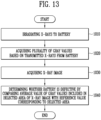
- FIG. 13 shows a diagram for explaining an X-ray inspection method according to one embodiment of the present disclosure.
- an X-ray inspection method of an X-ray inspection device 100 may include: a step 1010 of irradiating X-rays to a battery 200; a step 1020 of acquiring a plurality of gray values based on transmitted X-rays from the battery 200; a step 1030 of acquiring an X-ray image including the plurality of gray values; and a step 1040 of determining whether the battery is defective by comparing an average value of the gray values included in the selected area of the X-ray image with a reference value corresponding to the selected area.
- a first reference value corresponding to a first area representing an area where a cathode layer 230, an anode layer 220, and a separator 215 are stacked together and a second reference value corresponding to a second area where an anode layer 220 and a separator 215 are stacked together may be stored.
- one area of the first area and the second area may be determined as the selected area, and the battery may be determined to be defective when the average value is greater or smaller than the reference value corresponding to the area among the first reference value and the second reference value.
Landscapes
- Chemical & Material Sciences (AREA)
- Health & Medical Sciences (AREA)
- General Physics & Mathematics (AREA)
- Analytical Chemistry (AREA)
- Pathology (AREA)
- Immunology (AREA)
- Physics & Mathematics (AREA)
- General Health & Medical Sciences (AREA)
- Life Sciences & Earth Sciences (AREA)
- Biochemistry (AREA)
- Chemical Kinetics & Catalysis (AREA)
- Manufacturing & Machinery (AREA)
- Engineering & Computer Science (AREA)
- General Chemical & Material Sciences (AREA)
- Electrochemistry (AREA)
- Toxicology (AREA)
- Analysing Materials By The Use Of Radiation (AREA)
Applications Claiming Priority (2)
| Application Number | Priority Date | Filing Date | Title |
|---|---|---|---|
| KR20220027741 | 2022-03-03 | ||
| PCT/KR2023/002964 WO2023167555A1 (fr) | 2022-03-03 | 2023-03-03 | Dispositif d'inspection par rayons x et procédé d'inspection par rayons x |
Publications (2)
| Publication Number | Publication Date |
|---|---|
| EP4488667A1 true EP4488667A1 (fr) | 2025-01-08 |
| EP4488667A4 EP4488667A4 (fr) | 2026-01-14 |
Family
ID=88020041
Family Applications (1)
| Application Number | Title | Priority Date | Filing Date |
|---|---|---|---|
| EP23763753.3A Pending EP4488667A4 (fr) | 2022-03-03 | 2023-03-03 | Dispositif d'inspection par rayons x et procédé d'inspection par rayons x |
Country Status (3)
| Country | Link |
|---|---|
| EP (1) | EP4488667A4 (fr) |
| KR (1) | KR20230130578A (fr) |
| CN (1) | CN118843788A (fr) |
Cited By (2)
| Publication number | Priority date | Publication date | Assignee | Title |
|---|---|---|---|---|
| CN119887781A (zh) * | 2025-03-28 | 2025-04-25 | 宁波新容电器科技有限公司 | 一种薄膜电容器的检测方法、装置、设备和介质 |
| CN120314339A (zh) * | 2025-06-12 | 2025-07-15 | 中国电子产品可靠性与环境试验研究所((工业和信息化部电子第五研究所)(中国赛宝实验室)) | 基于x射线无损分析的电池检测方法、装置、设备、存储介质和程序产品 |
Families Citing this family (1)
| Publication number | Priority date | Publication date | Assignee | Title |
|---|---|---|---|---|
| CN118566266B (zh) * | 2024-08-01 | 2024-10-01 | 中铁电气化铁路运营管理有限公司 | 基于x射线的供电设备内部缺陷无损检测方法及系统 |
Family Cites Families (1)
| Publication number | Priority date | Publication date | Assignee | Title |
|---|---|---|---|---|
| JP4233826B2 (ja) * | 2001-08-10 | 2009-03-04 | パナソニック株式会社 | コイン形電池とその製造方法 |
-
2023
- 2023-03-03 CN CN202380025265.4A patent/CN118843788A/zh active Pending
- 2023-03-03 EP EP23763753.3A patent/EP4488667A4/fr active Pending
- 2023-03-03 KR KR1020230028328A patent/KR20230130578A/ko active Pending
Cited By (2)
| Publication number | Priority date | Publication date | Assignee | Title |
|---|---|---|---|---|
| CN119887781A (zh) * | 2025-03-28 | 2025-04-25 | 宁波新容电器科技有限公司 | 一种薄膜电容器的检测方法、装置、设备和介质 |
| CN120314339A (zh) * | 2025-06-12 | 2025-07-15 | 中国电子产品可靠性与环境试验研究所((工业和信息化部电子第五研究所)(中国赛宝实验室)) | 基于x射线无损分析的电池检测方法、装置、设备、存储介质和程序产品 |
Also Published As
| Publication number | Publication date |
|---|---|
| EP4488667A4 (fr) | 2026-01-14 |
| KR20230130578A (ko) | 2023-09-12 |
| CN118843788A (zh) | 2024-10-25 |
Similar Documents
| Publication | Publication Date | Title |
|---|---|---|
| EP4488667A1 (fr) | Dispositif d'inspection par rayons x et procédé d'inspection par rayons x | |
| US20250189465A1 (en) | X-ray inspection device and x-ray inspection method | |
| KR102236815B1 (ko) | 이차전지 전극 탭의 누락 및 접힘 결함 검출장치 | |
| JP7793879B2 (ja) | 電池セル検査システムおよび方法 | |
| KR101699809B1 (ko) | 전지 검사 장치 | |
| KR102940143B1 (ko) | 전지셀 불량 검사 시스템 및 전지셀 불량 검사 방법 | |
| US20120148880A1 (en) | Method for operating a battery | |
| EP4488668A1 (fr) | Dispositif d'inspection par rayons x et procédé d'inspection par rayons x | |
| JP5246525B2 (ja) | 異物検出装置及び異物検出方法 | |
| JP2004022206A (ja) | 電池検査装置 | |
| US20250172509A1 (en) | X-ray inspection device and x-ray inspection method | |
| CN113899766A (zh) | 用于检测极片翻折的方法及极片翻折检测平台 | |
| CN218272049U (zh) | 一种多探测器x射线成像检测设备 | |
| JP2015065178A (ja) | フィルム外装電池の製造方法 | |
| CN110333256A (zh) | 异物检查装置以及异物检查方法 | |
| JP7479465B2 (ja) | 溶接不良の検査方法 | |
| KR20250014297A (ko) | 결함 검사 장치 | |
| US20250377317A1 (en) | X-ray inspection device and operating method thereof | |
| EP4586360A1 (fr) | Appareil d'inspection de cellule de batterie, procédé d'inspection de cellule de batterie et système d'inspection de cellule de batterie | |
| KR102920584B1 (ko) | 전극 탭과 전극 리드의 용접 검사장치 및 방법 | |
| EP4700328A1 (fr) | Dispositif d'inspection de défauts et procédé d'inspection de défauts | |
| US20250362244A1 (en) | X-ray inspection device and operating method thereof | |
| KR102952010B1 (ko) | 분리막 접힘 확인이 용이한 스택셀, 분리막 검사 장치 및 방법 | |
| CN119103986B (zh) | 电池单体的阴阳极间隙检测方法和电池单体的检测方法 | |
| KR20240039586A (ko) | 배터리 셀 검사 장치, 배터리 셀 검사 방법 및 배터리 셀 검사 시스템 |
Legal Events
| Date | Code | Title | Description |
|---|---|---|---|
| STAA | Information on the status of an ep patent application or granted ep patent |
Free format text: STATUS: THE INTERNATIONAL PUBLICATION HAS BEEN MADE |
|
| PUAI | Public reference made under article 153(3) epc to a published international application that has entered the european phase |
Free format text: ORIGINAL CODE: 0009012 |
|
| STAA | Information on the status of an ep patent application or granted ep patent |
Free format text: STATUS: REQUEST FOR EXAMINATION WAS MADE |
|
| 17P | Request for examination filed |
Effective date: 20241002 |
|
| AK | Designated contracting states |
Kind code of ref document: A1 Designated state(s): AL AT BE BG CH CY CZ DE DK EE ES FI FR GB GR HR HU IE IS IT LI LT LU LV MC ME MK MT NL NO PL PT RO RS SE SI SK SM TR |
|
| DAV | Request for validation of the european patent (deleted) | ||
| DAX | Request for extension of the european patent (deleted) | ||
| A4 | Supplementary search report drawn up and despatched |
Effective date: 20251217 |
|
| RIC1 | Information provided on ipc code assigned before grant |
Ipc: G01N 23/04 20180101AFI20251211BHEP Ipc: G01N 23/083 20180101ALI20251211BHEP Ipc: G01N 23/18 20180101ALI20251211BHEP Ipc: H01M 10/04 20060101ALI20251211BHEP Ipc: H01M 10/058 20100101ALI20251211BHEP |