EP4488690A2 - Mécanisme de réglage de tête d'entraînement - Google Patents
Mécanisme de réglage de tête d'entraînement Download PDFInfo
- Publication number
- EP4488690A2 EP4488690A2 EP24181931.7A EP24181931A EP4488690A2 EP 4488690 A2 EP4488690 A2 EP 4488690A2 EP 24181931 A EP24181931 A EP 24181931A EP 4488690 A2 EP4488690 A2 EP 4488690A2
- Authority
- EP
- European Patent Office
- Prior art keywords
- drive head
- test tube
- sections
- tube cap
- section
- Prior art date
- Legal status (The legal status is an assumption and is not a legal conclusion. Google has not performed a legal analysis and makes no representation as to the accuracy of the status listed.)
- Pending
Links
Images







Classifications
-
- G—PHYSICS
- G01—MEASURING; TESTING
- G01N—INVESTIGATING OR ANALYSING MATERIALS BY DETERMINING THEIR CHEMICAL OR PHYSICAL PROPERTIES
- G01N35/00—Automatic analysis not limited to methods or materials provided for in any single one of groups G01N1/00 - G01N33/00; Handling materials therefor
- G01N35/02—Automatic analysis not limited to methods or materials provided for in any single one of groups G01N1/00 - G01N33/00; Handling materials therefor using a plurality of sample containers moved by a conveyor system past one or more treatment or analysis stations
- G01N35/04—Details of the conveyor system
-
- B—PERFORMING OPERATIONS; TRANSPORTING
- B67—OPENING, CLOSING OR CLEANING BOTTLES, JARS OR SIMILAR CONTAINERS; LIQUID HANDLING
- B67B—APPLYING CLOSURE MEMBERS TO BOTTLES JARS, OR SIMILAR CONTAINERS; OPENING CLOSED CONTAINERS
- B67B7/00—Hand- or power-operated devices for opening closed containers
- B67B7/14—Hand- or power-operated devices for opening closed containers for removing tightly-fitting lids or covers, e.g. of shoe-polish tins, by gripping and rotating
-
- B—PERFORMING OPERATIONS; TRANSPORTING
- B25—HAND TOOLS; PORTABLE POWER-DRIVEN TOOLS; MANIPULATORS
- B25B—TOOLS OR BENCH DEVICES NOT OTHERWISE PROVIDED FOR, FOR FASTENING, CONNECTING, DISENGAGING, OR HOLDING
- B25B7/00—Pliers; Other hand-held gripping tools with jaws on pivoted limbs; Details applicable generally to pivoted-limb hand tools
-
- B—PERFORMING OPERATIONS; TRANSPORTING
- B67—OPENING, CLOSING OR CLEANING BOTTLES, JARS OR SIMILAR CONTAINERS; LIQUID HANDLING
- B67B—APPLYING CLOSURE MEMBERS TO BOTTLES JARS, OR SIMILAR CONTAINERS; OPENING CLOSED CONTAINERS
- B67B7/00—Hand- or power-operated devices for opening closed containers
-
- B—PERFORMING OPERATIONS; TRANSPORTING
- B67—OPENING, CLOSING OR CLEANING BOTTLES, JARS OR SIMILAR CONTAINERS; LIQUID HANDLING
- B67B—APPLYING CLOSURE MEMBERS TO BOTTLES JARS, OR SIMILAR CONTAINERS; OPENING CLOSED CONTAINERS
- B67B7/00—Hand- or power-operated devices for opening closed containers
- B67B7/02—Hand- or power-operated devices for opening closed containers for removing stoppers
-
- B—PERFORMING OPERATIONS; TRANSPORTING
- B67—OPENING, CLOSING OR CLEANING BOTTLES, JARS OR SIMILAR CONTAINERS; LIQUID HANDLING
- B67B—APPLYING CLOSURE MEMBERS TO BOTTLES JARS, OR SIMILAR CONTAINERS; OPENING CLOSED CONTAINERS
- B67B7/00—Hand- or power-operated devices for opening closed containers
- B67B7/18—Hand- or power-operated devices for opening closed containers for removing threaded caps
- B67B7/182—Hand- or power-operated devices for opening closed containers for removing threaded caps power-operated
-
- G—PHYSICS
- G01—MEASURING; TESTING
- G01N—INVESTIGATING OR ANALYSING MATERIALS BY DETERMINING THEIR CHEMICAL OR PHYSICAL PROPERTIES
- G01N35/00—Automatic analysis not limited to methods or materials provided for in any single one of groups G01N1/00 - G01N33/00; Handling materials therefor
- G01N35/02—Automatic analysis not limited to methods or materials provided for in any single one of groups G01N1/00 - G01N33/00; Handling materials therefor using a plurality of sample containers moved by a conveyor system past one or more treatment or analysis stations
- G01N35/026—Automatic analysis not limited to methods or materials provided for in any single one of groups G01N1/00 - G01N33/00; Handling materials therefor using a plurality of sample containers moved by a conveyor system past one or more treatment or analysis stations having blocks or racks of reaction cells or cuvettes
-
- G—PHYSICS
- G01—MEASURING; TESTING
- G01N—INVESTIGATING OR ANALYSING MATERIALS BY DETERMINING THEIR CHEMICAL OR PHYSICAL PROPERTIES
- G01N35/00—Automatic analysis not limited to methods or materials provided for in any single one of groups G01N1/00 - G01N33/00; Handling materials therefor
- G01N35/02—Automatic analysis not limited to methods or materials provided for in any single one of groups G01N1/00 - G01N33/00; Handling materials therefor using a plurality of sample containers moved by a conveyor system past one or more treatment or analysis stations
- G01N35/04—Details of the conveyor system
- G01N2035/0401—Sample carriers, cuvettes or reaction vessels
- G01N2035/0403—Sample carriers with closing or sealing means
- G01N2035/0405—Sample carriers with closing or sealing means manipulating closing or opening means, e.g. stoppers, screw caps, lids or covers
Definitions
- the present invention relates to sample testing in the field of biomedicine, and relates in particular to tools and methods for handling laboratory sample containers. Specifically, the present invention relates to an uncapping apparatus for a test tube cap. The present invention further relates to a method for using an uncapping apparatus to drive a test tube cap, e.g., to drive the test tube cap to rotate, thereby opening the test tube cap.
- uncapping may be performed manually or automatically by a machine.
- the manual uncapping method is inefficient, and an operator can operate only a single test tube cap at a time.
- the operator performs the operation of screwing and unscrewing the test tube cap manually for a long period of time, which may affect the flexibility of the fingers or may cause damage to the fingers.
- the risk of contaminating the sample in the test tube also exists.
- the automatic uncapping method by a machine can significantly reduce efforts of opening/closing the cap and improve working efficiency, and is characterized by not causing contamination.
- cryotubes need to be uncapped or recapped frequently, various uncapping apparatuses have been widely used in laboratories to manage compound libraries and biological sample libraries so as to save experiment or storage time.
- the majority of current uncapping apparatuses still require test tubes to be uncapped one by one, and the degree of automation and efficiency are not high.
- the majority of current uncapping apparatuses can only open test tube caps of the same diameter, and cannot uncap test tubes having test tube caps of different diameters. If the latter needs to be uncapped or recapped, it is typically necessary to replace a drive head of the uncapping apparatus or other components acting directly on the test tube caps. Such a replacement also requires a large amount of experimental time and large costs.
- the present invention provides an uncapping apparatus for a test tube cap.
- the uncapping apparatus may comprise: a drive head, configured to engage with the test tube cap so as to drive the same, the drive head comprising at least two drive head elements, at least one of the drive head elements being rotatable about a rotary shaft, the drive head elements each comprising a first section that is close to the test tube cap when the drive head engages with the test tube cap and a second section that is located away from the test tube cap when the drive head engages with the test tube cap, and the first section and the second section being located on two opposite sides of the rotary shaft; an elastic element, configured to act on the second sections to provide a tensioning force to the drive head elements; and a switching element, configured to be movable between a first position and a second position, wherein in the first position, the second sections are under the action of the tensioning force of the elastic element to cause the first section to form a first drive head size, and in the second position, the switching element is capable of acting on the elastic
- test tube caps of different sizes can be driven, particularly rotatably driven, by using a very simple structure, thereby improving the flexibility of operations such as uncapping, significantly improving the efficiency of experiments, reducing working time, and reducing costs.
- Adaptation to test tube caps of different sizes can be achieved by means of the switching element in the uncapping apparatus, and interaction between the switching element and the elastic element can open the drive head elements to different degrees, thereby achieving effective engagement with test tube caps of different sizes. In this way, it is not necessary to change to a different drive head when faced with a test tube cap of a different size.
- the first sections can engage with the test tube cap from the inside thereof.
- first sections of the drive head elements may be at different distances from each other, i.e. opened to different degrees. Such first sections can easily engage with the interior of the test tube cap so as to drive the same. Compared with external engagement, engagement of the drive head elements with the test tube cap from the inside allows the first sections to open to a smaller angle, thereby facilitating the configuration of the elastic element and the design of the sizes of the first sections and the second sections of the drive head elements, thus increasing the compactness of the overall tool apparatus. Furthermore, the corresponding test tube cap in this case may be internally recessed, thereby facilitating reduction in the overall material weight of the test tube cap.
- the tensioning force acting on the second sections may change continuously, so that the first sections are capable of forming a plurality of drive head sizes different from each other, thereby allowing engagement with different sized test tube caps so as to drive the same.
- Movement of the switching element between different positions causes the tensioning force to change continuously, so that the degree to which the first sections can be opened can also change steplessly, thereby resulting in adaptability to more test tube caps (with continuously variable sizes, theoretically) and considerably high flexibility.
- the switching element is implemented such that movement thereof between the first position and the second position may be translational movement in a direction towards or away from the test tube cap.
- the switching element can easily change the degree to which the first sections are opened.
- a structure is more efficient and less costly, and is more reliable.
- the elastic element may be connected between the at least two drive head elements at the second section to provide an outward tensioning force thereto, and the switching element may externally surround the drive head elements, wherein as the switching element moves towards the elastic element, the switching element externally resists the tensioning force of the elastic element to act on the second sections, so that the second sections rotate inwards, and the first sections rotate outwards, so as to increase a drive head size.
- the elastic element is provided inside of the drive head elements, and the switching element is arranged at the exterior the drive head elements, so that the elastic element and the switching element can be configured to be structurally simple, and the switching element has a wider movement range (compared to the reverse arrangement).
- the switching element may be configured to be a switching plate, the switching plate comprises at least one through opening portion, the drive head extends through the through opening portion, and the switching plate is configured to be translationally movable along the drive head elements.
- the structure of the switching element as a switching plate is very simple, and the through opening portion can be easily formed thereon to easily insert the drive head therein to achieve the switching function. Repair and replacement of the switching plate are also easy, and costs are low.
- the switching plate may comprise a plurality of through opening portions to accommodate a plurality of different drive heads, thereby allowing simultaneous engagement with a plurality of test tube caps.
- a bearing may be provided in the through opening portion so that the switching plate engages with the drive head elements by means of the bearing.
- the configuration of the bearing minimizes the wear caused by movement between the switching element and the drive head, particularly between the drive head elements.
- the at least two drive head elements are configured to be hinged at the same rotary shaft, and are each rotatable about the rotary shaft when the acting tensioning force changes.
- the drive head elements rotate about only one and the same rotary shaft, thereby resulting in a particularly compact overall structure.
- the drive head elements may be configured to be two clamping arms, and when the switching element is in the vicinity of the rotary shaft, the respective first sections of the two clamping arms make contact with each other and are closed under the action of the tensioning force of the elastic element, so as to form a minimum drive head size.
- the elastic coefficient of the elastic element is designed to cause the distance between the clamping arms to be zero, thereby minimizing the drive head size. At which time, the drive head may be in a released state, i.e., not engaging with a test tube cap.
- the uncapping apparatus may further comprise a driving device for driving the drive head to rotate
- the drive head may further comprise a mounting component for receiving and supporting the drive head elements and the rotary shaft, the mounting component being operatively connectable to the driving device.
- the mounting component connected to the driving device is used to accommodate the drive head elements and the rotary shaft, thereby reducing the wear of the drive head elements, and facilitating the support of components.
- the present invention further provides a method for using an uncapping apparatus to open a test tube cap.
- the uncapping apparatus may comprise a drive head.
- the drive head may comprise at least two drive head elements.
- the drive head elements may each comprise a first section that is close to the test tube cap when the drive head is close to the test tube cap and a second section that is located away from the test tube cap when the drive head is close to the test tube cap, and the first section and the second section are located on two opposite sides of a rotary shaft.
- the method may comprise: causing a switching element to move from a first position to a second position, wherein in the first position, the second sections are under the action of a tensioning force of an elastic element so that the first sections form a first drive head size, and the first sections having the first drive head size do not engage with the test tube cap, and in the second position, the switching element is capable of acting on the elastic element to change the tensioning force acting on the second sections, and at least one of the drive head elements rotates about the rotary shaft, so that the first sections can form a second drive head size different from the first drive head size, and the first sections having the second drive head size can engage with the test tube cap to drive the same to rotate to be uncapped.
- the present invention further provides an uncapping apparatus for a test tube cap.
- the uncapping apparatus may comprise: a drive head, comprising a main body, the main body comprising a plurality of different sections in a longitudinal direction thereof, and the sections comprising a first section that is close to the test tube cap when the drive head is close to the test tube cap and a second section that is located away from the test tube cap when the drive head is close to the test tube cap, wherein the external size of the first section is smaller than that of the second section, so that the sections are capable of engaging with test tube caps of different sizes so as to drive the test tube caps from the inside thereof.
- test tube caps of different sizes can be driven, particularly rotatably driven, by using a very simple structure, thereby improving the flexibility of operations such as uncapping, significantly improving the efficiency of experiments, reducing working time, and reducing costs. Furthermore, no movement components need to be provided, and flexible adaptation to test tube caps of different sizes can be achieved using only different sections of the main body of the drive head.
- the first section may be configured to be immediately adjacent to the second section, and a plurality of protruding portions protruding outwards may be provided on the outer periphery of the second section.
- the first section is immediately adjacent to the second section, so that the main body has a compact structure, and the protruding portions facilitate effective engagement with a test tube cap.
- the protruding portions may deform to some extent when pressed.
- the sections may further comprise a third section configured to be immediately adjacent to the second section, and when the drive head is close to the test tube cap, the third section is further away from the test tube cap than the second section.
- the third section may comprise a plurality of frustoconical portions, and the frustoconical portions may respectively taper in a direction away from the second section.
- the present invention relates to an uncapping apparatus for a test tube cap.
- the test tube caps described in the present invention may encompass various test tube caps for closing or sealing test tubes in various fields (e.g., biology, medicine, chemistry, etc.).
- a test tube cap typically covers a test tube
- the present invention is not so limited, and any test tube cap that can be rotated by means of the uncapping apparatus of the present invention, no matter whether the test tube cap is physically actually located on a test tube, falls within the scope of the present invention.
- the shape of the test tube cap is not generally limited, and the size of each test tube cap may be widely different.
- uncapping apparatus of the present invention is termed "uncapping"
- functions of the apparatus of the present invention include, but are not limited to, complete uncapping, partial uncapping, partial capping, complete capping, translating a test tube cap, or any action for driving a test tube cap.
- the expression "subjected to a ... force” may mean at least being subjected to such a force, i.e., not excluding being subjected to (under the action of) other forces.
- the expressions "close to” and “away from” may be relative positional relationships, such as different sections closer to or away from a test tube cap, but this does not mean that "away from” is a significant distance from the test tube cap, and "close to” does not exclude a distance of zero from the test tube cap.
- An uncapping apparatus 100 of the present invention may include a drive head 110.
- the term "drive head” refers to a portion of the uncapping apparatus that can engage with a test tube cap 200, but the term does not put any limitation on the shape of the portion of the uncapping apparatus. More specifically, the drive head 110 may be used to engage with the test tube cap 200 to drive the same (for example, to drive the same to rotate), so as to uncap the test tube, to cap the test tube with the test tube cap 200, or to perform other desired operations on the test tube.
- the drive head 110 may include at least two drive head elements 112, preferably two, but three, or four, or more drive head elements 112 may also be provided. These drive head elements 112 are typically independent and separate from each other prior to assembly into the drive head 110.
- the drive head 110 may further include at least one rotary shaft 114.
- the rotary shaft 114 preferably provides an axis of rotation oriented substantially parallel to the test tube cap 200.
- parallel to the test tube cap mainly means a direction parallel to a top surface of the cap or a direction parallel to a plane perpendicular to an axis of rotation of the test tube cap 200.
- At least one of the plurality of drive head elements 112 can rotate about the rotary shaft 114.
- the plurality of drive head elements 112 can rotate about respective rotary shafts 114.
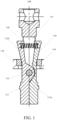
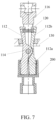
- the plurality of drive head elements 112 can rotate about the same rotary shaft 114, for example, each connected to the rotary shaft 114 so as to be rotatable about the rotary shaft, as shown in FIG. 1 and FIG. 3 .
- relative movement between the plurality of drive head elements 112 may be present since at least one of the plurality of drive head elements 112 can rotate about the rotary shaft 114.
- the at least one drive head element 112 rotating about the rotary shaft 114 may move relative to other drive head elements 112 that do not rotate.
- the plurality of drive head elements 112 rotating about the rotary shaft may also move relative to each other.
- Each of the plurality of drive head elements 112 respectively has a length in a direction substantially perpendicular to the rotary shaft 114.
- the length dimension of the drive head elements 112 is greater than the dimensions in other directions (e.g., the radial dimension thereof).
- each drive head element 112 may be divided into a plurality of sections along the length thereof. More specifically, while the drive head 110 is approaching (moving towards) the test tube cap 200 or when the drive head 110 is engaged with the test tube cap 200, each drive head element 112 may include a first section 112a that is close to the test tube cap 200 and a second section 112b that is located away from the test tube cap 200.
- FIG. 8 An exemplary cross-sectional shape of the first section 112a is shown in FIG. 8 , but the present invention is not limited thereto, and any shape suitable for engagement with the test tube cap 200 can be used.
- the first section 112a is located below the second section 112b. It can be understood that if the first section 112a of the drive head element 112 is inserted inside the test tube cap 200 in a certain depth to engage with the test tube cap 200, then no matter how close the second section 112b is actually to the test tube cap 200, the second section 112b is considered to be further away from the test tube cap 200 than the first section 112a is.
- first section 112a and the second section 112b of each drive head element 112 are located on two opposite sides of the rotary shaft 114, rather than on the same side thereof, because when the respective second sections 112b move towards each other, the corresponding first sections 112a move in the opposite direction, i.e., away from each other.
- moving towards or away from each other does not mean that each of the plurality of drive head elements 112 has to move, but rather indicates the existent result of relative movement or relative displacement therebetween.
- each drive head element 112 having the first section 112a and the second section 112b must be rotatable about the rotary shaft 114, although this is a preferred solution.
- the first section 112a and the second section 112b thereof may also be located, relative to the rotary shaft 114, on two sides thereof, such as the upper side and the lower side. If the plurality of drive head elements 112 rotate about the respective rotary shafts 114, then the rotary shafts 114 referred to herein are the corresponding rotary shafts 114 about which the drive head elements 112 respectively rotate.
- one or more drive head elements 112 may be in the form of clamping arms, and the first section 112a and the second section 112b may correspond to two opposite sections of the clamping arm located on two sides of the rotary shaft 114 (e.g., the lower section and the upper section of the drive head element 112 as seen in FIG. 1 and FIG. 3 ), similar to two ends of a scissor or clamp structure. It can also be understood that the drive head element 112 may also include other sections along the length thereof in addition to the first section 112a and the second section 112b.
- the drive head of the present invention may include more than two drive head elements.
- the drive head elements may be (preferably evenly) circumferentially distributed (resembling a claw).
- the mounting component (described in detail below) of the present invention may be configured to include structural features that match the more than two drive head elements, e.g., accommodating openings capable of accommodating a plurality of drive head elements, or the like.
- the uncapping apparatus 100 of the present invention may further include an elastic element 120, in particular a spring, such as a coil spring.
- the elastic element 120 may be configured to act on the second section 112b of each drive head element 112, i.e., the section relatively further away from the test tube cap 200, so as to provide a tensioning force to the drive head element 112.
- the term “tensioning force” includes an elastic force applied by the elastic element 120 to the drive head elements 112 (mainly by means the second sections 112b thereof), but the term itself does not limit the direction of the applied elastic force unless a direction (e.g., inward or outward) is explicitly defined before the term.
- a tensioning force may cause the second sections 112b of the respective drive head elements 112 to move away from each other (i.e., separated from each other) or towards each other (that is, approaching each other or even making contact with each other).
- this does not require that the second section 112b of each drive head element 112 generates movement as long as there is relative movement therebetween.
- one of the plurality of drive head elements 112 may be stationary.
- the tensioning force applied by the elastic element 120 to the second sections 112b of the drive head element 112 is a force that causes the second sections 112b to move outward (i.e., away from each other) or prevents the seconds section 112b from moving inward.
- the elastic element 120 may be connected between at least two drive head elements 112 at the second sections 112b to provide an outward tensioning force thereto. As shown in FIG. 1 and FIG. 3 , the elastic element 120 is directly provided between corresponding respective second sections 112b of two drive head elements 112.
- recesses opening towards each other may be provided in the second sections 112b of the drive head elements 112, and the elastic element 120 may be at least partially provided in these recesses or connected to the interior of these recesses. More preferably, the elastic element 120 may be arranged at or near free ends of the second section 112b located away from the test tube cap 200 or away from the first sections 112a, so as to generate larger torque.
- the magnitude of the tensioning force (e.g., determined at least by the elastic coefficient of the elastic elements 120) may be designed to maintain a certain larger distance between the second sections 112b of the drive head elements 112, so that the first sections 112a of the drive head elements 112 correspondingly have a smaller distance therebetween or even make contact with each other. As previously described, since the first section 112a and the second section 112b are located on two opposite sides of the rotary shaft 114, movement of the second sections 112b away from each other results in movement of the first sections 112a toward each other.
- the tensioning force applied by the elastic element 120 to the second sections 112b of the drive head elements 112 is a force that causes the second sections 112b to move inward (i.e., toward each other) or prevents the second sections 112b from moving outward.
- the elastic element 120 may be configured to be connected to the exterior of the second sections 112b of the drive head elements 112 (e.g., the outer periphery surrounding and formed by the second sections 112b of the drive head elements 112), so as to externally apply an elastic force thereto.
- recesses may be respectively provided in the second sections 112b of the drive head elements 112 on sides facing away from each other, and the elastic element 120 may be at least partially provided in these recesses or connected to the interior of these recesses.
- the magnitude of the tensioning force may be designed to maintain a smaller distance between the second sections 112b of the drive head elements 112, so that the first sections 112a of the drive head elements 112 correspondingly have a larger distance therebetween.
- the first section 112a and the second section 112b are located on two opposite sides of the rotary shaft 114, movement of the second sections 112b toward each other results in movement of the first sections 112a away from each other.
- the uncapping apparatus 100 of the present invention may further include a switching element 130 configured to actuate the drive head 110 to produce different drive head sizes.
- the switching element 130 can move between a first position and a second position.
- moving between the two positions means that the switching element 130 can reach the first position and the second position, but the switching element 130 is not required to move continuously between the first position and the second position.
- the switching element 130 can further move to other positions in addition to the first position, the second position, and positions therebetween.
- the second sections 112b of the drive head elements 112 are under the action of the tensioning force provided by the elastic element 120, so that the first sections 112a form a first drive head size.
- this does not mean that the second sections 112b, at the time, must only be under the action of the elastic element 120, but that the second sections 112b, preferably, are mainly under the action of the elastic element 120.
- the first sections 112a are the sections of the drive head elements 112 that engage with the test tube cap 200, so that the first drive head size is substantially formed by the first sections 112a.
- an outer (peripheral) size formed by corresponding respective ends of the plurality of first sections 112a directly facing the test tube cap 200 while the drive head 110 is approaching the test tube cap 200 may form the first drive head size (or a second drive head size that will be described below).
- the switching element 130 can act on the elastic element 120 or, in other words, the second sections 112b, so as to change the tensioning force acting on the second sections 112b.
- the switching element 130 may act on the second sections 112b to change the amount of elongation of the elastic element 120, such as a spring, thereby changing the tensioning force. Since the tensioning force acting on the second sections 112b changes, relative movement between the corresponding respective second sections 112b of the plurality of drive head elements 112 occurs. Further, due to the presence of the rotary shaft 114, the relative movement between the second sections 112b, such as movement towards each other, causes the drive head elements 112 to rotate about the rotary shaft 114.
- the second drive head size may be larger than the first drive head size.
- the tensioning force applied by the elastic element 120 to the second sections 112b is an outward force that causes the second sections 112b to move away from each other, and when the switching element 130 moves from the first position to the second position, the switching element 130 acts on the second sections 112b in a direction opposite to that of the elastic element 120, i.e., from the outside to the inside, so that the tensioning force acting on the second sections 112b is smaller than that when the switching element 130 is in the first position. Therefore, the second sections 112b move towards each other (i.e., rotating inward), and the first sections 112a move away from each other.
- the second drive head size may be smaller than the first drive head size.
- the tensioning force applied by the elastic element 120 to the second sections 112b is an inward force that causes the second sections 112b to move towards each other, and when the switching element 130 moves from the first position to the second position, the switching element 130 acts on the second sections 112b in a direction opposite to that of the elastic element 120, i.e., from the inside to the outside, so that the tensioning force acting on the second sections 112b is greater than that when the switching element 130 is in the first position (i.e., rotating outward). Therefore, the second sections 112b move away from each other, and the first sections 112a move towards each other.
- the uncapping apparatus 100 of the present invention achieve engagement with test tube caps 200 of different sizes by means of a very simple structure and operation method, and it is not necessary to provide different drive heads 110 for different test tube cap sizes, thereby significantly improving (e.g., experiment) efficiency, and reducing costs.
- the term "drive head size" does not mean that a drive head of the size must drive a test tube cap, but rather describes a drive capability (unless otherwise defined in the description).
- the first drive head size can enable a test tube cap to be driven to rotate, but can also allow disengagement from a test tube cap to release the test tube cap.
- the tensioning force acting on the second sections 112b may change continuously.
- the first sections 112a can form a plurality of drive head sizes that are different from each other, thereby allowing engagement with more differently sized test tube caps 200 so as to drive the same.
- the plurality of different drive head sizes may vary continuously.
- the switching element 130 may be implemented such that movement thereof between the first position and the second position is translational movement in a direction of moving towards or away from the test tube cap 200 (e.g., the vertical movement shown in FIG. 1 and FIG. 3 ).
- the switching element 130 of the present invention may also produce movement other than the translational movement, such as rotational movement or a combination of rotational movement and translational movement.
- the switching element 130 may perform the above translational movement along the exterior (e.g., the outer periphery) of the drive head elements 112. In other embodiments, the switching element 130 may also perform the above translational movement along the interior formed by the distance between the drive head elements 112. However, due to the presence of the rotary shaft 114, the range of the translational movement in the interior may be smaller than the range of the translational movement at the exterior. Preferably, the switching element 130 may translate only from a position at or near the rotary shaft 114 along the second sections 112b in a direction away from the test tube cap 200, or reversely move along the second sections 112b in a direction towards the test tube cap 200 to a position at or near the rotary shaft 114.
- the respective first sections 112a of the drive head elements 112 in the form of, for example, clamping arms may make contact with each other and be closed under the action of the tensioning force of the elastic element 120, so as to form a minimum drive head size.
- said minimum drive head size may generally be used to disengage the drive head 110 from the test tube cap 200, but the possibility of using the minimum drive head size for engagement with a test tube cap 200 of the minimum size is not excluded.
- the switching element 130 may be configured to be a switching plate.
- switching plate means that the size of the switching element 130 in a direction perpendicular to the translational movement (the horizontal direction shown in FIGs. 1-2 ) is much larger than the size thereof in the direction of the translational movement (the vertical direction shown in FIGs. 1-2 ), but the specific shape and size thereof are not limited in any way.
- the switching plate of the present invention may include at least one through opening portion 132, and the drive head 110 may extend through the through opening portion 132.
- the switching plate may be configured to be translationally movable along (the outer periphery of) the drive head elements 112. From comparison between FIG. 1 and FIG. 3 , it can be seen that the switching plate moves upwards along the second sections 112b from a position close to the rotary shaft 114.
- the switching plate acts on the drive head 110 (mainly the drive head elements 112) by means of a bearing 134.
- the bearing 134 is preferably a rolling bearing that can make contact with the exterior of the drive head elements 112.
- the switching plate may include a plurality of through opening portions 132 to accommodate a plurality of different drive heads 110, thereby allowing simultaneous engagement with a plurality of test tube caps 200.
- the switching plate may include an opening portion array formed by the plurality of through opening portions 132 to correspond to test tubes commonly arranged in an array in laboratories and test tube caps 200 provided thereon, thereby achieving very high uncapping efficiency (or, test tube cap 200 driving efficiency).
- the required amount of translation of the switching plate can be designed for the same batch of test tubes, such that the drive head 110 can simultaneously engage with or disengage from a plurality of test tube caps 200.
- the present invention does not rule out the possibility of providing different switching plates (typically smaller in size) for different test tube caps 200, thereby providing the flexibility of allowing different amounts of translation for the different test tube caps 200.
- the drive head 110 may engage with the test tube cap 200 from the outside of the test tube cap, but it is more preferable for the drive head 110 to engage with the test tube cap 200 from the inside of the test tube cap.
- the first sections 112a of the drive head elements 112 may engage with the test tube cap 200 from the inside thereof.
- the expression "engaging from the inside of the test tube cap” means that the drive head 110, mainly outer surfaces of the first sections 112a of the drive head elements 112, makes contact with inner surfaces of the test tube cap 200. That is, the test tube cap 200 has inner surfaces disposed opposite each other.
- engagement refers to engagement to the extent of being capable of driving the test tube cap 200 to rotate, and includes, but is not limited to, a tight fit, an interference fit, or the like between the drive head 110 and the test tube cap 200.
- the first sections 112a are in a certain open position in which the test tube cap 200 can be driven to rotate (i.e., the first sections 112a of the plurality of drive head elements 112 are not closed), and in said open position, the drive head elements 112 have a corresponding drive head size (e.g., the aforementioned second drive head size).
- the internal structure of an exemplary test tube cap 200 when engaging with the first sections 112a is further shown in FIG. 8 , but the test tube cap 200 that can be used with the uncapping apparatus 100 of the present invention is not limited thereto, and may be a test tube cap 200 having any suitable shape and size.
- the drive head 110 of the uncapping apparatus 100 of the present invention may further include a driving device for driving the aforementioned drive head 110 to rotate.
- the drive head 110 further includes a mounting component 116.
- the mounting component 116 is operatively connectable to the driving device.
- the mounting component 116 may also be configured to support a plurality of drive head elements 112.
- the support component includes a through hole 116a, particularly a through hole 116a that extends substantially horizontally (when the drive head 110 is positioned vertically).
- the through hole 116a allows the rotary shaft 114 to pass therethrough.
- the drive head elements 112 can be rotatably or pivotally connected to the rotary shaft 114, and are thus also supported by the support component.
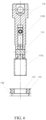
- the support component may be provided with accommodating openings 116b (also referred to as side openings) on two opposite sides thereof to accommodate two drive head elements 112 (as best shown in FIG. 5 and FIG. 6 ), but the support component of the present invention is not limited to the accommodating openings 116b corresponding to the two drive head elements 112.
- the drive head elements 112 may be provided partially inside the accommodating openings 116b and partially outside the accommodating openings 116b.
- the second sections 112b should at least partially be located outside the accommodating opening 116b, so that the switching element 130 can act on the exterior thereof.
- configuring the drive head elements 112 to be supported inside the mounting component 116 should not affect the movement thereof, for example, formation of various drive head sizes by the first sections 112a would not be affected.
- the drive head 110 has not yet been inserted into the switching element 130 in the form of the switching plate, and the mounting component 116 of the drive head 110 can be clearly seen.
- the mounting component 116 is substantially columnar, with a top portion having a structure (which will not be further described herein) matching the driving device, and a side surface provided with two openings for accommodating corresponding drive head elements 112.
- the rotary shaft 114 is horizontally disposed in the through hole 116a of the mounting component 116 to be connected to the drive head elements 112, so that the two drive head elements 112 can rotate about the rotary shaft 114.
- the second sections 112b (which may be in the form of, for example, a jaw or a clamp) are both located substantially outside the mounting component 116, thereby facilitating engagement with the test tube cap 200.
- FIG. 5 shows that only one through opening portion 132 is provided with the bearing 134, it should be understood that the bearing 134, particularly a rolling bearing, which directly makes contact with the drive head 110, can be provided in any number of through opening portions 132.
- the used uncapping apparatus 100 includes a drive head 110, an elastic element 120, and a switching element 130.
- the drive head 110 includes at least two drive head elements 112.
- These drive head elements 112 each include a first section 112a that is close to the test tube cap 200 when the drive head 110 is close to or, in other words, engages with the test tube cap 200, and a second section 112b that is located away from the test tube cap 200 when the drive head 110 is close to or, in other words, engages with the test tube cap 200.
- the first section 112a and the second section 112b are located on two opposite sides of the rotary shaft 114.
- the second sections 112b are under the action of a tensioning force of the elastic element 120, so that the first sections 112a located on the opposite side of the rotary shaft 114 can form a first drive head size, and the first sections 112a having the first drive head size may not engage with the test tube cap 200.
- the corresponding first sections 112a of the drive head elements 112 may make contact with each other, but may also be spaced apart from each other by a small distance. Due to disengagement from the test tube cap 200, in the first position of the switching element 130, the drive head cannot drive the test tube cap 200 to rotate, and may be referred to as being in a released state.
- the method of the present invention includes causing the switching element 130 to move from the first position to a second position.
- the switching element 130 can act on the elastic element 120 or, in other words, the second sections 112b, so that the tensioning force acting on the second sections 112b changes.
- this does not mean that the switching element 130 definitely does not act on the elastic element 120 or, in other words, the second sections 112b when the switching element 130 is in the first position (certainly, it is also possible that a non-negligible effect is not generated), but that the tensioning force acting on the second sections 112b changes when the switching element 130 is in the second position.
- the switching element 130 when the switching element 130 is in the first position, the switching element 130 may externally apply an inward force to the second sections 112b (i.e., move the second sections 112b towards each other), and then the switching element 130 may translate upwards (e.g., move towards the free ends of the second sections 112b), so that the amount of elongation of the elastic element 120 is reduced, thereby enabling the second sections 112b to further move towards each other.
- the position of the switching element 130 changes, so that the second sections 112b move relative to each other, and at least one of the drive head elements 112 can rotate about the rotary shaft 114. Therefore, the first sections 112a form a second drive head size different from the first drive head size, and the first sections 112a having the second drive head size can engage with the test tube cap 200 to drive the same to rotate to be uncapped.
- the second drive head size is larger than the first drive head size. That is, the drive head 110 is in an engaged state.
- the drive head 110, the elastic element 120, the switching element 130, and other components in the previously described preferred embodiments of the present invention may also be used in conjunction with the method of the present invention described above. It should be noted that, although what is described above is the method for opening the test tube cap 200, it is also possible to perform driving in the opposite rotational direction to close the test tube cap 200. Furthermore, in other embodiments, the first sections 112a having the first drive head size may also engage with a test tube cap 200, but the size of said test tube cap 200 is different from (for example, smaller than) the size of the test tube cap 200 engaging with the first sections 112a having the second drive head size.
- the drive head 110 of the uncapping apparatus 100 does not include at least two separate drive head elements 112, but has only one integrally formed drive head element 112.
- the one drive head element 112 may also be referred to herein as a main body 111 of the drive head 110.
- the drive head 110 preferably engages with the test tube cap 200 from the inside thereof.
- the uncapping apparatus 100 in these embodiments may also include a driving device for driving the drive head 110, which is not described in detail herein.
- engagement means engaged to the degree of being capable of driving the test tube cap 200 to rotate, and includes, but is not limited to, an interference fit, a tight fit, and the like.
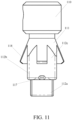
- the main body 111 of the drive head 110 may include a plurality of different sections in the longitudinal direction thereof or, in other words, the length direction thereof.
- the longitudinal direction generally refers to a movement direction towards or away from the test tube cap 200 (e.g., the vertical direction shown in FIGs. 10-11 ), and the longitudinal direction is generally the length direction of the main body 111 of the drive head 110, that is, the size thereof in the length direction is generally larger than the radial size thereof.
- the main body 111 includes a first section 112a that is close to the test tube cap 200 when the drive head 110 is close to the test tube cap 200 and a second section 112b that is located away from the test tube cap 200 when the drive head 110 is close to the test tube cap 200.
- the external size of the first section 112a is smaller than that of the second section 112b.
- the first section 112a can engage with a test tube cap 200 that has a smaller internal size
- the second section 112b can engage with a test tube cap 200 that has a larger internal size.
- the respective sections of the main body 111 can engage with test tube caps 200 of different sizes, so as to drive each test tube cap 200 from the inside thereof, thereby achieving the flexibility of driving the test tube caps 200.
- the first section 112a and the second section 112b do not need to be adjacent to or adjoin each other. That is, sections of other sizes may be interposed between the first section 112a and the second section 112b.
- the first section 112a may be configured to be a square column, but is not limited thereto.
- the first section 112a may also be a cylinder, or columns having other cross-sectional shapes, or even a hollow column.
- the second section 112b is configured to be immediately or directly adjacent to the first section 112a.
- the second section 112b may also be configured to be a square column, but is not limited thereto.
- the second section 112b may also be a cylinder, or columns having other cross-sectional shapes, or even a hollow column.
- the external size of the second section 112b should be larger than that of the first section 112a; for example, the cross-sectional size of the square column thereof is greater than the cross-sectional size of the first section 112a.
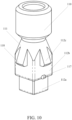
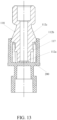
- a plurality of protruding portions 117 or protrusions protruding outwards are provided on the outer periphery of the second section 112b, as best shown in FIGs. 10-11 and 13 .
- these protruding portions 117 or protrusions may be provided symmetrically on opposite side surfaces of the second section 112b, for example, arranged at 180 degrees, but it is also conceivable that these protruding portions 117 or protrusions are provided on each side surface of the second section 112b in the form of a square column. More preferably, these protruding portions 117 or protrusions may be provided at positions on the second section 112b adjacent to the first section 112a. These protruding portions 117 or protrusions may engage with recesses inside the test tube cap 200 by means of shape mating.
- the main body 111 of the drive head 110 may further include a third section 112c.
- the third section 112c is configured to be further away from the test tube cap 200 than the second section 112b while the drive head 110 is approaching the test tube cap 200.
- the third section 112c is configured to be immediately adjacent to the second section 112b.
- the third section 112c includes a plurality of protruding portions, and these protruding portions cause the external size of the third section 112c to be larger than that of the second section 112b.
- each protruding portion of the third section 112c may be a portion outwardly protruding from an integral extending portion of the directional column of the second section 112b that extends in a direction away from the first section 112a.
- the protruding portions of the third section 112c are configured to be frustoconical portions 118.
- the frustoconical portions 118 respectively taper in a direction away from the second section 112b, i.e., tapering upward as shown in the drawings.
- the third section 112c includes one frustoconical portion 118 correspondingly provided on each one of the four side surfaces of the square column, and these frustoconical portions 118 may be connected to each other, or independent from each other.
- the main body 111 of the drive head 110 includes: a first section 112a, also referred to as a lower section, configured to be a square column or a cube, and sized and shaped to engage with a test tube cap 200 having a circular inner hole; a second section 112b, also referred to as a middle section, configured to be a larger directional column or a larger cube, provided with two symmetrical protruding portions 117 or protrusions, and sized and shaped to engage with a test tube cap 200 having a square inner hole; and a third section 112c, also referred to as an upper section, comprising four symmetrical frustoconical portions 118 which collectively act to engage with a test tube cap 200 having circular inner holes of different sizes ( FIG.
- FIG. 12 shows an external view of the main body 111 of the drive head 110 when engaging with the test tube cap 200).
- a drive head 110 can engage with a test tube cap 200 having a shape different from those described above, but typically engages with the test tube cap 200 from the inside thereof.
- the main body 111 of the drive head 110 of the present invention may make contact with or engage with an inner surface of a test tube cap 200 at symmetric or asymmetric positions.
- a pair of diagonal corners of the second section 112b of the main body 111 make contact with and engage with a pair of protrusions located at diagonal corners inside the test tube cap 200.
- all of the four frustoconical portions 118 of the third section 112c of the main body 111 make contact with and engage with the inner surface of the test tube cap 200.
- portions of the third section 112c may also make contact with and engage with the inner surface of the test tube cap 200. That is, for the present invention, the sections of the main body 111 may engage with a test tube cap 200 at a variety of positions thereon in order to meet the requirements for driving test tube caps 200 of different sizes to rotate.
Landscapes
- Mechanical Engineering (AREA)
- Engineering & Computer Science (AREA)
- Chemical & Material Sciences (AREA)
- Biochemistry (AREA)
- Life Sciences & Earth Sciences (AREA)
- Analytical Chemistry (AREA)
- Health & Medical Sciences (AREA)
- General Health & Medical Sciences (AREA)
- General Physics & Mathematics (AREA)
- Immunology (AREA)
- Pathology (AREA)
- Physics & Mathematics (AREA)
- Chemical Kinetics & Catalysis (AREA)
- Automatic Analysis And Handling Materials Therefor (AREA)
- Investigating Strength Of Materials By Application Of Mechanical Stress (AREA)
Applications Claiming Priority (1)
| Application Number | Priority Date | Filing Date | Title |
|---|---|---|---|
| CN202310701321.3A CN119118029A (zh) | 2023-06-13 | 2023-06-13 | 用于试管盖的开盖设备及利用开盖设备打开试管盖的方法 |
Publications (2)
| Publication Number | Publication Date |
|---|---|
| EP4488690A2 true EP4488690A2 (fr) | 2025-01-08 |
| EP4488690A3 EP4488690A3 (fr) | 2025-04-09 |
Family
ID=91782212
Family Applications (1)
| Application Number | Title | Priority Date | Filing Date |
|---|---|---|---|
| EP24181931.7A Pending EP4488690A3 (fr) | 2023-06-13 | 2024-06-13 | Mécanisme de réglage de tête d'entraînement |
Country Status (3)
| Country | Link |
|---|---|
| US (1) | US12600612B2 (fr) |
| EP (1) | EP4488690A3 (fr) |
| CN (1) | CN119118029A (fr) |
Citations (1)
| Publication number | Priority date | Publication date | Assignee | Title |
|---|---|---|---|---|
| US20070095024A1 (en) | 2005-11-01 | 2007-05-03 | Neeper Robert K | System and method for simultaneous capping/de-capping of storage containers in an array |
Family Cites Families (23)
| Publication number | Priority date | Publication date | Assignee | Title |
|---|---|---|---|---|
| JPS5824328B2 (ja) * | 1979-08-13 | 1983-05-20 | 澁谷工業株式会社 | 抜栓機を備えたアンケ−サ |
| CA1287991C (fr) | 1985-02-15 | 1991-08-27 | George Seabrook Wing | Collier et joint limiteur de couple de serrage, ainsi que methode et outil depose |
| US4704924A (en) * | 1986-03-24 | 1987-11-10 | Ronald Echols | Safety stopper engager |
| JP3347407B2 (ja) * | 1993-08-17 | 2002-11-20 | シスメックス株式会社 | 試料容器回転装置 |
| US5746042A (en) * | 1996-04-02 | 1998-05-05 | Scientific Resources, Inc. | Vial capping device |
| GB2329859A (en) | 1997-10-03 | 1999-04-07 | David Anthony Tyers | Universal wrench |
| US5993417A (en) * | 1998-01-06 | 1999-11-30 | Yerfino; Daniel Alberto | Disposable syringe with an automatically retractable hypodermic needle |
| US8028357B2 (en) * | 2000-06-13 | 2011-10-04 | Wcm Industries, Inc. | Method and associated apparatus for assembling and testing a plumbing system |
| DE20310332U1 (de) * | 2003-07-04 | 2004-11-11 | Mwg-Biotech Ag | Vorrichtung zum automatischen Öffnen und Schließen von Reaktionsgefäßen |
| JP3980014B2 (ja) * | 2004-05-14 | 2007-09-19 | 株式会社アイディエス | 剥離式キャップの矯正開蓋装置 |
| US20100088871A1 (en) * | 2008-10-09 | 2010-04-15 | Doris Chavez | Ergonomic Hand-Held Device |
| JP2012018007A (ja) | 2010-07-06 | 2012-01-26 | Tsubakimoto Chain Co | デキャッパピン |
| US9199755B1 (en) * | 2012-02-11 | 2015-12-01 | Joseph Cohen | Apparatus and methods for handling tubes or vials |
| CN104220006A (zh) * | 2012-12-22 | 2014-12-17 | 弗罗斯特诊断有限责任公司 | 用于样本的采样和检查的装置 |
| US10493457B2 (en) * | 2014-03-28 | 2019-12-03 | Brooks Automation, Inc. | Sample storage and retrieval system |
| EP3327443B1 (fr) * | 2016-11-25 | 2019-05-01 | GLP systems GmbH | Système et procédé de fermeture automatique de tubes d'essai |
| EP3894869B1 (fr) * | 2018-12-14 | 2022-08-24 | Project Management Limited | Système de manipulation de tube à essai |
| DE102019108767A1 (de) * | 2019-01-11 | 2020-07-16 | Hti Bio-X Gmbh | Greifvorrichtung zum Greifen von Deckeln für Laborgefäße |
| CN214129827U (zh) | 2020-07-06 | 2021-09-07 | 复旦大学附属华山医院 | 一种气管扩张钳 |
| US12497279B2 (en) * | 2021-08-18 | 2025-12-16 | Merck Sharp & Dohme Llc | Hand held device for automatically removing and replacing screw-on caps for cryogenic tubes, cryogenic vials and microtubes |
| CN114537876A (zh) | 2022-03-22 | 2022-05-27 | 基点生物科技(上海)有限公司 | 冻存管管盖及开盖结构 |
| CN219136320U (zh) | 2022-12-30 | 2023-06-06 | 湖南元景智造科技有限公司 | 开盖装置 |
| IT202300017916A1 (it) * | 2023-08-31 | 2025-03-03 | Gimatic S R L | Pinza pneumatica motorizzata |
-
2023
- 2023-06-13 CN CN202310701321.3A patent/CN119118029A/zh active Pending
-
2024
- 2024-06-11 US US18/739,800 patent/US12600612B2/en active Active
- 2024-06-13 EP EP24181931.7A patent/EP4488690A3/fr active Pending
Patent Citations (1)
| Publication number | Priority date | Publication date | Assignee | Title |
|---|---|---|---|---|
| US20070095024A1 (en) | 2005-11-01 | 2007-05-03 | Neeper Robert K | System and method for simultaneous capping/de-capping of storage containers in an array |
Also Published As
| Publication number | Publication date |
|---|---|
| CN119118029A (zh) | 2024-12-13 |
| US12600612B2 (en) | 2026-04-14 |
| US20240417232A1 (en) | 2024-12-19 |
| EP4488690A3 (fr) | 2025-04-09 |
Similar Documents
| Publication | Publication Date | Title |
|---|---|---|
| JP4007700B2 (ja) | 試料カップの自動取扱装置 | |
| US9878890B2 (en) | Universal container capper/decapper | |
| US9821313B2 (en) | Reaction vessel and apparatus and method for opening and closing a reaction vessel | |
| US12151365B2 (en) | Gripper device for gripping laboratory vessels | |
| EP4051622B1 (fr) | Décapsuleur de tube à échantillon | |
| EP4488690A2 (fr) | Mécanisme de réglage de tête d'entraînement | |
| DE102020133420A1 (de) | Laborgerät mit fixiermechanismus zum fixieren eines objektträgers | |
| DE102020133424A1 (de) | Laborgerät mit mischmechanismus zum mischen von medium eines objektträgers | |
| CN113353866B (zh) | 一种试管开盖装置 | |
| CN111717783B (zh) | 抓取机构 | |
| US12139292B2 (en) | Clamping device and clamping method | |
| CN115448237A (zh) | 一种用于连盖管的开盖装置 | |
| JPH02262922A (ja) | 支持パレット上の部品クランプ取付用具の自動プログラム可能な繰返しサイクルを有する組立及び取外しステーション | |
| KR102892166B1 (ko) | 그리퍼 장치 | |
| WO2023180296A1 (fr) | Dispositif de capsulage et de décapsulage, système de capsulage et de décapsulage et procédé de capsulage et de décapsulage d'un tube | |
| US12320821B2 (en) | Autosampler system with automated sample container cover removal and sample probe positioning | |
| JP2009120200A (ja) | キャップの装着装置、取り外し装置、装着方法並びに取り外し方法 | |
| US20230393031A1 (en) | Transfer device for tranferring a plurality of objects through a transfer port | |
| KR20230042332A (ko) | 샘플 컨테이너 커버 제거 및 샘플 프로브 배치가 자동화된 오토샘플러 시스템 | |
| KR101858848B1 (ko) | 도가니 이송장치 | |
| CN219340750U (zh) | 一种试剂瓶装卸系统及生化检测设备 | |
| WO2026027447A1 (fr) | Dispositif automatisé de retrait et de manipulation de bouchon pour contenants à bouchon fileté ou enfiché et système de manipulation de contenant pourvu de celui-ci | |
| CN114789983A (zh) | 一种法兰桶桶盖开关机械手及开关盖方法 | |
| US20240255535A1 (en) | Decapping of screw cap test tubes | |
| CN224062407U (zh) | 研磨瓶的瓶盖旋拧装置 |
Legal Events
| Date | Code | Title | Description |
|---|---|---|---|
| PUAI | Public reference made under article 153(3) epc to a published international application that has entered the european phase |
Free format text: ORIGINAL CODE: 0009012 |
|
| STAA | Information on the status of an ep patent application or granted ep patent |
Free format text: STATUS: THE APPLICATION HAS BEEN PUBLISHED |
|
| AK | Designated contracting states |
Kind code of ref document: A2 Designated state(s): AL AT BE BG CH CY CZ DE DK EE ES FI FR GB GR HR HU IE IS IT LI LT LU LV MC ME MK MT NL NO PL PT RO RS SE SI SK SM TR |
|
| PUAL | Search report despatched |
Free format text: ORIGINAL CODE: 0009013 |
|
| AK | Designated contracting states |
Kind code of ref document: A3 Designated state(s): AL AT BE BG CH CY CZ DE DK EE ES FI FR GB GR HR HU IE IS IT LI LT LU LV MC ME MK MT NL NO PL PT RO RS SE SI SK SM TR |
|
| RIC1 | Information provided on ipc code assigned before grant |
Ipc: B25B 7/00 20060101ALI20250305BHEP Ipc: B67B 7/00 20060101ALI20250305BHEP Ipc: G01N 35/04 20060101AFI20250305BHEP |
|
| STAA | Information on the status of an ep patent application or granted ep patent |
Free format text: STATUS: REQUEST FOR EXAMINATION WAS MADE |
|
| 17P | Request for examination filed |
Effective date: 20251009 |