EP4488970A1 - Procédés et tachygraphes pour opérations basées sur le géorepérage - Google Patents
Procédés et tachygraphes pour opérations basées sur le géorepérage Download PDFInfo
- Publication number
- EP4488970A1 EP4488970A1 EP24186787.8A EP24186787A EP4488970A1 EP 4488970 A1 EP4488970 A1 EP 4488970A1 EP 24186787 A EP24186787 A EP 24186787A EP 4488970 A1 EP4488970 A1 EP 4488970A1
- Authority
- EP
- European Patent Office
- Prior art keywords
- vehicle
- related information
- tachograph
- map
- area
- Prior art date
- Legal status (The legal status is an assumption and is not a legal conclusion. Google has not performed a legal analysis and makes no representation as to the accuracy of the status listed.)
- Pending
Links
Images



Classifications
-
- G—PHYSICS
- G07—CHECKING-DEVICES
- G07C—TIME OR ATTENDANCE REGISTERS; REGISTERING OR INDICATING THE WORKING OF MACHINES; GENERATING RANDOM NUMBERS; VOTING OR LOTTERY APPARATUS; ARRANGEMENTS, SYSTEMS OR APPARATUS FOR CHECKING NOT PROVIDED FOR ELSEWHERE
- G07C5/00—Registering or indicating the working of vehicles
- G07C5/08—Registering or indicating performance data other than driving, working, idle, or waiting time, with or without registering driving, working, idle or waiting time
- G07C5/0841—Registering performance data
- G07C5/085—Registering performance data using electronic data carriers
-
- G—PHYSICS
- G07—CHECKING-DEVICES
- G07C—TIME OR ATTENDANCE REGISTERS; REGISTERING OR INDICATING THE WORKING OF MACHINES; GENERATING RANDOM NUMBERS; VOTING OR LOTTERY APPARATUS; ARRANGEMENTS, SYSTEMS OR APPARATUS FOR CHECKING NOT PROVIDED FOR ELSEWHERE
- G07C5/00—Registering or indicating the working of vehicles
- G07C5/02—Registering or indicating driving, working, idle, or waiting time only
Definitions
- the present disclosure relates generally to methods and tachographs for creating geofences for vehicles and related operations.
- the present disclosure also relates generally to methods and vehicle units for non-driving period related information data.
- vehicle unit shall mean a digital unit capable of gathering information relating to the vehicle.
- Examples of such information may be a geographical location, driving hours, distance travelled, start time, finish time, rest time, driver name, starting location and finishing location, exhaust measurements, fuel consumption, temperature data from vehicle or cargo sensors, opening and closing of cargo doors or operation of other vehicle systems, e.g. cranes and lifts etc.
- Such information in this document also known as vehicle information, vehicle related information data, or vehicle information data, can further be driving video, driver identity, speed information, position information, time information, environment information, etc.
- a vehicle unit is a digital tachograph, capable of recording and digitally compiling and storing the vehicle data including driving times and rest periods as well as periods of other work and availability taken by the driver of a heavy vehicle.
- the vehicle unit is normally located in the cabin of the vehicle, where the vehicle unit is arranged in the instrument board, so that the vehicle operator may operate the vehicle unit in adjacency to start or stop of a journey.
- the vehicle unit is connected to one or more sensors, where the sensors are capable of measuring, for instance, the motion of the wheels or other parameters.
- a motion sensor is attached to the gearbox of the vehicle to receive pulses, i.e. speed and movement information, which is sent to the tachograph.
- a driver may cross several country borders or other regional borders that implicates changes to the driving time and rest rules, as well as working time directives, according to legislation that needs to be complied with by the driver. Further, during trips, time zones may change by entering new time zones adhering to the complexity. Breaking of rules often means that transport companies risk expensive fines, yet keeping track of the rules is complicated, time consuming and tiring, and shifts focus from the driving and work tasks. In addition, the transport companies/fleet management firms may require the driver to comply with the firm's own rules or route planning or prohibited areas based on its goals on performance, efficiency and safety. The driver needs to keep track of the rules by himself, which is difficult, and make the necessary adjustments and configurations to the vehicle units accordingly.
- compliance with e.g. driving times and rest periods rules are checked by relevant authorities.
- the vehicle information accumulated over a period is transmitted to an external network entity at regular intervals, typically once a week or once a month.
- transport companies shall provide the stored vehicle information to the enforcement authorities e.g. by allowing access to the network entity.
- the authorities may request direct access to the vehicle unit upon request for downloading the vehicle information.
- the entire data file is transmitted and parsed for generation of vehicle behavior reports and identification of any rule violation or mistake by the enforcement authority.
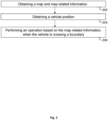
- a method performed by a tachograph for creating a geofence for a vehicle comprises: obtaining a map with boundaries and areas which are divided by the boundaries, and map related information; obtaining a vehicle position of the vehicle; performing an operation based on the map related information, following the vehicle crossing a boundary.
- the map related information comprises boundary related information and/or area related information which is related to the area the vehicle is entering.
- the area related information comprises at least an area related rule.
- the at least an area related rule comprises local driving time and/or working time rule.
- the area related information comprises local time of the area, wherein the local time is calculated based on the vehicle position.
- performing an operation based on the map related information further comprises notifying map related information and/or recording vehicle information data based on the map related information.
- a tachograph for creating a geofence for a vehicle
- the tachograph comprises a processing circuitry and a memory, the memory containing instructions executable by the processing circuitry, whereby the tachograph is operative for: obtaining a map with boundaries and areas which are divided by the boundaries, and map related information; obtaining a vehicle position of the vehicle; performing an operation based on the map related information, following the vehicle crossing a boundary.
- the map related information comprises boundary related information and/or area related information which is related to the area the vehicle is entering.
- the area related information comprises at least an area related rule.
- the at least an area related rule comprises local working time rule.
- the area related information comprises local time of the area, wherein the local time is calculated based on the vehicle position.
- performing an operation based on the map related information further comprises notifying map related information and/or recording vehicle information data based on the map related information.
- a computer program comprising instructions, which, when executed by a processing circuitry of a tachograph for creating a geofence for a vehicle, causes the tachograph to perform the method according to any one of the preceding embodiments.
- a carrier containing the computer program according to previous embodiment wherein the carrier is one of an electronic signal, an optical signal, a radio signal, an electric signal, or a computer readable storage medium.
- a vehicle comprises at least one tachograph according to any one of preceding embodiments.
- a method performed by a vehicle unit the vehicle unit is communicatively connected to a network entity, the vehicle unit is mounted on a vehicle which performs a trip, the trip comprises at least one driving period and at least one non-driving period, the method comprises: obtaining vehicle information data during the driving period; receiving non-driving period related information data from the network entity; combining the obtained vehicle information data during the driving period and the received non-driving period related information data.
- the combining is performed when the trip is finished, so as to generate a full information entry of the trip.
- the non-driving period related information data comprises at least one video clip recording vehicle driver during the at least one non-driving period, position information of the vehicle driver during the at least one non-driving period, time information of the at least one non-driving period and/or preload event information related to the at least one non-driving period.
- the non-driving period related information data is obtained by the network entity.
- the vehicle unit is a tachograph.
- a vehicle unit wherein the vehicle unit is communicatively connected to a network entity, the vehicle unit is mounted on a vehicle which performs a trip, the trip comprises at least one driving period and at least one non-driving period, the vehicle unit comprises a processing circuitry and a memory, the memory containing instructions executable by the processing circuitry, whereby the vehicle unit is operative for: obtaining vehicle information data during the driving period; receiving non-driving period related information data from the network entity; combining the obtained vehicle information data during the driving period and the received non-driving period related information data.
- the combining is performed when the trip is finished, so as to generate a full information entry of the trip.
- the non-driving period related information data comprises at least one video clip recording vehicle driver during the at least one non-driving period, position information of the vehicle driver during the at least one non-driving period, time information of the at least one non-driving period and/or preload event information related to the at least one non-driving period.
- the non-driving period related information data is obtained by the network entity.
- the vehicle unit is a tachograph.
- a computer program comprising instructions, which, when executed by a processing circuitry of a vehicle unit for transmitting information to a network entity, wherein the vehicle unit is communicatively connected to the network entity, causes the vehicle unit to perform the method according to any of the above embodiments.
- a vehicle comprises at least one vehicle unit according to any one of the preceding embodiments.
- a vehicle 500 can be equipped with a tachograph 10.
- the vehicle can be any kind of vehicle, e.g., car, truck, bus, etc.
- the tachograph 10 is operative for recording vehicle information data.
- the insight of the invention is that the tachograph 10 performs operations according to information related to a map. This is based on the concept of the geofence, however further combining geofence with tachograph behavior, capabilities, operations and functions.
- the tachograph 10 can obtain a map.
- the map can be an official map which defines boundaries and areas of countries, cities, districts, etc. However, the map can also be a customized map obtained by the tachograph.
- the map shows customized and/or personalized boundaries and areas, e.g., a yard, an industrial zone, a residential area, etc.
- the tachograph 10 also obtains map related information, which can be specific information related to the map.
- the map related information can be local time of a time zone, a working time regulation of an industrial zone, a horn ban of a residential area.
- the tachograph 10 performs an operation based on the obtained map related information, e.g., indicating a local time to the driver, informing of the working time regulation, recording vehicle information according to local regulation, etc.
- s method performed by a tachograph 10 for creating a geofence for a vehicle comprises: obtaining 202 a map with boundaries and areas which are divided by the boundaries, and map related information; obtaining 204 a vehicle position of the vehicle; performing 206 an operation based on the map related information, following the vehicle crossing a boundary.
- the tachograph 10 can be any kind of tachograph which obtains and records vehicle information.
- the tachograph 10 can obtain the vehicle information by itself, e.g., recording driving video, or obtain the vehicle information from other devices, e.g., obtaining vehicle position and speed from vehicle positioning device and speed sensor.
- the tachograph 10 obtains a map and map related information.
- the map comprises boundaries and areas divided by the boundaries; the map can be an official map or a customized map.
- the tachograph 10 can obtain the map from other devices or generate the map by itself. For example, a fleet manager or other related party generates a customized map on a map generator, and the tachograph 10 obtains the map from the map generator.
- different fleets can have different maps.
- the boundaries and areas of the map can be boundaries and areas of countries, cities, districts, etc., they can also be boundaries and areas of customized zones, e.g., a yard, an industrial zone, a residential area, etc.
- the tachograph 10 also obtains map related information, which indicates information related to boundaries and areas of the map.
- the map related information can be e.g., local time of a time zone, a driving time and/or working time regulation of a country or an industrial zone, a horn ban of a residential area, etc.
- the map related information can also be e.g., user preference information of the driver or the fleet, such as the user intends not to drive in a certain area.
- the map and map related information obtained by the tachograph 10 can be updated dynamically, by a network entity which is connected to the tachograph 10. For example, a user equipment (UE) is communicatively connected to the tachograph 10.
- UE user equipment
- the driver or fleet manager other party which is using the UE can update the map and map related information obtained by the tachograph 10 via the UE.
- the external device can be connected to the tachograph 10 via any communication protocol, e.g., Bluetooth.
- the map and map related information can be certified, for example by the driver, fleet manager, related authority, etc.
- the tachograph 10 obtains a vehicle position of the vehicle.
- the tachograph 10 can obtain the vehicle position from a vehicle positioning device, e.g., a GPS receiver, etc.
- the tachograph 10 performs an operation based on the map related information, when the vehicle position shows that it is crossing a boundary. When the vehicle is crossing a boundary, it indicates that the vehicle enters a new area. Therefore, the tachograph 10 performs a corresponding operation based on the map related information which is related to the new area or the boundary.
- the operation can be e.g., informing of the map related information, recording vehicle information data based on local regulations, etc. This will be discussed in details in the following text.
- the tachograph 10 can use an official or customized map and perform a specific operation based on map related information.
- the map related information comprises boundary related information and/or area related information which is related to the area the vehicle is entering.
- the boundary related information can be entry regulation related to the boundary.
- the area related information can be all kinds of information which is related to the area and may affect the way of driving and/or the tachograph behavior.
- the area related information comprises at least an area related rule.
- the area related rule can be specific traffic regulation in the area (horn ban, not allowed to turn on the headlights, etc.), specific working regulation in the area, etc.
- the area related rule can also be driving hours rules, e.g., maximum drive hours rules, rules on breaks, daily break/rest rules, weekly rest rules, double manning rules, ferry crossings or train journeys rules, general working and rest time rules, data download rules, etc.
- the at least an area related rule comprises a local driving time and/or working time rule.
- the local driving time and/or working time rule can be e.g., driving hours rule, e.g., maximum drive hours rule, rule on breaks, daily break/rest rule, weekly rest rule, general working and rest time rule, etc.
- the tachograph 10 can notify that the local driving time and/or working time rule for certain vehicle is from local time 8:00 to 17:00; and maximum daily drive hour is 9 hours.
- the area related information comprises local time of the area, wherein the local time is calculated based on the vehicle position.
- the vehicle can obtain Coordinated Universal Time (UTC) from Global Navigation Satellite System (GNSS) signal, preferably authenticated GNSS signal.
- UTC Coordinated Universal Time
- GNSS Global Navigation Satellite System
- a time offset is added on the UTC to obtain the local time. The time offset is based on the time zone where the vehicle is located.
- performing 206 an operation based on the map related information further comprises notifying map related information and/or recording vehicle information data based on the map related information.
- the map related information can be notified by the tachograph 10 to a user, e.g., a driver, so that the user knows the map related information, e.g., regulation of the boundaries and areas.
- the notifying can be performed by e.g., triggering an alarm or send map related information to a network entity, e.g., the user's UE, so that the UE can notify the user about the map related information.
- the map related information can be sent via e.g., Bluetooth connection between the tachograph 10 and the UE.
- the tachograph 10 can record vehicle information data based on the map related information.
- the map related information indicates that in a specific area, it is required that the tachograph 10 should record the vehicle information at a higher frequency than other areas. So that the tachograph 10 records the vehicle information according to the requirement following the vehicle crossing the boundary and driving in this area.
- the map related information indicates that the recording of vehicle information is forbidden in a specific area, so that the tachograph 10 stops recording the vehicle information when the vehicle is crossing the boundary and driving in this area.
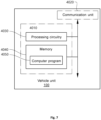
- a tachograph 10 for creating a geofence for a vehicle comprises a processing circuitry 403 and a memory 404, the memory 404 containing instructions executable by the processing circuitry 403, whereby the tachograph 10 is operative for: obtaining a map with boundaries and areas which are divided by the boundaries, and map related information; obtaining a vehicle position of the vehicle; performing an operation based on the map related information, following the vehicle crossing a boundary.
- the map related information comprises boundary related information and/or area related information which is related to the area the vehicle is entering.
- the area related information comprises at least an area related rule.
- the at least an area related rule comprises local working time rule.
- the area related information comprises local time of the area, wherein the local time is calculated based on the vehicle position.
- performing 206 an operation based on the map related information further comprises notifying map related information and/or recording vehicle information data based on the map related information.
- a vehicle 500 is provided, the vehicle comprises at least one tachograph according to any one of the preceding embodiments.
- the tachograph 10 may further comprise a communication unit 402, which may be considered to comprise conventional means for wireless communication with other devices, such as a transceiver for wireless transmission and reception of signals.
- the instructions executable by said processing circuitry 403 may be arranged as a computer program 405 stored e.g. in said memory 404.
- the processing circuitry 403 and the memory 404 may be arranged in a sub-arrangement 401.
- the sub-arrangement 401 may be a micro-processor and adequate software and storage therefore, a Programmable Logic Device, PLD, or other electronic component(s)/processing circuit(s) configured to perform the methods mentioned above.
- the processing circuitry 403 may comprise one or more programmable processor, application-specific integrated circuits, field programmable gate arrays or combinations of these adapted to execute instructions.
- the computer program 405 may be arranged such that when its instructions are run in the processing circuitry, they cause the tachograph 10 to perform the steps described in any of the described embodiments of the tachograph 10 and its method.
- the computer program 405 may be carried by a computer program product connectable to the processing circuitry 403.
- the computer program product may be the memory 404, or at least arranged in the memory.
- the memory 404 may be realized as for example a RAM (Random-access memory), ROM (Read-Only Memory) or an EEPROM (Electrical Erasable Programmable ROM).
- a carrier may contain the computer program 405.
- the carrier may be one of an electronic signal, an optical signal, an electromagnetic signal, a magnetic signal, an electric signal, a radio signal, a microwave signal, or computer readable storage medium.
- the computer-readable storage medium may be e.g. a CD, DVD or flash memory, from which the program could be downloaded into the memory 404.
- the computer program may be stored on a server or any other entity to which the tachograph 10 has access via the communication unit 402. The computer program 405 may then be downloaded from the server into the memory 404.
- a vehicle 5000 can be equipped with a vehicle unit 100.
- the vehicle 5000 can be any kind of vehicle, e.g., car, truck, bus, etc.
- the vehicle unit 100 can be a tachograph and operative for recording vehicle information data.
- the vehicle unit 100 can be communicatively connected to a network entity 200, and can send or receive information to/from the network entity 200.
- a trip 3000 can be defined as the whole period from the vehicle start point to the destination.
- the trip 3000 can comprise at least one driving period 3010, 3030, 3050 and at least one non-driving period 3020, 3040.
- the at least one non-driving period 3020, 3040 can be e.g., driver taking a break, vehicle charging, vehicle fueling, vehicle loading, vehicle unloading, etc.
- the non-driving period comprises working period.
- the vehicle information data can be obtained by the vehicle unit 100 during the driving periods 3010, 3030, 3050, however the vehicle unit 100 may not be capable of obtaining information during non-driving periods 3020, 3040.
- the insight of the invention is that the network entity 200 obtains non-driving period 3020, 3040 related information data and transmits the non-driving period 3020, 3040 related information data to the vehicle unit 100.
- the vehicle unit 100 combines the vehicle information data during the driving period 3010, 3030, 3050 and the non-driving period 3020, 3040 related information data, so as to have a more comprehensive record.
- a method performed by a vehicle unit 100 is disclosed.
- the vehicle unit 100 is communicatively connected to a network entity 200, the vehicle unit 100 is mounted on a vehicle which performs a trip 3000, the trip comprises at least one driving period 3010, 3030, 3050 and at least one non-driving period 3020, 3040, the method comprises: obtaining 2020 vehicle information data during the driving period 3010, 3030, 3050; receiving 2040 non-driving period 3020, 3040 related information data from the network entity 200; combining 2060 the obtained 2020 vehicle information data during the driving period 3010, 3030, 3050 and the received 2040 non-driving period 3020, 3040 related information data.
- the network entity 200 may be a network device of any kind of wireless communication network.
- the network entity 200 may also be a network device of any kind of wired communication network.
- the network entity 200 can be a user equipment (UE), or a network server, or a cloud device.
- the network entity 200 can also be an Internet of Things (IoT) device, e.g., a network camera, a plug or a socket with network function, a fueling device with network function, etc.
- IoT Internet of Things
- the vehicle unit 100 obtains vehicle information data during the driving period 3010, 3030, 3050.
- the vehicle information data can be all kinds of vehicle related information, e.g., driving activities, driving video, driver identity, speed information, position information, time information, environment information, etc.
- the driving activities, driving video and/or driver identity can be obtained by a camera.
- the speed information can be obtained by all kinds of speed sensors on the vehicle.
- the position information can be obtained from a vehicle position module.
- the time information can be obtained from vehicle time system or time signal from external system.
- the environment information can be obtained from environment sensors.
- the vehicle unit 100 gathers/obtains all the vehicle information data during the driving period 3010, 3030, 3050.
- the vehicle unit 100 receives non-driving period 3020, 3040 related information data from the network entity 200.
- the driver takes a coffee break during the non-driving period 3020, so that the network entity 200 can be the driver's UE and the driver's UE takes video during the non-driving period 3020 to record this non-driving period 3020.
- the video of the coffee break is the non-driving period 3020 related information data and it is transmitted to the vehicle unit 100.
- the vehicle is charging during the non-driving period 3040, so that the network entity 200 can be the charging plug/socket which has network function.
- the charging plug/socket transmits the charging related information data to the vehicle unit 100 as the non-driving period 3040 related information data. Furthermore, multiple network entities 200 can transmit non-driving period related information data to the vehicle unit 100. Data from multiple network entities 200 can be combined and transmitted to the vehicle unit 200, so that the non-driving period related information data is more reliable. For example, the driver's UE records the process of the charging, and the plug/socket also obtains charging related information. These two types of data are combined and cross checked to have reliable non-driving period related information data of a charging non-driving period. The combined non-driving period related information data is sent to the vehicle unit 200.
- the vehicle unit 100 combines the obtained vehicle information data during the driving period 3010, 3030, 3050 and the received non-driving period 3020, 3040 related information data, so that the driving period related information and non-driving period related information becomes one record.
- the vehicle unit 100 obtains both driving period 3010, 3030, 3050 related information and non-driving period 3020, 3040 related information and combines them together. A more comprehensive record of the vehicle unit 100 is obtained.
- the combining 2060 is performed when the trip is finished, so as to generate a full information entry of the trip 3000.
- information related to all the driving periods 3010, 3030, 3050 and all the non-driving periods 3020, 3040 are combined together when the whole trip 3000 is finished.
- the whole trip 3000 is finished when the vehicle reaches its destination, the driver turns off the engine and locks the vehicle.
- a full information entry of the trip 3000 is generated by combining information of all the periods.
- the non-driving period 3020, 3040 related information data comprises at least one video clip recording vehicle driver during the at least one non-driving period 3020, 3040, position information of the vehicle driver during the at least one non-driving period 3020, 3040, time information of the at least one non-driving period 3020, 3040 and/or preload event information related to the at least one non-driving period 3020, 3040.
- the non-driving period 3020, 3040 related information data can be e.g., video clip of the driver when the driver is taking a break, position of the driver, time information of the at least one non-driving period 3020, 3040, preload event information, etc.
- Preload event information refers to predefined scenario information, e.g., charging, fueling, loading, unloading, etc., and related time/position information of these scenarios. These scenarios are preload or predefined, so that the network entity 200, e.g., the driver's UE can simply select the preload event information, add position/time information to the preload event and send it to the vehicle unit 100.
- the non-driving period 3020, 3040 related information data is obtained by the network entity 200.
- the non-driving period 3020, 3040 related information data can be a video clip recording the driver during a coffee break.
- the video clip can be taken by the driver's UE, which is the network entity 200.
- the non-driving period 3020, 3040 related information data can be charging related information, and can be obtained by the charging plug/socket with network function, which is the network entity 200.
- the non-driving period 3020, 3040 related information data can be fueling related information, and can be obtained by the fueling device with network function, which is the network entity 200.
- the charging plug/socket and/or the fueling device can send the non-driving period 3020, 3040 related information data to the driver's UE, then the driver's UE transmits the non-driving period 3020, 3040 related information data to the vehicle unit 100, alternatively together with the driver's identity.
- the driver's UE acts as the network entity 200.
- the vehicle unit 100 is a tachograph.
- a vehicle unit 100 is disclosed.
- the vehicle unit 100 is communicatively connected to a network entity 200, the vehicle unit 100 is mounted on a vehicle which performs a trip 3000, the trip 3000 comprises at least one driving period 3010, 3030, 3050 and at least one non-driving period 3020, 3040.
- the vehicle unit 100 comprises a processing circuitry 4030 and a memory 4040, the memory 4040 containing instructions executable by the processing circuitry 4030, whereby the vehicle unit 100 is operative for: obtaining vehicle information data during the driving period 3010, 3030, 3050; receiving non-driving period 3020, 3040 related information data from the network entity 200; combining the obtained vehicle information data during the driving period 3010, 3030, 3050 and the received non-driving period 3020, 3040 related information data.
- the combining is performed when the trip 3000 is finished, so as to generate a full information entry of the trip 3000.
- the non-driving period 3020, 3040 related information data comprises at least one video clip recording vehicle driver during the at least one non-driving period 3020, 3040, position information of the vehicle driver during the at least one non-driving period 3020, 3040, time information of the at least one non-driving period 3020, 3040 and/or preload event information related to the at least one non-driving period 3020, 3040.
- the non-driving period 3020, 3040 related information data is obtained by the network entity 200.
- the vehicle unit 100 is a tachograph.
- a vehicle 5000 is provided.
- the vehicle comprises at least one vehicle unit 100 according to any one of the preceding embodiments.
- the vehicle unit 100 may further comprise a communication unit 4020, which may be considered to comprise conventional means for wireless communication with other devices, such as a transceiver for wireless transmission and reception of signals.
- the instructions executable by said processing circuitry 4030 may be arranged as a computer program 4050 stored e.g. in said memory 4040.
- the processing circuitry 4030 and the memory 4040 may be arranged in a sub-arrangement 4010.
- the sub-arrangement 4010 may be a micro-processor and adequate software and storage therefore, a Programmable Logic Device, PLD, or other electronic component(s)/processing circuit(s) configured to perform the methods mentioned above.
- the processing circuitry 4030 may comprise one or more programmable processor, application-specific integrated circuits, field programmable gate arrays or combinations of these adapted to execute instructions.
- the computer program 4050 may be arranged such that when its instructions are run in the processing circuitry, they cause the vehicle unit 100 to perform the steps described in any of the described embodiments of the vehicle unit 100 and its method.
- the computer program 4050 may be carried by a computer program product connectable to the processing circuitry 4030.
- the computer program product may be the memory 4040, or at least arranged in the memory.
- the memory 4040 may be realized as for example a RAM (Random-access memory), ROM (Read-Only Memory) or an EEPROM (Electrical Erasable Programmable ROM).
- a carrier may contain the computer program 4050.
- the carrier may be one of an electronic signal, an optical signal, an electromagnetic signal, a magnetic signal, an electric signal, a radio signal, a microwave signal, or computer readable storage medium.
- the computer-readable storage medium may be e.g. a CD, DVD or flash memory, from which the program could be downloaded into the memory 4040.
- the computer program may be stored on a server or any other entity to which the vehicle unit 100 has access via the communication unit 4020. The computer program 4050 may then be downloaded from the server into the memory 4040.
Landscapes
- Physics & Mathematics (AREA)
- General Physics & Mathematics (AREA)
- Traffic Control Systems (AREA)
Applications Claiming Priority (2)
| Application Number | Priority Date | Filing Date | Title |
|---|---|---|---|
| SE2350884A SE2350884A1 (en) | 2023-07-07 | 2023-07-07 | Methods and vehicle units for non-driving period related information data |
| SE2350882A SE2350882A1 (en) | 2023-07-07 | 2023-07-07 | Methods and tachographs for geofencing based operations |
Publications (1)
| Publication Number | Publication Date |
|---|---|
| EP4488970A1 true EP4488970A1 (fr) | 2025-01-08 |
Family
ID=91853727
Family Applications (1)
| Application Number | Title | Priority Date | Filing Date |
|---|---|---|---|
| EP24186787.8A Pending EP4488970A1 (fr) | 2023-07-07 | 2024-07-05 | Procédés et tachygraphes pour opérations basées sur le géorepérage |
Country Status (1)
| Country | Link |
|---|---|
| EP (1) | EP4488970A1 (fr) |
Citations (2)
| Publication number | Priority date | Publication date | Assignee | Title |
|---|---|---|---|---|
| EP2319021B1 (fr) * | 2008-07-25 | 2019-12-11 | Toyota Jidosha Kabushiki Kaisha | Système de stockage de données de véhicule, appareil de stockage de données de véhicule, serveur de stockage de données de véhicule et procédé de stockage de données de véhicule |
| EP4016481A1 (fr) * | 2020-12-18 | 2022-06-22 | Continental Automotive GmbH | Dispositif tachygraphe ayant des fonctions spécifiques au pays, véhicule comprenant au moins un dispositif tachygraphe et procédé de fonctionnement d'un dispositif tachygraphe |
-
2024
- 2024-07-05 EP EP24186787.8A patent/EP4488970A1/fr active Pending
Patent Citations (2)
| Publication number | Priority date | Publication date | Assignee | Title |
|---|---|---|---|---|
| EP2319021B1 (fr) * | 2008-07-25 | 2019-12-11 | Toyota Jidosha Kabushiki Kaisha | Système de stockage de données de véhicule, appareil de stockage de données de véhicule, serveur de stockage de données de véhicule et procédé de stockage de données de véhicule |
| EP4016481A1 (fr) * | 2020-12-18 | 2022-06-22 | Continental Automotive GmbH | Dispositif tachygraphe ayant des fonctions spécifiques au pays, véhicule comprenant au moins un dispositif tachygraphe et procédé de fonctionnement d'un dispositif tachygraphe |
Similar Documents
| Publication | Publication Date | Title |
|---|---|---|
| US10991245B2 (en) | System and method of two-way wireless communication for connected car vehicle | |
| JP5076973B2 (ja) | 駐車場情報提供システム、サーバ、情報端末 | |
| US11823112B2 (en) | Fleet trigger-based incentives with blockchain | |
| US8983771B2 (en) | Inter-vehicle information conveyance system and method | |
| US9008894B2 (en) | Automobile mileage notification system | |
| EP3165034B1 (fr) | Détermination automatique de géorepères | |
| CN102160089A (zh) | 用于集成车辆装置的功能的系统和车载单元 | |
| WO2003077206A1 (fr) | Procede et systeme permettant d'enregistrer les deplacements d'un objet en mouvement | |
| US11960627B2 (en) | Method for anonymizing vehicle data | |
| US20220038847A1 (en) | Vehicle and terminal device location determining system, and method | |
| WO2014168556A1 (fr) | Navigation respectant des horaires de conduite autorisés | |
| CN115150776A (zh) | V2x道路使用收费 | |
| US20210099664A1 (en) | Digital video recorder privacy | |
| US20060276185A1 (en) | Wireless system for providing critical sensor alerts for equipment | |
| US11223935B2 (en) | Onboard communication device, communication method and communication program | |
| US10972143B2 (en) | Information processing device and information processing program | |
| CN114179819A (zh) | 自主车辆的健康的数字化检测 | |
| JP2020091511A (ja) | 車両情報管理システム | |
| EP4488970A1 (fr) | Procédés et tachygraphes pour opérations basées sur le géorepérage | |
| JP7662444B2 (ja) | 運行管理装置、運行管理システム及びプログラム | |
| EP4488968A1 (fr) | Procédés et unités de véhicule pour générer des rapports de comportement de conduite | |
| EP4488966A1 (fr) | Procédés et unités de véhicule pour transmettre des informations à une entité de réseau | |
| CN109887309A (zh) | 一种高速公路车辆速度监控系统及监控方法 | |
| KR101487263B1 (ko) | 위성 항법 장치 및 이의 정보 제공 방법 | |
| EP4488969A1 (fr) | Unité de véhicule sécurisée |
Legal Events
| Date | Code | Title | Description |
|---|---|---|---|
| PUAI | Public reference made under article 153(3) epc to a published international application that has entered the european phase |
Free format text: ORIGINAL CODE: 0009012 |
|
| STAA | Information on the status of an ep patent application or granted ep patent |
Free format text: STATUS: THE APPLICATION HAS BEEN PUBLISHED |
|
| AK | Designated contracting states |
Kind code of ref document: A1 Designated state(s): AL AT BE BG CH CY CZ DE DK EE ES FI FR GB GR HR HU IE IS IT LI LT LU LV MC ME MK MT NL NO PL PT RO RS SE SI SK SM TR |
|
| STAA | Information on the status of an ep patent application or granted ep patent |
Free format text: STATUS: REQUEST FOR EXAMINATION WAS MADE |
|
| 17P | Request for examination filed |
Effective date: 20250704 |