EP4491075A1 - Dispositif de nettoyage pour surfaces lisses - Google Patents
Dispositif de nettoyage pour surfaces lisses Download PDFInfo
- Publication number
- EP4491075A1 EP4491075A1 EP24186128.5A EP24186128A EP4491075A1 EP 4491075 A1 EP4491075 A1 EP 4491075A1 EP 24186128 A EP24186128 A EP 24186128A EP 4491075 A1 EP4491075 A1 EP 4491075A1
- Authority
- EP
- European Patent Office
- Prior art keywords
- liquid reservoir
- cleaning device
- main body
- cleaning
- closure element
- Prior art date
- Legal status (The legal status is an assumption and is not a legal conclusion. Google has not performed a legal analysis and makes no representation as to the accuracy of the status listed.)
- Pending
Links
Images

Classifications
-
- A—HUMAN NECESSITIES
- A47—FURNITURE; DOMESTIC ARTICLES OR APPLIANCES; COFFEE MILLS; SPICE MILLS; SUCTION CLEANERS IN GENERAL
- A47L—DOMESTIC WASHING OR CLEANING; SUCTION CLEANERS IN GENERAL
- A47L13/00—Implements for cleaning floors, carpets, furniture, walls, or wall coverings
- A47L13/10—Scrubbing; Scouring; Cleaning; Polishing
- A47L13/16—Cloths; Pads; Sponges
- A47L13/17—Cloths; Pads; Sponges containing cleaning agents
-
- A—HUMAN NECESSITIES
- A47—FURNITURE; DOMESTIC ARTICLES OR APPLIANCES; COFFEE MILLS; SPICE MILLS; SUCTION CLEANERS IN GENERAL
- A47L—DOMESTIC WASHING OR CLEANING; SUCTION CLEANERS IN GENERAL
- A47L1/00—Cleaning windows
- A47L1/06—Hand implements
- A47L1/08—Hand implements with provision for supplying liquids, e.g. cleaning agents
Definitions
- the invention relates to a cleaning device according to the features in the preamble of claim 1.
- Such cleaning devices are used in particular to clean smooth surfaces, such as glass surfaces or painted surfaces. Because they are self-sufficient, no additional cleaning agents or water need to be carried and the amount of liquid used is relatively small, so that the inside of vehicle windows or displays of electronic devices can also be cleaned without the risk of water damage.
- a relevant state of the art is the DE 10 2020 117 922 A1 with a cleaning pad for treating surfaces.
- the cleaning pad comprises an elastically deformable core which is surrounded by a cleaning cover.
- a container with a storage part and a neck protruding from the cleaning pad is inserted into the interior of the core, in which a spray head can be detachably attached.
- a cleaning agent is sprayed onto the surface to be cleaned using the spray head and then wiped off with the cleaning cover. The cleaning agent is refilled by removing the spray head from the neck of the container.
- the object of the invention was to provide a cleaning device which effectively reduces the risk of collision of the spray head with the surface to be cleaned during use.
- the main body serves to carry out the actual cleaning and has at least one side with a cleaning surface.
- the cleaning surface can be made from a nonwoven fabric, for example based on polyamide and/or polyurethane, from a velour and/or terry cloth fabric or knitted fabric. It is particularly advantageous if the cleaning surface is made from a dirt-absorbing microfiber material.
- the liquid reservoir is permanently inserted into the main body and protrudes from it at a first end with its spray head.
- the liquid reservoir is also accessible from an opposite, second end for the purpose of refilling with a cleaning agent or solvent. It is preferred that the second end of the liquid reservoir has a refill opening sealed by means of a detachable closure element.
- the detachable closure element is, for example, a plug that can be inserted into the refill opening or a screw cap.
- both components can be designed to be more spatially compact and lie within the outer contour of the main body spanned by the cleaning surface. This reduces the risk of causing damage to the surface to be cleaned with the spray head or the closure element of the refill opening.
- the closure element can in particular have a laterally projecting edge, the side of which facing the liquid reservoir lies flat against the main body when the closure element is inserted. This results in the advantage of a closure element that is particularly compact in the axial direction of the liquid reservoir.
- the usually softer main body can be pushed back in the immediate vicinity of the closure element and the closure element can be gripped behind at its laterally projecting edge.
- the spray head is advantageously attached to the first end of the liquid reservoir.
- the cleaning agent or solvent is refilled via the refill opening formed at the second end, so that the spray head can remain permanently on the liquid reservoir.
- the main body expediently comprises a support cushion and an outer shell surrounding it.
- the support cushion can comprise, for example, a permanently elastic, open-cell soft foam, for example polyurethane soft foam, or a soft foam-nonwoven material combination.
- the support cushion can also be made in the form of a loose granulate or from a block.
- a material mix also comprises, for example, at least two soft material layers, of which one material layer is made of soft foam and the other of a textile material, such as cushioning cotton fleece.
- a silicone foam or a viscose foam can also be used as the soft foam.
- the outer cover preferably surrounds the carrier pad on all sides, with the cleaning surface being an integral part of the outer cover.
- the outer cover is generally made of a flexible fabric and/or a film, for example synthetic leather, PVC foam film and/or polymerization products without a carrier layer. In an initial state without external forces, the outer cover should fit tightly and wrinkle-free against the carrier pad, without being connected to it in a force- or material-locking manner.
- the liquid reservoir is flush with the carrier pad at the first and/or second end.
- the length of the liquid reservoir is determined by the length of the carrier pad, so that the length of the spray head and/or closure element protruding from the main body is further minimized due to this measure.
- the carrier pad and the liquid reservoir are connected to one another in a materially bonded manner. This prevents the liquid reservoir from migrating into the carrier pad when the spray head is activated or the closure element is removed and, due to this displacement, the spray head or the closure element protrudes so far from the main body that a collision can occur, for example with the surface to be cleaned.
- the receiving opening can in particular have an inner diameter within the carrier cushion which is complementary to the outer diameter of the liquid reservoir.
- the receiving opening and the liquid reservoir have a cylindrical cross-section.
- the outer diameter of the liquid reservoir should essentially correspond to the inner diameter of the receiving opening so that the carrier pad fits as evenly as possible against the liquid reservoir. This in turn can reduce any amount of adhesive that needs to be used between the liquid reservoir or even eliminate it altogether.
- two opposing through-openings are formed in the outer shell, which are aligned with the receiving opening of the carrier pad and/or the liquid reservoir.
- the purpose of the two through-openings is that the spray head at the first end of the liquid reservoir and the closure element at the second end are led out of the main body through the associated through-opening.
- the outer shell is advantageously formed from the cleaning surface and a holding surface that engages it in the circumferential direction, with the opposite passage openings being formed in the holding surface.
- the holding surface can in principle be made of the same material as the cleaning surface.
- the holding surface is preferably made of a material with low water absorption, which on the one hand ensures that the user's fingers are as dry as possible and on the other hand is particularly suitable for the permanent printing of advertising information. Artificial leather (imitation leather) is particularly suitable for this.
- FIG. 1 shows a plan view of the cleaning device according to the invention with a main body 10, which comprises an internal support cushion 12 and an outer shell 13 enclosing the latter.
- the support cushion 12 is in particular an elastic element such as a foam or sponge.
- the cleaning device has a substantially cuboid shape with oppositely tapered, opposite side edges. The cuboid shape and the maximum dimensions of the cleaning device are predetermined by the internal support cushion 12, which holds the outer shell 13 in a largely tensioned state.
- the outer shell 13 has a holding surface 16 visible in the image plane, which during an operation faces the hand of an operator and faces away from the surface to be cleaned.
- the holding surface 16 is made of a waterproof material such as synthetic leather and serves in particular as a printable surface for advertising information.
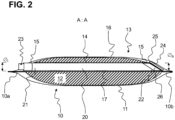
- a cleaning surface 11 (see FIG. 2 ) which is formed in particular from a cleaning cloth, particularly preferably a microfiber cloth or fleece.
- a contact-based rubbing movement takes place over the surface to be cleaned.
- the connecting seam 17 is arranged equidistantly between the cleaning surface 11 and the holding surface 16 and completely surrounds the main body 10 in the circumferential direction.
- a liquid reservoir 20 is inserted into the main body 10, in which a cleaning agent or solvent is kept ready, which can be dispensed onto a surface to be cleaned via a spray head 23 arranged at a first end 21.
- the cleaning agent or solvent is refilled via a refill opening 26 located at a second end 22, which can be sealed by means of a closure element 24 that releasably engages the liquid reservoir 20.
- the spray head 23 is projected over by at least one front end section 10a of the main body 10 in the axial extension of the liquid reservoir 20.
- the liquid reservoir 20 is completely accommodated by the main body 10.
- a receiving opening 14 is formed in the support cushion 12, which completely penetrates the support cushion 12.
- the receiving opening 14 has an inner diameter ⁇ I that approximately corresponds to the outer diameter ⁇ A of the liquid reservoir 20, so that the support cushion 12 clings to the liquid reservoir 20 over its entire axial length and is thus permanently connected to it, in particular by gluing.
- the liquid reservoir 20 is provided as a tube with a cylindrical cross-section that is constant over its entire axial length. This can be particularly well matched to the complementarily shaped receiving opening 14.
- the liquid reservoir 20 is flush with the support pad 12, as can be seen particularly well in the illustration of the FIG. 2 can be seen.
- passage openings 15 are formed in the outer shell 13 at the first and second ends 21, 22, in particular on the side of the holding surface 16. Both the spray head 23 and the closure element 24 protrude from the outer shell 13 through the respective passage opening 15 and can thus be actuated by an operator.
- the closure element 24 is also projected over by at least one rear end section 10b of the main body 10 in the axial extension of the liquid reservoir 20.
- the outer contour 18 follows the course of the connecting seam 17 between the cleaning surface 11 and the holding surface 16.
Landscapes
- Details Or Accessories Of Spraying Plant Or Apparatus (AREA)
Applications Claiming Priority (2)
| Application Number | Priority Date | Filing Date | Title |
|---|---|---|---|
| DE202023103962.6U DE202023103962U1 (de) | 2023-07-14 | 2023-07-14 | Reinigungsvorrichtung für glatte Oberflächen |
| DE102023118753.8A DE102023118753A1 (de) | 2023-07-14 | 2023-07-14 | Reinigungsvorrichtung für glatte oberflächen |
Publications (1)
| Publication Number | Publication Date |
|---|---|
| EP4491075A1 true EP4491075A1 (fr) | 2025-01-15 |
Family
ID=91810227
Family Applications (1)
| Application Number | Title | Priority Date | Filing Date |
|---|---|---|---|
| EP24186128.5A Pending EP4491075A1 (fr) | 2023-07-14 | 2024-07-02 | Dispositif de nettoyage pour surfaces lisses |
Country Status (1)
| Country | Link |
|---|---|
| EP (1) | EP4491075A1 (fr) |
Citations (5)
| Publication number | Priority date | Publication date | Assignee | Title |
|---|---|---|---|---|
| US20040265042A1 (en) * | 2003-04-25 | 2004-12-30 | Browne & Co. | Fulid-dispensing cleaning tool |
| US20130047358A1 (en) * | 2010-10-26 | 2013-02-28 | Adam Robert-George Shafer | Cleaning device having onboard replaceable cleaning pad and onboard replaceable cleaning solution |
| US20170065140A1 (en) * | 2015-09-03 | 2017-03-09 | The Procter & Gamble Company | Foam cleaning device having onboard replaceable cleaning pad and onboard replaceable cleaning solution |
| US20180056709A1 (en) * | 2016-08-30 | 2018-03-01 | Wal-Mart Stores, Inc. | Dry Eraser and Associated Systems and Methods |
| DE102020117922A1 (de) | 2020-07-07 | 2022-01-13 | Ulrich Pohlmann | Reinigungskissen zum Behandeln von Oberflächen |
-
2024
- 2024-07-02 EP EP24186128.5A patent/EP4491075A1/fr active Pending
Patent Citations (5)
| Publication number | Priority date | Publication date | Assignee | Title |
|---|---|---|---|---|
| US20040265042A1 (en) * | 2003-04-25 | 2004-12-30 | Browne & Co. | Fulid-dispensing cleaning tool |
| US20130047358A1 (en) * | 2010-10-26 | 2013-02-28 | Adam Robert-George Shafer | Cleaning device having onboard replaceable cleaning pad and onboard replaceable cleaning solution |
| US20170065140A1 (en) * | 2015-09-03 | 2017-03-09 | The Procter & Gamble Company | Foam cleaning device having onboard replaceable cleaning pad and onboard replaceable cleaning solution |
| US20180056709A1 (en) * | 2016-08-30 | 2018-03-01 | Wal-Mart Stores, Inc. | Dry Eraser and Associated Systems and Methods |
| DE102020117922A1 (de) | 2020-07-07 | 2022-01-13 | Ulrich Pohlmann | Reinigungskissen zum Behandeln von Oberflächen |
Similar Documents
| Publication | Publication Date | Title |
|---|---|---|
| EP0883369B1 (fr) | Dispositif pour le nettoyage d'objets plats | |
| EP1503650B1 (fr) | Dispositif de nettoyage pour des sols | |
| DE3202435C1 (de) | Kosmetisches Reinigungsgeraet | |
| DE112009001579T5 (de) | Handschuh mit der Fähigkeit, Flüssigkeit zu speichern und abzugeben | |
| EP1647204A1 (fr) | Appareil de stockage et d'application | |
| DE202018006815U1 (de) | Reinigungsgeräte für die Reinigung von schwer zugänglichen Stellen | |
| DE102023118753A1 (de) | Reinigungsvorrichtung für glatte oberflächen | |
| EP3300624A1 (fr) | Dispositif d'application d'un matériau cosmétique | |
| DE202023103962U1 (de) | Reinigungsvorrichtung für glatte Oberflächen | |
| DE9207228U1 (de) | Auftragsgerät für eine pigmentierte Flüssigkeit | |
| DE102006011070B4 (de) | Vorrichtung zum Auftragen eines Haarmittels | |
| DE102019103587A1 (de) | Vorrichtung zum Auftrag einer Flüssigkeit | |
| WO2003015567A1 (fr) | Dispositif d'application de liquides et de substances visqueuses ou pateuses | |
| EP0321521B1 (fr) | Dispositif de nettoyage de surfaces sensibles, notamment de verres optiques | |
| DE102012109380A1 (de) | Vorrichtung zum Aufbewahren und Auftragen einer fließfähigen Substanz | |
| DE202013001058U1 (de) | Set Kartusche zum handgesteuerten Dosieren eines lichthärtenden Materials | |
| DE102022002836A1 (de) | Reinigungselement | |
| WO2001064093A1 (fr) | Dispositif de nettoyage avec boucle de fixation | |
| DE102017118207B4 (de) | Tablett zur Aufnahme von Farbe | |
| DE888969C (de) | Fuellfederhalter, insbesondere fuer schnell eindickende Tinten od. dgl. | |
| DE8307155U1 (de) | Applikator für kosmetische Zubereitungen | |
| DE7024207U (de) | Auftragevorrichtung fuer gewebekleber in der chirurgie | |
| DE102021126759A1 (de) | Handgeführte Vorrichtung und Verfahren zum Aufbringen einer Flüssigkeit auf ein langgestrecktes Element | |
| DE202020105966U1 (de) | Reinigungselement | |
| DE1237743B (de) | Vorrichtung zum gleichzeitigen Auftragen und Verteilen von fluessigen oder pastoesen Behandlungsmitteln auf Oberflaechen wie Fussboeden u. dgl. |
Legal Events
| Date | Code | Title | Description |
|---|---|---|---|
| PUAI | Public reference made under article 153(3) epc to a published international application that has entered the european phase |
Free format text: ORIGINAL CODE: 0009012 |
|
| STAA | Information on the status of an ep patent application or granted ep patent |
Free format text: STATUS: THE APPLICATION HAS BEEN PUBLISHED |
|
| AK | Designated contracting states |
Kind code of ref document: A1 Designated state(s): AL AT BE BG CH CY CZ DE DK EE ES FI FR GB GR HR HU IE IS IT LI LT LU LV MC ME MK MT NL NO PL PT RO RS SE SI SK SM TR |
|
| STAA | Information on the status of an ep patent application or granted ep patent |
Free format text: STATUS: REQUEST FOR EXAMINATION WAS MADE |
|
| 17P | Request for examination filed |
Effective date: 20250714 |
|
| STAA | Information on the status of an ep patent application or granted ep patent |
Free format text: STATUS: EXAMINATION IS IN PROGRESS |
|
| 17Q | First examination report despatched |
Effective date: 20251117 |