EP4491258A1 - Procédé et installation de refroidissement d'un gaz de processus - Google Patents
Procédé et installation de refroidissement d'un gaz de processus Download PDFInfo
- Publication number
- EP4491258A1 EP4491258A1 EP23020405.9A EP23020405A EP4491258A1 EP 4491258 A1 EP4491258 A1 EP 4491258A1 EP 23020405 A EP23020405 A EP 23020405A EP 4491258 A1 EP4491258 A1 EP 4491258A1
- Authority
- EP
- European Patent Office
- Prior art keywords
- process gas
- gas
- cooling
- processing
- unit
- Prior art date
- Legal status (The legal status is an assumption and is not a legal conclusion. Google has not performed a legal analysis and makes no representation as to the accuracy of the status listed.)
- Withdrawn
Links
Images



Classifications
-
- B—PERFORMING OPERATIONS; TRANSPORTING
- B01—PHYSICAL OR CHEMICAL PROCESSES OR APPARATUS IN GENERAL
- B01D—SEPARATION
- B01D53/00—Separation of gases or vapours; Recovering vapours of volatile solvents from gases; Chemical or biological purification of waste gases, e.g. engine exhaust gases, smoke, fumes, flue gases, aerosols
- B01D53/26—Drying gases or vapours
- B01D53/265—Drying gases or vapours by refrigeration (condensation)
-
- B—PERFORMING OPERATIONS; TRANSPORTING
- B01—PHYSICAL OR CHEMICAL PROCESSES OR APPARATUS IN GENERAL
- B01D—SEPARATION
- B01D2256/00—Main component in the product gas stream after treatment
- B01D2256/22—Carbon dioxide
Definitions
- the present invention relates to a method for cooling a process gas, in context with compressing and, e.g., drying the gas, and providing the gas for further use, and to a corresponding gas processing plant for cooling a process gas.
- carbon dioxide or other gas is to be separated and stored or otherwise used.
- CO2 carbon dioxide
- CCS carbon dioxide sequestration and CCS are used.
- Carbon dioxide which is extracted either from the environment or directly from the sources of fossil carbon dioxide emissions of an industrial or energy-related nature, can first be processed and compressed before being transported to a storage site.
- the water-containing or water-saturated carbon dioxide rich gas (it is noted that, typically, carbon dioxide is most times not provided as pure gas; rather, other components can be included; thus, the term "carbon dioxide rich gas” will be used in the following) is compressed from an atmospheric pressure level to either a subcritical pressure level of about 10-50 bar or a supercritical pressure level of about 150-250 bar in several compression steps.
- the processing of the carbon dioxide rich gas usually takes place after a first compression step to a subcritical pressure level of approx. 10-50 bar.
- a primary goal of carbon dioxide processing at this stage is the removal of water (drying) to a concentration of less than 50-150 ppmv (ppmv is ppm by volume).
- the water is typically removed by glycol scrubbing or by adsorption methods (temperature or pressure swing adsorption) before being sent to either further compression to the supercritical pressure level, and transport to the storage site or further utilization facilities.
- the temperature of the carbon dioxide rich gas increases.
- the resulting compression heat can be removed via heat exchangers against air or cooling water.
- a certain portion of the water present in the raw carbon dioxide rich gas is condensed and removed prior to the drying step.
- Such cooling process in-between (inter-stage) and/or after compression stages typically to 30-45°C cannot remove water entirely from the carbon dioxide rich gas and is aimed at condensing as much water as possible before downstream drying step. This allows for the much more economical sizing of the drying units.
- carbon dioxide rich gas can be cooled in a heat exchanger to a minimum temperature level of, preferably, higher than 0°C and colder than 30°C, whereby a large part of the contained water condenses out.
- the necessary cooling power for carbon dioxide rich gas cooling and water condensation is provided by a chiller package.
- the condensed water can be separated in a downstream separator and fed to the wastewater system or similar.
- the now water-depleted carbon dioxide rich gas can be fed to the drying unit and then optionally be compressed to a desired final pressure.
- Carbon dioxide rich gas cooling by means of a chiller package with a separate refrigeration circuit requires additional equipment such as compressors, heat exchangers, tanks, instrumentation, etc.
- the refrigeration process is expensive and additional operating fluids (e.g., refrigerant) are required. This increases the investment and operating costs of the plant.
- the plant availability is reduced due to the chiller package, as the probability of system failure increases, e.g., due to failure of the refrigerant compressor.
- refrigerant Depending on the choice of refrigerant, additional plant requirements may arise, such as the necessity of a flare system or the definition of Ex-zones, which increases the investment costs. Further, certain refrigerants are harmful to the environment if released into the atmosphere, e.g., due to leaks or malfunctions.
- the objective of the present invention is to provide an improved way for economical and simple cooling of a gas or process gas like carbon dioxide rich gas.
- the present invention relates to processing, in particular, cooling, a process gas and a corresponding plant.
- process gas can comprise (or be), for example, at least one of: carbon dioxide, natural gas, other hydrocarbons, nitrogen, oxygen.
- the process gas is pre-processed.
- This pre-processing comprises compressing the gas and after-cooling the gas.
- Carbon dioxide rich gas as feed gas for example, often has a high concentration when leaving a capture process with a pressure of, e.g., 1 to 10 bara.
- the carbon dioxide rich gas then needs to be compressed and dried before routing to further use (e.g., pipeline transport, liquefaction, chemical usage).
- the carbon dioxide rich gas is compressed, using, e.g., a compressor unit.
- the carbon dioxide rich gas will, for example, be gradually compressed in several compressor stages (e.g., four stages for medium pressure, and several stages for supercritical state) to a pressure level required by product specification. In-between the compressor stages the carbon dioxide rich gas can be cooled against air or cooling water down to typically 45°C. As the result, a part of water vapor present in the carbon dioxide rich gas will condense.
- the carbon dioxide rich gas can be withdrawn at medium pressure of, e.g., 46 bar(a) or, in general, e.g., between e.g. 10 and 50 bar(a), and a temperature of, e.g., 130°C.
- the hot compressed gas can then be routed to a cooling unit where the gas is cooled down to, e.g., 30 to 35°C. Water or air can e.g. be used for cooling. A part of condensed water vapor can be drawn off and evacuated. The water content of the cooled raw CO2 gas is approx. 2000 ppmv.
- This pre-processing can be done using the mentioned compressing unit and cooling unit, both in combination also referred to a compressing and cooling system.
- the process gas after having been pre-processed, is cooled in a heat exchanger. It is noted that the entire gas stream can be fed into the heat exchanger; however, also only part of the gas stream can be fed into the heat exchanger and a remaining part can be bypassed, for example, and afterwards be combined with the part fed into the heat exchanger.
- the process gas After having been cooled (in the heat exchanger), the process gas is depressurized (or expanded), using, e.g., a valve or another depressurizing unit.
- the process gas can be depressurized to a specified product pressure level. For example, a pressure difference between 2 and 20 bar can be used at a valve for depressurizing.
- the process gas is used in the heat exchanger as a cooling medium. It is noted that the entire gas stream can be fed into the heat exchanger and used as cooling medium; however, also only part of the gas stream can be fed into the heat exchanger and used as cooling medium and a remaining part can be bypassed, for example, and afterwards be combined with the part fed into the heat exchanger.
- the process gas is provided for further use, e.g., storage or the like. In particular, the process gas can also be dried after having been cooled.
- the existing gas (or carbon dioxide rich gas) compressor and the process gas or carbon dioxide rich gas itself are used as refrigerant.
- the refrigeration capacity for cooling before the potential drying step includes the depressurizing or expansion step of the process gas to generate the enthalpy drop (Joule-Thomson effect).
- the carbon dioxide rich gas e.g., after having been pre-processed, can be fed to the heat exchanger and cooled down to, e.g., 13°C against the carbon dioxide rich gas itself. The water content then drops to approx. 500-700 ppmv.
- the process gas is dried in a drying unit, and, after having been dried, the process gas is used in the heat exchanger as a cooling medium. This means that the process gas is dried before being used as the cooling medium. It is noted that other processing of the process gas (in a processing unit) instead of drying can be used, depending on the needs or specific application.
- the process gas after having been cooled and before being dried (or processed), the process gas can be depressurized.
- the process gas can be depressurized and used in the heat exchanger as the cooling medium. In other words, the depressurizing can be done before or after the drying or processing unit.
- the process gas is dried (or processed) in a drying unit (or processing unit), and after having been dried (or processed), the process gas is provided for further use.
- the process gas is used as the cooling medium before the drying (or processing).
- fluid is removed from the process gas, using a gas separating unit (e.g., a gas separator, or a fluid or water separator).
- a gas separating unit e.g., a gas separator, or a fluid or water separator.
- Such process gas separating unit can also be part of the mentioned chilling unit, i.e., the chilling unit can comprise the heat exchanger and the gas separating unit.
- the process gas can be depressurized before the fluid is removed from the gas.
- the process gas can be depressurized after the fluid has been removed from the process gas.
- the depressurizing unit valve
- the depressurizing unit can be arranged at the required position.
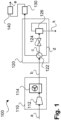
- Fig. 1 schematically illustrates a process according to an embodiment of the invention, using a gas processing plant 100.
- the gas processing plant 100 comprises, by means of example, a compressing and cooling system 110, a chilling unit 120, a processing unit 130 and an optional post-processing and cooling system 140.
- the processing unit 130 can comprise (or even can be) a drying unit, for example. In particular, the processing unit 130 can require certain pre-cooling upfront.
- the compressing and cooling system 110 comprises, by means of example, a compressing unit 112 and a cooling unit 114.
- the compressing unit can, for example, comprise one or more compressors.
- the cooling unit 114 can, for example, comprise one or more coolers or heat exchangers using water or air, for example.
- a compressing and cooling system see Fig. 5 .
- the chilling unit 120 comprises, by means of example, a heat exchanger 122, and gas separation unit 126. Further, the chilling unit 120 comprises a depressurizing unit 124, e.g., a valve. It is noted that the depressurizing unit 124 does not necessarily be part of the chilling unit 120 but could also be part of another component or just be part of the gas processing plant 100. For other examples, see below.
- the gas to be processed can be provided as a feed gas stream (a) to the compressing and cooling unit 110.
- the process gas is pre-processed, i.e., compressed and after-cooled; note that the cooling of the process gas is called after-cooling as the gas is heated by the compressing and, thus, has to be cooled afterwards.
- the stream of gas leaving the compressing and cooling unit 110 is called stream (b).
- the process gas can, before entering the cooling unit 114, have a pressure of, preferably, 10 to 50 bar(a), and a temperature of, e.g., 130°C.
- the process gas can be cooled to, e.g., 35°C.
- the process gas is then fed to the heat exchanger 122 in order to (further) cool down the process gas to, e.g., 15°C. As mentioned above, part of the gas can also be bypassed.
- the process gas after having been cooled by the heat exchanger, is called stream (c).
- the process gas is then routed through the depressurizing unit or valve 124 such that the process gas is de-pressurized (or expanded).
- a pressure difference of, e.g., between 2 and 20 bar can be used here. In this way, the necessary refrigeration capacity for using the process gas as cooling medium is generated (Joule-Thomson effect).
- the process gas is fed to the gas separation unit 126 where the process gas is separated from water or water vapor (or any other fluid) still present in the process gas.
- the fluid k e.g., condensate, can be fed to further processing or the wastewater system or similar.
- the (remaining) process gas is then fed to the heat exchanger 122, used as cooling medium. As mentioned above, part of the gas can also be bypassed (and, thus, not be used as cooling medium).
- the depressurized process gas (irrespective of whether or not fluid has been removed) is called stream (d). In this way, the process gas fed to the heat exchanger upstream, as stream (b), is cooled.
- the process gas can be fed, for example, to the drying unit and, after the drying unit, the process gas can be fed to the post-processing and cooling system 140.
- the post-processing and cooling system 140 can, for example, comprise one or more compressors and one or more coolers or heat exchangers using water, for example.
- Such further post-processing and cooling system 140 can optionally be used if the process gas has to be further compressed, what can depend on the intended use.
- a post-processing and cooling system see Fig. 6 .
- the process gas, after having been dried or otherwise processed, is called stream (e)
- Fig. 2 schematically illustrates a process according to an embodiment of the invention, using a gas processing plant 200.
- the gas processing plant 200 comprises the same components or units as gas processing plant 100 of Fig. 1 ; for explanation of the components see Fig. 1 .
- the components are arranged differently in order to achieve a different order of processing steps.
- the depressurizing unit or valve 124 is arranged after the gas separation unit 126. In this way, the process gas is depressurized after the fluid k has been removed from the process gas, whereas with gas processing plant 100, the process gas is depressurized before the fluid k is removed from the process gas.
- Fig. 3 schematically illustrates a process according to an embodiment of the invention, using a gas processing plant 300.
- the gas processing plant 300 comprises the same components or units as gas processing plant 100 of Fig. 1 ; for explanation of the components see Fig. 1 .
- the components are arranged differently in order to achieve a different order of processing steps.
- the process gas is fed to the processing unit 130 (e.g., a drying unit) and, after having been processed, the process gas is fed to the heat exchanger 122 and used as the cooling medium.
- the processing unit 130 e.g., a drying unit
- depressurizing unit or valve 124 is arranged after the gas separation unit 126, like in gas processing plant 200 of Fig. 2 , but before the process gas is fed to the processing unit 130.
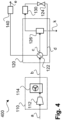
- Fig. 4 schematically illustrates a process according to an embodiment of the invention, using a gas processing plant 400.
- the gas processing plant 400 comprises the same components or units as gas processing plant 100 of Fig. 1 ; for explanation of the components see Fig. 1 .
- the components are arranged differently in order to achieve a different order of processing steps.
- the process gas After having been cooled, the process gas is fed to the processing unit 130 and, after having been processed, the process gas is fed to the heat exchanger 122 and used as the cooling medium.
- the depressurizing unit or valve 124 is arranged after the processing unit 130 but still before the heat exchanger 122.
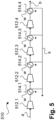
- Fig. 5 schematically illustrates part of a process plant according to an embodiment of the invention.
- a compression and cooling unit 510 is shown which can be used as or instead of compression and cooling unit 110 in any of the process plants 100, 200, 300, 400, for example.
- the feed gas stream (a) is received therein, and the pre-processed gas stream b is provided.
- the compression and cooling unit 510 comprises, by means of example, four stages of compression, having a first compressor or compressor unit 512.1, a second compressor or compressor unit 512.2, a third compressor or compressor unit 512.3, and a fourth compressor or compressor unit 512.4.
- a cooling stage is provided, e.g., using a heat exchanger with water (w) as cooling medium.
- These stages are 514.1, 514.2, 514.3, and 514.4.
- the last stage or heat exchanger 514.4 can, for example, correspond to the individual cooling unit 114 in any of the process plants 100, 200, 300, 400.
- fluid k e.g., condensed water
- fluid k can be fed to the wastewater system or similar after each stage.
- Fig. 6 schematically illustrates part of a process plant according to an embodiment of the invention.
- a post-processing and cooling system 640 is shown which can be used as or instead of post-processing and cooling system 140 in any of the process plants 100, 200, 300, 400, for example.
- the gas stream d is received therein, and the gas stream (e) is provided, e.g., for further use.
- the post-processing and cooling system 640 comprises, by means of example, three stages of compression, which can be seen in combination with the four stages of the processing and cooling system 510, for example.
- the post-processing and cooling system 640 has a fifth compression stage or compressor unit 612.5, a sixth compression stage or compressor unit 612.6, and a seventh compression stage or compressor unit 612.7.
- a cooling stage is provided, e.g., using a heat exchanger with water (w) as cooling medium.
- These stages are 614.5, 614.6, and 614.7.
- fluid k e.g., condensed water
- a required number of compressors or compression stages with required power can be used. Further note that the numbering of the stages in the post-processing and cooling system 640 is based on the numbers of stages in the processing and cooling system 510 and may, of course, differ depending on the number of stages in the processing and cooling system 510.
Landscapes
- Chemical & Material Sciences (AREA)
- Physics & Mathematics (AREA)
- Thermal Sciences (AREA)
- Engineering & Computer Science (AREA)
- Analytical Chemistry (AREA)
- General Chemical & Material Sciences (AREA)
- Oil, Petroleum & Natural Gas (AREA)
- Chemical Kinetics & Catalysis (AREA)
- Drying Of Gases (AREA)
Priority Applications (1)
| Application Number | Priority Date | Filing Date | Title |
|---|---|---|---|
| PCT/EP2024/025197 WO2025016557A1 (fr) | 2023-07-14 | 2024-07-02 | Procédé et installation de refroidissement d'un gaz riche en dioxyde de carbone |
Applications Claiming Priority (1)
| Application Number | Priority Date | Filing Date | Title |
|---|---|---|---|
| EP23020346 | 2023-07-14 |
Publications (1)
| Publication Number | Publication Date |
|---|---|
| EP4491258A1 true EP4491258A1 (fr) | 2025-01-15 |
Family
ID=87377898
Family Applications (1)
| Application Number | Title | Priority Date | Filing Date |
|---|---|---|---|
| EP23020405.9A Withdrawn EP4491258A1 (fr) | 2023-07-14 | 2023-08-30 | Procédé et installation de refroidissement d'un gaz de processus |
Country Status (1)
| Country | Link |
|---|---|
| EP (1) | EP4491258A1 (fr) |
Citations (4)
| Publication number | Priority date | Publication date | Assignee | Title |
|---|---|---|---|---|
| US20070232706A1 (en) * | 2006-04-03 | 2007-10-04 | Shah Minish M | Carbon dioxide production method |
| US20110296867A1 (en) * | 2010-06-03 | 2011-12-08 | Ortloff Engineers, Ltd. | Hydrocarbon Gas Processing |
| US20110296868A1 (en) * | 2008-12-19 | 2011-12-08 | L'air Liquide Societe Anonyme Pour L'etude Et L'exploitation Des Procedes Georges Claude | CO2 Recovery Method Using Cryo-Condensation |
| CA3210125A1 (fr) * | 2021-03-03 | 2022-09-09 | Michael Tran | Procede de liquefaction d'un courant riche en co2 |
-
2023
- 2023-08-30 EP EP23020405.9A patent/EP4491258A1/fr not_active Withdrawn
Patent Citations (4)
| Publication number | Priority date | Publication date | Assignee | Title |
|---|---|---|---|---|
| US20070232706A1 (en) * | 2006-04-03 | 2007-10-04 | Shah Minish M | Carbon dioxide production method |
| US20110296868A1 (en) * | 2008-12-19 | 2011-12-08 | L'air Liquide Societe Anonyme Pour L'etude Et L'exploitation Des Procedes Georges Claude | CO2 Recovery Method Using Cryo-Condensation |
| US20110296867A1 (en) * | 2010-06-03 | 2011-12-08 | Ortloff Engineers, Ltd. | Hydrocarbon Gas Processing |
| CA3210125A1 (fr) * | 2021-03-03 | 2022-09-09 | Michael Tran | Procede de liquefaction d'un courant riche en co2 |
Similar Documents
| Publication | Publication Date | Title |
|---|---|---|
| EP2478312B1 (fr) | Système de séparation de gaz autoréfrigéré pour capture et compression de dioxyde de carbone | |
| JP5226457B2 (ja) | 空気流圧縮方法及び空気流圧縮装置 | |
| US6158240A (en) | Conversion of normally gaseous material to liquefied product | |
| EP2365265B1 (fr) | Procédé et installation pour séparer du dioxyde de carbone d'un effluent gazeux provenant des installations de combustion | |
| JP5754052B2 (ja) | 液体から凝縮性成分を除くための製法 | |
| AU2002357302B2 (en) | Combined recovery of hydrogen and hydrocarbon liquids from hydrogen-containing gases | |
| JP6357155B2 (ja) | 流体からの凝縮性成分除去を最適化するための方法 | |
| CN119923549A (zh) | 用于冷却包含氢或氦的流体的系统和方法 | |
| US20140123700A1 (en) | Heat integration for cryogenic co2 separation | |
| EP4491258A1 (fr) | Procédé et installation de refroidissement d'un gaz de processus | |
| US6925818B1 (en) | Air cycle pre-cooling system for air separation unit | |
| WO2025016557A1 (fr) | Procédé et installation de refroidissement d'un gaz riche en dioxyde de carbone | |
| US20220146193A1 (en) | Method for integrating a co2 capture unit with the precooling section of a natural gas liquefaction plant | |
| KR20200088279A (ko) | 혼합 냉매 시스템 및 방법 | |
| TW202532796A (zh) | 低溫氣體冷卻系統和方法 | |
| US20170307291A1 (en) | Low pressure ethane liquefaction and purification from a high pressure liquid ethane source | |
| TW201314153A (zh) | 用於低溫分離二氧化碳之熱整合 | |
| WO2011083365A2 (fr) | Déshydratation du gaz | |
| CN105241178A (zh) | 用于通过低温分离空气获取压力气体产物的方法和装置 | |
| US20250334330A1 (en) | Gas liquefaction system with multiple refrigerant cycles | |
| KR101686513B1 (ko) | 증발가스 재액화 장치 및 방법 | |
| JP2631809B2 (ja) | 産業排気ガスからの炭酸ガス回収液化装置 | |
| WO2026023532A1 (fr) | Système de liquéfaction et procédé de liquéfaction | |
| WO2024199733A1 (fr) | Installation de séparation de dioxyde de carbone utilisant un circuit de réfrigération externe, et procédé | |
| WO2025186120A1 (fr) | Installation de séparation de dioxyde de carbone utilisant du dioxyde de carbone en tant que fluide frigorigène dans un circuit de réfrigération, et procédé |
Legal Events
| Date | Code | Title | Description |
|---|---|---|---|
| PUAI | Public reference made under article 153(3) epc to a published international application that has entered the european phase |
Free format text: ORIGINAL CODE: 0009012 |
|
| STAA | Information on the status of an ep patent application or granted ep patent |
Free format text: STATUS: THE APPLICATION HAS BEEN PUBLISHED |
|
| AK | Designated contracting states |
Kind code of ref document: A1 Designated state(s): AL AT BE BG CH CY CZ DE DK EE ES FI FR GB GR HR HU IE IS IT LI LT LU LV MC ME MK MT NL NO PL PT RO RS SE SI SK SM TR |
|
| STAA | Information on the status of an ep patent application or granted ep patent |
Free format text: STATUS: THE APPLICATION IS DEEMED TO BE WITHDRAWN |
|
| 18D | Application deemed to be withdrawn |
Effective date: 20250716 |