EP4491780A1 - Gewebesensor zur mehrdimensionalen erfassung und betriebsverfahren zur analyse eines durch einen gewebesensor erzeugten einzelausgangssignals - Google Patents
Gewebesensor zur mehrdimensionalen erfassung und betriebsverfahren zur analyse eines durch einen gewebesensor erzeugten einzelausgangssignals Download PDFInfo
- Publication number
- EP4491780A1 EP4491780A1 EP23184712.0A EP23184712A EP4491780A1 EP 4491780 A1 EP4491780 A1 EP 4491780A1 EP 23184712 A EP23184712 A EP 23184712A EP 4491780 A1 EP4491780 A1 EP 4491780A1
- Authority
- EP
- European Patent Office
- Prior art keywords
- woven fabric
- sensor
- fabric sensor
- weft
- bridge
- Prior art date
- Legal status (The legal status is an assumption and is not a legal conclusion. Google has not performed a legal analysis and makes no representation as to the accuracy of the status listed.)
- Pending
Links
Images


Classifications
-
- D—TEXTILES; PAPER
- D03—WEAVING
- D03D—WOVEN FABRICS; METHODS OF WEAVING; LOOMS
- D03D1/00—Woven fabrics designed to make specified articles
- D03D1/0088—Fabrics having an electronic function
-
- A—HUMAN NECESSITIES
- A61—MEDICAL OR VETERINARY SCIENCE; HYGIENE
- A61B—DIAGNOSIS; SURGERY; IDENTIFICATION
- A61B5/00—Measuring for diagnostic purposes; Identification of persons
- A61B5/02—Detecting, measuring or recording for evaluating the cardiovascular system, e.g. pulse, heart rate, blood pressure or blood flow
- A61B5/024—Measuring pulse rate or heart rate
-
- A—HUMAN NECESSITIES
- A61—MEDICAL OR VETERINARY SCIENCE; HYGIENE
- A61B—DIAGNOSIS; SURGERY; IDENTIFICATION
- A61B5/00—Measuring for diagnostic purposes; Identification of persons
- A61B5/08—Measuring devices for evaluating the respiratory organs
- A61B5/0816—Measuring devices for examining respiratory frequency
-
- A—HUMAN NECESSITIES
- A61—MEDICAL OR VETERINARY SCIENCE; HYGIENE
- A61B—DIAGNOSIS; SURGERY; IDENTIFICATION
- A61B5/00—Measuring for diagnostic purposes; Identification of persons
- A61B5/103—Measuring devices for testing the shape, pattern, colour, size or movement of the body or parts thereof, for diagnostic purposes
- A61B5/11—Measuring movement of the entire body or parts thereof, e.g. head or hand tremor or mobility of a limb
- A61B5/113—Measuring movement of the entire body or parts thereof, e.g. head or hand tremor or mobility of a limb occurring during breathing
- A61B5/1135—Measuring movement of the entire body or parts thereof, e.g. head or hand tremor or mobility of a limb occurring during breathing by monitoring thoracic expansion
-
- A—HUMAN NECESSITIES
- A61—MEDICAL OR VETERINARY SCIENCE; HYGIENE
- A61B—DIAGNOSIS; SURGERY; IDENTIFICATION
- A61B5/00—Measuring for diagnostic purposes; Identification of persons
- A61B5/68—Arrangements of detecting, measuring or recording means, e.g. sensors, in relation to patient
- A61B5/6887—Arrangements of detecting, measuring or recording means, e.g. sensors, in relation to patient mounted on external non-worn devices, e.g. non-medical devices
- A61B5/6891—Furniture
-
- D—TEXTILES; PAPER
- D03—WEAVING
- D03D—WOVEN FABRICS; METHODS OF WEAVING; LOOMS
- D03D13/00—Woven fabrics characterised by the special disposition of the warp or weft threads, e.g. with curved weft threads, with discontinuous warp threads, with diagonal warp or weft
- D03D13/004—Woven fabrics characterised by the special disposition of the warp or weft threads, e.g. with curved weft threads, with discontinuous warp threads, with diagonal warp or weft with weave pattern being non-standard or providing special effects
-
- D—TEXTILES; PAPER
- D03—WEAVING
- D03D—WOVEN FABRICS; METHODS OF WEAVING; LOOMS
- D03D15/00—Woven fabrics characterised by the material, structure or properties of the fibres, filaments, yarns, threads or other warp or weft elements used
- D03D15/50—Woven fabrics characterised by the material, structure or properties of the fibres, filaments, yarns, threads or other warp or weft elements used characterised by the properties of the yarns or threads
- D03D15/533—Woven fabrics characterised by the material, structure or properties of the fibres, filaments, yarns, threads or other warp or weft elements used characterised by the properties of the yarns or threads antistatic; electrically conductive
Definitions
- the invention relates to a woven fabric sensor for multi-dimensional sensing, a multi-dimensional sensing system, and a seat or a bed comprising the woven fabric sensor for multi-dimensional sensing.
- the invention further relates to an operating method for analysing a single output signal generated by a woven fabric sensor.
- Capacitive sensing generally uses two layers of conductive materials separated by a non-conductive layer, to transfer charge that bounces from one conductive layer to the other conductive layer to create a sensor signal change corresponding to electrical resistance.
- An equivalent exemplary fabric sensor hereto is disclosed in EP 3374551 A1 or WO 2018 076 106 A1 .
- this structure does not allow capacitive sensing to be used for voltage differential sensing, whereas voltage differential requires two conductive layers to come into contact for a transfer of charge, resulting in a sensor signal change corresponding to electrical resistance.
- Another fabric sensor is known from WO 2009/093040 A1 , but this fabric is knitted rather than woven.
- a knitted fabric generally has more stretch than a woven fabric.
- the excessive movement of most electrically conductive materials reduce their lifetime, as the conductive material tends to break when it is exposed to excessive movement.
- Woven fabrics comprising an electrically conductive material are also known from EP 2 524 983 A2 .
- this fabric consists of non-conductive warp and non-conductive weft yarns.
- the electrically conductive wire is an additional wire woven into the fabric additionally to the electrically non-conductive warp yarns and electrically non-conductive weft yarns.
- a common drawback of fabric sensors is a high level of signal noise, which leads to higher power consumption and inaccuracy in signal analysis.
- the object of the invention is to provide a woven fabric sensor, a multi-dimensional sensing system, a seat or a bed as well as an operating method with an improved energy efficiency and a reduced signal noise.
- the object of the invention is solved by a woven fabric sensor according to independent claim 1, a multi-dimensional sensing system according to independent claim 10, a seat or a bed according to independent claim 11, an operating method according to claim 12 and a computer program product according to claim 15.
- a first aspect of the invention is directed at the woven fabric sensor for multi-dimensional sensing, which comprises a plurality of electrically conductive warps and at least on electrically non-conductive weft.
- the warps are arranged parallel to each other.
- the at least one weft is floating over or under the warp.
- the weft comprises a bridge section floating over or under at least two adjacent electrically conductive warps for generating an electrically connected bridge path.
- the bridge path presses at least two parallel warps together so that the warps are electrically connected. This results in an improved sensitivity of the sensor as the sensing area increases.
- the signal detected by the woven fabric sensor according to the invention is of greater magnitude and, in particular, greater relative to the magnitude of the signal noise present.
- the overall power consumption is reduced as a result of the increased sensing area, since the signal from the woven fabric sensor does not need to be amplified, or not as much. It is also possible to set a first cutoff threshold value so that, for example, a processor is only activated when the signal value generated by the woven fabric sensor is above the first cutoff threshold value.
- the woven fabric sensor according to the invention enables a change in the magnetic field to be detected with high sensitivity.
- the proximity of a fingertip can be measured by capacitance as long as there is no contact with the fabric, and the pressure applied can be measured by resistance when there is contact between the fingertip and the fabric sensor.
- Exemplary products in which the woven fabric sensor could be integrated are fabrics for clothing, for car seats, for car seat covers, for steering wheels and steering wheel covers, for bedsheets, for carpets, for flooring, for buttons such as turn on/off buttons and/or for switches.
- the woven fabric sensor could therefore be used in many different products, in particular in the automotive field and/or for healthcare sectors.
- woven fabrics comprise less stretch than knitted fabrics.
- the warp runs in a direction of warp and the weft runs along a direction of weft.
- the warps of a plurality of warps runs parallel to each other and the wefts of a plurality of wefts runs parallel to each other.
- the warp is held stationary under tension while the transversing weft is drawn through and inserted over and under the warp.
- the tension of the warp and/ or the weft can be alternated.
- Different tensions in the warp and weft allows tighter or looser weaving of the conductive yarns which also has the effect of increasing or decreasing the dynamic (non-binary) electrical resistance of the fabric sensor. This allows to customize specifications such as resistance values.
- the most common woven fabric type is called plain weave and has the direction of warp arranged perpendicular to the direction of weft. This style of weaving has the weft alternating over and under the warp. The next adjacent weft follows in a mirrored order when passed over and under the warp. Thereby, the warp is fixed by the weft and separated from each other.
- the weft passes over or under at least two adjacent warps.
- the at least one adjacent weft passes over or under the warps in a mirrored sequence to the previously described adjacent weft.
- the warps comprised within a bridge path are thus pressed together.
- the bridge path comprises between three to ten warps, thus, increasing the bridge length.
- three or more bridge paths allow to extend with an adjacent bridge path along two ways.
- plain weave is known as twill weave or sating weave.
- Plain weave is the preferred embodiment, but it is also possible to implement the woven fabric sensor as described above based on other styles, such as twill weave or sating weave.
- Multi-dimensional sensing refers to sensing parameters including, but not limited to, proximity, capacitance, temperature, humidity, vibration, applied force, and pressure differential.
- multi-dimensional sensing utilizes for example electric field sensing or the Hall Effect for sensing, which are sensitive to a change in the magnetic field.
- Electrically conductive materials comprise in particular semiconductors, nickel, copper and/or stainless steel.
- Stainless steel is a cheap but less conductive mixture comprising nickel and copper achieving optimum signal strength for woven fabric sensors.
- the non-conductive material could be made of polyamide (PA), in particular polyamide 6.6, also known as Nylon, or recycled polyethylene terephthalate (PET) or a bio-based yarn, such as a yarn made of sugar cane.
- the woven fabric sensor comprises a first weft having a first bridge section for generating a first bridge path and a second weft having a second bridge section for generating a second bridge path.
- the first bridge path and the second bridge path are electrically connected to at least one common electrically conductive warp.
- Adjacent wefts increase the width of the bridge section along the direction of warp. By increasing the width, the contact surface of two or more adjacent warps is increased. The connection is thereby less susceptible to disconnection by separation of the warp during movement of the fabric, allowing a more reliable sensor.
- An even further improved sensor can be made by having four, more preferably 6 and most preferably 10 or more adjacent bridge sections comprising the same warps.
- the second bridge path is electrically connected to at least one electrically conductive warp, which is not electrically connected to the first bridge path.
- the bridge path extends thereby along the direction of warp and the direction of weft.
- a new warp is electrically connected which was not previously connected by the first bridge path. Thereby the sensing area is further increased resulting an even more sensitive sensor.
- the woven fabric sensor comprises a third weft having a third bridge section for generating a third bridge path.
- the third weft has at least one weft arranged between the third weft and the first weft.
- the first bridge path and the third bridge path are electrically connected to at least one common electrically conductive warp.
- the third bridge path which fulfils the above condition, allows to form multiple connection points with the same warps along the direction of warp. Thereby ensuring that a long warp is connected throughout multiple times with another warp.
- the woven fabric becomes thereby more robust over breakages in single warps within the woven fabric sensor, as the warp is connected to a different warp at a section before and after the breakage, thereby, bypassing the breakage.
- a plurality of overlapping bridge paths form a continuous path of conductivity.
- the continuous path of conductivity improves the sensing area by interconnecting multiple electrically conductive warps.
- the sensitivity is thereby greatly enhanced because the adjacent bridge paths have an overlapping section.
- the continuous path of conductivity can be arranged to form different patterns. Exemplarily, this pattern could be circular and/or spiral.
- the continuous path of conductivity can split into two or more continuous path of conductivity, thereby forming for example a "Y" pattern.
- the continuous path of conductivity follows a wave like pattern.
- the wave like pattern preferably extends along the direction of warp.
- the wave like pattern ensures a multiple crossing of a single warp making the fabric sensor signal less susceptible to breakages of single warps.
- the wave like pattern is particularly beneficial for electromagnetic interference. It increases the electromagnetic compatibility.
- the wave like shape is of constant nature, in particular comprises a constant frequency and a constant amplitude.
- the continuous path of conductivity defines a sensor section.
- the sensor section is preferably bound by a first boundary and a second boundary.
- the first boundary and the second boundary can be the first warp and the last warp of the plurality of electrically connected warps via one or more continuous paths of conductivity. With other words, the most external warps electrically connected with each other form the boundary.
- the definition of the sensor section allows the allocation of a signal received by a control unit. This allocation is possible as each section is positioned at a predefined place. As soon as a signal from this section is generated the control unit processing the signal can allocate the signal to the corresponding section, and consequently allocating the sensed signal.
- a single section comprises at least two paths of conductivity having preferably a wave like pattern.
- the two paths of conductivity are electrically connecting at least one common electrically conductive warp. This further increases the sensing section, resulting in an even larger sensing area. The increased sensing area provides an even more sensitive sensor.
- the woven fabric sensor comprises a plurality of sensor sections.
- the plurality of sensor sections enable a multiple of signals generated by a single woven fabric sensor. This could be utilised, for example, for measuring different interactions by the single woven fabric sensor.
- the woven fabric sensor comprises a single contact point for transmitting a single output signal.
- the single contact point is arranged within the sensor section.
- the single contact point provides a very simple implementation of the invention. As all the warps are connected via the bridge paths, the single contact point can be located anywhere within the defined sensor section. This allows for a wide variety of applications. For example, for a seat cover comprising a woven fabric sensor the single contact point can be allocated at a position that allows enough installation space for the wire to be connected to a control unit or a wireless transmitter. Thereby, failure modes are reduced, the industrial implementation is enhanced and the product can be much easier assembled.
- a second aspect of the invention is directed at a multi-dimensional sensing system for measuring sensing parameters comprising: a woven fabric sensor as previously described, and a connector connected to the single contact point for transmitting the single input signal to a control unit.
- the control unit is configured to process the single input signal.
- the control unit is configured to respond in real time due to the woven sensor signal, in particular including various multi-dimensional sensing parameters, according to the invention. Responding in real time allows post processing to be made redundant and reduces latency limitations caused by post processing filtering. Further, the system can be integrated into an internet of things architecture.
- a third aspect of the invention is directed at a seat characterised by a woven fabric sensor as described above.
- a fourth aspect of the invention is directed at a bed characterized by a woven fabric sensor as described above.
- the seat in particular for the automotive industry, or the bed, in particular for healthcare appliances, require an ever increasing amount of sensors for enabling sensing of in particular human physical parameters, human-machine interaction, and human behaviour.
- a fifth aspect of the invention is directed at an operating method for analysing a single output signal generated by a woven fabric sensor as described above or a multi-dimensional sensing system as described above carried out by a control unit. The method comprising the followings steps: a) Receiving a single input sensor signal having a signal value. b) Analysing the signal value for determining a magnitude of a sensing parameter. c) Generating an output signal indicating the magnitude of the sensing parameter.
- the step of analysing allows differentiation between a plurality of different information sensed by the woven fabric sensor according to the invention.
- the woven fabric sensor to detect information about a person's heart rate as well as breathing rate from a single woven fabric sensor having only a single point of contact.
- the heart rate is for example sensed by use of capacity sensing and the torso expansion, directly correlated to breathing rate, is measured by resistance sensing.
- the differentiation is made possible by applying a filter to the sensor signal or by performing a Fourier transform to identify different frequencies and amplitudes in the signal relating to heart rate or respiratory rate respectively.
- the output signal can be used to initiate or trigger a response based on the output signal.
- a first output signal is generated, when the signal value is greater than a first cutoff threshold value; and/or a second output signal is generated, when the signal value is greater than a second cutoff threshold value; and/or a third output signal is generated when the signal value is greater than a third cutoff threshold value.
- the first cutoff threshold reduces the power consumption when the fabric sensor is not in use.
- some magnetic field or electric field is at most times present in the environment.
- it is not the intention to use it to measure any magnetic field but, exemplarily only when a finger is approaching the fabric sensor that will change and/or influence and/or disrupt the magnetic or electric field.
- first cutoff threshold can be used as the sensing area of the woven fabric sensor provides a very sensitive signal having a high amplitude.
- the first cutoff threshold can be set relatively high, such that unintentional signal outputs are avoided.
- the cutoff thresholds can be adjusted according to the intended use. For example, a baby in a childseat generates a much lower amplitude signal and requires lower cutoff thresholds, whereas an adult generates a much higher amplitude in the signal resulting in a higher cutoff threshold value.
- the sensing parameter is any one or multiple of: proximity, capacitance, temperature, humidity, vibration, applied force, or pressure differential.
- a sixth aspect of the invention is directed at a computer program product comprising instructions which, when the program is executed by a control unit, cause the control unit to carry out the steps of the operating method described above.
- Fig. 1 shows a woven fabric sensor 100 comprising a plurality of electrically conductive warps 10 and electrically non-conductive wefts 20 floating over or under the warp.
- the woven fabric sensor 100 extends along a direction of warp D Warp running parallel to the warp 10 and a direction of weft D Weft running parallel to the weft 20.
- the direction of warp D Warp is perpendicular to the direction of weft D Weft similar to a plain weave.
- the woven fabric sensor 100 has at least one sensor section 50 including at least one continuous path of conductivity 32 electrically connecting the plurality of electrically conductive warps 10 included in the sensor section 50.
- the sensor section 50 exemplarily shows two continuous paths of conductivity 32 within a single sensor section 50. This is enabled because both paths of conductivity 32 have at least one common electrically conductive warp 10, indicated in Fig. 1 by a dotted line in the centre of the sensor section 50.
- the sensor section 50 is bound by a first boundary 51 and a second boundary 52.
- the first and second boundaries 51, 52 are defined by the outermost warp being electrically connected to the continuous path of conductivity 32.
- the warps 10 arranged within the sensor section 50 are electrically conductive.
- the warps outside the sensor section 50 can be electrically non-conductive.
- the sensor section 50 further comprises a single contact point 40, which is designed to be connected to a connector 210, which is described in more detail below.
- Fig. 2 shows an enlarged view of section A of Fig. 1 .
- six parallel warps 10a to 10f and nine parallel wefts 20a to 20i are shown.
- each weft 20a to 20i flows alternately over and under the warp 10a to 10f as shown in Fig. 3 , thereby separating the electrically conductive warps 10 from each other.
- the weft 20a to 20i flows over or under at least two adjacent electrically conductive warps 10a to 10f, thereby pressing the comprised warps 10 together to form an electrical connection as best shown in Fig. 4 and Fig. 5 .
- the consecutive bridge paths 30a, 30b; 30b, 30c have at least one common electrically conductive warp 10e, 10f; 10d, 10e. All bridge paths 30a to 30i are preferably of the same length. Further, the abutting bridge path comprises at least one electrically conductive warp which is not comprised by the adjacent bridge path.
- the adjacent bridge paths 30 to 30i comprise an overlapping section.
- the adjacent bridge paths 30 to 30i can be referred to as plurality of overlapping bridge paths 31 forming the continuous path of conductivity 32. As shown in Fig. 1 the continuous path of conductivity 32 is arranged such that it follows a wave like pattern. Adjacent can also be understood as equivalent to abutting.
- Fig. 6 shows a multi-dimensional sensing system 200.
- the sensing system 200 comprises a woven fabric sensor 100, as described above, a connector 210 connected to the single contact point 40 and a transmitter 220, which is preferably a wireless transmitter 220, and a control unit 230 comprising a memory 250 and a processor 240 configured to analyse signals sensed by the woven fabric sensor 100.
- the woven fabric sensor 100 shown in Fig. 6 exemplarily comprises two sensor sections 50, 55, each connected via a connector 210 and a wireless transmitter 220 to a control unit 230.
- the control unit 230 could also be a microcontroller, a computer or a centrally located computer configured to receive from a plurality of woven fabric sensors 100 or sensor sections 50, 55 input signals.
- FIG. 7a An exemplarily sensor input signal S having a signal value SV according to the prior art, WO 2018 076 106 A1 , is shown in Fig. 7a .
- the sensor signal value SV comprises relatively a large amount of noise in the signal.
- the sensor signal of a single input sensor signal S in 1, as it is measured with the woven fabric sensor 100, is shown by way of example in Fig. 7b .
- the signal contains less signal noise.
- Fig. 7b shows three cutoff threshold values 1CTV, 2CTV, 3CTV. If the signal value SV1 is below the respective cutoff threshold value, no corresponding output signal 1S out , 2S out , 3S out is generated by the control unit 230.
- Fig. 7b no output signal is generated until t 1 .
- a first output signal 1S out is generated until the signal value SV1 has risen to a value greater than the second cutoff threshold value 2CTV at time t 2 .
- This range could be adjusted such that a proximity of a finger is sensed, but, no contact with the woven fabric sensor 100 has occured.
- Time t 3 to t 4 show a transmission when the finger has been moved away from the woven fabric sensor 100.
- the first output signal 1S out is generated until the signal value SV1 falls below the first cutoff threshold value 1CTV and no output signal is generated.
- a force is applied to the woven fabric sensor 100 equivalent to time t 1 to t 2 .
- the force applied to the woven fabric sensor 100 increases such that the signal value SV1 increases from t 7 to t 8 to a value above the third cutoff threshold value 3CTV such that a third output signal 3S out is generated.
- the third output signal 3S out could be configured to indicate a high force applied to the woven fabric sensor 100.
- the three thresholds shown are for demonstration purposes only and could include a number of other thresholds to produce an even more differentiated output signal.
- the output signal 1S out , 2S out , 3S out can be used to trigger a predefined action.
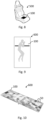
- a light bulb of a different colour can be activated for each output signal. It could also be used for a car seat 500 as shown in Fig. 8 .
- the specific location of the sensor section 50, 55 allows, for example, an assessment to be made as to whether the person is sitting out of position (OOP) or is experiencing high levels of stress or other emotional levels which can be correlated with a measurable signal by use of the woven fabric sensor 100.
- the sheet consists of a woven fabric sensor 100.
- the woven fabric sensor 100 comprises a plurality of sensor sections 50.
- the sensor sections 50 detect in particular whether a person is sleeping stationary or moving on the bed 600.
- the woven fabric sensor 100 as described above, as well as the multi-dimensional sensing system 200, can be seamlessly integrated into a woven fabric.
- the woven fabric sensor 100 is characterised by having an increased sensing area achieved by the use of the described bridge paths 30a to 30e, thereby having an improved sensitivity.
- the corresponding input signal generated by the woven fabric sensor 100 therefore comprises a higher magnitude in the signal value SV1 compared to standard woven fabric sensors known in the prior art. Also, the relative ratio of signal noise to the absolute signal value SV1 is reduced to a negligible ratio by the woven fabric sensor described above.
Landscapes
- Health & Medical Sciences (AREA)
- Life Sciences & Earth Sciences (AREA)
- Engineering & Computer Science (AREA)
- Molecular Biology (AREA)
- Animal Behavior & Ethology (AREA)
- Veterinary Medicine (AREA)
- Biophysics (AREA)
- Pathology (AREA)
- Public Health (AREA)
- Biomedical Technology (AREA)
- Heart & Thoracic Surgery (AREA)
- Medical Informatics (AREA)
- General Health & Medical Sciences (AREA)
- Surgery (AREA)
- Physics & Mathematics (AREA)
- Physiology (AREA)
- Textile Engineering (AREA)
- Pulmonology (AREA)
- Cardiology (AREA)
- Dentistry (AREA)
- Oral & Maxillofacial Surgery (AREA)
- Woven Fabrics (AREA)
- Geophysics And Detection Of Objects (AREA)
- Treatment Of Fiber Materials (AREA)
Priority Applications (4)
| Application Number | Priority Date | Filing Date | Title |
|---|---|---|---|
| EP23184712.0A EP4491780A1 (de) | 2023-07-11 | 2023-07-11 | Gewebesensor zur mehrdimensionalen erfassung und betriebsverfahren zur analyse eines durch einen gewebesensor erzeugten einzelausgangssignals |
| CN202480058076.1A CN121816446A (zh) | 2023-07-11 | 2024-07-11 | 用于多维感测的机织物传感器及用于分析由机织物传感器产生的单一输入传感器信号的操作方法 |
| TW113126062A TW202511729A (zh) | 2023-07-11 | 2024-07-11 | 用於多維度感測之紡織品感測器及用於分析由紡織品感測器產生之單一輸入感測器訊號之操作方法 |
| PCT/EP2024/069624 WO2025012367A1 (en) | 2023-07-11 | 2024-07-11 | A woven fabric sensor for multi-dimensional sensing and an operating method for analysing a single input sensor signal generated by a woven fabric sensor |
Applications Claiming Priority (1)
| Application Number | Priority Date | Filing Date | Title |
|---|---|---|---|
| EP23184712.0A EP4491780A1 (de) | 2023-07-11 | 2023-07-11 | Gewebesensor zur mehrdimensionalen erfassung und betriebsverfahren zur analyse eines durch einen gewebesensor erzeugten einzelausgangssignals |
Publications (1)
| Publication Number | Publication Date |
|---|---|
| EP4491780A1 true EP4491780A1 (de) | 2025-01-15 |
Family
ID=87245405
Family Applications (1)
| Application Number | Title | Priority Date | Filing Date |
|---|---|---|---|
| EP23184712.0A Pending EP4491780A1 (de) | 2023-07-11 | 2023-07-11 | Gewebesensor zur mehrdimensionalen erfassung und betriebsverfahren zur analyse eines durch einen gewebesensor erzeugten einzelausgangssignals |
Country Status (4)
| Country | Link |
|---|---|
| EP (1) | EP4491780A1 (de) |
| CN (1) | CN121816446A (de) |
| TW (1) | TW202511729A (de) |
| WO (1) | WO2025012367A1 (de) |
Citations (9)
| Publication number | Priority date | Publication date | Assignee | Title |
|---|---|---|---|---|
| US20050072250A1 (en) | 2003-10-06 | 2005-04-07 | Brown David R. | Dual interdigitated chamber seat bladder for occupant position and weight estimation |
| WO2007050650A2 (en) * | 2005-10-24 | 2007-05-03 | Sensatex, Inc. | Fabrics and garments with information infrastructure |
| WO2009093040A1 (en) | 2008-01-25 | 2009-07-30 | Smartlife Technology Limited | Linear electronic transducer |
| EP2524983A2 (de) | 2010-01-14 | 2012-11-21 | Silveray Co., Ltd. | Leitfähige faser sowie verfahren und vorrichtung zu ihrer herstellung |
| WO2018076106A1 (en) | 2016-10-25 | 2018-05-03 | Studio 1 Holdings Inc. | Flexible conductive apparatus and systems for detecting pressure |
| EP3374551A1 (de) | 2015-11-09 | 2018-09-19 | Sanko Tekstil Isletmeleri San. Ve Tic. A.S. | Textilgewebe mit kapazitativem gitter |
| DE112017000505T5 (de) | 2016-01-26 | 2018-12-27 | Iee International Electronics & Engineering S.A. | Kapazitives Sitzbelegungserkennungs- und Klassifizierungssystem |
| US10400364B1 (en) * | 2016-09-20 | 2019-09-03 | Apple Inc. | Fabrics with conductive paths |
| US20190301058A1 (en) * | 2018-03-30 | 2019-10-03 | Seiren Co., Ltd. | Conductive woven fabric, conductive member and process for producing conductive woven fabric |
-
2023
- 2023-07-11 EP EP23184712.0A patent/EP4491780A1/de active Pending
-
2024
- 2024-07-11 TW TW113126062A patent/TW202511729A/zh unknown
- 2024-07-11 CN CN202480058076.1A patent/CN121816446A/zh active Pending
- 2024-07-11 WO PCT/EP2024/069624 patent/WO2025012367A1/en active Pending
Patent Citations (10)
| Publication number | Priority date | Publication date | Assignee | Title |
|---|---|---|---|---|
| US20050072250A1 (en) | 2003-10-06 | 2005-04-07 | Brown David R. | Dual interdigitated chamber seat bladder for occupant position and weight estimation |
| WO2007050650A2 (en) * | 2005-10-24 | 2007-05-03 | Sensatex, Inc. | Fabrics and garments with information infrastructure |
| WO2009093040A1 (en) | 2008-01-25 | 2009-07-30 | Smartlife Technology Limited | Linear electronic transducer |
| EP2524983A2 (de) | 2010-01-14 | 2012-11-21 | Silveray Co., Ltd. | Leitfähige faser sowie verfahren und vorrichtung zu ihrer herstellung |
| EP3374551A1 (de) | 2015-11-09 | 2018-09-19 | Sanko Tekstil Isletmeleri San. Ve Tic. A.S. | Textilgewebe mit kapazitativem gitter |
| DE112017000505T5 (de) | 2016-01-26 | 2018-12-27 | Iee International Electronics & Engineering S.A. | Kapazitives Sitzbelegungserkennungs- und Klassifizierungssystem |
| US10400364B1 (en) * | 2016-09-20 | 2019-09-03 | Apple Inc. | Fabrics with conductive paths |
| WO2018076106A1 (en) | 2016-10-25 | 2018-05-03 | Studio 1 Holdings Inc. | Flexible conductive apparatus and systems for detecting pressure |
| US10386224B2 (en) * | 2016-10-25 | 2019-08-20 | Studio 1 Labs Inc. | Flexible conductive apparatus and systems for detecting pressure |
| US20190301058A1 (en) * | 2018-03-30 | 2019-10-03 | Seiren Co., Ltd. | Conductive woven fabric, conductive member and process for producing conductive woven fabric |
Also Published As
| Publication number | Publication date |
|---|---|
| WO2025012367A1 (en) | 2025-01-16 |
| CN121816446A (zh) | 2026-04-07 |
| TW202511729A (zh) | 2025-03-16 |
Similar Documents
| Publication | Publication Date | Title |
|---|---|---|
| CN108291334B (zh) | 实现电容性网格的纺织织物 | |
| US6452479B1 (en) | Detector contructed from fabric | |
| CN109695087B (zh) | 包括具有植绒导电纬纱线的多功能织物的变形检测设备 | |
| JP2000112640A (ja) | 織物製検出器 | |
| JP2011086114A (ja) | 導電性織物及び導電性織物を使用したタッチパネル装置 | |
| CN109959474B (zh) | 具有集成感测和控制元件的多功能纺织品 | |
| JP6119482B2 (ja) | タッチセンサ | |
| EP1986513A1 (de) | Struktur aus einem stoff und elektronischen komponenten | |
| KR20130081762A (ko) | 텍스타일 터치 센서 | |
| US11453963B2 (en) | Methods and apparatus for sensor or controller that includes knitted fabric | |
| EP4491780A1 (de) | Gewebesensor zur mehrdimensionalen erfassung und betriebsverfahren zur analyse eines durch einen gewebesensor erzeugten einzelausgangssignals | |
| KR20180083220A (ko) | 압력 측정이 가능한 직물 및 이를 이용한 압력 측정 장치 | |
| KR101789876B1 (ko) | 텍스타일형 하이브리드 제어 장치 | |
| KR101711754B1 (ko) | 원단과 일체로 형성된 텍스타일형 제어 장치 | |
| EP1927825A1 (de) | Textile kapazitative Sensorelektrode | |
| KR20180103481A (ko) | 복합센서 | |
| JP2020113258A (ja) | 面積の大きなタッチ繊維 | |
| EP2743387A1 (de) | Stoffprodukt und daraus hergestellter Sensorstoff | |
| CN118849537A (zh) | 一种电容式柔性滑动传感器及其制备方法 | |
| KR102378947B1 (ko) | 압력 방향 및 세기의 감지가 가능한 섬유부재 | |
| Sofronova | Application and technologies for textile sensors production used in pressure distribution measurement-a critical review | |
| CN111051146B (zh) | 乘员检测系统、感测垫和电开关 | |
| WO2005093397A1 (en) | Moisture sensing apparatus | |
| KR20190050421A (ko) | 하나의 터치 전극을 포함하는 텍스타일형 슬라이드 제어 장치 | |
| WO2025126015A1 (en) | A sensor-embedding textile structure, and a manufacturing method thereof |
Legal Events
| Date | Code | Title | Description |
|---|---|---|---|
| STAA | Information on the status of an ep patent application or granted ep patent |
Free format text: STATUS: EXAMINATION IS IN PROGRESS |
|
| PUAI | Public reference made under article 153(3) epc to a published international application that has entered the european phase |
Free format text: ORIGINAL CODE: 0009012 |
|
| 17P | Request for examination filed |
Effective date: 20240118 |
|
| AK | Designated contracting states |
Kind code of ref document: A1 Designated state(s): AL AT BE BG CH CY CZ DE DK EE ES FI FR GB GR HR HU IE IS IT LI LT LU LV MC ME MK MT NL NO PL PT RO RS SE SI SK SM TR |
|
| GRAP | Despatch of communication of intention to grant a patent |
Free format text: ORIGINAL CODE: EPIDOSNIGR1 |
|
| STAA | Information on the status of an ep patent application or granted ep patent |
Free format text: STATUS: GRANT OF PATENT IS INTENDED |
|
| INTG | Intention to grant announced |
Effective date: 20250326 |
|
| GRAJ | Information related to disapproval of communication of intention to grant by the applicant or resumption of examination proceedings by the epo deleted |
Free format text: ORIGINAL CODE: EPIDOSDIGR1 |
|
| STAA | Information on the status of an ep patent application or granted ep patent |
Free format text: STATUS: EXAMINATION IS IN PROGRESS |
|
| TPAC | Observations filed by third parties |
Free format text: ORIGINAL CODE: EPIDOSNTIPA |
|
| INTC | Intention to grant announced (deleted) | ||
| GRAP | Despatch of communication of intention to grant a patent |
Free format text: ORIGINAL CODE: EPIDOSNIGR1 |
|
| STAA | Information on the status of an ep patent application or granted ep patent |
Free format text: STATUS: GRANT OF PATENT IS INTENDED |
|
| GRAS | Grant fee paid |
Free format text: ORIGINAL CODE: EPIDOSNIGR3 |
|
| INTG | Intention to grant announced |
Effective date: 20251209 |
|
| RAP1 | Party data changed (applicant data changed or rights of an application transferred) |
Owner name: DIMENSIONX SPOLKA Z O.O. |