EP4492009A1 - Procédé et appareil de positionnement de véhicule, dispositif informatique et support de stockage - Google Patents
Procédé et appareil de positionnement de véhicule, dispositif informatique et support de stockage Download PDFInfo
- Publication number
- EP4492009A1 EP4492009A1 EP23849060.1A EP23849060A EP4492009A1 EP 4492009 A1 EP4492009 A1 EP 4492009A1 EP 23849060 A EP23849060 A EP 23849060A EP 4492009 A1 EP4492009 A1 EP 4492009A1
- Authority
- EP
- European Patent Office
- Prior art keywords
- information
- filter
- moment
- location information
- working state
- Prior art date
- Legal status (The legal status is an assumption and is not a legal conclusion. Google has not performed a legal analysis and makes no representation as to the accuracy of the status listed.)
- Pending
Links
Images




Classifications
-
- G—PHYSICS
- G01—MEASURING; TESTING
- G01C—MEASURING DISTANCES, LEVELS OR BEARINGS; SURVEYING; NAVIGATION; GYROSCOPIC INSTRUMENTS; PHOTOGRAMMETRY OR VIDEOGRAMMETRY
- G01C21/00—Navigation; Navigational instruments not provided for in groups G01C1/00 - G01C19/00
- G01C21/26—Navigation; Navigational instruments not provided for in groups G01C1/00 - G01C19/00 specially adapted for navigation in a road network
- G01C21/28—Navigation; Navigational instruments not provided for in groups G01C1/00 - G01C19/00 specially adapted for navigation in a road network with correlation of data from several navigational instruments
- G01C21/30—Map- or contour-matching
-
- G—PHYSICS
- G01—MEASURING; TESTING
- G01C—MEASURING DISTANCES, LEVELS OR BEARINGS; SURVEYING; NAVIGATION; GYROSCOPIC INSTRUMENTS; PHOTOGRAMMETRY OR VIDEOGRAMMETRY
- G01C21/00—Navigation; Navigational instruments not provided for in groups G01C1/00 - G01C19/00
- G01C21/38—Electronic maps specially adapted for navigation; Updating thereof
- G01C21/3804—Creation or updating of map data
- G01C21/3807—Creation or updating of map data characterised by the type of data
- G01C21/3815—Road data
-
- G—PHYSICS
- G01—MEASURING; TESTING
- G01C—MEASURING DISTANCES, LEVELS OR BEARINGS; SURVEYING; NAVIGATION; GYROSCOPIC INSTRUMENTS; PHOTOGRAMMETRY OR VIDEOGRAMMETRY
- G01C21/00—Navigation; Navigational instruments not provided for in groups G01C1/00 - G01C19/00
- G01C21/04—Navigation; Navigational instruments not provided for in groups G01C1/00 - G01C19/00 by terrestrial means
- G01C21/06—Navigation; Navigational instruments not provided for in groups G01C1/00 - G01C19/00 by terrestrial means involving measuring of drift angle; involving correction for drift
-
- G—PHYSICS
- G01—MEASURING; TESTING
- G01C—MEASURING DISTANCES, LEVELS OR BEARINGS; SURVEYING; NAVIGATION; GYROSCOPIC INSTRUMENTS; PHOTOGRAMMETRY OR VIDEOGRAMMETRY
- G01C21/00—Navigation; Navigational instruments not provided for in groups G01C1/00 - G01C19/00
- G01C21/10—Navigation; Navigational instruments not provided for in groups G01C1/00 - G01C19/00 by using measurements of speed or acceleration
- G01C21/12—Navigation; Navigational instruments not provided for in groups G01C1/00 - G01C19/00 by using measurements of speed or acceleration executed aboard the object being navigated; Dead reckoning
- G01C21/16—Navigation; Navigational instruments not provided for in groups G01C1/00 - G01C19/00 by using measurements of speed or acceleration executed aboard the object being navigated; Dead reckoning by integrating acceleration or speed, i.e. inertial navigation
- G01C21/165—Navigation; Navigational instruments not provided for in groups G01C1/00 - G01C19/00 by using measurements of speed or acceleration executed aboard the object being navigated; Dead reckoning by integrating acceleration or speed, i.e. inertial navigation combined with non-inertial navigation instruments
- G01C21/1656—Navigation; Navigational instruments not provided for in groups G01C1/00 - G01C19/00 by using measurements of speed or acceleration executed aboard the object being navigated; Dead reckoning by integrating acceleration or speed, i.e. inertial navigation combined with non-inertial navigation instruments with passive imaging devices, e.g. cameras
-
- G—PHYSICS
- G01—MEASURING; TESTING
- G01C—MEASURING DISTANCES, LEVELS OR BEARINGS; SURVEYING; NAVIGATION; GYROSCOPIC INSTRUMENTS; PHOTOGRAMMETRY OR VIDEOGRAMMETRY
- G01C21/00—Navigation; Navigational instruments not provided for in groups G01C1/00 - G01C19/00
- G01C21/26—Navigation; Navigational instruments not provided for in groups G01C1/00 - G01C19/00 specially adapted for navigation in a road network
- G01C21/34—Route searching; Route guidance
-
- G—PHYSICS
- G01—MEASURING; TESTING
- G01C—MEASURING DISTANCES, LEVELS OR BEARINGS; SURVEYING; NAVIGATION; GYROSCOPIC INSTRUMENTS; PHOTOGRAMMETRY OR VIDEOGRAMMETRY
- G01C21/00—Navigation; Navigational instruments not provided for in groups G01C1/00 - G01C19/00
- G01C21/38—Electronic maps specially adapted for navigation; Updating thereof
- G01C21/3804—Creation or updating of map data
- G01C21/3833—Creation or updating of map data characterised by the source of data
- G01C21/3848—Data obtained from both position sensors and additional sensors
Definitions
- a plurality of filters are usually used for multi-sensor fusion positioning, and output parameters of the plurality of filters are weighted to ensure that stable positioning information can be obtained.
- each filter since each filter requires inputs of parameters such as speed and angular speed, and needs to be independently connected to its own corresponding sensor, different errors may be easily introduced, hardware equipment of the vehicle is highly required, and a plurality of sets of navigation hardware are required in the vehicle. How to effectively improve the accuracy of vehicle positioning information while reducing costs of hardware equipment becomes an urgent problem to be resolved.
- this application further provides a vehicle positioning apparatus.
- the apparatus includes: an obtaining module, configured to obtain odometer data of a vehicle during driving; a prediction module, configured to predict, based on the odometer data and a first working state of a filter at a first moment, a second working state of the filter at a second moment; and predict location information of the vehicle at the second moment based on the second working state of the filter; a determining module, configured to select a target road section that matches the location information from candidate road sections in an electronic map, and determine matching point information corresponding to the location information in the target road section; and a correction module, configured to correct the location information based on the matching point information, to obtain positioning information of the vehicle at the second moment.
- this application further provides a computer device.
- the computer device includes a memory and one or more processors, the memory having computer-readable instructions stored therein, and the processor, when executing the computer-readable instructions, implementing the following steps: obtaining odometer data of a vehicle during driving; predicting, based on the odometer data and a first working state of a filter at a first moment, a second working state of the filter at a second moment; predicting location information of the vehicle at the second moment based on the second working state of the filter; selecting a target road section that matches the location information from candidate road sections in an electronic map, and determining matching point information corresponding to the location information in the target road section; and correcting the location information based on the matching point information, to obtain positioning information of the vehicle at the second moment.
- this application further provides a computer-readable storage medium.
- the computer-readable storage medium having computer-readable instructions stored therein, the computer-readable instructions, when executed by a processor, implementing the following steps: obtaining odometer data of a vehicle during driving; predicting, based on the odometer data and a first working state of a filter at a first moment, a second working state of the filter at a second moment; predicting location information of the vehicle at the second moment based on the second working state of the filter; selecting a target road section that matches the location information from candidate road sections in an electronic map, and determining matching point information corresponding to the location information in the target road section; and correcting the location information based on the matching point information, to obtain positioning information of the vehicle at the second moment.
- this application further provides a computer program product.
- the computer program product includes computer-readable instructions, the computer-readable instructions, when executed by a processor, implementing the following steps: obtaining odometer data of a vehicle during driving; predicting, based on the odometer data and a first working state of a filter at a first moment, a second working state of the filter at a second moment; predicting location information of the vehicle at the second moment based on the second working state of the filter; selecting a target road section that matches the location information from candidate road sections in an electronic map, and determining matching point information corresponding to the location information in the target road section; and correcting the location information based on the matching point information, to obtain positioning information of the vehicle at the second moment.
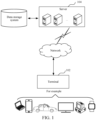
- a vehicle positioning method provided in the embodiments of this application may be applied to an application environment shown in FIG. 1 .
- a terminal 102 communicates with a server 104 through a network.
- a data storage system may store data that the server 104 needs to process.
- the data storage system may be integrated on the server 104, or placed on a cloud or another server.
- the terminal 102 may obtain odometer data of a vehicle during driving from a local database, or the terminal 102 may obtain the odometer data of the vehicle during driving from the server 104.
- the terminal 102 predicts, based on the odometer data and a first working state of a filter at a first moment, a second working state of the filter at a second moment.
- An intelligent traffic system is also referred to as an intelligent transportation system and applies advanced science and technologies (an information technology, a computer technology, a data communication technology, a sensor technology, an electronic control technology, an automatic control technology, operational research, an artificial intelligence technology, and the like) to transportation, service control, and vehicle manufacturing comprehensively and effectively, so as to strengthen a connection between a vehicle, a road, and a user, thereby forming an integrated transportation system for safety assurance, efficiency improvement, environmental enhancement, and energy saving.
- advanced science and technologies an information technology, a computer technology, a data communication technology, a sensor technology, an electronic control technology, an automatic control technology, operational research, an artificial intelligence technology, and the like
- the vehicle refers to a vehicle traveling on a road.
- a vehicle 1, a vehicle 2, and a vehicle 3 traveling on a road A can all be used as target vehicles.
- the vehicle is installed with an in-vehicle terminal, a camera, and a sensor.
- the in-vehicle terminal installed in the vehicle may obtain corresponding odometer data in real time when the vehicle is traveling on the road A.
- An odometer refers to an apparatus for measuring distance of travel, for example, various types of sensors installed on the vehicle for measuring distance of travel.
- Odometer data refers to data obtained from an apparatus for measuring distance of travel.
- the odometer data of a current vehicle during driving is obtained from an inertial measurement unit (IMU for short).
- the inertial measurement unit is an apparatus for measuring a three-axis posture angle and an acceleration of an object.
- the odometer data in this application may include location data, course data, and timestamp information.
- the terminal may obtain odometer data of the target vehicle during driving, and use the obtained odometer data as an input parameter of a filter, so that the filter performs recursion based on the inputted odometer data and an initial working state to predict a working state at a next moment.
- the odometer data includes corresponding location data and course data of the target vehicle at different moments.
- the terminal device installed in the target vehicle includes, but not limited to, an in-vehicle terminal device, a mobile terminal device, a portable terminal device, and the like.
- Step 204 Predict, based on the odometer data and a first working state of a filter at a first moment, a second working state of the filter at a second moment.
- the first moment and the second moment are used to distinguish different moments.
- the first moment is a previous moment
- the second moment is a later moment.
- the first moment is a current moment
- the second moment is a next moment (that is, a future moment). That is, the second moment in this application is later than the first moment.
- a working state of the filter refers to a state of the filter at a moment.
- the working state of the filter includes a course angle, longitude, and latitude of the target vehicle, and a transformation relationship between an odometer coordinate system and a local Cartesian coordinates coordinate system or equivalent data.
- Both the odometer coordinate system and the local Cartesian coordinates coordinate system are Cartesian coordinate systems.
- the local Cartesian coordinates coordinate system (ENU) may also be referred to as a topocentric coordinate system and a station coordinate system, which are mainly for understanding law of movement of other objects centered on an observer.
- the local Cartesian coordinates coordinate system is required for an angle of view, azimuth, and distance of a receiver-visible GPS satellite.
- the local Cartesian coordinates coordinate system is a coordinate system with an observation station as an origin, that is, a prepared base is used to set points for observation and measurement.
- working states of the filter in this application may include the first working state and the second working state.
- the second working state refers to a working state of the filter at the second moment estimated through prediction, for example, the second working state may be a working state predicted by the filter at a next moment, that is, the predicted working state of the filter at the next moment may be represented as X0+1
- 0 (C1, lon1, lat1,T). It may be understood that, the first working state and the second working state in this application are only used to distinguish the working states of the filter at different moments.
- the predicted second working state of the filter at the second moment refers to the working state at the next moment estimated by the filter performing state recursion on the working state at the next moment based on the working state at the first moment, that is, the predicted second working state.
- the filter is a Kalman filter
- Matching point information refers to positioning point information obtained by matching the predicted positioning information with information in the electronic map.
- the matching point information in this application may be positioning point information in the SD map obtained by matching the predicted positioning information with information in the SD map; or the matching point information in this application may be positioning point information in the HD map obtained by matching the predicted positioning information with information in the HD map. That is, the matching point information in this application is determined based on the provided electronic map.
- the electronic map may include SD map matching or HD map matching.
- the filter outputs positioning information (second working state) at the second moment.
- the positioning information at the second moment is P, including longitude and latitude, and course.
- the terminal may further use other information independently as observation information to correct the predicted second working state of the filter at the second moment.
- the terminal may obtain navigation positioning data, that is, GNSS data, and use the GNSS data as observation information to correct the predicted second working state of the filter at the second moment.
- the terminal may directly use the matching point information as observation information to perform Kalman correction on the predicted second working state of the filter at the second moment.
- the terminal may calculate new observation information by using the distances between the target vehicle and the left and right lane lines and a lane width corresponding to the left and right lane lines, and then the terminal performs Kalman correction on the predicted second working state of the filter at the second moment based on the new observation information.
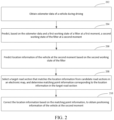
- odometer data of a vehicle during driving is obtained; based on the odometer data and a first working state of a filter at a first moment, a second working state of the filter at a second moment is predicted; location information of the vehicle at the second moment is predicted based on the second working state of the filter; a target road section that matches the location information is selected from candidate road sections in an electronic map, and matching point information corresponding to the location information is determined in the target road section; and the location information is corrected based on the matching point information, to obtain positioning information of the vehicle at the second moment, the positioning information and working states of the filter being defined in the same coordinate system.
- the method before the obtaining odometer data of a vehicle during driving, the method further includes:
- Historical odometer data refers to historical data obtained from an apparatus for measuring distance of travel. For example, if a current moment is 9:00, the terminal may obtain historical odometer data corresponding to the moment of 8:55.
- the historical odometer data includes location data, course data, and timestamp.
- Navigation positioning data refers to global navigation positioning data.
- the global navigation satellite system also referred to as the global navigation satellite system, is a space-based radio navigation and positioning system that can provide a user with round-the-clock information such as 3D coordinates, speed, and time at any location on a surface of the Earth or near-Earth space.
- navigation positioning data may be obtained from a GPS device.
- the navigation positioning data include timestamp, valid longitude information, latitude information, and course angle information. It may be understood that, in this application, the navigation positioning data and the odometer data do not need to be at the same frequency.
- the odometer data is 10 Hz
- the navigation positioning data is 1 Hz, that is, specific frequencies of the obtained odometer data and navigation positioning data are not specifically limited in this application.
- the initial working state of the filter refers to an initialized working state of the filter.
- the terminal may obtain historical odometer data and navigation positioning data of the vehicle during driving, and initialize the filter based on the historical odometer data and the navigation positioning data. That is, when performing vehicle positioning for the first time, the terminal first needs to initialize a navigation system. During the initialization of the navigation system, the terminal also initializes the filter. That is, during the initialization, the terminal may select a target location from the navigation positioning data as a starting positioning point, and determine the initial working state of the filter based on course information and longitude and latitude information of the starting positioning point.
- the GNSS point with good quality is determined from the GNSS data as the starting point, and the course information and the location information of the starting point are used as the initial value in the initial working state of the filter.
- the transformation relationship T between the odometer coordinate system and the ENU coordinate system is also used as an initial value in the initial working state of the filter, to provide more accurate initial data for subsequent state recursion and correction, so that the filter outputs more accurate positioning information.
- the odometer data includes odometer data at different moments; and the step of predicting, based on the odometer data and a first working state of a filter at a first moment, a second working state of the filter at a second moment includes:
- the odometer increment refers to a variation of the odometer, which refers to a difference between odometer values at different moments.
- the terminal may perform difference calculation on odometer data corresponding to the moment of 9:00 and odometer data corresponding to the moment of 8:55.
- the obtained difference is an odometer increment within the period of time from 8:55 to 9:00.
- the terminal may determine the odometer increment based on odometer data at different moments, and predict the second working state of the filter at the second moment based on the odometer increment and the first working state of the filter at the first moment. That is, the terminal may perform state estimation based on sensor information and a dynamic formula inputted at a previous moment, to estimate the working state of the filter at the next moment.
- an observation signal may be flexibly configured to implement positioning solutions adaptive to different occasions and with different precisions.
- the step of predicting the second working state of the filter at the second moment based on the odometer increment and the first working state of the filter at the first moment includes:
- the filter is a Kalman filter and the target coordinate system is the ENU coordinate system
- the terminal may perform coordinate transformation on the odometer increment ( ⁇ x , ⁇ y ) based on the coordinate transformation relationship T to obtain odometer increment ( ⁇ x', ⁇ y' ) in the ENU coordinate system, and predict the second working state X k+1
- ( ⁇ x , ⁇ y ) represents an odometer increment in the odometer coordinate system
- ( ⁇ x' , ⁇ y' ) represents an odometer increment in the ENU coordinate system
- T represents a transformation relationship between the odometer coordinate system and the ENU coordinate system.
- the most commonly used geodetic coordinate system is a WGS coordinate system.
- the WGS coordinate system is not a Cartesian coordinate system.
- the selected coordinate system is the ENU coordinate system.
- Working states of the filter are defined in the ENU coordinate system, and the transformation of the obtained positioning information from the WGS coordinate system to the ENU coordinate system is non-linear transformation, which is essentially selecting a point on a sphere and performing tangent plane expansion.
- longitude and latitude of the origin is S1, and after 2 seconds, a point A is reached.
- ⁇ X in the ENU coordinate system. This is an original estimate and may have an error, and ⁇ X needs to be corrected.
- a change in longitude and latitude is ⁇ S.
- the coordinate transformation in the conventional manner generates errors.
- working states of the filter are directly defined in the geodetic (WGS) coordinate system, and the acquired positioning information is also defined in the geodetic (WGS) coordinate system. Therefore, the state may be directly introduced to participate in the calculation, that is, all those involved in the calculation are part of the state estimation. During transformation, no non-state quantity is not involved. Therefore, errors caused by the participation of non-state quantity are effectively avoided, making the positioning information finally outputted by the filter more accurate.
- the transformation relationship T between the odometer coordinate system and the ENU coordinate system is a second-order rotation matrix and is related to an angle, denoted as ⁇ , where ⁇ represents an angle between the E-axis of the ENU coordinate system and the X-axis of the odometer coordinate system.
- ⁇ represents an angle between the E-axis of the ENU coordinate system and the X-axis of the odometer coordinate system.
- T cos ⁇ ⁇ sin ⁇ sin ⁇ cos ⁇
- X k +1 f ( X k , ⁇ O ) in the state recursion formula of Kalman filtering
- a feasible implementation of the function f is as shown in the following formula (4):
- RE and F are constants related to the Earth.
- the function regulate is used to output an angle based on a north zero course angle, and an output range is 0° to 360°.
- North zero represents a reference zero point of a course angle, with due north direction as 0° and due east direction as 90°. Similarly, east zero, with due east direction as 0°.
- the state transition is a non-linear relationship
- the Kalman filter is transformed into an extended Kalman filter.
- the step of selecting a target road section that matches the location information from candidate road sections in an electronic map, and determining matching point information corresponding to the location information in the target road section includes:
- the first precision map may be an SD map.
- the terminal may select a target link that matches the predicted location information P from a plurality of candidate links in the SD map through the SD map matching module, and determine matching point information P L corresponding to the location information P in the target link. That is, the SD map matching module may project the positioning point P onto the target link, similar to projecting a point outside a straight line onto the straight line. The obtained projection point is the matching point P L . It may be understood that which link the terminal selects as the target link to project is based on an algorithm set by the SD map matching module to select the target link.
- the fusion of a plurality of signals and data is implemented by using a Kalman filtering method as a positioning framework, and advantages of the plurality of signals are combined to avoid a loss of a single signal.
- An observation signal may be flexibly configured to implement positioning solutions adaptive to different occasions and with different precisions. For example, when an SD map exists, road-level positioning and navigation may be adaptively implemented.
- the step of selecting a target road section that matches the location information from candidate road sections in an electronic map, and determining matching point information corresponding to the location information in the target road section includes:
- the terminal may obtain visual information carrying lane information, and fuse the visual information carrying the lane information and the predicted location information outputted by the filter by using a Bayesian filtering algorithm. After the fused location information is obtained, the terminal selects a lane in the HD map as a target lane, and matches the fused location information with the target lane to obtain a matching point. Matching point information includes longitude and latitude information and course information.
- a visual HD map matching module in the terminal may be configured to process lane line information sensed by a visual perception module and match the lane line information with the HD map, to obtain high-precision positioning information, and feed back the positioning information to the filter for correction processing. That is, the visual HD map matching module in the terminal may maintain a state vector by using a Bayesian framework, and the state vector stores probabilities of the vehicle being in all the lanes. During driving of the vehicle, state transition is performed on the state itself to obtain priori information of the state. The terminal may further use visual information as observation information, and perform Bayesian posterior estimation by using the observation information, to obtain high-precision positioning information after Bayesian posterior estimation. It may be understood that the foregoing is only a possible implementation in the solution of this application.
- the method further includes:
- the terminal may determine the first distance value between the target vehicle and the first lane line, and determine the second distance value between the target vehicle and the second lane line. Further, the terminal may determine whether the first distance value and the second distance value satisfy the credible distance condition. If the credible distance condition is satisfied, it represents that the first distance value and the second distance value are credible; or if the credible distance condition is not satisfied, it represents that the first distance value and the second distance value are not credible.
- the terminal may re-determine new target observation information based on the first distance value, the second distance value, and the lane width, so that the second working state of the filter may be subsequently corrected based on the new target observation information.
- FIG. 3 is a schematic diagram of correction processing on the predicted positioning information.
- the target lane in FIG. 3 is a lane 1, a left lane line of the lane 1 is denoted as L1, a right lane line of the lane 1 is denoted as L2, and a distance between the left lane line L1 and the right lane line L2 is D, that is, a lane width is D.
- observation information with the highest credibility may be dynamically selected as independent observation information to correct the filter state, that is, the state is corrected by using a variety of independent observation information, making the estimated state more accurate.
- the participation of a plurality of types of observations can make the state estimation not rely solely on an observation, and can effectively avoid the impact of misobservation on the state.
- Z is an observation of GNSS
- H is an observation matrix
- w is observation noise
- ⁇ X is a state correction error
- correcting working states of the Kalman filter needs the participation of independent observation information, for example, an independent GPS receiver, provided SD map matching, and visual information. After processing, theinformation may be used as independent observation information to correct the working state of the filter. Since GPS data acquisition, SD map matching, and visual information acquisition are independent of each other, corresponding correction may be independent. That is, in the embodiments of this application, the state of the Kalman filter is corrected by using a variety of independent observation information, making the estimated state more accurate. Secondly, the participation of a plurality of observations can make the state estimation not rely solely on an observation, which can effectively avoid the impact of misobservation on the state, making the estimated state more accurate.
- the terminal may calculate the state correction error ⁇ X according to the following formula (7), correct the working state of the filter, and correct a covariance.
- a rotation transformation relationship T between the odometer coordinate system and the local Cartesian coordinates coordinate system is corrected.
- an observation signal may be flexibly configured to implement positioning solutions adaptive to different occasions and with different precisions.
- Step 404 Perform, in a case that the transverse distance between the matching point information and the location information is greater than the preset threshold, longitudinal correction and transverse correction respectively on the second working state based on the correction error, to obtain the corrected second working state.
- the longitudinal correction refers to correction at a location in a driving direction
- the transverse correction refers to correction at a location in a transverse direction
- the transverse direction refers to a direction perpendicular to a vehicle driving direction
- a longitudinal direction refers to a direction parallel to a driving direction.
- the terminal may determine whether the matching point information is credible.
- the terminal may further determine whether a transverse distance between the matching point information and the predicted location information is less than a preset threshold.
- the terminal may perform longitudinal correction on the second working state based on the correction error, to obtain the corrected second working state; or when the terminal determines that the transverse distance between the matching point information and the predicted location information is greater than the preset threshold, the terminal may perform longitudinal correction and transverse correction respectively on the second working state based on the correction error, to obtain the corrected second working state.
- FIG. 3 is a schematic diagram of correction processing on the predicted positioning information.
- the target lane in FIG. 3 is a lane 1, a left lane line of the lane 1 is denoted as L1, a right lane line of the lane 1 is denoted as L2, and a distance between the left lane line L1 and the right lane line L2 is D, that is, a lane width is D.
- G1 is a GNSS observation point (an actual observation point).
- a G1G2 connecting line is perpendicular to a course direction.
- this application further provides an application scenario, and the application scenario is applied to the foregoing vehicle positioning method.
- the application of the vehicle positioning method in the application scenario is as follows:
- the foregoing vehicle positioning method may be used. That is, after the driver logs in to a navigation system in the in-vehicle terminal, the in-vehicle terminal may automatically obtain odometer data and GNSS data of the target vehicle during driving, and predict the second working state of the filter at the second moment based on the obtained odometer data and the first working state of the filter at the first moment.
- the in-vehicle terminal may predict location information of the target vehicle at the second moment based on the second working state of the filter, select a target road section that matches the location information from candidate road sections in the electronic map, determine matching point information corresponding to the location information in the target road section, and perform feedback correction on the location information based on the matching point information, to obtain positioning information of the target vehicle at the second moment; or the in-vehicle terminal may correct the location information based on the obtained GNSS data to obtain the positioning information of the target vehicle at the second moment.
- the navigation system in the in-vehicle terminal may be implemented by using an independent server or a server cluster that includes a plurality of servers.
- the method provided in the embodiments of this application may be applied to various positioning and navigation scenarios, or may be applied to application scenarios such as outdoor unmanned vehicle positioning and navigation, and robot positioning and navigation.
- the vehicle positioning method provided in the embodiments of this application is described below by using an example of an adaptive positioning and navigation scenario based on electronic map data in an AR navigation scenario.
- multi-sensor fusion positioning is performed by using a plurality of Kalman filters, and outputs of the plurality of Kalman filters is weighted to obtain stable positioning information, which is equivalent to multiple guarantees.
- each filter in the conventional manner requires parameter input such as speed and angular speed, and is independently connected to its own IMU. This is equivalent to requiring the vehicle to have a plurality of sets of navigation hardware, which places some requirements on hardware of the vehicle.
- a positioning state quantity is defined in a Cartesian coordinate system similar to the local Cartesian coordinates coordinate system. Since the acquired positioning information is defined in the WGS84 coordinate system, transformation from the WGS coordinate system to the ENU coordinate system or transformation in an opposite direction requires the participation of estimated positioning information, which may cause errors.
- this application provides a positioning method based on Kalman (EKF), where the method fuses one or more of signals such as an odometer signal, a GNSS positioning signal, an SD map signal, a visual perception signal, and an HD map, and can implement road-level positioning and lane-level positioning. That is, in the solution provided in this application, visual information, SD map matching information, and GNSS positioning information are all used as observation information, to correct the filter state. These corrections are independent of each other.
- EKF Kalman
- the method in this application may be used to implement lane-level positioning.
- the method in this application may implement road-level positioning and navigation, and may perform positioning and navigation in scenarios without GNSS signals such as a basement and a tunnel.
- the foregoing observations may be flexibly configured to implement different functions.
- the positioning state in the method provided in this application is directly defined in the WGS84 coordinate system, and both the recursion process and the correction process of the Kalman filter are performed in the WGS84 coordinate system, to avoid errors during coordinate transformation.
- the positioning information obtained from the SD map or obtained by using the visual information and the HD map is also in the WGS84 coordinate system and may be directly involved in Kalman correction, thereby effectively avoiding errors during coordinate transformation and making the estimated state more accurate. That is, in this application, the state is corrected by using a variety of independent observation information, making the estimated state more accurate.
- the participation of a plurality of observations can make the state estimation not rely solely on an observation, which can effectively avoid the impact of misobservation on the state, and can effectively improve the accuracy of vehicle positioning information while reducing costs of hardware equipment.
- the technical solution provided in this application may be widely applied to various positioning and navigation.
- the technical solution provided in this application may be applied to in-vehicle real-time positioning and navigation, and real-time positioning and navigation services may be provided in scenarios with poor GNSS quality, such as a tunnel and a basement.
- the method provided in this application may be applied to a lane-level positioning and navigation product.
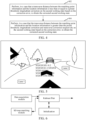
- FIG. 5 is a schematic diagram of lane-level positioning and navigation.
- the solution provided in this application is a universal positioning framework solution that may also be applied to scenarios such as outdoor unmanned vehicle positioning and navigation, and robot positioning and navigation.
- FIG. 6 is a schematic diagram of a method framework applied to road-level positioning.
- a data acquisition module in FIG. 6 is configured to acquire odometer data and global navigation positioning data, that is, GNSS data.
- An SD map matching module is configured to match a positioning location outputted by the Kalman filter with a link of the SD map, and feed back to the filter for correction processing.
- a Kalman filter module is configured to implement multi-sensor fusion and positioning output.
- An initialization module is configured to initialize the Kalman filter.
- the filter outputs location information, such as P, and P includes longitude and latitude information and course information.
- the SD map matching module selects a link in the SD map for matching by using the positioning information P, which is equivalent to binding the positioning information to a feasible road and returning a matching positioning point.
- the matching positioning point includes longitude and latitude information and course information. Subsequently, the filter may correct the filter state by using the fed back positioning point information.
- the positioning point is projected onto a link, similar to projecting a point outside a straight line onto the straight line, and the projection point is the matching point, except that which link is selected for projection needs to be determined by the SD map matching module based on its own algorithm.
- the filter performs standard EKF observation and correction.
- FIG. 7 is a schematic diagram of a method framework applied to lane-level positioning.
- a visual HD map matching module in FIG. 7 is configured to process lane line information sensed by a visual perception module and match the lane line information with the HD map, to obtain high-precision positioning information, and feed back the positioning information to the filter for correction processing.
- the visual HD map matching module may fuse the inputted visual information and the positioning information outputted by the filter by using a Bayesian filtering algorithm, and match with the HD map, that is, the visual HD map matching module selects a lane in the HD map for matching, to obtain a matching point.
- Matching point information includes longitude and latitude information and course information.
- the matching point information may be fed back to the filter, so that the filter performs correction processing on the filter state by using a standard EKF correction algorithm.
- the inputted visual information includes information such as a quantity of lanes, a lane width, a lane equation, and a vertical distance between a vehicle and lane lines on both sides of a lane.
- the visual HD map matching module maintains a state vector by using a Bayesian framework, and the state vector stores probabilities of the vehicle being in all the lanes.
- state transition is performed on the state itself to obtain priori information of the state.
- the module may use visual information as observation information and perform Bayesian posterior estimation by using the information.
- the module may also match the positioning information outputted by the filter with the HD map, calculate a possible lane of the vehicle, and also perform posterior estimation on the state to obtain high-precision positioning information after Bayesian posterior estimation. It may be understood that the foregoing is only a possible implementation in the solution of this application.
- the positioning method based on Kalman (EKF) provided in this application specifically includes the following steps: Step 1: Acquire GNSS data and odometer data.
- the odometer data includes location data, course data, and timestamp
- the GNSS data includes timestamp, valid longitude and latitude information, and course angle information.
- GNSS data and odometer data do not need to be at the same frequency.
- the odometer data is 10 Hz
- the GNSS data may be 1 Hz.
- frequencies of sensors are different.
- a sensor IMU configured for state propagation may reach 100 Hz, while GPS generally only has 10 Hz or lower 1 Hz.
- a plurality of types of information may be used independently for state correction, making the estimated state in this embodiment is generally relatively accurate, there is no need to require high frequency for each observed quantity. Therefore, in the embodiments of this application, there is no requirement for a specific frequency of quantity data.
- Step 2 If the system is not initialized, the terminal needs to initialize the filter.
- the initialization process includes: The terminal determines a GNSS point with good quality as a starting point, and uses course information and location information of the starting point as an initial value in an initial state X of the Kalman filter; and the terminal determines a transformation relationship T between an odometer coordinate system and a local Cartesian coordinates (ENU) coordinate system, determines an error value of the odometer data, and determines an initial value and an initial covariance matrix of the state of the Kalman filter.
- ENU Cartesian coordinates
- the terminal determines the initial value and the initial covariance matrix of the state. For example, the terminal selects a GNSS positioning point P with good quality, and uses longitude and latitude, and course of the positioning point P as the initial value of the filter state.
- the transformation between coordinate systems is also a part of the filter state.
- the terminal selects an initial value as the initial covariance matrix based on a GNSS error.
- a method for determining quality of GNSS includes checking whether the shapes of two trajectories match by using the smoothness of a GPS trajectory and signal-to-noise ratio information in a GSV, or by using other independent information (for example, odometer data), to determine a GNSS point with good quality.
- the odometer coordinate system similar to ENU, is a Cartesian coordinate system, and the transformation between the two conforms to rigid body transformation.
- FIG. 8 is a schematic diagram of coordinate transformation between an odometer coordinate system and an ENU coordinate system.
- the odometer coordinate system is an X-O-Y coordinate system
- the ENU coordinate system is an E-O-N coordinate system.
- the Z-axis of the odometer coordinate system coincides with the U-axis of the ENU coordinate system and is perpendicular to a paper surface.
- the odometer includes course and location information in the coordinate system, and the ENU coordinate system includes course information.
- the transformation relationship T between the two coordinate systems may be determined through the two values.
- Step 3 After the initialization is completed, acquire new odometer data to perform Kalman filter recursion.
- the Kalman state recursion may be performed in the manner shown in the foregoing formula (1).
- the second formula in the formula (1) is a standard Kalman covariance propagation formula, and the first formula is an overview representation.
- a specific form is related to a specific meaning of the odometer data and the selected transformation formula.
- the function f is a symbol that represents the estimated state at the next moment based on the current state and the odometer data. In the embodiments of this application, f represents a non-linear transformation process.
- the EKF algorithm is selected in this embodiment for positioning estimation. Similar implementations include multi-state optimization algorithms and the like, but the corresponding calculation amount is relatively large. In some cases, another algorithm may further be used for positioning estimation.
- the transformation relationship T between the odometer coordinate system and the ENU coordinate system is a second-order rotation matrix and is related to an angle, denoted as ⁇ , where ⁇ represents an angle between the E-axis of the ENU coordinate system and the X-axis of the odometer coordinate system.
- ⁇ represents an angle between the E-axis of the ENU coordinate system and the X-axis of the odometer coordinate system.
- the terminal may transform the odometer increment from the odometer coordinate system to the ENU coordinate system based on the transformation manner shown in the foregoing formula (2).
- the state transition is a non-linear relationship, and the Kalman filter is transformed into an extended Kalman filter.
- the corresponding state transition matrix and noise coefficient matrix are shown in the foregoing formula (5).
- Step 4 Perform Kalman observation and correction when a new GNSS observation arrives.
- a Kalman observation and correction equation is shown in the foregoing formula (6). It may be understood that, each solution has its own consideration when a measurement error is specifically calculated. For example, the technical solution of this application considers inherent characteristics of GNSS when calculating the measurement error related to GNSS. When a transverse distance between a GNSS positioning point and a Kalman filter positioning point is less than a value, no transverse correction is performed, that is, no transverse information is included in Z. This is an optimization point in this application.
- the observation noise is adjusted based on quality of GNSS, that is, low-quality GNSS corresponds to higher observation noise, and high-quality GNSS corresponds to lower observation noise.
- a method for determining quality of GNSS is not specifically limited in this embodiment.
- the terminal When performing GNSS observation and correction, the terminal considers a GNSS positioning error. When the terminal determines that the transverse distance between the GNSS positioning point and the Kalman filter positioning point is less than a threshold td, transverse correction is not performed for the GNSS observation, but only longitudinal correction is performed. On the contrary, both transverse correction and longitudinal correction are performed.
- a value of td is related to longitude of GNSS, and the value is not specifically limited in the present invention.
- the transverse direction refers to a direction perpendicular to a vehicle driving direction
- a longitudinal direction refers to a direction parallel to a driving direction.
- the transverse correction refers to correction at a location in a transverse direction
- the longitudinal correction refers to correction at a location in a driving direction.
- the terminal when performing GNSS observation and correction, calculates a state correction error to correct the state, and corrects the covariance based on a standard Kalman correction form. In addition, the terminal further corrects the rotation transformation relationship T between the odometer coordinate system and the local Cartesian coordinates coordinate system. For details, reference is made to the correction manner shown in the foregoing formula (7).
- Step 5 Optionally, when an SD map exists, perform SD map matching correction based on matching information of the SD map.
- SD map matching refers to matching positioning information outputted by the Kalman filter with links of the SD map, selecting the most appropriate link, and calculating positioning information of a corresponding adsorption point.
- the positioning information of the adsorption point includes a direction of a road network, and longitude and latitude information of the adsorption point.
- SD map matching correction is correcting the filter statebased on longitude, latitude, and a course angle of a road link outputted by SD map matching, and according to the foregoing formula (6).
- Step 6 the terminal matches the visual perception with an HD map, and uses a matching result to correct the state of the Kalman filter.
- Visual perception refers to the perception of road information, including elements such as a lane line, a quantity of lanes, a current lane width, distances between a vehicle and left and right lane lines, and a current lane number.
- the terminal may match a visual perception result with the HD map to calculate a current location of the vehicle.
- An output of the visual perception and the HD map matching module includes longitude and latitude of the positioning point, a lane width, a lane number, adistance between a vehicle and left and right lane lines, a lane course angle, and a positioning credibility probability. For example, if a currently fed back positioning point is credible, the terminal may directly perform Kalman correction by using the formula (6). If the current positioning point is not credible, but the distances between the vehicle and the left and right lanes are credible, the terminal may calculate observation information by using the left and right distances and the lane width, and then perform Kalman correction based on the observation information according to the formula (6).
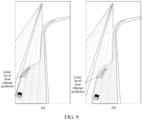
- FIG. 9 is a schematic diagram of lane-level lane change guidance. For example, if there is an intersection 500 meters in front of the target vehicle, to warn a traveler to change lanes in advance, the terminal may display lane-level lane change guidance 200 meters in front of the target vehicle. Reference may be made to FIG. 9(a) .
- adjustment may be performed based on a feedback probability.
- a larger probability corresponds to a smaller error, and a smaller probability corresponds to a larger error.
- the fusion of a plurality of signals and data is implemented by using a Kalman filtering method as a positioning framework, and advantages of the plurality of signals are combined to avoid a loss of a single signal.
- an observation signal may be flexibly configured to implement positioning solutions adaptive to different occasions and with different precisions. For example, when visual perception and an HD map exist, this application may be applied to lane-level positioning and navigation products.
- the states in this application are directly defined in the WGS coordinate system, to avoid errors caused by coordinate transformation in the conventional manner.
- the Kalman filtering solution used in the embodiments of this application has a small amount of states, a small dimension, and a small amount of calculation, the solution is a lightweight and widely applied positioning solution.
- steps in flowcharts involved in the foregoing embodiments are displayed in sequence based on indication of arrows, but the steps are not necessarily performed in sequence based on a sequence indicated by the arrows. Unless otherwise explicitly specified in this specification, the steps are performed without any strict sequence limit, and may be performed in other sequences.
- at least some steps in the flowcharts involved in the foregoing embodiments may include a plurality of steps or a plurality of stages, and these steps or stages are not necessarily performed at a same moment, but may be performed at different moments.
- the steps or stages are not necessarily performed in sequence, but may be performed by turn or alternately with other steps or at least part of steps or stages in other steps.
- an embodiment of this application further provides a vehicle positioning apparatus for implementing the foregoing vehicle positioning method.
- the implementation solution for solving the problem provided by this apparatus is similar to the implementation solution recorded in the foregoing method. Therefore, for the specific limitations in one or more embodiments of the vehicle positioning apparatus provided below, reference may be made to the foregoing limitations for the vehicle positioning method, and the description is not repeated herein again.
- a vehicle positioning apparatus includes an obtaining module 1002, a prediction module 1004, a determining module 1006, and a correction module 1008, where
- the apparatus further includes: an initialization module.
- the obtaining module is further configured to obtain historical odometer data and navigation positioning data of the vehicle during driving.
- the initialization module is configured to initialize the filter based on the historical odometer data and the navigation positioning data, select a target location from the navigation positioning data as a starting positioning point during initialization, and determine an initial working state of the filter based on course information and location information of the starting positioning point.
- the determining module is further configured to determine an odometer increment based on the odometer data at different moments; and predict the second working state of the filter at the second moment based on the odometer increment and the first working state of the filter at the first moment.
- the apparatus further includes: a coordinate transformation module, configured to perform coordinate transformation on the odometer increment based on a coordinate transformation relationship, to obtain the odometer increment in a target coordinate system, the coordinate transformation relationship being a transformation relationship between an odometer coordinate system and the target coordinate system.
- the determining module is further configured to predict the second working state of the filter at the second moment based on the odometer increment in the target coordinate system and the first working state of the filter at the first moment.
- the apparatus further includes: a selection module, configured to select, in a case that the electronic map is a first precision map, a target road section that matches location information from candidate road sections of the first precision map.
- the determining module is further configured to determine projection point information of the location information in the target road section; and use the projection point information as the matching point information corresponding to the location information.
- the first precision map includes a self-maintained state.
- the correction module is further configured to use the location information as observation information; and correct the self-maintained state based on the observation information to obtain the corrected self-maintained state.
- the apparatus further includes: a fusion module.
- the obtaining module is further configured to obtain visual information carrying lane information in a case that the electronic map is a second precision map.
- the fusion module is configured to fuse the visual information and the location information to obtain fused location information.
- the selection module is further configured to select a target lane that matches the fused location information from candidate lanes of the second precision map.
- the determining module is further configured to determine matching point information corresponding to the fused location information in the target lane.
- the apparatus further includes: an execution module is configured to perform, in a case that it is determined that a credibility of the matching point information is greater than a credibility threshold, a step of correcting the fused location information based on the matching point information.
- the determining module is further configured to determine a first distance value between the vehicle and a first lane line, and determine a second distance value between the vehicle and a second lane line in a case that it is determined that the credibility of the matching point information is less than or equal to the credibility threshold; and determine target observation information based on the first distance value, the second distance value, and a lane width in a case that the first distance value and the second distance value satisfy a credible distance condition, the lane width being a distance between the first lane line and the second lane line.
- the correction module is further configured to correct the fused location information based on the target observation information to obtain the positioning information of the vehicle at the second moment.
- the selection module is further configured to select, in a case that the electronic map is a second precision map, a target lane that matches the location information from candidate lanes of the second precision map.
- the determining module is further configured to determine matching point information corresponding to the location information in the target lane.
- the determining module is further configured to determine an observation matrix and observation noise; and determine a correction error of the filter based on the matching point information, a prediction covariance matrix of the filter at the first moment, the observation matrix, and the observation noise.
- the correction module is further configured to correct the second working state based on the correction error to obtain a corrected second working state.
- the determining module is further configured to determine the positioning information of the vehicle at the second moment based on the corrected second working state.
- the obtaining module is further configured to obtain an initial covariance matrix and an initial state transition matrix.
- the determining module is further configured to determine the prediction covariance matrix of the filter at the first moment based on the initial covariance matrix, the initial state transition matrix, a linear quantity of the odometer, and measurement noise of the odometer.
- the correction module is further configured to perform, in a case that a transverse distance between the matching point information and the location information is less than or equal to a preset threshold, longitudinal correction on the second working state based on the correction error, to obtain the corrected second working state; and perform, in a case that the transverse distance between the matching point information and the location information is greater than the preset threshold, longitudinal correction and transverse correction respectively on the second working state based on the correction error, to obtain the corrected second working state.
- the modules in the vehicle positioning apparatus may be implemented entirely or partially by software, hardware, or a combination thereof.
- the foregoing modules may be built in or independent of a processor of a computer device in a hardware form, or may be stored in a memory of the computer device in a software form, so that the processor invokes and performs an operation corresponding to each of the foregoing modules.
- a computer device may be a terminal, and an internal structure diagram thereof may be shown in FIG. 11 .
- the computer device includes a processor, a memory, an input/output interface, a communication interface, a display unit, and an input apparatus.
- the processor, the memory, and the input/output interface are connected through a system bus, and the communication interface, the display unit, and the input apparatus are connected to the system bus through the input/output interface.
- the processor of the computer device is configured to provide computing and control capabilities.
- the memory of the computer device includes a non-volatile storage medium and an internal memory.
- the non-volatile storage medium stores an operating system and computer-readable instructions.
- the internal memory provides an environment for running of the operating system and the computer-readable instructions in the non-volatile storage medium.
- the input/output interface of the computer device is configured to exchange information between the processor and an external device.
- the communication interface of the computer device is configured to communicate with an external terminal in a wired or a wireless manner, and the wireless manner can be implemented by using WIFI, a mobile cellular network, an NFC (near field communication), or other technologies.
- the computer-readable instructions are executed by the processor to implement the vehicle positioning method.
- the display unit of the computer device is configured to form a visually visible picture, and may be a display screen, a projection apparatus, or a virtual reality imaging apparatus.
- the display screen may be a liquid crystal display screen or an electronic ink display screen.
- the input apparatus of the computer device may be a touch layer covering the display screen, or may be a key, a trackball, or a touch pad disposed on a housing of the computer device, or may be an external keyboard, a touch pad, a mouse, or the like.
- FIG. 11 is only a block diagram of a part of a structure related to a solution of this application and does not limit the computer device to which the solution of this application is applied.
- the computer device may include more or fewer components than those in the drawings, or some components are combined, or a different component deployment is used.
- a computer device including a memory and a processor, the memory storing computer-readable instructions, the processor, when executing the computer-readable instructions, implementing the steps in the foregoing method embodiments.
- a computer-readable storage medium storing computer-readable instructions, the computer-readable instructions, when executed by a processor, implementing the steps in the foregoing method embodiments.
- a computer program product or a computer-readable instruction is provided, the computer program product or the computer-readable instruction includes computer instructions, and the computer instructions are stored in the computer-readable storage medium.
- the processor of the computer device reads the computer instructions from the computer-readable storage medium, and the processor executes the computer instructions, to cause the computer device to perform the steps in the foregoing method embodiments.
- the user information including, but not limited to, user equipment information, user personal information, and the like
- data including, but not limited to, data for analysis, stored data, displayed data, and the like
- involved in this application all are information and data that are authorized by the user or fully authorized by each party, and the collection, use, and processing of relevant data need to comply with relevant laws and regulations of relevant countries and regions.
- a person of ordinary skill in the art may understand that all or some of the procedures of the methods of the foregoing embodiments may be implemented by computer-readable instructions instructing relevant hardware.
- the computer-readable instructions may be stored in a non-volatile computer-readable storage medium.
- the non-volatile memory may include a read-only memory (ROM), a magnetic tape, a floppy disk, a flash memory, an optical memory, a high-density embedded non-volatile memory, a resistive random access memory (ReRAM), a magnetoresistive random access memory (MRAM), a ferroelectric random access memory (FRAM), a phase change memory (PCM), a graphene memory, and the like.
- the volatile memory may include a random access memory (RAM) or an external cache.
- the RAM is available in a plurality of forms, such as a static random access memory (SRAM) or a dynamic random access memory (DRAM).
- the database involved in the embodiments provided in this application may include at least one of a relational database and a non-relational database.
- the non-relational database may include a blockchain-based distributed database, but is not limited thereto.
- the processor involved in the embodiments provided in this application may be a general-purpose processor, a central processing unit, a graphics processing unit, a digital signal processor, a programmable logic device, a quantum computing-based data processing logic device, and are not limited thereto.
Landscapes
- Engineering & Computer Science (AREA)
- Remote Sensing (AREA)
- Radar, Positioning & Navigation (AREA)
- Automation & Control Theory (AREA)
- Physics & Mathematics (AREA)
- General Physics & Mathematics (AREA)
- Navigation (AREA)
Applications Claiming Priority (2)
| Application Number | Priority Date | Filing Date | Title |
|---|---|---|---|
| CN202210929163.2A CN115326084B (zh) | 2022-08-03 | 2022-08-03 | 车辆定位方法、装置、计算机设备、存储介质 |
| PCT/CN2023/100444 WO2024027350A1 (fr) | 2022-08-03 | 2023-06-15 | Procédé et appareil de positionnement de véhicule, dispositif informatique et support de stockage |
Publications (2)
| Publication Number | Publication Date |
|---|---|
| EP4492009A1 true EP4492009A1 (fr) | 2025-01-15 |
| EP4492009A4 EP4492009A4 (fr) | 2025-09-24 |
Family
ID=83922159
Family Applications (1)
| Application Number | Title | Priority Date | Filing Date |
|---|---|---|---|
| EP23849060.1A Pending EP4492009A4 (fr) | 2022-08-03 | 2023-06-15 | Procédé et appareil de positionnement de véhicule, dispositif informatique et support de stockage |
Country Status (4)
| Country | Link |
|---|---|
| US (1) | US20240255305A1 (fr) |
| EP (1) | EP4492009A4 (fr) |
| CN (1) | CN115326084B (fr) |
| WO (1) | WO2024027350A1 (fr) |
Families Citing this family (13)
| Publication number | Priority date | Publication date | Assignee | Title |
|---|---|---|---|---|
| CN115326084B (zh) * | 2022-08-03 | 2026-06-23 | 腾讯科技(深圳)有限公司 | 车辆定位方法、装置、计算机设备、存储介质 |
| JP7507816B2 (ja) * | 2022-08-12 | 2024-06-28 | 本田技研工業株式会社 | 車両制御装置、車両制御方法、およびプログラム |
| KR20240030700A (ko) * | 2022-08-31 | 2024-03-07 | 현대자동차주식회사 | 자율 주행 제어 방법 및 그 차량 |
| CN116295490A (zh) * | 2023-03-17 | 2023-06-23 | 智道网联科技(北京)有限公司 | 车辆定位方法、装置及电子设备、存储介质 |
| CN116539037B (zh) * | 2023-03-28 | 2026-02-24 | 阿里巴巴(中国)有限公司 | 组合导航的参数初始化方法、装置、设备及产品 |
| CN116399351B (zh) * | 2023-04-23 | 2026-05-01 | 燕山大学 | 一种车辆位置估计方法 |
| CN116222545B (zh) * | 2023-05-10 | 2023-07-25 | 北京白水科技有限公司 | 用于群组导航定位的智能地标设备 |
| CN116380088B (zh) * | 2023-06-05 | 2023-08-29 | 小米汽车科技有限公司 | 车辆定位方法、装置、车辆及存储介质 |
| CN118067148B (zh) * | 2024-04-17 | 2024-07-09 | 深圳市科乐达电子科技有限公司 | 一种基于大数据分析的车载导航系统 |
| CN118168566B (zh) * | 2024-05-14 | 2024-10-01 | 合众新能源汽车股份有限公司 | 一种车辆定位方法、装置、电子设备及存储介质 |
| CN118565471A (zh) * | 2024-06-05 | 2024-08-30 | 长安大学 | 一种具有容错性的智能网联汽车协同定位方法及系统 |
| CN119779334B (zh) * | 2024-12-26 | 2025-10-10 | 东南大学 | 一种用于gnss拒止环境下的车辆精确定位方法 |
| CN121504989A (zh) * | 2025-09-23 | 2026-02-10 | 中国第一汽车股份有限公司 | 状态估计方法、装置、存储介质及系统 |
Family Cites Families (19)
| Publication number | Priority date | Publication date | Assignee | Title |
|---|---|---|---|---|
| US6282496B1 (en) * | 1999-10-29 | 2001-08-28 | Visteon Technologies, Llc | Method and apparatus for inertial guidance for an automobile navigation system |
| CN102682590B (zh) * | 2011-03-16 | 2014-04-30 | 高德软件有限公司 | 实时交通信息处理方法和装置 |
| US10330479B2 (en) * | 2016-09-20 | 2019-06-25 | Trimble Inc. | Vehicle navigation by dead reckoning and GNSS-aided map-matching |
| KR102565482B1 (ko) * | 2018-03-06 | 2023-08-11 | 현대모비스 주식회사 | 차량의 측위 장치 및 그 방법 |
| US10907972B2 (en) * | 2018-03-29 | 2021-02-02 | Intel Corporation | 3D localization device |
| CN108827292A (zh) * | 2018-06-27 | 2018-11-16 | 四川大学 | 基于gnss和地面基站的组合式导航精确测速定位方法及系统 |
| CN109581449B (zh) * | 2018-12-14 | 2021-09-14 | 安徽江淮汽车集团股份有限公司 | 一种自动驾驶汽车的定位方法及系统 |
| CN110986930B (zh) * | 2019-11-29 | 2022-07-15 | 北京三快在线科技有限公司 | 设备定位方法、装置、电子设备及存储介质 |
| CN110865405A (zh) * | 2019-11-29 | 2020-03-06 | 浙江商汤科技开发有限公司 | 融合定位方法及装置、移动设备控制方法及电子设备 |
| CN113551680B (zh) * | 2020-04-23 | 2024-09-10 | 上汽通用汽车有限公司 | 一种车道级定位系统和方法 |
| CN111679302B (zh) * | 2020-05-28 | 2023-10-03 | 阿波罗智联(北京)科技有限公司 | 车辆定位方法、装置、电子设备和计算机存储介质 |
| CN111596329A (zh) * | 2020-06-10 | 2020-08-28 | 中国第一汽车股份有限公司 | 车辆定位方法、装置、设备及车辆 |
| CN111721289B (zh) * | 2020-06-28 | 2022-06-03 | 阿波罗智能技术(北京)有限公司 | 自动驾驶中车辆定位方法、装置、设备、存储介质及车辆 |
| KR20220081521A (ko) * | 2020-12-09 | 2022-06-16 | 현대자동차주식회사 | 도로형상분류 기반 맵 매칭을 통한 고정밀 위치추정 방법 및 자율주행 자동차 |
| EP4020111B1 (fr) * | 2020-12-28 | 2023-11-15 | Zenseact AB | Localisation de véhicules |
| CN114111774B (zh) * | 2021-12-06 | 2024-04-16 | 纵目科技(上海)股份有限公司 | 车辆的定位方法、系统、设备及计算机可读存储介质 |
| CN114264301B (zh) * | 2021-12-13 | 2024-06-21 | 青岛慧拓智能机器有限公司 | 车载多传感器融合定位方法、装置、芯片及终端 |
| CN114323050B (zh) * | 2022-01-07 | 2024-07-19 | 苏州挚途科技有限公司 | 车辆定位方法、装置和电子设备 |
| CN115326084B (zh) * | 2022-08-03 | 2026-06-23 | 腾讯科技(深圳)有限公司 | 车辆定位方法、装置、计算机设备、存储介质 |
-
2022
- 2022-08-03 CN CN202210929163.2A patent/CN115326084B/zh active Active
-
2023
- 2023-06-15 EP EP23849060.1A patent/EP4492009A4/fr active Pending
- 2023-06-15 WO PCT/CN2023/100444 patent/WO2024027350A1/fr not_active Ceased
-
2024
- 2024-02-28 US US18/590,124 patent/US20240255305A1/en active Pending
Also Published As
| Publication number | Publication date |
|---|---|
| WO2024027350A1 (fr) | 2024-02-08 |
| CN115326084B (zh) | 2026-06-23 |
| US20240255305A1 (en) | 2024-08-01 |
| CN115326084A (zh) | 2022-11-11 |
| EP4492009A4 (fr) | 2025-09-24 |
Similar Documents
| Publication | Publication Date | Title |
|---|---|---|
| US20240255305A1 (en) | Vehicle positioning method and apparatus, computer device, and storage medium | |
| CN113899363B (zh) | 车辆的定位方法、装置及自动驾驶车辆 | |
| CN111561937B (zh) | 用于精确定位的传感器融合 | |
| Allig et al. | Alignment of perception information for cooperative perception | |
| US12085403B2 (en) | Vehicle localisation | |
| AU2018252237B2 (en) | Co-localisation | |
| Mokhtarzadeh et al. | Cooperative inertial navigation | |
| CN112985391B (zh) | 一种基于惯性和双目视觉的多无人机协同导航方法和装置 | |
| CN114061611B (zh) | 目标对象定位方法、装置、存储介质和计算机程序产品 | |
| CN114088104B (zh) | 一种自动驾驶场景下的地图生成方法 | |
| CN113063425B (zh) | 车辆定位方法、装置、电子设备及存储介质 | |
| Huang et al. | An expectation-maximization-based interacting multiple model approach for cooperative driving systems | |
| Belhajem et al. | Improving vehicle localization in a smart city with low cost sensor networks and support vector machines | |
| CN112945227A (zh) | 定位方法和装置 | |
| US20220057517A1 (en) | Method for constructing point cloud map, computer device, and storage medium | |
| WO2020189079A1 (fr) | Dispositif d'estimation de position propre, système de conduite automatique le comprenant, et dispositif de partage de carte générée propre | |
| CN114993317B (zh) | 一种基于多源融合的室内外无缝定位方法 | |
| WO2018037653A1 (fr) | Système de commande de véhicule, dispositif de calcul de position locale de véhicule, dispositif de commande de véhicule, programme de calcul de position locale de véhicule et programme de commande de véhicule | |
| CN117782114A (zh) | 车辆定位校正方法、装置、计算机设备和存储介质 | |
| Soloviev et al. | Reconfigurable integration filter engine (RIFE) for plug-and-play navigation | |
| CN118089758A (zh) | 协同感知方法、装置、设备、存储介质和程序产品 | |
| CN120871165A (zh) | 地震勘探路径规划方法、系统、设备及介质 | |
| Zhong et al. | Multi-mode vehicle pose estimation under different GNSS conditions | |
| HK40075665A (en) | Vehicle positioning method and apparatus, computer device, and storage medium | |
| CN111811500A (zh) | 目标对象的位姿估计方法、装置、存储介质和电子设备 |
Legal Events
| Date | Code | Title | Description |
|---|---|---|---|
| STAA | Information on the status of an ep patent application or granted ep patent |
Free format text: STATUS: THE INTERNATIONAL PUBLICATION HAS BEEN MADE |
|
| PUAI | Public reference made under article 153(3) epc to a published international application that has entered the european phase |
Free format text: ORIGINAL CODE: 0009012 |
|
| STAA | Information on the status of an ep patent application or granted ep patent |
Free format text: STATUS: REQUEST FOR EXAMINATION WAS MADE |
|
| 17P | Request for examination filed |
Effective date: 20241007 |
|
| AK | Designated contracting states |
Kind code of ref document: A1 Designated state(s): AL AT BE BG CH CY CZ DE DK EE ES FI FR GB GR HR HU IE IS IT LI LT LU LV MC ME MK MT NL NO PL PT RO RS SE SI SK SM TR |
|
| A4 | Supplementary search report drawn up and despatched |
Effective date: 20250826 |
|
| RIC1 | Information provided on ipc code assigned before grant |
Ipc: G01C 21/30 20060101AFI20250820BHEP Ipc: G01C 21/16 20060101ALI20250820BHEP |
|
| DAV | Request for validation of the european patent (deleted) | ||
| DAX | Request for extension of the european patent (deleted) |