EP4492027A1 - Dispositif de détection de véhicule - Google Patents
Dispositif de détection de véhicule Download PDFInfo
- Publication number
- EP4492027A1 EP4492027A1 EP23766825.6A EP23766825A EP4492027A1 EP 4492027 A1 EP4492027 A1 EP 4492027A1 EP 23766825 A EP23766825 A EP 23766825A EP 4492027 A1 EP4492027 A1 EP 4492027A1
- Authority
- EP
- European Patent Office
- Prior art keywords
- section
- detection
- receiving coil
- displacement
- bearing
- Prior art date
- Legal status (The legal status is an assumption and is not a legal conclusion. Google has not performed a legal analysis and makes no representation as to the accuracy of the status listed.)
- Pending
Links
Images







Classifications
-
- F—MECHANICAL ENGINEERING; LIGHTING; HEATING; WEAPONS; BLASTING
- F16—ENGINEERING ELEMENTS AND UNITS; GENERAL MEASURES FOR PRODUCING AND MAINTAINING EFFECTIVE FUNCTIONING OF MACHINES OR INSTALLATIONS; THERMAL INSULATION IN GENERAL
- F16C—SHAFTS; FLEXIBLE SHAFTS; ELEMENTS OR CRANKSHAFT MECHANISMS; ROTARY BODIES OTHER THAN GEARING ELEMENTS; BEARINGS
- F16C41/00—Other accessories, e.g. devices integrated in the bearing not relating to the bearing function as such
- F16C41/007—Encoders, e.g. parts with a plurality of alternating magnetic poles
-
- B—PERFORMING OPERATIONS; TRANSPORTING
- B60—VEHICLES IN GENERAL
- B60B—VEHICLE WHEELS; CASTORS; AXLES FOR WHEELS OR CASTORS; INCREASING WHEEL ADHESION
- B60B27/00—Hubs
- B60B27/0047—Hubs characterised by functional integration of other elements
- B60B27/0068—Hubs characterised by functional integration of other elements the element being a sensor
-
- F—MECHANICAL ENGINEERING; LIGHTING; HEATING; WEAPONS; BLASTING
- F16—ENGINEERING ELEMENTS AND UNITS; GENERAL MEASURES FOR PRODUCING AND MAINTAINING EFFECTIVE FUNCTIONING OF MACHINES OR INSTALLATIONS; THERMAL INSULATION IN GENERAL
- F16C—SHAFTS; FLEXIBLE SHAFTS; ELEMENTS OR CRANKSHAFT MECHANISMS; ROTARY BODIES OTHER THAN GEARING ELEMENTS; BEARINGS
- F16C19/00—Bearings with rolling contact, for exclusively rotary movement
- F16C19/02—Bearings with rolling contact, for exclusively rotary movement with bearing balls essentially of the same size in one or more circular rows
- F16C19/04—Bearings with rolling contact, for exclusively rotary movement with bearing balls essentially of the same size in one or more circular rows for radial load mainly
- F16C19/08—Bearings with rolling contact, for exclusively rotary movement with bearing balls essentially of the same size in one or more circular rows for radial load mainly with two or more rows of balls
-
- F—MECHANICAL ENGINEERING; LIGHTING; HEATING; WEAPONS; BLASTING
- F16—ENGINEERING ELEMENTS AND UNITS; GENERAL MEASURES FOR PRODUCING AND MAINTAINING EFFECTIVE FUNCTIONING OF MACHINES OR INSTALLATIONS; THERMAL INSULATION IN GENERAL
- F16C—SHAFTS; FLEXIBLE SHAFTS; ELEMENTS OR CRANKSHAFT MECHANISMS; ROTARY BODIES OTHER THAN GEARING ELEMENTS; BEARINGS
- F16C19/00—Bearings with rolling contact, for exclusively rotary movement
- F16C19/02—Bearings with rolling contact, for exclusively rotary movement with bearing balls essentially of the same size in one or more circular rows
- F16C19/14—Bearings with rolling contact, for exclusively rotary movement with bearing balls essentially of the same size in one or more circular rows for both radial and axial load
- F16C19/18—Bearings with rolling contact, for exclusively rotary movement with bearing balls essentially of the same size in one or more circular rows for both radial and axial load with two or more rows of balls
-
- F—MECHANICAL ENGINEERING; LIGHTING; HEATING; WEAPONS; BLASTING
- F16—ENGINEERING ELEMENTS AND UNITS; GENERAL MEASURES FOR PRODUCING AND MAINTAINING EFFECTIVE FUNCTIONING OF MACHINES OR INSTALLATIONS; THERMAL INSULATION IN GENERAL
- F16C—SHAFTS; FLEXIBLE SHAFTS; ELEMENTS OR CRANKSHAFT MECHANISMS; ROTARY BODIES OTHER THAN GEARING ELEMENTS; BEARINGS
- F16C41/00—Other accessories, e.g. devices integrated in the bearing not relating to the bearing function as such
-
- G—PHYSICS
- G01—MEASURING; TESTING
- G01B—MEASURING LENGTH, THICKNESS OR SIMILAR LINEAR DIMENSIONS; MEASURING ANGLES; MEASURING AREAS; MEASURING IRREGULARITIES OF SURFACES OR CONTOURS
- G01B11/00—Measuring arrangements characterised by the use of optical techniques
- G01B11/26—Measuring arrangements characterised by the use of optical techniques for measuring angles or tapers; for testing the alignment of axes
- G01B11/275—Measuring arrangements characterised by the use of optical techniques for measuring angles or tapers; for testing the alignment of axes for testing wheel alignment
-
- G—PHYSICS
- G01—MEASURING; TESTING
- G01L—MEASURING FORCE, STRESS, TORQUE, WORK, MECHANICAL POWER, MECHANICAL EFFICIENCY, OR FLUID PRESSURE
- G01L1/00—Measuring force or stress, in general
- G01L1/14—Measuring force or stress, in general by measuring variations in capacitance or inductance of electrical elements, e.g. by measuring variations of frequency of electrical oscillators
-
- G—PHYSICS
- G01—MEASURING; TESTING
- G01L—MEASURING FORCE, STRESS, TORQUE, WORK, MECHANICAL POWER, MECHANICAL EFFICIENCY, OR FLUID PRESSURE
- G01L5/00—Apparatus for, or methods of, measuring force, work, mechanical power, or torque, specially adapted for specific purposes
- G01L5/20—Apparatus for, or methods of, measuring force, work, mechanical power, or torque, specially adapted for specific purposes for measuring wheel side-thrust
-
- B—PERFORMING OPERATIONS; TRANSPORTING
- B60—VEHICLES IN GENERAL
- B60B—VEHICLE WHEELS; CASTORS; AXLES FOR WHEELS OR CASTORS; INCREASING WHEEL ADHESION
- B60B35/00—Axle units; Parts thereof ; Arrangements for lubrication of axles
- B60B35/02—Dead axles, i.e. not transmitting torque
-
- F—MECHANICAL ENGINEERING; LIGHTING; HEATING; WEAPONS; BLASTING
- F16—ENGINEERING ELEMENTS AND UNITS; GENERAL MEASURES FOR PRODUCING AND MAINTAINING EFFECTIVE FUNCTIONING OF MACHINES OR INSTALLATIONS; THERMAL INSULATION IN GENERAL
- F16C—SHAFTS; FLEXIBLE SHAFTS; ELEMENTS OR CRANKSHAFT MECHANISMS; ROTARY BODIES OTHER THAN GEARING ELEMENTS; BEARINGS
- F16C2233/00—Monitoring condition, e.g. temperature, load, vibration
-
- F—MECHANICAL ENGINEERING; LIGHTING; HEATING; WEAPONS; BLASTING
- F16—ENGINEERING ELEMENTS AND UNITS; GENERAL MEASURES FOR PRODUCING AND MAINTAINING EFFECTIVE FUNCTIONING OF MACHINES OR INSTALLATIONS; THERMAL INSULATION IN GENERAL
- F16C—SHAFTS; FLEXIBLE SHAFTS; ELEMENTS OR CRANKSHAFT MECHANISMS; ROTARY BODIES OTHER THAN GEARING ELEMENTS; BEARINGS
- F16C2326/00—Articles relating to transporting
- F16C2326/01—Parts of vehicles in general
- F16C2326/02—Wheel hubs or castors
Definitions
- the present disclosure relates to a detection device for vehicles.
- bearing units are known to rotatably support a hub fixed to a wheel against a vehicle body, as described in Patent Literature 1.
- the bearing unit has an outer ring fixed to the vehicle body, an inner ring fixed to the hub, and rolling elements between the outer and inner rings.
- vehicle driving control be based on forces acting on the wheels (e.g., lateral forces).
- Patent Literature 1 discloses a ring to be detected, which is disposed on an inner circumference of the inner ring and fixed against the hub, and a displacement sensor unit.
- the ring to be detected has a cylindrical section and a bent section bent radially outward from an axial end of the cylindrical section.
- a tip of the displacement sensor unit is located on the inner circumference of the inner ring.
- a displacement measuring element that opposes the bent section in the axial direction of the bearing unit is disposed at the tip of the displacement sensor unit has.
- the bent section Since the bent section is located inside the bearing unit, the axial displacement of the bent section is small when a force acts on the wheel. In this case, there is concern that the accuracy of displacement detection will deteriorate.
- the main purpose of the present disclosure is to provide a detection device for vehicles that can increase the accuracy of displacement detection.
- the present disclosure includes a base section fixed to a body of a vehicle;
- the rotating section for detection is disposed to rotate integrally with the first bearing member that constitutes the bearing. Therefore, the rotating section for detection rotates integrally with the wheel fixed against the first bearing member.
- the axial displacement of the rotating section for detection in the axial direction when a lateral force acts on the wheel increases as it moves radially outward from the first bearing member.
- the accuracy of displacement detection can be improved by disposing the displacement detection section at a position where displacement is greater. Therefore, in the present disclosure, the displacement detection section is disposed in the base section at a position away from the bearing in the radial direction and opposite to the rotating section for detection in the axial direction. Therefore, the change in the output signal of the displacement detection section (e.g., amplitude of the output signal) in response to a change in the axial displacement of the rotating section for detection can be increased compared to a configuration in which the displacement detection section is disposed in the bearing, for example. This makes it possible to improve the accuracy of the displacement detection by the displacement detection section, and, for example, to improve the accuracy of calculating the lateral force based on the detected displacement.
- the detection device of the present embodiment is configured to have: be able to calculate the lateral force acting on a wheel (drive wheel) equipped with an in-wheel motor.
- a vehicle is, for example, a passenger four-wheeled vehicle with two front wheels and two rear wheels.
- the vehicle may be any vehicle other than a four-wheeled vehicle, such as a two-wheeled vehicle.
- the use of the vehicle is not limited to passenger use.
- a vehicle wheel includes a wheel 10 and an in-wheel motor 20.
- the wheel 10 includes a cylindrical rim section 11 and a disk section 12 disposed at an outer end of the rim section 11 in a vehicle width direction.
- a tire 13 is attached to an outer circumference of the rim section 11.
- the in-wheel motor 20 is accommodated in an inner space of the wheel 10 enclosed by the rim section 11 and disk section 12 and provides rotational power to the wheel 10.
- the in-wheel motor 20 is an outer rotor type motor with a rotor 30 and a stator 40 positioned radially inward of the rotor 30.
- the rotor 30 has a cylindrical magnet holding section 31 and a magnet unit 32 disposed on an inner circumferential surface of the magnet holding section 31.
- the magnet holding section 31 faces an inner circumferential surface of the rim section 11 from an outer end to an inner end in the axial direction of the in-wheel motor 20 (the vehicle width direction).
- the magnet unit 32 has a cylindrical shape concentric with a central axis of rotation of the rotor 30 and has a plurality of magnets fixed to the inner circumferential surface of the magnet holding section 31.
- the in-wheel motor 20 of the present embodiment is a surface mounted permanent magnet synchronous motor (SPMSM).
- SPMSM surface mounted permanent magnet synchronous motor
- the magnets are arranged so that polarities thereof alternate along a circumferential direction of the rotor 30.
- the in-wheel motor 20 may be an interior permanent magnet synchronous motor (IPMSM).
- the rotor 30 has a disk-shaped flat plate section 33 that is disposed at an outer end of the magnet holding section 31 in the vehicle width direction and connects the magnet holding section 31 and the disk section 12.
- the disk section 12 is fixed to the flat plate section 33 by bolts. This causes the rotor 30 and the wheel 10 to rotate together.
- the stator 40 has a cylindrical stator winding 41 positioned opposite the magnet unit 32 in the radial direction and a cylindrical stator base section 42 disposed on an inner side of the stator winding 41 in the radial direction.
- the stator winding 41 has a coil side section disposed at a position opposite the magnet unit 32 in the radial direction and coil end sections disposed at both axial ends of the coil side section.
- the stator base section 42 is fixed to a vehicle body via, for example, knuckles, and holds the stator winding 41 and other parts.
- the stator base section 42 has a cylindrical section 43 fixed to the vehicle body. A portion of the cylindrical section 43 adjacent to the stator winding 41 in the radial direction is a stator core 43a.
- the stator base section 42 has a fixing section 44 extending radially inward from one end in the axial direction of the cylindrical section 43.
- the rotor 30 is rotatably supported relative to the stator base section 42 by the fixing section 44 and a bearing 50.
- An outer radial end of the fixing section 44 is a circular projecting section 45 that projects toward the flat plate section 33.
- a portion of the projecting section 45 that faces the flat plate section 33 is a flat surface.
- the bearing 50 is a rolling bearing (e.g., radial ball bearing) and has an outer ring 51 corresponding to a first bearing member, an inner ring 52 corresponding to a second bearing member, and a plurality of rolling elements 53 (e.g., balls) disposed between the outer ring 51 and the inner ring 52.
- the outer ring 51 is fixed to the fixing section 44 by bolts.
- the inner ring 52 includes a cylindrical section 52a that faces the outer ring 51 in the radial direction, and a flange section 52b that extends radially outward from one axial end of the cylindrical section 52a.
- the flange section 52b is fixed to the flat plate section 33 and the disk section 12 by bolts. Note that Fig. 1 shows a state in which the inner ring 52 and the outer ring 51 are coaxial.
- the vehicle is equipped with an inverter electrically connected to the stator winding 41 and an energy storage unit electrically connected to the inverter.
- the energy storage unit is installed in the vehicle body and is, for example, a storage battery such as a lithium-ion storage battery. Switching control of upper and lower arm switches constituting the inverter is controlled by a control device. This causes the rotor 30 to rotate and the wheel to rotate. Note that the inverter and the control device may be installed in the vehicle body or may be built into the in-wheel motor 20.
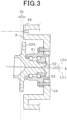
- a disk-shaped race section 80 which corresponds to a rotating section for detection, and a detection unit 90, which corresponds to a displacement detection section are disposed in the inner space of the wheel 10.
- the race section 80 and the detection unit 90 are used to calculate a rotation angle (specifically, electrical or mechanical angle) of the rotor 30 of the in-wheel motor 20, the rotation speed of the wheel, and the lateral force Fy acting between the ground surface (ground) GL and the wheel (tire 13).
- the calculated rotation angle (electrical angle) is used by the control device to control inverter switching, and the wheel rotation speed and lateral force are used by the control device to control vehicle travel.
- the race section 80 is disk-shaped and made of a metallic material (e.g., iron or aluminum).
- a through hole is formed in the center of the race section 80.
- a peripheral edge of the through hole in the race section 80 is a bent section 80a that bends in the direction of the disk section 12.
- the bent section 80a is fitted into a through hole formed in the center of the flat plate section 33 of the rotor 30.
- the race section 80 is fixed by bolts away from the flat plate section 33 of the rotor 30 and in surface contact with the flange section 52b of the inner ring 52. This makes the race section 80 and the inner ring 52 coaxial.
- the race section 80, the rotor 30 and the wheel 10 rotate together.
- An outer radial end of the race section 80 faces the projecting section 45 of the stator base section 42.
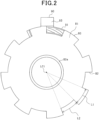
- the outer radial end of the race section 80 has shielding sections 81, which are metal portions, and cutouts 82, which are portions pierced in the direction of the thickness of the race section 80, alternating in the circumferential direction.
- the shielding sections 81 and the cutouts 82 form a circular detection target section.
- a circumferential length L1 of the shielding section 81 and a circumferential length L2 of the cutout 82 are equal.
- there are eight sets of shielding sections 81 and cutouts 82 there are eight sets of shielding sections 81 and cutouts 82. Note that an LCi shown in Fig. 2 indicates the central axis of the inner ring 52.
- the detection unit 90 is a so-called eddy current inductive sensor.
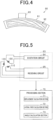
- the detection unit 90 has a substrate 91, a coil section 92 on the substrate 91, and a circuit section 93, as shown in Figs. 2 , 4 , and 5 .
- Fig. 2 shows the race section 80 viewed from the wheel 10 side.
- Fig. 4 shows the substrate 91 viewed from the wheel 10 side.
- the substrate 91 is fixed to a flat surface of the projecting section 45. As a result, the substrate 91 extends in a direction perpendicular to the axial direction of the outer ring 51. In the present embodiment, the substrate 91 is fixed to the flat surface of the upper end of the circular projecting section 45.
- the circuit section 93 is electrically connected to a processing section 70.
- an insertion hole 46 is formed in the projecting section 45, and the processing section 70 and the circuit section 93 are electrically connected via wiring inserted in the insertion hole 46.
- the processing section 70 may be installed in the vehicle body or built into the in-wheel motor 20.
- the coil section 92 includes an excitation coil 100, a first receiving coil 110, and a second receiving coil 120. Each coil 100, 110, 120 is a planar coil.
- the circuit section 93 composed of an integrated circuit.
- the circuit section 93 has an excitation circuit 94 that supplies a high-frequency excitation voltage to the excitation coil 100 and a receiving circuit 95, as shown in Fig. 5 .
- the receiving circuit 95 detects the voltage at both ends of each receiving coil 110, 120 as an output voltage signal.
- the substrate 91 is a multilayer substrate (specifically, a four-layer substrate), and the excitation coil 100 and each of the receiving coils 110, 120, which constitute the coil section 92, are composed of wiring patterns on the multilayer substrate.
- Figs. 7 through 10 show the wiring patterns formed in each layer when the substrate 91 is viewed from the race section 80 side.
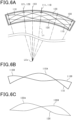
- Fig. 6A shows the projection of second through fourth layer wiring patterns onto a first layer wiring pattern.
- the excitation coil 100 is explained.
- the excitation coil 100 is formed in the first and second layers adjacent to the substrate 91 in the thickness direction, as shown in Figs. 7 and 8 .
- the wiring patterns in each layer are electrically connected by conductors filled in excitation side vias VI.
- a first excitation end 101 electrically connected to the excitation circuit 94 and a first excitation pattern 102 formed in a clockwise multiple (three times) circumference from the first excitation end 101 to the excitation side via VI are formed as a wiring pattern.
- a second excitation end 103 electrically connected to the excitation circuit 94 and a second excitation pattern 104 formed by counterclockwise multiple (three times) circumferences from the second excitation end 103 to the excitation side via VI are formed.
- six-turn planar coil excitation coils 100 are formed on the substrate 91.
- the excitation coil 100 is arc-shaped, extending in the circumferential direction of the outer ring 51.
- the first receiving coil 110 is formed in layers 1 to 4, as shown in Figs. 7 through 10 .
- the third layer has a first receiving end 111 electrically connected to the receiving circuit 95.
- a first end of a first layer pattern 112 is connected to the first receiving end 111 through a first A via VA1.
- a second end of the pattern 112 is connected to a first end of a second layer pattern 113 through a second A via VA2.
- a second end of the pattern 113 is connected to a first end of a first layer pattern 115 through a third A via VA3, a pattern 114 and a fourth A via VA4.
- a second end of the pattern 115 is connected to a first end of a second layer pattern 116 through a fifth A via VA5.
- a second end of the pattern 116 is connected to a second receiving end 118 of a fourth layer, through a sixth A via VA6, a pattern 117 and a seventh A via VA7.
- the second receiving end 118 is connected to the receiving circuit 95.
- the receiving circuit 95 detects the potential difference between the first and second receiving ends 111 and 118 as a first output voltage signal v1.
- the first receiving coil 110 is disposed in an area surrounded by the excitation coil 100 in the plan view of the substrate 91, as shown in Fig. 6A .
- the first receiving coil 110 is composed of a first portion that generates a voltage of a first polarity between the first receiving end 111 and the second receiving end 118 of the first receiving coil 110, and a second portion that generates a voltage of a second polarity that is opposite to the first polarity.
- a circumferential center of the first receiving coil 110 is a first portion 110A with one turn, and both ends of the first portion 110A of the first receiving coil 110 are second portions 110B with the same number of turns (one turn) as the first portion 110A.
- pattern shapes of the first and second portions 110A, 110B on one side with respect to a circumferential central axis Lt of the first receiving coil 110 and pattern shapes of the first and second portions 110A, 110B on another side are symmetrical with respect to the above central axis Lt.
- the second receiving coil 120 is formed in layers 1 to 4, as shown in Figs. 7 through 10 .
- the third layer has a third receiving end 121 electrically connected to the receiving circuit 95.
- a first end of the second layer pattern 122 is connected to the third receiving end 121 through a first B via VB1.
- Asecond end of the pattern 122 is connected to a first end of a first layer pattern 123 through a second B via VB2.
- a second end of the pattern 123 is connected to a first end of a first layer pattern 125 through a third A via VA3, a pattern 124 and a fourth B via VB4.
- a second end of the pattern 125 is connected to a first end of a second layer pattern 126 through a fifth B via VB5.
- a second end of the pattern 126 is connected to a fourth receiving end 128 of a fourth layer, through a sixth via VB6, a pattern 127 and a seventh B via VB7.
- the fourth receiving end 128 is connected to the receiving circuit 95.
- the receiving circuit 95 detects the potential difference between the third and fourth receiving ends 121 and 128 as a second output voltage signal v2.
- the second receiving coil 120 is disposed in an area surrounded by the excitation coil 100 in the plan view of the substrate 91, as shown in Fig. 6A .
- a circumferential length of the second receiving coil 120 is the same as a circumferential length of the first receiving coil 110.
- a radial length of the second receiving coil 120 is the same as a radial length of the first receiving coil 110.
- a circumferential end position of the second receiving coil 120 is the same as a circumferential end position of the first receiving coil 110.
- a position of a radially outer end of the second receiving coil 120 and a position of a radially outer end of the first receiving coil 110 lie on concentric circles centered on the central axis LCo of the outer ring 51.
- a position of a radially inner end of the second receiving coil 120 and a position of a radially inner end of the first receiving coil 110 lie on concentric circles on the central axis line LCo.
- the second receiving coil 120 is composed of a first portion 120A and a second portion 120B.
- one side of the second receiving coil 120 with respect to the circumferential central axis Lt is the first portion 120A and another side is the second portion 120B.
- a circumferential length from the central axis Lt to a circumferential end is the same as the circumferential length L1 of the shielding section 81 and cutout 82.
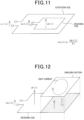
- Figs. 11 and 12 As shown in Fig. 11 , when a high-frequency excitation voltage vr(t) is supplied to the excitation coil, a high-frequency current flows in the excitation coil. The current generates a magnetic flux ⁇ (t), and the flux ⁇ (t) chains the receiving coil. A voltage ve(t) proportional to the time rate of change of the chain magnetic flux is induced at both ends of the receiving coil.
- Fig. 12 shows aa state in which a part of the receiving coil is covered by the shielding section, which is a metal portion. Eddy currents flow in a portion of the shielding section that faces the receiving coil due to the chain magnetic flux caused by the energization of the excitation coil. This eddy current generates a magnetic flux in the direction of weakening the magnetic flux that generates the induced voltage in the receiving coil, which reduces the amplitude of the induced voltage in the receiving coil. In other words, the amplitude of the potential difference between the two ends of the receiving coil is proportional to an area of the receiving coil that is not covered by the shielding section.
- Figs. 13 and 14 show the second receiving coil 120 and shielding section 81 shown in Fig. 6 , etc., with the circumferential direction in a straight line.
- Fig. 14 shows the relative positions of the second receiving coil 120 and the shielding section 81 and the transition of the second output voltage signal v2 of the second receiving coil 120.
- a direction of current flow from the second receiving end 118 to the first receiving end 111 (I+) is referred to as a positive direction
- aa direction of current flow from the first receiving end 111 to the second receiving end 118 (I-) is referred to as a negative direction.
- the magnetic flux from the excitation coil 100 passes from the front side of the drawings to the rear side.
- a half of a center side of the first portion 120A and a half of a center side of the second portion 120B are covered by the shielding section 81.
- a voltage is induced in the first portion 120A to flow current in the positive direction, and a voltage is induced in the second portion 120B to flow current in the negative direction.
- the induced voltage generated in the first portion 120A cancels out the induced voltage generated in the second portion 120B, and the amplitude of the second output voltage signal v2 becomes zero.
- the second portion 120B among the first portion 120A and the second portion 120B is covered by the shielding section 81.
- a voltage is induced in the first portion 120A to flow current in the positive direction, and the induced voltage in the second portion 120B is zero.
- the amplitude of the second output voltage signal v2 becomes the maximum value on the first polarity (positive polarity) side. This maximum value becomes larger as the race section 80 approaches the second receiving coil 120.
- a half of an end side of the first portion 120A and a half of an end side of the second portion 120B are covered by the shielding section 81.
- a voltage is induced in the first portion 120A to flow current in the positive direction, and a voltage is induced in the second portion 120B to flow current in the negative direction.
- the induced voltage generated in the first portion 120A cancels out the induced voltage generated in the second portion 120B, and the amplitude of the second output voltage signal v2 becomes zero.
- the first portion 120A is covered by the shielding section 81 among the first portion 120A and the second portion 120B.
- a voltage is induced in the second portion 120B to flow current in the negative direction, and the induced voltage in the first portion 120A becomes zero.
- the amplitude of the second output voltage signal v2 becomes the maximum value on the second polarity (negative polarity) side, which is opposite to the first polarity. This maximum value becomes larger as the race section 80 approaches the second receiving coil 120.
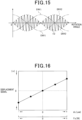
- the shielding section 81 and the cutout 82 are formed alternately at the outer radial end of the race section 80. Therefore, during the rotation of the rotor 30, the amplitude of the second output voltage signal v2 of the second receiving coil 120 changes periodically, and the envelope of the second output voltage signal v2 (hereinafter referred to as the second envelope ENV2) becomes sinusoidal, as shown by the broken line in Figs. 14 and 15 .
- the second envelope ENV2 envelope of the second output voltage signal v2
- the second envelope ENV2 becomes sinusoidal, as shown by the broken line in Figs. 14 and 15 .
- the phase difference of the first output voltage signal v1 of the first receiving coil 110 to the second output voltage signal v2 of the second receiving coil 120 is 90 degrees. Therefore, the phase difference of the envelope of the first output voltage signal v 1 (hereinafter referred to as the first envelope ENV1) relative to the second envelope ENV2 is also 90 degrees, as shown by the single-dotted line in Fig. 15 .
- the receiving circuit 95 outputs the amount of deviation of the amplitude of the actual first envelope ENV1 from the amplitude of the first envelope ES1 in a reference state to the processing section 70 as the first displacement signal.
- the reference state may be set arbitrarily.
- the reference state is, for example, a vehicle stopped, specifically, for example, a vehicle stopped on a level road surface.
- the receiving circuit 95 is configured so that the first displacement signal in the reference state is zero.
- the first displacement signal becomes positive polarity when an upper end of the race section 80 approaches the first and second receiving coils 110, 120 from its position in the reference state.
- the first displacement signal becomes larger in the positive direction when the race section 80 approaches the first and second receiving coils 110, 120 from its position in the reference state.
- the first displacement signal becomes negative polarity when the upper end of the race section 80 is away from the first and second receiving coils 110, 120 relative to its position in the reference state.
- the first displacement signal becomes larger in the negative direction when the upper end of the race section 80 is away from the first and second receiving coils 110, 120 relative to its position in the reference state.
- the first displacement signal is updated whenever the amplitude maximum on the positive polarity side and the amplitude maximum on the negative polarity side of the first envelope ENV1 appear.
- the receiving circuit 95 outputs the amount of deviation of the amplitude of the actual second envelope ENV2 from the amplitude of the second envelope ES2 in the reference state to the processing section 70 as the second displacement signal.
- the receiving circuit 95 is configured so that the second displacement signal in the reference state is zero.
- the displacement calculation section 71 which constitutes the processing section 70, calculates the displacement ⁇ L in the axial direction of the race section 80 based on the first or second displacement signal.
- the displacement calculation section 71 calculates the displacement ⁇ L based on map or formula information in which the displacement signal and displacement ⁇ L are related.
- the lateral force calculation section 72 which constitutes the processing section 70, calculates the lateral force Fy based on the calculated displacement ⁇ L and the map or formula information in which the displacement ⁇ L and the lateral force Fy are related.
- the lateral force Fy is positive, the lateral force acts on the wheel in the direction outward in the vehicle width direction, and when the lateral force Fy is negative, the lateral force acts on the wheel in the direction inward in the vehicle width direction.
- the lateral force calculation section 72 may calculate the lateral force Fy based on the first displacement signal and the map or formula information in which the first displacement signal and the lateral force Fy are related.
- the calculation of lateral force Fy based on the displacement signal and the map or formula information can be applied in the same way in each of the following embodiments.
- the angle calculation section 73 which constitutes the processing section 70, calculates the rotation angle (e.g., electrical angle ⁇ e) of the rotor 30 based on at least one of the first output voltage signal v1 and the second output voltage signal v2.
- the angle calculation section 73 can calculate the electrical angle ⁇ e based on the first or second envelope ENV1 or ENV2. This calculation method is based on the fact that the envelope is information about the transition of the amplitude of the output voltage signal and that the amplitude of the output voltage signal depends on the rotation angle.
- the angle calculation section 73 can calculate the electrical angle ⁇ e by using synchronous detection and a low-pass filter with the first output voltage signal v1, the second output voltage signal v2, and the excitation voltage vr as inputs.
- This calculation method is a digital tracking method and is disclosed, for example, in paragraphs 0028-0030 of the specification of JP 2015-073407 A .
- the detection unit 90 is disposed in the stator base section 42, at a position away from the bearing 50 in the radial direction and opposite the radial end of the race section 80 in the axial direction.
- the portion of the race section 80 that faces the detection unit 90 in the axial direction is a portion that is radially outward from the bearing 50. Therefore, when a lateral force acts on the wheel, the axial displacement of the portion of the race section 80 that faces the detection unit 90 in the axial direction can be increased. As a result, the detection accuracy of displacement ⁇ L can be improved, which in turn improves the accuracy of calculating the lateral force Fy of the wheel that constitutes the under-spring of the vehicle.
- the radial end of the race section 80 can be disposed at a greater distance in the radial direction from the bearing 50. This can improve the detection accuracy of the displacement ⁇ L.
- the first and second receiving coils 110 and 120 are disposed on the wheel 10 side in the axial direction from the coil end section comprising the stator winding 41. This makes it possible to suppress the influence of noise and the like that accompanies the passage of current through the stator winding 41 on the induced voltages in the first receiving coil 110 and the second receiving coil 120. As a result, the detection accuracy of the displacement ⁇ L and the rotation angle can be improved.
- the race section is not limited to the configuration shown in Fig. 1 , etc., but may, for example, have the following A and B configurations.
- the detection unit 90 may be disposed opposite the lower end of the race section 80.
- the detection unit 90 may be disposed on the disk section 12 side with respect to the race section 80.
- a first detection unit 90A and a second detection unit 90B are provided as detection units.
- a coil section 92 (first and second receiving coils 110, 120) provided by the first detection unit 90A is disposed in the projecting section 45 of the stator base section 42, opposite the upper end of the race section 80 in the axial direction of the inner ring 52.
- a coil section 92 (first and second receiving coils 110, 120) provided by the second detection unit 90B is disposed in the projecting section 45 opposite the lower end of the race section 80 in the axial direction of the inner ring 52.
- the substrates 91 of the first and second detection units 90A, 90B are disposed on the same side of the race section 80 in the axial direction.
- HL indicates a horizontal axis line passing through the central axis line LCi of the inner ring 52.
- each detection unit 90A, 90B is configured and disposed so that the phase difference between the first and second output voltage signals v1A, v2A of the first and second receiving coils 110, 120 provided in the first detection unit 90A and the first and second output voltage signals v1B, v2B of the first and second receiving coils 110, 120 provided in the second detection unit 90B is zero.
- the processing section 70 is equipped with a differential amplifier circuit AP.
- the differential amplifier circuit AP amplifies the difference between the first output voltage signal v1A of the first detection unit 90A and the first output voltage signal v1B of the second detection unit 90B and outputs it as the first amplified signal vt1.
- the differential amplifier circuit AP amplifies the difference between the second output voltage signal v2A of the first detection unit 90A and the second output voltage signal v2B of the second detection unit 90B and outputs it as the second amplified signal vt2.
- an angle calculation section 73 instead of the first and second output voltage signals v1 and v2, the first and second amplified signals vt1 and vt2 are used to calculate the rotation angle.
- the rotation angle may be calculated based on the first and second output voltage signals v1A, v2A of the first detection unit 90A or the first and second output voltage signals v1B, v2B of the second detection unit 90B.
- the displacement calculation section 71 calculates the amplitude of the envelope of the first amplified signal vt1 as the first displacement signal and the amplitude of the envelope of the second amplified signal vt2 as the second displacement signal. Because of the differential amplification, the amplitude change of the output voltage signal of each receiving coil 110, 120 with respect to the change in the axial displacement of the coil section 92 and the race section 80 can be increased. In other words, the sensitivity of the inductive sensor can be increased. This can improve the detection accuracy of the displacement ⁇ L.
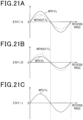
- Fig. 21A shows the envelope ENV1A of the first output voltage signal v1A in the first detection unit 90A
- Fig. 21B shows the envelope ENV1B of the first output voltage signal v1B in the second detection unit 90B
- the phase difference between the first output voltage signal v1A of the first detection unit 90A and the first output voltage signal v1B of the second detection unit 90B is zero.
- the amplitude of the first output voltage signal v1A of the first detection unit 90A and the amplitude of the first output voltage signal v1B of the second detection unit 90B becomes the same.
- the amplitudes of each envelope ENV1A and ENV1B become the same, and the first amplified signal vt1 and the first displacement signal become zero, as shown by the dashed lines in the drawings.
- the inner ring 52 tilts with respect to the outer ring 51 so that the upper end of the race section 80 approaches the stator base section 42 side and the lower end approaches the wheel 10 side.
- This increases the amplitude of the first output voltage signal v1A of the first detection unit 90A and decreases the amplitude of the first output voltage signal v1B of the second detection unit 90B.
- the amplitude of the envelope ENV1A of the first output voltage signal v1A in the first detection unit 90A increases and the amplitude of the envelope ENV1B of the first output voltage signal v1B in the second detection unit 90B decreases as shown by the solid line in the drawings.
- the displacement calculation section 71 which constitutes the processing section 70, calculates the amplitudes of the envelopes of the first and second amplified signals vt1 and vt2 as the first and second displacement signals, and calculates the displacement ⁇ L in the axial direction of the race section 80 based on one of the calculated first and second displacement signals.
- the coil section 92 of the first detection unit 90A is disposed opposite the upper end of the race section 80, and the coil section 92 of the second detection unit 90B is disposed opposite the lower end of the race section 80.
- the axial displacement of the upper and lower ends of the race section 80 increases. This arrangement allows the amplitude of the output voltage signal of each receiving coil 110, 120 of each detection unit 90A, 90B to be increased, thus improving the detection accuracy of the displacement ⁇ L.
- the substrates 91 of the first and second detection units 90A and 90B are disposed on the same side of the race section 80 in the axial direction.
- the inner ring 52 tilts with respect to the outer ring 51 so that the upper end of the race section 80 is closer to the stator base section 42 and the lower end is closer to the wheel 10.
- the amplitude of the output voltage signal of each of the receiving coils 110, 120 of the first detection unit 90A increases and the amplitude of the output voltage signal of each of the receiving coils 110, 120 of the second detection unit 90B decreases.
- a decrease in the amplitude of the output voltage signal on the 90B side of the second detection unit can be compensated for by an increase in the amplitude of the output voltage signal on the side of the first detection unit 90A.
- the inner ring 52 tilts with respect to the outer ring 51 so that the upper end of the race section 80 approaches the wheel 10 side and the lower end approaches the stator base section 42.
- the amplitude of the output voltage signal of each of the receiving coils 110, 120 of the first detection unit 90A decreases and the amplitude of the output voltage signal of each of the receiving coils 110, 120 of the second detection unit 90B increases.
- a decrease in the amplitude of the output voltage signal on the 90A side of the first detection unit can be compensated for by an increase in the amplitude of the output voltage signal on the side of the second detection unit 90B.
- the amplitude of the output voltage signal can be maintained as much as possible regardless of whether the direction of the lateral force acting on the wheel is inside or outside the vehicle width direction. As a result, the detection accuracy of the displacement ⁇ L can be maintained.
- the second detection unit 90B may be disposed on the opposite side of the race section 80 from the first detection unit 90A.
- the substrate 91 and coil section 92 provided by the second detection unit 90B are disposed on the opposite side of the central axis line LCo of the outer ring 51 from the substrate 91 and coil section 92 provided by the first detection unit 90A across the race section 80.
- the first and second detection units 90A and 90B are disposed opposite the upper end of the race section 80.
- Fig. 22 shows the race section 80 and each of the detection units 90A, 90B viewed from above the race section 80.
- each detection unit 90A, 90B is configured and disposed so that the phase difference between the first and second output voltage signals v1A, v2A of the first and second receiving coils 110, 120 provided in the first detection unit 90A and the first and second output voltage signals v1B, v2B of the first and second receiving coils 110, 120 provided in the second detection unit 90B is zero.
- the angle calculation section 73 calculates the rotation angle as in the second embodiment, and the displacement calculation section 71 calculates the first and second displacement signals as in the second embodiment.
- the first and second detection units 90A and 90B may be disposed opposite the lower end of the race section 80.
- the fourth embodiment is described below with reference to the drawings, focusing on the differences from the first embodiment.
- the coil section 92 first and second receiving coils 110, 120
- This placement method is explained below, using the second receiving coil 120 as an example.
- the relative position of the second receiving coil 120 and the shielding section 81 causes the induced voltage generated at the first portion 120A of the second receiving coil 120 and the induced voltage generated at the second portion 120B to cancel each other out.
- the second output voltage signal v2 of the second receiving coil 120 becomes zero.
- the amplitude of the second output voltage signal v2 increases.
- the axial displacement of the race section 80 near the horizontal axis line HL is smaller than the radial end of the race section 80. Therefore, the amplitude of the second output voltage signal v2 of the second receiving coil 120 is likely to be smaller in a configuration where the detection unit 90 straddles the horizontal axis HL.
- the circumferential center of the first and second receiving coils 110, 120 is shifted upward with respect to the horizontal axis HL. This allows the axial displacement between the second receiving coil 120 and the race section 80 to be as large as possible when the inner ring 52 is inclined with respect to the outer ring 51. As a result, the detection accuracy of the displacement ⁇ L can be improved.
- the fifth embodiment is described below with reference to the drawings, focusing on the differences from the first embodiment.
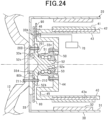
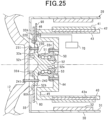
- a configuration is adopted that can reduce the coaxiality of the rotor 30, the race section 80, and the bearing 50.
- Fig. 24 the same or corresponding configurations as those shown in Fig. 1 , etc. above are given with the same reference signs for convenience.
- the race section 80 in this embodiment does not have a bent section 80a.
- Athrough hole 33a is formed in the radial center of the flat plate section 33 that constitutes the rotor 30.
- An inner side of the flat plate section 33 in the vehicle width direction has a circular step section 33b extending from an inner end in the radial direction toward an outer side in the radial direction.
- a inside surface of the step section 33b in the vehicle width direction is flat.
- a circular locating section 33c protruding inward in the vehicle width direction is formed at an inner radial end of the step section 33b.
- a through hole 80b is formed in the center of the race section 80 in the radial direction.
- the locating section 33c is fitted into the through hole 80b of the race section 80.
- the central axis of rotation of the rotor 30 and the axis of rotation of the race section 80 are coaxial.
- a circular bearing-side step section 52c protruding outward in the vehicle width direction is formed at the radially inner end of the flange section 52b of the inner ring 52.
- a circular concave section 33d that is concave outward in the vehicle width direction is formed in a portion of the flat plate section 33 that is radially inward from the locating section 33c.
- the bearing-side step section 52c is fitted into the concave section 33d, so that the central axis of the inner ring 52, the central axis of rotation of the rotor 30, and the central axis of rotation of the race section 80 are coaxial.
- the flat surface of the outer side of the flange section 52b in the vehicle width direction is in contact with the flat surface of the race section 80 and the locating section 33c. This allows the coaxiality of the central axis of rotation of the rotor 30, the central axis of rotation of the race section 80, and the central axis of the inner ring 52 to be suitably reduced.
- the flat plate section 33, race section 80, and flange section 52b have first through holes that pass through in the axial direction.
- the first through holes are formed in a plurality of rows aligned in the circumferential direction (e.g., aligned at equal intervals in the circumferential direction).
- a bolt 200 is inserted into each first through hole.
- the bolt 200 is inserted into the first through hole with a head of the bolt 200 facing outward in the vehicle width direction and a shaft of the bolt 200 facing inward in the vehicle width direction.
- a male thread at an end of the shaft is screwed into a female thread of a nut 201.
- the overlapped flat plate section 33, the race section 80 and the flange section 52b are sandwiched by the head of the bolt 200 and the nut 201.
- the rotor 30, the race section 80, and the bearing 50 are integrated.
- the flat plate section 33, the race section 80, the flange section 52b, and the disk section 12 have second through holes that pass through in the axial direction.
- the second through holes are formed in a plurality of positions shifted from the positions at which the first through holes are formed, and are aligned in the circumferential direction (e.g., aligned at equal intervals in the circumferential direction).
- a bolt 210 is inserted into each second through-hole.
- the bolt 210 is inserted into the second through-hole with a head of the bolt 210 facing inward in the vehicle width direction and a shaft of the bolt 210 facing outward in the vehicle width direction. In this inserted state, a male thread of the bolt 210 is screwed into a female thread of a nut 211.
- the locating section 33c is fitted into the through hole 80b of the race section 80.
- the race section 80 is then sandwiched between the step section 33b and the flange section 52b, while the bearing-side step section 52c is fitted into the concave section 33d.
- the locating section 33c With the flat surface of the race section 80 in contact with the flat surface of the step section 33b, the locating section 33c is fitted into the through hole 80b of the race section 80. In this state, the bolts 220 secure the race section 80 and the step section 33b.
- the flat plate section 33 and the flange section 52b have first through holes that pass through the flat plate section 33 and the flange section 52b in the axial direction.
- the first through holes are formed in a plurality of rows aligned in the circumferential direction (e.g., aligned at equal intervals in the circumferential direction).
- a bolt 230 is inserted through each first through hole.
- the bolt 230 is inserted into the first through hole with a head of the bolt 230 facing inward in the vehicle width direction and a shaft of the bolt 230 facing outward in the vehicle width direction.
- a male thread of bolt 230 is screwed into a female thread of a nut 231.
- the overlapped flat plate section 33 and the flange section 52b are sandwiched by the head of the bolt 230 and the nut 231.
- the rotor 30, the race section 80, the and bearing 50 are integrated.
- the flat plate section 33, the flange section 52b, and the disk section 12 have second through holes that pass through the flat plate section 33, the flange section 52b, and the disk section 12 in the axial direction.
- the second through holes are formed in a plurality of positions shifted in the radial direction from the positions at which the first through holes are formed, and are aligned in the circumferential direction (e.g., aligned at equal intervals in the circumferential direction).
- a bolt 240 is inserted into each second through hole.
- the bolt 240 is inserted into the second through hole with a head of the bolt 240 facing inward in the vehicle width direction and a shaft of the bolt 240 facing outward in the vehicle width direction.
- the circumferential center of the first and second receiving coils 110, 120 may be shifted downward with respect to the horizontal axis HL.
- the cutouts 82 in Fig. 2 or the openings 84 in Fig. 17 may be provided by non-metallic parts such as a synthetic resin.
- non-metallic parts such as a synthetic resin.
- a configuration in which metal and non-metal portions alternate in the circumferential direction in the race section can be realized, and the rotation angle can be detected in the same manner as in the first embodiment, etc.
- the in-wheel motor 20 shown in Fig. 1 does not have to have a race section 80.
- a shielding section and an opening may be formed alternately in the circumferential direction, or a concave section and a convex section may be formed alternately in the circumferential direction, in the flat plate section 33 of the in-wheel motor 20 that is opposite the coil section 92 in the axial direction.
- the flat plate section 33 corresponds to the rotating section for detection.
- the receiving coil formed on the substrate 91 may be either the first receiving coil 110 or the second receiving coil 120.
- the sensor for detecting displacement is not limited to eddy current type sensors, but can also be a sensor that detects displacement with a laser beam, for example.
- the bearing is not limited to one in which the outer ring 51 is fixed to the stator base section 42 and the inner ring 52 is fixed to the wheel 10, but may also be one in which the outer ring is fixed to the wheel 10 and the inner ring is fixed to the stator base section 42.
- the inner ring corresponds to the first bearing member and the outer ring corresponds to the second bearing member.
- the motor is not limited to those accommodated in the wheels, but can be, for example, an on-board motor in the vehicle body. Moreover, the motor is not limited to an outer rotor type, but may be an inner rotor type.
- a control section and methods described in the present disclosure may be realized by a dedicated computer provided by configuring a processor and memory programmed to perform one or more functions embodied by the computer program.
- the control section and methods described in the present disclosure may be realized by a dedicated computer provided by configuring the processor with one or more dedicated hardware logic circuits.
- the control section and methods described in the present disclosure may be realized by one or more dedicated computers composed of a processor and memory programmed to perform one or more functions, in combination with a processor composed of one or more hardware logic circuits.
- the computer program may also be stored in a computer-readable, non-transitory tangible storage media as instructions to be executed by a computer.
- a detection device for vehicles including:
- the detection device for vehicles according to any one of configurations 2 to 8, wherein the processing section calculates a lateral force acting on the wheel based on the calculated displacement.
Landscapes
- Engineering & Computer Science (AREA)
- General Engineering & Computer Science (AREA)
- Mechanical Engineering (AREA)
- Physics & Mathematics (AREA)
- General Physics & Mathematics (AREA)
- Transmission And Conversion Of Sensor Element Output (AREA)
- Force Measurement Appropriate To Specific Purposes (AREA)
- Rolling Contact Bearings (AREA)
Applications Claiming Priority (2)
| Application Number | Priority Date | Filing Date | Title |
|---|---|---|---|
| JP2022034711A JP2023130184A (ja) | 2022-03-07 | 2022-03-07 | 車両用検出装置 |
| PCT/JP2023/008503 WO2023171649A1 (fr) | 2022-03-07 | 2023-03-07 | Dispositif de détection de véhicule |
Publications (2)
| Publication Number | Publication Date |
|---|---|
| EP4492027A1 true EP4492027A1 (fr) | 2025-01-15 |
| EP4492027A4 EP4492027A4 (fr) | 2025-06-18 |
Family
ID=87935063
Family Applications (1)
| Application Number | Title | Priority Date | Filing Date |
|---|---|---|---|
| EP23766825.6A Pending EP4492027A4 (fr) | 2022-03-07 | 2023-03-07 | Dispositif de détection de véhicule |
Country Status (5)
| Country | Link |
|---|---|
| US (1) | US20240426345A1 (fr) |
| EP (1) | EP4492027A4 (fr) |
| JP (1) | JP2023130184A (fr) |
| CN (1) | CN118829859A (fr) |
| WO (1) | WO2023171649A1 (fr) |
Families Citing this family (2)
| Publication number | Priority date | Publication date | Assignee | Title |
|---|---|---|---|---|
| WO2025211137A1 (fr) * | 2024-04-05 | 2025-10-09 | 株式会社デンソー | Dispositif de détection, programme et procédé de commande |
| WO2025211093A1 (fr) * | 2024-04-05 | 2025-10-09 | 株式会社デンソー | Dispositif de détection |
Family Cites Families (8)
| Publication number | Priority date | Publication date | Assignee | Title |
|---|---|---|---|---|
| JP2006003268A (ja) * | 2004-06-18 | 2006-01-05 | Ntn Corp | 荷重センサ内蔵車輪用軸受装置 |
| JP2006058254A (ja) * | 2004-08-24 | 2006-03-02 | Ntn Corp | 車輪荷重検出装置 |
| JP2006258572A (ja) * | 2005-03-16 | 2006-09-28 | Jtekt Corp | 変位センサ付きハブユニット |
| JP4525423B2 (ja) * | 2005-03-30 | 2010-08-18 | 株式会社ジェイテクト | センサ付き転がり軸受装置 |
| US20080144985A1 (en) * | 2006-12-15 | 2008-06-19 | The Timken Company | Wheel End With Monitoring Capabilities |
| JP6094444B2 (ja) | 2013-10-04 | 2017-03-15 | 株式会社デンソー | 絶縁電源装置 |
| FR3031589B1 (fr) * | 2015-01-13 | 2018-11-16 | Hutchinson | Capteurs inductifs de deplacement |
| JP6892167B1 (ja) | 2020-08-19 | 2021-06-23 | 利浩 林 | シートクッション、又はシート |
-
2022
- 2022-03-07 JP JP2022034711A patent/JP2023130184A/ja active Pending
-
2023
- 2023-03-07 EP EP23766825.6A patent/EP4492027A4/fr active Pending
- 2023-03-07 WO PCT/JP2023/008503 patent/WO2023171649A1/fr not_active Ceased
- 2023-03-07 CN CN202380025760.5A patent/CN118829859A/zh active Pending
-
2024
- 2024-09-09 US US18/828,215 patent/US20240426345A1/en active Pending
Also Published As
| Publication number | Publication date |
|---|---|
| JP2023130184A (ja) | 2023-09-20 |
| EP4492027A4 (fr) | 2025-06-18 |
| WO2023171649A1 (fr) | 2023-09-14 |
| CN118829859A (zh) | 2024-10-22 |
| US20240426345A1 (en) | 2024-12-26 |
Similar Documents
| Publication | Publication Date | Title |
|---|---|---|
| US20240426345A1 (en) | Detection device for vehicles | |
| JP3952881B2 (ja) | 荷重測定装置付車輪支持用転がり軸受ユニット | |
| US7501811B2 (en) | Displacement measuring apparatus and load measuring apparatus of rotating member | |
| JP3312531B2 (ja) | 回転速度検出装置付ハブユニット | |
| EP2088398B1 (fr) | Détecteur d'angle de rotation | |
| JPH08285879A (ja) | 回転速度検出装置付転がり軸受ユニット | |
| CN109075688B (zh) | 旋转电机 | |
| JP3635707B2 (ja) | 回転速度検出装置付転がり軸受ユニット | |
| JP7850049B2 (ja) | 検出装置 | |
| US20250003453A1 (en) | Detection apparatus | |
| JP5724326B2 (ja) | センサ付き転がり軸受及びセンサ付き転がり軸受を使用した自動車、鉄道車両、製鉄設備、工作機械 | |
| EP4492069A1 (fr) | Dispositif de véhicule, programme et système de véhicule | |
| EP4692747A1 (fr) | Dispositif de détection | |
| JP4948252B2 (ja) | シャシーダイナモメータ | |
| CN118829860A (zh) | 检测装置 | |
| WO2025069871A1 (fr) | Dispositif informatique et programme | |
| JP2004340579A (ja) | 転がり軸受ユニットの荷重測定装置及び荷重測定用転がり軸受ユニット | |
| US20020067158A1 (en) | Sensor system for sensing axle speed | |
| US11300582B2 (en) | Wheel speed detecting device and wheel bearing assembly comprising same | |
| JP3704736B2 (ja) | 回転速度検出装置付転がり軸受ユニット | |
| WO2025052886A1 (fr) | Dispositif de détection et module pourvu d'un dispositif de détection | |
| JP3530682B2 (ja) | 回転検出装置およびそれを備えるハブユニット | |
| KR20250083898A (ko) | 인휠 모터 구동 시스템용 휠베어링 | |
| JPH08194008A (ja) | 回転速度検出装置付転がり軸受ユニット | |
| CN119677646A (zh) | 轮内电动机 |
Legal Events
| Date | Code | Title | Description |
|---|---|---|---|
| STAA | Information on the status of an ep patent application or granted ep patent |
Free format text: STATUS: THE INTERNATIONAL PUBLICATION HAS BEEN MADE |
|
| PUAI | Public reference made under article 153(3) epc to a published international application that has entered the european phase |
Free format text: ORIGINAL CODE: 0009012 |
|
| STAA | Information on the status of an ep patent application or granted ep patent |
Free format text: STATUS: REQUEST FOR EXAMINATION WAS MADE |
|
| 17P | Request for examination filed |
Effective date: 20240923 |
|
| AK | Designated contracting states |
Kind code of ref document: A1 Designated state(s): AL AT BE BG CH CY CZ DE DK EE ES FI FR GB GR HR HU IE IS IT LI LT LU LV MC ME MK MT NL NO PL PT RO RS SE SI SK SM TR |
|
| STAA | Information on the status of an ep patent application or granted ep patent |
Free format text: STATUS: EXAMINATION IS IN PROGRESS |
|
| DAV | Request for validation of the european patent (deleted) | ||
| DAX | Request for extension of the european patent (deleted) | ||
| A4 | Supplementary search report drawn up and despatched |
Effective date: 20250519 |
|
| RIC1 | Information provided on ipc code assigned before grant |
Ipc: F16C 19/08 20060101ALI20250513BHEP Ipc: F16C 41/00 20060101ALI20250513BHEP Ipc: F16C 19/18 20060101ALI20250513BHEP Ipc: B60B 35/02 20060101ALI20250513BHEP Ipc: G01L 5/00 20060101AFI20250513BHEP |
|
| 17Q | First examination report despatched |
Effective date: 20250602 |
|
| GRAP | Despatch of communication of intention to grant a patent |
Free format text: ORIGINAL CODE: EPIDOSNIGR1 |
|
| STAA | Information on the status of an ep patent application or granted ep patent |
Free format text: STATUS: GRANT OF PATENT IS INTENDED |
|
| RIC1 | Information provided on ipc code assigned before grant |
Ipc: G01L 5/00 20060101AFI20260225BHEP Ipc: B60B 35/02 20060101ALI20260225BHEP Ipc: F16C 19/18 20060101ALI20260225BHEP Ipc: F16C 41/00 20060101ALI20260225BHEP Ipc: F16C 19/08 20060101ALI20260225BHEP |