EP4492076A1 - Unité de gestion de batterie - Google Patents
Unité de gestion de batterie Download PDFInfo
- Publication number
- EP4492076A1 EP4492076A1 EP23306209.0A EP23306209A EP4492076A1 EP 4492076 A1 EP4492076 A1 EP 4492076A1 EP 23306209 A EP23306209 A EP 23306209A EP 4492076 A1 EP4492076 A1 EP 4492076A1
- Authority
- EP
- European Patent Office
- Prior art keywords
- message
- chain
- cmcs
- cmc
- bmu
- Prior art date
- Legal status (The legal status is an assumption and is not a legal conclusion. Google has not performed a legal analysis and makes no representation as to the accuracy of the status listed.)
- Pending
Links
Images



Classifications
-
- H—ELECTRICITY
- H04—ELECTRIC COMMUNICATION TECHNIQUE
- H04L—TRANSMISSION OF DIGITAL INFORMATION, e.g. TELEGRAPHIC COMMUNICATION
- H04L67/00—Network arrangements or protocols for supporting network services or applications
- H04L67/01—Protocols
- H04L67/12—Protocols specially adapted for proprietary or special-purpose networking environments, e.g. medical networks, sensor networks, networks in vehicles or remote metering networks
-
- H—ELECTRICITY
- H01—ELECTRIC ELEMENTS
- H01M—PROCESSES OR MEANS, e.g. BATTERIES, FOR THE DIRECT CONVERSION OF CHEMICAL ENERGY INTO ELECTRICAL ENERGY
- H01M10/00—Secondary cells; Manufacture thereof
- H01M10/42—Methods or arrangements for servicing or maintenance of secondary cells or secondary half-cells
- H01M10/425—Structural combination with electronic components, e.g. electronic circuits integrated to the outside of the casing
-
- G—PHYSICS
- G01—MEASURING; TESTING
- G01R—MEASURING ELECTRIC VARIABLES; MEASURING MAGNETIC VARIABLES
- G01R31/00—Arrangements for testing electric properties; Arrangements for locating electric faults; Arrangements for electrical testing characterised by what is being tested not provided for elsewhere
- G01R31/36—Arrangements for testing, measuring or monitoring the electrical condition of accumulators or electric batteries, e.g. capacity or state of charge [SoC]
- G01R31/396—Acquisition or processing of data for testing or for monitoring individual cells or groups of cells within a battery
-
- H—ELECTRICITY
- H01—ELECTRIC ELEMENTS
- H01M—PROCESSES OR MEANS, e.g. BATTERIES, FOR THE DIRECT CONVERSION OF CHEMICAL ENERGY INTO ELECTRICAL ENERGY
- H01M10/00—Secondary cells; Manufacture thereof
- H01M10/42—Methods or arrangements for servicing or maintenance of secondary cells or secondary half-cells
- H01M10/4207—Methods or arrangements for servicing or maintenance of secondary cells or secondary half-cells for several batteries or cells simultaneously or sequentially
-
- H—ELECTRICITY
- H01—ELECTRIC ELEMENTS
- H01M—PROCESSES OR MEANS, e.g. BATTERIES, FOR THE DIRECT CONVERSION OF CHEMICAL ENERGY INTO ELECTRICAL ENERGY
- H01M10/00—Secondary cells; Manufacture thereof
- H01M10/42—Methods or arrangements for servicing or maintenance of secondary cells or secondary half-cells
- H01M10/48—Accumulators combined with arrangements for measuring, testing or indicating the condition of cells, e.g. the level or density of the electrolyte
- H01M10/482—Accumulators combined with arrangements for measuring, testing or indicating the condition of cells, e.g. the level or density of the electrolyte for several batteries or cells simultaneously or sequentially
-
- H—ELECTRICITY
- H02—GENERATION; CONVERSION OR DISTRIBUTION OF ELECTRIC POWER
- H02J—ELECTRIC POWER NETWORKS; CIRCUIT ARRANGEMENTS OR SYSTEMS FOR SUPPLYING OR DISTRIBUTING ELECTRIC POWER; SYSTEMS FOR STORING ELECTRIC ENERGY
- H02J7/00—Circuit arrangements for charging or discharging batteries or for supplying loads from batteries
- H02J7/40—Circuit arrangements for charging or discharging batteries or for supplying loads from batteries characterised by the exchange of charge or discharge related data
-
- H—ELECTRICITY
- H02—GENERATION; CONVERSION OR DISTRIBUTION OF ELECTRIC POWER
- H02J—ELECTRIC POWER NETWORKS; CIRCUIT ARRANGEMENTS OR SYSTEMS FOR SUPPLYING OR DISTRIBUTING ELECTRIC POWER; SYSTEMS FOR STORING ELECTRIC ENERGY
- H02J7/00—Circuit arrangements for charging or discharging batteries or for supplying loads from batteries
- H02J7/50—Circuit arrangements for charging or discharging batteries or for supplying loads from batteries acting upon multiple batteries simultaneously or sequentially
-
- H—ELECTRICITY
- H02—GENERATION; CONVERSION OR DISTRIBUTION OF ELECTRIC POWER
- H02J—ELECTRIC POWER NETWORKS; CIRCUIT ARRANGEMENTS OR SYSTEMS FOR SUPPLYING OR DISTRIBUTING ELECTRIC POWER; SYSTEMS FOR STORING ELECTRIC ENERGY
- H02J7/00—Circuit arrangements for charging or discharging batteries or for supplying loads from batteries
- H02J7/80—Circuit arrangements for charging or discharging batteries or for supplying loads from batteries including monitoring or indicating arrangements
-
- H—ELECTRICITY
- H01—ELECTRIC ELEMENTS
- H01M—PROCESSES OR MEANS, e.g. BATTERIES, FOR THE DIRECT CONVERSION OF CHEMICAL ENERGY INTO ELECTRICAL ENERGY
- H01M10/00—Secondary cells; Manufacture thereof
- H01M10/42—Methods or arrangements for servicing or maintenance of secondary cells or secondary half-cells
- H01M10/425—Structural combination with electronic components, e.g. electronic circuits integrated to the outside of the casing
- H01M2010/4271—Battery management systems including electronic circuits, e.g. control of current or voltage to keep battery in healthy state, cell balancing
-
- H—ELECTRICITY
- H01—ELECTRIC ELEMENTS
- H01M—PROCESSES OR MEANS, e.g. BATTERIES, FOR THE DIRECT CONVERSION OF CHEMICAL ENERGY INTO ELECTRICAL ENERGY
- H01M10/00—Secondary cells; Manufacture thereof
- H01M10/42—Methods or arrangements for servicing or maintenance of secondary cells or secondary half-cells
- H01M10/425—Structural combination with electronic components, e.g. electronic circuits integrated to the outside of the casing
- H01M2010/4278—Systems for data transfer from batteries, e.g. transfer of battery parameters to a controller, data transferred between battery controller and main controller
-
- Y—GENERAL TAGGING OF NEW TECHNOLOGICAL DEVELOPMENTS; GENERAL TAGGING OF CROSS-SECTIONAL TECHNOLOGIES SPANNING OVER SEVERAL SECTIONS OF THE IPC; TECHNICAL SUBJECTS COVERED BY FORMER USPC CROSS-REFERENCE ART COLLECTIONS [XRACs] AND DIGESTS
- Y02—TECHNOLOGIES OR APPLICATIONS FOR MITIGATION OR ADAPTATION AGAINST CLIMATE CHANGE
- Y02E—REDUCTION OF GREENHOUSE GAS [GHG] EMISSIONS, RELATED TO ENERGY GENERATION, TRANSMISSION OR DISTRIBUTION
- Y02E60/00—Enabling technologies; Technologies with a potential or indirect contribution to GHG emissions mitigation
- Y02E60/10—Energy storage using batteries
Definitions
- the present disclosure relates to a battery management unit. It also relates to a battery management unit for managing a battery pack in combination with a plurality of cell monitoring circuits that are associated with battery cells or groups of battery cells that form at least part of the battery pack. It also relates to a plurality of cell monitoring circuits with which the BMU communicates; a system comprising the battery management unit and a plurality of cell monitoring circuits and an associated method.
- a battery pack typically comprises a plurality of battery cells or groups of cells, such as battery modules.
- a Cell Monitoring Circuit which may include a Battery Cell Controller, is configured to monitor each battery cell or each group of battery cells.
- a battery management unit or BMU is configured to communicate with a plurality of CMCs. Providing an effective way for the BMU to communicate with the CMCs is a challenge.
- a battery management unit configured to communicate with a plurality of cell monitoring circuits, each cell monitoring circuit, CMC, configured to provide for monitoring of one or more battery cells and to store a chain-identifier parameter initially comprising a predetermined default value, and wherein the battery management unit is configured to communicate with the plurality of cell monitoring circuits in parallel, wherein the battery management unit is configured to perform a chain-identifier parameter assignment procedure comprising assigning a different chain-identifier parameter to each of the plurality of CMCs, wherein said assigning comprises using a unique ID of each CMC to individually select each one of the plurality of CMCs when assigning the respective different chain-identifier parameter, wherein the unique ID of each CMC is received by the BMU in response to the BMU being configured to send, in parallel to the CMCs using the predetermined default value, one or more request messages requesting that they report their unique IDs to the BMU.
- the BMU subsequent to said chain-identifier parameter assignment procedure, is configured to one or both of:
- the BMU is configured to send, in parallel to the CMCs using the predetermined default value, a first request message, prior to assigning of the different chain identifier parameters and at least a second request message after assigning at least one of the different chain identifier parameters, wherein the second request message includes the predetermined default value such that it is configured to processed by the CMCs that still have the chain-identifier parameter set to the predetermined default value and ignored by the at least one CMC that has been assigned one of the different chain identifier parameters.
- the chain-identifier parameter assignment procedure comprises:
- said selecting the first one of the received unique IDs comprises selecting the received unique ID corresponding to the second message that is first received by the BMU.
- the further assignment procedure comprises transmitting a further first request message prior to the selecting of the different one of the received unique IDs to one previously selected during the chain-identifier parameter assignment procedure.
- the further first request message is sent each time prior to the selecting of the different one of the received unique IDs to one previously selected during the chain-identifier parameter assignment procedure.
- the further assigned value is determined by the BMU incrementing the first assigned value and, subsequently, each further assigned value each time the BMU requests a respective CMC to change its chain-identifier parameter.
- the BMU is configured to, in the event that the second message is not successfully received after a predetermined maximum delay period, re-transmit the first message.
- a cell monitoring circuit configured to communicate with a battery management unit, BMU, along with a plurality of other CMCs, each CMC comprising an integrated circuit configured to provide for monitoring of one or more battery cells and store a chain-identifier parameter initially comprising a predetermined default value, wherein the CMC is configured to, in response to a first message from the BMU, determine if the chain-identifier parameter indicated in the message matches the chain-identifier parameter of the CMC and, if there is a match, process the first message and, if there is not a match, ignore the message; wherein the integrated circuit of the CMC further comprises a unique ID and the CMC, when processing said first message, is configured to report its unique ID in a second message to the BMU in response to the first message that requests reporting of the unique ID.
- the integrated circuit of the CMC is configured to transmit the second message after expiry of a randomly set delay period.
- the integrated circuit is configured to receive a third message or a further message in parallel to the plurality of CMCs, the third message or further message including at least:
- the system further comprises a battery pack comprising one or both of a plurality of battery cells and a plurality of groups of battery cells, wherein the plurality of CMCs are each associated with a respective one of the plurality of battery cells and the plurality of groups of battery cells.
- a battery management unit for assigning a chain-identifier parameter
- the BMU is configured to communicate with a plurality of cell monitoring circuits, each cell monitoring circuit, CMC, configured to provide for monitoring of one or more battery cells and to store a respective chain-identifier parameter initially comprising a predetermined default value
- the battery management unit is configured to communicate with the plurality of cell monitoring circuits in parallel, wherein the battery management unit is configured to perform a chain-identifier parameter assignment procedure comprising:
- the method comprises the BMU, subsequent to said chain-identifier parameter assignment procedure, addressing a message to a particular one of the plurality of CMCs based on the assigned chain-identifier parameter.
- the method comprises the BMU, subsequent to said chain-identifier parameter assignment procedure, receiving a message from the CMCs, wherein a source of the message is identified by the message containing the assigned chain-identifier parameter.
- the method comprises the BMU sending, in parallel to the CMCs using the predetermined default value, a first request message, prior to assigning of the different chain identifier parameters and at least a second request message after assigning at least one of the different chain identifier parameters, wherein the second request message includes the predetermined default value such that it is configured to processed by the CMCs that still have the chain-identifier parameter set to the predetermined default value and ignored by the at least one CMC that has been assigned one of the different chain identifier parameters.
- the method comprises sending a plurality of second request messages each time after assigning one or more of the different chain identifier parameters until the plurality of CMCs have been assigned.
- a communication system may be required to allow for communication between the various "slaves" or cell monitoring circuits that are performing measurements (e.g. Electro Chemical Spectroscopy measurements) and a battery management unit.
- the communication system may be required to provide for reconfigurable batteries.
- Figure 1 shows a system 100 including a battery pack and a communication system.
- a battery pack typically comprises several modules, groups of battery cells 101, 102, 103, or individual cells that are each monitored by a Cell Monitoring Circuit (CMC) 104, 105, 106.
- CMC Cell Monitoring Circuit
- a master unit generally referred to as a Battery Management Unit (BMU) 107, communicates with the "slave" CMCs that are connected in "a daisy chain fashion" comprising a serially connected chain.
- BMU Battery Management Unit
- the communication protocols in use typically do not include collision management.
- the enumeration procedure can be achieved by the BMU requesting that a non-enumerated node does not propagate the messages sent by the BMU that achieve enumeration to the following node in the daisy chain.
- the nodes can be enumerated and thereby assigned a CID.
- This auto-enumeration procedure can only be achieved with a daisy chain with a series topology as shown in Figure 1 .
- the serially connected chain communication wiring 110 topology presents some limitations.
- battery cell controllers present within the CMC, or the CMC in general to feature a repeater function which repeats messages to the adjacent CMC in the chain.
- the use of repeaters has been found to add a delay in the message propagation to the next node. This delay can be around 1 ⁇ s per node and can also be prone to variation due to digital jitter. This delay can hinder accurate synchronized operation within the serial connected chain.
- the BCC may include switches that are used to disconnect the rest of the chain when the CMC is not enumerated and to terminate the chain to avoid reflection.
- a parallel connected communication network between the CMCs may be preferred.
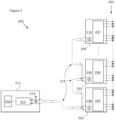
- the present embodiments of the disclosure relate to a BMU that is configured to communicate with the CMCs by way of a parallel arranged communication network, as shown in Figure 2 .
- a parallel arranged communication network a message sent by the BMU is conveyed to all CMCs coupled to the parallel arranged communication network without the need for relaying of the message along a chain of CMCs by actions of the CMCs.
- FIG. 2 shows a system 200 comprising a plurality of battery cells 201 wherein respective groups of those battery cells 201 are monitored by a plurality of cell monitoring circuits or CMCs 202, 203, 204.
- Each CMC 202, 203, 204 may include one or more battery cell controllers 205, 206, 207.
- the CMCs 202, 203, 204 in the present example are each coupled to the parallel arranged communication network 215 by a transformer 208, 209, 210, although other galvanic isolation may be provided.
- the parallel arranged communication network is provided by a twisted pair of wires with parallel branches to couple to the transformers 208, 209, 210 of each CMC.
- the system 200 includes a battery management unit, BMU, 211 configured to communicate with the plurality of cell monitoring circuits 202, 203, 204 via the parallel arranged communication network 215.
- the BMU 211 may comprise a microcontroller 212 and a physical layer block 213 that couples the microcontroller 212 to the parallel arranged communication network wiring via a transformer 214 (or other galvanic isolation). Accordingly, the MCU 212 may send and/or receive messages to/from the CMCs via the parallel arranged communication network
- each CMC 202, 203, 204 is configured to store a chain-identifier parameter (known as chain ID parameter), which is conventionally used to store the chain-identifier value assigned to the CMC by the BMU in a serially connected network.
- the chain ID parameter is typically, at least initially at power-on or after a system reset, set to a predetermined default value.
- the predetermined default value may comprise "zero" in some examples.
- the battery management unit 211 is configured to communicate with the plurality of CMCs 202, 203, 204 in parallel and is configured to, at least during an initialization period such as power-on or after a reset, perform a chain-identifier parameter assignment procedure which will be described below.
- the chain-identifier parameter assignment procedure comprises assigning a different chain-identifier parameter to each of the plurality of CMCs 204, 205, 206.
- each CMC coupled to the parallel arranged communication network is given a different chain ID assigned by the BMU, which provides for what is known in the art as enumeration of the CMCs.
- the assigning is achieved by using a unique ID of each CMC to individually select each one of the plurality of CMCs.
- the unique ID is used to ensure the BMU 211 is instructing a single CMC 202, 203, 204 when assigning the respective different chain-identifier parameter.
- the unique ID may be a unique ID of an integrated circuit of the CMC, such as the integrated circuit 205-207 that provides the battery cell controller (BCC) functionality. It is known that many integrated circuits have a unique ID (UID) that is typically spread over several registers (e.g. 2 to 3) and IC manufacturers typically make sure that it is unique in a production span of over 10 years. Thus, it is has been found that the uniqueness of each integrated circuit's unique ID can be used to select a single CMC and thereby uniquely assign a chain identifier parameter in a parallel arranged communication network.
- UID unique ID
- the unique ID of each CMC 202, 203, 204 is received by the BMU 211 in response to the BMU 211 being configured to send, in parallel to the CMCs using the predetermined default value, one or more request messages requesting that the CMCs report their unique IDs to the BMU 211.
- the BMU may be configured to send one or more request messages over the parallel communication network that specify the predetermined default value and will therefore be processed by CMCs having their chain-identifier parameter set to the predetermined default value (and not by those that don't have their chain-identifier parameter set to the predetermined default value).
- CMC 202, 203, 204 may be standard functionality of a CMC 202, 203, 204 to interpret the request message and in response, read from the one or more registers that store the unique ID, generate a reply message containing the unique ID, and transmit the reply message to the BMU 211. These actions of the CMC will be described in more detail later.
- the BMU subsequent to the chain-identifier parameter assignment procedure, may be configured to address future messages to a particular one of the plurality of CMCs based on the assigned chain-identifier parameter.
- the BMU 211 may be configured to receive a message from the CMCs, wherein a source of the message is identified by the message containing the assigned chain-identifier parameter.
- the CMCs 202, 203, 204 may be configured to, prior to said transmission of the reply message to the BMU 211, generate a random timer value termed t delay and start a delay counter set to t delay .
- Each CMC may be configured to wait until the delay counter has reached its t delay value before the transmission of the reply message. There may be a maximum delay period and during such maximum delay period, if a reply message is received by the BMU 211 it can then assign the chain-identifier parameter using the unique ID contained in the reply message such that the assignment applies to one of the CMCs.
- the BMU 211 may be configured to receive the first reply message (e.g.
- the BMU 211 may be configured to collate a plurality of unique IDs from a corresponding plurality of received reply messages before assigning the different chain-identifier parameters using the unique IDs received in each of those reply messages to individually select each one of the plurality of CMCs in turn.
- the BMU 211 may be configured to send a plurality of request messages in one or more examples. Given that the t delay is generated randomly, sending a plurality of request message may improve the chance of successfully receiving the reply messages from all of the CMCs over time (i.e. successive request messages). It has also been recognised that only the CMCs having their chain identifier parameters set to the default value will respond to the plurality of request messages.
- the BMU 107 may be configured to send a request message after each assignment (or a predetermined number of assignments) of a different chain identifier parameter. In this way, the chance of a collision reduces as the number of CMCs responding to the request messages also reduces as the CMCs are assigned a different chain identifier parameter to the predetermined default value.
- the BMU 211 is configured to send, in parallel to the CMCs 202-204 using the predetermined default value, a first request message, prior to assigning of the different chain identifier parameter to say CMC 202 as an illustrative example.
- the CMCs 202-204 will therefore respond, with some or all of the reply messages successfully being received by the BMU 211.
- the BMU 211 may be configured to send at least a second request message after assigning the different chain identifier parameter to CMC 202, wherein the second request message includes the predetermined default value such that it is configured to be processed by the CMCs that still have the chain-identifier parameter set to the predetermined default value, namely CMCs 203 and 204 in the present example.
- the CMC 202 has been assigned a chain-identifier parameter other than the predetermined default value different and may therefore ignore second request message.
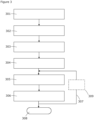
- the chain-identifier parameter assignment procedure comprises: transmitting 301 a first request message, of the one or more request messages, in parallel to the plurality of cell monitoring circuits 202-204, the first request message including at least:
- the chain-identifier value in the first request message defines which of the CMCs the first request is for.
- the CMCs 202-204 having a chain-identifier parameter that matches the chain-identifier value are configured to respond to the first request.
- the first request message will be processed and responded to by all of the CMCs 202-204 because the default value is used and, initially, all CMCs have the default value for their chain-identifier parameter.
- the BMU 211 is then configured to receive 302, from each of the plurality of CMCs having a chain-identifier parameter that matches the chain-identifier value, a second message containing the unique ID of that CMC.
- the BMU is configured to act upon the first received second message.
- the BMU 211 may receive multiple second messages.
- the BMU 211 is then configured to select 303 a first one of the received unique IDs (that were reported in the second messages). In selecting a received unique ID, the BMU 211 is effectively selecting a first one of the CMCs, say CMC 202 for example.
- the BMU 211 is then configured to transmit 304 a third message in parallel to the plurality of CMCs, the third message including at least:
- the third request may instruct CMC 202 to change their chain-identifier parameter to "1".
- the BMU 211 is then configured to perform a further assignment procedure.
- the further assignment procedure successively moves through the other unique IDs in order to assign a different chain-identifier parameter to each of the remaining CMCs 203 and 204.
- the BMU 211 is configured to select 305 a different one of the received unique IDs to one previously selected during the chain-identifier parameter assignment procedure and thereby selecting a different one of the CMCs, say CMC 203 for example.
- the BMU 211 is configured to transmit 306 a further message in parallel to the plurality of CMCs, the further message including at least:
- the further message may instruct CMC 203 to change their chain-identifier parameter to "2".
- the BMU 211 may determine the further assigned value by incrementing the previously assigned value.
- the BMU is then configured to repeat 307 the further assignment procedure for the remaining CMCs that have the predetermined default value of zero, which in this example is CMC 204.
- the BMU 211 is configured to select 305 a different one of the received unique IDs to one previously selected during the chain-identifier parameter assignment procedure and thereby selecting a different one of the CMCs, which is the last remaining CMC 204 in this example.
- the BMU 211 is configured to transmit 306 another further message in parallel to the plurality of CMCs, the further message including at least:
- the further message may instruct CMC 204 to change their chain-identifier parameter to "3" (incremented from "2", which was assigned in the previous iteration).
- the BMU 211 may be configured to end 308 the chain-identifier parameter assignment procedure. The end may be determined by receiving no responses to the transmission of a first message.
- the further assignment procedure may comprises the BMU 211 being configured to transmit 309 a further first request message (and receive the remaining unique IDs in second messages for the CMCs still having the predetermined default value for their chain-identifier parameter) prior to the selecting 305 of the different one of the received unique IDs to one previously selected during the chain-identifier parameter assignment procedure.
- the selecting step 305 may comprise selecting one of the unique IDs received in response to the transmitting 309 of the most recent further first request message.
- the BMU 211 is configured to transmit 309 the further first request message each time prior to the selecting 305 of the different one of the received unique IDs to one previously selected during the chain-identifier parameter assignment procedure.
- multiple unique IDs may be collated from a plurality of received second message and therefore transmitting 309 the further first request message each time may not be necessary.
- the BMU 211 may be configured to, in the event that the second message is not successfully received after a predetermined maximum delay period, re-transmit the first message. Retransmitting the first message (or further first message) will prompt the CMCs to generate a different T delay and therefore a collision may not occur the next time.
- the CMC 202-204 is configured to, in response to the first message or further first message, read 401 the unique ID from its registers.
- the reading of the registers may include an error check step 402, such as a cyclic redundancy check (CRC) verification process. If the CRC fails, the read 401 is performed again. If the CRC is ok, the CMC 202-204, in response to the first message from the BMU 211, is configured to determine 403 if the chain-identifier parameter indicated in the message matches the chain-identifier parameter of the CMC.
- CRC cyclic redundancy check
- the CMC transmits the content of the UID registers to the BMU in the second message 411.
- An error checking step may be performed at 502.
- the CMC is further configured to determine if the unique ID indicated in the message matches the unique ID of the integrated circuit of the CMC at 503.
- the CMC 202-204 is configured to process the third or further message by changing its chain-identifier parameter to the first or further assigned value stated in the third or further message at step 505.
- the CMC may ignore the message and the process performed by the CMC returns to step 501.
- the set of instructions/method steps described above are implemented as functional and software instructions embodied as a set of executable instructions which are effected on a computer or machine which is programmed with and controlled by said executable instructions. Such instructions are loaded for execution on a processor (such as one or more CPUs).
- processor includes microprocessors, microcontrollers, processor modules or subsystems (including one or more microprocessors or microcontrollers), or other control or computing devices.
- a processor can refer to a single component or to plural components.
- the set of instructions/methods illustrated herein and data and instructions associated therewith are stored in respective storage devices, which are implemented as one or more non-transient machine or computer-readable or computer-usable storage media or mediums.
- Such computer-readable or computer usable storage medium or media is (are) considered to be part of an article (or article of manufacture).
- An article or article of manufacture can refer to any manufactured single component or multiple components.
- the non-transient machine or computer usable media or mediums as defined herein excludes signals, but such media or mediums may be capable of receiving and processing information from signals and/or other transient mediums.
- one or more instructions or steps discussed herein are automated.
- the terms automated or automatically mean controlled operation of an apparatus, system, and/or process using computers and/or mechanical/electrical devices without the necessity of human intervention, observation, effort and/or decision.
- any components said to be coupled may be coupled or connected either directly or indirectly.
- additional components may be located between the two components that are said to be coupled.
Landscapes
- Engineering & Computer Science (AREA)
- Power Engineering (AREA)
- Manufacturing & Machinery (AREA)
- Chemical & Material Sciences (AREA)
- Chemical Kinetics & Catalysis (AREA)
- Electrochemistry (AREA)
- General Chemical & Material Sciences (AREA)
- General Health & Medical Sciences (AREA)
- Health & Medical Sciences (AREA)
- Computing Systems (AREA)
- Medical Informatics (AREA)
- Computer Networks & Wireless Communication (AREA)
- Signal Processing (AREA)
- Physics & Mathematics (AREA)
- General Physics & Mathematics (AREA)
- Microelectronics & Electronic Packaging (AREA)
- Charge And Discharge Circuits For Batteries Or The Like (AREA)
- Mobile Radio Communication Systems (AREA)
Priority Applications (3)
| Application Number | Priority Date | Filing Date | Title |
|---|---|---|---|
| EP23306209.0A EP4492076A1 (fr) | 2023-07-13 | 2023-07-13 | Unité de gestion de batterie |
| CN202410810957.6A CN119315130A (zh) | 2023-07-13 | 2024-06-21 | 电池管理单元 |
| US18/756,060 US20250023948A1 (en) | 2023-07-13 | 2024-06-27 | Battery management unit |
Applications Claiming Priority (1)
| Application Number | Priority Date | Filing Date | Title |
|---|---|---|---|
| EP23306209.0A EP4492076A1 (fr) | 2023-07-13 | 2023-07-13 | Unité de gestion de batterie |
Publications (1)
| Publication Number | Publication Date |
|---|---|
| EP4492076A1 true EP4492076A1 (fr) | 2025-01-15 |
Family
ID=87553540
Family Applications (1)
| Application Number | Title | Priority Date | Filing Date |
|---|---|---|---|
| EP23306209.0A Pending EP4492076A1 (fr) | 2023-07-13 | 2023-07-13 | Unité de gestion de batterie |
Country Status (3)
| Country | Link |
|---|---|
| US (1) | US20250023948A1 (fr) |
| EP (1) | EP4492076A1 (fr) |
| CN (1) | CN119315130A (fr) |
Citations (4)
| Publication number | Priority date | Publication date | Assignee | Title |
|---|---|---|---|---|
| US20110175574A1 (en) * | 2009-08-03 | 2011-07-21 | Samsung Sdi Co., Ltd. | Battery id setting system and method of driving the same |
| US20140115191A1 (en) * | 2012-10-19 | 2014-04-24 | Lg Chem, Ltd. | Method of allocating unique identifier and battery management system using the same |
| US8963507B2 (en) * | 2011-09-05 | 2015-02-24 | Lg Chem, Ltd. | Method and system for allocating identifiers to multi-slave in battery pack |
| EP3537562A1 (fr) * | 2017-07-06 | 2019-09-11 | LG Chem, Ltd. | Système de gestion de batterie sans fil et bloc-batterie comprenant ce dernier |
-
2023
- 2023-07-13 EP EP23306209.0A patent/EP4492076A1/fr active Pending
-
2024
- 2024-06-21 CN CN202410810957.6A patent/CN119315130A/zh active Pending
- 2024-06-27 US US18/756,060 patent/US20250023948A1/en active Pending
Patent Citations (4)
| Publication number | Priority date | Publication date | Assignee | Title |
|---|---|---|---|---|
| US20110175574A1 (en) * | 2009-08-03 | 2011-07-21 | Samsung Sdi Co., Ltd. | Battery id setting system and method of driving the same |
| US8963507B2 (en) * | 2011-09-05 | 2015-02-24 | Lg Chem, Ltd. | Method and system for allocating identifiers to multi-slave in battery pack |
| US20140115191A1 (en) * | 2012-10-19 | 2014-04-24 | Lg Chem, Ltd. | Method of allocating unique identifier and battery management system using the same |
| EP3537562A1 (fr) * | 2017-07-06 | 2019-09-11 | LG Chem, Ltd. | Système de gestion de batterie sans fil et bloc-batterie comprenant ce dernier |
Also Published As
| Publication number | Publication date |
|---|---|
| US20250023948A1 (en) | 2025-01-16 |
| CN119315130A (zh) | 2025-01-14 |
Similar Documents
| Publication | Publication Date | Title |
|---|---|---|
| US9015267B2 (en) | Method for setting addresses of slave devices in communication network | |
| US9354965B2 (en) | Method and apparatus for isolating a fault in a controller area network | |
| US9222986B2 (en) | Distributed battery management system and method of identification distribution using the same | |
| CN103328992A (zh) | 用于诊断网络中的故障或开路的方法和系统 | |
| CN108268383A (zh) | 自动寻址与数据分配方法、装置、主控设备、从控设备及计算机可读存储介质 | |
| CN103186440B (zh) | 检测子卡在位的方法、装置及系统 | |
| CN110061773A (zh) | 一种光模块测试方法、装置、系统及计算机存储介质 | |
| CN105874816B (zh) | 用于启动电池组管理系统的方法 | |
| EP4492076A1 (fr) | Unité de gestion de batterie | |
| CN105338129B (zh) | 自动分址方法、显示终端和模块终端 | |
| EP3905603A1 (fr) | Détermination d'une séquence de n uds de bus dans un bus de communication multipoints | |
| CN108141480B (zh) | 用于互连单元系统中的寻址的方法和设备 | |
| CN119363718A (zh) | 一种地址分配方法、装置、电子设备及存储介质 | |
| US11108589B2 (en) | Battery module, control method, program, and information processing system | |
| CN118075113A (zh) | 网络配置方法、装置、设备、存储介质及产品 | |
| CN114580824B (zh) | 用于从一组电表收集信息的方法 | |
| CN116980260A (zh) | 一种应用于下行电压上行电流总线中的全双工与多主竞争通讯方法 | |
| CN116383115A (zh) | 一种数据通信方法及系统 | |
| CN106031190B (zh) | 用于管理包括多个单电池的电池组的系统和相应方法 | |
| CN119788990B (zh) | 机柜标识的管理方法和装置、存储介质及电子设备 | |
| CN114944967A (zh) | 编码方法、系统、电子设备及存储介质 | |
| CN104969520B (zh) | 一种资源分配的方法以及终端设备 | |
| CN114598566A (zh) | 一种基于spi总线的通信系统及方法 | |
| CN121000636B (zh) | 通信链路的监测方法、装置、电子设备、存储介质及产品 | |
| CN113645322B (zh) | 一种基于光纤串行通信的地址码识别方法、装置及其应用 |
Legal Events
| Date | Code | Title | Description |
|---|---|---|---|
| PUAI | Public reference made under article 153(3) epc to a published international application that has entered the european phase |
Free format text: ORIGINAL CODE: 0009012 |
|
| STAA | Information on the status of an ep patent application or granted ep patent |
Free format text: STATUS: THE APPLICATION HAS BEEN PUBLISHED |
|
| AK | Designated contracting states |
Kind code of ref document: A1 Designated state(s): AL AT BE BG CH CY CZ DE DK EE ES FI FR GB GR HR HU IE IS IT LI LT LU LV MC ME MK MT NL NO PL PT RO RS SE SI SK SM TR |
|
| STAA | Information on the status of an ep patent application or granted ep patent |
Free format text: STATUS: REQUEST FOR EXAMINATION WAS MADE |
|
| 17P | Request for examination filed |
Effective date: 20250715 |