EP4492091A1 - Procédé d'estimation et de correction de références de phase et de temps de données sar non synchrones d'un système sar multicanal - Google Patents
Procédé d'estimation et de correction de références de phase et de temps de données sar non synchrones d'un système sar multicanal Download PDFInfo
- Publication number
- EP4492091A1 EP4492091A1 EP24186465.1A EP24186465A EP4492091A1 EP 4492091 A1 EP4492091 A1 EP 4492091A1 EP 24186465 A EP24186465 A EP 24186465A EP 4492091 A1 EP4492091 A1 EP 4492091A1
- Authority
- EP
- European Patent Office
- Prior art keywords
- data
- sar
- channels
- phase error
- channel
- Prior art date
- Legal status (The legal status is an assumption and is not a legal conclusion. Google has not performed a legal analysis and makes no representation as to the accuracy of the status listed.)
- Pending
Links
Images

Classifications
-
- G—PHYSICS
- G01—MEASURING; TESTING
- G01S—RADIO DIRECTION-FINDING; RADIO NAVIGATION; DETERMINING DISTANCE OR VELOCITY BY USE OF RADIO WAVES; LOCATING OR PRESENCE-DETECTING BY USE OF THE REFLECTION OR RERADIATION OF RADIO WAVES; ANALOGOUS ARRANGEMENTS USING OTHER WAVES
- G01S7/00—Details of systems according to groups G01S13/00, G01S15/00, G01S17/00
- G01S7/02—Details of systems according to groups G01S13/00, G01S15/00, G01S17/00 of systems according to group G01S13/00
- G01S7/40—Means for monitoring or calibrating
- G01S7/4004—Means for monitoring or calibrating of parts of a radar system
-
- G—PHYSICS
- G01—MEASURING; TESTING
- G01S—RADIO DIRECTION-FINDING; RADIO NAVIGATION; DETERMINING DISTANCE OR VELOCITY BY USE OF RADIO WAVES; LOCATING OR PRESENCE-DETECTING BY USE OF THE REFLECTION OR RERADIATION OF RADIO WAVES; ANALOGOUS ARRANGEMENTS USING OTHER WAVES
- G01S13/00—Systems using the reflection or reradiation of radio waves, e.g. radar systems; Analogous systems using reflection or reradiation of waves whose nature or wavelength is irrelevant or unspecified
- G01S13/88—Radar or analogous systems specially adapted for specific applications
- G01S13/89—Radar or analogous systems specially adapted for specific applications for mapping or imaging
- G01S13/90—Radar or analogous systems specially adapted for specific applications for mapping or imaging using synthetic aperture techniques, e.g. synthetic aperture radar [SAR] techniques
- G01S13/904—SAR modes
- G01S13/9058—Bistatic or multistatic SAR
Definitions
- the invention relates to a method and a device for estimating and correcting the time and phase references of non-synchronous SAR data, wherein the non-synchronous SAR data are acquired and provided by a bistatic or multistatic multi-channel radar system with N channels.
- the SAR system moves in a direction known as the azimuth direction.
- the satellite whose height above the earth's surface is known, continuously sends out radar pulses via a transmitting antenna towards the earth's surface during its movement in the azimuth direction.
- the radar echo of each transmitted radar pulse is recorded by temporally scanning the radar radiation reflected from the earth's surface in the so-called range direction, which extends perpendicular to the direction of flight (azimuth direction) of the satellite, using a receiver.
- the transmitter and the receiver are, for example, components of a combined transmit-receive antenna, which represents the transmitter in transmit mode and the receiver in receive mode.
- the SAR system is a so-called single aperture system, in which the radar echoes are only recorded by a single receiver, i.e. not by several receivers at the same time.
- a swath of the ground illuminated by the transmitted radar pulse which can be several kilometers wide, e.g. several tens or hundreds of kilometers.
- the width of the swath depends, among other things, on the length of the time window within which the backscattered radar echoes from a transmitted pulse are received by the receiver. This time window is called the echo window.
- the received echoes are converted in frequency (i.e. mixed), demodulated, digitized and stored in a two-dimensional matrix as raw data.
- the principle of SAR measurement is based on the fact that certain points on the earth's surface are recorded several times from different angles due to the movement of the satellite. Due to the well-known Doppler effect, the detection of the radar echo leads to a phase modulation that can be suitably evaluated, whereby amplitude and phase information and thus an image point of the earth's surface are obtained for the points on the earth's surface at which the radar pulses are reflected.
- the corresponding calculation of image points of the earth's surface from SAR data is known to the person skilled in the art and will therefore not be explained in further detail.
- a large synthetic aperture corresponding to the extent of the radar pulse on the earth's surface is simulated by a large number of radar pulses from a radar sensor with a small aperture.
- SAR imaging is based on the assumption that the reflectivity of a complex coherent backscatterer can be reconstructed if its geometric position is known. For this reason, two conditions must be met for the reconstruction of the radar signal to be accurate: a) the complex reflectivity of the backscatterer must be recorded as undistorted as possible, and b) its geometric position must be determinable within the acquired data. The second condition is only met if the transmitter and receiver share a common time and phase reference. However, a common time and phase reference is only given if the transmitter and receiver basically use the same clock or time reference, which is the case with so-called monostatic SAR systems. In contrast, bistatic and multistatic SAR systems usually work with different time references (master clocks) for the transmitter and receiver.
- mirrorSAR a complete system architecture (mirrorSAR) is proposed in [8] to avoid demodulation of the received signals with another oscillator.
- the approach is that the receivers work like transponders, i.e. they forward the radar echoes to another element of the SAR system, e.g. the transmitter, which has access to the oscillator used for modulation.
- this approach is more of a system architecture solution for accompanying SAR missions than a specific synchronization strategy.
- a method for correcting the time and phase references of non-synchronous SAR data is proposed.
- the non-synchronous SAR data are recorded and provided by a bistatic or a multistatic multi-channel radar system with N channels.
- the multi-channel radar system thus comprises at least two channels, although the number can also be greater (N ⁇ 2).
- a residual clock phase error present within the SAR data is estimated and corrected based on an evaluation, in particular an exclusive evaluation, of information from the SAR data.
- differential phase data between one or more pairs of channels of the multi-channel radar system are processed, which are sampled at different times in a receiver of the multi-channel radar system.
- the time and phase references of the received SAR data are then corrected by processing the estimated residual clock phase error.
- the azimuth averaging is conveniently chosen so that most of the phase noise in the oscillators (master clocks) is captured, as is the case, for example, in the EP 2 843 439 A1 This typically results in a sampling of the instantaneous frequency in the range between 1 Hz and 10 Hz, depending on the characteristics of the oscillators and the carrier frequency of the radar system.
- step c) the residual clock phase error is estimated by comparing it with a reference SAR image that does not have a clock phase error, whereby a two-dimensional distortion of the SAR image generated in step b) is determined with respect to the reference SAR image and whereby the residual clock phase error is estimated by inverting the determined distortion.
- the device according to the invention has the same advantages as those described above in connection with the method according to the invention.
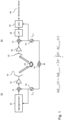
- Fig. 1 shows a block diagram of a known non-synchronous SAR system comprising a transmitter 50 and a receiver 60.
- the transmitter 50 and the receiver 60 are formed on different carrier platforms. Carrier platforms can be aircraft or satellites.
- the transmitter 50 comprises a signal generator 30 to which a reference frequency f 0 ,Tx is fed from an internal time reference 34, e.g. an oscillator, of the transmitter 50.
- the internal time reference 34 is also referred to as a master clock.
- the reference frequency f 0 ,Tx is also fed to a mixer 31, which is also connected to an output of the signal generator 30.
- the mixer 31 modulates the clock signal f 0 ,Tx fed from the internal time reference 34.
- the modulated signal is fed to an amplifier 32, the output of which is connected to a transmitting antenna 33.
- the signal antenna 33 transmits radar pulses which are reflected by a radar target 43 and received by an antenna 35 of the receiver 60.
- the antenna 35 is connected to an amplifier 36, which feeds the received signal to a mixer 37 for demodulation with a reference frequency f 0 ,Rx provided by an internal time reference 41, e.g. an oscillator.
- an internal time reference 41 e.g. an oscillator.
- another input of the mixer 37 is connected to the internal time reference 41.
- the internal time reference is connected to a clock generator of the receiver.
- the internal time reference 41 of the receiver 60 feeds the frequency f 0 ,Rx not only to the mixer 37 but also to an analog-digital converter 39 (ADC).
- ADC analog-digital converter
- the mixer 37 is connected to a filter 38 (low-pass filter, LPF).
- LPF low-pass filter
- the azimuth averaging is chosen such that most of the power of the phase noise errors of the time reference 41 and the carrier frequency of the radar system is captured, which is the case when the frequency is sampled in the range between 1 Hz and 10 Hz, depending on the characteristics of the oscillator of the time reference 41 and the carrier frequency of the radar system.
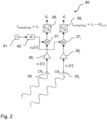
- Fig. 2 represents a special case in which the receiver 60 has only two channels.
- the estimation of the frequency error is only carried out for the single pair of channels present.
- the receiver can have a plurality N ⁇ 2 of channels, resulting in a larger number of possible channel pairs.
- the method described above is carried out separately for each pair of channels.
- the inversion described below which is based on a matrix notation, takes into account the general number N of channel pairs.
Landscapes
- Engineering & Computer Science (AREA)
- Remote Sensing (AREA)
- Radar, Positioning & Navigation (AREA)
- Physics & Mathematics (AREA)
- Computer Networks & Wireless Communication (AREA)
- General Physics & Mathematics (AREA)
- Electromagnetism (AREA)
- Radar Systems Or Details Thereof (AREA)
Applications Claiming Priority (1)
| Application Number | Priority Date | Filing Date | Title |
|---|---|---|---|
| DE102023118730.9A DE102023118730B3 (de) | 2023-07-14 | 2023-07-14 | Verfahren zur Schätzung und Korrektur der Zeit- und Phasenreferenzen von nicht-synchronen SAR-Daten eines mehrkanaligen SAR-Systems |
Publications (1)
| Publication Number | Publication Date |
|---|---|
| EP4492091A1 true EP4492091A1 (fr) | 2025-01-15 |
Family
ID=91829455
Family Applications (1)
| Application Number | Title | Priority Date | Filing Date |
|---|---|---|---|
| EP24186465.1A Pending EP4492091A1 (fr) | 2023-07-14 | 2024-07-04 | Procédé d'estimation et de correction de références de phase et de temps de données sar non synchrones d'un système sar multicanal |
Country Status (2)
| Country | Link |
|---|---|
| EP (1) | EP4492091A1 (fr) |
| DE (1) | DE102023118730B3 (fr) |
Citations (1)
| Publication number | Priority date | Publication date | Assignee | Title |
|---|---|---|---|---|
| EP2843439A1 (fr) | 2013-07-26 | 2015-03-04 | Deutsches Zentrum für Luft- und Raumfahrt e.V. | Procédé de correction de références de phase et de temps de données SAR non synchrones |
-
2023
- 2023-07-14 DE DE102023118730.9A patent/DE102023118730B3/de active Active
-
2024
- 2024-07-04 EP EP24186465.1A patent/EP4492091A1/fr active Pending
Patent Citations (1)
| Publication number | Priority date | Publication date | Assignee | Title |
|---|---|---|---|---|
| EP2843439A1 (fr) | 2013-07-26 | 2015-03-04 | Deutsches Zentrum für Luft- und Raumfahrt e.V. | Procédé de correction de références de phase et de temps de données SAR non synchrones |
Non-Patent Citations (16)
| Title |
|---|
| AZCUETA MARIO ET AL: "Potential for Absolute Ionosphere and Clock Correction in Noncooperative Bistatic SAR", IEEE TRANSACTIONS ON GEOSCIENCE AND REMOTE SENSING, IEEE, USA, vol. 58, no. 1, 1 January 2020 (2020-01-01), pages 363 - 377, XP011763118, ISSN: 0196-2892, [retrieved on 20191226], DOI: 10.1109/TGRS.2019.2936569 * |
| E. RODRIGUES SILVA FILHO ET AL.: "Experimental evaluation of GNSS-based frequency synchronization for SAR applications", PROCEEDINGS IGARSS, 2022 |
| G. KRIEGERA. MOREIRA: "Spaceborne bi- and multistatic synthetic aperture radar: potential and challenges", IEE PROC. RADAR SONAR NAVIG., vol. 153, no. 3, June 2006 (2006-06-01), pages 184 - 198 |
| G. KRIEGERA. MOREIRAH. FIEDLERI. HAJNSEKM. WERNERM. YOUNISM. ZINK: "TanDEM-X: a satellite formation for high-resolution SAR interferometry", IEEE TRANS. GEOSCI. REMOTE SENS., vol. 45, no. 11, November 2007 (2007-11-01), pages 3317 - 3341 |
| G. KRIEGERM. YOUNIS: "Impact of oscillator noise in bistatic and multistatic SAR", IEEE GEOSCI. REMOTE SENS. LETT., vol. 3, no. 3, July 2006 (2006-07-01), pages 424 - 428 |
| G. KRIEGERM. ZONNOJ. MITTERMAYERA. MOREIRAS. HUBERM. RODRIGUEZ-CASSOLA: "EUSAR 2018", June 2018, EUROPEAN CONFERENCE ON SYNTHETIC APERTURE RADAR, article "Mirrorsar: A fractionated space transponder concept for the implementation of low-cost multistatic sar missions", pages: 1 - 6 |
| J. L. AUTERMAN: ""Phase stability requirements for bistatic SAR," ", NAT. RADAR CONF., 1984, pages 48 - 52, XP002285963 |
| K. SCIPAL ET AL.: "The SAOCOM-CS mission: ESA's first bi static and tomographic I-band mission", PROCEEDINGS IGARSS, 2017 |
| LOPEZ-DEKKER P ET AL: "Phase Synchronization and Doppler Centroid Estimation in Fixed Receiver Bistatic SAR Systems", IEEE TRANSACTIONS ON GEOSCIENCE AND REMOTE SENSING, IEEE, USA, vol. 46, no. 11, 1 November 2008 (2008-11-01), pages 3459 - 3471, XP011238779, ISSN: 0196-2892, DOI: 10.1109/TGRS.2008.923322 * |
| M. DAVIDSON ET AL.: "ROSE-L: Copernicus L-band SAR Mission", PROCEEDINGS IGARSS, 2021 |
| M. PINHEIRO ET AL.: "Reconstruction of coherent pairs of synthetic aperture radar data acquired in interrupted mode", TGRS, 2015 |
| M. RODRIGUEZ-CASSOLA: "Bi static synthetic aperture radar data processing", DLR TECHNICAL REPORT 2013/27, 2012 |
| M. RODRIGUEZ-CASSOLAP. PRATSD. SCHULZEN. TAUS-RAMONU. STEIN-BRECHERL. MAROTTIM. NANNINNIM. YOUNISM. ZINKA. REIGBER: "First bistatic spaceborne SAR experiments with TanDEM-X", IEEE GEOSCI. REMOTE SENS. LETT., vol. 7, no. 1, January 2012 (2012-01-01), pages 108 - 112 |
| RODRIGUEZ-CASSOLA M ET AL: "Bistatic TerraSAR-X/F-SAR Spaceborne-Airborne SAR Experiment: Description, Data Processing, and Results", IEEE TRANSACTIONS ON GEOSCIENCE AND REMOTE SENSING, IEEE, USA, vol. 48, no. 2, 1 February 2010 (2010-02-01), pages 781 - 794, XP011296763, ISSN: 0196-2892 * |
| RODRIGUEZ-CASSOLA MARC ET AL: "Autonomous time and phase calibration of spaceborne bistatic SAR systems", 10TH EUROPEAN CONFERENCE ON SYNTHETIC APERTURE RADAR, 5 June 2014 (2014-06-05), pages 264 - 267, XP093226831 * |
| RODRIGUEZ-CASSOLA MARC ET AL: "General Processing Approach for Bistatic SAR Systems: Descrip tion and Performance Analysis", ELECTRONIC PROCEEDINGS / EUSAR 2010 : 8TH EUROPEAN CONFERENCE ON SYNTHETIC APERTURE RADAR ; 7 - 10 JUNE 2010, AACHEN, GERMANY, 10 June 2010 (2010-06-10), Berlin [u.a.], pages 998 - 1001, XP093227029, ISBN: 978-3-8007-3272-2 * |
Also Published As
| Publication number | Publication date |
|---|---|
| DE102023118730B3 (de) | 2024-11-28 |
Similar Documents
| Publication | Publication Date | Title |
|---|---|---|
| EP2843439B1 (fr) | Procédé de correction de références de phase et de temps de données SAR non synchrones | |
| DE102018208366B3 (de) | Synthetik-Apertur-Radarverfahren und Synthetik-Apertur-Radarvorrichtung | |
| EP2875384B1 (fr) | Procédé de traitement de données brutes d'un radar rso en mode de saisie hyperfine obtenues en haute résolution et à protection spatiale | |
| DE69511118T2 (de) | Positionsbestimmung der quelle eines unbekannten signales | |
| DE60309006T2 (de) | Rauschunterdrückungsvorrichtung und -verfahren für phasengesteuerte systeme | |
| DE69924011T2 (de) | Sar-radarsystem | |
| DE69420230T2 (de) | Mehrfach-Bild-SAR-System für hochgenaue Interfermetrie mit einer Doppelantenne | |
| DE3785475T2 (de) | Verfahren und vorrichtung zur passiven abstandsmessung. | |
| DE69935035T2 (de) | Verfahren und System mit integrierter Zweiweg-Entfernungsbestimmung zur Eichung von GPS | |
| EP0286806B1 (fr) | Procédé de cartograhie topographique | |
| DE3883527T2 (de) | Fahrzeug-ortungssystem mit grösserer genauigkeit für luftfahrzeuge. | |
| EP0795762A2 (fr) | Procédé de mise à l'échelle de l'azimut pour données SAR et processeur à grande précision pour traitement des données SCAN-SAR | |
| DE69026583T2 (de) | Radar mit synthetischer Apertur und Strahlkeulenschärfungsfähigkeit in der Richtung der Fahrt | |
| EP3470874B1 (fr) | Procédé et système radar permettant de déterminer la position angulaire, l'emplacement et la vitesse vectorielle d'une cible | |
| EP1637902B1 (fr) | Système et dispositif de mesure radar interférometrique | |
| WO2021047844A1 (fr) | Procédé radar et système radar | |
| DE60319370T2 (de) | Verfahren und vorrichtung für genaue phasendetektion | |
| DE102020109611A1 (de) | Radarsystem mit balancing der empfangskanäle über mehrere radar-chips | |
| EP0755522B1 (fr) | Procede d'aide a la navigation par satellites | |
| DE102022101576A1 (de) | Verfahren zur Reduktion von Auswirkungen einer Störunterdrückung auf die Messung einer Phasenverschiebung eines Satellitennavigationssignals am Ort seines Empfangs sowie Anwendungen dieses Verfahrens | |
| DE102023118730B3 (de) | Verfahren zur Schätzung und Korrektur der Zeit- und Phasenreferenzen von nicht-synchronen SAR-Daten eines mehrkanaligen SAR-Systems | |
| EP1217384B1 (fr) | Procédé de localisation de satellites géostationaires par mesure de temps de vol de signaux provenant de systèmes de navigation par satellite | |
| DE102023118442B4 (de) | Verfahren zum Erzeugen digitaler Höhenmodelle einer zu betrachtenden Region auf der Erde unter Verwendung eines Systems von mehreren Plattformen mit einem Radar mit synthetischer Apertur (SAR) | |
| WO2025031859A1 (fr) | Procédé d'étalonnage d'un capteur sar | |
| DE102004045273B4 (de) | Verfahren zur Bilderzeugung bei einem Synthetischen Apertur Radar |
Legal Events
| Date | Code | Title | Description |
|---|---|---|---|
| PUAI | Public reference made under article 153(3) epc to a published international application that has entered the european phase |
Free format text: ORIGINAL CODE: 0009012 |
|
| STAA | Information on the status of an ep patent application or granted ep patent |
Free format text: STATUS: THE APPLICATION HAS BEEN PUBLISHED |
|
| AK | Designated contracting states |
Kind code of ref document: A1 Designated state(s): AL AT BE BG CH CY CZ DE DK EE ES FI FR GB GR HR HU IE IS IT LI LT LU LV MC ME MK MT NL NO PL PT RO RS SE SI SK SM TR |
|
| STAA | Information on the status of an ep patent application or granted ep patent |
Free format text: STATUS: REQUEST FOR EXAMINATION WAS MADE |
|
| 17P | Request for examination filed |
Effective date: 20250710 |