EP4492394A1 - Système et procédé de planification d'une procédure dentaire à l'aide d'une réalité augmentée ou virtuelle - Google Patents
Système et procédé de planification d'une procédure dentaire à l'aide d'une réalité augmentée ou virtuelle Download PDFInfo
- Publication number
- EP4492394A1 EP4492394A1 EP23184789.8A EP23184789A EP4492394A1 EP 4492394 A1 EP4492394 A1 EP 4492394A1 EP 23184789 A EP23184789 A EP 23184789A EP 4492394 A1 EP4492394 A1 EP 4492394A1
- Authority
- EP
- European Patent Office
- Prior art keywords
- dental
- procedure
- virtual reality
- planning
- overlay
- Prior art date
- Legal status (The legal status is an assumption and is not a legal conclusion. Google has not performed a legal analysis and makes no representation as to the accuracy of the status listed.)
- Pending
Links
Images


Classifications
-
- G—PHYSICS
- G16—INFORMATION AND COMMUNICATION TECHNOLOGY [ICT] SPECIALLY ADAPTED FOR SPECIFIC APPLICATION FIELDS
- G16H—HEALTHCARE INFORMATICS, i.e. INFORMATION AND COMMUNICATION TECHNOLOGY [ICT] SPECIALLY ADAPTED FOR THE HANDLING OR PROCESSING OF MEDICAL OR HEALTHCARE DATA
- G16H40/00—ICT specially adapted for the management or administration of healthcare resources or facilities; ICT specially adapted for the management or operation of medical equipment or devices
- G16H40/60—ICT specially adapted for the management or administration of healthcare resources or facilities; ICT specially adapted for the management or operation of medical equipment or devices for the operation of medical equipment or devices
- G16H40/63—ICT specially adapted for the management or administration of healthcare resources or facilities; ICT specially adapted for the management or operation of medical equipment or devices for the operation of medical equipment or devices for local operation
-
- A—HUMAN NECESSITIES
- A61—MEDICAL OR VETERINARY SCIENCE; HYGIENE
- A61B—DIAGNOSIS; SURGERY; IDENTIFICATION
- A61B34/00—Computer-aided surgery; Manipulators or robots specially adapted for use in surgery
- A61B34/10—Computer-aided planning, simulation or modelling of surgical operations
-
- A—HUMAN NECESSITIES
- A61—MEDICAL OR VETERINARY SCIENCE; HYGIENE
- A61B—DIAGNOSIS; SURGERY; IDENTIFICATION
- A61B34/00—Computer-aided surgery; Manipulators or robots specially adapted for use in surgery
- A61B34/25—User interfaces for surgical systems
-
- A—HUMAN NECESSITIES
- A61—MEDICAL OR VETERINARY SCIENCE; HYGIENE
- A61C—DENTISTRY; APPARATUS OR METHODS FOR ORAL OR DENTAL HYGIENE
- A61C13/00—Dental prostheses; Making same
- A61C13/0003—Making bridge-work, inlays, implants or the like
- A61C13/0004—Computer-assisted sizing or machining of dental prostheses
-
- A—HUMAN NECESSITIES
- A61—MEDICAL OR VETERINARY SCIENCE; HYGIENE
- A61C—DENTISTRY; APPARATUS OR METHODS FOR ORAL OR DENTAL HYGIENE
- A61C9/00—Impression cups, i.e. impression trays; Impression methods
- A61C9/004—Means or methods for taking digitized impressions
- A61C9/0046—Data acquisition means or methods
- A61C9/0053—Optical means or methods, e.g. scanning the teeth by a laser or light beam
-
- G—PHYSICS
- G06—COMPUTING OR CALCULATING; COUNTING
- G06N—COMPUTING ARRANGEMENTS BASED ON SPECIFIC COMPUTATIONAL MODELS
- G06N20/00—Machine learning
-
- G—PHYSICS
- G06—COMPUTING OR CALCULATING; COUNTING
- G06T—IMAGE DATA PROCESSING OR GENERATION, IN GENERAL
- G06T19/00—Manipulating three-dimensional [3D] models or images for computer graphics
- G06T19/006—Mixed reality
-
- G—PHYSICS
- G16—INFORMATION AND COMMUNICATION TECHNOLOGY [ICT] SPECIALLY ADAPTED FOR SPECIFIC APPLICATION FIELDS
- G16H—HEALTHCARE INFORMATICS, i.e. INFORMATION AND COMMUNICATION TECHNOLOGY [ICT] SPECIALLY ADAPTED FOR THE HANDLING OR PROCESSING OF MEDICAL OR HEALTHCARE DATA
- G16H20/00—ICT specially adapted for therapies or health-improving plans, e.g. for handling prescriptions, for steering therapy or for monitoring patient compliance
- G16H20/40—ICT specially adapted for therapies or health-improving plans, e.g. for handling prescriptions, for steering therapy or for monitoring patient compliance relating to mechanical, radiation or invasive therapies, e.g. surgery, laser therapy, dialysis or acupuncture
-
- G—PHYSICS
- G16—INFORMATION AND COMMUNICATION TECHNOLOGY [ICT] SPECIALLY ADAPTED FOR SPECIFIC APPLICATION FIELDS
- G16H—HEALTHCARE INFORMATICS, i.e. INFORMATION AND COMMUNICATION TECHNOLOGY [ICT] SPECIALLY ADAPTED FOR THE HANDLING OR PROCESSING OF MEDICAL OR HEALTHCARE DATA
- G16H30/00—ICT specially adapted for the handling or processing of medical images
- G16H30/40—ICT specially adapted for the handling or processing of medical images for processing medical images, e.g. editing
-
- G—PHYSICS
- G16—INFORMATION AND COMMUNICATION TECHNOLOGY [ICT] SPECIALLY ADAPTED FOR SPECIFIC APPLICATION FIELDS
- G16H—HEALTHCARE INFORMATICS, i.e. INFORMATION AND COMMUNICATION TECHNOLOGY [ICT] SPECIALLY ADAPTED FOR THE HANDLING OR PROCESSING OF MEDICAL OR HEALTHCARE DATA
- G16H50/00—ICT specially adapted for medical diagnosis, medical simulation or medical data mining; ICT specially adapted for detecting, monitoring or modelling epidemics or pandemics
- G16H50/50—ICT specially adapted for medical diagnosis, medical simulation or medical data mining; ICT specially adapted for detecting, monitoring or modelling epidemics or pandemics for simulation or modelling of medical disorders
-
- A—HUMAN NECESSITIES
- A61—MEDICAL OR VETERINARY SCIENCE; HYGIENE
- A61B—DIAGNOSIS; SURGERY; IDENTIFICATION
- A61B34/00—Computer-aided surgery; Manipulators or robots specially adapted for use in surgery
- A61B34/10—Computer-aided planning, simulation or modelling of surgical operations
- A61B2034/101—Computer-aided simulation of surgical operations
-
- A—HUMAN NECESSITIES
- A61—MEDICAL OR VETERINARY SCIENCE; HYGIENE
- A61B—DIAGNOSIS; SURGERY; IDENTIFICATION
- A61B34/00—Computer-aided surgery; Manipulators or robots specially adapted for use in surgery
- A61B34/10—Computer-aided planning, simulation or modelling of surgical operations
- A61B2034/101—Computer-aided simulation of surgical operations
- A61B2034/102—Modelling of surgical devices, implants or prosthesis
-
- A—HUMAN NECESSITIES
- A61—MEDICAL OR VETERINARY SCIENCE; HYGIENE
- A61B—DIAGNOSIS; SURGERY; IDENTIFICATION
- A61B34/00—Computer-aided surgery; Manipulators or robots specially adapted for use in surgery
- A61B34/10—Computer-aided planning, simulation or modelling of surgical operations
- A61B2034/101—Computer-aided simulation of surgical operations
- A61B2034/102—Modelling of surgical devices, implants or prosthesis
- A61B2034/104—Modelling the effect of the tool, e.g. the effect of an implanted prosthesis or for predicting the effect of ablation or burring
-
- A—HUMAN NECESSITIES
- A61—MEDICAL OR VETERINARY SCIENCE; HYGIENE
- A61B—DIAGNOSIS; SURGERY; IDENTIFICATION
- A61B34/00—Computer-aided surgery; Manipulators or robots specially adapted for use in surgery
- A61B34/10—Computer-aided planning, simulation or modelling of surgical operations
- A61B2034/101—Computer-aided simulation of surgical operations
- A61B2034/105—Modelling of the patient, e.g. for ligaments or bones
-
- A—HUMAN NECESSITIES
- A61—MEDICAL OR VETERINARY SCIENCE; HYGIENE
- A61B—DIAGNOSIS; SURGERY; IDENTIFICATION
- A61B90/00—Instruments, implements or accessories specially adapted for surgery or diagnosis and not covered by any of the groups A61B1/00 - A61B50/00, e.g. for luxation treatment or for protecting wound edges
- A61B90/36—Image-producing devices or illumination devices not otherwise provided for
- A61B2090/364—Correlation of different images or relation of image positions in respect to the body
- A61B2090/365—Correlation of different images or relation of image positions in respect to the body augmented reality, i.e. correlating a live optical image with another image
-
- A—HUMAN NECESSITIES
- A61—MEDICAL OR VETERINARY SCIENCE; HYGIENE
- A61B—DIAGNOSIS; SURGERY; IDENTIFICATION
- A61B90/00—Instruments, implements or accessories specially adapted for surgery or diagnosis and not covered by any of the groups A61B1/00 - A61B50/00, e.g. for luxation treatment or for protecting wound edges
- A61B90/36—Image-producing devices or illumination devices not otherwise provided for
- A61B90/37—Surgical systems with images on a monitor during operation
- A61B2090/372—Details of monitor hardware
-
- A—HUMAN NECESSITIES
- A61—MEDICAL OR VETERINARY SCIENCE; HYGIENE
- A61B—DIAGNOSIS; SURGERY; IDENTIFICATION
- A61B90/00—Instruments, implements or accessories specially adapted for surgery or diagnosis and not covered by any of the groups A61B1/00 - A61B50/00, e.g. for luxation treatment or for protecting wound edges
- A61B90/50—Supports for surgical instruments, e.g. articulated arms
- A61B2090/502—Headgear, e.g. helmet, spectacles
Definitions
- the present invention relates to a system for planning a dental procedure using augmented or virtual reality.
- the invention further relates to a method of planning a dental procedure using augmented or virtual reality utilising said system.
- Procedures such as dental implant surgery also involve serious risks of damaging vital structures such as nerves or sinus cavities when drilling into the jaw and placing the implant.
- vital structures can only be seen on the scan data, so the dentist may have to intuit where these structures are by referring back and forth between the scan data and their view, which is a difficult process and increases the probability of errors.
- a system for planning a dental procedure using augmented or virtual reality comprising: a scanning means for creating a digital representation of a head or face of a patient, the digital representation comprising at least one scan flag associated therewith, a video capture device for receiving a video input of a dental surgical site in real time, an augmented reality or virtual reality display device, and a processor associated with the augmented reality or virtual reality display device, the processor being configured to determine an augmented reality or virtual reality overlay based on the digital representation, and display the augmented reality or virtual reality overlay on the augmented reality or virtual reality display device in real-time by matching the at least one scan flag to a corresponding feature of the video input, wherein the augmented reality or virtual reality overlay comprises a dental-procedure-planning overlay component indicative of a dental procedure to be performed.
- a system for planning a dental procedure using virtual or augmented reality can reduce the demands on dental practitioners, minimise the risks of accidental damage to the patient, and increase the efficiency of dental planning.
- Procedures can be planned more easily and to a higher standard with the aid of an augmented reality or virtual reality overlay which matches the scanning data and video input which are needed in conjunction to plan dental procedures and can display them in superposition.
- a dental-procedure-planning overlay component can provide the dentist with visual cues to aid the procedure, allowing them to move more easily plan the placement and design of dental surgical components such as implants or surgical guides without causing any discomfort to the patient.
- the system allows for a post-procedure representation of the patient to be viewed, which can better inform the choice of dental procedure.
- the augmented reality or virtual reality display device may comprise an interactive user interface.
- An interactive user interface allows the user to interact with the augmented reality or virtual reality display device, allowing for better visualisation and display of information.
- the interactive user interface may comprise a plurality of library dental-procedure-planning overlay components displayable in the augmented reality or virtual reality display device.
- the dentist may choose suitable dental-procedure-planning overlay components from the library dental-procedure-planning overlay components to suit the procedure to be performed.
- the interactive user interface may allow alteration of the digital representation and/or the dental-procedure-planning overlay component in the augmented reality or virtual reality display device.
- Alteration of the digital representation and/or the dental-procedure-planning overlay component via the interactive user interface can allow for better planning of the procedure.
- the dentist could view alternative angles of the digital representation of the head or face of the patient, highlight relevant sections, or view magnified sections of the digital representation or video input. It is appreciated that this list of examples is non-exhaustive.
- the scanning means may comprise an X-ray scanning device and/or a CBCT scanning device.
- X-ray and CBCT scanning devices are commonly used in dental services and provide a convenient means to scan the internal structure of a patients face.
- the processor may comprise artificial intelligence or machine learning algorithms capable of automatically identifying assistive dental-procedure-planning overlay component for display in the augmented reality or virtual reality overlay.
- Artificial intelligence or machine learning algorithms can facilitate the planning of a dental procedure by automatically identifying assistive dental-procedure-planning overlay components for display that could be useful for the dentist in planning the dental procedure.
- the system may comprise at least one dental tool having a detectable component identifiable by the processor when in the video input.
- Dental tools such as drills or picks are useful and sometimes necessary for carrying out a wide variety of dental procedures.
- a dental tool being identifiable by the processor allows for information such as the distance from the dental tool to a tooth or nerve to be tracked and potentially displayed in real-time.
- the dental-procedure-planning overlay component may comprise a representation of a dental implant or restoration.
- Dental restoration and dental implant surgery are two common types of dental procedure. Having a representation of dental implants or restoration in the overlay aids the dentist in planning the procedure, as it can give visual cues on positioning and placement. Additionally, it allows the dentist and/or patient to view a post-procedure model representation of the patient.
- the dental-procedure-planning overlay component may be manipulable or modifiable in the interactive user interface.
- Manipulation or modification of the dental-procedure-planning overlay component allows for the dentist to reshape and resize dental-procedure-planning overlay components to accommodate for the specific facial structure of the patient. This has obvious cosmetic benefits, but could also for instance be used to modify the size of a dental implant to prevent skewering a nerve or sinus.
- a representation of the dental-procedure-planning overlay component is exportable following manipulation or modification for subsequent manufacture.
- Having a representation of the dental-procedure-planning overlay component be exportable for subsequent manufacture provides an easy means to create custom components such as crowns or implants to better suit the facial structure of the patient.
- the dental-procedure-planning overlay component may comprise a pre-determined representation of a tooth or teeth of a patient.
- a pre-determined representation of a tooth or teeth displayable on the dental-planning-procedure overlay component has obvious utility in producing post-procedure representations of the patient, which can help inform the choice of dental procedure.
- the scanning means may be configured to create a plurality of different digital representations of the head or face of the patient, the different digital representations having different facial expressions.
- the scanning means being configured in this way allows for the dentist and/or patient to view how the patient will look post-procedure with a variety of different facial representations.
- the processor automatically adds additional scan flags to the digital representation based on identified features of the video input of a dental surgical site.
- Adding scan flags to the digital representation based on the features of the video input allows the processor to keep track of features of the video input that were not initially present in the digital representation.
- the digital representation may be displayable in real-time in the augmented reality or virtual reality display device.
- Displaying the digital representation on the augmented reality or virtual reality display device allows the dentist and/or patient to view the digital representation in isolation without the video input, which could be useful in the planning and discussion of a dental procedure.
- a method for planning a dental procedure using augmented or virtual reality comprising: scanning a digital representation of a head or face of a patient, the digital representation comprising at least one scan flag associated therewith, receiving a video input of a dental surgical site in real time, determining, using a processor, an augmented reality or virtual reality overlay based on the digital representation; and characterised by displaying the augmented reality or virtual reality overlay on an augmented reality or virtual reality display device in real-time by matching the at least one scan flag to a corresponding feature of the video input; wherein the augmented reality or virtual reality overlay comprises a dental-procedure-planning overlay component indicative of a dental procedure to be performed.
- the above-detailed method allows for the improved planning of a dental procedure.
- an augmented or virtual reality overlay can be generated. This overlay can provide effective aid for the dentist in deciding on and planning a dental procedure.
- FIG. 1 there is shown a system for planning a dental procedure referenced globally at 10.
- the system 10 could be used be utilised, for instance, in planning restorative design such as crowns, veneers, inlays and overlays, and bridges, used in planning dental implant surgery, or used as an aid to regular dental check-ups. It is appreciated that this list is non-exhaustive.
- the system 10 comprises a scanning means 12 for scanning at least a patient's oral region 14, a video capture device 16, an augmented or virtual reality display device 18, and a processor 20.
- the system 10 may also comprise a dental tool 22, to be used for the dental procedure.
- the scanning means 12 may for example comprise an X-ray scanning device, preferably a CBCT scanning device. Such devices are already commonly used to provide information on the internal structure of the face or head of a patient.
- the scanning means 12 may comprise an intraoral scanner.
- the video capture device 16 may be a provided as a video camera.
- the video capture device 16 may be mounted in place to capture a view of the dental surgical site or alternatively mounted to the dentist, preferably near eye level, to provide a video input similar to the ocular view of the dentist.
- the video capture device 16 is provided with one or more lenses, which may have fixed focus lengths or be zoom lenses, allowing for a magnified view.
- the augmented or virtual reality display device 18 may be provided as a pair of glasses or goggles as depicted or may, to provide a non-exhaustive list of example devices, be a tablet, smartphone, or monitor.
- the processor 20 receives data from the scanning means 12 and the video capture device 16, and can output to the augmented reality or virtual reality display device 18.
- the processor 20 may be part of a computer at the location of the dental procedure to be performed or accessed via cloud computing, which has the advantage of reducing the equipment required onsite.
- Figure 2 shows a pictorial representation of a video input 24 of the oral region 14 of the patient.
- An augmented or virtual reality overlay is shown, generated based on scan flags of the digital representation.
- the digital representation is created from the scan data obtained by the scanning means 12, and comprises at least one scan flag assigned by the processor 20 to an oral or facial feature of the patient.
- Scan flags may be stored in point-cloud format, each point in the cloud having three cartesian coordinates identifying its location in three-dimensional space.
- the digital representation may be obtained by stitching together multiple data sources, such as data obtained from multiple scans.
- the processor may automatically identify and assign scan flags to oral or facial features of the patient.
- the processor may comprise artificial intelligence or machine learning algorithms trained on datasets of facial or oral scan data to identify features such as teeth, cavities, nerves and sinuses.
- the training data set may be expanded with scans performed by users of the system 10 for planning dental procedures.
- the digital representation may be viewable in isolation on the augmented reality or virtual reality display device 18.
- the interactive user interface 26 may allow alteration of the digital representation by the user, for example to rotate the view of the digital representation or to zoom in or highlight specific portions. This alterable view of the digital representation may be helpful for the dentist in planning the procedure, and also provides a visual aid for the dentist to discuss possible dental procedures with the patient.
- the overlay depicted in Figure 2 explicitly shows plurality of markers 28, with one for each feature that corresponds to a scan flag of the digital representation.
- Scan flags may be present for any relevant features of the patient's facial structure such as teeth, tooth cavities, nerves, or sinuses.
- a preferably injective map between the scan flags and the features of the video input 24 is created by the processor 20.
- the scan flags are matched to the features of the video input 24 in real time, recalculating as the video input 24 changes.
- Scan flags may be added automatically to the digital representation by the processor 20, by identifying features of the video input 24 and creating a corresponding scan flag for said features.
- Any dental tools 22 present within the video input 24 are identifiable by the processor 20, which can allow for the position of the tool to be tracked in relation to any scan flags.
- the processor 20 may detect a dental tool 22 through its shape, possibly through the use of artificial intelligence or machine learning algorithms, or alternatively the dental tool 22 may have a detectable component such as for example an identifiable bar code or QR code, or an electronic chip within the dental tool 22 in communication with the processor 20, to track the position of the dental tool 22 more accurately.
- the user can ideally interact with the display via the interactive user interface 26, for instance to view a magnified view of the feature, which may be accomplished with a zoom lens of the video capture device 16 or by a digital zoom.
- a representation of the plurality of library dental-procedure-planning overlay components 30 displayed in the augmented or virtual reality display device 18 is shown in Figure 3 .
- a user is able to browse through and select one or more library dental-procedure-planning overlay components 30 via the interactive user interface 26. This allows for the procedure to be easily planned by selecting stock components (such as the depicted crowns, abutments, and implants) to fit the procedure.
- the library dental-procedure-planning components 30 could include many different components used in dentistry, including prostheses, including but not limited to crowns, bridges, inlays and overlays, and veneers, and surgical components including but not limited to implants, abutments, and surgical guides, as well as abstract overlay components such as arrows or text which may be useful in guiding a dental procedure.
- Users of the system 10 could export and import library dental-procedure-planning to a repository which may be accessible online or stored on a computer.
- a plurality of dental-procedure-planning overlay components 32a, 32b, 32c, 32d are shown being used to assist in planning a dental procedure on a modified augmented reality or virtual reality overlay, showing two representations of false teeth 32a, 32d, an abutment 32b, and a dental implant 32c.
- the dental-procedure-planning overlay components 32a, 32b, 32c, 32d may be manually positioned by the user or automatically positioned by the processor 20.
- the processor 20 may utilise artificial intelligence or machine learning algorithms to identify assistive dental-procedure-planning overlay components and suggest their placement.
- the dental procedures carried out by a user of the system 10 may serve as a training data set to improve the suggestions of the processor 20.
- the training data set may be generated by a plurality of different users each utilising a system 10 for planning dental procedures in different locations.
- the dental-procedure-planning overlay components 32a, 32b, 32c, 32d may be manipulated or modifiable as illustrated in Figure 4(b) , which shows the modification of a tooth implant 32a.
- the user may be able to size, shape, and position the dental-procedure-planning overlay components 32a, 32b, 32c, 32d in three-dimensional space, which could be used, for instance, to achieve the desired bite and occlusion of a crown or bridge.
- Another example use-case is modifying the size, shape, and position of a dental implant to avoid damaging a nerve or sinus.
- the interactive user interface 26 may comprise a plurality of assistive tools 34 to facilitate the modification and manipulation of the dental-procedure-planning overlay components 32a, 32b, 32c, 32d.
- Figure 5 provides a good example of how useful manipulating and modifying the dental-procedure-planning overlay components 32a, 32b, 32c, 32d can be in planning a dental procedure.
- two of the dental-procedure-planning overlay components 32a, 32d shown in Figure 4 have been shaped and sized to fit well between the other teeth of the patient.
- the dentist can move the dental-procedure-planning overlay components 32a, 32b, 32c, 32d such as the depicted representation of false teeth into the position the physical false teeth will sit post procedure, to view the resulting appearance of the patient. While the planning of false teeth is shown in Figure 5 , the system 10 can evidently be used in the same way to plan crowns, bridges, veneers, inlays and overlays, or any other form of dental prosthetic.
- the ease with which the dentist can create post-procedure representations of the patient's appearance means that mock-ups can be quickly created to be shown to the patient for feedback, and amendments can potentially be made. This allows for a prosthesis that the patient approves of to be quickly designed in one sitting, and potentially eliminates the need for manufacturing of prototypes to physically show the user.
- the manufacturing apparatus 34 could for example comprise a 3D printer, which allows for physical components, including but not limited to false teeth, inlays and overlays, crowns, bridges, and veneers, to be produced on site and almost immediately. Components produced in this way are particularly suitable for temporary prostheses, which are often needed while waiting for harder wearing prostheses to be produced, or while waiting for the patient's jaw to sufficiently recover post-surgery such that permanent prostheses can be installed.
- the manufacturing apparatus 34 could comprise a milling machine. This allows for hard-wearing dental prostheses to be precisely milled, and may occur offsite. It is also envisioned that parameters from the dental-procedure-planning components may be exported to the 3D printer, or similar additive manufacturing machine, and a milling machine, to quickly create a temporary prostheses which can later be replaced by a hard-wearing prosthesis produced by the milling machine.
- the manufacturing apparatus 34 can also be used to produce other components needed for dental procedures, such as dental implants or surgical guides, allowing for these parts to be specifically designed to suit the patient.
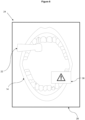
- FIG. 6 illustrates how the system 10 can track and display information that would otherwise be inaccessible to the dentist to facilitate the planning of a dental procedure.
- the processor 20 can track the position of scan flags and the distances between scan flags, which can be displayed to the dentist to aid in dental procedure planning. This could include information such as the distance between a dental tool vital structures such as nerves or sinuses.
- One useful possibility of the system 10 is to display a warning 36 if the position of a dental tool is close to a vital structure. Such a warning 36 could prevent accidental damage to a vital structure by the dentist.
- the present system allows for implementation of a method for planning a dental procedure using augmented or virtual reality, the method comprising: a] scanning a digital representation of a head or face of a patient, the digital representation comprising at least one scan flag associated therewith; b] receiving a video input of a dental surgical site in real time; c] determining, using a processor, an augmented reality or virtual reality overlay based on the digital representation; and d] displaying the augmented reality or virtual reality overlay on an augmented reality or virtual reality display device in real-time by matching the at least one scan flag to a corresponding feature of the video input; wherein the augmented reality or virtual reality overlay comprises a dental-procedure-planning overlay component indicative of a dental procedure to be performed.
Landscapes
- Health & Medical Sciences (AREA)
- Engineering & Computer Science (AREA)
- Public Health (AREA)
- General Health & Medical Sciences (AREA)
- Medical Informatics (AREA)
- Life Sciences & Earth Sciences (AREA)
- Epidemiology (AREA)
- Surgery (AREA)
- Biomedical Technology (AREA)
- Primary Health Care (AREA)
- Animal Behavior & Ethology (AREA)
- Veterinary Medicine (AREA)
- Nuclear Medicine, Radiotherapy & Molecular Imaging (AREA)
- Theoretical Computer Science (AREA)
- Software Systems (AREA)
- Physics & Mathematics (AREA)
- Robotics (AREA)
- Dentistry (AREA)
- Oral & Maxillofacial Surgery (AREA)
- Heart & Thoracic Surgery (AREA)
- Molecular Biology (AREA)
- General Physics & Mathematics (AREA)
- Data Mining & Analysis (AREA)
- General Engineering & Computer Science (AREA)
- Artificial Intelligence (AREA)
- Computing Systems (AREA)
- Evolutionary Computation (AREA)
- Computer Vision & Pattern Recognition (AREA)
- Mathematical Physics (AREA)
- Human Computer Interaction (AREA)
- Databases & Information Systems (AREA)
- Pathology (AREA)
- Optics & Photonics (AREA)
- Computer Graphics (AREA)
- Computer Hardware Design (AREA)
- Radiology & Medical Imaging (AREA)
- Urology & Nephrology (AREA)
- Business, Economics & Management (AREA)
- General Business, Economics & Management (AREA)
- Dental Tools And Instruments Or Auxiliary Dental Instruments (AREA)
Priority Applications (2)
| Application Number | Priority Date | Filing Date | Title |
|---|---|---|---|
| EP23184789.8A EP4492394A1 (fr) | 2023-07-11 | 2023-07-11 | Système et procédé de planification d'une procédure dentaire à l'aide d'une réalité augmentée ou virtuelle |
| PCT/GB2024/050835 WO2025012591A1 (fr) | 2023-07-11 | 2024-03-27 | Système et procédé de planification d'une procédure dentaire à l'aide de la réalité augmentée ou virtuelle |
Applications Claiming Priority (1)
| Application Number | Priority Date | Filing Date | Title |
|---|---|---|---|
| EP23184789.8A EP4492394A1 (fr) | 2023-07-11 | 2023-07-11 | Système et procédé de planification d'une procédure dentaire à l'aide d'une réalité augmentée ou virtuelle |
Publications (1)
| Publication Number | Publication Date |
|---|---|
| EP4492394A1 true EP4492394A1 (fr) | 2025-01-15 |
Family
ID=87245358
Family Applications (1)
| Application Number | Title | Priority Date | Filing Date |
|---|---|---|---|
| EP23184789.8A Pending EP4492394A1 (fr) | 2023-07-11 | 2023-07-11 | Système et procédé de planification d'une procédure dentaire à l'aide d'une réalité augmentée ou virtuelle |
Country Status (2)
| Country | Link |
|---|---|
| EP (1) | EP4492394A1 (fr) |
| WO (1) | WO2025012591A1 (fr) |
Citations (7)
| Publication number | Priority date | Publication date | Assignee | Title |
|---|---|---|---|---|
| US20170065379A1 (en) * | 2014-02-21 | 2017-03-09 | Trispera Dental, Inc. | Augmented Reality Dental Design Method and System |
| US20200008877A1 (en) * | 2018-07-05 | 2020-01-09 | Dentsply Sirona Inc. | Method and system for augmented reality guided surgery |
| US20200357186A1 (en) * | 2016-12-16 | 2020-11-12 | Align Technology, Inc. | Kiosk for viewing of dental treatment outcomes |
| US20210177548A1 (en) * | 2017-12-29 | 2021-06-17 | Align Technology, Inc. | Augmented reality enhancements for dental practitioners |
| US20220233287A1 (en) * | 2016-06-20 | 2022-07-28 | Carestream Dental Llc | Dental restoration assessment using virtual model |
| US20220335630A1 (en) * | 2018-01-29 | 2022-10-20 | Philipp K. Lang | Augmented reality guidance for dental procedures |
| US20230141733A1 (en) * | 2016-12-16 | 2023-05-11 | Align Technology, Inc. | Area of interest overlay on dental site using augmented reality |
-
2023
- 2023-07-11 EP EP23184789.8A patent/EP4492394A1/fr active Pending
-
2024
- 2024-03-27 WO PCT/GB2024/050835 patent/WO2025012591A1/fr not_active Ceased
Patent Citations (7)
| Publication number | Priority date | Publication date | Assignee | Title |
|---|---|---|---|---|
| US20170065379A1 (en) * | 2014-02-21 | 2017-03-09 | Trispera Dental, Inc. | Augmented Reality Dental Design Method and System |
| US20220233287A1 (en) * | 2016-06-20 | 2022-07-28 | Carestream Dental Llc | Dental restoration assessment using virtual model |
| US20200357186A1 (en) * | 2016-12-16 | 2020-11-12 | Align Technology, Inc. | Kiosk for viewing of dental treatment outcomes |
| US20230141733A1 (en) * | 2016-12-16 | 2023-05-11 | Align Technology, Inc. | Area of interest overlay on dental site using augmented reality |
| US20210177548A1 (en) * | 2017-12-29 | 2021-06-17 | Align Technology, Inc. | Augmented reality enhancements for dental practitioners |
| US20220335630A1 (en) * | 2018-01-29 | 2022-10-20 | Philipp K. Lang | Augmented reality guidance for dental procedures |
| US20200008877A1 (en) * | 2018-07-05 | 2020-01-09 | Dentsply Sirona Inc. | Method and system for augmented reality guided surgery |
Also Published As
| Publication number | Publication date |
|---|---|
| WO2025012591A1 (fr) | 2025-01-16 |
Similar Documents
| Publication | Publication Date | Title |
|---|---|---|
| US12070375B2 (en) | Area of interest overlay on dental site using augmented reality | |
| JP5154955B2 (ja) | 口腔スキャニング用システムおよび方法 | |
| US11636943B2 (en) | Method for manipulating a dental virtual model, method for creating physical entities based on a dental virtual model thus manipulated, and dental models thus created | |
| Mangano et al. | Artificial intelligence and augmented reality for guided implant surgery planning: a proof of concept | |
| US20220330830A1 (en) | Systems for creating and interacting with three dimensional virtual models | |
| KR102057207B1 (ko) | 3차원 구강 모델 분석방법 및 이를 포함하는 보철물 디자인 방법 | |
| US11419701B2 (en) | Augmented reality enhancements for dental practitioners | |
| KR102233745B1 (ko) | 치과 진료 실습 장치 및 치과 진료 실습 시스템 | |
| US7156655B2 (en) | Method and system for comprehensive evaluation of orthodontic treatment using unified workstation | |
| US9936166B2 (en) | Method for planning a dental treatment | |
| CN112469358B (zh) | 用于分析牙齿状况的方法 | |
| CN112469359B (zh) | 用于分析牙齿状况的方法 | |
| US20040029068A1 (en) | Method and system for integrated orthodontic treatment planning using unified workstation | |
| JP2022545767A (ja) | 複合現実を利用して歯科治療をガイドするためのシステム及び方法 | |
| CN104603859B (zh) | 牙科补缀及赝复体数字建档与制作的方法 | |
| KR20210094732A (ko) | 두 개의 3차원 상사 영상을 디스플레이 화면상에서 정합하는 방법 | |
| Nayyar et al. | Augmenting Dental Care: A Current Perspective | |
| WO2025012591A1 (fr) | Système et procédé de planification d'une procédure dentaire à l'aide de la réalité augmentée ou virtuelle | |
| JP2024054010A (ja) | 施術支援装置、施術支援方法及びプログラム |
Legal Events
| Date | Code | Title | Description |
|---|---|---|---|
| PUAI | Public reference made under article 153(3) epc to a published international application that has entered the european phase |
Free format text: ORIGINAL CODE: 0009012 |
|
| STAA | Information on the status of an ep patent application or granted ep patent |
Free format text: STATUS: THE APPLICATION HAS BEEN PUBLISHED |
|
| AK | Designated contracting states |
Kind code of ref document: A1 Designated state(s): AL AT BE BG CH CY CZ DE DK EE ES FI FR GB GR HR HU IE IS IT LI LT LU LV MC ME MK MT NL NO PL PT RO RS SE SI SK SM TR |
|
| STAA | Information on the status of an ep patent application or granted ep patent |
Free format text: STATUS: REQUEST FOR EXAMINATION WAS MADE |
|
| 17P | Request for examination filed |
Effective date: 20250710 |
|
| RAP3 | Party data changed (applicant data changed or rights of an application transferred) |
Owner name: NULTY, ADAM BRIAN Owner name: ZACHRISSON, PATRIK MAGNUS FREDRIK |
|
| RIN1 | Information on inventor provided before grant (corrected) |
Inventor name: NULTY, ADAM BRIAN Inventor name: ZACHRISSON, PATRIK MAGNUS FREDRIK |