EP4492631A2 - Procédé d'évaluation décentralisée de la sécurité d'alimentation, système et produit de programme informatique - Google Patents
Procédé d'évaluation décentralisée de la sécurité d'alimentation, système et produit de programme informatique Download PDFInfo
- Publication number
- EP4492631A2 EP4492631A2 EP24186700.1A EP24186700A EP4492631A2 EP 4492631 A2 EP4492631 A2 EP 4492631A2 EP 24186700 A EP24186700 A EP 24186700A EP 4492631 A2 EP4492631 A2 EP 4492631A2
- Authority
- EP
- European Patent Office
- Prior art keywords
- network area
- measured value
- area
- time window
- network
- Prior art date
- Legal status (The legal status is an assumption and is not a legal conclusion. Google has not performed a legal analysis and makes no representation as to the accuracy of the status listed.)
- Pending
Links
Images

Classifications
-
- H—ELECTRICITY
- H02—GENERATION; CONVERSION OR DISTRIBUTION OF ELECTRIC POWER
- H02J—ELECTRIC POWER NETWORKS; CIRCUIT ARRANGEMENTS OR SYSTEMS FOR SUPPLYING OR DISTRIBUTING ELECTRIC POWER; SYSTEMS FOR STORING ELECTRIC ENERGY
- H02J13/00—Circuit arrangements for providing remote monitoring or remote control of equipment in a power distribution network
- H02J13/12—Monitoring network conditions, e.g. electrical magnitudes or operational status
-
- G—PHYSICS
- G01—MEASURING; TESTING
- G01R—MEASURING ELECTRIC VARIABLES; MEASURING MAGNETIC VARIABLES
- G01R19/00—Arrangements for measuring currents or voltages or for indicating presence or sign thereof
- G01R19/25—Arrangements for measuring currents or voltages or for indicating presence or sign thereof using digital measurement techniques
- G01R19/2513—Arrangements for monitoring electric power systems, e.g. power lines or loads; Logging
-
- H—ELECTRICITY
- H02—GENERATION; CONVERSION OR DISTRIBUTION OF ELECTRIC POWER
- H02J—ELECTRIC POWER NETWORKS; CIRCUIT ARRANGEMENTS OR SYSTEMS FOR SUPPLYING OR DISTRIBUTING ELECTRIC POWER; SYSTEMS FOR STORING ELECTRIC ENERGY
- H02J13/00—Circuit arrangements for providing remote monitoring or remote control of equipment in a power distribution network
- H02J13/18—Circuit arrangements for providing remote monitoring or remote control of equipment in a power distribution network characterised by the remotely-controlled equipment, e.g. converters or transformers
- H02J13/333—Circuit arrangements for providing remote monitoring or remote control of equipment in a power distribution network characterised by the remotely-controlled equipment, e.g. converters or transformers the equipment forming part of substations
Definitions
- the object of the invention is to provide a method for the decentralized assessment of the security of supply of a power grid, a system and a computer program product which allows a cost-effective and quickly realizable possibility of ensuring the security of supply in the power grid.
- a method for assessing the condition of a part of a power grid, in which at least one initial value is measured that lies within a predetermined period of time.
- This initial value determines limit values for a normal state in which the power grid functions normally, and a threat state in which there is a risk that the power grid will not function normally if it deteriorates further.
- By recording at least one current measured value it can be determined, based on the limit values, whether the power grid is currently operating in a normal or threatened state.
- the steps mentioned are carried out decentrally directly on the part of the power grid where the initial value is also measured.
- the method can be carried out as a computer-implemented method.
- the method steps can be carried out at least partially simultaneously and/or sequentially, whereby the sequence of the method steps is not limited by the specified sequence, so that individual steps can be carried out in different orders. Furthermore, individual or all steps can be carried out repeatedly.
- a decentralized assessment can be understood as an assessment that takes place at one location and/or relates to a part of the power grid that is accessible to an end consumer.
- a decentralized assessment can be understood as the assessment of a local area of the grid being carried out on site, in particular not in a power plant and/or in a central data center.
- a decentralized assessment can be carried out at least without taking into account data from other measuring points, knowledge of the grid structure of the power grid or connected consumers and feed-in systems.
- the security of supply can at least refer to the reliability, stability and quality of the electricity offered. It can be stipulated that the security of supply essentially depends on compliance with the requirements of DIN EN 50160 ("Characteristics of the voltage in public electricity supply grids", in particular the version from November 2020 or later).
- a network area of a power grid can be understood as a part of the power grid that is substantially smaller than the entire power grid. Specific embodiments of the network area are described in connection with the subclaims.
- the recording can correspond to a measurement and/or a query of one of the reference measured values.
- the reference measured value is recorded in the network area to be evaluated.
- the reference measured value can be specific to the network area. In other words, the reference measured value is determined by the physical condition of the network area. If the network area is, for example, a home network of an end consumer, the reference measured value is measured directly in the end consumer's property.
- the at least one reference measurement value can be understood as a basis for determining a normal range or a risk range.
- the reference measurement value serves to define limits for normal operation. It can be provided that more than one reference measurement value is recorded. In particular, it can be provided that a large number of reference measurement values are recorded within the time window. It is also conceivable that the large number of reference measurement values occur as a function of time within the time window, so that a reference measurement value is recorded as a function of time.
- reference environmental measured values are recorded, in particular solar radiation, wind strength or outside temperature.
- a time window can be understood as a period of time. At least one reference measurement value must be measured within the time window.
- the method can provide for the setting of a time window.
- the time window can end before or immediately with the measurement of the current measurement value.
- the determination of at least one normal range and one risk range can be understood as a calculation in which limit values are determined on the basis of the reference measured value for the start and end of the normal and risk areas.
- the calculation can be based on a machine learning algorithm.
- the machine learning algorithm can be trained using historical measurement data.
- the algorithm can be specified, particularly in adaptation to the network area to be evaluated. This can be done by the network operator.
- the normal range and the danger range can be determined either completely or at least partially by the reference measurement value. If the ranges are completely determined by the reference measurement value, no further input variables are necessary for the algorithm that determines the ranges. Alternatively, it can also be provided that the algorithm includes further input variables, in particular reference environmental measurements, in the determination of the normal range and the danger range.
- Measuring a current measured value at the network area can correspond to a measurement and/or a query of a measured value, in particular by a measuring unit.
- the measured value can be specific to the network area. In other words, the measured value is determined by the physical state of the network area.
- Evaluating the security of supply can be understood as dividing the supply into one of at least two states. Either the current measured value falls into a range associated with the "normal" state, or the measured value falls into a range associated with the "endangered” state.
- the evaluation can be a simple comparison of values, for example whether a voltage is above or below a limit value. In other words, the evaluation can be determined entirely or at least partially by the measured value and the ranges. It can also be provided that other input values, in particular current ambient measured values, are included in the evaluation. For this purpose, it can be provided that, in addition to the current measured value, current ambient measured values are recorded, in particular solar radiation, wind strength or outside temperature.
- the steps of the method in particular all steps of the method, can be carried out at the location that corresponds to the network area to be evaluated. "At this location” can be understood in particular as being different from “centrally”.
- the method according to the invention has the advantage that it allows a cost-effective and quick way of maintaining the security of supply in the power grid.
- the recording of at least one reference measurement value in a time window in the grid area offers the advantage that a specific output variable can be measured locally in the grid area, which enables an assessment of the future state of the grid area.
- the determination of at least one normal range and one risk area, whereby the normal range and the risk area are at least partially determined by the at least one reference measurement value in the time window enables a simple classification of the state of the grid area, on the basis of which a quick and efficient assessment can be carried out. By measuring a current measurement value in the grid area, a variable that is decisive for the current state of the grid area is determined.
- Assessing the security of supply in the network area on the basis of the current measured value according to the determined normal range and the danger area as normal or at risk offers the advantage that a distinction can be made quickly between a normal state in which normal operation can be continued and a danger state in which the security of supply is at risk. The result of this assessment is clear, so that the security of supply can be guaranteed particularly reliably.
- the fact that the recording, determination, measurement and assessment are carried out in the network area offers the advantage that the entire process is decentralized and can be carried out without taking into account data from other measuring points, knowledge of the network structure or connected consumers and feed-in systems.
- a centralized assessment would increase the implementation effort.
- the security of the power grid can be increased through the decentralized approach, since the Network areas on their own can at least partially guarantee security of supply.
- the network area can be designed at least as an end-user access point, an end-user network or an island network.
- the network areas mentioned offer the advantage that they can be designed to be relatively small compared to a power grid and/or autonomous from it.
- An end user in the context of the invention can be understood as a person, a household, a company or an organization that draws electrical energy from the power grid and uses it for final consumption.
- End users can be the last links in the power supply chain and can be directly connected to the power grid.
- An end user access point is accordingly understood to be the final user's point of consumption and the facilities that are designed to produce and consume electricity for the end user and to provide the connections and controls necessary for both processes.
- the end user access point can be designed as a charging station for electric vehicles or as a household connection.
- an end-user network can be understood as a combination of at least two end-user access points.
- this can be a house connection for at least two households.
- An island grid can be considered as a grid that operates at least partially autonomously. Unlike an interconnected grid, which consists of a complex network of power plants, transmission and distribution lines, an island grid can usually be smaller and serves a limited geographical region. For example, it can be used on remote islands, in rural areas or in industrial plants that are not connected to a larger power grid.
- the current measured value serves as a further reference measured value, which at least partially determines the normal range and the danger range in a future determination.
- the current measured value can immediately serve as a reference measured value for the future determination of the ranges. This has the advantage that fewer measurements are required overall than if the current measured value is discarded for the measurement of the reference measured value.
- a later time window is specified, whereby the later time window is at least after the time window or the time of the measurement, whereby in particular the later time window is designed as a time window when the method steps are repeated.
- the method can provide as a further step that a new time window is planned for a repetition of the process.
- At least the reference measurement value or the current measurement value is taken from one phase or from two phases or from three phases of the network area. By measuring two or more phases, a particularly high level of accuracy can be achieved.
- a comparison of the measurement on at least two phases is included in the determination of the areas and/or in the evaluation of the network area. This offers the advantage that the state of the network area can be determined more precisely and reliably.
- At least the reference measurement value or the current measurement value is at least a voltage, a current, a power or a frequency.
- the quantities mentioned can be measured particularly easily and inexpensively, so that the process can be carried out inexpensively and efficiently overall.
- Frequency measurement offers a particular advantage when the network area is designed as an island network. In island networks, the frequency is often a better indicator of the quality of the network than, for example, the absolute voltage value, since this cannot be balanced out as well by the relatively small network and is more susceptible to interference.
- the danger zone comprises a lower danger zone, which is below the normal range, and an upper danger zone, which is above the normal range.
- the normal range can have an upper and lower limit, with the danger zone lying outside the two limits.
- the determination includes a critical area that is at least partially determined by the at least one reference measurement value in the time window, wherein the critical area has a greater risk potential than the risk area.
- the critical area has a greater risk potential than the risk area.
- at least one further area is provided that corresponds to a greater urgency.
- further areas with a finer gradation are provided.
- the additional information can, for example, be information about a structure of the network area (e.g. how many consumers and producers are present in the network area and how they are connected to one another or how, for example, measured values are formed at an associated transformer output).
- the additional information can also be implemented as environmental information, which can in particular include measured values for the current solar radiation, wind strength or outside temperature. This has the advantage that the evaluation can be tailored more precisely to the current situation. For example, if particularly critical consumers (such as medical devices) are connected to the network area, the security of supply may have to be assessed more critically than if only household appliances are connected to the network area.
- the time window has a predetermined size, with the predetermined size being at least one minute, one hour or one day.
- the time window is advantageously of a size in which more than one measured value can be recorded and which depicts a specific situation in the network area (for example, a typical Monday morning). This has the advantage that the evaluation of the network area is particularly robust against short-term disruptions and deviations.
- a processing of the at least one reference measurement value and/or a measurement value is provided, wherein the processing in particular comprises at least averaging, smoothing, filtering or a fast Fourier transformation.
- the processing can prevent outliers from negatively influencing the determination of the areas or the evaluation and reducing the accuracy.
- additional information can be determined through the processing, for example through the fast Fourier transformation (FFT), which can increase the significance of the areas.
- FFT fast Fourier transformation
- the time window has a fixed time interval, which in particular is at least greater than or equal to one minute, one hour, one week or one year.
- the time intervals can be used to depict certain situations in the network area. Intervals where a regular similarity in the state of the network area is expected are particularly interesting. For example, on the same day in the previous year, a similar level of sunlight or wind strength can be expected, so that the production of renewable energies should be similar. Regularities can also arise on a daily basis, for example, consumers may be switched on earlier during the week than at the weekend if people who access the network area work on those days.
- a method for the decentralized operation of a network area of a power grid comprising a method according to one of the preceding claims, wherein at least if the security of supply of the network area is assessed as being at risk, in response to the assessment, the implementation at least one measure is provided which is designed to improve the security of supply in the network area.
- the step of implementing at least one measure designed to improve the security of supply of the network area as a reaction to the assessment, at least if the security of supply of the network area is assessed as being at risk, can also be part of the method according to one of claims 1 to 12.
- Measures to improve security of supply may include, in particular, preparation for a shutdown and/or shutdown of consumers and/or power generators. Furthermore, provision may be made for a message to be issued, in particular to the grid operator, so that measures can be taken in the rest of the electricity grid to ensure security of supply.
- a method according to the invention for the decentralized operation of a network area of a power grid brings with it the same advantages as have been described in detail with reference to the method according to the invention for the decentralized assessment of the security of supply of a network area of a power grid.
- a system according to the invention brings with it the same advantages as have been described in detail with reference to the method according to the invention for the decentralized assessment of the security of supply of a network area of a power grid and/or the method according to the invention for the decentralized operation of a network area.
- a computer program product comprising instructions which, when the program is executed by a computer, in particular by a control unit of a system according to claim 14, cause the computer to carry out a method according to one of claims 1 to 12 and/or a method according to claim 12.
- a computer program product according to the invention brings with it the same advantages as have been described in detail with reference to the method according to the invention for the decentralized assessment of the security of supply of a network area of a power grid and/or the method according to the invention for the decentralized operation of a network area and/or the system according to the invention.
- the method 100 achieves the advantage that a cost-effective and quickly realizable possibility of ensuring the security of supply in the power grid 200 is permitted.
- the recording 110 of at least one reference measured value 11 in a time window 10 at the grid area 210 offers the advantage that an output variable specific to this can be measured locally at the grid area 210, which enables an assessment of a future state of the grid area 210.
- the determination 120 of at least one normal range 12 and one danger area 13, wherein the normal range 12 and the danger area 13 are defined by the at least one Reference measured value 11 in the time window 10 is at least partially determined, enables a simple classification of the state of the network area 210, on the basis of which a quick and efficient assessment can be made.
- a quantity relevant to the current state of the network area 210 is determined.
- the assessment 140 of the security of supply of the network area 210 on the basis of the current measured value 15 according to the determined normal range 12 and the danger area 13 as normal or at risk offers the advantage that a quick distinction can be made between a normal state in which normal operation can be continued and a danger state in which the security of supply is at risk. The result of this assessment is clear, so that the security of supply can be guaranteed with particular reliability.
- the fact that the recording, determination 120, measurement 130 and evaluation are carried out in the network area 210 offers the advantage that the entire process 100 is decentralized and can be carried out without taking into account data from other measuring points, knowledge of the network structure or connected consumers and feed-in systems.
- a centralized evaluation would increase the implementation effort.
- the decentralized approach can increase the security of the power grid 200, since the network areas 210 can already guarantee at least partial security of supply on their own.
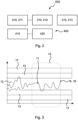
- a setting 150 of a later time window can be provided, whereby the later time window is at least after the time window 10 or the time of measurement 130, whereby in particular the later time window is designed as time window 10 when repeating the method steps.
- the later time window would therefore be in the Figure 3 to the right of the time window 10.
- the method 100 can provide as a further step that a new time window is planned for a repetition of the process. This has the advantage that the method 100 can be executed in a type of loop, so that an evaluation of the state of the network area 210 can be carried out permanently using current reference values.
- a step 111 is shown.
- the processing 111 comprises at least averaging, smoothing, filtering or a fast Fourier transformation.
- FFT Fast Fourier Transformation
- Figure 1 also a method 300 for the decentralized operation of a network area 210 of a power network 200, comprising a method 100 according to one of claims 1 to 12, wherein at least if the security of supply of the network area 210 is assessed 140 as being at risk, in response to the assessment 140 the implementation 310 of at least one measure is provided which is designed to improve the security of supply of the network area 210.
- the step of, at least if the security of supply of the network area 210 is assessed as being at risk, providing for the implementation 310 of at least one measure designed to improve the security of supply of the network area 210 as a reaction to the assessment can also be part of the method 100 according to one of claims 1 to 12.
- Measures to improve security of supply may include, in particular, preparation for a shutdown and/or shutdown of consumers and/or power generators. Furthermore, provision may be made for a message to be issued, in particular to the grid operator, so that measures can be taken in the rest of the electricity grid 200 to ensure security of supply.
- a method 100 according to the invention for the decentralized operation of a network area 210 of a power grid 200 brings with it the same advantages as have been described in detail with reference to the method 100 according to the invention for the decentralized assessment of the security of supply of a network area 210 of a power grid 200.
- a system 400 according to the invention brings with it the same advantages as have been described in detail with reference to the method 100 according to the invention for the decentralized assessment of the security of supply of a network area of a power grid and/or the method 300 according to the invention for the decentralized operation of a network area.
- the network area 210 can be designed at least as an end-user access point 211, an end-user network 212 or an island network 213.
- the network areas 210 mentioned offer the advantage that they can be designed to be relatively small compared to a power grid 200 and/or autonomous from it.
- the danger area 13 comprises a lower danger area, which is below the normal range 12, and an upper danger area, which is above the normal range 12.
- the normal range 12 can have an upper and lower limit, with the danger area 13 lying outside the two limits. This offers the advantage that with simple comparisons, e.g. when a voltage deviates from an upper and/or lower limit value, it is particularly easy to determine whether the danger area 13 has been reached.
- the determination 120 can include a critical area 17 that is at least partially determined by the at least one reference measurement value 11 in the time window 10, wherein the critical area 17 has a greater risk potential than the risk area 13.
- the critical area 17 has a greater risk potential than the risk area 13.
- at least one other area 17 is provided that corresponds to a greater urgency.
- further areas with a finer gradation are provided.
Landscapes
- Engineering & Computer Science (AREA)
- Power Engineering (AREA)
- Physics & Mathematics (AREA)
- General Physics & Mathematics (AREA)
- Supply And Distribution Of Alternating Current (AREA)
- Remote Monitoring And Control Of Power-Distribution Networks (AREA)
Applications Claiming Priority (1)
| Application Number | Priority Date | Filing Date | Title |
|---|---|---|---|
| DE102023118775.9A DE102023118775A1 (de) | 2023-07-14 | 2023-07-14 | Verfahren zur dezentralen Bewertung der Versorgungssicherheit, System und Computerprogrammprodukt |
Publications (2)
| Publication Number | Publication Date |
|---|---|
| EP4492631A2 true EP4492631A2 (fr) | 2025-01-15 |
| EP4492631A3 EP4492631A3 (fr) | 2025-01-22 |
Family
ID=91853241
Family Applications (1)
| Application Number | Title | Priority Date | Filing Date |
|---|---|---|---|
| EP24186700.1A Pending EP4492631A3 (fr) | 2023-07-14 | 2024-07-05 | Procédé d'évaluation décentralisée de la sécurité d'alimentation, système et produit de programme informatique |
Country Status (2)
| Country | Link |
|---|---|
| EP (1) | EP4492631A3 (fr) |
| DE (1) | DE102023118775A1 (fr) |
Family Cites Families (1)
| Publication number | Priority date | Publication date | Assignee | Title |
|---|---|---|---|---|
| DE102011051199A1 (de) * | 2011-06-20 | 2012-12-20 | Changetec Gmbh | Verfahren und Vorrichtung zur Inselnetzerkennung |
-
2023
- 2023-07-14 DE DE102023118775.9A patent/DE102023118775A1/de active Pending
-
2024
- 2024-07-05 EP EP24186700.1A patent/EP4492631A3/fr active Pending
Also Published As
| Publication number | Publication date |
|---|---|
| EP4492631A3 (fr) | 2025-01-22 |
| DE102023118775A1 (de) | 2025-01-16 |
Similar Documents
| Publication | Publication Date | Title |
|---|---|---|
| EP3751699B1 (fr) | Procédé et dispositif d'estimation d'un état d'un réseau de distribution d'énergie | |
| EP3107174B1 (fr) | Procédé, dispositif de commande et système de fonctionnement d'un sous-réseau d'un réseau de distribution d'énergie | |
| EP3336995B1 (fr) | Procédé, dispositif de commande et système de détermination de valeurs d'état pour décrire des états de fonctionnement dans un sous-réseau d'un réseau de distribution d'énergie | |
| EP3540911A1 (fr) | Procédé de fonctionnement d'un réseau d'alimentation en énergie électrique et dispositif de commande destiné à commander des dispositifs d'un réseau de distribution électrique | |
| EP3639339B1 (fr) | Procédé d'injection de la puissance électrique dans un réseau d'alimentation électrique au moyen d'un dispositif d'injection commandé par un convertisseur | |
| EP3048687A1 (fr) | Procede de commande d'un reseau de distribution d'energie electrique | |
| DE112017004673T5 (de) | Energie-Umwandlungsvorrichtung | |
| DE102018116446A1 (de) | Windenergiesystem und Verfahren zum Erkennen niederfrequenter Schwingungen in einem elektrischen Versorgungsnetz | |
| EP3239908A1 (fr) | Dispositif pour prévisions probabilistes, réseau de distribution d'énergie et/ou de transport d'énergie équipé d'un tel dispositif et son procédé de fonctionnement | |
| DE102014115119A1 (de) | Verfahren und System zum Überwachen einer Netzspannung in einem Niederspannungsnetz | |
| DE102023203031B3 (de) | Netzzustandsschätzung sowie Steuerung eines Stromnetzes | |
| EP2899828B1 (fr) | Système de commande pour une installation électrique destinée au redémarrage de l'installation électrique après une panne de courant | |
| EP4690086A1 (fr) | Procédé de génération de données d'entrée pour une estimation d'état d'un réseau électrique, estimation d'état et commande d'un réseau électrique | |
| DE102014222687A1 (de) | Steuerung eines Energienetzes | |
| EP2834898B1 (fr) | Procédé de détermination de points de mesure dans des réseaux à basse tension et sous-système de gestion de réseau servant à mettre en oeuvre ce procédé | |
| EP3340413A1 (fr) | Procédé, dispositif de commande et système de détermination de données d'état d'un réseau d'alimentation électrique | |
| DE102023118775A1 (de) | Verfahren zur dezentralen Bewertung der Versorgungssicherheit, System und Computerprogrammprodukt | |
| DE102022104015B4 (de) | Inselnetzerkennung spannungseinprägender Wechselrichter und Wechselrichter | |
| EP3101749B1 (fr) | Procédé de commande d'un consommateur de courant local | |
| DE102018113689A1 (de) | Load-Manager für dezentrale Ladepunkte | |
| DE102018124612A1 (de) | Steuerung eines lokalen Netzbereichs zur Realisierung einer Local Energy Community mit Fahrplan | |
| EP2664939A1 (fr) | Procédé de validation de valeurs de mesure en fonction de la position du soleil sur plusieurs canaux de mesure | |
| EP3993207A1 (fr) | Évaluation de l'état d'un réseau électrique | |
| EP4645628A1 (fr) | Procédé mis en uvre par ordinateur pour régler un réseau d'alimentation en énergie électrique, dispositif de régulation pour réguler le réseau d'alimentation en énergie électrique et réseau d'alimentation en énergie électrique comprenant le dispositif de régulation | |
| EP3510683B1 (fr) | Procédé et système de régulation décentralisée longue portée |
Legal Events
| Date | Code | Title | Description |
|---|---|---|---|
| PUAI | Public reference made under article 153(3) epc to a published international application that has entered the european phase |
Free format text: ORIGINAL CODE: 0009012 |
|
| STAA | Information on the status of an ep patent application or granted ep patent |
Free format text: STATUS: THE APPLICATION HAS BEEN PUBLISHED |
|
| PUAL | Search report despatched |
Free format text: ORIGINAL CODE: 0009013 |
|
| AK | Designated contracting states |
Kind code of ref document: A2 Designated state(s): AL AT BE BG CH CY CZ DE DK EE ES FI FR GB GR HR HU IE IS IT LI LT LU LV MC ME MK MT NL NO PL PT RO RS SE SI SK SM TR |
|
| AK | Designated contracting states |
Kind code of ref document: A3 Designated state(s): AL AT BE BG CH CY CZ DE DK EE ES FI FR GB GR HR HU IE IS IT LI LT LU LV MC ME MK MT NL NO PL PT RO RS SE SI SK SM TR |
|
| RIC1 | Information provided on ipc code assigned before grant |
Ipc: G01R 19/25 20060101ALI20241217BHEP Ipc: H02J 13/00 20060101AFI20241217BHEP |
|
| STAA | Information on the status of an ep patent application or granted ep patent |
Free format text: STATUS: REQUEST FOR EXAMINATION WAS MADE |
|
| 17P | Request for examination filed |
Effective date: 20250722 |