EP4492733A2 - Procédé et dispositif de transmission de données par trajets multiples - Google Patents
Procédé et dispositif de transmission de données par trajets multiples Download PDFInfo
- Publication number
- EP4492733A2 EP4492733A2 EP24198140.6A EP24198140A EP4492733A2 EP 4492733 A2 EP4492733 A2 EP 4492733A2 EP 24198140 A EP24198140 A EP 24198140A EP 4492733 A2 EP4492733 A2 EP 4492733A2
- Authority
- EP
- European Patent Office
- Prior art keywords
- multipath
- mptcp
- client
- address
- multipath proxy
- Prior art date
- Legal status (The legal status is an assumption and is not a legal conclusion. Google has not performed a legal analysis and makes no representation as to the accuracy of the status listed.)
- Pending
Links
Images





Classifications
-
- H—ELECTRICITY
- H04—ELECTRIC COMMUNICATION TECHNIQUE
- H04L—TRANSMISSION OF DIGITAL INFORMATION, e.g. TELEGRAPHIC COMMUNICATION
- H04L47/00—Traffic control in data switching networks
- H04L47/10—Flow control; Congestion control
-
- H—ELECTRICITY
- H04—ELECTRIC COMMUNICATION TECHNIQUE
- H04L—TRANSMISSION OF DIGITAL INFORMATION, e.g. TELEGRAPHIC COMMUNICATION
- H04L67/00—Network arrangements or protocols for supporting network services or applications
- H04L67/14—Session management
- H04L67/141—Setup of application sessions
-
- H—ELECTRICITY
- H04—ELECTRIC COMMUNICATION TECHNIQUE
- H04L—TRANSMISSION OF DIGITAL INFORMATION, e.g. TELEGRAPHIC COMMUNICATION
- H04L45/00—Routing or path finding of packets in data switching networks
- H04L45/24—Multipath
-
- H—ELECTRICITY
- H04—ELECTRIC COMMUNICATION TECHNIQUE
- H04L—TRANSMISSION OF DIGITAL INFORMATION, e.g. TELEGRAPHIC COMMUNICATION
- H04L12/00—Data switching networks
- H04L12/02—Details
- H04L12/14—Charging, metering or billing arrangements specially adapted for data communications, e.g. authentication, authorisation and accounting [AAA] framework
-
- H—ELECTRICITY
- H04—ELECTRIC COMMUNICATION TECHNIQUE
- H04L—TRANSMISSION OF DIGITAL INFORMATION, e.g. TELEGRAPHIC COMMUNICATION
- H04L12/00—Data switching networks
- H04L12/66—Arrangements for connecting between networks having differing types of switching systems, e.g. gateways
-
- H—ELECTRICITY
- H04—ELECTRIC COMMUNICATION TECHNIQUE
- H04L—TRANSMISSION OF DIGITAL INFORMATION, e.g. TELEGRAPHIC COMMUNICATION
- H04L61/00—Network arrangements, protocols or services for addressing or naming
-
- H—ELECTRICITY
- H04—ELECTRIC COMMUNICATION TECHNIQUE
- H04L—TRANSMISSION OF DIGITAL INFORMATION, e.g. TELEGRAPHIC COMMUNICATION
- H04L61/00—Network arrangements, protocols or services for addressing or naming
- H04L61/50—Address allocation
- H04L61/5007—Internet protocol [IP] addresses
-
- H—ELECTRICITY
- H04—ELECTRIC COMMUNICATION TECHNIQUE
- H04L—TRANSMISSION OF DIGITAL INFORMATION, e.g. TELEGRAPHIC COMMUNICATION
- H04L67/00—Network arrangements or protocols for supporting network services or applications
- H04L67/50—Network services
- H04L67/56—Provisioning of proxy services
-
- H—ELECTRICITY
- H04—ELECTRIC COMMUNICATION TECHNIQUE
- H04L—TRANSMISSION OF DIGITAL INFORMATION, e.g. TELEGRAPHIC COMMUNICATION
- H04L67/00—Network arrangements or protocols for supporting network services or applications
- H04L67/50—Network services
- H04L67/56—Provisioning of proxy services
- H04L67/562—Brokering proxy services
-
- H—ELECTRICITY
- H04—ELECTRIC COMMUNICATION TECHNIQUE
- H04L—TRANSMISSION OF DIGITAL INFORMATION, e.g. TELEGRAPHIC COMMUNICATION
- H04L69/00—Network arrangements, protocols or services independent of the application payload and not provided for in the other groups of this subclass
- H04L69/14—Multichannel or multilink protocols
-
- H—ELECTRICITY
- H04—ELECTRIC COMMUNICATION TECHNIQUE
- H04L—TRANSMISSION OF DIGITAL INFORMATION, e.g. TELEGRAPHIC COMMUNICATION
- H04L69/00—Network arrangements, protocols or services independent of the application payload and not provided for in the other groups of this subclass
- H04L69/16—Implementation or adaptation of Internet protocol [IP], of transmission control protocol [TCP] or of user datagram protocol [UDP]
-
- H—ELECTRICITY
- H04—ELECTRIC COMMUNICATION TECHNIQUE
- H04L—TRANSMISSION OF DIGITAL INFORMATION, e.g. TELEGRAPHIC COMMUNICATION
- H04L69/00—Network arrangements, protocols or services independent of the application payload and not provided for in the other groups of this subclass
- H04L69/30—Definitions, standards or architectural aspects of layered protocol stacks
- H04L69/32—Architecture of open systems interconnection [OSI] 7-layer type protocol stacks, e.g. the interfaces between the data link level and the physical level
- H04L69/322—Intralayer communication protocols among peer entities or protocol data unit [PDU] definitions
- H04L69/326—Intralayer communication protocols among peer entities or protocol data unit [PDU] definitions in the transport layer [OSI layer 4]
Definitions
- the present invention relates to the field of communications technologies, and in particular, to a multipath data transmission method and device.
- MPTCP multipath transmission control protocol
- a terminal mainly establishes an MPTCP link to a proxy server by using agent software such as socks5. Then the proxy server performs transmission control protocol (TCP)-based data transmission with a server that the terminal truly intends to access.
- TCP transmission control protocol
- the proxy server when performing TCP-based data transmission with the server, the proxy server establishes a TCP connection to the server by using an IP address of the proxy server instead of an internet protocol (IP) address of the terminal.
- IP internet protocol
- the proxy server uses its own IP address for data transmission, the IP address of the proxy server is visible to both a user side and a network side, and the proxy server is vulnerable to security attacks with a low level of security.
- the network side is unable to obtain the IP address of the terminal, and consequently is unable to implement traffic statistics and control for the terminal.
- Embodiments of the present invention provide a multipath transmission method and device, to implement an MPTCP-based multipath data transmission service based on an IP address of a terminal.
- a multipath data transmission method is provided.
- MPTCP-based multipath data transmission based on IP address information of a multipath proxy client is implemented through proxy of a multipath proxy client and a multipath proxy gateway.
- At least two multipath data subflows are established and data transmission through the multipath data subflows is performed between the multipath proxy client and the multipath proxy gateway.
- the multipath proxy gateway Based on the IP address information for establishing the at least two multipath data subflows between the multipath proxy client and the multipath proxy gateway, the multipath proxy gateway establishes a TCP connection to and performs TCP-based data transmission with an application server to be accessed by the multipath proxy client.
- the multipath proxy client may be an MPTCP application installed on a terminal, and the IP address information of the multipath proxy client may be construed as IP address information of the terminal. Therefore, an MPTCP-based multipath data transmission service based on an IP address of the terminal is implemented. In addition, TCP-based transmission between the multipath proxy gateway and the application server is implemented without using an IP address of the multipath proxy gateway, thereby improving security of the multipath proxy gateway.
- the application server can obtain the IP address of the multipath proxy client based on an MPTCP connection establishment request, which facilitates traffic statistics and control for the multipath proxy client.
- the multipath proxy gateway may establish, based on a first IP address, a TCP connection to and perform TCP-based data transmission with the application server to be accessed by the multipath proxy client, where the first IP address is an IP address for establishing at least two multipath data subflows between the multipath proxy client and the multipath proxy gateway.
- the multipath proxy gateway may allocate a second IP address to the multipath proxy client based on the first IP address, and establish, based on the second IP address, the TCP connection to the application server to be accessed by the multipath proxy client.
- the second IP address is in a mapping relationship with the first IP address, and is used to indicate that multipath data transmission is to be performed.
- the application server uses the second IP address as a destination address for sending data to the multipath proxy gateway.
- the multipath proxy gateway establishes multipath data subflows to and performs MPTCP-based data transmission with the multipath proxy client by using the first IP address.
- the multipath proxy client may determine, based on the mapping relationship, that the data with the destination address being the second IP address needs to be received. In this way, IP layer data can be directly routed from the application server to the multipath proxy gateway, and the multipath proxy client can perform fast addressing, thereby implementing fast MPTCP-based data transmission.
- the multipath proxy client sends an IP address of the application server to be accessed by the multipath proxy client to the multipath proxy gateway, and the multipath proxy gateway obtains the IP address of the application server to be accessed by the multipath proxy client, and establishes the TCP connection to and performs TCP-based data transmission with the application server based on the IP address of the application server and the IP address information for establishing the at least two multipath data subflows between the multipath proxy client and the multipath proxy gateway.
- the multipath proxy gateway may allocate, to the multipath proxy client based on the first IP address, a port dedicated to multipath data transmission, to accelerate MPTCP-based data transmission.
- the multipath proxy client determines the port dedicated to multipath data transmission, obtains the IP address of the multipath proxy gateway, establishes, by using the port and based on the first IP address and the IP address of the multipath proxy gateway, at least two multipath data subflows to the multipath proxy gateway, and performs data transmission through the multipath data subflows.
- the multipath proxy gateway and the multipath proxy client determine that no data is transmitted in any of the established at least two multipath data subflows within preset duration, or that the multipath proxy client is already offline in at least two networks in which the at least two multipath data subflows are established, the multipath proxy gateway releases the established at least two multipath data subflows and the TCP connection, and the multipath proxy client releases the established at least two multipath data subflows.
- the multipath proxy gateway may establish, based on the first IP address, the TCP connection to the application server to be accessed by the multipath proxy client.
- the multipath proxy client establishes at least two multipath data subflows to the multipath proxy gateway.
- a multipath management device for MPTCP user authentication (whether a multipath proxy client supports a multipath service) and multipath proxy gateway management and allocation may be deployed, to facilitate flexible deployment and management of a plurality of multipath proxy gateways.
- the multipath management device may determine a multipath proxy client performing an MPTCP service and the service by using a blacklist/whitelist, for example, by adding a multipath proxy client capable of performing an MPTCP service and the service to a whitelist.
- Using a mechanism such as a blacklist/whitelist policy by the multipath management device helps implement splitting control and differentiated charging for a terminal service.
- the multipath proxy client sends a multipath policy request to the multipath management device, where the multipath policy request includes identification information of the multipath proxy client.
- the multipath management device receives the multipath policy request sent by the multipath proxy client, determines, based on the identification information of the multipath proxy client, that the multipath proxy client supports a multipath service, and sends a multipath policy request response to the multipath proxy client.
- the multipath proxy client receives the multipath policy request response fed back by the multipath management device, and determines that the multipath service is supported.
- the multipath management device allocates a multipath proxy gateway to the multipath proxy client supporting the multipath service, and sends indication information used to indicate that the multipath proxy gateway is allocated to the multipath proxy client for multipath data transmission.
- the multipath proxy gateway determines, based on the indication information sent by the multipath management device to indicate that the multipath proxy gateway is allocated to the multipath proxy client for multipath data transmission, that the multipath proxy client supports the multipath service.
- the multipath proxy client can determine the IP address of the multipath proxy gateway by receiving the IP address of the multipath proxy gateway allocated by the multipath management device to the multipath proxy client based on the identification information of the multipath proxy client.
- the multipath management device may allocate the multipath proxy gateway to the multipath proxy client based on the identification information of the multipath proxy client in the following manner: determining, by the multipath management device based on the identification information of the multipath proxy client, access gateways accessed by the multipath proxy client in at least two different networks; and allocating, by the multipath management device based on a correspondence between an access gateway and a multipath proxy gateway or based on an IP address of a multipath proxy gateway sent by the access gateway, a multipath proxy gateway in each of the at least two different networks to the multipath proxy client.
- the multipath management device may interact with the multipath proxy gateway, to obtain information about a second IP address and a port that are allocated by the multipath proxy gateway to the multipath proxy client and that are dedicated to establishing a multipath data subflow, and send, to the multipath proxy client, the information about the second IP address and the port that are dedicated to establishing a multipath data subflow.
- the multipath management device determines that no data is transmitted in any of the established at least two multipath data subflows within preset duration, or that the multipath proxy client is already offline in at least two networks in which the at least two multipath data subflows are established, the multipath management device sends first indication information to the multipath proxy client and the multipath proxy gateway, where the first indication information is used to indicate that no data is transmitted in any of the established at least two multipath data subflows within the preset duration, or that the multipath proxy client is already offline in the at least two networks in which the at least two multipath data subflows are established. After receiving the first indication information, the multipath proxy gateway and the multipath proxy client release the at least two multipath data subflows and the TCP connection.
- a notification message that no data is transmitted in the multipath data subflows within the preset duration and that the multipath proxy client is already offline in the at least two networks may be pushed by a network element in a communications network to the multipath management device.
- the network element pushing the notification message is a network element capable of determining whether the multipath proxy client is offline, for example, a PGW or a PCRF in an LTE network.
- the PGW in the LTE network is preferred in the embodiments of the present invention.
- the multipath management device may further query a data transmission status of each of the at least two multipath data subflows and whether the multipath proxy client is offline. If the multipath management device finds that no data is transmitted in any of the at least two multipath data subflows within the preset duration, or that the multipath proxy client is already offline in the at least two networks, a corresponding link resource may be released.
- the multipath management device may query, according to a specified period, the data transmission status of each of the at least two multipath data subflows and whether the multipath proxy client is offline.
- the multipath management device may query, after receiving a notification message that no data is transmitted in a specified quantity of multipath data subflows in the at least two multipath data subflows or that the multipath proxy client is offline in a specified network, a data transmission status of a multipath data subflow not receiving the notification message or whether the multipath proxy client is offline in another unspecified network.
- a multipath proxy gateway has a function of implementing the multipath proxy gateway in the first aspect.
- the function may be implemented by hardware or may be implemented by hardware executing corresponding software.
- the hardware or software includes one or more modules corresponding to the foregoing function.
- the modules may be software and/or hardware.
- the multipath proxy gateway includes a transceiver unit and a processing unit. Functions of the transceiver unit and the processing unit may correspond to steps in the method. No more details are described herein.
- a multipath proxy client has a function of implementing the multipath proxy client in the first aspect.
- the function may be implemented by hardware or may be implemented by hardware executing corresponding software.
- the hardware or software includes one or more modules corresponding to the foregoing function.
- the modules may be software and/or hardware.
- the multipath proxy client includes an obtaining unit and a processing unit.
- the multipath proxy client further includes a sending unit.
- Functions of the obtaining unit, the processing unit, and the sending unit may correspond to steps in the method. No more details are described herein.
- a multipath management device has a function of implementing the multipath management device in the first aspect.
- the function may be implemented by hardware or may be implemented by hardware executing corresponding software.
- the hardware or software includes one or more modules corresponding to the foregoing function.
- the modules may be software and/or hardware.
- the multipath management device includes a communications unit and a processing unit.
- a multipath proxy gateway includes a processor, a memory, and a transceiver.
- the memory is configured to store an instruction
- the processor is configured to execute the instruction stored in the memory to control the transceiver to perform signal receiving and sending.
- the multipath proxy gateway is configured to implement any method of the multipath proxy gateway described in the first aspect.
- a multipath proxy client includes a processor, a memory, a receiver, and a transmitter.
- the memory is configured to store an instruction
- the processor is configured to execute the instruction stored in the memory to control the receiver and the transmitter to perform signal receiving and sending.
- the multipath proxy client is configured to implement any method of the multipath proxy client described in the first aspect.
- a multipath management device includes a processor, a memory, and a communications interface.
- the memory is configured to store an instruction
- the processor is configured to execute the instruction stored in the memory, and communicate with another network element device through the communications interface.
- the multipath management device is configured to implement any method of the multipath management device described in the first aspect.
- a computer storage medium configured to store some instructions. When these instructions are executed, any method of the multipath proxy gateway, the multipath proxy client, or the multipath management device may be implemented.
- a communications system including a multipath proxy gateway, a multipath proxy client, and a multipath management device.
- the multipath proxy gateway is the multipath proxy gateway in the second aspect or the fifth aspect
- the multipath proxy client is the multipath proxy client in the third aspect or the sixth aspect
- the multipath management device is the multipath management device in the fourth aspect or the seventh aspect.
- the multipath proxy client and the multipath proxy gateway provide a proxy service for TCP-based data transmission.
- TCP-based transmission between the multipath proxy gateway and the application server is implemented without using the IP address of the multipath proxy gateway, thereby improving security of the multipath proxy gateway.
- the application server can obtain the IP address of the multipath proxy client, which facilitates traffic statistics and control for the multipath proxy client.
- using the multipath policy mechanism such as a blacklist/whitelist by the multipath management device helps implement splitting control and differentiated charging for a service.
- a multipath data transmission method provided in the embodiments of the present invention may be applied to data transmission in a wireless communications system, where a data receive end and a data transmit end exchange data through a radio access network (Radio Access Network, RAN) and a core network.
- a TCP connection may be established between the data receive end and the data transmit end for data transmission over the TCP protocol.
- a terminal exchanges data with an application server.
- the terminal is connected to a RAN through an air interface, and is connected to the application server via a core network.
- a network between the terminal and the RAN may be referred to as a wireless network
- a network between the RAN and the application server may be referred to as a wired network.
- a TCP connection is established and data transmission is performed between the application server and the terminal.
- a terminal may access more than one communications network for communication.
- a terminal may access the Wi-Fi network and perform data transmission with an application server through an evolved packet data gateway (ePDG) or a trusted gateway (TGW).
- ePDG evolved packet data gateway
- TGW trusted gateway
- the terminal may access the LTE network and perform data transmission with the application server through a serving gateway (SGW) or a packet data network gateway (PGW).
- SGW serving gateway
- PGW packet data network gateway
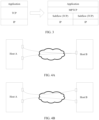
- FIG. 3 is a schematic diagram of expanding a TCP protocol stack to an MPTCP protocol stack.
- an application layer TCP flow is sent in one TCP flow
- an application layer TCP flow is split into two TCP subflows at an MPTCP layer for separate transmission.
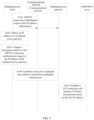
- FIG. 4A and FIG. 4B are schematic diagrams of application scenarios of MPTCP in RFC 6824.
- a TCP flow is split into two TCP subflows at an MPTCP layer of a transmit end for separate transmission, and the two subflows are merged at a receive end and sent to an application layer.
- a TCP flow is split into two TCP subflows at an MPTCP layer of a transmit end for separate transmission, and the two subflows remain as two separate subflows at a receive end and are sent to an application layer.
- a terminal and an application server are not highly supportive for the MPTCP protocol stack, and an IP address of the terminal cannot be used for MPTCP-based multipath data transmission between the terminal and the application server.
- the embodiments of the present invention provide a method for implementing MPTCP-based multipath data transmission between the terminal and the application server based on the IP address of the terminal.
- a multipath proxy client and a multipath proxy gateway (MPTCP GW) may be introduced to implement MPTCP-based multipath data transmission between the terminal and the application server.
- MPTCP client multipath proxy client
- MPTCP GW multipath proxy gateway
- At least two multipath data subflows are established and data transmission is performed between the MPTCP client and the MPTCP GW through the multipath data subflows.
- a TCP connection is established and TCP-based data transmission is performed based on IP address information for establishing the at least two multipath data subflows between the MPTCP client and the MPTCP GW.
- MPTCP-based multipath data transmission based on the IP address information of the MPTCP client is implemented through proxy of the MPTCP client and the MPTCP GW.
- the terminal in the embodiments of the present invention is a terminal that supports multiple access, where multiple access means being capable of accessing at least two different networks.
- the terminal may include a variety of wireless communication function-embedded handheld devices, in-vehicle devices, wearable devices, computing devices, or other processing devices connected to a wireless modem, or various forms of user equipment (UE for short), mobile stations (MS), terminal equipment, or the like.
- a network accessed by the terminal may be a Wi-Fi network, an LTE network, or other wireless communications networks using a variety of radio access technologies, for example, communications networks using access technologies such as code division multiple access, frequency division multiple access, time division multiple access, orthogonal frequency division multiple access, and single carrier frequency division multiple access.
- the terminal may also be applied to an evolved LTE system, for example, a 5th generation 5G system.
- LTE evolved LTE
- 5th generation 5G system a 5th generation 5G system.
- the MPTCP client in the embodiments of the present invention may be a network element component newly deployed in the communications network, or may be a function unit newly added to an original network element component.
- an MPTCP application APP
- APP MPTCP application
- description is provided by using an example in which a terminal installed with the MPTCP client serves as the MPTCP client.
- the MPTCP client in the following embodiments may be understood as a terminal.
- the MPTCP GW in the embodiments of the present invention is a network element component newly deployed in the communications network.
- a plurality of MPTCP GWs may be deployed in the communications network.
- a multipath management device may be further introduced to facilitate flexible deployment and management of a plurality of MPTCP GWs.
- the multipath management device is configured to perform MPTCP user authentication and MPTCP GW management and allocation.
- the multipath management device may obtain a multipath policy request sent by an MPTCP client, determine a supported multipath service based on the multipath policy request, and allocate an MPTCP GW supporting the multipath service.
- the multipath management device in the embodiments of the present invention may be a network element component newly deployed in the communications network, or may be a function unit newly added to an original network element component.
- the multipath management device may be an original PGW in the communications network, or may be an MPTCP manager newly deployed in the communications network.
- description is provided by using an example in which a newly deployed MPTCP manager serves as the multipath management device.
- the MPTCP GW implements functions of the MPTCP manager such as receiving a multipath policy request and determining that a multipath service is supported.
- FIG. 5 is an implementation flowchart of a multipath data transmission method according to an embodiment of the present invention. As shown in FIG. 5 , the method includes the following steps.
- An MPTCP client accesses at least two different networks, and sends an MPTCP connection establishment request in the at least two different networks.
- the MPTCP client sends the MPTCP connection establishment request in the at least two different networks, to request to perform data transmission through multipath data subflows.
- IP address information of the MPTCP client included in the MPTCP connection establishment request may be used for establishing at least two multipath data subflows between the MPTCP client and an MPTCP GW.
- the IP address information of the MPTCP client may be an IP address, obtained after the MPTCP client accesses the networks, for the MPTCP client to perform communication in the at least two different networks.
- the IP address used for establishing at least two multipath data subflows between the MPTCP client and the MPTCP GW is referred to as a first IP address in this embodiment of the present invention.
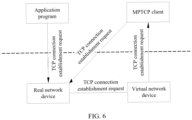
- the MPTCP client may send the MPTCP connection establishment request according to a data processing principle of a virtual private network (VPN) service framework of a virtual network device (for example, a virtual network adapter) shown in FIG. 6 .
- VPN virtual private network
- an application program invokes a socket to send a corresponding data packet (an MPTCP connection establishment request) to a real network device (an application server).
- a VPN service system forwards all data packets to a virtual network device through network address translation (NAT) by using an IP information packet filtering tool (iptables).
- the MPTCP client can obtain all the IP data packets forwarded to the virtual network device by reading data of the virtual network device, process the obtained IP data packets, and send the processed IP data packets by using the real network device (the application server).
- the MPTCP client obtains an IP address of the MPTCP GW.
- the MPTCP client can obtain the IP address of the MPTCP GW from a domain name server (DNS) through query.
- DNS domain name server
- the MPTCP client changes a destination address of the MPTCP connection establishment request to the IP address of the MPTCP GW, and forwards the MPTCP connection establishment request to the MPTCP GW.
- the destination address of the MPTCP connection establishment request may be an IP address of an application server to be accessed by the MPTCP client.
- the application server to be accessed by the MPTCP client is an application server that establishes a TCP connection to and performs TCP-based data transmission with a terminal acting as the MPTCP client.
- the MPTCP client establishes at least two multipath data subflows to the MPTCP GW, and performs data transmission through the established multipath data subflows.
- the MPTCP client may establish at least two multipath data subflows to the MPTCP GW based on the first IP address information of the MPTCP client included in the MPTCP connection establishment request and address information of the MPTCP GW.
- the MPTCP GW establishes, based on the first IP address information of the MPTCP client, a TCP connection to the application server to be accessed by the MPTCP client, and performs TCP-based data transmission through the TCP connection.
- the MPTCP client sends the MPTCP connection establishment request in the at least two different networks, establishes multipath data subflows between the MPTCP client and the MPTCP GW based on the IP address information of the MPTCP client included in the MPTCP connection establishment request, and performs data transmission through the multipath data subflows.
- the MPTCP GW establishes the TCP connection to and performs TCP-based data transmission with the application server based on the IP address information of the MPTCP client.
- the MPTCP client and the MPTCP GW provide a proxy service for the MPTCP client to perform TCP-based data transmission, and TCP-based transmission established between the MPTCP GW and the application server is implemented without using the IP address of the MPTCP GW, thereby improving security of the MPTCP GW.
- the application server can obtain the IP address of the MPTCP client based on the MPTCP connection establishment request, which facilitates traffic statistics and control for the MPTCP client.
- the MPTCP client can interact with the MPTCP manager, to implement MPTCP proxy.
- the MPTCP manager is configured to perform MPTCP user authentication, for example, configured to determine an MPTCP client performing an MPTCP service and the service.
- the MPTCP manager may determine an MPTCP client performing an MPTCP service and the service by using a blacklist/whitelist, for example, by adding an MPTCP client capable of performing an MPTCP service and the service to a whitelist.
- Using a mechanism such as a blacklist/whitelist policy by the MPTCP manager helps implement splitting control and differentiated charging for a terminal service.
- the MPTCP manager is further configured to perform MPTCP GW management and allocation.
- the MPTCP manager can maintain a plurality of MPTCP GWs.
- the MPTCP client needs to perform MPTCP-based multipath data transmission
- the MPTCP client sends a multipath policy request to the MPTCP manager, where the multipath policy request includes identification information of the MPTCP client.
- the MPTCP manager determines, based on the identification information of the MPTCP client included in the multipath policy request, that the MPTCP client supports a multipath service, and allocates a multipath proxy gateway supporting the multipath service to the MPTCP client.
- the MPTCP client when a plurality of MPTCP GWs are deployed in the communications network, the MPTCP client needs to select an MPTCP GW, and establish multipath data subflows to the selected MPTCP GW.
- the following describes, with reference to actual application, a process of selecting an MPTCP GW by the MPTCP client and a process of establishing multipath data subflows to the MPTCP GW by the MPTCP client.
- the following provides description by using an example in which the MPTCP client accesses a Wi-Fi network and an LTE network and an MPTCP manager allocates an MPTCP GW.
- FIG. 7 is an implementation flowchart for an MPTCP client to establish a multipath data subflow to an MPTCP GW according to an embodiment of the present invention.
- An MPTCP client supporting multiple access normally accesses an LTE network and a Wi-Fi network, and obtains IP addresses of the MPTCP client in the LTE network and the Wi-Fi network. That the MPTCP client accesses the LTE network is used as an example in FIG. 7 .
- the MPTCP client initiates a multipath policy request, where the multipath policy request includes identification information of the MPTCP client.
- the identification information of the MPTCP client may be an access point name (Access Point Name, APN) or an international mobile subscriber identity (International Mobile Subscriber Identity, IMSI).
- the multipath policy request further includes the IP addresses of the MPTCP client in the LTE network and the Wi-Fi network.
- the MPTCP client may send a query request for querying an IP address of an MPTCP manager to a DNS, and the DNS responds to the query request and feeds back the IP address of the MPTCP manager.
- the MPTCP client initiates the multipath policy request to the MPTCP manager.
- the MPTCP manager determines, based on the multipath policy request, whether the MPTCP client initiating the multipath policy request can perform an MPTCP service. For example, after the MPTCP manager determines that the MPTCP client is online in the LTE network by querying a policy and charging rules function (Policy and Charging Rules Function, PCRF) and obtains a multipath policy for performing the MPTCP service, and determines that the MPTCP client is online in the Wi-Fi network by querying authentication, authorization, and accounting (AAA) server and obtains a multipath policy for performing the MPTCP service, the MPTCP manager determines that the MPTCP client can perform the MPTCP service, and sends a multipath policy request response message to the MPTCP client. In this embodiment of the present invention, if the MPTCP manager determines that the MPTCP client is unable to perform the MPTCP service, the MPTCP client can perform data transmission with the application server
- the MPTCP client receives the multipath policy request response message, determines to support the MPTCP service, and sends an MPTCP connection establishment request.
- the MPTCP client interacts with the MPTCP manager to implement MPTCP proxy.
- the MPTCP manager obtains addresses of access gateways of at least two different networks that the MPTCP client accesses, for example, an IP address of a PGW of the LTE network that the MPTCP client accesses.
- the MPTCP manager may send an access authorization request to the AAA server, a home subscriber server (Home Subscriber Server, HSS), or the PCRF based on the identification information of the MPTCP client included in the multipath policy request, obtain information about mapping between an MPTCP client identity and a PGW based on an authorization response, and determine the addresses of the access gateways of the at least two different networks that the MPTCP client accesses.
- HSS Home Subscriber Server
- the MPTCP manager determines a multipath policy and allocates, based on the addresses of the access gateways, an available MPTCP GW to the MPTCP client that can perform the MPTCP service.
- the MPTCP manager may statically configure a multipath policy, or may obtain a dynamically configured multipath policy from another network device such as the AAA server or the PCRF.
- the multipath policy includes the MPTCP client supporting multipath data transmission, a service, and the like.
- the MPTCP manager can allocate an MPTCP GW to the MPTCP client based on a correspondence between an MPTCP GW and a PGW.
- priorities may be set for different MPTCP GWs, and the MPTCP manager allocates an MPTCP GW to the MPTCP client according to the priorities.
- PGWs of at least two different networks that the MPTCP client accesses may alternatively send the address of the MPTCP GW to the MPTCP manager.
- the MPTCP manager may allocate an MPTCP GW that shares one IP address with the PGW and is in one network segment with the PGW to the MPTCP client.
- the MPTCP client obtains an IP address of the MPTCP GW, and establishes multiple multipath data subflows to the MPTCP GW based on an IP address of the MPTCP client in the LTE network and an IP address of the MPTCP client in the Wi-Fi network (the first IP address) and the IP address of the MPTCP GW, and performs data transmission through the established multiple multipath data subflows.
- the MPTCP client may determine, based on the multipath policy, whether a proxy for MPTCP-based multipath data transmission is started. For example, if the MPTCP client identity included in the multipath policy request is an authorized MPTCP client identity, after the MPTCP client corresponding to the MPTCP client identity sends the MPTCP connection establishment request, the MPTCP client changes a destination address of the MPTCP connection establishment request to an address of the MPTCP GW, and forwards the MPTCP connection establishment request to the MPTCP GW.
- the MPTCP GW may allocate, to the MPTCP client, a port dedicated to establishing a multipath data subflow, and the MPTCP client may establish at least two multipath data subflows to the MPTCP GW based on the port allocated by the MPTCP GW, the first IP address, and the IP address of the MPTCP GW.
- the MPTCP GW may allocate, based on the IP address of the MPTCP client in the LTE network and the IP address of the MPTCP client in the Wi-Fi network (the first IP address), a second IP address in a mapping relationship with the first IP address to the MPTCP client, where the second IP address is used to indicate that multipath data transmission is to be performed.
- the MPTCP client may record a mapping relationship between an IP address and an MPTCP client in each multipath data subflow, to maintain the MPTCP connection establishment request sent by the MPTCP client.
- the IP address in the mapping relationship includes IP addresses of the MPTCP client in the LTE network and the Wi-Fi network (the first IP address), and the second IP address that is allocated by the MPTCP GW to the MPTCP client and that is dedicated to establishing the multipath data subflows.
- the MPTCP GW establishes, by using the second IP address, a TCP connection to and performs TCP data transmission with an application server to be accessed by the MPTCP client, and the application server uses the second IP address as a destination address for sending data to the MPTCP GW.
- the MPTCP GW establishes multipath data subflows to and performs MPTCP-based data transmission with the MPTCP client by using the first IP address.
- the MPTCP client may determine, based on the mapping relationship, that the data with the destination address being the second IP address needs to be received. In this way, IP layer data can be directly routed from the application server to the MPTCP GW, and the MPTCP client can perform fast addressing, thereby implementing fast MPTCP-based data transmission.
- FIG. 8 is an implementation flowchart for an MPTCP GW to allocate a second IP address dedicated to establishing multipath data subflows to an MPTCP client according to an embodiment of the present invention.
- S301, S302, S303, S304, and S305 in FIG. 8 are identical to implementation processes of S201, S202, S203, S204, and S205, respectively. No more details are described herein. The following describes their differences only.
- the MPTCP GW allocates, to the MPTCP client, an IP address and a port number that are dedicated to establishing multipath data subflows, and sends the IP address and the port number to an MPTCP manager.
- a multipath policy request sent by the MPTCP manager to the MPTCP GW allocated for an MPTCP service includes identification information of the MPTCP client and IP addresses of the MPTCP client in an LTE network and a Wi-Fi network.
- the MPTCP GW allocates, to the MPTCP client, the IP address and the port number that are dedicated to establishing multipath data subflows, where the allocated IP address and port number dedicated to establishing multipath data subflows are in a correspondence with the identification information of the MPTCP client and the IP addresses of the MPTCP client in the LTE network and the Wi-Fi network, respectively.
- the MPTCP manager obtains information about the second IP address and the port (for example, the port number) that are dedicated to establishing multipath data subflows and that are allocated by the MPTCP GW to the MPTCP client, determines a multipath policy including an identity of the MPTCP client and the IP address and port number allocated by the MPTCP GW, and feeds back a multipath policy request response to the MPTCP client that can perform an MPTCP service.
- the multipath policy request response sent by the MPTCP manager to the MPTCP client includes the information about the second IP address and the port that are dedicated to establishing multipath data subflows and that are allocated by the MPTCP GW to the MPTCP client, the identity of the MPTCP client, and a whitelist of MPTCP clients supporting multipath data transmission and services.
- FIG. 9 is an implementation flowchart for an MPTCP client to establish multipath data subflows to an MPTCP GW and perform MPTCP-based multipath data transmission.
- UE IP an IP allocated by a PGW to an MPTCP client accessing an LTE network.
- IP1 an IP address of HostA1 in MPTCP-based multipath data transmission.
- a UE IP is used as IP1 in this solution.
- IP2 an IP address of HostA2 in MPTCP-based multipath data transmission.
- IP3 an IP address of HostB in an MPTCP GW in MPTCP-based multipath data transmission.
- Server IP an IP address of an application server to be accessed by an MPTCP client.
- an implementation procedure of establishing multipath data subflows and performing MPTCP-based multipath data transmission in this embodiment of the present invention includes the following steps.
- a TCP connection establishment request initiated by the MPTCP client may be used to trigger the MPTCP client to send the MPTCP connection establishment request, where a source address of the TCP connection establishment request is UE IP, and a destination address is Server IP.
- the MPTCP client establishes a mapping relationship between UE IP (IP1) and IP3, and a mapping relationship between IP2 and IP3, and sends the MPTCP connection establishment request, to request to establish MPTCP multipath data subflows to the MPTCP GW.
- the MPTCP client establishes the first MPTCP multipath data subflow to the MPTCP GW.
- HostA1 of the MPTCP client establishes the first MPTCP multipath data subflow, for example, a multipath data subflow in the LTE network, to HostB of the MPTCP GW.
- a source address of HostA1 is IP1
- an address of HostB of the MPTCP GW is IP3.
- a message exchange process for HostA1 of the MPTCP client to establish the first MPTCP multipath data subflow to HostB of the MPTCP GW is similar to conventional TCP handshaking, but differs from conventional TCP handshaking in that a multipath capability (MP_CAPABLE) option needs to be carried and a 64-bit key (Key) value needs to be exchanged.
- MP_CAPABLE multipath capability
- Key 64-bit key
- the MPTCP client may establish the multipath data subflow to the MPTCP GW by using the port that is allocated by the MPTCP GW to the MPTCP client and that is dedicated to establishing a multipath data subflow, so as to accelerate MPTCP-based data transmission.
- the option MP_CAPABLE needs to include information about the port that is dedicated to establishing a multipath data subflow and that is allocated by the MPTCP GW to the MPTCP client, so that the MPTCP client and the MPTCP GW establish a multipath data subflow in the LTE network by using the port that is dedicated to establishing a multipath data subflow and that is allocated by the MPTCP GW to the MPTCP client.
- the MPTCP client sends, to the MPTCP GW, an IP address Server IP address of an application server to be accessed by the MPTCP client.
- the MPTCP client After the first MPTCP multipath data subflow is established, the MPTCP client sends the Server IP to the MPTCP GW, so as to notify the MPTCP GW of the Server IP.
- the MPTCP client may send the Server IP by using a TCP message, where the TCP message is a TCP message sending the Server IP.
- the TCP message is referred to as an MPTCP message hereinafter.
- Information about the IP address and the port in the MPTCP message needs to be the same as the information about the IP address and the port in the MPTCP connection establishment request sent by the MPTCP client. Therefore, the MPTCP message may be alternatively an MPTCP connection establishment request.
- the MPTCP connection establishment request used for sending the Server IP is different from the MPTCP connection establishment request sent by the MPTCP client.
- the MPTCP message may be implemented by an extended private field, for example, an MPTCP_ADD option.
- the extended private field in this embodiment of the present invention is preferably a TCP message carrying an MPTCP option.
- a field used to enable the MPTCP GW to identify the Server IP is added to the MPTCP connection establishment request sending the Server IP.
- the MPTCP GW After obtaining the MPTCP connection establishment request sending the Server IP, if the MPTCP GW determines that an IP address carried in the MPTCP connection establishment request is not in a local HostB address list, the MPTCP GW determines that the IP address carried in the MPTCP connection establishment request is the IP address of the application server to be accessed by the MPTCP client, and forwards, based on the IP address of the application server, the MPTCP connection establishment request to the application server to be accessed by the MPTCP client.
- the MPTCP GW may send response information to the MPTCP client, so that the MPTCP client determines whether the MPTCP GW has received the Server IP.
- the MPTCP GW may alternatively ignore the MPTCP message sending the Server IP, to simplify the message processing procedure. For example, if the MPTCP GW determines that the Server IP is sent in the MPTCP connection establishment request, the MPTCP GW ignores the MPTCP connection establishment request sending the Server IP.
- HostA2 of the MPTCP client establishes an MPTCP multipath data subflow, for example, a multipath data subflow in the LTE network, to HostB of the MPTCP GW.
- a source address of HostA2 is IP2
- an address of HostB of the MPTCP GW is IP3.
- a message exchange process for HostA2 of the MPTCP client to establish the MPTCP multipath data subflow to HostB of the MPTCP GW is similar to conventional TCP handshaking, but differs from conventional TCP handshaking in that a multipath join (MP_JOIN) option needs to be carried and a 32-bit random number (token) needs to be carried.
- the 32-bit token value is a hash value of the key carried in the established first multipath data subflow. This method enables verification for a newly established multipath data subflow and prevents a connection establishment attack on HostB.
- the MPTCP GW establishes a TCP connection to the application server to be accessed by the MPTCP client, and performs TCP-based data transmission.
- the MPTCP GW may establish the TCP connection to the application server to be accessed by the MPTCP client, by using the first IP address for the MPTCP client to establish a multipath data subflow and the IP address of the application server.
- the MPTCP GW may establish the TCP connection to the application server to be accessed by the MPTCP client, by using the IP address of the application server and the second IP address that is allocated by the MPTCP GW to the MPTCP client and that is in a correspondence with the first IP address.
- FIG. 9 an example in which the TCP connection is established based on the second IP address allocated by the MPTCP GW to the MPTCP client is used for description.
- the MPTCP client may perform MPTCP-based multipath data transmission with the MPTCP GW, and the MPTCP GW performs TCP-based transmission with the application server.
- timing of establishing the MPTCP multipath data subflows and the TCP connection is not limited.
- the MPTCP multipath data subflows and the TCP connection may be established when it is determined that data transmission needs to be performed through the MPTCP multipath data subflows.
- the MPTCP multipath data subflows and the TCP connection may be established in advance, and when it is determined that data transmission needs to be performed through the MPTCP multipath data subflows, the pre-established MPTCP multipath data subflows and the TCP connection are used for data transmission.
- the pre-established MPTCP multipath data subflow may be an MPTCP long connection.
- the MPTCP long connection means that the MPTCP multipath data subflow remains in a connected state in at least two communications networks until the MPTCP client is offline in all of the at least two communications networks.
- a corresponding link resource may be released to save resources.
- the MPTCP GW determines that no data is transmitted in any of the at least two multipath data subflows within preset duration, or that the MPTCP client is already offline in the at least two networks, the MPTCP GW releases the at least two multipath data subflows and the TCP connection.
- the MPTCP client determines that the MPTCP client is already offline in the at least two networks, or that no data is transmitted in any of the at least two multipath data subflows within preset duration, the MPTCP client releases the at least two multipath data subflows.
- that the MPTCP client is offline means that the MPTCP client has performed an operation such as detachment.
- the MPTCP manager may determine whether no data is transmitted in any of the at least two multipath data subflows. If the MPTCP manager determines that no data is transmitted in any of the at least two multipath data subflows within preset duration, or that the MPTCP client is already offline in the at least two networks, the MPTCP manager sends first indication information to the MPTCP GW and the MPTCP client, where the first indication information is used to indicate that no data is transmitted in any of the at least two multipath data subflows within preset duration, or that the MPTCP client is already offline in the at least two networks. After receiving the first indication information, the MPTCP GW and the MPTCP client release the at least two multipath data subflows and the TCP connection.
- a notification message that no data is transmitted in the multipath data subflows within preset duration and that the MPTCP client is already offline in the at least two networks may be pushed by a network element in a communications network to the MPTCP manager.
- the network element pushing the notification message is a network element capable of determining whether the MPTCP client is offline, for example, a PGW or a PCRF in the LTE network.
- the PGW in the LTE network is preferred in this embodiment of the present invention.
- the MPTCP manager may further query a data transmission status of each of the at least two multipath data subflows and whether the MPTCP client is offline. If the MPTCP manager finds that no data is transmitted in any of the at least two multipath data subflows within the preset duration, or that the MPTCP client is already offline in the at least two networks, a corresponding link resource may be released.
- the MPTCP manager may query, according to a specified period, the data transmission status of each of the at least two multipath data subflows and whether the MPTCP client is offline.
- the MPTCP manager may query, after receiving a notification message that no data is transmitted in a specified quantity of multipath data subflows in the at least two multipath data subflows or that the MPTCP client is offline in a specified network, a data transmission status of a multipath data subflow not receiving the notification message or whether the MPTCP client is offline in another unspecified network.
- the MPTCP manager queries whether the MPTCP client is offline in the Wi-Fi network. If the MPTCP manager determines that the MPTCP client is offline both in the LTE network and the Wi-Fi network, the MPTCP manager releases corresponding link resources.
- the MPTCP client and the MPTCP GW provide a proxy service for TCP-based data transmission.
- TCP-based transmission between the MPTCP GW and the application server is implemented without using the IP address of the MPTCP GW, thereby improving security of the MPTCP GW.
- the application server can obtain the IP address information of the MPTCP client, which facilitates traffic statistics and control for the MPTCP client.
- using the multipath policy mechanism such as a blacklist/whitelist by the MPTCP manager helps implement splitting control and differentiated charging for a service.
- the multipath proxy gateway, the multipath proxy client, and the multipath management device all include a corresponding hardware structure and/or software module for performing each function.
- the embodiments of the present invention may be implemented in a form of hardware or a combination of hardware and computer software. Whether a function is performed by hardware or hardware driven by computer software depends on particular applications and design constraints of the technical solutions. A person skilled in the art may use different methods for each particular application to implement the described functions, but it should not be construed that the implementation goes beyond the scope of the technical solutions of the embodiments of the present invention.
- each functional unit may be defined in a correspondence to each function, or two or more functions may be integrated into one processing unit.
- the integrated unit may be implemented in a form of hardware, or may be implemented in a form of a software functional unit. It should be noted that the unit division in the embodiments of this application is an example and merely logical function division, and may be other division in actual implementation.
- FIG. 10 is a schematic structural diagram of a multipath proxy gateway 100.
- the multipath proxy gateway 100 includes a transceiver unit 101 and a processing unit 102.
- the transceiver unit 101 is configured to obtain a first IP address of a multipath proxy client, where the first IP address is used for establishing at least two multipath data subflows between the multipath proxy gateway and the multipath proxy client.
- the processing unit 102 is configured to establish, based on the first IP address obtained by the transceiver unit 101, a TCP connection to an application server to be accessed by the multipath proxy client, and perform TCP-based data transmission through the TCP connection.
- the processing unit 102 may allocate, based on the first IP address, a second IP address in a mapping relationship with the first IP address to the multipath proxy client, where the second IP address is used to indicate that multipath data transmission is to be performed; and establish, based on the second IP address, the TCP connection to the application server to be accessed by the multipath proxy client.
- the transceiver unit 101 is further configured to: before the multipath proxy gateway establishes the TCP connection to the application server to be accessed by the multipath proxy client, obtain an IP address of the application server to be accessed by the multipath proxy client, where the IP address of the application server is sent by the multipath proxy client.
- the processing unit 102 is further configured to: after the transceiver unit 101 obtains the IP address of the application server, ignore a TCP message used for sending the IP address of the application server.
- the processing unit 102 is further configured to: after the transceiver unit 101 obtains the first IP address of the multipath proxy client, allocate, to the multipath proxy client based on the first IP address, a port dedicated to multipath data transmission; and establish, by using the port, at least two multipath data subflows to the multipath proxy client.
- the processing unit 102 is further configured to: after the multipath proxy gateway establishes the TCP connection to the application server to be accessed by the multipath proxy client, if determining that no data is transmitted in any of the established at least two multipath data subflows within preset duration, or that the multipath proxy client is already offline in at least two networks in which the at least two multipath data subflows are established, release the established at least two multipath data subflows and the TCP connection.
- the processing unit 102 is further configured to: before establishing, based on the first IP address, the TCP connection to the application server to be accessed by the multipath proxy client, determine that the multipath proxy client supports a multipath service.
- the processing unit 102 may determine, based on indication information sent by a multipath management device to indicate that the multipath proxy gateway is allocated to the multipath proxy client for multipath data transmission, that the multipath proxy client supports a multipath service.
- the processing unit 102 may be a processor or a controller.
- the transceiver unit 101 may be a communications interface, a transceiver, a transceiver circuit, or the like.
- the communications interface is a collective term and may include one or more interfaces.
- the multipath proxy gateway 100 in this embodiment of the present invention may be a multipath proxy gateway 1000 shown in FIG. 11 .
- FIG. 11 is a schematic structural diagram of a multipath proxy gateway 1000 according to an embodiment of the present invention.
- the multipath proxy gateway 1000 includes a processor 1001, a memory 1002, and a transceiver 1003.
- the memory 1002 is configured to store an instruction.
- the processor 1001 is configured to execute the instruction stored in the memory to control the transceiver 1003 to obtain a first IP address of a multipath proxy client, establish, based on the first IP address obtained by the transceiver 1003, a TCP connection to an application server to be accessed by the multipath proxy client, and perform TCP-based data transmission through the TCP connection.
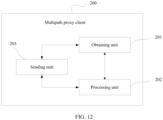
- FIG. 12 is a schematic structural diagram of a multipath proxy client 200.
- the multipath proxy client 200 includes an obtaining unit 201 and a processing unit 202.
- the obtaining unit 201 is configured to obtain an IP address of a multipath proxy gateway and determine a port dedicated to multipath data transmission, where the port is allocated by the multipath proxy gateway to the multipath proxy client based on a first internet protocol IP address of the multipath proxy client, and the first IP address is used for establishing at least two multipath data subflows between the multipath proxy client and the multipath proxy gateway.
- the processing unit 202 is configured to establish, by using the port determined by the obtaining unit 201 and based on the first IP address and the IP address of the multipath proxy gateway obtained by the obtaining unit 201, at least two multipath data subflows to the multipath proxy gateway, and perform data transmission through the multipath data subflows.
- the multipath proxy client further includes a sending unit 203.
- the sending unit 203 is configured to send a multipath policy request to a multipath management device, where the multipath policy request includes identification information of the multipath proxy client.
- the obtaining unit 201 receives the IP address of the multipath proxy gateway allocated by the multipath management device to the multipath proxy client based on the identification information of the multipath proxy client.
- the sending unit 203 is configured to: after the obtaining unit 201 obtains the IP address of the multipath proxy gateway, send an IP address of an application server to be accessed by the multipath proxy client to the multipath proxy gateway.
- the processing unit 202 is further configured to: after the multipath proxy client establishes the at least two multipath data subflows to the multipath proxy gateway, if determining that no data is transmitted in any of the established at least two multipath data subflows within preset duration, or that the multipath proxy client is already offline in at least two networks in which the at least two multipath data subflows are established, release the established at least two multipath data subflows.
- the processing unit 202 is further configured to: before the multipath proxy client establishes the at least two multipath data subflows to the multipath proxy gateway, determine that the multipath proxy client supports a multipath service.
- the processing unit 202 may be a processor or a controller; the receiving unit 201 may be a receiver, or the like; and the sending unit 203 may be a transmitter, or the like.
- the multipath proxy client 200 in this embodiment of the present invention may be a structure shown in FIG. 13 .
- FIG. 13 is a schematic structural diagram of a multipath proxy client 2000 according to an embodiment of the present invention.
- the multipath proxy client 2000 may be a terminal.
- the multipath proxy client 2000 includes a receiver 2001 and a processor 2002.
- the receiver 2001 is configured to support the multipath proxy client in obtaining an IP address of a multipath proxy gateway and determining a port dedicated to multipath data transmission.
- the processor 2002 is configured to support the multipath proxy client in performing functions of the multipath proxy client in the foregoing method embodiments.
- the multipath proxy client may further include a memory 2003 and a transmitter 2004.
- the memory 2003 is configured to couple to the processor 2001, and store program instructions and data necessary for the multipath proxy client.
- the transmitter 2004 is configured to send an IP address of an application server to be accessed by the multipath proxy client to the multipath proxy gateway.
- FIG. 14 is a schematic structural diagram of a multipath management device 300.
- the multipath management device 300 includes a communications unit 301 and a processing unit 302.
- the communications unit 301 is configured to obtain a multipath policy request sent by a multipath proxy client, where the multipath policy request includes identification information of the multipath proxy client.
- the processing unit 302 is configured to determine, based on the identification information of the multipath proxy client, that the multipath proxy client supports a multipath service, and allocate a multipath proxy gateway to the multipath proxy client.
- the processing unit 302 may determine, based on the identification information of the multipath proxy client, access gateways accessed by the multipath proxy client in at least two different networks; and allocate, based on a correspondence between an access gateway and a multipath proxy gateway or based on an IP address of a multipath proxy gateway sent by the access gateway, a multipath proxy gateway in each of the at least two different networks to the multipath proxy client.
- the communications unit 301 is further configured to: after obtaining the multipath policy request sent by the multipath proxy client, obtain information about a second IP address and a port that are allocated by the multipath proxy gateway to the multipath proxy client and that are dedicated to establishing a multipath data subflow, and send, to the multipath proxy client, the obtained information about the second IP address and the port that are dedicated to establishing a multipath data subflow.
- the processing unit 302 is further configured to: after allocating the multipath proxy gateway to the multipath proxy client, if determining that no data is transmitted in any of the established at least two multipath data subflows within preset duration, or that the multipath proxy client is already offline in at least two networks in which the at least two multipath data subflows are established, send first indication information to the multipath proxy client and the multipath proxy gateway, where the first indication information is used to indicate that no data is transmitted in any of the established at least two multipath data subflows within the preset duration, or that the multipath proxy client is already offline in the at least two networks in which the at least two multipath data subflows are established.
- the processing unit 302 may be a processor or a controller.
- the communications unit 301 may be a communications interface, a transceiver, a transceiver circuit, or the like.
- the communications interface is a collective term and may include one or more interfaces.
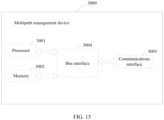
- the multipath management device 300 in this embodiment of the present invention may be a multipath management device 3000 shown in FIG. 15 .
- FIG. 15 is a schematic structural diagram of a multipath management device 3000 according to an embodiment of the present invention.
- the multipath management device 3000 includes a processor 3001, a memory 3002, and a communications interface 3003.
- the memory 3002 is configured to store an instruction.
- the processor 3001 is configured to execute the instruction stored in the memory 3002 to support the functions of the multipath management device in the foregoing method embodiments.
- the communications interface 3003 is configured to, under control of the processor 3001, support the multipath management device in communicating with other network elements such as a multipath proxy gateway and a multipath proxy client.
- a terminal acting as the multipath proxy client may further include a display device, an input/output interface, and the like. All terminals that can implement the embodiments of the present invention fall within the protection scope of the embodiments of the present invention.
- the multipath proxy gateway and the multipath management device may further include any quantity of transmitters, receivers, processors, controllers, memories, communications units, and the like. All network devices that can implement the embodiments of the present invention fall within the protection scope of the embodiments of the present invention.
- a bus architecture may include any quantity of interconnected buses and bridges that are specifically connected by using various circuits of one or more processors represented by the processor and a memory represented by the memory.
- the bus architecture may further connect various other circuits such as a peripheral device, a voltage stabilizer, and a power management circuit. These are well known in the art, and therefore are not further described in this specification.
- the multipath management device shown in FIG. 15 including a bus interface 3004 providing an interface is used as an example for description.
- the processor is responsible for bus architecture management and general processing.
- the memory may store data that is used by the processor when the processor performs an operation.
- the processor in the embodiments of the present invention may be a central processing unit (Central Processing Unit, CPU), a general-purpose processor, a digital signal processor (Digital Signal Processor, DSP), an application-specific integrated circuit (Application-Specific Integrated Circuit, ASIC), a field programmable gate array (Field Programmable Gate Array, FPGA), or another programmable logic device, a transistor logic device, a hardware component, or a combination thereof.
- the processor may implement or execute various example logical blocks, modules, and circuits described with reference to content disclosed in the present invention.
- the processor may be a combination of processors implementing a computing function, for example, a combination of one or more microprocessors, or a combination of a DSP and a microprocessor.
- the memory may be integrated into the processor, or may be separate from the processor.
- functions of the receiver and the transmitter may be implemented by using a transceiver circuit or a dedicated transceiver chip.
- the processor may be implemented by using a dedicated processing chip, a processing circuit, a processor, or a general-purpose chip.
- program code that implements functions of the processor, the receiver, and the transmitter is stored in the memory, and the general-purpose processor executes the code in the memory to implement the functions of the processor, the receiver, and the transmitter.
- an embodiment of the present invention further provides a communications system, including one or more foregoing multipath proxy gateways, a multipath client, and a multipath management device.
- An embodiment of the present invention further provides a computer storage medium configured to store some instructions. When these instructions are executed, any method of the multipath proxy gateway, the multipath client, or the multipath management device may be implemented.
- Embodiment 1 A multipath data transmission method, comprising:
- Embodiment 2 The method according to embodiment 1, wherein the establishing, by the multipath proxy gateway based on the first IP address, a TCP connection to an application server to be accessed by the multipath proxy client comprises:
- Embodiment 3 The method according to embodiment 1 or 2, wherein before the establishing, by the multipath proxy gateway, a TCP connection to an application server to be accessed by the multipath proxy client, the method further comprises: obtaining, by the multipath proxy gateway, an IP address of the application server to be accessed by the multipath proxy client, wherein the IP address of the application server is sent by the multipath proxy client.
- Embodiment 4 The method according to any one of embodiments 1 to 3, wherein after the obtaining, by a multipath proxy gateway, a first IP address of a multipath proxy client, the method further comprises:
- Embodiment 5 The method according to any one of embodiments 1 to 4, wherein after the establishing, by the multipath proxy gateway, a TCP connection to an application server to be accessed by the multipath proxy client, the method further comprises: releasing, by the multipath proxy gateway, the established at least two multipath data subflows and the TCP connection if the multipath proxy gateway determines that no data is transmitted in any of the established at least two multipath data subflows within preset duration, or that the multipath proxy client is already offline in at least two networks in which the at least two multipath data subflows are established.
- Embodiment 6 The method according to any one of embodiments 1 to 5, wherein before the establishing, by the multipath proxy gateway based on the first IP address, a TCP connection to an application server to be accessed by the multipath proxy client, the method further comprises: determining, by the multipath proxy gateway, that the multipath proxy client supports a multipath service.
- Embodiment 7 The method according to embodiment 6, wherein the determining, by the multipath proxy gateway, that the multipath proxy client supports a multipath service comprises: determining, by the multipath proxy gateway based on indication information sent by a multipath management device to indicate that the multipath proxy gateway is allocated to the multipath proxy client for multipath data transmission, that the multipath proxy client supports a multipath service.
- Embodiment 8 A multipath data transmission method, comprising:
- Embodiment 9 The method according to embodiment 8, wherein the obtaining, by the multipath proxy client, an IP address of the multipath proxy gateway comprises:
- Embodiment 10 The method according to embodiment 8 or 9, wherein after the obtaining, by the multipath proxy client, an IP address of the multipath proxy gateway, the method further comprises: sending, by the multipath proxy client, an IP address of an application server to be accessed by the multipath proxy client to the multipath proxy gateway.
- Embodiment 11 The method according to any one of embodiments 8 to 10, wherein after the establishing, by the multipath proxy client, at least two multipath data subflows to the multipath proxy gateway, the method further comprises: releasing, by the multipath proxy client, the at least two multipath data subflows if the multipath proxy client determines that no data is transmitted in any of the at least two multipath data subflows within preset duration, or that the multipath proxy client is already offline in at least two networks in which the at least two multipath data subflows are established.
- Embodiment 12 The method according to any one of embodiments 8 to 11, wherein before the establishing, by the multipath proxy client, at least two multipath data subflows to the multipath proxy gateway, the method further comprises: determining, by the multipath proxy client, that a multipath service is supported.
- Embodiment 13 A multipath data transmission method, comprising:
- Embodiment 14 The method according to embodiment 13, wherein the allocating, by the multipath management device based on the identification information of the multipath proxy client, a multipath proxy gateway to the multipath proxy client comprises:
- Embodiment 15 The method according to embodiment 13 or 14, wherein after the obtaining, by a multipath management device, a multipath policy request sent by a multipath proxy client, the method further comprises: obtaining, by the multipath management device, information about a second IP address and a port that are allocated by the multipath proxy gateway to the multipath proxy client and that are dedicated to establishing a multipath data subflow, and sending, to the multipath proxy client, the information about the second IP address and the port that are dedicated to establishing a multipath data subflow.
- Embodiment 16 The method according to any one of embodiments 13 to 15, wherein after the allocating, by the multipath management device, a multipath proxy gateway to the multipath proxy client, the method further comprises:
- a multipath proxy gateway comprising:
- Embodiment 18 The multipath proxy gateway according to embodiment 17, wherein the processing unit specifically establishes, based on the first IP address in the following manner, the TCP connection to the application server to be accessed by the multipath proxy client:
- Embodiment 19 The multipath proxy gateway according to embodiment 17 or 18, wherein the transceiver unit is further configured to: before the multipath proxy gateway establishes the TCP connection to the application server to be accessed by the multipath proxy client, obtain an IP address of the application server to be accessed by the multipath proxy client, wherein the IP address of the application server is sent by the multipath proxy client.
- Embodiment 20 The multipath proxy gateway according to any one of embodiments 17 to 19, wherein the processing unit is further configured to:
- Embodiment 21 The multipath proxy gateway according to any one of embodiments 17 to 20, wherein the processing unit is further configured to:
- Embodiment 22 The multipath proxy gateway according to any one of embodiments 17 to 21, wherein the processing unit is further configured to: before establishing, based on the first IP address, the TCP connection to the application server to be accessed by the multipath proxy client, determine that the multipath proxy client supports a multipath service.
- Embodiment 23 The multipath proxy gateway according to embodiment 22, wherein the processing unit determines, in the following manner, that the multipath proxy client supports a multipath service: determining, based on indication information sent by a multipath management device to indicate that the multipath proxy gateway is allocated to the multipath proxy client for multipath data transmission, that the multipath proxy client supports a multipath service.
- a multipath proxy client comprising:
- Embodiment 25 The multipath proxy client according to embodiment 24, wherein the multipath proxy client further comprises a sending unit, wherein
- Embodiment 26 The multipath proxy client according to embodiment 24 or 25, wherein the multipath proxy client further comprises a sending unit, wherein the sending unit is configured to, after the obtaining unit obtains the IP address of the multipath proxy gateway, send an IP address of an application server to be accessed by the multipath proxy client to the multipath proxy gateway.
- Embodiment 27 The multipath proxy client according to any one of embodiments 24 to 26, wherein the processing unit is further configured to:
- Embodiment 28 The multipath proxy client according to any one of embodiments 24 to 27, wherein the processing unit is further configured to: before the multipath proxy client establishes at least two multipath data subflows to the multipath proxy gateway, determine that the multipath proxy client supports a multipath service.
- a multipath management device comprising:
- Embodiment 30 The multipath management device according to embodiment 29, wherein the processing unit allocates a multipath proxy gateway to the multipath proxy client based on the identification information of the multipath proxy client in the following manner:
- Embodiment 31 The multipath management device according to embodiment 29 or 30, wherein the communications unit is further configured to:
- Embodiment 32 The multipath management device according to any one of embodiments 29 to 31, wherein the processing unit is further configured to:
Landscapes
- Engineering & Computer Science (AREA)
- Computer Networks & Wireless Communication (AREA)
- Signal Processing (AREA)
- Computer Security & Cryptography (AREA)
- Data Exchanges In Wide-Area Networks (AREA)
- Mobile Radio Communication Systems (AREA)
Applications Claiming Priority (4)
| Application Number | Priority Date | Filing Date | Title |
|---|---|---|---|
| CN201611014002.1A CN108075987B (zh) | 2016-11-17 | 2016-11-17 | 一种多路径数据传输方法及设备 |
| EP20186847.8A EP3793144B1 (fr) | 2016-11-17 | 2017-07-28 | Procédé et dispositif de transmission de données à trajets multiples |
| EP17870918.4A EP3544246B1 (fr) | 2016-11-17 | 2017-07-28 | Procédé et dispositif de transmission de données à trajets multiples |
| PCT/CN2017/094792 WO2018090666A1 (fr) | 2016-11-17 | 2017-07-28 | Procédé et dispositif de transmission de données à trajets multiples |
Related Parent Applications (3)
| Application Number | Title | Priority Date | Filing Date |
|---|---|---|---|
| EP20186847.8A Division-Into EP3793144B1 (fr) | 2016-11-17 | 2017-07-28 | Procédé et dispositif de transmission de données à trajets multiples |
| EP20186847.8A Division EP3793144B1 (fr) | 2016-11-17 | 2017-07-28 | Procédé et dispositif de transmission de données à trajets multiples |
| EP17870918.4A Division EP3544246B1 (fr) | 2016-11-17 | 2017-07-28 | Procédé et dispositif de transmission de données à trajets multiples |
Publications (2)
| Publication Number | Publication Date |
|---|---|
| EP4492733A2 true EP4492733A2 (fr) | 2025-01-15 |
| EP4492733A3 EP4492733A3 (fr) | 2025-04-16 |
Family
ID=62145170
Family Applications (3)
| Application Number | Title | Priority Date | Filing Date |
|---|---|---|---|
| EP20186847.8A Active EP3793144B1 (fr) | 2016-11-17 | 2017-07-28 | Procédé et dispositif de transmission de données à trajets multiples |
| EP24198140.6A Pending EP4492733A3 (fr) | 2016-11-17 | 2017-07-28 | Procédé et dispositif de transmission de données par trajets multiples |
| EP17870918.4A Active EP3544246B1 (fr) | 2016-11-17 | 2017-07-28 | Procédé et dispositif de transmission de données à trajets multiples |
Family Applications Before (1)
| Application Number | Title | Priority Date | Filing Date |
|---|---|---|---|
| EP20186847.8A Active EP3793144B1 (fr) | 2016-11-17 | 2017-07-28 | Procédé et dispositif de transmission de données à trajets multiples |
Family Applications After (1)
| Application Number | Title | Priority Date | Filing Date |
|---|---|---|---|
| EP17870918.4A Active EP3544246B1 (fr) | 2016-11-17 | 2017-07-28 | Procédé et dispositif de transmission de données à trajets multiples |
Country Status (5)
| Country | Link |
|---|---|
| US (2) | US11140071B2 (fr) |
| EP (3) | EP3793144B1 (fr) |
| CN (2) | CN108075987B (fr) |
| ES (2) | ES2832731T3 (fr) |
| WO (1) | WO2018090666A1 (fr) |
Families Citing this family (30)
| Publication number | Priority date | Publication date | Assignee | Title |
|---|---|---|---|---|
| CN108075987B (zh) * | 2016-11-17 | 2020-12-08 | 华为技术有限公司 | 一种多路径数据传输方法及设备 |
| US11089138B2 (en) * | 2017-02-15 | 2021-08-10 | Nokia Solutiona and Networks Oy | Network multi-path proxy selection to route data packets |
| US11202230B2 (en) * | 2017-05-19 | 2021-12-14 | Telefonaktiebolaget Lm Ericsson (Publ) | Technique for enabling multipath transmission |
| EP3669568B1 (fr) * | 2017-08-18 | 2023-10-25 | Nokia Technologies Oy | Commande de distribution de trafic pour réseaux d'accès hybrides sans fil |
| US11902890B2 (en) * | 2018-02-03 | 2024-02-13 | Nokia Technologies Oy | Application based routing of data packets in multi-access communication networks |
| CN112005533B (zh) * | 2018-02-22 | 2023-11-07 | 瑞典爱立信有限公司 | 代理多路径协议连接的方法和设备 |
| US10992712B2 (en) * | 2018-02-27 | 2021-04-27 | Cisco Technology, Inc. | Multipath subflow anchoring for security policy enforcement |
| WO2019185179A1 (fr) | 2018-03-28 | 2019-10-03 | Telefonaktiebolaget Lm Ericsson (Publ) | Procédés et appareils permettant d'accéder à un service à l'extérieur d'un réseau de communication mobile dans une connexion par trajets multiples |
| US10979355B2 (en) * | 2018-04-02 | 2021-04-13 | Apple Inc. | Multipath transmission control protocol proxy use in a cellular network |
| US11191121B2 (en) * | 2018-07-23 | 2021-11-30 | Parallel Wireless, Inc. | Multipath TCP with mesh access |
| CN109104479A (zh) * | 2018-08-01 | 2018-12-28 | 福州大学 | 一种基于多路并行传输技术的采集数据流传送方法与系统 |
| CN111107672B (zh) | 2018-10-26 | 2023-04-18 | 华为技术有限公司 | 一种建立多路径连接的子流的方法、装置和系统 |
| CN109587275A (zh) * | 2019-01-08 | 2019-04-05 | 网宿科技股份有限公司 | 一种通信连接的建立方法及代理服务器 |
| WO2020173920A1 (fr) * | 2019-02-25 | 2020-09-03 | Nokia Technologies Oy | Corrélation de segments à trajets multiples à l'aide d'une configuration de clé client à trajets multiples |
| US11425086B2 (en) * | 2019-06-11 | 2022-08-23 | Juniper Networks, Inc. | Using DNS to communicate MC-TCP capability of server devices |
| CN110621040B (zh) * | 2019-10-24 | 2021-02-02 | 北京大学 | 一种实现多路并行传输通信的方法和系统 |
| CN111953594B (zh) * | 2019-10-24 | 2021-08-17 | 北京大学 | 一种数据传输装置及方法 |
| US11368535B2 (en) | 2019-11-18 | 2022-06-21 | Connectify, Inc. | Apparatus and method for client connection establishment |
| US11893092B2 (en) * | 2020-01-17 | 2024-02-06 | Sony Group Corporation | Privilege auto platform |
| CN113271252B (zh) * | 2020-02-14 | 2023-06-06 | 中国电信股份有限公司 | 通信建立方法、系统和计算机可读存储介质 |
| CN114095474B (zh) * | 2020-07-31 | 2023-02-03 | 华为技术有限公司 | 确定mptcp服务器公网地址的方法和通信装置 |
| CN114793367B (zh) * | 2021-01-25 | 2025-10-03 | 阿里巴巴集团控股有限公司 | 通信链路建立方法、通信系统及非易失性存储介质 |
| CN113746902B (zh) * | 2021-08-04 | 2023-06-16 | 新华三大数据技术有限公司 | 通信方法及装置 |
| CN113810425B (zh) * | 2021-09-26 | 2022-11-18 | 杭州安恒信息技术股份有限公司 | 一种并联网络传输方法、装置、设备及存储介质 |
| CN114726850B (zh) * | 2022-04-02 | 2024-01-05 | 福达新创通讯科技(厦门)有限公司 | 一种vnc远程访问的方法、装置及存储介质 |
| CN115150082A (zh) * | 2022-07-28 | 2022-10-04 | 北京计算机技术及应用研究所 | 一种面向工控网络的明密文混合多链路数据安全传输方法 |
| CN115514828A (zh) * | 2022-09-19 | 2022-12-23 | 联想(北京)有限公司 | 数据传输方法及电子设备 |
| CN115866653A (zh) * | 2022-11-28 | 2023-03-28 | 中国电信股份有限公司 | 数据传输方法、系统以及客户端、服务端 |
| CN116582487B (zh) * | 2023-07-10 | 2023-10-03 | 中国电信股份有限公司 | 数据分流传输方法、装置、电子设备及存储介质 |
| CN116708041B (zh) * | 2023-08-07 | 2023-11-03 | 烽台科技(北京)有限公司 | 伪装代理方法、装置、设备及介质 |
Citations (1)
| Publication number | Priority date | Publication date | Assignee | Title |
|---|---|---|---|---|
| EP3085192B1 (fr) * | 2013-12-18 | 2019-03-06 | Telefonaktiebolaget LM Ericsson (publ) | Etablissement d'un sous-flux tcp à trajet multiple sur une connexion ip unique |
Family Cites Families (24)
| Publication number | Priority date | Publication date | Assignee | Title |
|---|---|---|---|---|
| US8400923B2 (en) | 2010-10-15 | 2013-03-19 | Telefonaktiebolaget L M Ericsson (Publ) | Multipath transmission control protocol proxy |
| US8547835B2 (en) * | 2010-10-21 | 2013-10-01 | Telefonaktiebolaget L M Ericsson (Publ) | Controlling IP flows to bypass a packet data network gateway using multi-path transmission control protocol connections |
| US20120331160A1 (en) * | 2011-06-22 | 2012-12-27 | Telefonaktiebolaget L M Ericsson (Publ) | Multi-path transmission control protocol proxy service |
| CN103313232B (zh) * | 2012-03-07 | 2017-10-17 | 华为技术有限公司 | 通信方法、通信设备和用户设备 |
| KR101882567B1 (ko) * | 2012-11-02 | 2018-07-26 | 텔레폰악티에볼라겟엘엠에릭슨(펍) | 통신 네트워크에서의 어드레스 할당 |
| KR101820583B1 (ko) * | 2012-12-14 | 2018-01-19 | 텔레폰악티에볼라겟엘엠에릭슨(펍) | 통신 네트워크에서 다중경로 통신 제어 프로토콜 시그널링 처리 |
| EP2869524A1 (fr) | 2013-10-31 | 2015-05-06 | Telefonica Digital España, S.L.U. | Procédé et système permettant de fournir des services proxy TCP à trajets multiples |
| EP3097670B1 (fr) * | 2014-01-24 | 2018-05-09 | Telefonaktiebolaget LM Ericsson (publ) | Procédés, noeud réseau, systèmes, et produits programmes informatiques de commande de l'utilisation de tcp à chemins multiples |
| CN106465436A (zh) * | 2014-04-04 | 2017-02-22 | 诺基亚技术有限公司 | 利用多路径传输进行访问管理 |
| US9843522B2 (en) * | 2014-04-09 | 2017-12-12 | Hcl Technologies Ltd. | Efficient mechanism to improve data speed between systems by MPTCP and MIMO combination |
| WO2016018183A1 (fr) * | 2014-07-31 | 2016-02-04 | Telefonaktiebolaget L M Ericsson (Publ) | Acheminement de flux secondaires mptcp |
| US10142965B2 (en) * | 2014-08-01 | 2018-11-27 | Alcatel Lucent | Methods and devices for providing application services to users in communications network |
| EP3195683A1 (fr) * | 2014-08-25 | 2017-07-26 | Nokia Technologies Oy | Procédés et appareil de gestion de connexion sans fil |
| CN104581892B (zh) | 2014-12-05 | 2018-08-21 | 华为技术有限公司 | 一种终端的数据传输方法和装置 |
| CN104581816A (zh) * | 2014-12-18 | 2015-04-29 | 上海华为技术有限公司 | 一种数据多流传输方法、装置、锚点及系统 |
| FR3038475A1 (fr) * | 2015-07-01 | 2017-01-06 | Orange | Procede d' optimisation de la charge d' un concentrateur de connexions reseau |
| CN105071897B (zh) * | 2015-07-03 | 2018-05-29 | 东北大学 | 一种网络实时音频会话媒体数据多径冗余传输方法 |
| EP3338423B1 (fr) * | 2015-08-17 | 2019-05-08 | Telefonaktiebolaget LM Ericsson (PUBL) | Accès à distance à une entité à trajets multiples résidentielle |
| US11063785B2 (en) * | 2015-09-28 | 2021-07-13 | Intel Corporation | Multipath traffic management |
| EP3459217B1 (fr) * | 2016-05-16 | 2020-07-08 | Telefonaktiebolaget LM Ericsson (PUBL) | Transport de paquets udp sur une connexion mptcp |
| US10159101B2 (en) * | 2016-05-20 | 2018-12-18 | Blackberry Limited | Using WLAN connectivity of a wireless device |
| CN106131233B (zh) * | 2016-06-20 | 2019-03-15 | 腾讯科技(深圳)有限公司 | 实现数据库多路径访问的方法、装置及系统 |
| CN108075987B (zh) * | 2016-11-17 | 2020-12-08 | 华为技术有限公司 | 一种多路径数据传输方法及设备 |
| US11109449B1 (en) * | 2020-02-28 | 2021-08-31 | Blu Wireless Technology Limited | Wireless communication for vehicle based node |
-
2016
- 2016-11-17 CN CN201611014002.1A patent/CN108075987B/zh active Active
- 2016-11-17 CN CN202011285458.8A patent/CN112995050B/zh active Active
-
2017
- 2017-07-28 ES ES17870918T patent/ES2832731T3/es active Active
- 2017-07-28 ES ES20186847T patent/ES3000983T3/es active Active
- 2017-07-28 WO PCT/CN2017/094792 patent/WO2018090666A1/fr not_active Ceased
- 2017-07-28 EP EP20186847.8A patent/EP3793144B1/fr active Active
- 2017-07-28 EP EP24198140.6A patent/EP4492733A3/fr active Pending
- 2017-07-28 US US16/482,657 patent/US11140071B2/en active Active
- 2017-07-28 EP EP17870918.4A patent/EP3544246B1/fr active Active
-
2021
- 2021-08-19 US US17/406,946 patent/US11838203B2/en active Active
Patent Citations (1)
| Publication number | Priority date | Publication date | Assignee | Title |
|---|---|---|---|---|
| EP3085192B1 (fr) * | 2013-12-18 | 2019-03-06 | Telefonaktiebolaget LM Ericsson (publ) | Etablissement d'un sous-flux tcp à trajet multiple sur une connexion ip unique |
Also Published As
| Publication number | Publication date |
|---|---|
| EP3793144B1 (fr) | 2024-10-23 |
| CN108075987B (zh) | 2020-12-08 |
| EP3793144A1 (fr) | 2021-03-17 |
| EP4492733A3 (fr) | 2025-04-16 |
| ES2832731T3 (es) | 2021-06-11 |
| WO2018090666A1 (fr) | 2018-05-24 |
| ES3000983T3 (es) | 2025-03-04 |
| EP3544246A4 (fr) | 2019-12-04 |
| CN112995050A (zh) | 2021-06-18 |
| CN108075987A (zh) | 2018-05-25 |
| US11838203B2 (en) | 2023-12-05 |
| US20210385154A1 (en) | 2021-12-09 |
| EP3544246B1 (fr) | 2020-09-02 |
| US11140071B2 (en) | 2021-10-05 |
| CN112995050B (zh) | 2025-05-30 |
| EP3544246A1 (fr) | 2019-09-25 |
| US20190363974A1 (en) | 2019-11-28 |
Similar Documents
| Publication | Publication Date | Title |
|---|---|---|
| US11838203B2 (en) | Multipath data transmission method and device | |
| JP6355705B2 (ja) | ネットワークにアクセスするシステム及び方法 | |
| US9807603B2 (en) | Method and system for WiBro network interworking in wireless terminal | |
| US8228848B2 (en) | Method and apparatus for facilitating push communication across a network boundary | |
| US9729501B2 (en) | System and data card for stateless automatic configuration of IPv6 address and method for implementing the same | |
| EP3472992B1 (fr) | Vérification des chemins utilisant des connexions réseau disponibles | |
| JP6009630B2 (ja) | 同時パケット・データ・ネットワーク(pdn)・アクセス | |
| US20130182651A1 (en) | Virtual Private Network Client Internet Protocol Conflict Detection | |
| EP2643962A1 (fr) | Procédés et systèmes permettant la transmission de données entre un dispositif mobile et une adresse de destination statique | |
| WO2017012089A1 (fr) | Procédé, dispositif et système de communication basés sur une couche de liaison de données | |
| CN105554176A (zh) | 发送报文的方法、装置和通信系统 | |
| US12500862B2 (en) | Generating or providing IPV6 addresses | |
| CN106921610A (zh) | 访问控制方法和网络设备 | |
| WO2014169590A1 (fr) | Procédé, dispositif et système de communication de service de données | |
| CN109962917A (zh) | 认证信息处理方法及设备、系统、存储介质 | |
| CN102932467B (zh) | 数据包的传输方法和装置 | |
| KR20050065131A (ko) | IPv6 호스트 장치, 동적 터널링 인터페이스(DTI)장치, IPv6 in IPv6 터널링 수행 방법 | |
| WO2025093103A1 (fr) | Réglage de lan spécifique de gnb |
Legal Events
| Date | Code | Title | Description |
|---|---|---|---|
| PUAI | Public reference made under article 153(3) epc to a published international application that has entered the european phase |
Free format text: ORIGINAL CODE: 0009012 |
|
| STAA | Information on the status of an ep patent application or granted ep patent |
Free format text: STATUS: THE APPLICATION HAS BEEN PUBLISHED |
|
| AC | Divisional application: reference to earlier application |
Ref document number: 3544246 Country of ref document: EP Kind code of ref document: P Ref document number: 3793144 Country of ref document: EP Kind code of ref document: P |
|
| AK | Designated contracting states |
Kind code of ref document: A2 Designated state(s): AL AT BE BG CH CY CZ DE DK EE ES FI FR GB GR HR HU IE IS IT LI LT LU LV MC MK MT NL NO PL PT RO RS SE SI SK SM TR |
|
| PUAL | Search report despatched |
Free format text: ORIGINAL CODE: 0009013 |
|
| AK | Designated contracting states |
Kind code of ref document: A3 Designated state(s): AL AT BE BG CH CY CZ DE DK EE ES FI FR GB GR HR HU IE IS IT LI LT LU LV MC MK MT NL NO PL PT RO RS SE SI SK SM TR |
|
| RIC1 | Information provided on ipc code assigned before grant |
Ipc: H04L 67/141 20220101ALI20250313BHEP Ipc: H04L 67/56 20220101ALI20250313BHEP Ipc: H04L 67/562 20220101ALI20250313BHEP Ipc: H04L 69/14 20220101ALI20250313BHEP Ipc: H04L 69/16 20220101ALI20250313BHEP Ipc: H04L 12/14 20240101AFI20250313BHEP |
|
| STAA | Information on the status of an ep patent application or granted ep patent |
Free format text: STATUS: REQUEST FOR EXAMINATION WAS MADE |
|
| 17P | Request for examination filed |
Effective date: 20251016 |
|
| GRAP | Despatch of communication of intention to grant a patent |
Free format text: ORIGINAL CODE: EPIDOSNIGR1 |
|
| STAA | Information on the status of an ep patent application or granted ep patent |
Free format text: STATUS: GRANT OF PATENT IS INTENDED |