EP4492834A1 - Automatische isochrone adaptionsschichtmodusumschaltung - Google Patents
Automatische isochrone adaptionsschichtmodusumschaltung Download PDFInfo
- Publication number
- EP4492834A1 EP4492834A1 EP23184982.9A EP23184982A EP4492834A1 EP 4492834 A1 EP4492834 A1 EP 4492834A1 EP 23184982 A EP23184982 A EP 23184982A EP 4492834 A1 EP4492834 A1 EP 4492834A1
- Authority
- EP
- European Patent Office
- Prior art keywords
- mode
- isochronous
- interval
- data
- audio
- Prior art date
- Legal status (The legal status is an assumption and is not a legal conclusion. Google has not performed a legal analysis and makes no representation as to the accuracy of the status listed.)
- Pending
Links
Images


Classifications
-
- H—ELECTRICITY
- H04—ELECTRIC COMMUNICATION TECHNIQUE
- H04W—WIRELESS COMMUNICATION NETWORKS
- H04W76/00—Connection management
- H04W76/10—Connection setup
-
- H—ELECTRICITY
- H04—ELECTRIC COMMUNICATION TECHNIQUE
- H04W—WIRELESS COMMUNICATION NETWORKS
- H04W52/00—Power management, e.g. Transmission Power Control [TPC] or power classes
- H04W52/02—Power saving arrangements
-
- H—ELECTRICITY
- H04—ELECTRIC COMMUNICATION TECHNIQUE
- H04W—WIRELESS COMMUNICATION NETWORKS
- H04W24/00—Supervisory, monitoring or testing arrangements
- H04W24/02—Arrangements for optimising operational condition
-
- H—ELECTRICITY
- H04—ELECTRIC COMMUNICATION TECHNIQUE
- H04W—WIRELESS COMMUNICATION NETWORKS
- H04W4/00—Services specially adapted for wireless communication networks; Facilities therefor
- H04W4/80—Services using short range communication, e.g. near-field communication [NFC], radio-frequency identification [RFID] or low energy communication
-
- H—ELECTRICITY
- H04—ELECTRIC COMMUNICATION TECHNIQUE
- H04W—WIRELESS COMMUNICATION NETWORKS
- H04W52/00—Power management, e.g. Transmission Power Control [TPC] or power classes
- H04W52/02—Power saving arrangements
- H04W52/0209—Power saving arrangements in terminal devices
- H04W52/0225—Power saving arrangements in terminal devices using monitoring of external events, e.g. the presence of a signal
- H04W52/0229—Power saving arrangements in terminal devices using monitoring of external events, e.g. the presence of a signal where the received signal is a wanted signal
- H04W52/0235—Power saving arrangements in terminal devices using monitoring of external events, e.g. the presence of a signal where the received signal is a wanted signal where the received signal is a power saving command
-
- H—ELECTRICITY
- H04—ELECTRIC COMMUNICATION TECHNIQUE
- H04W—WIRELESS COMMUNICATION NETWORKS
- H04W52/00—Power management, e.g. Transmission Power Control [TPC] or power classes
- H04W52/02—Power saving arrangements
- H04W52/0209—Power saving arrangements in terminal devices
- H04W52/0225—Power saving arrangements in terminal devices using monitoring of external events, e.g. the presence of a signal
- H04W52/0245—Power saving arrangements in terminal devices using monitoring of external events, e.g. the presence of a signal according to signal strength
-
- H—ELECTRICITY
- H04—ELECTRIC COMMUNICATION TECHNIQUE
- H04W—WIRELESS COMMUNICATION NETWORKS
- H04W84/00—Network topologies
- H04W84/18—Self-organising networks, e.g. ad-hoc networks or sensor networks
Definitions
- This disclosure relates generally to wireless communication systems, and in particular, to streaming audio over wireless communications systems such as Bluetooth that may utilize, for example, an isochronous adaption layer.
- a user may connect a listening device (such as a hearing aid, headphones, a speaker, a headset, etc.) via a Bluetooth LE connection to a host device (such as a computer, laptop, smartphone, etc.) in order to stream music and/or make voice calls while using the listening device for audio.
- a listening device such as a hearing aid, headphones, a speaker, a headset, etc.
- a host device such as a computer, laptop, smartphone, etc.
- the Bluetooth LE specification defines different types of audio streaming configurations that depend on whether other devices are present in the audio source's piconet (e.g., a group of devices (CIG) that share the same channel to the host).
- CCG group of devices
- the audio stream communication configuration with the listening device may use an "unframed" communication mode.
- unframed communication mode audio service data unit (SDU) frames are received at 10 millisecond (ms) intervals and sent to the listening device at an isochronous (ISO) interval of 10 ms (e.g., defined at the ISO adaption layer, ISOAL).
- ISO isochronous
- the audio stream configuration for the listening device may use an "unsegmented framed" mode (also called “framed, unsegmented mode”), where SDU frames received at 10 ms are sent to the listening devices at a 7.5 ms ISO interval, without any SDU segmentation.
- an "unsegmented framed" mode also called “framed, unsegmented mode”
- phrases "at least one” and “one or more” may be understood to include a numerical quantity greater than or equal to one (e.g ., one, two, three, four,tinct, etc.).
- the phrase "at least one of” with regard to a group of elements may be used herein to mean at least one element from the group consisting of the elements.
- the phrase "at least one of” with regard to a group of elements may be used herein to mean a selection of: one of the listed elements, a plurality of one of the listed elements, a plurality of individual listed elements, or a plurality of a multiple of individual listed elements.
- any phrases explicitly invoking the aforementioned words e.g ., “plural [elements]", “multiple [elements]" referring to a quantity of elements expressly refers to more than one of the said elements.
- the phrase “a plurality” may be understood to include a numerical quantity greater than or equal to two (e.g., two, three, four, five,tinct, etc.).
- group (of) refers to a quantity equal to or greater than one, i.e., one or more.
- the terms “proper subset”, “reduced subset”, and “lesser subset” refer to a subset of a set that is not equal to the set, illustratively, referring to a subset of a set that contains less elements than the set.
- data may be understood to include information in any suitable analog or digital form, e.g., provided as a file, a portion of a file, a set of files, a signal or stream, a portion of a signal or stream, a set of signals or streams, and the like. Further, the term “data” may also be used to mean a reference to information, e.g., in the form of a pointer. The term “data”, however, is not limited to the aforementioned examples and may take various forms and represent any information as understood in the art.
- processor or “controller” as, for example, used herein may be understood as any kind of technological entity (e.g., hardware, software, and/or a combination of both) that allows handling of data.
- the data may be handled according to one or more specific functions executed by the processor or controller.
- a processor or controller as used herein may be understood as any kind of circuit, e.g., any kind of analog or digital circuit.
- a processor or a controller may thus be or include an analog circuit, digital circuit, mixed-signal circuit, software, firmware, logic circuit, processor, microprocessor, Central Processing Unit (CPU), Graphics Processing Unit (GPU), Digital Signal Processor (DSP), Field Programmable Gate Array (FPGA), integrated circuit, Application Specific Integrated Circuit (ASIC), etc., or any combination thereof. Any other kind of implementation of the respective functions, which will be described below in further detail, may also be understood as a processor, controller, or logic circuit.
- any two (or more) of the processors, controllers, or logic circuits detailed herein may be realized as a single entity with equivalent functionality or the like, and conversely that any single processor, controller, or logic circuit detailed herein may be realized as two (or more) separate entities with equivalent functionality or the like.
- memory is understood as a computer-readable medium (e.g., a non-transitory computer-readable medium) in which data or information can be stored for retrieval. References to "memory” included herein may thus be understood as referring to volatile or non-volatile memory, including random access memory (RAM), read-only memory (ROM), flash memory, solid-state storage, magnetic tape, hard disk drive, optical drive, 3D XPoint TM , among others, or any combination thereof. Registers, shift registers, processor registers, data buffers, among others, are also embraced herein by the term memory.
- software refers to any type of executable instruction, including firmware.
- the term “transmit” encompasses both direct (point-to-point) and indirect transmission (via one or more intermediary points).
- the term “receive” encompasses both direct and indirect reception.
- the terms “transmit,” “receive,” “communicate,” and other similar terms encompass both physical transmission ( e.g ., the transmission of radio signals) and logical transmission ( e.g ., the transmission of digital data over a logical software-level connection).
- a processor or controller may transmit or receive data over a software-level connection with another processor or controller in the form of radio signals, where the physical transmission and reception is handled by radio-layer components such as radio frequency (RF) transceivers and antennas, and the logical transmission and reception over the software-level connection is performed by the processors or controllers.
- the term "communicate” encompasses one or both of transmitting and receiving, i.e., unidirectional or bidirectional communication in one or both of the incoming and outgoing directions.
- the term “calculate” encompasses both "direct” calculations via a mathematical expression/formula/relationship and 'indirect' calculations via lookup or hash tables and other array indexing or searching operations.
- Bluetooth low energy (LE) standard and more particularly, the ISO adaption layer (ISOAL) may be found in the Bluetooth standard. See, e.g., Bluetooth Core Specification, v. 5.2 (Dec. 31, 2019 ) (see Volume 6, Part G for a discussion of the ISOAL).
- ISOAL ISO adaption layer
- the communication connection may be set up as an "unframed” communication mode or "framed” communication mode.
- audio service data unit (SDU) frames may be received at 10 millisecond (ms) intervals and sent to the listening device at an isochronous (ISO) interval of 10 ms.
- SISO isochronous
- SDU frames may be received at 10 millisecond (ms) intervals and sent to the listening device at an ISO interval of 7 ms.
- the audio stream configuration for the listening device may be required to match the connection interval of other device(s) (e.g., a connection interval of 7.5 ms) in the group even though the SDU frames with the audio stream are received at 10 ms.
- the connection interval of other device(s) e.g., a connection interval of 7.5 ms
- the listening device would be configured with a faster ISO interval (e.g., 7.5 ms) than its audio stream is arriving (e.g., 10 ms).
- the keyboard may switch to a low energy/power mode when the user of the keyboard has not actively typed on the keyboard for some time.
- the keyboard may have a reduced data communication demand when in low energy/power mode (e.g., because there are no new keypresses that need to be transmitted from the keyboard to the host computer).
- the keyboard would not need to communicate at the faster connection interval (e.g., 7.5 ms).
- the listening device may be sending data packets more frequently than is necessary, considering the interval at which the audio stream is being provided and the current state of the other devices in the group. This may add an extra 5 bytes of data in order for the host to transmit to the listening device at a 7.5 ms interval. As result, there may be a significant amount of unnecessary power consumption by both the listening device and the host device.
- the disclosed automatic mode switching automatically switches the communication mode dynamically between a framed communication mode (e.g., at a first ISO interval) and an unframed communication mode (e.g., at a second ISO interval) based on whether there are other device(s) in the same group as the listening device and based on the current state of operation of those other device(s) (e.g., whether the other device(s), such as a Bluetooth-connected keyboard and/or mouse, are in an idle state).
- a framed communication mode e.g., at a first ISO interval
- an unframed communication mode e.g., at a second ISO interval
- the automatic switching may provide significant power savings for the listening device (e.g., especially for a listening device that operates from a small battery, such as a hearing aid running on a coin-cell battery) as well as the for the host (e.g., the computer/laptop).
- the listening device e.g., especially for a listening device that operates from a small battery, such as a hearing aid running on a coin-cell battery
- the host e.g., the computer/laptop
- the automatic mode switching method disclosed herein may reduce these problems and inefficiencies by dynamically adjusting the frame interval (e.g., from an unsegmented framed mode to an unframed mode) based on an activity status of the devices in the group, without disconnecting/reconnecting the group of devices. If the other devices in the group are operating in a low power mode, inactive state, or idle state, a longer connection interval may be used (and, e.g., the listening device set to unframed mode). If the other devices in the group are in a normal, active, or non-idle state, the frame interval may be switched back to the shorter connection interval (and, e.g., the listening device set to unsegmented framed mode). In this manner, power is not wasted to communicate at an interval that is faster than necessary for communicating the audio stream to the listening device, and audio glitches are not caused by disconnected/reconnecting the group of devices.
- the frame interval e.g., from an unsegmented framed mode to an unframed mode
- automatic mode switching of the audio streaming mode between unsegmented framed mode (e.g., at a faster ISO interval) and unframed mode (e.g., at a slower ISO interval) based on the presence and/or state of other Bluetooth-connected devices (e.g., such as a mouse or keyboard) in the group may provide a seamless way of taking advantage of the idle state of other devices in the group to reduce the power consumption of the streaming audio connection.
- other Bluetooth-connected devices e.g., such as a mouse or keyboard
- the source device e.g., to which the listening device is also connected
- the source device may request a communication mode switch that will switch the audio streaming mode from unsegmented framed communication mode to unframed communication mode.
- the audio streaming mode may dynamically switch between unsegmented framed communication mode and unframed communication mode. This automatic mode switching may allow the listening device (such as a hearing aid device that may have a small form factor, is expected to operate from a battery for a long time, and is therefore cautious about power consumption) to save power and thus improve battery life.
- This automatic mode switching may also reduce power consumption of the host/source computer and may improve its battery life, which may be particularly helpful, for example, if the computer is a battery-powered laptop.
- This automatic mode switching may also provide an improved audio experience, where there may not need to be a lengthy process for pausing the audio, disconnecting all the connected isochronous stream (CIS) devices associated with the group (CIG), and reestablishing the connections with new set of CIG parameters for the framed/unframed communication mode and the corresponding ISO interval of 10 ms/7.5 ms.
- CIS connected isochronous stream
- the disclosed automatic mode switching may be implemented as follows.
- a host e.g., the audio source such as a computer, laptop, smartphone, etc.
- the audio stream configuration for the Bluetooth-connected listening device may use unframed mode for the communication connection.
- unframed mode audio SDU frames are received at a 10 ms interval and are transmitted over the communication connection to the listening device at an ISO interval of 10 ms.
- an additional Bluetooth device e.g. a keyboard or mouse
- the group e.g., a shared communication connection
- the audio stream configuration may switch to unsegmented framed mode.
- unsegmented framed mode the SDU frames are received at 10 ms interval and are transmitted over communication connection to the listening device at an ISO interval of 7.5 ms without segmentation.
- the disclosed automatic mode switching may utilize two modes that define the communication connection and in particular, the interval of audio communication as between the listening device and the source (e.g., the host device from which the audio is being sourced and to which the listening device has a Bluetooth connection).
- the audio communication configuration may switch between the two modes (e.g., between mode 1 and mode 2), depending on whether another device is connected and its state of operation: Mode ISO interval SDU interval Framed? Unsegmented? Mode 1 10 ms 10 ms No No Mode 2 7.5 ms 10 ms Yes Yes Yes
- the two modes are merely exemplary, and other modes may be defined that include different combinations of ISO intervals, SDU intervals, and whether the communication is framed/unframed or unsegmented/not unsegmented.
- the host may transmit the audio stream to the listening device using mode 1 (e.g., unframed mode, where the audio stream has a 10 ms SDU frame duration and the data packets are transmitted at a 10 ms ISO interval).
- mode 1 e.g., unframed mode, where the audio stream has a 10 ms SDU frame duration and the data packets are transmitted at a 10 ms ISO interval.
- the music or voice audio frames are sent to the listening device in unframed mode unless or until an additional Bluetooth device in the group is connected.
- mode 2 e.g., unsegmented, framed mode, where 10 ms SDU frames are sent over 7.5 ms ISO interval
- the system may use reserved bit(s) in a CIS data header of a protocol data unit (PDU) (e.g., the RFU bit).
- PDU protocol data unit
- the source may set the reserved bit to 0x01, which may indicate a mode switch between unframed mode (mode 1) and framed mode (mode 2) for the next ISO interval.
- a reserved bit of 0x01 in the CIS data header of the PDU may indicate a switch to framed mode (mode 2) for the next ISO interval.
- setting the reserved bit to 0x01 may indicate a switch to unframed mode (mode 1) for the next interval.
- the reserved bit is 0x00, this may indicate no mode switch, and the mode for the next interval may stay the same as the current mode.
- the disclosed automatic mode switching may also consider the state of the other Bluetooth-connected devices (e.g., that are in the same communication group) to determine whether to switch modes. For example, when user activity on a Bluetooth-connected keyboard or mouse is in a standby state, low-power state, or idle state (e.g., the keyboard or mouse connection enters a low power mode (e.g., based on sniff sub rate in the case of a classic Bluetooth connection or connection sub rating in the case of a LE Bluetooth connection)), the host/source may, for the audio streaming connection to the listing device, initiate a mode switch from mode 2 to mode 1 for the next frame. Once there is an indication of user activity on the Bluetooth-connected keyboard or mouse, the host/source may initiate a mode switch from mode 1 back to mode 2. Because the switching is dynamic, there is no need to pause the audio, disconnect, and reestablish connection(s) in order to change the ISO interval.
- a standby state, low-power state, or idle state e.g., the keyboard or mouse connection enters
- the disclosed automatic mode switching may also determine whether to switch modes based on whether the listening device provides an acknowledgement (e.g., an ACK). If the host/source device receives a non-acknowledgement (e.g., a NAK) or does not receive an access code detection from the listening device in response to the indication of the mode switch request (e.g., a mode-switch indicator in the RFU of the header of the CIS data PDU) that was sent from the host/source, the host/source may continue to send the mode-switch indicator as part of the CIS procedure until the acknowledgement is received or until the mode-switch indicator changes due to new conditions at the time of (re)sending the CIS data PDU.
- a non-acknowledgement e.g., a NAK
- the host/source may continue to send the mode-switch indicator as part of the CIS procedure until the acknowledgement is received or until the mode-switch indicator changes due to new conditions at the time of (re)sending the CIS
- FIG. 1 shows an exemplary flow diagram 100 of SDU and PDU as between a source device (e.g., a computer/laptop from which audio is being streamed and to which Bluetooth devices are connected) and a listening device (e.g., a hearing aid (HA)).
- a source device e.g., a computer/laptop from which audio is being streamed and to which Bluetooth devices are connected
- a listening device e.g., a hearing aid (HA)
- the SDU arrives at 10 ms intervals, where SDU2 arrives 10 ms after SDU 1, SDU3 arrives 10 ms after SDU2, and SDU4 arrives 10 ms after SDU 3.
- the ISO interval is 7.5 ms.
- the ISO interval of the PDU for the streaming audio is also at 7.5 ms, as shown between PDU2 and PDU1.
- the source device may indicate a mode switch to unframed mode for the next SDU (i.e., SDU 3).
- the indication of a mode switch may be provided in a header field of the next PDU (i.e., in this example, the PDU associated with SDU2, or PDU2, because this is when the other device went to low-power mode).
- An example header field 110 is shown in FIG. 1 , where a reserved bit 104 (RFU) may be used to indicate the mode switch (e.g., setting the reserved bit 104 to 0x01).
- RAU reserved bit 104
- other header formats may be used and other bits may be used to indicate the mode switch.
- toggle bit as an indication that the mode is to switch for the next frame (e.g., to toggle between two modes)
- other indications may be used, such as providing a bit code that corresponds to a unique one of a set of possible modes (e.g., 0x00 indicates mode 1 while 0x01 indicates mode 2) to be used for the next frame.
- the PDU2 may be received (in FIG. 1 : Rx-PDU2 of SDU2 data) and may acknowledge its receipt and its agreement to switch modes by transmitting an "ACK". Then, the next SDU (SDU3) may be transmitted in PDU3 at the new ISO interval of 10 ms and using the new communication mode (mode 1, referencing the table above) for the next frame, which is longer than the old ISO interval of 7.5 ms using the old communication mode (mode 2, referencing the table above). Mode 1 communication may continue while the Bluetooth-connected keyboard or mouse remains in low-power mode.
- mode 1 may continue while the Bluetooth-connected keyboard or mouse remains in low-power mode.
- the source device may again indicate a mode switch by setting the reserved bit 104 (RFU) to one (0x01) in order to cause the mode to switch back to the old ISO interval of 7.5 ms (mode 2) for the next frame.
- REU reserved bit 104
- FIG. 2 shows an example flow chart 200 of a listening device's audio connection establishment and mode switching based on the change of state of another Bluetooth-connected device.
- the listening device in this example, a hearing aid "HA"
- the listening device may establish, at 210 and 211, a communication connection (a CIS connection) with a host device from which audio will be streamed over the connection to the HA.
- the audio stream may be transmitted, at 220, over the communication connection using unframed mode.
- the host may monitor whether another device (in this example, a Bluetooth keyboard and/or mouse "KB/mouse") is connected as another Bluetooth device in the group. If no KB/mouse is detected, the audio stream may continue, at 220, to be transmitted over the communication connection using unframed mode. If a KB/mouse is detected, the mode may be automatically changed to stream the audio, at 230, to the HA in an unsegmented, framed mode. Next, at 235, the host may monitor the operational status of the KB/mouse (e.g., whether the KB/mouse enters a low-power mode).
- a Bluetooth keyboard and/or mouse "KB/mouse” e.g., whether the KB/mouse enters a low-power mode.
- the audio stream may continue, at 230, to be transmitted over the communication connection using framed, unsegmented mode. If the KM/mouse has entered a low power mode, the mode may be automatically changed to stream the audio, at 240, to the HA in an unframed mode. Next, at 245, the host may monitor whether the operational status of the KB/mouse changes (e.g., whether the KB/mouse moves so as to exit low-power mode and be in an active state). If the KB/mouse remains in an inactive state, the audio stream may continue, at 240, to be transmitted over the communication connection using unframed mode. If the KM/mouse has entered an active state, the mode may be automatically changed to stream the audio, at 230, to the HA in an unsegmented, framed mode.
- the operational status of the KB/mouse changes e.g., whether the KB/mouse moves so as to exit low-power mode and be in an active state. If the KB/mouse remains
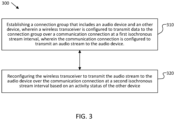
- FIG. 3 depicts a schematic flow diagram of a method 300 for automatically switching a mode of the isochronous adaption layer.
- Method 300 may implement any of the features of the automatic switching discussed above, including with respect to FIGs. 1-2 .
- Method 300 includes, at 310, establishing a connection group that includes an audio device and an other device, wherein a wireless transceiver is configured to transmit data to the connection group over a communication connection at a first isochronous stream interval, wherein the communication connection is configured to transmit an audio stream to the audio device.
- Method 300 also includes, at 320, reconfiguring the wireless transceiver to transmit the audio stream to the audio device over the communication connection at a second isochronous stream interval based on an activity status of the other device.
- Example 1 is an apparatus including a wireless transceiver configurable to communicate with external devices using a Bluetooth low-energy connection.
- the apparatus also includes a communication controller configured to establish via the wireless transceiver a connection group that includes a listening device and an other device, wherein the wireless transceiver is configured to transmit data packets to the connection group using a communication connection in a data packet mode.
- the communication controller is also configured to determine a reconfiguration of the communication connection based on an activity status of the other device within the connection group, wherein the reconfiguration includes changing the data packet mode of the communication connection to a second data packet mode.
- the communication controller is also configured to cause the wireless transceiver to transmit the data packets over the communication connection in the second data packet mode.
- Example 2 is the apparatus of example 1, wherein the connection group includes a Bluetooth low energy isochronous group, wherein the communication connection includes an isochronous adaption layer.
- Example 3 is the apparatus of either of examples 1 or 2, wherein the data packet mode includes a framed mode and the second data packet mode includes an unframed mode.
- Example 4 is the apparatus of example 3, wherein the framed mode includes data packet transmissions that occur at a first isochronous interval without segmentation, wherein the unframed mode includes data packet transmissions that occur at a second isochronous interval, wherein the first isochronous interval is different from the second isochronous interval.
- Example 5 is the apparatus of any of examples 1 to 4, wherein the reconfiguration includes changing an isochronous stream interval between a first isochronous interval and a second isochronous interval.
- Example 6 is the apparatus of example 5, wherein the first isochronous interval includes 7.5 ms and the second isochronous interval includes 10 ms.
- Example 7 is the apparatus of any of examples 1 to 6, wherein the activity status of the other device includes whether the other device is in an idle mode, whether the other device is in a low-power mode, or whether the other device is scheduled for communicating data packets over the communication connection.
- Example 8 is the apparatus of any of examples 1 to 7, wherein the communication controller is configured to wait to cause the wireless transceiver to transmit the data packets over the communication connection in the second data packet mode until after an acknowledgement is received from the listening device.
- Example 9 is the apparatus of any of examples 1 to 8, wherein the data packets include streaming audio data packets.
- Example 10 is the apparatus of any of examples 1 to 9, wherein the listening device includes a hearing aid, a headset, or a speaker.
- Example 11 is the apparatus of any of examples 1 to 10, wherein the other device includes a wireless mouse, a wireless keyboard, or other wireless peripheral device.
- Example 12 is the apparatus of any of examples 1 to 11, wherein the data packets include audio data packets that have been encapsulated into a protocol data unit (PDU), wherein each of the audio data packets include a service data unit (SDU) of streaming audio data.
- PDU protocol data unit
- SDU service data unit
- Example 13 is the apparatus of any of examples 1 to 12, wherein the communication controller configured to cause the wireless transceiver to transmit the data packets over the communication connection in the second data packet mode includes the communication controller configured to transmit a mode switch indicator to the wireless transceiver to change the communication connection from the first data packet mode to the second data packet mode.
- Example 14 is the apparatus of example 13, wherein each packet of the data packets includes a header and a payload, wherein the header includes the mode switch indicator.
- Example 15 is the apparatus of example 14, wherein the mode switch indicator of one packet of the data packets is configured to indicate the reconfiguration for a subsequent packet of the data packets.
- Example 16 is a non-transitory computer-readable medium including instructions that, when executed, cause one or more processors to establish a connection group that includes an audio device and an other device, wherein a wireless transceiver is configured to transmit data to the connection group over a communication connection at a first isochronous stream interval, wherein the communication connection is configured to transmit an audio stream to the audio device.
- the instructions also cause the one or more processors to reconfigure the wireless transceiver to transmit the audio stream to the audio device over the communication connection at a second isochronous stream interval based on an activity status of the other device.
- Example 17 is the non-transitory computer-readable medium of example 16, wherein the first isochronous stream interval is associated with a framed, unsegmented mode for transmitting data to the other device; wherein the second isochronous stream interval is associated with an unframed mode for transmitting the packet data units of the audio stream over the communication connection.
- Example 18 is the non-transitory computer-readable medium of either of examples 16 or 17, wherein the first isochronous stream interval is based on a frame rate of data communications of the other device over the communication connection.
- Example 19 is the non-transitory computer-readable medium of any of examples 16 to 18, wherein the second isochronous stream interval is based on a frame rate of the audio stream.
- Example 20 is the non-transitory computer-readable medium of any of examples 16 to 19, wherein the instructions that cause the one or more processors to reconfigure the wireless transceiver to transmit the audio stream to the audio device over the communication connection at the second isochronous stream interval includes that the instructions cause the one or more processors to indicate a toggling between the first isochronous stream interval and the second isochronous stream interval via a reserved bit in a header of at least one of the data packets.
Landscapes
- Engineering & Computer Science (AREA)
- Computer Networks & Wireless Communication (AREA)
- Signal Processing (AREA)
- Mobile Radio Communication Systems (AREA)
Priority Applications (3)
| Application Number | Priority Date | Filing Date | Title |
|---|---|---|---|
| EP23184982.9A EP4492834A1 (de) | 2023-07-12 | 2023-07-12 | Automatische isochrone adaptionsschichtmodusumschaltung |
| CN202311726589.9A CN119316914A (zh) | 2023-07-12 | 2023-12-15 | 自动等时自适应层模式切换 |
| US18/391,757 US20250024524A1 (en) | 2023-07-12 | 2023-12-21 | Automatic isochronous adaption layer mode switching |
Applications Claiming Priority (1)
| Application Number | Priority Date | Filing Date | Title |
|---|---|---|---|
| EP23184982.9A EP4492834A1 (de) | 2023-07-12 | 2023-07-12 | Automatische isochrone adaptionsschichtmodusumschaltung |
Publications (1)
| Publication Number | Publication Date |
|---|---|
| EP4492834A1 true EP4492834A1 (de) | 2025-01-15 |
Family
ID=87280759
Family Applications (1)
| Application Number | Title | Priority Date | Filing Date |
|---|---|---|---|
| EP23184982.9A Pending EP4492834A1 (de) | 2023-07-12 | 2023-07-12 | Automatische isochrone adaptionsschichtmodusumschaltung |
Country Status (3)
| Country | Link |
|---|---|
| US (1) | US20250024524A1 (de) |
| EP (1) | EP4492834A1 (de) |
| CN (1) | CN119316914A (de) |
Citations (2)
| Publication number | Priority date | Publication date | Assignee | Title |
|---|---|---|---|---|
| WO2023027407A1 (en) * | 2021-08-23 | 2023-03-02 | Samsung Electronics Co., Ltd. | A system and method for managing audio quality in a low energy audio broadcast scenario |
| CN116233812A (zh) * | 2023-02-03 | 2023-06-06 | 国芯科技(广州)有限公司 | 一种蓝牙通信网络音频产生周期调整方法 |
Family Cites Families (2)
| Publication number | Priority date | Publication date | Assignee | Title |
|---|---|---|---|---|
| EP3883259A4 (de) * | 2018-12-24 | 2021-12-15 | Huawei Technologies Co., Ltd. | Auf die umschaltung der monauralen und binauralen modi eines tws-ohrhörers angewendete audiodatenübertragungsverfahren und -vorrichtung |
| JP2023157732A (ja) * | 2022-04-15 | 2023-10-26 | キヤノン株式会社 | 通信装置およびその制御方法 |
-
2023
- 2023-07-12 EP EP23184982.9A patent/EP4492834A1/de active Pending
- 2023-12-15 CN CN202311726589.9A patent/CN119316914A/zh active Pending
- 2023-12-21 US US18/391,757 patent/US20250024524A1/en active Pending
Patent Citations (2)
| Publication number | Priority date | Publication date | Assignee | Title |
|---|---|---|---|---|
| WO2023027407A1 (en) * | 2021-08-23 | 2023-03-02 | Samsung Electronics Co., Ltd. | A system and method for managing audio quality in a low energy audio broadcast scenario |
| CN116233812A (zh) * | 2023-02-03 | 2023-06-06 | 国芯科技(广州)有限公司 | 一种蓝牙通信网络音频产生周期调整方法 |
Non-Patent Citations (2)
| Title |
|---|
| BLUETOOTH CORE SPECIFICATION, vol. 6, 31 December 2019 (2019-12-31) |
| WOOLLEY MARTIN: "Bluetooth Core Specification Version 5.2 Feature Overview", 9 December 2020 (2020-12-09), XP093004072, Retrieved from the Internet <URL:https://www.bluetooth.com/wp-content/uploads/2020/01/Bluetooth_5.2_Feature_Overview.pdf> [retrieved on 20221201] * |
Also Published As
| Publication number | Publication date |
|---|---|
| US20250024524A1 (en) | 2025-01-16 |
| CN119316914A (zh) | 2025-01-14 |
Similar Documents
| Publication | Publication Date | Title |
|---|---|---|
| US12192894B2 (en) | Multi-link hibernation mode for WLAN | |
| EP1678892B1 (de) | Verfahren und vorrichtung zur datenkommunikation über mehrere kanäle | |
| US9635493B2 (en) | Audio transfer using the bluetooth low energy standard | |
| US11895589B2 (en) | Power-efficient communication of group-addressed frames | |
| US9531501B2 (en) | Data transfer between electronic devices | |
| US12207071B2 (en) | Method and system for transmitting audio data, TWS earphone pair, chip and medium | |
| KR101832718B1 (ko) | 컴퓨팅 디바이스들에서의 전력 절약 기술들 | |
| US20200252875A1 (en) | Power consumption control method and apparatus | |
| WO2022042600A1 (zh) | 一种通信方法、装置及系统 | |
| WO2022001175A1 (zh) | 数据包发送的方法、装置 | |
| WO2017091994A1 (zh) | 数据发送方法、装置和终端 | |
| CN115996217A (zh) | 一种发送和/或接收音频信息的无线通信方法及存储介质 | |
| CN118104289A (zh) | 用于无线网络中拥塞控制的方法、设备和系统 | |
| EP3657851B1 (de) | Verfahren und vorrichtung zur kontrolle des leistungsverbrauchs | |
| EP4492834A1 (de) | Automatische isochrone adaptionsschichtmodusumschaltung | |
| WO2025001119A1 (zh) | 多天线信息发射方法、网络设备及存储介质 | |
| US12574844B2 (en) | Method for data obtaining and communication device | |
| US11064435B1 (en) | Rapid sync up mechanism for traffic control between two systems | |
| CN111224758B (zh) | 一种重复传输指示方法、基站及终端 | |
| US20200413334A1 (en) | Transmit optimizations for increased power savings on low power nodes | |
| EP4366179A1 (de) | Funkübertragungsverwaltung in multimodemkonfigurationen | |
| WO2022217528A1 (en) | Methods, devices, and systems for configuring group-based bandwidth part switch | |
| CN115052330A (zh) | 上行传输功率的控制方法、装置、终端及存储介质 | |
| KR20160094024A (ko) | 단말 및 단말의 전력 관리 방법 |
Legal Events
| Date | Code | Title | Description |
|---|---|---|---|
| PUAI | Public reference made under article 153(3) epc to a published international application that has entered the european phase |
Free format text: ORIGINAL CODE: 0009012 |
|
| STAA | Information on the status of an ep patent application or granted ep patent |
Free format text: STATUS: THE APPLICATION HAS BEEN PUBLISHED |
|
| AK | Designated contracting states |
Kind code of ref document: A1 Designated state(s): AL AT BE BG CH CY CZ DE DK EE ES FI FR GB GR HR HU IE IS IT LI LT LU LV MC ME MK MT NL NO PL PT RO RS SE SI SK SM TR |
|
| STAA | Information on the status of an ep patent application or granted ep patent |
Free format text: STATUS: REQUEST FOR EXAMINATION WAS MADE |
|
| 17P | Request for examination filed |
Effective date: 20250715 |
|
| STAA | Information on the status of an ep patent application or granted ep patent |
Free format text: STATUS: EXAMINATION IS IN PROGRESS |
|
| 17Q | First examination report despatched |
Effective date: 20251106 |