EP4492883A1 - Messverfahren, empfänger und speichermedium - Google Patents
Messverfahren, empfänger und speichermedium Download PDFInfo
- Publication number
- EP4492883A1 EP4492883A1 EP23841784.4A EP23841784A EP4492883A1 EP 4492883 A1 EP4492883 A1 EP 4492883A1 EP 23841784 A EP23841784 A EP 23841784A EP 4492883 A1 EP4492883 A1 EP 4492883A1
- Authority
- EP
- European Patent Office
- Prior art keywords
- different moments
- multipath signals
- path signal
- arrival
- receiver
- Prior art date
- Legal status (The legal status is an assumption and is not a legal conclusion. Google has not performed a legal analysis and makes no representation as to the accuracy of the status listed.)
- Pending
Links
Images


Classifications
-
- H—ELECTRICITY
- H04—ELECTRIC COMMUNICATION TECHNIQUE
- H04W—WIRELESS COMMUNICATION NETWORKS
- H04W4/00—Services specially adapted for wireless communication networks; Facilities therefor
- H04W4/02—Services making use of location information
- H04W4/025—Services making use of location information using location based information parameters
-
- G—PHYSICS
- G01—MEASURING; TESTING
- G01S—RADIO DIRECTION-FINDING; RADIO NAVIGATION; DETERMINING DISTANCE OR VELOCITY BY USE OF RADIO WAVES; LOCATING OR PRESENCE-DETECTING BY USE OF THE REFLECTION OR RERADIATION OF RADIO WAVES; ANALOGOUS ARRANGEMENTS USING OTHER WAVES
- G01S7/00—Details of systems according to groups G01S13/00, G01S15/00, G01S17/00
- G01S7/003—Transmission of data between radar, sonar or lidar systems and remote stations
- G01S7/006—Transmission of data between radar, sonar or lidar systems and remote stations using shared front-end circuitry, e.g. antennas
-
- G—PHYSICS
- G01—MEASURING; TESTING
- G01S—RADIO DIRECTION-FINDING; RADIO NAVIGATION; DETERMINING DISTANCE OR VELOCITY BY USE OF RADIO WAVES; LOCATING OR PRESENCE-DETECTING BY USE OF THE REFLECTION OR RERADIATION OF RADIO WAVES; ANALOGOUS ARRANGEMENTS USING OTHER WAVES
- G01S13/00—Systems using the reflection or reradiation of radio waves, e.g. radar systems; Analogous systems using reflection or reradiation of waves whose nature or wavelength is irrelevant or unspecified
- G01S13/74—Systems using reradiation of radio waves, e.g. secondary radar systems; Analogous systems
- G01S13/76—Systems using reradiation of radio waves, e.g. secondary radar systems; Analogous systems wherein pulse-type signals are transmitted
-
- G—PHYSICS
- G01—MEASURING; TESTING
- G01S—RADIO DIRECTION-FINDING; RADIO NAVIGATION; DETERMINING DISTANCE OR VELOCITY BY USE OF RADIO WAVES; LOCATING OR PRESENCE-DETECTING BY USE OF THE REFLECTION OR RERADIATION OF RADIO WAVES; ANALOGOUS ARRANGEMENTS USING OTHER WAVES
- G01S13/00—Systems using the reflection or reradiation of radio waves, e.g. radar systems; Analogous systems using reflection or reradiation of waves whose nature or wavelength is irrelevant or unspecified
- G01S13/003—Bistatic radar systems; Multistatic radar systems
-
- G—PHYSICS
- G01—MEASURING; TESTING
- G01S—RADIO DIRECTION-FINDING; RADIO NAVIGATION; DETERMINING DISTANCE OR VELOCITY BY USE OF RADIO WAVES; LOCATING OR PRESENCE-DETECTING BY USE OF THE REFLECTION OR RERADIATION OF RADIO WAVES; ANALOGOUS ARRANGEMENTS USING OTHER WAVES
- G01S13/00—Systems using the reflection or reradiation of radio waves, e.g. radar systems; Analogous systems using reflection or reradiation of waves whose nature or wavelength is irrelevant or unspecified
- G01S13/02—Systems using reflection of radio waves, e.g. primary radar systems; Analogous systems
- G01S13/06—Systems determining position data of a target
- G01S13/46—Indirect determination of position data
-
- G—PHYSICS
- G01—MEASURING; TESTING
- G01S—RADIO DIRECTION-FINDING; RADIO NAVIGATION; DETERMINING DISTANCE OR VELOCITY BY USE OF RADIO WAVES; LOCATING OR PRESENCE-DETECTING BY USE OF THE REFLECTION OR RERADIATION OF RADIO WAVES; ANALOGOUS ARRANGEMENTS USING OTHER WAVES
- G01S13/00—Systems using the reflection or reradiation of radio waves, e.g. radar systems; Analogous systems using reflection or reradiation of waves whose nature or wavelength is irrelevant or unspecified
- G01S13/87—Combinations of radar systems, e.g. primary radar and secondary radar
- G01S13/878—Combination of several spaced transmitters or receivers of known location for determining the position of a transponder or a reflector
-
- G—PHYSICS
- G01—MEASURING; TESTING
- G01S—RADIO DIRECTION-FINDING; RADIO NAVIGATION; DETERMINING DISTANCE OR VELOCITY BY USE OF RADIO WAVES; LOCATING OR PRESENCE-DETECTING BY USE OF THE REFLECTION OR RERADIATION OF RADIO WAVES; ANALOGOUS ARRANGEMENTS USING OTHER WAVES
- G01S5/00—Position-fixing by co-ordinating two or more direction or position line determinations; Position-fixing by co-ordinating two or more distance determinations
- G01S5/02—Position-fixing by co-ordinating two or more direction or position line determinations; Position-fixing by co-ordinating two or more distance determinations using radio waves
- G01S5/0273—Position-fixing by co-ordinating two or more direction or position line determinations; Position-fixing by co-ordinating two or more distance determinations using radio waves using multipath or indirect path propagation signals in position determination
-
- H—ELECTRICITY
- H04—ELECTRIC COMMUNICATION TECHNIQUE
- H04W—WIRELESS COMMUNICATION NETWORKS
- H04W4/00—Services specially adapted for wireless communication networks; Facilities therefor
- H04W4/02—Services making use of location information
- H04W4/029—Location-based management or tracking services
-
- G—PHYSICS
- G01—MEASURING; TESTING
- G01S—RADIO DIRECTION-FINDING; RADIO NAVIGATION; DETERMINING DISTANCE OR VELOCITY BY USE OF RADIO WAVES; LOCATING OR PRESENCE-DETECTING BY USE OF THE REFLECTION OR RERADIATION OF RADIO WAVES; ANALOGOUS ARRANGEMENTS USING OTHER WAVES
- G01S13/00—Systems using the reflection or reradiation of radio waves, e.g. radar systems; Analogous systems using reflection or reradiation of waves whose nature or wavelength is irrelevant or unspecified
- G01S13/02—Systems using reflection of radio waves, e.g. primary radar systems; Analogous systems
- G01S13/06—Systems determining position data of a target
- G01S13/46—Indirect determination of position data
- G01S2013/462—Indirect determination of position data using multipath signals
- G01S2013/464—Indirect determination of position data using multipath signals using only the non-line-of-sight signal(s), e.g. to enable survey of scene 'behind' the target only the indirect signal is evaluated
-
- G—PHYSICS
- G01—MEASURING; TESTING
- G01S—RADIO DIRECTION-FINDING; RADIO NAVIGATION; DETERMINING DISTANCE OR VELOCITY BY USE OF RADIO WAVES; LOCATING OR PRESENCE-DETECTING BY USE OF THE REFLECTION OR RERADIATION OF RADIO WAVES; ANALOGOUS ARRANGEMENTS USING OTHER WAVES
- G01S13/00—Systems using the reflection or reradiation of radio waves, e.g. radar systems; Analogous systems using reflection or reradiation of waves whose nature or wavelength is irrelevant or unspecified
- G01S13/02—Systems using reflection of radio waves, e.g. primary radar systems; Analogous systems
- G01S13/06—Systems determining position data of a target
- G01S13/46—Indirect determination of position data
- G01S2013/466—Indirect determination of position data by Trilateration, i.e. two antennas or two sensors determine separately the distance to a target, whereby with the knowledge of the baseline length, i.e. the distance between the antennas or sensors, the position data of the target is determined
-
- G—PHYSICS
- G01—MEASURING; TESTING
- G01S—RADIO DIRECTION-FINDING; RADIO NAVIGATION; DETERMINING DISTANCE OR VELOCITY BY USE OF RADIO WAVES; LOCATING OR PRESENCE-DETECTING BY USE OF THE REFLECTION OR RERADIATION OF RADIO WAVES; ANALOGOUS ARRANGEMENTS USING OTHER WAVES
- G01S13/00—Systems using the reflection or reradiation of radio waves, e.g. radar systems; Analogous systems using reflection or reradiation of waves whose nature or wavelength is irrelevant or unspecified
- G01S13/02—Systems using reflection of radio waves, e.g. primary radar systems; Analogous systems
- G01S13/06—Systems determining position data of a target
- G01S13/46—Indirect determination of position data
- G01S2013/468—Indirect determination of position data by Triangulation, i.e. two antennas or two sensors determine separately the bearing, direction or angle to a target, whereby with the knowledge of the baseline length, the position data of the target is determined
Definitions
- Embodiments of the present application relate to, but not limited to, the field of communications, in particular to a sensing method, a receiver and a storage medium.
- a wireless communication network satisfies ubiquity, and thus, implementing ubiquitous sensing through the wireless communication network becomes a main feasible technical route.
- Ubiquitous sensing needs to implement sensing under various complex scenes, for example, a multipath environment, however, sensing of the multipath environments is researched less at present, and a commercial sensing technology is much less, and sensing of the multipath environments is a research focus both in aspects of standardization and education circles, and is in the early stage of technical breakthrough.
- how to implement sensing in the current environment in the multipath environments becomes an urgent technical problem to be solved.
- Embodiments of the present application provide a sensing method, a receiver and a storage medium.
- a current environment may be sensed by using multipath signals in multipath environment.
- an embodiment of the present application provides a sensing method, including: determining, according to multipath signals received at different moments, arrival times and arrival angles of the multipath signals at different moments; obtaining, according to the arrival times at different moments, propagation distances of the multipath signals at different moments; obtaining, according to the arrival angles and the propagation distances at different moments, sensing results of a plurality of objects in a current environment at different moments; and determining, according to the sensing results at different moments, whether positions of the plurality of objects in the current environment have changed.
- an embodiment of the present application provides a receiver, including: a memory, a processor, and a computer program stored on the memory and capable of running on the processor, where the processor, when executing the computer program, implements the sensing method according to the above first aspect.
- an embodiment of the present application provides a computer readable storage medium, storing a computer executable program, where the computer executable program is used to enable a computer to execute the sensing method according to the above first aspect.
- the embodiments of the present application include: determining, according to multipath signals received at different moments, arrival times and arrival angles of the multipath signals at different moments; obtaining, according to the arrival times at different moments, propagation distances of the multipath signals at different moments; obtaining, according to the arrival angles and the propagation distances at different moments, sensing results of a plurality of objects in a current environment at different moments; and determining, according to the sensing results at different moments, whether positions of the plurality of objects in the current environment have changed.
- the multipath signals received at different moments are analyzed and calculated to obtain the arrival times and the arrival angles of the multipath signals at different moments, then the propagation distances of the multipath signals at different moments are determined according to the arrival times and the arrival angles at different moments, the sensing results of the plurality of objects in the current environment at different moments are obtained according to the arrival angles and the propagation distances at different moments, and a sensing result at a current moment is compared with a sensing result at a previous moment, so as to determine whether the positions of the plurality of objects in the current environment have changed.
- the sensing method of the present application is used to analyze the multipath signals received at different moments, and thus sense the current environment by using the multipath signals in the multipath environment.
- a plurality refers to more than two, greater, less, exceeding, etc. are understood as not including the number, and above, below, within, etc. are understood as including the number.
- descriptions of “first”, “second”, etc. are merely intended to distinguish technical features, “first”, “second”, etc. may not be understood as indicating or implying a relative importance or implicitly indicating the number of indicated technical features or implicitly indicating a precedence relationship of indicated technical features.
- a ubiquitous intelligent technology mainly includes a ubiquitous sensing technology, a ubiquitous computing technology, product research and development, etc.
- the ubiquitous intelligence needs a ubiquitous system, however, in a current deployed system, merely the wireless communication network meets the ubiquity, and thus, implementing ubiquitous sensing and ubiquitous computing by using the wireless communication network becomes a main feasible technical route.
- a deep research is mainly implemented in a field of radars, however, at present, application scenes of radar devices are mainly sensing of planes in the air, such as airport radar; and short-distance sensing, such as vehicle radar. These two scenes both belong to simple scenes.
- the ubiquitous sensing needs to be implemented at various complex scenes, such as an indoor multipath environment, a ground multi-infrastructure environment, a multi-vehicle environment and a market multi-user environment.
- the sensing of the multipath environments is researched less at present, and the commercial sensing technology is much less.
- the sensing of the multipath environments is a research focus both in aspects of standardization and education circles, and is in the early stage of technical breakthrough. Thus, how to implement sensing in the current environment in the multipath environments becomes an urgent technical problem to be solved.
- an embodiment of the present application provides a sensing method, a receiver and a computer readable storage medium.
- the sensing method of one of embodiments according to multipath signals received at different moments, arrival times and arrival angles of the multipath signals at different moments are determined; according to the arrival times at different moments, propagation distances of the multipath signals at different moments are obtained; according to the arrival angles and the propagation distances at different moments, sensing results of a plurality of objects in a current environment at different moments are obtained; and according to the sensing results at different moments, whether positions of the plurality of objects in the current environment have changed is determined.
- the multipath signals received at different moments are analyzed and calculated to obtain the arrival times and the arrival angles of the multipath signals at different moments, then the propagation distances of the multipath signals at different moments are determined according to the arrival times and the arrival angles at different moments, the sensing results of the plurality of objects in the current environment at different moments are obtained according to the arrival angles and the propagation distances at different moments, and a sensing result at a current moment is compared with a sensing result at a previous moment, so as to determine whether the positions of the plurality of objects in the current environment have changed.
- the sensing method of the present application is used to analyze the multipath signals received at different moments, and thus sense the current environment by using the multipath signals in the multipath environment.
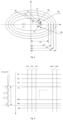
- FIG. 1A is a schematic diagram of an implementing environment for executing a sensing method provided by an embodiment of the present application.
- the implementing environment includes a transmitter BS and a receiver Br, where the transmitter BS is responsible for transmitting multipath signals, the receiver Br is responsible for receiving the multipath signals, and a direct path may exist or may not exist between the transmitter BS and the receiver Br.
- P1, P2 and P5 are walls, P3 is a person, P4 is a fixed object, the transmitter BS transmits the multipath signals at a Tn moment, where a signal of a first path is reflected to the receiver Br by P1, and an arrival time and an arrival angle of the signal of the first path received by the receiver Br are respectively t1 and ⁇ 1 ; a signal of a second path is reflected to the receiver Br by P2, and an arrival time and an arrival angle of the signal of the second path received by the receiver Br are respectively t2 and ⁇ 2 ; a signal of a third path is reflected to the receiver Br by P3, and an arrival time and an arrival angle of the signal of the third path received by the receiver Br are respectively t3 and ⁇ 3 ; and a signal of a fourth path is reflected to the receiver Br by P4, and an arrival time and an arrival angle of the signal of the fourth path received by the receiver Br are respectively t4 and ⁇ 4 .
- the multipath signals include, but are not
- Fig. 1A does not constitute limitations on the embodiment of the present application, and may include components more or less than those in the diagram, or combination of some components, or different arrangement of components.
- Fig. 1B is a flowchart of a sensing method provided by an embodiment of the present application.
- the sensing method may be applied to a receiver, and the receiver includes but is not limited to a reception base station and a multi-antenna receiver.
- the sensing method includes but is not limited to the following steps.
- step S101 arrival times and arrival angles of multipath signals at different moments are determined according to the multipath signals received at different moments.
- step S102 propagation distances of the multipath signals at different moments are obtained according to the arrival times at different moments.
- step S103 sensing results of a plurality of objects in a current environment at different moments are obtained according to the arrival angles and the propagation distances at different moments.
- step S104 whether positions of the plurality of objects in the current environment have changed is determined according to the sensing results at different moments.
- a multi-antenna receiver is taken as the receiver as an example, the multipath signals received at different moments are analyzed and calculated by the multi-antenna receiver to obtain the arrival times and the arrival angles of the multipath signals at different moments, then the propagation distances of the multipath signals at different moments are determined according to the arrival times and the arrival angles at different moments, the sensing results of the plurality of objects in the current environment at different moments are obtained according to the arrival angles and the propagation distances at different moments, and the sensing result at the current moment is compared with the sensing result at the previous moment, so as to determine whether the positions of the plurality of objects in the current environment have changed. Based on this, compared with the prior art, the sensing method of the present application is used to analyze the multipath signals received at different moments, and thus sense the current environment by using the multipath signals in the multipath environment.
- the transmitter transmits multipath signals S at a set time Tn and on a wireless resource.
- the receiver receives multipath signals R i reflected to the receiver by objects in the environment, i ⁇ 1, and arrival times t i and arrival angles ⁇ i of the multipath signals are calculated, where i is the number of paths of the received multipath signals.
- the receiver calculates time-domain impact responses of the multipath signals received at different moments to obtain an impact response sequence, then calculates the arrival times t i and a time interval where time-domain impact responses of distributed arrival times are located correspondingly according to the impact response sequence, and then determines the arrival angle ⁇ i of each path signal of the multipath signals according to the time interval.
- the wireless resource includes but is not limited to time-domain and frequency-domain resources allocated by taking a symbol as a unit, taking a subcarrier as a unit or taking a frame as a unit, etc.
- the transmitter and the receiver complete clock synchronization before the multipath signals are transmitted by the transmitter.
- Completion of the clock synchronization by the transmitter and the receiver refers to that the transmitter and the receiver have completed synchronization, and have implemented clock synchronization.
- the transmitter and the receiver do not complete synchronization, information such as a clock difference of the transmitter and the receiver and hardware link time delay needs to be measured, the synchronization correction amount is obtained through calculation, and the correction amount is used to correct the received arrival time, so as to implement clock synchronization.
- the arrival time t i of the present application refers to the corrected arrival time.
- multipath signals reflected to the multi-antenna receiver by objects in an environment are received by the multi-antenna receiver, time-domain impact responses of the multipath signals received by multi antennas are analyzed and calculated by the multi-antenna receiver, according to the impact response sequence, the arrival times t i of the multipath signals and the time interval where time-domain impact responses of distributed arrival times t i of the multipath signals are located correspondingly;, and then multi-antenna data are obtained according to the time interval where the impact responses of the arrival time t i of the multipath signals are correspondingly located to analyze the arrival angle ⁇ i of each path.
- the time interval is a time interval whose time-domain response energy or frequency-domain response energy exceeds a first threshold value
- a specific value of the first threshold value may be set differently according to different application scenes.
- the specific value of the first threshold value is not limited to the present application.
- data of the time-domain time corresponding to the time-domain impact responses of each antenna of the receiver may be read according to the time-domain time of each path signal, and angle estimation is performed on the data of the time-domain time corresponding to the time-domain impact responses of each antenna to obtain the arrival angle of each path signal.
- a virtual ellipse is generated by taking a position of the transmitter and a position of the receiver as two focal points, and taking d i /2 as a semi-major axis, d i is the propagation distance at the current moment; and by taking the position of the receiver as an origin of coordinates and according to the arrival angle ⁇ i of each path signal, a virtual straight line is made for extension until the virtual straight line and the virtual ellipse generate a virtual point of intersection, and the virtual point of intersection is a reflecting point position P i of each path signal at the current moment.
- four virtual ellipses are generated by taking the position of the transmitter BS and the position of the receiver Br as the two focal points, and respectively taking the propagation distances d 1 /2, d 2 /2, d 3 /2 and d 4 /2 as the semi-major axes, the position of the receiver Br is taken as the origin of coordinates, four virtual straight line are respectively made according to the arrival angles ⁇ i ⁇ 2 , ⁇ 3 and ⁇ 4 of four-path signals for extension until the four virtual straight lines and the four virtual ellipses respectively generate four virtual points of intersection, and the four virtual points of intersection are respectively the reflecting point positions P 1 , P 2 , P 3 and P 4 of the four-path signals at the Tn moment.
- the reflecting point positions P i of each path signal at different moments are determined according to the arrival angles ⁇ i at different moments, the propagation distances d i at different moments, the position of the transmitter, and the position of the receiver, and the sensing results include the reflecting point positions P i .
- b 2 c 2 -(d i / 2) 2
- d i is a propagation distance of an i th path signal at the current moment
- c is half of a distance between the position of the transmitter and the position of the receiver
- (x, y) is reflecting point position coordinates of the i th path signal at the current moment
- ⁇ i is an arrival angle of the i th path signal at the current moment
- (x r ,y r ) is position coordinates of the receiver
- C 1 is a first coefficient
- C 2 is a second coefficient.
- a value of the first coefficient C 1 may be determined; in a case that the position coordinates (x r ,y r ) of the receiver are determined, a value of the second coefficient C 2 may be determined in combination with the value of the first coefficient C 1 ; and in a case that the value of the first coefficient C 1 and the value of the second coefficient C 2 are both determined, the coordinates (x, y) of the reflecting point position P i may be solved.
- the sensing result A Tn ⁇ i , d i , P i , i ⁇ 1 ⁇ at the Tn moment is recorded.
- the sensing result A Tn at the current moment in a case that the sensing result A Tn at the current moment is consistent with the sensing result A Tn-1 at the previous moment, it is determined that positions of the plurality of objects in the current environment have not changed. In a case that the sensing result A Tn at the current moment is inconsistent with the sensing result A Tn- 1 at the previous moment, it is determined that a position of at least one object in the current environment has changed.
- the situation that the position of at least one object in the current environment has changed may include a new object appearing in the current environment.
- a movement trajectory of the new object may be determined according to a coordinate position of the new object at the current moment and a coordinate position of the new object at the previous moment. After the movement trajectory of the new object is determined, the movement trajectory of the new object may be fitted and smoothed through filtering and interpolation. It needs to be noted that a specific value of the second threshold value may be set differently according to different application scenes, and the specific value of the second threshold value is not limited to the present application.
- the sensing method of the present application is adopted to sense the plurality of objects by using the multipath signals in the multipath environment, meanwhile, a moving object may be sensed, and a static object may also be sensed. It can be known that the present application may overcome the problems such as the multipath influence and low speed in a complex environment, so as to implement wireless sensing on the moving object and the static object.
- the step S101 may include but is not limited to the following sub-steps.
- step S401 the impact response sequence is obtained by caculating the time-domain impact responses of the multipath signals received at different moments.
- step S402 the arrival times and the time interval where the time-domain impact responses of distributed arrival times are correspondingly located are determined according to the impact response sequence.
- step S403 the arrival angle of each path signal of the multipath signals is determined according to the time interval.
- multipath signals reflected to a multi-antenna receiver by objects in an environment are received by the multi-antenna receiver, for example, the time-domain impact responses of the multipath signals received respectively by multiantennas Anti, Ant2, Ant3...AntN-1, and AntN are analyzed and calculated by the multi-antenna receiver, according to the impact response sequence, the arrival times t i of the multipath signals are determined, for example, the arrival times of each path signal are St1, St2, St3, St4...StM-2, StM-1 and StM respectively, where St4...StM-2 and StM-1 respectively correspond to the signals with the time-domain response energy exceeding the threshold 1, multi-antenna data is obtained according to the time interval whose time-domain response energy exceeds the threshold 1 to analyze the arrival angles ⁇ i of the corresponding multipath signals, that is to say, the receiver only calculates the arrival angle ⁇ i of the multipath signals whose time-domain response
- the time-domain impact responses are obtained by performing time-domain mathematical processing on the multipath signals received by the receiver and the multipath signals transmitted by the transmitter, or obtained by transforming the multipath signals received by the receiver from a time domain to a frequency domain, obtaining each second subcarrier data by multiplying each first subcarrier data of the multipath signals by a conjugate of frequency-domain data of multipath signals transmitted by a transmitter, and then transforming each second subcarrier data to the time domain.
- a specific value of the threshold 1 may be set differently according to different application scenes, and the specific value of the threshold 1 is not limited to the present application.
- the step S403 may include but is not limited to the following sub-steps.
- step S501 data of the time-domain time corresponding to a time-domain impact response of each antenna of the receiver is read according to time-domain time of each path signal.
- step S502 the arrival angle of each path signal is obtained by performing an angle estimation on the data of the time-domain time corresponding to the time-domain impact response of each antenna.
- the data of the time-domain time corresponding to the time-domain impact response of each antenna of the receiver is read according to time-domain time of each path signal, and angle estimation is performed to obtain the arrival angle ⁇ i of each path signal.
- Step S103 may include but is not limited to the following sub-steps.
- step S1031 the reflecting point positions of each path signal at different moments are determined according to the arrival angles at different moments, the propagation distances at different moments, the position of the transmitter, and the position of the receiver, where the sensing results include the reflecting point positions.
- the reflecting point position P i may be solved according to a mathematical equation set.
- the reflecting point position P i of each path signal at different moments may be determined according to the arrival angles ⁇ i at different moments, the propagation distances d i at different moments, the position of the transmitter, and the position of the receiver, and the sensing results include the reflecting point positions P i .
- b 2 c 2 -(d i / 2) 2
- d i is the propagation distance of the i th path signal at the current moment
- c half of the distance between the position of the transmitter and the position of the receiver
- (x, y) is coordinates of the reflecting point position of the i th path signal of the multipath signals at the current moment
- ⁇ i is the arrival angle of the i th path signal at the current moment
- ( x r , y r ) is the position coordinates of the receiver
- C 1 is the first coefficient
- C 2 is the second coefficient.
- the equation set is listed for solving through the ellipse expression and the linear expression, the point of intersection of the ellipse and the straight line may be obtained, and the coordinates of the point of intersection are the coordinates (x, y) of the reflecting point position P i .
- the value of the first coefficient C 1 may be determined; in a case that the position coordinates ( x r , y r ) of the receiver are determined, the value of the second coefficient C 2 may be determined in combination with the value of the first coefficient C 1 ; and in a case that the value of the first coefficient C 1 and the value of the second coefficient C 2 are both determined, the coordinates (x, y) of the reflecting point position P i may be solved.
- the sensing result A Tn ⁇ i , d i , P i , i ⁇ 1 ⁇ at the Tn moment is recorded.
- the step S1031 may include but is not limited to the following sub-steps.
- step S601 a virtual ellipse is generated by taking the position of the transmitter and the position of the receiver as focal points, and taking half of the propagation distance at the current moment as a semi-major axis.
- step S602 by taking the position of the receiver as an origin of coordinates and according to the arrival angles of each path signal, a virtual straight line is made for extension until the virtual straight line and the virtual ellipse generate a virtual point of intersection, and the virtual point of intersection is the reflecting point position of the each path signal at the current moment.
- the reflecting point position P i may be determined according to a geometry manner.
- a virtual ellipse is generated by taking the position of the transmitter and the position of the receiver as two focal points, and taking the propagation distance d i /2 at the current moment as a semi-major axis; and by taking the position of the receiver is taken as an origin of coordinates and according to the arrival angle ⁇ i of each path signal, a virtual straight line is made for extension until the virtual straight line and the virtual ellipse generate a virtual point of intersection, and the virtual point of intersection is the reflecting point position P i of each path signal of the multipath signals at the current moment.
- four virtual ellipses are generated by taking the position of the transmitter BS and the position of the receiver Br as the two focal points, and respectively taking the propagation distances d 1 /2, d 2 /2, d 3 /2 and d 4 /2 as the semi-major axes, by taking the position Br of the receiver is taken as the origin of coordinates and according to the arrival angles ⁇ i , ⁇ 2 , ⁇ 3 and ⁇ 4 of four of the multipath signals, four virtual straight line are respectively made for extension until the four virtual straight lines and the four virtual ellipses respectively generate four virtual points of intersection, and the four virtual points of intersection are respectively the reflecting point positions P 1 , P 2 , P 3 and P 4 of the four of the multipath signals at the Tn moment.
- the sensing result A Tn at the current moment in a case that the sensing result A Tn at the current moment is consistent with the sensing result A Tn-1 at the previous moment, it is determined that the positions of the plurality of objects in the current environment have not changed. In a case that the sensing result A Tn at the current moment is inconsistent with the sensing result A Tn-1 at the previous moment, it is determined that a position of at least one object in the current environment has changed.
- the situation that the position of at least one object in the current environment has changed may include a new object appearing in the current environment.
- a movement trajectory of the new object may be determined according to a coordinate position of the new object at the current moment and a coordinate position of the new object at the previous moment. After the movement trajectory of the new object is determined, the movement trajectory of the new object may be fitted and smoothed through filtering and interpolation. It needs to be noted that a specific value of the second threshold value may be set differently according to different application scenes, and the specific value of the second threshold value is not limited to the present application.
- the sensing method of the present application is adopted to sense the plurality of objects by using the multipath signals in the multipath environment, meanwhile, a moving object may be sensed, and a static object may also be sensed. It can be known that the present application may overcome the problems such as the multipath influence and low speed in a complex environment, so as to implement wireless sensing on the moving object and the static object.
- Embodiment one as shown in Fig. 7 , a situation that while a person walks around a room, positions at the Tn moment are inconsistent with those at the Tn+1 moment is taken as an example.
- LFM linear frequency modulation
- a frequency point is 3.5 GHz
- a bandwidth is 100 MHz
- a sampling rate is 122.88 MHz
- a signal transmitting power is 43 dBm
- a noise power is -94 dBm
- an 8*1 linear array of an antenna of a base station is received.
- a sensing signal is an LFM symbol, and is transmitted once every 5 ms.
- Each sampling point time is Ts.
- the first path is an LOS path
- the following equation set is listed for solving reflecting point coordinates (x, y).
- b 2 c 2 - ( d i / 2) 2
- d i is a propagation distance of an i th path signal at the current moment
- c half of a distance between the position of the transmitter and the position of the receiver
- (x, y) is coordinates of the reflecting point position of the i th path signal of the multipath signals at the current moment
- ⁇ i is an arrival angle of the i th path signal at the current moment
- ( x r , y r ) is position coordinates of the receiver
- C 1 is a first coefficient
- a value of the first coefficient C 1 may be determined; in a case that the position coordinates ( x r , y r ) of the receiver are determined, a value of the second coefficient C 2 may be determined in combination with the value of the first coefficient C 1 ; and in a case that the value of the first coefficient C 1 and the value of the second coefficient C 2 are both determined, the coordinates (x, y) of the reflecting point position P i may be solved.
- the sensing result A Tn ⁇ i , d i , P i , i ⁇ 1 ⁇ at the Tn moment is recorded.
- the different reflecting point coordinates at different moments are connected to obtain trajectories of the different reflecting points over a period of time.
- Embodiment two a situation that there is no person in the room at the Tn moment, but there is a person in the room at the Tn+1 moment is taken as an example.
- LFM signals are adopted as the multipath signals, a frequency point is 3.5 GHz, a bandwidth is 100 MHz, a sampling rate is 122.88 MHz, a signal transmitting power is 43 dBm, a noise power is -94 dBm, and an 8*1 linear array of an antenna of a base station is received.
- a sensing signal is as an LFM symbol, and is transmitted once every 5 ms. Time of each sampling point is Ts.
- a sensing flow is as follows:
- the first path is an LOS path
- the following equation set is listed for solving reflecting point coordinates (x, y).
- b 2 c 2 - ( d i / 2) 2
- d i is a propagation distance of an i th path signal at the current moment
- c half of a distance between the position of the transmitter and the position of the receiver
- (x, y) is coordinates of the reflecting point position of the i th path signal of the multipath signals at the current moment
- ⁇ i is an arrival angle of the i th path signal at the current moment
- ( x r ,y r ) is position coordinates of the receiver
- C 1 is a first coefficient
- C 2 1 a first
- a value of the first coefficient C 1 may be determined; in a case that the position coordinates ( x r , y r ) of the receiver are determined, a value of the second coefficient C 2 may be determined in combination with the value of the first coefficient C 1 ; and in a case that the value of the first coefficient C 1 and the value of the second coefficient C 2 are both determined, the coordinates (x, y) of the reflecting point position P i may be solved.
- the sensing result A Tn ⁇ i , d i , P i , i ⁇ 1 ⁇ at the Tn moment is recorded.
- the movement trajectory of the reflecting point is analyzed, in response to determining that one trajectory exists, no trajectory is recorded before the Tn moment, after the Tn moment, continuous moving is performed, a position distance at a neighboring moment is greater than the second threshold value, it is considered that there is no person in the room at the Tn moment, and there is a person in the room and the person moves at the Tn+1 moment.
- an embodiment of the present application further provides a receiver.
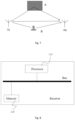
- the receiver includes: one or more processors 110 and a memory 120, and one processor 110 and the memory 120 are taken as an example in Fig. 8 .
- the processor 110 and the memory 120 may be connected through a bus or other manners, and connection through the bus is taken as an example in Fig. 8 .
- the memory 120 serves as a non-transient computer readable storage medium, and may be configured to store non-transient software programs and non-transient computer executable programs, such as the above sensing method in the embodiment of the present application.
- the processor 110 implements the above sensing method in the embodiment of the present application by running the non-transient software programs and programs stored in the memory 120.
- the memory 120 may include a storage program area and a storage data area, where the storage program area may store operation systems, and application programs needs by at least one function; and the storage data area may store data needed by executing the above sensing method in the embodiment of the present application and the like.
- the memory 120 may include a high-speed random access memory, and may further include a non-transient memory, for example, at least one magnetic disk storage apparatus, a flash storage device, or other non-transient solid-state memory.
- the memory 120 optionally includes a memory arranged remotely relative to the processor 110, and these remote memories may be connected to a terminal through a network. Instances of the above network include but are not limited to an internet, an intranet, a local area network, a mobile communication network and a combination of them.
- the non-transient software programs and programs needed by implementing the above sensing method in the embodiment of the present application are stored in the memory 120, when executed by one or more processors 110, implement the above sensing method in the embodiment of the present application, for example, implement the method step S101 to step S104 in the above Fig. 1B , the method step S401 to step S403 in Fig. 4 , the method step S501 to step S502 in Fig. 5 , and the method step S601 to S602 in Fig. 6 .
- the receiver determines the arrival times and the arrival angles of multipath signals at different moments according to the multipath signals received at different moments; the propagation distances of the multipath signals at different moments are obtained according to the arrival times at different moments; the sensing results of the plurality of objects in the current environment at different moments are obtained according to the arrival angles and the propagation distances at different moments; and whether the positions of the plurality of objects in the current environment have changed is determined according to the sensing results at different moments.
- the multipath signals received at different moments are analyzed and calculated to obtain the arrival times and the arrival angles of the multipath signals at different moments, then the propagation distances of the multipath signals at different moments are determined according to the arrival times and the arrival angles at different moments, the sensing results of the plurality of objects in the current environment at different moments are obtained according to the arrival angles and the propagation distances at different moments, and the sensing result at the current moment is compared with the sensing result at the previous moment, so as to determine whether the positions of the plurality of objects in the current environment have changed.
- the sensing method of the present application is used to analyze the multipath signals received at different moments, and thus sense the current environment by using the multipath signals in the multipath environment.
- an embodiment of the present application further provides a computer readable storage medium.
- a computer executable program is stored in the computer readable storage medium, and the computer executable program is executed by one or more control processors, for example, the computer executable program is executed by one processor 110 in Fig. 8 , so that the above one or more processors 110 execute the above sensing method in the embodiment of the present application, for example, execute the method step S101 to step S104 in the above Fig. 1B , the method step S401 to step S403 in Fig. 4 , the method step S501 to step S502 in Fig. 5 , and the method step S601 to S602 in Fig. 6 .
- the arrival times and the arrival angles of multipath signals at different moments are determined according to the multipath signals received at different moments; the propagation distances of the multipath signals at different moments are obtained according to the arrival times at different moments; the sensing results of the plurality of objects in the current environment at different moments are obtained according to the arrival angles and the propagation distances at different moments; and whether the positions of the plurality of objects in the current environment have changed is determined according to the sensing results at different moments.
- the multipath signals received at different moments are analyzed and calculated to obtain the arrival times and the arrival angles of the multipath signals at different moments, then the propagation distances of the multipath signals at different moments are determined according to the arrival times and the arrival angles at different moments, the sensing results of the plurality of objects in the current environment at different moments are obtained according to the arrival angles and the propagation distances at different moments, and the sensing result at the current moment is compared with the sensing result at the previous moment, so as to determine whether the positions of the plurality of objects in the current environment have changed.
- the sensing method of the present application is used to analyze the multipath signals received at different moments, and thus sense the current environment by using the multipath signals in the multipath environment.
- a term computer storage medium includes volatile and non-volatile media and removable and non-removable media implemented in any method or technology for storing information (such as a computer readable program, a data structure, a program module or other data).
- the computer storage medium includes but is not limited to an RAM, an ROM, an EEPROM, a flash storage or other memory technologies, a CD-ROM, a digital multifunctional disk (DVD) or other optical disk memories, magnetic boxes, magnetic tapes, magnetic disk storages or other magnetic storage apparatuses, or any other media capable of being used for store expected information and being accessed by a computer information for storing expectation and any other media capable of being accessed by a computer.
- the communication medium generally includes a computer readable program, a data structure, a program module or other data in modulation data signals such as a carrier or other transmission mechanisms, and may include any information delivery medium.
Landscapes
- Engineering & Computer Science (AREA)
- Radar, Positioning & Navigation (AREA)
- Remote Sensing (AREA)
- Computer Networks & Wireless Communication (AREA)
- Physics & Mathematics (AREA)
- General Physics & Mathematics (AREA)
- Signal Processing (AREA)
- Position Fixing By Use Of Radio Waves (AREA)
- Noise Elimination (AREA)
Applications Claiming Priority (2)
| Application Number | Priority Date | Filing Date | Title |
|---|---|---|---|
| CN202210846178.2A CN117479095A (zh) | 2022-07-19 | 2022-07-19 | 感知方法、接收机及存储介质 |
| PCT/CN2023/083779 WO2024016709A1 (zh) | 2022-07-19 | 2023-03-24 | 感知方法、接收机及存储介质 |
Publications (2)
| Publication Number | Publication Date |
|---|---|
| EP4492883A1 true EP4492883A1 (de) | 2025-01-15 |
| EP4492883A4 EP4492883A4 (de) | 2025-07-02 |
Family
ID=89616903
Family Applications (1)
| Application Number | Title | Priority Date | Filing Date |
|---|---|---|---|
| EP23841784.4A Pending EP4492883A4 (de) | 2022-07-19 | 2023-03-24 | Messverfahren, empfänger und speichermedium |
Country Status (4)
| Country | Link |
|---|---|
| US (1) | US20250189655A1 (de) |
| EP (1) | EP4492883A4 (de) |
| CN (1) | CN117479095A (de) |
| WO (1) | WO2024016709A1 (de) |
Families Citing this family (2)
| Publication number | Priority date | Publication date | Assignee | Title |
|---|---|---|---|---|
| CN121040113A (zh) * | 2024-02-23 | 2025-11-28 | 北京小米移动软件有限公司 | 感知方法、装置、系统、通信设备和存储介质 |
| WO2026007045A1 (zh) * | 2024-07-03 | 2026-01-08 | 北京小米移动软件有限公司 | 感知方法、装置以及存储介质 |
Family Cites Families (6)
| Publication number | Priority date | Publication date | Assignee | Title |
|---|---|---|---|---|
| FR2858061B1 (fr) * | 2003-07-25 | 2005-10-07 | Thales Sa | Procede de detection et localisation multi statique d'engin mobile par l'utilisation d'emetteurs de diffusion numeriques |
| GB0719995D0 (en) * | 2007-10-12 | 2007-11-21 | Qinetiq Ltd | Radar method and apparatus suitable for use in multipath environments |
| FR2964289A1 (fr) * | 2010-09-01 | 2012-03-02 | France Telecom | Procede et dispositif de localisation d'au moins un obstacle dans un reseau de communication, programme d'ordinateur correspondant. |
| WO2018160141A1 (en) * | 2017-03-03 | 2018-09-07 | Nanyang Technological University | Apparatus and method for localisation and/or tracking |
| WO2019164370A1 (en) * | 2018-02-23 | 2019-08-29 | Lg Electronics Inc. | Method for determining a position of nlos tx ue |
| US11456809B2 (en) * | 2018-05-31 | 2022-09-27 | Electronics And Telecommunications Research Institute | Position estimation method for estimating position of interference signal source and position estimation system for performing the method |
-
2022
- 2022-07-19 CN CN202210846178.2A patent/CN117479095A/zh active Pending
-
2023
- 2023-03-24 EP EP23841784.4A patent/EP4492883A4/de active Pending
- 2023-03-24 US US18/852,439 patent/US20250189655A1/en active Pending
- 2023-03-24 WO PCT/CN2023/083779 patent/WO2024016709A1/zh not_active Ceased
Also Published As
| Publication number | Publication date |
|---|---|
| CN117479095A (zh) | 2024-01-30 |
| EP4492883A4 (de) | 2025-07-02 |
| US20250189655A1 (en) | 2025-06-12 |
| WO2024016709A1 (zh) | 2024-01-25 |
Similar Documents
| Publication | Publication Date | Title |
|---|---|---|
| EP4492883A1 (de) | Messverfahren, empfänger und speichermedium | |
| CN118075769A (zh) | 信息发送方法、信息接收方法、装置及相关设备 | |
| US12512878B2 (en) | Cooperative precoding method and apparatus | |
| WO2021129581A1 (zh) | 一种信号处理方法及装置 | |
| WO2023174342A1 (zh) | 感知处理方法、装置、通信设备及可读存储介质 | |
| WO2023231867A1 (zh) | 感知方式切换方法、装置及通信设备 | |
| EP4581393A1 (de) | Konfiguration zur funkerfassung | |
| Nataraja et al. | Integrated sensing and communication (ISAC) for vehicles: Bistatic radar with 5G-NR signals | |
| EP4492857A1 (de) | Messverfahren, empfänger und speichermedium | |
| WO2024140796A1 (zh) | 传输处理方法、装置、终端及网络侧设备 | |
| US20260029522A1 (en) | Multi-target position classification wireless sensing method, device, and medium | |
| Hashida et al. | Mathematical modeling and deployment optimization: Intelligent reflecting surface-aided communications under partial blockages | |
| US20250271568A1 (en) | Partition trajectory target sensing method, communication device and storage medium | |
| US11671793B2 (en) | Channel frequency response reconstruction assisted time-of-arrival estimation method | |
| EP4503775B1 (de) | Verfahren und vorrichtung zur erfassung der synchronisation und computerlesbares medium | |
| US12537588B2 (en) | Precoder selection for minimizing impact of cyclic shift port virtualization on communication performance in joint communication and sensing | |
| WO2025021006A1 (zh) | 信道反馈方法、装置、终端及网络侧设备 | |
| KR102064657B1 (ko) | 프리앰블 생성 방법 및 그 장치 | |
| CN113766424B (zh) | 一种无人机室内定位方法、装置、计算机设备及存储介质 | |
| CN116981043A (zh) | 对象检测方法、对象检测装置、电子设备、存储介质 | |
| US20240027602A1 (en) | Methods and devices for detecting motion | |
| Wang et al. | A sensing-based cooperative position scheme for perceptive mobile network towards 6G | |
| EP4529322A1 (de) | Ausgeglichenes drahtloses erfassungsverfahren, kommunikationsknoten und speichermedium | |
| EP4628925A1 (de) | Verfahren und vorrichtung zur drahtlosen erfassung von umgebungsgraustufen und computerlesbares medium | |
| Hu et al. | DeepAoA+: Online cross-domain vehicular relative direction estimation via deep learning |
Legal Events
| Date | Code | Title | Description |
|---|---|---|---|
| STAA | Information on the status of an ep patent application or granted ep patent |
Free format text: STATUS: THE INTERNATIONAL PUBLICATION HAS BEEN MADE |
|
| PUAI | Public reference made under article 153(3) epc to a published international application that has entered the european phase |
Free format text: ORIGINAL CODE: 0009012 |
|
| STAA | Information on the status of an ep patent application or granted ep patent |
Free format text: STATUS: REQUEST FOR EXAMINATION WAS MADE |
|
| 17P | Request for examination filed |
Effective date: 20241008 |
|
| AK | Designated contracting states |
Kind code of ref document: A1 Designated state(s): AL AT BE BG CH CY CZ DE DK EE ES FI FR GB GR HR HU IE IS IT LI LT LU LV MC ME MK MT NL NO PL PT RO RS SE SI SK SM TR |
|
| A4 | Supplementary search report drawn up and despatched |
Effective date: 20250602 |
|
| RIC1 | Information provided on ipc code assigned before grant |
Ipc: G01S 13/87 20060101ALI20250526BHEP Ipc: G01S 13/46 20060101ALI20250526BHEP Ipc: G01S 5/02 20100101ALI20250526BHEP Ipc: G01S 13/00 20060101ALI20250526BHEP Ipc: H04W 64/00 20090101AFI20250526BHEP |
|
| DAV | Request for validation of the european patent (deleted) | ||
| DAX | Request for extension of the european patent (deleted) | ||
| STAA | Information on the status of an ep patent application or granted ep patent |
Free format text: STATUS: EXAMINATION IS IN PROGRESS |
|
| 17Q | First examination report despatched |
Effective date: 20260302 |