EP4494476A1 - Pflanzliches proteinbindemittel, chunkfleischähnliche fleischalternative und verfahren zur herstellung einer chunkfleischähnlichen fleischalternative - Google Patents
Pflanzliches proteinbindemittel, chunkfleischähnliche fleischalternative und verfahren zur herstellung einer chunkfleischähnlichen fleischalternative Download PDFInfo
- Publication number
- EP4494476A1 EP4494476A1 EP23770698.1A EP23770698A EP4494476A1 EP 4494476 A1 EP4494476 A1 EP 4494476A1 EP 23770698 A EP23770698 A EP 23770698A EP 4494476 A1 EP4494476 A1 EP 4494476A1
- Authority
- EP
- European Patent Office
- Prior art keywords
- meat
- chunk
- mixture
- vegetable protein
- alternative
- Prior art date
- Legal status (The legal status is an assumption and is not a legal conclusion. Google has not performed a legal analysis and makes no representation as to the accuracy of the status listed.)
- Pending
Links
Images




Classifications
-
- A—HUMAN NECESSITIES
- A23—FOODS OR FOODSTUFFS; TREATMENT THEREOF, NOT COVERED BY OTHER CLASSES
- A23J—PROTEIN COMPOSITIONS FOR FOODSTUFFS; WORKING-UP PROTEINS FOR FOODSTUFFS; PHOSPHATIDE COMPOSITIONS FOR FOODSTUFFS
- A23J3/00—Working-up of proteins for foodstuffs
-
- A—HUMAN NECESSITIES
- A23—FOODS OR FOODSTUFFS; TREATMENT THEREOF, NOT COVERED BY OTHER CLASSES
- A23J—PROTEIN COMPOSITIONS FOR FOODSTUFFS; WORKING-UP PROTEINS FOR FOODSTUFFS; PHOSPHATIDE COMPOSITIONS FOR FOODSTUFFS
- A23J3/00—Working-up of proteins for foodstuffs
- A23J3/14—Vegetable proteins
-
- A—HUMAN NECESSITIES
- A23—FOODS OR FOODSTUFFS; TREATMENT THEREOF, NOT COVERED BY OTHER CLASSES
- A23J—PROTEIN COMPOSITIONS FOR FOODSTUFFS; WORKING-UP PROTEINS FOR FOODSTUFFS; PHOSPHATIDE COMPOSITIONS FOR FOODSTUFFS
- A23J3/00—Working-up of proteins for foodstuffs
- A23J3/14—Vegetable proteins
- A23J3/16—Vegetable proteins from soybean
-
- A—HUMAN NECESSITIES
- A23—FOODS OR FOODSTUFFS; TREATMENT THEREOF, NOT COVERED BY OTHER CLASSES
- A23J—PROTEIN COMPOSITIONS FOR FOODSTUFFS; WORKING-UP PROTEINS FOR FOODSTUFFS; PHOSPHATIDE COMPOSITIONS FOR FOODSTUFFS
- A23J3/00—Working-up of proteins for foodstuffs
- A23J3/14—Vegetable proteins
- A23J3/18—Vegetable proteins from wheat
-
- A—HUMAN NECESSITIES
- A23—FOODS OR FOODSTUFFS; TREATMENT THEREOF, NOT COVERED BY OTHER CLASSES
- A23J—PROTEIN COMPOSITIONS FOR FOODSTUFFS; WORKING-UP PROTEINS FOR FOODSTUFFS; PHOSPHATIDE COMPOSITIONS FOR FOODSTUFFS
- A23J3/00—Working-up of proteins for foodstuffs
- A23J3/22—Working-up of proteins for foodstuffs by texturising
- A23J3/225—Texturised simulated foods with high protein content
- A23J3/227—Meat-like textured foods
-
- A—HUMAN NECESSITIES
- A23—FOODS OR FOODSTUFFS; TREATMENT THEREOF, NOT COVERED BY OTHER CLASSES
- A23L—FOODS, FOODSTUFFS OR NON-ALCOHOLIC BEVERAGES, NOT OTHERWISE PROVIDED FOR; PREPARATION OR TREATMENT THEREOF
- A23L13/00—Meat products; Meat meal; Preparation or treatment thereof
- A23L13/60—Comminuted or emulsified meat products, e.g. sausages; Reformed meat from comminuted meat product
-
- A—HUMAN NECESSITIES
- A23—FOODS OR FOODSTUFFS; TREATMENT THEREOF, NOT COVERED BY OTHER CLASSES
- A23L—FOODS, FOODSTUFFS OR NON-ALCOHOLIC BEVERAGES, NOT OTHERWISE PROVIDED FOR; PREPARATION OR TREATMENT THEREOF
- A23L29/00—Foods or foodstuffs containing additives; Preparation or treatment thereof
- A23L29/015—Inorganic compounds
-
- A—HUMAN NECESSITIES
- A23—FOODS OR FOODSTUFFS; TREATMENT THEREOF, NOT COVERED BY OTHER CLASSES
- A23L—FOODS, FOODSTUFFS OR NON-ALCOHOLIC BEVERAGES, NOT OTHERWISE PROVIDED FOR; PREPARATION OR TREATMENT THEREOF
- A23L29/00—Foods or foodstuffs containing additives; Preparation or treatment thereof
- A23L29/20—Foods or foodstuffs containing additives; Preparation or treatment thereof containing gelling or thickening agents
-
- A—HUMAN NECESSITIES
- A23—FOODS OR FOODSTUFFS; TREATMENT THEREOF, NOT COVERED BY OTHER CLASSES
- A23L—FOODS, FOODSTUFFS OR NON-ALCOHOLIC BEVERAGES, NOT OTHERWISE PROVIDED FOR; PREPARATION OR TREATMENT THEREOF
- A23L29/00—Foods or foodstuffs containing additives; Preparation or treatment thereof
- A23L29/20—Foods or foodstuffs containing additives; Preparation or treatment thereof containing gelling or thickening agents
- A23L29/206—Foods or foodstuffs containing additives; Preparation or treatment thereof containing gelling or thickening agents of vegetable origin
- A23L29/231—Pectin; Derivatives thereof
-
- A—HUMAN NECESSITIES
- A23—FOODS OR FOODSTUFFS; TREATMENT THEREOF, NOT COVERED BY OTHER CLASSES
- A23L—FOODS, FOODSTUFFS OR NON-ALCOHOLIC BEVERAGES, NOT OTHERWISE PROVIDED FOR; PREPARATION OR TREATMENT THEREOF
- A23L29/00—Foods or foodstuffs containing additives; Preparation or treatment thereof
- A23L29/20—Foods or foodstuffs containing additives; Preparation or treatment thereof containing gelling or thickening agents
- A23L29/206—Foods or foodstuffs containing additives; Preparation or treatment thereof containing gelling or thickening agents of vegetable origin
- A23L29/256—Foods or foodstuffs containing additives; Preparation or treatment thereof containing gelling or thickening agents of vegetable origin from seaweeds, e.g. alginates, agar or carrageenan
Definitions
- JP-A Japanese Patent Application Laid-Open ( JP-A) No. 2009-213356 proposes "a protein material obtained by combining a vegetable protein with one or more of sodium alginate, konjac mannan, agar, carrageenan, locust bean gum, tara gum, tamarind gum, and pectin, which are water-soluble polysaccharides, and subjecting the formulation to a pressure heat treatment at a water content of from 20 wt% to 80 wt% and a pressure of from 0.5 MPa to 3.0 MPa".
- JP-A Japanese Patent Application Laid-Open ( JP-A) No. 2016-163548 proposes "a gelling agent-containing composition containing a thermally reversible gelling agent, a thermally irreversible gelling agent, and a sodium chloride, in which 0.30 ⁇ B/A ⁇ 2.30, 0.50 ⁇ A + B ⁇ 1.40, and 2.0 ⁇ C ⁇ 4.0, in which A (w/w%) is a content of the thermally reversible gelling agent, B (w/w%) is a content of the thermally irreversible gelling agent, and C (w/w%) is a content of the sodium chloride".
- JP-A Japanese Patent Application Laid-Open ( JP-A) No. 2016-010358 proposes "a gel-like food containing an ingredient, a heat-resistant first gel, and a heat-reversible second gel, in which the gel-like food fills into a container in a heat-treated state, and the gel-like food has spreadability".
- JP-A Japanese Patent Application Laid-Open ( JP-A) No. 2003-180265 proposes "a method of producing a heat-resistant gel-like food, the method including: heating and dissolving a gelling agent having a property of reacting with cations to form a gel and a gelling agent having a cooling gelation property without reacting with cations, and then cooling the gelling agents to form a gelled product; and molding the obtained gelled product into an appropriate size, if necessary, and immersing the obtained gelled product in a solution containing cations for further promote gelation".
- a polysaccharide may be used as a binder having moldability during molding.
- a binder capable of maintaining a gel state even when a heat treatment is performed is generally used from the viewpoint of maintaining the shape of the meat alternative.
- the binder capable of maintaining a gel state even when a heat treatment is performed may have low solubility, the concentration of the binder in the gel cannot be increased, and even when the binder is mixed at a high concentration, the binder becomes brittle and does not provide a texture of livestock meat in some cases. Therefore, there is a demand for a binder that has moldability, maintains a shape of a chunk meat-like meat alternative by performing a heat treatment, and can provide a chunk meat-like meat alternative having a texture close to a texture of livestock meat after cooking.
- an embodiment of the disclosure is to provide a vegetable protein binder that has moldability, maintains a shape of a chunk meat-like meat alternative by performing a heat treatment, and can provide a chunk meat-like meat alternative having a texture close to a texture of livestock meat after cooking, and to provide a chunk meat-like meat alternative and a method of producing a chunk meat-like meat alternative.
- Means for solving the above-described problems include the following embodiments.
- a vegetable protein binder that has moldability, maintains a shape of a chunk meat-like meat alternative by performing a heat treatment, and can provide a chunk meat-like meat alternative having a texture close to a texture of livestock meat after cooking, a chunk meat-like meat alternative, and a method of producing a chunk meat-like meat alternative.
- the upper limit value or the lower limit value described in one numerical range may be replaced with the upper limit value or the lower limit value of another stepwise numerical range.
- upper limit values or lower limit values of the numerical value ranges may be replaced with values described in Examples.
- Each component may contain a plurality of kinds of corresponding substances.
- the amount of each component in the composition means the total amount of the plurality of substances present in the composition.
- step includes not only an independent step, but also a step that can achieve a predetermined action of the step even in the case of being not clearly distinguished from other steps.
- a vegetable protein binder according to the disclosure contains a polysaccharide including a thermally irreversible gel-forming polysaccharide and a thermally reversible gel-forming polysaccharide, and a gelation retardant.
- the vegetable protein binder according to the disclosure becomes a vegetable protein binder that has moldability, maintains a shape of a chunk meat-like meat alternative by performing a heat treatment, and can provide a chunk meat-like meat alternative having a texture close to a texture of livestock meat after cooking.
- the reason is presumed as follows.
- a state of a gel containing the thermally irreversible gel-forming polysaccharide is maintained even after cooking.
- a texture of a chunk meat-like meat alternative after cooking is close to a texture of livestock meat.
- a gelation retardant is contained, formation of a gel containing a polysaccharide can be retarded before cooking. As a result, it is possible to easily form a chunk meat and increase unity at the time of molding, and it is possible to improve an appearance and a texture of a chunk meat-like meat alternative.
- the vegetable protein binder according to the disclosure contains a thermally irreversible gel-forming polysaccharide.
- a thermally irreversible gel is a gel that maintains a state thereof even when heated once the gel is formed.
- the "gel” refers to a gel that contains at least water and a thermally irreversible gel-forming polysaccharide and exhibits a behavior as an elastic solid.
- the thermally irreversible gel-forming polysaccharide is a polysaccharide that forms a thermally irreversible gel.
- thermally irreversible gel-forming polysaccharide a polysaccharide that is crosslinked by a reaction with a cation is preferable from the viewpoint of solubility before gelation.
- the cation as a gelling agent is preferably a metal ion having an ionic valence of 2 or higher.
- the metal ion is preferably at least one selected from a calcium ion, a magnesium ion, or a zinc ion, and more preferably a calcium ion.
- thermally irreversible gel-forming polysaccharide examples include a polysaccharide having at least one selected from the group consisting of a carboxy group, a carboxylic acid anion group (-COO - ), a sulfo group, and a sulfonic acid anion group (-SO 3 - ).
- the viscosity of the aqueous solution containing 1% by mass of the thermally irreversible gel-forming polysaccharide is a value measured by a tuning fork vibration type viscometer under a temperature condition of 20°C.
- the order of addition of the thermally irreversible gel-forming polysaccharide, the thermally reversible gel-forming polysaccharide, the gelling agent, and the gelation retardant at the time of producing a vegetable protein binder is not particularly limited. It is preferable to mix these materials in advance and simultaneously add the mixture from the viewpoint of retardation of gelation.
- a chunk meat-like meat alternative according to the disclosure contains a vegetable protein and the vegetable protein binder according to the disclosure.
- the vegetable protein contained in the chunk meat-like meat alternative according to the disclosure is preferably a textured protein, and more preferably a fibrous fiber bundle-shaped textured protein.
- the vegetable protein is a fiber bundle-shaped textured protein, and a fiber axis direction of the fiber bundle-shaped textured protein is oriented in one direction.
- the fiber axis direction of the fiber bundle-shaped textured protein is oriented in one direction in an adjacent region.
- the fiber axis direction of the fiber bundle-shaped textured protein means an orientation of a longitudinal direction of fibers forming the muscle-like texture.
- the aspect in which the fiber axis direction of the fiber bundle-shaped textured protein is oriented in one direction in the adjacent region includes, for example, an aspect in which the fiber axis direction of the fiber bundle-shaped textured protein is different in the adjacent region, an aspect in which the fiber axis direction of the fiber bundle-shaped textured protein is oriented in a constant direction as a whole, and an aspect in which the fiber axis direction of the fiber bundle-shaped textured protein has a fluctuation as a whole but is oriented in one direction in the adjacent region, in addition to an aspect in which the fiber axis direction of the fiber bundle-shaped textured protein is oriented in one direction as a whole.
- the sponge textured protein having an isotropic porous structure is also formed into a fiber bundle-shaped textured protein by a method of loosening a protein into a fiber shape or a method of cutting a protein into a fiber shape.
- the fiber bundle-shaped textured protein contained in the chunk meat-like meat alternative is more preferably a fibrous textured protein.
- a content of the vegetable protein is preferably from 5% by mass to 95% by mass, more preferably from 7% by mass to 90% by mass, and still more preferably from 10% by mass to 85% by mass, with respect to an entirety of the chunk meat-like meat alternative.
- the chunk meat-like meat alternative according to the disclosure contains a vegetable protein binder.
- the vegetable protein binder As the vegetable protein binder, the vegetable protein binder according to the disclosure is applied.
- a content of the vegetable protein binder is preferably from 1% by mass to 30% by mass, and more preferably from 3% by mass to 20% by mass, with respect to the mass of an entirety of the chunk meat-like meat alternative.
- a content of the polysaccharide is preferably 1% by mass or more, more preferably from 3% by mass to 30% by mass, and still more preferably from 5% by mass to 20% by mass, with respect to an entirety of the chunk meat-like meat alternative, from the viewpoint of maintenance of the shape of the chunk meat-like meat alternative after cooking and the texture.
- the chunk meat-like meat alternative according to the disclosure contains oil and/or fat from the viewpoint of the texture.
- oil and/or fat examples include vegetable oil and/or fat and animal oil and/or fat.
- Examples of the vegetable oil and/or fat include rapeseed oil, soybean oil, palm oil, olive oil, rice oil, corn oil, and coconut oil. Note that the vegetable oil and/or fat refers to oil and/or fat obtained from a plant.
- animal oil and/or fat examples include beef tallow, lard, whale oil, and fish oil. Note that the animal oil and/or fat refers to oil and/or fat obtained from an animal.
- a melting point of the oil and/or fat is not particularly limited, and may be, for example, 300°C or lower.
- the melting point of the oil and/or fat is a value measured by a thermal analysis measurement apparatus.
- thermal analysis measurement apparatus for example, SSC5000DSC200 manufactured by Seiko EG&G Co., Ltd. can be used.
- the melting point of the oil and/or fat is measured by adding 3 mg of a sample to an apparatus and performing a measurement at a heating rate of 3 °C/min.
- a content of the oil and/or fat is preferably from 0% by mass to 50% by mass, more preferably from 1% by mass to 40% by mass, and still more preferably from 3% by mass to 30% by mass, with respect to an entirety of the chunk meat-like meat alternative.
- the chunk meat-like meat alternative according to the disclosure contains an emulsion from the viewpoint of the texture.
- emulsion refers to an emulsion that contains oil and/or fat and water and is in an emulsified state such as an oil-in-water emulsion or a water-in-oil emulsion.
- the emulsion may be an oil-in-water emulsion or may be a water-in-oil emulsion, and from the viewpoint of the texture, the emulsion is preferably a water-in-oil emulsion.
- the emulsion may contain water, oil and/or fat, a surfactant, and the like.
- the water contained in the emulsion may be any water that can be used for food, and is not particularly limited.
- a content of the water in the emulsion is preferably from 10% by mass to 95% by mass, more preferably from 20% by mass to 90% by mass, and still more preferably from 30% by mass to 85% by mass, with respect to an entirety of the emulsion.
- oil and/or fat examples include vegetable oil and/or fat and animal oil and/or fat.
- a content of the oil and/or fat in the emulsion is preferably from 5% by mass to less than 90% by mass, more preferably from 10% by mass to 80% by mass, and still more preferably from 15% by mass to 70% by mass, with respect to an entirety of the emulsion.
- Examples of the surfactant contained in the emulsion include an edible surfactant.
- edible surfactant examples include glycerin fatty acid ester, polyglycerin fatty acid ester, organic acid monoglyceride, sorbitan fatty acid ester, propylene glycol fatty acid ester, sucrose fatty acid ester, polyglycerin condensed ricinoleic acid ester, and lecithin.
- a content of the surfactant in the emulsion is preferably from 0.1% by mass to less than 5% by mass with respect to an entirety of the emulsion.
- the chunk meat-like meat alternative according to the disclosure may contain a fat mass composition containing a granular material containing oil and/or fat and a hydrophilic gel.
- the same oil and/or fat as those described above can be used.
- An average particle diameter of the granular material is preferably from 50 ⁇ m to 500 ⁇ m.
- the produced fiber bundle-shaped textured protein may be used, or a commercially available fiber bundle-shaped textured protein may be used.
- the raw material containing a vegetable protein at least a vegetable protein is contained, and it is preferable to contain water from the viewpoint of improving extraction efficiency.
- a gap (lip clearance) of a discharge port of the die is preferably from 1 mm to 10 mm.
- a length of the die is preferably 30 mm or more.
- the die may be a cooling die.
- the cooling die refers to, for example, a die cooled by circulation of a cooling liquid (water, glycol, or the like).
- a temperature of the discharge port of the cooling die is preferably from 90°C to 120°C.
- the first step is a step of mixing a fiber bundle-shaped textured protein and the vegetable protein binder according to the disclosure to obtain a mixture.
- the fiber bundle-shaped textured protein has the same meaning as the fiber bundle-shaped textured protein contained in the chunk meat-like meat alternative, and a preferred aspect thereof is also the same as the fiber bundle-shaped textured protein contained in the chunk meat-like meat alternative.
- the amount of the vegetable protein binder added in the first step is preferably from 1% by mass to 30% by mass, more preferably from 3% by mass to 25% by mass, and still more preferably from 5% by mass to 20% by mass, with respect to the mass of the fiber bundle-shaped textured protein swollen by moisture.
- a method of mixing the fiber bundle-shaped textured protein and the vegetable protein binder is not particularly limited, and examples thereof include a method of mixing by hand and a method using a known mixing device.
- Examples of the mixing device include a mixer, and attachment of the mixer preferably has a structure that scrapes up deposits on a wall surface.
- fiber bundle-shaped textured protein it is preferable to adjust the fiber bundle-shaped textured protein to an appropriate size before mixing the fiber bundle-shaped textured protein and the vegetable protein binder.
- Examples of a method of adjusting a size of the fiber bundle-shaped textured protein include a method of tearing the fiber bundle-shaped textured protein, a method of cutting the fiber bundle-shaped textured protein with a knife, and a method using both methods.
- the size of the fiber bundle-shaped textured protein may be adjusted by crushing the protein in the vicinity of the discharge port of the extruder in the above-described (Preparation Step), or may be adjusted by crushing the protein using a meat mallet or the like after collection from the extruder.
- the fiber bundle-shaped textured protein has a horizontal width of from 2 mm to 35 mm and a vertical width of from 35 mm to 500 mm before being mixed with the vegetable protein binder.
- a thickness of the fiber bundle-shaped textured protein is not particularly limited, and is preferably appropriately adjusted according to a thickness of the fiber bundle-shaped textured protein produced by an extruder or the like.
- the horizontal width of the fiber bundle-shaped textured protein is preferably, for example, from 0.1 times to 2 times the horizontal width of the chunk meat-like meat alternative to be produced.
- the second step is a step of stretching the mixture to obtain a stretched mixture, in which a fiber axis direction of the fiber bundle-shaped textured protein is oriented in one direction.
- a method of stretching the mixture obtained in the first step is not particularly limited as long as a stretched mixture in which a fiber axis direction of the fiber bundle-shaped textured protein is oriented in one direction is obtained.
- the fiber axis direction of the fiber bundle-shaped textured protein means an orientation of a longitudinal direction of fibers forming a muscle-like texture.
- the second step is preferably a step of stretching the mixture obtained in the first step to obtain a stretched mixture in which a degree of orientation (hereinafter, also simply referred to as "specific degree of orientation) of the fiber direction of the fiber bundle-shaped textured protein in a cross section along a stretching direction is 1.1 or more.
- a degree of orientation hereinafter, also simply referred to as "specific degree of orientation”
- the specific degree of orientation is preferably 1.10 or more, more preferably 1.15 or more, and still more preferably 1.20 or more.
- the specific degree of orientation is a value calculated by the method described in Literature 1.
- the specific degree of orientation is calculated by the method described in Literature 1 from an image obtained by imaging a cross section of the stretched mixture in the stretching direction.
- the specific degree of orientation is calculated by the following procedure of (Cross Section Imaging) and (Calculation of Specific Degree of Orientation).
- the stretched mixture after the second step is heated and cured. Thereafter, a cross section is exposed by cutting the stretched mixture along the stretching direction, and the cross section of the stretched mixture is imaged under the following conditions.
- the degree of orientation may be calculated in any manner as long as the degree of orientation can be calculated, and for example, a non-destructive paper surface fiber orientation analysis program FiberOri8single03.exe, which is free software, can be used.
- a non-destructive paper surface fiber orientation analysis program FiberOri8single03.exe which is free software
- free software described in the following site may be used. http://www.enomae.com/FiberOri/index.htm
- a size of the stretched mixture is less than 15 mm
- the same stretched mixtures are stacked to a size of 15 mm or more, and imaging and calculation of a specific degree of orientation are performed.
- the method of stretching the first step mixture is preferably any one of:
- a stretch ratio of the mixture is preferably 2 times or more, more preferably 4 times or more, and still more preferably 6 times or more.
- the stretch ratio is a value obtained by dividing the length of the stretched mixture in the stretching direction by the length of the first step mixture in the stretching direction.
- the stretching direction refers to a direction in which the first step mixture is stretched in the second step.
- roller set Details of the method of stretching the mixture in a direction perpendicular to a plane including a rotation axis of a set of rollers (hereinafter, referred to as "roller set") by passing the mixture through a region surrounded by the set of rollers in the direction perpendicular to the plane including the rotation axis of the set of rollers and pressing the mixture by the rollers will be described.
- perpendicular includes a range that can be considered to be substantially a right angle (specifically, a range of 90° ⁇ 10°).
- Examples of a method of passing the mixture through the region surrounded by the set of rollers in the direction perpendicular to the plane including the rotation axis of the set of rollers include a method of passing the first step mixture through a region surrounded by a set of rollers by moving one of the set of rollers or the first step mixture.
- the method of moving the first step mixture is not particularly limited, and the first step mixture may be moved by wrapping the first step mixture with a film and pulling the film as a carrier.
- FIG. 1 An example of an arrangement mode of the roller set is as illustrated in Fig. 1 .
- Fig. 1 is a view showing a series of flows in which a first step mixture 1 is passed through a region surrounded by a set of rollers (roller set) 2 and the first step mixture 1 is stretched to obtain a stretched mixture 4.
- a crossing angle is preferably from 80 degrees to 90 degrees, more preferably from 85 degrees to 90 degrees, and still more preferably 90 degrees.
- a size of the roller is not particularly limited, and is appropriately adjusted according to the size of the chunk meat-like meat alternative to be produced.
- the rollers are preferably arranged so that axes of the rollers are parallel.
- a radius of the circle circumscribing all the rollers included in the set of rollers may be constant or may vary during the second step.
- a specific radius at the start of the second step is, for example, preferably from 1 mm to 200 mm, more preferably from 2 mm to 150 mm, and still more preferably from 5 mm to 100 mm.
- the rotation directions of the sets of rollers are preferably the same direction.
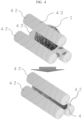
- the roller may have an uneven shape on the surface of the roller.
- the surface of the roller has a spiral uneven shape that moves from the center of the roller in a rotation axis direction to both ends of the roller in the rotation axis direction when the rollers rotate.
- the mode thereof is illustrated in Fig. 4 .
- Fig. 4 is a view showing a series of flows in which a first step mixture 1 is stretched by rotating the first step mixture 1 on a surface of a set of rollers 42 that rotate to obtain a stretched mixture 4.
- each of the rollers included in the set of rollers 42 has a spiral uneven shape 43 that moves from the center of a rotation axis direction of the roller to both ends of the roller in the rotation axis direction when the rollers rotate.
- the spiral uneven shape 43 is preferably an uneven shape extending spirally from the center in the rotation axis direction of the roller as a starting point to both ends in the rotation axis direction of the roller.
- the method of gripping and pulling the surface of the first step mixture is not particularly limited.
- Examples of the method of gripping and pulling the surface of the first step mixture include a method of gripping and pulling the surface of the first step mixture by hand.
- the surface of the first step mixture is gripped and pulled by hand, for example, it is preferable that the surface of the first step mixture is gripped by the right hand and the left hand and the surface of the first step mixture is pulled so that the shape of the first step mixture becomes a rod-like shape.
- the method (iv) is not particularly limited.
- a method of stretching the first step mixture along the shape of a mold by putting the first step mixture into the mold and pressing the first step mixture with a plate, or a method of stretching the first step mixture by sandwiching the first step mixture between two plates and pressing the first step mixture while rotating the first step mixture by moving the plates may be used.
- the shape of the mold is not particularly limited, and from the viewpoint of the degree of orientation, it is preferable to form a shape in which a stretch ratio of the stretched mixture obtained after pressing with a plate is high.
- the second step preferably include an operation of stretching the first step mixture, cutting the stretched mixture, stacking the cut stretched mixtures with aligned longitudinal directions of the stretched mixtures, and stretching the mixtures again.
- the number of cycles is preferably from 1 to 5, and more preferably from 2 to 4.
- the method of cutting the stretched mixture is not particularly limited, and examples thereof include a method of cutting the stretched mixture by hand and a method of cutting the stretched mixture using a cutter or the like.
- the stretching methods may be the same or different in each cycle.
- the chunk meat-like meat alternative to be produced contains oil and/or fat, a fat mass composition, other additives, and the like, these materials may be mixed when the stretched mixtures are stacked between cycles.
- the method of producing a chunk meat-like meat alternative according to the disclosure preferably further includes, after the second step, a third step of molding the stretched mixture to obtain a molded product, and then heating and curing the molded product.
- the binder contains a thermally irreversible gel-forming polysaccharide
- formation of a gel containing a thermally irreversible gel-forming polysaccharide is promoted by heating the molded product.
- the molded product is cured, and the shape of the chunk meat-like meat alternative is more easily maintained.
- the shape of the molded product is preferably a shape similar to, for example, steak meat or meat for stewing.
- a method of molding the stretched mixture is not particularly limited, examples thereof include a method of cutting the stretched mixture and a method of deforming the stretched mixture by applying an external force, and from the viewpoint of the texture, a method of cutting the stretched mixture is preferable.
- the stretched mixture In a case in which the stretched mixture is cut, it is preferable to cut the stretched mixture in a direction orthogonal to the fiber axis direction of the textured protein contained in the stretched mixture.
- the stretched mixture is cut, it is preferable to cut the stretched mixture using a knife such as a cutter or a kitchen knife.
- the third step preferably includes a step of cutting the stretched mixture perpendicularly to an orientation direction of fibers, and a step of bundling a plurality of stretched mixtures before cutting or after cutting.
- the plurality of cut stretched mixtures When a plurality of cut stretched mixtures are bundled and molded, the plurality of cut stretched mixtures may be bundled and molded with aligned fiber directions, or the plurality of stretched mixtures or cut stretched mixtures may be bundled with aligned fiber directions, and then the bundled stretched mixtures or cut stretched mixtures may be cut and molded perpendicularly to the fiber direction.
- a chunk meat-like meat alternative having an appearance similar to that of steak of livestock meat is easily obtained by molding the stretched mixture so that the fiber direction is in a thickness direction of the steak.
- the third step may include a step of molding the stretched mixture to obtain a molded product, and then forming a pattern similar to fat, for example, a marbled pattern on a surface of the molded product for the purpose of brining an appearance of a chunk meat-like meat alternative closer to an appearance of livestock meat (hereinafter, also referred to as "fat-like portion forming step").
- the fat-like portion forming step is preferably, for example, a step of forming a groove having a depth of 100 ⁇ m or more in the surface of the molded product and forming a fat-like portion by attaching oil and/or fat to the formed groove.
- Examples of a method of forming a groove in the surface of the molded product include a method of digging a surface with a knife and a method of forming a groove with a mold, and the method of forming a groove with a mold is preferable.
- a mold illustrated in Fig. 5 can be used as the mold.
- the mold illustrated in Fig. 5 is a mold having a protrusion provided so as to obtain a groove having a shape close to a shape of fat of mass meat.
- the region of C in Fig. 5 is a protruding portion, and a groove is formed when the molded product comes into contact with C.
- the region of D in Fig. 5 (the whitish region in Fig. 5 ) is a portion having no protrusion.
- oil and/or fat is attached to the groove formed in the surface of the molded product, and the groove is filled to form a pattern similar to that of fat.
- the oil and/or fat When oil and/or fat is attached to the groove formed in the surface of the molded product, the oil and/or fat may be in a liquid state, a semi-solid state in which a liquid and a solid are mixed, or a solid state, and the liquid state or the semi-solid state is preferable.
- oil and/or fat When oil and/or fat is attached to the groove formed in the surface of the molded product, the oil and/or fat may be attached in an emulsion state.
- an emulsion containing a gelling agent, oil and/or fat, and water may be used.
- the emulsion containing a gelling agent, oil and/or fat, and water is hereinafter referred to as a gelling emulsifier.
- the gelling emulsifier is attached to the groove formed in the surface of the molded product, and then the gelling emulsion attached to the groove is gelled.
- An oil drop diameter of the oil and/or fat in the gelling emulsifier is preferably from 20 ⁇ m to 500 ⁇ m, more preferably from 30 ⁇ m to 400 ⁇ m, and still more preferably from 50 ⁇ m to 300 ⁇ m.
- Examples of a method of gelling the gelling emulsifier attached to the groove include a method of gelling the molded product in which the gelling emulsifier is attached to the groove by charging the molded product into an aqueous solution containing a gelling accelerator.
- Examples of the fat-like portion forming step include a step of printing on the surface of the molded product with a white ink using a food printer and a step of cutting a white film into a marbled shape and attaching the film to the surface of the molded product.
- a method of heating the molded product is not particularly limited, and examples thereof include wet heating (a heating method using water as a heat resource), dry heating (a heating method using a material other than water such as metal or gas as a heat resource), and dielectric heating.
- the molded product is uniformly and quickly heated by a wet heating method after vacuum pouch of the molded product.
- wet heating examples include a steaming method and a method of boiling water, and the wet heating is preferably a method of boiling water because the molded product can be uniformly and quickly treated.
- the temperature inside the molded product is preferably from 70°C to 100°C.
- the temperature inside the molded product is a value measured by a thermometer.
- thermometer for example, a data logger (TR-W550) manufactured by KEYENCE CORPORATION can be used.
- TR-W550 data logger manufactured by KEYENCE CORPORATION
- the internal temperature of the molded product can be measured by inserting a thermocouple into the chunk meat-like meat alternative during the vacuum pouch.
- a vegetable protein binder 1 was prepared by mixing 15 g of carrageenan (GENUTINE 310-C, manufactured by Sansho Co., Ltd.) as a thermally reversible gel-forming polysaccharide, and 15 g of ALGINIC ACID 429S (manufactured by KIMICA Corporation) containing 9.45 g of sodium alginate as a thermally irreversible gel-forming polysaccharide, 4.2 g of calcium sulfate as a gelling agent (that is, a salt containing a cation, the same applies hereinafter) and 1.35 g of sodium pyrophosphate as a gelation retardant.
- carrageenan Glucentan
- ALGINIC ACID 429S manufactured by KIMICA Corporation
- a vegetable protein binder 2 was prepared by mixing 15 g of carrageenan (GENUTINE 310-C, manufactured by Sansho Co., Ltd.) as a thermally reversible gel-forming polysaccharide, 9.45 g of LM pectin as a thermally irreversible gel-forming polysaccharide, 4.2 g of calcium sulfate as a gelling agent, and 1.35 g of sodium pyrophosphate as a gelation retardant.
- carrageenan GUTINE 310-C, manufactured by Sansho Co., Ltd.
- Carrageenan (GENUTINE 310-C, manufactured by Sansho Co., Ltd.) as a thermally reversible gel-forming polysaccharide was used as a vegetable protein binder C1.
- ALGINIC ACID 429S (manufactured by KIMICA Corporation) containing sodium alginate as a thermally irreversible gel-forming polysaccharide, calcium sulfate as a gelling agent, and sodium pyrophosphate as a gelation retardant was used as a vegetable protein binder C2.
- a vegetable protein binder C3 was prepared by mixing 20.8 g of sodium alginate as a thermally irreversible gel-forming polysaccharide and 9.2 g of calcium sulfate as a gelling agent.
- a cooling die (die width: 50 mm, lip clearance: 3 mm) having a length of 350 mm was attached to a discharge portion of a twin screw extruder set so that a screw length was 1,100 mm and a maximum temperature of a screw tip portion was 155°C, and an outlet temperature of the cooling die was stabilized at 105°C.
- the mixed powder 1 was introduced into an extruder at 250 g/min, and 50% by mass of water with respect to the mass of the mixed powder 1 was added to the extruder and discharged from the extruder, thereby obtaining a fiber bundle-shaped textured protein 1 having a fiber axis direction in the same direction as the extrusion direction.
- the fiber bundle-shaped textured protein 1 was boiled in 3 L (liter) of boiling water for 10 minutes and subjected to drain.
- the fiber bundle-shaped textured protein 1 after being drained was cut to a length of 100 mm and torn along a fiber axis direction so as to have a width of about 5 mm.
- An aqueous solution containing SAN GRILL BEEF TASTE 3457E (a seasoning not using an animal material, manufactured by San-Ei Gen F.F.I.) as a seasoning (concentration; 5% by mass of the seasoning with respect to an entirety of the aqueous solution) was boiled for 10 minutes, and the boiled aqueous solution was immersed in an aqueous solution containing SAN BEET CONC No.
- the stretched mixture was cut in a direction orthogonal to a fiber axis direction of the textured protein contained in the stretched mixture so as to have a shape of a fillet steak, thereby obtaining a molded product.
- the molded product was vacuum-pouched and then heated for 1 minute so that the temperature inside the molded product was 75°C. Thereafter, the molded product was rapidly cooled with ice water to obtain a chunk meat-like meat alternative 1.
- a chunk meat-like meat alternative 2 was obtained by the same procedure as that of Example 2-1, except that the vegetable protein binder was changed from the vegetable protein binder 1 to the vegetable protein binder 2 in the first step.
- a fatty chunk meat-like meat alternative (chunk meat-like meat alternative 3) was obtained by the same procedure as that of Example 2-1, except that 30 g of a fat mass composition prepared by the following procedure was mixed with the strip-shaped fiber bundle-shaped textured protein, the vegetable protein binder, and water to obtain a first step mixture in the first step.
- Fig. 8 illustrates a schematic front view showing a cross section of the obtained fatty chunk meat-like meat alternative.
- An aqueous phase and an oil phase were prepared as follows.
- Aqueous phase 99.5 parts by mass of tap water and 0.5 parts by mass of RYOTO SUGAR ESTER M-1695 (manufactured by Mitsubishi Chemical Corporation) as a surfactant were weighed to a total of 5 kg, and the weighed materials were stirred using THREE-ONE MOTOR (manufactured by Shinto Scientific Co., Ltd.) for 30 minutes to be completely dissolved.
- Oil phase 1 kg of coconut oil (product name: ORGANIC PREMIUM COCONUT OIL (M041), manufactured by COCOWELL CORPORATION) as oil and/or fat was weighed.
- Membrane emulsification was performed using a pipe-shaped SPG membrane (manufactured by SPG Technology Co., Ltd., pore size of 50 ⁇ m) with an aqueous phase as a continuous phase and an oil phase as a dispersed phase.
- the pipe-shaped SPG membrane was inserted and disposed in a tubular container, and from one end to the other end of the container, the aqueous phase was allowed to flow at a flow rate of 50 mL/min inside the pipe-shaped SPG membrane (inner conduit), and the oil phase was allowed to flow at a flow rate of 10 mL/min outside the pipe-shaped SPG membrane (outer conduit (flow path between the container and the SPG membrane)).
- aqueous solution containing droplets containing oil and/or fat (hereinafter, also referred to as “droplet dispersion”) was obtained.
- the droplet containing oil and/or fat had a particle diameter of 190 ⁇ m and a CV value of 19%.
- the particle diameter and CV value of the droplet containing oil and/or fat were measured by a transmission optical microscope.
- the droplet dispersion collected in a Petri dish was observed with a transmission optical microscope and imaged at an objective magnification of 5 times. 200 or more images of the droplet containing oil and/or fat included in the screen obtained by imagining were selected, and an equivalent circle diameter of each droplet was calculated with image process software (for example, ImageJ).
- image process software for example, ImageJ.
- the equivalent circle diameter of each droplet refers to a diameter of a perfect circle corresponding to an area of the image of the droplet.
- the CV value of the droplet containing oil and/or fat is a value determined by the following equation.
- CV value (%) of droplet containing oil and/or fat (Standard deviation of equivalent circle diameter of droplet containing oil and/or fat/average particle diameter of droplets containing oil and/or fat) ⁇ 100
- the standard deviation of the equivalent circle diameter of the droplet containing oil and/or fat is a standard deviation of the equivalent circle diameters of 200 droplets containing oil and/or fat calculated in the measurement of the average particle diameter of the droplets containing oil and/or fat.
- the droplet dispersion was added to a separatory funnel and then allowed to stand for 30 minutes. Since the droplet dispersion was separated into a phase containing a droplet containing oil and/or fat and an aqueous phase, the aqueous phase was discharged from the separatory funnel, and the phase containing the droplet containing oil and/or fat was recovered.
- the recovered phase containing the droplet containing oil and/or fat was allowed to stand and cooled in a refrigerator having an internal temperature of 5°C for 1 hour, and solidification of the oil and/or fat was performed, thereby obtaining an aqueous solution containing particles (hereinafter, also referred to as "particle-containing solution").
- the crude fat mass composition was washed with tap water, moisture on a surface was wiped off with KIM TOWEL (registered trademark), and the wiped crude fat mass composition was cut into bars of about 1 mm ⁇ 1 mm ⁇ 30 mm. Oil and/or fat attached to the surface of the crude fat mass composition was washed with edible ethanol to obtain a fat mass composition.
- KIM TOWEL registered trademark
- the stretched mixture was cut so as to have a fillet shape of steak, thereby obtaining a molded product.
- the stretched mixture was cut so that the fiber axis direction of the fiber bundle-shaped textured protein contained in the molded product was oriented in a direction orthogonal to a thickness direction of the molded product.
- the cut stretched mixture was placed in a mold having uneven grooves, and grooves similar to the fat shape of marbled meat were formed in the surface of the cut stretched mixture.
- the solution 1 (the solution 1 was the gelling emulsion prepared by the same procedure as that of (3) Crosslinking Step in Example 2-3 (Preparation of Fat Mass Composition)) was applied to the formed grooves.
- the molded product to which the solution 1 was applied was immersed in the aqueous solution 1 containing cations (the aqueous solution 1 was the aqueous solution containing a gelling accelerator prepared by the same procedure as that of (3) Crosslinking Step in Example 2-3 (Preparation of Fat Mass Composition)) to gel the ionically crosslinkable polymer contained in the solution 1, thereby obtaining a molded product in which the solution 1 was gelled.
- the molded product obtained by gelling the solution 1 was vacuum-pouched and then heated for 1 minute so that the temperature inside the molded product was 75°C. Thereafter, the molded product was rapidly cooled with ice water to obtain a chunk meat-like meat alternative having a marbled pattern.
- a chunk meat-like meat alternative C1 was obtained by the same procedure as that of Example 2-1, except that the vegetable protein binder was changed from the vegetable protein binder 1 to the vegetable protein binder C1 in (First Step).
- a chunk meat-like meat alternative C2 was obtained by the same procedure as that of Example 2-1, except that the vegetable protein binder was changed from the vegetable protein binder 1 to the vegetable protein binder C2 in (First Step).
- the chunk meat-like meat alternative obtained in each Example was cooked on a hot plate at 200°C, and then the following evaluations were visually performed by ten panelists.
- the chunk meat-like meat alternative after cooking was cut in the thickness direction, it was evaluated whether or not a cut surface had an appearance similar to a cut surface of steak meat after cooking, and the number of panelists who answered in the affirmative was counted.
- Ten panelists ate the chunk meat-like meat alternative after cooking, whether or not the meat had a texture similar to that of steak meat after cooking was evaluated, and the number of panelists who answered in the affirmative was counted.
- evaluation Criteria-1 The evaluation criteria for each evaluation were as follows. Note that the visual evaluation after cooking and the visual evaluation of the cross section after cooking were evaluated according to the following (Evaluation Criteria-1), and the texture evaluation was evaluated according to the following (Evaluation Criteria-2).
- Fiber axis direction of textured protein A case in which the fiber axis direction of the fiber bundle-shaped textured protein contained in the chunk meat-like meat alternative is oriented in one direction is described as “thickness direction” or “width direction” depending on the orientation direction. A case in which the fiber axis direction of the fiber bundle-shaped textured protein contained in the chunk meat-like meat alternative is not oriented in one direction is described as "absence”.
- thickness direction means that the fiber axis direction of the fiber bundle-shaped textured protein is oriented in the thickness direction of the chunk meat-like meat alternative.
- width direction means that the fiber axis direction of the fiber bundle-shaped textured protein is oriented in a direction orthogonal to the thickness direction of the chunk meat-like meat alternative.
- ⁇ Content (% by mass) of polysaccharide means a content of a polysaccharide including a thermally irreversible gel-forming polysaccharide and a thermally reversible gel-forming polysaccharide with respect to an entirety of the chunk meat-like meat alternative.
- the vegetable protein binder of each of Examples has moldability and maintains the shape of the chunk meat-like meat alternative by performing a heat treatment, and thus, a chunk meat-like meat alternative having a texture close to a texture of livestock meat after cooking can be obtained.
Landscapes
- Chemical & Material Sciences (AREA)
- Life Sciences & Earth Sciences (AREA)
- Health & Medical Sciences (AREA)
- Food Science & Technology (AREA)
- Engineering & Computer Science (AREA)
- Nutrition Science (AREA)
- Polymers & Plastics (AREA)
- Biochemistry (AREA)
- Dispersion Chemistry (AREA)
- Inorganic Chemistry (AREA)
- Molecular Biology (AREA)
- Meat, Egg Or Seafood Products (AREA)
- Jellies, Jams, And Syrups (AREA)
Applications Claiming Priority (2)
| Application Number | Priority Date | Filing Date | Title |
|---|---|---|---|
| JP2022040837 | 2022-03-15 | ||
| PCT/JP2023/009451 WO2023176743A1 (ja) | 2022-03-15 | 2023-03-10 | 植物性タンパク質結着剤、かたまり肉様代替肉、及びかたまり肉様代替肉の製造方法 |
Publications (2)
| Publication Number | Publication Date |
|---|---|
| EP4494476A1 true EP4494476A1 (de) | 2025-01-22 |
| EP4494476A4 EP4494476A4 (de) | 2025-04-09 |
Family
ID=88023724
Family Applications (1)
| Application Number | Title | Priority Date | Filing Date |
|---|---|---|---|
| EP23770698.1A Pending EP4494476A4 (de) | 2022-03-15 | 2023-03-10 | Pflanzliches proteinbindemittel, chunkfleischähnliche fleischalternative und verfahren zur herstellung einer chunkfleischähnlichen fleischalternative |
Country Status (5)
| Country | Link |
|---|---|
| US (1) | US12543760B2 (de) |
| EP (1) | EP4494476A4 (de) |
| JP (1) | JP7585521B2 (de) |
| CN (1) | CN118870988A (de) |
| WO (1) | WO2023176743A1 (de) |
Families Citing this family (6)
| Publication number | Priority date | Publication date | Assignee | Title |
|---|---|---|---|---|
| WO2025075172A1 (ja) * | 2023-10-06 | 2025-04-10 | 富士フイルム株式会社 | 脂肪塊組成物及び脂肪塊組成物の製造方法 |
| WO2025075171A1 (ja) * | 2023-10-06 | 2025-04-10 | 富士フイルム株式会社 | 脂肪塊組成物及び脂肪塊組成物の製造方法 |
| JP7638346B1 (ja) | 2023-10-23 | 2025-03-03 | 株式会社ソディック | 人工肉の二次成形装置 |
| WO2025204590A1 (ja) * | 2024-03-26 | 2025-10-02 | 日東電工株式会社 | 繊維集合体、及び繊維集合体の製造方法 |
| WO2026014175A1 (ja) * | 2024-07-10 | 2026-01-15 | 日東電工株式会社 | 繊維集合体、及び繊維集合体の製造方法 |
| WO2026053699A1 (ja) * | 2024-09-05 | 2026-03-12 | 株式会社ニッスイ | 組織化植物性タンパク質、イミテーション食品、およびイミテーション食品への食感付与方法 |
Family Cites Families (18)
| Publication number | Priority date | Publication date | Assignee | Title |
|---|---|---|---|---|
| US4276311A (en) * | 1976-06-17 | 1981-06-30 | Mars Limited | Food product and process |
| US4423083A (en) * | 1980-04-04 | 1983-12-27 | General Foods Corp. | Fabricated protein fiber bundles |
| WO1999034690A1 (en) | 1998-01-08 | 1999-07-15 | Otsuka Foods Co., Ltd. | Gelled foods and process for producing the same |
| JP2003180265A (ja) | 2001-12-21 | 2003-07-02 | Unitec Foods Co Ltd | 耐熱性ゲル化食品の製造方法 |
| EP1633203A1 (de) * | 2003-05-27 | 2006-03-15 | Unilever N.V. | Lebensmittelhalbfertigprodukt |
| EP1759593A1 (de) * | 2005-09-06 | 2007-03-07 | Nug Nahrungs-Und Genussmittel Vertriebsgesellschaft Mbh | Hackfleischersatz und Verfahren zur Herstellung |
| JP5226772B2 (ja) | 2007-04-24 | 2013-07-03 | エフ エム シー コーポレーション | 共沈したカラギーナン/キサンタンガム組成物およびそれらの製法 |
| JP5079551B2 (ja) * | 2008-03-06 | 2012-11-21 | 伊那食品工業株式会社 | タンパク質素材、畜肉または魚肉補助剤、およびこれを用いた畜肉または魚肉加工品 |
| TWI474782B (zh) | 2011-12-28 | 2015-03-01 | Food Industry Res & Dev Inst | 肉類內脂肪的替代物與其形成方法 |
| MX360480B (es) * | 2012-12-04 | 2018-11-05 | Nestec Sa | Composiciones alimenticias tipo barra. |
| DE102013000955A1 (de) * | 2013-01-21 | 2014-07-24 | Rovita Gmbh | Verfahren zur Herstellung von Fleischersatzprodukten |
| JP6401515B2 (ja) | 2014-06-30 | 2018-10-10 | ヱスビー食品株式会社 | ゲル状食品及びその製造方法 |
| GB201501320D0 (en) | 2015-01-27 | 2015-03-11 | Marlow Foods Ltd | Edible fungi |
| WO2016121923A1 (ja) * | 2015-01-29 | 2016-08-04 | 株式会社明治 | 筋肉合成促進剤 |
| JP6546757B2 (ja) | 2015-03-06 | 2019-07-17 | ポッカサッポロフード&ビバレッジ株式会社 | ゲル化剤含有組成物の製造方法 |
| BR112021022997A2 (pt) * | 2019-05-17 | 2022-01-18 | New Wave Foods | Produto de marisco simulado de textura aperfeiçoada |
| CA3161137A1 (en) * | 2019-11-12 | 2021-05-20 | Redefine Meat Ltd. | Whole muscle meat substitute and methods of obtaining the same |
| JP2022040837A (ja) | 2020-08-31 | 2022-03-11 | シャープ株式会社 | 空気調和機 |
-
2023
- 2023-03-10 EP EP23770698.1A patent/EP4494476A4/de active Pending
- 2023-03-10 WO PCT/JP2023/009451 patent/WO2023176743A1/ja not_active Ceased
- 2023-03-10 JP JP2023566748A patent/JP7585521B2/ja active Active
- 2023-03-10 CN CN202380027802.9A patent/CN118870988A/zh active Pending
- 2023-12-14 US US18/539,307 patent/US12543760B2/en active Active
Also Published As
| Publication number | Publication date |
|---|---|
| US20240114923A1 (en) | 2024-04-11 |
| JPWO2023176743A1 (de) | 2023-09-21 |
| EP4494476A4 (de) | 2025-04-09 |
| US12543760B2 (en) | 2026-02-10 |
| WO2023176743A1 (ja) | 2023-09-21 |
| CN118870988A (zh) | 2024-10-29 |
| JP7585521B2 (ja) | 2024-11-18 |
Similar Documents
| Publication | Publication Date | Title |
|---|---|---|
| EP4494476A1 (de) | Pflanzliches proteinbindemittel, chunkfleischähnliche fleischalternative und verfahren zur herstellung einer chunkfleischähnlichen fleischalternative | |
| EP4494475A1 (de) | Verfahren zur herstellung von klumpenbildender fleischähnlicher fleischalternative und klumpenbildendes fleischähnliches fleischalternative | |
| Qi et al. | Microstructure and physiochemical properties of meat sausages based on nanocellulose-stabilized emulsions | |
| Liu et al. | Effects of pre-emulsification by three food-grade emulsifiers on the properties of emulsified surimi sausage | |
| Calton et al. | 3-D printed meat alternatives based on pea and single cell proteins and hydrocolloids: Effect of paste formulation on process-induced fibre alignment and structural and textural properties | |
| Shao et al. | Effects of vegetable oil and ethylcellulose on the oleogel properties and its application in Harbin red sausage | |
| US9314045B2 (en) | Meat-like foodstuff and method for producing the same | |
| US12543759B2 (en) | Raw meat-like meat alternative and method for producing raw meat-like meat alternative | |
| EP4595772A1 (de) | Fettsimulationszusammensetzung und fleischersatz | |
| WO2023171303A1 (ja) | タンパク質食品素材及び代替成形肉 | |
| US20240341319A1 (en) | Fat lump composition and meat substitute | |
| Lyu et al. | Analysis of gelation properties of peach-κ-carrageenan gels: Effect of erythritol | |
| CN107683092A (zh) | 低脂肪油包水乳剂 | |
| EP4520185A1 (de) | Verfahren zur herstellung von proteinnahrungsmittelmaterial, proteinnahrungsmittelmaterial und geformtes fleischalternative | |
| JP2026008019A (ja) | 結着剤、及び、かたまり肉様代替肉 | |
| CN118890968A (zh) | 整块肉样替代肉的制造方法及整块肉样替代肉 | |
| Yu et al. | Dietary fiber-mediated high-moisture texturization of Antarctic krill-based hybrid protein: Interaction between microstructure and hydration properties | |
| JP7720922B2 (ja) | 脂肪塊組成物、脂肪塊混合物、代替肉及び脂肪塊組成物の製造方法 | |
| WO2025075172A1 (ja) | 脂肪塊組成物及び脂肪塊組成物の製造方法 | |
| JP2018000091A (ja) | 凍結乾燥食品及びその製造方法 | |
| Ježek et al. | Porosity of deep fat fried breaded chicken meat | |
| WO2025075171A1 (ja) | 脂肪塊組成物及び脂肪塊組成物の製造方法 | |
| JP7075430B2 (ja) | コンニャクゲル及びその製造方法並びにコンニャクゲルを用いたエビ様食品及びその製造方法 | |
| WO2025258278A1 (ja) | 脂肪塊模擬構造体、脂肪塊模擬構造体の製造方法、及び代替肉 | |
| WO2024181072A1 (ja) | 脂肪塊組成物、代替肉、脂肪塊組成物の製造方法、及び代替肉の製造方法 |
Legal Events
| Date | Code | Title | Description |
|---|---|---|---|
| STAA | Information on the status of an ep patent application or granted ep patent |
Free format text: STATUS: THE INTERNATIONAL PUBLICATION HAS BEEN MADE |
|
| PUAI | Public reference made under article 153(3) epc to a published international application that has entered the european phase |
Free format text: ORIGINAL CODE: 0009012 |
|
| STAA | Information on the status of an ep patent application or granted ep patent |
Free format text: STATUS: REQUEST FOR EXAMINATION WAS MADE |
|
| 17P | Request for examination filed |
Effective date: 20240910 |
|
| AK | Designated contracting states |
Kind code of ref document: A1 Designated state(s): AL AT BE BG CH CY CZ DE DK EE ES FI FR GB GR HR HU IE IS IT LI LT LU LV MC ME MK MT NL NO PL PT RO RS SE SI SK SM TR |
|
| A4 | Supplementary search report drawn up and despatched |
Effective date: 20250305 |
|
| RIC1 | Information provided on ipc code assigned before grant |
Ipc: A23L 13/60 20160101ALI20250228BHEP Ipc: A23L 29/256 20160101ALI20250228BHEP Ipc: A23L 29/231 20160101ALI20250228BHEP Ipc: A23L 29/20 20160101ALI20250228BHEP Ipc: A23J 3/14 20060101ALI20250228BHEP Ipc: A23J 3/00 20060101AFI20250228BHEP |
|
| DAV | Request for validation of the european patent (deleted) | ||
| DAX | Request for extension of the european patent (deleted) | ||
| STAA | Information on the status of an ep patent application or granted ep patent |
Free format text: STATUS: EXAMINATION IS IN PROGRESS |
|
| 17Q | First examination report despatched |
Effective date: 20251216 |