EP4494531A1 - Procédé de fonctionnement d'un appareil de préparation de boissons, unité de commande et appareil de préparation de boissons - Google Patents
Procédé de fonctionnement d'un appareil de préparation de boissons, unité de commande et appareil de préparation de boissons Download PDFInfo
- Publication number
- EP4494531A1 EP4494531A1 EP24183086.8A EP24183086A EP4494531A1 EP 4494531 A1 EP4494531 A1 EP 4494531A1 EP 24183086 A EP24183086 A EP 24183086A EP 4494531 A1 EP4494531 A1 EP 4494531A1
- Authority
- EP
- European Patent Office
- Prior art keywords
- temperature
- signal
- water
- beverage preparation
- water tank
- Prior art date
- Legal status (The legal status is an assumption and is not a legal conclusion. Google has not performed a legal analysis and makes no representation as to the accuracy of the status listed.)
- Pending
Links
Images

Classifications
-
- A—HUMAN NECESSITIES
- A47—FURNITURE; DOMESTIC ARTICLES OR APPLIANCES; COFFEE MILLS; SPICE MILLS; SUCTION CLEANERS IN GENERAL
- A47J—KITCHEN EQUIPMENT; COFFEE MILLS; SPICE MILLS; APPARATUS FOR MAKING BEVERAGES
- A47J31/00—Apparatus for making beverages
- A47J31/44—Parts or details or accessories of beverage-making apparatus
- A47J31/52—Alarm-clock-controlled mechanisms for coffee- or tea-making apparatus ; Timers for coffee- or tea-making apparatus; Electronic control devices for coffee- or tea-making apparatus
- A47J31/525—Alarm-clock-controlled mechanisms for coffee- or tea-making apparatus ; Timers for coffee- or tea-making apparatus; Electronic control devices for coffee- or tea-making apparatus the electronic control being based on monitoring of specific process parameters
- A47J31/5253—Alarm-clock-controlled mechanisms for coffee- or tea-making apparatus ; Timers for coffee- or tea-making apparatus; Electronic control devices for coffee- or tea-making apparatus the electronic control being based on monitoring of specific process parameters of temperature
-
- A—HUMAN NECESSITIES
- A47—FURNITURE; DOMESTIC ARTICLES OR APPLIANCES; COFFEE MILLS; SPICE MILLS; SUCTION CLEANERS IN GENERAL
- A47J—KITCHEN EQUIPMENT; COFFEE MILLS; SPICE MILLS; APPARATUS FOR MAKING BEVERAGES
- A47J31/00—Apparatus for making beverages
- A47J31/44—Parts or details or accessories of beverage-making apparatus
- A47J31/60—Cleaning devices
Definitions
- the invention relates to a method for operating a beverage preparation device, a control unit and a beverage preparation device, for example a fully automatic coffee machine.
- Drink preparation equipment must be cleaned regularly, for example descaled or degreased.
- DE20312094 U1 deals with a cleaning tablet for cleaning the brewing chamber of a coffee machine.
- the approach presented here aims to provide an improved operation of a beverage preparation device, an improved control unit and an improved beverage preparation device.
- this object is achieved by a method for operating a beverage preparation device, a control unit and a beverage preparation device with the features of the independent claims.
- the advantages that can be achieved with the invention include not only assisting a user in handling a beverage preparation device but also optimizing the use of a cleaning agent used to clean the beverage preparation device. Furthermore, the preparation of beverages is made more reliable because it is ensured that the water stored in the tank has the optimal preparation temperature. If the user fills the tank with water that is too hot, the heating block or flow heater can overheat during the subsequent brewing process, which leads to a malfunction-prone interruption of the device's function. Since the user is informed that the water is too hot by means of the display device or dispensing device before the brewing process is activated, no faulty brewing process is started. The device remains ready for use without interruption.
- the beverage preparation device can be designed for preparing and dispensing hot or cold beverages.
- the beverage preparation device can be designed as a built-in device or a free-standing device.
- the beverage preparation device can be a fully automatic coffee machine.
- a cleaning process can be understood as an at least partially automated process by which the beverage preparation device is cleaned. This can be a process that is usual for beverage preparation devices, by which the beverage preparation device is descaled or degreased, for example.
- Known cleaning agents can be used for this purpose, which, for example, have a descaling or have a degreasing effect.
- cleaning agents are dissolved before the start of the actual cleaning process using water from the water tank of the beverage preparation device, whereby the temperature of the water used is relevant for the dissolution.
- a temperature that is too low can, for example, extend the time required for dissolution and also reduce the cleaning effect of the cleaning agent.
- a temperature that is too high can also reduce the cleaning effect of the cleaning agent.
- the temperature of the water used for dissolution can therefore be recorded and taken into account when carrying out the cleaning process.
- the temperature sensor used for this purpose can be a suitable sensor, for example a measuring resistor. Using the temperature sensor, the temperature can be recorded directly on the water tank or at a distance from the water tank.
- the display device can be a display, for example. In addition to or as an alternative to an optical display, the display device can be designed to output a request or instruction acoustically.
- the request signal can be an electrical control signal with which the display device can be controlled so that a user is shown the request to fill the water tank with water at a temperature that differs from the current temperature if the temperature indicated by the temperature signal is within an inadmissible range.
- the temperature of the water inside the water tank can be changed so that the temperature is in the target range or in a tolerance range that optionally lies between the inadmissible range and the target range.
- the step of reading in the temperature signal can be carried out again.
- the instruction signal can also be a control signal that is suitable for controlling the display device so that the instruction to fill in the cleaning agent is displayed if the temperature indicated by the temperature signal is within a target range.
- the execution signal can represent a control signal with which devices of the beverage preparation device used to carry out the cleaning process are controlled when the water in the water tank has a temperature suitable for carrying out the cleaning process and the cleaning agent is in the beverage preparation device.
- a pump for pumping the water is activated in response to the execution signal, for example.
- the filling of the cleaning agent can be detected automatically or confirmed by an input from the user.
- the method can also be used to operate a beverage preparation device for preparing a beverage.
- a beverage preparation device for preparing a beverage.
- All of the above steps are performed, except for the steps that contain instructions for handling of the cleaning agent. These steps are omitted during preparation.
- the method may comprise a step of providing a pump signal to an interface to a pump. Using the pump signal, a test quantity of the water stored in the water tank may be pumped to the temperature sensor.
- a test quantity of the water stored in the water tank may be pumped to the temperature sensor.
- this allows the temperature sensor to be arranged in a line connecting the pump to the water tank.
- the pump signal can cause the partial quantity to be pumped that is smaller than 3ml.
- the partial quantity can also be smaller than 2ml. This ensures that there is still a sufficient amount of water in the water tank even after the partial quantity has been removed. This is important, for example, if the cleaning agent is poured directly into the water tank.
- the method can include a step of adjusting a value of a dissolving time period.
- the dissolving time period can be between the filling of the cleaning agent and the start of a cleaning process.
- the adjusting step can be carried out if the temperature indicated by the temperature signal is within a tolerance range.
- the tolerance range can be outside the target range and outside the impermissible range.
- the value of the dissolution time can be increased if the temperature indicated by the temperature signal is within a lower tolerance range adjacent to a lower limit of the target range.
- the value of the dissolution time can be reduced accordingly if the temperature indicated by the temperature signal is within an upper tolerance range adjacent to an upper limit of the target range. This can, for example, ensure that the cleaning agent dissolves at a low temperature and prevent damage to the cleaning agent at a high temperature.
- the prompt signal can be provided to indicate the request to fill the water tank with lukewarm water. This can give the user an indication of the required water temperature.
- the prompt signal may be provided to indicate a request to fill the water tank with cool water when the temperature indicated by the temperature signal exceeds a hot value. Accordingly, in the step of providing the prompt signal, the prompt signal can be provided to indicate a request to fill the water tank with hot water when the temperature indicated by the temperature signal falls below a cold value. This allows the water temperature to be quickly adjusted to the required water temperature.
- the impermissible range can include, for example, a temperature of less than 25°C, in particular less than 20°C, and, for example, a temperature of more than 45°C, in particular more than 50°C.
- the impermissible range can be selected according to the cleaning agent used. At corresponding temperatures, continuation of the cleaning process can be interrupted because the desired cleaning result cannot be achieved at these temperatures.
- the target range can, for example, include a temperature between 30°C and 40°C.
- the target range can be selected according to the cleaning agent used. This temperature range can be suitable for achieving an optimal cleaning effect.
- the approach presented here also creates a control unit that is designed to carry out, control or implement the steps of a variant of a method presented here in corresponding devices.
- This embodiment of the invention in the form of a device can also solve the problem underlying the invention quickly and efficiently.
- the control unit can be designed to read in input signals and to determine and provide output signals using the input signals.
- An input signal can, for example, represent a sensor signal that can be read in via an input interface of the control unit.
- An output signal can represent a control signal or a data signal that can be provided at an output interface of the control unit.
- the control unit can be designed to determine the output signals using a processing rule implemented in hardware or software.
- the control unit can comprise a logic circuit, an integrated circuit or a software module and can be implemented, for example, as a discrete component or be comprised of a discrete component.
- the temperature signal provided by the temperature sensor enables monitoring of the temperature of the water used for the cleaning process.
- the temperature sensor can be arranged at a suitable position on the beverage preparation device.
- the temperature sensor can be arranged on a line connecting the water tank to the pump. This allows the temperature of the water to be detected in response to a brief activation of the pump.
- the beverage preparation device can comprise a control unit which, for example, enables the temperature sensor to be read and the pump to be operated.
- a computer program product or computer program with program code that can be stored on a machine-readable carrier or storage medium such as a semiconductor memory, a hard disk memory or an optical memory. If the program product or program is executed on a computer or a control unit, the program product or program can be used to carry out, implement and/or control the steps of the method according to one of the embodiments described here.
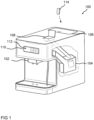
- FIG. 1 shows a representation of an embodiment of a beverage preparation device 100.
- the beverage preparation device 100 is designed as a fully automatic coffee machine.
- the beverage preparation device 100 has, for example, an outlet 102 for dispensing a prepared beverage, a brewing unit 104 for preparing the beverage, a water tank 106 for storing water that can be used to prepare the beverage or to clean the beverage preparation device 100, an input slot 108 for coffee powder and an operating unit 110.
- a user can, for example, enter a beverage request or select a cleaning program via the operating unit 112.
- the operating unit 110 comprises a display device 112 via which messages can be displayed to the user.
- a cleaning agent 114 is used, which is inserted into the beverage preparation device 100 by the user. If descaling of the beverage preparation device 100 is carried out as a cleaning process, according to one embodiment it is necessary for the user to insert the cleaning agent 114, for example a descaling tablet, into the water tank 106.
- the water tank 106 is optionally designed to be removable. If degreasing of the beverage preparation device 100 is carried out as a cleaning process, according to one embodiment it is necessary for the user to insert the cleaning agent 114, for example a cleaning tablet, into the input shaft 108.
- the approach described here enables automatic temperature control of the water during cleaning processes.
- a temperature sensor is used with which the temperature of the water stored in the water tank 106 can be detected. This can ensure that the cleaning agent 114, for example a cleaning tablet, is completely dissolved and that the cleaning solution is effective.
- beverage preparation device 100 is designed as another device, for example as a device for dispensing cold drinks or soups
- other units can be provided instead of the brewing unit 104 and the input shaft 108, and the cleaning agent 114 can be introduced in another suitable manner, optionally also automated.
- FIG 2 shows a schematic representation of an embodiment of a beverage preparation device 100, for example the one described with reference to Figure 1 described device.
- the beverage preparation device 100 has the outlet 102, the brewing unit 104 and the water tank 106.
- the brewing unit 104 is shown together with a grinder 212.
- the water tank 106 is connected to a valve 218 via a line in which a pump 214 and a thermoblock 216 are arranged.
- the line is part of a fluid system of the beverage preparation device 100. Water can thus be conveyed from the water tank 106 via the line to the valve 218 using the pump 214 and tempered, or heated according to one embodiment, using the thermoblock 216.
- the valve 218 has a plurality of valve positions so that an outlet of the line can be connected to different outlet lines leading to the outlet 102.
- a first outlet line leads via the brewing unit 104 to the outlet 102 and enables coffee to be dispensed.
- a second outlet line is provided, for example, for dispensing steam for milk and a third outlet line for dispensing hot water.
- a filter module 220 is arranged in the line, for example between the water tank 106 and the pump 214.
- a temperature sensor 222 is provided to directly or indirectly detect the temperature of the water in the water tank 106.
- the temperature sensor 220 is placed at a suitable position in the beverage preparation device 100, here for example in or on the line in the area of a connection of the line to the water tank 106.
- an additional temperature sensor is provided, which is used to measure the temperature of the water heated by the thermoblock.
- the beverage preparation device 100 has a control unit 224 that is designed to control or execute steps for carrying out a cleaning process.
- the control unit 224 is designed to read in a temperature signal 226, which represents a temperature detected by the temperature sensor 222, via an interface to the temperature sensor 222 and to provide a pump signal 228 for controlling operation of the pump 214 to an interface to the pump 214 and optionally a heating signal 230 for controlling operation of the thermoblock 216 to an interface to the thermoblock 216.
- the control unit 224 is designed to output control signals, for example a request signal 232 and/or an instruction signal 234, to an interface to a display device of the beverage preparation device 100.
- one or more functional blocks of the control unit are integrated in a logic circuit of the temperature sensor 222.
- the user in order to descale the beverage preparation device 100, which is embodied here as a fully automatic coffee machine, or to clean the brewing unit 104 and an optional milk system, the user is prompted to fill the water tank 106 with lukewarm water and to dissolve the cleaning agent, for example the respective tablet, in it.
- the cleaning agents only dissolve properly at certain temperatures and are sensitive to temperatures that are too hot, which can, for example, lead to the destruction of certain ingredients.
- the Figure 2 The fluid system shown is suitable for automatic checking of the water temperature in the water tank 106 due to the temperature sensor 222.
- the user can be supported in preparing a cleaning solution in such a way that it is ensured that the water in the water tank 106 has the correct water temperature for dissolving the cleaning agent.
- the aim is to prevent water that is either too cold, for example with a temperature of less than 20 °C, or too hot, for example with a temperature of more than 50 °C, from being filled in. Smaller deviations, however, can be tolerated by adapting the process according to the temperature.
- the user at the beginning of a cleaning process, the user first fills the water tank 106 with "hand-warm” water and, after it is filled, places the water tank 106 without cleaner into the device, here the beverage preparation device 100.
- the beverage preparation device 100 Since it is not certain whether the target temperature for the water in the water tank 106 is maintained, the beverage preparation device 100 now automatically checks the water temperature by having the pump 214 pump a small amount of water from the water tank 106 into the fluid system.
- the temperature sensor 222 which is implemented in the fluid system, for example, measures the temperature of the water and compares the measured value with the target value according to one embodiment. Alternatively, a corresponding comparison is carried out according to one embodiment using a control unit 224 arranged separately from the temperature sensor 222.
- the temperature sensor 222 is implemented as a thermistor, a so-called NTC (negative temperature coefficient thermistor).
- the time given to the system to dissolve the cleaner is adjusted accordingly, i.e. extended, for example by a factor of 1.5.
- the time given to the system to dissolve the cleaner is adjusted accordingly, i.e. shortened, for example by a factor of 0.75.
- the user is prompted to fill in lukewarm water.
- the user is prompted to fill in the cleaning agent and the cleaning process begins, for example controlled by the control unit 224.
- the temperature sensor 222 for example in the form of an additional NTC, is installed between the water tank 106 and the thermoblock 216.
- the temperature sensor 222 is ideally installed close to the water tank 106 in order to use as little water as possible for the measuring process. Basically, this only involves an amount of water of less than 2 ml taken from the water tank 106.
- thermoblock 216 there is already an NTC in the fluid system of the beverage preparation device 100 behind the thermoblock 216, which, however, cannot really be used for the method described here, since the temperature measured by this NTC typically does not correspond to the water temperature in the water tank. If the If the thermoblock 216 is still warm from a previous process, a higher temperature would be simulated, for example.
- this NC is located relatively far away from the water tank 106, so that significantly more water is wasted to measure the water temperature in the water tank, for example more than 12 ml, instead of less than 2 ml with the temperature sensor 222 close to the water tank.
- Figure 3 shows a flow chart of an embodiment of a method for carrying out a cleaning process for a beverage preparation device, as described by way of example with reference to the preceding figures. For example, the steps are carried out using devices of a control unit of the beverage preparation device.
- a temperature signal is read in via an interface to a temperature sensor.
- the temperature signal indicates a current temperature of water stored in a water tank.
- a request signal is provided to an interface to a display device of the beverage preparation device in a step 303.
- the request indicates that the water tank is being filled with lukewarm water.
- a first request signal is provided in step 303 to display a request to fill the water tank with cool water if the temperature indicated by the temperature signal exceeds a hot value
- a second request signal is provided to display a request to fill the water tank with warm water if the temperature indicated by the temperature signal falls below a cold value.
- the cold value is 25°C or 20°C and the hot value is 45°C or 50°C.
- the target range includes a temperature between 30°C and 40°.
- a signal for carrying out a Cleaning process of the cleaning process In response to the execution signal, for example, the Figure 2
- the pump shown, the thermoblock and/or the valve of the beverage preparation device are controlled in such a way that cleaning is carried out in a manner known from beverage preparation devices using the cleaning agent and the water from the water tank.
- the method optionally includes a step 309 of providing a pump signal to an interface to the pump to activate the pump to pump a test amount of the water stored in the water tank to the temperature sensor.
- the pump signal causes less than 3ml or less than 2ml of water to be pumped from the water tank.
- a step 310 is performed to detect the temperature of the water using the temperature sensor.
- the method comprises a step 311 in which a value of a dissolution period that lies between the filling of the cleaning agent and the start of a cleaning process of the cleaning operation is adjusted.
- the step 311 is carried out if the temperature indicated by the temperature signal read in step 301 is within a tolerance range.
- the step 311 is carried out, for example, before, at the same time as or after one of the steps 305, 307.
- the value of the dissolution period is increased if the temperature indicated by the temperature signal is within a lower tolerance range adjacent to a lower limit of the target range.
- the value of the dissolution period is correspondingly reduced if the temperature indicated by the temperature signal is within an upper tolerance range adjacent to an upper limit of the target range.
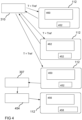
- Figure 4 shows a flow chart of an embodiment of a method for carrying out a cleaning process for a beverage preparation device, as described by way of example with reference to the preceding figures.
- a block 454 represents an end to the cleaning process, which the user for example, by a corresponding message 456.
- a field 458 enables, for example, the selection of a start menu.
- T ⁇ Tref If the water is too cold, T ⁇ Tref, or too hot, T > Tref, then the user is presented with a prompt 460 to add colder water to the tank or "temperature high, please add cold water” or a prompt 462 to add warmer water to the tank or "temperature low, please add warm water” according to one embodiment.
Landscapes
- Engineering & Computer Science (AREA)
- Food Science & Technology (AREA)
- Devices For Dispensing Beverages (AREA)
Applications Claiming Priority (1)
| Application Number | Priority Date | Filing Date | Title |
|---|---|---|---|
| BE20235597A BE1031807B1 (de) | 2023-07-17 | 2023-07-17 | Verfahren zum Betreiben eines Getränkezubereitungsgerätes, Steuereinheit und Getränkezubereitungsgerät |
Publications (1)
| Publication Number | Publication Date |
|---|---|
| EP4494531A1 true EP4494531A1 (fr) | 2025-01-22 |
Family
ID=88757376
Family Applications (1)
| Application Number | Title | Priority Date | Filing Date |
|---|---|---|---|
| EP24183086.8A Pending EP4494531A1 (fr) | 2023-07-17 | 2024-06-19 | Procédé de fonctionnement d'un appareil de préparation de boissons, unité de commande et appareil de préparation de boissons |
Country Status (2)
| Country | Link |
|---|---|
| EP (1) | EP4494531A1 (fr) |
| BE (1) | BE1031807B1 (fr) |
Citations (5)
| Publication number | Priority date | Publication date | Assignee | Title |
|---|---|---|---|---|
| US5862738A (en) * | 1996-12-31 | 1999-01-26 | Bloomfield Industries Canada Limited | Electronic brew control system |
| DE20312094U1 (de) | 2003-08-05 | 2003-10-02 | BSH Bosch und Siemens Hausgeräte GmbH, 81669 München | Kaffeemaschine |
| CN111904284A (zh) * | 2020-08-10 | 2020-11-10 | 六安索伊电器制造有限公司 | 一种组合式饮水咖啡机 |
| WO2022126199A1 (fr) * | 2020-12-18 | 2022-06-23 | Breville Pty Limited | Appareil à boisson |
| CN116406944A (zh) * | 2021-12-31 | 2023-07-11 | 广东美的生活电器制造有限公司 | 冲饮机的控制方法、冲饮机的控制装置及冲饮机 |
-
2023
- 2023-07-17 BE BE20235597A patent/BE1031807B1/de active IP Right Grant
-
2024
- 2024-06-19 EP EP24183086.8A patent/EP4494531A1/fr active Pending
Patent Citations (5)
| Publication number | Priority date | Publication date | Assignee | Title |
|---|---|---|---|---|
| US5862738A (en) * | 1996-12-31 | 1999-01-26 | Bloomfield Industries Canada Limited | Electronic brew control system |
| DE20312094U1 (de) | 2003-08-05 | 2003-10-02 | BSH Bosch und Siemens Hausgeräte GmbH, 81669 München | Kaffeemaschine |
| CN111904284A (zh) * | 2020-08-10 | 2020-11-10 | 六安索伊电器制造有限公司 | 一种组合式饮水咖啡机 |
| WO2022126199A1 (fr) * | 2020-12-18 | 2022-06-23 | Breville Pty Limited | Appareil à boisson |
| CN116406944A (zh) * | 2021-12-31 | 2023-07-11 | 广东美的生活电器制造有限公司 | 冲饮机的控制方法、冲饮机的控制装置及冲饮机 |
Also Published As
| Publication number | Publication date |
|---|---|
| BE1031807A1 (de) | 2025-02-10 |
| BE1031807B1 (de) | 2025-02-17 |
Similar Documents
| Publication | Publication Date | Title |
|---|---|---|
| EP3381336A1 (fr) | Procédé et dispositif de commande d'un dispositif de préparation de boissons chaudes | |
| EP2926699A1 (fr) | Machine à café entièrement automatique dotée d'un dispositif de commande et procédé de détermination du volume réel d'eau résiduelle dans le réservoir d'eau | |
| DE202004020907U1 (de) | Kaffeemaschine | |
| BE1031807B1 (de) | Verfahren zum Betreiben eines Getränkezubereitungsgerätes, Steuereinheit und Getränkezubereitungsgerät | |
| DE102023118792A1 (de) | Verfahren zum Betreiben eines Getränkezubereitungsgerätes, Steuereinheit und Getränkezubereitungsgerät | |
| EP1129653B1 (fr) | Méthode et machine pour déterminer l'état de calcification de chauffes-eau utilisés dans des appareils domestiques | |
| EP2954811B1 (fr) | Mesure de debit dans un automate de boissons chaudes, en particulier une machine a cafe totalement automatique | |
| WO1995016378A1 (fr) | Procede de detection de l'entartrage d'appareils producteurs d'eau chaude | |
| EP3415055A1 (fr) | Distributeur automatique de boissons à affichage de temps restant et procédé de fonctionnement d'un tel distributeur automatique de boissons | |
| DE102018210835A1 (de) | Getränkebereiter und Verfahren zur Diagnose eines Getränkebereiters | |
| EP4124267A1 (fr) | Procédé de détection d'un niveau de remplissage, dispositif de commande et appareil de préparation de boissons | |
| BE1031833B1 (de) | Verfahren zum Reinigen eines Getränkezubereitungsgeräts und Getränkezubereitungsgerät | |
| DE102019206397B3 (de) | Verfahren zur zeitsparenden Steuerung eines Kaffeeautomaten | |
| DE102023119575A1 (de) | Verfahren zum Reinigen eines Getränkezubereitungsgeräts und Getränkezubereitungsgerät | |
| DE102018117089A1 (de) | Vorrichtung und Verfahren zum Betreiben eines Getränkeautomaten und Getränkeautomat | |
| EP4032446B1 (fr) | Methode, machine automatique de distribution de boissons et unité de commande pour calculer un volume d'un récipient pour ladite machine automatique de distribution de boissons | |
| DE102020129389A1 (de) | Verfahren zum Betreiben eines Heißgetränkeautomaten mit einem Brühsystem, Steuervorrichtung und Heißgetränkeautomat | |
| EP3597085A1 (fr) | Procédé de surveillance d'un degré de remplissage de détergent pour un appareil d'acheminement d'eau et dispositif associé | |
| EP3733030A1 (fr) | Procédé de commande d'un distributeur automatique de boissons chaudes | |
| DE102024208410A1 (de) | Verfahren zum Entleeren eines Siebträgers einer Kaffeemaschine sowie Kaffeemaschine zur Ausführung des Verfahrens | |
| DE102021119235A1 (de) | Verfahren und Steuervorrichtung zum Steuern eines automatisch verfahrbaren Auslaufs und Getränkezubereitungsgerät | |
| DE102024109221A1 (de) | Verfahren und Vorrichtung zum Überwachen eines Milchbehälters und Getränkeautomat | |
| DE20122249U1 (de) | Vorrichtung zur Ermittlung des Verkalkungszustandes | |
| DE102023109252A1 (de) | Verfahren und Steuervorrichtung zum Betreiben eines Getränkezubereitungsgerätes sowie Getränkezubereitungsgerät | |
| DE102019132934A1 (de) | Verfahren und Vorrichtung zum Ausgeben eines Getränks für einen Getränkeautomaten und Getränkeautomat |
Legal Events
| Date | Code | Title | Description |
|---|---|---|---|
| PUAI | Public reference made under article 153(3) epc to a published international application that has entered the european phase |
Free format text: ORIGINAL CODE: 0009012 |
|
| STAA | Information on the status of an ep patent application or granted ep patent |
Free format text: STATUS: THE APPLICATION HAS BEEN PUBLISHED |
|
| AK | Designated contracting states |
Kind code of ref document: A1 Designated state(s): AL AT BE BG CH CY CZ DE DK EE ES FI FR GB GR HR HU IE IS IT LI LT LU LV MC ME MK MT NL NO PL PT RO RS SE SI SK SM TR |
|
| STAA | Information on the status of an ep patent application or granted ep patent |
Free format text: STATUS: REQUEST FOR EXAMINATION WAS MADE |
|
| 17P | Request for examination filed |
Effective date: 20250722 |