EP4494538A1 - Dispositif d'atténuation du bruit de conduit d'air, ensemble conduit d'air et robot de nettoyage - Google Patents
Dispositif d'atténuation du bruit de conduit d'air, ensemble conduit d'air et robot de nettoyage Download PDFInfo
- Publication number
- EP4494538A1 EP4494538A1 EP23769840.2A EP23769840A EP4494538A1 EP 4494538 A1 EP4494538 A1 EP 4494538A1 EP 23769840 A EP23769840 A EP 23769840A EP 4494538 A1 EP4494538 A1 EP 4494538A1
- Authority
- EP
- European Patent Office
- Prior art keywords
- diversion
- air
- airflow
- channel
- air duct
- Prior art date
- Legal status (The legal status is an assumption and is not a legal conclusion. Google has not performed a legal analysis and makes no representation as to the accuracy of the status listed.)
- Pending
Links
Images





Classifications
-
- A—HUMAN NECESSITIES
- A47—FURNITURE; DOMESTIC ARTICLES OR APPLIANCES; COFFEE MILLS; SPICE MILLS; SUCTION CLEANERS IN GENERAL
- A47L—DOMESTIC WASHING OR CLEANING; SUCTION CLEANERS IN GENERAL
- A47L7/00—Suction cleaners adapted for additional purposes; Tables with suction openings for cleaning purposes; Containers for cleaning articles by suction; Suction cleaners adapted to cleaning of brushes; Suction cleaners adapted to taking-up liquids
- A47L7/04—Suction cleaners adapted for additional purposes; Tables with suction openings for cleaning purposes; Containers for cleaning articles by suction; Suction cleaners adapted to cleaning of brushes; Suction cleaners adapted to taking-up liquids for using the exhaust air for other purposes, e.g. for distribution of chemicals in a room, for sterilisation of the air
-
- A—HUMAN NECESSITIES
- A47—FURNITURE; DOMESTIC ARTICLES OR APPLIANCES; COFFEE MILLS; SPICE MILLS; SUCTION CLEANERS IN GENERAL
- A47L—DOMESTIC WASHING OR CLEANING; SUCTION CLEANERS IN GENERAL
- A47L9/00—Details or accessories of suction cleaners, e.g. mechanical means for controlling the suction or for effecting pulsating action; Storing devices specially adapted to suction cleaners or parts thereof; Carrying-vehicles specially adapted for suction cleaners
- A47L9/0081—Means for exhaust-air diffusion; Means for sound or vibration damping
-
- A—HUMAN NECESSITIES
- A47—FURNITURE; DOMESTIC ARTICLES OR APPLIANCES; COFFEE MILLS; SPICE MILLS; SUCTION CLEANERS IN GENERAL
- A47L—DOMESTIC WASHING OR CLEANING; SUCTION CLEANERS IN GENERAL
- A47L2201/00—Robotic cleaning machines, i.e. with automatic control of the travelling movement or the cleaning operation
Definitions
- the present disclosure relates to the field of air purification, and in particular to a muffling air duct device, an air duct component, and a cleaning robot.
- the existing cleaning equipment such as vacuum cleaners, intelligent cleaning robots, etc., all have functions such as vacuuming and dust removal.
- the working principle of their vacuuming function is to use an electric motor to drive blades for rotation at high speed, thereby generating negative air pressure inside the sealed housing and sucking up dust from the ground or the required cleaning position.
- the high-speed airflow generated by the motor will rub against other air and equipment components, resulting in significant noise in the air duct system of the cleaning equipment during suction and dust removal.
- the noise not only affects the user experience of using the corresponding cleaning equipment products, but also the vibration generated by the friction between the air also affects the stability of the cleaning equipment during use, which to some extent affects the cleaning effect of the equipment.
- the purpose of the present disclosure is to provide a muffling air duct device, an air duct component, and a cleaning robot that solves a technical problem of excessive noise in a working state of cleaning equipment while ensuring the efficiency of the cleaning equipment.
- the present disclosure adopts the following technical solutions.
- a muffling air duct device which includes:
- an air duct component which includes:
- a cleaning robot which includes:
- the beneficial effects of the present disclosure are: in the muffling air duct device, the inlet direction and the outlet direction of the airflow channel are at least partially offset from each other, thereby extending the length of the airflow path in the airflow channel.
- collisions occur in the airflow channel, causing energy loss and reducing airflow velocity, achieving preliminary muffling effect; multi-stage diversion components, being installed in the airflow channel, each stage of diversion components dividing the airflow channel into several diversion channels, further extending a path length inside the airflow channel, the diversion body performing diverting processing on the airflow to allow multiple secondary airflows separated from the main airflow to enter each diversion channel separately.
- each stage of diversion component can further divert the airflow, indirectly increasing a contact area between the air and each diversion bodies and the length of the airflow path. This allows sound waves to be more fully absorbed and muffled in the airflow channel, and can also avoid the situation where the airflow is discharged through the shortest path in the airflow channel. Without increasing the size of the equipment and air duct, it is ensured that the air resistance parameters in the airflow channel meet working requirements of the cleaning equipment, while improving the muffling effect.
- connection and “fixed” should be broadly understood, for example, it may be fixed connections, detachable connections, or integrated; or it may be a mechanical connection or an electrical connection; or it may be directly connected or indirectly connected through an intermediate medium; or it may be a connection within two components or an interaction relationship between two components.
- connection and “fixed” should be broadly understood, for example, it may be fixed connections, detachable connections, or integrated; or it may be a mechanical connection or an electrical connection; or it may be directly connected or indirectly connected through an intermediate medium; or it may be a connection within two components or an interaction relationship between two components.
- a first feature “above” or “below” a second feature may include direct contact between the first and second features, or may include contact between the first and second features through another feature between them instead of direct contact.
- the first feature being “above”, “over”, and “on” the second feature includes the first feature being directly above and diagonally above the second feature, or simply indicating that the first feature is horizontally higher than the second feature.
- the first feature being “below”, “underneath”, and “under” includes the first feature being directly below and diagonally below the second feature, or simply indicating that the first feature is horizontally lower than the second feature.
- the embodiment of the present disclosure provides a muffling air duct device
- the muffling air duct device is mainly used in cleaning equipment.
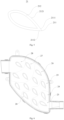
- the muffling air duct device reduces the exhaust noise of cleaning equipment, such as cleaning robots, by adding multi-stage diversion components 20 in an airflow channel 10.
- This muffling air duct device is suitable for the characteristics of small installation space and high space utilization required inside cleaning robots.
- this embodiment provides a cleaning robot, and the cleaning robot is an intelligent household appliance, also known as an automatic cleaning machine, intelligent vacuum robot, vacuum cleaner, etc. It is a type of intelligent household appliance that may automatically complete cleaning work in its region with certain artificial intelligence.
- Cleaning robots generally use brushing and vacuum manners to first absorb floor dust into their own dust collection box 70, thereby completing the function of floor cleaning.
- the cleaning robot is operated remotely using a remote control or through the control panel on the body, which is mainly disc-shaped. Using rechargeable batteries for operation, it is generally possible to set a time to schedule cleaning and self-charge. There are sensors installed in front that may detect obstacles.
- the cleaning robot generates noise during the operation of the fan, which affects the usage of the user and also has a certain impact on the physical health of the user.
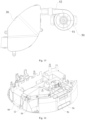
- FIG. 16 it is a schematic diagram of a partial structure of a cleaning robot applied to the muffling air duct device in this embodiment.
- the cleaning robot generally has an outer shell (not shown in the figure) and a base component arranged inside the outer shell.
- the base component includes a base body 60, and by setting driving wheels, batteries, air duct components and other components on the base body 60, the cleaning robot described in this embodiment is assembled.
- the outer shell may play a role in protecting the components in the base assembly of the cleaning robot.
- a corresponding avoidance space may be opened at an air outlet 12 of the muffling air duct device on the outer shell, providing air blown out from the air outlet 12 to be discharged outside the outer shell.
- the above-mentioned dust collection box 70 is used for temporary storage of dust and garbage collected by the cleaning robot.
- the dust collection box 70 may be installed on the outer shell of the cleaning robot through a detachable installation manner, or fixed relative to the outer shell. By arranging a dust outlet, users may clean the collected materials inside in a manner of automatic dust exhaust through the workstation or a manner of manual dust exhaust.
- the dust collection box 70 may be equipped with a dust inlet and an exhaust outlet.
- the dust inlet may be connected to a dust suction channel (not shown) on the bottom body of the cleaning robot.
- a dust suction part is formed on the dust suction channel that is connected to the outside of the cleaning robot. When the cleaning robot is in use, the dust suction part is facing the floor to be cleaned by the cleaning robot.
- the other side of the dust suction part is connected to the inlet airflow channel 321 of the muffling air duct device through the dust suction channel, the dust collection box 70, and an exhaust duct 52 of a fan 50.
- the exhaust outlet of the dust collection box 70 is used to connect with the draft duct 51 of the fan 50.
- the fan 50 is a main power output component of the air duct assembly in the cleaning robot. The fan 50 is used to provide power and create negative pressure in the dust suction channel, thereby sucking dust from the ground into the dust collection box 70.
- this embodiment is applied to the air duct component of the cleaning robot.
- the fan 50 according to this embodiment is a component that converts input electrical energy into mechanical energy, thereby increasing gas pressure and delivering gas.
- the fan 50 according to this embodiment has a draft duct 51 and an exhaust duct 52.
- the draft duct 51 may be arranged at the top or bottom of the fan 50, and the exhaust duct 52 may be arranged at the side of the fan 50. This can effectively utilize the internal space of the cleaning robot, and the fan 50 can also have better air force effect.
- a shock-absorbing hose 53 is arragned between the exhaust duct 52 and the muffling air duct device.
- the shock-absorbing hose 53 is made of a material with shock-absorbing function, which may be made of soft materials such as soft rubber.
- the shock-absorbing hose 53 can reduce the noise at the exhaust duct 52 of the fan 50 through shock-absorbing, and also improve the airtightness between the fan 50 and the muffling air duct device, ensuring the stability of air flow and thereby improving the reliability of the air duct component.
- the fan 50 includes a housing and an air supply component arranged inside the housing.
- a space for air flow is formed between the housing and the air supply component, and the space is connected to the external environment of the housing through the draft duct 51 and the exhaust duct 52, respectively.
- the housing can protect the air supply components and prevent airflow leakage.
- the exhaust duct 52 is tangent to the rotation direction of the air supply components, making the airflow inside the fan 50 smoother and increasing the air supply efficiency of the fan 50.
- the muffling air duct device of this embodiment includes an airflow channel 10, and the airflow channel 10 provides a gas discharge channel space for the cleaning equipment during the dust suction process, thereby restricting the direction of gas flow discharged by the fan 50.
- the two ends of the airflow channel 10 are respectively equipped with an air inlet 11 and an air outlet 12 that are connected to the external environment.
- the air inlet 11 is used to communicate with the exhaust duct 52 of the fan 50, and the gas discharged from the exhaust duct 52 may be discharged from the air outlet 12 through the airflow channel 10 to the outside of the cleaning robot.
- the air inlet 11 and the air outlet 12 are respectively used to restrict the inlet and outlet directions of the airflow channel 10.
- the inlet and outlet directions are at least partially offset from each other, and the offset between the inlet and outlet directions may be understood as the fact that the inlet and outlet directions are at least partially facing in different directions. It may also be understood that even if they are in the same direction, the inlet and outlet directions may be offset on the same horizontal plane or on different horizontal planes.
- the inlet and outlet directions are also at least partially offset in two positions, so that at least some of the airflow path in the airflow channel 10 may have disturbance structure such as bent, curved, or other ways that may disrupt the flow airflow direction.
- multi-stage diversion components 20 are sequentially set up.
- Each stage of diversion components 20 divides the airflow channel 10 into several diversion channels 22.
- the main airflow entering the airflow channel 10 from the air inlet 11 may be diverted by the diversion channels 22, thus forming a secondary airflow.
- the secondary airflow is guided by the diversion channels 22, changing the flow direction and extending the airflow path of the secondary airflow.
- Each secondary airflow will experience energy loss during the process of changing the flow direction, reducing the flow velocity of each secondary airflow.
- Corresponding muffling may be arranged in the diversion channels 22.
- the structure is such that the sound waves of the secondary airflow are buffered and absorbed within the diversion channel 22,
- the diversion channels 22 formed by each stage of diversion are communicated, allowing each secondary airflow to re-merge near the air outlet 12 and be discharged from the muffling duct device.
- the structure and muffling design of the diversion channel 22 need to ensure that the air resistance parameters meet the requirements of the cleaning robot during operation, and that the flow of each secondary airflow in the diversion channel 22 is smooth, so that the negative pressure formed at the draft duct 51 of the fan 50 in the application of the cleaning equipment is sufficient to suck in dust at the suction part.
- the diversion component 20 includes at least one diversion body 21, each diversion body 21 separating the airflow channel 10 into at least two diversion channels 22, thereby playing a role in diffusing, disturbing, and guiding the airflow with sound waves.
- the secondary airflow enters the corresponding diversion channel 22 its sound waves undergo multiple and repeated contact friction with the muffling structure arranged in the diversion channel 22, allowing the sound waves to be absorbed in the diversion channel 22 or resonate with the diversion body 21 when contact friction occurs with the diversion body 21, thereby consuming and absorbing the sound waves of the secondary airflow.
- the later stage of diversion body 21 is arranged at one of the diversion channels 22 separated by the former stage of diversion body 21. It may be understood that the main airflow entering the airflow channel 10 from the air inlet 11 is diverted by the diversion body 21 in the first stage of diversion component 20 closest to the air inlet 11 to form at least two secondary airflows.
- the secondary airflows flow in the diversion channels 22 separated by the first stage of diversion component 20 and undergo muffling treatment. Each secondary airflow will be guided by the corresponding diversion channel 22 to the later stage of diversion component 20.
- At least one secondary airflow will be further diverted, disturbed at the second stage of diversion body 21, and further diverted secondary airflow flows into the subsequent diversion channel 22 for further muffling treatment.
- multiple levels of branches of diversion channels 22 are formed within the airflow channel 10.
- the sound waves in the airflow are continuously diverted and disturbed before being subjected to muffling treatment, and then diverted and disturbed again, fully increasing the contact area between each airflow and the diversion body 21 and the muffling structure.
- the sound waves are buffered by each diversion channel 22, allowing the majority of their energy to be consumed within the diversion channel 22, thereby effectively improving the muffling effect of the muffling air duct device on the sound waves in the airflow.
- At least one side wall of the diversion channel 22 is formed through the side of the diversion body 21, and the other side wall of the diversion channel 22 may be determined based on the structure located on the side of the diversion body 21.
- any two adjacent diversion bodies 21 in the same stage of the diversion component 20 are arranged opposite to each other.
- two diversion channels 22 are formed from the perspective of airflow, and these two diversion channels 22 will eventually merge.
- the side walls of these two diversion channels 22 are respectively formed by two adjacent diversion bodies 21.
- the number of diversion bodies 21 in the same stage of the diversion component 20 is one, and a diversion channel 22 is formed between the side of the diversion body 21 and the inner wall of the muffling duct device; or when the number of diversion bodies 21 in the same level diversion component 20 is greater than or equal to two, a diversion channel 22 is formed between the side of the diversion body 21 closest to the inner wall of the muffling duct device and the inner wall of the muffling duct device.
- each secondary airflow may be guided to flow between the inner wall of the muffling duct device and the diversion body 21, as well as in the diversion channel 22 formed between each diversion body 21.
- a partition may be arranged between any two adjacent diversion bodies 21 of the same stage of diversion component 20, and a partition may be arranged between the diversion bodies 21 and the inner wall of the muffling air duct device, forming a diversion channel 22 through the partition and the side of the diversion bodies 21.
- the first stage of diversion component 20 closest to the air inlet 11 includes a diversion body 21, and the second stage of diversion component 20 after the first stage of diversion component 20 includes two diversion bodies 21.
- the diversion bodies 21 in the second stage of diversion component 20 are respectively arranged on the paths of two diversion channels 22 formed by the diversion body 21 of the first stage of diversion component 20. In this way, the main airflow entering from the air inlet 11 will be separated by the diversion body 21 located in the first stage of diversion component 20 to form two secondary airflows.
- the two secondary airflows will flow along the diversion channels 22 formed on both sides of the first stage of diversion body 21, respectively, towards the two diversion bodies 21 located in the second stage of diversion component 20. Subsequently, when the secondary airflows respectively come into contact with the second stage of diversion body 21, they will be separated into two secondary airflows, ultimately forming at least four secondary airflows. When the airflows are not separated once, their flow direction, velocity, and flow rate will change, thereby improving the contact area between each diversion channel 22 and its internal gas, effectively enhancing the sound wave muffling effect.
- the second stage of diversion component 20, the third stage of diversion component 20, and the subsequent stage of diversion components 20 are the diversion components 20 arranged in sequence along the airflow direction of the airflow channel 10 in each stage of diversion region.
- the former stage diversion component 20 refers to the diversion component 20 that is relatively located in the diversion region close to the air inlet 11
- the second stage of diversion component 20 refers to the diversion component 20 that is relatively located in the diversion region close to the air outlet 12.
- the air supply component Due to the small diameter of exhaust duct 52, the air supply component generates a large air pressure inside the housing of the fan 50 during rotation. Therefore, when high-pressure air is discharged from exhaust duct 52, it will cause impact vibration on the external air, resulting in noise. Therefore, the faster the speed of the air supply component and the higher the air pressure inside exhaust duct 52, the greater the noise generated by the fan 50 during the exhaust process.
- the size of the airflow channel 10 needs to be larger than that of the exhaust duct 52, providing sufficient buffer space for the discharged airflow, so that the noise can be buffered and absorbed in the muffling duct device.
- the diversion body 21 includes an air ward part 211 and an air guide part 212.
- the air ward part 211 and the air guide part 212 may be integrated into a single molding structure to reduce the processing and installation difficulties of the diversion body 21.
- the air ward part 211 and the air guide part 212 may also be two independent components that are coupled to each other in the air path structure formed by them, and are arranged in the airflow channel 10 through independent processing, installation, and other manners.
- the air ward part 211 is arranged at an end of the diversion body 21 close to the air inlet 11, used to separate the airflow channel 10 into at least two alternating diversion channels 22.
- the air ward part 211 is a part where the diversion body 21 first comes into contact with the airflow.
- the air ward part 211 will block the airflow, change the airflow direction, and divide the airflow into at least two channels, each of divided airflow will flow into the corresponding diversion channel 22.
- Each of air guide parts 212 forms one side wall of its corresponding diversion channel 22, and the air guide part 212 is used to guide the airflow direction in its corresponding diversion channel 22.
- the airflow path formed by the separation of each air guide part 212 and the air ward part 211 is consistent, so that all the airflow diverted by the air ward part 211 can be guided by the air guide part 212, and the buffering and absorption effect of noise and sound waves in the airflow can also be improved.
- the distance between any two adjacent air guide parts 212 is greater than or equal to that of the air ward parts 211, thereby forming a diffusive structure of diversion channels 22, providing sufficient installation space for the later stage of diversion body 21 and sufficient flow space for the air in the first stage.
- the air ward part 211 includes a first diversion surface 2111 and a second diversion surface 2112 arranged at an angle.
- the first diversion surface 2111 and the second diversion surface 2112 are used to separate the airflow channel 10 to form a diversion channel 22.
- An end of the first diversion surface 2111 is connected with that of the second diversion surface 2112, and the first diversion surface 2111 and the second diversion surface 2112 may gradually extend in the direction away from each other and towards the air outlet 12. It may be understood that, as shown in Fig.
- each of air guide parts 212 includes an air guide surface 2121.
- An end of the air guide surface 2121 is connected to the first diversion surface 2111 or the second diversion surface 2112, and the other end of the air guide surface 2121 extends along the airflow direction of the corresponding diversion channel 22.
- the air guide surface 2121 includes a first guide surface and a second guide surface. An end of the first guide surface is connected to the first diversion surface 2111, and an end of the second guide surface is connected to the second diversion surface 2112.
- first guide surface and the second guide surface are facing away from each other and extend towards the direction of the air outlet 12. It should be noted that the airflow path formed by the first diversion surface 2111 is coupled with the airflow path of the first guide surface, and the airflow path formed by the second diversion surface 2112 is coupled with the airflow path of the second guide surface.
- each air guide surface 2121 gradually increases from the end close to the air ward part 211 to the end far away from the air ward part 211.
- the space between them gradually increases to form a diffusive structure, providing sufficient installation space for the later stage of diversion body 21 and sufficient airflow space for the later stage of diversion channel 22.
- peripheral shape of the diversion body 21 includes but is not limited to a combination of one or more of droplet shape, circle, diamond shape, and rectangle.
- the above description of the structure of the diversion body 21 is applicable to cases where the periphery of the diversion body 21 has irregular shapes such as water droplets, diamonds, rectangles, etc.
- the shape of the periphery of the diversion body 21 adopts a water droplet structure.
- the air ward part 211 may also be a plane, as long as it may achieve the effect of diverting airflow.
- first channel 13 and second channel 14 formed in the airflow channel 10.
- the air inlet 11 is correspondingly connected to the first channel 13, and the air outlet 12 is correspondingly connected to the second channel 14.
- the number of diversion components 20 is greater than 2.
- the number of diversion bodies 21 of each stage of diversion components 20 in the first channel 13 increases stage by stage in the airflow direction, and the number of diversion bodies 21 of each stage of diversion components 20 in the second channel 14 decreases stage by stage in the airflow direction.
- the main airflow is separated into multiple secondary airflows after entering the airflow channel 10, and the multiple secondary airflows may merge into one airflow and be discharged from the air outlet 12 when approaching the air outlet 12.
- the muffling requirements of the air duct device are met, and the volume of the air duct device gradually increases from the air inlet 11 to the air outlet 12 and then gradually decreases, minimizing the overall volume of the air duct device and meeting the installation needs of the cleaning robot.
- the airflow channel 10 is sequentially equipped with multi-stage diversion regions along the airflow direction, and each of the diversion regions is equipped with the diversion component 20; the number of diversion channels 22 separated by any two adjacent diversion regions gradually increases or decreases in the airflow direction.
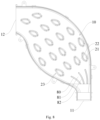
- the airflow channel 10 is sequentially provided with six diversion regions in the airflow direction, with the first stage of diversion region closest to the air inlet 11, namely the first-stage diversion region 23, including a diversion body 21.
- the air ward part 211 of the diversion body 21 located in the first-stage diversion region 23 is arranged towards the air inlet 11.
- the main airflow L1 entering from the air inlet 11 is separated into two branch airflows L2 under the diversion of the first-stage diversion region 23, and the two secondary airflows flow along the separated diversion channels 22.
- the diversion component 20 in the subsequent second-stage diversion region 24 includes two diversion bodies 21.
- the two diversion bodies 21 located in the second-stage diversion region 24 are respectively arranged on the path of the two diversion channels 22 separated by the first-stage diversion region 23.
- the air ward part 211 of the diversion body 21 in the second-stage diversion region 24 faces the air ward direction of the respective diversion channels 22, and diverts the two branch airflows L2 into four branch airflows L3-1.
- the branch airflows L3-1 between two adjacent diversion bodies 21 merge to form a merging L3-2 after flowing along the diversion channels 22 for a certain distance.
- the diversion component 20 of the third-stage diversion region 25 includes three diversion bodies 21, and the three diversion bodies 21 are respectively arranged on the diversion channels 22 formed by the separation of the second-stage regions.
- One diversion body 21 located in the third-stage diversion region 25 is arranged on the merging channel to divert the merging L3-2, while the diversion bodies 21 located on both sides divert the branch airflow L3-1 on both sides of the second-stage diversion region 24, forming six secondary airflows L4-1.
- the secondary airflows L4-1 between two adjacent diversion bodies 21 merge to form the merging L4-2 after flowing for a certain distance.
- the diversion section of the fourth-stage diversion region 26 includes four diversion bodies 21, which follow the same diversion principle as the third-stage diversion region 25.
- the four diversion bodies 21 correspond to the secondary airflow L4-1 and the two merging L4-2 on both sides of the third-stage diversion body 21 for diversion.
- the diversion body 21 in the fifth-stage diversion region 27 and the sixth-stage diversion region 28 gradually decreases, ultimately allowing each secondary airflow and merging to converge and be discharged from the air outlet 12.
- the main airflow may be separated into multiple secondary airflows with relatively lower flow rates than the main airflow, in order to gradually perturb, buffer, and absorb each secondary airflow. Finally, the airflow with absorbed noise and sound waves can be re merged and discharged from the air outlet 12.
- the muffling air duct device further includes a diversion component 80, and the diversion component 80 may be arranged between the air inlet 11 and the diversion component 20.
- the diversion component 80 may be arranged between the air inlet 11 and the first-stage diversion region 23, so that the airflow flowing into the airflow channel 10 through the air inlet 11 may all pass through the diversion component 80.
- the diversion component 80 is used to separate the airflow channel 10 into multiple guide channels 81, similar to the arrangement of the diversion body 21 in the airflow channel 10.
- Each guide channel 81 is arranged side by side in the airflow channel 10, and multiple diversion bodies 21 are arranged in the first-stage diversion region 23 to form multiple diversion channels 22.
- the diversion channel 22 of the first-stage diversion region 23 and the guide channel 81 are alternately arranged and connected to each other.
- the main airflow L1 flowing into the airflow channel 10 through the air inlet 11 may be divided into multiple corresponding branch airflow L2 flowing into each guide channel 81 under the action of the diversion component 80.
- the branch airflow L2 flows in the direction of the first-stage diversion region 23 under the guidance of the diversion component 80 and ultimately acts on the first-stage diversion region 23.
- each branch airflow L2 flows into the corresponding diversion channel 22 formed by the first-stage diversion region 23, ultimately implementing the above-mentioned muffling and vibration reduction of the airflow.
- the main airflow L1 may relatively uniformly flow into each guide channel 81 under the action of the diversion component 80 to form a branch airflow L2, and uniformly diffuse into each diversion channel 22 formed by the first-stage diversion region 23 under the guidance of each guide channel 81 to form a branch airflow L3.
- the branch airflow L3 flowing into each diversion channel 22 of the first-stage diversion region 23 is relatively uniform, improving the efficiency of the interaction between the airflow in the airflow channel 10 and the first-stage diversion region 23. To a certain extent, it ensures that each diversion body 21 in the first-stage diversion region 23 may have the same noise and vibration reduction effect on the second stage diversion, avoiding the situation where the airflow is discharged through the shortest path in the airflow channel 10.
- the diversion component 80 should ensure the relative smoothness of the first stage diversion in the guide channel 81, avoiding excessive deceleration or disturbance of the airflow in the guide channel 81, which may affect the effect of the subsequent branch airflows L2 being disturbed by the first-stage diversion region 23.
- the guide channel 81 may be formed between any two adjacent diversion components 80, or may be formed by the diversion component 80 cooperating with the channel side wall of the airflow channel 10.
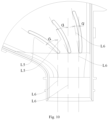
- the diversion component 80 is formed with a guide surface 82 that guides the airflow from the air inlet 11 to the first-stage diversion region 23.
- the guide surface 82 extends from an end close to the air inlet 11 towards the first-stage diversion region 23, so that the main airflow L1 enters the guide channel 81 and forms a branch airflow L2, and is guided to the corresponding position of the first-stage diversion region 23 according to the extension direction of the guide surface 82.
- the diversion component 80 may be one of other irregular structures such as a plate-like structure, a block structure, etc., and at least two guide surfaces 82 may be provided on the diversion component 80.
- the diversion body as a plate-like structure with two guide surfaces 82 as an example, the two guide surfaces 82 are respectively formed on the opposite side surfaces of the diversion body.
- the guide channel 81 may be formed between any guide surface 82 and the channel side wall of the airflow channel 10, or between any two adjacent and opposite guide surfaces 82 when multiple diversion bodies are arranged.
- the guide surface 82 may be arranged as a curved surface or a flat surface.
- the guide surface 82 of this embodiment is arranged as a curved surface that gradually bends towards the first-stage diversion region 23 close to the air inlet 11. In this way, the airflow in the guide channel 81 may be guided by the curved structure of the diversion surface, allowing it to flow more smoothly towards the first-stage diversion region 23 for turbulence treatment.
- the end of the guide surface 82 close to the air inlet 11 is tangent to the direction of the air inlet, so that the flow velocity and direction of the main airflow entering the corresponding guide channel 81 are not greatly disturbed.
- an angle ⁇ between the straight line L5 formed by connecting the opposite ends of the guide surface 82 and the extension line of the inlet direction L6 of the air inlet 11 is 0°-70°.
- the opposite ends of the diversion component 80 in the airflow direction are respectively formed with a first end close to the air inlet 11 and a second end far away from the air inlet 11.
- the straight line L5 may also be understood as the straight line formed by connecting the first end of the diversion component 80 with its second end.
- the inlet direction L6 may be understood as the airflow direction at the position of the first end of the diversion component 80. In practical applications, there will be multiple airflows entering the airflow channel 10 through the air inlet 11. When multiple airflows flow towards the corresponding diversion component 80 along the airflow direction, each airflow will be cut and divided by the corresponding diversion component 80. At this time, the airflow direction corresponding to the first end of the diversion component 80 is defined as the inlet direction L5.
- the channel structure between the air inlet 11 and the diversion component 80 may be a straight channel, an arc-shaped channel, etc., but regardless of the channel structure between the diversion component 80 and the air inlet 11, the airflow direction ultimately in contact with the position of the first end of the corresponding diversion component 80 is the inlet direction L6.
- Arranging the guide surface 82 in the above-mentioned structural form between the air inlet 11 and the first-stage diversion region 23 can ensure that the guide surface 82 can guide the corresponding first diversion to the position corresponding to the first-stage diversion region 23, and the first diversion is not easily affected by the guide surface 82, avoiding the situation where the first diversion generates additional turbulence at the end of the guide surface 82 close to the first-stage diversion region 23.
- the end of the diversion component 80 close to the air inlet 11 may be arranged as a circular arc structure, and the two sides of the circular arc structure are respectively tangent to the guide surfaces 82 placed on opposite sides of the diversion component 80.
- the circular arc structure may divide the main airflow into two first stage diversions and guide them to the corresponding guide channels 81 on both sides, minimizing the turbulence caused by the main airflow when it impacts the end of the diversion component 80.
- the end of the diversion component 80 close to the air inlet 11 may also be designed as a conical structure.
- the first-stage diversion region 23 of this embodiment includes at least two separated and parallel diversion bodies 21.
- the diversion bodies 21 of the first-stage diversion region 23 are used to divide the airflow channel 10 into at least two diversion channels 22, thereby playing the roles of diffusion, turbulence, and acoustic guidance of the airflow as described above.
- the sound waves in the airflow undergo multiple and repeated contact frictions with the first-stage diversion region 23 and the muffling structure arranged in the first-stage diversion body 21, so that the sound waves are absorbed to a certain extent in the diversion channel 22 formed by the first-stage diversion region 23.
- resonance occurs between the airflow and the diversion body 21, thereby consuming and absorbing the sound waves of the first stage diversion.
- the diversion bodies 21 in the first-stage diversion region 23 are alternately arranged with the diversion component 80.
- This setting method may be understood as:
- an end of the diversion component 80 close to the first-stage diversion region 23 is directly facing the diversion channel 22 of the first-stage diversion region 23; as well as
- the diversion body 21 of the first-stage diversion region 23 is arranged facing the guide channel 81.
- this embodiment sets the number of diversion channels 22 in the first-stage diversion region 23 to n, where n ⁇ 3, and the corresponding number of guide channels 81 is (n-1). As shown in Fig. 9 , when the number of diversion channels 22 arranged in the first-stage diversion region 23 is 5, the corresponding guide channels 81 are 4.
- the number of diversion channels 22 in the first-stage diversion region 23 does not correspond to the number of guide channels 81.
- the corresponding guide channels 81 may also be set to 2, 3, etc.
- the branch airflow L2 may evenly enter the first-stage diversion region 23, so that the branch airflow L3 in each diversion channel 22 within the first-stage diversion region 23 is more uniform, facilitating further muffling and shock absorption processing in the second-stage diversion region 24, third-stage diversion region 25, etc.
- a sound-absorbing material 40 is installed inside the airflow channel 10.
- the sound-absorbing material 40 may be fitted around the periphery of each diversion body 21;
- the sound-absorbing material 40 may be arranged around the inner wall of the air duct housing 30;
- the sound-absorbing material 40 may be filled in the airflow channel 10, specifically, the sound-absorbing material 40 is filled in each diversion channel 22.
- the sound-absorbing material 40 is not provided in the guide channel 81, that is, the sound-absorbing material 40 is provided between the diversion component 80 and the air outlet 12.
- Fig. 13 is a simulation diagram of the airflow channel 10 of the muffling air duct device in this embodiment. It may be seen that under the action of the diversion component 80, the high-speed main airflow (the lighter colored part near the air inlet 11) may be evenly diverted and flow towards the first-stage diversion region 23. As the airflow passes through the first-stage diversion region 23, the second stage diversion region 24, the third-stage diversion region 25 in sequence, the airflow gradually becomes stable (the color gradually becomes uniform), so that the airflow may be smoothly discharged at the air outlet 12, achieving the effect of muffling and vibration reduction.
- the muffling air duct device further includes an air duct housing 30, which is hollow inside to form an airflow channel 10.
- the air inlet 11 and the air outlet 12 are both arranged in the air duct housing 30.
- Each diversion body 21 is arranged inside the air duct housing 30, so that each diversion channel 22 is formed inside the air duct housing 30.
- An avoidance space is opened on the surface of the air duct housing 30, which is opposite to the air inlet 11 and the air outlet 12.
- the air duct housing 30 may be equipped with an air guide pipe 31 extending from the air duct housing 30 at the air outlet, and an outlet airflow channel 311 is formed inside the air guide pipe 31 to restrict the flow direction of the gas discharged from the muffling air duct device.
- the air duct housing 30 may be equipped with an air duct connecting pipe 32 extending from the air duct housing 30 at the air inlet 11, and an air inlet channel 321 is formed inside the air duct connecting pipe 32 to restrict the flow direction of the gas entering the muffling air duct device and facilitate the connection between the muffling air duct device and the fan 50.
- the cross-sectional shapes of the inlet airflow channel 321 and the outlet airflow channel 311 may have various shapes, such as but not limited to: circular, square, trumpet shaped, and other irregular shapes.
- the diversion channel 22 is formed.
- a diversion channel 22 is formed between the side of the diversion body 21, namely the guide part, and the inner wall of the air duct housing 30.
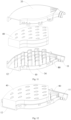
- the air duct housing 30 includes an upper cover 33 and a lower cover 34 that cover each other.
- the airflow channel 10 may be formed by the assembly of the upper and lower housings, and the diversion body 21 may be arranged on the upper or lower housings, which can improve the processing efficiency through integrated molding during the processing.
- the upper and lower housings described in this embodiment are specifically the two housings of the muffling air duct device that are relatively close to and far away from the cleaning robot when installed in the cleaning robot.
- the housing that is relatively close to the cleaning robot is defined as the lower housing, and the housing that is relatively far away from the cleaning robot side is defined as the upper housing.
- the upper cover 33 and the lower cover 34 may be detachably connected by buckles or fixedly connected by threaded connections.
- the materials of the air guide part 212, upper cover 33, and lower cover 34 mentioned above include but are not limited to a combination of one or more of resin materials, plastic materials, and metal materials.
- an end of the diversion body 21 is arranged on the lower cover 34. After the upper cover 33 and the lower cover 34 are closed, the other end of the diversion body 21 may be pressed against the upper cover 33, so that the diversion body 21 is horizontally placed between the upper cover 33 and the lower cover 34.
- the sound-absorbing material 40 is installed inside the airflow channel 10.
- the diversion body 21 includes a diversion main body integrally formed on the air duct housing 30 and the sound-absorbing material 40 fitted around the periphery of the diversion main body.
- the diversion main body integrally formed on the air duct housing 30 does not need to have assembly structures or reserved installation positions between the air duct housing 30 and the diversion main body, which is more conducive to the production and processing of the device.
- the sound-absorbing material 40 is arranged around the inner wall of the air duct housing 30.
- the sound-absorbing material 40 is different from the material of the diversion body.
- the diversion body 21 may divert the airflow while allowing the air to come into contact with the sound-absorbing material 40 as much as possible. After the airflow is diverted into at least two channels by the diversion body 21, each airflow may come into contact with the sound-absorbing material 40.
- the diversion treatment can reduce the airflow velocity, increase the contact area between the air and the sound-absorbing material 40, and improve the sound-absorbing effect of the sound-absorbing duct device.
- the upper and lower sides of the upper and lower shells used to enclose the airflow channel 10 may further be equipped with sound-absorbing materials 40, but there should be a certain gap between the sound-absorbing materials 40 located on the upper and lower housings to ensure that gas can smoothly pass through the diversion channel 22.
- the sound-absorbing material 40 may be in the form of a sheet or block structure.
- the sound-absorbing material 40 may be attached or clamped to the inner wall of the air duct housing 30 or the periphery of each diversion body 21.
- the sound-absorbing material 40 may be arranged by filling the ventilation space.
- the sound-absorbing material 40 is a sheet-like structure, which is attached to the outer peripheral wall of each diversion body 21 and the inner wall of the air duct housing 30.
- the specific function of the sound-absorbing material 40 is to reduce the noise generated by the exhaust of the fan 50 during the operation of the cleaning robot.
- some necessary conditions should be met.
- the sound-absorbing material 40 needs to be a breathable component, or may be said that the air resistance of sound-absorbing material 40 should not be too high, so that sound-absorbing material 40 can reduce noise in the airflow without affecting the normal operation of the fan 50.
- the sound-absorbing material 40 needs to be a component with good muffling effect, so as to minimize noise and enhance the user experience.
- the sound-absorbing material 40 is sound-absorbing cotton, and the material of sound-absorbing cotton is not limited to fiber cotton, polyurethane sound-absorbing cotton, sponge, pearl cotton, etc. Its thickness is not limited. It may be understood that the internal structure of the sound-absorbing cotton is mesh shaped. When noise enters the surface of the sound-absorbing cotton, a part of the noise will be reflected by the sound-absorbing cotton, and the reflected noise will cancel out the subsequent noise transmitted to the direction of the sound-absorbing cotton, achieving an once-sound-absorbing effect. Part of the noise will pass through the sound-absorbing cotton and be absorbed by the sound-absorbing cotton, and another part of the noise will be lost when it rubs against the surrounding medium due to its own vibration propagation, ultimately achieving the sound-absorbing effect.
- the sound-absorbing cotton is a material made of single or multiple different fibers processed through various processes, among which polyester sound-absorbing cotton has a better sound-absorbing effect.
- Polyester sound-absorbing cotton is composed of 100% polyester fibers that have undergone high-tech hot pressing and are formed in the shape of cocoon cotton, which has good air permeability.
- the sound absorption coefficient of polyester sound-absorbing cotton reaches 0.94 in the noise range of 125-4000HZ, which can maximize the absorption of the noise generated by the exhausts of the fan 50.
- the noise frequency band will not continuously decay with distance and time as the airflow passes through each diversion channel 22. Therefore, as the noise flows through each diversion channel 22 in the airflow direction, its frequency band will also decrease.
- the preset energy absorption frequency band of the sound-absorbing material 40 close to the air inlet 11 is higher than that of the sound-absorbing material 40 close to the air outlet 12, so that the sound-absorbing frequency band of the sound-absorbing duct device covers a wider range of frequency bands and improves the applicability of the sound-absorbing duct device.
- the muffling duct device in this embodiment does not have a completely silent effect on the fan 50 and the airflow discharged by the fan 50. It only reduces the noise, allowing users to almost ignore the reduced noise when applying the muffling duct device to the corresponding cleaning equipment.
Landscapes
- Engineering & Computer Science (AREA)
- Mechanical Engineering (AREA)
- Duct Arrangements (AREA)
- Soundproofing, Sound Blocking, And Sound Damping (AREA)
- Electric Vacuum Cleaner (AREA)
Applications Claiming Priority (2)
| Application Number | Priority Date | Filing Date | Title |
|---|---|---|---|
| CN202220576584.7U CN217696390U (zh) | 2022-03-15 | 2022-03-15 | 一种消声风道装置、风道组件及清洁机器人 |
| PCT/CN2023/081642 WO2023174338A1 (fr) | 2022-03-15 | 2023-03-15 | Dispositif d'atténuation du bruit de conduit d'air, ensemble conduit d'air et robot de nettoyage |
Publications (2)
| Publication Number | Publication Date |
|---|---|
| EP4494538A1 true EP4494538A1 (fr) | 2025-01-22 |
| EP4494538A4 EP4494538A4 (fr) | 2025-07-23 |
Family
ID=83788858
Family Applications (1)
| Application Number | Title | Priority Date | Filing Date |
|---|---|---|---|
| EP23769840.2A Pending EP4494538A4 (fr) | 2022-03-15 | 2023-03-15 | Dispositif d'atténuation du bruit de conduit d'air, ensemble conduit d'air et robot de nettoyage |
Country Status (4)
| Country | Link |
|---|---|
| EP (1) | EP4494538A4 (fr) |
| JP (1) | JP2025509625A (fr) |
| CN (1) | CN217696390U (fr) |
| WO (1) | WO2023174338A1 (fr) |
Families Citing this family (4)
| Publication number | Priority date | Publication date | Assignee | Title |
|---|---|---|---|---|
| CN217696390U (zh) * | 2022-03-15 | 2022-11-01 | 广州视源电子科技股份有限公司 | 一种消声风道装置、风道组件及清洁机器人 |
| CN117432608A (zh) * | 2023-10-09 | 2024-01-23 | 深圳市佳迈自动化股份有限公司 | 一种真空发生器 |
| CN117415112B (zh) * | 2023-10-24 | 2026-03-31 | 湖南大川新型建材有限公司 | 一种基于高尔夫球面降噪降风阻的多功能风管 |
| EP4588747A1 (fr) * | 2024-01-16 | 2025-07-23 | Korea Railroad Research Institute | Structure de réduction de bruit pour conduit de circulation d'air |
Family Cites Families (18)
| Publication number | Priority date | Publication date | Assignee | Title |
|---|---|---|---|---|
| JP2603131B2 (ja) * | 1989-05-11 | 1997-04-23 | 文博 中川 | 消音装置 |
| JPH031396U (fr) * | 1989-05-29 | 1991-01-09 | ||
| JP2005009377A (ja) * | 2003-06-18 | 2005-01-13 | Morimotogumi:Kk | 送風機の防音構造 |
| JP2006055622A (ja) * | 2004-08-23 | 2006-03-02 | Samsung Kwangju Electronics Co Ltd | サイクロン集塵装置及びこれを備えた掃除機 |
| JP5305372B2 (ja) * | 2007-10-02 | 2013-10-02 | 公益財団法人鉄道総合技術研究所 | 空力音低減構造 |
| KR20100010203A (ko) * | 2008-07-22 | 2010-02-01 | 볼보 컨스트럭션 이키프먼트 홀딩 스웨덴 에이비 | 건설장비용 노이즈 싸일런서 |
| CN204750174U (zh) * | 2015-06-05 | 2015-11-11 | 南车青岛四方机车车辆股份有限公司 | 一种消音风道及轨道车辆 |
| JP2017218946A (ja) * | 2016-06-07 | 2017-12-14 | 三菱重工業株式会社 | サイレンサ、空調ダクト及び発電プラント |
| CN207919791U (zh) * | 2018-02-09 | 2018-09-28 | 夏敬懿 | 消音装置 |
| DE102018003848A1 (de) * | 2018-05-09 | 2019-11-14 | Hydac Technology Gmbh | Dämpfungsvorrichtung |
| CN211460047U (zh) * | 2019-10-14 | 2020-09-11 | 广东美的白色家电技术创新中心有限公司 | 导风装置以及清洁设备 |
| CN211299813U (zh) * | 2019-10-14 | 2020-08-21 | 广东美的白色家电技术创新中心有限公司 | 一种出风装置及清洁装置 |
| CN211933902U (zh) * | 2020-01-08 | 2020-11-17 | 广州科语机器人有限公司 | 一种配有消音装置的扫地机器人 |
| CN212538221U (zh) * | 2020-05-26 | 2021-02-12 | 青岛海尔空调电子有限公司 | 用于风管式空调机的降噪管道 |
| CN214231212U (zh) * | 2020-11-03 | 2021-09-21 | 珊口(深圳)智能科技有限公司 | 清洁机器人及用于清洁机器人的消音组件 |
| CN213901431U (zh) * | 2020-12-28 | 2021-08-06 | 广东美的生活电器制造有限公司 | 风道组件和家用电器 |
| CN113425198B (zh) * | 2021-07-22 | 2025-02-07 | 成都迈科高分子材料股份有限公司 | 用于吸尘器或扫地机器人的消音降噪装置及降噪方法 |
| CN217696390U (zh) * | 2022-03-15 | 2022-11-01 | 广州视源电子科技股份有限公司 | 一种消声风道装置、风道组件及清洁机器人 |
-
2022
- 2022-03-15 CN CN202220576584.7U patent/CN217696390U/zh active Active
-
2023
- 2023-03-15 JP JP2024554887A patent/JP2025509625A/ja active Pending
- 2023-03-15 EP EP23769840.2A patent/EP4494538A4/fr active Pending
- 2023-03-15 WO PCT/CN2023/081642 patent/WO2023174338A1/fr not_active Ceased
Also Published As
| Publication number | Publication date |
|---|---|
| EP4494538A4 (fr) | 2025-07-23 |
| CN217696390U (zh) | 2022-11-01 |
| JP2025509625A (ja) | 2025-04-11 |
| WO2023174338A1 (fr) | 2023-09-21 |
Similar Documents
| Publication | Publication Date | Title |
|---|---|---|
| EP4494538A1 (fr) | Dispositif d'atténuation du bruit de conduit d'air, ensemble conduit d'air et robot de nettoyage | |
| CN217610781U (zh) | 一种消声风道装置、风道组件及清洁机器人 | |
| WO2019011313A1 (fr) | Aspirateur et module moteur associé | |
| CN217274349U (zh) | 一种具有降噪功能的吸油烟机 | |
| CN205359365U (zh) | 吸尘器 | |
| CN109780596B (zh) | 一种降噪导流装置及应用有该降噪导流装置的吸油烟机 | |
| RU2415635C2 (ru) | Пылесос, оборудованный устройством снижения шума | |
| CN205807552U (zh) | 一种侧吸式油烟机 | |
| AU2006249267A1 (en) | Vacuum cleaner | |
| CN220158168U (zh) | 一种消声风道装置、风道组件及清洁机器人 | |
| CN217547908U (zh) | 一种消声风道装置、风道组件及清洁机器人 | |
| CN216090303U (zh) | 一种过滤组件及吸尘设备 | |
| CN214170962U (zh) | 一种用于高压离心风机的降噪箱及高压离心风机 | |
| CN207928276U (zh) | 手持式吸尘器降噪机构 | |
| CN105725924B (zh) | 吸尘器和风道组件 | |
| CN221482236U (zh) | 动力装置和吸油烟机 | |
| CN211674060U (zh) | 排风系统及所应用的扫地机器人 | |
| CN207230684U (zh) | 一种近吸式吸油烟机 | |
| CN218862944U (zh) | 一种风机系统及使用该风机系统的吸油烟机 | |
| CN207214202U (zh) | 一种近吸式吸油烟机 | |
| CN222303844U (zh) | 一种降音降噪结构及扫地机器人 | |
| CN224175308U (zh) | 除尘电机、除尘模块及空气净化装置 | |
| CN120062149A (zh) | 风机、动力装置及吸油烟机 | |
| CN223691105U (zh) | 一种油烟处理装置 | |
| CN120062147A (zh) | 动力装置和吸油烟机 |
Legal Events
| Date | Code | Title | Description |
|---|---|---|---|
| STAA | Information on the status of an ep patent application or granted ep patent |
Free format text: STATUS: THE INTERNATIONAL PUBLICATION HAS BEEN MADE |
|
| PUAI | Public reference made under article 153(3) epc to a published international application that has entered the european phase |
Free format text: ORIGINAL CODE: 0009012 |
|
| STAA | Information on the status of an ep patent application or granted ep patent |
Free format text: STATUS: REQUEST FOR EXAMINATION WAS MADE |
|
| 17P | Request for examination filed |
Effective date: 20241015 |
|
| AK | Designated contracting states |
Kind code of ref document: A1 Designated state(s): AL AT BE BG CH CY CZ DE DK EE ES FI FR GB GR HR HU IE IS IT LI LT LU LV MC ME MK MT NL NO PL PT RO RS SE SI SK SM TR |
|
| DAV | Request for validation of the european patent (deleted) | ||
| DAX | Request for extension of the european patent (deleted) | ||
| A4 | Supplementary search report drawn up and despatched |
Effective date: 20250624 |
|
| RIC1 | Information provided on ipc code assigned before grant |
Ipc: A47L 9/00 20060101AFI20250617BHEP Ipc: A47L 5/22 20060101ALI20250617BHEP |