EP4494845A1 - Film de polyamide à orientation biaxiale et stratifié contenant un film de polyester à orientation biaxiale - Google Patents
Film de polyamide à orientation biaxiale et stratifié contenant un film de polyester à orientation biaxiale Download PDFInfo
- Publication number
- EP4494845A1 EP4494845A1 EP23770173.5A EP23770173A EP4494845A1 EP 4494845 A1 EP4494845 A1 EP 4494845A1 EP 23770173 A EP23770173 A EP 23770173A EP 4494845 A1 EP4494845 A1 EP 4494845A1
- Authority
- EP
- European Patent Office
- Prior art keywords
- stretching
- film
- stage
- mpa
- biaxially oriented
- Prior art date
- Legal status (The legal status is an assumption and is not a legal conclusion. Google has not performed a legal analysis and makes no representation as to the accuracy of the status listed.)
- Pending
Links
Images
Classifications
-
- H—ELECTRICITY
- H01—ELECTRIC ELEMENTS
- H01M—PROCESSES OR MEANS, e.g. BATTERIES, FOR THE DIRECT CONVERSION OF CHEMICAL ENERGY INTO ELECTRICAL ENERGY
- H01M50/00—Constructional details or processes of manufacture of the non-active parts of electrochemical cells other than fuel cells, e.g. hybrid cells
- H01M50/10—Primary casings; Jackets or wrappings
- H01M50/116—Primary casings; Jackets or wrappings characterised by the material
- H01M50/124—Primary casings; Jackets or wrappings characterised by the material having a layered structure
- H01M50/126—Primary casings; Jackets or wrappings characterised by the material having a layered structure comprising three or more layers
-
- B—PERFORMING OPERATIONS; TRANSPORTING
- B32—LAYERED PRODUCTS
- B32B—LAYERED PRODUCTS, i.e. PRODUCTS BUILT-UP OF STRATA OF FLAT OR NON-FLAT, e.g. CELLULAR OR HONEYCOMB, FORM
- B32B27/00—Layered products comprising a layer of synthetic resin
- B32B27/06—Layered products comprising a layer of synthetic resin as the main or only constituent of a layer, which is next to another layer of the same or of a different material
- B32B27/08—Layered products comprising a layer of synthetic resin as the main or only constituent of a layer, which is next to another layer of the same or of a different material of synthetic resin
-
- B—PERFORMING OPERATIONS; TRANSPORTING
- B29—WORKING OF PLASTICS; WORKING OF SUBSTANCES IN A PLASTIC STATE IN GENERAL
- B29C—SHAPING OR JOINING OF PLASTICS; SHAPING OF MATERIAL IN A PLASTIC STATE, NOT OTHERWISE PROVIDED FOR; AFTER-TREATMENT OF THE SHAPED PRODUCTS, e.g. REPAIRING
- B29C55/00—Shaping by stretching, e.g. drawing through a die; Apparatus therefor
- B29C55/02—Shaping by stretching, e.g. drawing through a die; Apparatus therefor of plates or sheets
- B29C55/10—Shaping by stretching, e.g. drawing through a die; Apparatus therefor of plates or sheets multiaxial
- B29C55/12—Shaping by stretching, e.g. drawing through a die; Apparatus therefor of plates or sheets multiaxial biaxial
-
- B—PERFORMING OPERATIONS; TRANSPORTING
- B29—WORKING OF PLASTICS; WORKING OF SUBSTANCES IN A PLASTIC STATE IN GENERAL
- B29D—PRODUCING PARTICULAR ARTICLES FROM PLASTICS OR FROM SUBSTANCES IN A PLASTIC STATE
- B29D7/00—Producing flat articles, e.g. films or sheets
- B29D7/01—Films or sheets
-
- B—PERFORMING OPERATIONS; TRANSPORTING
- B32—LAYERED PRODUCTS
- B32B—LAYERED PRODUCTS, i.e. PRODUCTS BUILT-UP OF STRATA OF FLAT OR NON-FLAT, e.g. CELLULAR OR HONEYCOMB, FORM
- B32B15/00—Layered products comprising a layer of metal
- B32B15/04—Layered products comprising a layer of metal comprising metal as the main or only constituent of a layer, which is next to another layer of the same or of a different material
- B32B15/08—Layered products comprising a layer of metal comprising metal as the main or only constituent of a layer, which is next to another layer of the same or of a different material of synthetic resin
- B32B15/085—Layered products comprising a layer of metal comprising metal as the main or only constituent of a layer, which is next to another layer of the same or of a different material of synthetic resin comprising polyolefins
-
- B—PERFORMING OPERATIONS; TRANSPORTING
- B32—LAYERED PRODUCTS
- B32B—LAYERED PRODUCTS, i.e. PRODUCTS BUILT-UP OF STRATA OF FLAT OR NON-FLAT, e.g. CELLULAR OR HONEYCOMB, FORM
- B32B15/00—Layered products comprising a layer of metal
- B32B15/04—Layered products comprising a layer of metal comprising metal as the main or only constituent of a layer, which is next to another layer of the same or of a different material
- B32B15/08—Layered products comprising a layer of metal comprising metal as the main or only constituent of a layer, which is next to another layer of the same or of a different material of synthetic resin
- B32B15/088—Layered products comprising a layer of metal comprising metal as the main or only constituent of a layer, which is next to another layer of the same or of a different material of synthetic resin comprising polyamides
-
- B—PERFORMING OPERATIONS; TRANSPORTING
- B32—LAYERED PRODUCTS
- B32B—LAYERED PRODUCTS, i.e. PRODUCTS BUILT-UP OF STRATA OF FLAT OR NON-FLAT, e.g. CELLULAR OR HONEYCOMB, FORM
- B32B15/00—Layered products comprising a layer of metal
- B32B15/04—Layered products comprising a layer of metal comprising metal as the main or only constituent of a layer, which is next to another layer of the same or of a different material
- B32B15/08—Layered products comprising a layer of metal comprising metal as the main or only constituent of a layer, which is next to another layer of the same or of a different material of synthetic resin
- B32B15/09—Layered products comprising a layer of metal comprising metal as the main or only constituent of a layer, which is next to another layer of the same or of a different material of synthetic resin comprising polyesters
-
- B—PERFORMING OPERATIONS; TRANSPORTING
- B32—LAYERED PRODUCTS
- B32B—LAYERED PRODUCTS, i.e. PRODUCTS BUILT-UP OF STRATA OF FLAT OR NON-FLAT, e.g. CELLULAR OR HONEYCOMB, FORM
- B32B15/00—Layered products comprising a layer of metal
- B32B15/20—Layered products comprising a layer of metal comprising aluminium or copper
-
- B—PERFORMING OPERATIONS; TRANSPORTING
- B32—LAYERED PRODUCTS
- B32B—LAYERED PRODUCTS, i.e. PRODUCTS BUILT-UP OF STRATA OF FLAT OR NON-FLAT, e.g. CELLULAR OR HONEYCOMB, FORM
- B32B27/00—Layered products comprising a layer of synthetic resin
- B32B27/32—Layered products comprising a layer of synthetic resin comprising polyolefins
-
- B—PERFORMING OPERATIONS; TRANSPORTING
- B32—LAYERED PRODUCTS
- B32B—LAYERED PRODUCTS, i.e. PRODUCTS BUILT-UP OF STRATA OF FLAT OR NON-FLAT, e.g. CELLULAR OR HONEYCOMB, FORM
- B32B27/00—Layered products comprising a layer of synthetic resin
- B32B27/34—Layered products comprising a layer of synthetic resin comprising polyamides
-
- B—PERFORMING OPERATIONS; TRANSPORTING
- B32—LAYERED PRODUCTS
- B32B—LAYERED PRODUCTS, i.e. PRODUCTS BUILT-UP OF STRATA OF FLAT OR NON-FLAT, e.g. CELLULAR OR HONEYCOMB, FORM
- B32B27/00—Layered products comprising a layer of synthetic resin
- B32B27/36—Layered products comprising a layer of synthetic resin comprising polyesters
-
- B—PERFORMING OPERATIONS; TRANSPORTING
- B65—CONVEYING; PACKING; STORING; HANDLING THIN OR FILAMENTARY MATERIAL
- B65D—CONTAINERS FOR STORAGE OR TRANSPORT OF ARTICLES OR MATERIALS, e.g. BAGS, BARRELS, BOTTLES, BOXES, CANS, CARTONS, CRATES, DRUMS, JARS, TANKS, HOPPERS, FORWARDING CONTAINERS; ACCESSORIES, CLOSURES, OR FITTINGS THEREFOR; PACKAGING ELEMENTS; PACKAGES
- B65D65/00—Wrappers or flexible covers; Packaging materials of special type or form
- B65D65/38—Packaging materials of special type or form
- B65D65/40—Applications of laminates for particular packaging purposes
-
- C—CHEMISTRY; METALLURGY
- C08—ORGANIC MACROMOLECULAR COMPOUNDS; THEIR PREPARATION OR CHEMICAL WORKING-UP; COMPOSITIONS BASED THEREON
- C08J—WORKING-UP; GENERAL PROCESSES OF COMPOUNDING; AFTER-TREATMENT NOT COVERED BY SUBCLASSES C08B, C08C, C08F, C08G or C08H
- C08J5/00—Manufacture of articles or shaped materials containing macromolecular substances
- C08J5/18—Manufacture of films or sheets
-
- H—ELECTRICITY
- H01—ELECTRIC ELEMENTS
- H01M—PROCESSES OR MEANS, e.g. BATTERIES, FOR THE DIRECT CONVERSION OF CHEMICAL ENERGY INTO ELECTRICAL ENERGY
- H01M50/00—Constructional details or processes of manufacture of the non-active parts of electrochemical cells other than fuel cells, e.g. hybrid cells
- H01M50/10—Primary casings; Jackets or wrappings
- H01M50/102—Primary casings; Jackets or wrappings characterised by their shape or physical structure
- H01M50/105—Pouches or flexible bags
-
- H—ELECTRICITY
- H01—ELECTRIC ELEMENTS
- H01M—PROCESSES OR MEANS, e.g. BATTERIES, FOR THE DIRECT CONVERSION OF CHEMICAL ENERGY INTO ELECTRICAL ENERGY
- H01M50/00—Constructional details or processes of manufacture of the non-active parts of electrochemical cells other than fuel cells, e.g. hybrid cells
- H01M50/10—Primary casings; Jackets or wrappings
- H01M50/116—Primary casings; Jackets or wrappings characterised by the material
- H01M50/117—Inorganic material
- H01M50/119—Metals
-
- H—ELECTRICITY
- H01—ELECTRIC ELEMENTS
- H01M—PROCESSES OR MEANS, e.g. BATTERIES, FOR THE DIRECT CONVERSION OF CHEMICAL ENERGY INTO ELECTRICAL ENERGY
- H01M50/00—Constructional details or processes of manufacture of the non-active parts of electrochemical cells other than fuel cells, e.g. hybrid cells
- H01M50/10—Primary casings; Jackets or wrappings
- H01M50/116—Primary casings; Jackets or wrappings characterised by the material
- H01M50/121—Organic material
-
- H—ELECTRICITY
- H01—ELECTRIC ELEMENTS
- H01M—PROCESSES OR MEANS, e.g. BATTERIES, FOR THE DIRECT CONVERSION OF CHEMICAL ENERGY INTO ELECTRICAL ENERGY
- H01M50/00—Constructional details or processes of manufacture of the non-active parts of electrochemical cells other than fuel cells, e.g. hybrid cells
- H01M50/10—Primary casings; Jackets or wrappings
- H01M50/116—Primary casings; Jackets or wrappings characterised by the material
- H01M50/124—Primary casings; Jackets or wrappings characterised by the material having a layered structure
-
- H—ELECTRICITY
- H01—ELECTRIC ELEMENTS
- H01M—PROCESSES OR MEANS, e.g. BATTERIES, FOR THE DIRECT CONVERSION OF CHEMICAL ENERGY INTO ELECTRICAL ENERGY
- H01M50/00—Constructional details or processes of manufacture of the non-active parts of electrochemical cells other than fuel cells, e.g. hybrid cells
- H01M50/10—Primary casings; Jackets or wrappings
- H01M50/116—Primary casings; Jackets or wrappings characterised by the material
- H01M50/124—Primary casings; Jackets or wrappings characterised by the material having a layered structure
- H01M50/126—Primary casings; Jackets or wrappings characterised by the material having a layered structure comprising three or more layers
- H01M50/129—Primary casings; Jackets or wrappings characterised by the material having a layered structure comprising three or more layers with two or more layers of only organic material
-
- H—ELECTRICITY
- H01—ELECTRIC ELEMENTS
- H01M—PROCESSES OR MEANS, e.g. BATTERIES, FOR THE DIRECT CONVERSION OF CHEMICAL ENERGY INTO ELECTRICAL ENERGY
- H01M50/00—Constructional details or processes of manufacture of the non-active parts of electrochemical cells other than fuel cells, e.g. hybrid cells
- H01M50/10—Primary casings; Jackets or wrappings
- H01M50/131—Primary casings; Jackets or wrappings characterised by physical properties, e.g. gas permeability, size or heat resistance
- H01M50/133—Thickness
-
- H—ELECTRICITY
- H01—ELECTRIC ELEMENTS
- H01M—PROCESSES OR MEANS, e.g. BATTERIES, FOR THE DIRECT CONVERSION OF CHEMICAL ENERGY INTO ELECTRICAL ENERGY
- H01M50/00—Constructional details or processes of manufacture of the non-active parts of electrochemical cells other than fuel cells, e.g. hybrid cells
- H01M50/20—Mountings; Secondary casings or frames; Racks, modules or packs; Suspension devices; Shock absorbers; Transport or carrying devices; Holders
- H01M50/271—Lids or covers for the racks or secondary casings
- H01M50/273—Lids or covers for the racks or secondary casings characterised by the material
- H01M50/282—Lids or covers for the racks or secondary casings characterised by the material having a layered structure
-
- B—PERFORMING OPERATIONS; TRANSPORTING
- B29—WORKING OF PLASTICS; WORKING OF SUBSTANCES IN A PLASTIC STATE IN GENERAL
- B29C—SHAPING OR JOINING OF PLASTICS; SHAPING OF MATERIAL IN A PLASTIC STATE, NOT OTHERWISE PROVIDED FOR; AFTER-TREATMENT OF THE SHAPED PRODUCTS, e.g. REPAIRING
- B29C2795/00—Printing on articles made from plastics or substances in a plastic state
-
- B—PERFORMING OPERATIONS; TRANSPORTING
- B29—WORKING OF PLASTICS; WORKING OF SUBSTANCES IN A PLASTIC STATE IN GENERAL
- B29K—INDEXING SCHEME ASSOCIATED WITH SUBCLASSES B29B, B29C OR B29D, RELATING TO MOULDING MATERIALS OR TO MATERIALS FOR MOULDS, REINFORCEMENTS, FILLERS OR PREFORMED PARTS, e.g. INSERTS
- B29K2067/00—Use of polyesters or derivatives thereof, as moulding material
- B29K2067/003—PET, i.e. poylethylene terephthalate
-
- B—PERFORMING OPERATIONS; TRANSPORTING
- B29—WORKING OF PLASTICS; WORKING OF SUBSTANCES IN A PLASTIC STATE IN GENERAL
- B29K—INDEXING SCHEME ASSOCIATED WITH SUBCLASSES B29B, B29C OR B29D, RELATING TO MOULDING MATERIALS OR TO MATERIALS FOR MOULDS, REINFORCEMENTS, FILLERS OR PREFORMED PARTS, e.g. INSERTS
- B29K2077/00—Use of PA, i.e. polyamides, e.g. polyesteramides or derivatives thereof, as moulding material
-
- B—PERFORMING OPERATIONS; TRANSPORTING
- B32—LAYERED PRODUCTS
- B32B—LAYERED PRODUCTS, i.e. PRODUCTS BUILT-UP OF STRATA OF FLAT OR NON-FLAT, e.g. CELLULAR OR HONEYCOMB, FORM
- B32B2307/00—Properties of the layers or laminate
- B32B2307/40—Properties of the layers or laminate having particular optical properties
- B32B2307/414—Translucent
-
- B—PERFORMING OPERATIONS; TRANSPORTING
- B32—LAYERED PRODUCTS
- B32B—LAYERED PRODUCTS, i.e. PRODUCTS BUILT-UP OF STRATA OF FLAT OR NON-FLAT, e.g. CELLULAR OR HONEYCOMB, FORM
- B32B2307/00—Properties of the layers or laminate
- B32B2307/50—Properties of the layers or laminate having particular mechanical properties
- B32B2307/514—Oriented
- B32B2307/518—Oriented bi-axially
-
- B—PERFORMING OPERATIONS; TRANSPORTING
- B32—LAYERED PRODUCTS
- B32B—LAYERED PRODUCTS, i.e. PRODUCTS BUILT-UP OF STRATA OF FLAT OR NON-FLAT, e.g. CELLULAR OR HONEYCOMB, FORM
- B32B2307/00—Properties of the layers or laminate
- B32B2307/50—Properties of the layers or laminate having particular mechanical properties
- B32B2307/54—Yield strength; Tensile strength
-
- B—PERFORMING OPERATIONS; TRANSPORTING
- B32—LAYERED PRODUCTS
- B32B—LAYERED PRODUCTS, i.e. PRODUCTS BUILT-UP OF STRATA OF FLAT OR NON-FLAT, e.g. CELLULAR OR HONEYCOMB, FORM
- B32B2307/00—Properties of the layers or laminate
- B32B2307/50—Properties of the layers or laminate having particular mechanical properties
- B32B2307/58—Cuttability
- B32B2307/581—Resistant to cut
-
- B—PERFORMING OPERATIONS; TRANSPORTING
- B32—LAYERED PRODUCTS
- B32B—LAYERED PRODUCTS, i.e. PRODUCTS BUILT-UP OF STRATA OF FLAT OR NON-FLAT, e.g. CELLULAR OR HONEYCOMB, FORM
- B32B2307/00—Properties of the layers or laminate
- B32B2307/70—Other properties
- B32B2307/732—Dimensional properties
- B32B2307/734—Dimensional stability
-
- B—PERFORMING OPERATIONS; TRANSPORTING
- B32—LAYERED PRODUCTS
- B32B—LAYERED PRODUCTS, i.e. PRODUCTS BUILT-UP OF STRATA OF FLAT OR NON-FLAT, e.g. CELLULAR OR HONEYCOMB, FORM
- B32B2457/00—Electrical equipment
- B32B2457/10—Batteries
-
- Y—GENERAL TAGGING OF NEW TECHNOLOGICAL DEVELOPMENTS; GENERAL TAGGING OF CROSS-SECTIONAL TECHNOLOGIES SPANNING OVER SEVERAL SECTIONS OF THE IPC; TECHNICAL SUBJECTS COVERED BY FORMER USPC CROSS-REFERENCE ART COLLECTIONS [XRACs] AND DIGESTS
- Y02—TECHNOLOGIES OR APPLICATIONS FOR MITIGATION OR ADAPTATION AGAINST CLIMATE CHANGE
- Y02E—REDUCTION OF GREENHOUSE GAS [GHG] EMISSIONS, RELATED TO ENERGY GENERATION, TRANSMISSION OR DISTRIBUTION
- Y02E60/00—Enabling technologies; Technologies with a potential or indirect contribution to GHG emissions mitigation
- Y02E60/10—Energy storage using batteries
Definitions
- the present invention relates to a laminate including a biaxially oriented polyester film and a biaxially oriented polyamide film, and particularly relates to a laminate that can be suitably used for cold forming.
- laminate-type lithium ion battery outer packaging materials, press through packs, and the like have been obtained by cold-forming a laminate formed of a resin film and metal foil.
- a structure of, for example, a polyethylene terephthalate film/biaxially stretched nylon film/aluminum foil/polypropylene film is used in general. (See, for example, Patent Document 1.)
- Needs for a packaging form having foil of a metal such as aluminum have increased in order to prevent deterioration of contents also in medicine packaging, and formability of the metal foil according to the shape of the content is required to be enhanced.
- Factors that affect formability in cold forming include, for example, flexibility of a resin film.
- flexibility of a resin film In a case where a resin film has low flexibility, high load is applied to the film during elongation in the cold forming, so that pinholes or delamination may occur. Meanwhile, in a case where a resin film has excessively high flexibility, an effect of protecting a laminate including metal foil, as a base material, is reduced, and the obtained laminate has degraded physical properties. Therefore, it is important for the resin film to have flexibility which is not excessively high and not excessively low.
- Patent Document 2 discloses a laminate in which at least a base layer, an adhesive layer, a metal layer, and a sealant layer are sequentially stacked, and discloses that, when a sum (A+B) of a value A of stress at 50% elongation/stress at 5% elongation in the MD direction, and a value B of stress at 50% elongation/stress at 5% elongation in the TD direction is in a specific range in the base layer, good formability is obtained.
- a phenomenon that, after draw-forming, a part of the formed product is returned from the formed shape to an original non-formed shape, may become a problem.
- Such springback may cause a problem that dimensional accuracy of the shape after the draw-forming is insufficient.
- a portion around a to-be-formed portion is strongly drawn during a forming process, and a base layer around the formed portion may thus be returned to an original shape when the forming process has been performed, warpage occurs and a yield may be reduced in the post-processing.
- An object of the present invention is to provide a laminate that includes a biaxially oriented polyester film and a biaxially oriented polyamide film, has excellent cold formability, and furthermore, inhibits dimensional accuracy from being reduced due to springback after forming and has excellent warp resistance.
- the inventors of the present invention have found, as a result of thorough studies, that, in a case where a specific stretching condition range is selected, and mechanical characteristics of the film are controlled to be in a predetermined range, excellent cold formability can be obtained, and springback and curling after forming can be inhibited, and have achieved the present invention.
- the present invention is as follows.
- metal foil is allowed to appropriately follow the shape of a mold during forming. Therefore, occurrence of pinholes, cracks, and the like can be inhibited and furthermore, springback and warpage after forming can be inhibited. Dimensional accuracy in forming is excellent, and therefore, contribution to enhancement of productivity can also be made.
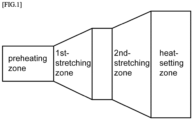
- FIG. 1 is a schematic diagram illustrating a method for performing multi-stage stretching in a TD direction in a film producing process.
- a base layer of the present invention is formed as a biaxially oriented polyester film.
- the biaxially oriented polyester film is a film formed of a polyester resin composition that includes, as main constituent components, terephthalic acid as a dicarboxylic acid component and ethylene glycol as a diol component.
- “include, as main constituent components” means that a content of the components in the polyester resin composition is 80 mol% or more with respect to 100 mol% of all the constituent components of the polyester resin, and the content thereof is preferably 90 mol% or more, more preferably 95 mol% or more, and most preferably 97 mol% or more with respect thereto.
- the polyester resin another component may be copolymerized to the extent that the object of the present invention is not impaired.
- the copolymerization component include, as dicarboxylic acid components, isophthalic acid, naphthalene dicarboxylic acid, 4,4-diphenyldicarboxylic acid, adipic acid, sebacic acid, and derivatives for forming esters thereof.
- diol component for example, diethylene glycol, hexamethylene glycol, neopentyl glycol, and cyclohexanedimethanol may be included.
- polyoxyalkylene glycol such as polyethylene glycol and polypropylene glycol may also be included.
- a copolymerization amount is preferably 10 mol% or less, more preferably 5 mol% or less, and most preferably 3 mol% or less per constituent repeating unit.
- the polyester resin composition may include one kind of polyester resin or a plurality of kinds of polyester resins.
- the polyester resin composition may include a resin other than polyester resin.
- the limiting viscosity of the polyester resin composition preferably ranges from 0.50 to 0.90 dl/g and more preferably ranges from 0.55 to 0.80 dl/g from the viewpoint of film forming property, recoverability, and the like.
- the polyester resin composition may contain, in addition to the polyester resin, conventionally known additives such as a lubricant, a stabilizer, a colorant, an antioxidant, an antistatic agent, and an ultraviolet absorber.
- conventional additives such as a lubricant, a stabilizer, a colorant, an antioxidant, an antistatic agent, and an ultraviolet absorber.
- the lubricant can adjust a coefficient of kinetic friction of the film.
- the lubricant include inorganic lubricants such as silica, calcium carbonate, and alumina, and organic lubricants.
- silica and calcium carbonate are preferable.
- porous silica is most preferable from the viewpoint of achieving both transparency and slipperiness.
- the base layer of the present invention may have a monolayer structure formed of one layer or have a multilayer structure formed of two or more layers.
- the base layer may have two layers, three layers, four layers, or five layers.
- the resin compositions forming the respective layers may be the same or different from each other.
- the upper limit of the cooling roll temperature is preferably 40°C, and more preferably 20°C or lower.
- the cooling roll temperature is 40°C or higher, the degree of crystallinity does not become excessively high when the melted polyester resin composition is cooled and solidified, and the stretching can be more easily performed, and furthermore, transparency can be inhibited from being reduced due to crystallization.
- the lower limit of the cooling roll temperature is preferably 0°C.
- the cooling roll temperature is 0°C or higher, an effect of inhibiting crystallization can be sufficiently exhibited when the melted polyester resin composition is cooled and solidified.
- an ambient humidity near the cooling roll is preferably reduced in order to prevent dew formation.
- the thickness of the unstretched sheet preferably ranges from 15 to 2500 ⁇ m, and is more preferably 600 ⁇ m or less and most preferably 400 ⁇ m or less.
- the stretching method may be either simultaneous biaxial stretching or sequential biaxial stretching. Sequential biaxial stretching will be described below as an example.
- the lower limit of the stretching ratio in the MD direction is preferably 2.5 times, more preferably 2.8 times, and particularly preferably 3.1 times.
- the stretching ratio in the MD direction is 2.5 times or more, the film has a good mechanical strength, and furthermore, thickness variation properties are good, and these lead to enhancement of winding quality when the film is formed into a roll.
- the upper limit of the stretching ratio in the MD direction is preferably 5.0 times, more preferably 4.5 times, and particularly preferably 4.0 times.
- the stretching ratio in the MD direction is 5.0 times or less, springback and curling after forming can be inhibited from being increased due to orientation of the film becoming excessively high.
- the temperature for the MD direction stretching preferably ranges from 80 to 130°C. If the stretching temperature in the MD direction is lower than 80°C, springback and curling after forming may be increased due to orientation of the film becoming excessively high. Meanwhile, if the stretching temperature in the MD direction is higher than 130°C, the orientation in the MD direction becomes low, and formability may thus be reduced.
- the MD direction stretching method a method in which stretching is performed between a plurality of rolls, while the rolls are heated, or a method in which stretching is performed by performing heating by an infrared heater or the like, is used.
- the method in which stretching is performed by performing heating by an infrared heater or the like is preferable in that a high temperature is easily obtained, localized heating can be easily performed, and scratch and defects caused by rolls can be reduced.
- a method in which multi-stage stretching is performed between the plurality of rolls is preferably used.
- the number of the rolls is preferably two or more and more preferably three or more.
- a relaxing step in the MD direction is preferably performed before the TD direction stretching process following the MD direction stretching process.
- the lower limit of the MD relaxation rate is preferably 1%, more preferably 3%, and particularly preferably 5%.
- the MD relaxation rate is 1% or more, amorphous components in the film may be relaxed, and the stretching stress can be lowered in the succeeding TD direction stretching process, so that the orientation of the film can be inhibited from being excessively high, and springback and curling after forming can thus be inhibited.
- the upper limit of the MD relaxation rate is preferably 10%, more preferably 8%, and particularly preferably 6%.
- the MD relaxation rate is 10% or less, wrinkling due to shrinkage can be inhibited, and the quality of the film can be enhanced, and furthermore, a mechanical strength can be inhibited from being reduced due to orientation relaxation.
- Examples of the MD relaxation method include, but are not particularly limited to, a method in which the relaxing process is performed, by using difference in speed between rolls, after heating is performed by a hot air heater.
- the upper limit of the stretching ratio in the TD direction is preferably 5.0 times, more preferably 4.5 times, and particularly preferably 4.0 times.
- orientation in the TD direction can be inhibited from being increased, and springback and curling after forming can be inhibited.
- the stretching pattern in the TD direction not only a generally used linear stretching pattern in which the stretching ratio is linearly increased, but also multi-stage stretching can be preferably used.
- multi-stage stretching two or more stages are performed in the stretching process with respect to general one-stage stretching, that is, a linear stretching pattern, as in the example illustrated in FIG. 1 , and stretching stress applied during the TD direction stretching can be lowered.
- orientation in the TD direction can be inhibited from being excessively high, and springback and curling after forming can be inhibited.
- the number of stages in the multi-stage stretching in the TD direction is preferably two or more and five or less.
- the multi-stage stretching is preferable since each of the stretching temperatures can be changed and the stretching stress can be changed, and the stretching stress during the TD direction stretching can be lowered.
- the number of stages in the stretching is two or more, stretching stress can be lowered, and, even when the stretching ratio is the same, orientation in the TD direction can be inhibited from being excessively high, and springback and curling after forming can be inhibited.
- the number of stages in the stretching is five or less, the equipment can be prevented from being excessively large.
- a temperature pattern in which the temperature is reduced from the first stage of stretching to the final stage of stretching such that the temperature is made different by 2°C or more per each stage of stretching is preferable.
- a zone having a fixed length can be provided following each stretching stage as appropriate.
- stretching stress can be further lowered in the succeeding stretching by relaxing, in the fixed length zone, internal stress generated during the stretching, and, even when the stretching ratio is the same, orientation in the TD direction can be inhibited from being excessively high, and springback and curling after forming can be inhibited.
- the lower limit of the heat-setting temperature is preferably 170°C, more preferably 180°C, and particularly preferably 190°C.
- the upper limit of the heat-setting temperature is preferably 230°C, more preferably 220°C, and particularly preferably 210°C.
- the heat-setting temperature is 230°C or lower, a mechanical strength can be inhibited from being reduced due to the biaxially oriented polyester film becoming brittle.
- the lower limit of the relaxation rate in the TD direction is preferably 0.5%, more preferably 1.0%, and particularly preferably 2.0%.
- the upper limit of the relaxation rate in the TD direction is preferably 10%, more preferably 8%, and particularly preferably 6%.
- the relaxation rate in the TD direction is 10% or less, looseness and the like can be prevented and planarity can be enhanced.
- the lower limit of the thickness of the base layer of the present invention is preferably 5 ⁇ m and more preferably 10 ⁇ m. When the thickness of the base layer is 5 ⁇ m or more, good mechanical characteristics and formability can be obtained.
- the upper limit of the thickness of the base layer is preferably 100 ⁇ m, more preferably 70 ⁇ m, and particularly preferably 40 ⁇ m.
- the piercing strength (unit is N/ ⁇ m) is a value obtained by dividing, when a needle having a tip radius of 0.5 mm pierces the film at a piercing speed of 50 mm/min, strength (unit is N) obtained when the needle penetrates through the film by the thickness (unit is ⁇ m) of the film.
- the lower limit of a heat shrinkage rate of the base layer in each of the MD direction and the TD direction is preferably 0.1%, more preferably 0.2%, and particularly preferably 0.3%.
- the upper limit of the heat shrinkage rate in each of the MD direction and the TD direction is preferably 2.5%, more preferably 2.0%, and particularly preferably 1.8%.
- the heat shrinkage rate of the base layer is 2.5% or less, dimensional change can be inhibited when heating is performed in a secondary process, and wrinkling can be inhibited.
- unevenness in thickness of the base layer in the TD direction is preferably 18% or less, more preferably 16% or less, and even more preferably 14% or less.
- unevenness in thickness is 18% or less, winding quality becomes good when the film is formed into a roll.
- the haze of the base layer of the present invention is preferably 5.0% or less, more preferably 3.0% or less, and even more preferably 2.5% or less.
- the haze of 5.0% or less is preferable since printing is clearly presented.
- the film is pressed into a mold having a predetermined shape, the film is thereafter held for a certain time period in the pressed state, and the mold is thereafter taken up to produce a molded body. If the mold is taken up in a state where the internal stress in the film is not sufficiently relaxed in the holding time period, a force that restores the film to its original shape acts, and springback is increased, so that dimensional accuracy of the molded body may be reduced.
- the inventors of the present invention have found that the springback can be reduced in a case where the stress attenuation rate of the film having been held for two seconds is within a specific range in a tensile stress relaxation test of the obtained biaxially oriented polyester film.
- Y(MD) When the value of Y(MD) is 125 MPa or more, excellent formability can be obtained. Meanwhile, when the value of Y(MD) is 155 MPa or less, stress of the film after forming can be inhibited from being excessively high, springback and resistance after forming can be reduced, and good formability can be obtained. Similarly, when the value of Y(TD) is 140 MPa or more, excellent formability can be obtained. When the value of Y(TD) is 190 MPa or less, stress of the film after forming can be inhibited from being excessively high, springback and resistance after forming can be reduced, and good formability can be obtained.
- X(MD) represents a stress (F3 value) at 3% elongation at 25°C in the MD direction of the film
- X(TD) represents a stress (F3 value) at 3% elongation at 25°C in the TD direction of the film
- Z(MD) represents a value of Y(MD)/X(MD)
- Z(TD) represents a value of Y(TD)/X(TD)
- the following formula (4) and formula (5) are preferably satisfied.
- the base layer of the present invention preferably has a coefficient ⁇ d of kinetic friction against a metal surface of 0.10 or more and 0.50 or less from the viewpoint of formability.
- the constituent member thereof is molded by male/female-type press molding.
- the coefficient ⁇ d of kinetic friction is more preferably 0.20 or more and 0.50 or less, and even more preferably 0.25 or more and 0.40 or less.
- the coefficient of kinetic friction against a metal represents a coefficient of kinetic friction between any surface of the film, and a mirror-finished SUS304-#400 material.
- the coefficient of kinetic friction can be controlled by a content of a lubricant to be added to the film.
- An intermediate layer of the present invention is formed as a biaxially oriented polyamide film.
- the biaxially oriented polyamide film is preferably formed of a polyamide resin composition including 60% by mass or more of polyamide 6, more preferably including 80% by mass or more of polyamide 6, and even more preferably including 90% by mass or more of polyamide 6.
- 60% by mass or more of polyamide 6 is included, an excellent mechanical strength such as an impact strength and excellent gas barrier properties can be obtained.
- the polyamide 6 used in the present invention is produced by ring-opening polymerization of ⁇ -caprolactam in general.
- the polyamide 6 obtained by ring-opening polymerization is dried and then melt-extruded by an extruder after lactam monomers are removed by using hot water in general.
- the relative viscosity of the polyamide 6 is preferably 1.8 to 4.5 and more preferably 2.6 to 3.2. If the relative viscosity is less than 1.8, the film may have insufficient impact strength. If the relative viscosity is more than 4.5, a load on the extruder is increased, and it may be difficult to obtain a non-stretched film before stretching.
- the polyamide 6 used in the present invention may be polyamide 6 that is commercially available from UBE Corporation, BASF, or the like.
- polyamide 6 which is commercially available as polyamide 6 for films, has the above-described relative viscosity, has a residual lactam monomer content of 1% by mass or less, and has blocked or modified terminals and is unlikely to generate lactam monomers during melting, is preferable.
- polyamide 6 in addition to generally used polyamide 6 obtained by polymerization from monomers derived from fossil fuel, polyamide 6 that is chemically recycled from waste polyamide 6 products such as waste plastic products, waste tire rubber, fibers, and fishing nets can also be used.
- waste polyamide 6 products such as waste plastic products, waste tire rubber, fibers, and fishing nets.
- Examples of a method for obtaining the polyamide 6 chemically recycled from the waste polyamide 6 products include a method in which used polyamide products are collected and the collected products are thereafter depolymerized to obtain ⁇ -caprolactam, and the ⁇ -caprolactam is refined and polymerized to obtain polyamide 6.
- polyamide 6 obtained by mechanically recycling waste materials discharged in the polyamide film producing process can be used in combination.
- the mechanically recycled polyamide 6 refers to, for example, a raw material obtained in a manner in which off-specification films that are generated during production of biaxially stretched polyamide films and cannot be shipped or waste materials generated as cut end materials (selvage trims) are collected and pelletized through melt-extrusion or compression molding.
- the intermediate layer of the present invention may include a thermoplastic resin other than the polyamide 6 as the main component in order to improve stretchability, pinhole resistance, ease of cutting, and the like. Furthermore, the intermediate layer may include a small amount of an additive such as an anti-blocking agent, a lubricating agent, an antistatic agent, a thermal stabilizer, and a light resisting agent.
- an additive such as an anti-blocking agent, a lubricating agent, an antistatic agent, a thermal stabilizer, and a light resisting agent.
- thermoplastic resin other than polyamide 6 examples include homopolymers or copolymers of polyamide-based resins, polyester-based resins, polyolefin-based resins, acrylic resins, polycarbonate-based resins, polyvinyl-based resins, and urethane-based resins.
- the biaxially oriented polyamide film may include polyamide MXD6 and/or polyamide 6I in order to enhance stretchability when the film is formed.
- the content of the polyamides is preferably 20% by mass or less, more preferably 10% by mass or less, and even more preferably 5% by mass or less with respect to a resin composition forming the biaxially oriented polyamide film.
- the biaxially oriented polyamide film may include a polyamide elastomer, a polyester elastomer, a polyolefin elastomer, or the like in order to enhance pinhole resistance.
- the biaxially oriented polyamide film may include inorganic particulates such as silica, kaolin, zeolite, or the like, or crosslinked polymeric particulates of acryl, polystyrene, or the like as an anti-blocking agent or a lubricant.
- Silica particulates are suitably used from the viewpoint of transparency and slipperiness.
- the biaxially oriented polyamide film may include an organic lubricating agent having an effect of lowering surface energy, as a lubricating agent, to the extent that problems as to adhesiveness and wettability do not arise.
- organic lubricating agent include ethylenebisstearamide (EBS).
- a method for obtaining the biaxially oriented polyamide film of the present invention is not particularly limited and can be selected as appropriate, and may be, for example, a T-die method or an inflation method. A typical production process in which a T-die method is used will be described.
- the T-die method includes (1) melt-extruding a polyamide resin composition into a sheet-like shape and cooling the obtained sheet on a cooling roll to form an unstretched sheet, (2) a stretching step of stretching the formed unstretched sheet in an MD direction (longitudinal direction ) and a TD direction (width direction) orthogonal to the MD direction, (3) a heat-setting step of heating and crystallizing the film having been subjected to the stretching step, (4) a thermal relaxation step (may also be referred to as relaxing step) of removing residual strain of the film having been subjected to the heat-setting step, and (5) a cooling step of cooling the film after the thermal relaxation step.
- the intermediate layer of the present invention may have a monolayer structure formed of one layer or have a multilayer structure formed of two or more layers.
- the intermediate layer may have two layers, three layers, four layers, or five layers.
- the resin compositions forming the respective layers may be the same or different from each other.
- a step of performing preliminary stretching of the unstretched sheet in the MD direction at a low ratio, and thereafter performing main stretching in the MD direction at a high ratio is preferably included.
- the above-described MD preliminary stretching is preferably performed in one stage or two stages.
- the total stretching ratio obtained by multiplying the stretching ratios in the respective stages of MD preliminary stretching is preferably 1.005 times or more and 1.15 times or less.
- the preliminary stretching ratio is 1.15 times or less, progress of oriented crystallization can be prevented, and breakage can be inhibited from being caused during the main stretching or TD stretching due to stretching stress becoming excessively high in the succeeding MD main stretching.
- the temperature for the MD preliminary stretching is preferably [glass-transition temperature (the unit is °C, hereinafter abbreviated as Tg) of the polyamide resin composition+20]°C or higher and [low-temperature crystallization temperature (the unit is °C, hereinafter abbreviated as Tc) of the polyamide resin composition+20]°C or lower.
- Tg and Tc are values obtained by measurement in which the method described in Examples is used.
- the stretching temperature is more preferably (Tg+30)°C or higher and (Tc+10)°C or lower.
- a known longitudinal stretching method such as thermal roll stretching or infrared radiation stretching can be used.
- the MD main stretching is preferably performed in two or more stages.
- the ratio of the first stage of the MD main stretching is preferably 1.1 times or more and 2.9 times or less. If the stretching ratio in the first stage of the main machine direction stretching is excessively low, the stretching effect is not obtained. Meanwhile, when the stretching ratio in the first stage is 2.9 times or less, progress of oriented crystallization can be prevented.
- the stretching temperature at the first stage is preferably (Tg+20)°C or higher and (Tc+20)°C or lower. If the stretching temperature is lower than (Tg+20)°C, stretching stress becomes high, and breakage is likely to occur in the TD stretching. If the stretching temperature is higher than (Tc+20)°C, unevenness in thickness may be increased.
- the stretching temperature is more preferably (Tg+25)°C or higher and (Tc+10)°C or lower.
- a known MD stretching method such as thermal roll stretching or infrared radiation stretching can be used.
- the ratios in the second and the succeeding stages of the MD main stretching are set such that the total stretching ratio obtained by multiplying the stretching ratios including the MD preliminary stretching ratios is preferably 2.8 times or more and 5.0 times or less, more preferably 3.0 times or more and 3.8 times or less, and even more preferably 3.0 times or more and 3.6 times or less. If the total stretching ratio is less than 2.8 times, although variation in physical properties of the biaxially oriented film in the width direction is reduced, strength in the longitudinal direction may be reduced. If the total machine direction stretching ratio is excessively large, an effect of reducing variation in physical properties of the biaxially oriented film in the width direction may not be exhibited.
- the stretching temperature at the second stage in the MD main stretching is preferably (Tg+20)°C or higher and (Tc+20)°C or lower and more preferably (Tg+25)°C or higher and (Tc+10)°C or lower. If the stretching temperature is lower than (Tg+20)°C, stretching stress becomes high, and breakage is likely to occur in the TD stretching. If the stretching temperature is higher than (Tc+20)°C, unevenness in thickness may be increased.
- a thermal roll stretching method is preferably used at the second stage of the MD main stretching.
- a ceramic roll having a surface roughness Ra of 0.2 ⁇ m or less is preferably used. If a roll having the Ra of more than 0.2 ⁇ m is used, stretching may be performed in a state where the film slides on the roll, and abrasion may disadvantageously occur on the film surface.
- the stretching start points on the roll may become non-uniform in the width direction, or the stretching start point may vary, so that the thickness may become uneven.
- a relaxing step in the MD direction is preferably performed before the TD direction stretching process following the MD direction stretching process.
- the lower limit of the MD relaxation rate is preferably 1%, more preferably 3%, and particularly preferably 5%.
- the upper limit of the MD relaxation rate is preferably 10%, more preferably 8%, and particularly preferably 6%.
- the MD relaxation rate is 10% or less, wrinkling due to shrinkage can be inhibited, and the quality of the film can be enhanced, and furthermore, a mechanical strength can be inhibited from being reduced due to orientation relaxation.
- Examples of the MD relaxation method include, but are not particularly limited to, a method in which the relaxing process is performed, by using difference in speed between rolls, after heating is performed by a hot air heater.
- the lower limit of the stretching temperature in the TD direction is preferably 90°C, more preferably 100°C, and particularly preferably 110°C.
- the upper limit of the stretching temperature in the TD direction is preferably 140°C, more preferably 130°C, and particularly preferably 120°C. If the stretching temperature in the TD direction is higher than 140°C, film forming property may be degraded, and, furthermore, orientation of the obtained film in the TD direction may be low, so that formability may be degraded.
- the lower limit of the stretching ratio in the TD direction is preferably 2.5 times, more preferably 3.0 times, and particularly preferably 3.5 times.
- the upper limit of the stretching ratio in the TD direction is preferably 5.0 times, more preferably 4.5 times, and particularly preferably 4.0 times.
- orientation in the TD direction can be inhibited from being enhanced, and springback and curling after forming can be inhibited.
- the stretching pattern in the TD direction not only a generally used linear stretching pattern in which the stretching ratio is linearly increased, but also multi-stage stretching can be preferably used.
- multi-stage stretching two or more stages are performed in the stretching process with respect to general one-stage stretching, that is, a linear stretching pattern, as in the example illustrated in FIG. 1 , and stretching stress applied during the TD direction stretching can be lowered.
- orientation in the TD direction can be inhibited from being excessively high, and springback and curling after forming can be inhibited.
- the number of stages in the multi-stage stretching in the TD direction is preferably two or more and five or less.
- the multi-stage stretching is preferable since each of the stretching temperatures can be changed and the stretching stress can be changed, and the stretching stress during the TD direction stretching can be lowered.
- the number of stages in the stretching is two or more, stretching stress can be lowered, and, even when the stretching ratio is the same, orientation in the TD direction can be inhibited from being excessively high, and springback and curling after forming can be inhibited.
- the number of stages in the stretching is five or less, the equipment can be prevented from being excessively large.
- a temperature pattern in which the temperature is reduced from the first stage of stretching to the final stage of stretching such that the temperature is made different by 2°C or more per each stage of stretching is preferable.
- a zone having a fixed length can be provided following each stretching stage as appropriate.
- stretching stress can be further lowered in the succeeding stretching by relaxing, in the fixed length zone, internal stress generated during the stretching, and, even when the stretching ratio is the same, orientation in the TD direction can be inhibited from being excessively high, and springback and curling after forming can be inhibited.
- the lower limit of the heat-setting temperature is preferably 170°C, more preferably 180°C, and particularly preferably 190°C.
- the upper limit of the heat-setting temperature is preferably 230°C, more preferably 220°C, and particularly preferably 210°C.
- the heat-setting temperature is 230°C or lower, a mechanical strength can be inhibited from being reduced due to the biaxially oriented polyamide film becoming brittle.
- the lower limit of the relaxation rate in the TD direction is preferably 0.5%, more preferably 1.0%, and particularly preferably 2.0%.
- the upper limit of the relaxation rate in the TD direction is preferably 10%, more preferably 8%, and particularly preferably 6%.
- the relaxation rate in the TD direction is 10% or less, looseness and the like can be prevented and planarity can be enhanced.
- the biaxially oriented polyamide film can also be subjected to corona treatment, coating treatment, flame treatment, or the like in order to further enhance adhesiveness and wettability.
- the above-described treatment can also be performed while the biaxially oriented polyamide film is being produced.
- the treatment may be performed by winding off a mill roll or slit roll.
- the lower limit of the thickness of the intermediate layer of the present invention is preferably 5 ⁇ m and more preferably 10 ⁇ m. When the thickness of the intermediate layer is 5 ⁇ m or more, good mechanical characteristics and formability can be obtained.
- the upper limit of the thickness of the intermediate layer is preferably 100 ⁇ m, more preferably 70 ⁇ m, and particularly preferably 40 ⁇ m.
- the lower limit of piercing strength of the intermediate layer of the present invention is preferably 0.5 N/ ⁇ m and more preferably 0.6 N/ ⁇ m. When the piercing strength is 0.5 N/ ⁇ m or more, good formability can be obtained.
- the upper limit of the piercing strength of the intermediate layer is, but is not particularly limited to, preferably 1.0 N/ ⁇ m or less. If the piercing strength is more than 1.0 N/ ⁇ m, an effect of enhancing formability may be saturated.
- the piercing strength (unit is N/ ⁇ m) is a value obtained by dividing, when a needle having a tip radius of 0.5 mm pierces the film at a piercing speed of 50 mm/min, strength (unit is N) obtained when the needle penetrates through the film by the thickness (unit is ⁇ m) of the film.
- the lower limit of a heat shrinkage rate in each of the MD direction and the TD direction is preferably 0.5%, more preferably 0.8%, and particularly preferably 1.0%.
- the upper limit of the heat shrinkage rate in each of the MD direction and the TD direction is preferably 3.0%, more preferably 2.5%, and particularly preferably 2.0%.
- the heat shrinkage rate is 3.0% or less, dimensional change can be inhibited when heating is performed in a secondary process, and wrinkling can be inhibited.
- Y(MD) When the value of Y(MD) is 100 MPa or more, excellent formability can be obtained. Meanwhile, when the value of Y(MD) is 150 MPa or less, stress of the film after forming can be inhibited from being excessively high, springback and resistance after forming can be reduced, and good formability can be obtained. Similarly, when the value of Y(TD) is 110 MPa or more, excellent formability can be obtained. When the value of Y(TD) is 200 MPa or less, stress of the film after forming can be inhibited from being excessively high, springback and resistance after forming can be reduced, and good formability can be obtained.
- X(MD) represents a stress (F3 value) at 3% elongation at 25°C in the MD direction of the film
- X(TD) represents a stress (F3 value) at 3% elongation at 25°C in the TD direction of the film
- Z(MD) represents a value of Y(MD)/X(MD)
- Z(TD) represents a value of Y(TD)/X(TD)
- the following formula (4) and formula (5) are preferably satisfied.
- metal foil various metal foils such as aluminum foil and stainless steel foil can be used, and aluminum foil is preferable from the viewpoint of moisture resistance, processability such as extendability, and cost.
- aluminum foil standard soft aluminum foils can be used. Among them, aluminum foil containing iron is preferable from the viewpoint of excellent pinhole resistance and excellent extendability during molding.
- a content of iron in aluminum foil (100% by mass) containing iron is preferably 0.1 to 9.0% by mass and more preferably 0.5 to 2.0% by mass. When the content of the iron is the lower limit value or more, pinhole resistance and extendability are excellent. When the content of the iron is 9.0% by mass or less, flexibility is excellent.
- the thickness of the metal foil is preferably 9 to 200 ⁇ m and more preferably 15 to 100 ⁇ m from the viewpoint of barrier properties, pinhole resistance, and processability.
- the sealant layer examples include a resin film formed of a polyolefin-based resin, or an acid-modified polyolefin-based resin obtained by graft-modifying polyolefin-based resin with acid such as maleic anhydride.
- the polyolefin-based resin include low-density, medium-density, and high-density polyethylenes; ethylene-a olefin copolymers; homo-, block- or random-polypropylenes; and propylene- ⁇ olefin copolymers.
- One of these polyolefin-based resins may be used alone, or two or more of them may be used in combination.
- the sealant layer may be a monolayer film or a multilayer film, and may be selected according to the required function.
- a multilayer film that includes therein resin such as an ethylene-cyclic olefin copolymer or polymethylpentene can be used in order to impart moisture resistance.
- various additives such as a flame retardant, a slipping agent, an anti-blocking agent, an antioxidant, a light stabilizer, and a tackifier may be blended.
- the thickness of the sealant layer is preferably 10 to 100 ⁇ m and more preferably 20 to 60 ⁇ m.
- the base layer, the intermediate layer, the metal foil, and the sealant layer are preferably stacked in this order.
- the laminate may have a structure in which an adhesive layer, a printed layer, or the like is disposed between the base layer and the intermediate layer, between the intermediate layer and the metal foil, and/or between the metal foil and the sealant layer.
- the laminate of the present invention is suitably used for cold forming.
- the present invention further provides a battery outer package material in which the laminate is used.
- the present invention provides a battery outer package material for a laminate-type lithium ion battery.
- the present invention provides a material for medicine packaging.
- the film and the laminate were evaluated by the following measurement methods. Unless otherwise specified, the measurement was performed in a measurement room in an environment of 23°C and a relative humidity of 65%.
- a sample having a size of 800 mm in the TD direction and 40 mm in the longitudinal direction was taken from a film roll, and a thickness was continuously measured at 5 m/second in the width direction by using a film tester continuous thickness measuring device (manufactured by Fujiwork Co., Ltd.).
- Tmax. was defined as the maximum thickness
- Tmin. was defined as the minimum thickness
- Tave. was defined as an average thickness in the measurement
- unevenness in thickness Tmax . ⁇ Tmin . / Tave . ⁇ 100 %
- the heat shrinkage rate of the biaxially oriented polyester film was measured by a dimensional change testing method based on JIS-C-2318 except that the test temperature was 150°C and the heating time was 15 minutes. A sample was cut out in each of the MD direction and the TD direction, and the measurement was performed.
- the heat shrinkage rate of the biaxially oriented polyamide film was measured by a dimensional change testing method based on JIS-C-2318 except that the test temperature was 160°C and the heating time was 10 minutes. A sample was cut out in each of the MD direction and the TD direction, and the measurement was performed.
- the piercing strength was measured in accordance with " 2. Testing methods for strength, etc.” in “Standards for Food and Additives, etc. Chapter III: Apparatus, Containers and Packaging” (Notification No. 20 of the Ministry of Health and Welfare, 1982 ) in the Food Sanitation Act.
- a needle having a tip radius of 0.5 mm was caused to pierce the film at a piercing speed of 50 mm/min, and a value obtained by dividing the strength (N) obtained when the needle penetrated through the film by the thickness ( ⁇ m) of the film was set as the piercing strength.
- the measurement was performed at a normal temperature (23°C). The unit was [N/pm].
- a test sample was cut out in the film MD direction so as to have a width of 15 mm and a length of 100 mm in accordance with JIS K 7127.
- a tensile test for the test sample was performed by using a tensile tester (AUTOGRAPH AG-I manufactured by SHIMADZU CORPORATION) under conditions that a gauge length was 50 mm and a tensile rate was 200 mm/min.
- a stress value (F3) at 3% deformation of the test sample and a stress value (F30 value) at 30% deformation of the test sample were calculated according to the obtained stress-strain curve.
- test sample was cut out in the film MD direction so as to have a width of 15 mm and a length of 100 mm.
- a 50% tensile strain was applied by using a tensile tester
- stress attenuation rate (%) after the strain was held for two seconds 100 ⁇ ( ⁇ 0- ⁇ 1)/ ⁇ 0
- ⁇ 0 represents a tensile stress of the film, which was obtained immediately after the 50% tensile strain was applied to the film by applying a tensile force at the tensile rate of 200 mm/min
- ⁇ 1 represents a stress value obtained when the 50% tensile strain was held for two seconds from ⁇ 0.
- the laminate was set at a die set mold (90 mm ⁇ 50 mm projection shape), and draw-forming was performed by applying pressure to the laminate at 23°C with use of a pressing machine.
- the draw depth at the forming was increased in units of 0.2 mm, and the maximum depth at which breakage of the laminate was not caused was set as the draw depth.
- the evaluation was made according to the following criteria:
- the laminate was set at a die set mold (90 mm ⁇ 50 mm projection shape), and draw-forming was performed by applying pressure to the laminate at 23°C with use of a pressing machine.
- the rate at which the laminate was pressed into the mold was 200 mm/min, and the holding time after the pressing was two seconds.
- the depth of the container was measured after the mold was removed, and the retention rate (ratio between the depth of the container and the forming depth) was calculated.
- the evaluation was made according to the following criteria:
- a sample which was able to be formed without being broken in the cold formability evaluation was placed on a level table such that the projection of the sample was on the upper side.
- the average value of heights by which four corners of the formed test piece were raised from the table serving as an originating point was set as the warp height average value, and the evaluation was made according to the following criteria:
- a fossil-fuel-derived PET resin formed of terephthalic acid//ethylene glycol 100//100 (% by mole) (intrinsic viscosity of 0.62 dl/g), was used.
- a fossil-fuel-derived PET resin in which terephthalic acid//ethylene glycol 100//100 (% by mole) were included, and a content of porous silica particles was 0.72 % by mass (intrinsic viscosity of 0.62 dl/g), was used.
- the film was stretched at a stretching ratio of 4.6 times in the TD direction by a tenter-type transverse stretching machine at a preheating temperature of 120°C and a stretching temperature of 140°C. Thereafter, the film was heat-set at 210°C and subjected to 5% relaxation in the TD direction, and one surface of the film was subjected to corona treatment, to produce a biaxially oriented polyester film having a thickness of 12 ⁇ m.
- Table 1 indicates evaluation results.
- the polyester resin A and the polyester resin B were put at the ratio indicated in Table 1.
- the resins were melted at 280°C by the extruder, thereafter cast from a T-die, and were brought into close contact with a cooling roll set at 10°C by an electrostatic adhesion method, to obtain an unstretched sheet.
- the obtained unstretched film was preheated by a roll having been heated to a temperature of 80°C, thereafter heated to 120°C by an infrared heater, and was subjected to one-stage stretching at the stretching ratio of 5.0 times in the MD direction.
- the film was caused to pass through a heating oven set to 95°C by a hot air heater, and was subjected to 3% relaxation in the MD direction by using difference in speed between a roll at an inlet of the heating oven and a roll at an outlet thereof.
- the stretching method at the tenter-type transverse stretching machine was changed to three-stage stretching, and a 1 m fixed length region was provided between the first stage and the second stage, and between the second stage and the third stage, and the stretching was performed.
- the stretching temperatures and the stretching ratios at the respective stages were as indicated in Table 1.
- the film was heat-set at 210°C and subjected to 5% thermal relaxation in the width direction, and one surface of the film was subjected to corona treatment, to produce a biaxially oriented polyester film having a thickness of 12 ⁇ m. Table 1 indicates evaluation results.
- Films were formed in the same manner as for PET-1 except that the stretching conditions in the MD direction and the stretching conditions in the TD direction were changed to the conditions indicated in Table 1, to produce biaxially oriented polyester films each having a thickness of 12 ⁇ m.
- Table 1 indicates evaluation results.
- a polyamide 6 resin having a relative viscosity of 2.9 and a melting point (Tm) of 220°C was used.
- a polyamide MDX6 resin having a relative viscosity of 2.2 and a melting point (Tm) of 238°C was used.
- the raw materials were blended so as to contain 85 parts by mass of the polyamide 6, 3 parts by mass of the polyamide MXD6, and 12 parts by mass of the master batch of the silica particulates and the ethylenebisamide.
- the blended raw materials were extruded as a melted film by an extruder through a T-die at a temperature of 260°C after a water content was adjusted to 0.1% by mass, and the melted film was brought into close contact with a cooling roll set at 30°C by an electrostatic adhesion method, and cooled and solidified, to obtain an unstretched film having a thickness of 200 ⁇ m.
- the unstretched film had a Tg of 41°C and a Tc of 69°C.
- the unstretched film was stretched 1.03 times at a stretching temperature of 80°C in the first stage of the MD preliminary stretching, and subsequently stretched 1.03 times at a stretching temperature of 80°C in the second stage of the MD preliminary stretching.
- the film was stretched 2.1 times at 85°C in the first stage of the MD main stretching, and further stretched 1.53 times at a stretching temperature of 70°C in the second stage of the MD main stretching.
- the MD stretched film was sequentially guided to a tenter, and stretched 4.0 times at 130°C in the TD direction, and thereafter heat-set at 210°C, and was further subjected to 5.0% relaxation at 210°C in the TD direction.
- the film was cooled at 100°C, and one surface of the film was subjected to corona treatment, to produce a biaxially oriented polyamide film having a thickness of 15 ⁇ m. Table 2 indicates the evaluation results.
- biaxially oriented polyamide films were obtained in the same manner as in examples except that the temperatures and the ratios in the MD preliminary stretching and the ratios in the MD main stretching were changed. Table 2 indicates the evaluation results.
- the raw materials were blended so as to contain 85 parts by mass of the polyamide 6, 3 parts by mass of the polyamide MXD6, and 12 parts by mass of the master batch of the silica particulates and the ethylenebisamide.
- the blended raw materials were extruded as a melted film by an extruder through a T-die at a temperature of 260°C after a water content was adjusted to 0.1% by mass, and the melted film was brought into close contact with a cooling roll set at 30°C by an electrostatic adhesion method, and cooled and solidified, to obtain an unstretched film having a thickness of 200 ⁇ m.
- the unstretched film had a Tg of 41°C and a Tc of 69°C.
- the unstretched film was stretched 1.07 times at a stretching temperature of 85°C in the MD preliminary stretching. Subsequently, the film was stretched 2.0 times at 85°C in the first stage of the MD main stretching, and further stretched 2.0 times at a stretching temperature of 70°C in the second stage of the MD main stretching.
- the film was caused to pass through a heating oven having been set to 85°C by a hot air heater, and was subjected to 5% relaxation in the MD direction by using difference in speed between a roll at an inlet of the heating oven and a roll at an outlet thereof.
- the MD stretched film was sequentially guided to a tenter, and stretched 4.0 times at 130°C in the TD direction.
- the film was heat-set at 210°C, and was further subjected to 5.0% relaxation at 210°C in the TD direction. Subsequently, the film was cooled at 100°C, and one surface of the film was subjected to corona treatment, to produce a biaxially oriented polyamide film having a thickness of 15 ⁇ m. Table 2 indicates the evaluation results.
- the raw materials were blended so as to contain 85% by mass of the polyamide 6, 3% by mass of the polyamide MXD6, and 12% by mass of the master batch of the silica particulates and the ethylenebisamide.
- the blended raw materials were extruded as a melted film by an extruder through a T-die at a temperature of 260°C after a water content was adjusted to 0.1% by mass, and the melted film was brought into close contact with a cooling roll set at 30°C by an electrostatic adhesion method, and cooled and solidified, to obtain an unstretched film having a thickness of 200 ⁇ m.
- the unstretched film had a Tg of 41°C and a Tc of 69°C.
- the unstretched film was stretched 1.03 times at a stretching temperature of 80°C in the first stage of the MD preliminary stretching, and subsequently stretched 1.03 times at a stretching temperature of 80°C in the second stage of the MD preliminary stretching. Subsequently, the film was stretched 2.1 times at 85°C in the first stage of the MD main stretching, and further stretched 1.53 times at a temperature of 70°C in the second stage of the MD main stretching.
- the MD stretched film was sequentially guided to a tenter. As the stretching method at the tenter, three-stage stretching was performed, a 1 m fixed length region was provided between the first stage and the second stage, and between the second stage and the third stage, and the stretching was performed in the TD direction.
- the film was heat-set at 210°C, was further subjected to 5.0% relaxation at 210°C in the TD direction, and subsequently cooled at 100°C, and one surface of the film was subjected to corona treatment, to produce a biaxially oriented polyamide film having a thickness of 15 ⁇ m.
- Table 2 indicates the evaluation results.
- Biaxially oriented polyamide films were produced in the same manner as for ONY-1 except that MD preliminary stretching was not performed, and the MD main stretching was performed at the temperatures and ratios indicated in Table 2. Table 2 indicates the evaluation results.
- a biaxially oriented polyamide film was produced in the same manner as for ONY-1 except that MD preliminary stretching was not performed, and the MD main stretching was performed merely by one-stage stretching at the temperature and the ratio indicated in Table 2.
- Table 2 indicates the evaluation results.
- Unit ONY-1 ONY-2 ONY-3 ONY-4 ONY-5 MD stretching process Preliminary stretching 1st-stage Temperature °C 80 85 85 85 80 Times times 1.03 1.03 1.07 1.07 1.03
- the biaxially oriented polyester films PET-1 to PET-9 and the biaxially oriented polyamide films ONY-1 to ONY-9 as described above were used in combinations indicated in Table 3, and dry-laminated.
- an adhesive an ester-based adhesive obtained by mixing 33.6 parts by mass of a main agent (TM569 manufactured by Toyo-Morton, Ltd.), 4.0 parts by mass of a curing agent (CAT10L manufactured by Toyo-Morton, Ltd.), and 62.4 parts by mass of ethyl acetate was used, and was applied at an application amount of 3.0 g/m 2 .
- the same ester-based adhesive as described above was applied to a surface of the laminate obtained as described above on the biaxially oriented polyamide film side at an application amount of 3.0 g/m 2 , and aluminum foil (8079 material, thickness of 40 ⁇ m) was stacked and dry-laminated on the laminate.
- the aluminum foil of the laminate of the biaxially oriented polyester film/the biaxially oriented polyamide film/the aluminum foil which was thus obtained, and an unstretched polypropylene sealant film (unstretched polypropylene film P1146 manufactured by TOYOBO Co., Ltd.) having a thickness of 70 ⁇ m were dry-laminated by using the same ester-based adhesive as described above.
- the laminates of the examples had excellent formability, and reduction of dimensional accuracy due to springback after forming was inhibited and warp resistance was excellent, and therefore, dimensional accuracy in forming was excellent.
- the laminates of the comparative examples cold formability, and inhibition of springback and curling after forming were insufficient.
Landscapes
- Chemical & Material Sciences (AREA)
- Chemical Kinetics & Catalysis (AREA)
- Engineering & Computer Science (AREA)
- Electrochemistry (AREA)
- General Chemical & Material Sciences (AREA)
- Mechanical Engineering (AREA)
- Manufacturing & Machinery (AREA)
- Materials Engineering (AREA)
- Health & Medical Sciences (AREA)
- Medicinal Chemistry (AREA)
- Polymers & Plastics (AREA)
- Organic Chemistry (AREA)
- Inorganic Chemistry (AREA)
- Shaping By String And By Release Of Stress In Plastics And The Like (AREA)
- Laminated Bodies (AREA)
Applications Claiming Priority (2)
| Application Number | Priority Date | Filing Date | Title |
|---|---|---|---|
| JP2022041878 | 2022-03-16 | ||
| PCT/JP2023/004181 WO2023176212A1 (fr) | 2022-03-16 | 2023-02-08 | Film de polyamide à orientation biaxiale et stratifié contenant un film de polyester à orientation biaxiale |
Publications (2)
| Publication Number | Publication Date |
|---|---|
| EP4494845A1 true EP4494845A1 (fr) | 2025-01-22 |
| EP4494845A4 EP4494845A4 (fr) | 2026-03-11 |
Family
ID=88022769
Family Applications (1)
| Application Number | Title | Priority Date | Filing Date |
|---|---|---|---|
| EP23770173.5A Pending EP4494845A4 (fr) | 2022-03-16 | 2023-02-08 | Film de polyamide à orientation biaxiale et stratifié contenant un film de polyester à orientation biaxiale |
Country Status (7)
| Country | Link |
|---|---|
| US (1) | US20250162295A1 (fr) |
| EP (1) | EP4494845A4 (fr) |
| JP (1) | JPWO2023176212A1 (fr) |
| KR (1) | KR20240162489A (fr) |
| CN (1) | CN118804836A (fr) |
| TW (1) | TW202400414A (fr) |
| WO (1) | WO2023176212A1 (fr) |
Family Cites Families (13)
| Publication number | Priority date | Publication date | Assignee | Title |
|---|---|---|---|---|
| JP5226941B2 (ja) * | 2006-08-14 | 2013-07-03 | 出光ユニテック株式会社 | 冷間成形用二軸延伸ナイロンフィルム、ラミネート包材及び冷間成形用二軸延伸ナイロンフィルムの製造方法 |
| JP5266628B2 (ja) | 2006-08-28 | 2013-08-21 | 大日本印刷株式会社 | 電池用包装材 |
| JP6218582B2 (ja) * | 2013-12-04 | 2017-10-25 | 出光ユニテック株式会社 | 延伸ナイロンフィルムの製造方法、多層フィルムの製造方法、包装材の製造方法、および電池の製造方法 |
| JP2015107585A (ja) * | 2013-12-04 | 2015-06-11 | 出光ユニテック株式会社 | 多層フィルム、多層フィルム包材、絞り成型品、および電池 |
| WO2015125806A1 (fr) | 2014-02-18 | 2015-08-27 | 大日本印刷株式会社 | Matériau pour emballage de batterie |
| EP3121864B1 (fr) * | 2014-04-24 | 2019-03-06 | Toppan Printing Co., Ltd. | Matériau d'emballage externe de dispositif accumulateur et dispositif accumulateur utilisant ce matériau |
| KR20150125806A (ko) | 2014-04-30 | 2015-11-10 | 주식회사 에스에이치글로벌 | 열경화성 및 열가소성 수지를 이용한 자동차 내장재 및 그의 제조 방법 |
| JP5954362B2 (ja) * | 2014-06-27 | 2016-07-20 | 大日本印刷株式会社 | 電気化学セル用包装材 |
| JP6841484B2 (ja) * | 2016-06-15 | 2021-03-10 | ユニチカ株式会社 | ポリアミド系フィルム及びその製造方法 |
| JP7060842B2 (ja) * | 2018-03-16 | 2022-04-27 | 東洋紡株式会社 | ラミネート積層体 |
| CN109367046B (zh) * | 2018-09-26 | 2021-10-29 | 江阴长庚高科技材料有限公司 | 一种高抗冲双向拉伸聚酰胺薄膜及其三泡生产方法与应用 |
| TWI803697B (zh) * | 2018-10-05 | 2023-06-01 | 日商東洋紡股份有限公司 | 雙軸配向聚醯胺膜以及聚醯胺膜輥 |
| JP7705727B2 (ja) * | 2020-05-29 | 2025-07-10 | 株式会社Dnp高機能マテリアル彦根 | 蓄電デバイス外包材用積層体 |
-
2023
- 2023-02-08 CN CN202380024888.XA patent/CN118804836A/zh active Pending
- 2023-02-08 EP EP23770173.5A patent/EP4494845A4/fr active Pending
- 2023-02-08 JP JP2024507578A patent/JPWO2023176212A1/ja active Pending
- 2023-02-08 KR KR1020247028545A patent/KR20240162489A/ko active Pending
- 2023-02-08 US US18/841,608 patent/US20250162295A1/en active Pending
- 2023-02-08 WO PCT/JP2023/004181 patent/WO2023176212A1/fr not_active Ceased
- 2023-02-20 TW TW112106018A patent/TW202400414A/zh unknown
Also Published As
| Publication number | Publication date |
|---|---|
| US20250162295A1 (en) | 2025-05-22 |
| TW202400414A (zh) | 2024-01-01 |
| JPWO2023176212A1 (fr) | 2023-09-21 |
| EP4494845A4 (fr) | 2026-03-11 |
| CN118804836A (zh) | 2024-10-18 |
| KR20240162489A (ko) | 2024-11-15 |
| WO2023176212A1 (fr) | 2023-09-21 |
Similar Documents
| Publication | Publication Date | Title |
|---|---|---|
| JP5105459B2 (ja) | 積層フィルムおよび二軸配向ポリエステルフィルム | |
| KR101961002B1 (ko) | 폴리에스테르 필름 및 그의 제조 방법 | |
| KR101859485B1 (ko) | 폴리에스테르 필름, 적층체 및 폴리에스테르 필름의 제조 방법 | |
| EP3235859B1 (fr) | Film polyamide et son procédé de production | |
| HK1207102A1 (en) | Polyester film for cold forming and method for producing same | |
| WO2017170333A1 (fr) | Stratifié pour enveloppe de batterie | |
| CN109661420B (zh) | 聚酰胺系膜及其制造方法 | |
| WO2019131752A1 (fr) | Film de polyamide et sa méthode de production | |
| EP3854837B1 (fr) | Film pour revêtir une plaque métallique et plaque métallique revêtue de résine | |
| EP4494847A1 (fr) | Film de polyamide à orientation biaxiale | |
| EP4494845A1 (fr) | Film de polyamide à orientation biaxiale et stratifié contenant un film de polyester à orientation biaxiale | |
| JP7732248B2 (ja) | 電池包装用積層体 | |
| WO2023157730A1 (fr) | Film polyester à orientation biaxiale | |
| EP4494846A1 (fr) | Film de polyamide à orientation biaxiale | |
| KR100260077B1 (ko) | 공압출된열접착성고분자필름및그의제조방법 | |
| WO2023157731A1 (fr) | Film de polyester à orientation biaxiale | |
| KR20250095626A (ko) | 냉간 성형용 이축 연신 폴리아미드 필름 | |
| JP2024121338A (ja) | ポリエステルフィルム | |
| HK40005549A (en) | Polyamide film and production method for same | |
| HK1233290A1 (en) | Polyamide film and method for producing same | |
| HK1240895A1 (en) | Polyester film, laminate, and method for producing polyester film | |
| HK1233290B (zh) | 聚酰胺系膜及其制造方法 |
Legal Events
| Date | Code | Title | Description |
|---|---|---|---|
| STAA | Information on the status of an ep patent application or granted ep patent |
Free format text: STATUS: THE INTERNATIONAL PUBLICATION HAS BEEN MADE |
|
| PUAI | Public reference made under article 153(3) epc to a published international application that has entered the european phase |
Free format text: ORIGINAL CODE: 0009012 |
|
| STAA | Information on the status of an ep patent application or granted ep patent |
Free format text: STATUS: REQUEST FOR EXAMINATION WAS MADE |
|
| 17P | Request for examination filed |
Effective date: 20241011 |
|
| AK | Designated contracting states |
Kind code of ref document: A1 Designated state(s): AL AT BE BG CH CY CZ DE DK EE ES FI FR GB GR HR HU IE IS IT LI LT LU LV MC ME MK MT NL NO PL PT RO RS SE SI SK SM TR |
|
| DAV | Request for validation of the european patent (deleted) | ||
| DAX | Request for extension of the european patent (deleted) | ||
| REG | Reference to a national code |
Ref country code: DE Ref legal event code: R079 Free format text: PREVIOUS MAIN CLASS: B29C0055120000 Ipc: B32B0027080000 |
|
| A4 | Supplementary search report drawn up and despatched |
Effective date: 20260211 |
|
| RIC1 | Information provided on ipc code assigned before grant |
Ipc: B32B 27/08 20060101AFI20260205BHEP Ipc: B32B 15/085 20060101ALI20260205BHEP Ipc: B32B 15/088 20060101ALI20260205BHEP Ipc: B32B 15/09 20060101ALI20260205BHEP Ipc: B32B 15/20 20060101ALI20260205BHEP Ipc: B32B 27/32 20060101ALI20260205BHEP Ipc: B32B 27/34 20060101ALI20260205BHEP Ipc: B32B 27/36 20060101ALI20260205BHEP Ipc: B29C 55/12 20060101ALI20260205BHEP Ipc: B29D 7/01 20060101ALI20260205BHEP Ipc: B65D 65/40 20060101ALI20260205BHEP Ipc: C08J 5/18 20060101ALI20260205BHEP Ipc: H01M 50/105 20210101ALI20260205BHEP Ipc: H01M 50/119 20210101ALI20260205BHEP Ipc: H01M 50/121 20210101ALI20260205BHEP Ipc: H01M 50/124 20210101ALI20260205BHEP Ipc: H01M 50/126 20210101ALI20260205BHEP Ipc: H01M 50/129 20210101ALI20260205BHEP Ipc: H01M 50/133 20210101ALI20260205BHEP |