EP4495185A1 - Composition d'extrusion réactive, procédé pour améliorer des propriétés mécaniques d'un mélange pla/p(3hp), et mélange pla/p(3hp) produit à partir de celle-ci - Google Patents
Composition d'extrusion réactive, procédé pour améliorer des propriétés mécaniques d'un mélange pla/p(3hp), et mélange pla/p(3hp) produit à partir de celle-ci Download PDFInfo
- Publication number
- EP4495185A1 EP4495185A1 EP24744896.2A EP24744896A EP4495185A1 EP 4495185 A1 EP4495185 A1 EP 4495185A1 EP 24744896 A EP24744896 A EP 24744896A EP 4495185 A1 EP4495185 A1 EP 4495185A1
- Authority
- EP
- European Patent Office
- Prior art keywords
- pla
- weight
- reactive
- less
- reactive extrusion
- Prior art date
- Legal status (The legal status is an assumption and is not a legal conclusion. Google has not performed a legal analysis and makes no representation as to the accuracy of the status listed.)
- Pending
Links
Images

Classifications
-
- C—CHEMISTRY; METALLURGY
- C08—ORGANIC MACROMOLECULAR COMPOUNDS; THEIR PREPARATION OR CHEMICAL WORKING-UP; COMPOSITIONS BASED THEREON
- C08L—COMPOSITIONS OF MACROMOLECULAR COMPOUNDS
- C08L67/00—Compositions of polyesters obtained by reactions forming a carboxylic ester link in the main chain; Compositions of derivatives of such polymers
- C08L67/04—Polyesters derived from hydroxycarboxylic acids, e.g. lactones
-
- B—PERFORMING OPERATIONS; TRANSPORTING
- B29—WORKING OF PLASTICS; WORKING OF SUBSTANCES IN A PLASTIC STATE IN GENERAL
- B29C—SHAPING OR JOINING OF PLASTICS; SHAPING OF MATERIAL IN A PLASTIC STATE, NOT OTHERWISE PROVIDED FOR; AFTER-TREATMENT OF THE SHAPED PRODUCTS, e.g. REPAIRING
- B29C48/00—Extrusion moulding, i.e. expressing the moulding material through a die or nozzle which imparts the desired form; Apparatus therefor
- B29C48/25—Component parts, details or accessories; Auxiliary operations
- B29C48/36—Means for plasticising or homogenising the moulding material or forcing it through the nozzle or die
- B29C48/395—Means for plasticising or homogenising the moulding material or forcing it through the nozzle or die using screws surrounded by a cooperating barrel, e.g. single screw extruders
- B29C48/40—Means for plasticising or homogenising the moulding material or forcing it through the nozzle or die using screws surrounded by a cooperating barrel, e.g. single screw extruders using two or more parallel screws or at least two parallel non-intermeshing screws, e.g. twin screw extruders
- B29C48/405—Intermeshing co-rotating screws
-
- B—PERFORMING OPERATIONS; TRANSPORTING
- B29—WORKING OF PLASTICS; WORKING OF SUBSTANCES IN A PLASTIC STATE IN GENERAL
- B29C—SHAPING OR JOINING OF PLASTICS; SHAPING OF MATERIAL IN A PLASTIC STATE, NOT OTHERWISE PROVIDED FOR; AFTER-TREATMENT OF THE SHAPED PRODUCTS, e.g. REPAIRING
- B29C48/00—Extrusion moulding, i.e. expressing the moulding material through a die or nozzle which imparts the desired form; Apparatus therefor
- B29C48/25—Component parts, details or accessories; Auxiliary operations
- B29C48/78—Thermal treatment of the extrusion moulding material or of preformed parts or layers, e.g. by heating or cooling
- B29C48/875—Thermal treatment of the extrusion moulding material or of preformed parts or layers, e.g. by heating or cooling for achieving a non-uniform temperature distribution, e.g. using barrels having both cooling and heating zones
-
- C—CHEMISTRY; METALLURGY
- C08—ORGANIC MACROMOLECULAR COMPOUNDS; THEIR PREPARATION OR CHEMICAL WORKING-UP; COMPOSITIONS BASED THEREON
- C08G—MACROMOLECULAR COMPOUNDS OBTAINED OTHERWISE THAN BY REACTIONS ONLY INVOLVING UNSATURATED CARBON-TO-CARBON BONDS
- C08G63/00—Macromolecular compounds obtained by reactions forming a carboxylic ester link in the main chain of the macromolecule
- C08G63/02—Polyesters derived from hydroxycarboxylic acids or from polycarboxylic acids and polyhydroxy compounds
- C08G63/06—Polyesters derived from hydroxycarboxylic acids or from polycarboxylic acids and polyhydroxy compounds derived from hydroxycarboxylic acids
-
- C—CHEMISTRY; METALLURGY
- C08—ORGANIC MACROMOLECULAR COMPOUNDS; THEIR PREPARATION OR CHEMICAL WORKING-UP; COMPOSITIONS BASED THEREON
- C08G—MACROMOLECULAR COMPOUNDS OBTAINED OTHERWISE THAN BY REACTIONS ONLY INVOLVING UNSATURATED CARBON-TO-CARBON BONDS
- C08G63/00—Macromolecular compounds obtained by reactions forming a carboxylic ester link in the main chain of the macromolecule
- C08G63/78—Preparation processes
- C08G63/785—Preparation processes characterised by the apparatus used
-
- C—CHEMISTRY; METALLURGY
- C08—ORGANIC MACROMOLECULAR COMPOUNDS; THEIR PREPARATION OR CHEMICAL WORKING-UP; COMPOSITIONS BASED THEREON
- C08G—MACROMOLECULAR COMPOUNDS OBTAINED OTHERWISE THAN BY REACTIONS ONLY INVOLVING UNSATURATED CARBON-TO-CARBON BONDS
- C08G63/00—Macromolecular compounds obtained by reactions forming a carboxylic ester link in the main chain of the macromolecule
- C08G63/91—Polymers modified by chemical after-treatment
- C08G63/912—Polymers modified by chemical after-treatment derived from hydroxycarboxylic acids
-
- C—CHEMISTRY; METALLURGY
- C08—ORGANIC MACROMOLECULAR COMPOUNDS; THEIR PREPARATION OR CHEMICAL WORKING-UP; COMPOSITIONS BASED THEREON
- C08J—WORKING-UP; GENERAL PROCESSES OF COMPOUNDING; AFTER-TREATMENT NOT COVERED BY SUBCLASSES C08B, C08C, C08F, C08G or C08H
- C08J3/00—Processes of treating or compounding macromolecular substances
- C08J3/24—Crosslinking, e.g. vulcanising, of macromolecules
- C08J3/246—Intercrosslinking of at least two polymers
-
- C—CHEMISTRY; METALLURGY
- C08—ORGANIC MACROMOLECULAR COMPOUNDS; THEIR PREPARATION OR CHEMICAL WORKING-UP; COMPOSITIONS BASED THEREON
- C08K—Use of inorganic or non-macromolecular organic substances as compounding ingredients
- C08K5/00—Use of organic ingredients
- C08K5/04—Oxygen-containing compounds
- C08K5/09—Carboxylic acids; Metal salts thereof; Anhydrides thereof
-
- C—CHEMISTRY; METALLURGY
- C08—ORGANIC MACROMOLECULAR COMPOUNDS; THEIR PREPARATION OR CHEMICAL WORKING-UP; COMPOSITIONS BASED THEREON
- C08K—Use of inorganic or non-macromolecular organic substances as compounding ingredients
- C08K5/00—Use of organic ingredients
- C08K5/04—Oxygen-containing compounds
- C08K5/13—Phenols; Phenolates
-
- C—CHEMISTRY; METALLURGY
- C08—ORGANIC MACROMOLECULAR COMPOUNDS; THEIR PREPARATION OR CHEMICAL WORKING-UP; COMPOSITIONS BASED THEREON
- C08K—Use of inorganic or non-macromolecular organic substances as compounding ingredients
- C08K5/00—Use of organic ingredients
- C08K5/49—Phosphorus-containing compounds
- C08K5/51—Phosphorus bound to oxygen
- C08K5/52—Phosphorus bound to oxygen only
- C08K5/524—Esters of phosphorous acids, e.g. of H3PO3
-
- B—PERFORMING OPERATIONS; TRANSPORTING
- B29—WORKING OF PLASTICS; WORKING OF SUBSTANCES IN A PLASTIC STATE IN GENERAL
- B29C—SHAPING OR JOINING OF PLASTICS; SHAPING OF MATERIAL IN A PLASTIC STATE, NOT OTHERWISE PROVIDED FOR; AFTER-TREATMENT OF THE SHAPED PRODUCTS, e.g. REPAIRING
- B29C2948/00—Indexing scheme relating to extrusion moulding
- B29C2948/92—Measuring, controlling or regulating
- B29C2948/92504—Controlled parameter
- B29C2948/92561—Time, e.g. start, termination, duration or interruption
-
- B—PERFORMING OPERATIONS; TRANSPORTING
- B29—WORKING OF PLASTICS; WORKING OF SUBSTANCES IN A PLASTIC STATE IN GENERAL
- B29C—SHAPING OR JOINING OF PLASTICS; SHAPING OF MATERIAL IN A PLASTIC STATE, NOT OTHERWISE PROVIDED FOR; AFTER-TREATMENT OF THE SHAPED PRODUCTS, e.g. REPAIRING
- B29C2948/00—Indexing scheme relating to extrusion moulding
- B29C2948/92—Measuring, controlling or regulating
- B29C2948/92504—Controlled parameter
- B29C2948/9258—Velocity
- B29C2948/926—Flow or feed rate
-
- B—PERFORMING OPERATIONS; TRANSPORTING
- B29—WORKING OF PLASTICS; WORKING OF SUBSTANCES IN A PLASTIC STATE IN GENERAL
- B29C—SHAPING OR JOINING OF PLASTICS; SHAPING OF MATERIAL IN A PLASTIC STATE, NOT OTHERWISE PROVIDED FOR; AFTER-TREATMENT OF THE SHAPED PRODUCTS, e.g. REPAIRING
- B29C2948/00—Indexing scheme relating to extrusion moulding
- B29C2948/92—Measuring, controlling or regulating
- B29C2948/92504—Controlled parameter
- B29C2948/92704—Temperature
-
- B—PERFORMING OPERATIONS; TRANSPORTING
- B29—WORKING OF PLASTICS; WORKING OF SUBSTANCES IN A PLASTIC STATE IN GENERAL
- B29K—INDEXING SCHEME ASSOCIATED WITH SUBCLASSES B29B, B29C OR B29D, RELATING TO MOULDING MATERIALS OR TO MATERIALS FOR MOULDS, REINFORCEMENTS, FILLERS OR PREFORMED PARTS, e.g. INSERTS
- B29K2067/00—Use of polyesters or derivatives thereof, as moulding material
- B29K2067/04—Polyesters derived from hydroxycarboxylic acids
- B29K2067/046—PLA, i.e. polylactic acid or polylactide
-
- B—PERFORMING OPERATIONS; TRANSPORTING
- B29—WORKING OF PLASTICS; WORKING OF SUBSTANCES IN A PLASTIC STATE IN GENERAL
- B29K—INDEXING SCHEME ASSOCIATED WITH SUBCLASSES B29B, B29C OR B29D, RELATING TO MOULDING MATERIALS OR TO MATERIALS FOR MOULDS, REINFORCEMENTS, FILLERS OR PREFORMED PARTS, e.g. INSERTS
- B29K2995/00—Properties of moulding materials, reinforcements, fillers, preformed parts or moulds
- B29K2995/0037—Other properties
- B29K2995/0077—Yield strength; Tensile strength
-
- C—CHEMISTRY; METALLURGY
- C08—ORGANIC MACROMOLECULAR COMPOUNDS; THEIR PREPARATION OR CHEMICAL WORKING-UP; COMPOSITIONS BASED THEREON
- C08L—COMPOSITIONS OF MACROMOLECULAR COMPOUNDS
- C08L2205/00—Polymer mixtures characterised by other features
- C08L2205/02—Polymer mixtures characterised by other features containing two or more polymers of the same C08L -group
- C08L2205/025—Polymer mixtures characterised by other features containing two or more polymers of the same C08L -group containing two or more polymers of the same hierarchy C08L, and differing only in parameters such as density, comonomer content, molecular weight, structure
-
- C—CHEMISTRY; METALLURGY
- C08—ORGANIC MACROMOLECULAR COMPOUNDS; THEIR PREPARATION OR CHEMICAL WORKING-UP; COMPOSITIONS BASED THEREON
- C08L—COMPOSITIONS OF MACROMOLECULAR COMPOUNDS
- C08L2205/00—Polymer mixtures characterised by other features
- C08L2205/08—Polymer mixtures characterised by other features containing additives to improve the compatibility between two polymers
Definitions
- PLA poly(lactic acid)
- PLA poly(lactic acid)
- PLA poly(lactic acid)
- P(3HP) In copolymerization or blending with PLA, P(3HP) can be considered.
- P(3HP) is a biodegradable polymer with good flexibility and low thermal stability, but when blended with PLA, the low thermal stability of P(3HP) and low elongation and impact strength of PLA can be complemented.
- a reactive extrusion composition a method for enhancing mechanical properties of a PLA (poly(lactic acid)) and a P(3HP) (poly(3-hydroxypropionate)) blend, and a PLA/P(3HP) blend having enhanced mechanical property manufactured therefrom.
- PLA poly(lactic acid)
- P(3HP) poly(3-hydroxypropionate)
- the inventors of the present application have conducted extensive research into a blend of PLA and P(3HP) having enhanced physical properties (e.g., mechanical properties such as tensile strength, elongation, etc.) as well as biodegradability, and completed the invention of the present application.
- a blend of PLA and P(3HP) having enhanced physical properties e.g., mechanical properties such as tensile strength, elongation, etc.
- biodegradability e.g., mechanical properties such as tensile strength, elongation, etc.
- this application relates to a reactive extrusion composition.
- the reactive extrusion composition is intended for use in reactive extrusion, and may be a composition containing the components described below.
- the reactive extrusion composition may mean a composition that satisfies a predetermined complex viscosity when heated (for example, it may be heated in a temperature range of 150 to 300°C).
- a reactive extrusion composition comprising 100 parts by weight of a resin component containing PLA and P(3HP); 0.2 to 15 parts by weight of a chain extender containing an epoxy group; and 0.2 to 15 parts by weight of a reactive compatibilizer, wherein the reactive compatibilizer contains an epoxy group and a vinyl group.
- composition further comprises a predetermined component in addition to PLA and P(3HP) in order to enhance the interfacial coupling reaction between the two phases, i.e., PLA (poly(lactic acid)) and P(3HP) (poly(3-hydroxypropionate)).
- a predetermined component in addition to PLA and P(3HP) in order to enhance the interfacial coupling reaction between the two phases, i.e., PLA (poly(lactic acid)) and P(3HP) (poly(3-hydroxypropionate)).
- the reactive extrusion composition includes a resin component containing PLA and P(3HP); a reactive compatibilizer; and a chain extender.
- a reactive compatibilizer and a chain extender are mixed/reacted together, a synergistic effect occurs to improve the extrusion mixing performance (e.g. the size of the dispersed phase is small and the mixing performance can be improved), and the efficiency of the coupling reaction between the resin interfaces can become high.
- the resin component in the reactive extrusion composition may include 30 to 95% by weight of PLA and 5 to 70% by weight of P(3HP).
- the content of PLA in the resin component may be, for example, 35% by weight or more, 40% by weight or more, 45% by weight or more, 50% by weight or more, 55% by weight or more, 60% by weight or more, 65% by weight or more, 70% by weight or more, 75% by weight or more, 80% by weight or more, 85% by weight or more, or 90% by weight or more.
- the upper limit of the content may be, for example, 90% by weight or less, 85% by weight or less, 80% by weight or less, 75% by weight or less, 70% by weight or less, 65% by weight or less, 60% by weight or less, or 55% by weight or less.
- P(3HP) may be included by a residual content excluding the above-mentioned PLA content, based on 100% by weight of the resin component. Within the above-mentioned content range, the low thermal stability of P(3HP) and the low elongation and impact strength of PLA can be complemented each other.
- PLA in the resin components may be used in an excessive amount relative to P(3HP). That is, a relatively excessive amount of PLA is a continuous phase, and a relatively small amount of P(3HP) is a dispersed phase.
- the resin component may contain 70 to 90% by weight of PLA, and the remainder can be occupied by P(3HP).
- the PLA content of the resin component may be 75% by weight or more, 80% by weight or more, or 85% by weight or more, and the upper limit of the content may be, for example, 85% by weight or less, 80% by weight or less, or 75% by weight or less.
- P(3HP) may be included in the resin component by an amount excluding the above-mentioned PLA content based on 100% by weight of the resin component.
- the molecular weight of the resin component can be controlled at a level that can ensure the tensile strength and improved elongation at break, which will be described below.
- the PLA may have a weight average molecular weight in the range of 50,000 or more and 400,000 or less.
- the PLA may have a weight average molecular weight of, for example, 60,000 or more, 80,000 or more, 100,000 or more, 120,000 or more, 140,000 or more, 150,000 or more, or 170,000 or more, and, for example, 350,000 or less, 320,000 or less, 300,000 or less, 250,000 or less, 230,000 or less, or 200,000 or less. If the weight average molecular weight of PLA is too low, the mechanical properties may be reduced, and if the weight average molecular weight of PLA is too large, the processability may be reduced.
- the P(3HP) may have a weight average molecular weight within the range of, for example, 2,000 or more and 200,000 or less. Specifically, the P(3HP) may have a weight average molecular weight of, for example, 5,000 or more, 7,000 or more, 10,000 or more, 13,000 or more, 15,000 or more, or 20,000 or more, and, for example, 150,000 or less, 130,000 or less, 100,000 or less, 80,000 or less, 70,000 or less, 50,000 or less, 40,000 or less, or 30,000 or less. If the weight average molecular weight of P(3HP) is too low, the mechanical properties may be reduced, and if the weight average molecular weight of P(3HP) is too large, the processability may be reduced.
- P(3HP) may have a lower molecular weight than PLA.
- P(3HP) when PLA is used in an excessive amount relative to P(3HP), P(3HP) may have a molecular weight lower than PLA.
- the chain extender described below selectively reacts with the P(3HP) phase rather than the PLA phase (i.e., the chain extender has a higher reactivity with P(3HP)); the chain extender selectively reacts with the dispersed phase P(3HP) dispersed in the continuous phase PLA, thereby increasing its molecular weight and viscosity; the viscosity difference between high molecular weight PLA and low molecular weight P(3HP) decreases through the chain extension reaction of P(3HP), thereby improving extrusion mixing performance (e.g., due to increase in a mixing efficiency, the dispersed phase P3HP breaks up less), and the increase in extrusion mixing performance promotes the coupling reaction with a reactive compatibilizer at the interface of PLA and P(3HP) to thereby increase compatibility (e.g., reduction in dispersed phase size) and interfacial adhesion between P(3HP) and PLA, and enhance tensile properties.
- the chain extender described below selectively reacts with the P(
- the type and/or content of the reactive compatibilizer and the chain extender contained in the composition together with the resin component may be determined at a level that can increase the interfacial coupling reaction between PLA and P(3HP) and achieve the technical object of the present application.
- the chain extender may be a component that selectively extends a P(3HP) chain in a PLA/P(3HP) blend, i.e., in a state where PLA and P(3HP) are mixed.
- a P(3HP) which has selectively reacted with the chain extender, its viscosity and molecular weight are increased, which may reduce the viscosity difference between high molecular weight PLA and low molecular weight P(3HP), and also enhance the extrusion kneading efficiency and mechanical properties.
- the type of the chain extender is not particularly limited as long as it does not impede the achievement of the technical object of the present application.
- an epoxide compound, an anhydride compound, or an oxazoline compound may be used as the chain extender.
- the epoxide compound may contain a functional group such as or a unit derived therefrom
- the anhydride compound may contain a functional group such as or a unit derived therefrom
- the oxazoline compound may contain a functional group such as or a unit derived therefrom.
- a chain extender containing at least one reactive functional group such as an epoxy group (glycidyl group) may be used as the chain extender.
- the chain extender may include, for example, 2 or more reactive functional groups, specifically 2 to 15 functional groups.
- Such chain extenders may include, but are not limited to, poly(alkylene glycol)diglycidyl ether (e.g., poly(ethylene glycol)diglycidyl ether, poly(propylene glycol)diglycidyl ether, etc.), trimethylolpropane triglycidyl ether, 1,4-butanediol diglycidyl ether, or the like.
- the weight average molecular weight of the chain extender may be 200 g/mol or more and 10,000 g/mol or less.
- the reactive extrusion composition may include 0.2 to 15 parts by weight of the chain extender, based on 100 parts by weight of the above-mentioned resin component.
- the content of the chain extender may be 10 parts by weight or less or 5 parts by weight or less based on 100 parts by weight of the resin component, and the lower limit thereof may be 0.5 parts by weight or more, 1.0 parts by weight or more, 1.5 parts by weight or more, or 2.0 parts by weight or more. If the content is less than the above range, the physical property-improving effect is small, and if the content exceeds the above range, the physical properties may be deteriorated due to unreacted chain extender. Taking this into consideration, the chain extender may be included in the composition in the range of 0.2 to 5 parts by weight, based on 100 parts by weight of the resin component.
- the reactive extrusion composition may contain 1.0 to 15 parts by weight of the chain extender, based on 100 parts by weight of the PLA resin.
- the content of the chain extender may be 10 parts by weight or less or 5 parts by weight or less, and the lower limit thereof may be 1.2 parts by weight or more, 1.3 parts by weight or more, 1.5 parts by weight or more, or 2.0 parts by weight or more.
- the reactive compatibilizer may contain a reactive functional group capable of reacting with the chain end group (e.g., -OH or -COOH) of the polyester polymers PLA and P(3HP).
- the reactive functional group contained in the reactive compatibilizer may include at least one selected from, for example, an epoxy group, an isocyanate group, an isocyanurate group, and the like.
- Examples of the reactive compatibilizer containing an epoxy group include a compatibilized product such as Joncryl ADR, examples of the reactive compatibilizer containing an isocyanate group include poly(hexamethylene diisocyanate), and the like, and examples of the reactive compatibilizer containing an isocyanurate group include triglycidyl isocyanurate, and the like.
- the reactive compatibilizer may include, for example, 1 to 30 or 3 to 30 reactive functional groups.
- the reactive compatibilizer as described above may further include a vinyl group in addition to the reactive functional group.
- the reactive compatibilizer may include an epoxy group, that is, it may be an epoxy group-containing reactive compatibilizer. Further, the reactive compatibilizer may contain an epoxy group and a vinyl group, that is, it may be a polymer containing an epoxy group and a vinyl group. As the reactive compatibilizer contains both an epoxy group and a vinyl group, the reaction efficiency and the raw material storage stability can be improved.
- the molecular weight of the reactive compatibilizer can be determined considering the affinity solubility of the polymer and the penetration rate into the PLA phase.
- the reactive compatibilizer may have a weight average molecular weight within the range of 1,000 g/mol or more and 15,000 g/mol or less, 3,000 g/mol or more and 13,000 g/mol or less, and 5,000 g/mol or more and 10,000 g/mol or less.
- the epoxy equivalent weight is the number of reactive epoxy functional groups, which is related to the number of PLA and P3HP polymers bonded to the reactive compatibilizer.
- the reactive compatibilizer may satisfy an epoxy equivalent weight of 200 g/eq or more and 600 g/eq or less, 250 g/eq or more and 550 g/eq or less, 300 g/eq or more and 500 g/eq or less, or 350 g/eq or more and 485 g/eq or less. If the epoxy equivalent weight exceeds the above range, the effect due to the use of the compatibilizer may be small, and if the epoxy equivalent weight is less than the above range, it may become excessively hard while forming a crosslinked polymer structure.
- the vinyl group equivalent weight is the number of reactive vinyl functional groups, wherein the vinyl group is related to the number of PLA and P3HP polymers bonded to the reactive compatibilizer.
- the reactive compatibilizer may satisfy a vinyl group equivalent weight of 100 g/eq or more and 1000 g/eq or less, 120 g/eq or more and 900 g/eq or less, 140 g/eq or more and 800 g/eq or less, and 170 g/eq or more and 700 g/eq or less, or 190 g/eq or more and 500 g/eq or less. If the vinyl group equivalent weight exceeds the above range, the effect due to the use of a compatibilizer may be small, and if the vinyl group equivalent weight is less than the above range, it may become excessively hard due to an increase in the degree of crosslinking.
- the reactive extrusion composition may contain 0.2 to 15 parts by weight of the reactive compatibilizer based on 100 parts by weight of the resin component.
- the content of the reactive compatibilizer may be 10 parts by weight or less, or 5 parts by weight or less, and the lower limit thereof may be 0.3 parts by weight or more, 0.5 parts by weight or more, 0.6 parts by weight or more, or 1.0 parts by weight or more. If the content of the reactive compatibilizer is less than the above range, it is difficult to expect the compatibility-improving effect, and if the content of the reactive compatibilizer exceeds the above range, the mechanical properties of the blend material may deteriorate. Taking this into consideration, the reactive compatibilizer may be included in the composition in the range of 0.2 to 5 parts by weight, based on 100 parts by weight of the resin component.
- the reactive extrusion composition may contain 1.5 to 15 parts by weight of the reactive compatibilizer based on 100 parts by weight of the PLA resin.
- the content of the reactive compatibilizer may be 10 parts by weight or less, or 5 parts by weight or less, and the lower limit thereof may be 1.7 parts by weight or more, 1.8 parts by weight or more, or 2.0 parts by weight or more.
- the reactive extrusion composition may further include an additive.
- an additive may be, for example, an antioxidant and/or a lubricant.
- the lubricant is a component that can assist the flow of the extrudate and reduce the extrusion load.
- the specific type of the lubricant is not particularly limited.
- the lubricant may include at least one selected from higher fatty acids having 10 to 20 carbon atoms or salts thereof.
- stearic acid, zinc stearic acid, and the like may be used as the lubricant.
- the reactive extrusion composition may include a lubricant within a content range of 0.1 to 5 parts by weight, 0.2 to 3 parts by weight, or 0.4 to 2 parts by weight, based on 100 parts by weight of the resin component. If the content of the lubricant is less than the above range, it is difficult to expect the effect due to the addition of the lubricant. If the content of the lubricant exceeds the above range, the physical properties (impact resistance, heat resistance, transparency) of the resin may deteriorate.
- the type of the antioxidant is also not particularly limited.
- products such as Irganox 1010 or Irgafos 168 may be used.
- the content of the antioxidant can be appropriately adjusted to a level that does not interfere with the technical object of the present application.
- the reactive extrusion composition may include an antioxidant within the content range of 0.1 to 5 parts by weight, 0.2 to 3 parts by weight, or 0.5 to 2 parts by weight, based on 100 parts by weight of the resin component.
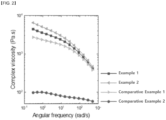
- the reactive extrusion composition may satisfy a complex viscosity at 185°C, 0.5% strain and 0.3 rad/s of 2,000 Pa.s or more.
- the complex viscosity of the composition may be 2500 Pa.s or more, 3000 Pa.s or more, 3500 Pa.s or more, 4000 Pa.s or more, 4,500 Pa.s or more, 5000 Pa.s or more, 5500 Pa.s or more, 6000 Pa.s or more, 6500 Pa.s or more, 7000 Pa.s or more, 7500 Pa.s or more, or 8000 Pa.s or more.
- the upper limit thereof may be, for example, 25000 Pa.s or less, 20000 Pa.s or less, 15000 Pa.s or less, 10000 Pa.s or less, specifically 9000 Pa.s or less or 8000 Pa.s or less.
- a composition satisfying the above range is advantageous for providing a blend product having excellent extrusion processability and excellent mechanical properties.
- this application relates to an extrusion method for enhancing the mechanical properties of a PLA and P(3HP) blend.
- the extrusion method may be a reactive extrusion method.
- the method may be a method comprising reacting a composition containing a compatibilizer and a chain extender in addition to PLA and P(3HP) under predetermined conditions in order to increase the interfacial coupling reaction between the two phases, i.e., PLA and P(3HP). Therefore, the extrusion mixing performance can be improved (e.g., the size of the dispersed phase is small and the mixing performance can be improved) and the efficiency of the PLA/P(3HP) interfacial coupling reaction may become high.
- an extrusion method for manufacturing a PLA/P(3HP) blend comprising a step of feeding a reactive extrusion composition comprising a resin component containing PLA and P(3HP), a chain extender and a reactive compatibilizer at a flow rate of 2.0 g/min or more and 7.0 g/min or less into an extruder having a stirring shaft rotating at 250 rpm or more in a temperature range of 110°C or more and 200°C or less, wherein the reactive extrusion composition contains 0.2 to 15 parts by weight of a chain extender and 0.2 to 15 parts by weight of a reactive compatibilizer based on 100 parts by weight of the resin component.
- the method may include a step of feeding a reactive extrusion composition comprising a resin component containing PLA and P(3HP), a reactive compatibilizer, and a chain extender into an extruder controlled under predetermined conditions.
- a content of PLA and P(3HP) contained in the resin component of the extrusion composition, a weight average molecular weight, a type and/or content of a reactive compatibilizer and a chain extender, and a type and/or content of an additive are the same as described above for the reactive extrusion composition.
- the method of the present application can be performed under conditions controlled so that the blend manufactured from the reactive extrusion composition has excellent mechanical properties (e.g., improved elongation).
- the method may include a step of feeding the reactive extrusion composition at a flow rate of 2.0 to 7.0 g/min into an extruder having a stirring shaft rotating at 250 rpm or more in a temperature range of 110 to 200°C.
- excellent mechanical properties e.g., elongation
- PLA and P(3HP) may be imparted to a blend of PLA and P(3HP).
- the extruder may be controlled so as to have a temperature gradient in the transfer direction of the reactive extrusion composition within the extruder.
- the transfer direction may mean the direction in which the reactive extrusion composition fed into a feeding inlet of the extruder moves to a discharge outlet of the extruder.
- the method of imparting a temperature gradient within the extruder is not particularly limited, and devices such as known sensors can be used.
- the method may be a method comprising dividing the extruder into at least three zones in the transfer direction, and imparting a temperature gradient for each area in each transfer direction (direction from a feeding inlet to a discharge outlet) to low temperature ⁇ high temperature ⁇ low temperature, or low temperature ⁇ high temperature ⁇ medium temperature.
- the respective areas can be called a first zone, a second zone, and a third zone in the transfer direction (direction from a feeding inlet to a discharge outlet).
- the method may be a method of imparting a temperature gradient by controlling the reactive extrusion composition feeding inlet side temperature of the extruder to a range of 120°C to 165°C, the reactive extrusion composition discharge outlet side temperature of the extruder to a range of 135°C to 180°C, and the temperature between the feeding inlet side and the discharge outlet side to a range of 170°C to 200°C.
- the feeding inlet side may be referred to as the first zone
- the discharge outlet side may be referred to as the third zone
- the area between the first zone and the third zone i.e., between the feeding inlet side and the discharge outlet side
- the second zone As a result of experimental confirmation, when the reactive extrusion conditions are controlled as described above, it is more advantageous to impart excellent mechanical properties (e.g., elongation) to a blend of PLA and P(3HP).
- the method may be a method of imparting a temperature gradient such that the temperature of the second zone is higher than the temperatures of the first zone and the third zone.
- the method may be a method of imparting a temperature gradient such that the temperature of the first zone is higher than the temperature of the third zone.
- the method may be a method of imparting a temperature gradient such that the temperature of the third zone is higher than the temperature of the first zone.
- the first zone, the second zone or the third zone may be divided into at least two zones according to the temperature.
- the first zone may be divided into a 1-1 zone and a 1-2 zone from the composition feeding inlet side to the discharge outlet side
- the third zone may be divided into a 3-1 zone and a 3-2 zone from the composition feeding inlet side to the discharge side.
- the 1-1 zone and the 1-2 zone can be controlled to the temperature range (120°C to 165°C) of the 1 zone, and the temperature of the 1-2 zone may be higher than that of the 1-1 zone.
- the 3-1 zone and the 3-2 zone can be controlled within the temperature range of the above-mentioned third zone (135°C to 180°C), and the temperature of the 3-1 zone may be higher than that of the 3-2 zone.
- the rotation speed of the extruder shaft may be 300 rpm or more, 350 rpm or more, or 400 rpm or more, and the upper limit thereof may be, for example, 500 rpm or less, 450 rpm or less, 400 rpm or less, or 350 rpm or less.
- the extruder may include a rotor blade.
- the speed at which the reactive extrusion composition is fed or moved within the extruder may be 2.0 to 7.0 g/min.
- the flow rate of the reactive extrusion composition may be 2.5 g/min or more, 3.0 g/min or more, 3.5 g/min or more, 4.0 g/min or more, 4.5 g/min or more, or 5.0 g/min or more, and the upper limit thereof may be, for example, 6.5 g/min or less, 6.0 g/min or less, 5.5 g/min or less, 5.0 g/min or less, 4.5 g/min or less, or 4.0 g/min or less.
- the method may be a method of feeding the reactive extrusion composition at a flow rate of 4.5 to 5.5 g/min into an extruder having a stirring shaft rotating at 250 to 350 rpm.
- the residence time of the reactive extrusion composition in the extruder may be within the range of 220 to 300 seconds (sec). If the residence time is longer than the above-mentioned time, the polymer may decompose and the molecular weight may decrease. If the residence time is shorter than the above-mentioned time, the reaction may not occur sufficiently and thus, the molecular weight may decrease. The decrease in molecular weight leads to a decrease in mechanical properties such as tensile strength and elongation.
- this application relates to a blend of PLA and P(3HP) having excellent mechanical properties.
- a blend of PLA and P(3HP) may be referred to as a PLA/P(3HP) blend.
- PLA/P(3HP) blend manufactured by reactive extrusion, wherein PLA-g-P(3HP) copolymer exists at the PLA and P(3HP) interface, and the blend has a tensile strength of 25 MPa or more and an elongation at break of 20% or more.
- the tensile strength and the elongation at break can be measured according to ASTM D882, and the stretching speed can be measured under the condition of 30-50%/min (stretching speed that stretches the length of the initial sample by 30 to 50% per minute).
- the tensile strength of the PLA/P (3HP) blend may be, for example, 30 MPa or more, 35 MPa or more, 40 MPa or more, 45 MPa or more, or 50 MPa or more, and the upper limit thereof may be, for example, 70 MPa or less, 65 MPa or less, 60 MPa or less, 55 MPa or less, 50 MPa or less, 45 MPa or less, 40 MPa or less, or 35 MPa or less.
- the elongation at break of the PLA/P(3HP) blend may be, for example, 20% or more, 30% or more, 40% or more, 50% or more, 60% or more, more specifically, 70% or more, 80% or more, 90% or more, 100% or more, 110% or more, 120% or more, 130% or more, 140% or more, 150% or more, 160% or more, 170% or more, 180% or more, 190% or more, 200% or more, 210% or more, 220% or more, 230% or more, 240% or more, or 250% or more.
- the upper limit thereof may be, for example, 600% or less, 550% or less, 500% or less, 450% or less, 400% or less, 350% or less, 300% or less, 250% or less, or 200% or less.
- the PLA-g-P(3HP) copolymer existing at the interface is entangled with the polymer in the PLA and P(3HP) phases, which leads to an increase in the interfacial adhesion, so that when an external force (elongation) is applied, the resistance at the interface can increase (high elongation).
- the lack of entanglement by the PLA-g-P(3HP) copolymer in the PLA and P(3HP) phases leads to the formation of voids at the interface, which can easily tear the blend product (low elongation).
- the blend has excellent mechanical properties such as tensile strength and elongation while being eco-friendly, which makes it useful as a material for daily necessities such as biodegradable films and biodegradable injection containers.
- this application relates to an article comprising the above-mentioned blend.
- the article may be an injection product or a film.
- the injection articles can be manufactured, for example, in the form of a container.
- the film can be manufactured to have a thickness of, for example, about 1 mm or less, 0.5 mm or less, 0.3 mm or less, or 0.1 mm or less.
- a PLA/P(3HP) blend that not only has eco-friendly characteristics such as biodegradability, but also has excellent extrusion processability and mechanical properties (e.g. tensile strength, elongation, etc.).
- composition containing the following components was prepared.
- the flow rate in the extruder was adjusted to range of 4.5 to 5.5 g/min, and the rotation speed of the extruder was adjusted to 400 rpm. Further, the extruder was given a temperature gradient so that the average temperature of multiple areas sequentially located in the transfer direction (i.e. from a feeding inlet side to a discharge outlet side) was 140°C, 170°C, 185°C and 165°C. Under the above conditions, the residence time of the composition in the extruder was in the range of 220 to 300 seconds (sec).
- Example 1 Base resin (weight ratio) Reactive compatibilizer (parts by weight*) Chain extender (parts by weight) Lubricant (parts by weight) Antioxidant (parts by weight)
- Example 1 PLA 80 P(3HP) 20 1.2 PEGDE 2 0.4 0.5
- Example 2 PLA 80 P(3HP) 20 1.6 PEGDE 2 0.4 0.5
- Example 3 PLA 90 P(3HP) 10 0.6 PEGDE 1 0.4 0.5
- Example 4 PLA 80 : P(3HP) 20 1.2 TMPTE 2 0.4 0.5 Comparative Example 1 PLA 80 : P(3HP) 20 - PEGDE 2 0.4 0.5 Comparative Example 2 PLA 80 : P(3HP) 20 1.2 - 0.4 0.5 Comparative Example 3 PLA 100 : P(3HP) 20 1.2 - 0.4 0.5 Comparative Example 3 PLA 100 : P(3HP) 20 1.2 - 0.4 0.5 Comparative Example 3 PLA 100 : P(3HP) 20 1.2 - 0.4 0.5 Comparative Example 3 PLA 100
- the flow rate in the extruder was adjusted to range of 4.5 to 5.5 g/min, and the rotation speed of the extruder was adjusted as listed in Table 2 below. Further, the extruder was given a temperature gradient so that the average temperature of multiple areas sequentially located in the transfer direction (i.e. from a feeding inlet side to a discharge outlet side) was 120°C, 160°C, 185°C, 175°C and 145°C. Under the above conditions, the residence time of the composition in the extruder was in the range of 220 to 300 seconds(sec).
- the sample reactively extruded from the extruder was pressed with a hot press at 170°C to produce a specimen with a thickness of about 0.15 mm (specimen length 80 mm, width 6 mm).
- A means a reactive compatibilizer and P means a chain extender, and respective contents (parts by weight) are based on 100 parts by weight of the resin component.
- the lubricant and antioxidant were used in the same amounts in respective samples (100 parts by weight of a resin component, 0.4 parts by weight of a lubricant, and 0.5 parts by weight of an antioxidant).
Landscapes
- Chemical & Material Sciences (AREA)
- Chemical Kinetics & Catalysis (AREA)
- Medicinal Chemistry (AREA)
- Polymers & Plastics (AREA)
- Organic Chemistry (AREA)
- Health & Medical Sciences (AREA)
- Mechanical Engineering (AREA)
- Engineering & Computer Science (AREA)
- General Chemical & Material Sciences (AREA)
- Physics & Mathematics (AREA)
- Thermal Sciences (AREA)
- Extrusion Moulding Of Plastics Or The Like (AREA)
- Compositions Of Macromolecular Compounds (AREA)
- Epoxy Resins (AREA)
Applications Claiming Priority (4)
| Application Number | Priority Date | Filing Date | Title |
|---|---|---|---|
| KR20230008924 | 2023-01-20 | ||
| KR1020230012859A KR20240120314A (ko) | 2023-01-31 | 2023-01-31 | Pla/p(3hp) 블렌드의 기계적 물성 개선을 위한 방법 및 그로부터 제조된 pla/p(3hp) 블렌드 |
| KR1020240006048A KR20240116384A (ko) | 2023-01-20 | 2024-01-15 | 반응 압출 조성물 및 그로부터 제조된 pla/p(3hp) 블렌드 |
| PCT/KR2024/000885 WO2024155116A1 (fr) | 2023-01-20 | 2024-01-18 | Composition d'extrusion réactive, procédé pour améliorer des propriétés mécaniques d'un mélange pla/p(3hp), et mélange pla/p(3hp) produit à partir de celle-ci |
Publications (2)
| Publication Number | Publication Date |
|---|---|
| EP4495185A1 true EP4495185A1 (fr) | 2025-01-22 |
| EP4495185A4 EP4495185A4 (fr) | 2025-09-03 |
Family
ID=91956282
Family Applications (1)
| Application Number | Title | Priority Date | Filing Date |
|---|---|---|---|
| EP24744896.2A Pending EP4495185A4 (fr) | 2023-01-20 | 2024-01-18 | Composition d'extrusion réactive, procédé pour améliorer des propriétés mécaniques d'un mélange pla/p(3hp), et mélange pla/p(3hp) produit à partir de celle-ci |
Country Status (5)
| Country | Link |
|---|---|
| US (1) | US20250257207A1 (fr) |
| EP (1) | EP4495185A4 (fr) |
| JP (1) | JP7818100B2 (fr) |
| CN (1) | CN119032134A (fr) |
| WO (1) | WO2024155116A1 (fr) |
Family Cites Families (9)
| Publication number | Priority date | Publication date | Assignee | Title |
|---|---|---|---|---|
| JP5398106B2 (ja) | 2006-07-05 | 2014-01-29 | 東レ株式会社 | 樹脂組成物およびそれからなる成形品 |
| KR101385879B1 (ko) | 2011-12-26 | 2014-04-16 | (주)엘지하우시스 | 바이오 플라스틱 조성물 |
| CN109054254B (zh) * | 2012-08-17 | 2021-02-02 | Cj第一制糖株式会社 | 用于聚合物共混物的生物基橡胶改性剂 |
| US20150361212A1 (en) | 2013-02-19 | 2015-12-17 | Toray Industries, Inc. | Polylactic resin composition, molded product, and method of producing polylactic resin composition |
| KR102342779B1 (ko) * | 2017-12-26 | 2021-12-22 | 주식회사 엘지화학 | 생분해성 고분자 조성물의 제조방법 |
| KR102727421B1 (ko) * | 2019-09-16 | 2024-11-07 | 주식회사 엘지화학 | 바이오폴리머 조성물, 이의 제조방법 및 이를 이용한 바이오플라스틱 |
| FR3106591B1 (fr) * | 2020-01-24 | 2022-08-05 | Carbiolice | Utilisation d’un melange enzyme pour ameliorer les proprietes mecaniques d’un article comprenant le melange enzyme et un polymere biodegradable |
| KR102431676B1 (ko) * | 2021-07-30 | 2022-08-11 | 씨제이제일제당(주) | 생분해성 수지 조성물, 이를 이용한 생분해성 필름 및 멀칭 필름, 및 이의 제조방법 |
| CN117946502A (zh) | 2022-10-27 | 2024-04-30 | 江西科院生物新材料有限公司 | 一种聚乳酸增韧组合物、制备方法及制得的聚乳酸树脂 |
-
2024
- 2024-01-18 EP EP24744896.2A patent/EP4495185A4/fr active Pending
- 2024-01-18 CN CN202480002151.2A patent/CN119032134A/zh active Pending
- 2024-01-18 US US18/859,687 patent/US20250257207A1/en active Pending
- 2024-01-18 JP JP2024556773A patent/JP7818100B2/ja active Active
- 2024-01-18 WO PCT/KR2024/000885 patent/WO2024155116A1/fr not_active Ceased
Also Published As
| Publication number | Publication date |
|---|---|
| US20250257207A1 (en) | 2025-08-14 |
| JP2025513190A (ja) | 2025-04-24 |
| WO2024155116A1 (fr) | 2024-07-25 |
| EP4495185A4 (fr) | 2025-09-03 |
| CN119032134A (zh) | 2024-11-26 |
| JP7818100B2 (ja) | 2026-02-19 |
Similar Documents
| Publication | Publication Date | Title |
|---|---|---|
| EP1773586B1 (fr) | Polymeres ramifies d'acide polylactique et leur procede de preparation | |
| EP0642556B1 (fr) | Melanges polymeres a cristaux liquides, leur procede de preparation et produits fabriques a partir desdits melanges | |
| EP3186310B1 (fr) | Modification de plastiques industriels au moyen de copolymères oléfine-anhydride maléique | |
| JPH0377826B2 (fr) | ||
| KR100875253B1 (ko) | 폴리에스테르 수지용 개질제 및 이를 이용한 성형품의 제조방법 | |
| WO2006101076A1 (fr) | Composition de résine de polyester aliphatique et article moulé | |
| EP4495185A1 (fr) | Composition d'extrusion réactive, procédé pour améliorer des propriétés mécaniques d'un mélange pla/p(3hp), et mélange pla/p(3hp) produit à partir de celle-ci | |
| JP2000336256A (ja) | カレンダー成形用樹脂組成物 | |
| EP4019586A2 (fr) | Vulcanisats thermoplastiques résistant à l'huile à haute température | |
| CN112795148B (zh) | 一种热塑性共聚酯复合材料及其制备方法和应用 | |
| CN119708791A (zh) | 一种生物降解淋膜材料及其制备方法 | |
| KR20240116384A (ko) | 반응 압출 조성물 및 그로부터 제조된 pla/p(3hp) 블렌드 | |
| KR100758221B1 (ko) | 생분해성 수지조성물 및 그 제조방법과 이를 이용해 제조된그물 | |
| KR20240120314A (ko) | Pla/p(3hp) 블렌드의 기계적 물성 개선을 위한 방법 및 그로부터 제조된 pla/p(3hp) 블렌드 | |
| KR102361738B1 (ko) | 폴리락트산을 포함하는 블로운 필름용 생분해성 조성물 및 블로운 필름 | |
| JP2006232976A (ja) | ポリエステル樹脂用改質剤およびこれを用いた成形品の製造方法 | |
| WO1999019402A1 (fr) | Polymeres a cristaux liquides thermotropiques utilises comme stabilisants dans les polyesters thermoplastiques | |
| KR20240145616A (ko) | Pla 및 분지형 p(3hp)를 포함하는 반응 압출 조성물 및 그로부터 형성된 블렌드 | |
| JP7821334B2 (ja) | Nmt用途のための高金属接着力を有する熱可塑性組成物 | |
| JP7718778B2 (ja) | 生分解性高分子 | |
| JP2000143949A (ja) | ポリエステルエラストマ―組成物 | |
| WO1996034051A2 (fr) | Compositions de resine fluoree thermoplastique et articles moules et/ou extrudes produits a partir de celles-ci | |
| KR102177890B1 (ko) | 수지 조성물 및 성형체 | |
| JPH042622B2 (fr) | ||
| CN117070054A (zh) | 一种生物降解材料及其制备方法与应用 |
Legal Events
| Date | Code | Title | Description |
|---|---|---|---|
| STAA | Information on the status of an ep patent application or granted ep patent |
Free format text: STATUS: THE INTERNATIONAL PUBLICATION HAS BEEN MADE |
|
| PUAI | Public reference made under article 153(3) epc to a published international application that has entered the european phase |
Free format text: ORIGINAL CODE: 0009012 |
|
| STAA | Information on the status of an ep patent application or granted ep patent |
Free format text: STATUS: REQUEST FOR EXAMINATION WAS MADE |
|
| 17P | Request for examination filed |
Effective date: 20241017 |
|
| AK | Designated contracting states |
Kind code of ref document: A1 Designated state(s): AL AT BE BG CH CY CZ DE DK EE ES FI FR GB GR HR HU IE IS IT LI LT LU LV MC ME MK MT NL NO PL PT RO RS SE SI SK SM TR |
|
| A4 | Supplementary search report drawn up and despatched |
Effective date: 20250805 |
|
| RIC1 | Information provided on ipc code assigned before grant |
Ipc: C08L 67/04 20060101AFI20250730BHEP Ipc: C08G 63/06 20060101ALI20250730BHEP Ipc: C08G 63/08 20060101ALI20250730BHEP Ipc: C08G 63/91 20060101ALI20250730BHEP Ipc: B29C 48/00 20190101ALI20250730BHEP Ipc: C08G 63/02 20060101ALI20250730BHEP |