EP4495555A1 - Qualitometrie, die von einem flüssigkeitszähler ausgefallen wird - Google Patents
Qualitometrie, die von einem flüssigkeitszähler ausgefallen wird Download PDFInfo
- Publication number
- EP4495555A1 EP4495555A1 EP24188959.1A EP24188959A EP4495555A1 EP 4495555 A1 EP4495555 A1 EP 4495555A1 EP 24188959 A EP24188959 A EP 24188959A EP 4495555 A1 EP4495555 A1 EP 4495555A1
- Authority
- EP
- European Patent Office
- Prior art keywords
- fluid
- conduit
- fluid meter
- processing unit
- downstream
- Prior art date
- Legal status (The legal status is an assumption and is not a legal conclusion. Google has not performed a legal analysis and makes no representation as to the accuracy of the status listed.)
- Granted
Links
Images
Classifications
-
- G—PHYSICS
- G01—MEASURING; TESTING
- G01F—MEASURING VOLUME, VOLUME FLOW, MASS FLOW OR LIQUID LEVEL; METERING BY VOLUME
- G01F1/00—Measuring the volume flow or mass flow of fluid or fluent solid material wherein the fluid passes through a meter in a continuous flow
- G01F1/66—Measuring the volume flow or mass flow of fluid or fluent solid material wherein the fluid passes through a meter in a continuous flow by measuring frequency, phase shift or propagation time of electromagnetic or other waves, e.g. using ultrasonic flowmeters
- G01F1/662—Constructional details
-
- G—PHYSICS
- G01—MEASURING; TESTING
- G01F—MEASURING VOLUME, VOLUME FLOW, MASS FLOW OR LIQUID LEVEL; METERING BY VOLUME
- G01F1/00—Measuring the volume flow or mass flow of fluid or fluent solid material wherein the fluid passes through a meter in a continuous flow
- G01F1/66—Measuring the volume flow or mass flow of fluid or fluent solid material wherein the fluid passes through a meter in a continuous flow by measuring frequency, phase shift or propagation time of electromagnetic or other waves, e.g. using ultrasonic flowmeters
- G01F1/667—Arrangements of transducers for ultrasonic flowmeters; Circuits for operating ultrasonic flowmeters
-
- G—PHYSICS
- G01—MEASURING; TESTING
- G01F—MEASURING VOLUME, VOLUME FLOW, MASS FLOW OR LIQUID LEVEL; METERING BY VOLUME
- G01F15/00—Details of, or accessories for, apparatus of groups G01F1/00 - G01F13/00 insofar as such details or appliances are not adapted to particular types of such apparatus
- G01F15/06—Indicating or recording devices
- G01F15/061—Indicating or recording devices for remote indication
- G01F15/063—Indicating or recording devices for remote indication using electrical means
-
- G—PHYSICS
- G01—MEASURING; TESTING
- G01N—INVESTIGATING OR ANALYSING MATERIALS BY DETERMINING THEIR CHEMICAL OR PHYSICAL PROPERTIES
- G01N21/00—Investigating or analysing materials by the use of optical means, i.e. using sub-millimetre waves, infrared, visible or ultraviolet light
- G01N21/17—Systems in which incident light is modified in accordance with the properties of the material investigated
- G01N21/47—Scattering, i.e. diffuse reflection
- G01N21/49—Scattering, i.e. diffuse reflection within a body or fluid
- G01N21/53—Scattering, i.e. diffuse reflection within a body or fluid within a flowing fluid, e.g. smoke
-
- G—PHYSICS
- G01—MEASURING; TESTING
- G01N—INVESTIGATING OR ANALYSING MATERIALS BY DETERMINING THEIR CHEMICAL OR PHYSICAL PROPERTIES
- G01N21/00—Investigating or analysing materials by the use of optical means, i.e. using sub-millimetre waves, infrared, visible or ultraviolet light
- G01N21/17—Systems in which incident light is modified in accordance with the properties of the material investigated
- G01N21/47—Scattering, i.e. diffuse reflection
- G01N21/49—Scattering, i.e. diffuse reflection within a body or fluid
- G01N21/53—Scattering, i.e. diffuse reflection within a body or fluid within a flowing fluid, e.g. smoke
- G01N21/532—Scattering, i.e. diffuse reflection within a body or fluid within a flowing fluid, e.g. smoke with measurement of scattering and transmission
-
- G—PHYSICS
- G01—MEASURING; TESTING
- G01N—INVESTIGATING OR ANALYSING MATERIALS BY DETERMINING THEIR CHEMICAL OR PHYSICAL PROPERTIES
- G01N21/00—Investigating or analysing materials by the use of optical means, i.e. using sub-millimetre waves, infrared, visible or ultraviolet light
- G01N21/17—Systems in which incident light is modified in accordance with the properties of the material investigated
- G01N21/47—Scattering, i.e. diffuse reflection
- G01N21/49—Scattering, i.e. diffuse reflection within a body or fluid
- G01N21/53—Scattering, i.e. diffuse reflection within a body or fluid within a flowing fluid, e.g. smoke
- G01N21/534—Scattering, i.e. diffuse reflection within a body or fluid within a flowing fluid, e.g. smoke by measuring transmission alone, i.e. determining opacity
-
- G—PHYSICS
- G01—MEASURING; TESTING
- G01N—INVESTIGATING OR ANALYSING MATERIALS BY DETERMINING THEIR CHEMICAL OR PHYSICAL PROPERTIES
- G01N2291/00—Indexing codes associated with group G01N29/00
- G01N2291/02—Indexing codes associated with the analysed material
- G01N2291/028—Material parameters
- G01N2291/02809—Concentration of a compound, e.g. measured by a surface mass change
Definitions
- the invention relates to the field of communicating fluid meters.
- distribution networks which include pipelines and hydraulic devices which make it possible to optimize the circulation of water from water reservoirs to the installations of end users via the pipelines.
- the quality of the water distributed depends of course on the quality of the water at the time of its collection, the treatments it undergoes, but also on the materials with which it is in contact in the reservoirs and during its circulation in the distribution network. Deposition phenomena (biofilms, scaling, metal oxides, etc.) can indeed occur in reservoirs and pipes.
- this monitoring may lack precision, particularly due to the extent of the distribution networks. For example, it is possible that the water quality observed at end users located in a particular area is significantly lower than the quality assessed upstream of the said area. This may result from localised deterioration of the pipes, which the monitoring devices are not able to detect.
- the invention relates to a solution making it possible, in a fluid distribution network, to improve the precision of the evaluation of the quality of the fluid supply depending on the location, said solution having a limited cost.
- the transmitter and receiver of the light signal are therefore used to assess the turbidity of the fluid circulating in the meter conduit.
- Turbidity is a relevant parameter for measuring the quality of the fluid supply.
- the assessment of turbidity is carried out by the meter itself and therefore at the end user's installation level.
- the invention therefore makes it possible to obtain a measurement of the quality of the fluid supply, which is associated with a very precise location in the network.
- the cost of turbidity assessment is very low, because the transmitter and receiver of the light signal are inexpensive and easy to integrate components into the meter.
- a fluid meter as previously described, in which the fluid flows in the conduit in a first direction, and in which the predefined path extends in a second direction perpendicular to the first direction.
- the light signal is an infrared signal.
- the transmitter is a light emitting diode and the receiver is a photodiode.
- conduit includes two holes, and wherein the transmitter and receiver each extend at least partially through one of the holes.
- a fluid meter as previously described, further comprising an ultrasonic measuring device comprising an upstream transducer and a downstream transducer and arranged to measure a flow rate of the fluid, the transmitter and the receiver being positioned downstream of the upstream transducer and the downstream transducer.
- the processing unit being arranged to evaluate quality parameters representative of a quality of a supply of the fluid, said quality parameters comprising the turbidity of the fluid.
- the processing unit being arranged to evaluate a speed of sound in the fluid using the ultrasonic measuring device, and then to evaluate the temperature of the fluid from the speed of sound.
- the meter comprises at least one pressure sensor, the quality measurement parameters further comprising a pressure measured by said pressure sensor.
- the meter comprises an upstream pressure sensor, positioned on one side of an upstream end of the conduit, and a downstream pressure sensor, positioned on one side of a downstream end of the conduit, the quality measurement parameters further comprising a pressure value representative of a pressure difference between an upstream pressure measured by the upstream pressure sensor and a downstream pressure measured by the downstream pressure sensor.
- a fluid meter as previously described, further comprising a communication module, the processing unit being arranged to receive via the communication module a request sent by a system external to the fluid meter, and to, in response to said request, transmit the parameters of quality audit system.
- the water meter 1 is used to measure the water consumption of the installation 2 of an end user.
- the water is supplied to the installation 2 by a water distribution network 3.
- Meter 1 has a conduit 4 in which the water supplied by network 3 to installation 2 circulates.
- the water circulates in conduit 4 from upstream to downstream, as indicated by the direction of arrows F.
- upstream we mean on the side of network 3
- downstream we mean on the side of installation 2.
- the meter 1 comprises a processing unit 5 (electronic and software).
- the processing unit 5 comprises at least one processing component 5a, which is for example a “generalist” processor, a processor specialized in signal processing (or DSP, for Digital Signal Processor ), a microcontroller, or a programmable logic circuit such as an FPGA (for Field Programmable Gate Arrays ) or an ASIC (for Application Specified Integrated Circuit ).
- the processing unit 5 also comprises one or more memories 5b, connected to or integrated in the processing component 5a. At least one of these memories 5b forms a computer-readable recording medium, on which is recorded at least one computer program comprising instructions which cause the processing component 5a to execute at least some of the steps of the measuring method which will be described below.
- the processing component 5a is here the metrology microcontroller of the meter 1.
- the microcontroller 5a integrates an analog-digital converter (ADC) 6.
- ADC analog-digital converter
- the meter 1 further comprises a communication module 7.
- the communication module 7 implements, for example, a cellular radio link according to the LTE-Cat M1 protocol or the NB-IoT protocol.
- the meter 1 also includes an ultrasonic measuring device 8.
- the ultrasonic measuring device 8 is used to measure the flow of water supplied to installation 2 by network 3.
- the ultrasonic measuring device 8 comprises an upstream transducer 9a and a downstream transducer 9b.
- the ultrasonic measuring device 8 also comprises a calculation module 10 (software) which is implemented here in the microcontroller 5a of the processing unit 5.
- the calculation module 10 performs the flow rate evaluations.
- the upstream transducer 9a and the downstream transducer 9b are advantageously (but not necessarily) paired.
- the upstream transducer 9a and the downstream transducer 9b are here piezoelectric transducers.
- Each transducer 9a, 9b successively plays the role of a transmitter and a receiver of ultrasonic signals.
- the processing unit 5 generates an electrical excitation signal, and provides the transmitter with the electrical excitation signal.
- the transmitter then generates an ultrasonic signal.
- the receiver receives the ultrasonic signal after it has traveled a first predefined path in the water.
- the first predefined path is here a direct path which is here inclined relative to a longitudinal axis X1 of the duct 4 (the first predefined path could also be parallel to said axis X1).
- the first predefined path could also be an indirect path: the ultrasonic signals would then be reflected against the internal wall of the duct 4 (possibly against reflectors themselves located on the internal wall).
- the first predefined path has a first length L1, which is known very precisely.
- the upstream transducer 9a and the downstream transducer 9b are notably connected to the CAN 6 which digitizes the signals produced by said transducers.
- the processing unit 5 first applies the electrical excitation signal to the terminals of the upstream transducer 9a so that the latter generates an upstream ultrasonic signal Sm in the conduit 4.
- the processing unit 5 acquires a downstream electrical signal produced by the downstream transducer 9b when the latter receives the upstream ultrasonic signal Sm.
- the processing unit 5 applies the electrical excitation signal to the terminals of the downstream transducer 9b so that the latter generates in the conduit 4 a downstream ultrasonic signal Sv.
- the processing unit 5 acquires an upstream electrical signal produced by the upstream transducer 9a when the latter receives the downstream ultrasonic signal Sv.
- the calculation module 10 analyzes the downstream electrical signal and the upstream electrical signal to evaluate a speed of the water in the conduit 4, then evaluates, from the speed of the water, the flow rate of the water in the conduit 4.
- the meter 1 further comprises at least one pressure sensor, in this case two pressure sensors: an upstream pressure sensor 11a, which is positioned on the side of the upstream end of the conduit 4, and a downstream pressure sensor 11b, which is positioned on the side of the downstream end of the conduit 4.
- at least one pressure sensor in this case two pressure sensors: an upstream pressure sensor 11a, which is positioned on the side of the upstream end of the conduit 4, and a downstream pressure sensor 11b, which is positioned on the side of the downstream end of the conduit 4.
- the upstream pressure sensor 11a and the downstream pressure sensor 11b are connected to the processing unit 5.
- the upstream pressure sensor 11a and the downstream pressure sensor 11b are in particular connected to the CAN 6 which digitizes the measurements produced by said sensors.
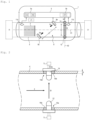
- the meter 1 further comprises a transmitter 12 arranged to emit a light signal Sl in the conduit 4, and a receiver 14 arranged to receive the light signal Sl after it has traveled a second predefined path in the conduit 4 (and therefore in the water).
- the second predefined path extends in a second direction X2 perpendicular to a first direction (axis X1) in which the water flows.
- the second predefined path has a second length L2, which is known very precisely.
- the light signal Sl here is an infrared signal.
- the wavelength of the light signal Sl is for example equal to 860nm.
- the transmitter 12 is here a light-emitting diode (LED) and the receiver 14 is a photodiode.
- LED light-emitting diode
- a first hole 15a and a second hole 15b, passing through, are formed in the thickness e of the wall of the conduit 4.
- the first hole 15a and the second hole 15b are located on the conduit 4 at diametrically opposite positions.
- the LED 12 and the photodiode 14 each extend at least partially through one of the holes 15a, 15b.
- the LED 12 is here encapsulated in a cylindrical housing with a rounded end.
- the rounded end here includes a lens.
- the housing is transparent or translucent to infrared light.
- the housing is here made of epoxy resin.
- the LED 12 is inserted into the first hole 15a so that the end of the LED 12, corresponding to the rounded tip, protrudes inside the conduit 4.
- the seal is ensured by a first seal 16a which extends around the housing of the LED 12 while being positioned between the housing of the LED 12 and the wall of the conduit 4 at the level of the first hole 15a.
- the photodiode 14 is also encapsulated in a cylindrical housing with a rounded end.
- the rounded end here includes a lens.
- the photodiode 14 is inserted into the second hole 15b opposite the LED 12 so that the end of the photodiode 14, corresponding to the rounded tip, projects inside the conduit 4.
- the seal is ensured by a second seal 16b which extends around the housing of the photodiode 14 while being positioned between the housing of the photodiode 14 and the wall of the conduit 4 at the level of the second hole 15b.
- LED 12 and photodiode 14 are connected to processing unit 5.
- the processing unit 5 can activate the LED 12 so that it emits the light signal Sl, and acquire the electrical signal Se produced by the photodiode 14 when the latter receives the light signal Sl.
- Photodiode 14 is connected to CAN 6 of microcontroller 5 which digitizes the electrical signal produced by photodiode 14.
- the LED 12 and the photodiode 14 are here positioned downstream of the upstream transducer 9a and the downstream transducer 9b of the ultrasonic measuring device 8. This ensures that these components do not disturb the metrological measurement of the water flow rate carried out by the ultrasonic measuring device 8.
- Treatment unit 5 evaluates quality parameters representative of the quality of the water supply.
- the quality parameters firstly include water turbidity.
- the processing unit 5 therefore controls the LED 12 so that it emits the light signal Sl in the conduit 4, and acquires the electrical signal Se produced by the photodiode 14.
- the processing unit 5 is therefore capable of determining the quantity of light received by the photodiode 14.
- the processing unit treatment 5 evaluates the turbidity of the water from said electrical signal Se.
- the electrical signal Se is an electric current.
- the turbidity evaluated by the processing unit 5 is inversely proportional to said electric current.
- Turbidity is expressed in NTU (for Nephelometric Turbidity Unit ), which is a unit that represents an order of magnitude in mg/L of MES (Suspended Matter).
- a calibration of the system including the LED 12 and the photodiode 14 integrated in the counter 1, is carried out in the factory.
- the processing unit 5 To perform a turbidity measurement at time T, the processing unit 5 here performs a predetermined number of measurements of the electrical signal produced by the photodiode 14 (the LED 12 being activated).
- the predetermined number is for example equal to 10, i.e. for example 5 measurements before time T and 5 measurements after time T.
- the processing unit 5 calculates the average of these 10 current measurements to obtain an averaged current value.
- the processing unit 5 then produces a turbidity measurement from the averaged current value.
- the quality parameters also include water temperature.
- the processing unit 5 evaluates a speed of sound (or sound celerity) in the water using the ultrasonic measuring device 8, then evaluates the temperature of the water from the speed of sound.
- the ultrasonic measuring device 8 makes it possible to measure the speed c of sound, in the following manner.
- Calculation module 10 first determines the sum time of flight ( ToF ) of the ultrasonic signals between the two transducers 9a, 9b: sTOF.
- the quality parameters further include a pressure measured by one of the pressure sensors of the processing unit 5.
- the quality measurement parameters further include a pressure value representative of a pressure difference between an upstream pressure measured by the upstream pressure sensor 11a and a downstream pressure measured by the downstream pressure sensor 11b.
- the pressure value ⁇ P is the pressure loss due to meter 1 itself. It is therefore not strictly speaking a quality parameter, capable of assessing the quality of the water supply, but rather a constraint that meter 1 must respect in order to comply with its technical and functional specifications. The channeling of the flow in meter 1 necessarily results in a slight pressure loss, but this must be limited.
- the pressure loss ⁇ P must verify the following predefined condition: ⁇ P ⁇ 0.63 Bar .
- the numerical values used for the predefined conditions are programmable and can be changed according to regulatory requirements.
- the processing unit 5 creates a daily table 17 which contains the quality measurements produced periodically.
- the period is for example equal to a quarter of an hour (i.e. 96 measurements per day).
- Table 17 is stored in one of the memories 5b.
- An example of Table 17 is provided in the appendix.
- Table 17 therefore contains 96 lines of measurements taken every quarter of an hour (for example from 00:07:30" to 23:52:30").
- Each quarter hour is associated with measurements of upstream pressure, pressure loss, temperature and turbidity.
- Processing unit 5 stores these values here over a week (therefore seven daily tables 17, identical to that provided in the appendix, including the table for the current day).
- the processing unit 5 can transmit these data to a system external to the meter 1 using the communication module 7.
- the processing unit 5 receives, for example, via the communication module 7, a request sent by said system.
- the external system is for example the IS (for Information System) of the water distributor and/or the manager of the network.
- IS for Information System
- the IS produces a dedicated DLMS request, to which counter 1 responds by sending table 17.
- Meter 1 can also send an alarm message to the water distributor, the network manager or even the end user when the quality of the water supply is not satisfactory (i.e. it does not meet the predefined conditions mentioned earlier).
- the assessment of the quality of the water supply by the meter provides legal proof that the quality of the supply to the end user is that expected in terms of water temperature, pressure and turbidity.
- the meter is not necessarily a water meter, it can be a meter for any fluid: gas, oil, etc.
- the LED and photodiode do not necessarily extend through holes formed in the thickness of the conduit.
- the LED and photodiode could be positioned outside the conduit and facing these holes, which would be closed by transparent or translucent surfaces (e.g. glass).
- the LED and photodiode could also be fixed to the internal wall of the duct, or integrated into a measuring device itself integrated into the duct.
- the transmitter and receiver of the light signal are not necessarily an LED and a photodiode. It could be a laser diode and a phototransistor for example.
- the light signal is not necessarily an infrared signal, it could belong to the visible range for example.
Landscapes
- Physics & Mathematics (AREA)
- General Physics & Mathematics (AREA)
- General Health & Medical Sciences (AREA)
- Chemical & Material Sciences (AREA)
- Analytical Chemistry (AREA)
- Biochemistry (AREA)
- Life Sciences & Earth Sciences (AREA)
- Health & Medical Sciences (AREA)
- Immunology (AREA)
- Pathology (AREA)
- Fluid Mechanics (AREA)
- Electromagnetism (AREA)
- Investigating Or Analysing Materials By Optical Means (AREA)
Applications Claiming Priority (1)
| Application Number | Priority Date | Filing Date | Title |
|---|---|---|---|
| FR2307746A FR3151398A1 (fr) | 2023-07-19 | 2023-07-19 | Qualimétrie évaluée par un compteur de fluide |
Publications (2)
| Publication Number | Publication Date |
|---|---|
| EP4495555A1 true EP4495555A1 (de) | 2025-01-22 |
| EP4495555B1 EP4495555B1 (de) | 2026-03-25 |
Family
ID=88779902
Family Applications (1)
| Application Number | Title | Priority Date | Filing Date |
|---|---|---|---|
| EP24188959.1A Active EP4495555B1 (de) | 2023-07-19 | 2024-07-16 | Qualitometrie, die von einem flüssigkeitszähler ausgefallen wird |
Country Status (3)
| Country | Link |
|---|---|
| US (1) | US20250027801A1 (de) |
| EP (1) | EP4495555B1 (de) |
| FR (1) | FR3151398A1 (de) |
Citations (5)
| Publication number | Priority date | Publication date | Assignee | Title |
|---|---|---|---|---|
| US5828458A (en) * | 1995-01-26 | 1998-10-27 | Nartron Corporation | Turbidity sensor |
| DE102007007812A1 (de) * | 2007-02-16 | 2008-08-21 | Siemens Ag | Durchflussmessumformer |
| KR20090035123A (ko) * | 2007-10-05 | 2009-04-09 | (주)씨엠엔텍 | 신호처리모듈 및 이를 이용한 초음파 유량계 |
| US20120185184A1 (en) * | 2011-01-18 | 2012-07-19 | TaKaDu Ltd. | System and method for identifying likely geographical locations of anomalies in a water utility network |
| WO2019186366A1 (en) * | 2018-03-26 | 2019-10-03 | Universidade Do Minho | Turbidity optical sensor for underwater continuous in-situ marine or fluvial monitoring |
Family Cites Families (3)
| Publication number | Priority date | Publication date | Assignee | Title |
|---|---|---|---|---|
| DE102013111235A1 (de) * | 2012-12-19 | 2014-06-26 | Endress + Hauser Conducta Gesellschaft für Mess- und Regeltechnik mbH + Co. KG | Anordnung zur optischen Messung einer oder mehrerer physikalischer, chemischer und/oder biologischer Prozessgrößen eines Mediums |
| US11407653B2 (en) * | 2016-05-26 | 2022-08-09 | Instantia Labs, Inc. | Method, system and apparatus for monitoring and controlling water quality and flow |
| KR102406733B1 (ko) * | 2022-02-28 | 2022-06-08 | 주식회사 레오테크 | 스마트 수도미터 |
-
2023
- 2023-07-19 FR FR2307746A patent/FR3151398A1/fr active Pending
-
2024
- 2024-07-16 EP EP24188959.1A patent/EP4495555B1/de active Active
- 2024-07-17 US US18/775,527 patent/US20250027801A1/en active Pending
Patent Citations (5)
| Publication number | Priority date | Publication date | Assignee | Title |
|---|---|---|---|---|
| US5828458A (en) * | 1995-01-26 | 1998-10-27 | Nartron Corporation | Turbidity sensor |
| DE102007007812A1 (de) * | 2007-02-16 | 2008-08-21 | Siemens Ag | Durchflussmessumformer |
| KR20090035123A (ko) * | 2007-10-05 | 2009-04-09 | (주)씨엠엔텍 | 신호처리모듈 및 이를 이용한 초음파 유량계 |
| US20120185184A1 (en) * | 2011-01-18 | 2012-07-19 | TaKaDu Ltd. | System and method for identifying likely geographical locations of anomalies in a water utility network |
| WO2019186366A1 (en) * | 2018-03-26 | 2019-10-03 | Universidade Do Minho | Turbidity optical sensor for underwater continuous in-situ marine or fluvial monitoring |
Also Published As
| Publication number | Publication date |
|---|---|
| FR3151398A1 (fr) | 2025-01-24 |
| US20250027801A1 (en) | 2025-01-23 |
| EP4495555B1 (de) | 2026-03-25 |
Similar Documents
| Publication | Publication Date | Title |
|---|---|---|
| EP2145051B1 (de) | Verfahren und anlage zur echtzeitüberprüfung der wasserqualität in einem liefernetzwerk | |
| EP3087361B1 (de) | Vorrichtung zum lesen und senden von gemessenen temperaturwerten | |
| FR2922625A1 (fr) | Dispositif et procede de surveillance d'un reseau de conduites de liquides et reseau equipe d'un tel dispositif | |
| FR2847670A1 (fr) | Detecteur par voie optique de la presence de bulles de gaz dans un liquide | |
| EP4495555B1 (de) | Qualitometrie, die von einem flüssigkeitszähler ausgefallen wird | |
| CA3061189A1 (fr) | Procede de mesure d'une vitesse d'un fluide | |
| US11896004B2 (en) | Sensing system and method for direct injection systems on agricultural sprayers | |
| EP4269955B1 (de) | Ultraschall-flüssigkeitszähler mit integriertem drucksensor | |
| EP4269953B1 (de) | Messung des durchflusses durch elektrische impedanzen piezoelektrischer wandler | |
| FR2911684A1 (fr) | Capteur optique pour la mesure de la salinite et de la visibilite dans l'eau de mer. | |
| FR2982893A1 (fr) | Systeme de surveillance d'un bassin et procede de surveillance associe | |
| EP4269952A1 (de) | Ultraschall-flüssigkeitszähler mit zwei drucksensoren | |
| FR3149973A1 (fr) | Compteur de fluide détectant et distinguant une fuite et un problème d’offset | |
| WO2004079301A2 (fr) | Dispositif de detection optique pour compteur | |
| BE1026946B1 (fr) | Système de detection de fuite d’eau | |
| FR3116336A1 (fr) | Procédé de traitement d’un signal de mesure pour obtenir une signature et dispositif de mesure associé | |
| EP1930712A1 (de) | Vorrichtung zur Bestimmung der Eigenschaften einer Zweiphasenströmung und Einsatzverfahren einer solchen Vorrichtung | |
| EP0983502A1 (de) | Vorrichtung zur bestimmung der optischen eigenschaften eines zirkulierenden flüssigen oder gasförmigen mediums | |
| US20250123198A1 (en) | Measurement of optical properties of a fluid | |
| FR3146499A1 (fr) | Dispositif de pompage et procédé de détection d’un risque d’endommagement d’un stator d’une pompe à cavités progressives d’un dispositif de pompage | |
| EP4354177A1 (de) | Verfahren zur detektion eines objekts durch einen flugzeitsensor | |
| GB2634585A (en) | Measurement of optical properties of a fluid | |
| EP4352480A1 (de) | Vorrichtung zur überwachung eines raumes | |
| FR3157446A1 (fr) | Réseau de distribution d’eau et procédé d'exploitation d'un réseau de distribution d’eau. | |
| CH717973A2 (fr) | Ensemble de mesure du degré d'humidité relative à l'intérieur d'un boîtier de montre. |
Legal Events
| Date | Code | Title | Description |
|---|---|---|---|
| PUAI | Public reference made under article 153(3) epc to a published international application that has entered the european phase |
Free format text: ORIGINAL CODE: 0009012 |
|
| STAA | Information on the status of an ep patent application or granted ep patent |
Free format text: STATUS: EXAMINATION IS IN PROGRESS |
|
| 17P | Request for examination filed |
Effective date: 20240716 |
|
| AK | Designated contracting states |
Kind code of ref document: A1 Designated state(s): AL AT BE BG CH CY CZ DE DK EE ES FI FR GB GR HR HU IE IS IT LI LT LU LV MC ME MK MT NL NO PL PT RO RS SE SI SK SM TR |
|
| GRAP | Despatch of communication of intention to grant a patent |
Free format text: ORIGINAL CODE: EPIDOSNIGR1 |
|
| STAA | Information on the status of an ep patent application or granted ep patent |
Free format text: STATUS: GRANT OF PATENT IS INTENDED |
|
| INTG | Intention to grant announced |
Effective date: 20250703 |
|
| GRAJ | Information related to disapproval of communication of intention to grant by the applicant or resumption of examination proceedings by the epo deleted |
Free format text: ORIGINAL CODE: EPIDOSDIGR1 |
|
| STAA | Information on the status of an ep patent application or granted ep patent |
Free format text: STATUS: EXAMINATION IS IN PROGRESS |
|
| INTC | Intention to grant announced (deleted) | ||
| GRAP | Despatch of communication of intention to grant a patent |
Free format text: ORIGINAL CODE: EPIDOSNIGR1 |
|
| STAA | Information on the status of an ep patent application or granted ep patent |
Free format text: STATUS: GRANT OF PATENT IS INTENDED |
|
| INTG | Intention to grant announced |
Effective date: 20251105 |
|
| GRAS | Grant fee paid |
Free format text: ORIGINAL CODE: EPIDOSNIGR3 |
|
| GRAA | (expected) grant |
Free format text: ORIGINAL CODE: 0009210 |
|
| STAA | Information on the status of an ep patent application or granted ep patent |
Free format text: STATUS: THE PATENT HAS BEEN GRANTED |
|
| AK | Designated contracting states |
Kind code of ref document: B1 Designated state(s): AL AT BE BG CH CY CZ DE DK EE ES FI FR GB GR HR HU IE IS IT LI LT LU LV MC ME MK MT NL NO PL PT RO RS SE SI SK SM TR |
|
| REG | Reference to a national code |
Ref country code: CH Ref legal event code: F10 Free format text: ST27 STATUS EVENT CODE: U-0-0-F10-F00 (AS PROVIDED BY THE NATIONAL OFFICE) Effective date: 20260325 Ref country code: GB Ref legal event code: FG4D Free format text: NOT ENGLISH |
|
| REG | Reference to a national code |
Ref country code: DE Ref legal event code: R096 Ref document number: 602024003402 Country of ref document: DE |
|
| REG | Reference to a national code |
Ref country code: IE Ref legal event code: FG4D Free format text: LANGUAGE OF EP DOCUMENT: FRENCH |