EP4495729A1 - Procédé et système de traitement de données - Google Patents
Procédé et système de traitement de données Download PDFInfo
- Publication number
- EP4495729A1 EP4495729A1 EP23769578.8A EP23769578A EP4495729A1 EP 4495729 A1 EP4495729 A1 EP 4495729A1 EP 23769578 A EP23769578 A EP 23769578A EP 4495729 A1 EP4495729 A1 EP 4495729A1
- Authority
- EP
- European Patent Office
- Prior art keywords
- data
- weight matrix
- optical
- output
- input data
- Prior art date
- Legal status (The legal status is an assumption and is not a legal conclusion. Google has not performed a legal analysis and makes no representation as to the accuracy of the status listed.)
- Pending
Links
Images




Classifications
-
- G—PHYSICS
- G06—COMPUTING OR CALCULATING; COUNTING
- G06E—OPTICAL COMPUTING DEVICES
- G06E1/00—Devices for processing exclusively digital data
- G06E1/02—Devices for processing exclusively digital data operating upon the order or content of the data handled
- G06E1/04—Devices for processing exclusively digital data operating upon the order or content of the data handled for performing computations using exclusively denominational number representation, e.g. using binary, ternary, decimal representation
- G06E1/045—Matrix or vector computation
-
- G—PHYSICS
- G06—COMPUTING OR CALCULATING; COUNTING
- G06E—OPTICAL COMPUTING DEVICES
- G06E3/00—Devices not provided for in group G06E1/00, e.g. for processing analogue or hybrid data
-
- G—PHYSICS
- G06—COMPUTING OR CALCULATING; COUNTING
- G06F—ELECTRIC DIGITAL DATA PROCESSING
- G06F17/00—Digital computing or data processing equipment or methods, specially adapted for specific functions
- G06F17/10—Complex mathematical operations
- G06F17/16—Matrix or vector computation, e.g. matrix-matrix or matrix-vector multiplication, matrix factorization
-
- G—PHYSICS
- G06—COMPUTING OR CALCULATING; COUNTING
- G06N—COMPUTING ARRANGEMENTS BASED ON SPECIFIC COMPUTATIONAL MODELS
- G06N20/00—Machine learning
Definitions
- the present invention relates to the field of electro-optical hybrid computer systems, and more specifically, to a method and system for data processing.
- the present invention provides a method and system for data processing using photonic multipliers and/or optical networks to perform matrix-vector multiplication, which can reduce computation time and energy consumption.
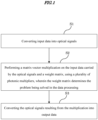
- the present invention provides a method for data processing, comprising the following steps: converting input data into optical signals; performing a matrix-vector multiplication on the input data carried by the optical signals and a weight matrix using a plurality of photonic multipliers, wherein the weight matrix determines the problem to be solved by the data processing; and converting the optical signals resulting from the multiplication into output data.
- the initial input data comprises an initial approximate solution to the problem determined by the weight matrix
- the output data includes an updated approximate solution to the problem determined by the weight matrix
- the matrix-vector multiplication is performed in a loop, with the output data from the previous cycle serving as the input data for the current cycle. Wherein the output data from each cycle forms a sequence of updated approximate solutions to the problem determined by the weight matrix.
- the problem determined by the weight matrix includes one or any combination of the following: data clustering, labeling, classification, and semantic segmentation.
- the weight matrix is determined by a weighted graph.
- the vertices of the weighted graph correspond to data points, and the edges correspond to the weights that reflect the correlations or interconnections between pairs of the data points.
- the weights in the weighted graph are determined by mutual correspondence between data points and the goals of one or any combination of the following: data clustering, labeling, classification, and semantic segmentation. In some embodiments, if adjacent data points are attracted to or correlated with each other, the corresponding weight is positive; if the adjacent data points are neutral or uncorrelated, the corresponding weight is zero; if the adjacent data points are repulsive or anticorrelated, the corresponding weight is negative.
- the initial input data includes a plurality of vectors with numerical components, which is used to determine cluster assignments, data labels, data classes, and semantic data segments by performing clustering, labeling, classification, and/or semantic segmentation on the numerical components.
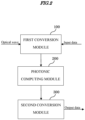
- the present invention also provides a system for data processing, comprising: a first conversion module for converting input data into optical signals; a photonic computing module, in communication with the first conversion module, comprising a plurality of photonic multipliers, wherein the photonic computing module is configured to perform a matrix-vector multiplication on the input data carried by the optical signals and a weight matrix, using the plurality of photonic multipliers, wherein the weight matrix determines the problem to be solved by the data processing; and a second conversion module, in communication with the photonic computing module, for converting the optical signals resulting from the multiplication into output data.
- the first conversion module includes: a digital-to-analog converter for converting the input data into analog input signals; and an optical modulator, in communication with the digital-to-analog converter, for modulating the analog input signals onto optical waves to generate the optical signals.
- the system further comprises a light source for generating the optical waves or an optical coupler for receiving the optical waves generated by an external light source.
- the second conversion module includes: a photoelectric converter, in communication with the photonic computing module, for converting the optical signals resulting from the multiplication into analog output signals; and an analog-to-digital converter, in communication with the photoelectric converter, for converting the analog output signals into digital output signals.
- system further comprises a guiding controller, in communication with the photonic computing module, to provide the weight matrix.
- the system further comprises a digital memory unit, in communication with the first and second conversion modules, for storing the input data and output data.
- the processes performed by the first conversion module, photonic computing module, and second conversion module are executed in a loop, with the digital memory unit using the output data from the previous cycle as the input data for the current cycle, and storing the output data from each cycle as a sequence of updated approximate solutions to the problem determined by the weight matrix.
- the present invention also provides a method for data processing, comprising the following steps: carrying input data onto optical waves through modulation; transmitting the input data carried by the optical waves, through an optical network, to a plurality of electronic multipliers; performing a matrix-vector multiplication on the input data and a weight matrix using the plurality of electronic multipliers, wherein the weight matrix determines the problem to be solved by the data processing; and outputting the result of the multiplication as output data.
- the initial input data includes an initial approximate solution to the problem determined by the weight matrix
- the output data includes an updated approximate solution to the problem determined by the weight matrix
- the matrix-vector multiplication is performed by the electronic multipliers in a loop, with the output data from the previous cycle serving as the input data for the current cycle. Wherein the output data from each cycle forms a sequence of updated approximate solutions to the problem determined by the weight matrix.
- the vertices of the weighted graph correspond to data points, and the edges correspond to the weights that reflect the correlations or interconnections between pairs of the data points.
- the weights in the weighted graph are determined by mutual correspondence between data points and the goals of one or any combination of the following: data clustering, labeling, classification, and semantic segmentation. If adjacent data points are attracted to or correlated with each other, the corresponding weight is positive; if the adjacent data points are neutral or uncorrelated, the corresponding weight is zero; if the adjacent data points are repulsive or anticorrelated, the corresponding weight is negative.
- the initial input data includes a plurality of vectors with numerical components, which is used to determine cluster assignments, data labels, data classes, and semantic data segments by performing clustering, labeling, classification, and/or semantic segmentation on the numerical components.
- the plurality of electronic multipliers communicates with each other through the optical network.
- the present invention also provides a system for data processing, which comprises: an input module for inputting input data; an optical modulator for carrying the input data onto optical waves through modulation; an electronic computing module, in communication with the optical modulator via an optical network, comprising a plurality of electronic multipliers, wherein the electronic computing module is configured to receive the input data carried by the optical waves through the optical network and perform a matrix-vector multiplication on the input data and a weight matrix, using the plurality of electronic multipliers, wherein the weight matrix determines the problem to be solved by the data processing; and an output module in communication with the electronic computing module, for outputting the result of the multiplication as output data.
- the optical modulator and optical network are configured within one or more photonic chips.
- one or more of the input module, electronic multipliers, and output module are configured within one or more electronic chips.
- the electronic chips are mounted above or below the photonic chips, with the electronic chips communicating with each other through the optical network in the photonic chips.
- the output module communicates with the electronic computing module through the optical network, with the data resulting from the multiplication being carried onto optical waves through modulation and transmitted via the optical network to the output module.
- the system further includes a light source for generating the optical waves or an optical coupler for receiving the optical waves generated by an external light source.
- the initial input data of the input module includes an initial approximate solution to the problem determined by the weight matrix
- the output data of the output module includes an updated approximate solution to the problem determined by the weight matrix
- the system further includes a digital memory unit, in communication with the input module and the output module, for storing the input and output data.
- the electronic multipliers perform the matrix-vector multiplication in a loop, with the digital memory unit using the output data from the previous cycle as the input data for the current cycle, and storing the output data from each cycle as a sequence of updated approximate solutions to the problem determined by the weight matrix.
- the problem determined by the weight matrix includes one or any combination of the following: data clustering, labeling, classification, and semantic segmentation.
- the initial input data includes a plurality of vectors with numerical components, which is used to determine cluster assignments, data labels, data classes, and semantic data segments by performing clustering, labeling, classification, and/or semantic segmentation on the numerical components.
- photonic multipliers are employed for the most time-consuming and energy-intensive matrix-vector multiplication and data transmission in systems and algorithms used to solve problems such as data clustering, labeling, classification, and semantic segmentation.
- optical networks may also be utilized for data transmission. This approach reduces both computation and data transmission time and energy consumption, thereby increasing the system's processing speed and reducing energy usage.
- connection includes any direct or indirect means of connection. Therefore, if a first device is described as being connected to a second device, it implies that the first device can be directly connected to the second device or indirectly connected through other devices.
- communication refers to the transmission of information, data, messages, or signals between two objects, including sending, receiving, and interacting.
- Figure 1 illustrates a method for data processing according to an embodiment of the present invention. As shown in Figure 1 , the method includes the following steps:
- step S1 converting input data into optical signal comprises using a digital-to-analog converter to convert the digital input data into analog signals and modulating optical waves based on the analog signals by an optical modulator, thereby generating the optical signals carrying the input data.
- the optical signals are then transmitted to a photonic computing module including the photonic multipliers for performing the multiplication.
- step S1 the initial input data includes an initial approximate solution to the problem determined by the weight matrix
- step S3 the output data includes an updated approximate solution to the problem determined by the weight matrix
- step S3 converting the optical signal resulting from the multiplication into the output data comprises converting the optical signals processed by the photonic multipliers into analog electrical signals using a photoelectric converter (such as a photodiode), followed by converting the analog electrical signals into digital electrical signals through an analog-to-digital converter.
- the resulting digital electrical signal typically a binary signal composed of 0s and 1s, represents the output data.
- steps S1 through S3 are executed in a loop, where the output data from the previous cycle forms the input data for the current cycle, and each cycle's output data forms a sequence of data.
- This data sequence represents a series of updated approximate solutions to the problem determined by the weight matrix.
- the problem determined by the weight matrix includes any one or combination of the following: data clustering, labeling, classification, and semantic segmentation.
- the data sequence represents a series of updated approximate solutions to one or more of the following: data clustering, labeling, classification, or semantic segmentation.
- the initial input data includes a plurality of vectors with numerical components, which is used to determine cluster assignments, data labels, data classes, and semantic data segments by performing clustering, labeling, classification, and/or semantic segmentation on the numerical components.
- Figures 2 to 4 illustrate various embodiments of the system capable of executing the method described in any of the aforementioned embodiments of the present invention.
- FIG. 2 it shows an example of a system for data processing according to an embodiment of the present invention.
- the system comprises:
- the first conversion module 100 includes a digital-to-analog converter (DAC) for converting the input data into analog input signals, and an optical modulator, in communication with the DAC, that modulates optical waves based on the analog input signals.
- the optical signals carrying the input data are generated through the modulation of the optical wave.
- the modulator includes micro-ring modulators, MZI modulators, electro-absorption modulators, etc.
- the second conversion module 300 includes a photoelectric converter and an analog-to-digital converter (ADC).
- the photoelectric converter is in communication with the photonic computing module 200 to convert the optical signals resulting from the multiplication into analog output signals; the ADC is in communication with the photoelectric converter and converts the analog output signals into digital output signals, which serves as the output data.
- the ADC has a threshold that is used for digitizing the analog output signal into a binary signal, where the digital output signal consists of 0s and 1s.
- the photoelectric converter includes photodiodes, photodetectors, and similar devices.
- the initial input data of the first conversion module 100 includes an initial approximate solution to the problem determined by the weight matrix
- the output data of the second conversion module 300 includes an updated approximate solution to the problem determined by the weight matrix.
- the problem determined by the weight matrix may include one or any combination of in the following: data clustering, labeling, classification, and semantic segmentation, and the output data includes updated approximate solutions to any one or combination of these problems.
- the system also includes a light source for generating the optical wave or an optical coupler for receiving the optical wave generated by an external light source. In some embodiments, the system further includes a guiding controller for providing the weight matrix. In some embodiments, the system also includes a digital memory unit for storing the input data and/or the output data.
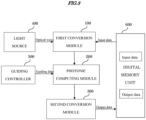
- Figure 3 illustrates another example of the system for data processing according to an embodiment of the present invention.
- This embodiment shares the same first conversion module 100, photonic computing module 200, and second conversion module 300 as the embodiment shown in Figure 2 .
- the system in this embodiment further includes a light source 400, a guiding controller 500, and a digital memory unit 600.
- the light source 400 generates optical waves
- the first conversion module 100 carries the input data onto the optical waves to generate the optical signals.
- the first conversion module 100 can convert the input data into analog input signals by using a digital-to-analog converter, then modulate the optical waves based on the analog input signals by using an optical modulator to generate the optical signals.
- the optical signals are then provided to the photonic computing module 200.
- the guiding controller 500 provides guiding data to the photonic computing module 200.
- the guiding data includes the weight matrix.
- the photonic computing module performs guidance by further modulating the optical signals based on the guiding transformation determined by the weights of the matrix, resulting in the guided optical signals.
- the guiding transformation involves performing matrix-vector multiplication using the optical signal and the weight matrix in the photonic computing module 200.
- the second conversion module 300 converts the guided optical signals into digital output data, for example, by converting the guided optical signals into analog output signals via a photoelectric converter, and then converting the analog output signals into digital output data via an analog-to-digital converter.
- the output data and input data are stored in the digital memory unit 600, and the output data can be provided as input data to the first conversion module 100, enabling iterative loop processing. This allows the output data to converge towards the desired solution for the problem determined by the weight matrix.
- the output data and the input data can be stored in different storage units.
- the digital memory unit includes one of floppy disks, hard drives, random-access memory (RAM), read-only memory (ROM), erasable programmable read-only memory (EPROM or flash memory), compact disc read-only memory (CD-ROM), and optical storage devices, or any suitable combination thereof.
- the problem to be solved by the data processing is determined using the weight matrix; the initial input data of the first conversion module 100 includes an initial approximate solution to the problem; and the output data of the second conversion module 300 includes an updated approximate solution to the problem.
- the processing executed by the first conversion module 100, the photonic computing module 200, and the second conversion module 300 is performed in a loop, wherein the digital memory unit 600 uses the output data from the previous cycle as the input data for the current cycle. Each cycle's output data is stored in the digital memory unit 600 to form a data sequence, which represents a series of updated approximate solutions to the problem.
- the problem determined by the weight matrix includes any one or combination of in the following: data clustering, labeling, classification, and semantic segmentation.
- the initial input data includes a plurality of vectors with numerical components that determine cluster assignments, data labels, data classes, and semantic data segments by performing clustering, labeling, classification, and/or semantic segmentation on the numerical components.
- Figure 4 shows yet another example of the system for data processing according to an embodiment of the present invention.
- the system at least includes a digital memory unit 101, a digital-to-analog converter (DAC) 102, a light source 103, a modulator 104, a photonic computing module 105, a photodetector (PD) 106, an analog-to-digital converter (ADC) 107, and a guiding controller 108.
- the DAC 102 and the modulator 104 can realize the functionality of the first conversion module described in the previous embodiments, while the photodetector 106 and the ADC 107 can perform the functions of the second conversion module described above. Below is a detailed description of the connections or coordination between the various components and the processing performed by each.
- the digital memory unit 101 stores the input data, which may include an initial approximate solution to the problem determined by the weight matrix.
- the DAC 102 is in operational communication with the digital memory unit 101, and converts the input data into analog input signals.
- the light source 103 is configured to generate optical waves.
- the light source 103 includes a laser.
- the modulator 104 is in optical communication with the light source 103 and in electronic communication with the DAC 102.
- the modulator 104 modulates the optical waves based on the analog input signals provided by the DAC 102 to generate modulated optical waves that carry the input data.
- the modulated optical waves serve as the optical signals carrying the input data.
- the photonic computing module 105 is in operational communication with the guiding controller 108 and in optical communication with the modulator 104.
- the photonic computing module 105 includes a plurality of photonic multipliers and is used to guide the modulated optical waves to generate guided optical waves based on the guiding data provided by the guiding controller 108.
- the guiding data includes the weight matrix
- the photonic computing module 105 guides the modulated optical waves by further modulating them based on the guiding transformation determined by the weights of the matrix.
- the guiding transformation may involve using the photonic multipliers to perform matrix-vector multiplication between the modulated optical waves and the weight matrix, resulting in guided optical waves.
- the photodetector (PD) 106 is in optical communication with the photonic computing module 105 and used for converting the guided optical waves into analog output signals that carries the result data from the matrix-vector multiplication.
- the analog-to-digital converter (ADC) 107 is in electronic communication with the photodetector 106 and converts the analog output signals into digital output signals, i.e., the output data.
- the ADC 107 is also in electronic communication with the digital memory unit 101 to store the output data in the digital memory unit 101.
- the ADC 107 has a threshold to produce binary output, such as by combining with a thresholding unit to threshold the analog output signal into a digital output signal composed of binary signals (0s and 1s).
- the processing performed by the system is executed in a loop.
- the digital memory unit 101 is operated to use the output data from the previous cycle to form input data for the current cycle, and store each cycle's output data in a data sequence.
- This data sequence approximates at least one solution to the problem determined by the weight matrix.
- the problem determined by the weight matrix includes any one or a combination of in the following: data clustering, labeling, classification, and semantic segmentation.
- the initial input data includes a plurality of vectors with numerical components, which is used to determine cluster assignments, data labels, data classes, and semantic data segments by performing clustering, labeling, classification, and/or semantic segmentation on the numerical components.
- the data sequence becomes a series of updated approximate solutions to any one or a combination of problems in data clustering, labeling, classification, and semantic segmentation.
- the system not only improves computation speed by performing matrix-vector operations using photonic multipliers but also enhances data transmission speed through optical data transmission using optical communication. Therefore, the system significantly reduces the computation time and energy consumption required for solving problems related to data clustering, labeling, classification, and semantic segmentation.
- matrix-vector operations using photonic multipliers alone can be used to reduce computation time and energy consumption for solving data clustering, labeling, classification, and semantic segmentation problems.
- only optical data transmission can be employed to achieve the same reductions in computation time and energy consumption for such problems.
- Figure 5 illustrates a method for data processing according to another embodiment of the present invention. As shown in Figure 5 , the method includes the following processes:
- the initial input data includes an initial approximate solution to the problem determined by the weight matrix.
- the output data includes an updated approximate solution to the problem.
- the initial input data comprises a plurality of vectors with numerical components, which are used to determine cluster assignments, data labels, data classes, and semantic data segments by performing clustering, labeling, classification, and/or semantic segmentation on the numerical components.
- the multiplication is performed by the electronic multipliers in a loop, with the output data from the previous cycle serving as the input data for the current cycle. Wherein the output data from each cycle forms a data sequence representing a series of updated approximate solutions to the problem determined by the weight matrix.
- the problem determined by the weight matrix includes one or a combination of in the following: data clustering, labeling, classification, and semantic segmentation.
- the data sequence represents a series of updated approximate solutions to any one or combination of these problems.
- the weight matrix is determined by a weighted graph.
- the vertices correspond to data points
- the edges correspond to weights that reflect the correlations or interconnections between data point pairs.
- the weights in the weighted graph are determined by mutual correspondence between data points and the goals of one or any combination of the following: data clustering, labeling, classification, and semantic segmentation.
- the corresponding weight is positive; if the adjacent data points are neutral or uncorrelated, the corresponding weight is zero; if the adjacent data points are repulsive or anticorrelated, the corresponding weight is negative.
- the multiple electronic multipliers communicate with each other through the optical network.
- the data transmission utilizes the optical network, specifically optical communication. This greatly reduces the time required for data transmission, thereby reducing the computational time and energy consumption for solving data clustering, labeling, classification, and semantic segmentation problems.
- FIGS. 6 to 8 illustrate different embodiments of a system for data processing according to the present invention that can execute the methods described in the above embodiments.
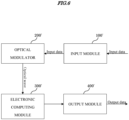
- Figure 6 shows an example of a system for data processing according to another embodiment of the present invention.
- the system includes an input module 100', an optical modulator 200', an electronic computing module 300', and an output module 400'.
- the input module 100' is used for inputting data, where "inputting” includes but is not limited to receiving, processing, transmitting, or forwarding data.
- the input data can be received, converted into analog input signals, and passed to the optical modulator 200'.
- the optical modulator 200' is used for carrying the input data onto optical waves, such as by modulating the optical waves based on the analog input signals.
- the system also includes a light source for generating the optical waves or an optical coupler for inputting the optical waves generated by an external light source.
- the input data carried by the optical waves is transmitted to the electronic computing module 300' via an optical network.
- a photoelectric converter such as a photodetector, is used to convert the optical waves into analog electrical signals, which are then digitized via analog-to-digital conversion to obtain digital input data.
- This digital input data is then passed to the electronic computing module 300'.
- the electronic computing module 300' comprises a plurality of electronic multipliers, and is configured to receive the input data carried by the optical waves via the optical network and perform a matrix-vector multiplication on the input data and a weight matrix using the plurality of electronic multipliers to, wherein the problem to be solved by the data processing is determined by the weight matrix.
- the output module 400' communicates with the electronic computing module 300' to output the result of the matrix-vector multiplication as output data.
- the output module 400' can communicate electronically with the electronic computing module 300' directly or communicate optically via an optical network.
- the data resulting from the multiplication may be converted into optical signals via digital-to-analog conversion and electro-optic modulation, and then transmitted through the optical network.
- they can be converted into digital output data through photoelectric and analog-to-digital conversions, and then output via the output module 400'.
- the optical modulator and the optical network can be configured within one or more photonic chips.
- one or more of the input module, the electronic multipliers, and the output module can be configured within one or more electronic chips.
- the electronic chips are mounted above or below the photonic chip, with the electronic chips communicating with each other via the optical network in the photonic chip. This allows for communication between the plurality of electronic multipliers via the optical network, further reducing data transmission time.
- the initial input data includes an initial approximate solution to the problem determined by the weight matrix
- the output data includes an updated approximate solution to the problem determined by the weight matrix.
- the problem determined by the weight matrix includes one or any combination of in the following: data clustering, labeling, classification, and semantic segmentation.
- the initial input data includes a plurality of vectors with numerical components, which is used to determine cluster assignments, data labels, data classes, and semantic data segments by performing clustering, labeling, classification, and/or semantic segmentation on the numerical components.
- FIG. 7 illustrates another example of a system for data processing according to another embodiment of the present invention.
- This embodiment has the same input module 100', optical modulator 200', electronic computing module 300', and output module 400' as the embodiment shown in Figure 6 .
- the difference is that this embodiment further includes a digital memory unit 500'.
- Identical modules or components serve the same functions, the following description primarily focuses on the differences between the two embodiments.
- the digital memory unit 500' is in communication with both the input module 100' and the output module 400', and used for storing both input data and output data.
- the output data and input data can be stored in different storage units.
- the digital memory unit 500' may include one or any combination of the following: floppy disks, hard disks, random access memory (RAM), read-only memory (ROM), erasable programmable read-only memory (EPROM or flash memory), compact disc read-only memory (CD-ROM), and optical storage devices.
- the electronic multipliers of the electronic computing module 300' perform the matrix-vector multiplication in a loop.
- the digital memory unit 500' is operated to use the output data from the previous cycle to form the input data for the current cycle.
- the output data from each cycle is stored in the digital memory unit 500' to form a data sequence, which is a series of updated approximate solutions to the problem determined by the weight matrix.
- the problem determined by the weight matrix includes any one or combination of in the following: data clustering, labeling, classification, or semantic segmentation.
- the initial input data includes a plurality of vectors with numerical components that determine cluster assignments, data labels, data classes, and semantic data segments by performing clustering, labeling, classification, and/or the semantic segmentation on the numerical components.
- the data sequence represents a series of updated approximate solutions to any one or combination of problems in data clustering, labeling, classification, or semantic segmentation.
- communication between the digital memory unit 500' and the input module 100' and/or output module 400' may be conducted via optical communication, meaning optical data transmission through an optical network.
- the output data from the output module 400' can be converted into optical signals via digital-to-analog conversion and electro-optic modulation.
- the optical signals carrying the output data are then propagated through the optical network.
- the optical signals can be converted into the output data through photoelectric and analog-to-digital conversions, and the output data can be stored in the digital memory unit 500'.
- the input data output by the digital memory unit 500' can be converted into optical signals through digital-to-analog conversion and electro-optic modulation.
- the optical signals carrying the input data are propagated through the optical network.
- the optical signals can be converted into the input data via photoelectric and analog-to-digital conversions and then the input data is sent to the input module 100'.
- one or more of the input module 100', electronic computing module 300', output module 400', and digital memory unit 500' may be configured in one or more electronic chips, while the optical modulator 200' and optical network may be configured in one or more photonic chips.
- the optical network may include the optical modulator 200'.
- FIG 8 illustrates yet another example of a system for data processing according to another embodiment of the present invention.
- the system includes two photonic chips 901 and 902, and eight electronic chips labeled A to H.
- the photonic chips 901 and 902 have an optical network, which may include optical waveguides, multiple optical modulators, and photodetectors to facilitate optical communication.
- the input module is configured in electronic chip A
- the digital memory unit is configured in electronic chip H
- the output module is configured in electronic chip G.
- Electronic chips B to F each include one or more electronic multipliers, corresponding to the electronic computing module.
- electronic chips A to D are mounted on photonic chip 901
- electronic chips E to H are mounted on photonic chip 902. Communication between photonic chip 901 and photonic chip 902 can be established through connecting optical fibers and corresponding optical couplers.
- An external light source generates optical waves that are coupled into the system through an optical coupler (not shown).
- Electronic chip A (with the input module) is in optical communication with electronic chip H (with the digital memory unit) via the optical network in photonic chips 901 and 902, as well as through the connecting optical fiber.
- the input data stored in electronic chip H is input to electronic chip A, and can be carried onto optical waves through modulation by optical modulators in photonic chip 901.
- the optical waves travel through the optical network in photonic chips 901 and 902 and the connecting optical fiber to electronic chips B to F (each containing electronic multipliers).
- Electronic chips B to F communicate with each other through the optical network, receive the input data carried by the optical waves, and perform a matrix-vector multiplication on the input data.
- the computation results are carried onto optical waves through modulation and transmitted through the optical network in photonic chips 901 and 902 and the connecting optical fiber to electronic chip G (with the output module).
- Electronic chip G organizes the computation results into output data, which is then carried onto optical waves through modulation and transmitted through the optical network in photonic chip 902 to electronic chip H (with the digital memory unit), where the output data is stored.
- the system can be configured so that electronic chips B to F communicate via the optical network to carry out matrix-vector multiplication, while the other electronic chips use electronic communication, still achieving the same benefits of reduced data transmission time, lower energy consumption, and faster processing speed.
- electronic chips B to F may communicate electronically for matrix-vector multiplication, while one or more other electronic chips use optical communication, which can still offer advantages over purely electronic processing in terms of speed and energy efficiency.
- the system utilizes eight electronic chips and two photonic chips.
- the invention is not limited to this configuration. Alternative embodiments may use one photonic chip, or three or more photonic chips. Similarly, fewer or more than eight electronic chips may be used for tasks such as data storage, input, computation, and/or output.
- embodiments achieve high bandwidth, low latency, low power consumption, high integration density, and strong electromagnetic interference resistance.
Landscapes
- Engineering & Computer Science (AREA)
- Physics & Mathematics (AREA)
- Theoretical Computer Science (AREA)
- General Physics & Mathematics (AREA)
- Mathematical Physics (AREA)
- Computing Systems (AREA)
- Pure & Applied Mathematics (AREA)
- Mathematical Analysis (AREA)
- Data Mining & Analysis (AREA)
- Software Systems (AREA)
- Mathematical Optimization (AREA)
- Computational Mathematics (AREA)
- Algebra (AREA)
- General Engineering & Computer Science (AREA)
- Databases & Information Systems (AREA)
- Medical Informatics (AREA)
- Evolutionary Computation (AREA)
- Computer Vision & Pattern Recognition (AREA)
- Artificial Intelligence (AREA)
- Optical Communication System (AREA)
Applications Claiming Priority (2)
| Application Number | Priority Date | Filing Date | Title |
|---|---|---|---|
| CN202210252872.1A CN116795171A (zh) | 2022-03-15 | 2022-03-15 | 数据处理方法及系统 |
| PCT/CN2023/079466 WO2023174072A1 (fr) | 2022-03-15 | 2023-03-03 | Procédé et système de traitement de données |
Publications (2)
| Publication Number | Publication Date |
|---|---|
| EP4495729A1 true EP4495729A1 (fr) | 2025-01-22 |
| EP4495729A4 EP4495729A4 (fr) | 2026-01-28 |
Family
ID=88022316
Family Applications (1)
| Application Number | Title | Priority Date | Filing Date |
|---|---|---|---|
| EP23769578.8A Pending EP4495729A4 (fr) | 2022-03-15 | 2023-03-03 | Procédé et système de traitement de données |
Country Status (4)
| Country | Link |
|---|---|
| US (1) | US20250199562A1 (fr) |
| EP (1) | EP4495729A4 (fr) |
| CN (1) | CN116795171A (fr) |
| WO (1) | WO2023174072A1 (fr) |
Families Citing this family (5)
| Publication number | Priority date | Publication date | Assignee | Title |
|---|---|---|---|---|
| CN120371079A (zh) * | 2024-01-23 | 2025-07-25 | 上海曦智科技有限公司 | 光计算方法、系统、程序产品及其存储介质 |
| CN117891023B (zh) * | 2024-03-15 | 2024-05-31 | 山东云海国创云计算装备产业创新中心有限公司 | 光子芯片、异构计算系统、精度调整方法及产品 |
| CN118394171B (zh) * | 2024-06-26 | 2024-10-29 | 光本位科技(苏州)有限公司 | 一种用于片上全光推理的光子计算阵列及方法 |
| CN121643889A (zh) * | 2024-08-29 | 2026-03-10 | 杭州光智元科技有限公司 | 计算系统及其调制器的校准方法 |
| CN120065431B (zh) * | 2025-04-25 | 2025-09-05 | 光本位智能科技(上海)有限公司 | 一种光计算模块及光计算阵列 |
Family Cites Families (5)
| Publication number | Priority date | Publication date | Assignee | Title |
|---|---|---|---|---|
| TWI852756B (zh) * | 2018-05-15 | 2024-08-11 | 美商萊特美特股份有限公司 | 光子處理系統及方法 |
| CN112424796B (zh) * | 2018-06-05 | 2026-01-30 | 光子智能私营科技有限公司 | 光电计算系统 |
| CN110503196A (zh) * | 2019-08-26 | 2019-11-26 | 光子算数(北京)科技有限责任公司 | 一种光子神经网络芯片以及数据处理系统 |
| CN111324858B (zh) * | 2020-03-20 | 2023-05-16 | 光子算数(北京)科技有限责任公司 | 一种卷积计算方法及卷积运算电路 |
| CN114037070A (zh) * | 2022-01-07 | 2022-02-11 | 苏州浪潮智能科技有限公司 | 光信号的处理方法、光子神经网络芯片及其设计方法 |
-
2022
- 2022-03-15 CN CN202210252872.1A patent/CN116795171A/zh active Pending
-
2023
- 2023-03-03 WO PCT/CN2023/079466 patent/WO2023174072A1/fr not_active Ceased
- 2023-03-03 EP EP23769578.8A patent/EP4495729A4/fr active Pending
- 2023-03-03 US US18/846,482 patent/US20250199562A1/en active Pending
Also Published As
| Publication number | Publication date |
|---|---|
| WO2023174072A1 (fr) | 2023-09-21 |
| CN116795171A (zh) | 2023-09-22 |
| US20250199562A1 (en) | 2025-06-19 |
| EP4495729A4 (fr) | 2026-01-28 |
Similar Documents
| Publication | Publication Date | Title |
|---|---|---|
| EP4495729A1 (fr) | Procédé et système de traitement de données | |
| US11704550B2 (en) | Optical convolutional neural network accelerator | |
| CN111753977B (zh) | 光学神经网络卷积层芯片、卷积计算方法和电子设备 | |
| US11373089B2 (en) | Serialized electro-optic neural network using optical weights encoding | |
| US12039433B2 (en) | Optical multiply and accumulate unit | |
| US20260005769A1 (en) | Signal modulation method, chip and system, device, and storage medium | |
| CN119558369B (zh) | 三维异质集成光计算芯片 | |
| CN116704319A (zh) | 一种由mzi级联阵列光计算芯片与fpga组成用于人脸识别的方法及光电混合系统 | |
| CN119721154B (zh) | 一种基于mzi级联网络的大模型计算装置及方法 | |
| CN109719732B (zh) | 基于光神经网络的机器人系统 | |
| CN118821880A (zh) | 光学系统、数据处理方法和计算系统 | |
| CN116384459B (zh) | 对象识别装置以及对象识别方法 | |
| CN116107037A (zh) | 密集波导阵列的片上光学器件光计算网络结构 | |
| WO2023230764A1 (fr) | Système de calcul optique et puce | |
| CN115759222B (zh) | 一种基于多任务神经网络的光子神经网络系统 | |
| Afifi et al. | A light-speed large language model accelerator with optical stochastic computing | |
| US12298801B2 (en) | Method and system for determining a guided random data sampling | |
| Frietman et al. | An electro-optic data communication system for the Delft parallel processor | |
| Jackson | Photonic processors: a systems approach | |
| CN120781896A (zh) | 一种基于光计算的神经网络加速器 | |
| Zhu et al. | Research on distributed cooperative silicon based photonic computing chip | |
| Peserico et al. | Design and Testing of Integrated 4F System into Silicon Photonics Chip for Convolutional Neural Network | |
| Gu et al. | Optical computing architecture based on arrayed waveguide grating routers and convolution acceleration application in ResNet-50 | |
| Zhang et al. | Research on photonic neural network and high-precision image recognition technology | |
| CN121902888A (zh) | 光电融合卷积计算系统及方法 |
Legal Events
| Date | Code | Title | Description |
|---|---|---|---|
| STAA | Information on the status of an ep patent application or granted ep patent |
Free format text: STATUS: THE INTERNATIONAL PUBLICATION HAS BEEN MADE |
|
| PUAI | Public reference made under article 153(3) epc to a published international application that has entered the european phase |
Free format text: ORIGINAL CODE: 0009012 |
|
| STAA | Information on the status of an ep patent application or granted ep patent |
Free format text: STATUS: REQUEST FOR EXAMINATION WAS MADE |
|
| 17P | Request for examination filed |
Effective date: 20241014 |
|
| AK | Designated contracting states |
Kind code of ref document: A1 Designated state(s): AL AT BE BG CH CY CZ DE DK EE ES FI FR GB GR HR HU IE IS IT LI LT LU LV MC ME MK MT NL NO PL PT RO RS SE SI SK SM TR |
|
| DAV | Request for validation of the european patent (deleted) | ||
| DAX | Request for extension of the european patent (deleted) | ||
| A4 | Supplementary search report drawn up and despatched |
Effective date: 20260107 |
|
| RIC1 | Information provided on ipc code assigned before grant |
Ipc: G06E 3/00 20060101AFI20251222BHEP Ipc: G06N 20/00 20190101ALI20251222BHEP |