EP4496036A1 - Procédé de production d'un matériau actif à base de soufre - Google Patents
Procédé de production d'un matériau actif à base de soufre Download PDFInfo
- Publication number
- EP4496036A1 EP4496036A1 EP23779868.1A EP23779868A EP4496036A1 EP 4496036 A1 EP4496036 A1 EP 4496036A1 EP 23779868 A EP23779868 A EP 23779868A EP 4496036 A1 EP4496036 A1 EP 4496036A1
- Authority
- EP
- European Patent Office
- Prior art keywords
- iron
- sulfur
- group
- less
- active material
- Prior art date
- Legal status (The legal status is an assumption and is not a legal conclusion. Google has not performed a legal analysis and makes no representation as to the accuracy of the status listed.)
- Pending
Links
Images
Classifications
-
- H—ELECTRICITY
- H01—ELECTRIC ELEMENTS
- H01M—PROCESSES OR MEANS, e.g. BATTERIES, FOR THE DIRECT CONVERSION OF CHEMICAL ENERGY INTO ELECTRICAL ENERGY
- H01M4/00—Electrodes
- H01M4/02—Electrodes composed of, or comprising, active material
- H01M4/36—Selection of substances as active materials, active masses, active liquids
- H01M4/58—Selection of substances as active materials, active masses, active liquids of inorganic compounds other than oxides or hydroxides, e.g. sulfides, selenides, tellurides, halogenides or LiCoFy; of polyanionic structures, e.g. phosphates, silicates or borates
- H01M4/581—Chalcogenides or intercalation compounds thereof
- H01M4/5815—Sulfides
-
- C—CHEMISTRY; METALLURGY
- C01—INORGANIC CHEMISTRY
- C01G—COMPOUNDS CONTAINING METALS NOT COVERED BY SUBCLASSES C01D OR C01F
- C01G49/00—Compounds of iron
- C01G49/009—Compounds containing iron, with or without oxygen or hydrogen, and containing two or more other elements
-
- C—CHEMISTRY; METALLURGY
- C01—INORGANIC CHEMISTRY
- C01G—COMPOUNDS CONTAINING METALS NOT COVERED BY SUBCLASSES C01D OR C01F
- C01G49/00—Compounds of iron
- C01G49/12—Sulfides
-
- H—ELECTRICITY
- H01—ELECTRIC ELEMENTS
- H01G—CAPACITORS; CAPACITORS, RECTIFIERS, DETECTORS, SWITCHING DEVICES, LIGHT-SENSITIVE OR TEMPERATURE-SENSITIVE DEVICES OF THE ELECTROLYTIC TYPE
- H01G11/00—Hybrid capacitors, i.e. capacitors having different positive and negative electrodes; Electric double-layer [EDL] capacitors; Processes for the manufacture thereof or of parts thereof
- H01G11/22—Electrodes
- H01G11/30—Electrodes characterised by their material
- H01G11/50—Electrodes characterised by their material specially adapted for lithium-ion capacitors, e.g. for lithium-doping or for intercalation
-
- H—ELECTRICITY
- H01—ELECTRIC ELEMENTS
- H01M—PROCESSES OR MEANS, e.g. BATTERIES, FOR THE DIRECT CONVERSION OF CHEMICAL ENERGY INTO ELECTRICAL ENERGY
- H01M10/00—Secondary cells; Manufacture thereof
- H01M10/05—Accumulators with non-aqueous electrolyte
- H01M10/052—Li-accumulators
-
- H—ELECTRICITY
- H01—ELECTRIC ELEMENTS
- H01M—PROCESSES OR MEANS, e.g. BATTERIES, FOR THE DIRECT CONVERSION OF CHEMICAL ENERGY INTO ELECTRICAL ENERGY
- H01M10/00—Secondary cells; Manufacture thereof
- H01M10/05—Accumulators with non-aqueous electrolyte
- H01M10/052—Li-accumulators
- H01M10/0525—Rocking-chair batteries, i.e. batteries with lithium insertion or intercalation in both electrodes; Lithium-ion batteries
-
- H—ELECTRICITY
- H01—ELECTRIC ELEMENTS
- H01M—PROCESSES OR MEANS, e.g. BATTERIES, FOR THE DIRECT CONVERSION OF CHEMICAL ENERGY INTO ELECTRICAL ENERGY
- H01M4/00—Electrodes
- H01M4/02—Electrodes composed of, or comprising, active material
- H01M4/04—Processes of manufacture in general
- H01M4/0471—Processes of manufacture in general involving thermal treatment, e.g. firing, sintering, backing particulate active material, thermal decomposition, pyrolysis
-
- H—ELECTRICITY
- H01—ELECTRIC ELEMENTS
- H01M—PROCESSES OR MEANS, e.g. BATTERIES, FOR THE DIRECT CONVERSION OF CHEMICAL ENERGY INTO ELECTRICAL ENERGY
- H01M4/00—Electrodes
- H01M4/02—Electrodes composed of, or comprising, active material
- H01M4/13—Electrodes for accumulators with non-aqueous electrolyte, e.g. for lithium-accumulators; Processes of manufacture thereof
- H01M4/136—Electrodes based on inorganic compounds other than oxides or hydroxides, e.g. sulfides, selenides, tellurides, halogenides or LiCoFy
-
- H—ELECTRICITY
- H01—ELECTRIC ELEMENTS
- H01M—PROCESSES OR MEANS, e.g. BATTERIES, FOR THE DIRECT CONVERSION OF CHEMICAL ENERGY INTO ELECTRICAL ENERGY
- H01M4/00—Electrodes
- H01M4/02—Electrodes composed of, or comprising, active material
- H01M4/13—Electrodes for accumulators with non-aqueous electrolyte, e.g. for lithium-accumulators; Processes of manufacture thereof
- H01M4/139—Processes of manufacture
- H01M4/1397—Processes of manufacture of electrodes based on inorganic compounds other than oxides or hydroxides, e.g. sulfides, selenides, tellurides, halogenides or LiCoFy
-
- H—ELECTRICITY
- H01—ELECTRIC ELEMENTS
- H01M—PROCESSES OR MEANS, e.g. BATTERIES, FOR THE DIRECT CONVERSION OF CHEMICAL ENERGY INTO ELECTRICAL ENERGY
- H01M4/00—Electrodes
- H01M4/02—Electrodes composed of, or comprising, active material
- H01M4/36—Selection of substances as active materials, active masses, active liquids
-
- H—ELECTRICITY
- H01—ELECTRIC ELEMENTS
- H01M—PROCESSES OR MEANS, e.g. BATTERIES, FOR THE DIRECT CONVERSION OF CHEMICAL ENERGY INTO ELECTRICAL ENERGY
- H01M4/00—Electrodes
- H01M4/02—Electrodes composed of, or comprising, active material
- H01M4/36—Selection of substances as active materials, active masses, active liquids
- H01M4/362—Composites
- H01M4/364—Composites as mixtures
-
- H—ELECTRICITY
- H01—ELECTRIC ELEMENTS
- H01M—PROCESSES OR MEANS, e.g. BATTERIES, FOR THE DIRECT CONVERSION OF CHEMICAL ENERGY INTO ELECTRICAL ENERGY
- H01M4/00—Electrodes
- H01M4/02—Electrodes composed of, or comprising, active material
- H01M4/36—Selection of substances as active materials, active masses, active liquids
- H01M4/38—Selection of substances as active materials, active masses, active liquids of elements or alloys
-
- H—ELECTRICITY
- H01—ELECTRIC ELEMENTS
- H01M—PROCESSES OR MEANS, e.g. BATTERIES, FOR THE DIRECT CONVERSION OF CHEMICAL ENERGY INTO ELECTRICAL ENERGY
- H01M4/00—Electrodes
- H01M4/02—Electrodes composed of, or comprising, active material
- H01M4/36—Selection of substances as active materials, active masses, active liquids
- H01M4/58—Selection of substances as active materials, active masses, active liquids of inorganic compounds other than oxides or hydroxides, e.g. sulfides, selenides, tellurides, halogenides or LiCoFy; of polyanionic structures, e.g. phosphates, silicates or borates
-
- H—ELECTRICITY
- H01—ELECTRIC ELEMENTS
- H01M—PROCESSES OR MEANS, e.g. BATTERIES, FOR THE DIRECT CONVERSION OF CHEMICAL ENERGY INTO ELECTRICAL ENERGY
- H01M4/00—Electrodes
- H01M4/02—Electrodes composed of, or comprising, active material
- H01M4/62—Selection of inactive substances as ingredients for active masses, e.g. binders, fillers
-
- H—ELECTRICITY
- H01—ELECTRIC ELEMENTS
- H01M—PROCESSES OR MEANS, e.g. BATTERIES, FOR THE DIRECT CONVERSION OF CHEMICAL ENERGY INTO ELECTRICAL ENERGY
- H01M4/00—Electrodes
- H01M4/02—Electrodes composed of, or comprising, active material
- H01M4/62—Selection of inactive substances as ingredients for active masses, e.g. binders, fillers
- H01M4/621—Binders
- H01M4/622—Binders being polymers
-
- Y—GENERAL TAGGING OF NEW TECHNOLOGICAL DEVELOPMENTS; GENERAL TAGGING OF CROSS-SECTIONAL TECHNOLOGIES SPANNING OVER SEVERAL SECTIONS OF THE IPC; TECHNICAL SUBJECTS COVERED BY FORMER USPC CROSS-REFERENCE ART COLLECTIONS [XRACs] AND DIGESTS
- Y02—TECHNOLOGIES OR APPLICATIONS FOR MITIGATION OR ADAPTATION AGAINST CLIMATE CHANGE
- Y02E—REDUCTION OF GREENHOUSE GAS [GHG] EMISSIONS, RELATED TO ENERGY GENERATION, TRANSMISSION OR DISTRIBUTION
- Y02E60/00—Enabling technologies; Technologies with a potential or indirect contribution to GHG emissions mitigation
- Y02E60/10—Energy storage using batteries
Definitions
- the present invention relates to a method of producing a sulfur-based active material.
- the lithium-ion secondary battery has been mainly used as a battery for portable electronic device because of its large charge and discharge capacity.
- the lithium-ion secondary battery has been used more and more as a battery for electric vehicle as well, and expected to have improved performance.
- Patent Document 1 describes a positive electrode active material for lithium-ion secondary battery, which is obtained by heating a base powder comprising a sulfur powder and a polyacrylonitrile powder under a non-oxidizing atmosphere.
- Patent Document 2 aims to provide a positive electrode active material at a low cost by using an industrial rubber.
- a general sulfur-based active material often uses excess sulfur as raw materials, which caused a problem that an unreacted sulfur or a low molecular sulfur compound remained in the material after heat treatment.
- This unreacted sulfur which is an insulating material, becomes an impurity in a battery, and the low molecular sulfur compound is subjected to a large deterioration with cycles.
- a step of removing the unreacted sulfur and the low molecular sulfur compound a so-called desulfurizing step was required. Then, since this desulfurizing step requires a high temperature, it had a problem of having disadvantages in terms of energy and cost.
- the present invention relates to a method of producing a sulfur-based active material, the method comprising the steps of:
- a method of producing a sulfur-based active material by which method a sulfur-based active material having improved cycle characteristics is obtained can be provided, despite that the heating history is once. That is, in the present invention, for a sulfur-based active material prepared by adding an iron complex to an acryl-based polymer and sulfur and heat-treating them, a material having good cycle characteristics can be obtained without performing a step of removing an unreacted sulfur or a low molecular sulfur compound. Therefore, the heating history requires only one heat treatment, so that it is advantageous in terms of cost and energy.
- cycle characteristics refers to characteristics in which charge and discharge capacity of a secondary battery is maintained despite repeated charging and discharging. Therefore, as charging and discharging are repeated, a secondary battery with a high degree of decrease in charge and discharge capacity and a low capacity retention rate has poor cycle characteristics, while, on the contrary, a secondary battery with a low degree of decrease in charge and discharge capacity and a high capacity retention rate has excellent cycle characteristics.
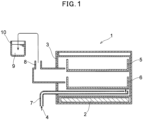
- FIG. 1 is a cross-sectional view schematically showing a reaction device used for producing a sulfur-based active material in Examples of the present invention.
- One embodiment of the present invention is a method of producing a sulfur-based active material, the method comprising the steps of: (1) mixing an acrylic resin, sulfur, and an iron compound comprising a divalent or trivalent iron ion to obtain a baking raw material; and (2) baking the baking raw material, wherein a heating history to which the baking raw material is subjected is once.
- a content of the iron compound comprising a divalent or trivalent iron ion in the baking raw material is preferably 10 parts by mass or more and 300 parts by mass or less based on 100 parts by mass of the acrylic resin.
- the step (1) preferably comprises the substep of mixing the acrylic resin, the sulfur, and the iron compound comprising a divalent or trivalent iron ion in powder state.
- the baking temperature in the step (2) is preferably higher than 250°C and lower than 500°C.
- the baking temperature in the step (2) is preferably higher than the temperature at which the iron compound comprising a divalent or trivalent iron ion thermally decomposes.
- a ratio of an amount of the sulfur to a total amount of the acrylic resin and the iron compound in the baking raw material is preferably 1.5 or more and 5.0 or less in parts by mass ratio.
- the acrylic resin is preferably at least one polymer selected from the group consisting of: a polymer obtained by polymerizing at least one monomer selected from the group consisting of acrylate compounds represented by the following formula (1); or a polymer obtained by polymerizing at least one monomer selected from the group consisting of acrylate compounds represented by the following formula (1) and at least one monomer selected from the group consisting of diacrylate compounds represented by the following formula (2).
- Y is a linear hydrocarbylene group, which may have at least one substituent selected from the group consisting of a hydroxyl group and an alkyl group, and a carbon skeleton constituting the hydrocarbylene group may have an ether bond with an oxygen atom provided that when there are two or more of the ether bonds, any adjacent oxygen atoms always have two or more intervening carbon atoms between them.
- R 12 is an alkyl group having 1 or more and 6 or less carbon atoms
- Y is a linear hydrocarbylene group having 2 or more and 6 or less carbon atoms
- the number of substituents is 1 or more and 4 or less
- the number of carbon atoms of the alkyl group that is a substituent is 1 or more and 4 or less
- the number of ether bonds which the carbon skeleton constituting the hydrocarbylene group has is 1 or more and 2 or less.
- the iron compound is preferably one or more compounds selected from the group consisting of a salt of iron acid and an iron complex.
- the iron compound is preferably one or more compounds selected from the group consisting of an organic acid salt of iron, an inorganic acid salt of iron, a neutral iron complex, and an iron complex salt.
- the iron compound is preferably one or more compounds selected from the group consisting of iron (II) oxalate, iron (II) acetate, iron (III) nitrate, and ferrocene.
- a temperature in the heating history is preferably higher than 100°C.
- Another embodiment of the present invention is a method of producing an electrode, the method further comprising, after producing a sulfur-based active material by the method of producing a sulfur-based active material, the step of (3) producing an electrode using the sulfur-based active material by a conventional method.
- Another embodiment of the present invention is a method of producing a lithium-ion secondary battery, the method further comprising, after producing an electrode by the method of producing an electrode, the method of (4) producing a lithium-ion secondary battery using the sulfur-based active material by a conventional method.
- the acrylic resin is at least one polymer selected from the group consisting of: a polymer obtained by polymerizing at least one monomer selected from the group consisting of acrylate compounds represented by the following formula (1); or a polymer obtained by polymerizing at least one monomer selected from the group consisting of acrylate compounds represented by the following formula (1) and at least one monomer selected from the group consisting of diacrylate compounds represented by the following formula (2).
- CH 2 C (R 11 ) COOR 12 (1) (wherein, R 11 is a hydrogen atom or a methyl group, and R 12 is an alkyl group.)
- R 21 and R 22 are the same or different and are each a hydrogen atom or a methyl group
- Y is a linear hydrocarbylene group, which may have at least one substituent selected from the group consisting of a hydroxyl group and an alkyl group, and a carbon skeleton constituting the hydrocarbylene group may have an ether bond with an oxygen atom provided that when there are two or more of the ether bonds, any adjacent oxygen atoms always have two or more intervening carbon atoms between them.
- R 11 is preferably a methyl group
- R 12 is preferably an alkyl group having 1 or more and 6 or less carbon atoms, more preferably an alkyl group having 1 or more and 4 or less carbon atoms, and among them, more preferably a methyl group, n-butyl, i-butyl, or t-butyl group.
- Examples of the compound represented by the formula (1) include, for example, methyl (meth)acrylate, butyl (meth)acrylate, and the like, more preferably methyl methacrylate and butyl methacrylate.
- (meth)acrylate of methyl (meth)acrylate and butyl (meth)acrylate represents either “acrylate” or “methacrylate” (the same shall apply hereinafter).
- a further preferred example of the compound represented by the formula (1) is butyl methacrylate.
- both R 21 and R 22 are preferably methyl groups.
- the number of carbon atoms in the hydrocarbylene group (straight chain) of Y is preferably 2 or more and 6 or less, more preferably 2 or 3.
- the number of substituents in Y is preferably 1 or more and 4 or less, more preferably 1 or 2.
- substituents in Y one or more substituents selected from the group consisting of a hydroxyl group and an alkyl group having 1 or more and 4 or less carbon atoms are preferable, and as the alkyl group having 1 or more and 4 or less carbon atoms, a methyl group is preferable.
- the acrylic resin is preferably in a form of a fine particle.
- the fine particle refers to a particle having a particle size of less than 300.0 ⁇ m.
- the particle size is preferably less than 270.0 ⁇ m, more preferably less than 200.0 ⁇ m, further preferably less than 100.0 ⁇ m, further preferably less than 50.0 ⁇ m, further preferably less than 20.0 ⁇ m, further preferably less than 15.0 ⁇ m, further preferably less than 13.0 ⁇ m, further preferably less than 10.0 ⁇ m, further preferably less than 6.0 ⁇ m.
- a lower limit of the particle size is, but not particularly limited to, usually, for example, greater than 0.1 ⁇ m, preferably greater than 1.0 ⁇ m.
- the particle size is a value measured by a precision particle size distribution measuring device, Multisizer 3, manufactured by Beckman Coulter, Inc.
- the acrylic resin may be a spherical fine particle or a porous fine particle.
- its oil absorption amount is preferably greater than 100 mL/100 g, more preferably greater than 110 mL/100 g, further preferably greater than 120 mL/100 g, further preferably greater than 130 mL/100 g, further preferably greater than 140 mL/100 g.
- the oil absorption amount is a value measured according to JIS K 5101-13-2:2004. More specifically, it can be measured by the method described in Paragraph 0069 of JP 2017-88501 A .
- the acrylic resin is commercially available or can be produced by a conventional method within the scope of knowledge of those skilled in the art.
- Examples of the commercially available acrylic resin include, for example, those manufactured by Sekisui Kasei Co., Ltd.
- sulfur any of those in various forms such as a powdered sulfur, an insoluble sulfur, a precipitated sulfur, a colloidal sulfur, and the like can be used. Among them, a precipitated sulfur and a colloidal sulfur are preferable.
- a ratio of an amount of sulfur to a total amount of an acrylic resin and an iron compound in a baking raw material is preferably 1.5 or more and 5.0 or less in parts by mass ratio from the viewpoint of effects of the present invention.
- the ratio is more preferably 2.0 or more, further preferably 2.5 or more, further preferably greater than 2.5, further preferably greater than 2.6, further preferably greater than 2.7, further preferably greater than 2.8, further preferably greater than 2.9.
- the ratio is more preferably less than 4.0, further preferably 3.5 or less, further preferably less than 3.4, further preferably less than 3.3, further preferably less than 3.2, further preferably less than 3.1.
- the content of sulfur is preferably 50 parts by mass or more, more preferably 100 parts by mass or more, further preferably 300 parts by mass or more, further preferably greater than 400 parts by mass, further preferably 500 parts by mass or more, further preferably greater than 500 parts by mass, based on 100 parts by mass of the acrylic resin.
- the content is 50 parts by mass or more, there is a tendency that charge and discharge capacity and cycle characteristics can be improved.
- there is no particular upper limit of the content of sulfur but it is usually less than 1000 parts by mass, preferably less than 900 parts by mass, further preferably less than 800 parts by mass, further preferably less than 700 parts by mass.
- the content is less than 1000 parts by mass, there is a tendency to be advantageous in terms of cost.
- any of various allotropes can be used, but those comprising S 8 sulfur which is solid at normal temperature and pressure are preferable, and S 8 sulfur alone is more preferable.
- iron compound comprising a divalent or trivalent iron ion
- organic acid salt of iron examples include, for example, a salt of divalent iron (Fe 2+ ) and organic acid, a salt of trivalent iron (Fe 3+ ) and organic acid, and the like. Among them, a salt of divalent iron and organic acid is preferable.
- the organic acid is, but not particularly limited to, one having a carboxyl group (-COOH), one having a sulfo group (-SO 3 H), or the like. Among them, one having a carboxyl group is preferable.
- Specific examples of the organic acid include fatty acid, oxalic acid, tartaric acid, citric acid, malic acid, succinic acid, and the like.
- fatty acid examples include, for example, those having 1 or more and 6 or less carbon atoms such as acetic acid, propionic acid, butyric acid, and the like. Among them, acetic acid, oxalic acid, and the like are preferable.
- Preferred examples of the organic acid salt of iron include iron (II) acetate, iron (II) oxalate, and the like. They may be hydrates. One or more kinds of organic acid salts of iron can be used.
- the inorganic acid salt of iron examples include, for example, a salt of divalent iron (Fe 2+ ) and inorganic acid, a salt of trivalent iron (Fe 3+ ) and inorganic acid, and the like. Among them, a salt of trivalent iron and inorganic acid is preferable.
- Specific examples of the inorganic acid include hydrochloric acid, sulfuric acid, nitric acid, and the like. Among them, nitric acid and the like are preferable.
- inorganic acid salt of iron examples include iron (II) chloride, iron (III) chloride, iron (II) sulfate, iron (III) sulfate, iron (II) nitrate, iron (III) nitrate, and the like. They may be hydrates. One or more kinds of inorganic acid salts of iron can be used.
- the iron complex examples include, for example, a divalent iron (Fe 2+ ) complex, a trivalent iron (Fe 3+ ) complex, and the like.
- the iron complex may be in a form of a neutral complex or in a form of a complex salt.
- a ligand that coordinates to the iron ion is not particularly limited, examples of which include, for example, halogen atoms such as a chlorine atom, a bromine atom, and the like, a cyano group, a dicyclopentadienyl group, N,N'-bis(salicylidene)ethylenediamine, and the like.
- iron complex examples include, for example, potassium hexacyanidoferrate(II) ([Fe(CN) 6 ]K 4 ), potassium hexacyanidoferrate(III) ([Fe(CN) 6 ]K 3 ), sodium iron(III) chloride ([FeCl 4 ]Na), dicyclopentadienyl iron(II) (ferrocene), N,N'-bis(salicylidene)ethylene diaminato iron(III) chloride, and the like.
- One or more kinds of iron complexes can be used.
- the iron compound comprising a divalent or trivalent iron ion
- at least one selected from the group consisting of the above-described organic acid salt of iron, inorganic acid salt of iron, neutral iron complex, and iron complex salt can be used.
- the organic acid salt of iron, the inorganic acid salt of iron, or the neutral iron complex is preferable.
- a content of the iron compound comprising a divalent or trivalent iron ion is preferably 10 parts by mass or more and 300 parts by mass or less based on 100 parts by mass of the acrylic resin, from the viewpoint of the effects of the present invention.
- the content is more preferably 20 parts by mass or more, further preferably greater than 20 parts by mass, further preferably greater than 30 parts by mass, further preferably greater than 40 parts by mass, further preferably 50 parts by mass or more, further preferably greater than 60 parts by mass, further preferably greater than 70 parts by mass, further preferably greater than 75 parts by mass.
- the content is preferably less than 300 parts by mass, more preferably less than 250 parts by mass, further preferably less than 200 parts by mass, further preferably less than 150 parts by mass, further preferably 100 parts by mass or less.
- the baking raw material may comprise a conductive carbon material. This is because that it can improve conductivity of the sulfur-based active material.
- a conductive carbon material a carbon material having a graphite structure is preferable.
- the carbon material those having a condensed aromatic ring structure such as, for example, carbon black, acetylene black, ketjen black, graphite, a carbon nanotube (CNT), a carbon fiber (CF), graphene, fullerene, and the like can be used.
- One or more kinds of conductive carbon materials can be used.
- acetylene black, carbon black, and ketjen black are preferable because they are inexpensive and excellent in dispersibility.
- a small amount of CNT, graphene, or the like may be used in combination with acetylene black, carbon black, or ketjen black.
- the combined amount of CNT or graphene is preferably 8% by mass or more, more preferably greater than 8% by mass, while preferably 12% by mass or less, more preferably less than 12% by mass, of a total amount of conductive carbon materials.
- the sulfur-based active material can be produced by baking a baking raw material obtained by mixing an acrylic resin, sulfur, and an iron compound comprising a divalent or trivalent iron ion.
- the step (1) is a step of mixing an acrylic resin, sulfur, and an iron compound comprising a divalent or trivalent iron ion to obtain a baking raw material for baking.
- the mixing is not particularly limited as long as these components are sufficiently mixed, but in the present invention, examples of a preferred mixing method can at least include mixing by a WET method with a solvent or mixing by a DRY method without a solvent, which will be mentioned below.
- the WET method comprises, for preparation of a baking raw material, the substeps of:
- the method of adding the acrylic resin and the iron compound comprising a divalent or trivalent iron ion to the organic solvent is not particularly limited as long as the liquid mixture can be obtained by mixing them.
- the acrylic resin and the iron compound comprising a divalent or trivalent iron ion may be simultaneously added to the organic solvent and mixed, (2) the acrylic resin may be added to the organic solvent and mixed, and then the iron compound comprising a divalent or trivalent iron ion may be further added and mixed, or (3) the iron compound comprising a divalent or trivalent iron ion may be added to the organic solvent and mixed, and then the acrylic resin may be further added and mixed.
- an organic solvent commonly used in this field can be used, examples of which include, for example, N-methyl-2-pyrrolidone, N,N-dimethylformaldehyde, alcohol, hexane, water, acetone, ethers such as tetrahydrofuran, etc., and the like.
- the organic solvent one that dissolves the acrylic resin is preferable. This is because it contributes to a good mixing.
- One or more kinds of these solvents can be used.
- the mixing of the acrylic resin and/or the iron compound comprising a divalent or trivalent iron ion with the organic solvent can be performed by stirring them in a container such as, for example, a beaker and the like.
- the removal of the organic solvent can be performed by a conventional method, by a method involving heating, or by a drying method not involving heating.
- the removal can be performed by subjecting the liquid mixture to a drying method such as drying under reduced pressure and the like.
- the dry mixture thus obtained is preferably pulverized before being subjected to the next step. This is because, in this way, it can be expected that the mixing in the substep (1-a-3) will be performed more appropriately.
- the pulverization can be performed by a conventional method, for example, using a cutter mill, a freezing pulverizer, or the like.
- fine pulverization is preferably performed using a freezing pulverizer after coarse pulverization with a cutter mill.
- a preferred particle size is, in terms of median diameter, 1 ⁇ m or more, more preferably greater than 1 ⁇ m, further preferably greater than 2 ⁇ m, further preferably greater than 3 ⁇ m, further preferably greater than 4 ⁇ m.
- the median diameter is preferably 40 ⁇ m or less, more preferably less than 40 ⁇ m, further preferably less than 30 ⁇ m, further preferably less than 20 ⁇ m, further preferably less than 15 ⁇ m, further preferably less than 10 ⁇ m.
- the median diameter is preferably within the above-described ranges from the viewpoint of the effects of the present invention. The median diameter can be measured by a method described below.
- the mixing of the dry mixture and sulfur can be performed by a conventional method, examples of which can include, for example, a method of mixing them using a blender, and the like.
- the DRY method comprises, for preparation of a baking raw material, the substep of: (1-b) mixing the acrylic resin, the sulfur, and the iron compound comprising a divalent or trivalent iron ion in powder state.
- the powder refers to a state where each material that is solid has been made fine enough to be suitable for mixing for the purpose of the present invention.
- a size of such particle is not particularly limited as long as the mixing is appropriately performed, but it is, in median diameter, usually within a range of 1 ⁇ m or more and 40 ⁇ m or less, for example.
- the size of the particle is preferably greater than 1 ⁇ m, more preferably greater than 2 ⁇ m, further preferably greater than 3 ⁇ m, further preferably greater than 4 ⁇ m, while preferably 40 ⁇ m or less, more preferably less than 40 ⁇ m, more preferably less than 30 ⁇ m, further preferably less than 20 ⁇ m, further preferably less than 15 ⁇ m, further preferably less than 10 ⁇ m, from the viewpoint of the effects of the present invention.
- the median diameter can be measured by a method described below.
- the baking raw materials thus obtained may be used as they are in the next step (2), or if desired, they can be formed into pellets and used in the step (2).
- the step (2) is a step of baking the baking raw materials as obtained above.
- the baking of the baking raw materials can be performed by a conventional method, for example, by heating the baking raw materials at a predetermined temperature rising rate until reaching a predetermined temperature, maintaining them at the predetermined temperature for a predetermined time, and then cooling them naturally.
- the baking is preferably performed under a non-oxidizing atmosphere.
- the non-oxidizing atmosphere refers to an atmosphere that does not substantially contain oxygen, and is adopted to suppress oxidative deterioration and excessive pyrolysis of constituent components. Specifically, it refers to an inert gas atmosphere such as nitrogen, argon, and the like, a sulfur gas atmosphere, or the like. Thus, modification is performed, for example, in a quartz tube under an inert gas atmosphere.
- the temperature rising rate is preferably within a range of, for example, 50°C/h or higher and 500°C/h or lower.
- the temperature rising rate is preferably higher than 100°C/h, more preferably higher than 150°C/h.
- the temperature rising rate is more preferably lower than 400°C/h, further preferably lower than 350°C/h. When the temperature rising rate is within such ranges, there is a tendency to easily achieve the purpose of improving charge and discharge capacity and cycle characteristics.
- a baking temperature refers to a temperature after completion of the temperature rising of the baking raw materials, the temperature being maintained for a certain period of time for baking the baking raw materials.
- the temperature is preferably in a range of higher than 250°C and lower than 500°C. When it is higher than 250°C, there is a tendency to avoid insufficient sulfurization reaction and prevent a decrease in charge and discharge capacity of the object. On the other hand, when it is lower than 500°C, there is a tendency that decomposition of the baking raw materials can be prevented and a decrease in yield and a decrease in charge and discharge capacity can be prevented.
- the temperature is more preferably higher than 300°C, further preferably higher than 350°C, further preferably higher than 380°C. On the other hand, it is more preferably lower than 480°C, further preferably lower than 450°C.
- the baking temperature in the step (2) is preferably higher than the temperature at which the iron compound comprising a divalent or trivalent iron ion thermally decomposes, from the viewpoint of the effects of the present invention.
- a time for maintaining the baking temperature may be appropriately set according to types of baking raw materials, a baking temperature, etc.
- the time is preferably 1 hour or more and 6 hours or less. When it is 1 hour or more, there is a tendency that the baking can be sufficiently advanced, and when it is 6 hours or less, there is a tendency that excessive pyrolysis of the constituent components can be prevented.
- the time is preferably greater than 1 hour, more preferably greater than 1.5 hours. On the other hand, the time is preferably less than 6 hours, more preferably less than 4 hours.
- Baking can be performed by, for example, a muffle furnace ( FIG. 1 ), or can be performed using a continuous device such as, for example, a twin-screw extruder and the like.
- a continuous device such as, for example, a twin-screw extruder and the like.
- the muffle furnace ( FIG. 1 ) is a furnace partitioned by a hot plate or the like so that a heat source (heater) is not exposed inside the furnace in order to prevent contamination of a sample.
- the muffle furnace 1 has a heater 2 in the lower part of the furnace, the heater being partitioned by the hot plate.
- a lid 3 is installed on the front surface of the furnace (the left end side in the figure), which makes the furnace to have a structure in which the inside of the furnace can be held with an atmosphere of an inert gas 4.
- a thermocouple (not shown) is attached to the lid, so that a temperature inside the furnace during baking can be measured.
- Two tiers of stainless steel (SUS) rectangular parallelepiped trays 5 and 6 for baking raw materials are installed on the upper tier and the lower tier, inside the furnace.
- the inside of the furnace is configured so that gas (for example, an inert gas such as an argon (Ar) gas and the like) can be continuously supplied in from and discharged out to the outside through a gas introduction tube 7 and a gas discharge tube 8.
- gas for example, an inert gas such as an argon (Ar) gas and the like
- the gas discharge tube 8 is connected to a trap tank 10 accommodating a sodium hydroxide aqueous solution 9, and an exhaust gas to exit from the muffle furnace 1 through the gas discharge tube 8 to the outside once passes through the sodium hydroxide aqueous solution 9 in the trap tank 10 and then is released to the outside. Therefore, even if the exhaust gas contains a hydrogen sulfide gas generated by reaction, the hydrogen sulfide gas is neutralized with the sodium hydroxide aqueous solution and removed from the exhaust gas.
- gas for example, an inert gas such as an argon (Ar) gas and the like
- the obtained sulfur-based active material can be pulverized to have a predetermined particle size and classified, in order to obtain a particle having a size suitable for producing an electrode.
- a preferred particle size distribution of the particle is about 1 ⁇ m or more and 40 ⁇ m or less in terms of median diameter, from the viewpoint of the effects of the present invention.
- the median diameter is preferably greater than 1 ⁇ m, more preferably greater than 2 ⁇ m, further preferably greater than 3 ⁇ m, further preferably greater than 4 ⁇ m, further preferably greater than 5 ⁇ m.
- the median diameter is preferably less than 40 ⁇ m, more preferably less than 30 ⁇ m, further preferably less than 20 ⁇ m, further preferably less than 15 ⁇ m, further preferably less than 10 ⁇ m.
- a median diameter can be calculated by measuring a volume basis cumulative 50% size (median diameter D50) using water as a dispersion medium.
- pulverization of the produced sulfur-based active material can be performed, at the same time as production of the sulfur-based active material, by shearing during kneading.
- a heating history refers to a history of heat treatment to which a baking raw material is subjected.
- the heating history has an end-point temperature of typically higher than 50°C, more typically higher than 60°C, further typically higher than 70°C, further typically higher than 80°C, further typically higher than 90°C, further typically higher than 100°C, further typically higher than 110°C, further typically higher than 120°C, further typically higher than 130°C, further typically higher than 140°C, further typically higher than 150°C.
- the baking raw material is not subjected to any heating history other than the baking in the above-described step (2).
- the sulfur-based active material as obtained above comprises a sulfur-modified acrylic resin (acrylic resin sulfide) and iron disulfide, where an active material, in which they are compounded, comprises an unreacted sulfur, and the sulfur-based active material at least comprises carbon, sulfur, and iron as constituent elements.
- a sulfur content shown below is an amount contained in the sulfur-based active material.
- the fact that the obtained sulfur-based active material comprises iron disulfide is based on comparison with a peak profile of a diffraction intensity of iron disulfide (iron pyrite) which is obtained by X-ray diffraction measurement.
- an amount of sulfur in the sulfur-based active material is typically greater than 55.0% by mass, more typically greater than 60.0% by mass, further typically greater than 61.0% by mass, further preferably greater than 62.0% by mass, further typically greater than 63.0% by mass.
- the sulfur content is usually less than 70.0% by mass or less than 65.0% by mass.
- a content of sulfur is somewhat lower due to an influence of carbon that constitutes the conductive carbon material, but in such a case, the content of sulfur is considered to be lower than the above-mentioned amount of sulfur by about 5.0% by mass.
- the sulfur content decreases by the amount of the unreacted sulfur removed.
- the sulfur-based active material of the present invention can be used as an electrode active material for a lithium-ion secondary battery, i.e., as a positive electrode active material or a negative electrode active material. That is, an electrode for a lithium-ion secondary battery can be produced in the same manner as in a case of producing an electrode for a general lithium-ion secondary battery, except that the sulfur-based active material is used, further, a lithium-ion secondary battery can be produced in the same manner as in a case of producing a general lithium-ion secondary battery, except that the electrode for the lithium-ion secondary battery is used.
- the lithium-ion secondary battery thus produced has a large charge and discharge capacity and excellent cycle characteristics.
- the lithium-ion secondary battery of the present invention can be produced using a negative electrode and an electrolyte, and further, if desired, a member such as a separator and the like, in addition to a positive electrode comprising the above-described sulfur-based active material (positive electrode active material), according to a conventional method.
- the positive electrode for the lithium-ion secondary battery can be produced in the same manner as in a case for a general positive electrode for a lithium-ion secondary battery, except that the above-described sulfur-based active material is used as a positive electrode active material.
- the positive electrode is produced by mixing the sulfur-based active material in a particulate state with a conductive aid, a binder, and a solvent to prepare a paste-like positive electrode material, applying the positive electrode material to a current collector, and then drying it.
- the positive electrode can also be produced by, for example, kneading the sulfur-based active material together with a conductive aid, a binder, and a small amount of solvent using a mortar or the like and forming them into a film, followed by crimping it to a current collector using a press machine or the like.
- the conductive aid examples include, for example, Vapor Grown Carbon Fiber (VGCF), carbon powder, carbon black (CB), acetylene black (AB), Ketjen black (KB), graphite, or a fine powder of metal that is stable at a positive electrode potential such as aluminum, titanium, and the like.
- VGCF Vapor Grown Carbon Fiber
- CB carbon black
- AB acetylene black
- KB Ketjen black
- graphite graphite
- a fine powder of metal that is stable at a positive electrode potential such as aluminum, titanium, and the like.
- binder examples include polyvinylidene fluoride (PolyVinylidene DiFluoride: PVDF), polytetrafluoroethylene (PTFE), a styrenebutadiene rubber (SBR), polyimide (PI), polyamideimide (PAI), carboxymethylcellulose (CMC), polyvinyl chloride (PVC), an acrylic resin, a methacrylic resin (PMA), polyacrylonitrile (PAN), a modified polyphenylene oxide (PPO), polyethylene oxide (PEO), polyethylene (PE), polypropylene (PP), and the like.
- PVDF polyvinylidene fluoride
- PTFE polytetrafluoroethylene
- SBR styrenebutadiene rubber
- PI polyimide
- PAI polyamideimide
- CMC carboxymethylcellulose
- PVC polyvinyl chloride
- an acrylic resin a methacrylic resin
- PMA methacrylic resin
- PAN polyacrylon
- the solvent examples include N-methyl-2-pyrrolidone, N,N-dimethylformaldehyde, alcohol, hexane, water, and the like. One or more kinds of these solvents can be used.
- a compounding amount of these materials constituting the positive electrode is not particularly limited, but, for example, 2 parts by mass or more and 100 parts by mass or less of a conductive aid, 2 parts by mass or more and 50 parts by mass or less of a binder, and an appropriate amount of a solvent are preferably compounded based on 100 parts by mass of the sulfur-based active material.
- examples of the current collector include one composed of an aluminum foil, an aluminum mesh, a punched aluminum sheet, an expanded aluminum sheet, a stainless steel foil, a stainless steel mesh, a punched stainless steel sheet, an expanded stainless steel sheet, a nickel foam, a nickel non-woven fabric, a copper foil, a copper mesh, a punched copper sheet, an expanded copper sheet, a titanium foil, a titanium mesh, a carbon non-woven fabric, a carbon woven fabric, or the like.
- a current collector composed of a carbon non-woven fabric or a carbon woven fabric made of carbon with a high degree of graphitization is appropriate as a current collector when the sulfur-based active material of the present invention is used as a positive electrode active material because the current collector does not contain hydrogen and has a low reactivity with sulfur.
- various pitches i.e., by-products of petroleum, coal, coal tar, and the like
- PAN polyacrylonitrile fiber
- the current collector may be used alone, or two or more thereof may be used in combination.
- the negative electrode material a known metallic lithium, a carbon-based material such as graphite and the like, a silicon-based material such as a silicon thin film and the like, and an alloy-based material such as copper-tin, cobalt-tin, and the like can be used.
- a lithium-free material such as, for example, a carbon-based material, a silicon-based material, an alloy-based material, and the like, among the above-described negative electrode materials, is used as the negative electrode material, it is advantageous that a short circuit between the positive and negative electrodes due to generation of dendrites is unlikely to occur.
- these lithium-free negative electrode materials are used in combination with the positive electrode of the present invention, neither the positive electrode nor the negative electrode contain lithium.
- a lithium pre-doping process of inserting lithium into either or both of the negative electrode and the positive electrode in advance is required.
- a method of pre-doping lithium a known method may be followed.
- the lithium-free negative electrode materials silicon-based materials that are negative electrode materials with a high capacity are particularly preferable, and among them, a thin-film silicon, which is thin in electrode thickness and thus is advantageous in terms of capacity per volume, is more preferable.
- a concentration of the electrolyte may be about 0.5 mol/L or more and 1.7 mol/L or less.
- the electrolyte is not limited to one in a liquid state.
- the electrolyte is in a solid state (for example, a polymer gel state).
- the lithium-ion secondary battery may comprise a member such as a separator and the like, in addition to the negative electrode, positive electrode, and electrolyte as mentioned above.
- the separator is interposed between the positive electrode and the negative electrode, permits ion migration between the positive electrode and the negative electrode, and prevents an internal short circuit between the positive electrode and the negative electrode. If the lithium-ion secondary battery is of a sealed type, the separator is required to have a function of retaining the electrolyte.
- the separator it is preferable to use a thin and microporous or non-woven fabric film made of polyethylene, polypropylene, polyacrylonitrile, aramid, polyimide, cellulose, glass, or the like.
- a shape of the lithium-ion secondary battery is not particularly limited, and various shapes such as a cylindrical shape, a stacked shape, a coin shape, a button shape, and the like can be used.
- the lithium-ion secondary battery of the present invention can be produced using a positive electrode and an electrolyte, and further, if desired, a member such as a separator and the like, in addition to a negative electrode comprising the above-described sulfur-based active material (negative electrode active material), according to a conventional method.
- the negative electrode for the lithium-ion secondary battery can be produced in the same manner as in a case for a general negative electrode for a lithium-ion secondary battery, except that the above-described sulfur-based active material is used as a negative electrode active material.
- the negative electrode is produced by mixing the sulfur-based active material in a particulate state with a conductive aid, a binder, and a solvent to prepare a paste-like negative electrode material, applying the negative electrode material to a current collector, and then drying it.
- the negative electrode can also be produced by, for example, kneading the sulfur-based active material together with a conductive aid, a binder, and a small amount of solvent using the mortar or the like and forming them into a film, and then crimping it to a current collector using the press machine or the like.
- the same ones as in the case of using the sulfur-based active material as the positive electrode active material can be used, and the same can also be applied to the current collector.
- the positive electrode material is not particularly limited as long as it is, for example, a transition metal oxide or solid solution oxide that contains lithium, or a substance capable of electrochemically absorbing and releasing lithium ions.
- the transition metal oxide that contain lithium include, for example, a Li-Co-based composite oxide such as LiCoO 2 and the like, a Li-Ni-Co-Mn-based composite oxide such as LiNi x Co y Mn z O 2 and the like, a Li-Ni-based composite oxide such as LiNiO 2 and the like, a Li-Mn-based composite oxide such as LiMn 2 O 4 and the like, etc.
- the solid solution oxide examples include, for example, Li a Mn x Co y Ni z O 2 (1.150 ⁇ a ⁇ 1.430, 0.450 ⁇ x ⁇ 0.600, 0.100 ⁇ y ⁇ 0.150, 0.200 ⁇ z ⁇ 0.280), LiMn x Co y Ni z O 2 (0.300 ⁇ x ⁇ 0.850, 0.100 ⁇ y ⁇ 0.300, 0.100 ⁇ z ⁇ 0.300), LiMn 1.5 Ni 0.5 O 4 , and the like. These compounds may be used alone, or multiple kinds thereof may be mixed and used.
- the electrolyte As for the electrolyte, the separator, and the shape of lithium-ion secondary battery, the same ones as in the case of using the sulfur-based active material as the positive electrode active material can be used.
- Production example 1 (Preparation of baking raw material by DRY method)
- an acrylic resin, sulfur, and an iron compound in powder state were mixed using a blender to obtain a baking raw material for baking.
- a muffle furnace ( FIG. 1 ) was used to bake the baking raw material.
- the muffle furnace in FIG. 1 is as described above.
- an atmosphere in a muffle furnace was replaced with an Ar gas three times using a vacuum pump with the baking raw material being contained in a SUS container. Then, while continuously supplying the Ar gas at a flow rate of 100 mL/min from a gas introduction tube, heating of the muffle furnace was started 30 minutes after the start of supply. The temperature was increased at a temperature rising rate of 5°C/min, and when the temperature of the baking raw material reached 400°C, heat treatment was performed for 2 hours while maintaining the temperature at 400°C. Next, while adjusting the flow rate of the Ar gas, the temperature of the baked material was naturally cooled to 25°C under an Ar gas atmosphere, and then the baked material was taken out from the muffle furnace.
- the baked material was pulverized with a cutter mill (free speed mill, FS-20, manufactured by Labonect).
- the baked material was classified using a 32 ⁇ m mesh stainless steel sieve to obtain a sulfur-based active material.
- a lithium-ion secondary battery was produced as follows.
- the sulfur-based active material obtained above was used as an active material, acetylene black was used as a conductive aid, and the acrylic resin was used as a binder. They were weighed so that a proportion of the active material:conductive aid:binder becomes 85:10:5 (% by mass), put in a container, stirred and mixed with a planetary centrifugal mixer (ARE-250 manufactured by THINKY CORPORATION) using milliQ water for a dispersant to produce a uniform slurry.
- ARE-250 manufactured by THINKY CORPORATION
- the slurry produced was applied onto a 20 ⁇ m aluminum foil using an applicator with a slit width of 60 ⁇ m, and compressed using a roll press to obtain an electrode, which was then heated at 120°C for 3 hours, dried, and then punched to ⁇ 11 to obtain an electrode (positive electrode). Then, a mass of the electrode was measured to calculate an amount of an active material in the electrode from the above-mentioned ratio.
- a metallic lithium foil disk-shaped with a diameter of 14 mm and a thickness of 500 ⁇ m, manufactured by Honjo Metal Co., Ltd. was used.
- electrolyte a nonaqueous electrolyte in which LiPF 6 was dissolved in a mixed solvent of ethylene carbonate and diethyl carbonate was used. Ethylene carbonate and diethyl carbonate were mixed at a volume ratio of 1:1. A concentration of LiPF 6 in the electrolyte was 1.0 mol/L.
- a coin battery was produced using the above-described positive electrode, negative electrode, and electrolyte.
- a separator (Celgard 2400 manufactured by Celgard LLC, a polypropylene microporous membrane with a thickness of 25 ⁇ m) and a glass non-woven fabric filter (440 ⁇ m thickness, GA100 manufactured by ADVANTEC) were filled with electrolytes between the positive electrode and the negative electrode to form an electrode body battery.
- This electrode body battery was accommodated in a battery case made of stainless steel (member for CR2032 type coin battery, manufactured by Hohsen Corp.).
- the above-described electrolyte was injected into the battery case.
- the battery case was sealed with a caulking machine to obtain a lithium-ion secondary battery of Example 1.
- a sulfur-based active material and a lithium-ion secondary battery were produced in the same manner as in Example 1 except that appropriate changes were made according to Table 1. However, in a case where there is a desulfurizing step (for example, in the cases of Comparative examples 1 and 3), the following desulfurizing step was performed after the above-described pulverizing step.
- the baked material was pulverized in a mortar, and the pulverized product was placed in a glass tube oven and heated at 250°C for 3 hours while being vacuum-sucked to obtain a baked material in which unreacted sulfur was removed (or which comprises only a trace amount of unreacted sulfur).
- the temperature rising rate was set to 10°C/min.
- Each coin-type lithium-ion secondary battery produced in Examples and Comparative examples was charged and discharged at a current value corresponding to 50 mA (0.1 C) per 1 g of a positive electrode active material, under a condition of a test temperature at 30°C.
- a discharge termination voltage was set to 1.0V, and a charge termination voltage was set to 3.0V. While charging and discharging were repeated, first, second, third, and 10th battery discharge capacities (mAh) were observed.
- the second discharge capacity (mAh/g) was defined as an initial capacity.
- a mass ratio (%) of sulfur in the sulfur-based active material was determined by calculating a proportion of sulfur occupied in a total mass of the sulfur-based active material from a mass of sulfur measured using a column (IonPac AS12A) manufactured by Dionex for an ion chromatograph device DX-320 manufactured by Dionex.
- a method of producing a sulfur-based active material comprising the steps of:
- a content of the iron compound comprising a divalent or trivalent iron ion in the baking raw material is 10 parts by mass or more and 300 parts by mass or less, preferably 20 parts by mass or more and less than 250 parts by mass, more preferably greater than 20 parts by mass and less than 250 parts by mass, further preferably greater than 30 parts by mass and less than 200 parts by mass, further preferably greater than 40 parts by mass and less than 150 parts by mass, further preferably 50 parts by mass or more and 100 parts by mass or less, based on 100 parts by mass of the acrylic resin.
- step (1) comprises the substep of mixing the acrylic resin, the sulfur, and the iron compound comprising a divalent or trivalent iron ion in powder state.
- a ratio of an amount of the sulfur to a total amount of the acrylic resin and the iron compound in the baking raw material is 1.5 or more and 5.0 or less, preferably 2.0 or more and less than 4.0, more preferably 2.5 or more and 3.5 or less, further preferably greater than 2.5 and 3.5 or less, further preferably greater than 2.6 and less than 3.4, further preferably greater than 2.7 and less than 3.3, further preferably greater than 2.8 and less than 3.2, further preferably greater than 2.9 and less than 3.1, in parts by mass ratio.
- the acrylic resin is at least one polymer selected from the group consisting of a polymer obtained by polymerizing at least one selected from the group consisting of acrylate compounds represented by the following formula (1) or a polymer obtained by polymerizing at least one selected from the group consisting of acrylate compounds represented by the following formula (1) and at least one selected from the group consisting of diacrylate compounds represented by the following formula (2).
- CH 2 C (R 11 ) COOR 12 (1) (wherein, R 11 is a hydrogen atom or a methyl group, and R 12 is an alkyl group.)
- R 21 and R 22 are the same or different and are each a hydrogen atom or a methyl group
- Y is a linear hydrocarbylene group, which may have at least one substituent selected from the group consisting of a hydroxyl group and an alkyl group, and a carbon skeleton constituting the hydrocarbylene group may have an ether bond with an oxygen atom provided that when there are two or more of the ether bonds, any adjacent oxygen atoms always have two or more intervening carbon atoms between them.
- R 12 is an alkyl group having 1 or more and 6 or less carbon atoms, preferably 1 or more and 4 or less carbon atoms
- Y is a linear hydrocarbylene group having 2 or more and 6 or less carbon atoms, preferably 2 or 3 carbon atoms, and in the hydrocarbylene group, the number of substituents is 1 or more and 4 or less, preferably 1 or 2, the number of carbon atoms of the alkyl group that is a substituent is 1 or more and 4 or less, preferably 1, and the number of ether bonds which the carbon skeleton constituting the hydrocarbylene group has is 1 or more and 2 or less.
- iron compound is one or more compounds selected from the group consisting of an organic acid salt of iron, an inorganic acid salt of iron, a neutral iron complex, and an iron complex salt.
- iron compound is one or more compounds selected from the group consisting of iron (II) oxalate, iron (II) acetate, iron (III) nitrate, and ferrocene.
- a temperature of the heating history is greater than 50°C, more preferably greater than 60°C, further preferably greater than 70°C, further preferably greater than 80°C, further preferably greater than 90°C, greater than 100°C, preferably greater than 110°C, more preferably greater than 120°C, further preferably greater than 130°C, further preferably greater than 140°C, further preferably greater than 150°C.
- a method of producing a lithium-ion secondary battery the method further comprising, after producing an electrode by the method of producing an electrode of [13] above, the step of: (4) producing a lithium-ion secondary battery using the electrode by a conventional method.
Landscapes
- Chemical & Material Sciences (AREA)
- Chemical Kinetics & Catalysis (AREA)
- Electrochemistry (AREA)
- General Chemical & Material Sciences (AREA)
- Engineering & Computer Science (AREA)
- Inorganic Chemistry (AREA)
- Materials Engineering (AREA)
- Manufacturing & Machinery (AREA)
- Organic Chemistry (AREA)
- Composite Materials (AREA)
- Power Engineering (AREA)
- Microelectronics & Electronic Packaging (AREA)
- Battery Electrode And Active Subsutance (AREA)
- Inorganic Compounds Of Heavy Metals (AREA)
Applications Claiming Priority (2)
| Application Number | Priority Date | Filing Date | Title |
|---|---|---|---|
| JP2022061324A JP7794058B2 (ja) | 2022-03-31 | 2022-03-31 | 硫黄系活物質の製造方法 |
| PCT/JP2023/010990 WO2023189852A1 (fr) | 2022-03-31 | 2023-03-20 | Procédé de production d'un matériau actif à base de soufre |
Publications (2)
| Publication Number | Publication Date |
|---|---|
| EP4496036A1 true EP4496036A1 (fr) | 2025-01-22 |
| EP4496036A4 EP4496036A4 (fr) | 2026-03-18 |
Family
ID=88201205
Family Applications (1)
| Application Number | Title | Priority Date | Filing Date |
|---|---|---|---|
| EP23779868.1A Pending EP4496036A4 (fr) | 2022-03-31 | 2023-03-20 | Procédé de production d'un matériau actif à base de soufre |
Country Status (6)
| Country | Link |
|---|---|
| US (1) | US20260005240A1 (fr) |
| EP (1) | EP4496036A4 (fr) |
| JP (1) | JP7794058B2 (fr) |
| KR (1) | KR20240167031A (fr) |
| CN (1) | CN118696437B (fr) |
| WO (1) | WO2023189852A1 (fr) |
Family Cites Families (18)
| Publication number | Priority date | Publication date | Assignee | Title |
|---|---|---|---|---|
| JP4889067B2 (ja) * | 2001-02-22 | 2012-02-29 | 昭和電工株式会社 | 非水電池並びに該電池に用いる電極用ペースト及び電極 |
| EP2337126A4 (fr) | 2008-10-17 | 2013-09-04 | Nat Inst Of Advanced Ind Scien | Polyacrylonitrile modifié par du soufre, son procédé de fabrication et son application |
| JP5142415B2 (ja) | 2011-01-18 | 2013-02-13 | 株式会社豊田自動織機 | リチウムイオン二次電池用正極およびリチウムイオン二次電池 |
| JP5263557B2 (ja) | 2011-09-05 | 2013-08-14 | 株式会社豊田自動織機 | 非水電解質二次電池用正極の製造方法、非水電解質二次電池用正極ならびに非水電解質二次電池 |
| JP5164295B2 (ja) | 2012-09-20 | 2013-03-21 | 株式会社豊田自動織機 | リチウムイオン二次電池用正極およびその製造方法 |
| JP6132102B2 (ja) | 2013-10-04 | 2017-05-24 | 住友ゴム工業株式会社 | 硫黄系正極活物質の製造方法およびリチウムイオン二次電池の製造方法 |
| JP2017088501A (ja) | 2015-11-02 | 2017-05-25 | 積水化成品工業株式会社 | 化粧料用多孔質樹脂粒子 |
| CN106848311A (zh) * | 2017-03-16 | 2017-06-13 | 河南工程学院 | 一种高容量的硫掺杂改性磷酸铁锂正极材料的制备方法 |
| CN106935796B (zh) * | 2017-05-16 | 2020-07-14 | 中国科学院青岛生物能源与过程研究所 | 一种硫/硫化物/铜三元复合正极及其制备和在镁-硫电池中的应用 |
| CN109755498B (zh) * | 2018-12-03 | 2022-04-19 | 河南师范大学 | 一种碱性二次电池铁基负极添加剂,制备方法和使用该添加剂的铁基负极板及其应用 |
| KR102150615B1 (ko) | 2019-01-07 | 2020-09-01 | 경상대학교산학협력단 | 복합 황화물 전극 및 제조 방법 |
| KR102864155B1 (ko) * | 2020-01-03 | 2025-09-26 | 주식회사 엘지에너지솔루션 | 리튬 이차전지 |
| KR20210130101A (ko) * | 2020-04-20 | 2021-10-29 | 스미토모 고무 코교 카부시키카이샤 | 유기 황 재료, 전극 및 리튬 이온 이차 전지, 및 제조 방법 |
| JP7136244B2 (ja) * | 2020-04-20 | 2022-09-13 | 住友ゴム工業株式会社 | 有機硫黄材料、電極およびリチウムイオン二次電池並びに製造方法 |
| KR102876037B1 (ko) * | 2020-09-04 | 2025-10-23 | 주식회사 엘지에너지솔루션 | 리튬-황 전지용 양극 및 이를 포함하는 리튬-황 전지 |
| CN117223129A (zh) * | 2021-06-02 | 2023-12-12 | 住友橡胶工业株式会社 | 硫系活性物质、电极、锂离子二次电池以及它们的制造方法 |
| JP7264306B1 (ja) * | 2022-12-01 | 2023-04-25 | 住友ゴム工業株式会社 | 電極およびリチウムイオン二次電池 |
| JP7318789B1 (ja) * | 2022-12-01 | 2023-08-01 | 住友ゴム工業株式会社 | 電極およびリチウムイオン二次電池 |
-
2022
- 2022-03-31 JP JP2022061324A patent/JP7794058B2/ja active Active
-
2023
- 2023-03-20 KR KR1020247034511A patent/KR20240167031A/ko active Pending
- 2023-03-20 US US18/852,186 patent/US20260005240A1/en active Pending
- 2023-03-20 WO PCT/JP2023/010990 patent/WO2023189852A1/fr not_active Ceased
- 2023-03-20 EP EP23779868.1A patent/EP4496036A4/fr active Pending
- 2023-03-20 CN CN202380021891.6A patent/CN118696437B/zh active Active
Also Published As
| Publication number | Publication date |
|---|---|
| WO2023189852A1 (fr) | 2023-10-05 |
| JP7794058B2 (ja) | 2026-01-06 |
| EP4496036A4 (fr) | 2026-03-18 |
| CN118696437A (zh) | 2024-09-24 |
| CN118696437B (zh) | 2025-10-24 |
| US20260005240A1 (en) | 2026-01-01 |
| JP2023151614A (ja) | 2023-10-16 |
| KR20240167031A (ko) | 2024-11-26 |
Similar Documents
| Publication | Publication Date | Title |
|---|---|---|
| KR102860248B1 (ko) | 황계 활물질 | |
| EP4629309A1 (fr) | Électrode et batterie rechargeable au lithium-ion | |
| EP3923377A1 (fr) | Matériau soufré organique, électrode et batteries secondaires lithium-ion et procédé de production | |
| EP4296235A1 (fr) | Matériau actif à base de soufre, électrode, batterie rechargeable au lithium-ion et procédé de production | |
| JP2022188154A (ja) | 有機硫黄材料、電極およびリチウムイオン二次電池並びに製造方法 | |
| EP4629308A1 (fr) | Électrode et batterie secondaire au lithium-ion | |
| JP7163983B2 (ja) | 有機硫黄材料、電極およびリチウムイオン二次電池並びに製造方法 | |
| US11876228B2 (en) | Organic sulfur material, electrode, and lithium-ion secondary batteries, and producing method | |
| EP4496035A1 (fr) | Matériau actif à base de soufre, électrode et batterie secondaire au lithium-ion | |
| EP4496036A1 (fr) | Procédé de production d'un matériau actif à base de soufre | |
| EP4496034A1 (fr) | Matériau actif à base de soufre, électrode, batterie rechargeable au lithium-ion et procédé de production | |
| EP4730424A1 (fr) | Matière active d'électrode, électrode, et batterie secondaire au lithium-ion ainsi que procédé de fabrication de celle-ci | |
| JP7771582B2 (ja) | 硫黄系活物質、電極およびリチウムイオン二次電池の製造方法、並びに、変性ポリマー、硫黄系活物質、電極およびリチウムイオン二次電池 | |
| CN111755687A (zh) | 硫系活性物质 | |
| EP4730437A1 (fr) | Matériau actif d'électrode, électrode et batterie secondaire au lithium-ion | |
| WO2025105004A1 (fr) | Matière active d'électrode, électrode, et batterie secondaire au lithium-ion | |
| EP4645407A1 (fr) | Électrode et batterie secondaire |
Legal Events
| Date | Code | Title | Description |
|---|---|---|---|
| STAA | Information on the status of an ep patent application or granted ep patent |
Free format text: STATUS: THE INTERNATIONAL PUBLICATION HAS BEEN MADE |
|
| PUAI | Public reference made under article 153(3) epc to a published international application that has entered the european phase |
Free format text: ORIGINAL CODE: 0009012 |
|
| STAA | Information on the status of an ep patent application or granted ep patent |
Free format text: STATUS: REQUEST FOR EXAMINATION WAS MADE |
|
| 17P | Request for examination filed |
Effective date: 20241017 |
|
| AK | Designated contracting states |
Kind code of ref document: A1 Designated state(s): AL AT BE BG CH CY CZ DE DK EE ES FI FR GB GR HR HU IE IS IT LI LT LU LV MC ME MK MT NL NO PL PT RO RS SE SI SK SM TR |
|
| P01 | Opt-out of the competence of the unified patent court (upc) registered |
Free format text: CASE NUMBER: APP_12451/2025 Effective date: 20250313 |
|
| DAV | Request for validation of the european patent (deleted) | ||
| DAX | Request for extension of the european patent (deleted) | ||
| A4 | Supplementary search report drawn up and despatched |
Effective date: 20260216 |
|
| RIC1 | Information provided on ipc code assigned before grant |
Ipc: H01M 4/58 20100101AFI20260210BHEP Ipc: H01G 11/50 20130101ALI20260210BHEP Ipc: H01M 4/36 20060101ALI20260210BHEP |