EP4496266A1 - Verfahren und vorrichtung zur sicherheitsbeurteilung, elektronische vorrichtung und lesbares speichermedium - Google Patents
Verfahren und vorrichtung zur sicherheitsbeurteilung, elektronische vorrichtung und lesbares speichermedium Download PDFInfo
- Publication number
- EP4496266A1 EP4496266A1 EP23769895.6A EP23769895A EP4496266A1 EP 4496266 A1 EP4496266 A1 EP 4496266A1 EP 23769895 A EP23769895 A EP 23769895A EP 4496266 A1 EP4496266 A1 EP 4496266A1
- Authority
- EP
- European Patent Office
- Prior art keywords
- security
- information
- electronic device
- security status
- ree
- Prior art date
- Legal status (The legal status is an assumption and is not a legal conclusion. Google has not performed a legal analysis and makes no representation as to the accuracy of the status listed.)
- Pending
Links
Images


Classifications
-
- H—ELECTRICITY
- H04—ELECTRIC COMMUNICATION TECHNIQUE
- H04L—TRANSMISSION OF DIGITAL INFORMATION, e.g. TELEGRAPHIC COMMUNICATION
- H04L41/00—Arrangements for maintenance, administration or management of data switching networks, e.g. of packet switching networks
- H04L41/28—Restricting access to network management systems or functions, e.g. using authorisation function to access network configuration
-
- H—ELECTRICITY
- H04—ELECTRIC COMMUNICATION TECHNIQUE
- H04L—TRANSMISSION OF DIGITAL INFORMATION, e.g. TELEGRAPHIC COMMUNICATION
- H04L63/00—Network architectures or network communication protocols for network security
- H04L63/08—Network architectures or network communication protocols for network security for authentication of entities
- H04L63/083—Network architectures or network communication protocols for network security for authentication of entities using passwords
-
- G—PHYSICS
- G06—COMPUTING OR CALCULATING; COUNTING
- G06F—ELECTRIC DIGITAL DATA PROCESSING
- G06F21/00—Security arrangements for protecting computers, components thereof, programs or data against unauthorised activity
- G06F21/50—Monitoring users, programs or devices to maintain the integrity of platforms, e.g. of processors, firmware or operating systems
- G06F21/57—Certifying or maintaining trusted computer platforms, e.g. secure boots or power-downs, version controls, system software checks, secure updates or assessing vulnerabilities
- G06F21/577—Assessing vulnerabilities and evaluating computer system security
-
- G—PHYSICS
- G06—COMPUTING OR CALCULATING; COUNTING
- G06F—ELECTRIC DIGITAL DATA PROCESSING
- G06F21/00—Security arrangements for protecting computers, components thereof, programs or data against unauthorised activity
- G06F21/70—Protecting specific internal or peripheral components, in which the protection of a component leads to protection of the entire computer
- G06F21/71—Protecting specific internal or peripheral components, in which the protection of a component leads to protection of the entire computer to assure secure computing or processing of information
- G06F21/74—Protecting specific internal or peripheral components, in which the protection of a component leads to protection of the entire computer to assure secure computing or processing of information operating in dual or compartmented mode, i.e. at least one secure mode
-
- H—ELECTRICITY
- H04—ELECTRIC COMMUNICATION TECHNIQUE
- H04L—TRANSMISSION OF DIGITAL INFORMATION, e.g. TELEGRAPHIC COMMUNICATION
- H04L63/00—Network architectures or network communication protocols for network security
- H04L63/14—Network architectures or network communication protocols for network security for detecting or protecting against malicious traffic
- H04L63/1433—Vulnerability analysis
-
- H—ELECTRICITY
- H04—ELECTRIC COMMUNICATION TECHNIQUE
- H04L—TRANSMISSION OF DIGITAL INFORMATION, e.g. TELEGRAPHIC COMMUNICATION
- H04L63/00—Network architectures or network communication protocols for network security
- H04L63/20—Network architectures or network communication protocols for network security for managing network security; network security policies in general
-
- H—ELECTRICITY
- H04—ELECTRIC COMMUNICATION TECHNIQUE
- H04L—TRANSMISSION OF DIGITAL INFORMATION, e.g. TELEGRAPHIC COMMUNICATION
- H04L9/00—Cryptographic mechanisms or cryptographic arrangements for secret or secure communications; Network security protocols
- H04L9/08—Key distribution or management, e.g. generation, sharing or updating, of cryptographic keys or passwords
- H04L9/0894—Escrow, recovery or storing of secret information, e.g. secret key escrow or cryptographic key storage
- H04L9/0897—Escrow, recovery or storing of secret information, e.g. secret key escrow or cryptographic key storage involving additional devices, e.g. trusted platform module [TPM], smartcard or USB
-
- H—ELECTRICITY
- H04—ELECTRIC COMMUNICATION TECHNIQUE
- H04L—TRANSMISSION OF DIGITAL INFORMATION, e.g. TELEGRAPHIC COMMUNICATION
- H04L9/00—Cryptographic mechanisms or cryptographic arrangements for secret or secure communications; Network security protocols
- H04L9/32—Cryptographic mechanisms or cryptographic arrangements for secret or secure communications; Network security protocols including means for verifying the identity or authority of a user of the system or for message authentication, e.g. authorization, entity authentication, data integrity or data verification, non-repudiation, key authentication or verification of credentials
- H04L9/3234—Cryptographic mechanisms or cryptographic arrangements for secret or secure communications; Network security protocols including means for verifying the identity or authority of a user of the system or for message authentication, e.g. authorization, entity authentication, data integrity or data verification, non-repudiation, key authentication or verification of credentials involving additional secure or trusted devices, e.g. TPM, smartcard, USB or software token
-
- H—ELECTRICITY
- H04—ELECTRIC COMMUNICATION TECHNIQUE
- H04L—TRANSMISSION OF DIGITAL INFORMATION, e.g. TELEGRAPHIC COMMUNICATION
- H04L9/00—Cryptographic mechanisms or cryptographic arrangements for secret or secure communications; Network security protocols
- H04L9/32—Cryptographic mechanisms or cryptographic arrangements for secret or secure communications; Network security protocols including means for verifying the identity or authority of a user of the system or for message authentication, e.g. authorization, entity authentication, data integrity or data verification, non-repudiation, key authentication or verification of credentials
- H04L9/3247—Cryptographic mechanisms or cryptographic arrangements for secret or secure communications; Network security protocols including means for verifying the identity or authority of a user of the system or for message authentication, e.g. authorization, entity authentication, data integrity or data verification, non-repudiation, key authentication or verification of credentials involving digital signatures
-
- H—ELECTRICITY
- H04—ELECTRIC COMMUNICATION TECHNIQUE
- H04L—TRANSMISSION OF DIGITAL INFORMATION, e.g. TELEGRAPHIC COMMUNICATION
- H04L9/00—Cryptographic mechanisms or cryptographic arrangements for secret or secure communications; Network security protocols
- H04L9/40—Network security protocols
Definitions
- This application pertains to the field of communications technologies, and specifically relates to a security assessment method and apparatus, an electronic device, and a readable storage medium.
- a mobile application service provider When providing services to users, a mobile application service provider performs corresponding service security risk assessments and needs to consider whether an electronic device is secure, whether user behavior is abnormal, whether an application that initiates mobile payment is trustworthy, or the like.
- security risk assessment results obtained by using a current security risk assessment solution are not accurate enough and cannot meet high service security requirements of users.
- Embodiments of this application are intended to provide a security assessment method and apparatus, an electronic device, and a readable storage medium, which can resolve the problem that security risk assessment results obtained through a security risk assessment solution in related art are not accurate enough and cannot meet high service security requirements of users.
- an embodiment of this application provides a security assessment method applied to an electronic device that supports a TEE (Trusted Execution Environment, trusted execution environment) and a REE (Rich Execution Environment, rich execution environment).
- the method includes:
- an embodiment of this application provides a security assessment method applied to a server, where the method includes:
- an embodiment of this application provides a security assessment apparatus, applied to an electronic device that supports a trusted execution environment TEE and a rich execution environment REE, where the apparatus includes:
- an embodiment of this application provides a security assessment apparatus applied to an application server, where the apparatus includes:
- an embodiment of this application provides an electronic device, where the electronic device includes a processor and a memory, the memory stores a program or instructions capable of running on the processor, and when the program or instructions are executed by the processor, the steps of the method according to the first aspect are implemented or the steps of the method according to the second aspect are implemented.
- an embodiment of this application provides a readable storage medium, where a program or instructions are stored in the readable storage medium, and when the program or instructions are executed by a processor, the steps of the method according to the first aspect are implemented; or when the program or instructions are executed by a processor, the steps of the method according to the second aspect are implemented.
- an embodiment of this application provides a chip, where the chip includes a processor and a communication interface, the communication interface is coupled to the processor, and the processor is configured to run a program or instructions to implement the method according to the first aspect or implement the method according to the second aspect.
- an embodiment of this application provides a computer program product, where the program product is stored in a storage medium, and the program product is executed by at least one processor to implement the method according to the first aspect, or the program product is executed by at least one processor to implement the method according to the second aspect.
- the REE security status information is collected on the REE side and the target security information is collected on the TEE side.
- the REE security status information and the target security information can be used to implement a comprehensive assessment on the security status of the electronic device, so that the security assessment result is more accurate.
- the system security is enhanced because the comprehensive security information is generated in the TEE environment.
- first and second are intended to distinguish between similar objects but do not necessarily indicate a specific order or sequence. It should be understood that the data used in this way is interchangeable in appropriate circumstances so that the embodiments of this application can be implemented in other orders than the order illustrated or described herein, and “first” and “second” are usually for distinguishing same-type objects but not limiting the number of objects, for example, there may be one or more first objects.
- first and second are usually for distinguishing same-type objects but not limiting the number of objects, for example, there may be one or more first objects.
- “and/or” in this specification and claims indicates at least one of connected objects, and the symbol “/" generally indicates that the associated objects are in an "or” relationship.
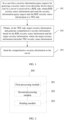
- FIG. 1 is a schematic flowchart of a security assessment method according to an embodiment of this application.
- one embodiment of this application provides a security assessment method applicable to an electronic device that supports a trusted execution environment TEE and a rich execution environment REE. The method includes the following steps.
- Step 101 In a case that a security information query request for querying a security status of the electronic device that is sent by a server is received by the REE side, obtain REE security status information and send the security information query request and the REE security status information to the TEE side.
- a rich execution environment operating system runs in the REE (Rich Execution Environment, rich execution environment), and a trusted execution environment operating system runs in the TEE (Trusted Execution Environment, trusted execution environment).
- the server may be an application server.
- a transmission security mechanism between the application server and the local electronic device can use a TLS (Transport Layer Security, transport layer protocol) to improve transmission security.
- the application server may be an application server providing services with high security requirements, such as payment services.
- REE security detection may be performed to collect REE security status information.
- the REE security status information may include whether there is malware, whether a system has virus, and whether a network connection is secure.
- the REE side may send the security information query request and the REE security status information to the TEE side through the transmission channel.
- a user may alternatively initiate a security information query request for querying the security status of the electronic device to meet the user's own needs for querying the security status of the electronic device.
- Step 102 Obtain, on the TEE side, target security information and generate comprehensive security information based on the REE security status information and the target security information, where the target security information includes TEE security status information.
- the target security information may be collected in response to the security information query request, where the target security information may include TEE security status information, and the TEE security status information may include whether there is malware, whether the system has virus, whether kernel configuration has been tampered with, whether there are execution operations in a data region on a stack, or the like.
- Step 103 Send the comprehensive security information to the server.
- the TEE side may return the comprehensive security information to the REE side, and the REE side sends the comprehensive security information to the server.
- the comprehensive security information may be sent to an application programming interface where the user initiates the security information query request, for display, so as to present a query result to the user.
- the comprehensive security information may be sent to the corresponding application server, and the transmission security mechanism may use the TLS protocol.
- the REE security status information is collected on the REE side and the target security information is collected on the TEE side.
- the REE security status information and the target security information can be used to implement a comprehensive assessment on the security status of the electronic device, so that the security assessment result is more accurate.
- the system security is enhanced because the comprehensive security information is generated in the TEE environment.
- the method further includes:
- the security information query request includes only the identifier of the client application program, that is, the user initiates a security information query request through the client application program.
- the identifier of the client application program needs to be verified on the TEE side to verify whether the client application program has query permission. If a verification result is that the client application program has query permission, the target security information is then collected; or if the verification result is that the client application program has no query permission, a related operation is terminated and an error message is returned. This can improve system security performance.
- the method further includes:
- the security information query request includes the identifier of the client application program and the authorization token of the application server, that is, the application server initiates a security information query request through the client application program.
- the TEE side needs to verify the identifier of the client application program and the authorization token of the application server to verify whether the client application program has query permission, whether the application server has query permission, and whether an authorization time limit of the authorization token has expired.
- a verification result is that the client application program has query permission and the authorization token is valid
- the target security information is then collected; or if the verification result is that the client application program has no query permission or the authorization token is invalid, a related operation is terminated and an error message is returned, and the application server will be prompted to reapply for an authorization token. This can improve system security performance.
- the generating comprehensive security information based on the REE security status information and the target security information includes:
- the collected target security information includes TEE security status information.
- a security status assessment result of the electronic device may be generated based on the REE security status information and the TEE security status information.
- the obtained security status assessment result is not only for assessing a REE security status but also for assessing a TEE security status, so that the security status assessment result can fully reflect the current security status of the electronic device and the security status assessment result is more accurate and reliable.
- a security status assessment model is stored in the TEE, and the security status assessment model is used to assess the current security status of the electronic device.
- the collected REE security status information and TEE security status information may be used as input to the security status assessment model, and analysis processing is performed according to a corresponding security status assessment policy to generate a current security status assessment result of the electronic device. Therefore, with the model-based analysis and assessment method, accuracy of the security status assessment results can be effectively improved, and the security status assessment model can be continuously optimized through learning. As the number of assessments increases, the security status assessment results also become more accurate.
- the security status assessment result is a score, that is, the security status assessment result is expressed in the form of score.
- the score is positively correlated with security of the electronic device. For example, a score range of the security status assessment result is 0 to 10, 0 indicating the lowest security and 10 indicating the highest security, thus providing a more accurate security assessment basis for security risk assessment of various application services.
- the method further includes:
- the target server is an electronic device management server, which is used to manage the local electronic device.
- the local electronic device may receive security status assessment model configuration information sent by the target server.
- the security status assessment model configuration information is used to update and adjust parameters and assessment policies in the security status assessment model. Therefore, the electronic device may perform configuration updating on the security status assessment model in the TEE according to the received security status assessment model configuration information, so as to make security status assessment results generated by the security status assessment model more accurate.
- the local electronic device may receive security capability configuration information sent by the target server.
- the security capability configuration information is used to update and adjust a security capability of the electronic device. Therefore, the electronic device may perform configuration updating on the security capability of the electronic device itself according to the received security capability configuration information, so as to improve the security performance of the system.
- the target security information further includes security capability information of the electronic device.
- the target security information not only includes TEE security status information, but also includes the security capability information of the electronic device.
- the security capability information of the electronic device includes at least one of trusted execution environment, trusted user interaction, hardware encryption and decryption, security unit, memory encryption, anti-side channel attack, and anti-fault injection attack.
- the generating the comprehensive security information based on the security status assessment result includes:
- FIG. 2 is a schematic structural diagram of a security assessment apparatus according to an embodiment of this application. As shown in FIG. 2 , another embodiment of this application further provides a security assessment apparatus, applied to an electronic device that supports a trusted execution environment TEE and a rich execution environment REE, where the apparatus 200 includes:
- the apparatus 200 further includes:
- the apparatus 200 further includes:
- the second processing module 202 includes:
- the target security information further includes security capability information of the electronic device
- the second generating unit includes:
- the apparatus 200 further includes:
- the security capability information includes at least one of the following: trusted execution environment information, trusted user interaction information, hardware encryption and decryption information, security unit information, memory encryption information, anti-side channel attack information, and anti-fault injection attack information.
- the REE security status information and the TEE security status information each include at least one of the following: application access control information, file system access control information, data encryption information, data integrity protection information, security lock screen and authentication information, integrity verification information of device configuration files, whether there is malware or virus in a system, whether configuration of hardware and firmware has been tampered with, whether a system software version meets requirements, whether the system is rooted, whether a memory has been attacked, whether a kernel and kernel configuration have been tampered with, and whether a network connection is secure.
- the REE security status information is collected on the REE side and the target security information is collected on the TEE side.
- the REE security status information and the target security information can be used to implement a comprehensive assessment on the security status of the electronic device, so that the security assessment result is more accurate.
- the system security is enhanced because the comprehensive security information is generated in the TEE environment.
- the security assessment apparatus in this embodiment of this application may be an electronic device, or may be a component in the electronic device, such as an integrated circuit or a chip.
- the electronic device may be a terminal or other devices than the terminal.
- the electronic device may be a mobile phone, a tablet computer, a notebook computer, a palmtop computer, an in-vehicle electronic device, a mobile Internet device (Mobile Internet Device, MID), an augmented reality (augmented reality, AR)/virtual reality (virtual reality, VR) device, a robot, a wearable device, an ultra-mobile personal computer (ultra-mobile personal computer, UMPC), a netbook, a personal digital assistant (personal digital assistant, PDA), or the like; or may be a network-attached storage (Network Attached Storage, NAS), a personal computer (personal computer, PC), a television (television, TV), a teller machine, a self-service machine, or the like. This is not specifically limited in the embodiments of this application.
- the security assessment apparatus in this embodiment of this application may be an apparatus with an operating system.
- the operating system may be an Android (Android) operating system, an iOS operating system, or other possible operating systems, and is not specifically limited in the embodiments of this application.
- the security assessment apparatus provided in this embodiment of this application is capable of implementing the processes that are implemented by the method embodiments in FIG. 1 . To avoid repetition, details are not described herein again.
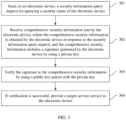
- Step 301 Send, to an electronic device, a security information query request for querying a security status of the electronic device.
- Step 302 Receive comprehensive security information sent by the electronic device, where the comprehensive security information is obtained based on REE security status information and TEE security status information of the electronic device by the electronic device in response to the security information query request, and the comprehensive security information includes a signature generated by the electronic device by using a private key.
- Step 303 Verify the signature in the comprehensive security information by using a public key paired with the private key.
- Step 304 If verification is successful, provide a target-service service to the electronic device.
- the comprehensive security information generated after the electronic device receives the security information query request is digitally signed by using the private key of the electronic device, so that the application server can use the public key paired with the private key to verify authenticity and integrity of the comprehensive security information that is fed back, thereby enhancing the system security. Only after the verification is successful, the electronic device is authorized to provide the target-service service, thereby improving security of related services.
- the execution subject may be a security assessment apparatus.
- the security assessment method being performed by the security assessment apparatus is used as an example to describe the security assessment apparatus provided in the embodiments of this application.
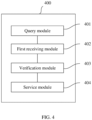
- FIG. 4 is a schematic structural diagram of another security assessment apparatus according to an embodiment of this application. As shown in FIG. 4 , still another embodiment of this application provides a security assessment apparatus, applied to a server.
- the apparatus 400 includes:
- the comprehensive security information generated after the electronic device receives the security information query request is digitally signed by using the private key of the electronic device, so that the application server can use the public key paired with the private key to verify authenticity and integrity of the comprehensive security information that is fed back, thereby enhancing the system security.
- the security assessment apparatus in this embodiment of this application may be a server or the like, which is not specifically limited in the embodiments of this application.
- the security assessment apparatus in this embodiment of this application may be an apparatus with an operating system.
- the operating system may be an Android (Android) operating system, an iOS operating system, or other possible operating systems, and is not specifically limited in the embodiments of this application.
- the security assessment apparatus provided in this embodiment of this application is capable of implementing the processes that are implemented by the method embodiments in FIG. 3 . To avoid repetition, details are not described herein again.
- FIG. 5 is a schematic structural diagram of an electronic device supporting a TEE and a REE according to an embodiment of this application.
- a querying party may be a mobile banking server, a mobile payment server, an enterprise application server, another high-security application server, or the like.
- the electronic device supports a trusted execution environment TEE and a rich execution environment REE.
- a rich execution environment operating system REE OS runs in the REE, and a trusted execution environment operating system TEE OS runs in the TEE.
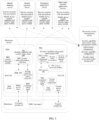
- FIG. 6 is a schematic flowchart of still another security assessment method according to an embodiment of this application. As shown in FIG. 6 , in the security assessment method in this embodiment of this application:
- a query phase includes the following steps:
- the REE security status information is collected on the REE side and the target security information is collected on the TEE side.
- the REE security status information and the target security information can be used to implement a comprehensive assessment on the security status of the electronic device, so that the security assessment result is more accurate.
- the system security is enhanced because the comprehensive security information is generated in the TEE environment.
- an embodiment of this application further provides an electronic device 700, including a processor 701 and a memory 702.
- the memory 702 stores a program or instructions capable of running on the processor 701.
- the steps of the foregoing embodiments of the security assessment method are implemented, with the same technical effects achieved. To avoid repetition, details are not described herein again.
- FIG. 8 is a schematic diagram of a hardware structure of an electronic device according to an embodiment of this application.
- the electronic device 800 includes but is not limited to components such as a radio frequency unit 801, a network module 802, an audio output unit 803, an input unit 804, a sensor 805, a display unit 806, a user input unit 807, an interface unit 808, a memory 809, and a processor 8010.
- the electronic device 800 may further include a power supply (for example, a battery) supplying power to all components, and the power supply may be logically connected to the processor 8010 through a power management system. In this way, functions such as charge management, discharge management, and power consumption management are implemented by using the power management system.
- a power supply for example, a battery
- functions such as charge management, discharge management, and power consumption management are implemented by using the power management system.
- the structure of the electronic device shown in FIG. 8 does not constitute any limitation on the electronic device.
- the electronic device may include more or fewer components than shown in the figure, or a combination of some components, or the components disposed differently. Details are not repeated herein.
- the processor 8010 is configured to: in a case that a security information query request for querying a security status of the electronic device that is sent by a server is received by the REE side, obtain REE security status information and send the security information query request and the REE security status information to the TEE side;
- the REE security status information is collected on the REE side and the target security information is collected on the TEE side.
- the REE security status information and the target security information can be used to implement a comprehensive assessment on the security status of the electronic device, so that the security assessment result is more accurate.
- the system security is enhanced because the comprehensive security information is generated in the TEE environment.
- the method further includes:
- the method further includes:
- the generating comprehensive security information based on the REE security status information and the target security information includes:
- the target security information further includes security capability information of the electronic device; and the generating the comprehensive security information based on the security status assessment result includes:
- the processor 8010 is further configured to: in a case that security capability configuration information sent by a target server is received, perform configuration updating on a security capability of the electronic device according to the security capability configuration information; or in a case that security status assessment model configuration information sent by a target server is received, perform configuration updating on a security status assessment model of the electronic device according to the security status assessment model configuration information.
- the security capability information includes at least one of the following: trusted execution environment information, trusted user interaction information, hardware encryption and decryption information, security unit information, memory encryption information, anti-side channel attack information, and anti-fault injection attack information.
- the REE security status information and the TEE security status information each include at least one of the following: application access control information, file system access control information, data encryption information, data integrity protection information, security lock screen and authentication information, integrity verification information of device configuration files, whether there is malware or virus in a system, whether configuration of hardware and firmware has been tampered with, whether a system software version meets requirements, whether the system is rooted, whether a memory has been attacked, whether a kernel and kernel configuration have been tampered with, and whether a network connection is secure.
- the input unit 804 may include a graphics processing unit (Graphics Processing Unit, GPU) 8041 and a microphone 8042.
- the graphics processing unit 8041 processes image data of a still picture or video obtained by an image capture apparatus (such as a camera) in a video capture mode or an image capture mode.
- the display unit 806 may include a display panel 8061, and the display panel 8061 may be configured in a form of a liquid crystal display, an organic light-emitting diode, and the like.
- the user input unit 807 may include at least one of a touch panel 8071 and other input devices 8072.
- the touch panel 8071 is also referred to as a touchscreen.
- the touch panel 8071 may include two parts: a touch detection apparatus and a touch controller.
- the other input devices 8072 may include but are not limited to a physical keyboard, a function key (such as a volume control key or a power on/off key), a trackball, a mouse, a joystick, and the like. Details are not described herein.
- the memory 809 may be configured to store software programs and various types of data.
- the memory 809 includes a first storage area for storing a program or instructions and a second storage area for storing data.
- the first storage area may store an operating system, an application program or instruction required by at least one function (for example, a sound playback function or an image playback function), and the like.
- the memory 809 may include a volatile memory or a non-volatile memory, or the memory 809 may include both a volatile memory and a non-volatile memory.
- the non-volatile memory may be a read-only memory (Read-Only Memory, ROM), a programmable read only memory (Programmable ROM, PROM), an erasable programmable read-only memory (Erasable PROM, EPROM), and an electrically erasable programmable read-only memory (Electrically EPROM, EEPROM), or flash memory.
- ROM Read-Only Memory
- PROM programmable read only memory
- Erasable PROM Erasable PROM
- EPROM erasable programmable read-only memory
- Electrically erasable programmable read-only memory Electrically erasable programmable read-only memory
- the volatile memory can be a random access memory (Random Access Memory, RAM), a static random access memory (Static RAM, SRAM), a dynamic random access memory (Dynamic RAM, DRAM), a synchronous dynamic random access memory (Synchronous DRAM, SDRAM), a double data rate synchronous dynamic random access memory (Double Data Rate SDRAM, DDRSDRAM), an enhanced synchronous dynamic random access memory (Enhanced SDRAM, ESDRAM), a synchlink dynamic random access memory (Synch link DRAM, SLDRAM), and a direct rambus random access memory (Direct Rambus RAM, DRRAM).
- RAM Random Access Memory
- SRAM static random access memory
- DRAM dynamic random access memory
- DRAM synchronous dynamic random access memory
- SDRAM double data rate synchronous dynamic random access memory
- Enhanced SDRAM, ESDRAM enhanced synchronous dynamic random access memory
- Synch link DRAM, SLDRAM synchlink dynamic random access memory
- Direct Rambus RAM Direct Rambus RAM
- the processor 8010 may include one or more processing units.
- an application processor and a modem processor may be integrated in the processor 8010.
- This application processor primarily processes operations involving an operating system, user interfaces, application programs, and the like.
- the modem processor primarily processes radio communication signals, for example, being a baseband processor. It can be understood that the modem processor may alternatively be not integrated in the processor 8010.
- An embodiment of this application further provides a readable storage medium, where a program or instructions are stored in the readable storage medium.
- a program or instructions are stored in the readable storage medium.
- the processor is a processor in the electronic device described in the foregoing embodiments.
- the readable storage medium includes a computer-readable storage medium, for example, a computer read only memory, a random access memory, a magnetic disk, or an optical disc.
- An embodiment of this application further provides a chip, where the chip includes a processor and a communication interface.
- the communication interface is coupled to the processor, and the processor is configured to run a program or instructions to implement the processes of the foregoing security assessment method embodiments, with the same technical effects achieved. To avoid repetition, details are not described herein again.
- the chip mentioned in the embodiments of this application may also be referred to as a system-level chip, a system chip, a chip system, a system-on-chip, or the like.
- An embodiment of this application provides a computer program product, where the program product is stored in a storage medium, and the program product is executed by at least one processor to implement the processes of the foregoing security assessment method embodiments, with the same technical effects achieved. To avoid repetition, details are not repeated herein.
- the disclosed apparatus and method may be implemented in other manners.
- the described apparatus embodiment is merely an example.
- the unit division is merely logical function division and may be other division in actual implementation.
- a plurality of units or components may be combined or integrated into another system, or some features may be ignored or may not be performed.
- the displayed or discussed mutual couplings or direct couplings or communications connections may be implemented by using some interfaces.
- the indirect couplings or communications connections between apparatuses or units may be implemented in electrical, mechanical, or other forms.
- Units described as separate components may or may not be physically separated.
- a component displayed as a unit may be one or more physical units, and may be located in one place, or may be distributed in a plurality of network elements. Some or all of the units may be selected based on actual requirements to achieve the objectives of the solutions of the embodiments.
- the functions When the functions are implemented in a form of a software functional unit and sold or used as an independent product, the functions may be stored in a computer-readable storage medium.
- the software product is stored in a storage medium, and includes several instructions for instructing a computer device (which may be a personal computer, a server, a network device, or the like) to perform all or some of the steps of the method described in the embodiments of this disclosure.
- the foregoing storage medium includes: any medium that can store program code, such as a USB flash drive, a removable hard disk, a ROM, a RAM, a magnetic disk, or an optical disc.
- the program may be stored in a computer readable storage medium. When the program runs, the processes of the method embodiments may be included.
- the storage medium may include: a magnetic disk, an optical disc, a read-only memory (Read-Only Memory, ROM), or a random access memory (Random Access Memory, RAM).
- the computer software product is stored in a storage medium (such as a ROM/RAM, a magnetic disk, or an optical disc), and includes several instructions for instructing a terminal (which may be a mobile phone, a computer, a server, a network device, or the like) to perform the methods described in the embodiments of this application.
- a storage medium such as a ROM/RAM, a magnetic disk, or an optical disc
Landscapes
- Engineering & Computer Science (AREA)
- Computer Security & Cryptography (AREA)
- Signal Processing (AREA)
- Computer Hardware Design (AREA)
- Computer Networks & Wireless Communication (AREA)
- General Engineering & Computer Science (AREA)
- Computing Systems (AREA)
- Theoretical Computer Science (AREA)
- Physics & Mathematics (AREA)
- Software Systems (AREA)
- General Physics & Mathematics (AREA)
- Mathematical Physics (AREA)
- Storage Device Security (AREA)
- Management, Administration, Business Operations System, And Electronic Commerce (AREA)
Applications Claiming Priority (2)
| Application Number | Priority Date | Filing Date | Title |
|---|---|---|---|
| CN202210273432.4A CN114598541B (zh) | 2022-03-18 | 2022-03-18 | 一种安全评估方法及装置、电子设备和可读存储介质 |
| PCT/CN2023/082037 WO2023174393A1 (zh) | 2022-03-18 | 2023-03-17 | 一种安全评估方法及装置、电子设备和可读存储介质 |
Publications (2)
| Publication Number | Publication Date |
|---|---|
| EP4496266A1 true EP4496266A1 (de) | 2025-01-22 |
| EP4496266A4 EP4496266A4 (de) | 2025-06-18 |
Family
ID=81819540
Family Applications (1)
| Application Number | Title | Priority Date | Filing Date |
|---|---|---|---|
| EP23769895.6A Pending EP4496266A4 (de) | 2022-03-18 | 2023-03-17 | Verfahren und vorrichtung zur sicherheitsbeurteilung, elektronische vorrichtung und lesbares speichermedium |
Country Status (4)
| Country | Link |
|---|---|
| US (1) | US20250007944A1 (de) |
| EP (1) | EP4496266A4 (de) |
| CN (1) | CN114598541B (de) |
| WO (1) | WO2023174393A1 (de) |
Families Citing this family (10)
| Publication number | Priority date | Publication date | Assignee | Title |
|---|---|---|---|---|
| CN114598541B (zh) * | 2022-03-18 | 2024-03-29 | 维沃移动通信有限公司 | 一种安全评估方法及装置、电子设备和可读存储介质 |
| CN115037482A (zh) * | 2022-06-10 | 2022-09-09 | 维沃移动通信有限公司 | 欺诈行为检测方法、装置、电子设备及可读存储介质 |
| CN115243269A (zh) * | 2022-07-22 | 2022-10-25 | 北京小米移动软件有限公司 | 确定风险信息的方法、装置、电子设备及存储介质 |
| CN117917660A (zh) * | 2022-10-20 | 2024-04-23 | 华为技术有限公司 | 数据处理方法、终端设备及系统 |
| US12445471B2 (en) * | 2023-03-31 | 2025-10-14 | Rapid7, Inc. | Techniques of monitoring network traffic in a cloud computing environment |
| CN116633661B (zh) * | 2023-06-15 | 2026-02-24 | 维沃移动通信有限公司 | 安全评估、业务处理、安全信息传输方法及相关设备 |
| CN116910614A (zh) * | 2023-07-07 | 2023-10-20 | 维沃移动通信有限公司 | 设备状态确定方法、装置及电子设备 |
| CN119628846A (zh) * | 2023-09-13 | 2025-03-14 | 中兴通讯股份有限公司 | 网络安全检测的方法及网络侧设备 |
| CN118694867A (zh) * | 2024-06-21 | 2024-09-24 | 维沃移动通信有限公司 | 图像信息安全传输方法、装置、电子设备及服务器 |
| CN120011272B (zh) * | 2024-12-31 | 2025-12-30 | 北京开源芯片研究院 | 中断处理方法、装置、电子设备及可读存储介质 |
Family Cites Families (19)
| Publication number | Priority date | Publication date | Assignee | Title |
|---|---|---|---|---|
| CN104079530A (zh) * | 2013-03-26 | 2014-10-01 | 北京中创智信科技有限公司 | 远程数据采集系统 |
| KR102208631B1 (ko) * | 2014-02-19 | 2021-01-28 | 삼성전자 주식회사 | 전자 장치의 보안 정보 입출력 방법 및 이를 사용하는 전자 장치 |
| CN104125216B (zh) * | 2014-06-30 | 2017-12-15 | 华为技术有限公司 | 一种提升可信执行环境安全性的方法、系统及终端 |
| DE102015000656A1 (de) * | 2015-01-20 | 2016-07-21 | Giesecke & Devrient Gmbh | Laufzeitumgebung für mobiles Endgerät, die ein Bereitstellen eines Sicherheits-Dienstes ermöglicht |
| US11379573B2 (en) * | 2017-07-13 | 2022-07-05 | Huawei Technologies Co., Ltd. | Trusted application access control method and terminal |
| CN111125705B (zh) * | 2018-11-01 | 2022-08-19 | 华为终端有限公司 | 一种能力开放方法及装置 |
| WO2020088323A1 (zh) * | 2018-11-01 | 2020-05-07 | 华为技术有限公司 | 一种能力开放方法及装置 |
| CN109871327B (zh) * | 2019-02-20 | 2022-05-31 | 中国信息通信研究院 | 可信执行环境安全存储安全性测试方法及装置 |
| US11706199B2 (en) * | 2019-08-06 | 2023-07-18 | Samsung Electronics Co., Ltd | Electronic device and method for generating attestation certificate based on fused key |
| CN112596802B (zh) * | 2019-09-17 | 2022-07-12 | 华为技术有限公司 | 一种信息处理方法及装置 |
| CN115039376B (zh) * | 2020-02-25 | 2025-01-28 | 深圳市欢太科技有限公司 | 终端设备信息传输方法、设备指纹生成方法及相关产品 |
| US20200320206A1 (en) * | 2020-06-24 | 2020-10-08 | Intel Corporation | Systems, methods, apparatus and articles of manufacture to prevent unauthorized release of information associated with a function as a service |
| CN111881459B (zh) * | 2020-08-03 | 2024-04-05 | 沈阳谦川科技有限公司 | 一种基于可信运算环境的设备风险控管系统及检测方法 |
| CN112351022B (zh) * | 2020-10-30 | 2022-07-12 | 新华三技术有限公司 | 信任区的安全防护方法及装置 |
| CN113014539B (zh) * | 2020-11-23 | 2022-05-17 | 杭州安芯物联网安全技术有限公司 | 一种物联网设备安全保护系统及方法 |
| CN113315637B (zh) * | 2021-05-31 | 2023-07-04 | 中国农业银行股份有限公司 | 安全认证方法、装置及存储介质 |
| CN113485524B (zh) * | 2021-07-12 | 2022-11-11 | 上海瓶钵信息科技有限公司 | 基于可信执行环境的时钟同步方法及系统 |
| CN113836538B (zh) * | 2021-08-23 | 2025-04-15 | 杭州逗酷软件科技有限公司 | 数据模型处理方法、装置、服务器及存储介质 |
| CN114598541B (zh) * | 2022-03-18 | 2024-03-29 | 维沃移动通信有限公司 | 一种安全评估方法及装置、电子设备和可读存储介质 |
-
2022
- 2022-03-18 CN CN202210273432.4A patent/CN114598541B/zh active Active
-
2023
- 2023-03-17 EP EP23769895.6A patent/EP4496266A4/de active Pending
- 2023-03-17 WO PCT/CN2023/082037 patent/WO2023174393A1/zh not_active Ceased
-
2024
- 2024-09-11 US US18/830,696 patent/US20250007944A1/en active Pending
Also Published As
| Publication number | Publication date |
|---|---|
| CN114598541A (zh) | 2022-06-07 |
| WO2023174393A1 (zh) | 2023-09-21 |
| US20250007944A1 (en) | 2025-01-02 |
| EP4496266A4 (de) | 2025-06-18 |
| CN114598541B (zh) | 2024-03-29 |
Similar Documents
| Publication | Publication Date | Title |
|---|---|---|
| EP4496266A1 (de) | Verfahren und vorrichtung zur sicherheitsbeurteilung, elektronische vorrichtung und lesbares speichermedium | |
| AU2019222729B2 (en) | Asset management method and apparatus, and electronic device | |
| EP2681689B1 (de) | Schutz von betriebssystem-konfigurationswerten | |
| CN104247329B (zh) | 请求云服务的装置的安全补救 | |
| CN107431924B (zh) | 将设备标识符和用户标识符相关联的设备盗窃防护 | |
| CN109218260B (zh) | 一种基于可信任环境的认证保护系统及方法 | |
| US20120266259A1 (en) | Approaches for firmware to trust an application | |
| CN106330850A (zh) | 一种基于生物特征的安全校验方法及客户端、服务器 | |
| EP3206329B1 (de) | Sicherheitsprüfverfahren, vorrichtung, endgerät und server | |
| CN108335105B (zh) | 数据处理方法及相关设备 | |
| US9600671B2 (en) | Systems and methods for account recovery using a platform attestation credential | |
| EP3176719B1 (de) | Verfahren und vorrichtungen zum erwerb eines zertifizierungsdokuments | |
| WO2017206833A1 (zh) | 支付方法、支付设备和支付服务器 | |
| CN107979467A (zh) | 验证方法及装置 | |
| US20260095321A1 (en) | Security evaluation method, service processing method, security information transmission method, and related device | |
| WO2023236884A1 (zh) | 欺诈行为检测方法、装置、电子设备及可读存储介质 | |
| CN117751551A (zh) | 用于安全互联网通信的系统和方法 | |
| CN114925336A (zh) | 一种激活软件的方法及系统 | |
| WO2025232741A1 (zh) | 信息传输方法、装置、管理服务器、电子设备及应用服务器 | |
| CN115361216A (zh) | 授权登陆方法、装置、电子设备及存储介质 | |
| WO2025016301A1 (zh) | 安全认证 | |
| US8832443B2 (en) | Methods and systems for increasing the security of private keys | |
| EP4418710A1 (de) | Verfahren und vorrichtung zur verhinderung der fälschung eines vorrichtungsidentifikators und elektronische vorrichtung | |
| WO2023174389A1 (zh) | 一种安全状态评估方法及装置、电子设备和可读存储介质 | |
| CN107248078A (zh) | 移动支付防护方法、移动终端及计算机可读存储介质 |
Legal Events
| Date | Code | Title | Description |
|---|---|---|---|
| STAA | Information on the status of an ep patent application or granted ep patent |
Free format text: STATUS: THE INTERNATIONAL PUBLICATION HAS BEEN MADE |
|
| PUAI | Public reference made under article 153(3) epc to a published international application that has entered the european phase |
Free format text: ORIGINAL CODE: 0009012 |
|
| STAA | Information on the status of an ep patent application or granted ep patent |
Free format text: STATUS: REQUEST FOR EXAMINATION WAS MADE |
|
| 17P | Request for examination filed |
Effective date: 20240806 |
|
| AK | Designated contracting states |
Kind code of ref document: A1 Designated state(s): AL AT BE BG CH CY CZ DE DK EE ES FI FR GB GR HR HU IE IS IT LI LT LU LV MC ME MK MT NL NO PL PT RO RS SE SI SK SM TR |
|
| A4 | Supplementary search report drawn up and despatched |
Effective date: 20250519 |
|
| RIC1 | Information provided on ipc code assigned before grant |
Ipc: H04L 9/32 20060101ALI20250513BHEP Ipc: H04L 9/08 20060101ALI20250513BHEP Ipc: G06F 21/74 20130101ALI20250513BHEP Ipc: G06F 21/57 20130101ALI20250513BHEP Ipc: H04L 9/40 20220101AFI20250513BHEP |
|
| DAV | Request for validation of the european patent (deleted) | ||
| DAX | Request for extension of the european patent (deleted) |