EP4496314A1 - Videocodierungsverfahren und -vorrichtung, videodecodierungsverfahren und -vorrichtung sowie speichermedium, elektronische vorrichtung und computerprogrammprodukt - Google Patents
Videocodierungsverfahren und -vorrichtung, videodecodierungsverfahren und -vorrichtung sowie speichermedium, elektronische vorrichtung und computerprogrammprodukt Download PDFInfo
- Publication number
- EP4496314A1 EP4496314A1 EP22931820.9A EP22931820A EP4496314A1 EP 4496314 A1 EP4496314 A1 EP 4496314A1 EP 22931820 A EP22931820 A EP 22931820A EP 4496314 A1 EP4496314 A1 EP 4496314A1
- Authority
- EP
- European Patent Office
- Prior art keywords
- vector
- block
- displacement
- prediction
- decoded
- Prior art date
- Legal status (The legal status is an assumption and is not a legal conclusion. Google has not performed a legal analysis and makes no representation as to the accuracy of the status listed.)
- Pending
Links
Images




Classifications
-
- H—ELECTRICITY
- H04—ELECTRIC COMMUNICATION TECHNIQUE
- H04N—PICTORIAL COMMUNICATION, e.g. TELEVISION
- H04N19/00—Methods or arrangements for coding, decoding, compressing or decompressing digital video signals
- H04N19/50—Methods or arrangements for coding, decoding, compressing or decompressing digital video signals using predictive coding
- H04N19/503—Methods or arrangements for coding, decoding, compressing or decompressing digital video signals using predictive coding involving temporal prediction
- H04N19/51—Motion estimation or motion compensation
- H04N19/513—Processing of motion vectors
- H04N19/521—Processing of motion vectors for estimating the reliability of the determined motion vectors or motion vector field, e.g. for smoothing the motion vector field or for correcting motion vectors
-
- H—ELECTRICITY
- H04—ELECTRIC COMMUNICATION TECHNIQUE
- H04N—PICTORIAL COMMUNICATION, e.g. TELEVISION
- H04N19/00—Methods or arrangements for coding, decoding, compressing or decompressing digital video signals
- H04N19/50—Methods or arrangements for coding, decoding, compressing or decompressing digital video signals using predictive coding
- H04N19/503—Methods or arrangements for coding, decoding, compressing or decompressing digital video signals using predictive coding involving temporal prediction
- H04N19/51—Motion estimation or motion compensation
- H04N19/513—Processing of motion vectors
- H04N19/517—Processing of motion vectors by encoding
- H04N19/52—Processing of motion vectors by encoding by predictive encoding
-
- H—ELECTRICITY
- H04—ELECTRIC COMMUNICATION TECHNIQUE
- H04N—PICTORIAL COMMUNICATION, e.g. TELEVISION
- H04N19/00—Methods or arrangements for coding, decoding, compressing or decompressing digital video signals
- H04N19/10—Methods or arrangements for coding, decoding, compressing or decompressing digital video signals using adaptive coding
- H04N19/102—Methods or arrangements for coding, decoding, compressing or decompressing digital video signals using adaptive coding characterised by the element, parameter or selection affected or controlled by the adaptive coding
- H04N19/103—Selection of coding mode or of prediction mode
- H04N19/105—Selection of the reference unit for prediction within a chosen coding or prediction mode, e.g. adaptive choice of position and number of pixels used for prediction
-
- H—ELECTRICITY
- H04—ELECTRIC COMMUNICATION TECHNIQUE
- H04N—PICTORIAL COMMUNICATION, e.g. TELEVISION
- H04N19/00—Methods or arrangements for coding, decoding, compressing or decompressing digital video signals
- H04N19/10—Methods or arrangements for coding, decoding, compressing or decompressing digital video signals using adaptive coding
- H04N19/102—Methods or arrangements for coding, decoding, compressing or decompressing digital video signals using adaptive coding characterised by the element, parameter or selection affected or controlled by the adaptive coding
- H04N19/13—Adaptive entropy coding, e.g. adaptive variable length coding [AVLC] or context adaptive binary arithmetic coding [CABAC]
-
- H—ELECTRICITY
- H04—ELECTRIC COMMUNICATION TECHNIQUE
- H04N—PICTORIAL COMMUNICATION, e.g. TELEVISION
- H04N19/00—Methods or arrangements for coding, decoding, compressing or decompressing digital video signals
- H04N19/10—Methods or arrangements for coding, decoding, compressing or decompressing digital video signals using adaptive coding
- H04N19/134—Methods or arrangements for coding, decoding, compressing or decompressing digital video signals using adaptive coding characterised by the element, parameter or criterion affecting or controlling the adaptive coding
- H04N19/136—Incoming video signal characteristics or properties
- H04N19/137—Motion inside a coding unit, e.g. average field, frame or block difference
- H04N19/139—Analysis of motion vectors, e.g. their magnitude, direction, variance or reliability
-
- H—ELECTRICITY
- H04—ELECTRIC COMMUNICATION TECHNIQUE
- H04N—PICTORIAL COMMUNICATION, e.g. TELEVISION
- H04N19/00—Methods or arrangements for coding, decoding, compressing or decompressing digital video signals
- H04N19/10—Methods or arrangements for coding, decoding, compressing or decompressing digital video signals using adaptive coding
- H04N19/134—Methods or arrangements for coding, decoding, compressing or decompressing digital video signals using adaptive coding characterised by the element, parameter or criterion affecting or controlling the adaptive coding
- H04N19/157—Assigned coding mode, i.e. the coding mode being predefined or preselected to be further used for selection of another element or parameter
- H04N19/159—Prediction type, e.g. intra-frame, inter-frame or bidirectional frame prediction
-
- H—ELECTRICITY
- H04—ELECTRIC COMMUNICATION TECHNIQUE
- H04N—PICTORIAL COMMUNICATION, e.g. TELEVISION
- H04N19/00—Methods or arrangements for coding, decoding, compressing or decompressing digital video signals
- H04N19/10—Methods or arrangements for coding, decoding, compressing or decompressing digital video signals using adaptive coding
- H04N19/169—Methods or arrangements for coding, decoding, compressing or decompressing digital video signals using adaptive coding characterised by the coding unit, i.e. the structural portion or semantic portion of the video signal being the object or the subject of the adaptive coding
- H04N19/17—Methods or arrangements for coding, decoding, compressing or decompressing digital video signals using adaptive coding characterised by the coding unit, i.e. the structural portion or semantic portion of the video signal being the object or the subject of the adaptive coding the unit being an image region, e.g. an object
- H04N19/176—Methods or arrangements for coding, decoding, compressing or decompressing digital video signals using adaptive coding characterised by the coding unit, i.e. the structural portion or semantic portion of the video signal being the object or the subject of the adaptive coding the unit being an image region, e.g. an object the region being a block, e.g. a macroblock
-
- H—ELECTRICITY
- H04—ELECTRIC COMMUNICATION TECHNIQUE
- H04N—PICTORIAL COMMUNICATION, e.g. TELEVISION
- H04N19/00—Methods or arrangements for coding, decoding, compressing or decompressing digital video signals
- H04N19/50—Methods or arrangements for coding, decoding, compressing or decompressing digital video signals using predictive coding
- H04N19/593—Methods or arrangements for coding, decoding, compressing or decompressing digital video signals using predictive coding involving spatial prediction techniques
-
- H—ELECTRICITY
- H04—ELECTRIC COMMUNICATION TECHNIQUE
- H04N—PICTORIAL COMMUNICATION, e.g. TELEVISION
- H04N19/00—Methods or arrangements for coding, decoding, compressing or decompressing digital video signals
- H04N19/70—Methods or arrangements for coding, decoding, compressing or decompressing digital video signals characterised by syntax aspects related to video coding, e.g. related to compression standards
Definitions
- the present disclosure relates to the field of computers and communication technologies, and in particular, to a video encoding and decoding method and apparatus, a storage medium, an electronic device, and a computer program product.
- a code stream does not include a prediction vector of a current block, one or more default prediction vectors may be derived. If these default prediction vectors are not selected properly, encoding performance may be affected.
- Embodiments of the present disclosure provide a video encoding and decoding method and apparatus, a computer readable storage medium, an electronic device, and a computer program product.
- a more suitable prediction vector candidate list may be constructed according to displacement vectors of a decoded block whose reference frame is a current frame, so as to ensure that a more accurate prediction vector is selected therefrom, thereby improving encoding performance.
- An embodiment of the present disclosure provides a video decoding method, including: generating a prediction vector candidate list according to displacement vectors of a decoded block whose reference frame is a current frame; selecting a prediction vector of a to-be-decoded current block from the prediction vector candidate list; and decoding the current block based on the prediction vector of the current block.
- An embodiment of the present disclosure provides a video encoding method, including: generating a prediction vector candidate list according to displacement vectors of an encoded block whose reference frame is a current frame; selecting a prediction vector of a to-be-coded current block from the prediction vector candidate list; and encoding the current block based on the prediction vector of the current block.
- An embodiment of the present disclosure provides a video decoding apparatus, including: a first generation unit, configured to generate a prediction vector candidate list according to displacement vectors of a decoded block whose reference frame is a current frame; a first selection unit, configured to select a prediction vector of a to-be-decoded current block from the prediction vector candidate list; and a first processing unit, configured to decode the current block based on the prediction vector of the current block.
- An embodiment of the present disclosure provides a video encoding apparatus, including: a second generation unit, configured to generate a prediction vector candidate list according to displacement vectors of an encoded block whose reference frame is a current frame; a second selection unit, configured to select a prediction vector of a to-be-coded current block from the prediction vector candidate list; and a second processing unit, configured to code the current block based on the prediction vector of the current block.
- An embodiment of the present disclosure provides a computer readable storage medium, where a computer program is stored in the computer readable storage medium, and the computer program is executed by a processor to implement the method in the foregoing embodiment.
- An embodiment of the present disclosure provides an electronic device, including one or more processors and a memory, configured to store one or more programs, so that the electronic device implements the method in the foregoing embodiment when the one or more programs are executed by the one or more processors.
- An embodiment of the present disclosure provides a computer program product or a computer program.
- the computer program product or the computer program includes computer instructions, and the computer instructions are stored in a computer readable storage medium.
- a processor of a computer device reads the computer instructions from the computer readable storage medium, and the processor executes the computer instructions, so that the computer device performs the method provided in the foregoing.
- a prediction vector candidate list is generated according to displacement vectors of a decoded block whose reference frame is a current frame, and further, a prediction vector of a current block is selected from the prediction vector candidate list, so that a more suitable prediction vector candidate list can be constructed according to the displacement vectors of the decoded block whose reference frame is the current frame, thereby ensuring that a more accurate prediction vector is selected therefrom, thereby improving encoding performance.
- Example implementations are now described in a more comprehensive manner with reference to the accompanying drawings.
- the example implementations can be implemented in various forms and are not to be construed as limited to these examples.
- the purpose of providing these implementations is to make the present disclosure more comprehensive and complete, and convey the concept of the example implementations to a person skilled in the art in a comprehensive manner.
- the block diagrams shown in the accompanying drawings are merely functional entities and do not necessarily correspond to physically independent entities. That is, the functional entities may be implemented in a software form, or in one or more hardware modules or integrated circuits, or in different networks and/or processor apparatuses and/or microcontroller apparatuses.
- “Plurality of” mentioned in the specification means two or more. "And/or” describes an association relationship of an associated object, indicating that three relationships may exist. For example, A and/or B may indicate three cases: A exists alone, both A and B exist, and B exist alone. The character “/” generally indicates an “or” relationship between associated objects before and after the character.
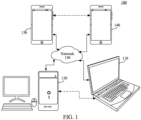
- FIG. 1 illustrates a schematic diagram of an example system architecture of a technical solution according to an embodiment of the present disclosure.
- a system architecture 100 includes a plurality of terminal apparatuses that may communicate with each other by using, for example, a network 150.
- the system architecture 100 may include a first terminal apparatus 110 and a second terminal apparatus 120 that are interconnected by using the network 150.
- the first terminal apparatus 110 and the second terminal apparatus 120 perform unidirectional data transmission.
- the first terminal apparatus 110 may encode video data (for example, a video picture stream collected by the terminal apparatus 110) to be transmitted to the second terminal apparatus 120 by using the network 150.
- the encoded video data is transmitted in one or more encoded video code streams.
- the second terminal apparatus 120 may receive the encoded video data from the network 150, decode the encoded video data to recover the video data, and display the video picture according to the recovered video data.
- the system architecture 100 may include a third terminal apparatus 130 and a fourth terminal apparatus 140 that perform bidirectional transmission of encoded video data, where the bidirectional transmission may occur, for example, during a video conference.
- each terminal apparatus in the third terminal apparatus 130 and the fourth terminal apparatus 140 may code video data (for example, a video picture stream collected by the terminal apparatus), so as to transmit the video data to the other terminal apparatus in the third terminal apparatus 130 and the fourth terminal apparatus 140 by using the network 150.
- Each terminal apparatus in the third terminal apparatus 130 and the fourth terminal apparatus 140 may further receive the encoded video data transmitted by the other terminal apparatus in the third terminal apparatus 130 and the fourth terminal apparatus 140, decode the encoded video data to recover the video data, and display the video picture on an accessible display apparatus according to the recovered video data.
- the first terminal apparatus 110, the second terminal apparatus 120, the third terminal apparatus 130, and the fourth terminal apparatus 140 may be servers or terminals.
- a principle disclosed in the present disclosure is not limited thereto.
- the server may be an independent physical server, or may be a server cluster or a distributed system formed by multiple physical servers, or may be a cloud server that provides basic cloud computing service such as a cloud service, a cloud database, cloud computing, a cloud function, cloud storage, a network service, cloud communication, a middleware service, a domain name service, a security service, a content distribution network (CDN), big data, and an artificial intelligence platform.
- the terminal may be a smartphone, a tablet computer, a notebook computer, a desktop computer, a smart sound box, a smart watch, an intelligent voice interaction device, a smart home appliance, an in-vehicle terminal, an aircraft, or the like, but is not limited thereto.
- the network 150 shown in FIG. 1 represents any quantity of networks that transmit encoded video data among the first terminal apparatus 110, the second terminal apparatus 120, the third terminal apparatus 130, and the fourth terminal apparatus 140, including, for example, a wired and/or wireless communication network.
- the communication network 150 may exchange data in circuit-switched and/or packet-switched channels.
- the network may include a telecommunication network, a local area network, a wide area network, and/or the Internet.
- the architecture and topology of the network 150 may be inessential for the operations disclosed in the present disclosure unless otherwise explained below.
- FIG. 2 illustrates a placement manner of a video encoding apparatus and a video decoding apparatus in a streaming environment.
- the subject matter disclosed in the present disclosure may be equally applicable to another video-enabled application, including, for example, a video conference, a digital television (TV), and storing a compressed video on a digital medium that includes a CD, a DVD, a memory stick, and the like.
- the streaming system may include a collection subsystem 213.
- the collection subsystem 213 may include a video source 201 such as a digital camera.
- the video source creates an uncompressed video picture stream 202.
- the video picture stream 202 includes a sample photographed by the digital camera.
- the video picture stream 202 is depicted as a thick line to emphasize a high data volume video picture stream, and the video picture stream 202 may be processed by an electronic apparatus 220, where the electronic apparatus 220 includes a video encoding apparatus 203 coupled to the video source 201.
- the video encoding apparatus 203 may include hardware, software, or a combination of software and hardware to implement or conduct aspects of the disclosed subject matter as described in more detail below.
- the encoded video data 204 (or the encoded video code stream 204) is depicted as a thin line to emphasize a lower data amount of the encoded video data 204 (or the encoded video code stream 204) that may be stored on a streaming server 205 for future use.
- One or more streaming client subsystems such as a client subsystem 206 and a client subsystem 208 in FIG. 2 , may access the streaming server 205 to retrieve a copy 207 and a copy 209 of the encoded video data 204.
- the client subsystem 206 may include, for example, a video decoding apparatus 210 in the electronic apparatus 230.
- the video decoding apparatus 210 decodes the incoming copy 207 of the encoded video data and generates an output video picture stream 211 that may be presented on a display 212 (e.g., a display screen) or another presentation apparatus.
- the encoded video data 204, the video data 207, and the video data 209 may be encoded according to some video encoding/compression standards.
- the electronic apparatus 220 and the electronic apparatus 230 may include other components not shown in the figure.
- the electronic apparatus 220 may include a video decoding apparatus
- the electronic apparatus 230 may further include a video encoding apparatus.
- HEVC High Efficiency Video Coding
- VVC Versatile Video Coding
- AVS Chinese national video encoding standard AVS
- HEVC High Efficiency Video Coding
- VVC Versatile Video Coding
- AVS Chinese national video encoding standard AVS
- This processing unit is referred to as an encoding tree unit (CTU), or is referred to as a largest encoding unit (LCU).
- the CTU may be further divided into one or more basic encoding units (CU), where the CU is a most basic element in an encoding phase.
- the processing unit may also be referred to as a tile, which is a rectangular area of a multimedia data frame that can be independently decoded and encoded.
- the tile may be further divided into one or more superblocks (SB), where the SB is a start point of block division, and may be further divided into multiple subblocks, and then the superblock is further divided into one or more blocks.
- SB superblocks
- Each block is a most basic element in an encoding phase.
- a relationship between the SB and the block (B) may be shown in FIG. 3 , that is, one SB may include several Bs.
- Predictive encoding includes a manner such as intra-frame prediction and inter-frame prediction. After a selected reconstructed video signal is used for performing prediction on an original video signal, a residual video signal is obtained. An encoder needs to determine which predictive encoding mode to select for a current encoding unit (or encoding block), and notifies a decoder regarding the same. Intra-frame prediction means that a predicted signal is obtained from an area that has been encoded and reconstructed in the same image. Inter-frame prediction means that a predicted signal is obtained from another image that has been encoded and is different from a current image (referred to as a reference image)
- Transform & Quantization After a transform operation such as discrete Fourier transform (DFT) or discrete cosine transform (DCT) is performed, a residual video signal is converted into a transform field, which is referred to as a transform coefficient.
- the transform coefficient is used for performing a lossy quantization operation, to lose some information, so that a quantized signal facilitates compression expression.
- a degree of precision of quantization is usually determined by a quantization parameter (QP).
- a larger value of the QP indicates that a coefficient of a larger value range is quantized to the same output, and may thus result in a larger distortion and a lower bit rate are generally brought. Conversely, when the value of the QP is relatively small, a coefficient indicating a relatively small value range is quantized to the same output, and may thus result in relatively small distortion, and a relative high bit rate.
- Entropy encoding or statistical encoding A quantized transform field signal is subject to statistical compression encoding according to an appearance frequency of each value, and finally a binary (0 or 1) compressed code stream is outputted.
- other information is generated through encoding, such as a selected encoding mode and motion vector data, and entropy encoding also needs to be performed to reduce a bit rate.
- Statistical encoding is a lossless encoding manner, and a bit rate required for expressing the same signal can be effectively reduced. Common statistical encoding manners include variable length encoding (VLC) or content adaptive binary arithmetic encoding (CABAC).
- a content adaptive binary arithmetic encoding (CABAC) process mainly includes three operations: binarization, context modeling, and binary arithmetic encoding.
- binarization operation is performed on an inputted syntax element
- binary data may be encoded by using a conventional encoding mode and a bypass encoding mode.
- the bypass encoding mode does not need to allocate a specific probability model for each binary bit, and an inputted binary bit bin value is encoded directly with a simple bypass coder to accelerate the entire encoding and decoding.
- different syntax elements are not completely independent of each other, and the same syntax element has a specific memory.
- conditional encoding is performed by using another encoded syntax element, and encoding performance can be improved relative to independent encoding or memoryless encoding.
- These encoded symbol information used as a condition is referred to as a context.
- binary bits of a syntax element are sequentially inputted into a context modeler, and the coder allocates a suitable probability model for each inputted binary bit according to a value of a previously encoded syntax element or binary bit.
- This process is context modeling.
- a context model corresponding to a syntax element may be located by using a context index increment (ctxIdxInc) and a context index Start (ctxIdxStart). After the bin value and the allocated probability model are sent together to a binary arithmetic coder for encoding, the context model needs to be updated according to the bin value, that is, an adaptive process in encoding.
- Loop filtering A changed and quantized signal is used for obtaining a reconstructed image through operations like inverse quantization, inverse transform, and prediction compensation. Compared with an original image, some information of the reconstructed image is different from that of the original image due to quantization, that is, the reconstructed image has distortion. Therefore, a filtering operation may be performed on the reconstructed image, for example, a filter such as a deblocking filter (DB), sample adaptive offset (SAO), or an adaptive loop filter (ALF), so as to effectively reduce at least a degree of distortion generated during quantization. Because these filtered reconstructed images are used as references for subsequently encoded images to predict future image signals, the foregoing filtering operation is also referred to as loop filtering, (i.e., a filtering operation in an encoding loop).
- DB deblocking filter
- SAO sample adaptive offset
- ALF adaptive loop filter
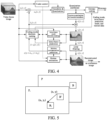
- FIG. 4 is a basic flowchart of a video coder.
- intra-frame prediction is used as an example for description.
- a difference operation is performed between the original image signal s k [ x, y ] and the predicted image signal ⁇ k [ x, y ] to obtain a residual signal u k [ x, y ], and after the residual signal u k [ x , y ] is transformed and quantized, a quantization coefficient is obtained.
- an encoded bit stream is obtained by means of entropy encoding using the quantization coefficient
- a reconstructed residual signal u' k [ x , y ] is obtained by means of inverse quantization and inverse transform processing.
- the predicted image signal ⁇ k [ x , y ] is superposed with the reconstructed residual signal u' k[ x, y] to generate an image signal s k ⁇ x y .
- the image signal s k ⁇ x y is inputted to an intra-frame mode decision module and an intra-frame prediction module to perform intra-frame prediction processing, and on the other hand, a reconstructed image signal s' k [ x , y ] is outputted by using loop filtering.
- the reconstructed image signal s' k [ x , y ] may be used as a reference image of a next frame to perform motion estimation and motion compensation prediction.
- a predicted image signal ⁇ k [ x , y ] of the next frame is obtained based on a result s ' r [ x + m x , y + m y ] of motion compensation prediction and an intra-frame prediction result f s k ⁇ x y , and the foregoing process continues to be repeated until encoding is completed.
- entropy decoding is performed for each encoding unit (or encoding block) at the decoder, to obtain various mode information and quantization coefficients after a compressed code stream (that is, a bit stream) is obtained. Then the quantization coefficient is subjected to inverse quantization and inverse transform processing to obtain a residual signal.
- a prediction signal corresponding to the encoding unit (or code block) may be obtained according to known encoding mode information, and then a reconstruction signal may be obtained by adding a residual signal and a prediction signal, and the reconstruction signal is then subjected to an operation such as loop filtering, to generate a final output signal.
- Mainstream video encoding standards (such as HEVC, VVC, AVS3, AV1, and AV2) use block-based hybrid encoding frameworks.
- original video data is divided into a series of encoding blocks, and video data compression is implemented with reference to video encoding methods such as prediction, transform, and entropy encoding.
- Motion compensation is a common prediction method used in video encoding. Motion compensation derives a prediction value of a current encoding block from an encoded area based on a redundancy characteristic of video content in a time domain or a space domain.
- Such prediction methods include inter-frame prediction, intra-frame block replication prediction, intra-frame string replication prediction, and the like. In encoding implementation, these prediction methods may be used independently or in combination.
- a full name of AV1 is Alliance for Open Media Video 1, and it is the first-generation video encoding standard formulated by the Alliance for Open Media.
- AV2 is Alliance for Open Media Video 2 and it is the second-generation video encoding standard formulated by the Alliance for Open Media.
- a displacement vector may have different names.
- the embodiments of the present disclosure are described in the following manner: 1) A displacement vector in inter-frame prediction is referred to as a motion vector (MV); 2) a displacement vector in intra-frame block replication is referred to as a block vector (BV); 3) a displacement vector in intra-frame string replication is referred to as a string vector (SV). Descriptions associated with inter-frame prediction and intra-frame block replication prediction are provided in the following.
- inter-frame prediction uses a correlation in a video time domain to predict a pixel of a current image by using a pixel of an adjacent encoded image, so as to effectively remove video time domain redundancy, and effectively save a bit of encoded residual data.
- P represents a current frame
- Pr represents a reference frame
- B represents a current code block
- Br represents a reference block of B.
- inter-frame prediction includes two types of MV prediction technologies: merge and advanced motion vector prediction (AMVP).
- the merge mode establishes an MV candidate list for a prediction unit (PU), where there are five candidate MVs (and corresponding reference images). An MV with a lowest rate distortion cost within the five candidate MVs are selected as an optimal MV. If an encoder establishes a candidate list in the same manner, a coder only needs to transmit an index of the optimal MV in the candidate list.
- the MV prediction technology of HEVC also has a skip mode, which is a special example of the merge mode. After the optimal MV is found in the merge mode, if a current block and a reference block are basically the same, residual data does not need to be transmitted, and only an index of the MV and a skip flag need to be transmitted.
- the AMVP mode establishes a candidate prediction MV list for a current PU by using an MV correlation between a space domain adjacent block and a time domain adjacent block.
- the decoder may calculate the MV of the current code block only by using a sequence number of a motion vector difference (MVD) and a motion vector predictor (MVP) in the list.
- An AMVP candidate MV list also includes two cases in a space domain and a time domain, but is different in that a length of the AMVP list is only 2.
- Intra-frame block replication is an encoding technique adopted in screen content encoding (SCC) extension of HEVC, which significantly improves encoding efficiency of screen content.
- SCC screen content encoding
- VVC intra block copy
- the IBC can effectively save bits required for encoding pixels by using a spatial correlation of screen content videos and using pixels of a currently encoded image to predict pixels of a current to-be-encoded block.
- a displacement between a current block and a reference block in an IBC is referred to as a block vector (BV).
- BV block vector
- the IBC mode uses a solution of a global reference range (i.e., a reconstructed area of a current frame is allowed to be used as a reference block of a current block).
- a global reference range i.e., a reconstructed area of a current frame is allowed to be used as a reference block of a current block.
- FIG. 8 illustrates a schematic diagram of an example IBC reference range in a AV2 standard.
- a reference range of an IBC includes two parts, which are respectively referred to as a global reference range and a local reference range.
- the global reference range is a reference range allowed in AV1.
- the local reference range is a newly added reference range, and a size of the local reference range may be, for example, 64 ⁇ 64 (that is, an SB area in which a current block is located).
- a pixel sample of the reference range is stored in an additional on-chip memory.
- the IBC allows different reference ranges depending on a frame type. For example, for a key frame, the IBC allows usage of a global reference range and a local reference range, and for a non-key frame, the IBC allows only usage of a local reference range.
- the local reference range may have different sizes in different implementations. For example, in addition to 64 ⁇ 64, 128 ⁇ 128 may also be used.
- values of a block vector vary significantly when a reference block is within different types of reference ranges. For example, when the reference block is within a local reference range, an absolute value of the block vector will be less than 64. When the reference block is in the global reference range, the absolute values of the block vector are all greater than 64.
- default prediction block vectors are all directed to the global reference range, without considering a case in which the current block is located in the local reference range. For a reference block in a local reference range, a default prediction block vector cannot provide better prediction, which causes a larger block vector encoding overhead.
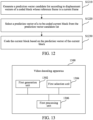
- FIG. 9 is a flowchart of a video decoding method according to an embodiment of the present disclosure.
- the video decoding method may be performed by a device having a computing and processing function.
- the video decoding method may be performed by a terminal device or a server.
- the video decoding method includes at least the following operations.
- Operation S910 Generate a prediction vector candidate list according to displacement vectors of a decoded block whose reference frame is a current frame.
- Operation S920 Select a prediction vector of a to-be-decoded current block from the prediction vector candidate list.
- Operation S930 Decode the current block based on the prediction vector of the current block.
- the technical solution of the embodiment shown in FIG. 9 allows a more suitable prediction vector candidate list to be constructed according to displacement vectors of a decoded block whose reference frame is a current frame, and allows a more accurate prediction vector to be selected therefrom, thereby improving encoding performance.
- the technical solution in the embodiment shown in FIG. 9 may be used for deriving a "default" prediction vector. Namely, only when all components of a prediction block vector of a current block (derived through a fixed rule in a standard) are 0, the prediction vector is derived by using the method shown in FIG. 9 . Certainly, in another embodiment of the present disclosure, the technical solution in the embodiment shown in FIG. 9 may also be directly used.
- the prediction vector candidate list is generated according to the displacement vectors of the decoded block whose reference frame is the current frame.
- a displacement vector may have different names in different prediction modes and different implementations.
- a displacement vector in inter-frame prediction may be referred to as a motion vector (MV)
- a displacement vector in intra-frame block replication is referred to as a block vector (BV)
- a displacement vector in intra-frame string replication is referred to as a string vector (SV).
- a prediction vector candidate list may be constructed according to displacement vectors of a decoded block adjacent to a current block.
- the displacement vectors of the decoded block adjacent to the current block may be obtained from the displacement vectors of the decoded block whose reference frame is the current frame, and then the displacement vectors of the decoded block adjacent to the current block are sorted according to a specified sequence, so as to generate a first displacement vector list. Accordingly, a prediction vector candidate list may be generated according to the first displacement vector list. For example, the first displacement vector list may be used as a prediction vector candidate list.
- the decoded block adjacent to the current block may include at least one of the following: one or more decoded blocks in n 1 rows above the current block, or one or more decoded blocks in n 2 columns on the left of the current block; and n 1 and n 2 are positive integers.
- adjacent decoded blocks may be three rows of decoded blocks above the current block or three columns of decoded blocks on the left of the current block, and a basic unit of each row or column may be a size of 8 ⁇ 8.
- Displacement vector information is usually stored in a unit of 4 ⁇ 4. In an implementation, multiple displacement vectors may be obtained through searching using an 8 ⁇ 8 unit, and quantities of displacement vectors obtained by searching may be different for different rows or columns.
- the specified sequence may include a decoding sequence of decoded blocks, a scanning sequence of decoded blocks, or a weight corresponding to a displacement vector.
- the weight corresponding to the displacement vector may be associated with at least one of the following factors: a repetition quantity of a displacement vector, a block size corresponding to a displacement vector, and a block location corresponding to a displacement vector.
- the weight corresponding to the displacement vector is larger, and a sequence in the first displacement vector list is more top ranked. If a block corresponding to the displacement vector is smaller, the weight corresponding to the displacement vector is larger, and the sequence in the first displacement vector list is more top ranked. If the location of the block corresponding to the displacement vector is closer to the current block, the weight corresponding to the displacement vector is larger, and the sequence in the first displacement vector list is more top ranked.
- a prediction vector candidate list may be constructed according to displacement vectors of a historical decoded block.
- the displacement vectors of the historical decoded block may be obtained from the displacement vectors of the decoded block whose reference frame is the current frame. Subsequently, based on a specified sequence, the displacement vectors of the historical decoded block are added to a queue of a specified length in a first-in first-out manner, so as to generate a second displacement vector list. Further, a prediction vector candidate list is generated according to the second displacement vector list. For example, the second displacement vector list may be used as the prediction vector candidate list.
- a displacement vector 1, a displacement vector 2, and a displacement vector 3 may be stored according to the specified sequence.
- the displacement vectors in the queue become the displacement vector 2, the displacement vector 3, and the displacement vector 4.
- the displacement vectors in the queue become the displacement vector 3, the displacement vector 4, and the displacement vector 5.
- the specified sequence may be a decoding sequence of decoded blocks, a scanning sequence of decoded blocks, or a weight corresponding to a displacement vector.
- the weight corresponding to the displacement vector may be associated with at least one of the following factors: a repetition quantity of a displacement vector, a block size corresponding to a displacement vector, and a block location corresponding to a displacement vector.
- the weight corresponding to the displacement vector is larger, and a sequence in the first displacement vector list is more top ranked. If a block corresponding to the displacement vector is smaller, the weight corresponding to the displacement vector is larger, and the sequence in the first displacement vector list is more top ranked. If the location of the block corresponding to the displacement vector is closer to the current block, the weight corresponding to the displacement vector is larger, and the sequence in the first displacement vector list is more top ranked.
- the same displacement vector already existing in the queue is deleted.
- a displacement vector 1 a displacement vector 2, and a displacement vector 3 are stored in a queue.
- the displacement vector 4 may be deleted from the queue, and the obtained queue is changed into: the displacement vector 1, the displacement vector 3, and the displacement vector 4.
- a second displacement vector list may be corresponding to at least one to-be-decoded area, and the to-be-decoded area includes one of the following: a superblock (SB) in which the current block is located, a row of the superblock (SB) in which the current block is located, and a tile in which the current block is located.
- SB superblock
- SB superblock
- SB superblock
- tile a tile in which the current block is located.
- one second displacement vector list is corresponding to one SB, or one second displacement vector list is corresponding to multiple SBs.
- the displacement vector in the second displacement vector list corresponding to the target to-be-decoded region exceeds a specified value
- adding the displacement vector to the second displacement vector list corresponding to the target to-be-decoded region is stopped. Namely, a maximum quantity may be specified for the second displacement vector list corresponding to the to-be-decoded region. After the maximum quantity is exceeded, adding the displacement vector to the corresponding second displacement vector list may be stopped.
- an operation quantity of adding a displacement vector to the second displacement vector list corresponding to the to-be-decoded code area may also be recorded.
- adding a new displacement vector to the corresponding second displacement vector list is stopped. That is,by recording an operation quantity of adding a displacement vector to the second displacement vector list, example embodiments of the present disclosure may determine whether to stop adding a displacement vector to the corresponding second displacement vector list.
- a prediction vector candidate list may be constructed according to the displacement vectors of the decoded block adjacent to the current block and the displacement vectors of the historical decoded block.
- the displacement vectors of the decoded block adjacent to the current block may be obtained from the displacement vectors of the decoded block whose reference frame is the current frame, the displacement vectors of the historical decoded block are obtained from the displacement vectors of the decoded block whose reference frame is the current frame. Subsequently, a prediction vector candidate list is generated according to the obtained displacement vectors of the adjacent decoded block and the obtained displacement vectors of the historical decoded block.
- the prediction vector candidate list is generated according to the obtained displacement vectors of the adjacent decoded block and the obtained displacement vectors of the historical decoded block
- the obtained displacement vectors may be arranged in a specified sequence, so as to generate the prediction vector candidate list. In this process, a repeated or redundant displacement vector can be deleted.
- a displacement vector not in a preset area may be further deleted, and the preset area includes at least one of the following: a current image, a current tile, a current global reference range, and a current local reference range.
- the specified sequence may be a decoding sequence of decoded blocks, a scanning sequence of decoded blocks, a type of a decoded block, or a weight corresponding to a displacement vector.
- the weight corresponding to the displacement vector may be associated with at least one of the following factors: a repetition quantity of a displacement vector, a block size corresponding to a displacement vector, and a block location corresponding to a displacement vector.
- a decoded block may be a decoded block adjacent to the current block (that is, a code block in the foregoing first displacement vector list), or may be a historical decoded block (that is, a code block in the foregoing second displacement vector list).
- the type of the decoded block is used for indicating whether the decoded block is a decoded block adjacent to the current block (i.e., a code block in the first displacement vector list) or a historical decoded block (i.e., a code block in the second displacement vector list).
- the displacement vectors of the decoded block adjacent to the current block may be arranged before the displacement vectors of the historical decoded block, or certainly, the displacement vectors of the decoded block adjacent to the current block may be arranged after the displacement vectors of the historical decoded block.
- the displacement vectors of the decoded block adjacent to the current block may further be obtained from the displacement vectors of the decoded block whose reference frame is the current frame, and the displacement vectors of the decoded block adjacent to the current block are sorted in a specified sequence to generate a first displacement vector list. Then, the displacement vectors of the historical decoded block are obtained from the displacement vectors of the decoded block whose reference frame is the current frame, and the displacement vectors of the historical decoded block are added to a queue of a specified length in a first-in first-out manner according to a specified sequence, so as to generate a second displacement vector list; and further, the prediction vector candidate list is generated according to the first displacement vector list and the second displacement vector list.
- the process of generating the prediction vector candidate list according to the first displacement vector list and the second displacement vector list may include merging the first displacement vector list and the second displacement vector list, and deleting a duplicate displacement vector to generate a prediction vector candidate list.
- the displacement vectors in the first displacement vector list may be arranged before the displacement vectors in the second displacement vector list when the first displacement vector list and the second displacement vector list are merged.
- the displacement vectors in the first displacement vector list may also be arranged after the displacement vectors in the second displacement vector list.
- the first displacement vector list and the second displacement vector list are merged, whether a displacement vector not in a preset area exists in the first displacement vector list and the second displacement vector list may be further detected.
- the preset area includes at least one of the following: a current image, a current tile, a current global reference range, and a current local reference range. Then, in a process of merging the first displacement vector list and the second displacement vector list, a displacement vector not in the preset area is deleted.
- the prediction vector of the to-be-decoded current block is selected from the prediction vector candidate list.
- a process of selecting the prediction vector of the current block from the prediction vector candidate list may be decoding a code stream to obtain prediction vector index information, and then selecting a prediction vector from a corresponding location in the prediction vector candidate list according to the prediction vector index information as the prediction vector of the current block.
- whether the prediction vector index information needs to be decoded may be determined according to a length of the prediction vector candidate list. If it is determined that the prediction vector index information needs to be decoded, the code stream is decoded to obtain the prediction vector index information. In actual application, for example, if the length of the prediction vector candidate list is 1, the code stream does not need to be decoded to obtain the prediction vector index information, and a prediction vector in the prediction vector candidate list may be directly used as the prediction vector of the current block.
- the prediction vector index information may be encoded using a context-based multi-symbol arithmetic.
- the code stream may further include a maximum value of the prediction vector index information.
- the maximum value may be located in a sequence header, an image header, or a tile header, and the maximum value may represent a maximum quantity of prediction vector index information.
- maximum values corresponding to different displacement vector prediction modes are the same or different.
- a process of selecting the prediction vector of the current block from the prediction vector candidate list may also be selecting a prediction vector from the prediction vector candidate list as the prediction vector of the current block according to a preset selection policy. For example, an ith (i is a positive integer) prediction vector may be selected as the prediction vector of the current block according to a sequence, or one prediction vector is randomly selected.
- the current block is decoded based on the prediction vector of the current block.
- a process of decoding the current block based on the prediction vector of the current block in operation S930 may be decoding the current block by using the prediction vector of the current block as the displacement vector of the current block.
- a process of decoding the current block based on the prediction vector of the current block in operation S930 may be decoding the code stream to obtain a vector residual of the current block, calculating the displacement vector of the current block according to the vector residual and the prediction vector of the current block, and then decoding the current block according to the displacement vector of the current block.
- FIG. 11 is a flowchart of a video decoding method according to an embodiment of the present disclosure.
- the video decoding method may be performed by a device having a computing and processing function, for example, may be performed by a terminal device or a server.
- the video decoding method includes at least the following steps:
- Operation S1110 Decode a code stream to obtain reference range category indication information, the reference range category indication information being used for indicating a target reference range used in an intra-frame block replication mode, and the target reference range including at least one of a global reference range and a local reference range.
- the reference range category indication information may be implemented by using two flag bits, for example, the reference range category indication information may include a first flag bit and a second flag bit, the first flag bit is used for indicating whether the intra-frame block replication mode is allowed to use a global reference range, and the second flag bit is used for indicating whether the intra-frame block replication mode is allowed to use a local reference range.
- a value of the first flag bit is 1, it indicates that the intra-frame block replication mode allows a global reference range to be used. If the value of the first flag bit is 0, it indicates that the intra-frame block replication mode does not allow a global reference range to be used. If a value of the second flag bit is 1, it indicates that the intra-frame block replication mode allows a local reference range to be used. If the value of the second flag bit is 0, it indicates that the intra-frame block replication mode does not allow the local reference range to be used.
- the reference range category indication information may be implemented by using one flag bit.
- the reference range category indication information may include a third flag bit, and when the third flag bit is a first value (for example, 1), it indicates that a global reference range is allowed to be used in the intra-frame block replication mode. When the third flag bit is a second value (for example, 0), it indicates that a local reference range is allowed to be used in the intra-frame block replication mode.
- the reference range category indication information may include a fourth flag bit, and when the fourth flag bit is a first value (for example, 1), it indicates that a global reference range and a local reference range are allowed to be used in the intra-frame block replication mode. When the fourth flag bit is a second value (for example, 0), it indicates that the intra-frame block replication mode allows a local reference range to be used.
- Operation S1120 Generate a prediction vector candidate list according to displacement vectors of a decoded block whose reference frame is a current frame.
- An execution sequence of operation S1110 and operation S1120 is not limited in this embodiment of the present disclosure.
- a process of generating the prediction vector candidate list according to the displacement vectors of the decoded block whose reference frame is the current frame in step S 1120 may be: obtaining, from the displacement vectors of the decoded block whose reference frame is the current frame, a target decoded block whose corresponding reference block is in the target reference range and uses an intra-frame block replication mode; and generating the prediction vector candidate list according to a displacement vector of the target decoded block.
- a process of generating the prediction vector candidate list according to the displacement vectors of the decoded block whose reference frame is the current frame in step S 1120 may be: calculating reference blocks of the current block according to the displacement vectors of the decoded block whose reference frame is the current frame, determining a target reference block that is in a target reference range and that is in the reference blocks of the current block, and further generating the prediction vector candidate list according to displacement vectors of a decoded block corresponding to the target reference block.
- location information of the reference block of the current block may be determined according to coordinates of the current block and the displacement vectors of the decoded block. For example, a horizontal coordinate of a corresponding reference block is calculated according to the horizontal coordinate of the current block and a horizontal component of a displacement vector. A vertical coordinate of a corresponding reference block is calculated according to the vertical coordinate of the current block and a vertical component of a displacement vector.
- the reference range category indication information may be image-level reference range category indication information or tile-level reference range category indication information. If a quantity of displacement vectors included in the prediction vector candidate list does not reach a specified quantity, a preset block vector may be filled in the prediction vector candidate list according to the image-level reference range category indication information or the tile-level reference range category indication information.
- At least one of the following block vectors may be selected to fill the prediction vector candidate list: (-sb_w-D, 0), (0, -sb_h), (sb_x-b_w-cur_x- D, 0), (0, sb_y-b h-cur y), and (-M ⁇ sb_w -D, -N ⁇ sb_h).
- the precision of these block vectors may be at the whole pixel level, and different precision representations may be used in an implementation.
- sb_w represents a width of a maximum code block in which the current block is located;
- sb_h represents a height of the maximum code block in which the current block is located;
- sb_x represents a horizontal coordinate of an upper left corner of the maximum code block in which the current block is located;
- sb_y represents a vertical coordinate of the upper left corner of the maximum code block in which the current block is located;
- b_w represents a width of the current block;
- b_h indicates a height of the current block;
- cur_x represents a horizontal coordinate of the upper left corner of the current block;
- cur_y represents a vertical coordinate of the upper left corner of the current block; and
- D, M, and N are specified constants.
- At least one of the following block vectors may be selected to fill the prediction vector candidate list: (-b_w, 0), (0, -b_h), (-b_w, -b_h), (-2 ⁇ b_w, 0), (0, -2 ⁇ b_h), (0, 0), (0, - vb_w), (-vb_h, 0), and (-vb_w, -vb_h).
- b_w represents a width of the current block
- b_h represents a height of the current block
- vb_w represents a preset block width, for example, may be 64, 32, 16, 8, or 4
- vb_h represents a preset block height, for example, may be 64, 32, 16, 8, or 4.
- the precision of these block vectors may be at the whole pixel level, and different precision representations may be used in an implementation.
- At least one of the above block vectors may be selected for filling.
- a candidate prediction block vector that meets any one of the following conditions may also be selected for filling: cur_x + bvpi_x ⁇ min_x; cur_y + bvpi_y ⁇ min_y; cur_x + bvpi_x ⁇ min_x and cur_y + bvpi_y ⁇ min_y; cur_x + b_w ⁇ 1 + bvpi_x ⁇ max_x; cur_y + b_h ⁇ 1 + bvpi_y ⁇ max_y; cur_x + b_w ⁇ 1 + bvpi_x ⁇ max_x and cur_y + b_h ⁇ 1 + bvpi_y ⁇ max_y .
- cur_x represents the horizontal coordinate of the upper left corner of the current block
- cur_y represents the vertical coordinate of the upper left corner of the current block
- b_w represents the width of the current block
- b_h represents the height of the current block
- bvpi_x represents a horizontal component of an ith candidate prediction block vector
- bvpi_y represents a vertical component of the ith candidate prediction block vector.
- min_x and min_y indicate coordinates of an upper left corner of a tile in which the current block is located
- max_x and max_y indicate coordinates of a lower right corner of a global reference range in a row in which a specified maximum code block is located
- the specified maximum code block is a maximum code block in which the current block is located.
- min_x and min_y represent coordinates of an upper left corner of a local reference range in which the current block is located
- max_x and max_y represent coordinates of a lower right corner of the local reference range in which the current block is located.
- the following operations may be performed:
- Operation S1130 Select a prediction vector corresponding to the target reference range from the prediction vector candidate list.
- a process of selecting the prediction vector corresponding to the target reference range from the prediction vector candidate list may be decoding the code stream to obtain the prediction vector index information, and then selecting a prediction vector from a corresponding location in the prediction vector candidate list according to the prediction vector index information as the prediction vector of the current block.
- a process of selecting the prediction vector corresponding to the target reference range from the prediction vector candidate list may also be selecting a prediction vector corresponding to the target reference range from the prediction vector candidate list as the prediction vector of the current block according to a preset selection policy. For example, an ith (i is a positive integer) prediction vector corresponding to the target reference range may be selected as the prediction vector of the current block according to a sequence, or a prediction vector may be randomly selected.
- Operation S 1140 Decode the current block based on the prediction vector of the current block.
- a process of decoding the current block based on the prediction vector of the current block may be decoding the current block by using the prediction vector of the current block as the displacement vector of the current block; or decoding the code stream to obtain a vector residual of the current block, calculating the displacement vector of the current block according to the vector residual and the prediction vector of the current block, and then decoding the current block according to the displacement vector of the current block.
- the displacement vector prediction mode indication information may be further obtained by decoding the code stream.
- the displacement vector prediction mode indication information indicates that the current block uses a skip prediction mode
- a prediction vector of the current block is used as a displacement vector of the current block, and a decoding process of a residual coefficient of the current block is skipped, to decode the current block
- the displacement vector prediction mode indication information indicates that the current block uses a NearMV prediction mode
- a prediction vector of the current block is used as a displacement vector of the current block
- a residual coefficient of the current block is decoded, to decode the current block
- the displacement vector prediction mode indication information indicates that the current block uses a NewMV prediction mode
- the code stream is decoded to obtain a displacement vector residual of the current block, a displacement vector of the current block is calculated according to the displacement vector residual and the prediction vector of the current block, and a residual coefficient of the current block is decode
- the foregoing three prediction modes may be randomly combined during implementation, for example, one, two, or all of the three modes are used.
- whether the displacement vector prediction mode indication information needs to be decoded may be further determined according to a length of the prediction vector candidate list. If it is determined that the displacement vector prediction mode indication information needs to be decoded, the displacement vector prediction mode indication information is obtained by decoding the code stream. For example, if the length of the prediction vector candidate list is 0, it indicates that the prediction vector of the current block is 0. In this case, the NewMV prediction mode may be used by default, and the displacement vector residual of the current block is decoded as the prediction vector of the current block.
- a process of decoding the code stream to obtain the displacement vector residual of the current block may include decoding the code stream to obtain a symbol and a value of the displacement vector of the current block; or may include decoding the code stream to obtain joint type indication information (joint_type).
- the joint type indication information is used for indicating component consistency between the displacement vector residual of the current block and the prediction vector of the current block. That is, the joint type indication information can indicate whether or not components between the displacement vector residual of the current block and the prediction vector of the current block are consistent.
- the displacement vector residual of the current block is obtained by decoding according to the joint type indication information.
- the encoder also does not need to encode the horizontal component of the displacement vector residual in the code stream. If the joint type indication information indicates that the horizontal components between the displacement vector residual and the prediction vector are inconsistent, and the vertical components therebetween are consistent, only the horizontal components need to be decoded from the code stream. In this case, the encoder does not need to encode the vertical component of the displacement vector residual in the code stream. If the joint type indication information indicates that the horizontal components and the vertical components between the displacement vector residual and the prediction vector are consistent, the displacement vector residual does not need to be decoded from the code stream.
- the coder does not need to code the displacement vector residual in the code stream. If the joint type indication information indicates that the horizontal components and the vertical components between the displacement vector residual and the prediction vector are inconsistent, the horizontal component and the vertical component of the displacement vector residual need to be decoded from the code stream.
- FIG. 12 is a flowchart of a video encoding method according to an embodiment of the present disclosure.
- the video encoding method may be performed by a device having a computing and processing function, for example, may be performed by a terminal device or a server.
- the video encoding method includes at least operation S1210 to operation S 1230. Descriptions of the operations S1210 to S 1230 are provided in the following.
- Operation S1210 Generate a prediction vector candidate list according to displacement vectors of an encoded block whose reference frame is a current frame.
- Operation S1220 Select a prediction vector of a to-be-coded current block from the prediction vector candidate list.
- Operation S1230 Encode the current block based on the prediction vector of the current block.
- the selecting a prediction vector of a to-be-encoded current block from the prediction vector candidate list includes: decoding a code stream to obtain prediction vector index information; and selecting, according to the prediction vector index information, a prediction vector from a corresponding location in the prediction vector candidate list as the prediction vector of the to-be-coded current block.
- the decoding a code stream to obtain prediction vector index information includes: decoding, when it is determined, according to the length of the prediction vector candidate list, that the prediction vector index information needs to be decoded, the code stream to obtain the prediction vector index information.
- the prediction vector index information is encoded using a context-based multi-symbol arithmetic.
- the code stream includes a maximum value of the prediction vector index information, and the maximum value is located in a sequence header, an image header, or a tile header.
- maximum values corresponding to different displacement vector prediction modes are the same or different.
- the selecting a prediction vector of a to-be-encoded current block from the prediction vector candidate list includes: selecting a prediction vector from the prediction vector candidate list as the prediction vector of the to-be-coded current block according to a specified selection policy.
- the generating a prediction vector candidate list according to displacement vectors of an encoded block whose reference frame is a current frame includes: obtaining displacement vectors of an encoded block adjacent to the current block from the displacement vectors of the encoded block whose reference frame is the current frame; sorting the displacement vectors of the encoded block adjacent to the current block in a specified sequence to obtain a first displacement vector list; and generating the prediction vector candidate list according to the first displacement vector list.
- the adjacent encoded blocks include at least one of the following: encoded blocks in n1 rows above the current block, or encoded blocks in n2 columns on the left of the current block; and n1 and n2 are positive integers.
- the generating a prediction vector candidate list according to displacement vectors of an encoded block whose reference frame is a current frame includes: obtaining displacement vectors of a historical encoded block from the displacement vectors of the encoded block whose reference frame is the current frame; adding the displacement vectors of the historical encoded block to a queue of a specified length in a first-in first-out manner according to a specified sequence, to obtain a second displacement vector list; and generating the prediction vector candidate list according to the second displacement vector list.
- the video encoding method further includes: deleting, when the displacement vectors of the historical encoded block are added to the queue, and a same displacement vector already exists in the queue, the same displacement vector already existing in the queue.
- a second displacement vector list may correspond to at least one to-be-encoded area, and the to-be-encoded area includes one of the following: a maximum code block in which the current block is located, a row in the maximum code block in which the current block is located, and a tile in which the current block is located.
- the video encoding method further includes: when a displacement vector in a second displacement vector list corresponding to a target to-be-encoded area exceeds a specified value, stopping adding a displacement vector to the second displacement vector list corresponding to the target to-be-encoded area; or when a quantity of times of adding a displacement vector to a second displacement vector list corresponding to a target to-be-coded area exceeds a specified quantity of times, stopping adding a displacement vector to the second displacement vector list corresponding to the target to-be-encoded area.
- the generating a prediction vector candidate list according to displacement vectors of an encoded block whose reference frame is a current frame includes: obtaining displacement vectors of an encoded block adjacent to the current block from the displacement vectors of the encoded block whose reference frame is the current frame, and sorting the displacement vectors of the encoded block adjacent to the current block in a specified sequence to obtain a first displacement vector list; obtaining displacement vectors of a historical encoded block from the displacement vectors of the encoded block whose reference frame is the current frame, and adding the displacement vectors of the historical encoded block to a queue of a specified length in a first-in first-out manner according to a specified sequence, to obtain a second displacement vector list; and generating the prediction vector candidate list according to the first displacement vector list and the second displacement vector list.
- the generating the prediction vector candidate list according to the first displacement vector list and the second displacement vector list includes: merging the first displacement vector list and the second displacement vector list to obtain a merged displacement vector list; and removing a duplicate displacement vector from the merged displacement vector list to obtain the prediction vector candidate list.
- the video encoding method further includes: detecting displacement vectors in the first displacement vector list and the second displacement vector list; and deleting a displacement vector not in a preset area in a process of merging the first displacement vector list and the second displacement vector list; where the preset area includes at least one of the following: a current image, a current tile, a current global reference range, and a current local reference range.
- the specified sequence includes one of the following: an encoding sequence of encoded blocks, a scanning sequence of encoded blocks, a type of an encoded block, and a weight of a displacement vector.
- the weight is associated with at least one of the following factors: a repetition quantity of a displacement vector, a block size corresponding to a displacement vector, and a block location corresponding to a displacement vector.
- the video encoding method further includes: decoding a code stream to obtain reference range category indication information, the reference range category indication information being used for indicating a target reference range used in an intra-frame block replication mode, and the target reference range including at least one of a global reference range and a local reference range.
- the selecting a prediction vector of a to-be-coded current block from the prediction vector candidate list includes: selecting, from the prediction vector candidate list, a prediction vector corresponding to the target reference range as the prediction vector of the to-be-coded current block.
- the generating a prediction vector candidate list according to displacement vectors of an encoded block whose reference frame is a current frame includes: obtaining, from the displacement vectors of the encoded block whose reference frame is the current frame, a target encoded block whose corresponding reference block is in the target reference range and uses an intra-frame block replication mode; and generating the prediction vector candidate list according to a displacement vector of the target encoded block.
- the generating a prediction vector candidate list according to displacement vectors of an encoded block whose reference frame is a current frame includes: determining a reference block of the current block according to the displacement vectors of the encoded block whose reference frame is the current frame; determining a target reference block in the target reference range from the reference block of the current block; and generating the prediction vector candidate list according to a displacement vector of an encoded block corresponding to the target reference block.
- the reference range category indication information is image-level reference range category indication information or tile-level reference range category indication information; and the video encoding method further includes: when a quantity of displacement vectors in the prediction vector candidate list does not reach a specified quantity, filling a preset block vector into the prediction vector candidate list according to the image-level reference range category indication information or the tile-level reference range category indication information.
- the video encoding method further includes: decoding the code stream to obtain displacement vector prediction mode indication information.
- the encoding the current block based on the prediction vector of the current block includes: using, when the displacement vector prediction mode indication information indicates that the current block uses a skip prediction mode, a prediction vector of the current block as a displacement vector of the current block, and skipping an encoding process of a residual coefficient of the current block; using, when the displacement vector prediction mode indication information indicates that the current block uses a near motion vector prediction mode, a prediction vector of the current block as a displacement vector of the current block, and encoding a residual coefficient of the current block; or decoding, when the displacement vector prediction mode indication information indicates that the current block uses a new motion vector prediction mode, the code stream to obtain a displacement vector residual of the current block, determining a displacement vector of the current block according to the displacement vector residual and the prediction vector of the current block, and encoding a residual coefficient of the current block.
- the decoding the code stream to obtain displacement vector prediction mode indication information includes: when it is determined, according to the length of the prediction vector candidate list, that the displacement vector prediction mode indication information needs to be decoded, decoding the code stream to obtain the displacement vector prediction mode indication information.
- the decoding, when the displacement vector prediction mode indication information indicates that the current block uses a new motion vector prediction mode, the code stream to obtain a displacement vector residual of the current block includes: decoding the code stream to obtain a symbol and a value of the displacement vector of the current block.
- the decoding, when the displacement vector prediction mode indication information indicates that the current block uses a new motion vector prediction mode, the code stream to obtain a displacement vector residual of the current block includes: decoding the code stream to obtain joint type indication information, the joint type indication information being used for indicating component consistency between the displacement vector residual of the current block and the prediction vector of the current block, and performing decoding to obtain the displacement vector residual of the current block according to the joint type indication information.
- a more suitable prediction vector candidate list may be constructed according to displacement vectors of a decoded block whose reference frame is a current frame, so as to ensure that a more accurate prediction vector is selected therefrom, thereby improving encoding performance.
- a proper default prediction vector derivation method may be selected according to a reference range type, so as to select corresponding prediction vectors for different reference ranges, thereby improving accuracy of vector prediction, reducing an encoding cost of a displacement vector, and improving encoding performance.
- a displacement vector of the current block needs to be decoded.
- the current block is an IBC block
- the displacement vector of the IBC block is a block vector bv (bv_x, bv_y).
- the bvd may be decoded directly, that is, the code stream is decoded to obtain a symbol and an absolute value of the bvd.
- decoding manners of the bvd may be classified into several types, and then joint_type is first decoded to determine a category, and then the bvd is decoded. For example, there are the following four cases: (1) Both components of the bvd are consistent with those of the bvp, and the bvd does not need to be decoded. (2) A horizontal component of the bvd is consistent with that of the bvp, but their vertical components are inconsistent. In this case, only the vertical component of the bvd needs to be decoded.
- the horizontal component of the bvd is inconsistent with that of the bvp, and their vertical components are consistent. In this case, only the horizontal component of the bvd needs to be decoded.
- Both components of the bvd are inconsistent with those of the bvp. In this case, the horizontal component and the vertical component of the bvd need to be decoded from the code stream.
- the bvp of the current block may be derived from a prediction block vector candidate list.
- a prediction block vector index bvp_index may be decoded, and then the bvp of the current block is derived according to a location of the bvp in the prediction block vector candidate list indicated by the bvp_index.
- the bvp may be derived according to a fixed rule sequence, and the index does not need to be decoded. For example, the first two candidate bvps in the prediction block vector candidate list are checked, and then the first candidate bvp that is not 0 is exported as the bvp of the current block.
- the code stream includes reference range category indication information ibc_ref_type used for indicating a reference range in which a reference block of the current IBC block is located, the bvp of the corresponding category needs to be used. For example, if it is indicated that the reference block of the current IBC block is within a global reference range, a bvp corresponding to the global reference range needs to be used. If it is indicated that the reference block of the current IBC block is within a local reference range, a bvp corresponding to the local reference range needs to be used.
- the ibc_ref_type belongs to block-level reference range category indication information, and image-level reference range category indication information or tile-level reference range category indication information may alternatively be included, so as to respectively indicate a reference range of an IBC block in a current image or a current tile.
- the indication may also be performed by using multi-level reference range category indication information, for example, by using image-level reference range category indication information and block-level reference range category indication information.
- a method for constructing the prediction block vector candidate list bvp_list is as follows:
- SBVP with a length of N1 may be constructed, to record BVs of space-domain adjacent decoded IBC blocks in a specified sequence.
- the space-domain adjacent decoded IBC blocks include decoded blocks in N1 rows above the current block or in N2 columns on the left of the current block, and N1 and N2 are positive integers.
- the specified sequence may be a decoding sequence or a scanning sequence of space-domain adjacent decoded IBC blocks, weights corresponding to displacement vectors of the space-domain adjacent decoded IBC blocks, or the like.
- the weight corresponding to the displacement vector may be associated with at least one of the following factors: a repetition quantity of a displacement vector, a block size corresponding to a displacement vector, and a block location corresponding to a displacement vector.
- the SBVP may be constructed according to a reference range type of the bv (e.g., a global reference range or a local reference range), for example, may include only a bv of a reference block within a corresponding reference range.
- a reference range type of the bv e.g., a global reference range or a local reference range
- the prediction block vector candidate list bvp_list may include block vector information of a historical decoded block, that is, history based block vector prediction (HBVP).
- HBVP history based block vector prediction
- HBVP with a length of N2 may be constructed, and a BV of a decoded IBC block (or a BV of a decoded block whose reference frame is a current frame) is recorded in a specified sequence.
- a bv of the decoded block is added to the HBVP in a sequence of first input first output (FIFO), where the decoding sequence has a higher priority than a bv adjacent to the current block.
- a duplicate checking operation can be performed when the bv is inserted into the HBVP. If a BV that is duplicate with a new BV that needs to be inserted exists in the list, the BV that is duplicate in the HBVP is deleted.
- the HBVP may have a check count limit. For an SB, an SB row, or a tile, when a quantity ofBVs added to the HBVP exceeds a preset value, adding the BV of the decoded block to the HBVP may be stopped. In addition, the HBVP can be reset according to the SB, the SB row, or tile.
- the bv in the HBVP may also have different sorting sequences, for example, according to a decoding sequence of decoded IBC blocks, a scanning sequence of decoded IBC blocks, and weights corresponding to displacement vectors of decoded IBC blocks.
- the weight corresponding to the displacement vector may be associated with at least one of the following factors: a repetition quantity of a displacement vector, a block size corresponding to a displacement vector, and a block location corresponding to a displacement vector.
- the prediction block vector candidate list bvp_list may be formed by a combination of the SBVP or the HBVP.
- bvp_list is constructed together by the SBVP and the HBVP, a duplicate checking operation can be performed so that the list does not contain duplicate instances.
- the code stream includes the reference range category indication information (which may be block-level reference range category indication information ibc_ref_type, or may be image-level or tile-level reference range category indication information)
- the following method may be used for constructing bvp_list: bvp_list is constructed by using a bv of a decoded IBC block within a reference range indicated by reference range category indication information of a reference block; or the reference block of the current IBC block is first calculated by using the bv of the decoded block, and then the bv of the decoded block is used for constructing bvp_list only when the reference block is within the reference range indicated by the reference range category indication information.
- the code stream includes one or more of reference range category indication information, bvp_mode, and bvp_index.
- the following uses an example in which the reference range category indication information is ibc_ref_type to describe this embodiment of the present disclosure.
- the code stream includes ibc_ref_type, bvp_mode, and bvp_index.
- a processing process of the decoder is: decoding ibc_ref_type. If a value of ibc_ref_type is 0, it indicates that the reference block of the current IBC block is located within a local reference range; otherwise, the reference block of the current IBC block is located within a global reference range.
- a category i.e., joint_type
- bvp_index is decoded to determine a location of the bvp in bvp_list.
- a maximum length of the constructed bvp_list is 8.
- a candidate construction prediction block vector candidate list corresponding to ibc_ref_type is used.
- a candidate bv adjacent in a space domain or a candidate bv adjacent in a historical encoding sequence is allowed.
- the candidate bv in the SBVP may be added to bvp_list first. If the bvp_list list is not fully filled, the candidate bv in the HBVP is added.
- the code stream includes bvp_mode and bvp_index.
- bvp_list there are two block vector prediction modes, including the NearMV mode and the NewMV mode.
- the location of the bvp in bvp_list can be determined according to bvp_index, and then the bvp can be determined.
- a maximum length of the constructed bvp_list is 8. In specific construction, only a candidate bv in the SBVP may be used.
- the code stream includes bvp_index.
- the block vector prediction mode has only one prediction mode NewMV mode.
- the location of the bvp in bvp_list can be determined according to bvp_index, and then the bvp can be determined.
- a maximum length of the constructed bvp_list is 8. In specific construction, only a candidate bv in the SBVP may be used.
- the code stream includes a flag indicating a reference range, bvp_mode, and bvp_idx.
- flags indicating a reference range may be allowed_global_intrabc and allowed_local_intrabc, respectively indicating whether a global reference range or a local reference range is allowed for a block in a current image or a current tile.
- allowed_global_intrabc For example, if a value of allowed_global_intrabc is 1, it indicates that a global reference range is allowed to be used. If the value of allowed_global_intrabc is 0, it indicates that a global reference range is not allowed to be used. If a value of allowed_local_intrabc is 1, it indicates that a local reference range is allowed to be used. If the value of allowed_local_intrabc is 0, it indicates that a local reference range is not allowed to be used.
- the decoder further includes:
- decoding bvp_mode to determine the mode used, for example, which may include two modes. 0 indicates the NewMV mode and 1 indicates the NearMV mode.
- bvp_index is decoded to determine a location of the bvp in bvp_list.
- the maximum length of the constructed bvp_list is 4, and bvp_list includes the SBVP and the HBVP. If the length of the list is less than 4, bvp_list is filled according to the reference range, which is specifically as follows:
- a proper default prediction vector derivation method may be selected according to a reference range type, so as to select corresponding prediction vectors for different reference ranges, thereby improving accuracy of vector prediction, reducing an encoding cost of a displacement vector, and improving encoding performance.
- a more suitable prediction vector candidate list may be constructed according to displacement vectors of a decoded block whose reference frame is a current frame, so as to ensure that a more accurate prediction vector is selected therefrom, thereby improving encoding performance.
- FIG. 13 is a block diagram of a video decoding apparatus according to an embodiment of the present disclosure.
- the video decoding apparatus may be disposed in a device that has a computing and processing function.
- the video decoding apparatus may be disposed in a terminal device or a server.
- the video decoding apparatus 1300 includes a first generation unit 1302, a first selection unit 1304, and a first processing unit 1306.
- the first generation unit 1302 is configured to generate a prediction vector candidate list according to displacement vectors of a decoded block whose reference frame is a current frame; the first selection unit 1304 is configured to select a prediction vector of a to-be-decoded current block from the prediction vector candidate list; and the first processing unit 1306 is configured to decode the current block based on the prediction vector of the current block.
- the first selection unit 1304 is configured to: decode a code stream to obtain prediction vector index information, and select a prediction vector from a corresponding location in the prediction vector candidate list according to the prediction vector index information as the prediction vector of the current block.
- the first selection unit 1304 is further configured to: determine whether the prediction vector index information needs to be decoded according to a length of the prediction vector candidate list, and if it is determined that the prediction vector index information needs to be decoded, decode the code stream to obtain the prediction vector index information.
- the prediction vector index information is encoded using a context-based multi-symbol arithmetic.
- the code stream includes a maximum value of the prediction vector index information, and the maximum value is located in a sequence header, an image header, or a tile header; and maximum values corresponding to different displacement vector prediction modes are the same or different.
- the first selection unit 1304 is configured to select a prediction vector from the prediction vector candidate list as the prediction vector of the current block according to a specified selection policy.
- the first generation unit 1302 is configured to: obtain displacement vectors of a decoded block adjacent to the current block from the displacement vectors of the decoded block whose reference frame is the current frame; sort the displacement vectors of the decoded block adjacent to the current block in a specified sequence to generate a first displacement vector list; and generate the prediction vector candidate list according to the first displacement vector list.
- the adjacent decoded blocks include at least one of the following: decoded blocks in n1 rows above the current block, or decoded blocks in n2 columns on the left of the current block; and n1 and n2 are positive integers.
- the first generation unit 1302 is configured to: obtain displacement vectors of a historical decoded block from the displacement vectors of the decoded block whose reference frame is the current frame; add the displacement vectors of the historical decoded block to a queue of a specified length in a first-in first-out manner according to a specified sequence, to generated a second displacement vector list; and generate the prediction vector candidate list according to the second displacement vector list.
- the first generation unit 1302 is further configured to: delete, when the displacement vectors of the historical decoded block are added to the queue, and a same displacement vector already exists in the queue, the same displacement vector already existing in the queue.
- one second displacement vector list corresponds to at least one to-be-decoded area
- the to-be-decoded area includes one of the following: a maximum code block in which the current block is located, a row in the maximum code block in which the current block is located, and a tile in which the current block is located.
- the first generation unit 1302 is further configured to: stop, when a displacement vector in a second displacement vector list corresponding to a target to-be-decoded area exceeds a specified value, adding a displacement vector to the second displacement vector list corresponding to the target to-be-decoded area.
- the first generation unit 1302 is further configured to: stop, when a quantity of times of adding a displacement vector to a second displacement vector list corresponding to a target to-be-decoded area exceeds a specified quantity of times, adding a displacement vector to the second displacement vector list corresponding to the target to-be-decoded area.
- the first generation unit 1302 is configured to: obtain displacement vectors of a decoded block adjacent to the current block from the displacement vectors of the decoded block whose reference frame is the current frame; sort the displacement vectors of the decoded block adjacent to the current block in a specified sequence to generate a first displacement vector list; obtain displacement vectors of a historical decoded block from the displacement vectors of the decoded block whose reference frame is the current frame, and add the displacement vectors of the historical decoded block to a queue of a specified length in a first-in first-out manner according to a specified sequence, to generate a second displacement vector list; and generate the prediction vector candidate list according to the first displacement vector list and the second displacement vector list.
- the first generation unit 1302 is configured to: merge the first displacement vector list and the second displacement vector list, and delete a duplicate displacement vector to generate the prediction vector candidate list.
- the first generation unit 1302 is further configured to: detect whether a displacement vector not in a preset area exists in the first displacement vector list and the second displacement vector list, where the preset area includes at least one of the following: a current image, a current tile, a current global reference range, and a current local reference range; and in a process of merging the first displacement vector list and the second displacement vector list, delete the displacement vector not in the preset area.
- the specified sequence includes one of the following: a decoding sequence of decoded blocks, a scanning sequence of decoded blocks, a type of a decoded block, and a weight of a displacement vector; and the weight is associated with at least one of the following factors: a repetition quantity of a displacement vector, a block size corresponding to a displacement vector, and a block location corresponding to a displacement vector.
- the video decoding apparatus further includes a decoding unit.
- the decoding unit is configured to: decode a code stream to obtain reference range category indication information, the reference range category indication information being used for indicating a target reference range used in an intra-frame block replication mode, and the target reference range including at least one of a global reference range and a local reference range; and the first selection unit 1304 is configured to: select a prediction vector corresponding to the target reference range from the prediction vector candidate list.
- the first generation unit 1302 is configured to: obtain, from the displacement vectors of the decoded block whose reference frame is the current frame, a target decoded block whose corresponding reference block is in the target reference range and uses an intra-frame block replication mode; and generate the prediction vector candidate list according to a displacement vector of the target decoded block.
- the first generation unit 1302 is configured to: calculate a reference block of the current block according to the displacement vectors of the decoded block whose reference frame is the current frame; determine a target reference block that is in the reference block of the current block and that is in the target reference range; and generate the prediction vector candidate list according to a displacement vector of a decoded block corresponding to the target reference block.
- the reference range category indication information is image-level reference range category indication information or tile-level reference range category indication information; and the first generation unit 1302 is further configured to: fill, when a quantity of displacement vectors included in the prediction vector candidate list does not reach a specified quantity, a preset block vector into the prediction vector candidate list according to the image-level reference range category indication information or the tile-level reference range category indication information.
- the video decoding apparatus further includes a decoding unit, configured to decode the code stream to obtain displacement vector prediction mode indication information; and the first processing unit 1306 is configured to: use, when the displacement vector prediction mode indication information indicates that the current block uses a skip prediction mode, a prediction vector of the current block as a displacement vector of the current block, and skip a decoding process of a residual coefficient of the current block, so as to decode the current block.
- the first processing unit 1306 is configured to use, when the displacement vector prediction mode indication information indicates that the current block uses a NearMV prediction mode, a prediction vector of the current block as a displacement vector of the current block, and decode a residual coefficient of the current block, so as to decode the current block.
- the first processing unit 1306 is configured to decode, when the displacement vector prediction mode indication information indicates that the current block uses a NewMV prediction mode, the code stream to obtain a displacement vector residual of the current block, calculate a displacement vector of the current block according to the displacement vector residual and the prediction vector of the current block, and decode a residual coefficient of the current block, so as to decode the current block.
- the decoding unit is further configured to: determine, according to a length of the prediction vector candidate list, whether the displacement vector prediction mode indication information needs to be decoded; and if it is determined that the displacement vector prediction mode indication information needs to be decoded, decode the code stream to obtain the displacement vector prediction mode indication information.
- a process in which the first processing unit 1306 decodes the code stream to obtain the displacement vector residual of the current block includes: decoding the code stream to obtain a symbol and a value of the displacement vector of the current block; or decoding the code stream to obtain joint type indication information, the joint type indication information being used for indicating component consistency between the displacement vector residual of the current block and the prediction vector of the current block, and performing decoding to obtain the displacement vector residual of the current block according to the joint type indication information.
- FIG. 14 is a block diagram of a video encoding apparatus according to an embodiment of the present disclosure.
- the video encoding apparatus may be disposed in a device that has a computing and processing function, for example, may be disposed in a terminal device or a server.
- the video encoding apparatus 1400 includes a second generation unit 1402, a second selection unit 1404, and a second processing unit 1406.
- the second generation unit 1402 is configured to generate a prediction vector candidate list according to displacement vectors of an encoded block whose reference frame is a current frame; the second selection unit 1404 is configured to select a prediction vector of a to-be-coded current block from the prediction vector candidate list; and the second processing unit 1406 is configured to code the current block based on the prediction vector of the current block.
- FIG. 15 is a schematic structural diagram of a computer system adapted to implement an electronic device according to an embodiment of the present disclosure.
- a computer system 1500 of the electronic device shown in FIG. 15 is merely an example, and does not constitute any limitation on functions and use ranges of the embodiments of the present disclosure.
- the computer system 1500 includes a central processing unit (CPU) 1501, which may perform various suitable actions and processing based on a program stored in a read-only memory (ROM) 1502 or a program loaded from a storage part 1508 into a random access memory (RAM) 1503, for example, perform the method described in the foregoing embodiments.
- the RAM 1503 further stores various programs and data required for operating the system.
- the CPU 1501, the ROM 1502, and the RAM 1503 are connected to each other through a bus 1504.
- An input/output (I/O) interface 1505 is also connected to the bus 1504.
- the following parts are connected to the I/O interface 1505: an input part 1506 including a keyboard, a mouse, and the like; an output part 1507 including, for example, a cathode ray tube (CRT), a liquid crystal display (LCD), a speaker, and the like; a storage part 1508 including a hard disk or the like; and a communication part 1509 including a network interface card such as a local area network (LAN) card and a modem.
- the communication part 1509 performs communication processing by using a network such as the Internet.
- a driver 1510 is also connected to the I/O interface 1505 as required.
- a removable medium 1511 such as a magnetic disk, an optical disc, a magneto-optical disk, or a semiconductor memory, is installed on the drive 1510 as required, so that a computer program read from the removable medium is installed into the storage part 1508 as required.
- an embodiment of the present disclosure includes a computer program product.
- the computer program product includes a computer program stored in a computer readable storage medium.
- the computer program includes a computer program used for performing a method shown in the flowchart.
- the computer program may be downloaded and installed from a network, and/or installed from the removable medium 1511.
- the various functions defined in the system of the present disclosure are executed.
- the computer readable storage medium shown in this embodiment of the present disclosure may be a memory such as a read-only memory (ROM), a random access memory (RAM), an erasable programmable read-only memory (EPROM), an electrically erasable programmable read-only memory (EEPROM), a flash memory, a magnetic surface memory, an optical disc, or a CD-ROM; or may be various devices including one or any combination of the foregoing memories.
- ROM read-only memory
- RAM random access memory
- EPROM erasable programmable read-only memory
- EEPROM electrically erasable programmable read-only memory
- flash memory a magnetic surface memory
- optical disc or a CD-ROM
- a related unit described in the embodiments of the present disclosure may be implemented in a software manner, or may be implemented in a hardware manner, and the unit described can also be set in a processor. Names of the units do not constitute a limitation on the units in a specific case.
- An embodiment of the present disclosure further provides a computer readable storage medium.
- the computer readable storage medium may be included in the electronic device described in the foregoing embodiment; or may exist separately, and is not assembled into the electronic device.
- the computer readable storage medium carries one or more programs, the one or more programs, when executed by the electronic device, causing the electronic device to implement the method described in the foregoing embodiments.
- the exemplary implementations described herein may be implemented by using software, or may be implemented by combining software and necessary hardware. Therefore, the technical solutions of the embodiments of the present disclosure may be implemented in a form of a software product.
- the software product may be stored in a non-volatile storage medium (which may be a CD-ROM, a USB flash drive, a removable hard disk, or the like) or on the network, including several instructions for instructing a computing device (which may be a personal computer, a server, a touch terminal, a network device, or the like) to perform the methods according to the embodiments of the present disclosure.
Landscapes
- Engineering & Computer Science (AREA)
- Multimedia (AREA)
- Signal Processing (AREA)
- Compression Or Coding Systems Of Tv Signals (AREA)
Applications Claiming Priority (2)
| Application Number | Priority Date | Filing Date | Title |
|---|---|---|---|
| CN202210260543.1A CN116805968A (zh) | 2022-03-16 | 2022-03-16 | 视频编解码方法、装置、计算机可读介质及电子设备 |
| PCT/CN2022/135499 WO2023173809A1 (zh) | 2022-03-16 | 2022-11-30 | 视频编解码方法、装置、存储介质、电子设备及计算机程序产品 |
Publications (2)
| Publication Number | Publication Date |
|---|---|
| EP4496314A1 true EP4496314A1 (de) | 2025-01-22 |
| EP4496314A4 EP4496314A4 (de) | 2025-06-25 |
Family
ID=88022138
Family Applications (1)
| Application Number | Title | Priority Date | Filing Date |
|---|---|---|---|
| EP22931820.9A Pending EP4496314A4 (de) | 2022-03-16 | 2022-11-30 | Videocodierungsverfahren und -vorrichtung, videodecodierungsverfahren und -vorrichtung sowie speichermedium, elektronische vorrichtung und computerprogrammprodukt |
Country Status (6)
| Country | Link |
|---|---|
| US (1) | US20240089494A1 (de) |
| EP (1) | EP4496314A4 (de) |
| JP (1) | JP2025509017A (de) |
| KR (1) | KR20240051197A (de) |
| CN (1) | CN116805968A (de) |
| WO (1) | WO2023173809A1 (de) |
Families Citing this family (3)
| Publication number | Priority date | Publication date | Assignee | Title |
|---|---|---|---|---|
| CN117615129B (zh) * | 2024-01-23 | 2024-04-26 | 腾讯科技(深圳)有限公司 | 帧间预测方法、装置、计算机设备及存储介质 |
| CN120676147A (zh) * | 2024-03-18 | 2025-09-19 | 中兴通讯股份有限公司 | 视频块处理方法、电子设备及存储介质 |
| CN121509677A (zh) * | 2024-08-09 | 2026-02-10 | 腾讯科技(深圳)有限公司 | 视频编解码方法、装置、计算机可读介质及电子设备 |
Family Cites Families (5)
| Publication number | Priority date | Publication date | Assignee | Title |
|---|---|---|---|---|
| EP3152906B1 (de) * | 2014-07-07 | 2021-06-16 | HFI Innovation Inc. | Verfahren für intrablockkopiesuche und kompensationsbereich |
| WO2017131908A1 (en) * | 2016-01-29 | 2017-08-03 | Google Inc. | Dynamic reference motion vector coding mode |
| WO2019036080A1 (en) * | 2017-08-15 | 2019-02-21 | Google Llc | ESTIMATION OF CONSTRAINED MOTION FIELD FOR INTERPRETING |
| KR102780576B1 (ko) * | 2019-06-20 | 2025-03-11 | 가부시키가이샤 제이브이씨 켄우드 | 동화상 부호화 장치, 동화상 부호화 방법 및, 동화상 부호화 프로그램, 동화상 복호 장치, 동화상 복호 방법 및 동화상 복호 프로그램 |
| CN113709458B (zh) * | 2020-05-22 | 2023-08-29 | 腾讯科技(深圳)有限公司 | 视频编解码中的位移矢量预测方法、装置及设备 |
-
2022
- 2022-03-16 CN CN202210260543.1A patent/CN116805968A/zh active Pending
- 2022-11-30 KR KR1020247009420A patent/KR20240051197A/ko active Pending
- 2022-11-30 EP EP22931820.9A patent/EP4496314A4/de active Pending
- 2022-11-30 WO PCT/CN2022/135499 patent/WO2023173809A1/zh not_active Ceased
- 2022-11-30 JP JP2024513809A patent/JP2025509017A/ja active Pending
-
2023
- 2023-11-21 US US18/516,013 patent/US20240089494A1/en active Pending
Also Published As
| Publication number | Publication date |
|---|---|
| US20240089494A1 (en) | 2024-03-14 |
| JP2025509017A (ja) | 2025-04-11 |
| WO2023173809A1 (zh) | 2023-09-21 |
| KR20240051197A (ko) | 2024-04-19 |
| CN116805968A (zh) | 2023-09-26 |
| EP4496314A4 (de) | 2025-06-25 |
Similar Documents
| Publication | Publication Date | Title |
|---|---|---|
| US20250301183A1 (en) | Method and apparatus for entropy-encoding and entropy-decoding video signal | |
| EP4496314A1 (de) | Videocodierungsverfahren und -vorrichtung, videodecodierungsverfahren und -vorrichtung sowie speichermedium, elektronische vorrichtung und computerprogrammprodukt | |
| US20260106991A1 (en) | Video data inter prediction method and apparatus | |
| CN113315967B (zh) | 视频编码方法、装置、介质及电子设备 | |
| US20240422346A1 (en) | Method and apparatus for constructing motion information list in video encoding and decoding and device | |
| US20250071306A1 (en) | Video coding/decoding method and apparatus, computer-readable medium, and electronic device | |
| CN116805969A (zh) | 视频编解码方法、装置、计算机可读介质及电子设备 | |
| HK40092646A (zh) | 视频编解码方法、装置、计算机可读介质及电子设备 | |
| US12526445B2 (en) | Video encoding method and apparatus, video decoding method and apparatus, computer-readable medium, and electronic device | |
| US12621444B2 (en) | Loop filtering, video encoding, and video decoding methods and apparatus, storage medium, and electronic device | |
| CN115086656B (zh) | 视频编解码方法、装置、计算机可读介质及电子设备 | |
| CN112565789B (zh) | 视频解码及编码方法、装置、计算机可读介质及电子设备 | |
| CN114079788B (zh) | 视频编解码中的运动信息列表构建方法、装置及设备 | |
| CN121509677A (zh) | 视频编解码方法、装置、计算机可读介质及电子设备 | |
| CN121967700A (zh) | 视频编解码方法、装置、计算机可读介质及电子设备 | |
| CN121462766A (zh) | 视频编解码方法、装置、计算机可读介质及电子设备 | |
| WO2025252185A1 (zh) | 视频编解码方法、装置、计算机可读介质及电子设备 | |
| CN115086655A (zh) | 视频编解码方法、装置、计算机可读介质及电子设备 | |
| EP4694135A2 (de) | Verfahren und vorrichtung zur intraprädiktionsbasierten bildcodierung/-decodierung und aufzeichnungsmedium zur bitstromspeicherung | |
| WO2025118926A1 (zh) | 视频编解码方法、装置、介质及电子设备 | |
| CN119402654A (zh) | 视频编码方法及其装置、电子设备和非暂态计算机可读存储介质 | |
| CN121037574A (zh) | 视频编码方法及装置、设备、介质、产品、存储及发送比特流的方法 | |
| CN117956164A (zh) | 视频编解码方法、装置、计算机可读介质及电子设备 | |
| HK40041013B (en) | Video decoding and encoding method, apparatus, computer readable medium, and electronic device | |
| HK40041013A (en) | Video decoding and encoding method, apparatus, computer readable medium, and electronic device |
Legal Events
| Date | Code | Title | Description |
|---|---|---|---|
| STAA | Information on the status of an ep patent application or granted ep patent |
Free format text: STATUS: THE INTERNATIONAL PUBLICATION HAS BEEN MADE |
|
| PUAI | Public reference made under article 153(3) epc to a published international application that has entered the european phase |
Free format text: ORIGINAL CODE: 0009012 |
|
| STAA | Information on the status of an ep patent application or granted ep patent |
Free format text: STATUS: REQUEST FOR EXAMINATION WAS MADE |
|
| 17P | Request for examination filed |
Effective date: 20240926 |
|
| AK | Designated contracting states |
Kind code of ref document: A1 Designated state(s): AL AT BE BG CH CY CZ DE DK EE ES FI FR GB GR HR HU IE IS IT LI LT LU LV MC ME MK MT NL NO PL PT RO RS SE SI SK SM TR |
|
| A4 | Supplementary search report drawn up and despatched |
Effective date: 20250523 |
|
| DAV | Request for validation of the european patent (deleted) | ||
| DAX | Request for extension of the european patent (deleted) | ||
| RIC1 | Information provided on ipc code assigned before grant |
Ipc: H04N 19/70 20140101ALI20250519BHEP Ipc: H04N 19/593 20140101ALI20250519BHEP Ipc: H04N 19/52 20140101AFI20250519BHEP |