EP4496361A1 - Kommunikationsverfahren und -system sowie zugehörige vorrichtung - Google Patents
Kommunikationsverfahren und -system sowie zugehörige vorrichtung Download PDFInfo
- Publication number
- EP4496361A1 EP4496361A1 EP23806832.4A EP23806832A EP4496361A1 EP 4496361 A1 EP4496361 A1 EP 4496361A1 EP 23806832 A EP23806832 A EP 23806832A EP 4496361 A1 EP4496361 A1 EP 4496361A1
- Authority
- EP
- European Patent Office
- Prior art keywords
- accessory device
- bluetooth
- event
- button
- host device
- Prior art date
- Legal status (The legal status is an assumption and is not a legal conclusion. Google has not performed a legal analysis and makes no representation as to the accuracy of the status listed.)
- Pending
Links
Images









Classifications
-
- H—ELECTRICITY
- H04—ELECTRIC COMMUNICATION TECHNIQUE
- H04W—WIRELESS COMMUNICATION NETWORKS
- H04W4/00—Services specially adapted for wireless communication networks; Facilities therefor
- H04W4/80—Services using short range communication, e.g. near-field communication [NFC], radio-frequency identification [RFID] or low energy communication
-
- H—ELECTRICITY
- H04—ELECTRIC COMMUNICATION TECHNIQUE
- H04W—WIRELESS COMMUNICATION NETWORKS
- H04W76/00—Connection management
- H04W76/10—Connection setup
- H04W76/14—Direct-mode setup
-
- H—ELECTRICITY
- H04—ELECTRIC COMMUNICATION TECHNIQUE
- H04W—WIRELESS COMMUNICATION NETWORKS
- H04W76/00—Connection management
- H04W76/10—Connection setup
- H04W76/15—Setup of multiple wireless link connections
-
- H—ELECTRICITY
- H04—ELECTRIC COMMUNICATION TECHNIQUE
- H04W—WIRELESS COMMUNICATION NETWORKS
- H04W84/00—Network topologies
- H04W84/18—Self-organising networks, e.g. ad-hoc networks or sensor networks
Definitions
- This application relates to the field of communication technologies, and in particular, to a communication method and system, and a related device.
- accessory devices for example, Bluetooth accessory devices such as a Bluetooth mouse, a Bluetooth keyboard, a stylus, and a Bluetooth speaker
- These accessory devices may establish communication connections (for example, Bluetooth communication connections) with a host device (for example, a tablet, a personal computer, or a large screen) to implement data exchange.
- a host device for example, a tablet, a personal computer, or a large screen
- Embodiments of this application provide a communication method, a system, and a related device, so that a plurality of accessory devices can implement differentiated functions in collaboration in corresponding scenarios, to simplify a user operation and improve user experience.
- an embodiment of this application provides a communication method, applied to a communication system, where the communication system includes a first host device, a first accessory device, and a second accessory device.
- the method includes: The first accessory device establishes a first communication connection with the first host device; the second accessory device establishes a second communication connection with the first host device; the first accessory device detects a first event triggered by a user, and in response to the first event, the first accessory device sends first data to the first host device through the first communication connection, where the first data includes information about the first event; the first host device sends the information about the first event to the second accessory device through the second communication connection; and the second accessory device receives the information about the first event sent by the first host device, and performs a response operation based on the information about the first event.
- a data communication channel may be provided for the plurality of accessory devices based on a routing function (for example, a Bluetooth routing function) of the host device.
- a routing function for example, a Bluetooth routing function
- the first data further includes device information of one or more accessory devices
- the device information of the one or more accessory devices includes device information of the second accessory device
- the device information of the second accessory device is used by the first host device to determine to send the information about the first event to the second accessory device.
- the first host device may determine, based on the device information of the second accessory device, to send the information about the first event to the second accessory device.
- the communication system further includes a second host device.
- the first event is an event of changing a focus host device from the first host device to the second host device.
- the information about the first event includes device information of the second host device. That the second accessory device performs a response operation based on the information about the first event specifically includes: The second accessory device sends a first direct advertising message based on the device information of the second host device; and when the second host device receives the first direct advertising message, the second accessory device changes the focus host device from the first host device to the second host device, and the second accessory device establishes a third communication connection with the second host device.
- the user may change the focus host device of all the accessory devices from the first host device to the second host device by one click, which is convenient and quick.
- the first accessory device is a keyboard
- the second accessory device is a mouse
- the first event is an event of pressing a button for adjusting dots per inch DPI.
- the information about the first event includes a button value of the button for adjusting the DPI. That the second accessory device performs a response operation based on the information about the first event specifically includes: The second accessory device adjusts DPI of the second accessory device based on the button value of the button for adjusting the DPI.
- the user may adjust the DPI of the mouse through the keyboard.
- the button for adjusting the DPI includes a DPI button, a button combination for increasing the DPI, or a button combination for decreasing the DPI. That the second accessory device adjusts DPI of the second accessory device based on the button value of the button for adjusting the DPI specifically includes: When the button for adjusting the DPI is the DPI button, the second accessory device increases or decreases the DPI of the second accessory device based on the button value of the DPI button; when the button for adjusting the DPI is the button combination for increasing the DPI, the second accessory device increases the DPI of the second accessory device based on the button value of the button combination for increasing the DPI; or when the button for adjusting the DPI is the button combination for decreasing the DPI, the second accessory device decreases the DPI of the second accessory device based on the button value of the button combination for decreasing the DPI.
- the user may increase or decrease the DPI of the mouse through the DPI button or a button combination for the DPI on the keyboard.
- the first accessory device is a keyboard
- the second accessory device is a mouse
- the first event is an event of pressing a button for adjusting a light effect.
- the information about the first event includes a button value of the button for adjusting the light effect. That the second accessory device performs a response operation based on the information about the first event specifically includes: The second accessory device adjusts a light effect of the second accessory device based on the button value of the button for adjusting the light effect.
- the user may adjust the light effect (for example, brightness and a mode of the light effect) of the mouse through the keyboard.
- the light effect for example, brightness and a mode of the light effect
- the button for adjusting the light effect includes a light up button for increasing brightness, a light down button for decreasing brightness, a button combination for increasing brightness, or a button combination for decreasing brightness. That the second accessory device adjusts a light effect of the second accessory device based on the button value of the button for adjusting the light effect specifically includes: When the button for adjusting the light effect is the light up button or the button combination for increasing the brightness, the second accessory device increases brightness of the light effect of the second accessory device based on a button value of the light up button or a button value of the button combination for increasing the brightness; or when the button for adjusting the light effect is the light down button or the button combination for decreasing the brightness, the second accessory device decreases brightness of the light effect of the second accessory device based on a button value of the light down button or a button value of the button combination for decreasing the brightness.
- the user may adjust the brightness of the light effect of the mouse through the button for adjusting the light effect on the keyboard.
- the button for adjusting the light effect includes a single button or a button combination for switching a mode of the light effect. That the second accessory device adjusts a light effect of the second accessory device based on the button value of the button for adjusting the light effect specifically includes: The second accessory device switches a mode of the light effect of the second accessory device based on a button value of the single button or the button combination for switching the mode of the light effect.
- the user may adjust the mode of the light effect of the mouse through the button for adjusting the light effect on the keyboard.
- the first accessory device is a mouse
- the second accessory device is a keyboard
- the first event is an event of pressing a first button by the user. That the second accessory device performs a response operation based on the information about the first event specifically includes: The second accessory device converts the event of pressing the first button by the user and an event of pressing a second button by the user into an event of pressing a third button by the user, where the event of pressing the second button by the user is detected by the second accessory device after receiving the information about the first event sent by the first host device; the second accessory device sends a button value of the third button to the first host device; and the first host device responds to a function corresponding to the button value of the third button.
- the user may form a button combination through collaboration between the mouse and the keyboard, to reduce a quantity of buttons of the keyboard. This reduces a size of the keyboard and meets a requirement of the user.
- the method further includes: The first accessory device detects a second event, where the second event is an event of releasing the first button by the user; in response to the second event, the first accessory device sends second data to the first host device through the first communication connection, where the second data includes information about the second event; the first host device sends the information about the second event to the second accessory device through the second communication connection; and the second accessory device receives the information about the second event sent by the first host device, and determines, based on the information about the second event, that the user releases the first button.
- the device information of the second accessory device includes a device type of the second accessory device.
- the method further includes: The second accessory device sends a first message to the first host device, where the first message includes the device type of the second accessory device; and the first host device stores a mapping relationship between the second communication connection and the device type of the second accessory device.
- the method further includes: The first host device determines, based on the device type of the second accessory device and the mapping relationship between the second communication connection and the device type of the second accessory device, to send the information about the first event to the second accessory device through the second communication connection.
- an accessory device may perform device registration with a host device, so that the host device stores a mapping relationship between a communication connection and a device type of the accessory device.
- the method further includes: The second accessory device sends a second message to the first accessory device through the first host device, where the second message is used to notify the first accessory device of a result of performing the response operation by the second accessory device.
- the second accessory device may notify, through the first host device, the first accessory device of the result of performing the response operation by the second accessory device.
- both the first communication connection and the second communication connection are Bluetooth communication connections.
- the first host device may be a host device 100.
- the second host device may be a host device 200.
- the first accessory device and the second accessory device may separately establish a first communication connection (for example, a Bluetooth communication connection) and a second communication connection (for example, a Bluetooth communication connection) with the first host device.
- the first event may be an event (for example, a switching event, an event of adjusting DPI, an event of adjusting a light effect, or an event of pressing a button) triggered by the user.
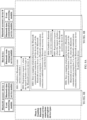
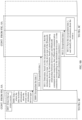
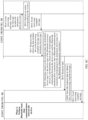
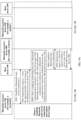
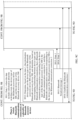
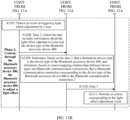
- the first data may be data including the information about the first event and the device information of the one or more accessory devices (for example, data 1 in FIG. 9A to FIG. 9D , data 2 in FIG. 11A and FIG. 11B , data 3 in FIG.
- the first direct advertising message may be a Bluetooth broadcast message 2 sent by a Bluetooth accessory device 400 in FIG. 9A to FIG. 9D .
- the third communication connection may be a Bluetooth communication connection 2 established between the Bluetooth accessory device 400 and the host device 200.
- the first button may be a button 1 in FIG. 13A to FIG. 13C
- the second button may be a button 2 in FIG. 13A to FIG. 13C
- the third button may be a button combination 1 in FIG. 13A to FIG. 13C
- the second data may be data 5 in FIG. 13A to FIG. 13C .
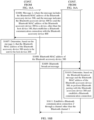
- the first message may be a registration request sent by the second accessory device to the first host device, and the second message may be an event processing complete message in FIG. 8A to FIG. 8C .
- an embodiment of this application provides a communication method, applied to a first accessory device.
- the method includes: The first accessory device detects a first event triggered by a user; and in response to the first event, the first accessory device sends first data to a second accessory device through a first host device, where the first data includes information about the first event.
- the information about the first event is used by the second accessory device to perform a response operation based on the information about the first event, the first accessory device establishes a first communication connection with the first host device, and the second accessory device establishes a second communication connection with the first host device.
- the first data further includes device information of one or more accessory devices
- the device information of the one or more accessory devices includes device information of the second accessory device
- the device information of the second accessory device is used by the first host device to determine to send the information about the first event to the second accessory device.
- the first event is an event of changing a focus host device from the first host device to a second host device.
- the information about the first event is used by the second accessory device to change the focus host device from the first host device to the second host device based on the information about the first event.
- the second accessory device establishes a third communication connection with the second host device.
- the first accessory device is a keyboard
- the second accessory device is a mouse
- the first event is an event of pressing a button for adjusting dots per inch DPI
- the information about the first event is used by the second accessory device to adjust DPI of the second accessory device based on the information about the first event.
- the button for adjusting the DPI includes a DPI button, a button combination for increasing the DPI, or a button combination for decreasing the DPI.
- the button for adjusting the DPI is the DPI button
- the information about the first event is used by the second accessory device to increase or decrease the DPI of the second accessory device based on the information about the first event.
- the button for adjusting the DPI is the button combination for increasing the DPI
- the information about the first event is used by the second accessory device to increase the DPI of the second accessory device based on the information about the first event.
- the button for adjusting the DPI is the button combination for decreasing the DPI
- the information about the first event is used by the second accessory device to decrease the DPI of the second accessory device based on the information about the first event.
- the first accessory device is a keyboard
- the second accessory device is a mouse
- the first event is an event of pressing a button for adjusting a light effect
- the information about the first event is used by the second accessory device to adjust a light effect of the second accessory device based on the information about the first event.
- the button for adjusting the light effect includes a light up button for increasing brightness, a light down button for decreasing brightness, a button combination for increasing brightness, or a button combination for decreasing brightness.
- the button for adjusting the light effect is the light up button or the button combination for increasing the brightness
- the information about the first event is used by the second accessory device to increase brightness of the light effect of the second accessory device based on the information about the first event.
- the button for adjusting the light effect is the light down button or the button combination for decreasing the brightness
- the information about the first event is used by the second accessory device to decrease brightness of the light effect of the second accessory device based on the information about the first event.
- the first accessory device is a mouse
- the second accessory device is a keyboard
- the first event is an event of pressing a first button by the user
- the information about the first event is used by the second accessory device to convert the event of pressing the first button by the user and an event of pressing a second button by the user into an event of pressing a third button by the user.
- the event of pressing the second button by the user is detected by the second accessory device after receiving the information about the first event sent by the first host device.
- the method further includes: The first accessory device detects a second event, where the second event is an event of releasing the first button by the user; in response to the second event, the first accessory device sends information about the second event to the second accessory device through the first host device, where the information about the second event is included in second data, and the information about the second event is used by the second accessory device to determine, based on the information about the second event, that the user releases the first button.
- the device information of the second accessory device includes a device type of the second accessory device.
- the method further includes: The first accessory device sends a first message to the first host device, where the first message includes a device type of the first accessory device, and the first message is used by the first host device to store, based on the first message, a mapping relationship between the first communication connection and the device type of the first accessory device.
- the first host device may be a host device 100.
- the second host device may be a host device 200.
- the first accessory device and the second accessory device may separately establish a first communication connection (for example, a Bluetooth communication connection) and a second communication connection (for example, a Bluetooth communication connection) with the first host device.
- the first event may be an event (for example, a switching event, an event of adjusting DPI, an event of adjusting a light effect, or an event of pressing a button) triggered by the user.
- the first data may be data including the information about the first event and the device information of the one or more accessory devices (for example, data 1 in FIG. 9A to FIG. 9D , data 2 in FIG. 11A and FIG. 11B , data 3 in FIG.
- the third communication connection may be a Bluetooth communication connection 2 established between a Bluetooth accessory device 400 and the host device 200.
- the first button may be a button 1 in FIG. 13A to FIG. 13C
- the second button may be a button 2 in FIG. 13A to FIG. 13C
- the third button may be a button combination 1 in FIG. 13A to FIG. 13C .
- the second data may be data 5 in FIG. 13A to FIG. 13C .
- the first message may be a registration request sent by the first accessory device to the first host device.
- an embodiment of this application provides a communication method, applied to a second accessory device.
- the method includes: The second accessory device establishes a first communication connection with a first host device; the second accessory device receives, through the first communication connection, information about a first event sent by the first host device, where the information about the first event may be included in first data, the information about the first event is sent by a first accessory device to the first host device through a second communication connection after the first accessory device detects the first event triggered by a user and the second communication connection may be established between the first accessory device and the first host device; and the second accessory device performs a response operation based on the information about the first event.
- the first data further includes device information of one or more accessory devices
- the device information of the one or more accessory devices includes device information of the second accessory device
- the device information of the second accessory device is used by the first host device to determine to send the information about the first event to the second accessory device.
- the first event is an event of changing a focus host device from the first host device to a second host device.
- the information about the first event includes device information of the second host device. That the second accessory device performs a response operation based on the information about the first event specifically includes: The second accessory device sends a first direct advertising message based on the device information of the second host device; and when the second host device receives the first direct advertising message, the second accessory device changes the focus host device from the first host device to the second host device, and the second accessory device establishes a third communication connection with the second host device.
- the first accessory device is a keyboard
- the second accessory device is a mouse
- the first event is an event of pressing a button for adjusting dots per inch DPI.
- the information about the first event includes a button value of the button for adjusting the DPI. That the second accessory device performs a response operation based on the information about the first event specifically includes: The second accessory device adjusts DPI of the second accessory device based on the button value of the button for adjusting the DPI.
- the button for adjusting the DPI includes a DPI button, a button combination for increasing the DPI, or a button combination for decreasing the DPI. That the second accessory device adjusts DPI of the second accessory device based on the button value of the button for adjusting the DPI specifically includes: When the button for adjusting the DPI is the DPI button, the second accessory device increases or decreases the DPI of the second accessory device based on the button value of the DPI button; when the button for adjusting the DPI is the button combination for increasing the DPI, the second accessory device increases the DPI of the second accessory device based on the button value of the button combination for increasing the DPI; or when the button for adjusting the DPI is the button combination for decreasing the DPI, the second accessory device decreases the DPI of the second accessory device based on the button value of the button combination for decreasing the DPI.
- the first accessory device is a keyboard
- the second accessory device is a mouse
- the first event is an event of pressing a button for adjusting a light effect.
- the information about the first event includes a button value of the button for adjusting the light effect. That the second accessory device performs a response operation based on the information about the first event specifically includes: The second accessory device adjusts a light effect of the second accessory device based on the button value of the button for adjusting the light effect.
- the button for adjusting the light effect includes a light up button for increasing brightness, a light down button for decreasing brightness, a button combination for increasing brightness, or a button combination for decreasing brightness. That the second accessory device adjusts a light effect of the second accessory device based on the button value of the button for adjusting the light effect specifically includes: When the button for adjusting the light effect is the light up button or the button combination for increasing the brightness, the second accessory device increases brightness of the light effect of the second accessory device based on a button value of the light up button or a button value of the button combination for increasing the brightness; or when the button for adjusting the light effect is the light down button or the button combination for decreasing the brightness, the second accessory device decreases brightness of the light effect of the second accessory device based on a button value of the light down button or a button value of the button combination for decreasing the brightness.
- the first accessory device is a mouse
- the second accessory device is a keyboard
- the first event is an event of pressing a first button by the user. That the second accessory device performs a response operation based on the information about the first event specifically includes: The second accessory device converts the event of pressing the first button by the user and an event of pressing a second button by the user into an event of pressing a third button by the user, where the event of pressing the second button by the user is detected by the second accessory device after receiving the information about the first event sent by the first host device; and the second accessory device sends a button value of the third button to the first host device, where the button value of the third button is used by the first host device to respond to a function corresponding to the button value of the third button based on the button value of the third button.
- the method further includes: The second accessory device receives, through the first communication connection, information about a second event sent by the first host device, where the information about the second event is included in second data, the second event is an event of releasing the first button by the user, and the second data is sent by the first accessory device to the first host device after the first accessory device detects the second event; and the second accessory device determines, based on the information about the second event, that the user releases the first button.
- the device information of the second accessory device includes a device type of the second accessory device.
- the method further includes: The second accessory device sends a first message to the first host device, where the first message includes the device type of the second accessory device, and the first message is used by the first host device to store, based on the first message, a mapping relationship between the first communication connection and the device type of the second accessory device.
- the method further includes: The second accessory device sends a second message to the first accessory device through the first host device, where the second message is used to notify the first accessory device of a result of performing the response operation by the second accessory device.
- the first host device may be a host device 100.
- the second host device may be a host device 200.
- the first accessory device and the second accessory device may separately establish a second communication connection (for example, a Bluetooth communication connection) and a first communication connection (for example, a Bluetooth communication connection) with the first host device.
- the first event may be an event (for example, a switching event, an event of adjusting DPI, an event of adjusting a light effect, or an event of pressing a button) triggered by the user.
- the first data may be data including the information about the first event and the device information of the one or more accessory devices (for example, data 1 in FIG. 9A to FIG. 9D , data 2 in FIG. 11A and FIG. 11B , data 3 in FIG.
- the first direct advertising message may be a Bluetooth broadcast message 2 sent by a Bluetooth accessory device 400 in FIG. 9A to FIG. 9D .
- the third communication connection may be a Bluetooth communication connection 2 established between the Bluetooth accessory device 400 and the host device 200.
- the first button may be a button 1 in FIG. 13A to FIG. 13C
- the second button may be a button 2 in FIG. 13A to FIG. 13C
- the third button may be a button combination 1 in FIG. 13A to FIG. 13C
- the second data may be data 5 in FIG. 13A to FIG. 13C .
- the first message may be a registration request sent by the second accessory device to the first host device, and the second message may be an event processing complete message in FIG. 8A to FIG. 8C .
- an embodiment of this application provides a communication method, applied to a first host device.
- the method includes: The first host device establishes a first communication connection with a first accessory device; the first host device establishes a second communication connection with a second accessory device; the first host device receives, through the first communication connection, first data sent by the first accessory device, where the first data includes information about a first event, and the first data is sent by the first accessory device after the first accessory device detects a first event triggered by a user; and the first host device sends the information about the first event to the second accessory device through the second communication connection, where the information about the first event is used by the second accessory device to perform a response operation based on the information about the first event.
- the first data further includes device information of one or more accessory devices
- the device information of the one or more accessory devices includes device information of the second accessory device
- the device information of the second accessory device is used by the first host device to determine to send the information about the first event to the second accessory device.
- the device information of the second accessory device includes a device type of the second accessory device.
- the method further includes: The first host device receives a first message sent by the second accessory device, where the first message includes the device type of the second accessory device; and the first host device stores a mapping relationship between the second communication connection and the device type of the second accessory device.
- the method further includes: The first host device determines, based on the device type of the second accessory device and the mapping relationship between the second communication connection and the device type of the second accessory device, to send the information about the first event to the second accessory device through the second communication connection.
- the first host device may be a host device 100.
- the second host device may be a host device 200.
- the first accessory device and the second accessory device may separately establish a first communication connection (for example, a Bluetooth communication connection) and a second communication connection (for example, a Bluetooth communication connection) with the first host device.
- the first event may be an event (for example, a switching event, an event of adjusting DPI, an event of adjusting a light effect, or an event of pressing a button) triggered by the user.
- the first data may be data including the information about the first event and the device information of the one or more accessory devices (for example, data 1 in FIG. 9A to FIG. 9D , data 2 in FIG. 11A and FIG. 11B , data 3 in FIG. 12A and FIG. 12B , and data 4 in FIG. 13A to FIG. 13C ).
- the first message may be a registration request sent by the second accessory device to the first host device.
- an embodiment of this application provides a communication method, applied to a communication system.
- the communication system includes a first host device, a second host device, a first accessory device, and a second accessory device, and the second accessory device establishes Bluetooth communication connections with both the first host device and the second host device.
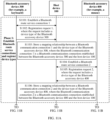
- the method includes: The first accessory device establishes a first Bluetooth communication connection with the first host device; the first host device sends a first message to the first accessory device through the first Bluetooth communication connection, where the first message indicates the first accessory device to send a pairing broadcast message; the first accessory device sends the pairing broadcast message after receiving the first message; the first host device sends a second message to the second accessory device, where the second message includes a Bluetooth media access control MAC address of the first accessory device, the second message indicates the second accessory device to send the Bluetooth MAC address of the first accessory device to one or more host devices, and the one or more host devices include the second host device; the second accessory device sends the Bluetooth MAC address of the first accessory device to the second host device; and the second host device receives the pairing broadcast message and the Bluetooth MAC address of the first accessory device, performs, based on the pairing broadcast message and the Bluetooth MAC address of the first accessory device, Bluetooth pairing with the first accessory device, and establishes a second Bluetooth communication connection.
- the first host device may be a host device 100.
- the second host device may be a host device 200.
- the first accessory device may be a Bluetooth accessory device 300 in FIG. 16A and FIG. 16B .
- the second accessory device may be a Bluetooth accessory device 400 in FIG. 16A and FIG. 16B .
- the first Bluetooth communication connection may be a Bluetooth communication connection 2 in FIG. 16A and FIG. 16B .
- the first message may be a message 1 in FIG. 16A and FIG. 16B
- the second message may be a message 2 in FIG. 16A and FIG. 16B .
- the second Bluetooth communication connection may be a Bluetooth communication connection 2' in FIG. 16A and FIG. 16B .
- an embodiment of this application provides a communication method, applied to a first accessory device.
- the method includes: The first accessory device establishes a first Bluetooth communication connection with a first host device; the first accessory device sends a pairing broadcast message after receiving, through the first Bluetooth communication connection, a first message sent by the first host device; and when a second host device determines, based on the pairing broadcast message and a Bluetooth media access control MAC address of the first accessory device, to perform Bluetooth pairing with the first accessory device and establish a second Bluetooth communication connection, the first accessory device establishes the second Bluetooth communication connection with the second host device, where the Bluetooth MAC address of the first accessory device is sent by the first host device to the second host device through the second accessory device, and the second accessory device establishes Bluetooth communication connections with both the first host device and the second host device.
- the first host device may be a host device 100.
- the second host device may be a host device 200.
- the first accessory device may be a Bluetooth accessory device 300 in FIG. 16A and FIG. 16B .
- the second accessory device may be a Bluetooth accessory device 400 in FIG. 16A and FIG. 16B .
- the first Bluetooth communication connection may be a Bluetooth communication connection 2 in FIG. 16A and FIG. 16B .
- the first message may be a message 1 in FIG. 16A and FIG. 16B .
- the second Bluetooth communication connection may be a Bluetooth communication connection 2' in FIG. 16A and FIG. 16B .
- an embodiment of this application provides a communication method, applied to a second accessory device, where the second accessory device establishes Bluetooth communication connections with both a first host device and a second host device.
- the method includes: The second accessory device receives a first message sent by the first host device, where the first message includes a Bluetooth media access control MAC address of the first accessory device, the first message is used by the second accessory device to send the Bluetooth MAC address of the first accessory device to one or more host devices based on the first message, and the one or more host devices include the second host device; and the second accessory device sends the Bluetooth MAC address of the first accessory device to the second host device based on the first message, where the Bluetooth MAC address of the first accessory device is used by the second host device to establish a Bluetooth communication connection with the first accessory device.
- the first host device may be a host device 100.
- the second host device may be a host device 200.
- the first accessory device may be a Bluetooth accessory device 300 in FIG. 16A and FIG. 16B .
- the second accessory device may be a Bluetooth accessory device 400 in FIG. 16A and FIG. 16B .
- the first message may be a message 2 in FIG. 16A and FIG. 16B .
- an embodiment of this application provides a communication method, applied to a first host device.
- the method includes: The first host device establishes a first Bluetooth communication connection with a first accessory device; the first host device sends a first message to the first accessory device through the first Bluetooth communication connection, where the first message indicates the first accessory device to send a pairing broadcast message; and the first host device sends a second message to a second accessory device, where the second message includes a Bluetooth media access control MAC address of the first Bluetooth accessory device, the second message indicates the second accessory device to send the Bluetooth MAC address of the first accessory device to one or more host devices, and the one or more host devices include a second host device.
- the second accessory device establishes Bluetooth communication connections with both the first host device and the second host device, and the pairing broadcast message and the Bluetooth MAC address of the first accessory device are used by the second host device to establish a second Bluetooth communication connection with the first accessory device.
- the first host device may be a host device 100.
- the second host device may be a host device 200.
- the first accessory device may be a Bluetooth accessory device 300 in FIG. 16A and FIG. 16B .
- the second accessory device may be a Bluetooth accessory device 400 in FIG. 16A and FIG. 16B .
- the first Bluetooth communication connection may be a Bluetooth communication connection 2 in FIG. 16A and FIG. 16B .
- the first message may be a message 1 in FIG. 16A and FIG. 16B
- the second message may be a message 2 in FIG. 16A and FIG. 16B .
- the second Bluetooth communication connection may be a Bluetooth communication connection 2' in FIG. 16A and FIG. 16B .
- an embodiment of this application provides a communication system, where the communication system includes a first host device, a first accessory device, and a second accessory device.
- the first accessory device is configured to establish a first communication connection to the first host device.
- the second accessory device is configured to establish a second communication connection to the first host device.
- the first accessory device is further configured to detect a first event triggered by a user, and in response to the first event, send first data to the first host device through the first communication connection, where the first data includes information about the first event.
- the first host device is configured to send the information about the first event to the second accessory device through the second communication connection.
- the second accessory device is further configured to receive the information about the first event sent by the first host device, and perform a response operation based on the information about the first event.
- an embodiment of this application provides a communication system.
- the communication system includes a first host device, a second host device, a first accessory device, and a second accessory device.
- the second accessory device establishes Bluetooth communication connections with both the first host device and the second host device.
- the first accessory device is configured to establish a first Bluetooth communication connection with the first host device.
- the first host device is configured to send a first message to the first Bluetooth accessory device through the first Bluetooth communication connection, where the first message indicates the first accessory device to send a pairing broadcast message.
- the first accessory device is further configured to send the pairing broadcast message after receiving the first message.
- the first host device is further configured to send a second message to the second accessory device, where the second message includes a Bluetooth media access control MAC address of the first accessory device, the second message indicates the second accessory device to send the Bluetooth MAC address of the first accessory device to one or more host devices, and the one or more host devices include the second host device.
- the second accessory device is configured to send the Bluetooth MAC address of the first accessory device to the second host device.
- the second host device is configured to receive the pairing broadcast message and the Bluetooth MAC address of the first accessory device, perform Bluetooth pairing with the first accessory device based on the pairing broadcast message and the Bluetooth MAC address of the first accessory device, and establish a second Bluetooth communication connection.
- an embodiment of this application provides an electronic device, where the electronic device includes one or more processors and one or more memories.
- the one or more memories are coupled to the one or more processors.
- the one or more memories are configured to store computer program code.
- the computer program code includes computer instructions.
- an embodiment of this application provides a computer storage medium.
- the computer storage medium stores a computer program.
- the computer program includes program instructions.
- the electronic device is enabled to perform the method according to the second aspect, the third aspect, the fourth aspect, the sixth aspect, the seventh aspect, or the eighth aspect.
- an embodiment of this application provides a computer program product.
- the computer program product runs on a computer, the computer is enabled to perform the method according to the second aspect, the third aspect, the fourth aspect, the sixth aspect, the seventh aspect, or the eighth aspect.
- a term "user interface (user interface, UI)" in the following embodiments of this application is a medium interface for interaction and information exchange between an application or an operating system and a user, and implements conversion between an internal form of information and a form that can be accepted by the user.
- the user interface is source code written in a specific computer language like Java or an extensible markup language (extensible markup language, XML).
- Interface source code is parsed and rendered on an electronic device, and is finally presented as content that can be identified by the user.
- a frequently-used representation form of the user interface is a graphical user interface (graphical user interface, GUI), and is a user interface that is displayed in a graphical manner and that is related to a computer operation.
- GUI graphical user interface
- the user interface may be a visual interface element like a text, an icon, a button, a menu, a tab, a text box, a dialog box, a status bar, a navigation bar, or a widget that is displayed on a display of the electronic device.
- a communication system provided in an embodiment of this application is first described.
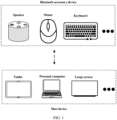
- FIG. 1 shows an example of a communication system according to an embodiment of this application.
- the communication system may include a plurality of Bluetooth accessory devices (also referred to as Bluetooth accessories, accessories, accessory devices, or secondary devices) and a plurality of host devices.
- a plurality of Bluetooth accessory devices also referred to as Bluetooth accessories, accessories, accessory devices, or secondary devices
- a plurality of host devices also referred to as Bluetooth accessories, accessories, accessory devices, or secondary devices
- Both the Bluetooth accessory devices and the host devices are intelligent terminal devices, and may be of various types. This is not limited in embodiments of this application.
- the Bluetooth accessory devices may include a speaker, a mouse, and a keyboard, and may further include a stylus, an earphone, and the like.
- the host devices may include a tablet, a personal computer (Personal Computer, PC), and a large screen, and may further include a desktop computer, a laptop computer, a handheld computer, a head unit, a mobile phone, and the like.
- PC Personal Computer
- both the host devices and the Bluetooth accessory devices may be devices that support Bluetooth multi-connection.
- the plurality of Bluetooth accessory devices in the communication system may establish Bluetooth (Bluetooth, BT) communication connections (or referred to as Bluetooth connections) with the host devices, so as to communicate with each other through the established Bluetooth communication connections.
- Bluetooth Bluetooth, BT
- the plurality of Bluetooth accessory devices in the communication system may further establish wired connections or other wireless connections with the host devices.
- the wireless connections are wireless local area network (wireless local area network, WLAN) connections such as wireless fidelity point-to-point (wireless fidelity point-to-point, Wi-Fi P2P) connections, near field communication (near field communication, NFC) connections, and infrared (infrared, IR) technology connections.
- WLAN wireless local area network
- WLAN wireless local area network
- WLAN wireless local area network
- wireless fidelity point-to-point wireless fidelity point-to-point, Wi-Fi P2P
- NFC near field communication
- infrared infrared
- the plurality of host devices in the communication system may be configured with different software operating systems (Operating Systems, OSs), including but not limited to HarmonyOS ® , Android ® , iOS ® , Windows ® , and Linux ® .
- HarmonyOS ® is Huawei HarmonyOS.
- the plurality of host devices may also be configured with a same software operating system, for example, HarmonyOS ® .
- the accessory devices may alternatively not be Bluetooth accessory devices.
- Bluetooth accessory devices such as a Bluetooth mouse, a Bluetooth keyboard, a stylus, and a Bluetooth speaker
- a host device for example, a tablet, a personal computer, and a large screen.
- these Bluetooth accessory devices are still independent of each other, cannot perform data exchange, and cannot cooperatively complete a task or implement a function. This brings great limitation to a product design, and results in poor user experience.
- Application scenario 1 Switch Bluetooth communication connections of a plurality of Bluetooth accessory devices.
- Each Bluetooth accessory device may perform Bluetooth pairing with one or more host devices (such as a tablet, a PC, or a large screen) and establish a Bluetooth communication connection. It is assumed that a plurality of Bluetooth accessory devices have performed Bluetooth pairing with a host device 100 and a host device 200, and currently, the plurality of Bluetooth accessory devices all maintain established Bluetooth communication connections with the host device 100. If a user wants to switch the Bluetooth communication connections of the plurality of Bluetooth accessory devices from the host device 100 to the host device 200 (that is, the plurality of Bluetooth accessory devices all establish Bluetooth communication connections with the host device 200 to exchange data with the host device 200), the following two possible implementations are available.
- the plurality of Bluetooth accessory devices may separately support the user to implement switching of the Bluetooth communication connections from the host device 100 to the host device 200 through a switching button.
- the user needs to operate the switching button on each of the plurality of Bluetooth accessory devices once, so as to implement switching of the Bluetooth communication connections of the plurality of Bluetooth accessory devices from the host device 100 to the host device 200.
- the operation is complex, and user experience is poor.
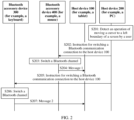
- a keyboard-and-mouse traversal solution is as follows: The host device detects a switching condition of a Bluetooth communication connection, and separately controls a mouse and a keyboard when it is determined that the switching condition is met. The following separately describes an execution process of the solution with reference to FIG. 2 and FIG. 3 .
- the host device 100 is a tablet
- the host device 200 is a PC
- the host device 201 is a large screen. Positions of the three host devices may be shown in FIG. 1 .
- the host device 200 is located in a middle position, the host device 100 is located on a left side of the host device 200, and the host device 201 is located on a right side of the host device 200. Position information of the three host devices is already configured on the three host devices in advance.
- a Bluetooth accessory device 300 is a keyboard
- a Bluetooth accessory device 400 is a mouse.
- the Bluetooth accessory device 300 and the Bluetooth accessory device 400 each establish a Bluetooth communication connection with the host device 200. In this way, the host device 200 may establish a control service channel with the Bluetooth accessory device 300 and the Bluetooth accessory device 400, so as to perform data exchange.
- FIG. 2 shows an example of a specific procedure of switching Bluetooth communication connections of the Bluetooth accessory device 300 and the Bluetooth accessory device 400 from the host device 200 to the host device 100. Specific steps are described below.
- the host device 200 detects an operation of moving a cursor to a left boundary of a screen by the user.
- the host device 200 may monitor a position of the cursor and a movement direction of the cursor of the Bluetooth accessory device 400 in real time. When it is detected that the cursor is located at a boundary of the screen and moves towards the boundary of the screen, position information of another host device is already configured on the host device 200 in advance. Therefore, when the host device 200 may determine that the cursor is located at the left boundary of the screen and moves towards the left boundary of the screen, the user intends to switch a Bluetooth communication connection of the Bluetooth accessory device to the host device 100.
- the host device 200 may separately send, to the Bluetooth accessory device 300 and the Bluetooth accessory device 400, an instruction for switching a Bluetooth communication connection to the host device 100 (that is, perform the following steps S202 and S205).
- the host device 200 sends, to the Bluetooth accessory device 400, the instruction for switching the Bluetooth communication connection to the host device 100; after receiving the instruction, the Bluetooth accessory device 400 may switch a Bluetooth channel; and after switching is complete, the Bluetooth accessory device 400 may send a message 1 to the host device 100.
- the Bluetooth accessory device 400 may switch the Bluetooth channel to the host device 100. After switching is complete, the Bluetooth accessory device 400 establishes a Bluetooth communication connection with the host device 100. Then, the Bluetooth accessory device 400 may send the message 1 to the host device 100 to exchange data with the host device 100.
- the message 1 may include a cursor movement message and a button message of the Bluetooth accessory device 400.
- the host device 100 may perform a related task (for example, displaying a position of the cursor and responding to a button operation) based on the message 1.
- the host device 200 sends, to the Bluetooth accessory device 300, the instruction for switching the Bluetooth communication connection to the host device 100; after receiving the instruction, the Bluetooth accessory device 300 may switch a Bluetooth channel; and after switching is complete, the Bluetooth accessory device 300 may send a message 2 to the host device 100.
- the Bluetooth accessory device 300 may switch the Bluetooth channel to the host device 100. After switching is complete, the Bluetooth accessory device 300 establishes a Bluetooth communication connection with the host device 100. Then, the Bluetooth accessory device 300 may send the message 2 to the host device 100 to exchange data with the host device 100.
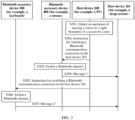
- FIG. 3 shows an example of a specific procedure of switching Bluetooth communication connections of the Bluetooth accessory device 300 and the Bluetooth accessory device 400 from the host device 200 to the host device 201. Specific steps are described below.
- the host device 200 detects an operation of moving a cursor to a right boundary of a screen by the user.
- the host device 200 may monitor a position of the cursor and a movement direction of the cursor of the Bluetooth accessory device 400 in real time.
- position information of another host device is already configured on the host device 200 in advance. Therefore, when the host device 200 may determine that the cursor is located at the right boundary of the screen and moves towards the right boundary of the screen, the user intends to switch a Bluetooth communication connection of the Bluetooth accessory device to the host device 201.
- the host device 200 may separately send, to the Bluetooth accessory device 300 and the Bluetooth accessory device 400, an instruction for switching a Bluetooth communication connection to the host device 201 (that is, perform the following steps S302 and S305).
- the host device 200 sends, to the Bluetooth accessory device 400, the instruction for switching the Bluetooth communication connection to the host device 201; after receiving the instruction, the Bluetooth accessory device 400 may switch a Bluetooth channel; and after switching is complete, the Bluetooth accessory device 400 may send a message 1' to the host device 201.
- the Bluetooth accessory device 400 may switch the Bluetooth channel to the host device 201. After switching is complete, the Bluetooth accessory device 400 establishes a Bluetooth communication connection with the host device 201. Then, the Bluetooth accessory device 400 may send the message 1' to the host device 201 to exchange data with the host device 201.
- the message 1' may include a cursor movement message and a button message of the Bluetooth accessory device 400.
- the host device 201 may perform a related task (for example, displaying a position of the cursor and responding to a button operation) based on the message 1'.
- the host device 200 sends, to the Bluetooth accessory device 300, the instruction for switching the Bluetooth communication connection to the host device 201; after receiving the instruction, the Bluetooth accessory device 300 may switch a Bluetooth channel; and after switching is complete, the Bluetooth accessory device 300 may send a message 2' to the host device 201.
- the Bluetooth accessory device 300 may switch the Bluetooth channel to the host device 201. After switching is complete, the Bluetooth accessory device 300 establishes a Bluetooth communication connection with the host device 201. Then, the Bluetooth accessory device 300 may send the message 2' to the host device 201 to exchange data with the host device 201.
- the message 2' may include a button message of the Bluetooth accessory device 300.
- the host device 201 may perform a related task (for example, responding to a button operation) based on the message 2'.
- a complex application needs to be developed on a host device, which has strong customization and cannot cover a plurality of scenarios.
- a plurality of Bluetooth accessory devices cannot exchange data with each other, and can only passively receive a control instruction from the host device.
- Function evolution needs to strongly depend on the application on the host device, and the plurality of Bluetooth accessory devices cannot implement some scenario-based functions in collaboration.
- the user needs to configure position information of host devices in advance. In this case, the solution is complex, and the user needs to participate heavily, resulting in poor experience.
- Application scenario 2 Control a Bluetooth accessory device to adjust a related configuration
- the Bluetooth accessory device has some configuration functions, for example, dots per inch (Dots Per Inch, DPI) adjustment and light effect adjustment of a mouse.
- DPI dots per inch
- a button may be added to the mouse or a related application may be developed on a host device to support a manual configuration by a user.
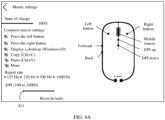
- FIG. 4A shows an example of a user interface for setting a mouse on a host device.
- the user interface may include a DPI adjustment drag bar 411, and a user may adjust DPI of the mouse by dragging the DPI adjustment drag bar 411.
- the mouse has DPI plus and DPI minus buttons, and the user may alternatively adjust the DPI of the mouse by operating the two buttons on the mouse.
- the user may alternatively adjust the DPI of the mouse by operating the two buttons on the mouse.
- DPI plus and DPI minus buttons it is not expected to add too many control buttons to the mouse. Therefore, a common solution in the current market is to develop a related application on a host device for configuration.
- the user interface may further support a specific function of configuring a button on the mouse as a button combination on the keyboard by the user.
- FIG. 4B shows an example of a user interface for adjusting a light effect of the mouse on the host device.
- the user interface may support the user in turning on/off a light effect, turning on/off an outline light, setting a light color, setting a speed, setting brightness, and the like for the mouse.
- the related application is developed on the host device to implement adjustment of configurations such as the DPI and the light effect on the mouse, each adjustment requires the user to start the application, and operations are complex.
- the button is added to the mouse to implement the specific function of the button combination on the keyboard. Because a quantity of buttons of the mouse is limited, a requirement of common button combinations cannot be covered. In addition, software and hardware costs are increased, and an appearance design and an ID design of the mouse are restricted.
- a user uses a keyboard and a mouse
- the user uses a left hand to operate the keyboard and a right hand to operate the mouse.
- the user needs to separate the right hand from the mouse, and press Fn and Fx respectively by using the left hand and the right hand to implement a function of the button combination.
- Application scenario 5 A plurality of Bluetooth accessory devices separately establish Bluetooth communication connections with a plurality of host devices
- a user may separately trigger each Bluetooth channel of the Bluetooth accessory device to send a Bluetooth broadcast message.
- the host devices may discover the corresponding Bluetooth accessory device based on the Bluetooth broadcast message, and may further perform Bluetooth pairing with the Bluetooth accessory devices one by one and establish Bluetooth communication connections.
- FIG. 5 is an example of a diagram of separately establishing Bluetooth connections between a plurality of Bluetooth accessory devices and a plurality of host devices.
- two Bluetooth accessory devices separately establish Bluetooth communication connections with three host devices (for example, a host device 100, a host device 200, and a host device 201).
- three host devices for example, a host device 100, a host device 200, and a host device 201.
- the user wants to establish Bluetooth communication connections between the Bluetooth accessory device 300 and the three host devices, the user needs to separately trigger the Bluetooth accessory device 300 to perform Bluetooth pairing with the three host devices in sequence, that is, the user needs to perform three Bluetooth pairing operations to establish the Bluetooth communication connections between the Bluetooth accessory device 300 and the three host devices.
- the Bluetooth pairing operation needs to be performed three times to implement the establishment of the Bluetooth communication connections between the Bluetooth accessory device 300 and the three host devices.
- An embodiment of this application provides a communication method.
- a plurality of Bluetooth accessory devices establish Bluetooth communication connections with a host device
- a data communication channel may be provided for the plurality of Bluetooth accessory devices based on a Bluetooth routing function of the host device.
- data communication may be performed between the plurality of Bluetooth accessory devices, so that the plurality of Bluetooth accessory devices can implement differentiated functions in collaboration in corresponding scenarios, to simplify user operations and improve user experience.
- the communication method provided in an embodiment of this application mainly includes the following four solutions.
- An operating system configured for the host device may include but is not limited to HarmonyOS ® , Android ® , macOS ® , and Windows ® .
- a software architecture of the host device may be an architecture shown in FIG. 6A as an example.
- the host device may include an application layer, a framework layer, and a driver layer.
- the application layer may include a series of applications.
- the framework layer may provide an application programming interface (application programming interface, API) and a programming framework for applications at the application layer.
- the framework layer includes some predefined functions.
- the framework layer may include an input subsystem and a Bluetooth management service module.
- the input subsystem may be configured to receive input events such as a button and a touch, may process these original input events, and may further dispatch these events.
- the input subsystem may further provide an interface for injecting an event.
- An application may generate an input event by invoking the interface, and then inject the input event into the input subsystem for processing.
- the Bluetooth management service module may include a Bluetooth device management service module and a Bluetooth route management service module.
- the Bluetooth device management service module may be configured to query whether a Bluetooth device exists nearby, establish a Bluetooth communication connection with a Bluetooth accessory device, be responsible for that a local device can be discovered or connected by another device, and the like.
- the Bluetooth route management service module is a core module of embodiments of this application, and may be configured to be responsible for route registration management, data forwarding, and the like of a Bluetooth accessory device.
- the driver layer may be configured to detect and enable hardware.
- the driver layer may include one or more drivers, for example, a display driver, a camera driver, an audio driver, a sensor driver, and a Bluetooth driver.
- a software architecture of the host device may be an architecture shown in FIG. 6B as an example.
- the host device may include an application layer, a Windows software development kit (Software Development Kit, SDK), and a driver layer.
- a Windows software development kit Software Development Kit, SDK
- driver layer a driver layer
- the application layer may include a series of applications, for example, an application 1 (for example, a computer manager).
- the application 1 may include a Bluetooth route management service module.
- the Bluetooth route management service module shown in FIG. 6B is integrated in the application layer, and a function of the Bluetooth route management service module may be similar to that of the Bluetooth route management service module shown in FIG. 6A .
- the Windows SDK may include a Bluetooth SDK.
- the Bluetooth SDK may provide a related interface for the Bluetooth route management service module in the upper-layer application to implement the method provided in embodiments of this application.
- the driver layer may be configured to detect and enable hardware.
- the driver layer may include one or more drivers, for example, a display driver, a camera driver, an audio driver, a sensor driver, and a Bluetooth driver.
- FIG. 6A and FIG. 6B are merely examples, and should not impose any limitation on the software architecture of the host device in embodiments of this application.
- the software architecture of the host device may alternatively use a layered structure different from that in the examples shown in FIG. 6A and FIG. 6B , or each layer may further include more or fewer modules, a combination of a plurality of different modules, or the like. This is not limited in embodiments of this application.
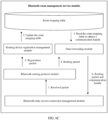
- FIG. 6C is an example of a diagram of an architecture of the foregoing Bluetooth route management service module according to an embodiment of this application.
- the Bluetooth route management service module may include a Bluetooth route service connection management module, a Bluetooth routing protocol module, a routing device registration management module, a data forwarding module, and a route mapping table.
- the Bluetooth route service connection management module may be configured to: establish a specific universally unique identifier (Universally Unique Identifier, UUID) service connection and device authentication based on a Bluetooth protocol; send a received packet to the Bluetooth routing protocol module; provide a data transmitting/receiving interface; send a routing packet to a corresponding Bluetooth accessory device based on the routing packet and a communication handle that are sent by the data forwarding module; and the like.
- UUID Universally unique Identifier
- the received packet may be a packet (for example, a registration packet or a routing packet) from the Bluetooth accessory device.
- the Bluetooth routing protocol module may be configured to be responsible for parsing the packet sent by Bluetooth route service connection management, sending the registration packet to the routing device registration management module, sending the routing packet to the data forwarding module, and the like.
- the routing device registration management module may be configured to: receive the registration packet sent by the Bluetooth routing protocol module, update the route mapping table, and the like.
- the routing device registration management module may write the communication handle into the corresponding route mapping table based on a registered device type in the registration packet.
- the communication handle may include information about a Bluetooth communication connection corresponding to the registered device type (for example, information about a Bluetooth channel).
- the route mapping table may be used to record and store a mapping relationship between the registered device type and the communication handle, namely, a mapping relationship between the registered device type and the Bluetooth communication connection.
- the data forwarding module may be configured to receive the routing packet sent by the Bluetooth routing protocol module; may further read the route mapping table based on a destination device type carried in the routing packet, to obtain a communication handle corresponding to the destination device type; may further send the routing packet and the communication handle to the Bluetooth route service connection management module; and the like.
- FIG. 6C is merely an example, and should not impose any limitation on an architecture of the Bluetooth route management service module in embodiments of this application.
- the architecture of the Bluetooth route management service module may further include more or fewer modules, a combination of a plurality of different modules, or the like. This is not limited in embodiments of this application.
- FIG. 6D is an example of a diagram of a structure of a Bluetooth routing protocol packet according to an embodiment of this application.
- the Bluetooth routing protocol packet may include the following fields: version information (Version), a data type (Data Type), a source device type (Source Device Type, SrcDevType), a destination device type (Destination Device Type, DestDevType), a reserved (Reserved, Rev) field, and a payload (Payload).
- the version information may have a field length of 1 byte, may include information such as a version of a routing protocol, and may be used to perform protocol matching check between devices.
- the data type may have a field length of 1 byte, and may indicate a data type of a packet.
- 0 ⁇ 01 may indicate that a data type of a packet is a registration type, that is, the packet is a registration packet (which may also be referred to as a device registration packet), and 0 ⁇ 02 may indicate that a data type of a packet is a routing type, that is, the packet is a routing packet (namely, a packet that needs to be routed to another device).
- the source device type (Source Device Type, SrcDevType) may have a field length of 1 byte, and may indicate a device type of a packet sender.
- 0 ⁇ 00 may indicate a host device
- 0 ⁇ 01 may indicate a mouse device
- 0 ⁇ 02 may indicate a keyboard device
- 0 ⁇ 03 may indicate a stylus device
- 0 ⁇ 04 may indicate a speaker device.
- the destination device type may have a field length of 2 bytes, and may indicate a device type of a packet receiver.
- Each bit may indicate a device type. For example, bit 0 may indicate a host device, bit 1 may indicate a mouse device, bit 2 may indicate a keyboard device, bit 3 may indicate a stylus device, and bit 4 may indicate a speaker device.
- a destination device type may be a device type indicated by the one or more bits. For example, if bit 1 is set to 1, a destination device type is a mouse device. For another example, if bit 1 and bit 2 are set to 1, destination device types are a mouse device and a keyboard device.
- the reserved (Reserved, Rev) field may have a field length of 2 bytes, and may indicate undefined data for subsequent extension.
- the payload may have a field length of n bytes (where n is a positive integer), may be based on a service requirement between devices, and may indicate self-defined data.
- the self-defined data may include information about an event detected by a Bluetooth accessory device (for example, information about an event of pressing a button on a keyboard by a user, and information about an event of pressing a button on a mouse by a user).
- a Bluetooth accessory device for example, information about an event of pressing a button on a keyboard by a user, and information about an event of pressing a button on a mouse by a user.
- the structure of the Bluetooth routing protocol packet shown in FIG. 6D is merely an example. In some embodiments, the structure of the Bluetooth routing protocol packet may be another structure. This is not limited in embodiments of this application.
- the following describes a diagram of a software architecture of a Bluetooth accessory device according to an embodiment of this application.
- An operating system configured for the Bluetooth accessory device may include but is not limited to HarmonyOS ® , Linux ® , and a lightweight Internet of Things system kernel LiteOS ® .
- the operating system configured for the Bluetooth accessory device may be an embedded operating system, or no operating system is configured for the Bluetooth accessory device.
- FIG. 7 is an example of a diagram of a software architecture of a Bluetooth accessory device.
- the Bluetooth accessory device may include an application layer, a service layer, and a driver layer.
- the application layer is an implementation module of a specific service function of the Bluetooth accessory device, and may include an event processing module.
- the event processing module may be configured to receive information about an event sent by a Bluetooth data communication service module, and may be further configured to perform a corresponding action based on the information about the event. For example, in response to an event of pressing a button on a keyboard by a user, a button value corresponding to the button is sent to a host device based on a Bluetooth protocol of a human interface device (Human Interface Device, HID), or an action of switching a Bluetooth channel is performed.
- HID Human Interface Device
- the service layer is a module that provides a general capability of the Bluetooth accessory device, and may include an event monitoring module and a Bluetooth data communication service module.
- the event monitoring module may be configured to be responsible for monitoring all events of the Bluetooth accessory device (for example, an event of pressing a button by the user, an event of releasing a button by the user, an event of establishing a Bluetooth communication connection, and an event of disconnecting a Bluetooth communication connection), and may further collect information about the foregoing events.
- the Bluetooth data communication service module may be configured to be responsible for encapsulation and parsing of route data, provide a transmitting/receiving interface of the route data, and the like.
- the driver layer is a module for detecting and enabling hardware of the Bluetooth accessory device, and may include a button collection module and a Bluetooth SDK.
- the button collection module may be configured to obtain a button pressing behavior of the user.
- the Bluetooth SDK may provide a basic SDK of a Bluetooth chip.
- FIG. 7 is merely an example, and should not impose any limitation on the software architecture of the Bluetooth accessory device in embodiments of this application.
- the software architecture of the Bluetooth accessory device may alternatively use a layered structure different from that in the example shown in FIG. 7 , or each layer may further include more or fewer modules, a combination of a plurality of different modules, or the like. This is not limited in embodiments of this application.
- FIG. 8A to FIG. 8C show an example of a specific procedure of a Bluetooth routing method according to an embodiment of this application.
- the method may be applied to a communication system including a host device, a Bluetooth accessory device A, and a Bluetooth accessory device B.
- the host device may include a Bluetooth route management service module
- the Bluetooth accessory device A may include an event monitoring module and a Bluetooth data communication service module
- the Bluetooth accessory device B may include an event processing module and a Bluetooth data communication service module. Specific steps of the method are described in detail below.
- Bluetooth route service connections need to be established between the host device and the Bluetooth accessory device A and between the host device and the Bluetooth accessory device B, and the Bluetooth accessory device A and the Bluetooth accessory device B need to register device types with the host device. Steps in the following phase 2 can continue to be performed only after the Bluetooth route service connections are established and the device types are registered, so as to perform Bluetooth route data communication between devices.
- a possible implementation of establishing the Bluetooth route service connections and registering the device types may be an implementation described in the following phase 1 (step S801 to step S806), which is described in detail below.
- Phase 1 Establish the Bluetooth route service connections and register the device types
- the Bluetooth accessory device A establishes a Bluetooth route service connection 1 with the host device, and then the Bluetooth accessory device A may send a registration request 1 to the host device, where the request includes a device type of the Bluetooth accessory device A; and the host device stores a mapping relationship between a Bluetooth communication connection 1 and the device type of the Bluetooth accessory device A, where the Bluetooth communication connection 1 is a Bluetooth communication connection established between the Bluetooth accessory device A and the host device.
- the Bluetooth route service connection 1 may be a service connection of a specific UUID established based on a Bluetooth protocol.
- the Bluetooth accessory device A may perform device registration (for example, perform Bluetooth routing device type registration) with the host device, and perform data communication with the host device.
- the Bluetooth data communication service module of the Bluetooth accessory device A may actively send the registration request 1 to the Bluetooth route management service module of the host device.
- the request may be a request of the Bluetooth accessory device A for registering a Bluetooth routing device type with the host device, and the request may include the device type of the Bluetooth accessory device A.
- the registration request 1 is a registration packet.
- the Bluetooth route management service module of the host device may obtain the device type of the Bluetooth accessory device A by parsing the registration request 1, and then record and store the mapping relationship between the Bluetooth communication connection 1 and the device type of the Bluetooth accessory device A.
- the Bluetooth accessory device A before the Bluetooth accessory device A establishes the Bluetooth route service connection 1 with the host device, the Bluetooth accessory device A further needs to establish the Bluetooth communication connection 1 with the host device first, where the Bluetooth communication connection 1 may be established through a Bluetooth device management module of the host device. In other words, on the basis that the Bluetooth accessory device A establishes the Bluetooth communication connection 1 with the host device, the Bluetooth accessory device A may establish the Bluetooth route service connection 1 with the host device.
- the Bluetooth accessory device B establishes a Bluetooth route service connection 2 with the host device, and then the Bluetooth accessory device B may send a registration request 2 to the host device, where the request includes a device type of the Bluetooth accessory device B; and the host device stores a mapping relationship between a Bluetooth communication connection 2 and the device type of the Bluetooth accessory device B, where the Bluetooth communication connection 2 is a Bluetooth communication connection established between the Bluetooth accessory device B and the host device.
- the Bluetooth route service connection 2 may be a service connection of a specific UUID established based on a Bluetooth protocol.
- the Bluetooth accessory device B may perform device registration (for example, perform Bluetooth routing device type registration) with the host device, and perform data communication with the host device.
- the Bluetooth data communication service module of the Bluetooth accessory device B may actively send the registration request 2 to the Bluetooth route management service module of the host device, where the request may be a request of the Bluetooth accessory device B for registering a Bluetooth routing device type with the host device, and the request may include the device type of the Bluetooth accessory device B.
- the registration request 2 is a registration packet.
- a structure of the registration request 2 refer to the structure of the packet shown in FIG. 6D .
- the Bluetooth route management service module of the host device may obtain the device type of the Bluetooth accessory device B by parsing the registration request 2, and then record and store the mapping relationship between the Bluetooth communication connection 2 and the device type of the Bluetooth accessory device B.
- the Bluetooth accessory device B further needs to establish the Bluetooth communication connection 2 with the host device first, where the Bluetooth communication connection 2 may be established through the Bluetooth device management module of the host device. In other words, on the basis that the Bluetooth accessory device B establishes the Bluetooth communication connection 2 with the host device, the Bluetooth accessory device B may establish the Bluetooth route service connection 2 with the host device.
- step S801 to step S803 and step S804 to step S806 are not limited in embodiments of this application.
- step S801 to step S803 may be performed before step S804 to step S806.
- step S801 to step S803 may be performed after step S804 to step S806.
- step S801 to step S803 and step S804 to step S806 may be performed simultaneously.
- Bluetooth route data communication between devices may be performed through the established Bluetooth route service connections.
- a possible implementation of performing Bluetooth route data communication between the devices may be an implementation described in the following phase 2 (step S807 to step S821), which is described in detail below.
- Phase 2 Perform Bluetooth route data communication between the devices
- the event monitoring module of the Bluetooth accessory device A detects that an event a occurs, and then the event monitoring module of the Bluetooth accessory device A may send data 1 to the Bluetooth data communication service module of the Bluetooth accessory device A, where the data may include information about the event a and a destination device type 1; and the Bluetooth data communication service module of the Bluetooth accessory device A may encapsulate the data 1, and then send encapsulated data 1 to the Bluetooth route management service module of the host device.
- the event monitoring module of the Bluetooth accessory device A may perform event monitoring in real time. After detecting that the event a (for example, an event of pressing a button of the Bluetooth accessory device A by a user) occurs, the event monitoring module may invoke a data sending interface provided by the Bluetooth data communication service module to send the data 1 to the Bluetooth data communication service module, where the data may include the information about the event a (for example, information about a button value corresponding to a button of the Bluetooth accessory device A pressed by the user) and the destination device type 1.
- the data 1 may include one or more destination device types (for example, the destination device type 1), and the one or more destination device types may be preset and do not need to be manually set by the user.
- the one or more destination device types are device types corresponding to devices (namely, receivers of the data 1) that need to receive the data 1.
- the Bluetooth data communication service module of the Bluetooth accessory device A may encapsulate the data 1 to obtain data satisfying a Bluetooth protocol format, namely, the encapsulated data 1.
- the encapsulated data 1 is a routing packet.
- a structure of the encapsulated data 1 refer to the structure of the packet shown in FIG. 6D .
- the Bluetooth data communication service module of the Bluetooth accessory device A may send the encapsulated data 1 to the Bluetooth route management service module of the host device.
- the Bluetooth route management service module of the host device determines, based on the encapsulated data 1, that the destination device type 1 is the device type of the Bluetooth accessory device B, and determines, based on stored mapping relationships between device types and Bluetooth communication connections, that a Bluetooth communication connection corresponding to the destination device type 1 is the Bluetooth communication connection 2; and then the Bluetooth route management service module of the host device may send the encapsulated data 1 to the Bluetooth data communication service module of the Bluetooth accessory device B.
- the Bluetooth route management service module of the host device may parse the encapsulated data 1 to obtain the destination device type 1 and determine that the destination device type 1 is the device type of the Bluetooth accessory device B.
- the Bluetooth route management service module of the host device may determine, based on the stored mapping relationships between the device types and the Bluetooth communication connections, that the Bluetooth communication connection corresponding to the destination device type 1 is the Bluetooth communication connection 2. Further, the Bluetooth route management service module of the host device may determine that the encapsulated data 1 needs to be sent to the Bluetooth accessory device B through the Bluetooth communication connection 2. Then, the Bluetooth route management service module of the host device may send the encapsulated data 1 to the Bluetooth data communication service module of the Bluetooth accessory device B through the Bluetooth communication connection 2.
- the data 1 in step S808 may alternatively include only the information about the event a, and does not include the destination device type 1.
- the host device may alternatively send only the information about the event a included in the data 1 to the Bluetooth accessory device B.
- the Bluetooth data communication service module of the Bluetooth accessory device B parses the encapsulated data 1 to identify the information about the event a, and then the Bluetooth data communication service module of the Bluetooth accessory device B may send an event processing message to the event processing module of the Bluetooth accessory device B, where the message includes the information about the event a.
- the Bluetooth data communication service module of the Bluetooth accessory device B may parse the encapsulated data 1, so as to identify the information about the event a included in the encapsulated data 1. Then, the Bluetooth data communication service module of the Bluetooth accessory device B may send the event processing message to the event processing module of the Bluetooth accessory device B, so as to notify the event processing module of the Bluetooth accessory device B to process the event a, where the message may include the information about the event a.
- the event processing module of the Bluetooth accessory device B performs an action corresponding to the event a, and after the action is completed, may send an event processing complete message to the Bluetooth data communication service module of the Bluetooth accessory device B.
- the event processing module of the Bluetooth accessory device B may process the event a, that is, perform the action corresponding to the event a. After the action is completed, the event processing complete message may be sent to the Bluetooth data communication service module of the Bluetooth accessory device B, so as to notify the Bluetooth data communication service module of the Bluetooth accessory device B that the event processing module of the Bluetooth accessory device B has completed processing of the event a.
- the event processing complete message may include a result of processing the event a by the Bluetooth accessory device B.
- the Bluetooth data communication service module of the Bluetooth accessory device B sends response data to the Bluetooth route management service module of the host device, where the data includes the event processing complete message and a destination device type 2.
- the Bluetooth data communication service module of the Bluetooth accessory device B may generate the response data, where the data may include the event processing complete message and the destination device type 2. Then, the Bluetooth data communication service module of the Bluetooth accessory device B may send the response data to the Bluetooth route management service module of the host device, so that the result of processing the event a by the Bluetooth accessory device B is fed back to the Bluetooth accessory device A through the host device.
- the destination device type 2 may be a device type (namely, the device type of the Bluetooth accessory device A) corresponding to a sender of the data 1.
- the response data is a routing packet.
- For a structure of the response data refer to the structure of the packet shown in FIG. 6D .
- the Bluetooth route management service module of the host device determines, based on the response data, that the destination device type 2 is the device type of the Bluetooth accessory device A, and determines, based on the stored mapping relationships between the device types and the Bluetooth communication connections, that a Bluetooth communication connection corresponding to the destination device type 2 is the Bluetooth communication connection 1; and then the Bluetooth route management service module of the host device may send the response data to the Bluetooth data communication service module of the Bluetooth accessory device A.
- the destination device type 2 is the device type of the Bluetooth accessory device A.
- the Bluetooth route management service module of the host device may parse the response data to obtain the destination device type 2 and determine that the destination device type 2 is the device type of the Bluetooth accessory device A. Further, because the Bluetooth route management service module of the host device records and stores the mapping relationship between the device type of the Bluetooth accessory device A and the Bluetooth communication connection 1 in the phase 1, the Bluetooth route management service module of the host device may determine, based on the stored mapping relationships between the device types and the Bluetooth communication connections, that the Bluetooth communication connection corresponding to the destination device type 2 is the Bluetooth communication connection 1.
- the Bluetooth route management service module of the host device may determine that the response data needs to be sent to the Bluetooth accessory device A through the Bluetooth communication connection 1. Then, the Bluetooth route management service module of the host device may send the response data to the Bluetooth data communication service module of the Bluetooth accessory device A through the Bluetooth communication connection 1.
- the Bluetooth data communication service module of the Bluetooth accessory device A parses the response data to obtain the event processing complete message, and then the Bluetooth data communication service module of the Bluetooth accessory device A may send the event processing complete message to the event monitoring module of the Bluetooth accessory device A.
- the Bluetooth data communication service module of the Bluetooth accessory device A may parse the response data to obtain the event processing complete message. Then, the Bluetooth data communication service module of the Bluetooth accessory device A may send the event processing complete message to the event monitoring module of the Bluetooth accessory device A, so as to notify the event monitoring module of the Bluetooth accessory device A of the result of processing the event a by the Bluetooth accessory device B.
- Bluetooth route service connections need to be established between the host device 100 and the Bluetooth accessory device 300, the Bluetooth accessory device 400, and the Bluetooth accessory device 500, and the Bluetooth accessory device 300, the Bluetooth accessory device 400, and the Bluetooth accessory device 500 need to register device types with the host device 100.
- Steps in the following phase 2 can continue to be performed only after the Bluetooth route service connections are established and the device types are registered, so as to switch Bluetooth communication connections of a plurality of Bluetooth accessory devices.
- the Bluetooth communication connections of the plurality of Bluetooth accessory devices may be switched based on the established Bluetooth route service connections.
- a possible implementation of switching the Bluetooth communication connections of the plurality of Bluetooth accessory devices may be an implementation described in the following phase 2 (step S910 to step S920), which is described in detail below.
- Phase 2 Switch the Bluetooth communication connections of the plurality of Bluetooth accessory devices
- the Bluetooth accessory device 300 detects an event that a user triggers switching of a Bluetooth communication connection from the host device 100 to the host device 200 (namely, a switching event), and then the Bluetooth accessory device 300 may send data 1 to the host device 100, where the data may include information about the switching event, the device type of the Bluetooth accessory device 400, and the device type of the Bluetooth accessory device 500.
- the Bluetooth accessory device 300 is an example keyboard shown in FIG. 10 .
- the Bluetooth accessory device 300 has an F8 button, an F9 button, and an F10 button, and the three buttons (which may alternatively be referred to as Bluetooth switching buttons) may all be configured to support the Bluetooth accessory device 300 in performing Bluetooth pairing with another device and establishing a Bluetooth communication connection.
- the Bluetooth accessory device 300 may have three Bluetooth channels, the three buttons each may correspond to one Bluetooth channel, and the Bluetooth accessory device 300 may separately perform Bluetooth pairing with other three devices and establish Bluetooth communication connections through the three Bluetooth channels.
- the user only needs to tap the F8 button, the F9 button, and the F10 button to switch a Bluetooth communication connection between the devices, and does not need to perform Bluetooth pairing again. This is convenient and quick.
- an accessory device for example, the Bluetooth accessory device 300
- the accessory device can perform data communication (for example, Bluetooth data communication) with only one host device with which a communication connection (for example, a Bluetooth communication connection) is established.
- a host device that can perform data communication with the accessory device through an established communication connection may be referred to as a focus host device of the accessory device.
- a host device currently operated or controlled by the accessory device may be referred to as a focus host device of the accessory device.
- a host device currently controlling the accessory device may be referred to as a focus host device of the accessory device.
- focus host devices of the Bluetooth accessory device 300, the Bluetooth accessory device 400, and the Bluetooth accessory device 500 are all the host device 100; and after the switching event is triggered, the focus host devices of the Bluetooth accessory device 300, the Bluetooth accessory device 400, and the Bluetooth accessory device 500 may be switched from the host device 100 to another host device (for example, the host device 200).
- switching a Bluetooth communication connection of a Bluetooth accessory device may refer to changing a focus host device of the Bluetooth accessory device from one host device to another host device.
- the Bluetooth accessory device may perform Bluetooth data communication with a host device (for example, the host device 100) through a Bluetooth communication connection established with the host device (for example, the host device 100); and after switching, the Bluetooth accessory device may perform Bluetooth data communication with another host device (for example, the host device 200) through a Bluetooth communication connection established with the another host device (for example, the host device 200).
- the Bluetooth accessory device 300 may send the data 1 to the host device 100 through the Bluetooth route service connection 1 established with the host device 100, where the data may include the information about the switching event, the device type of the Bluetooth accessory device 400, and the device type of the Bluetooth accessory device 500.
- the information about the switching event may include device information of the host device 200, for example, a Bluetooth media access control (Media Access Control, MAC) address of the host device 200.
- the Bluetooth MAC address of the host device 200 may be a complete Bluetooth MAC address, or may be a partial Bluetooth MAC address, for example, last three bits of the Bluetooth MAC address, so as to improve security.
- the device type of the Bluetooth accessory device 400 and the device type of the Bluetooth accessory device 500 may be destination device types, which are preset and do not need to be manually set by the user.
- the host device 100 determines, based on the data 1, that the destination device types are the device type of the Bluetooth accessory device 400 and the device type of the Bluetooth accessory device 500, and determines, based on stored mapping relationships between device types and Bluetooth communication connections, that a Bluetooth communication connection corresponding to the device type of the Bluetooth accessory device 400 is the Bluetooth communication connection 2, and that a Bluetooth communication connection corresponding to the device type of the Bluetooth accessory device 500 is the Bluetooth communication connection 3; and then the host device 100 may separately send the data 1 to the Bluetooth accessory device 400 and the Bluetooth accessory device 500.
- the host device 100 may parse the data 1 and determine that the destination device types are the device type of the Bluetooth accessory device 400 and the device type of the Bluetooth accessory device 500. Further, in the phase 1, the host device 100 records and stores the mapping relationship between the device type of the Bluetooth accessory device 400 and the Bluetooth communication connection 2 and the mapping relationship between the device type of the Bluetooth accessory device 500 and the Bluetooth communication connection 3. Therefore, the host device 100 may determine, based on the stored mapping relationships between the device types and the Bluetooth communication connections, that a Bluetooth communication connection corresponding to the device type of the Bluetooth accessory device 400 is the Bluetooth communication connection 2, and that a Bluetooth communication connection corresponding to the device type of the Bluetooth accessory device 500 is the Bluetooth communication connection 3.
- the host device 100 may determine that the data 1 needs to be sent to the Bluetooth accessory device 400 through the Bluetooth communication connection 2, and that the data 1 needs to be sent to the Bluetooth accessory device 500 through the Bluetooth communication connection 3. Then, the host device 100 may send the data 1 to the Bluetooth accessory device 400 through the Bluetooth communication connection 2, and send the data 1 to the Bluetooth accessory device 500 through the Bluetooth communication connection 3.
- step S913 and step S914 are not limited in embodiments of this application.
- step S913 may be performed before step S914.
- step S913 may be performed after step S914.
- step S913 and step S914 may be performed simultaneously.
- the Bluetooth accessory device 300 sends a Bluetooth broadcast message 1 to the host device 200, and then the Bluetooth accessory device 300 establishes the Bluetooth communication connection 1 with the host device 200.
- the Bluetooth accessory device 300 may parse the data 1 and determine, based on the data 1, that a Bluetooth communication connection needs to be established with the host device 200. Further, the Bluetooth accessory device 300 may send the Bluetooth broadcast message 1 to the host device 200. After receiving the Bluetooth broadcast message 1 sent by the Bluetooth accessory device 300, the host device 200 may establish the Bluetooth communication connection 1 with the Bluetooth accessory device 300, that is, the Bluetooth accessory device 300 successfully switches a Bluetooth channel to the host device 200. In this way, the Bluetooth accessory device 300 and the host device 200 may perform Bluetooth data communication through the established Bluetooth communication connection 1.
- Step S915 and step S916 may be performed after step S911, or may be performed at time between step S911 and step S914. This is not limited in embodiments of this application.
- the Bluetooth accessory device 400 sends a Bluetooth broadcast message 2 to the host device 200, and then the Bluetooth accessory device 400 establishes a Bluetooth communication connection 2 with the host device 200.
- the Bluetooth accessory device 400 may parse the data 1 and determine, based on the data 1, that the Bluetooth communication connection needs to be established with the host device 200. Further, the Bluetooth accessory device 400 may send the Bluetooth broadcast message 2 to the host device 200. After receiving the Bluetooth broadcast message 2 sent by the Bluetooth accessory device 400, the host device 200 may establish the Bluetooth communication connection 2 with the Bluetooth accessory device 400, that is, the Bluetooth accessory device 400 successfully switches a Bluetooth channel to the host device 200. In this way, the Bluetooth accessory device 400 and the host device 200 may perform Bluetooth data communication through the established Bluetooth communication connection 2.
- the Bluetooth accessory device 500 may parse the data 1 and determine, based on the data 1, that the Bluetooth communication connection needs to be established with the host device 200. Further, the Bluetooth accessory device 500 may send the Bluetooth broadcast message 3 to the host device 200. After receiving the Bluetooth broadcast message 3 sent by the Bluetooth accessory device 500, the host device 200 may establish the Bluetooth communication connection 3 with the Bluetooth accessory device 400, that is, the Bluetooth accessory device 500 successfully switches a Bluetooth channel to the host device 200. In this way, the Bluetooth accessory device 500 and the host device 200 may perform Bluetooth data communication through the established Bluetooth communication connection 3.
- Step S919 and step S920 may be performed at time after step S914. This is not limited in embodiments of this application.
- the Bluetooth accessory device 300, the Bluetooth accessory device 400, and the Bluetooth accessory device 500 may all perform Bluetooth pairing with the host device 200 and do not maintain Bluetooth communication connections with the host device 200.
- the Bluetooth broadcast message 1, the Bluetooth broadcast message 2, and the Bluetooth broadcast message 3 may be respectively referred to as a Bluetooth direct advertising message 1, a Bluetooth direct advertising message 2, and a Bluetooth direct advertising message 3.
- Bluetooth pairing does not need to be performed again.
- the Bluetooth accessory device 300, the Bluetooth accessory device 400, and the Bluetooth accessory device 500 may all maintain Bluetooth communication connections with a plurality of host devices, for example, maintain Bluetooth communication connections with the host device 100 and the host device 200 at the same time. In this case, the Bluetooth accessory devices may switch Bluetooth communication connections from the host device 100 to the host device 200 without sending Bluetooth broadcast messages.
- step S910 before step S910 is performed, if neither the Bluetooth accessory device 400 nor the Bluetooth accessory device 500 has performed Bluetooth pairing with the host device 200, Bluetooth pairing needs to be performed before a Bluetooth communication connection is established, and the Bluetooth communication connection can be established only after pairing succeeds.
- the Bluetooth accessory device may maintain Bluetooth communication connections with a plurality of host devices at the same time (but can perform Bluetooth data communication with only one of the host devices). In this case, after a switching event is triggered, the Bluetooth accessory device may only need to switch Bluetooth channels, and does not need to re-establish the Bluetooth communication connections.
- the Bluetooth accessory device may alternatively maintain a Bluetooth communication connection with only one host device (that is, when a Bluetooth communication connection is established with one host device, a Bluetooth communication connection established with another host device may be disconnected). In this case, after the switching event is triggered, the Bluetooth accessory device needs to re-establish a Bluetooth communication connection.
- Bluetooth communication connections of a plurality of Bluetooth accessory devices may be automatically switched from one host device to another host device by operating one Bluetooth accessory device (for example, by pressing one Bluetooth switching button of the Bluetooth accessory device).
- the solution is simple, and both a registration mechanism and a routing mechanism can be imperceptible to the user. Automatic collaboration between a plurality of devices can be implemented with one operation. This is convenient and quick, simplifies user operations, and improves user experience.
- FIG. 9A to FIG. 9D is merely described by using an example in which Bluetooth communication connections of two Bluetooth accessory devices, namely, the Bluetooth accessory device 300 and the Bluetooth accessory device 400, are automatically switched from one host device to another host device by operating the Bluetooth accessory device 300.
- the Bluetooth accessory device 300 may also enable Bluetooth communication connections of more Bluetooth accessory devices to be automatically switched from one host device to another host device.
- a quantity of Bluetooth accessory devices is not limited in embodiments of this application.
- the Bluetooth accessory device 400 or the Bluetooth accessory device 500 may also implement automatic switching of a Bluetooth communication connection of another Bluetooth accessory device from one host device to another host device in a similar manner. Details are not described herein again.
- Bluetooth communication connections of a plurality of Bluetooth accessory devices may also be switched from the host device 200 to the host device 100 by operating one Bluetooth accessory device.
- a specific process is similar to the specific process of switching the Bluetooth communication connection from the host device 100 to the host device 200. Details are not described herein again.
- Embodiment 2 One Bluetooth accessory device (for example, a keyboard) is used to control another Bluetooth accessory device (for example, a mouse) to perform DPI adjustment.
- a keyboard for example, a keyboard
- another Bluetooth accessory device for example, a mouse
- FIG. 11A and FIG. 11B show an example of a specific procedure of a communication method provided in an embodiment of this application in an application scenario in which one Bluetooth accessory device (for example, a keyboard) is used to control another Bluetooth accessory device (for example, a mouse) to perform DPI adjustment.
- one Bluetooth accessory device for example, a keyboard
- another Bluetooth accessory device for example, a mouse
- the method may be applied to a communication system including a host device 100, a Bluetooth accessory device 300 (for example, a keyboard), and a Bluetooth accessory device 400 (for example, a mouse). Specific steps of the method are described in detail below.
- Bluetooth route service connections need to be established between the host device 100 and the Bluetooth accessory device 300 and between the host device 100 and the Bluetooth accessory device 400, and the Bluetooth accessory device 300 and the Bluetooth accessory device 400 need to register device types with the host device 100.
- Steps in the following phase 2 can continue to be performed only after the Bluetooth route service connections are established and the device types are registered, so that the Bluetooth accessory device 300 is used to control the Bluetooth accessory device 400 to adjust DPI.
- a possible implementation of establishing the Bluetooth route service connections and registering the device types may be an implementation described in the following phase 1 (step S1101 to step S1106), which is described in detail below.
- Phase 1 Establish the Bluetooth route service connections and register the device types
- the Bluetooth accessory device 300 establishes a Bluetooth route service connection 1 with the host device 100, and then the Bluetooth accessory device 300 may send a registration request 1 to the host device 100, where the request includes a device type of the Bluetooth accessory device 300; and the host device 100 stores a mapping relationship between a Bluetooth communication connection 1 and the device type of the Bluetooth accessory device 300, where the Bluetooth communication connection 1 is a Bluetooth communication connection established between the Bluetooth accessory device 300 and the host device 100.
- the Bluetooth accessory device 400 establishes a Bluetooth route service connection 2 with the host device 100, and then the Bluetooth accessory device 400 may send a registration request 2 to the host device 100, where the request includes a device type of the Bluetooth accessory device 400; and the host device 100 stores a mapping relationship between a Bluetooth communication connection 2 and the device type of the Bluetooth accessory device 400, where the Bluetooth communication connection 2 is a Bluetooth communication connection established between the Bluetooth accessory device 400 and the host device 100.
- Step S1101 to step S1103 and step S1104 to step S1106 are similar to step S801 to step S803 (or step S804 to step S806) in the phase 1 shown in FIG. 8A to FIG. 8C .
- step S801 to step S803 or step S804 to step S806 in the phase 1 shown in FIG. 8A to FIG. 8C . Details are not described herein again.
- the Bluetooth accessory device 300 may be used to control the Bluetooth accessory device 400 through the established Bluetooth route service connections to adjust the DPI.
- a possible implementation of controlling, through the Bluetooth accessory device 300, the Bluetooth accessory device 400 to adjust the DPI may be an implementation described in the following phase 2 (step S1107 to step S1111), which is described in detail below.
- Phase 2 Control, through the Bluetooth accessory device 300, the Bluetooth accessory device 400 to adjust the DPI
- the Bluetooth accessory device 300 detects an event of triggering DPI adjustment by a user, and then the Bluetooth accessory device 300 may send data 2 to the host device 100, where the data may include information about the DPI adjustment event and the device type of the Bluetooth accessory device 400.
- the Bluetooth accessory device 300 is a keyboard shown in FIG. 10 as an example, and the Bluetooth accessory device 400 is a mouse.
- the Bluetooth accessory device 300 has a Dpi button (which may also be referred to as a DPI button), and the button may be used to support the user in controlling, through the Bluetooth accessory device 300, the Bluetooth accessory device 400 to adjust the DPI.
- a Dpi button which may also be referred to as a DPI button
- the Bluetooth accessory device 300 may detect the event of triggering the DPI adjustment by the user (for example, an event of pressing, by the user, the Dpi button shown in FIG. 10 ), and then the Bluetooth accessory device 300 may send the data 2 to the host device 100 through the Bluetooth route service connection 1 established with the host device 100, where the data may include the information about the DPI adjustment event and the device type of the Bluetooth accessory device 400.
- the event of triggering the DPI adjustment by the user for example, an event of pressing, by the user, the Dpi button shown in FIG. 10
- the Bluetooth accessory device 300 may send the data 2 to the host device 100 through the Bluetooth route service connection 1 established with the host device 100, where the data may include the information about the DPI adjustment event and the device type of the Bluetooth accessory device 400.
- the information about the DPI adjustment event may include a button value of the Dpi button.
- DPI may be adjusted in a polling manner, that is, the Bluetooth accessory device 300 is used to control the Bluetooth accessory device 400 to adjust the DPI.
- a value of the DPI that can be adjusted may be a preset value set. For example, it is assumed that the value set is ⁇ 100, 200, 300, 400, ..., 16,000 ⁇ .
- a value of DPI corresponding to an event of pressing the Dpi button by the user for the first time is 100.
- a value of DPI corresponding to an event of pressing the Dpi button for the second time is 200, and the like.
- a value of DPI corresponding to an event of pressing the Dpi button by the user is 16,000, if the user presses the Dpi button again, a value of DPI corresponding to the event of pressing the Dpi button by the user this time returns to 100. It may be easily understood that, each time the user presses the Dpi button of the Bluetooth accessory device 300, a value of the DPI of the Bluetooth accessory device 400 may be adjusted once.
- the value of the DPI of the Bluetooth accessory device 400 is adjusted to a value of DPI corresponding to each event of pressing the Dpi button, where the value of the DPI corresponding to each event of pressing the Dpi button by the user (namely, each value in the value set) may be preset by the Bluetooth accessory device 400 and stored in the Bluetooth accessory device 400.
- a single Dpi button is used as an example to trigger the DPI adjustment.
- the Dpi button may be a pair of buttons, where one button is used to increase the DPI, for example, each time the user presses the button, the value of the DPI of the Bluetooth accessory device 400 may be increased once; and the other button is used to decrease the DPI, for example, each time the user presses the button, the value of the DPI of the Bluetooth accessory device 400 may be decreased once.
- a button combination may be defined to control, through the Bluetooth accessory device 300, the Bluetooth accessory device 400 to adjust the DPI.
- the information about the DPI adjustment event may include a button value of a button combination pressed by the user.
- one Bluetooth accessory device for example, a keyboard
- another Bluetooth accessory device for example, a mouse
- the user does not need to install a related application on a host device to perform light effect adjustment on the Bluetooth accessory device, and does not need to add a button on the Bluetooth accessory device to perform light effect adjustment.
- This can reduce costs and can also make a simpler appearance design.
- Embodiment 4 one Bluetooth accessory device (for example, a keyboard) and another Bluetooth accessory device (for example, a mouse) implement a button combination function in collaboration.
- a keyboard for example, a keyboard
- another Bluetooth accessory device for example, a mouse
- FIG. 13A to FIG. 13C show an example of a specific procedure of a communication method according to an embodiment of this application in an application scenario in which one Bluetooth accessory device (for example, a keyboard) and another Bluetooth accessory device (for example, a mouse) implement a button combination function in collaboration.
- one Bluetooth accessory device for example, a keyboard
- another Bluetooth accessory device for example, a mouse
- the method may be applied to a communication system including a host device 100, a Bluetooth accessory device 300 (for example, a keyboard), and a Bluetooth accessory device 400 (for example, a mouse). Specific steps of the method are described in detail below.
- Bluetooth route service connections need to be established between the host device 100 and the Bluetooth accessory device 300 and between the host device 100 and the Bluetooth accessory device 400, and the Bluetooth accessory device 300 and the Bluetooth accessory device 400 need to register device types with the host device 100.
- Steps in the following phase 2 can continue to be performed only after the Bluetooth route service connections are established and the device types are registered, so as to implement the button combination function in collaboration through the Bluetooth accessory device 300 and the Bluetooth accessory device 400.
- a possible implementation of establishing the Bluetooth route service connections and registering the device types may be an implementation described in the following phase 1 (step S1301 to step S1306), which is described in detail below.
- Phase 1 Establish the Bluetooth route service connections and register the device types
- the Bluetooth accessory device 300 establishes a Bluetooth route service connection 1 with the host device 100, and then the Bluetooth accessory device 300 may send a registration request 1 to the host device 100, where the request includes a device type of the Bluetooth accessory device 300; and the host device 100 stores a mapping relationship between a Bluetooth communication connection 1 and the device type of the Bluetooth accessory device 300, where the Bluetooth communication connection 1 is a Bluetooth communication connection established between the Bluetooth accessory device 300 and the host device 100.
- the Bluetooth accessory device 400 establishes a Bluetooth route service connection 2 with the host device 100, and then the Bluetooth accessory device 400 may send a registration request 2 to the host device 100, where the request includes a device type of the Bluetooth accessory device 400; and the host device 100 stores a mapping relationship between a Bluetooth communication connection 2 and the device type of the Bluetooth accessory device 400, where the Bluetooth communication connection 2 is a Bluetooth communication connection established between the Bluetooth accessory device 400 and the host device 100.
- Step S1301 to step S1303 and step S1304 to step S1306 are similar to step S801 to step S803 (or step S804 to step S806) in the phase 1 shown in FIG. 8A to FIG. 8C .
- step S801 to step S803 or step S804 to step S806 in the phase 1 shown in FIG. 8A to FIG. 8C . Details are not described herein again.
- the Bluetooth accessory device 300 and the Bluetooth accessory device 400 may implement the button combination function in collaboration through the established Bluetooth route service connections.
- a possible implementation of implementing the button combination function in collaboration through the Bluetooth accessory device 300 and the Bluetooth accessory device 400 may be an implementation described in the following phase 2 (step S1307 to step S1320), which is described in detail below.
- Phase 2 The Bluetooth accessory device 300 and the Bluetooth accessory device 400 implement the button combination function in collaboration.
- the Bluetooth accessory device 400 is a mouse, and the Bluetooth accessory device 300 is a keyboard.
- the Bluetooth accessory device 400 may detect the event of pressing the button 1 by the user, where the button 1 may be a button of the Bluetooth accessory device 400, for example, a side button of the Bluetooth accessory device 400. Then, the Bluetooth accessory device 400 may send the data 4 to the host device 100, where the data may include the information about the event of pressing the button 1 and the device type of the Bluetooth accessory device 300.
- the information about the event of pressing the button 1 may include a button value of the button 1 and press status indication information.
- the host device 100 determines, based on the data 4, that a destination device type is the device type of the Bluetooth accessory device 300, and determines, based on stored mapping relationships between device types and Bluetooth communication connections, that a Bluetooth communication connection corresponding to the device type of the Bluetooth accessory device 300 is the Bluetooth communication connection 1; and then the host device 100 may send the data 4 to the Bluetooth accessory device 300.
- the host device 100 may parse the data 4 and determine that the destination device type is the device type of the Bluetooth accessory device 300. Further, in the phase 1, the host device 100 records and stores the mapping relationship between the device type of the Bluetooth accessory device 300 and the Bluetooth communication connection 1. Therefore, the host device 100 may determine, based on the stored mapping relationships between the device types and the Bluetooth communication connections, that the Bluetooth communication connection corresponding to the device type of the Bluetooth accessory device 300 is the Bluetooth communication connection 1. Further, the host device 100 may determine that the data 4 needs to be sent to the Bluetooth accessory device 300 through the Bluetooth communication connection 1. Then, the host device 100 may send the data 4 to the Bluetooth accessory device 300 through the Bluetooth communication connection 1.
- the Bluetooth accessory device 300 stores a pressed state of the button 1.
- the Bluetooth accessory device 300 may parse the data 4, and determine that the button 1 is in the pressed state based on the information that is about the event of pressing the button 1 and that is included in the data 4. Further, the Bluetooth accessory device 300 may store the pressed state of the button 1 (which may also be referred to as storing the event of pressing the button 1).
- the Bluetooth accessory device 300 detects an event of pressing a button 2 by the user, next, the Bluetooth accessory device 300 may convert the pressed state of the button 1 and the event of pressing the button 2 into an event of pressing a button combination 1, and then the Bluetooth accessory device 300 may send a button value of the button combination 1 to the host device 100; and the host device 100 responds to a function corresponding to the button value of the button combination 1.
- the Bluetooth accessory device 300 may detect the event of pressing the button 2 by the user, where the button 2 may be a button of the Bluetooth accessory device 300. Then, the Bluetooth accessory device 300 may convert the pressed state of the button 1 (which may also be referred to as the event of pressing the button 1) and the event of pressing the button 2 into the event of pressing the button combination 1.
- the button combination 1 may be a button combination of the Bluetooth accessory device 300, for example, a button combination Fn+Fx. For example, it is assumed that the button combination 1 is Fn+F1, the event of pressing the button 1 may be converted into an event of pressing a button Fn, and the event of pressing the button 2 is an event of pressing a button F1.
- the Bluetooth accessory device 300 may send the button value of the button combination 1 to the host device 100.
- the host device 100 may respond to the function corresponding to the button value of the button combination 1. For example, the host device 100 responds to the button value of the button combination Fn+Fx to adjust background light of a display.
- the Bluetooth accessory device 300 and the Bluetooth accessory device 400 may implement the button combination function in collaboration.
- the user does not need to frequently switch between the Bluetooth accessory device 300 and the Bluetooth accessory device 400, so as to reduce user fatigue.
- a function of the button 1 is defined on the Bluetooth accessory device 400. After detecting that the user presses the button 1, the Bluetooth accessory device 400 may send the button value of the button 1 to the host device 100. The host device 100 may respond to a function corresponding to the button value of the button 1. In this way, one button of the Bluetooth accessory device 400 can implement only one function. It can be seen that, through implementation of this solution, after the user presses the button 1, one or more button combinations may be formed by pressing a button of the Bluetooth accessory device 300, so as to implement a plurality of functions.
- the Bluetooth accessory device 300 may change a function of a single button on the Bluetooth accessory device 300 after storing the pressed state of the button 1.
- Q, W, E, R, and T may be respectively converted into Y, U, I, O, and P
- A, S, D, F, and G may be respectively converted into H, J, K, L, and
- Z, X, C, V, and B may be respectively converted into N, M, , ., and /, Caps may be converted into Enter, and the like.
- the button 2 is a button Q.
- the button combination 1 is a button Y.
- buttons of the Bluetooth accessory device 300 are reduced, and a size of the Bluetooth accessory device 300 is reduced without changing a button size or cutting button functions of the Bluetooth accessory device 300. In this way, user requirements can still be met.
- the Bluetooth accessory device 400 detects an event of releasing the button 1 by the user, and then the Bluetooth accessory device 400 may send data 5 to the host device 100, where the data may include information about the event of releasing the button 1 and the device type of the Bluetooth accessory device 300.
- the Bluetooth accessory device 400 may further detect the event of releasing the button 1 by the user, and then the Bluetooth accessory device 400 may send the data 5 to the host device 100, where the data may include the information about the event of releasing the button 1 and the device type of the Bluetooth accessory device 300.
- the information about the event of releasing the button 1 may include the button value of the button 1 and releasing status indication information.
- the host device 100 determines, based on the data 5, that the destination device type is the device type of the Bluetooth accessory device 300, and determines, based on the stored mapping relationships between the device types and the Bluetooth communication connections, that the Bluetooth communication connection corresponding to the device type of the Bluetooth accessory device 300 is the Bluetooth communication connection 1; and then the host device 100 may send the data 5 to the Bluetooth accessory device 300.
- the host device 100 may parse the data 5 and determine that the destination device type is the device type of the Bluetooth accessory device 300. Further, in the phase 1, the host device 100 records and stores the mapping relationship between the device type of the Bluetooth accessory device 300 and the Bluetooth communication connection 1. Therefore, the host device 100 may determine, based on the stored mapping relationships between the device types and the Bluetooth communication connections, that the Bluetooth communication connection corresponding to the device type of the Bluetooth accessory device 300 is the Bluetooth communication connection 1. Further, the host device 100 may determine that the data 5 needs to be sent to the Bluetooth accessory device 300 through the Bluetooth communication connection 1. Then, the host device 100 may send the data 5 to the Bluetooth accessory device 300 through the Bluetooth communication connection 1.
- the Bluetooth accessory device 300 may parse the data 5, and determine that the button 1 is in a released state based on the information that is about the event of releasing the button 1 and that is included in the data 5. Further, the Bluetooth accessory device 300 may clear the pressed state of the button 1.
- the Bluetooth accessory device 300 clears the pressed state of the button 1, the Bluetooth accessory device 300 cannot collaborate with the Bluetooth accessory device 400 to implement the button combination function. For example, if the user wants to implement the function corresponding to Fn+Fx, the user needs to press the button Fn and the button Fx of the Bluetooth accessory device 300.
- an implementation of clearing the pressed state of the button 1 by the Bluetooth accessory device 300 is to delete the recorded pressed state of the button 1.
- the clearing the pressed state of the button 1 by the Bluetooth accessory device 300 may alternatively have another possible implementation.
- the Bluetooth accessory device 300 may make different marks in the pressed or released state of the button 1.
- the pressed state is marked with a number 1
- the released state is marked with a number 0.
- the Bluetooth accessory device 300 sets the originally marked number 1 to the number 0, to indicate that the button 1 is in the released state, that is, the user releases the button 1.
- button state information of the Bluetooth accessory device 400 may be synchronized to the Bluetooth accessory device 300 (for example, a keyboard).
- a button on the Bluetooth accessory device 400 and a button on the Bluetooth accessory device 300 may form a button combination (for example, a side button on the Bluetooth accessory device 400 and a button Fx on the Bluetooth accessory device 300 may form a button combination having a same function as that of Fn+Fx on the Bluetooth accessory device 400), and the user does not need to frequently switch between the mouse and the keyboard, so as to reduce fatigue of the user.
- a button on the Bluetooth accessory device 300 may implement different functions based on different button states of the Bluetooth accessory device 400. For example, when a button on the Bluetooth accessory device 400 is pressed, a function of a button on the Bluetooth accessory device 300 may be changed (for example, Q, W, E, R, and T on the Bluetooth accessory device 300 is respectively converted into Y, U, I, O, and P).
- a button on the Bluetooth accessory device 400 is pressed, a function of a button on the Bluetooth accessory device 300 may be changed (for example, Q, W, E, R, and T on the Bluetooth accessory device 300 is respectively converted into Y, U, I, O, and P).
- One-button-based multi-function is implemented. A quantity of buttons of the Bluetooth accessory device 300 is reduced, and a size of the Bluetooth accessory device 300 is reduced. In this way, user requirements can still be met.
- one Bluetooth accessory device communicates with another Bluetooth accessory device through a host device.
- Bluetooth accessory devices are used as secondary devices, and the two secondary devices communicate with each other through one host device.
- a host device may alternatively be used as a secondary device to establish a Bluetooth route service connection with another host device (namely, an intermediate host device) and register a device type with the another host device, so that communication may be performed through the intermediate host device when a Bluetooth communication connection is not directly established between the host device and the another host device and between the host device and a Bluetooth accessory device. This is convenient and improves user experience.
- FIG. 14 is a diagram of performing communication through an intermediate host device (for example, a mobile phone) when a Bluetooth accessory device (for example, a Bluetooth band) does not directly establish a Bluetooth communication connection with a host device (for example, a tablet).
- a Bluetooth band, the tablet, and the mobile phone are used as an example.
- the Bluetooth band and the tablet may be used as secondary devices, and the mobile phone may be used as an intermediate host device.
- the Bluetooth band and the tablet separately establish Bluetooth route service connections to the mobile phone, and register device types with the mobile phone. Based on a Bluetooth routing function of the mobile phone, the tablet may communicate with the band, for example, obtain related information of the band, or perform related settings on the band.
- FIG. 15 is a diagram of performing communication through an intermediate host device (for example, a personal computer) when a host device (for example, a mobile phone) does not directly establish a Bluetooth communication connection with another host device (for example, a tablet).
- a host device for example, a mobile phone
- the mobile phone, the tablet, and the personal computer are used as an example.
- the mobile phone and the tablet may be used as secondary devices, and the personal computer may be used as an intermediate host device.
- the mobile phone and the tablet separately establish Bluetooth route service connections to the personal computer, and register device types with the personal computer. Based on a Bluetooth routing function of the personal computer, the mobile phone may communicate with the tablet.
- FIG. 8A to FIG. 8C In embodiments shown in FIG. 8A to FIG. 8C , FIG. 9A to FIG. 9D , FIG. 11A and
- a communication connection established between a host device and a Bluetooth accessory device is a Bluetooth communication connection
- the communication connection may alternatively be a wired connection, or another wireless connection (for example, a Wi-Fi connection), or a combination of a wired connection and a wireless connection. This is not limited in embodiments of this application.
- Embodiment 5 A host device sends, to another host device through a Bluetooth accessory device, device information of another Bluetooth accessory device, so that the another host device automatically establishes a Bluetooth communication connection with the another Bluetooth accessory device.
- FIG. 16A and FIG. 16B show an example of a specific procedure of a communication method provided in an embodiment of this application in an application scenario in which a plurality of Bluetooth accessory devices separately establish Bluetooth communication connections with a plurality of host devices.
- the method may be applied to a communication system including a host device 100, a host device 200, a Bluetooth accessory device 300 (for example, a keyboard), and a Bluetooth accessory device 400 (for example, a mouse). Specific steps of the method are described in detail below.
- the Bluetooth accessory device 400 establishes a Bluetooth communication connection 1 with the host device 100 through a Bluetooth channel 1 of the Bluetooth accessory device 400, and the Bluetooth accessory device 400 establishes a Bluetooth communication connection 1' with the host device 200 through a Bluetooth channel 2 of the Bluetooth accessory device 400.
- the Bluetooth accessory device 400 may be a device having a Bluetooth multi-connection function. In this way, the Bluetooth accessory device 400 may sequentially establish Bluetooth communication connections with a plurality of host devices through a plurality of Bluetooth channels.
- the Bluetooth accessory device 400 may establish the Bluetooth communication connection 1 with the host device 100 through the Bluetooth channel 1 of the Bluetooth accessory device 400.
- the Bluetooth accessory device 400 may establish the Bluetooth communication connection 1' with the host device 200 through the Bluetooth channel 2 of the Bluetooth accessory device 400.
- step S1601 may alternatively be performed after step S1602.
- the Bluetooth accessory device 300 establishes a Bluetooth communication connection 2 with the host device 100 through a Bluetooth channel 1 of the Bluetooth accessory device 300.
- the Bluetooth accessory device 300 may be a device having a Bluetooth multi-connection function. In this way, the Bluetooth accessory device 300 may sequentially establish Bluetooth communication connections with a plurality of host devices through a plurality of Bluetooth channels.
- the Bluetooth accessory device 300 may first establish a Bluetooth communication connection with one of the plurality of host devices.
- the Bluetooth accessory device 300 establishes the Bluetooth communication connection with the host device 100. After a user triggers the Bluetooth accessory device 300 to send a Bluetooth broadcast message through the Bluetooth channel 1, the host device 100 may discover the Bluetooth accessory device 300 based on the Bluetooth broadcast message. Further, the host device 100 may perform Bluetooth pairing with the Bluetooth accessory device and establish the Bluetooth communication connection 2. In this way, the Bluetooth accessory device 300 may establish the Bluetooth communication connection 2 with the host device 100 through the Bluetooth channel 1 of the Bluetooth accessory device 300.
- the host device 100 may send, through the Bluetooth accessory device 400, device information of the Bluetooth accessory device 300 (for example, a Bluetooth MAC address of the Bluetooth accessory device 300) to another host device (for example, the host device 200) that establishes a Bluetooth communication connection with the Bluetooth accessory device 400, so that the another host device that establishes the Bluetooth communication connection with the Bluetooth accessory device 400 obtains the device information of the Bluetooth accessory device 300, and may further automatically perform Bluetooth pairing with the Bluetooth accessory device 300 based on the device information of the Bluetooth accessory device 300 and establish a Bluetooth communication connection.
- device information of the Bluetooth accessory device 300 for example, a Bluetooth MAC address of the Bluetooth accessory device 300
- another host device for example, the host device 200
- a possible implementation of the foregoing solution may be an implementation described in step S1604 to step S1611. Details are described below.
- S1604 The host device 100 sends a message 1 to the Bluetooth accessory device 300, where the message indicates the Bluetooth accessory device 300 to open a channel other than the Bluetooth channel 1 to send the Bluetooth broadcast message.
- the host device 100 may send the message 1 to the Bluetooth accessory device 300, where the message may indicate the Bluetooth accessory device 300 to open the channel (for example, the Bluetooth channel 2) other than the Bluetooth channel 1 to send the Bluetooth broadcast message.
- the message may indicate the Bluetooth accessory device 300 to open the channel (for example, the Bluetooth channel 2) other than the Bluetooth channel 1 to send the Bluetooth broadcast message.
- the Bluetooth accessory device 300 may send the Bluetooth broadcast message through the channel other than the Bluetooth channel 1, so that another device discovers the Bluetooth accessory device 300. After the another device discovers the Bluetooth accessory device 300, the Bluetooth accessory device 300 may perform Bluetooth pairing with the another device through the channel other than the Bluetooth channel 1 and establish a Bluetooth communication connection.
- the host device 100 obtains the Bluetooth MAC address of the Bluetooth accessory device 300.
- Step S1605 may be performed simultaneously with step S1604, or may be performed before or after step S1604. This is not limited in embodiments of this application.
- each Bluetooth channel of the Bluetooth accessory device 300 may correspond to one Bluetooth MAC address, and the Bluetooth MAC address of the Bluetooth accessory device 300 may include a Bluetooth MAC address corresponding to the channel other than the Bluetooth channel 1 of the Bluetooth accessory device 300.
Landscapes
- Engineering & Computer Science (AREA)
- Computer Networks & Wireless Communication (AREA)
- Signal Processing (AREA)
- Input From Keyboards Or The Like (AREA)
Applications Claiming Priority (2)
| Application Number | Priority Date | Filing Date | Title |
|---|---|---|---|
| CN202210537177.XA CN117119416A (zh) | 2022-05-17 | 2022-05-17 | 通信方法、系统及相关设备 |
| PCT/CN2023/093746 WO2023221880A1 (zh) | 2022-05-17 | 2023-05-12 | 通信方法、系统及相关设备 |
Publications (2)
| Publication Number | Publication Date |
|---|---|
| EP4496361A1 true EP4496361A1 (de) | 2025-01-22 |
| EP4496361A4 EP4496361A4 (de) | 2025-11-12 |
Family
ID=88804378
Family Applications (1)
| Application Number | Title | Priority Date | Filing Date |
|---|---|---|---|
| EP23806832.4A Pending EP4496361A4 (de) | 2022-05-17 | 2023-05-12 | Kommunikationsverfahren und -system sowie zugehörige vorrichtung |
Country Status (3)
| Country | Link |
|---|---|
| EP (1) | EP4496361A4 (de) |
| CN (1) | CN117119416A (de) |
| WO (1) | WO2023221880A1 (de) |
Family Cites Families (9)
| Publication number | Priority date | Publication date | Assignee | Title |
|---|---|---|---|---|
| US8750799B2 (en) * | 2010-09-30 | 2014-06-10 | Apple Inc. | Wireless accessory device pairing determination for multiple host devices |
| US10191869B2 (en) * | 2014-10-20 | 2019-01-29 | Logitech Europe S.A. | Input device with multi-host switching |
| US9769594B2 (en) * | 2015-01-30 | 2017-09-19 | Cassia Networks Inc. | Methods, devices and systems for increasing wireless communication range |
| WO2020024180A1 (zh) * | 2018-08-01 | 2020-02-06 | 华为技术有限公司 | 一种蓝牙通信的方法及双模蓝牙终端 |
| WO2020107485A1 (zh) * | 2018-11-30 | 2020-06-04 | 华为技术有限公司 | 一种蓝牙连接方法及设备 |
| CN110198534A (zh) * | 2019-04-30 | 2019-09-03 | 努比亚技术有限公司 | 通信透传控制方法、通信设备、系统及存储介质 |
| CN112822663B (zh) * | 2019-10-31 | 2022-06-14 | 华为技术有限公司 | 蓝牙连接方法及相关装置 |
| US11175751B2 (en) * | 2020-02-21 | 2021-11-16 | Logitech Europe S.A. | Multi-peripheral position-based synchronous lighting |
| US12402053B2 (en) * | 2020-09-14 | 2025-08-26 | Razer (Asia-Pacific) Pte. Ltd. | Seamless bluetooth switching system |
-
2022
- 2022-05-17 CN CN202210537177.XA patent/CN117119416A/zh active Pending
-
2023
- 2023-05-12 WO PCT/CN2023/093746 patent/WO2023221880A1/zh not_active Ceased
- 2023-05-12 EP EP23806832.4A patent/EP4496361A4/de active Pending
Also Published As
| Publication number | Publication date |
|---|---|
| EP4496361A4 (de) | 2025-11-12 |
| CN117119416A (zh) | 2023-11-24 |
| WO2023221880A1 (zh) | 2023-11-23 |
Similar Documents
| Publication | Publication Date | Title |
|---|---|---|
| EP2541800B1 (de) | Verbindungsaufbau zwischen zwei geräten über ein relais-gerät mittels nfc | |
| CN110113739B (zh) | 信息处理方法及电子设备 | |
| EP2401871B1 (de) | Fernbenutzerschnittstellensystem und verfahren | |
| EP3029650B1 (de) | Elektronische vorrichtung, audiovorrichtung sowie verfahren zur steuerung einer elektronischen vorrichtung und stromversorgung für eine audiovorrichtung | |
| EP4099690A1 (de) | Verbessertes videoanrufverfahren und -system und elektronische vorrichtung | |
| EP3163972B1 (de) | Endgerät, server und endgerätesteuerungsverfahren | |
| KR101658630B1 (ko) | 사용자 단말 장치, 전자 장치, 시스템 및 그 제어 방법 | |
| WO2019205618A1 (zh) | 无线投屏方法、装置和投屏器 | |
| US20190089800A1 (en) | Method And Apparatus for Providing Instruction In Operating Terminal Device, And Device | |
| JP2015149625A (ja) | 通信装置、その制御方法、及びプログラム | |
| CN104601715A (zh) | 一种基于二维码的文件共享方法、系统及移动终端 | |
| CN113794928B (zh) | 一种音频播放方法及显示设备 | |
| CN116056076B (zh) | 通信系统、方法及电子设备 | |
| JP2016192795A (ja) | 通信システム、通信制御システム、通信装置、通信方法及び接続プログラム | |
| US12452476B2 (en) | Display apparatus, terminal device and communication connection method | |
| JP6040617B2 (ja) | 通信装置、情報処理方法、およびプログラム | |
| US10264312B2 (en) | Method for controlling IP-based HDMI device | |
| EP4496361A1 (de) | Kommunikationsverfahren und -system sowie zugehörige vorrichtung | |
| US11523462B2 (en) | Communication apparatus capable of wirelessly communicating with another apparatus, control method therefor, and storage medium | |
| CN115696280B (zh) | 一种配网方法及装置 | |
| JP2009224876A (ja) | 携帯端末装置、そのアクセス方法、およびプログラム | |
| EP4436150A1 (de) | Kommunikationsverfahren und zugehörige vorrichtung | |
| JP2021518728A (ja) | 端末機器の制御方法 | |
| JP2011081591A (ja) | 情報処理装置及びシステム、コンピュータプログラム及び記録媒体 | |
| CN120282240A (zh) | 一种设备管理方法、通信系统及相关装置 |
Legal Events
| Date | Code | Title | Description |
|---|---|---|---|
| STAA | Information on the status of an ep patent application or granted ep patent |
Free format text: STATUS: THE INTERNATIONAL PUBLICATION HAS BEEN MADE |
|
| PUAI | Public reference made under article 153(3) epc to a published international application that has entered the european phase |
Free format text: ORIGINAL CODE: 0009012 |
|
| STAA | Information on the status of an ep patent application or granted ep patent |
Free format text: STATUS: REQUEST FOR EXAMINATION WAS MADE |
|
| 17P | Request for examination filed |
Effective date: 20241015 |
|
| AK | Designated contracting states |
Kind code of ref document: A1 Designated state(s): AL AT BE BG CH CY CZ DE DK EE ES FI FR GB GR HR HU IE IS IT LI LT LU LV MC ME MK MT NL NO PL PT RO RS SE SI SK SM TR |
|
| RIC1 | Information provided on ipc code assigned before grant |
Ipc: H04W 4/80 20180101AFI20250707BHEP |
|
| DAV | Request for validation of the european patent (deleted) | ||
| DAX | Request for extension of the european patent (deleted) | ||
| A4 | Supplementary search report drawn up and despatched |
Effective date: 20251015 |
|
| RIC1 | Information provided on ipc code assigned before grant |
Ipc: H04W 4/80 20180101AFI20251009BHEP Ipc: H04W 84/18 20090101ALI20251009BHEP |