EP4496428A2 - Konfigurationsrücksetzungsverfahren und -vorrichtung sowie endgerätevorrichtung - Google Patents
Konfigurationsrücksetzungsverfahren und -vorrichtung sowie endgerätevorrichtung Download PDFInfo
- Publication number
- EP4496428A2 EP4496428A2 EP24218268.1A EP24218268A EP4496428A2 EP 4496428 A2 EP4496428 A2 EP 4496428A2 EP 24218268 A EP24218268 A EP 24218268A EP 4496428 A2 EP4496428 A2 EP 4496428A2
- Authority
- EP
- European Patent Office
- Prior art keywords
- configuration
- terminal device
- network
- indication information
- reset
- Prior art date
- Legal status (The legal status is an assumption and is not a legal conclusion. Google has not performed a legal analysis and makes no representation as to the accuracy of the status listed.)
- Pending
Links
Images


Classifications
-
- H—ELECTRICITY
- H04—ELECTRIC COMMUNICATION TECHNIQUE
- H04W—WIRELESS COMMUNICATION NETWORKS
- H04W4/00—Services specially adapted for wireless communication networks; Facilities therefor
- H04W4/50—Service provisioning or reconfiguring
-
- H—ELECTRICITY
- H04—ELECTRIC COMMUNICATION TECHNIQUE
- H04W—WIRELESS COMMUNICATION NETWORKS
- H04W76/00—Connection management
- H04W76/20—Manipulation of established connections
- H04W76/23—Manipulation of direct-mode connections
-
- H—ELECTRICITY
- H04—ELECTRIC COMMUNICATION TECHNIQUE
- H04W—WIRELESS COMMUNICATION NETWORKS
- H04W76/00—Connection management
- H04W76/10—Connection setup
- H04W76/15—Setup of multiple wireless link connections
-
- H—ELECTRICITY
- H04—ELECTRIC COMMUNICATION TECHNIQUE
- H04W—WIRELESS COMMUNICATION NETWORKS
- H04W72/00—Local resource management
- H04W72/20—Control channels or signalling for resource management
- H04W72/25—Control channels or signalling for resource management between terminals via a wireless link, e.g. sidelink
-
- H—ELECTRICITY
- H04—ELECTRIC COMMUNICATION TECHNIQUE
- H04W—WIRELESS COMMUNICATION NETWORKS
- H04W72/00—Local resource management
- H04W72/40—Resource management for direct mode communication, e.g. D2D or sidelink
-
- H—ELECTRICITY
- H04—ELECTRIC COMMUNICATION TECHNIQUE
- H04W—WIRELESS COMMUNICATION NETWORKS
- H04W76/00—Connection management
- H04W76/10—Connection setup
- H04W76/14—Direct-mode setup
-
- H—ELECTRICITY
- H04—ELECTRIC COMMUNICATION TECHNIQUE
- H04W—WIRELESS COMMUNICATION NETWORKS
- H04W76/00—Connection management
- H04W76/20—Manipulation of established connections
- H04W76/22—Manipulation of transport tunnels
-
- H—ELECTRICITY
- H04—ELECTRIC COMMUNICATION TECHNIQUE
- H04W—WIRELESS COMMUNICATION NETWORKS
- H04W4/00—Services specially adapted for wireless communication networks; Facilities therefor
- H04W4/30—Services specially adapted for particular environments, situations or purposes
- H04W4/40—Services specially adapted for particular environments, situations or purposes for vehicles, e.g. vehicle-to-pedestrians [V2P]
- H04W4/46—Services specially adapted for particular environments, situations or purposes for vehicles, e.g. vehicle-to-pedestrians [V2P] for vehicle-to-vehicle communication [V2V]
-
- H—ELECTRICITY
- H04—ELECTRIC COMMUNICATION TECHNIQUE
- H04W—WIRELESS COMMUNICATION NETWORKS
- H04W76/00—Connection management
- H04W76/20—Manipulation of established connections
- H04W76/27—Transitions between radio resource control [RRC] states
-
- H—ELECTRICITY
- H04—ELECTRIC COMMUNICATION TECHNIQUE
- H04W—WIRELESS COMMUNICATION NETWORKS
- H04W92/00—Interfaces specially adapted for wireless communication networks
- H04W92/16—Interfaces between hierarchically similar devices
- H04W92/18—Interfaces between hierarchically similar devices between terminal devices
Definitions
- Embodiments of the present disclosure relate to the technical field of mobile communication, and in particular to a method and an apparatus for resetting configuration, and a terminal device.
- a sender and a receiver for sidelink communication are both terminal devices.
- RRC Radio Resource Control
- the method for resetting configuration provided by the embodiments of the present disclosure includes the following operations.
- a first terminal device performs sidelink communication with a second terminal device using a first configuration.
- the first terminal device receives a second configuration and reset configuration indication information from the second terminal device.
- the first terminal device releases the first configuration according to the reset configuration indication information, and performs sidelink communication with the second terminal device using the second configuration.
- the method for resetting configuration provided by the embodiments of the present disclosure includes the following operations.
- a second terminal device performs sidelink communication with a first terminal device using a first configuration.
- the second terminal device transmits a second configuration and reset configuration indication information to the first terminal device.
- the reset configuration indication information is used for indicating the first terminal device to release the first configuration
- the second configuration is used for the first terminal device to perform sidelink communication with the second terminal device.
- a terminal device provided by the embodiments of the present disclosure includes a processor and a memory.
- the memory is configured to store a computer program
- the processor is configured to call and execute the computer program stored in the memory to implement the above method for resetting configuration.
- a chip provided by the embodiments of the present disclosure is used for implementing the above method for resetting configuration.
- the chip includes a processor, configured to call and execute a computer program in a memory to cause a device equipped with the chip to implement the above method for resetting configuration.
- a computer program product provided by the embodiments of the present disclosure includes computer program instructions that cause a computer to implement the above method for resetting configuration.
- a computer program provided by the embodiments of the present disclosure that, when running on a computer, causes the computer to implement the above method for resetting configuration.
- the second terminal device transmits the second configuration and the reset configuration indication information to the first terminal device.
- the first terminal device releases the first configuration according to the reset configuration indication information and performs sidelink communication with the second terminal device using the second configuration. In this way, when the access stratum configuration for the second terminal device is changed, the first terminal device can be ensured to communicate normally.
- LTE long term evolution
- FDD frequency division duplex
- TDD time division duplex
- 5G communication system 5G communication system or future communication system, etc.
- the communication system 100 may include a network device 110, which may be a device that communicates with a terminal 120 (or referred to as a communication terminal or a terminal).
- the network device 110 may provide communication coverage for a particular geographic area and may communicate with terminals located within the coverage area.
- the network device 110 may be an evolution NodeB (eNB or eNodeB) in an LTE system, or a wireless controller in a cloud radio access network (CRAN), or the network device may be a mobile switching center, a relay station, an access point, an in-vehicle device, a wearable device, a hub, a switch, a bridge, a router, a network-side device in a 5G network or a network device in a future communication system, etc.
- eNB evolution NodeB
- CRAN cloud radio access network
- the communication system 100 also includes at least one terminal 120 located within the coverage area of the network device 110.
- Terminal includes, but is not limited to, a connection via a wired line, such as via a public switched telephone network (PSTN), a digital subscriber line (DSL), a digital cable, a direct cable connection; and/or another data connection/network; and/or via a wireless interface such as a cellular network, a wireless local area network (WLAN), a digital television network such as a DVB-H network, a satellite network, an AM-FM broadcast transmitter; and/or a device of another terminal arranged to receive/send a communication signal; and/or Internet of Things (IoT) devices.
- PSTN public switched telephone network
- DSL digital subscriber line
- WLAN wireless local area network
- TV network such as a DVB-H network
- satellite network such as a DVB-H network
- AM-FM broadcast transmitter an AM-FM broadcast transmitter
- IoT Internet of Things
- a terminal arranged to communicate through a wireless interface may be referred to as "a wireless communication terminal", “a wireless terminal”, or “a mobile terminal”.
- mobile terminals include, but are not limited to satellite or cellular phones; personal communications system (PCS) terminals that can combine cellular radio telephones with data processing, facsimile, and data communication capabilities; PDA which may include radio telephones, pagers, Internet/Intranet access, Web browsers, notebooks, calendars, and/or global positioning system (GPS) receivers; and conventional laptop and/or handheld receivers or other electronic devices including radio telephone transceivers.
- PCS personal communications system
- GPS global positioning system
- the terminal may refer to an access terminal, user equipment (UE), a subscriber unit, a subscriber station, a mobile station, a mobile platform, a remote station, a remote terminal, a mobile device, a user terminal, a terminal, a wireless communication device, a user agent, or a user device.
- the access terminal may be a cellular phone, a cordless phone, a session initiation protocol (SIP) telephone, a wireless local loop (WLL) station, a personal digital assistant (PDA), a handheld device with wireless communication function, a computing device or other processing device connected to wireless modem, an in-vehicle device, a wearable device, a terminal in 5G network or a terminal in the future evolved public land mobile network (PLMN), etc.
- SIP session initiation protocol
- WLL wireless local loop
- PDA personal digital assistant
- D2D communication may be performed between the terminals 120.
- the 5G communication system or 5G network may also be referred to as a new radio (NR) system or an NR network.
- NR new radio
- FIG. 1 exemplarily illustrates a network device and two terminals.
- the communication system 100 may include multiple network devices and other numbers of terminals may be included within the coverage of each network device, which is not limited by the embodiments of the present disclosure.
- the communication system 100 may also include other network entities such as network controllers, mobility management entities and the like, which are not limited by the embodiments of the present disclosure.
- a device having a communication function in a network/system in the embodiments of the present disclosure may be referred to as a communication device.
- the communication device may include a network device 110 and terminals 120 having a communication function, the network device 110 and the terminals 120 may be specific devices described above and will not be described here.
- the communication device may also include other devices in the communication system 100 such as network controllers, mobility management entities and other network entities, which are not limited in the embodiments of the present disclosure.
- system and “network” of the present disclosure are often used interchangeably herein.
- the term “and/or” is used to describe an association relationship of associated objects, and represents that there may be three relationships.
- a and/or B may represent the following three situations: i.e., independent existence of A, existence of both A and B and independent existence of B.
- the character “/” in the present disclosure generally represents that an "or" relationship is formed between the previous and next associated objects.
- D2D Device to Device
- D2D communication is based on Sidelink (SL) transmission technology, which is different from a traditional cellular system in which communication data is received or transmitted through a base station.
- SL Sidelink
- Internet of vehicles system adopts the D2D communication (i.e., direct communication of device to device), so it has higher spectrum efficiency and lower transmission delay.
- 3GPP Third Generation Partnership Project
- Mode A and Mode B are described below.
- transmission resources for a terminal device are allocated by a base station, and the terminal device transmits data on a sidelink according to the resources allocated by the base station.
- the base station may allocate resources of single transmission for the terminal device, and may also allocate resources of semi-static transmission for the terminal device.
- Mode B as illustrated in FIG. 2-2 , the terminal device selects a resource from a resource pool to transmit data. Specifically, the terminal device may select the transmission resource from the resource pool by listening or by randomly selecting.
- D2D communication is studied in the following different stages:
- Proximity based Service communication of device to device is studied for ProSe scenario, which mainly focuses on services for public security.
- V2X Vehicle to Everything
- Further Enhancement Device to Device (FeD2D): communication of device to device is studied for a scenario that wearable devices access a network through mobile phones, which is mainly for scenarios of low mobile speed and low power access.
- access stratum configuration For configuration of access stratum parameters (hereinafter referred to as access stratum configuration), a method centered on a transmitting end UE (that is, a terminal device as the transmitting end) is adopted.
- the access stratum configuration is set according to a pre-configuration
- the access stratum configuration for the transmitting end UE may change, which will cause parameters for the transmitting end UE to change, and thus affect the normal communication at a receiving end UE.
- PDCP Packet Data Convergence Protocol
- MaxCID maximum context identification
- OutOfOrderDelivery out-of-order delivery
- RLC Radio Link Control
- RLC serial number field length RLC serial number field length
- LogicalChannelIdentity LogicalChannelIdentity
- Configuration of some parameters cannot be modified in real-time during data transmission, otherwise data transmission errors will be caused.
- Configuration of some parameters can only change based on PDCP reconstruction and/or data recovery.
- Configuration of some parameters can only change based on RLC reconstruction and/or MAC reset.
- Configuration of some parameters can only change when a bearer is established.
- FIG. 3 is a schematic flowchart of a method for resetting configuration provided by an embodiment of the present disclosure. As illustrated in FIG. 3 , the method for resetting configuration includes the following operations.
- the first terminal device performs sidelink communication with a second terminal device using a first configuration
- the second terminal device performs sidelink communication with the first terminal device using the first configuration
- the sidelink communication between the first terminal device and the second terminal device is realized based on the access stratum configuration.
- the access stratum configuration includes at least one of the following: RRC layer configuration, PDCP layer configuration, RLC layer configuration, MAC layer configuration or PHY layer configuration.
- the access stratum configuration includes at least one of the following: SDAP layer configuration, PDCP layer configuration, RLC layer configuration, MAC layer configuration or PHY layer configuration.
- the first configuration is an access stratum configuration
- the first terminal device and the second terminal device use the first configuration for sidelink communication.
- the first configuration is acquired by the second terminal device from a first network or from a pre-configuration, and the second terminal device forwards the acquired first configuration to the first terminal device, thereby realizing the sidelink communication between the first terminal device and the second terminal device using the first configuration.
- the access stratum configuration changes, for example, from the first configuration to a second configuration.
- the second terminal device transmits the second configuration and reset configuration indication information to the first terminal device, and reference is made to block 302 below.
- the second terminal device transmits the second configuration and the reset configuration indication information to the first terminal device, and the first terminal device receives the second configuration and the reset configuration indication information from the second terminal device.
- the reset configuration indication information is used for indicating the first terminal device to release the first configuration
- the second configuration is used for the first terminal device to perform sidelink communication with the second terminal device.
- the second configuration and the reset configuration indication information is transmitted through a PC5-RRC message between the second terminal device and the first terminal device.
- the second terminal device transmits the PC5-RRC message to the first terminal device, and the first terminal device receives the PC5-RRC message from the second terminal device.
- the PC5-RRC message carries the second configuration and the reset configuration indication information.
- the access stratum configuration changes, for example, from the first configuration to the second configuration.
- the second terminal device acquires the second configuration, and determines whether to perform reset configuration according to the first configuration and/or the second configuration.
- the second terminal device transmits the second configuration and the reset configuration indication information to the first terminal device.
- the second terminal device may determine whether to perform reset configuration by comparing whether the first configuration is the same with the second configuration. Specifically, if all or part of parameter values of the second configuration are different from that of the first configuration, it is determined to perform reset configuration; if the second configuration is the same with the first configuration, it is determined not to perform reset configuration. Optionally, if the second configuration includes an indication for indicating the second terminal device to perform reset configuration, it is determined to perform reset configuration.
- the second terminal device may acquire the second configuration in the following manners.
- the second terminal device acquires the second configuration from a second network.
- the second terminal device acquires the second configuration from a dedicated signaling sent by the second network.
- the dedicated signaling refers to the dedicated RRC signaling.
- the second terminal device when the second terminal device is in an RRC idle state or an RRC inactive state, the second terminal device acquires the second configuration from a system message sent by the second network.
- the second terminal device acquires a second configuration from a saved configuration, the second configuration being previously acquired by the second terminal device from the second network.
- the second terminal device acquires the second configuration from a pre-configuration.
- the second terminal device acquires the first configuration in a different manner than the second configuration.
- the second terminal device when the second terminal device is located within the coverage of the second network, the second terminal device acquires the first configuration from the second network. When the second terminal device moves out of the coverage of the second network, the second terminal device acquires the second configuration from the pre-configuration.
- the second terminal device when the second terminal device is located outside the coverage of the second network, the second terminal device acquires the first configuration from the pre-configuration. When the second terminal device moves within the coverage of the second network, the second terminal device acquires the second configuration from the second network.
- the second terminal device when the second terminal device is located within the coverage of the second network and is in an RRC idle state or an RRC inactive state, the second terminal device acquires the first configuration from a system message sent by the second network.
- the second terminal device enters the RRC connected state from the RRC idle state or the RRC inactive state, the second terminal device acquires the second configuration from the dedicated signaling sent by the second network.
- the second terminal device when the second terminal device is located within the coverage of the second network and is in an RRC connected state, the second terminal device acquires the first configuration from the dedicated signaling sent by the second network.
- the second terminal device enters the RRC idle state or the RRC inactive state from the RRC connected state, the second terminal device acquires the second configuration from the system message sent by the second network.
- the second terminal device acquires the first configuration in the same manner than the second configuration.
- the second terminal device when the second terminal device is located within the coverage of the second network and is in an RRC connected state, the second terminal device acquires the first configuration from a first dedicated signaling sent by the second network, and then the second terminal device acquires a second configuration from a second dedicated signaling sent by the second network.
- the second terminal device after acquiring the second configuration, transmits the second configuration and the reset configuration indication information to the first terminal device.
- the first terminal device after receiving the second configuration and the reset configuration indication information from the second terminal device, transmits first indication information to the first network.
- the first indication information is used for indicating that the first terminal device has received the reset configuration indication information from the second terminal device, or the first indication information is the reset configuration indication information.
- the first indication information is carried in sidelink UE information.
- the first terminal device performs sidelink communication with the second terminal device using the second configuration.
- the first terminal device performs sidelink communication with the second terminal device using the second configuration and a third configuration.
- the third configuration may also be referred to as a compatible configuration of the second configuration.
- the second configuration is used for sidelink communication in a first direction
- the third configuration is used for sidelink communication in a second direction.
- the first direction refers to a transmission direction from the second terminal device to the first terminal device
- the second direction refers to a receiving direction from the first terminal device to the second terminal device.
- the first terminal device When the first terminal device needs to use the second configuration and the third configuration for sidelink communication with the second terminal device, the first terminal device needs to further acquire the third configuration.
- the first terminal device may acquire the third configuration in the following manners.
- Manner A the first terminal device acquires the third configuration from the first network.
- the first terminal device acquires the third configuration from a dedicated signaling sent by the first network.
- the first terminal device when the first terminal device is in an RRC idle state or an RRC inactive state, acquires the third configuration from a system message sent by the first network.
- the first terminal device acquires the third configuration from a saved configuration, the third configuration being previously acquired by the first terminal device from the first network. That is, the first terminal device may acquire the third configuration from the first network from locally stored content.
- Manner B the first terminal device acquires the third configuration from the pre-configuration.
- pre-configured contents are also stored in the first terminal device.
- the third configuration in the above solution includes at least one of: configuration information for sidelink resource authorization or configuration information for sidelink bearer. Further, optionally, the third configuration further includes second indication information, and the second indication information is used for indicating the first terminal device to establish a bearer between the first terminal device and the second terminal device.
- the first terminal device releases the first configuration according to the reset configuration indication information, and performs sidelink communication with the second terminal device using the second configuration.
- the first terminal device releases the first configuration according to the reset configuration indication information. Further, the first terminal device releases a bearer between the first terminal device and the second terminal device according to the reset configuration indication information. It should be noted that the operation of releasing the first configuration and the related sidelink bearer by the first terminal device may be executed before the first terminal device reports the first indication information to the first network, or may be executed after the first terminal device reports the first indication information to the first network. For example, after receiving the reset configuration indication information, the first terminal device releases the first configuration and the related sidelink bearer, and then reports the first indication information to the first network. For another example, after receiving the reset configuration indication information, the first terminal device reports the first indication information to the first network, and then releases the first configuration and the related sidelink bearer.
- the first terminal device needs to establish the bearer between the first terminal device and the second terminal device.
- the bearer is established in the following manners.
- Manner I after acquiring the third configuration, the first terminal device establishes a first bearer and a second bearer between the first terminal device and the second terminal device according to the second configuration and the third configuration.
- the first terminal device establishes the bearers (including the first bearer and the second bearer) between the first terminal device and the second terminal device after acquiring all the configurations (i.e., the second configuration and the third configuration).
- Manner II after acquiring the second configuration, the first terminal device establishes the first bearer between the first terminal device and the second terminal device according to the second configuration. After acquiring the third configuration, the first terminal device establishes the second bearer between the first terminal device and the second terminal device according to the third configuration.
- the third configuration is a configuration stored locally by the first terminal device, that is, the first terminal device acquires the third configuration by acquiring the third configuration from the pre-configuration, or by acquiring the third configuration from locally stored configurations from the second network. Then, the operation of establishing the bearer between the first terminal device and the second terminal device by the first terminal device may be executed before the first terminal device reports the first indication information to the first network, or may be executed after the first terminal device reports the first indication information to the first network. For example, after receiving the second configuration and the reset configuration indication information, the first terminal device establishes the bearer between the first terminal device and the second terminal device according to the second configuration and the locally stored third configuration, and then reports the first indication information to the first network. For another example, after receiving the second configuration and the reset configuration indication information, the first terminal device reports the first indication information to the first network, and then establishes the bearer between the first terminal device and the second terminal device according to the second configuration and the locally stored third configuration.
- the first terminal device After acquiring the second configuration, the first terminal device establishes the first bearer between the first terminal device and the second terminal device. After acquiring the third configuration, the first terminal device continues to establish the second bearer between the first terminal device and the second terminal device.
- first bearer is used for sidelink communication in a first direction
- second bearer is used for sidelink communication in a second direction.
- the first direction refers to a transmission direction in which the second terminal device transmits to the first terminal device
- the second direction refers to a receiving direction in which the second terminal device receives from the first terminal device.
- the technical solution of the embodiments of the present disclosure provides a mechanism of change of access stratum configuration, which is used for smoothly updating the configuration when the terminal device switches between different coverage or different RRC states.
- UE1 corresponds to the second terminal device in the above solution
- UE2 corresponds to the first terminal device in the above solution
- Network 1 corresponds to a second network in the above solution
- network 2 corresponds to a first network in the above solution.
- the process of resetting configuration of the application example includes the following operations.
- UE1 acquires configuration-1 from a system message sent from network 1.
- the UE1 transmits the configuration-1 to UE2.
- the UE1 transmits the configuration-1 to the UE2 through a PC5-RRC message.
- the configuration-1 belongs to the access stratum configuration. Specifically, the UE1 transmits related parameters of the configuration-1 to the UE2 through the PC5-RRC message.
- the UE2 transmits a sidelink UE information report (SUI report) to a network 2.
- SAI report sidelink UE information report
- the network 2 transmits a compatible configuration of the configuration-1 (i.e., conf-1 compatible configuration) to UE2.
- a compatible configuration of the configuration-1 i.e., conf-1 compatible configuration
- the UE1 and the UE2 use the configuration-1 for sidelink communication.
- the UE2 performs sidelink communication using the configuration-1 and the conf-1 compatible configuration.
- the conf-1 is used for sidelink communication in a first direction
- the conf-1 compatible configuration is used for sidelink communication in a second direction.
- the first direction refers to a direction of transmission from the UE1 to the UE2
- the second direction refers to a direction of reception in which the UE1 receives from the UE2.
- the UE1 transmits the configuration-2 and a reset configuration indication to the UE2.
- the UE1 determines whether to perform reset configuration according to contents of the configuration-1 and the configuration-2. For example, if it is determined that there is a parameter to be reset according to the contents of configuration-1 and configuration-2, it is determined to perform reset configuration.
- the reset configuration indication may be implemented by sl-ResetConfig.
- the UE1 transmits the configuration-2 and the reset configuration indication to the UE2 through a PC5-RRC message.
- the configuration-2 belongs to the access stratum configuration.
- the UE2 releases the configuration-1 and the conf-1 compatible configuration according to the reset configuration indication, and releases the related sidelink bearer.
- the UE2 transmits a sidelink UE information report (SUI report) to the network 2.
- the SUI report carries first indication information, and the first indication information is used for indicating that the UE2 has received a reset configuration indication or the first indication information is the reset configuration indication.
- the network 2 transmits a compatible configuration of the configuration-2 (i.e., conf-2 compatible configuration) to UE2.
- a compatible configuration of the configuration-2 i.e., conf-2 compatible configuration
- the conf-2 compatible configuration includes configuration information for sidelink resource authorization and configuration information for sidelink bearer.
- the conf-2 compatible configuration further includes second indication information, and the second indication information is used to indicate the UE2 to re-establish the related sidelink bearer.
- the UE2 establishes the sidelink bearer according to the configuration-2 and the conf-2 compatible configuration. Or, the UE2 first establishes a part of sidelink bearer after acquiring the configuration-2, and the UE2 establishes the other part of sidelink bearer after acquiring the conf-2 compatible configuration.
- the UE1 and the UE2 use the configuration-2 for sidelink communication.
- the UE2 performs sidelink communication using the configuration 2 and the conf-2 compatible configuration.
- the configuration-2 is used for sidelink communication in a first direction
- the conf-2 compatible configuration is used for sidelink communication in a second direction.
- the first direction refers to a direction of transmission from the UE1 to the UE2
- the second direction refers to a receiving direction in which the UE1 receives from the UE2.
- the process of resetting configuration of the application example includes the following operations.
- UE1 acquires configuration-1 in a dedicated signaling sent from a network 1.
- the UE1 transmits the configuration-1 to the UE2.
- the UE1 transmits the configuration-1 to the UE2 through a PC5-RRC message.
- the configuration-1 belongs to the access stratum configuration. Specifically, the UE1 transmits related parameters of the configuration-1 to the UE2 through the PC5-RRC message.
- the UE1 and the UE2 use the configuration-1 for sidelink communication.
- the UE1 acquires configuration-2 in the dedicated signaling sent from the network 1.
- the UE1 transmits the configuration-2 and a reset configuration indication to the UE2.
- UE1 determines whether to perform reset configuration according to contents of the configuration-1 and the configuration-2. For example, if it is determined that there is a parameter to be reset according to the contents of the configuration-1 and the configuration-2, it is determined to perform reset configuration.
- the reset configuration indication may be implemented by sl-ResetConfig.
- the UE1 transmits the configuration-2 and the reset configuration indication to the UE2 through a PC5-RRC message.
- the configuration-2 belongs to the access stratum configuration.
- the UE 2 releases the configuration-1 according to the reset configuration indication, and releases the related sidelink bearer.
- the UE2 re-establishes the related sidelink bearer according to the configuration-2.
- the UE1 and the UE2 use the configuration-2 for sidelink communication.
- FIG. 6 is a first structural composition diagram of an apparatus for resetting configuration provided by an embodiment of the present disclosure, and the apparatus for resetting configuration is applied to a first terminal device.
- the apparatus for resetting configuration includes a communication unit 601, a receiving unit 602, and a release unit 603.
- the communication unit 601 is configured to perform sidelink communication with a second terminal device using a first configuration.
- the receiving unit 602 is configured to receive a second configuration and reset configuration indication information from the second terminal device.
- the release unit 603 is configured to release the first configuration according to the reset configuration indication information.
- the communication unit 601 is further configured to perform sidelink communication with the second terminal device using the second configuration.
- the apparatus further includes a transmitting unit 604.
- the transmitting unit 604 is configured to transmit first indication information to a first network.
- the first indication information is used for indicating that the first terminal device has received the reset configuration indication information from the second terminal device, or the first indication information is the reset configuration indication information.
- the apparatus further includes an acquiring unit (not illustrated in the FIG. 6 ).
- the acquiring unit is configured to acquire a third configuration.
- the communication unit 601 is configured to perform sidelink communication with the second terminal device using the second configuration and the third configuration.
- the acquiring unit is configured to acquire the third configuration from a first network.
- the acquiring unit is configured to acquire the third configuration from a pre-configuration.
- the acquiring unit is configured to acquire the third configuration from a saved configuration, the third configuration being previously acquired by the first terminal device from the first network.
- the acquiring unit is configured to acquire the third configuration from a dedicated signaling sent by the first network.
- the acquiring unit is configured to acquire the third configuration from a system message sent by the first network.
- the third configuration includes at least one of: configuration information for sidelink resource authorization or configuration information for sidelink bearer.
- the second configuration is used for sidelink communication in a first direction
- the third configuration is used for sidelink communication in a second direction.
- the first direction refers to a direction in which the second terminal device transmits to the first terminal device
- the second direction refers to a direction in which the second terminal device receives from the first terminal device.
- the apparatus further includes an establishing unit 605.
- the establishing unit 605 is configured to establish a first bearer and a second bearer between the first terminal device and the second terminal device according to the second configuration and the third configuration after the third configuration is acquired.
- the apparatus further includes the establishing unit 605.
- the establishing unit 605 is configured to establish a first bearer between the first terminal device and the second terminal device according to the second configuration after the second configuration is acquired, and establish a second bearer between the first terminal device and the second terminal device according to the third configuration after the third configuration is acquired.
- the first bearer is used for sidelink communication in a first direction
- the second bearer is used for sidelink communication in a second direction.
- the first direction refers to a transmission direction from the second terminal device to the first terminal device
- the second direction refers to a receiving direction from the first terminal device to the second terminal device.
- the receiving unit 602 is configured to receive a PC5-RRC message from the second terminal device, the PC5-RRC message carrying the second configuration and the reset configuration indication information.
- FIG. 7 is a second structural composition diagram of an apparatus for resetting configuration provided by an embodiment of the present disclosure, and the apparatus for resetting configuration is applied to a second terminal device.
- the apparatus for resetting configuration includes a communication unit 701 and a transmitting unit 702.
- the communication unit 701 is configured to perform sidelink communication with a first terminal device using a first configuration.
- the transmitting unit 702 is configured to transmit a second configuration and reset configuration indication information to the first terminal device.
- the reset configuration indication information is used for indicating the first terminal device to release the first configuration
- the second configuration is used for the first terminal device to perform sidelink communication with the second terminal device.
- the apparatus further includes an acquiring unit and a determining unit (not illustrated in the FIG. 7 ).
- the acquiring unit is configured to acquire the second configuration.
- the determining unit is configured to determine whether to perform reset configuration according to the first configuration and the second configuration.
- the transmitting unit 702 is configured to transmit the second configuration and the reset configuration indication information to the first terminal device in response to determining to perform reset configuration.
- the acquiring unit is configured to acquire the second configuration from a second network.
- the acquiring unit is configured to acquire the second configuration from a pre-configuration.
- the acquiring unit is configured to acquire the second configuration from a saved configuration, the second configuration being previously acquired by the second terminal device from the second network.
- the acquiring unit is configured to acquire the second configuration in a dedicated signaling sent by the second network.
- the acquiring unit is configured to acquire the second configuration in a system message sent by the second network.
- the transmitting unit 702 is configured to transmit a PC5-RRC message to the first terminal device, the PC5-RRC message carrying the second configuration and the reset configuration indication information.
- a method for resetting configuration including:
- the method of example 1 wherein after receiving, by the first terminal device, the second configuration and the reset configuration indication information from the second terminal device, the method further includes: transmitting, by the first terminal device, first indication information to a first network, wherein the first indication information is used for indicating that the first terminal device has received the reset configuration indication information from the second terminal device, or the first indication information is the reset configuration indication information.
- the method of example 3, wherein acquiring, by the first terminal device, the third configuration includes: acquiring, by the first terminal device, the third configuration from a first network.
- the method of example 3, wherein acquiring, by the first terminal device, the third configuration includes: acquiring, by the first terminal device, the third configuration from a pre-configuration.
- the method of example 4, wherein in response to that the first terminal device is in an RRC connected state, acquiring, by the first terminal device, the third configuration from the first network includes: acquiring, by the first terminal device, the third configuration from a dedicated signaling sent by the first network.
- the method of example 4, wherein in response to that the first terminal device is in an RRC idle state or in an RRC inactive state, acquiring, by the first terminal device, the third configuration from the first network includes: acquiring, by the first terminal device, the third configuration from a system message sent by the first network.
- the method of example 4, wherein acquiring, by the first terminal device, the third configuration from the first network includes: acquiring, by the first terminal device, the third configuration from a saved configuration, wherein the third configuration is acquired by the first terminal device from the first network.
- example 10 the method of any one of examples 3 to 9, wherein the second configuration is used for sidelink communication in a first direction, and the third configuration is used for sidelink communication in a second direction, the first direction being a transmission direction in which the second terminal device transmits to the first terminal device, and the second direction being a receiving direction in which the second terminal device receives from the first terminal device.
- example 13 the method of example 11 or 12, wherein the first bearer is used for sidelink communication in a first direction, and the second bearer is used for sidelink communication in a second direction, the first direction being a transmission direction in which the second terminal device transmits to the first terminal device, and the second direction being a receiving direction in which the second terminal device receives from the first terminal device.
- example 14 the method of any one of examples 1 to 13, wherein receiving, by the first terminal device, the second configuration and the reset configuration indication information from the second terminal device includes: receiving, by the first terminal device, a PC5-RRC message from the second terminal device, wherein the PC5-RRC message carries the second configuration and the reset configuration indication information.
- a method for resetting configuration including:
- the method of example 16, wherein acquiring, by the second terminal device, the second configuration includes: acquiring, by the second terminal device, the second configuration from a second network.
- acquiring, by the second terminal device, the second configuration includes: acquiring, by the second terminal device, the second configuration from a pre-configuration.
- example 19 the method of example 17, wherein in response to that the second terminal device is in an RRC connected state, acquiring, the second terminal device, the second configuration from the second network, including: acquiring, by the second terminal device, the second configuration from a dedicated signaling sent by the second network.
- the method of example 17, wherein acquiring, by the second terminal device, the second configuration from the second network includes: acquiring, by the second terminal device, the second configuration from a saved configuration, wherein the second configuration is acquired by the second terminal device from the second network.
- the method of any one of examples 15 to 21, wherein transmitting, by the second terminal device, the second configuration and the reset configuration indication information to the first terminal device includes: transmitting, by the second terminal device, a PC5-RRC message to the first terminal device, wherein the PC5-RRC message carries the second configuration and the reset configuration indication information.
- an apparatus for resetting configuration, applied to a first terminal device including:
- the apparatus of example 23, further including: a transmitting unit, configured to transmit first indication information to a first network, wherein the first indication information is used for indicating that the first terminal device has received the reset configuration indication information from the second terminal device, or the first indication information is the reset configuration indication information.
- a transmitting unit configured to transmit first indication information to a first network, wherein the first indication information is used for indicating that the first terminal device has received the reset configuration indication information from the second terminal device, or the first indication information is the reset configuration indication information.
- example 26 the apparatus of example 25, wherein the acquiring unit is configured to acquire the third configuration from a first network.
- example 27 the apparatus of example 25, wherein the acquiring unit is configured to acquire the third configuration from a pre-configuration.
- example 28 the apparatus of example 26, wherein the acquiring unit is configured to acquire the third configuration from a dedicated signaling sent by the first network.
- the apparatus of example 26 wherein the acquiring unit is configured to acquire the third configuration from a system message sent by the first network.
- the apparatus of example 26 wherein the acquiring unit is configured to acquire the third configuration from a saved configuration, wherein the third configuration is acquired by the first terminal device from the first network.
- example 32 the apparatus of any one of examples 25 to 31, wherein the second configuration is used for sidelink communication in a first direction, and the third configuration is for sidelink communication in a second direction, the first direction being a transmission direction in which the second terminal device transmits to the first terminal device, and the second direction being a receiving direction in which the second terminal device receives from the first terminal device.
- the apparatus of any one of examples 25 to 32, wherein the apparatus further includes: an establishing unit, configured to establish a first bearer and a second bearer between the first terminal device and the second terminal device according to the second configuration and the third configuration after the third configuration is acquired.
- an establishing unit configured to establish a first bearer and a second bearer between the first terminal device and the second terminal device according to the second configuration and the third configuration after the third configuration is acquired.
- the apparatus of any one of examples 25 to 32, wherein the apparatus further includes: an establishing unit, configured to establish a first bearer between the first terminal device and the second terminal device according to the second configuration after the second configuration is acquired; and establish a second bearer between the first terminal device and the second terminal device according to the third configuration after the third configuration is acquired.
- an establishing unit configured to establish a first bearer between the first terminal device and the second terminal device according to the second configuration after the second configuration is acquired; and establish a second bearer between the first terminal device and the second terminal device according to the third configuration after the third configuration is acquired.
- example 35 the apparatus of example 33 or 34, wherein the first bearer is used for sidelink communication in a first direction, and the second bearer is used for sidelink communication in a second direction, the first direction being a transmission direction in which the second terminal device transmits to the first terminal device, and the second direction being a receiving direction in which the second terminal device receives from the first terminal device.
- example 36 the apparatus of any one of examples 23 to 35, wherein the receiving unit is configured to receive a PC5-RRC message from the second terminal device, wherein the PC5-RRC message carries the second configuration and the reset configuration indication information.
- an apparatus for resetting configuration, applied to a second terminal device including:
- the apparatus of example 37 further including:
- example 39 the apparatus of example 38, wherein the acquiring unit is configured to acquire the second configuration from a second network.
- example 40 the apparatus of example 38, wherein the acquiring unit is configured to acquire the second configuration from a pre-configuration.
- the apparatus of example 39 wherein the acquiring unit is configured to acquire the second configuration from a dedicated signaling sent by the second network.
- the apparatus of example 39 wherein the acquiring unit is configured to acquire the second configuration from a system message sent by the second network.
- the apparatus of example 39 wherein the acquiring unit is configured to acquire the second configuration from a saved configuration, wherein the second configuration is acquired by the second terminal device from the second network.
- the apparatus of any one of examples 37 to 43 wherein the transmitting unit is configured to transmit a PC5-RRC message to the first terminal device, wherein the PC5-RRC message carries second configuration and the reset configuration indication information.
- a terminal device including a processor and a memory for storing a computer program, wherein the processor is configured to call and execute the computer program stored in the memory to implement the method of any one of examples 1 to 14, or the method of any one of examples 15 to 22.
- a chip including a processor, configured to call and execute a computer program in a memory to cause a device equipped with the chip to implement the method of any one of examples 1 to 14, or the method of any one of examples 15 to 22.
- a computer-readable storage medium configured to store a computer program that causes a computer to implement the method of any one of examples 1 to 14, or the method of any one of examples 15 to 22.
- example 48 there is provided a computer program product, including computer program instructions that cause a computer to implement the method of any one of examples 1 to 14, or the method of any one of examples 15 to 22.
- example 49 there is provided a computer program, which causes a computer to implement the method of any one of examples 1 to 14, or the method of any one of examples 15 to 22.
- FIG. 8 is a schematic structural diagram of a communication device 800 provided by an embodiment of the present disclosure.
- the communication device may be a terminal device or a network device, and the communication device 800 illustrated in FIG. 8 includes a processor 810 that may call and execute a computer program from a memory to implement the method in the embodiments of the present disclosure.
- the communication device 800 may also include a memory 820.
- the processor 810 can call and execute a computer program from the memory 820 to implement the method in the embodiments of the present disclosure.
- the memory 820 may be a separate device independent of the processor 810 or may be integrated in the processor 810.
- the communication device 800 may also include a transceiver 830.
- the processor 810 may control the transceiver 830 to communicate with other devices, and in particular send information or data to other devices, or receive information or data sent by other devices.
- the transceiver 830 may include a transmitter and a receiver.
- the transceiver 830 may further include antennas.
- the number of antennas may be one or more.
- the communication device 800 may be specifically a network device of the embodiments of the present disclosure, and the communication device 800 may implement corresponding processes implemented by the network device in various methods of the embodiments of the present disclosure, which will not be repeated here for the sake of brevity.
- the communication device 800 may be specifically a mobile terminal/terminal device of the embodiments of the present disclosure, and the communication device 800 may implement corresponding processes implemented by the mobile terminal/the terminal device in various methods of the embodiments of the present disclosure, which will not be repeated here for the sake of brevity.
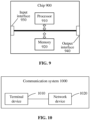
- FIG. 9 is a schematic structural diagram of a chip according to an embodiment of the present disclosure.
- a chip 900 illustrated in FIG. 9 includes a processor 910 that may call and execute a computer program from a memory to implement the method in the embodiments of the present disclosure.
- the chip 900 may also include a memory 920.
- the processor 910 may call and execute a computer program from the memory 920 to implement the method in the embodiments of the present disclosure.
- the memory 920 may be a separate device independent of the processor 910 or may be integrated in the processor 910.
- the chip 900 may also include an input interface 930.
- the processor 910 may control the input interface 930 to communicate with other devices or chips, and in particular obtain information or data sent by other devices or chips.
- the chip 900 may also include an output interface 940.
- the processor 910 may control the output interface 940 to communicate with other devices or chips, and in particular output information or data to other devices or chips.
- the chip may applied to be a network device of the embodiments of the present disclosure, and the chip may implement corresponding processes implemented by the network device in various methods of the embodiments of the present disclosure, which will not be repeated here for the sake of brevity.
- the chip may applied to be a mobile terminal/terminal device of an embodiment of the present disclosure, and the chip may implement corresponding processes implemented by the mobile terminal/the terminal device in the respective methods of the embodiments of the present disclosure, which will not be repeated here for the sake of brevity.
- the chip referred to in the embodiments of the present disclosure may also be referred to as a system-level chip, a system chip, a chip system or a system-on-chip or the like.
- FIG. 10 is a schematic block diagram of a communication system 1000 provided by an embodiment of the present disclosure. As illustrated in FIG. 10 , the communication system 1000 includes a terminal device 1010 and a network device 1020.
- the terminal device 1010 may be configured to implement corresponding functions implemented by the terminal device in the above method
- the network device 1020 may be configured to implement corresponding functions implemented by the network device in the above method, which will not be repeated here for the sake of brevity.
- the processor may be an integrated circuit chip having signal processing capability.
- the operations of the above method embodiments may be accomplished by integrated logic circuitry of hardware in processor or instructions in the form of software.
- the processor may be a general purpose processor, a digital signal processor (DSP), an application specific integrated circuit (ASIC), a field programmable gate array (FPGA) or other programmable logic devices, discrete gates or transistor logic devices, or discrete hardware components.
- DSP digital signal processor
- ASIC application specific integrated circuit
- FPGA field programmable gate array
- the processor may implement or execute the methods, operations and logic diagrams disclosed in the embodiments of the present disclosure.
- the general purpose processor can be a microprocessor or any conventional processor.
- the operations of the method disclosed in the embodiments of the present disclosure may be directly embodied as being executed by a hardware decoding processor or being executed by the hardware and software modules in a decoding processor.
- the software modules may be located in a random access memory, a flash memory, a read-only memory, a programmable read-only memory or an electrically erasable programmable memory, a register and other mature storage media in the art.
- the storage medium is located in the memory, and the processor reads the information in the memory to complete the operations of the aforementioned method in conjunction with its hardware.
- the memory in the embodiments of the present disclosure may be a volatile memory or a non-volatile memory, or may also include both a volatile memory and a non-volatile memory.
- the non-volatile memory may be a read-only memory (ROM), a programmable ROM (PROM), an erasable PROM (EPROM), an electrically EPROM (EPROM) or a flash memory.
- the volatile memory may be a random access memory (RAM), which serves as an external cache.
- RAM synchronous link DRAM
- SRAM static RAM
- DRAM dynamic RAM
- SDRAM synchronous DRAM
- DDR SDRAM double data rate SDRAM
- ESDRAM enhanced SDRAM
- SLDRAM synchronous link DRAM
- DR RAM direct rambus RAM
- the memory described above is exemplary but not limiting.
- the memory in the embodiments of the present disclosure may also be a static RAM (SRAM), a dynamic RAM (DRAM), a synchronous DRAM (SDRAM), a double data rate SDRAM (DDR SDRAM), an enhanced SDRAM (ESDRAM), a synchronous link DRAM (SLDRAM), a direct rambus RAM (DR RAM), etc. That is, the memory in the embodiments of the present disclosure is intended to include, but is not limited to, these memories and any other suitable types of memory.
- a computer-readable storage medium configured to store a computer program.
- the computer-readable storage medium may applied to the network device of the embodiments of the present disclosure, and the computer program causes a computer to implement corresponding processes implemented by the network device in the methods of the embodiments of the present disclosure, which will not be repeated here for the sake of brevity.
- the computer-readable storage medium may applied to the mobile terminal/terminal device of the embodiments of the present disclosure, and the computer program causes a computer to implement corresponding processes implemented by the mobile terminal/terminal device in the methods of the embodiments of the present disclosure, which will not be repeated here for the sake of brevity.
- a computer program product which includes computer program instructions.
- the computer program product may applied to the network device of the embodiments of the present disclosure, and the computer program instructions cause a computer to implement corresponding processes implemented by the network device in the methods of the embodiments of the present disclosure, which will not be repeated here for the sake of brevity.
- the computer program product may applied to the mobile terminal/terminal device of the embodiments of the present disclosure, and the computer program instructions causes a computer to implement corresponding processes implemented by the mobile terminal/terminal device in the methods of the embodiments of the present disclosure, which will not be repeated here for the sake of brevity.
- the computer program may applied to the network device of the embodiments of the present disclosure, the computer program, when running on a computer, causes the computer to implement corresponding processes implemented by the network device in the methods of the embodiments of the present disclosure, which will not be repeated here for the sake of brevity.
- the computer program may applied to the mobile terminal/terminal device of the embodiments of the present disclosure, the computer program, when running on a computer, causes the computer to implement corresponding processes implemented by the mobile terminal/terminal device in the methods of the embodiments of the present disclosure, which will not be repeated here for the sake of brevity.
- the disclosed systems, apparatuses and methods may be implemented in other manners.
- the above-described embodiments of the apparatus is only schematic, for example, the division of the units is only a logical function division, and in practice, there may be another division manner, for example, multiple units or components may be combined or integrated into another system, or some features may be ignored or not performed.
- the coupling or direct coupling or communication connection between each other illustrated or discussed may be indirect coupling or communication connection through some interfaces, devices or units, and may be electrical, mechanical or other form.
- the units illustrated as separate elements may or may not be physically separated, and the elements displayed as units may or may not be physical units, i.e. may be located in a place, or may be distributed over a plurality of network units. Part or all of the units can be selected according to the actual needs to achieve the purpose of the embodiments of the present disclosure.
- each functional unit in each embodiment of the present disclosure may be integrated in one processing unit, each unit may exist physically alone, or two or more units may be integrated in one unit.
- the computer software product is stored in a storage medium, and includes several instructions so that a computer device (which may be a personal computer, a server, a network device or the like) implements all or part of the method according to respective embodiments of the disclosure.
- the aforementioned storage medium includes various media capable of storing a program code such as a USB disk, a mobile hard drive disk, a read-only memory (ROM), a random access memory (RAM), a magnetic disk or an optical disk.
Landscapes
- Engineering & Computer Science (AREA)
- Computer Networks & Wireless Communication (AREA)
- Signal Processing (AREA)
- Mobile Radio Communication Systems (AREA)
- Small-Scale Networks (AREA)
- Debugging And Monitoring (AREA)
Priority Applications (1)
| Application Number | Priority Date | Filing Date | Title |
|---|---|---|---|
| EP24218268.1A EP4496428A3 (de) | 2020-12-16 | 2020-12-16 | Konfigurationsrücksetzungsverfahren und -vorrichtung sowie endgerätevorrichtung |
Applications Claiming Priority (3)
| Application Number | Priority Date | Filing Date | Title |
|---|---|---|---|
| PCT/CN2020/136726 WO2022126412A1 (zh) | 2020-12-16 | 2020-12-16 | 一种重置配置方法及装置、终端设备 |
| EP24218268.1A EP4496428A3 (de) | 2020-12-16 | 2020-12-16 | Konfigurationsrücksetzungsverfahren und -vorrichtung sowie endgerätevorrichtung |
| EP20965430.0A EP4255094B1 (de) | 2020-12-16 | 2020-12-16 | Konfigurationsrücksetzungsverfahren und -vorrichtung sowie endgerätevorrichtung |
Related Parent Applications (2)
| Application Number | Title | Priority Date | Filing Date |
|---|---|---|---|
| EP20965430.0A Division-Into EP4255094B1 (de) | 2020-12-16 | 2020-12-16 | Konfigurationsrücksetzungsverfahren und -vorrichtung sowie endgerätevorrichtung |
| EP20965430.0A Division EP4255094B1 (de) | 2020-12-16 | 2020-12-16 | Konfigurationsrücksetzungsverfahren und -vorrichtung sowie endgerätevorrichtung |
Publications (2)
| Publication Number | Publication Date |
|---|---|
| EP4496428A2 true EP4496428A2 (de) | 2025-01-22 |
| EP4496428A3 EP4496428A3 (de) | 2025-04-16 |
Family
ID=82059907
Family Applications (2)
| Application Number | Title | Priority Date | Filing Date |
|---|---|---|---|
| EP24218268.1A Pending EP4496428A3 (de) | 2020-12-16 | 2020-12-16 | Konfigurationsrücksetzungsverfahren und -vorrichtung sowie endgerätevorrichtung |
| EP20965430.0A Active EP4255094B1 (de) | 2020-12-16 | 2020-12-16 | Konfigurationsrücksetzungsverfahren und -vorrichtung sowie endgerätevorrichtung |
Family Applications After (1)
| Application Number | Title | Priority Date | Filing Date |
|---|---|---|---|
| EP20965430.0A Active EP4255094B1 (de) | 2020-12-16 | 2020-12-16 | Konfigurationsrücksetzungsverfahren und -vorrichtung sowie endgerätevorrichtung |
Country Status (7)
| Country | Link |
|---|---|
| US (2) | US12376170B2 (de) |
| EP (2) | EP4496428A3 (de) |
| JP (1) | JP7637243B2 (de) |
| KR (1) | KR20230117620A (de) |
| CN (2) | CN116547995A (de) |
| ES (1) | ES3019182T3 (de) |
| WO (1) | WO2022126412A1 (de) |
Family Cites Families (20)
| Publication number | Priority date | Publication date | Assignee | Title |
|---|---|---|---|---|
| CN107637162B (zh) * | 2015-05-14 | 2022-05-10 | 苹果公司 | Ue到网络中继发起和配置 |
| WO2017191917A1 (ko) | 2016-05-02 | 2017-11-09 | 엘지전자 주식회사 | 무선 통신 시스템에서 sps 동작을 변경하는 방법 및 장치 |
| US10383008B2 (en) * | 2016-10-27 | 2019-08-13 | Ofinno, Llc | Base station configuration for V2X |
| US20200029340A1 (en) * | 2018-07-19 | 2020-01-23 | Samsung Electronics Co., Ltd. | Method and apparatus for nr v2x resource selection |
| CN111132327A (zh) * | 2018-11-01 | 2020-05-08 | 华为技术有限公司 | 资源配置方法及装置 |
| CN111417215B (zh) * | 2019-01-08 | 2022-04-22 | 华为技术有限公司 | 一种无线承载的配置方法、终端及通信装置 |
| CN115426694A (zh) | 2019-02-13 | 2022-12-02 | 苹果公司 | V2x网络辅助侧链路配置和数据传输 |
| US11659551B2 (en) * | 2019-04-02 | 2023-05-23 | Huawei Technologies Co., Ltd. | Higher layer assisted resource configuration for sidelink configured grant transmission |
| CN110536262A (zh) * | 2019-04-30 | 2019-12-03 | 中兴通讯股份有限公司 | 一种直通链路通信方法、装置和存储介质 |
| WO2020261350A1 (ja) * | 2019-06-24 | 2020-12-30 | 株式会社Nttドコモ | 端末及び通信方法 |
| CN114128323B (zh) * | 2019-07-12 | 2025-07-29 | 三星电子株式会社 | 用于支持无线通信系统中的车辆到万物通信的装置和方法 |
| CN113163358B (zh) * | 2020-01-22 | 2024-07-05 | 华为技术有限公司 | 配置使能方法及装置 |
| KR102931538B1 (ko) * | 2020-02-12 | 2026-02-27 | 엘지전자 주식회사 | Nr v2x에서 사이드링크 cg 자원을 기반으로 사이드링크 통신을 수행하는 방법 및 장치 |
| JP7531597B2 (ja) * | 2020-02-14 | 2024-08-09 | オッポ広東移動通信有限公司 | 情報処理方法、装置、記憶媒体、プロセッサ、及び電子デバイス |
| WO2021207464A1 (en) * | 2020-04-08 | 2021-10-14 | Convida Wireless, Llc | Sidelink enhancements - resource allocation simultaneous mode 1/mode 2 |
| JP2023523224A (ja) * | 2020-04-29 | 2023-06-02 | ホアウェイ・テクノロジーズ・カンパニー・リミテッド | サイドリンク通信チャネルにおける間欠受信動作のための方法およびデバイス |
| CN113676960B (zh) * | 2020-05-13 | 2023-04-25 | 维沃移动通信有限公司 | 切换方法及装置、终端设备及网络设备 |
| US11653181B2 (en) * | 2020-06-16 | 2023-05-16 | Qualcomm Incorporated | Network coding sidelink data transmission |
| US12004173B2 (en) * | 2020-07-07 | 2024-06-04 | Qualcomm Incorporated | Semi-persistent scheduling configurations for sidelink communications |
| WO2022082781A1 (zh) * | 2020-10-23 | 2022-04-28 | 华为技术有限公司 | 通信方法和通信装置 |
-
2020
- 2020-12-16 EP EP24218268.1A patent/EP4496428A3/de active Pending
- 2020-12-16 JP JP2023536477A patent/JP7637243B2/ja active Active
- 2020-12-16 ES ES20965430T patent/ES3019182T3/es active Active
- 2020-12-16 EP EP20965430.0A patent/EP4255094B1/de active Active
- 2020-12-16 CN CN202080107257.0A patent/CN116547995A/zh active Pending
- 2020-12-16 CN CN202311528082.2A patent/CN117615356A/zh active Pending
- 2020-12-16 WO PCT/CN2020/136726 patent/WO2022126412A1/zh not_active Ceased
- 2020-12-16 KR KR1020237024101A patent/KR20230117620A/ko active Pending
-
2023
- 2023-06-14 US US18/334,715 patent/US12376170B2/en active Active
-
2025
- 2025-07-01 US US19/257,381 patent/US20250331048A1/en active Pending
Also Published As
| Publication number | Publication date |
|---|---|
| US20230328825A1 (en) | 2023-10-12 |
| JP2024505786A (ja) | 2024-02-08 |
| EP4255094B1 (de) | 2025-01-22 |
| US20250331048A1 (en) | 2025-10-23 |
| CN117615356A (zh) | 2024-02-27 |
| EP4496428A3 (de) | 2025-04-16 |
| KR20230117620A (ko) | 2023-08-08 |
| WO2022126412A1 (zh) | 2022-06-23 |
| ES3019182T3 (en) | 2025-05-20 |
| EP4255094A4 (de) | 2024-01-24 |
| EP4255094A1 (de) | 2023-10-04 |
| JP7637243B2 (ja) | 2025-02-27 |
| US12376170B2 (en) | 2025-07-29 |
| CN116547995A (zh) | 2023-08-04 |
Similar Documents
| Publication | Publication Date | Title |
|---|---|---|
| CN111526599B (zh) | 一种无线资源控制rrc消息发送方法及装置 | |
| US12003450B2 (en) | Signal transmission method and device and terminal | |
| EP3979763A1 (de) | Datenübertragungsverfahren und vorrichtung und kommunikationsvorrichtung | |
| WO2022110168A1 (zh) | 通信配置的方法和通信装置 | |
| EP3952596A1 (de) | Informationsübertragungsverfahren und -einrichtung und netzwerkvorrichtung | |
| US11432370B2 (en) | D2D communication method and terminal device | |
| CN113207153B (zh) | 一种控制终端移动性的方法及装置、终端 | |
| EP3833139A1 (de) | Verfahren, vorrichtung, chip und computerprogramm zur konfiguration einer datenreplikationsübertragung | |
| CN117917158A (zh) | 无线通信的方法、终端设备和网络设备 | |
| CN113661732B (zh) | 一种资源协调方法及装置、终端设备 | |
| US20230199712A1 (en) | Wireless communication method and terminal | |
| CN112703805A (zh) | 无线通信方法和基站 | |
| JP2021536206A (ja) | リソース決定及び設定方法、装置、端末、ネットワーク装置 | |
| CN116528376B (zh) | 无线通信方法、终端设备和网络设备 | |
| US20240040655A1 (en) | Parameter configuration method, terminal device and network device | |
| CN116074847A (zh) | 一种信号传输方法及装置、终端设备 | |
| US12376170B2 (en) | Configuration reset method and apparatus, and terminal device | |
| CN112532356A (zh) | 混合自动重传请求的指示方法、装置及存储介质 | |
| US11997700B2 (en) | Resource pool configuration method, device, and storage medium | |
| CN117223389A (zh) | 一种drx参数的确定方法及装置、终端设备 | |
| CN113508618B (zh) | 一种侧行链路通信方法及装置、终端 | |
| WO2025140298A1 (zh) | 运用于双连接dc场景下的通信方法和通信装置 | |
| WO2022104608A1 (zh) | 一种信息指示方法及装置、终端设备、网络设备 |
Legal Events
| Date | Code | Title | Description |
|---|---|---|---|
| PUAI | Public reference made under article 153(3) epc to a published international application that has entered the european phase |
Free format text: ORIGINAL CODE: 0009012 |
|
| STAA | Information on the status of an ep patent application or granted ep patent |
Free format text: STATUS: THE APPLICATION HAS BEEN PUBLISHED |
|
| AC | Divisional application: reference to earlier application |
Ref document number: 4255094 Country of ref document: EP Kind code of ref document: P |
|
| AK | Designated contracting states |
Kind code of ref document: A2 Designated state(s): AL AT BE BG CH CY CZ DE DK EE ES FI FR GB GR HR HU IE IS IT LI LT LU LV MC MK MT NL NO PL PT RO RS SE SI SK SM TR |
|
| REG | Reference to a national code |
Ref country code: DE Ref legal event code: R079 Free format text: PREVIOUS MAIN CLASS: H04W0092180000 Ipc: H04W0076270000 |
|
| PUAL | Search report despatched |
Free format text: ORIGINAL CODE: 0009013 |
|
| AK | Designated contracting states |
Kind code of ref document: A3 Designated state(s): AL AT BE BG CH CY CZ DE DK EE ES FI FR GB GR HR HU IE IS IT LI LT LU LV MC MK MT NL NO PL PT RO RS SE SI SK SM TR |
|
| RIC1 | Information provided on ipc code assigned before grant |
Ipc: H04W 92/18 20090101ALI20250307BHEP Ipc: H04W 76/23 20180101ALI20250307BHEP Ipc: H04W 4/40 20180101ALI20250307BHEP Ipc: H04W 76/27 20180101AFI20250307BHEP |
|
| STAA | Information on the status of an ep patent application or granted ep patent |
Free format text: STATUS: REQUEST FOR EXAMINATION WAS MADE |
|
| 17P | Request for examination filed |
Effective date: 20251016 |