EP4497451A1 - Matériau multicouche, procédé de fabrication du matériau multicouche et utilisation du matériau multicouche et implant cardiovasculaire médical comprenant le matériau multicouche et procédé de fabrication de l'implant cardiovasculaire médical - Google Patents
Matériau multicouche, procédé de fabrication du matériau multicouche et utilisation du matériau multicouche et implant cardiovasculaire médical comprenant le matériau multicouche et procédé de fabrication de l'implant cardiovasculaire médical Download PDFInfo
- Publication number
- EP4497451A1 EP4497451A1 EP23187577.4A EP23187577A EP4497451A1 EP 4497451 A1 EP4497451 A1 EP 4497451A1 EP 23187577 A EP23187577 A EP 23187577A EP 4497451 A1 EP4497451 A1 EP 4497451A1
- Authority
- EP
- European Patent Office
- Prior art keywords
- multilayer material
- metal structure
- fold
- cardiovascular implant
- medical
- Prior art date
- Legal status (The legal status is an assumption and is not a legal conclusion. Google has not performed a legal analysis and makes no representation as to the accuracy of the status listed.)
- Pending
Links
Images

Classifications
-
- A—HUMAN NECESSITIES
- A61—MEDICAL OR VETERINARY SCIENCE; HYGIENE
- A61L—METHODS OR APPARATUS FOR STERILISING MATERIALS OR OBJECTS IN GENERAL; DISINFECTION, STERILISATION OR DEODORISATION OF AIR; CHEMICAL ASPECTS OF BANDAGES, DRESSINGS, ABSORBENT PADS OR SURGICAL ARTICLES; MATERIALS FOR BANDAGES, DRESSINGS, ABSORBENT PADS OR SURGICAL ARTICLES
- A61L27/00—Materials for grafts or prostheses or for coating grafts or prostheses
- A61L27/50—Materials characterised by their function or physical properties, e.g. injectable or lubricating compositions, shape-memory materials, surface modified materials
- A61L27/507—Materials characterised by their function or physical properties, e.g. injectable or lubricating compositions, shape-memory materials, surface modified materials for artificial blood vessels
-
- A—HUMAN NECESSITIES
- A61—MEDICAL OR VETERINARY SCIENCE; HYGIENE
- A61L—METHODS OR APPARATUS FOR STERILISING MATERIALS OR OBJECTS IN GENERAL; DISINFECTION, STERILISATION OR DEODORISATION OF AIR; CHEMICAL ASPECTS OF BANDAGES, DRESSINGS, ABSORBENT PADS OR SURGICAL ARTICLES; MATERIALS FOR BANDAGES, DRESSINGS, ABSORBENT PADS OR SURGICAL ARTICLES
- A61L27/00—Materials for grafts or prostheses or for coating grafts or prostheses
- A61L27/40—Composite materials, i.e. containing one material dispersed in a matrix of the same or different material
- A61L27/44—Composite materials, i.e. containing one material dispersed in a matrix of the same or different material having a macromolecular matrix
- A61L27/446—Composite materials, i.e. containing one material dispersed in a matrix of the same or different material having a macromolecular matrix with other specific inorganic fillers other than those covered by A61L27/443 or A61L27/46
Definitions
- the invention relates to a multilayer material, a method for producing the multilayer material and an application of the multilayer material as well as a medical cardiovascular implant comprising the multilayer material and a method for producing the medical cardiovascular implant.
- the heart can suffer from various valve diseases or malformations that cause significant malfunction of the heart and ultimately require replacement of the natural heart valve with an artificial valve.
- Human heart valves which include the aortic, pulmonary, mitral and tricuspid valves, essentially function as one-way valves that work in synchronization with the pumping heart. The valves allow blood to flow downstream but block blood flow upstream.
- valve narrowing or regurgitation which impairs the valves' ability to control blood flow.
- impairments reduce the heart's ability to pump blood and can be a debilitating and life-threatening condition.
- valve insufficiency can lead to conditions such as cardiac hypertrophy and ventricular enlargement. Therefore, extensive efforts have been made to develop methods and To develop devices to repair or replace damaged heart valves.
- prostheses to correct problems related to heart valve disorders.
- mechanical and tissue-based heart valve prostheses can be used to replace the body's own damaged heart valves.
- Xenogeneic material usually porcine or bovine pericardium
- porcine or bovine pericardium is usually used for biological heart valve replacement.
- These prostheses are expensive to manufacture and usually have a lifespan of less than 10 years.
- TAVI transcatheter aortic valve implantation
- Coating technologies include dip coating, spray coating, compression molding and Electrospinning.
- the requirements profile which includes extensive mandatory criteria such as consistent physicochemical material quality, mechanical long-term performance and crimpability, as well as biological inertness, has not yet been fully or sufficiently met by any polymer material according to current knowledge. It is irrelevant whether the artificial sails are structured, fibrous, porous or compact, built up in layers or composites, because the long-term performance under high pressure gradients in particular is limited.
- thermoplastic polyurethanes TPU
- their copolymers TPU
- the hemocompatibility, joining, long-term stable anchoring in a stent framework, long-term stability, fatigue strength under physiological conditions, mechanical performance, cellular colonization, degradation processes, calcification and delamination properties of polymeric film or fleece valve structures are investigated.
- WO2021251974A1 discloses synthetic fabric materials that can be used in various medical devices.
- US2022054702A1 discloses a fiber-based surgical implant stabilized against fraying and comprising a thermally crimped flat knit fabric made of a biocompatible, optionally biodegradable, polymeric material.
- US20220133950A1 discloses a biocompatible textile consisting of at least one electrospun fiber comprising at least one polymer, wherein the biocompatible textile can be transplanted into a patient to replace damaged tissue.
- WO0197741A2 discloses an anatomically shaped atrioventricular valve consisting of a biologically compatible synthetic membrane or a biological membrane of autologous, homologous or heterologous origin.
- WO2021173937A2 discloses several embodiments of a leaflet material that may be used in current and future heart valve prostheses, including surgically implanted mechanical heart valves and transcatheter heart valves.
- a heart valve prosthesis may include a support structure and a valve assembly disposed within the support structure, the valve assembly comprising a plurality of leaflets, each leaflet formed from a composite material, the composite material comprising a metal substrate having a plurality of apertures and a polymer coated onto the metal substrate.
- the problem is solved by a multilayer material, wherein the multilayer material has at least two outer layers and at least one inner layer.
- the first outer layer comprises a first polymer coating.
- the second outer layer comprises a second polymer coating.
- the inner layer comprises a flexible metal structure which comprises metallic glass. The layers are fixed to one another by means of permanent connections, wherein the inner layer is arranged between the first outer layer and the second outer layer.
- the multilayer material has at least one predefined fixed fold.
- the polymer coatings of the outer layers and/or the outer layers are made of the same material or are designed differently.
- the polymer coatings of the outer layers and/or the outer layers are biostable and/or biodegradable and/or populated with endothelial cells.
- At least the polymer coating of an outer layer and/or an outer layer has a surface modification and/or an active ingredient loading.
- the outer layers are in the form of fibers and/or films and/or blends and/or foils and/or nonwovens and/or composites.
- the flexible metal structure is single-layered or multi-layered.
- the flexible metal structure is an ultra-thin woven fabric and/or knitted fabric and/or braid and/or scrim and/or fleece and/or felt made of wires and/or threads and/or filaments and/or fibers and/or ribbons and/or strands and/or fibrils.
- the wires and/or threads and/or filaments and/or fibers and/or ribbons and/or strands and/or fibrils have a thickness in the micrometer range.
- Amorphous metals or metallic glasses are metal or metal-nonmetal alloys that have an amorphous structure rather than a crystalline structure at the atomic level and yet still exhibit metallic conductivity.
- An amorphous atomic arrangement which is very unusual for metals, results in a unique combination of physical properties: metallic glasses are generally harder, more corrosion-resistant and stronger than ordinary metals.
- Metallic glasses are harder than their crystalline counterparts and have high strength. Small deformations ( ⁇ 1%) are purely elastic. This means that absorbed energy is not lost as deformation energy, but is fully released when the material springs back. Their corrosion resistance is generally higher than that of metals with a comparable chemical composition. This is because corrosion usually attacks grain boundaries between individual crystallites of a metal, which do not exist in amorphous materials.
- amorphous metals are created by preventing natural crystallization. This can be done, for example, by rapidly cooling ("quenching") a melt, so that the atoms are deprived of mobility before they can assume a crystal arrangement. Conventional metals typically contract suddenly when solidifying. Since solidification as a glass is not Since amorphous metals are a first-order phase transition, this volume jump does not occur in amorphous metals. If the melt of a metallic glass fills a mold, it retains this shape when it solidifies. This is a behavior that is known from polymers, for example, and offers great advantages when processing.
- the flexible metal structure can comprise other metals and/or metal and/or metal-non-metal alloys, for example made of stainless steel and/or gold and/or silver and/or tungsten and/or CoCr and/or titanium and/or magnesium and/or nitinol.
- the flexible metal structure can comprise admixtures of rare earths.
- the mechanical resilience of the multilayer material is achieved by the flexible metal structure in the form of an ultra-thin fabric and/or knitted fabric and/or braid and/or scrim and/or fleece and/or felt made of wires and/or threads and/or filaments and/or fibers and/or bands and/or strands and/or fibrils in micrometer dimensions.
- Other examples of structures for forming the metal structure are hollow fibers, twists, composites, tubes, nanotubes, coaxial fibers, - threads, filaments and coated fibers.
- Ultra-thin refers to a thickness which essentially corresponds to an average thickness of natural bicuspid valves and/or tricuspid valves and/or pulmonary valves and/or aortic valves.
- the wires and/or threads and/or filaments and/or fibers and/or bands and/or strands and/or fibrils of the flexible metal structure can have any cross-section. Threads typically have a circular cross-section. Bands typically have a rectangular cross-section. Typical cross-sections can, however, be modified, for example by suitable processing methods, in such a way that they become atypical, for example in the shape of a triangle or an oval. This can be done in the sense of an intentional or unintentional functionalization, for example to increase bending and/or breaking strength.
- biocompatible polymers natural fiber-reinforced composites and high-performance polymers are suitable for the (fiber) coating, with preference being given to i) biostable, inert polymers such as polyfluorocarbons (including ePTFE), polyurethanes (PU), polyamides (PA), silicones, thermoplastic polyesters (TPE), including their co- or block polymers, blend partners or composite systems and ii) biodegradable polymers with the following monomer units: esters, dioxanones, lactic acid, hydroxybutyric acid, succinic acid, ethylene glycol, cellulose (derivatives), chitosan, (amino) sugars, sugar acids, glycogen, starch, lipids, which are used regardless of their raw material basis (bio- or petroleum-based).
- biostable, inert polymers such as polyfluorocarbons (including ePTFE), polyurethanes (PU), polyamides (PA), silicones, thermoplastic polyesters (TPE), including their co
- polymers suitable for coating are gelatin, bacterial cellulose, alginate, procollagen, collagen, hyaluronic acid, glycoprotein, fibronectin, laminin, mussel and silk protein, for example in the form of Hydrogels, although it is known to the person skilled in the art that a large number of other polymers exist which are suitable for a coating according to the invention.
- the first outer layer can differ in its design from the second outer layer.
- the first polymer coating therefore does not necessarily have to be identical to the second polymer coating.
- the multilayer material can have a plurality of outer layers, which can be formed from different polymers. For example, one side of the multilayer material can have one outer layer, while the other side of the multilayer material has three outer layers.
- the polymer coatings can be applied to the flexible metal structure using, for example, electrospinning, electrospraying, dip coating, spray coating, pressing, rolling, beating, punching and/or welding. Other methods that enable a polymer or similar coating to be applied to the metal structure are conceivable.
- a bonding of individual layers can be carried out during application or in a separate process step. Sufficient adhesion or layer integrity can be ensured by various in-situ processes for fiber production, for example by changing from electrospraying to electrospinning by adjusting the amount of solvent or the electrode distance.
- post-processing processes can be used to hybridize metal structures and polymer coatings to form multilayer materials, such as microstructuring using ultrasonic welding or laser processes, as well as thermal, (wet) chemical, mechanical or combination processes using vapor deposition or adhesive-based joining processes.
- Radiation-based post-processing processes are also conceivable, for example radiation cross-linking ( ⁇ , ⁇ ) and/or UV cross-linking.
- Polymer coatings applied to both sides and attached in a suitable manner ensure the necessary bio- and hemocompatibility in medical applications, especially when the multilayer material is used as a medical implant.
- One function of polymer fiber fleeces in combination with the metal structure is, on the one hand, to improve cellular colonization of the multilayer material by mimicking a natural fiber structure of an extracellular matrix with fiber diameters in the submicrometer range (50 nm - 5 ⁇ m), and, on the other hand, to reduce blood permeability.
- a coating can be designed to be both permanent and bioresorbable. Hemocompatibility can also be supported by tissue engineering by prior endothelial cell colonization.
- a surface modification or drug loading of at least one of the outer layers can be used to achieve the desired biocompatibility, so that the multilayer material can be used as a drug delivery system (DDS).
- DDS drug delivery system
- various atmospheric or low-pressure plasma activations including with air, ammonia, oxygen or nitrogen, or a chemical bonding of special substances, such as active proteins via crosslinker chemistry, as well as the incorporation of active pharmaceutical ingredients (APIs) into the polymeric coatings.
- the problem is further solved by applying the multilayer material, whereby the application of the multilayer material is as a filter, valve component or temporary and/or permanent implant application in bone defects.
- the flexible metal structure and the first and second polymer coatings can be selected according to the requirements profile of an application.
- the flexible metal structure can enable mechanical stability under high stress (pressure, throughput), for example during a pumping or filtration process using the multilayer material.
- the coatings can be formed with different pore sizes in order to provide, for example, a two-stage filter for a particle filtering process.
- the polymer coatings can be chemically modified in such a way that they function as selective ion filters. Due to a large number of customization options with regard to the design of the at least two outer layers and the at least one inner layer, a large number of other applications are conceivable.
- the object is further achieved by a medical cardiovascular implant, wherein the medical cardiovascular implant comprises the multilayer material.
- the multilayer material has a sail shape and at least one predefined fixed fold in order to achieve mechanical and fluid dynamic stability of the medical implant.
- the at least one predefined fixed fold is asymmetrically bent to avoid dead zones of stagnant flow.
- the fixation of the at least one predefined fold is positively locking and/or non-positively locking and/or materially locking.
- the medical cardiovascular implant is an occluder or a heart valve prosthesis.
- the medical cardiovascular implant is a single leaflet valve.
- the single leaflet valve is intended for open surgical and transcatheter aortic valve implantation.
- the metal structure can be cut before or after cleaning the metal structure. Furthermore, the metal structure can be cut before or after coating the metal structure.
- the fixation of the at least one predefined fixed fold is carried out, for example, by suturing with wire or other established suture materials, or by means of welding processes, adhesive processes, stapling processes, plugging or clamping processes, or combined processes.
- the at least one predefined fold is produced by folding the multilayer material, fixing it and pre-bending it to one side.
- the novel sail shape of the medical cardiovascular implant is characterized by one or more predefined fixed folds, which can be asymmetrically bent and provide the sail with mechanical and fluid dynamic stability.
- the leaflet During each cycle, i.e. during each opening and/or closing process, the leaflet is only exposed to minor local deformations or changes in curvature. This means that there are no areas that are repeatedly exposed to high load peaks. This extends the service life of the medical cardiovascular implant.
- the medical cardiovascular implant can be easily adapted to non-circular cross-sections and fitted into patient-specific holding systems such as stents or rings.
- the medical cardiovascular implant can be attached to the holding system (e.g. stent) using sutures with wire or other established suture materials, or by means of welding, gluing, stapling, plugging or clamping, or combined methods.
- the holding system e.g. stent
- sutures with wire or other established suture materials, or by means of welding, gluing, stapling, plugging or clamping, or combined methods.
- the flexible multilayer material is not damaged or impaired in its function by a crimping process that is necessary for catheter-based implantation of the medical cardiovascular implant.
- a problem-free valve-in-valve implantation of the medical cardiovascular implant according to the invention is possible in case of a necessary revision.
- the medical cardiovascular implant according to the invention allows embodiments with different numbers of leaflets. For example, instead of the usual tricuspid form, two or one leaflet can be used. If several leaflets are used, these can be made to different sizes as required, so that each leaflet contributes to a different proportion of the opening area of a valve prosthesis.
- a rapid closing process is facilitated by an elastic return of the sail in a partially opened state (without external forces).
- the upper edge of the leaflet rests against the outer wall of the holding system (e.g. stent) and a very small residual lumen remains in the area of the fold tip(s).
- the asymmetrical fold(s) allow the blood to flow through the pocket that is being formed during the closing process, so that dead areas of stagnant flow are avoided (stagnation promotes the formation of blood clots and thrombosis).
- the fold(s) gently adhere to the outer wall of the holding system (e.g. stent) due to the pre-curvature without any point load.
- the novelty of the invention relates essentially to two aspects: (i) a novel metal mesh reinforced multilayer material and (ii) a folded sail shape adapted thereto.
- the invention is a combination of a mechanically long-term stable multilayer material with a surface that is friendly to cell colonization, and a sail shape that is easily movable due to folds in the sense of a material-appropriate design, despite the rigidity of the material, and is mechanically similar to the biological model.
- the invention is basically suitable for open surgical as well as minimally invasive implantation techniques.
- the first aspect of the invention is based on the consideration that a flexible material that can withstand long-term stress and is readily colonized by endothelial cells is not yet known. Therefore, the desired properties are addressed to suitable materials that, as a whole, combine the desired properties as a layered composite.
- the second aspect of the invention is based on the idea that the individual wires of a metal structure with diameters in the micrometer range experience a small relative bending radius with the same macroscopic deformation, for example when opening and closing sail flaps.
- the wires are loaded well below the yield point (elastic) and are not brought into the area of plastic deformation or breaking stress.
- glass of macroscopic dimensions breaks even with small deformations.
- the present invention results in the avoidance of xenotransplantation of animal tissue components (including pericardium), which is advantageous in view of the effort required for processing, but also in view of ethical aspects.
- the subject matter of the invention can be manufactured using reproducible manufacturing processes and thus has consistent material properties compared to biological material, while at the same time requiring a reduced number of process steps. This allows the establishment of measures to ensure specified quality requirements in the sense of quality assurance.
- the materials used are not subject to any significant material fatigue, so that consistent operating behavior is ensured over the entire service life.
- valve prosthesis In addition to the heart valve prosthesis, other potential fields of application for cardiovascular applications are conceivable, e.g. as occluders, valve structures in the area of the venous or lymphatic system as well as temporary or permanent implant applications, e.g. in the case of bone defects of the skull.
- the subject matter of the invention is characterized by its adaptability. For example, it can be individually adapted for a specific patient in terms of material combination, sail shape and stent design, even in an anatomically difficult situation.
- the subject matter of the invention can be adapted to non-circular cross-sections or to individual patient anatomical conditions. It therefore has the potential to contribute to reducing damage to the conduction system and paravalvular leakage.
- the subject matter of the invention represents a platform technology for a wide range of application fields.
- the folded sail shape can be used across applications in the areas of conveying and pumping systems, valve and flap technology.
- the subject matter of the invention is also fundamentally suitable as a valve for technical applications, e.g. for media in pipes, industry, high-temperature processes, check valves, non-Newtonian fluids, filling systems, reduced pressure shock when closing, safety valve.
- Single or multiple sail combinations can be tailored specifically to the respective flow situation.
- the multilayer material offers potential as a filter for special applications under highly mechanically stressed conditions.
- the multilayer material 4 according to the invention is in Figure 1
- the multilayer material 4 has at least two outer layers 1, 3 and at least one inner layer 2.
- the first outer layer 1 comprises a first polymer coating.
- the second outer layer 3 comprises a second polymer coating.
- the inner layer 2 comprises a flexible metal structure which comprises metallic glass.
- the layers 1, 2, 3 are fixed to one another by means of permanent connections, wherein the inner layer 2 is arranged between the first outer layer 1 and the second outer layer 3.
- the multilayer material 4 can have a predefined fixed fold 7, not shown here.
- the polymer coatings of the outer layers and/or the outer layers 1, 3 can be made of the same material or can be designed differently.
- the outer layers 1, 3, which can be in the form of fibers and/or films and/or blends and/or foils and/or nonwovens and/or composites, are designed differently, with the first outer layer 1, for example, having a larger pore size than the second outer layer 3.
- One or more of the outer layers 1, 3 can be biostable and/or biodegradable and/or populated with endothelial cells and/or have a surface modification and/or an active ingredient loading.
- the flexible metal structure of the at least one inner layer 2 can be designed in one or more layers and can be an ultra-thin fabric and/or knitted fabric and/or braid and/or scrim and/or fleece and/or felt made of wires and/or threads and/or filaments and/or fibers and/or bands and/or strands and/or fibrils, wherein the wires and/or threads and/or filaments and/or fibers and/or bands and/or strands and/or fibrils have a thickness in the micrometer range.
- the flexible metal structure of the at least one inner layer 2 is designed as a fabric.
- the method according to the invention for producing the multilayer material 4 is also shown schematically in Figure 1
- the method comprises the production of the metal structure as an inner layer 2, the cleaning of the metal structure and the coating of the metal structure with, here with a first outer layer 1 and a second outer layer 3.
- the medical cardiovascular implant according to the invention is shown, which comprises the multilayer material 4, and here in Figure 1 as a movable sail valve in a vessel 5.
- the multilayer material 4 has a sail shape and at least one predefined fixed fold 7 (not shown here) in order to achieve mechanical and flow-dynamic stability of the medical implant.
- the medical cardiovascular implant according to the invention can, as in Figure 1 shown, by means of a fastening 6 to an outer wall of a holding structure 9 (e.g. stent, not shown here).
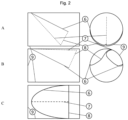
- Figure 2 shows a possible embodiment of the medical cardiovascular implant according to the invention, wherein the medical cardiovascular implant is preferably designed as a single-leaf valve.
- the at least one predefined fixed fold 7 is bent asymmetrically in order to avoid dead areas of stagnant flow.
- the fixation of the at least one predefined fold 7 can be carried out in a form-fitting and/or force-fitting and/or material-fitting manner, as will be explained later in application examples.
- the medical cardiovascular implant in the form of a single-leaf valve is used in a support structure 9, for example a stent. There it can be attached to a The door can be fixed to the outside wall.
- an upper edge of the leaflet 8 lies closely against the outer wall of the support structure 9, and only a very small residual lumen remains in the area of the tip of the predefined fixed fold 7.
- the vessel 5 (not shown here) is therefore essentially closed.
- the upper edge of the leaflet 8 is close to the outer wall of the support structure 9, to which the medical cardiovascular implant is attached.
- the predefined fixed fold 7 lies gently against the outer wall of the support structure 9 due to the pre-curvature without any point load, thereby closing the latter.
- the medical cardiovascular implant can be an occluder or a heart valve prosthesis and can be implanted by means of open surgical or transcatheter aortic valve implantation.
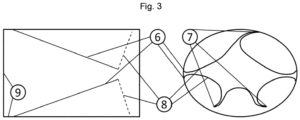
- FIG 3 shows another possible embodiment of the medical cardiovascular implant according to the invention, wherein the medical cardiovascular implant is designed here as a two-leaflet valve.
- the medical cardiovascular implant in the form of a two-leaflet valve is used in a holding structure 9, for example a stent.
- the holding structure 9 has an oval cross-section, for example as a patient-specific adaptation to a vessel 6 (not shown here).
- Each of the two leaflets can be fixed to the oval holding structure 9 by means of a separate fastening 6 on an outer wall.
- the upper sail has a predefined fixed fold 7, while the lower sail has two predefined folds 7.
- the upper edges 8 of the sails are located near the outer wall of the support structure 9 to which the medical cardiovascular implant is attached.
- the predefined fixed folds 7 gently adhere to the outer wall of the support structure 9 without any point load, thus protecting it.
- the metal structure is provided with an adhesion promoter solution if required and then immediately coated on one side with PLLA solution.
- the other side is pressed with PCL polymer fiber fleece in a thermal process step and combined in a multi-layer material in such a way that its components (layers) no longer separate from one another.
- the multi-layer material produced is cut to the appropriate size.
- the fold is created by first folding the material, then fixing it with staples, and pre-bending it to one side.
- the fixation creates a predefined curvature that is maintained permanently and allows for uniform operating behavior.
- the pre-bending prevents the edge of the fold from hitting the outer wall of the stent directly and causing damage.
- the outer edge of the sail is attached diagonally to the struts in the Nitinol stent using a seam so that the free upper edge can easily reach the outer walls of the stent when opening/closing ( Figures 1 , 2 ).
- the metal structure is covered on one side with PLLA polymer fiber fleece.
- the other side is covered with PCL polymer fiber fleece
- a multi-layer material is created by pressing together, the components (layers) of which no longer separate from one another.
- the multi-layer material is cut to the appropriate size.
- the fold is first folded, then fixed with a seam, and pre-bent to one side.
- the fixation creates a predefined curvature that is maintained permanently and allows for uniform operating behavior.
- the pre-bending prevents the edge of the fold from hitting the outer wall of the stent directly and causing damage.
- the outer edge of the sail is attached diagonally to the struts in the Nitinol stent by welding, so that the free upper edge can easily reach the outer walls of the stent when opening/closing ( Figures 1 , 2 ).
- the metal structure is electro-spun on one side with TSPCU polymer fiber fleece.
- the other side is covered with Hytrel film.
- the polymers are softened/dissolved on the surface using solvent vapor (chloroform) and thus bonded together to form a multi-layer material whose components (layers) no longer separate from one another.
- the multi-layer material produced is cut to the appropriate size.
- the fold is created by first folding the material, then fixing it using adhesive, and pre-bending it to one side.
- the fixation creates a predefined curvature that is retained permanently and allows for uniform operating behavior.
- the pre-bending prevents the edge of the fold from hitting the outer wall of the stent directly and causing damage.
- the outer edge of the sail is attached at an angle in the CoCr stent to the struts using Suture secured so that the free upper edge can easily reach the outer walls of the stent when opening/closing ( Figures 1 , 2 ).
- the metal structure is electrospun on one side with PLLA/gelatin polymer fiber fleece.
- the other side is electrospun with polydioxanone polymer fiber fleece.
- the intermediate product is misted with solvent (TFE), thus softening/dissolving the surface and bonded by mechanical pressing to form a multi-layer material whose components (layers) no longer separate from one another.
- TFE solvent
- the multi-layer material produced is cut to the appropriate size.
- the fold is created by first folding the material, then fixing it by gluing it, and pre-bending it to one side.
- the fixation creates a predefined curvature that is maintained permanently and allows for uniform operating behavior.
- the pre-bending prevents the edge of the fold from hitting the outer wall of the stent directly and causing damage.
- the outer edge of the sail is attached diagonally to the struts in the CoCr stent by adhesive so that the free upper edge can easily reach the outer walls of the stent when opening/closing ( Figures 1 , 2 ).
- a multi-layer material is bonded by mechanical pressing, the components (layers) of which no longer separate from each other.
- the multilayer material produced is cut to the appropriate size.
- the fold is created by first folding the material, then fixing it using adhesive, and pre-bending it to one side.
- the fixation creates a predefined curvature that is maintained permanently and allows for uniform operating behavior.
- the pre-bending prevents the edge of the fold from hitting the outer wall of the stent directly and causing damage.
- the outer edge of the sail is attached diagonally to the struts in the Nitinol stent using a seam, so that the free upper edge can easily reach the outer walls of the stent when opening/closing ( Figures 1 , 2 ).
- the metal structure is coated on one side with Hytrel solution.
- the other side is electrospun with PLLA polymer fiber fleece.
- the intermediate product is misted with solvent (TFE), thus softening/dissolving the surface and bonded by mechanical pressing to form a multi-layer material whose components (layers) no longer separate from one another.
- TFE solvent
- the multi-layer material produced is cut to the appropriate size.
- the fold in sail 1 is created by first folding the material, then fixing it with a seam, and pre-bending it to one side.
- two folds are made in a similar way and each is pre-bending it outwards. The fixation creates a predefined curvature that is maintained permanently and allows for uniform operating behavior.
- the pre-bending prevents the edge of the fold from hitting the outer wall of the stent directly and causing damage.
- the outer edges of the leaflets are welded obliquely into a CoCr stent, which is adapted to the individual anatomy of the patient. When opening/closing, the free upper edges allow for easy coaptation or contact with the outer walls of the stent ( Figures 1 , 3 ).
- the metal structure is electro-spun on one side with TSPCU polymer fiber fleece.
- the other side is electro-spun with nylon polymer fiber fleece.
- a multi-layer material is produced by thermal-mechanical pressing, the components (layers) of which no longer separate from one another.
- the compacted fleece layers have different pore sizes and thus represent a two-stage filter.
- the metallic support fabric ensures mechanical stability, which enables use under high stress (pressure, throughput).
Landscapes
- Health & Medical Sciences (AREA)
- Chemical & Material Sciences (AREA)
- Animal Behavior & Ethology (AREA)
- Transplantation (AREA)
- Veterinary Medicine (AREA)
- Public Health (AREA)
- Dermatology (AREA)
- Medicinal Chemistry (AREA)
- Oral & Maxillofacial Surgery (AREA)
- General Health & Medical Sciences (AREA)
- Epidemiology (AREA)
- Life Sciences & Earth Sciences (AREA)
- Inorganic Chemistry (AREA)
- Composite Materials (AREA)
- Engineering & Computer Science (AREA)
- Materials Engineering (AREA)
- Vascular Medicine (AREA)
- Prostheses (AREA)
Priority Applications (1)
| Application Number | Priority Date | Filing Date | Title |
|---|---|---|---|
| EP23187577.4A EP4497451A1 (fr) | 2023-07-25 | 2023-07-25 | Matériau multicouche, procédé de fabrication du matériau multicouche et utilisation du matériau multicouche et implant cardiovasculaire médical comprenant le matériau multicouche et procédé de fabrication de l'implant cardiovasculaire médical |
Applications Claiming Priority (1)
| Application Number | Priority Date | Filing Date | Title |
|---|---|---|---|
| EP23187577.4A EP4497451A1 (fr) | 2023-07-25 | 2023-07-25 | Matériau multicouche, procédé de fabrication du matériau multicouche et utilisation du matériau multicouche et implant cardiovasculaire médical comprenant le matériau multicouche et procédé de fabrication de l'implant cardiovasculaire médical |
Publications (1)
| Publication Number | Publication Date |
|---|---|
| EP4497451A1 true EP4497451A1 (fr) | 2025-01-29 |
Family
ID=87474406
Family Applications (1)
| Application Number | Title | Priority Date | Filing Date |
|---|---|---|---|
| EP23187577.4A Pending EP4497451A1 (fr) | 2023-07-25 | 2023-07-25 | Matériau multicouche, procédé de fabrication du matériau multicouche et utilisation du matériau multicouche et implant cardiovasculaire médical comprenant le matériau multicouche et procédé de fabrication de l'implant cardiovasculaire médical |
Country Status (1)
| Country | Link |
|---|---|
| EP (1) | EP4497451A1 (fr) |
Citations (7)
| Publication number | Priority date | Publication date | Assignee | Title |
|---|---|---|---|---|
| WO2001097741A2 (fr) | 2000-06-21 | 2001-12-27 | The International Heart Institute Of Montana Foundation | Dispositif valvulaire atrio-ventriculaire |
| US8496703B2 (en) * | 2003-06-27 | 2013-07-30 | Zuli Holdings Ltd. | Amorphous metal alloy medical devices |
| US20140017482A1 (en) * | 2012-07-13 | 2014-01-16 | Charles D. Tuffile | Glassy Metal Fiber Laminate |
| WO2021173937A2 (fr) | 2020-02-28 | 2021-09-02 | St. Jude Medical, Cardiology Division, Inc. | Feuillets valvulaires prothétiques de remplacement de valvule |
| WO2021251974A1 (fr) | 2020-06-11 | 2021-12-16 | Abbott Laboratories | Matériau textile pour dispositifs médicaux |
| US20220054702A1 (en) | 2008-01-21 | 2022-02-24 | International Life Sciences Llc D/B/A Artelon | Fiber-based surgical implant and method of manufacture |
| US20220133950A1 (en) | 2013-03-15 | 2022-05-05 | Nanofiber Solutions, Llc | Biocompatible fiber textiles for implantation |
-
2023
- 2023-07-25 EP EP23187577.4A patent/EP4497451A1/fr active Pending
Patent Citations (7)
| Publication number | Priority date | Publication date | Assignee | Title |
|---|---|---|---|---|
| WO2001097741A2 (fr) | 2000-06-21 | 2001-12-27 | The International Heart Institute Of Montana Foundation | Dispositif valvulaire atrio-ventriculaire |
| US8496703B2 (en) * | 2003-06-27 | 2013-07-30 | Zuli Holdings Ltd. | Amorphous metal alloy medical devices |
| US20220054702A1 (en) | 2008-01-21 | 2022-02-24 | International Life Sciences Llc D/B/A Artelon | Fiber-based surgical implant and method of manufacture |
| US20140017482A1 (en) * | 2012-07-13 | 2014-01-16 | Charles D. Tuffile | Glassy Metal Fiber Laminate |
| US20220133950A1 (en) | 2013-03-15 | 2022-05-05 | Nanofiber Solutions, Llc | Biocompatible fiber textiles for implantation |
| WO2021173937A2 (fr) | 2020-02-28 | 2021-09-02 | St. Jude Medical, Cardiology Division, Inc. | Feuillets valvulaires prothétiques de remplacement de valvule |
| WO2021251974A1 (fr) | 2020-06-11 | 2021-12-16 | Abbott Laboratories | Matériau textile pour dispositifs médicaux |
Similar Documents
| Publication | Publication Date | Title |
|---|---|---|
| DE69534640T2 (de) | Stent mit Kollagen | |
| EP3461459B1 (fr) | Implant et son procédé de fabrication | |
| DE69635274T2 (de) | Bioresorbierbarer stützring einer herzklappe | |
| AU2017232208B2 (en) | Biomedical patches with spatially arranged fibers | |
| DE60124930T2 (de) | Ventilprothesen mit blattelementen aus verstärktem kunststoff | |
| DE69724807T2 (de) | Implantierbare fasern und medizinische gegenstände | |
| DE10350287A1 (de) | Kardiovaskuläres Implantat, Verfahren und Vorrichtung zur Herstellung und Bereitstellung für die Chirurgie | |
| DE69304669T2 (de) | Endoluminale Prothese und ihre Herstellungsmethode | |
| DE69535595T2 (de) | Verfahren zur Herstellung einer Bio-umbaubaren Transplantatprothese aus Kollagen | |
| EP2698130B1 (fr) | Procédé de fabrication d'un implant corporel | |
| DE202008009610U1 (de) | Herzklappenprothesensystem | |
| EP2712633A2 (fr) | Composants bioprothétiques pour un implant, notamment valves cardiaques biologiques partiellement réticulées | |
| CN109475409A (zh) | 人工瓣膜、瓣膜小叶和相关方法 | |
| EP2042203B1 (fr) | Prothèse vasculaire renforcée ayant un effet antimicrobien prolongé | |
| DE102009037134A1 (de) | Tubuläres Implantat zum Ersatz von natürlichen Blutgefäßen | |
| EP4497451A1 (fr) | Matériau multicouche, procédé de fabrication du matériau multicouche et utilisation du matériau multicouche et implant cardiovasculaire médical comprenant le matériau multicouche et procédé de fabrication de l'implant cardiovasculaire médical | |
| WO2015091357A1 (fr) | Fabrication de tubes de polymère résorbables à partir de fils | |
| WO2022084313A1 (fr) | Prothèses de valve implantables fonctionnalisées par un textile | |
| EP2515960B1 (fr) | Implant, procédé de production et utilisation d'un tel implant | |
| EP4452135A1 (fr) | Valvules prothétiques implantables à cuspides valvulaires tissées | |
| EP2797640B1 (fr) | Structure fibreuse | |
| WO2025147387A1 (fr) | Matériau cellulosique anisotrope | |
| EP4433110A1 (fr) | Membrane de support et procédé de fabrication d'une membrane de support | |
| CN118161304A (zh) | 瓣膜小叶及瓣膜假体 | |
| WO2021073978A1 (fr) | Matériau d'étanchéité pour implant médical |
Legal Events
| Date | Code | Title | Description |
|---|---|---|---|
| PUAI | Public reference made under article 153(3) epc to a published international application that has entered the european phase |
Free format text: ORIGINAL CODE: 0009012 |
|
| STAA | Information on the status of an ep patent application or granted ep patent |
Free format text: STATUS: THE APPLICATION HAS BEEN PUBLISHED |
|
| AK | Designated contracting states |
Kind code of ref document: A1 Designated state(s): AL AT BE BG CH CY CZ DE DK EE ES FI FR GB GR HR HU IE IS IT LI LT LU LV MC ME MK MT NL NO PL PT RO RS SE SI SK SM TR |
|
| STAA | Information on the status of an ep patent application or granted ep patent |
Free format text: STATUS: REQUEST FOR EXAMINATION WAS MADE |
|
| 17P | Request for examination filed |
Effective date: 20250605 |
|
| STAA | Information on the status of an ep patent application or granted ep patent |
Free format text: STATUS: EXAMINATION IS IN PROGRESS |
|
| 17Q | First examination report despatched |
Effective date: 20260206 |