EP4497531A2 - Procédé de réparation d'une dent d'un joint à labyrinthe par fabrication additive - Google Patents
Procédé de réparation d'une dent d'un joint à labyrinthe par fabrication additive Download PDFInfo
- Publication number
- EP4497531A2 EP4497531A2 EP24178149.1A EP24178149A EP4497531A2 EP 4497531 A2 EP4497531 A2 EP 4497531A2 EP 24178149 A EP24178149 A EP 24178149A EP 4497531 A2 EP4497531 A2 EP 4497531A2
- Authority
- EP
- European Patent Office
- Prior art keywords
- weight
- amount
- tooth
- vise
- labyrinth seal
- Prior art date
- Legal status (The legal status is an assumption and is not a legal conclusion. Google has not performed a legal analysis and makes no representation as to the accuracy of the status listed.)
- Withdrawn
Links
Images


Classifications
-
- B—PERFORMING OPERATIONS; TRANSPORTING
- B23—MACHINE TOOLS; METAL-WORKING NOT OTHERWISE PROVIDED FOR
- B23P—METAL-WORKING NOT OTHERWISE PROVIDED FOR; COMBINED OPERATIONS; UNIVERSAL MACHINE TOOLS
- B23P6/00—Restoring or reconditioning objects
- B23P6/002—Repairing turbine components, e.g. moving or stationary blades, rotors
- B23P6/007—Repairing turbine components, e.g. moving or stationary blades, rotors using only additive methods, e.g. build-up welding
-
- B—PERFORMING OPERATIONS; TRANSPORTING
- B22—CASTING; POWDER METALLURGY
- B22F—WORKING METALLIC POWDER; MANUFACTURE OF ARTICLES FROM METALLIC POWDER; MAKING METALLIC POWDER; APPARATUS OR DEVICES SPECIALLY ADAPTED FOR METALLIC POWDER
- B22F7/00—Manufacture of composite layers, workpieces, or articles, comprising metallic powder, by sintering the powder, with or without compacting wherein at least one part is obtained by sintering or compression
- B22F7/06—Manufacture of composite layers, workpieces, or articles, comprising metallic powder, by sintering the powder, with or without compacting wherein at least one part is obtained by sintering or compression of composite workpieces or articles from parts, e.g. to form tipped tools
- B22F7/062—Manufacture of composite layers, workpieces, or articles, comprising metallic powder, by sintering the powder, with or without compacting wherein at least one part is obtained by sintering or compression of composite workpieces or articles from parts, e.g. to form tipped tools involving the connection or repairing of preformed parts
-
- B—PERFORMING OPERATIONS; TRANSPORTING
- B22—CASTING; POWDER METALLURGY
- B22F—WORKING METALLIC POWDER; MANUFACTURE OF ARTICLES FROM METALLIC POWDER; MAKING METALLIC POWDER; APPARATUS OR DEVICES SPECIALLY ADAPTED FOR METALLIC POWDER
- B22F10/00—Additive manufacturing of workpieces or articles from metallic powder
- B22F10/20—Direct sintering or melting
- B22F10/25—Direct deposition of metal particles, e.g. direct metal deposition [DMD] or laser engineered net shaping [LENS]
-
- B—PERFORMING OPERATIONS; TRANSPORTING
- B22—CASTING; POWDER METALLURGY
- B22F—WORKING METALLIC POWDER; MANUFACTURE OF ARTICLES FROM METALLIC POWDER; MAKING METALLIC POWDER; APPARATUS OR DEVICES SPECIALLY ADAPTED FOR METALLIC POWDER
- B22F10/00—Additive manufacturing of workpieces or articles from metallic powder
- B22F10/60—Treatment of workpieces or articles after build-up
- B22F10/66—Treatment of workpieces or articles after build-up by mechanical means
-
- B—PERFORMING OPERATIONS; TRANSPORTING
- B22—CASTING; POWDER METALLURGY
- B22F—WORKING METALLIC POWDER; MANUFACTURE OF ARTICLES FROM METALLIC POWDER; MAKING METALLIC POWDER; APPARATUS OR DEVICES SPECIALLY ADAPTED FOR METALLIC POWDER
- B22F5/00—Manufacture of workpieces or articles from metallic powder characterised by the special shape of the product
- B22F5/009—Manufacture of workpieces or articles from metallic powder characterised by the special shape of the product of turbine components other than turbine blades
-
- B—PERFORMING OPERATIONS; TRANSPORTING
- B23—MACHINE TOOLS; METAL-WORKING NOT OTHERWISE PROVIDED FOR
- B23K—SOLDERING OR UNSOLDERING; WELDING; CLADDING OR PLATING BY SOLDERING OR WELDING; CUTTING BY APPLYING HEAT LOCALLY, e.g. FLAME CUTTING; WORKING BY LASER BEAM
- B23K26/00—Working by laser beam, e.g. welding, cutting or boring
- B23K26/34—Laser welding for purposes other than joining
-
- B—PERFORMING OPERATIONS; TRANSPORTING
- B23—MACHINE TOOLS; METAL-WORKING NOT OTHERWISE PROVIDED FOR
- B23K—SOLDERING OR UNSOLDERING; WELDING; CLADDING OR PLATING BY SOLDERING OR WELDING; CUTTING BY APPLYING HEAT LOCALLY, e.g. FLAME CUTTING; WORKING BY LASER BEAM
- B23K35/00—Rods, electrodes, materials, or media, for use in soldering, welding, or cutting
- B23K35/02—Rods, electrodes, materials, or media, for use in soldering, welding, or cutting characterised by mechanical features, e.g. shape
- B23K35/0222—Rods, electrodes, materials, or media, for use in soldering, welding, or cutting characterised by mechanical features, e.g. shape for use in soldering or brazing
- B23K35/0244—Powders, particles or spheres; Preforms made therefrom
-
- B—PERFORMING OPERATIONS; TRANSPORTING
- B33—ADDITIVE MANUFACTURING TECHNOLOGY
- B33Y—ADDITIVE MANUFACTURING, i.e. MANUFACTURING OF THREE-DIMENSIONAL [3D] OBJECTS BY ADDITIVE DEPOSITION, ADDITIVE AGGLOMERATION OR ADDITIVE LAYERING, e.g. BY 3D PRINTING, STEREOLITHOGRAPHY OR SELECTIVE LASER SINTERING
- B33Y40/00—Auxiliary operations or equipment, e.g. for material handling
- B33Y40/10—Pre-treatment
-
- B—PERFORMING OPERATIONS; TRANSPORTING
- B33—ADDITIVE MANUFACTURING TECHNOLOGY
- B33Y—ADDITIVE MANUFACTURING, i.e. MANUFACTURING OF THREE-DIMENSIONAL [3D] OBJECTS BY ADDITIVE DEPOSITION, ADDITIVE AGGLOMERATION OR ADDITIVE LAYERING, e.g. BY 3D PRINTING, STEREOLITHOGRAPHY OR SELECTIVE LASER SINTERING
- B33Y70/00—Materials specially adapted for additive manufacturing
-
- B—PERFORMING OPERATIONS; TRANSPORTING
- B33—ADDITIVE MANUFACTURING TECHNOLOGY
- B33Y—ADDITIVE MANUFACTURING, i.e. MANUFACTURING OF THREE-DIMENSIONAL [3D] OBJECTS BY ADDITIVE DEPOSITION, ADDITIVE AGGLOMERATION OR ADDITIVE LAYERING, e.g. BY 3D PRINTING, STEREOLITHOGRAPHY OR SELECTIVE LASER SINTERING
- B33Y80/00—Products made by additive manufacturing
-
- C—CHEMISTRY; METALLURGY
- C22—METALLURGY; FERROUS OR NON-FERROUS ALLOYS; TREATMENT OF ALLOYS OR NON-FERROUS METALS
- C22C—ALLOYS
- C22C33/00—Making ferrous alloys
- C22C33/02—Making ferrous alloys by powder metallurgy
- C22C33/0257—Making ferrous alloys by powder metallurgy characterised by the range of the alloying elements
- C22C33/0278—Making ferrous alloys by powder metallurgy characterised by the range of the alloying elements with at least one alloying element having a minimum content above 5%
- C22C33/0285—Making ferrous alloys by powder metallurgy characterised by the range of the alloying elements with at least one alloying element having a minimum content above 5% with Cr, Co, or Ni having a minimum content higher than 5%
-
- C—CHEMISTRY; METALLURGY
- C22—METALLURGY; FERROUS OR NON-FERROUS ALLOYS; TREATMENT OF ALLOYS OR NON-FERROUS METALS
- C22C—ALLOYS
- C22C38/00—Ferrous alloys, e.g. steel alloys
- C22C38/002—Ferrous alloys, e.g. steel alloys containing In, Mg, or other elements not provided for in one single group C22C38/001 - C22C38/60
-
- C—CHEMISTRY; METALLURGY
- C22—METALLURGY; FERROUS OR NON-FERROUS ALLOYS; TREATMENT OF ALLOYS OR NON-FERROUS METALS
- C22C—ALLOYS
- C22C38/00—Ferrous alloys, e.g. steel alloys
- C22C38/02—Ferrous alloys, e.g. steel alloys containing silicon
-
- C—CHEMISTRY; METALLURGY
- C22—METALLURGY; FERROUS OR NON-FERROUS ALLOYS; TREATMENT OF ALLOYS OR NON-FERROUS METALS
- C22C—ALLOYS
- C22C38/00—Ferrous alloys, e.g. steel alloys
- C22C38/04—Ferrous alloys, e.g. steel alloys containing manganese
-
- C—CHEMISTRY; METALLURGY
- C22—METALLURGY; FERROUS OR NON-FERROUS ALLOYS; TREATMENT OF ALLOYS OR NON-FERROUS METALS
- C22C—ALLOYS
- C22C38/00—Ferrous alloys, e.g. steel alloys
- C22C38/18—Ferrous alloys, e.g. steel alloys containing chromium
-
- C—CHEMISTRY; METALLURGY
- C22—METALLURGY; FERROUS OR NON-FERROUS ALLOYS; TREATMENT OF ALLOYS OR NON-FERROUS METALS
- C22C—ALLOYS
- C22C38/00—Ferrous alloys, e.g. steel alloys
- C22C38/18—Ferrous alloys, e.g. steel alloys containing chromium
- C22C38/40—Ferrous alloys, e.g. steel alloys containing chromium with nickel
-
- C—CHEMISTRY; METALLURGY
- C22—METALLURGY; FERROUS OR NON-FERROUS ALLOYS; TREATMENT OF ALLOYS OR NON-FERROUS METALS
- C22C—ALLOYS
- C22C38/00—Ferrous alloys, e.g. steel alloys
- C22C38/18—Ferrous alloys, e.g. steel alloys containing chromium
- C22C38/40—Ferrous alloys, e.g. steel alloys containing chromium with nickel
- C22C38/42—Ferrous alloys, e.g. steel alloys containing chromium with nickel with copper
-
- C—CHEMISTRY; METALLURGY
- C22—METALLURGY; FERROUS OR NON-FERROUS ALLOYS; TREATMENT OF ALLOYS OR NON-FERROUS METALS
- C22C—ALLOYS
- C22C38/00—Ferrous alloys, e.g. steel alloys
- C22C38/60—Ferrous alloys, e.g. steel alloys containing lead, selenium, tellurium, or antimony, or more than 0.04% by weight of sulfur
-
- F—MECHANICAL ENGINEERING; LIGHTING; HEATING; WEAPONS; BLASTING
- F01—MACHINES OR ENGINES IN GENERAL; ENGINE PLANTS IN GENERAL; STEAM ENGINES
- F01D—NON-POSITIVE DISPLACEMENT MACHINES OR ENGINES, e.g. STEAM TURBINES
- F01D11/00—Preventing or minimising internal leakage of working-fluid, e.g. between stages
- F01D11/02—Preventing or minimising internal leakage of working-fluid, e.g. between stages by non-contact sealings, e.g. of labyrinth type
-
- B—PERFORMING OPERATIONS; TRANSPORTING
- B22—CASTING; POWDER METALLURGY
- B22F—WORKING METALLIC POWDER; MANUFACTURE OF ARTICLES FROM METALLIC POWDER; MAKING METALLIC POWDER; APPARATUS OR DEVICES SPECIALLY ADAPTED FOR METALLIC POWDER
- B22F10/00—Additive manufacturing of workpieces or articles from metallic powder
- B22F10/20—Direct sintering or melting
- B22F10/28—Powder bed fusion, e.g. selective laser melting [SLM] or electron beam melting [EBM]
-
- B—PERFORMING OPERATIONS; TRANSPORTING
- B22—CASTING; POWDER METALLURGY
- B22F—WORKING METALLIC POWDER; MANUFACTURE OF ARTICLES FROM METALLIC POWDER; MAKING METALLIC POWDER; APPARATUS OR DEVICES SPECIALLY ADAPTED FOR METALLIC POWDER
- B22F7/00—Manufacture of composite layers, workpieces, or articles, comprising metallic powder, by sintering the powder, with or without compacting wherein at least one part is obtained by sintering or compression
- B22F7/06—Manufacture of composite layers, workpieces, or articles, comprising metallic powder, by sintering the powder, with or without compacting wherein at least one part is obtained by sintering or compression of composite workpieces or articles from parts, e.g. to form tipped tools
- B22F7/062—Manufacture of composite layers, workpieces, or articles, comprising metallic powder, by sintering the powder, with or without compacting wherein at least one part is obtained by sintering or compression of composite workpieces or articles from parts, e.g. to form tipped tools involving the connection or repairing of preformed parts
- B22F2007/068—Manufacture of composite layers, workpieces, or articles, comprising metallic powder, by sintering the powder, with or without compacting wherein at least one part is obtained by sintering or compression of composite workpieces or articles from parts, e.g. to form tipped tools involving the connection or repairing of preformed parts repairing articles
-
- B—PERFORMING OPERATIONS; TRANSPORTING
- B22—CASTING; POWDER METALLURGY
- B22F—WORKING METALLIC POWDER; MANUFACTURE OF ARTICLES FROM METALLIC POWDER; MAKING METALLIC POWDER; APPARATUS OR DEVICES SPECIALLY ADAPTED FOR METALLIC POWDER
- B22F2301/00—Metallic composition of the powder or its coating
- B22F2301/35—Iron
-
- B—PERFORMING OPERATIONS; TRANSPORTING
- B23—MACHINE TOOLS; METAL-WORKING NOT OTHERWISE PROVIDED FOR
- B23K—SOLDERING OR UNSOLDERING; WELDING; CLADDING OR PLATING BY SOLDERING OR WELDING; CUTTING BY APPLYING HEAT LOCALLY, e.g. FLAME CUTTING; WORKING BY LASER BEAM
- B23K26/00—Working by laser beam, e.g. welding, cutting or boring
- B23K26/34—Laser welding for purposes other than joining
- B23K26/342—Build-up welding
-
- B—PERFORMING OPERATIONS; TRANSPORTING
- B33—ADDITIVE MANUFACTURING TECHNOLOGY
- B33Y—ADDITIVE MANUFACTURING, i.e. MANUFACTURING OF THREE-DIMENSIONAL [3D] OBJECTS BY ADDITIVE DEPOSITION, ADDITIVE AGGLOMERATION OR ADDITIVE LAYERING, e.g. BY 3D PRINTING, STEREOLITHOGRAPHY OR SELECTIVE LASER SINTERING
- B33Y10/00—Processes of additive manufacturing
Definitions
- the present invention relates to a method for manufacturing a turbine labyrinth seal consisting of an arch-shaped body and teeth protruding from one surface of the arch-shaped body, the turbine labyrinth seal being mounted between a turbine rotor as a rotor and a diaphragm as a stator to minimize friction between the turbine rotor and the diaphragm, while the turbine rotor is rotating, so that gas leakage is prevented, while inducing smooth rotation of the turbine rotor, more specifically to a method for repairing a tooth of a labyrinth seal using 3D printing that is capable of removing a damaged tooth by means of machining and meltedly depositing the same material as a body of the labyrinth seal onto the body by means of laser cladding to complete repairing for the tooth, thereby reducing a repairing cost of the tooth.
- a turbine labyrinth seal prevents high temperature and high pressure gas from leaking from a clearance between a diaphragm as a stator and a turbine rotor as a rotor that are mounted in a turbine casing, while minimizing pressure loss, so that the maximum rotational force is provided to turbine blades, thereby activating a power generator to produce electric power. Accordingly, the turbine labyrinth seal is one of important parts in improving power generation efficiency.
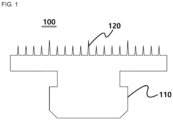
- a labyrinth seal 100 largely includes a body 110 and teeth 120, and in most cases, the teeth 120 are damaged.
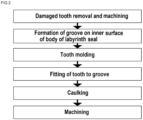
- a damaged tooth is removed by means of machining, and a long groove is formed on the removed tooth of the arch-shaped body 110 in a longitudinal direction of the body 110.
- a new tooth 120 is inserted into the groove, and the portion of the body 110 coming into contact with the inserted tooth 120 is hit with a tool such as a hammer, so that through such caulking, the tooth 120 is fixed to the body 110.
- the groove is first formed deeply on the inner surface of the body 110 of the labyrinth seal 100 by means of machining, and further, a thin steel plate is cut by means of slitting to prepare a plate material.
- the plate material is fitted to the groove and subjected to caulking, and after that, the caulked tooth is subjected to machining.
- caulking needs a series of complex processes, thereby undesirably causing a repairing cost of the labyrinth seal tooth to become increased.
- the present invention has been made in view of the above-mentioned problems occurring in the related art, and it is an object of the present invention to provide a method for repairing a tooth of a labyrinth seal using 3D printing that is capable of removing a damaged tooth by means of machining, meltedly depositing the same material as a body of the labyrinth seal onto the body by means of laser cladding to complete repairing for the tooth, thereby reducing a repairing cost of the tooth.
- a method for repairing a tooth of a labyrinth seal using 3D printing the labyrinth seal consisting of an arch-shaped body and teeth protruding from the inner surface as one surface of the arch-shaped body, the method including the steps of: removing a damaged tooth from the body of the labyrinth seal; depositing a tooth onto the body by means of the 3D printing; and adjusting the surface roughness of the deposited tooth by means of machining, wherein the body is seated on top of an arch-shaped jig device, and the jig device comprises an arch-shaped vise for supporting the underside of the body of the arch-shaped labyrinth seal, a rotating part coming into contact with the underside of the vise to rotate the vise, shafts having one end fixed to both ends of the vise in such a way as to extend toward a central portion of the vise to stably support the vise against top of the rotating
- the present invention relates to a method for repairing a tooth of a labyrinth seal using 3D printing, the labyrinth seal consisting of an arch-shaped body and teeth protruding from the inner surface as one surface of the arch-shaped body, the method including the steps of: removing a damaged tooth from the body of the labyrinth seal; depositing a tooth onto the body by means of the 3D printing; and adjusting the surface roughness of the deposited tooth by means of machining.
- Metal powder for the tooth deposited onto top of the body comprises carbon (C) in an amount of from 0.01 % by weight to 0.15% by weight, silicon (Si) in an amount of from 0.02% by weight to 0.1% by weight, manganese (Mn) in an amount of not more than 1% by weight, phosphorus (P) in an amount of from 0.01% by weight to 0.05% by weight, sulfur (S) in an amount of not more than 0.03% by weight, chromium (Cr) in an amount of from 15% by weight to 25% by weight, and iron (Fe) as the remainder.
- C carbon
- Si silicon
- Mn manganese
- P phosphorus
- S sulfur
- Cr chromium
- Fe iron
- the metal powder for the tooth deposited onto top of the body comprises carbon (C) in an amount of from 0.01% by weight to 0.15% by weight, silicon (Si) in an amount of from 0.02% by weight to 0.1% by weight, manganese (Mn) in an amount of not more than 1% by weight, phosphorus (P) in an amount of from 0.01% by weight to 0.05% by weight, sulfur (S) in an amount of not more than 0.03% by weight, nickel (Ni) in an amount of from 0.01% by weight to 3.25% by weight, chromium (Cr) in an amount of from 15% by weight to 25% by weight, and iron (Fe) as the remainder.
- the metal powder for the tooth deposited on top of the body comprises carbon (C) in an amount of from 0.01% by weight to 0.15% by weight, silicon (Si) in an amount of from 0.02% by weight to 0.5% by weight, manganese (Mn) in an amount of not more than 0.6% by weight, phosphorus (P) in an amount of from 0.01% by weight to 0.35% by weight, sulfur (S) in an amount of not more than 0.045% by weight, nickel (Ni) in an amount of from 0.01% by weight to 0.5% by weight, nickel (Ni) in an amount of from 0.01% by weight to 0.5% by weight, copper (Cu) in an amount of from 0.01% by weight to 1.05% by weight, chromium (Cr) in an amount of from 9.05% by weight to 12% by weight, and iron (Fe) as the remainder.
- C carbon
- Si silicon
- Mn manganese
- P phosphorus
- the metal powder for the tooth has a size in the range of 25 to 200 ⁇ m.
- ultrasonic vibrations are applied to the arch-shaped body, and the ultrasonic vibrations are applied in the range of 2 KHz to 100 MHz.
- the body is seated on top of an arch-shaped jig device, and the jig device includes an arch-shaped vise for supporting the underside of the body of the arch-shaped labyrinth seal, a rotating part coming into contact with the underside of the vise to rotate the vise, shafts having one end fixed to both ends of the vise in such a way as to extend toward a central portion of the vise to stably support the vise against top of the rotating part, and a central shaft for fixing the shafts thereto.
- the jig device includes an arch-shaped vise for supporting the underside of the body of the arch-shaped labyrinth seal, a rotating part coming into contact with the underside of the vise to rotate the vise, shafts having one end fixed to both ends of the vise in such a way as to extend toward a central portion of the vise to stably support the vise against top of the rotating part, and a central shaft for fixing the shafts thereto.
- a laser device which melts the metal powder and deposits the melted metal powder onto the body, is located above the vise to inject the melted metal powder into the body, so that the melted metal powder is deposited onto top of the body, and simultaneously, if the vise rotates around the central shaft by means of the rotating part, the melted metal powder is deposited in a vertical direction.
- the laser device has a linear moving part mounted thereon so that the laser device moves in a longitudinal direction of the central shaft, and accordingly, if one line of tooth is formed on top of the body, the laser device moves by a given distance by means of the linear moving part. Next, the vise rotates by means of the rotating part to form a next tooth.
- the arch of the vice has a longer length than the arch of the body of the labyrinth seal, so that the vice has no interference with the deposition of the tooth onto top of the body seated on top thereof.
- FIG. 3 is a flowchart showing a method for repairing a tooth of a labyrinth seal using 3D printing according to the present invention.
- a method for repairing a tooth of a labyrinth seal using 3D printing includes the steps of: removing a damaged tooth 120 from a body 110 of the labyrinth seal 100; depositing a tooth 120 onto the body 110 by means of the 3D printing; and adjusting the surface roughness of the deposited tooth 120 by means of machining.
- the damaged tooth 120 is removed by means of machining, and next, the same metal powder as the body 110 is melted and deposited onto top of the body 110 to form the tooth 120. After the tooth 120 has been formed, the surface roughness thereof is adjusted by means of machining.
- Laser cladding is used for the 3D printing.
- metal powder for the tooth 120 deposited onto top of the body 110 comprises carbon (C) in an amount of from 0.01% by weight to 0.15% by weight, silicon (Si) in an amount of from 0.02% by weight to 0.1% by weight, manganese (Mn) in an amount of not more than 1% by weight, phosphorus (P) in an amount of from 0.01% by weight to 0.05% by weight, sulfur (S) in an amount of not more than 0.03% by weight, chromium (Cr) in an amount of from 15% by weight to 25% by weight, and iron (Fe) as the remainder.
- C carbon
- Si silicon
- Mn manganese
- P phosphorus
- S sulfur
- Cr chromium
- Fe iron
- the metal powder for the tooth 120 deposited onto top of the body 110 comprises carbon (C) in an amount of from 0.01% by weight to 0.15% by weight, silicon (Si) in an amount of from 0.02% by weight to 0.1% by weight, manganese (Mn) in an amount of not more than 1% by weight, phosphorus (P) in an amount of from 0.01% by weight to 0.05% by weight, sulfur (S) in an amount of not more than 0.03% by weight, nickel (Ni) in an amount of from 0.01% by weight to 3.25% by weight, chromium (Cr) in an amount of from 15% by weight to 25% by weight, and iron (Fe) as the remainder.
- the metal powder for the tooth 120 deposited onto top of the body 110 comprises carbon (C) in an amount of from 0.01% by weight to 0.15% by weight, silicon (Si) in an amount of from 0.02% by weight to 0.5% by weight, manganese (Mn) in an amount of not more than 0.6% by weight, phosphorus (P) in an amount of from 0.01% by weight to 0.35% by weight, sulfur (S) in an amount of not more than 0.045% by weight, nickel (Ni) in an amount of from 0.01% by weight to 0.5% by weight, nickel (Ni) in an amount of from 0.01% by weight to 0.5% by weight, copper (Cu) in an amount of from 0.01% by weight to 1.05% by weight, chromium (Cr) in an amount of from 9.05% by weight to 12% by weight, and iron (Fe) as the remainder.
- C carbon
- Si silicon
- Mn manganese
- P phosphorus
- ultrasonic vibrations are applied to a base metal to prevent residual stress from being generated from the base metal due to rapid cooling of 10 4-5 K/s to the base metal when the metal powder is melted during the deposition of the tooth 120 by means of the 3D printing.
- the ultrasonic vibrations are applied in the range of 2 KHz to 100 MHz.
- a vibrator (not shown) is attached to a position at a distance of 0.5 to 2000 mm from the deposited portion, and accordingly, the ultrasonic vibrations are applied to the body 110 of the labyrinth seal 100 as the base metal, while the deposition is being performed.
- the vibrator comes into contact with the surface of the body 110 placed at a distance of 0.5 to 2000 mm from the deposited portion.
- porosity of the deposited portion is reduced to 0.01% or under and a grain size of the deposited portion is less than 50% of the grain size in the existing laser cladding, thereby advantageously improving mechanical properties (hardness, strength, wear, fatigue, and creep).
- a far infrared heater has the wavelength of 10 to 1000 ⁇ m to adjust solidification speed of the superalloy so that while the base metal is being kept to a temperature in the range of 25 to 900°C, the deposition is performed by means of the laser cladding.
- the labyrinth seal 100 has the shape of the arch, and accordingly, the body 110 also has the shape of the arch.
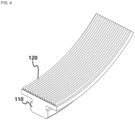
- the melted metal powder is deposited onto top of the labyrinth seal 100 where the tooth 120 is deposited, that is, along the inner periphery of the labyrinth seal 100, as shown in FIG. 4 as will be discussed later, a portion of the deposited, which is not kept horizontal, may be deformed, before the melted metal powder becomes hard, when the melted metal powder is deposited.
- the jig device 200 for fixing the labyrinth seal 100 thereto is provided.
- FIG. 4 is a perspective view showing a turbine labyrinth seal according to the present invention
- FIG. 5 is a schematic view showing a jig device for the turbine labyrinth seal according to the present invention.
- the jig device 200 includes an arch-shaped vise 210 for supporting the underside of the body 110 of the arch-shaped labyrinth seal 100, a rotating part 220 coming into contact with the underside of the vise 210 to rotate the vise 210, shafts 211 having one end fixed to both ends of the vise 210 in such a way as to extend toward a central portion of the vise 210 to stably support the vise 210 against top of the rotating part 220, and a central shaft 213 for fixing the shafts 211 thereto.
- a laser device 300 which melts the metal powder and deposits the metal powder onto the body 110, has a linear moving part 310 mounted thereon so that the laser device 300 moves in a longitudinal direction of the central shaft 212.
- the linear moving part 310 is a general means widely known, and therefore, an explanation of the linear moving part 310 will be avoided.
- the arch of the vice 210 has a longer length than the arch of the body 110 of the labyrinth seal 100, so that the vice 210 has no interference with the deposition of the tooth 120 onto top of the body 110 seated on top thereof.
- the melted metal powder is injected into the body 110 by means of the laser device 300 to deposit the metal powder onto top of the body 110, and further, the vise 210 rotates around the central shaft 212 by means of the rotating part 220, so that the melted metal powder is deposited in a vertical direction.
- a widely known means is used as a means for rotatably supporting the central shaft 212 of the vise 210, and therefore, an explanation of the means will be avoided.
- the vice 210 rotates stably by means of the gear engagement between the underside thereof and the rotating part 220.
- the tooth 120 is not formed in one column on top of the body 110, and the teeth 120 are formed in a plurality of columns along the width of the body 110. If one line of tooth 120 is formed on top of the body 110, the laser device 300 moves by a given distance by means of the linear moving part 310, and next, the vice 210 rotates by means of the rotating part 220 to form the next line of tooth 120.
- the method for repairing the tooth of the labyrinth seal using 3D printing includes the steps of removing the damaged tooth by means of machining and meltedly depositing the same material as the body onto the body by means of laser cladding to complete the repairing for the tooth, thereby reducing a repairing cost of the tooth.
- the conventional caulking process where the tooth is caulked to the body by means of press-fitting causes fatigue accumulation due to the press-fitting, and since the tooth and the body are not bonded to each other by means of melting, the coupling force therebetween becomes weak.
- the materials are melted to each other by means of a laser beam as a heat source, thereby having excellent coupling force.
- the method for repairing the tooth of the labyrinth seal using 3D printing deposits the metal powder by means of the laser beam, while the origin is shared with one jig device and performs the machining of the deposited metal powder as soon as the deposition is completed, thereby making the repairing process simplified and achieving productivity improvement.
Landscapes
- Chemical & Material Sciences (AREA)
- Engineering & Computer Science (AREA)
- Materials Engineering (AREA)
- Mechanical Engineering (AREA)
- Metallurgy (AREA)
- Organic Chemistry (AREA)
- Manufacturing & Machinery (AREA)
- Physics & Mathematics (AREA)
- Optics & Photonics (AREA)
- General Engineering & Computer Science (AREA)
- Composite Materials (AREA)
- Plasma & Fusion (AREA)
- Sealing Using Fluids, Sealing Without Contact, And Removal Of Oil (AREA)
- Powder Metallurgy (AREA)
Applications Claiming Priority (1)
| Application Number | Priority Date | Filing Date | Title |
|---|---|---|---|
| KR1020230095889A KR102616294B1 (ko) | 2023-07-24 | 2023-07-24 | 3d프린팅 기술에 의한 래비린스 씰 투스 재생 수리방법 |
Publications (2)
| Publication Number | Publication Date |
|---|---|
| EP4497531A2 true EP4497531A2 (fr) | 2025-01-29 |
| EP4497531A3 EP4497531A3 (fr) | 2025-06-11 |
Family
ID=89320603
Family Applications (1)
| Application Number | Title | Priority Date | Filing Date |
|---|---|---|---|
| EP24178149.1A Withdrawn EP4497531A3 (fr) | 2023-07-24 | 2024-05-27 | Procédé de réparation d'une dent d'un joint à labyrinthe par fabrication additive |
Country Status (3)
| Country | Link |
|---|---|
| US (1) | US20250033117A1 (fr) |
| EP (1) | EP4497531A3 (fr) |
| KR (1) | KR102616294B1 (fr) |
Family Cites Families (13)
| Publication number | Priority date | Publication date | Assignee | Title |
|---|---|---|---|---|
| US4657171A (en) * | 1985-06-13 | 1987-04-14 | General Electric Company | Repair of a member having a projection |
| US20080263863A1 (en) * | 2007-04-27 | 2008-10-30 | United Technologies Corporation | Dimensional restoration of turbine blade knife edge seals |
| KR100876603B1 (ko) | 2007-11-27 | 2008-12-31 | 터보파워텍(주) | 터빈용 다이아프램 제작방법 및 그 방법에 의해 제작된터빈용 다이아프램 |
| DE102010001414B4 (de) * | 2010-02-01 | 2013-05-08 | Rolls-Royce Deutschland Ltd & Co Kg | Verfahren zur Reparatur von Labyrinth-Dichtungsstegen |
| DE102010001413B4 (de) * | 2010-02-01 | 2013-10-17 | Rolls-Royce Deutschland Ltd & Co Kg | Verfahren zur Reparatur von Labyrinth-Dichtungsstegen |
| KR101442739B1 (ko) | 2014-04-08 | 2014-09-23 | 터보파워텍(주) | 브러시 실링장치 |
| KR101449473B1 (ko) | 2014-05-29 | 2014-10-13 | 터보파워텍(주) | 터빈용 브러시 실링장치 |
| KR101546385B1 (ko) | 2015-01-30 | 2015-08-25 | 터보파워텍(주) | 터빈용 브러시 실링장치 |
| KR102293186B1 (ko) | 2017-04-14 | 2021-08-25 | 터보파워텍(주) | 브러쉬씰 제조방법 |
| KR101950924B1 (ko) | 2018-09-20 | 2019-02-21 | 터보파워텍(주) | 터빈용 복합 실링장치 |
| KR102517073B1 (ko) * | 2022-10-18 | 2023-04-03 | 터보파워텍(주) | 진동과 3d프린팅을 이용한 래비린스 실링장치 제조방법 |
| KR102517064B1 (ko) * | 2022-10-28 | 2023-04-03 | 터보파워텍(주) | 3d프린팅에 의한 마르텐사이트 스테인리스 스틸을 적층하는 터빈의 래비린스 실링장치 제조방법 |
| CN116100029A (zh) * | 2022-11-18 | 2023-05-12 | 国营川西机器厂 | 用于航空发动机篦齿盘损伤的修复方法 |
-
2023
- 2023-07-24 KR KR1020230095889A patent/KR102616294B1/ko active Active
-
2024
- 2024-05-27 EP EP24178149.1A patent/EP4497531A3/fr not_active Withdrawn
- 2024-07-19 US US18/778,836 patent/US20250033117A1/en active Pending
Also Published As
| Publication number | Publication date |
|---|---|
| KR102616294B1 (ko) | 2023-12-21 |
| EP4497531A3 (fr) | 2025-06-11 |
| US20250033117A1 (en) | 2025-01-30 |
Similar Documents
| Publication | Publication Date | Title |
|---|---|---|
| KR101440152B1 (ko) | 기계 구성요소 및 이를 제작 및 수선하는 방법 | |
| EP1610923B1 (fr) | Reparation laser d'encoches en z par fusion de poudre avec poudre inconel 713 | |
| JP4301402B2 (ja) | レーザクラッディングを使用してガスタービンエンジンの固定シュラウドを修理する方法 | |
| EP1688211B1 (fr) | Réparation par soudure à l'arc de plasma d'alliages métaliques à forte teneur en nickel | |
| EP2739426B1 (fr) | Réparation par soudage par résistance de trous de bride de carter | |
| US4873751A (en) | Fabrication or repair technique for integrally bladed rotor assembly | |
| US4924581A (en) | Turbine air seal repair process | |
| EP2158059B1 (fr) | Enceinte de soudage, appareil de soudage comprenant une telle enceinte de soudage et procédé de soudage de premier et second éléments à souder au moyen d'une enceinte de soudage | |
| EP2497596B1 (fr) | Procédé de fabrication d'un composant et composant | |
| JPH05131281A (ja) | 金属部品の整形及び補修方法 | |
| WO1998045081A1 (fr) | Couche intermediaire soudee par friction et procede de jonction d'aluminure de titane gamma a l'acier, et composants de turbocompresseur fabriques dans de l'aluminure de titane gamma | |
| US20070111119A1 (en) | Method for repairing gas turbine engine compressor components | |
| EP0767867A1 (fr) | Procede de restauration de la surface d'ecoulement d'une aube de turbine | |
| US20240139808A1 (en) | Method for manufacturing labyrinth seal for turbine through additive manufacturing of martensitic stainless steel using 3d printing | |
| US20180345396A1 (en) | Machine components and methods of fabricating and repairing | |
| WO2004111304A1 (fr) | Procede pour reparer une piece de machine, procede pour façonner une piece de machine reparee, procede pour fabriquer une piece de machine, moteur de turbine a gaz, machine a decharge electrique, procede pour reparer un element de turbine et procede pour façonner un element de turbine repare | |
| JP2011036917A (ja) | 摩擦溶接方法 | |
| US20250033117A1 (en) | Method for repairing tooth of labyrinth seal using 3d printing | |
| CN100446949C (zh) | 一种锯片及其制造方法 | |
| KR102616606B1 (ko) | 3d프린팅에 의한 가스터빈의 베인 수리 및 코어플러그 제조방법 | |
| US20070068648A1 (en) | Method for repairing die cast dies | |
| JP2010046678A (ja) | 摩擦攪拌接合方法、摩擦攪拌接合継手の製造方法、及び、摩擦攪拌接合継手 | |
| EP4159370B1 (fr) | Outil et procédé de réparation pour enlever un revêtement de barrière thermique | |
| JP2025177284A (ja) | 回転体のシールフィンの補修方法 |
Legal Events
| Date | Code | Title | Description |
|---|---|---|---|
| PUAI | Public reference made under article 153(3) epc to a published international application that has entered the european phase |
Free format text: ORIGINAL CODE: 0009012 |
|
| STAA | Information on the status of an ep patent application or granted ep patent |
Free format text: STATUS: THE APPLICATION HAS BEEN PUBLISHED |
|
| AK | Designated contracting states |
Kind code of ref document: A2 Designated state(s): AL AT BE BG CH CY CZ DE DK EE ES FI FR GB GR HR HU IE IS IT LI LT LU LV MC ME MK MT NL NO PL PT RO RS SE SI SK SM TR |
|
| PUAL | Search report despatched |
Free format text: ORIGINAL CODE: 0009013 |
|
| AK | Designated contracting states |
Kind code of ref document: A3 Designated state(s): AL AT BE BG CH CY CZ DE DK EE ES FI FR GB GR HR HU IE IS IT LI LT LU LV MC ME MK MT NL NO PL PT RO RS SE SI SK SM TR |
|
| RIC1 | Information provided on ipc code assigned before grant |
Ipc: B23K 35/02 20060101ALI20250508BHEP Ipc: B22F 10/25 20210101ALI20250508BHEP Ipc: B23P 6/00 20060101AFI20250508BHEP |
|
| STAA | Information on the status of an ep patent application or granted ep patent |
Free format text: STATUS: THE APPLICATION IS DEEMED TO BE WITHDRAWN |
|
| 18D | Application deemed to be withdrawn |
Effective date: 20251212 |