EP4497749A1 - Verfahren zur herstellung von alkylencarbonat - Google Patents
Verfahren zur herstellung von alkylencarbonat Download PDFInfo
- Publication number
- EP4497749A1 EP4497749A1 EP23775268.8A EP23775268A EP4497749A1 EP 4497749 A1 EP4497749 A1 EP 4497749A1 EP 23775268 A EP23775268 A EP 23775268A EP 4497749 A1 EP4497749 A1 EP 4497749A1
- Authority
- EP
- European Patent Office
- Prior art keywords
- carbonate
- alkylene carbonate
- synthesizing
- group
- formula
- Prior art date
- Legal status (The legal status is an assumption and is not a legal conclusion. Google has not performed a legal analysis and makes no representation as to the accuracy of the status listed.)
- Pending
Links
Images



Classifications
-
- C—CHEMISTRY; METALLURGY
- C07—ORGANIC CHEMISTRY
- C07D—HETEROCYCLIC COMPOUNDS
- C07D317/00—Heterocyclic compounds containing five-membered rings having two oxygen atoms as the only ring hetero atoms
- C07D317/08—Heterocyclic compounds containing five-membered rings having two oxygen atoms as the only ring hetero atoms having the hetero atoms in positions 1 and 3
- C07D317/10—Heterocyclic compounds containing five-membered rings having two oxygen atoms as the only ring hetero atoms having the hetero atoms in positions 1 and 3 not condensed with other rings
- C07D317/32—Heterocyclic compounds containing five-membered rings having two oxygen atoms as the only ring hetero atoms having the hetero atoms in positions 1 and 3 not condensed with other rings with hetero atoms or with carbon atoms having three bonds to hetero atoms with at the most one bond to halogen, e.g. ester or nitrile radicals, directly attached to ring carbon atoms
- C07D317/34—Oxygen atoms
- C07D317/36—Alkylene carbonates; Substituted alkylene carbonates
- C07D317/38—Ethylene carbonate
-
- C—CHEMISTRY; METALLURGY
- C07—ORGANIC CHEMISTRY
- C07D—HETEROCYCLIC COMPOUNDS
- C07D317/00—Heterocyclic compounds containing five-membered rings having two oxygen atoms as the only ring hetero atoms
- C07D317/08—Heterocyclic compounds containing five-membered rings having two oxygen atoms as the only ring hetero atoms having the hetero atoms in positions 1 and 3
- C07D317/10—Heterocyclic compounds containing five-membered rings having two oxygen atoms as the only ring hetero atoms having the hetero atoms in positions 1 and 3 not condensed with other rings
- C07D317/32—Heterocyclic compounds containing five-membered rings having two oxygen atoms as the only ring hetero atoms having the hetero atoms in positions 1 and 3 not condensed with other rings with hetero atoms or with carbon atoms having three bonds to hetero atoms with at the most one bond to halogen, e.g. ester or nitrile radicals, directly attached to ring carbon atoms
- C07D317/34—Oxygen atoms
- C07D317/36—Alkylene carbonates; Substituted alkylene carbonates
Definitions
- the present disclosure relates to a method for synthesizing alkylene carbonate, more specifically, to a method for synthesizing alkylene carbonate for being converted to alkylene carbonate such as ethylene carbonate and propylene carbonate with high yield and concentration without addition of additional solvents, catalysts, and carbon dioxide, under conditions in which ethylene oxide, propylene oxide, and the like, are not used.
- Ethylene carbonate and propylene carbonate are not only used as raw materials for polycarbonate, pharmaceutical intermediates, oxyalkylation agents in a dye synthesis process, process equipment protectors, solvents in a process for producing textiles, and the like, but the scope of use thereof has been recently expanded, including as solvents for polymer electrolytes in secondary batteries.
- Japanese Patent Laid-Open No. 9-67365 discloses a method of using Kl (potassium iodide) as a catalyst
- Japanese Patent Publication No. 59-13776 discloses a method of using a tetraalkyl phosphnium halide such as tributylmethyl phosphonium iodide as a catalyst, respectively.
- the conventional technology for commercially producing ethylene carbonate and propylene carbonate has difficult reaction conditions, including that high-pressure gas and liquid carbon dioxide should be reacted at a high temperature, and the content of moisture of the raw material should be very low.
- the generation of carbon dioxide in the process of producing ethylene oxide cannot be avoided.
- An aspect of the present disclosure is to provide a method for synthesizing alkylene carbonate not requiring the use of ethylene oxide and propylene oxide, carbon oxide, solvents, catalysts, and the like.
- a method for synthesizing alkylene carbonate including an operation of mixing a compound represented by the following Formula 1, which is a liquid, with hydrogen carbonate (MHCO 3 ).
- X is halogen selected from the group consisting of fluorine, chlorine, bromine, and iodine
- R 1 and R 2 are independently selected from the group consisting of hydrogen and (C 1 -C 3 ) alkyl groups.
- alkylene carbonate in the method for synthesizing alkylene carbonate, the use or further addition of ethylene oxide, propylene oxide, or carbon dioxide is not required, alkylene carbonate may be obtained in a high yield, even under relatively low temperature and low pressure conditions, and since the use of solvents may be eliminated, a subsequent purification process may be simple, which may be preferable in terms of process economy.
- the method for synthesizing alkylene carbonate including ethylene carbonate, propylene carbonate, and the like, according to the present disclosure, does not require the use of ethylene oxide, propylene oxide, carbon dioxide, and the like, and alkylene carbonate may be obtained in a high yield, even under relatively low temperature and pressure conditions, and since the use of solvents may be eliminated, a subsequent purification process may be simple, which is preferable in terms of process economy.
- the method for synthesizing alkylene carbonate of the present disclosure includes an operation of mixing a compound represented by the following Formula 1, which is a liquid, with hydrogen carbonate (MHCO 3 ).
- X is halogen selected from the group consisting of fluorine, chlorine, bromine, and iodine
- R 1 and R 2 are independently selected from the group consisting of hydrogen and (C 1 -C 3 ) alkyl groups, respectively.
- R 1 and R 2 are respectively independently a hydrogen or methyl group.
- the compound of Formula 1 may be halogenated ethanol of Formula 1-1 below, or halogenated propanol of Formula 1-2 or Formula 1-3 below.
- the hydrogen carbonate (MHCO 3 ) may be in liquid or solid form.
- the method for synthesizing alkylene carbonate of the present disclosure employs a compound of Formula 1, which is a liquid, as a reactant, for example, halogenated alcohol in liquid form and hydrogen carbonate (MHCO 3 ) in solution or solid form, but does not require ethylene oxide, propylene oxide, additional carbon dioxide or solvents.
- the hydrogen carbonate (MHCO 3 ) is preferably in the form of solid powder.
- liquid alkylene carbonate may be obtained according to the following Scheme 1.
- a solvent is not essential, a subsequent separation process of the solvent from the product is simple, and high-concentration propylene carbonate or ethylene carbonate may be obtained as the product in a single operation.
- 2M + + 2HCO 3 - + 2 compounds of Formula 1
- 2alkylene carbonate + 2MX + 2H 2 O Scheme 1
- bicarbonate (HCO 3 - ) derived from hydrogen carbonate in solution or solid form reacts with compounds of Formula 1 in liquid form, such as halogenated alcohol.
- MX is obtained from solid form and thus can be easily separated by separation of the solid-liquid form thereof.
- metal (M + ) may be an alkali metal cation, for example, selected from the group consisting of Li, Na, K, and Cs.
- metal (M + ) may be an organic nitrogen compound-based cation, and may be selected from the group consisting of, for example, ammonium (NH 4 + ), primary ammonium (NH 3 + CH 2 CH 2 OH, NH 3 + CH 2 CH 3 , NH 3 + CH 2 CH 2 CH 3 , and the like), secondary ammonium (NH 2 + (CH 2 CH 2 OH) 2 , NH 2 + (CH 2 CH 3 ) 2 , NH 2 + (CH 2 CH 2 CH 3 ) 2 , and the like), tertiary ammonium (NH + (CH 2 CH 2 OH) 3 , NH + (CH 2 CH 3 ) 3 , NH + (CH 2 CH 2 CH 3 ) 3 , and the like), and quaternary ammonium (N + (CH 2 CH 2 OH) 4 , N
- the mixing operation may be performed at a temperature within a range of 40°C or higher and lower than 150°C, for example, at a temperature within a range of 45°C to 90°C, preferably at a temperature within a range of 60°C to 90°C, and more preferably at a temperature within a range of 65°C to 85°C.
- propylene carbonate and ethylene carbonate can be produced with a yield of 70% or more, and even 80% or more, without applying additional pressure.
- a time for which the mixing operation of the present disclosure is performed may be 15 minutes to 24 hours, for example, 30 minutes to 6 hours.
- a reaction time is less than 15 minutes, a yield of a product may be insufficient, and when the reaction time exceeds 24 hours, an increase in the yield of the product due to an increase in reaction time is not significant, which is not preferable in terms of process economy.
- the use of additional solvents in the mixing operation is not excluded, and if necessary, water; various types of polar organic solvents such as alcohol, dimethylformamide, acetone, ether, ester, and the like; and a mixture of at least two of these components can be used.
- water can be mixed as a solvent.
- the method for synthesizing propylene carbonate and ethylene carbonate of the present disclosure preferably uses a closed reactor.
- external pressure of a reaction vessel is maintained at atmospheric pressure, and internal pressure of the closed reaction vessel may change as the reaction progresses.
- the reaction vessel is not sealed, the reaction can proceed even if both the internal and external pressures are maintained at atmospheric pressure.
- a compound of Formula 1 for example, halogenated alcohol and hydrogen carbonate (MHCO 3 ) are mixed in a molar ratio of 1:0.5 to 2, preferably in the same molar ratio of 1:1.
- Compounds of Formula 1 in liquid form which are reactants of the present disclosure, such as halogenated alcohol and hydrogen carbonate (MHCO 3 ) in solution or solid form, can be obtained through synthesis or commercially obtained, respectively, and the acquisition routes and synthesis processes thereof are not particularly limited.
- reactants of the present disclosure such as halogenated alcohol and hydrogen carbonate (MHCO 3 ) in solution or solid form
- the compound represented by Formula 1 may be obtained by mixing a halogen-substituted nitrogen compound with alkylene in a solvent, according to the following Scheme 2 below.
- X is halogen selected from the group consisting of fluorine, chlorine, bromine, and iodine
- Y is a nitrogen compound
- alkylene may be selected from the group consisting of ethylene and propylene.
- the nitrogen compound (Y) is preferably a nitrogen compound of which conjugate acid (HY) of the nitrogen compound (Y) has a pKa of 7 to 14, preferably a pKa of 7 to 11, for example, is preferably at least one selected from a compound having an imide functional group and ammonium compounds, and more specifically, as the compound having an imide function group, succinimide, hydantoin, cyanurate, and the like may be used, and as the ammonium compound, ammonium, monoethanol ammonium, diethanol ammonium, and the like may be used.
- alkylene carbonate in liquid form can be obtained in a high yield and concentration, so a subsequent purification process is not required.
- a purification operation may be performed to improve purity, for example, a drying operation may be additionally performed.
- the use of high temperature, high pressure, catalyst, solvent, ethylene oxide, propylene oxide, and carbon dioxide is not necessarily required, and the purification process may be performed in a single operation at mild temperature and pressure.
- alkylene carbonate can be obtained in a high yield and no further subsequent purification is required.
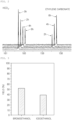
- FIG. 1 illustrates the results as a graph.
- alkylene carbonate may be obtained with a yield of 75% or more at a mild temperature within a range of 45 to 90°C at normal pressure, and alkylene carbonate may be obtained with a yield of about 85% or more at a temperature within a range of 60 to 85°C.
- FIG. 2 illustrates these results, and it was confirmed that ethylene carbonate, which did not exist at the start of the reaction (0h), was produced and the product increased over time. In addition, according to the same results, it was confirmed that bromoethanol may be converted to ethylene carbonate even when a reaction vessel is not sealed and both inside and outside the container are maintained at atmospheric pressure.
Landscapes
- Chemical & Material Sciences (AREA)
- Organic Chemistry (AREA)
- Organic Low-Molecular-Weight Compounds And Preparation Thereof (AREA)
Applications Claiming Priority (2)
| Application Number | Priority Date | Filing Date | Title |
|---|---|---|---|
| KR1020220035182A KR102797785B1 (ko) | 2022-03-22 | 2022-03-22 | 알킬렌 카보네이트의 합성 방법 |
| PCT/KR2023/003720 WO2023182772A1 (ko) | 2022-03-22 | 2023-03-21 | 알킬렌 카보네이트의 합성 방법 |
Publications (2)
| Publication Number | Publication Date |
|---|---|
| EP4497749A1 true EP4497749A1 (de) | 2025-01-29 |
| EP4497749A4 EP4497749A4 (de) | 2025-06-18 |
Family
ID=88101809
Family Applications (1)
| Application Number | Title | Priority Date | Filing Date |
|---|---|---|---|
| EP23775268.8A Pending EP4497749A4 (de) | 2022-03-22 | 2023-03-21 | Verfahren zur herstellung von alkylencarbonat |
Country Status (4)
| Country | Link |
|---|---|
| US (1) | US20250188051A1 (de) |
| EP (1) | EP4497749A4 (de) |
| KR (1) | KR102797785B1 (de) |
| WO (1) | WO2023182772A1 (de) |
Families Citing this family (1)
| Publication number | Priority date | Publication date | Assignee | Title |
|---|---|---|---|---|
| WO2025170365A1 (ko) * | 2024-02-08 | 2025-08-14 | 주식회사 엔바이온 | 친환경 알킬렌 카보네이트의 제조방법 |
Family Cites Families (8)
| Publication number | Priority date | Publication date | Assignee | Title |
|---|---|---|---|---|
| US1907891A (en) * | 1928-11-14 | 1933-05-09 | Ig Farbenindustrie Ag | Production of carbonic acid esters of the glycols |
| DE516281C (de) * | 1928-11-15 | 1931-01-22 | I G Farbenindustrie Akt Ges | Verfahren zur Herstellung von Kohlensaeureestern der Glykolreihe |
| US2766258A (en) * | 1952-05-15 | 1956-10-09 | Jefferson Chem Co Inc | Process for isolation of alkylene carbonates |
| IT1095606B (it) * | 1978-04-14 | 1985-08-10 | Montedison Spa | Processo per la sintesi di alchilencarbonati |
| JPS5913776A (ja) | 1982-07-14 | 1984-01-24 | Mitsubishi Petrochem Co Ltd | アルキレンカ−ボネ−トの製造方法 |
| DE3723782A1 (de) * | 1987-07-16 | 1989-01-26 | Dainippon Ink & Chemicals | Verfahren zur herstellung von cyclocarbonatverbindungen |
| JPH0967365A (ja) | 1995-08-29 | 1997-03-11 | Mitsubishi Chem Corp | アルキレンカーボネートの製造方法 |
| WO2014171894A1 (en) * | 2013-04-18 | 2014-10-23 | Agency For Science, Technology And Research | Synthesis of cyclic carbonates |
-
2022
- 2022-03-22 KR KR1020220035182A patent/KR102797785B1/ko active Active
-
2023
- 2023-03-21 WO PCT/KR2023/003720 patent/WO2023182772A1/ko not_active Ceased
- 2023-03-21 US US18/840,382 patent/US20250188051A1/en active Pending
- 2023-03-21 EP EP23775268.8A patent/EP4497749A4/de active Pending
Also Published As
| Publication number | Publication date |
|---|---|
| US20250188051A1 (en) | 2025-06-12 |
| EP4497749A4 (de) | 2025-06-18 |
| KR20230139820A (ko) | 2023-10-06 |
| WO2023182772A1 (ko) | 2023-09-28 |
| KR102797785B1 (ko) | 2025-04-23 |
Similar Documents
| Publication | Publication Date | Title |
|---|---|---|
| Yang et al. | Facile synthesis of zinc halide-based ionic liquid for efficient conversion of carbon dioxide to cyclic carbonates | |
| US20010021790A1 (en) | Process for producing sulfonylimide compound | |
| AU2002354475B2 (en) | Crystals of bicalutamide and process for their production | |
| JP2013500963A (ja) | ジアルキルカーボネートを製造する方法 | |
| JP2022552308A (ja) | ビス(フルオロスルホニル)イミド塩及びその調製方法 | |
| CN105731398A (zh) | 一种双氟磺酰亚胺的碱金属盐的制备方法 | |
| Chen et al. | Synthesis of highly effective [Emim] IM applied in one-step CO2 conversion to dimethyl carbonate | |
| EP4497749A1 (de) | Verfahren zur herstellung von alkylencarbonat | |
| KR20230118912A (ko) | 오늄 설포닐 이미드 염 및 알칼리 금속 설포닐 이미드염을 생성하기 위한 방법 | |
| CA2322099A1 (en) | Process for producing sulfonylimide compound | |
| US4605772A (en) | Process for preparing N-alkane-N-alkanolamines | |
| Khokarale et al. | Metal free synthesis of ethylene and propylene carbonate from alkylene halohydrin and CO 2 at room temperature | |
| Demberelnyamba et al. | New epoxide molten salts: Key intermediates for designing novel ionic liquids | |
| EP3560889A1 (de) | Verfahren zur herstellung von schwefeltetrafluorid | |
| EP2476666A1 (de) | Verfahren zur herstellung von bis(sulfonyl)imid-ammoniaksalzen, bis(sulfonyl)imid und bis(sulfonyl)imid-lithiumsalzen | |
| CN115285951B (zh) | 一种双氟磺酰亚胺盐电解质的制备方法及其应用 | |
| Lee et al. | Cycloaddition of carbon dioxide to epichlorohydrin using ionic liquid as a catalyst | |
| JP5186910B2 (ja) | トリス(パーフルオロアルカンスルホニル)メチド酸塩の製造方法 | |
| US20260125354A1 (en) | Method for synthesizing cyclic carbonate | |
| WO2021155350A1 (en) | Methods of making delmopinol and salts thereof | |
| KR20250005799A (ko) | 고리형 카보네이트의 합성방법 | |
| CN116836147A (zh) | 环状硫酸酯的制备方法及应用 | |
| JPH06329615A (ja) | アミノエタンスルホン酸ソーダ、または、n−置換アミノエタンスルホン酸ソーダの製造方法 | |
| Xu et al. | Direct Synthesis of Cyclic Carbonates from Olefins and CO 2 via Ionic Liquid Catalysis with Mutual Promoting Bifunctional Groups | |
| KR20040061164A (ko) | 이미다졸륨 아연테트라할라이드 촉매를 이용한알킬렌카보네이트의 제조방법 |
Legal Events
| Date | Code | Title | Description |
|---|---|---|---|
| STAA | Information on the status of an ep patent application or granted ep patent |
Free format text: STATUS: THE INTERNATIONAL PUBLICATION HAS BEEN MADE |
|
| PUAI | Public reference made under article 153(3) epc to a published international application that has entered the european phase |
Free format text: ORIGINAL CODE: 0009012 |
|
| STAA | Information on the status of an ep patent application or granted ep patent |
Free format text: STATUS: REQUEST FOR EXAMINATION WAS MADE |
|
| 17P | Request for examination filed |
Effective date: 20240916 |
|
| AK | Designated contracting states |
Kind code of ref document: A1 Designated state(s): AL AT BE BG CH CY CZ DE DK EE ES FI FR GB GR HR HU IE IS IT LI LT LU LV MC ME MK MT NL NO PL PT RO RS SE SI SK SM TR |
|
| REG | Reference to a national code |
Ref country code: DE Ref legal event code: R079 Free format text: PREVIOUS MAIN CLASS: C07D0317360000 Ipc: C07D0317380000 |
|
| A4 | Supplementary search report drawn up and despatched |
Effective date: 20250516 |
|
| RIC1 | Information provided on ipc code assigned before grant |
Ipc: C07D 317/36 20060101ALI20250512BHEP Ipc: C07D 317/38 20060101AFI20250512BHEP |
|
| DAV | Request for validation of the european patent (deleted) | ||
| DAX | Request for extension of the european patent (deleted) |