EP4497778A1 - Wärmehärtendes prepreg und verfahren zur herstellung davon - Google Patents
Wärmehärtendes prepreg und verfahren zur herstellung davon Download PDFInfo
- Publication number
- EP4497778A1 EP4497778A1 EP23775026.0A EP23775026A EP4497778A1 EP 4497778 A1 EP4497778 A1 EP 4497778A1 EP 23775026 A EP23775026 A EP 23775026A EP 4497778 A1 EP4497778 A1 EP 4497778A1
- Authority
- EP
- European Patent Office
- Prior art keywords
- resin composition
- thermosetting
- thermosetting resin
- fiber sheet
- prepreg
- Prior art date
- Legal status (The legal status is an assumption and is not a legal conclusion. Google has not performed a legal analysis and makes no representation as to the accuracy of the status listed.)
- Pending
Links
Images

Classifications
-
- C—CHEMISTRY; METALLURGY
- C08—ORGANIC MACROMOLECULAR COMPOUNDS; THEIR PREPARATION OR CHEMICAL WORKING-UP; COMPOSITIONS BASED THEREON
- C08J—WORKING-UP; GENERAL PROCESSES OF COMPOUNDING; AFTER-TREATMENT NOT COVERED BY SUBCLASSES C08B, C08C, C08F, C08G or C08H
- C08J5/00—Manufacture of articles or shaped materials containing macromolecular substances
- C08J5/24—Impregnating materials with prepolymers which can be polymerised in situ, e.g. manufacture of prepregs
- C08J5/241—Impregnating materials with prepolymers which can be polymerised in situ, e.g. manufacture of prepregs using inorganic fibres
- C08J5/243—Impregnating materials with prepolymers which can be polymerised in situ, e.g. manufacture of prepregs using inorganic fibres using carbon fibres
-
- B—PERFORMING OPERATIONS; TRANSPORTING
- B32—LAYERED PRODUCTS
- B32B—LAYERED PRODUCTS, i.e. PRODUCTS BUILT-UP OF STRATA OF FLAT OR NON-FLAT, e.g. CELLULAR OR HONEYCOMB, FORM
- B32B27/00—Layered products comprising a layer of synthetic resin
- B32B27/38—Layered products comprising a layer of synthetic resin comprising epoxy resins
-
- B—PERFORMING OPERATIONS; TRANSPORTING
- B32—LAYERED PRODUCTS
- B32B—LAYERED PRODUCTS, i.e. PRODUCTS BUILT-UP OF STRATA OF FLAT OR NON-FLAT, e.g. CELLULAR OR HONEYCOMB, FORM
- B32B5/00—Layered products characterised by the non- homogeneity or physical structure, i.e. comprising a fibrous, filamentary, particulate or foam layer; Layered products characterised by having a layer differing constitutionally or physically in different parts
- B32B5/02—Layered products characterised by the non- homogeneity or physical structure, i.e. comprising a fibrous, filamentary, particulate or foam layer; Layered products characterised by having a layer differing constitutionally or physically in different parts characterised by structural features of a fibrous or filamentary layer
-
- B—PERFORMING OPERATIONS; TRANSPORTING
- B32—LAYERED PRODUCTS
- B32B—LAYERED PRODUCTS, i.e. PRODUCTS BUILT-UP OF STRATA OF FLAT OR NON-FLAT, e.g. CELLULAR OR HONEYCOMB, FORM
- B32B5/00—Layered products characterised by the non- homogeneity or physical structure, i.e. comprising a fibrous, filamentary, particulate or foam layer; Layered products characterised by having a layer differing constitutionally or physically in different parts
- B32B5/22—Layered products characterised by the non- homogeneity or physical structure, i.e. comprising a fibrous, filamentary, particulate or foam layer; Layered products characterised by having a layer differing constitutionally or physically in different parts characterised by the presence of two or more layers which are next to each other and are fibrous, filamentary, formed of particles or foamed
- B32B5/24—Layered products characterised by the non- homogeneity or physical structure, i.e. comprising a fibrous, filamentary, particulate or foam layer; Layered products characterised by having a layer differing constitutionally or physically in different parts characterised by the presence of two or more layers which are next to each other and are fibrous, filamentary, formed of particles or foamed one layer being a fibrous or filamentary layer
- B32B5/26—Layered products characterised by the non- homogeneity or physical structure, i.e. comprising a fibrous, filamentary, particulate or foam layer; Layered products characterised by having a layer differing constitutionally or physically in different parts characterised by the presence of two or more layers which are next to each other and are fibrous, filamentary, formed of particles or foamed one layer being a fibrous or filamentary layer another layer next to it also being fibrous or filamentary
-
- C—CHEMISTRY; METALLURGY
- C08—ORGANIC MACROMOLECULAR COMPOUNDS; THEIR PREPARATION OR CHEMICAL WORKING-UP; COMPOSITIONS BASED THEREON
- C08J—WORKING-UP; GENERAL PROCESSES OF COMPOUNDING; AFTER-TREATMENT NOT COVERED BY SUBCLASSES C08B, C08C, C08F, C08G or C08H
- C08J5/00—Manufacture of articles or shaped materials containing macromolecular substances
- C08J5/24—Impregnating materials with prepolymers which can be polymerised in situ, e.g. manufacture of prepregs
- C08J5/241—Impregnating materials with prepolymers which can be polymerised in situ, e.g. manufacture of prepregs using inorganic fibres
- C08J5/244—Impregnating materials with prepolymers which can be polymerised in situ, e.g. manufacture of prepregs using inorganic fibres using glass fibres
-
- C—CHEMISTRY; METALLURGY
- C08—ORGANIC MACROMOLECULAR COMPOUNDS; THEIR PREPARATION OR CHEMICAL WORKING-UP; COMPOSITIONS BASED THEREON
- C08J—WORKING-UP; GENERAL PROCESSES OF COMPOUNDING; AFTER-TREATMENT NOT COVERED BY SUBCLASSES C08B, C08C, C08F, C08G or C08H
- C08J5/00—Manufacture of articles or shaped materials containing macromolecular substances
- C08J5/24—Impregnating materials with prepolymers which can be polymerised in situ, e.g. manufacture of prepregs
- C08J5/249—Impregnating materials with prepolymers which can be polymerised in situ, e.g. manufacture of prepregs characterised by the additives used in the prepolymer mixture
-
- B—PERFORMING OPERATIONS; TRANSPORTING
- B32—LAYERED PRODUCTS
- B32B—LAYERED PRODUCTS, i.e. PRODUCTS BUILT-UP OF STRATA OF FLAT OR NON-FLAT, e.g. CELLULAR OR HONEYCOMB, FORM
- B32B2260/00—Layered product comprising an impregnated, embedded, or bonded layer wherein the layer comprises an impregnation, embedding, or binder material
- B32B2260/02—Composition of the impregnated, bonded or embedded layer
- B32B2260/021—Fibrous or filamentary layer
-
- B—PERFORMING OPERATIONS; TRANSPORTING
- B32—LAYERED PRODUCTS
- B32B—LAYERED PRODUCTS, i.e. PRODUCTS BUILT-UP OF STRATA OF FLAT OR NON-FLAT, e.g. CELLULAR OR HONEYCOMB, FORM
- B32B2260/00—Layered product comprising an impregnated, embedded, or bonded layer wherein the layer comprises an impregnation, embedding, or binder material
- B32B2260/04—Impregnation, embedding, or binder material
- B32B2260/046—Synthetic resin
-
- B—PERFORMING OPERATIONS; TRANSPORTING
- B32—LAYERED PRODUCTS
- B32B—LAYERED PRODUCTS, i.e. PRODUCTS BUILT-UP OF STRATA OF FLAT OR NON-FLAT, e.g. CELLULAR OR HONEYCOMB, FORM
- B32B2262/00—Composition or structural features of fibres which form a fibrous or filamentary layer or are present as additives
- B32B2262/10—Inorganic fibres
- B32B2262/106—Carbon fibres, e.g. graphite fibres
-
- B—PERFORMING OPERATIONS; TRANSPORTING
- B32—LAYERED PRODUCTS
- B32B—LAYERED PRODUCTS, i.e. PRODUCTS BUILT-UP OF STRATA OF FLAT OR NON-FLAT, e.g. CELLULAR OR HONEYCOMB, FORM
- B32B2307/00—Properties of the layers or laminate
- B32B2307/70—Other properties
- B32B2307/718—Weight, e.g. weight per square meter
-
- B—PERFORMING OPERATIONS; TRANSPORTING
- B32—LAYERED PRODUCTS
- B32B—LAYERED PRODUCTS, i.e. PRODUCTS BUILT-UP OF STRATA OF FLAT OR NON-FLAT, e.g. CELLULAR OR HONEYCOMB, FORM
- B32B2307/00—Properties of the layers or laminate
- B32B2307/70—Other properties
- B32B2307/732—Dimensional properties
- B32B2307/737—Dimensions, e.g. volume or area
- B32B2307/7375—Linear, e.g. length, distance or width
- B32B2307/7376—Thickness
-
- C—CHEMISTRY; METALLURGY
- C08—ORGANIC MACROMOLECULAR COMPOUNDS; THEIR PREPARATION OR CHEMICAL WORKING-UP; COMPOSITIONS BASED THEREON
- C08J—WORKING-UP; GENERAL PROCESSES OF COMPOUNDING; AFTER-TREATMENT NOT COVERED BY SUBCLASSES C08B, C08C, C08F, C08G or C08H
- C08J2363/00—Characterised by the use of epoxy resins; Derivatives of epoxy resins
- C08J2363/02—Polyglycidyl ethers of bis-phenols
Definitions
- the present disclosure relates to a thermosetting prepreg and a method for producing the same.
- the present disclosure relates to a thermosetting prepreg that can be used in the production of carbon-fiber reinforced plastics (CFRP) used in applications such as aircraft, and a process for producing the same.
- CFRP carbon-fiber reinforced plastics
- Carbon-fiber-reinforced composites also referred to as a composite or CFRP
- CFRP Carbon-fiber-reinforced composites
- characteristics such as light weight, high strength, and high elastic modulus, and are widely applied to aircrafts, sporting leisure, and general industries.
- This composite material is often manufactured using a prepreg in which carbon fibers and a matrix resin are integrated with each other in advance.
- a composite material can be produced for example by laminating a plurality of prepregs.
- a composite material manufactured by laminating and molding a prepreg includes a resin layer made of a matrix resin between layers of laminated carbon fiber layers.
- the matrix resin used for the composite material has low electrical conductivity, and therefore, there was a case where the electrical conductivity in the thickness direction of the composite material is relatively low.
- Patent Documents 1 and 2 describe that metal particles or carbon particles are blended into a matrix resin of a composite material.
- thermosetting prepreg examples include a thermosetting prepreg.
- the thermosetting prepreg has, for example, a configuration in which a thermosetting resin such as an epoxy resin is impregnated into a reinforcing fiber sheet such as a carbon fiber sheet.
- a composite material can be produced for example by laminating a plurality (e.g., 24 layers) of thermosetting prepregs, followed by a thermosetting treatment (a heat-curing treatment).
- Patent Document 3 describes a prepreg composed of a primary prepreg consisting of reinforcing fibers and a resin composition (I) impregnated in the reinforcing fiber layer, and a surface layer consisting of a resin composition (II) formed on one or both surfaces of the primary prepreg.
- the resin composition (I) includes an epoxy resin and a thermoplastic resin
- the resin composition (II) includes an epoxy resin and electrically conductive particles.
- thermosetting prepreg With a conventional thermosetting prepreg, it was not easy to achieve excellent mechanical properties. In particular, with a conventional thermosetting prepreg, it was not easy to achieve good handleability in addition to excellent mechanical properties.
- An object of the present disclosure is to provide a thermosetting prepreg which has excellent mechanical properties and in particular further has good handling properties, as well as to provide a method for producing such a thermosetting prepreg.
- thermosetting prepreg having excellent mechanical properties and a method for producing the same can be provided.
- thermosetting prepreg having excellent mechanical properties and good handleability it is possible to provide a thermosetting prepreg having excellent mechanical properties and good handleability, and a method for producing the same.
- thermosetting prepreg according to the present invention comprises:
- thermosetting prepreg according to the present invention will be specifically described with reference to the drawings.
- the drawings are schematic illustrations for the purpose of helping understanding of the present invention and are not to scale and are not intended to limit the invention.
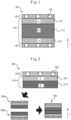
- FIG. 1 is a schematic cross sectional schematic view of a thermosetting prepreg according to one embodiment of the present disclosure, showing the cross section of the thermosetting prepreg when cut in a cross section perpendicular to the plane direction of the fiber sheet. "T” in FIG. 1 shows the thickness direction of the thermosetting prepreg.
- the thermosetting prepreg 100 depicted in FIG. 1 includes a fiber sheet 110.
- the fiber sheet 110 is in particular a carbon fiber sheet.
- a first thermosetting resin composition 112 is impregnated into the central region (B) of the fiber sheet 110 in the thickness direction thereof.
- the first thermosetting resin composition 112 comprises a thermosetting resin and a curing agent, and optionally further comprises a thermoplastic resin and an electrically conductive material.
- thermosetting prepreg 100 comprises the second thermosetting resin composition 122 which is impregnated in the outer region (A) of the fiber sheet 110 in the thickness direction thereof.
- the second thermosetting resin composition 122 comprises a thermosetting resin and a curing agent, and optionally further comprises a thermoplastic resin and an electrically conductive material.
- the second thermosetting resin composition 122 is disposed on the surface of the fiber sheet 110.
- the second thermosetting resin composition 122 disposed on the surface forms a resin layer 120.
- the resin layer 120 of FIG. 1 comprises resin particles 150.
- thermosetting prepreg 100 of FIG. 1 the equivalent ratio of the curing agent in the first thermosetting resin composition is higher than the equivalent ratio of the curing agent in the second thermosetting resin composition. Therefore, in the thermosetting prepreg 100, the equivalent ratio of the curing agent in the central region (B) of the thermosetting prepreg is larger than the equivalent ratio of the curing agent in the outer region (A).
- thermosetting prepreg according to the present disclosure as described above when subjected to a thermosetting treatment, a relatively high crosslink density of the thermosetting resin can be obtained inside the fiber sheet, so that the elasticity of a matrix resin is improved, and as a result, the mechanical properties are improved.
- thermosetting prepreg 100 in the cross section perpendicular to the plane direction of the fiber sheet, the ratio of the thickness of the central region to the total thickness of the central region and the outer region is 10 to 90%.
- At least one of the first thermosetting resin composition 112 and the second thermosetting resin composition 122 further contains a thermoplastic resin and/or an electrically conductive material (in particular, electrically conductive particles).
- a thermoplastic resin By containing an electrically conductive material, the electrical conductivity of a thermosetting prepreg can be further improved.
- the handling properties of a thermosetting prepreg can be further improved.
- the handling properties of a thermosetting prepreg mean, in particular, the handling property at the time when a plurality of thermosetting prepregs are automatically laminated (automatic lamination property).
- the viscosity at 50°C of the first thermosetting resin composition is higher than the viscosity at 50°C of the second thermosetting resin composition.
- particularly good tackiness can be obtained, and as a result of which particularly good handleability (in particular, automatic lamination property) of a thermosetting prepreg can be realized.
- the viscosity of the first thermosetting resin composition at 50°C is 500 to 10000 Pa ⁇ s
- the viscosity of the second thermosetting resin composition at 50°C is 100 to 1000 Pa ⁇ s.
- thermosetting prepreg according to the present disclosure is not particularly limited, but it can be produced in particular by the method for producing a thermosetting prepreg according to the present disclosure described below.
- thermosetting prepreg comprises the following steps (a) and (b):
- the method for producing a thermosetting prepreg according to the present disclosure uses a precursor sheet containing a plurality of resin compositions having different constitutions.
- a thermosetting prepreg is manufactured using precursor sheets impregnated with the plurality of resin compositions having different constitutions, it is possible to realize a thermosetting prepreg having properties optimized in a site-specific manner.
- thermosetting prepreg when a resin composition is impregnated into a fiber sheet, the degree of impregnation of the resin composition into the central portion of the fiber sheet may be reduced due to the impregnation properties of the resin composition.
- the degree of impregnation of a curing agent in the central region of a fiber sheet is low, the mechanical properties of the fiber sheet may be deteriorated.
- thermosetting prepreg is produced by superposing two thermosetting prepreg precursor sheets, and at the time of this superposition, out of the two outer regions in the thickness direction of each of the precursor sheets, the one having a resin composition with a relatively large equivalent ratio of a curing agent is superposed to that of the other precursor sheet. According to such a method, it is possible to increase the amount of the curing agent distributed in the central portion of the resulting thermosetting prepreg.
- FIG. 2 conceptually illustrates a manufacturing method according to one embodiment of the present disclosure.
- a thermosetting prepreg precursor sheet 200 of FIG. 2 comprises a fiber sheet 210.
- the first outer region (B') in the thickness direction of the fiber sheet 210 is impregnated with the first thermosetting resin composition 212.
- the second outer region (A') in the thickness direction of the fiber sheet 210 is impregnated with the second thermosetting resin composition 222.
- the second thermosetting resin composition 222 is disposed on the main surface of the fiber sheet 210 to form a resin layer 220.
- the resin layer 220 includes resin particles 250.
- the equivalent ratio of the curing agent in the first thermosetting resin composition 212 is higher than the equivalent ratio of the curing agent in the second thermosetting resin composition 222.
- thermosetting prepreg precursor sheets 200a, 200b are arranged on top of each other, such that the first outer region of the fiber sheet of one thermosetting prepreg precursor sheet 200a faces the first outer region of the fiber sheet of the other thermosetting prepreg precursor sheet 200b.
- the surfaces adjacent to the first outer regions are in contact with each other, either directly or via the resin composition.
- a treatment for integrating these precursor sheets for example a heat and pressure treatment, can be carried out.
- thermosetting prepreg 100 in which, in the cross section perpendicular to the plane direction of the sheet, the amount of the curing agent in the central region in the thickness direction is higher than the amount of the curing agent in the outer region in the thickness direction.
- thermosetting prepreg precursor sheet is not particularly limited, but may be produced in particular by the method for producing a thermosetting prepreg precursor sheet according to the present disclosure, the method including the following steps:
- FIG. 3 is a conceptual diagram illustrating one embodiment of the method for producing a thermosetting prepreg precursor sheet according to the present disclosure.
- a fiber sheet 310 having a first main surface 314 and a second main surface 316 are provided, and on the first major surface 314, a sheet 320 formed from the first thermosetting resin composition 322 is disposed, and on the second major surface 316, a sheet 330 formed from the second thermosetting resin composition 332 is disposed.
- the equivalent ratio of the curing agent contained in the first thermosetting resin composition 322 is higher than the equivalent ratio of the curing agent contained in the second thermosetting resin composition 332.
- the sheet 330 of FIG. 3 includes resin particles 350.
- each of the resin compositions 322 and 332 can be impregnated into the fiber sheet 310, by applying heat and/or pressure, for example, using a heat roller, in order to obtain the thermosetting prepreg precursor sheet 200.
- the fiber sheet can be simultaneously impregnated with the first thermosetting resin composition and the second thermosetting resin composition, the impregnation properties of the second thermosetting resin composition into the fiber sheet can be further improved, as compared with a case where the fiber sheet is first impregnated with the first thermosetting resin composition and then impregnated with the second thermosetting resin composition.
- thermosetting prepreg comprises a fiber sheet, a first thermosetting resin composition, and a second thermosetting resin composition.
- the basis weight of fiber of the thermosetting prepreg may be, for example, 50 to 1000 g/m 2 , 100 to 800 g/m 2 , in particular 200 to 600 g/m 2 .
- the thickness of the thermosetting prepreg may be, for example, 0.02 mm to 3.6 mm, 0.04 mm to 2.9 mm, or 0.08 mm to 2.2 mm.
- the fiber sheet contained in the thermosetting prepreg according to the present disclosure is, in particular, a reinforcing fiber sheet composed of reinforcing fibers.
- the reinforcing fiber sheet is preferably a carbon fiber sheet.
- the reinforcing fibers include carbon fibers, glass fibers, aramid fibers, silicon carbide fibers, polyester fibers, ceramic fibers, alumina fibers, boron fibers, metal fibers, mineral fibers, rock fibers, and slag fibers.
- carbon fibers, glass fibers, and aramid fibers are preferable, and carbon fibers are more preferable, since they have good specific strength and specific elastic modulus and make it possible to obtain a lightweight and high-strength composite material.
- the carbon fibers polyacrylonitrile (PAN)-based carbon fibers are particularly preferable, which have excellent tensile strength.
- the tensile modulus thereof is preferably 170 GPa to 600 GPa, and particularly preferably 220 GPa to 450 GPa. Further, the tensile strength is preferably 3920 MPa or more. The upper limit of the tensile strength is not particularly limited, but may be, for example, 10000 MPa or less. By using such carbon fibers, the mechanical properties of a composite material can be improved. The tensile strength and the tensile modulus of a carbon fiber can be measured in accordance with the standard JIS R 7608.
- the fiber sheet examples include an article in the form of a sheet in which a large number of fibers (especially reinforcing fibers) are aligned in one direction, bi-directional fabric such as plain or twill woven fabric, a multi-axial woven fabric, non-woven fabric, a mat, a knit, a braid, paper made from fibers (especially reinforcing fibers).
- bi-directional fabric such as plain or twill woven fabric, a multi-axial woven fabric, non-woven fabric, a mat, a knit, a braid, paper made from fibers (especially reinforcing fibers).
- the thickness of the fiber sheet may be 0.02 to 3.6 mm, 0.04 to 2.9 mm, or 0.08 to 2.2 mm.
- the basis weight of the fiber sheet may be 50 to 1000 g/m 2 , preferably 100 to 800 g/m 2 , and more preferably 200 to 600 g/m 2 .
- the distance between fibers in the fiber sheet is preferably less than 10 ⁇ m.
- the content of a fiber sheet in a thermosetting prepreg is preferably 40 to 80% by mass, more preferably 45 to 75% by mass, and even more preferably 50 to 70% by mass, based on the total weight of a thermosetting prepreg.
- the fiber sheet is impregnated with the first thermosetting resin composition in its central region in the thickness direction, and is impregnated with the second thermosetting resin composition in its outer region in the thickness direction.
- the ratio of the thickness of the central region to the total thickness of the central region and the outer region of the fiber sheet is 10 to 90%.
- the fiber sheet has two main surfaces, and the outer region of the fiber sheet are in particular regions of the fiber sheet each of which extends along one of the two main surfaces of the fiber sheet.
- the viscosity (V1 (units: Pa ⁇ s)) at 50°C of the first thermosetting resin composition is higher than the viscosity (V2 (units: Pa ⁇ s)) at 50°C of the second thermosetting resin composition, and in particular, the difference between these viscosities (V1-V2) is 10 or more, 25 or more, 50 or more, 75 or more, 100 or more, 150 or more, 200 or more, 250 or more, 300 or more, 400 or more, or 500 or more.
- the upper limit of the difference (V1-V2) may be, for example, 3000 or less, 2600 or less, 2000 or less, 1500 or less, 1000 or less, or 750 or less.
- the viscosity at 50°C of the first thermosetting resin composition is preferably 500 to 10000 Pa ⁇ s, or 550 to 5000 Pa ⁇ s, more preferably 600 to 3000 Pa ⁇ s, or 600 to 2000 Pa ⁇ s, even more preferably 650 to 1500 Pa ⁇ s or 650 to 1000 Pa ⁇ s, most preferably 700 to 900 Pa ⁇ s.
- the viscosity of a first thermosetting resin composition at 50°C is within this range, particularly good impregnation of the resin composition into a fiber sheet may be obtained.
- the viscosity at 50°C of the second thermoset composition is preferably 100 to 1250 Pa ⁇ s, 100 to 1000 Pa ⁇ s or 200 to 1000 Pa ⁇ s, more preferably 400 to 800 Pa ⁇ s, even more preferably 500 to 750 Pa ⁇ s.
- the viscosity of the second thermosetting resin composition at 50°C is within this range, particularly good impregnation of the resin composition into a fiber sheet can be obtained, and particularly good handleability of a thermosetting prepreg can be obtained.
- Viscosity can be determined from a temperature-viscosity curve measured using a rheometer.
- thermosetting resin composition can be adjusted by selecting the amount and/or type of a thermosetting resin and/or curing agent contained in the thermosetting resin composition, and can be further adjusted by selecting the amount and/or type of optional components, i.e., a thermoplastic resin, resin particles, and/or electrically conductive material.
- thermosetting resin composition comprises at least a thermosetting resin and a curing agent.
- resin compositions may further comprise a thermoplastic resin and/or an electrically conductive material.
- thermosetting resin (Thermosetting resin)
- the thermosetting resin can be crosslinked by being heated in the presence of a curing agent to form a three-dimensional molecular structure (e.g., a network structure).
- the thermosetting resin may include a heat-curable monomer and/or an oligomer and/or a prepolymer.
- examples of the thermosetting resin include an epoxy resin and a urethane resin, in particular an epoxy resin.
- One kind of the thermosetting resin may be used alone, or two or more kinds thereof may be used in combination.
- An epoxy resin is crosslinked by a curing reaction with a curing agent so as to form a network structure.
- the epoxy resin include conventionally known epoxy resins, and in particular, an epoxy resin having an aromatic group in a molecular structure, and in particular, di- functional or tri- or higher functional epoxy resins having either a glycidyl amine structure or a glycidyl ether structure.
- An alicyclic epoxy resin may also be mentioned.
- Examples of the epoxy resin having a glycidyl amine structure include N,N,N', N'-tetraglycidyl diaminodiphenylmethane, N,N,O-triglycidyl-p-aminophenol, N,N,O-triglycidyl-m-aminophenol, N,N,O-triglycidyl-3-methyl-4-aminophenol, and triglycidyl aminocresol, and various isomers thereof.
- Examples of the epoxy resin having a glycidyl ether structure include a bisphenol A type epoxy resin, a bisphenol F type epoxy resin, a bisphenol S type epoxy resin, a phenol novolak type epoxy resin, and a cresol novolak type epoxy resin.
- These epoxy resins may have a non-reactive substituent in an aromatic ring structure, etc., if necessary.
- a non-reactive substituent includes an alkyl group such as methyl groups, ethyl groups and isopropyl groups, an aromatic group such as a phenyl group, alkoxyl groups, aralkyl groups, and a halogen group (such as chlorine, bromine).
- tri-functional epoxy resin examples include N,N,O-triglycidyl-p-aminophenol, N,N,O-triglycidyl-m-aminophenol.
- epoxy resins may be used alone or in combination of two or more thereof.
- the epoxy resin for example, an epoxy resin preliminarily reacted with a curing agent, etc., a so-called B-stage epoxy resin, may be used.
- both of the first thermosetting resin composition and the second thermosetting resin composition have an epoxy resin as a thermosetting resin, they may be the same or different from each other.
- thermosetting resin can impart good mechanical properties and tackiness to the thermosetting prepreg.
- the curing agent is in particular a curing agent for a thermosetting resin, for example a curing agent for an epoxy resin or a urethane resin.
- a curing agent for an epoxy resin include dicyandiamide, various isomers of aromatic amine curing agents, and esters of aminobenzoic acid.
- One type of curing agent may be used alone , or two or more types of curing agents may be used in combination.
- the first thermosetting resin composition and the second thermosetting resin composition may comprise the same curing agent, or may comprise different curing agents.
- the dicyandiamide is preferable because it provides excellent storage stability of a prepreg.
- aromatic diamine compounds such as 4,4'-diaminodiphenylsulfone, 3,3'-diaminodiphenylsulfone, and 4,4'-diaminodiphenylmethane, and derivatives thereof having a non-reactive substituent are particularly preferred from the viewpoint of providing a cured product with high heat resistance.
- non-reactive substituent examples include an alkyl group such as a methyl group, an ethyl group, an isopropyl group, an aromatic group such as a phenyl group, an alkoxyl group, an aralkyl group, and a halogen group (such as chlorine, bromine).
- ester of amino benzoic acid examples include trimethylene glycol di-p-aminobenzoate and neopentyl glycol di-p-aminobenzoate.
- a composite material having a particularly excellent tensile elongation can be obtained, although the heat resistance of the composite material can be inferior as compared to the case of diaminodiphenylsulfone.
- thermosetting resin and the curing agent may have an effect of improving mechanical properties (in particular, elastic modulus and strength) and/or heat resistance of a matrix resin of a thermosetting prepreg.
- the equivalent ratio of curing agent(s) in the first thermosetting resin composition is preferably from 0.70 to 1.00, more preferably from 0.75 to 0.90.
- the equivalent ratio of curing agent(s) is within this range, it is possible to obtain particularly good handling properties of a thermosetting prepreg and physical properties (in particular, mechanical properties) of a composite material formed from a thermosetting prepreg.
- the equivalent ratio of curing agent(s) in the second thermosetting resin composition is preferably from 0.50 to 0.90, more preferably from 0.60 to 0.80.
- the equivalent weight ratio of curing agent(s) is within this range, it is possible to obtain particularly good handling properties of a thermosetting prepreg and physical properties (in particular, mechanical properties) of a composite material formed from a thermosetting prepreg.
- the difference (E1-E2) between the equivalent ratio (E1) of the curing agent in the first thermosetting resin composition and the equivalent ratio (E2) of the curing agent in the second thermosetting resin composition may be 0.01 or more, 0.05 or more, or 0.10 or more, and/or may be 1.0 or less, 0.50 or less, 0.40 or less, 0.30 or less, 0.20 or less, 0.18 or less, or 0.16 or less.
- the content of the curing agent in the thermosetting resin composition may be 5 to 70 parts by mass, 10 to 60 parts by mass, 20 to 50 parts by mass, or 30 to 45 parts by mass with respect to 100 parts by mass of a thermosetting resin.
- thermosetting prepreg according to the present disclosure when the thermosetting prepreg according to the present disclosure is heat-cured (i.e., subjected to a thermosetting treatment) at 180°C for 120 minutes, there is, in the cross section perpendicular to the plane direction of the fiber sheet, a region in which a crosslink density of the thermosetting resin decreases from the center toward the surface in the thickness direction of the fiber sheet.
- the crosslink density ( ⁇ crosslink ) (units: mol/m 3 ) of a thermosetting resin, in the cross section perpendicular to the plane direction of a fiber sheet, can be calculated by measuring the glass transition temperature (Tg) for a cured product of a resin composition by DMA (Dynamic Viscoelasticity Measurement), and then using the equation of state for rubber shown in Equation (2).
- Tg glass transition temperature
- ⁇ crosslink E ′ / 3 ⁇ RT
- DMA measurement is performed using a dynamic-viscoelasticity measuring device, for example, a Rheogel-4000 (manufactured by UBM Co., Ltd.), under the condition of a double-holding bending mode, a strain amplitude of 5 ⁇ m, a heating rate of 5°C/min, and a frequency of 1 Hz and under air; and the onset of the obtained storage elastic modulus is determined as Tg.
- a dynamic-viscoelasticity measuring device for example, a Rheogel-4000 (manufactured by UBM Co., Ltd.)
- thermoplastic resin (Thermoplastic resin)
- the thermoplastic resin is preferably a thermoplastic resin that is soluble in a thermosetting resin.
- the thermoplastic resin is in particular a thermoplastic resin soluble in epoxy resin.
- the resin composition may contain, in addition to a soluble thermoplastic resin (in particular, a thermoplastic resin soluble in epoxy resin), an insoluble thermoplastic resin composition which is insoluble in a thermosetting resin (in particular, a thermoplastic resin composition insoluble in epoxy resin).
- a thermoplastic resin in particular, a thermoplastic resin soluble in epoxy resin
- an insoluble thermoplastic resin composition which is insoluble in a thermosetting resin in particular, a thermoplastic resin composition insoluble in epoxy resin.
- One type of the thermoplastic resin may be used alone, or two or more types thereof may be used in combination.
- thermoplastic resin may improve the impregnation of a thermosetting resin composition into a fiber sheet. Further, the thermoplastic resin may have an effect of improving the tackiness of a thermosetting prepreg. In addition, the thermoplastic resin may have an effect of improving the mechanical properties (in particular, toughness) of a matrix resin of a thermosetting prepreg.
- the amount of the thermoplastic resin in a resin composition is not particularly limited, but may be set according to a desired viscosity of a thermosetting resin composition, etc.
- the amount of the thermoplastic resin in each of the first and second thermosetting resin compositions may be 1 to 60 parts by mass, in particular, 2 to 50 parts by mass, 5 to 40 parts by mass, 10 to 30 parts by mass, or 15 to 25 parts by mass, based on 100 parts by mass of the thermosetting resin (in particular, an epoxy resin).
- the thermoplastic resin soluble in epoxy resin is a thermoplastic resin a part or all of which can be dissolved in an epoxy resin by heating, et.
- the thermoplastic resin soluble in epoxy resin is preferably a resin 80% by mass or more of which can be dissolved in an epoxy resin at 190°C
- Examples of the thermoplastic resin soluble in epoxy resin include polyethersulfone, polysulfone, polyetherimide, and polycarbonate. These may be used alone or two or more thereof can be used in combination.
- the insoluble thermoplastic resin composition (the thermoplastic resin composition insoluble in epoxy resin) will be described later.
- thermoplastic resin soluble in epoxy resin is not particularly limited.
- the thermoplastic resin soluble in epoxy resin is preferably in the form of a particle, and the mean particle diameter thereof is preferably 1 to 50 ⁇ m, and particularly preferably 3 to 30 ⁇ m.
- the average particle diameter of a thermoplastic resin in the form of particles can be measured by a laser diffraction/scattering particle diameter distribution measurement apparatus.
- both the first thermosetting resin composition and the second thermosetting resin composition contain a thermoplastic resin, they may be the same or different from each other.
- the electrically conductive material can, when it is present in a fiber sheet and in particular in a resin layer, improve an electrical conductivity of a thermosetting prepreg.
- the electrically conductive material is not particularly limited as long as it is a particle that behaves as a good electrical conductor, but is preferably one that can be dispersed in a resin composition and can improve an electrical conductivity of a thermosetting prepreg.
- the electrically conductive material is in particular electrically conductive particles.
- the electrically conductive particles are preferably particles having a volume resistivity of from 10 to 10 -9 ⁇ cm, more preferably from 1 to 10 -9 ⁇ cm, and particularly preferably from 10 -1 to 10 -9 ⁇ cm.
- electrically conductive particles examples include electrically conductive polymer particles, carbon particles, metal particles, coated conductive particles, and carbon fiber particles. These may be used alone or in combination.
- Examples of the electrically conductive polymer particles include polyacetylene particles, polyaniline particles, polypyrrole particles, polythiophene particles, polyisothiana phthene particles, and polyethylenedioxythiophene particles.
- Examples of the carbon particles include carbon black, carbon nanotubes (CNT), carbon nanostructures (CNS), carbon nanofibers, expanded graphite, scaly graphite, graphite powder, graphite particles, graphene sheets, and carbon milled fibers.
- Examples of the carbon milled fiber include milled fibers of PAN-based carbon fibers, pitch-based carbon fibers, and phenolic carbon fibers. Among these, milled fibers of pitch-based carbon fibers are preferable.
- the carbon fiber content of carbon milled fibers is preferably 94% by mass or more.
- metal particles if carbon fibers are used as a reinforcing fiber, particles of platinum, gold, silver, copper, tin, nickel, titanium, cobalt, zinc, iron, chromium, and aluminum, particles of an alloy containing these metals as a main component, tin oxide, indium oxide, and indium tin oxide (ITO), are preferable from the viewpoint of preventing corrosion due to a potential difference between the metal particles and the carbon fiber.
- the particles of each of platinum, gold, silver, copper, tin, nickel and titanium, and the particles of an alloy containing these metals as a main component are more preferable, and the particles of each of silver, copper and nickel are particularly preferable, because they exhibit high conductivity and stability.
- Preferred examples of the electrically conductive particles include carbon nanotubes, carbon nanostructures, carbon black, carbon milled fibers, and silver nanoparticles.
- the electrically conductive material preferably has a size that allows a diffusion into a fiber sheet when a resin composition is impregnated into the fiber sheet.
- the electrically conductive material is preferably in the form of a particle (i.e. an electrically conductive particle) and has an mean particle size of, for example, 1 to 1000 nm or 1 to 500 nm, preferably, 2 to 200 nm, 3 to 100 nm, 4 to 50 nm, or 5 to 25 nm.
- electrically conductive particles having a relatively small particle size can further improve an electrical conductivity of a composite material formed from a prepreg as a result that the electrically conductive particles are dispersed in both a fiber sheet and a resin layer.
- the mean particle size of the electrically conductive material refers to a 50% particle size (D 50 ) in a particle size distribution measured using a laser diffraction/scattering particle size distribution analyzer.
- the content of the electrically conductive material may be 0.01 to 10 parts by mass, preferably 0.05 to 5 parts by mass, and more preferably 0.10 to 1 parts by mass, with respect to 100 parts by mass of a thermosetting resin (particularly, an epoxy resin) contained in a resin composition.
- a thermosetting resin particularly, an epoxy resin contained in a resin composition.
- the amount is 0.01 parts by mass or more, the effect of improving the electrical conductivity of a prepreg and a composite material can become particularly good.
- the amount is 10 parts by mass or less, the viscosity of a resin composition is prevented from being remarkably increased, and good handleability of a prepreg can be ensured.
- both the first thermosetting resin composition and the second thermosetting resin composition contain an electrically conductive material, they may be the same or may be different from each other.
- the thermosetting prepreg may comprise an additional electrically conductive material in addition to the electrically conductive material described above.
- This additional electrically conductive material is in particular intended to be present in the second thermosetting resin composition present on the surface of a fiber sheet (in particular in a resin layer described below).
- the second thermosetting resin composition disposed on the surface of a fiber sheet contains an additional electrically conductive material.
- additional conductive materials include carbon fibers, pitch-based carbon fibers, milled fibers (in particular, carbon milled fibers), silver aggregates. These may be used alone or in combination.
- the additional electrically conductive material preferably has an average length of greater than or equal to 1 ⁇ m, or greater than or equal to 1.5 ⁇ m, more preferably greater than or equal to 2 ⁇ m, particularly preferably greater than or equal to 4 ⁇ m.
- the upper limit of the average length of the additional electrically conductive material is not particularly limited, but may be, for example, 10 mm or less, 1 mm or less, 300 ⁇ m or less, 200 ⁇ m or less, or 100 ⁇ m or less. If the additional electrically conductive materials has such a length, they tend to remain on the surface of a fiber sheet (in particular in a resin layer) as a result that the additional electrically conductive materials have a difficulty in entering the fiber sheet.
- the additional electrically conductive material present on the surface of a fiber sheet (in particular in a resin layer) can further improve the overall electrical conductivity of a thermosetting prepreg.
- the average length of the additional electrically conductive material can be calculated by measuring the lengths of 30 or more additional electrically conductive materials in an image acquired using an electron microscope or an optical microscope, and averaging the obtained measurements.
- the mean diameter or the mean particle diameter thereof may be used as the average length.
- thermosetting resin compositions and the second thermosetting resin composition contain an additional electrically conductive material, they may be the same or different from each other.
- the second thermosetting resin composition which is impregnated in the outer region of a fiber sheet, is disposed on the surface of the fiber sheet.
- the second thermosetting resin composition forms a resin layer (a surface resin layer) on the surface of a fiber sheet.
- the resin layer is preferably laminated on the main surface of a fiber sheet, particularly preferably directly laminated on the main surface of a fiber sheet.
- the thickness of the resin layer is preferably 5 to 50 ⁇ m, in particular 10 to 40 ⁇ m.
- a thermosetting prepreg having particularly good tackiness may be obtained.
- a thermosetting prepreg having particularly good handling properties may be obtained, and particularly good moldability during manufacturing a composite material may be ensured.
- the second thermoplastic resin composition disposed on the surface of a fiber sheet may comprise resin particles.
- the resin particles are preferably dispersed in a resin layer. These resin particles can be present in a resin layer between fiber sheets in a laminate made by laminating thermosetting prepregs, and are therefore also referred to as "interlayer particles".
- the resin particles contained in a resin layer have an effect of improving the interlayer toughness of a composite material (in particular, a carbon-fiber-reinforced composite material) formed from a thermosetting prepreg.
- the resin particles contained in a resin layer may be composed of a thermoplastic resin.
- the resin particles are preferably hardly soluble in a thermosetting resin, and in particular composed of a thermoplastic resin insoluble in epoxy resin.
- the thermoplastic resin insoluble in epoxy resin refers to a thermoplastic resin which does not substantially dissolve in an epoxy resin at or below the temperature at which a composite material is molded.
- it refers to a thermoplastic resin in which the size of resin particles does not change when the resin particles are charged into an epoxy resin and stirred at a temperature at which a composite material is molded.
- the molding temperature of a composite material is 100 to 190°C.
- thermoplastic resin insoluble in epoxy resin examples include polyamide, polyacetal, polyphenylene oxide, polyphenylene sulfide, polyester, polyamideimide, polyimide, polyether ketone, polyether ether ketone, polyethylene naphthalate, polyether nitrile, and polybenzimidazole.
- polyamide, polyamideimide, and polyimide are preferred because of their high toughness and heat resistance. These may be used alone or two or more thereof may be used in combination. Copolymers thereof can also be used.
- amorphous polyimides and polyamides, such as nylon 6 (trademark) (polyamide obtained by ring-opening polycondensation reaction of caprolactam), nylon 12 (trademark) (polyamide obtained by ring-opening polycondensation reaction of lauryl lactam), and amorphous nylon (trademark), can be used.
- nylon 6 trademark
- nylon 12 trademark
- amorphous nylon trademark
- the mean particle size of the resin particles contained in a resin layer is preferably 5 to 50 ⁇ m, particularly 10 to 40 ⁇ m.
- the mean particle size of resin particles can be measured by a laser diffraction/scattering particle size distribution measurement apparatus.
- thermosetting resin composition may contain other components as long as the object and effect of the present invention are not impaired.
- the other components include amine compounds such as tertiary amines and imidazole, phosphines, phosphorus compounds such as phosphonium, curing accelerators such as N,N-dimethylurea derivatives, reactive diluents, fillers, antioxidants, flame retardants, and pigments, and other various additives. These other components are preferably 5% by mass or less, or 1% by mass or less with respect to a thermosetting resin composition.
- thermosetting prepreg according to the present disclosure may have, on both sides or one side thereof, release paper or a polymer film, for example, a polyethylene film.
- the release paper or polymer film can serve to protect the thermosetting prepreg.
- This release paper or polymer film can be removed, for example when a laminate (especially a fiber-reinforced composite material) is produced from thermosetting prepregs.
- a laminate can be formed by laminating thermosetting prepregs according to the present disclosure and optionally performing a thermosetting treatment.
- the laminate is in particular a fiber-reinforced composite material, more particularly a carbon-fiber-reinforced composite material.
- the laminate (the laminate of thermosetting prepregs) has a structure in which two or more thermosetting prepregs according to the present invention are laminated.
- the number of layers of thermosetting prepregs forming a laminate may be, for example, 2 to 200, 5 to 100, or 10 to 50.
- the laminate may be in the form of a sheet and may have a thickness of, for example, 1 mm to 100 mm, 2 mm to 50 mm, 3 mm to 25 mm or 4 mm to 10 mm.
- Such a laminate can be produced by conventionally known methods, including, for example, a manual lay-up, an automated tape lay-up (ATL), an automated fiber placement, a vacuum bagging, an autoclave curing, a non-autoclave curing, a fluid-assisted processing, a pressure-assisted processing, a match molding processes, a simple press curing, a press scrape curing, and a method using continuous hand pressing.
- ATL automated tape lay-up
- ATL automated tape lay-up
- ATL automated fiber placement
- vacuum bagging an autoclave curing, a non-autoclave curing
- a fluid-assisted processing a pressure-assisted processing
- a match molding processes a simple press curing, a press scrape curing, and a method using continuous hand pressing.
- a laminate in particular, a fiber-reinforced composite material
- a laminate can be formed by laminating a plurality of thermosetting prepregs according to the present invention, and pressurizing to 0.2 to 1.0 MPa and heating at 150 to 204°C in an autoclave for 1 to 8 hours.
- the laminate according to the present invention (in particular the fiber-reinforced composite) preferably exhibits, when measured according to the measuring method described in the Examples section, an electrical conductivity in the thickness direction of less than or equal to 3.5 k ⁇ cm, preferably of less than or equal to 0.3 k ⁇ cm, particularly preferably of less than or equal to 0.2 k ⁇ cm.
- the lower limit of the electrical conductivity in the thickness direction is not particularly limited, but may be, for example, 0.1 ⁇ cm or more or 1.0 ⁇ ⁇ cm or more.
- thermosetting prepreg according to the present disclosure is not particularly limited.
- the thermosetting prepreg according to the present disclosure can be produced according to the following production method, for example, by producing thermosetting prepreg precursor sheets and superposing the thermosetting prepreg precursor sheets.
- thermosetting prepreg by superposing precursor sheets ⁇ Method for producing thermosetting prepreg by superposing precursor sheets>>
- thermosetting prepreg comprises the following steps (a) and (b):
- thermosetting prepreg precursor sheets are provided.
- the fiber sheet the first thermosetting resin composition and the second thermosetting resin composition included in the thermosetting prepreg precursor sheet, reference can be made to the above descriptions regarding the thermosetting prepreg.
- thermosetting prepreg precursor sheets are arranged on top of each other such that the first outer region of the fiber sheet of one of the thermosetting prepreg precursor sheets faces the first outer region of the fiber sheet of the other of the thermosetting prepreg precursor sheets.
- the first outer region of each the two thermosetting prepreg precursor sheets faces each other, while the second outer region of each of the two thermosetting prepregs faces away from each other.
- the two thermosetting prepreg precursor sheets may be two separate thermosetting prepreg precursor sheets or may be two portions of one thermosetting prepreg precursor sheet.
- the above-described superposition may be performed by bending one precursor sheet.
- the direction of fibers in the fiber sheets of the precursor sheets are aligned.
- the direction of fibers in the fiber sheets of the two precursor sheets are substantially along the same direction. By doing so, it may be possible to reduce or substantially eliminate a resin composition being left between the two superposed precursor sheets.
- the amount of a resin composition present between the first outer regions of the two thermosetting prepreg precursor sheets is reduced. More preferably, there is substantially no resin composition between the surface which is adjacent to the first outer region of one thermosetting prepreg precursor sheet and the surface which is adjacent to the first outer region of the other thermosetting prepreg precursor sheet, such that the fiber sheets of the two thermosetting prepreg precursor sheets are in contact with each other.
- thermosetting prepreg after the two thermosetting prepreg precursor sheets are arranged on top of each other, a process for integrating them (e.g., a heat and pressure treatment) is performed to obtain a thermosetting prepreg.
- a process for integrating them e.g., a heat and pressure treatment
- a heat roller can be used.
- the heating temperature is preferably 40 to 140°C
- the pressurizing condition is preferably 0.1 to 200 N/cm, particularly preferably 5 to 100 N/cm.
- thermosetting prepreg by superposing two thermosetting prepreg precursor sheets
- the outer regions of the two thermosetting prepreg precursor sheets which have a relatively high equivalent ratio of curing agent are to be present in the central region of a thermosetting prepreg obtained as a result of the superposition. Therefore, according to this method of the present disclosure, the thermosetting prepreg according to the present disclosure can be obtained relatively simply and efficiently.
- the method of manufacturing a thermosetting prepreg according to the present disclosure may comprise a step of arranging release paper or a polymer film on both sides or one side (one or two main surfaces) of the thermosetting prepreg.
- the thermosetting prepreg obtained by superposing two thermosetting prepreg precursor sheets may be provided in a state in which both surfaces or one surface thereof is covered with release paper or a polymer film.
- the release paper or the polymer film can in particular be arranged such that both sides or the one side (one or two main surfaces) of the thermosetting prepreg are entirely covered.
- the polymer film include a polyethylene film.
- thermosetting prepreg precursor sheet ⁇ Method for producing thermosetting prepreg precursor sheet>
- thermosetting prepreg precursor sheet which can be used in the above method can be produced by the following method: A method comprising:
- a fiber sheet is provided.
- the fiber sheet may have a thickness of 0.01 to 1.8 mm, 0.02 to 1.5 mm or 0.04 to 1.1 mm.
- the basis weight of the fiber sheet may be 25 to 500 g/m 2 , preferably 50 to 400 g/m 2 , and more preferably 100 to 300 g/m 2 .
- Step of providing first resin composition step of providing second resin composition
- thermosetting resin composition In the step of providing first resin composition and the step of providing second resin composition, a first thermosetting resin composition and a second thermosetting resin composition are provided, respectively.
- These resin compositions comprise a thermosetting resin and a curing agent, and may optionally further comprise a thermoplastic resin and an electrically conductive material.
- thermosetting prepreg With regard to the resin compositions and its components, reference may be made to the above description regarding the thermosetting prepreg.
- thermosetting resin compositions can be produced by kneading constituent components.
- the kneading temperature is appropriately adjusted in consideration of the viscosity, thermal characteristics, curing temperature, etc., of a resin to be blended, but is lower than or equal to the curing onset temperature, and preferably 50 to 120°C
- the kneading may be performed in one stage or in multiple stages.
- the mixing order of constituent components of a resin composition is not particularly limited.
- a known kneading machine can be used, and for example, a roll mill, a planetary mixer, a kneader, an extruder, a Banbury mixer, etc., can be used.
- thermosetting resin composition provided in the providing steps may be, for example, in the form of a sheet.
- thermosetting resin composition sheet A method for producing a thermosetting resin composition in the form of a sheet (hereinafter also referred to as a "resin composition sheet” or “resin sheet”) is not particularly limited, and can be produced by a known method.
- a die coater, an applicator, a reverse roll coater, a comma coater, a knife coater, etc. can be used to apply (flow casting, casting, etc.,) a resin composition to a support such as release paper or a release sheet, in order to produce a thermosetting resin composition in the form of a sheet.
- a prepared thermosetting resin composition may be coated on release paper using a film coater and dried to form a sheet, and peeled from the release paper, in order to produce a sheet of a thermosetting resin composition.
- the processing temperature during the production of a sheet is preferably 70 to 160°C, and more preferably 75 to 140°C.
- the thickness of a resin sheet is preferably 2 to 500 ⁇ m, and more preferably 5 to 100 ⁇ m.
- the basis weight of a resin sheet may be 10 to 200 g/m 2 , preferably 20 to 100 g/m 2 , and more preferably 30 to 75 g/m 2 .
- the viscosity (V1 (units: Pa ⁇ s)) at 50°C of the first thermosetting resin composition is higher than the viscosity (V2 (units: Pa ⁇ s)) at 50°C of the second thermosetting resin composition, and in particular, the difference between these viscosities (V1-V2) is 10 or more, 25 or more, 50 or more, 75 or more, 100 or more, 150 or more, 200 or more, 250 or more, 300 or more, 400 or more, or 500 or more.
- the upper limit of the difference (V1-V2) may be, for example, 3000 or less, 2600 or less, 2000 or less, 1500 or less, 1000 or less, or 750 or less.
- the viscosity at 50°C of the first thermosetting resin composition is preferably 500 to 10000 Pa ⁇ s or 550 to 5000 Pa ⁇ s, more preferably 600 to 3000 Pa ⁇ s or 600 to 2000 Pa ⁇ s, even more preferably 650 to 1500 Pa ⁇ s or 650 to 1000 Pa ⁇ s, most preferably 700 to 900 Pa ⁇ s.
- the viscosity at 50°C of the second thermoset composition is preferably, 100 to 1250 Pa ⁇ s, 100 to 1000 Pa ⁇ s or 200 to 1000 Pa ⁇ s, more preferably 400 to 800 Pa ⁇ s, even more preferably 500 to 750 Pa ⁇ s.
- the first thermosetting resin composition and the second thermosetting resin composition are disposed on the first main surface and the second main surface of the fiber sheet, respectively.
- the first and second thermosetting resin compositions in the form of a sheet e.g. in the form of a resin film
- the first and second thermosetting resin compositions in the form of a sheet can be laminated on, in particular laminated directly on, the main surfaces of the fiber sheet, respectively.
- the ratio (M1/M2) of the basis weight M1 (g/m 2 ) of the first thermosetting resin composition in the form of a sheet to the basis weight M2 (g/m 2 ) of the second thermosetting resin composition in the form of a sheet may be 0.25 to 4.0, preferably 0.3 to 3.0 or even 0.5 to 2.0.
- the basis weight M1 (g/m 2 ) of the first thermosetting resin composition in the form of a sheet is higher than the basis weight M2 (g/m 2 ) of the second thermosetting resin composition in the form of a sheet.
- the ratio M1/M2 may be, for example, 1.2 to 3.0, 1.4 to 2.8, or 1.6 to 2.6.
- the basis weight M1 (g/m 2 ) of the first thermosetting resin composition in the form of a sheet is lower than the basis weight M2 (g/m 2 ) of the second thermosetting resin composition in the form of a sheet.
- the ratio M1/M2 may be, for example, 0.2 to 0.9, 0.3 to 0.8, or 0.4 to 0.7.
- the first thermosetting resin composition and the second thermosetting resin composition are at least partially impregnated into a fiber sheet.
- a method for impregnating a thermosetting resin composition into a fiber sheet is not particularly limited, but mention may be made of a preferable method in which a fiber sheet is impregnated with a resin composition having reduced viscosity by heating (a dry method).
- heat and pressure are optionally applied to an intermediate laminate obtained after the step of arranging first resin composition and the step of second resin composition, i.e., an intermediate laminate composed of a sheet of the first thermosetting resin composition, a fiber sheet and a sheet of the second thermosetting resin composition, so that the resin compositions are impregnated.
- an intermediate laminate obtained after the step of arranging first resin composition and the step of second resin composition, i.e., an intermediate laminate composed of a sheet of the first thermosetting resin composition, a fiber sheet and a sheet of the second thermosetting resin composition, so that the resin compositions are impregnated.
- a hot roller, etc. may be used for hot pressing, and for example, the intermediate laminate can be heated and passed between two rollers, in order to perform the impregnation.
- the heating temperature of the impregnation treatment can be appropriately determined in consideration of the viscosity, curing temperature, etc., of a thermosetting resin composition.
- a thermosetting resin composition contains an epoxy resin
- the heating temperature is preferably 70 to 160°C, more preferably 90 to 140°C.
- the duration of the impregnation treatment is preferably 10 to 300 seconds.
- the pressure condition of the impregnation treatment can be appropriately determined in consideration of the viscosity, curing temperature, etc., of a thermosetting resin composition.
- the condition of the pressure treatment in the impregnation process is 1 to 245 N/cm (0.1 to 25 kg/cm), more preferably 9.8 to 147 N/cm (1 to 15 kg/cm), or 9.8 to 50 N/cm (1 to 5 kg/cm), in linear pressure,.
- the impregnation treatment may be performed once or multiple times.
- the first thermosetting resin composition and the second thermosetting resin composition may each be completely impregnated into a fiber sheet, or a portion of the first thermosetting resin composition and/or the second thermosetting resin composition may remain on the surface of a fiber sheet.
- a resin composition remaining on the surface of a fiber sheet can form a resin layer.
- substantially all of the first thermosetting resin composition is impregnated into the fiber sheet, while a portion of the second thermosetting resin composition remains on the surface of the fiber sheet without being impregnated into the fiber sheet and forms a resin layer there.
- the basis weight of a fiber sheet, heating and pressurizing conditions, and/or viscosity of a resin composition can be adjusted as appropriate.
- the formation of a resin layer can also be promoted by adding interlayer particles to a thermosetting resin composition.
- thermosetting prepreg by sequentially impregnating the first and second resin compositions>
- thermosetting prepreg according to the present disclosure can also be produced by sequentially impregnating a fiber sheet with a first and second thermosetting resin compositions (hereinafter, this method is referred to as "sequential impregnation method").
- the method comprises:
- a fiber sheet is provided.
- the thickness of the fiber sheet may be 0.01 to 4.0 mm, 0.05 to 2.0 mm or 0.1 to 1.0 mm.
- the basis weight of the fiber sheet may be 70 to 600 g/m 2 , preferably 100 to 500 g/m 2 , and more preferably 200 to 450 g/m 2 .
- thermosetting resin compositions comprise a thermosetting resin and a curing agent, and may optionally further comprise a thermoplastic resin and an electrically conductive material.
- thermosetting resin compositions may be, for example, in the form of a sheet.
- thermosetting resin composition in the form of a sheet can be produced in the same manner as described above.
- a prepared thermosetting resin composition can be coated on release paper using a film coater and dried to form a sheet, and then peeled from the release paper in order to produce a thermosetting resin composition in the form of a sheet.
- the first thermosetting resin composition is arranged on the first main surface and/or the second main surface (preferably on the first and second main surfaces) of a fiber sheet.
- two sheets of the first thermosetting resin composition e.g. in the form of a resin film
- two sheets of the first thermosetting resin composition can be laminated on two main surfaces of a fiber sheet, respectively.
- the first thermosetting resin composition is at least partially impregnated into a fiber sheet.
- heat and pressure are applied to the fiber sheet having sheets of the first thermosetting resin composition arranged on both main surfaces thereof (i.e., first intermediate laminate), so that the resin compositions are impregnated.
- a hot roller, etc. may be used for hot pressing, and for example, the first intermediate laminate can be heated and passed through between two rollers, in order to perform the impregnation.
- the second thermosetting resin composition is disposed on the first main surface and/or the second main surface (preferably on the first and second main surfaces) of a fiber sheet impregnated with the first thermosetting resin composition.
- each of two sheets of the second thermosetting resin compositions e.g. in the form of a resin film
- the second thermosetting resin composition is at least partially impregnated into a fiber sheet.
- heat and pressure are applied to the fiber sheet impregnated with the first thermosetting resin composition and having sheets of the second thermosetting resin composition disposed on both surfaces thereof (i.e., second intermediate laminate), so that the resin composition is impregnated.
- a hot press such as a hot roller, may be used, and for example the second intermediate laminate can be heated and passed through between two rollers while heating, in order to perform the impregnation.
- the outer region of a fiber sheet which has been impregnated with a resin composition having a relatively high equivalent ratio of curing agent is impregnated with a resin composition having a relatively low equivalent ratio of curing agent, and thus the thermosetting prepreg according to the present disclosure can be produced which has a relatively high equivalent ratio of a curing agent in the central region.
- thermosetting resin composition when, for example, the amount of a first thermosetting resin composition impregnated into a fiber sheet is reduced, it is possible to sufficiently perform impregnation of a second thermosetting resin composition into a fiber sheet which has already been impregnated with the first thermosetting resin composition. In this case, since gaps may be present in the fiber sheet and the second thermosetting resin composition can be impregnated into these gaps, the second thermosetting resin composition can be impregnated relatively easily.
- the first thermosetting resin composition which is impregnated in a fiber sheet may be 10% by mass or more, 12% by mass or more, or 14% by mass or more, and/or may be 30% by mass or less, less than 30% by mass, 28% by mass or less, 26% by mass or less, 24% by mass or less, or 22% by mass or less, with respect to the mass of a fiber sheet.
- the basis weight (g/cm 2 ) of the sum of sheet(s) of the first thermosetting resin composition arranged on a fiber sheet in the step of arranging first resin composition may be 10% or more, 12% or more, 14% or more, or 16% or more, and/or may be 30% or less, less than 30%, 28% or less, 26% or less, or 24% or less, with respect to the basis weight (g/cm 2 ) of the fiber sheet.
- the heating temperature during the step of second resin composition impregnation may be set to 70 to 140°C and the pressing condition may be set to 9.8 to 245 N/cm. It is considered that by performing the impregnation treatment under such conditions, the viscosity of the thermosetting resin composition decreases and the impregnation of the second thermosetting resin composition is accelerated.
- a rheometer (product name: ARES-G2) manufactured by TA Instruments Co., Ltd. was used, and viscosity was measured using parallel plates having 25 mm-diameter with the thickness of a resin composition between the plates being set as 0.5 mm, under the condition of up to 180°C at a heating rate of 2°C/min and at an angular velocity of 10 radians per second, and then a resin viscosity was determined from a temperature-viscosity curve.
- Impregnation level of a prepreg i.e., the degree of impregnation of a resin composition into a fiber sheet, can be assessed by measuring the water absorption rate (WPU) based on the water absorption test. Specifically, the measurement is performed by the following steps: One ply of prepreg is cut to 100 mm ⁇ 100 mm. After removing a backing paper, the mass (W1) of the one ply of prepreg is measured for each sample. The prepreg is then securely fixed in the WPU device so that the 0° fiber orientation is perpendicular to the water surface.
- WPU water absorption rate
- Tackiness of a prepreg was evaluated using a tackiness test device (product name: TAC-II, manufactured by RHESCA Co., Ltd.). Specifically, a prepreg was set in a test stage held at 27°C, and the initial load 100 gf was applied with a stainless-steel cylindrical tack probe of ⁇ 5 held at 27°C and after withdrawal at 10mm/sec test rate, the maximum load (F 0 and F 14 ) was determined.
- the tack probe test was performed on a prepreg immediately after production (F 0 ) and on a prepreg stored at temperature 26.7°C and humidity 65% for 14 days (F 14 ), respectively.
- Compression characteristics were performed as follows: A prepreg was cut into squares having sides of 360 mm and laminated to obtain a laminate having a laminate configuration [+ 45/0/-45/90] nS . A conventional vacuum-autoclaving mold method was used to perform molding at 180°C under 0.59 MPa pressure for 2 hours. The obtained molded article was cut to dimensions of 38.10 mm width ⁇ 304.8 mm length to prepare a test piece, and then the test piece was perforated to form a hole of 6.35 mm-diameter in the center portion thereof, in order to obtain a test piece for the open hole compression (OHC) strength test. The test piece was used to measure the compressive (OHC) strength according to SACMA SRM 3R-94. The crosshead speed of the compression tester for the test piece was set to 1 mm/min and measurements were conducted for five test pieces.
- the compression-after-impact strength was carried out as follows: A prepreg was cut into squares having sides of 360 mm and laminated to obtain a laminate having a laminate configuration [+ 45/0/-45/90] nS . A conventional vacuum-autoclaving mold method was used to perform molding at 180°C under 0.59 MPa pressure for 2 hours. The resulting molded article was cut into dimensions of 100 mm width by 150 mm length. to obtain a test piece for compression-after-impact (CAI) strength test. Using this test piece, the compression-after-impact (CAI) strength was measured according to SACMA SRM 2R-94, by imparting 30J impact and causing damage. The crosshead speed of the compression tester for the test piece was set to 1 mm/min and measurements were performed for five test pieces.
- volume resistivity Electrical conductivity in the thickness direction (volume resistivity) was performed by measuring the volume resistivity in the Z direction (thickness direction) with respect to the composite (composite material) produced as described below using a digital ohmmeter (AX-111A, manufactured by ADEX Co., Ltd.). Volume resistivity is the resistivity of a given material.
- Manufacture of a composite and the measurement of electrical conductivity in the thickness direction were carried out as follows: A prepreg was cut and laminated to obtain a laminate having a laminate structure of [+ 45/0/-45/90] 2S . Vacuum-autoclaving mold method was used to perform molding at 180°C under 0.59 MPa pressure for 2 hours. The obtained molded article was cut into dimensions of 40 mm width by 40 mm length, and the upper and lower surfaces of the molded article were polished using sandpaper until the carbon fibers were exposed, and finally, surface finishing was performed using sandpaper No. 2000.
- PES Polyether sulfone
- Thermosetting prepregs according to Examples 1 to 4 and Comparative Examples 1 to 3 were produced and evaluated for physical properties.
- the resin composition 1 thus prepared was applied onto release paper using a film coater, in order to prepare a sheet (a resin film) of resin composition 1 which was 48 g/m 2 .
- the resin composition 2 thus prepared was applied onto release paper using a film coater, in order to prepare a sheet (a resin film) of resin composition 2 which was 48 g/m 2 .
- a carbon fiber sheet in which carbon fiber bundles of carbon fibers (manufactured by Teijin Limited, product name: IMS65) as reinforcing fibers were unidirectionally arranged, was provided, and the sheet of the resin composition 1 prepared as above and the sheet of the resin composition 2 prepared as above were stacked on each side of the carbon fiber sheet, respectively. Thereafter, the resin composition 1 and the resin composition 2 were impregnated into the carbon fiber sheet by heat and pressure treatment under conditions of 110°C and 15 N/cm using a heat roller, in order to produce a unidirectional prepreg precursor sheet (the thermosetting prepreg precursor sheet according to Example 1) having a 190 g/m 2 basis weight of carbon fibers and a 35.0 % mass fraction of matrix resin.
- a unidirectional prepreg precursor sheet the thermosetting prepreg precursor sheet according to Example 1 having a 190 g/m 2 basis weight of carbon fibers and a 35.0 % mass fraction of matrix resin.
- thermosetting prepreg precursor sheets were prepared as above, and the two precursor sheets were arranged on top of each other such that sides of their main surfaces which are impregnated with the resin composition 1 face each other, and then heated and pressurized under conditions of 50°C and 15 N/cm using a heat roller to integrate the two precursor sheets, in order to produce a unidirectional prepreg sheet (the thermosetting prepreg according to Example 1) having a 380 g/m 2 basis weight of carbon fibers and a 35.0 % mass fraction of matrix resin.
- Table 1 The evaluation results of the characteristics of the prepreg according to Example 1 are shown in Table 1 below.
- thermosetting prepreg A composite material was manufactured using the produced thermosetting prepreg according to Example 1. Specifically, 24 sheets of the thermosetting prepregs according to Example 1 were laminated in the form of a lamination structure of [45°/0°/-45°/90°] 3s and subjected to a thermosetting treatment, in order to produce a composite material. The evaluation results of the characteristics for the composite material obtained are shown in Table 1 below.
- thermosetting prepreg according to Example 2A was produced in the same manner as in Example 1, except that the basis weight of resin film was changed as described in Table 1 below.
- the thermosetting prepreg according to Example 2A thus obtained was used to produce a composite material in the same manner as in Example 1. Evaluation results of the characteristics for the obtained prepregs and composite are shown in Table 1 below.
- thermosetting prepreg according to Example 2B was produced in the same manner as in Example 2A above, except that the amount of the interlayer particles and the basis weights of the resin composition 1 and resin composition 2 were changed as described in Table 1 below.
- the thermosetting prepreg according to Example 2B thus obtained was used to produce a composite material in the same manner as in Example 1. Evaluation results of the characteristics for the obtained prepreg and composite are shown in Table 1 below.
- thermosetting prepreg according to Example 3 was produced in the same manner as in Example 1, except that the composition of resin composition (type and amount) was changed as described in Table 1 below.
- the thermosetting prepreg thus obtained was used to prepare a composite material in the same manner as in Example 1. Evaluation results of the characteristics for the obtained prepreg and composite are shown in Table 1 below.
- the resin composition 1' thus prepared was applied onto release paper using a film coater to prepare a sheet of resin composition 1' which was 68 g/m 2 .
- the resin composition 2' thus prepared was applied on release paper using a film coater to prepare a sheet of resin composition 2' which was 68 g/m 2 .
- thermosetting prepreg precursor sheet (Preparation of thermosetting prepreg precursor sheet)
- the resin composition 1' and the resin composition 2' were impregnated into the carbon fiber sheet by heat and pressure treatment under conditions of 110°C and 15 N/cm using a heat roller, in order to produce a unidirectional prepreg precursor sheet (the thermosetting prepreg precursor sheet according to Example 4) having a 260 g/m 2 basis weight of carbon fibers and a 35.0% mass fraction of matrix resin.
- thermosetting prepreg precursor sheets were prepared as above, and the two precursor sheets were arranged on top of each other such that the sides of the main surfaces impregnated with the resin composition 1' face to each other, and then heated and pressurized under conditions of 80°C and 50 N/cm using a heat roller to integrate the two precursor sheets, in order to produce a unidirectional prepreg sheet (the thermosetting prepreg according to Example 4) having a 520 g/m 2 basis weight of carbon fibers and a 35.0% weight fraction of matrix resin.
- thermosetting prepreg according to Example 4 A composite material was produced using the thermosetting prepreg according to Example 4. Specifically, 16 sheets of the thermosetting prepregs according to Example 4 were laminated in the form of a lamination structure of [45°/0°/-45°/90°] 2s , and subjected to a thermosetting treatment to produce a composite material. The evaluation results of the characteristics for the composite material obtained are listed in Table 1 below.
- Resin composition 1 was prepared in the same manner as in Example 1.
- the resin composition 1 thus prepared was coated on release paper using a film coater and dried to form a sheet and then peeled from the release paper, in order to prepare two sheets of the resin composition 1 having a basis weight of 96 g/m 2 .
- thermosetting prepreg according to Comparative Example 2 thus prepared was used to produce a composite material (composite) in the same manner as in Example 1, and the characteristics thereof were evaluated.
- the properties of the composite material obtained are shown in Table 1 below.
- thermosetting prepreg according to Comparative Example 3 was prepared in the same manner as in Comparative Example 2, except that sheet of the resin composition 2 was used instead of the sheet of the resin composition 1.
- the thermosetting prepreg thus prepared was used to produce a composite material (composite) in the same manner as in Example 1.
- the characteristics of the prepreg and composite thus obtained are shown in Table 1 below.
- thermosetting prepregs of Examples 1 to 4 exhibited favorable handleability (impregnation level and tackiness) brought about by a resin having low equivalent ratio of curing agents as well as favorable mechanical properties (compression properties and compression-after-impact properties) brought about by a resin having higher equivalent ratio of curing agents, as compared to the thermosetting prepregs of Comparative Examples 2 and 3 which were produced using only one resin composition.
- thermosetting prepreg of Comparative Example 1 exhibited properties inferior to those of Examples 1 to 4 in terms of mechanical properties.
- the equivalent ratio of curing agent of the first resin composition impregnated in the central region is lower than the equivalent ratio of curing agent of the second resin composition impregnated in the outer region.
- thermosetting prepreg according to Example 5 was produced, and the physical properties thereof were evaluated.
- a prepreg was prepared as follows using only one fiber sheet.
- Resin composition 1 was prepared in the same manner as in Example 1.
- the resin composition 1 thus prepared was coated on release paper using a film coater and dried to form a sheet and then peeled from the release paper, in order to prepare two sheets of the resin composition 1 having a basis weight of 48 g/m 2 .
- Resin composition 2 was prepared in the same manner as in Example 1.
- the prepared resin composition 2 was coated on release paper using a film coater and dried to form a sheet and then peeled from the release paper, in order to prepare two sheets of the resin composition 2 having a basis weight of 48 g/m 2 .
- thermosetting prepreg according to Example 5 the thermosetting prepreg according to Example 5 having a 380 g/m 2 basis weight of carbon fibers and a 35.0% mass fraction of matrix resin.
- Table 2 The evaluation results of the characteristics of the prepreg according to Example 5 are shown in Table 2 below.
- thermosetting prepreg according to Example 5 thus prepared was used to produce a composite material (composite) in the same manner as in Example 1 as described above, and the characteristics thereof were evaluated.
- the properties of the composite material thus obtained are shown in Table 2 below.
- the prepreg according to Example 5 which was impregnated with the resin composition 1 having a relatively high equivalent ratio of curing agent and then further impregnated with the resin composition 2 having a relatively low equivalent ratio of curing agent, exhibited better prepreg properties and composite properties, as compared to Comparative Example 2 and Comparative Example 3 in which only a single resin composition was used.
- these effects of Example 5 were brought about by the use of two resin compositions having different properties such as different contents of curing agent.
- the prepreg of Example 5 it is considered that the crosslink density of the thermosetting resin in the central region became relatively high, and as a result, good mechanical properties were exhibited.
- the resin composition 2 was impregnated relatively well into the fiber sheet which has been impregnated with the resin composition 1.
- thermosetting prepreg according to Example 6A was produced in the same manner as in Example 1, except that the resin composition was prepared with components and contents as shown in Table 3 below, and that the type of carbon fibers as reinforcing fibers was changed (manufactured by Teijin Limited, product name: ITS55 E23 24K).
- the thermosetting prepreg according to Example 6 thus obtained was used to produce a composite material (composite) in the same manner as in Example 1. Evaluation results of the characteristics for the obtained prepreg and composite are shown in Table 3 below.
- thermosetting prepreg according to Example 6B was produced in the same manner as in Example 6A, except that a ratio (M1/M2) of the basis weight M1 (g/m 2 ) of the sheet of resin composition 1 to the basis weight M2 (g/m 2 ) of the sheet of resin composition 2 is changed to 0.57. Evaluation was conducted in the same manner as in Example 6A. The results are shown in Table 3 below.
- thermosetting prepregs according to Examples 7 to 11 were produced respectively in the same manner as in Example 6A, except that resin compositions were prepared with components and contents as shown in Table 3 below, and that the electrically conductive materials shown in Table 3 below (in Example 8, further additional electrically conductive material) were added. Incidentally, the electrically conductive materials were added to a resin using a roll mill after the addition of curing agents the amounts of which are shown in Table 3 below.
- Table 3 The results of evaluation of the characteristics of the thermosetting prepregs according to Examples 7 to 11 thus obtained and of the composite material (composite) produced using these prepregs in the same manner as in Example 1 described above are shown in Table 3 below.
- thermosetting prepregs according to Comparative Examples 4 to 5 were produced in the same manner as in Example 7 above, except that a resin composition was prepared with components and contents shown in Table 3 below.
- Table 3 The results of evaluation of the characteristics of the obtained thermosetting prepregs according to Comparative Examples 4 to 5 and of the composite material (composite) produced using these prepregs in the same manner as in Example 1 are shown in Table 3 below.
- thermosetting prepregs of Examples 6A and 6B and Examples 7-11 exhibited sufficient electrical conductivity in thickness direction.
- Examples 7-11 which contained electrically conductive materials, exhibited particularly good electrical conductivity in thickness direction as compared to Example 6A which did not contain any electrically conductive material.
- thermosetting prepreg according to Example 8 which further comprised an additional electrically conductive material having a relatively large size in addition to the electrically conductive material, exhibited even better electrical conductivity in thickness direction as compared to the thermosetting prepregs having no additional electrically conductive material.
- Examples 7 to 11 exhibited a comparable or better electrical conductivity than Comparative Examples 4 and 5, and also exhibited high composite properties than Comparative Examples 4 and 5.
- Comparative Example 4 the equivalent ratio of curing agent in the first resin composition and the equivalent ratio of curing agent in the second resin composition are the same, and there is no difference between the equivalent ratio of curing agent in the outer region of the prepreg and the equivalent ratio of curing agent in the central region of the prepreg.
- Comparative Example 5 since the equivalent ratio of curing agent in the first resin composition is lower than the equivalent ratio of curing agent in the second resin composition, a resin composition having a relatively high equivalent ratio of curing agent is present in the outer region of the prepreg.
- a ratio (M1/M2) which is a ratio of the basis weights of the resin films at the time of producing the prepreg, was set to 0.57 in Example 6B, and better electrical conductivity in thickness direction was observed in this example as compared to Example 6A wherein the ratio was 1.00.
Landscapes
- Chemical & Material Sciences (AREA)
- Engineering & Computer Science (AREA)
- Materials Engineering (AREA)
- Manufacturing & Machinery (AREA)
- Health & Medical Sciences (AREA)
- Chemical Kinetics & Catalysis (AREA)
- Medicinal Chemistry (AREA)
- Polymers & Plastics (AREA)
- Organic Chemistry (AREA)
- Inorganic Chemistry (AREA)
- Reinforced Plastic Materials (AREA)
Applications Claiming Priority (2)
| Application Number | Priority Date | Filing Date | Title |
|---|---|---|---|
| JP2022047185 | 2022-03-23 | ||
| PCT/JP2023/011518 WO2023182432A1 (ja) | 2022-03-23 | 2023-03-23 | 熱硬化性プリプレグ及びその製造方法 |
Publications (2)
| Publication Number | Publication Date |
|---|---|
| EP4497778A1 true EP4497778A1 (de) | 2025-01-29 |
| EP4497778A4 EP4497778A4 (de) | 2025-08-06 |
Family
ID=88101711
Family Applications (1)
| Application Number | Title | Priority Date | Filing Date |
|---|---|---|---|
| EP23775026.0A Pending EP4497778A4 (de) | 2022-03-23 | 2023-03-23 | Wärmehärtendes prepreg und verfahren zur herstellung davon |
Country Status (5)
| Country | Link |
|---|---|
| US (1) | US20250206902A1 (de) |
| EP (1) | EP4497778A4 (de) |
| JP (2) | JP7781259B2 (de) |
| CN (1) | CN118891314A (de) |
| WO (1) | WO2023182432A1 (de) |
Family Cites Families (10)
| Publication number | Priority date | Publication date | Assignee | Title |
|---|---|---|---|---|
| JP3179247B2 (ja) | 1993-06-07 | 2001-06-25 | 三菱レイヨン株式会社 | スポーツ関連部材の製造方法 |
| JPH0834864A (ja) | 1994-07-22 | 1996-02-06 | Nippon Steel Chem Co Ltd | 耐衝撃性プリプレグ |
| WO2012124450A1 (ja) * | 2011-03-17 | 2012-09-20 | 東レ株式会社 | プリプレグ、プリプレグの製造方法および炭素繊維強化複合材料 |
| ES2881376T3 (es) | 2011-03-30 | 2021-11-29 | Toho Tenax Co Ltd | Preimpregnado y método de fabricación del mismo |
| JP2013142122A (ja) * | 2012-01-11 | 2013-07-22 | Toho Tenax Co Ltd | プリプレグ及びプリプレグの製造方法 |
| JP5603528B2 (ja) | 2012-09-26 | 2014-10-08 | 東邦テナックス株式会社 | プリプレグ及びその製造方法 |
| WO2017055920A1 (en) * | 2015-09-28 | 2017-04-06 | Toray Industries, Inc. | Prepreg with variable cure rate resin compositions |
| KR102112437B1 (ko) * | 2016-04-22 | 2020-05-18 | 쇼와 덴코 가부시키가이샤 | 경화성 조성물, 해당 조성물을 사용하는 경화막 및 오버코팅막 |
| JP7448409B2 (ja) * | 2020-04-21 | 2024-03-12 | 帝人株式会社 | プリプレグ |
| JP2021195473A (ja) * | 2020-06-16 | 2021-12-27 | 帝人株式会社 | プリプレグ |
-
2023
- 2023-03-23 US US18/849,085 patent/US20250206902A1/en active Pending
- 2023-03-23 JP JP2024509215A patent/JP7781259B2/ja active Active
- 2023-03-23 EP EP23775026.0A patent/EP4497778A4/de active Pending
- 2023-03-23 WO PCT/JP2023/011518 patent/WO2023182432A1/ja not_active Ceased
- 2023-03-23 CN CN202380028615.2A patent/CN118891314A/zh active Pending
-
2025
- 2025-07-16 JP JP2025119588A patent/JP2025142054A/ja active Pending
Also Published As
| Publication number | Publication date |
|---|---|
| JPWO2023182432A1 (de) | 2023-09-28 |
| CN118891314A (zh) | 2024-11-01 |
| US20250206902A1 (en) | 2025-06-26 |
| WO2023182432A1 (ja) | 2023-09-28 |
| JP7781259B2 (ja) | 2025-12-05 |
| EP4497778A4 (de) | 2025-08-06 |
| JP2025142054A (ja) | 2025-09-29 |
Similar Documents
| Publication | Publication Date | Title |
|---|---|---|
| EP2902435B1 (de) | Prepreg und verfahren zu dessen herstellung | |
| EP2692783B1 (de) | Prepreg und herstellungsverfahren dafür | |
| EP2861657B1 (de) | Verbesserungen an verbundmaterialien | |
| JP5359125B2 (ja) | プリプレグおよび炭素繊維強化複合材料 | |
| JP2011144213A (ja) | 炭素繊維強化複合材料用エポキシ樹脂組成物、プリプレグおよび炭素繊維強化複合材料 | |
| JP2011213991A (ja) | 炭素繊維強化複合材料 | |
| JP2013173812A (ja) | プリプレグおよび炭素繊維強化複合材料 | |
| EP4140676A1 (de) | Faserverstärktes verbundmaterial und verfahren zur herstellung von prepreg | |
| JP2021172694A (ja) | プリプレグ | |
| EP3974175A1 (de) | Prepreg, mehrschichtiger körper und formartikel | |
| EP4286461A1 (de) | Prepreg | |
| JP6213225B2 (ja) | プリプレグおよび繊維強化複合材料 | |
| JP6118655B2 (ja) | プリプレグおよびその製造方法、それを用いる繊維強化複合材料 | |
| EP4497778A1 (de) | Wärmehärtendes prepreg und verfahren zur herstellung davon | |
| EP4249534A1 (de) | Epoxidharzzusammensetzung, prepreg, faserverstärkter harzformkörper und integrierter formkörper | |
| JP6899239B2 (ja) | プリプレグ及びその製造方法、並びに繊維強化複合材料 | |
| EP4249540A1 (de) | Faserverstärktes harz und integral geformtes produkt | |
| JP2013067750A (ja) | プリプレグおよび炭素繊維強化複合材料 | |
| JP2021178902A (ja) | プリプレグ |
Legal Events
| Date | Code | Title | Description |
|---|---|---|---|
| STAA | Information on the status of an ep patent application or granted ep patent |
Free format text: STATUS: THE INTERNATIONAL PUBLICATION HAS BEEN MADE |
|
| PUAI | Public reference made under article 153(3) epc to a published international application that has entered the european phase |
Free format text: ORIGINAL CODE: 0009012 |
|
| STAA | Information on the status of an ep patent application or granted ep patent |
Free format text: STATUS: REQUEST FOR EXAMINATION WAS MADE |
|
| 17P | Request for examination filed |
Effective date: 20240923 |
|
| AK | Designated contracting states |
Kind code of ref document: A1 Designated state(s): AL AT BE BG CH CY CZ DE DK EE ES FI FR GB GR HR HU IE IS IT LI LT LU LV MC ME MK MT NL NO PL PT RO RS SE SI SK SM TR |
|
| DAV | Request for validation of the european patent (deleted) | ||
| DAX | Request for extension of the european patent (deleted) | ||
| STAA | Information on the status of an ep patent application or granted ep patent |
Free format text: STATUS: EXAMINATION IS IN PROGRESS |
|
| A4 | Supplementary search report drawn up and despatched |
Effective date: 20250704 |
|
| RIC1 | Information provided on ipc code assigned before grant |
Ipc: C08J 5/24 20060101AFI20250630BHEP Ipc: B29B 11/16 20060101ALI20250630BHEP Ipc: B32B 5/00 20060101ALI20250630BHEP Ipc: B32B 17/00 20060101ALI20250630BHEP |
|
| 17Q | First examination report despatched |
Effective date: 20250717 |