EP4501584A1 - Adjuvants de traitement de polymères de poly(ester vinylique) pour polyoléfines - Google Patents
Adjuvants de traitement de polymères de poly(ester vinylique) pour polyoléfines Download PDFInfo
- Publication number
- EP4501584A1 EP4501584A1 EP23189782.8A EP23189782A EP4501584A1 EP 4501584 A1 EP4501584 A1 EP 4501584A1 EP 23189782 A EP23189782 A EP 23189782A EP 4501584 A1 EP4501584 A1 EP 4501584A1
- Authority
- EP
- European Patent Office
- Prior art keywords
- poly
- vinyl ester
- composition
- polyolefin
- weight
- Prior art date
- Legal status (The legal status is an assumption and is not a legal conclusion. Google has not performed a legal analysis and makes no representation as to the accuracy of the status listed.)
- Withdrawn
Links
Images

Classifications
-
- B—PERFORMING OPERATIONS; TRANSPORTING
- B29—WORKING OF PLASTICS; WORKING OF SUBSTANCES IN A PLASTIC STATE IN GENERAL
- B29C—SHAPING OR JOINING OF PLASTICS; SHAPING OF MATERIAL IN A PLASTIC STATE, NOT OTHERWISE PROVIDED FOR; AFTER-TREATMENT OF THE SHAPED PRODUCTS, e.g. REPAIRING
- B29C48/00—Extrusion moulding, i.e. expressing the moulding material through a die or nozzle which imparts the desired form; Apparatus therefor
- B29C48/25—Component parts, details or accessories; Auxiliary operations
- B29C48/92—Measuring, controlling or regulating
-
- C—CHEMISTRY; METALLURGY
- C08—ORGANIC MACROMOLECULAR COMPOUNDS; THEIR PREPARATION OR CHEMICAL WORKING-UP; COMPOSITIONS BASED THEREON
- C08L—COMPOSITIONS OF MACROMOLECULAR COMPOUNDS
- C08L23/00—Compositions of homopolymers or copolymers of unsaturated aliphatic hydrocarbons having only one carbon-to-carbon double bond; Compositions of derivatives of such polymers
- C08L23/02—Compositions of homopolymers or copolymers of unsaturated aliphatic hydrocarbons having only one carbon-to-carbon double bond; Compositions of derivatives of such polymers not modified by chemical after-treatment
- C08L23/18—Homopolymers or copolymers of hydrocarbons having four or more carbon atoms
- C08L23/20—Homopolymers or copolymers of hydrocarbons having four or more carbon atoms having four to nine carbon atoms
-
- B—PERFORMING OPERATIONS; TRANSPORTING
- B29—WORKING OF PLASTICS; WORKING OF SUBSTANCES IN A PLASTIC STATE IN GENERAL
- B29C—SHAPING OR JOINING OF PLASTICS; SHAPING OF MATERIAL IN A PLASTIC STATE, NOT OTHERWISE PROVIDED FOR; AFTER-TREATMENT OF THE SHAPED PRODUCTS, e.g. REPAIRING
- B29C48/00—Extrusion moulding, i.e. expressing the moulding material through a die or nozzle which imparts the desired form; Apparatus therefor
- B29C48/022—Extrusion moulding, i.e. expressing the moulding material through a die or nozzle which imparts the desired form; Apparatus therefor characterised by the choice of material
-
- C—CHEMISTRY; METALLURGY
- C08—ORGANIC MACROMOLECULAR COMPOUNDS; THEIR PREPARATION OR CHEMICAL WORKING-UP; COMPOSITIONS BASED THEREON
- C08K—Use of inorganic or non-macromolecular organic substances as compounding ingredients
- C08K5/00—Use of organic ingredients
- C08K5/04—Oxygen-containing compounds
- C08K5/13—Phenols; Phenolates
- C08K5/134—Phenols containing ester groups
-
- C—CHEMISTRY; METALLURGY
- C08—ORGANIC MACROMOLECULAR COMPOUNDS; THEIR PREPARATION OR CHEMICAL WORKING-UP; COMPOSITIONS BASED THEREON
- C08K—Use of inorganic or non-macromolecular organic substances as compounding ingredients
- C08K5/00—Use of organic ingredients
- C08K5/49—Phosphorus-containing compounds
- C08K5/51—Phosphorus bound to oxygen
- C08K5/52—Phosphorus bound to oxygen only
- C08K5/524—Esters of phosphorous acids, e.g. of H3PO3
-
- B—PERFORMING OPERATIONS; TRANSPORTING
- B29—WORKING OF PLASTICS; WORKING OF SUBSTANCES IN A PLASTIC STATE IN GENERAL
- B29K—INDEXING SCHEME ASSOCIATED WITH SUBCLASSES B29B, B29C OR B29D, RELATING TO MOULDING MATERIALS OR TO MATERIALS FOR MOULDS, REINFORCEMENTS, FILLERS OR PREFORMED PARTS, e.g. INSERTS
- B29K2031/00—Use of polyvinylesters or derivatives thereof as moulding material
-
- B—PERFORMING OPERATIONS; TRANSPORTING
- B29—WORKING OF PLASTICS; WORKING OF SUBSTANCES IN A PLASTIC STATE IN GENERAL
- B29K—INDEXING SCHEME ASSOCIATED WITH SUBCLASSES B29B, B29C OR B29D, RELATING TO MOULDING MATERIALS OR TO MATERIALS FOR MOULDS, REINFORCEMENTS, FILLERS OR PREFORMED PARTS, e.g. INSERTS
- B29K2031/00—Use of polyvinylesters or derivatives thereof as moulding material
- B29K2031/04—Polymers of vinyl acetate, e.g. PVAc, i.e. polyvinyl acetate
-
- C—CHEMISTRY; METALLURGY
- C08—ORGANIC MACROMOLECULAR COMPOUNDS; THEIR PREPARATION OR CHEMICAL WORKING-UP; COMPOSITIONS BASED THEREON
- C08L—COMPOSITIONS OF MACROMOLECULAR COMPOUNDS
- C08L2205/00—Polymer mixtures characterised by other features
- C08L2205/06—Polymer mixtures characterised by other features having improved processability or containing aids for moulding methods
-
- C—CHEMISTRY; METALLURGY
- C08—ORGANIC MACROMOLECULAR COMPOUNDS; THEIR PREPARATION OR CHEMICAL WORKING-UP; COMPOSITIONS BASED THEREON
- C08L—COMPOSITIONS OF MACROMOLECULAR COMPOUNDS
- C08L2310/00—Masterbatches
Definitions
- the present invention relates to the application of poly(vinyl ester) as a polymer processing aid (PPA) in thermoplastic extrusion, including polyolefin film extrusion.
- PPA polymer processing aid
- Industrial polyolefin melt processes including blown film, cast film, sheet extrusion, profile extrusion, blow molding, wire and cable extrusion coating, and fibre spinning - desire high throughputs in order to reduce costs associated with such processing.
- elevating polyolefin extrusion rates above a critical wall shear stress can lead to the onset of flow instabilities which manifest themselves as distortions of the extruded product.
- Hatzikiriakos, S. G., & Migler, K. B. (2012), Polymer Processing Additives for Melt Fracture Control in "Applied Polymer Rheology: Polymeric Fluids with Industrial Applications", First Edition, pp 29-58 describes a range of melt extrusion instabilities observed in industry.
- polyolefin extrusions exhibit distortions which increase in severity as the flow rate increases. These distortions are collectively referred to as “melt fracture”. Above a first critical shear stress the polyolefin extrudate exhibits “surface melt fracture”, also called “sharkskin”. Sharkskin appears as a regular pattern of surface roughness causing haze which is undesirable and limits the rate of extrusion. Extrusion at still higher rates can lead to a stick-slip instability or "oscillating melt fracture”. Extrusion at even higher rates leads to gross, irregular distortions in the extrudate known as "gross melt fracture”.
- PPAs Polymer Processing Aids
- compositions of 0.005 to 2 wt.-% fluoropolymer in polyolefins discloses compositions of 0.005 to 2 wt.-% fluoropolymer in polyolefins.
- the compositions are effective in removing sharkskin from film and tube extrusions as compared to extrusions of the same polyolefins absent the fluoropolymer.
- US Patent No. 4,855,360 discloses polyolefin compositions containing minor amounts of fluoropolymers in combination with a poly(oxyalkylene) polymer.
- Preferred poly(oxyalkylene) polymers disclosed are polyethylene glycols (PEG; CAS#: 25322-68-3 ) with a molecular weight of 1,000 to 20,000 g/mol.
- PEG polyethylene glycols
- Such compositions show a synergistic effect of the poly(oxyalkylene) with the fluoropolymers of the invention.
- US Patent No. 6,642,310 discloses improved PPA efficiency through the use of dispersed fluoropolymer particles of a minimum particle size of 2 micron and the use of interfacial agents to help achieve the target particle size.
- Silicone-polyether, aromatic polyester and aliphatic polyesters including polylactic acid (PLA) and polycaprolactone (PCL; CAS#: 24980-41-4 ), among other materials are disclosed as useful interfacial agents.
- PPA polylactic acid
- PCL polycaprolactone
- Fluoropolymer PPAs are effective at low concentrations. In addition to delaying the onset of sharkskin to higher extrusion rates, such compositions can reduce extrusion pressure and extruder torque at a given output and can help reduce die lip build up (also called die drool).
- die lip build up also called die drool.
- fluoropolymers as polymer processing aids is now undesirable due to regulatory and market developments requiring the removal of per- and poly-fluoroalkyl substances ("PFAS”) from polyolefins.
- PFAS per- and poly-fluoroalkyl substances
- US Patent No. 4,535,113 discloses a composition of a polyolefin and a silicone additive.
- the silicone additive is a poly(dimethyl siloxane) ("PDMS”) copolymer where the comonomer consists of a siloxane substituted with at least one pendant ethylene oxide, vicinal epoxy or amino group in a concentration sufficient to improve optical or mechanical properties.
- PDMS poly(dimethyl siloxane)
- the compositions are shown to reduce melt fracture and pin striping where the silicone additive is present at 0.05% of the composition.
- US Patent No. 5,789,473 discloses a polyolefin composition containing 0.01 to 1 wt.-% of a hydroxy-functional di-organosiloxane having a molecular weight of at least 40,000 g/mol.
- the formulations of that patent are shown to reduce surface roughness of a film produced on a slit die as compared to controls not containing PPA additives and compared to conventional fluoroelastomer PPAs.
- Silicones and poly(dialkyl siloxane) copolymers are effective alternatives to fluoropolymers as PPAs for the removal or delay of melt fracture in polyolefins.
- PPAs poly(dialkyl siloxane) copolymers
- some applications now require siloxane free alternatives.
- fluorine-free, siloxane-free alternative PPA to eliminate sharkskin melt fracture.
- US Patent No. 10,982,079 B2 discloses the use of a poly(oxyalkylene) polymer with a molecular weight of at least 50,000 g/mol., optionally with a second poly(oxyalkylene) polymer of up to 20,000 g/mol., molecular weight and a metal salt of carbonylic acid, sulfonic acid, or alkylsulfate.
- the use of certain metal salts is demonstrated to improve the thermal stability of the poly(oxylalkylene) polymers. Examples demonstrate that high molecular weight PEG with zinc stearate in a concentration range of 300 to 1200 ppm in polyethylene are effective in clearing melt fracture. The inclusion of a second, lower molecular weight PEG improves performance.
- the disclosed formulations are not as effective in clearing melt fracture as fluoropolymer PPAs.
- the effect of the PEG on the specific output of the extruder (output/RPM) and properties of the films is not disclosed.
- US Patent application 2023/003100 A1 discloses the use of 200 to 10,000 ppm of a combination of sorbitan ester or polysorbate with either or both of a metal salt of a fatty acid and PEG having a molecular weight of less than 40,000 g/mol as a PPA for polyolefins.
- Examples disclose the use of combinations of polysorbate 60 with either of both of zinc stearate and PEG having a molecular weight of 8,000 g/mol and demonstrate their performance in blown film time-to-clear studies.
- the inventors disclose that output rates vary by 30% or less and do not disclose the effect of the formulations on the specific output of the extruder or extrusion stability.
- compositions of the present invention relate to polymer processing aid compositions for polyolefins, their methods of manufacture and articles made from the compositions as well as use of the compositions for the removal or reduction of sharkskin melt fracture, or reduction in the formation of die lip build-up.
- Compositions of the present invention are also substantially free of fluorine and in some embodiments substantially free of siloxane.
- the invention provides use of poly(vinyl ester) or vinyl ester copolymer as a polymer processing aid to remove or reduce sharkskin melt fracture formation, or reduce the formation of die lip buildup, in a polyolefin composition, wherein the polymer processing aid is used in an amount of from 0.01 to 1.0 weight-%, based on the total weight of the polyolefin composition.
- the poly(vinyl ester) or vinyl ester copolymer may be used in an amount of from 0.01 to 0.7 weight-%, preferably in an amount of from 0.02 to 0.5 weight-% and more preferably in an amount from 0.02 to 0.2 weight-% based on the total weight of the polyolefin composition.
- the invention provides a method for removing or reducing sharkskin formation, or reducing the formation of die lip buildup, in a polyolefin extrusion process comprising using a poly(vinyl ester) or vinyl ester copolymer as a polymer processing aid wherein the polymer processing aid is used in an amount of from 0.01 to 1.0 weight-%, based on the total weight of the polyolefin composition.
- the poly(vinyl ester) or vinyl ester copolymer may be used in an amount of from 0.01 to 0.7 weight-%, preferably in an amount of from 0.02 to 0.5 weight-% and more preferably in an amount from 0.02 to 0.2 weight-% based on the total weight of the polyolefin composition.
- the invention provides a composition comprising a polyolefin; and from 0.01 to 1.0 weight-% (of the total composition) of a polymer processing aid, wherein the polymer processing aid comprises a poly(vinyl ester) or vinyl ester copolymer.
- the poly(vinyl ester) or vinyl ester copolymer may be present in an amount of from 0.01 to 0.7 weight-% based on the total weight of the polyolefin composition.
- the poly(vinyl ester) or vinyl ester copolymer may be present in an amount of from 0.02 to 0.5 weight-% and more preferably in an amount from 0.02 to 0.2 weight-% based on the total weight of the polyolefin composition.
- a masterbatch composition comprising a polyolefin; and from 1 to 45 weight-% (of the total composition) of a polymer processing aid, wherein the polymer processing aid comprises a poly(vinyl ester) or vinyl ester copolymer.
- the poly(vinyl ester) or vinyl ester copolymer may be present in an amount from 1.5 to 40 weight %, or from 2 to 30 weight %, for example from 2 to 10 weight % based on the total weight of the polyolefin composition,
- the use, method or composition described above may further comprise the use of a polyester or ester copolymer as an additional component of the polymer processing aid, wherein the poly(vinyl ester) or vinyl ester copolymer, and the polyester or ester copolymer are used in a combined amount of from 0.01 to 1 weight-%, based on the total weight of the olefin composition.
- the polyester or ester copolymer may have a lower viscosity than the poly(vinyl ester) or vinyl ester copolymer.
- Viscosity of a polymer can be measured at a range of shear rates and temperatures by a capillary or rotational rheometer as is known in the art, but can be readily assessed at a single condition as measured by the Melt Flow Rate (MFR, ASTM D1238). A higher MFR indicates a lower viscosity.
- the polyester or ester copolymer may have a MFR that is at least 5% higher, suitably 10% higher, and preferably at least 20% higher, when measured under the same standard ASTM D1238 test conditions as the poly(vinyl ester) or vinyl ester copolymer.
- the poly(vinyl ester) or vinyl ester copolymer-based PPA is present in an amount of about 0.01 to 1 weight-% in the polyolefin composition.
- Such compositions are extrudable compositions useful in polyolefin extrusion processes including blown film, cast film, sheet extrusion, profile extrusion, pipe extrusion, wire and cable extrusion, and extrusion blow moulding. They are useful in the final extrusion process to remove or delay the onset of sharkskin, and to reduce die-lip buildup or reduce pressure drop across an extrusion die.
- compositions are useful in removing sharkskin under a given shear rate condition or delaying sharkskin to higher extrusion flow rates as compared to polyolefins without the poly(vinyl ester) or vinyl ester copolymer-based PPA.
- the PPA is present in an amount of about 1 to 45 weight-% percent in a carrier polymer, from example from 1.5 to 40%, preferably 2 to 30 weight %, for example 2 to 10% wt.
- masterbatches are useful as an intermediate material to prepare the final extrudable composition. Such uses are well known to those of skill in the art.
- the poly(vinyl ester) or vinyl ester copolymer may have a molecular weight of greater than 1,000 g/mol.
- the poly(vinyl ester) or vinyl ester may have a molecular weight of greater than 5,000 g/mol, preferably greater than 10,000 g/mol, for example greater than 50,000 g/mol, or greater than 100,000 g/mol, or greater than 200,000 g/mol, or greater than 300,000 g/mol.
- the poly(vinyl ester) or vinyl ester copolymer is poly(vinyl acetate) homopolymer ("PVAc").
- PVAc poly(vinyl acetate) homopolymer
- the PVAc may have a molecular weight of greater than 5,000 g/mol, preferably greater than 10,000 g/mol, for example greater than 50,000 g/mol, or greater than 100,000 g/mol, or greater than 200,000 g/mol, or greater than 300,000 g/mol.
- the poly(vinyl ester) or vinyl ester copolymer is vinyl acetate (“VA”) copolymer.
- VA copolymer may be a poly(ethylene-co-vinyl acetate) (“PEVA”) copolymer containing greater than 30% by weight vinyl acetate, for example greater than 35%, or greater than 40%, or greater than 50%, or greater than 60%, or greater than 70%, or greater than 80%, or greater than 90% vinyl acetate.
- PEVA poly(ethylene-co-vinyl acetate)
- the polyester or ester copolymer may be a poly(lactic acid) ("PLA").
- the poly(lactic acid) may comprise greater than 80% of the L-isomer of lactic acid or lactide monomer.
- polyester or ester copolymer may be a poly(hydroxy alkanoate) ("PHA").
- Either or both the poly(vinyl ester) or vinyl ester copolymer and the polyester or ester copolymers may have a linear or a non-linear architecture.
- the poly(vinyl ester) or vinyl ester copolymer and the polyester or ester copolymers may be branched through the addition of a chain extender or through free radical mediated chemistry.
- the polyester or ester copolymer may be selected from the group comprising poly(lactic acid), polyhydroxyalkanoates, polyhydroxyalkanoate copolymers, poly(butylene adipate terephthalate).
- the polyester or polyester copolymer is poly(lactic acid), a polyhydroxyalkanoate or polyhydroxyalkanoate copolymers.
- the polyester or ester copolymer may be a polyhydroxyalkanoate, polyhydroxyalkanoate copolymer or a poly(butylene adipate terephthalate).
- Polyesters and ester copolymers useful in the PPAs of the present invention include aliphatic polyesters, aromatic polyesters, and copolymers of aliphatic or aromatic polyesters.
- Aliphatic polyesters and aliphatic polyester copolymers suitable for use in the present invention include poly(lactic acid), poly(glycolic acid), poly(caprolactone), poly(butylene succinate), poly(butylene co-adipate), and the various poly(hydroxyalkanoates) including poly(4-hydroxybutyrate), poly(3-hdyroxyvalerate), poly(3-hydroxybutyrate), poly(3-hydroxybutyrate-co-4-hydroxybutyrate), poly(3-hydroxybutyrate-co-3-hydroxyvalerate).
- Aromatic polyesters and aromatic polyester copolymers suitable for use in the present invention include poly(butylene adipate terephthalate), poly(butylene succinate-co-terephthalate) and poly(butylene terephthalate co-oxyalkylene).
- a preferred polyester suitable for use in the current invention is poly(lactic acid).
- Preferred PLAs of the present invention have a Melt Flow Rate (ASTM D1238, 210°C, 2.16 kg) in the range of 0.1 to 150 g/10 min, for example 0.5 to 100, for example 0.5 to 80, for example 1 to 50.
- Preferred PLAs useful as the polyester of the present invention have a MFR in the range of 0.5 to 15.
- the composition may further comprise 0.01 to 50 weight-% of the total composition of a synergist which is a poly(oxyalkylene) or a polymeric liquid phosphite antioxidant of between 1,000 and 20,000 g/mol molecular weight.
- a synergist which is a poly(oxyalkylene) or a polymeric liquid phosphite antioxidant of between 1,000 and 20,000 g/mol molecular weight.
- the poly(oxyalkylene) may be a polyethylene glycol.
- the poly(oxyalkylene) may have a molecular weight of 2,000 to 10,000 grams/mole.
- the synergist is present at a concentration of 0.01 to 0.5 %, preferably from 0.01 to 0.2 %, such embodiments being suitable as extrudable compositions for use in polyolefin extrusion processes. In other embodiments, the synergist is present at a concentration of 1 to 50 %, preferably from 5 to 25 %, such embodiments being suitable for use as masterbatches.
- the invention also provides an extruded polyolefin product whenever produced using the composition or the methods described above.
- the fluorine-free, siloxane-free composition of the present invention is useful in removing, reducing the occurrence, or delaying the onset of melt fracture to higher throughputs in polyolefin conversion processes including extrusion and in particular blown and cast film extrusion, profile extrusion, extrusion blow molding, and fibre spinning.
- the compositions are also useful in reducing extrusion pressure in various extrusion processes including blown and cast film extrusion, profile extrusion, extrusion blow molding and fibre spinning.
- the compositions are also useful in reducing die lip buildup in various extrusion processes.
- the invention relates to polyolefin compositions showing improved extrusion properties.
- the invention also relates to the methods of manufacture of the polyolefin compositions and articles made from the polyolefin compositions.
- PPAs Polymer Processing Aids
- PPAs Polymer Processing Aids
- PPAs Polymer Processing Aids
- PPAs Polymer Processing Aids
- it relates to the use of PPAs comprised of synergists and poly(vinyl ester) or vinyl ester copolymer to improve the extrusion properties of polyolefin compositions.
- PPAs comprised of boron nitride and poly(vinyl ester) or vinyl ester copolymer copolymers to improve the extrusion properties of polyolefin compositions.
- a masterbatch useful for delivering accurate dosing of the PPA to a polyolefin composition.
- 'Base Polymer' is the polymer which is to be colored, functionalized, stabilized or otherwise modified by additives or masterbatch. This may also be referred to as the 'letdown resin' by those familiar with the art.
- Carrier Polymer' is the polymer or polymer blend that, when combined with fillers, colorants or additives, will encapsulate them to form a masterbatch.
- DLBU 'Die-Lip Buildup'
- MFR Melt Flow Rate'
- MVR Melt Volume Rate'
- 'Polar Functional Group' means a functional group containing two atoms with an electronegativity difference on the Pauling scale of 0.4 to 1.7.
- Substantially Free with regards to the content of a polymer or polymer additive means below the levels that would intentionally be included in a polymer composition. Substantially free may still allow for levels of unintentionally added substances. Substantially free permits trace amounts of less than 10 ppm and preferably less than 1ppm.
- composition may further comprise a polyester or ester copolymer.
- composition may further comprise an optional synergist selected from the list of poly(oxy alkylenes) and polymeric liquid phosphites.
- composition may further comprise boron nitride.
- the masterbatch composition may further comprise a polyester or ester copolymer.
- the masterbatch composition may further comprise an optional synergist selected from the list of poly(oxy alkylenes) and polymeric liquid phosphites.
- the masterbatch composition may further comprise boron nitride.
- the masterbatch composition may further comprise from 1 to 95% of additional polymer additives including the hindered phenol antioxidants, phosphite antioxidants, catalyst neutralizers including metal carboxylates, hydrotalcites or zinc oxide, anti-blocking agents, slip agents, anti-static agents, and pigments, such masterbatch compositions being useful to deliver combinations of the polymer processing aid and other polymer additives to a polyolefin extrudable composition.
- additional polymer additives including the hindered phenol antioxidants, phosphite antioxidants, catalyst neutralizers including metal carboxylates, hydrotalcites or zinc oxide, anti-blocking agents, slip agents, anti-static agents, and pigments
- Polyolefins suitable for use in the composition include linear or branched polyolefins.
- polyolefins useful in the present invention include polypropylene, high-density polyethylene, linear low-density polyethylene, medium density polyethylene, polybutene, copolymers thereof, and including ethylene vinyl acetate copolymers, acid copolymers including ethylene-methacrylic acid and ethylene-acrylic acid copolymers, and combinations thereof.
- Such polyolefins may be produced by any means known in the art including free radical high-pressure processes and via catalyzed processes including by chrome catalyst, Ziegler-Natta catalyst and single site catalysts including metallocene catalysts.
- the polyolefin may comprise a substantially linear polyolefin or alpha-olefin copolymer.
- the polyolefin may comprise a substantially linear polyethylene or polyethylene copolymer with a density of between 0.91 and 0.965 g/cm 3 .
- the polyolefin comprises a linear low-density polyethylene (LLDPE) with a density of between about 0.91 and 0.925 g/cm 3 .
- LLDPE linear low-density polyethylene
- This may be selected from the group comprising: butene, hexene, octene, or other low (short-chain) alpha-olefin copolymers of polyethylene.
- LLDPEs include LyondellBasell Petrothene GA502024 and ExxonMobil Chemical Company LL 1001X31.
- the polyolefin comprises a medium-density polyethylene (MDPE) with a density of between about 0.925 and 0.940 g/cm 3 .
- MDPE medium-density polyethylene
- This may be selected from the group comprising: butene, hexene, or other low alpha-olefin copolymers of polyethylene.
- the polyolefin comprises a high-density polyethylene (HDPE) with a density of equal to or greater than about 0.940 g/cm 3 .
- HDPE high-density polyethylene
- This may be selected from the group comprising: butene, hexene, or other low alpha-olefin copolymers of polyethylene. It may also be a homopolymer HDPE.
- the polyolefin may comprise a branched low-density polyethylene (LDPE) with a density of between about 0.91 and 0.94 g/cm 3 .
- LDPE is not particularly prone to sharkskin melt defects, but LDPE is often blended with linear polyolefins in compositions of the present invention.
- LDPEs of the present invention include LyondellBasell Petrothene NA219000.
- the polyolefin may be a blend of polyolefins. Blends of polyolefins may be used to impart specific properties to the finished polyolefin article. In some embodiments the polyolefin may be a blend including a lower density plastomer or elastomer component. Such lower density polyolefins may be used to impart specific properties including toughness or sealing properties for film applications.
- the polyolefin may be a polypropylene.
- polypropylenes can include homopolymer polypropylene (hPP), random copolymer polypropylene (RCP), impact copolymer polypropylene (ICP) or blends thereof.
- hPP homopolymer polypropylene
- RCP random copolymer polypropylene
- ICP impact copolymer polypropylene
- Examples of polypropylenes of the present invention include Braskem FF030F2. While polypropylenes are not typically prone to sharkskin melt fracture, they can exhibit die-lip buildup and can benefit from the polymer processing aids of the current invention in reducing die lip buildup.
- Poly(vinyl ester) or vinyl ester copolymers useful in the present invention include those represented by Formula 1: wherein m is zero or 1 or greater and where R 1 is either an alkyl group containing 1 to 12 carbon atoms or an alkyl group containing 1 to 12 carbon atoms with a polar vinyl substituent, and wherein R 2 is an alkyl group of 1 to 12 carbon atoms, n is greater than 1, and with the proviso that when m is 1 or greater and R 1 is an ethyl group the values of m and n are such that the vinyl ester content of the polymer is greater than 30 weight-%.
- R 1 is an alkyl group, it may be linear or branched.
- the alkyl group contains 1 to 6 carbon atoms.
- n + m is such that the molecular weight of the polymer is greater than 5,000 g/mol, preferably greater than 10,000 g/mol, for example greater than 50,000 g/mol, greater than 100,000 g/mol, greater than 200,000 g/mol, or greater than 300,000 g/mol.
- PVAc useful in the present invention has a molecular weight of greater than 1,000 g/mol.
- the PVAc may have a molecular weight of greater than 5,000 g/mol, preferably greater than 10,000 g/mol, for example greater than 50,000 g/mol, greater than 100,000 g/mol, greater than 200,000 g/mol, or greater than 300,000 g/mol.
- PVAc homopolymer useful in the present invention include Wacker (Germany) Vinnex 2522, Vinnex 2523, Vinnex 2525 and Vinnex 2526 as well as Synthomer (UK) M60.
- R 1 may be vinyl alcohol, vinyl butyral, dimethyl maleate, diethyl maleate, dibutyl maleate, vinyl laurate, crotonic acid ((2E)-but-2-enoic acid), a linear alkyl (such as an ethyl group) or a branched alkyl group.
- R 1 is an ethyl group the resulting vinyl acetate copolymer is referred to as poly(ethylene-co-vinyl acetate) or PEVA, also commonly referred to as ethylene-vinyl acetate (EVAC or EVA) copolymer and can be represented by Formula 4:
- PEVA is available in different ranges of vinyl acetate (VA) content.
- VA copolymers with a VA content from 4 up to 28 weight-% are commonly used in polyolefin films, where they are blended with polyolefins to improve properties such as seal initiation and gloss.
- Such lower VA content PEVA are not included as VA copolymers useful in the present invention.
- PEVA copolymers with a vinyl acetate content greater than 40% and typically less than 90% are referred to ethylene-vinyl acetate rubber or EVM.
- EVM ethylene-vinyl acetate rubber
- Such high VA content PEVA are commonly used as adhesives or as modifiers in PVC.
- PEVA copolymers with a vinyl acetate content greater than 28%, for example greater than 30%, greater than 35%, greater than 40%, greater than 50%, greater than 60%, greater than 70%, greater than 80%, or greater than 90% are useful VA copolymers of the present invention.
- VA copolymers useful in the present invention include the high VA content PEVA grades Levamelt ® 600, Levamelt 700, Levamelt 800 and Levamelt 900 available from Arlanxeo (Netherlands).
- Polyesters useful in the present invention include any polymer containing the ester functional group either within or across each repeat unit of the polymer backbone. This definition should be construed in a non-limiting manner and includes aliphatic and aromatic polyesters, and copolymers thereof.
- the polyesters suitable for use in the present invention include those represented by Formula 6 or Formula 7: Wherein R 4 is a branched, linear or cyclic alkyl of 1 to 12 carbon atoms.
- the linear alkyl may preferably have 1 to 8 carbon atoms, such as 1 to 5 carbon atoms.
- p is such that the molecular weight of the polymer is greater than 1000 g/mol, preferably greater than 10,000 g/mol, for example greater than 50,000 g/mol, or greater than 100,000 g/mol.
- Polyesters and ester copolymers useful in the present invention include aliphatic polyesters, aromatic polyesters, and copolymers of aliphatic or aromatic esters.
- PLAs suitable for use in the present invention can be represented by Formula 8:
- PLAs suitable for use in the present invention can be produced from either or both of the D-isomer or L-isomer of the lactic acid or lactide monomer. For reasons of economics, preferred PLAs of the present invention are primarily of the L-isomer. Preferred PLAs of the present invention are >80% L-isomer, more preferably >90% L-isomer and most preferably > 95% L-isomer.
- Preferred PLAs suitable for use in the present invention have a Melt Flow Rate (ASTM D1238, 210°C, 2.16 kg) in the range of 0.1 to 150 g/10 min.
- Preferred PLAs useful as the polyester of the present invention have a MFR in the range of 0.5 to 100, for example 0.5 to 80, for example 1 to 50, for example 0.5 to 15.
- PLAs useful in the present invention include Ingeo Biopolymer 3001D, 3051D, 3052D, 4043D, 4044D, 6302D, 6060D (Natureworks, Madison, MN USA) and Luminy L175, LX175, LX530, LX930, and LX975 (TotalEnergies Corbion, Gorinchem, The Netherlands).
- the PLA contains a minimum number of crosslinks or branches to provide an increase in viscosity, an increase in shear thinning or an increase of elasticity.
- Branching can be accomplished through the addition of a chain extender containing reactive functional groups such a glycidyl methacrylate ("GMA") or by radical-mediated coupling for example by a peroxide.
- GMA glycidyl methacrylate
- the chain extender can be incorporated into the PPA by any means known in the art.
- the chain extender may be extruded with the PLA in a first extrusion step in order to provide the increase in viscosity, increase in shear thinning or increase in elasticity of the PLA.
- the resulting branched PLA can then be incorporated in the PPA composition of the present invention in a second step.
- the chain extender can be incorporated in the PPA composition of the present invention in a single step.
- chain extenders of the current invention include Joncryl 4400 and Joncryl 4468 (BASF, Ludwigshafen Germany).
- Branching can also be accomplished via radical mediated chemistry including through the use of organic peroxides or ultraviolet radiation. Branching via radical mediated chemistry can be accomplished in a first step to generate the branched PLA prior to incorporation into the masterbatch or extrudable composition.
- Poly(glycolic acid) suitable for use in the present invention can be represented by Formula 9:
- Preferred PGAs suitable for use in the present invention have a MFR in the range of 0.5 to 50 (2.16 kg, 250°C). More preferred PGAs suitable for use in the present invention have a MFR of 1 to 40, more preferably 5 to 30. Examples of PGAs suitable for use in the present invention include Kuredux (Kureha, Japan).
- Poly(caprolactone) suitable for use in the present invention can be represented by Formula 10:
- Preferred PCLs suitable for use in the present invention have a molecular weight greater than 1000 g/mol. More preferred PCLs suitable for use in the present invention have a molecular weight greater than 2000 g/mol, for example greater than 3000 g/mol, greater than 10,000 g/mol, or greater than 40,000 g/mol.
- Examples of PCL useful as the polyester in the present invention includes Capa 2403D, Capa 6500, Capa 6800 (Ingevity, North Charleston, USA).
- aliphatic ester copolymers useful as PPA components in the present invention include the alkylene glycol-dicarboxylic acid copolymers represented by Formula 16 Where R 6 and R 7 are the same or different and are alkyl chains of 2 to 12 carbon atoms.
- Poly(butylene terephthalate co-oxyalkylene) useful as the ester copolymer in the present invention include Hytrel 3078FG, Hytrel 4053FG NC010, Hytrel 4068FG, Hytrel 5553FG NC010, and Hytrel 6359FG NC010.
- composition of the present invention optionally contains a synergist.
- the synergist of the present invention is either or both of a poly(oxyalkylene) also known as a poly(alkylene oxide), or a polymeric liquid phosphite antioxidant.
- the poly(oxyalkylene) is a polyethylene glycol.
- the polyethylene glycol has a molecular weight of 1,000 to 20,000 grams/mole. In a more preferred embodiment of the present invention the polyethylene glycol has a molecular weight of 2,000 to 10,000 grams/mole.
- An example of polyethylene glycol useful in the present invention is Dow Carbowax 8000.
- the synergist is a polymeric liquid phosphite antioxidant.
- US Patent No. 8,563,637 and US 8,981,042 disclose polymeric liquid polyphosphites useful in the present invention. Examples of polymeric liquid phosphites useful in the present invention are Dover Chemical Corp (Dover, OH) Doverphos LGP-11 and Doverphos LGP-12.
- the boron nitride may be present in the extrudable composition in an amount from 0.005 to 0.2 %.
- the boron nitride may be present in the masterbatch composition at higher concentrations of 0.2 to 10 weight-%.
- the boron nitride preferably has a mean particle size less than 30 microns.
- the boron nitride preferably has a mean particle size of less than 10 microns.
- An example of boron nitride useful in the present invention is Saint-Gobain CarboTherm PCTF5.
- the boron nitride may be used in conjunction with the synergists described above.
- compositions of the present invention may also contain additional polymer additives as are known in the art.
- Additional polymer additives which can be added to the composition of the present invention include, but are not limited to hindered phenol and phosphite antioxidants, catalyst/acid neutralizers include the hydrotalcites, zinc oxide, and the metal carboxylates including calcium, zinc, potassium, magnesium, lithium and sodium stearates.
- Other polymer additives that can be included in the composition of the present invention include slip additives, anti-blocking additives, antistatic agents, ultraviolet light absorbers (UVAs), and hindered amine light stabilizers (HALS).
- UVAs ultraviolet light absorbers
- HALS hindered amine light stabilizers
- Hindered phenols are known as antioxidants for polyolefins. Hindered phenols particularly useful in the present invention include, but are not limited to:
- Phosphites and phosphonites are also known as antioxidants for plastics. They are predominantly aromatic phosphites and phosphonites. Phosphites and phosphonites useful in the present invention include, but are not limited to:
- Metal carboxylates useful in the present invention include the metal stearates, including calcium stearate, zinc stearate, magnesium stearate, and lithium stearate.
- Slip additives useful in the present invention include erucamide CAS Number 112-84-5 ) and oleamide ( CAS Number 301-02-0 ).
- Anti-blocking additives useful in the present invention include synthetic silica ( CAS Number 112926-00-8 ), diatomaceous earth CAS Number 68855-54-9 ), nepheline syenite ( CAS Number 37244-96-5 ), talc ( CAS Number 14807-96-6 ), sodium calcium aluminosilicate hydrate ( CAS Number 1344-01-0 ), and calcined Kaolin ( CAS Number 92704-41-1 ).
- Antistatic Additives useful in the present invention include glycerol monostearate CAS Number 31566-31-1 ).
- UVAs useful in the present invention include 2-Hydroxy-4-(octyloxy)benzophenone ("UVA 81"; CAS Number 1843-05-6 ), and 2-(4,6-bis-(2,4-dimethylphenyl)-1,3,5-triazin-2-yl)-5-(octyloxy)-phenol ("UVA 1164"; CAS Number 2725-22-6 ).
- HALS useful in the present invention include 1,3,5-tirazine-2,4,6-triamine,N,N′′′-[1,2-ethanediylbis[[[4,6-bis-[butyl(1,2,2,6,6-pentamethyl-4-piperidinyl)amino]-1,3,5-triazine-2-yl]imino]-3,1-propanediyl]]bis[N',N"-bis91,2,2,6,6-pentamethyl-4-piperidinyl)- ("HALS 119"; CAS Number 106990-43-6 ),
- Poly(vinyl ester), including PVAc, is used in industry for a variety of purposes, including as an adhesive in coatings, and films, and as a component of hot-melt adhesives. It has surprisingly been found that low levels of 0.01 to 1.0% of poly(vinyl ester) or vinyl ester copolymers can act as polymer processing aids for polyolefins.
- the poly(vinyl ester) or vinyl ester copolymer polymer processing aids in the present invention function similarly to the fluoropolymer PPAs of the prior art. That is, the polymer processing aids coat the extrusion die wall, in particular the die exit, and induce a slip velocity between the PPA coating and the polyolefin being processed.
- the poly(vinyl ester) or vinyl ester copolymer based PPAs of the present invention are believed to efficiently achieve this.
- the PPAs should preferably also be non-migratory, suitable for food contact, and not have a large negative effect on haze or clarity of films.
- the PPAs suitable for use in the invention are based on poly(vinyl ester) or vinyl ester copolymer.
- the ester functional groups are believed to promote bonding to the metal oxide surface of an extrusion die.
- Poly(vinyl acetate) and vinyl acetate copolymers are believed to have a high affinity for the die wall.
- a higher vinyl acetate content provides better bonding to the extrusion die and reduced miscibility with the polyolefin matrix.
- the poly(vinyl ester) or vinyl ester copolymer should also be chosen with regards to its interfacial tension with the polyolefin.
- the PPAs are believed to function by promoting slip between the PPA layer on the die and the polyolefin.
- the critical shear rate for the onset of slip is related to the work of adhesion of the polyolefin to the PPA.
- the poly(vinyl ester) or vinyl ester copolymer based PPAs of the present invention are believed to have suitable properties to promote interfacial slip between the polyolefin and PPA layer.
- a specific poly(vinyl ester) or vinyl ester copolymer may depend on a number of factors.
- the molecular weight, molecular weight distribution, structure and surface energy of the PVAc will affect the coating kinetics of the PVAc on the die.
- the poly(vinyl ester) or vinyl ester copolymer will have a characteristic interfacial tension and work of adhesion with the polyolefin of the composition of the present invention.
- the poly(vinyl ester) or vinyl ester copolymer will preferably have a low work of adhesion with the polyolefin in order to facilitate slip of the polyolefin on the PVAc based PPA which is coating the die wall.
- the poly(vinyl ester) or vinyl ester copolymer should have sufficient molecular weight so that it has good thermal stability and is non-migratory in the finished polyolefin article.
- polyester in combination with the poly(vinyl ester) or vinyl ester copolymer is believed, depending on the specific combination of components, to improve the performance of the PPA.
- the mechanism behind this improvement is not yet understood.
- the polyester may act as an interfacial agent, reducing the shear on the dispersed phase of the poly(vinyl ester) or vinyl ester copolymer in the polyolefin composition, and thereby help maintain an optimum particle size during processing, or it may help facilitate coating of the die by some other mechanism.
- the polyester should have a viscosity under the processing conditions which is less than that of the poly(vinyl ester) or vinyl ester copolymer.
- the polyester should also be chosen with regards to the interfacial energies of the materials involved - i.e. the polyester or ester copolymer should preferably be chosen such that it has a tendency to wet (partially or fully encapsulate) the poly(vinyl ester) or vinyl ester copolymer when dispersed in the polyolefin.
- polymeric liquid phosphites of the present invention are also believed to work as synergists to improve performance of the PPA, they are believed to offer an additional benefit in that they mitigate degradation of the polymer. Reduced degradation of the polyolefin is expected to reduce the frequency of crosslinked gels as well as reduce oxidized polymer on the metal surfaces of processing equipment.
- Extrudable compositions of the present invention are useful in polyolefin extrusion processes including blown film, cast film, sheet extrusion, extrusion blow molding, fibre spinning, and profile extrusion in reducing or eliminating melt fracture including sharkskin as described in the foregoing.
- As little as 0.01 to 1.0% by weight of the total composition, based on the total weight of the polyolefin composition, of the PPA is required in the extrudable polyolefin composition in order to reduce or delay melt fracture.
- the PPA composition includes a polyester or polyester copolymer in addition to the poly(vinyl ester) or vinyl ester copolymer.
- the polyester or ester copolymer is used at a weight ratio of 1:10 to 10:1 with the poly(vinyl ester) or vinyl ester copolymer, preferably at a ratio of 1:3 to 10:1, more preferably at a ratio of 1:1 to 8:1, most preferably at a ratio of 1:1 to 5:1.
- the combination of the poly(vinyl ester) or vinyl ester copolymer and the polyester or ester copolymer is used at a concentration as low as 0.01 to 1.0 weight % of the extrudable polyolefin composition in order to reduce or delay melt fracture.
- suitable extrudable compositions contain from 0.01 to 0.7% of the PPA, for example from 0.02 to 0.5%, or from 0.02 to 0.2 %.
- the PPA includes a boron nitride.
- the boron nitride is present in the extrudable composition in an amount from 0.005 to 0.2 %.
- the boron nitride preferably has a mean particle size less than 30 microns.
- the boron nitride more preferably has a mean particle size of less than 10 microns.
- the PPA includes the boron nitride
- the combination of the poly(vinyl ester) or vinyl ester copolymer, the polyester or polyester copolymer if present, the synergist if present, and the boron nitride is used at a concentration as low as 0.01 to 1.0 weight % of the extrudable polyolefin composition in order to reduce or delay melt fracture.
- Preferred extrudable compositions contain from 0.01 to 0.7% of this combination, for example from 0.02 to 0.5%, from 0.02 to 0.2%.
- Extrudable compositions of the present invention can be prepared by polyolefin producers in their post reactor pelletizing operations. Pelletizing is typically achieved by extrusion through a die via a twin-screw extruder, melt pump or similar equipment as is known in the art. Numerous techniques can be employed to introduce the PPA components, as well as other polymer additives as is known in the art to the post reactor polyolefin stream. The PPA can be dosed directly to the polyolefin stream where it is mixed into the polymer prior to pelletization. The storage, handling and dosing systems for the PPA is well known in the art.
- the required feeding systems may not be available, or it may be otherwise desirable to handle and feed the PPA, and optional additional additives via a masterbatch. This can be achieved by the preparation of a masterbatch of a higher concentration of the PPA and optional additional additives in a polyolefin carrier polymer.
- masterbatches are well known in the art. Producing a masterbatch of a higher concentration of the PPA components to be let down into the base polymer to achieve the final extrudable composition can improve the accuracy in formulating the extrudable composition.
- the use of a masterbatch can also allow the dosing of the PPA in combination with other polymer additives via a single masterbatch.
- compositions of the present invention useful as masterbatches for polyolefins contain from 1 to 45 weight % of the poly(vinyl ester) or vinyl ester copolymer based PPA in a polyolefin carrier polymer. In some embodiments the masterbatch is comprised of 1.5 to 40% of the PPA in a polyolefin carrier polymer. Preferred compositions useful as masterbatches contain from 2 to 30% PPA, for example 2% to 25%, for example 2 to 10%.
- the use of a masterbatch composition of the present invention allows polyolefin producers to accurately prepare extrudable compositions of the present invention and thereby sell a fully formulated polyolefin with good processing characteristics to downstream converters.
- the polyolefin producer may include other polymer additives in their fully formulated polyolefin. Additional polymer additives which may be included by a polyolefin producer include hindered phenol and phosphite antioxidants, catalyst/acid neutralizers including hydrotalcite, zinc oxide, and the metal carboxylates including calcium, zinc, potassium, magnesium, lithium and sodium stearates. Other polymer additives that can be included are slip additives, anti-blocking additives, and antistatic agents.
- polymer additives can optionally be included in a PPA masterbatch composition of the present invention. Inclusion of these additives in addition to the PPA of the present invention in the masterbatch may simplify or improve the handling and feeding of multiple additives to the polyolefin.
- the downstream converter such as a film producer may not want to purchase a fully formulated polyolefin.
- the use of a PPA masterbatch allows converters to customize the composition of a base polymer to meet the particular needs of their converting process.
- the masterbatch allows the converter to adjust the active level of PPA in an extrudable composition of the present invention to meet the particular requirements of individual processing equipment and products.
- the use of a masterbatch also allows the converter to 'shock' their system for a short period of time with higher levels of PPA to reduce the conditioning time required to remove sharkskin melt fracture.
- compositions of the present invention are differentiated from the prior art in that they are substantially fluorine free and remove, reduce the appearance of or delay the onset of sharkskin.
- the compositions of the present invention may offer additional benefits in polyolefin extrusion including reduced extrusion pressures, increased output and reduced die lip buildup.
- Table 1 List of Materials Identifier Manufacturer and Grade Description LLDPE1 Exxon Mobil LL 1001X31 Butene copolymer LLDPE, 1 MFR (190 °C, 2.16 KG), 0.918 g/cc density LLDPE2 LyondellBasell Petrothene GA502024 Butene copolymer LLDPE, 2 MFR (190 °C, 2.16 KG), 0.918 g/cc density FKM1 3M Dynamar FX5920A Fluoroelastomer and PEG PPA containing a small amount of inorganic partitioning agent.
- masterbatches were prepared according to the formulations found in Table 2.
- LyondellBasell Petrothene GA502024 received in pellet form was ground to a 12 Mesh top size and was used as the carrier polymer for all of the masterbatches.
- 6 kg of each recipe was weighed out batchwise to two decimal accuracy on a digital scale.
- mass was measured in grams to two decimal place accuracy on a digital scale.
- the weighed batches were tumble blended for 2 minutes if all additives were solid and high speed mixed for 5 minutes if a liquid component was present in the recipe.
- the masterbatch formulations of Table 2 were fed by a loss in weight feeder to a Coperion ZSK30 corotating twin screw extruder; equipped with a 30 mm diameter, 36 length/diameter (L/D) set of screws. A low-shear screw design was used.
- the ZSK30 extruder is equipped with 6 barrel sections. From the feed section to the final barrel section before the die, the barrel zones were set to temperatures of 110-140-160-170-180-180 °C.
- the extruder was fitted with an Econ EWA 50 pelletizer set up for underwater pelletization. The diverter valve temperature was set to 170C and the die temperature was set to 170 °C.
- Exxon Mobil LL 1001X31 (LLDPE1) was used as the control polymer and as the base polymer for all comparative examples and examples of the present invention.
- LLDPE1 at 100% concentration was extruded under the temperature profile 150-180-185-185 °C with die temperature of 185 °C, a screw speed of 32 RPM at a rate of 9 kg per hour corresponding to an apparent shear rate of 350 s -1 .
- the melt density of LLDPE1 was taken as 770 kg/m 3 .
- LLDPE1 was found to exhibit sharkskin melt fracture around the entire circumference of the film (i.e. 100% melt fracture).
- the PPA masterbatches of Table 2 were dry mixed with LLDPE1 pellets according to the recipes in Table 3 to make extrudable compositions.
- the hopper of the film line extruder was allowed to run empty, and then immediately charged with the formulation to be evaluated in Table 3 and a timer was simultaneously started.
- the pressure before the extrusion die was measured via a pressure transducer located on the adapter between the single screw extruder and the blown film die. At 10-minute intervals the die head pressure was measured and a film sample was collected for 1 minute and the production rate was recorded in lbs. per hour.
- the film was laid flat on a light table in order to facilitate visual observation of the areas of the film containing sharkskin melt fracture. The melt fracture cleared in bands parallel to the machine direction.
- the widths of the film exhibiting melt fracture were marked and measured. The sum of the widths of areas containing sharkskin divided by the total width of the film provides the percent melt fracture. In some cases, the melt fracture exhibited decreasing intensity prior to being eliminated. Such areas of decreased intensity of melt fracture were still considered and measured as melt fracture.
- comparative example CE1 demonstrates the good performance of a traditional polymer processing aid consisting of fluoropolymer and polyethylene glycol for the removal of sharkskin in LLDPE.
- CE1 shows that a composition of 600 ppm of the FKM1 in LLDPE1, prepared via the masterbatch route (masterbatch CMB), can remove 100% of the melt fracture under the test conditions within one hour.
- the output is increased under the same extruder conditions (RPM) by 26% respectively, and the die head pressure reduced by 23% as compared to the output of the Control.
- PVAc1 is a PVAc homopolymer with a MVR of 26 cm 3 /10 min (100C, 21.6 kg) and Mw of 65,000 g/mol.
- Example E1 shows that an extrudable composition of 2000 ppm PVAc1 in LLDPE1 completely removes melt fracture within one hour.
- Figure 1 shows that composition E1 (2000 ppm PVAC1) clears melt fracture at a comparable rate to CE1 (600 ppm FKM1).
- the extrudable composition E1 also showed a decrease in extrusion pressure of 20% but showed an output decrease of 6% at constant extruder RPM.
- CE1 (FKM1) showed an increase in output of 26%.
- PVAc2 is a PVAc homopolymer with a MVR of 15.4 cm 3 /10 min (150C, 21.6 kg) and Mw of between 330,000 and 430,000 g/mol.
- Example E2 shows that an extrudable composition of 2000 ppm PVAc2 in LLDPE1 completely removes melt fracture within one hour.
- Figure 1 shows that composition E2 (2000 ppm PVAC2) clears melt fracture at a faster rate than CE1 (600 ppm FKM1).
- the extrudable composition E2 also showed a decrease in extrusion pressure of 17% and showed an output increase of 3% at constant extruder RPM.
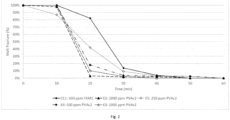
- Extrudable composition of E3, E4, and E5 use the PVAc2 as the PPA at loadings of 1000, 500 and 250 ppm respectively.
- the results of E3-E5 can be compared with E2 to examine the effect of PVAc concentration in the extrudable composition. Referring to Table 3 and Figure 2 it can be seen that decreasing the PVAc2 loading has an incremental but small negative effect on the time to clear performance of the composition. However, at all loadings from 250 ppm to 2000 ppm PVAc2 completely clears melt fracture by 60 minutes. Moreover, decreasing the PVAc loading shows an incremental positive effect on extruder output at constant RPM. As the PVAc2 loading is reduced from 2000, to 250 ppm the output increases from 3% to 9% versus the control. The time to clear performance of PVAc2 compares very favourably with the traditional fluoroelastomer FKM1 at 600 ppm.
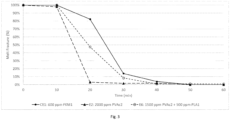
- Extrudable composition E6 investigates the effect of PLA1 in combination with PVAc1 in the PPA composition. Referring to Example E6 in Figure 3 and Table 3 it can be seen that an extrudable composition of 1500 ppm PVAc2 and 500 ppm of PLA1 in LLDPE1 completely removes melt fracture within one hour. Figure 3 shows that composition E6 clears melt fracture at a faster rate than traditional fluoroelastomer composition CE1 (600 ppm FKM1). The extrudable composition E6 also showed an increase in output of 21% at constant extruder RPM. These values are comparable to the rate increase and pressure drop seen in CE1.
Landscapes
- Chemical & Material Sciences (AREA)
- Health & Medical Sciences (AREA)
- Chemical Kinetics & Catalysis (AREA)
- Medicinal Chemistry (AREA)
- Polymers & Plastics (AREA)
- Organic Chemistry (AREA)
- Engineering & Computer Science (AREA)
- Mechanical Engineering (AREA)
- Compositions Of Macromolecular Compounds (AREA)
- Processes Of Treating Macromolecular Substances (AREA)
Priority Applications (9)
| Application Number | Priority Date | Filing Date | Title |
|---|---|---|---|
| EP23189782.8A EP4501584A1 (fr) | 2023-08-04 | 2023-08-04 | Adjuvants de traitement de polymères de poly(ester vinylique) pour polyoléfines |
| CN202480044215.5A CN121646529A (zh) | 2023-08-04 | 2024-08-02 | 用于聚烯烃的聚(乙烯基酯)聚合物加工助剂 |
| EP24754252.5A EP4611975B1 (fr) | 2023-08-04 | 2024-08-02 | Adjuvants de traitement de polymères de poly(ester vinylique) pour polyoléfines |
| PL24754252.5T PL4611975T3 (pl) | 2023-08-04 | 2024-08-02 | Środki z poli(estru winylu) ułatwiające przetwarzanie polimerów dla poliolefin |
| DE24754252.5T DE24754252T1 (de) | 2023-08-04 | 2024-08-02 | Verarbeitungshilfsmittel für polyolefine aus polyvinylesterpolymeren |
| ES24754252T ES3041727T3 (en) | 2023-08-04 | 2024-08-02 | Poly(vinyl ester) polymer processing aids for polyolefins |
| AU2024321053A AU2024321053A1 (en) | 2023-08-04 | 2024-08-02 | Poly(vinyl ester) polymer processing aids for polyolefins |
| PCT/EP2024/072067 WO2025032010A1 (fr) | 2023-08-04 | 2024-08-02 | Adjuvants de polymères de poly(ester vinylique) pour polyoléfines |
| US19/233,155 US20250376583A1 (en) | 2023-08-04 | 2025-06-10 | Poly(vinyl ester) polymer processing aids for polyolefins |
Applications Claiming Priority (1)
| Application Number | Priority Date | Filing Date | Title |
|---|---|---|---|
| EP23189782.8A EP4501584A1 (fr) | 2023-08-04 | 2023-08-04 | Adjuvants de traitement de polymères de poly(ester vinylique) pour polyoléfines |
Publications (1)
| Publication Number | Publication Date |
|---|---|
| EP4501584A1 true EP4501584A1 (fr) | 2025-02-05 |
Family
ID=87567528
Family Applications (2)
| Application Number | Title | Priority Date | Filing Date |
|---|---|---|---|
| EP23189782.8A Withdrawn EP4501584A1 (fr) | 2023-08-04 | 2023-08-04 | Adjuvants de traitement de polymères de poly(ester vinylique) pour polyoléfines |
| EP24754252.5A Active EP4611975B1 (fr) | 2023-08-04 | 2024-08-02 | Adjuvants de traitement de polymères de poly(ester vinylique) pour polyoléfines |
Family Applications After (1)
| Application Number | Title | Priority Date | Filing Date |
|---|---|---|---|
| EP24754252.5A Active EP4611975B1 (fr) | 2023-08-04 | 2024-08-02 | Adjuvants de traitement de polymères de poly(ester vinylique) pour polyoléfines |
Country Status (8)
| Country | Link |
|---|---|
| US (1) | US20250376583A1 (fr) |
| EP (2) | EP4501584A1 (fr) |
| CN (1) | CN121646529A (fr) |
| AU (1) | AU2024321053A1 (fr) |
| DE (1) | DE24754252T1 (fr) |
| ES (1) | ES3041727T3 (fr) |
| PL (1) | PL4611975T3 (fr) |
| WO (1) | WO2025032010A1 (fr) |
Citations (12)
| Publication number | Priority date | Publication date | Assignee | Title |
|---|---|---|---|---|
| US3125547A (en) | 1961-02-09 | 1964-03-17 | Extrudable composition consisting of | |
| US4535113A (en) | 1984-03-13 | 1985-08-13 | Union Carbide Corporation | Olefin polymer compositions containing silicone additives and the use thereof in the production of film material |
| US4855360A (en) | 1988-04-15 | 1989-08-08 | Minnesota Mining And Manufacturing Company | Extrudable thermoplastic hydrocarbon polymer composition |
| WO1995021887A1 (fr) * | 1994-02-15 | 1995-08-17 | E.I. Du Pont De Nemours And Company | Systeme d'adjuvants de fabrication des polyolefines |
| US5789473A (en) | 1995-01-17 | 1998-08-04 | Dow Corning Corporation | Polyolefin composition containing diorganopolysiloxane process aid |
| US6642310B2 (en) | 2001-02-16 | 2003-11-04 | Dupont Dow Elastomers L.L.C. | Process aid for melt processable polymers |
| US8563637B2 (en) | 2010-02-19 | 2013-10-22 | Dover Chemical Corporation | Alkylphenol free-liquid polymeric phosphite polymer stabilizers |
| US8981042B2 (en) | 2010-02-19 | 2015-03-17 | Dover Chemical Corporation | Cycloaliphatic polyphosphite polymer stabilizers |
| CN107236166A (zh) * | 2015-05-11 | 2017-10-10 | 中广核高新核材集团有限公司 | 用于低烟无毒耐热电缆材料的制备工艺 |
| US20200308379A1 (en) * | 2017-10-06 | 2020-10-01 | Total Research & Technology Feluy | Conductive Articles Produced from a Composite Material and Process to Produce Such Articles |
| US10982079B2 (en) | 2014-12-19 | 2021-04-20 | 3M Innovative Properties Company | Poly(oxyalkylene) polymer processing additive, compositions, and methods |
| US20230003100A1 (en) | 2019-11-28 | 2023-01-05 | Expro North Sea Limited | A valve assembly |
Family Cites Families (6)
| Publication number | Priority date | Publication date | Assignee | Title |
|---|---|---|---|---|
| US5401803A (en) * | 1993-12-23 | 1995-03-28 | Union Carbide Chemicals & Plastics Technology Corporation | Ethylene-vinyl acetate copolymer additives for molding compositions |
| DE19528647A1 (de) * | 1995-08-04 | 1997-02-06 | Basf Ag | Thermoplastische Formmassen auf der Basis von Ethylenpolymerisaten und thermoplastischen Polyestern |
| US6287692B1 (en) * | 1999-06-11 | 2001-09-11 | Judd Wire, Inc. | Melt-processable, crosslinkable coating compositions |
| WO2012000992A1 (fr) * | 2010-06-29 | 2012-01-05 | Basf Se | Procédé pour améliorer les propriétés d'écoulement de polymères en fusion |
| WO2017015338A1 (fr) * | 2015-07-20 | 2017-01-26 | Basf Corporation | Systèmes de polyoléfine ininflammables |
| WO2024147358A1 (fr) | 2023-01-05 | 2024-07-11 | ダイキン工業株式会社 | Auxiliaire de traitement, mélange maître, composition de résine thermoplastique et film |
-
2023
- 2023-08-04 EP EP23189782.8A patent/EP4501584A1/fr not_active Withdrawn
-
2024
- 2024-08-02 AU AU2024321053A patent/AU2024321053A1/en active Pending
- 2024-08-02 CN CN202480044215.5A patent/CN121646529A/zh active Pending
- 2024-08-02 DE DE24754252.5T patent/DE24754252T1/de active Pending
- 2024-08-02 EP EP24754252.5A patent/EP4611975B1/fr active Active
- 2024-08-02 ES ES24754252T patent/ES3041727T3/es active Active
- 2024-08-02 PL PL24754252.5T patent/PL4611975T3/pl unknown
- 2024-08-02 WO PCT/EP2024/072067 patent/WO2025032010A1/fr active Pending
-
2025
- 2025-06-10 US US19/233,155 patent/US20250376583A1/en active Pending
Patent Citations (12)
| Publication number | Priority date | Publication date | Assignee | Title |
|---|---|---|---|---|
| US3125547A (en) | 1961-02-09 | 1964-03-17 | Extrudable composition consisting of | |
| US4535113A (en) | 1984-03-13 | 1985-08-13 | Union Carbide Corporation | Olefin polymer compositions containing silicone additives and the use thereof in the production of film material |
| US4855360A (en) | 1988-04-15 | 1989-08-08 | Minnesota Mining And Manufacturing Company | Extrudable thermoplastic hydrocarbon polymer composition |
| WO1995021887A1 (fr) * | 1994-02-15 | 1995-08-17 | E.I. Du Pont De Nemours And Company | Systeme d'adjuvants de fabrication des polyolefines |
| US5789473A (en) | 1995-01-17 | 1998-08-04 | Dow Corning Corporation | Polyolefin composition containing diorganopolysiloxane process aid |
| US6642310B2 (en) | 2001-02-16 | 2003-11-04 | Dupont Dow Elastomers L.L.C. | Process aid for melt processable polymers |
| US8563637B2 (en) | 2010-02-19 | 2013-10-22 | Dover Chemical Corporation | Alkylphenol free-liquid polymeric phosphite polymer stabilizers |
| US8981042B2 (en) | 2010-02-19 | 2015-03-17 | Dover Chemical Corporation | Cycloaliphatic polyphosphite polymer stabilizers |
| US10982079B2 (en) | 2014-12-19 | 2021-04-20 | 3M Innovative Properties Company | Poly(oxyalkylene) polymer processing additive, compositions, and methods |
| CN107236166A (zh) * | 2015-05-11 | 2017-10-10 | 中广核高新核材集团有限公司 | 用于低烟无毒耐热电缆材料的制备工艺 |
| US20200308379A1 (en) * | 2017-10-06 | 2020-10-01 | Total Research & Technology Feluy | Conductive Articles Produced from a Composite Material and Process to Produce Such Articles |
| US20230003100A1 (en) | 2019-11-28 | 2023-01-05 | Expro North Sea Limited | A valve assembly |
Non-Patent Citations (4)
| Title |
|---|
| "CAS", Database accession no. 193098-40-7 |
| "Compendium of Polymer Terminology and Nomenclature, IUPAC Recommendations", 2008, RSC PUBLISHING, article "Copolymer" |
| HATZIKIRIAKOS, S. G.MIGLER, K. B.: "Applied Polymer Rheology: Polymeric Fluids with Industrial Applications", 2012, article "Polymer Processing Additives for Melt Fracture Control", pages: 29 - 58 |
| KOKAHCHI, AHMAD RAJJI, ABDELLAHCARREAU, PIERRE J: "Surface Morphology and Properties of Ternay Polymer Blends: Effect of the Migration of Minor Components", J. PHYS. CHEM. B, vol. 118, 2014, pages 6316 - 6323 |
Also Published As
| Publication number | Publication date |
|---|---|
| AU2024321053A1 (en) | 2026-02-19 |
| DE24754252T1 (de) | 2025-12-11 |
| PL4611975T3 (pl) | 2026-04-20 |
| CN121646529A (zh) | 2026-03-10 |
| ES3041727T3 (en) | 2026-04-24 |
| EP4611975C0 (fr) | 2025-12-31 |
| ES3041727T1 (en) | 2025-11-14 |
| US20250376583A1 (en) | 2025-12-11 |
| WO2025032010A1 (fr) | 2025-02-13 |
| EP4611975B1 (fr) | 2025-12-31 |
| EP4611975A1 (fr) | 2025-09-10 |
Similar Documents
| Publication | Publication Date | Title |
|---|---|---|
| EP4219617A1 (fr) | Aides au traitement des polyoléfines à base de silicone fonctionnalisé | |
| US8648134B2 (en) | Polymer processing aids | |
| JP4567001B2 (ja) | 溶融加工可能な組成物 | |
| AU2013305485A1 (en) | Polyolefin composition comprising thermoplastic starch | |
| WO2014029344A1 (fr) | Composés de polyoléfine stables aux uv | |
| EP4488328A1 (fr) | Auxiliaires de traitement de polymères exempts de fluor et de silicone | |
| JP5324442B2 (ja) | 溶融加工によるそれらの製造中ポリエチレン製品の改良加工条件 | |
| EP4501584A1 (fr) | Adjuvants de traitement de polymères de poly(ester vinylique) pour polyoléfines | |
| EP4479472A1 (fr) | Auxiliaires de traitement de polymères à base de polyéthylène glycol | |
| JP2011516711A (ja) | 極性低密度エチレンコポリマーとポリ(ヒドロキシカルボン酸)との混合物 | |
| KR20190061407A (ko) | 필름용 폴리에틸렌 수지 조성물 및 이를 이용한 필름 | |
| WO2024158881A1 (fr) | Auxiliaires de traitement polymères à base de phosphite polymère, de polydiméthylsiloxane et de polyalkylène glycol | |
| WO2023149985A1 (fr) | Auxiliaires de traitement des polymères à base de polyéthylène glycol | |
| AU2014301662B2 (en) | Use of an extrusion processing aid for the production of coloured polyethylene pipes | |
| KR20190062899A (ko) | 농업용 필름 제조를 위한 폴리에틸렌 수지 조성물 및 이를 이용하여 제조된 필름 | |
| US20260117053A1 (en) | Polymer processing aids | |
| EP4696740A1 (fr) | Auxiliaire de traitement écologique à base d'un sel d'acide gras | |
| WO2026039644A1 (fr) | Auxiliaires de traitement de polymères pour extrusion de polyoléfine | |
| WO2024228073A1 (fr) | Compositions transformables à l'état fondu contenant des additifs de transformation de polymère et des photostabilisants | |
| CN118660939A (zh) | 基于聚乙二醇的聚合物加工助剂 | |
| EP4476285A1 (fr) | Auxiliaires de traitement des polymères à base de polyéthylène glycol | |
| EP4206277A1 (fr) | Composition de résine thermoplastique, et article moulé formé à partir de celle-ci |
Legal Events
| Date | Code | Title | Description |
|---|---|---|---|
| PUAI | Public reference made under article 153(3) epc to a published international application that has entered the european phase |
Free format text: ORIGINAL CODE: 0009012 |
|
| STAA | Information on the status of an ep patent application or granted ep patent |
Free format text: STATUS: THE APPLICATION HAS BEEN PUBLISHED |
|
| AK | Designated contracting states |
Kind code of ref document: A1 Designated state(s): AL AT BE BG CH CY CZ DE DK EE ES FI FR GB GR HR HU IE IS IT LI LT LU LV MC ME MK MT NL NO PL PT RO RS SE SI SK SM TR |
|
| STAA | Information on the status of an ep patent application or granted ep patent |
Free format text: STATUS: THE APPLICATION IS DEEMED TO BE WITHDRAWN |
|
| 18D | Application deemed to be withdrawn |
Effective date: 20250806 |