EP4501602A1 - Produit d'étanchéité annulaire et procédé de production - Google Patents
Produit d'étanchéité annulaire et procédé de production Download PDFInfo
- Publication number
- EP4501602A1 EP4501602A1 EP23779603.2A EP23779603A EP4501602A1 EP 4501602 A1 EP4501602 A1 EP 4501602A1 EP 23779603 A EP23779603 A EP 23779603A EP 4501602 A1 EP4501602 A1 EP 4501602A1
- Authority
- EP
- European Patent Office
- Prior art keywords
- core
- outer layer
- rubber composition
- crosslinkable rubber
- annular seal
- Prior art date
- Legal status (The legal status is an assumption and is not a legal conclusion. Google has not performed a legal analysis and makes no representation as to the accuracy of the status listed.)
- Pending
Links
Images
Classifications
-
- F—MECHANICAL ENGINEERING; LIGHTING; HEATING; WEAPONS; BLASTING
- F16—ENGINEERING ELEMENTS AND UNITS; GENERAL MEASURES FOR PRODUCING AND MAINTAINING EFFECTIVE FUNCTIONING OF MACHINES OR INSTALLATIONS; THERMAL INSULATION IN GENERAL
- F16J—PISTONS; CYLINDERS; SEALINGS
- F16J15/00—Sealings
- F16J15/16—Sealings between relatively-moving surfaces
- F16J15/32—Sealings between relatively-moving surfaces with elastic sealings, e.g. O-rings
- F16J15/3284—Sealings between relatively-moving surfaces with elastic sealings, e.g. O-rings characterised by their structure; Selection of materials
-
- B—PERFORMING OPERATIONS; TRANSPORTING
- B29—WORKING OF PLASTICS; WORKING OF SUBSTANCES IN A PLASTIC STATE IN GENERAL
- B29C—SHAPING OR JOINING OF PLASTICS; SHAPING OF MATERIAL IN A PLASTIC STATE, NOT OTHERWISE PROVIDED FOR; AFTER-TREATMENT OF THE SHAPED PRODUCTS, e.g. REPAIRING
- B29C43/00—Compression moulding, i.e. applying external pressure to flow the moulding material; Apparatus therefor
- B29C43/003—Compression moulding, i.e. applying external pressure to flow the moulding material; Apparatus therefor characterised by the choice of material
-
- B—PERFORMING OPERATIONS; TRANSPORTING
- B29—WORKING OF PLASTICS; WORKING OF SUBSTANCES IN A PLASTIC STATE IN GENERAL
- B29C—SHAPING OR JOINING OF PLASTICS; SHAPING OF MATERIAL IN A PLASTIC STATE, NOT OTHERWISE PROVIDED FOR; AFTER-TREATMENT OF THE SHAPED PRODUCTS, e.g. REPAIRING
- B29C43/00—Compression moulding, i.e. applying external pressure to flow the moulding material; Apparatus therefor
- B29C43/02—Compression moulding, i.e. applying external pressure to flow the moulding material; Apparatus therefor of articles of definite length, i.e. discrete articles
- B29C43/20—Making multilayered or multicoloured articles
-
- B—PERFORMING OPERATIONS; TRANSPORTING
- B29—WORKING OF PLASTICS; WORKING OF SUBSTANCES IN A PLASTIC STATE IN GENERAL
- B29C—SHAPING OR JOINING OF PLASTICS; SHAPING OF MATERIAL IN A PLASTIC STATE, NOT OTHERWISE PROVIDED FOR; AFTER-TREATMENT OF THE SHAPED PRODUCTS, e.g. REPAIRING
- B29C69/00—Combinations of shaping techniques not provided for in a single one of main groups B29C39/00 - B29C67/00, e.g. associations of moulding and joining techniques; Apparatus therefore
- B29C69/02—Combinations of shaping techniques not provided for in a single one of main groups B29C39/00 - B29C67/00, e.g. associations of moulding and joining techniques; Apparatus therefore of moulding techniques only
-
- F—MECHANICAL ENGINEERING; LIGHTING; HEATING; WEAPONS; BLASTING
- F16—ENGINEERING ELEMENTS AND UNITS; GENERAL MEASURES FOR PRODUCING AND MAINTAINING EFFECTIVE FUNCTIONING OF MACHINES OR INSTALLATIONS; THERMAL INSULATION IN GENERAL
- F16J—PISTONS; CYLINDERS; SEALINGS
- F16J15/00—Sealings
- F16J15/02—Sealings between relatively-stationary surfaces
- F16J15/06—Sealings between relatively-stationary surfaces with solid packing compressed between sealing surfaces
- F16J15/10—Sealings between relatively-stationary surfaces with solid packing compressed between sealing surfaces with non-metallic packing
-
- F—MECHANICAL ENGINEERING; LIGHTING; HEATING; WEAPONS; BLASTING
- F16—ENGINEERING ELEMENTS AND UNITS; GENERAL MEASURES FOR PRODUCING AND MAINTAINING EFFECTIVE FUNCTIONING OF MACHINES OR INSTALLATIONS; THERMAL INSULATION IN GENERAL
- F16J—PISTONS; CYLINDERS; SEALINGS
- F16J15/00—Sealings
- F16J15/16—Sealings between relatively-moving surfaces
- F16J15/32—Sealings between relatively-moving surfaces with elastic sealings, e.g. O-rings
- F16J15/328—Manufacturing methods specially adapted for elastic sealings
-
- B—PERFORMING OPERATIONS; TRANSPORTING
- B29—WORKING OF PLASTICS; WORKING OF SUBSTANCES IN A PLASTIC STATE IN GENERAL
- B29C—SHAPING OR JOINING OF PLASTICS; SHAPING OF MATERIAL IN A PLASTIC STATE, NOT OTHERWISE PROVIDED FOR; AFTER-TREATMENT OF THE SHAPED PRODUCTS, e.g. REPAIRING
- B29C43/00—Compression moulding, i.e. applying external pressure to flow the moulding material; Apparatus therefor
- B29C43/02—Compression moulding, i.e. applying external pressure to flow the moulding material; Apparatus therefor of articles of definite length, i.e. discrete articles
- B29C43/14—Compression moulding, i.e. applying external pressure to flow the moulding material; Apparatus therefor of articles of definite length, i.e. discrete articles in several steps
- B29C43/146—Compression moulding, i.e. applying external pressure to flow the moulding material; Apparatus therefor of articles of definite length, i.e. discrete articles in several steps for making multilayered articles
- B29C2043/148—Compression moulding, i.e. applying external pressure to flow the moulding material; Apparatus therefor of articles of definite length, i.e. discrete articles in several steps for making multilayered articles using different moulds
-
- B—PERFORMING OPERATIONS; TRANSPORTING
- B29—WORKING OF PLASTICS; WORKING OF SUBSTANCES IN A PLASTIC STATE IN GENERAL
- B29C—SHAPING OR JOINING OF PLASTICS; SHAPING OF MATERIAL IN A PLASTIC STATE, NOT OTHERWISE PROVIDED FOR; AFTER-TREATMENT OF THE SHAPED PRODUCTS, e.g. REPAIRING
- B29C43/00—Compression moulding, i.e. applying external pressure to flow the moulding material; Apparatus therefor
- B29C43/02—Compression moulding, i.e. applying external pressure to flow the moulding material; Apparatus therefor of articles of definite length, i.e. discrete articles
- B29C43/027—Compression moulding, i.e. applying external pressure to flow the moulding material; Apparatus therefor of articles of definite length, i.e. discrete articles having an axis of symmetry
-
- B—PERFORMING OPERATIONS; TRANSPORTING
- B29—WORKING OF PLASTICS; WORKING OF SUBSTANCES IN A PLASTIC STATE IN GENERAL
- B29C—SHAPING OR JOINING OF PLASTICS; SHAPING OF MATERIAL IN A PLASTIC STATE, NOT OTHERWISE PROVIDED FOR; AFTER-TREATMENT OF THE SHAPED PRODUCTS, e.g. REPAIRING
- B29C43/00—Compression moulding, i.e. applying external pressure to flow the moulding material; Apparatus therefor
- B29C43/02—Compression moulding, i.e. applying external pressure to flow the moulding material; Apparatus therefor of articles of definite length, i.e. discrete articles
- B29C43/18—Compression moulding, i.e. applying external pressure to flow the moulding material; Apparatus therefor of articles of definite length, i.e. discrete articles incorporating preformed parts or layers, e.g. compression moulding around inserts or for coating articles
-
- B—PERFORMING OPERATIONS; TRANSPORTING
- B29—WORKING OF PLASTICS; WORKING OF SUBSTANCES IN A PLASTIC STATE IN GENERAL
- B29C—SHAPING OR JOINING OF PLASTICS; SHAPING OF MATERIAL IN A PLASTIC STATE, NOT OTHERWISE PROVIDED FOR; AFTER-TREATMENT OF THE SHAPED PRODUCTS, e.g. REPAIRING
- B29C43/00—Compression moulding, i.e. applying external pressure to flow the moulding material; Apparatus therefor
- B29C43/32—Component parts, details or accessories; Auxiliary operations
- B29C43/52—Heating or cooling
-
- B—PERFORMING OPERATIONS; TRANSPORTING
- B29—WORKING OF PLASTICS; WORKING OF SUBSTANCES IN A PLASTIC STATE IN GENERAL
- B29C—SHAPING OR JOINING OF PLASTICS; SHAPING OF MATERIAL IN A PLASTIC STATE, NOT OTHERWISE PROVIDED FOR; AFTER-TREATMENT OF THE SHAPED PRODUCTS, e.g. REPAIRING
- B29C48/00—Extrusion moulding, i.e. expressing the moulding material through a die or nozzle which imparts the desired form; Apparatus therefor
- B29C48/001—Combinations of extrusion moulding with other shaping operations
- B29C48/0022—Combinations of extrusion moulding with other shaping operations combined with cutting
-
- B—PERFORMING OPERATIONS; TRANSPORTING
- B29—WORKING OF PLASTICS; WORKING OF SUBSTANCES IN A PLASTIC STATE IN GENERAL
- B29C—SHAPING OR JOINING OF PLASTICS; SHAPING OF MATERIAL IN A PLASTIC STATE, NOT OTHERWISE PROVIDED FOR; AFTER-TREATMENT OF THE SHAPED PRODUCTS, e.g. REPAIRING
- B29C48/00—Extrusion moulding, i.e. expressing the moulding material through a die or nozzle which imparts the desired form; Apparatus therefor
- B29C48/03—Extrusion moulding, i.e. expressing the moulding material through a die or nozzle which imparts the desired form; Apparatus therefor characterised by the shape of the extruded material at extrusion
- B29C48/06—Rod-shaped
-
- B—PERFORMING OPERATIONS; TRANSPORTING
- B29—WORKING OF PLASTICS; WORKING OF SUBSTANCES IN A PLASTIC STATE IN GENERAL
- B29C—SHAPING OR JOINING OF PLASTICS; SHAPING OF MATERIAL IN A PLASTIC STATE, NOT OTHERWISE PROVIDED FOR; AFTER-TREATMENT OF THE SHAPED PRODUCTS, e.g. REPAIRING
- B29C48/00—Extrusion moulding, i.e. expressing the moulding material through a die or nozzle which imparts the desired form; Apparatus therefor
- B29C48/16—Articles comprising two or more components, e.g. co-extruded layers
- B29C48/18—Articles comprising two or more components, e.g. co-extruded layers the components being layers
- B29C48/21—Articles comprising two or more components, e.g. co-extruded layers the components being layers the layers being joined at their surfaces
-
- B—PERFORMING OPERATIONS; TRANSPORTING
- B29—WORKING OF PLASTICS; WORKING OF SUBSTANCES IN A PLASTIC STATE IN GENERAL
- B29L—INDEXING SCHEME ASSOCIATED WITH SUBCLASS B29C, RELATING TO PARTICULAR ARTICLES
- B29L2031/00—Other particular articles
- B29L2031/26—Sealing devices, e.g. packaging for pistons or pipe joints
-
- B—PERFORMING OPERATIONS; TRANSPORTING
- B29—WORKING OF PLASTICS; WORKING OF SUBSTANCES IN A PLASTIC STATE IN GENERAL
- B29L—INDEXING SCHEME ASSOCIATED WITH SUBCLASS B29C, RELATING TO PARTICULAR ARTICLES
- B29L2031/00—Other particular articles
- B29L2031/26—Sealing devices, e.g. packaging for pistons or pipe joints
- B29L2031/265—Packings, Gaskets
-
- B—PERFORMING OPERATIONS; TRANSPORTING
- B29—WORKING OF PLASTICS; WORKING OF SUBSTANCES IN A PLASTIC STATE IN GENERAL
- B29L—INDEXING SCHEME ASSOCIATED WITH SUBCLASS B29C, RELATING TO PARTICULAR ARTICLES
- B29L2031/00—Other particular articles
- B29L2031/709—Articles shaped in a closed loop, e.g. conveyor belts
- B29L2031/7096—Rings or ring-like articles
Definitions
- the present invention relates to an annular seal material, and further also relates to a method for manufacturing the same.
- Japanese Patent No. 4148493 discloses a method for manufacturing a composite structure O-ring, and discloses that a composite structure material produced by inserting an inner layer portion formed into a string into an inner space of a tube-like outer layer portion is cut and set in an O-ring mold, and then a material used for the outer layer portion shaped into a string is set in a gap between cut surfaces of the composite structure material, and pressurized, heated, and molded.
- Japanese Patent Laying-Open No. 10-323847 discloses a method for manufacturing a composite structure O-ring, including preforming two coating materials by using an insert having substantially the same shape as a core material, removing the insert, then inserting a supercritically extracted O-ring-like rubber core material in the cavity, and integrally molding the same together with the coating materials.
- Japanese Patent Laying-Open No. 10-52885 discloses a method for manufacturing a two-layer structure O-ring, characterized by extruding a string-like body constituted of an outer layer portion and an inner layer portion and hot pressing the string-like body to simultaneously vulcanize the inner and outer layers.
- Japanese Patent Laying-Open No. 10-329271 discloses, as a method for manufacturing an O-ring having a two-layer structure, a manufacturing method involving forming an outer layer material including a perfluoroelastomer into a ribbon and winding the same around a core material to heat and pressurize the resulting core material; and a manufacturing method involving freeze-pulverizing an outer layer material to form a particle, attaching the particle to a core material, and then heating and pressurizing the resulting core material.
- the outer layer portion material may break when the outer layer portion is inflated.
- a connecting member made of the outer layer portion material is disposed at a seam, and thus the layer configuration at the seam does not have a two-layer structure. Furthermore, the process is complicated and costly.
- the core material may protrude from the gap between the upper and lower outer layers during integral molding in the mold.
- the inner layer portion may protrude from a parting line and the seam during molding in the mold.
- the core may protrude from the outer layer at a seam and a parting line, but the core and the outer layer have the same or a similar color and thus it is often impossible or difficult to confirm the above protrusion.
- annular seal material that makes it easy to recognize protrusion of a core from an outer layer at a seam and a parting line when an annular seal material having a two-layer structure is manufactured by using different materials for the core and the outer layer, respectively, and a method for manufacturing the same.
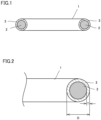
- the thickness T of outer layer 3 may be, for example, 0.1 to 10 mm, and is preferably 0.2 to 3 mm.
- the cross-sectional diameter D of seal material 1 may be, for example, 3 to 50 mm, and is preferably 3 to 15 mm.
- crosslinkable rubber composition for forming core 2 (hereinafter also referred to as a crosslinkable rubber composition for a core) and a crosslinkable rubber composition for forming outer layer 3 (hereinafter referred to as a crosslinkable rubber composition for an outer layer) have a different color from each other either after hot press molding or after secondary crosslinking or both, protrusion of core 2 from outer layer 3 at a seam and a parting line becomes easy to confirm at least either after hot press molding or after secondary crosslinking, and productivity tends to improve easily.
- Core 2 and outer layer 3 can have a different color from each other either after hot press molding or after secondary crosslinking or both by, for example, selecting the types of raw materials included in the crosslinkable rubber composition for a core and the crosslinkable rubber composition for an outer layer (hereinafter also referred to as the crosslinkable rubber composition when both are collectively referred to) or regulating the blending ratio of the raw materials.
- the crosslinkable rubber composition for a core and the crosslinkable rubber composition for an outer layer may have the same color or a different color from each other before hot press molding or before secondary crosslinking.
- the colors of the crosslinkable rubber composition for a core and the crosslinkable rubber composition for an outer layer may each be the same or different after hot press molding or after secondary crosslinking as compared with before hot press molding or before secondary crosslinking.
- the colorant may be a colorant conventionally used for a seal material.
- examples of the colorant include at least one selected from the group consisting of an inorganic pigment and an organic pigment.
- the inorganic pigment examples include a white pigment (for example, silica, zinc white, lead white, lithopone, titanium dioxide, precipitated barium sulfate, or a barite powder), a red pigment (for example, red lead or iron oxide red), a yellow pigment (for example, chrome yellow or zinc yellow), a blue pigment (for example, ultramarine blue, Prussian blue, or YInMn blue), and a black pigment (for example, carbon black).
- a white pigment for example, silica, zinc white, lead white, lithopone, titanium dioxide, precipitated barium sulfate, or a barite powder
- a red pigment for example, red lead or iron oxide red
- a yellow pigment for example, chrome yellow or zinc yellow
- a blue pigment for example, ultramarine blue, Prussian blue, or YInMn blue
- a black pigment for example, carbon black
- the organic pigment examples include an azo pigment (an azo lake pigment, an insoluble azo pigment, a condensed azo pigment, or the like); a polycyclic pigment such as an anthraquinone-based pigment, a thioindigo-based pigment, a perinone-based pigment, a perylene-based pigment, a quinacridone-based pigment, an isoindolinone pigment, an isoindoline pigment, a dioxazine pigment, a quinophthalone pigment, or a diketopyrrolopyrrole pigment, and a phthalocyanine-based pigment.
- an organic pigment classified as a pigment in the Color Index can be used.
- a preferably used pigment is an organic pigment that does not contain a metal element.
- the organic pigment that does not contain a metal element does not have the risk of scattering a substance derived from a metal element even if a seal material is used in a harsh ozone environment such as in a semiconductor application and the annular seal material is etched.
- the content of the colorant in the crosslinkable rubber composition may be, for example, 0.01 parts by mass or more and less than 2 parts by mass per 100 parts by mass of the crosslinkable rubber component described later, and from the viewpoint of ease of confirming protrusion of core 2 from outer layer 3 at a seam and a parting line, the content thereof is preferably 0.05 parts by mass or more and 1.5 parts by mass or less, and more preferably 0.1 parts by mass or more and 1 part by mass or less.
- the crosslinkable rubber composition can include a crosslinkable rubber component.
- the crosslinkable rubber component can form an elastomer (crosslinked rubber) having the above crosslinked structure through a crosslinking reaction.
- the crosslinkable rubber component can have a crosslinkable site such as a carbon-carbon unsaturated group, a nitrile group, a hydroxyl group, an amino group, a carbonyl group, or a halogen group.
- crosslinkable rubber component examples include a perfluoroelastomer (FFKM), a fluororubber (FKM), silicone rubber, fluorosilicone rubber, ethylene-propylene rubber (EPM), ethylene-propylene-diene rubber (EPDM), nitrile rubber (NBR; acrylonitrile butadiene rubber), hydrogenated nitrile rubber (HNBR; hydrogenated acrylonitrile butadiene rubber), butyl rubber (IIR), and acrylic rubber.
- FFKM perfluoroelastomer
- FKM fluororubber
- silicone rubber fluorosilicone rubber
- fluorosilicone rubber ethylene-propylene rubber
- EPM ethylene-propylene-diene rubber
- NBR nitrile rubber
- HNBR hydrogenated nitrile rubber
- IIR butyl rubber
- acrylic rubber acrylic rubber
- Outer layer 3 includes a crosslinked product of at least one selected from the group consisting of a perfluoroelastomer and a fluororubber
- core 2 includes a crosslinked product of at least one selected from the group consisting of a perfluoroelastomer, a fluororubber, silicone rubber, and fluorosilicone rubber. Therefore, the crosslinkable rubber component in the crosslinkable rubber composition for an outer layer is preferably at least one selected from the group consisting of a perfluoroelastomer and a fluororubber, and more preferably a perfluoroelastomer.
- the crosslinkable rubber component in the crosslinkable rubber composition for a core is preferably at least one selected from the group consisting of a perfluoroelastomer, a fluororubber, silicone rubber, and fluorosilicone rubber.
- Outer layer 3 advantageously includes a crosslinked product of a perfluoroelastomer from the viewpoint of radical resistance.
- Core 2 advantageously includes a crosslinked product of at least one selected from the group consisting of a fluororubber, silicone rubber, and fluorosilicone rubber from the viewpoint of material cost.
- the perfluoroelastomer is not particularly limited, and examples thereof include a tetrafluoroethylene (TFE)-perfluoro(alkyl vinyl ether)-based copolymer and a TFE-perfluoro(alkoxyalkyl vinyl ether)-based copolymer. These copolymers may further include a constitutional unit derived from a further perfluoromonomer. According to a perfluoroelastomer composition including a perfluoroelastomer, ozone resistance can be improved more than a crosslinkable rubber composition including a hydrogen atom-containing fluoroelastomer.
- the crosslinkable rubber composition may include only one perfluoroelastomer, or may include two or more perfluoroelastomers.
- the perfluoro(alkyl vinyl ether) forming a tetrafluoroethylene (TFE)-perfluoro(alkyl vinyl ether)-based copolymer can have 1 to 5 carbon atoms in the alkyl group, and for example, can be perfluoro(methyl vinyl ether), perfluoro(ethyl vinyl ether), perfluoro(propyl vinyl ether), or the like. Perfluoro(methyl vinyl ether) is preferable.
- n is, for example, 1 to 5
- m is, for example, 1 to 3.
- the perfluoroelastomer preferably has crosslinkability, and more specifically, the perfluoroelastomer is preferably one obtained by further copolymerizing a crosslinking site monomer (one further including a constitutional unit derived from a crosslinking site monomer).
- the crosslinking site means a site capable of a crosslinking reaction. Examples of the crosslinking site include a nitrile group, a halogen group (for example, an I group or a Br group), and a perfluorophenyl group.
- a crosslinking site monomer having a nitrile group as a crosslinking site is a nitrile group-containing perfluorovinyl ether.
- the nitrile group-containing perfluorovinyl ether include
- a crosslinking site monomer having a halogen group as a crosslinking site is a halogen group-containing perfluorovinyl ether.
- the halogen group-containing perfluorovinyl ether include the above specific examples of the nitrile group-containing perfluorovinyl ether in which the nitrile group is replaced with a halogen group.
- the crosslinkable perfluoroelastomer may have a crosslinked structure that crosslinks two main chains.
- the ratio by mol of constitutional unit derived from TFE/constitutional unit derived from a perfluoro(alkyl vinyl ether) or a perfluoro(alkoxyalkyl vinyl ether)/constitutional unit derived from a crosslinking site monomer in a perfluoroelastomer is usually 50 to 79.6%/20 to 49.8%/0.2 to 5%, and preferably 60 to 74.8%/25 to 39.5%/0.5 to 2%.
- the crosslinkable rubber composition can also include two or more perfluoroelastomers having different ratios of the above constitutional units.
- the fluororubber examples include a binary vinylidene fluoride-based rubber such as a vinylidene fluoride/hexafluoropropylene copolymer, a ternary vinylidene fluoride-based rubber such as a vinylidene fluoride/tetrafluoroethylene/hexafluoropropylene copolymer, a vinylidene fluoride/tetrafluoroethylene/perfluoroalkyl vinyl ether copolymer, or a vinylidene fluoride/tetrafluoroethylene/propylene copolymer, a tetrafluoroethylene/propylene copolymer, an ethylene/tetrafluoroethylene/perfluoromethyl vinyl ether copolymer, a thermoplastic fluororubber, and a liquid fluororubber having a perfluoropolyether skeleton (for example, "SIFEL (registered trademark)" manufactured by Shin-Ets
- the fluororubber may contain a functional group.
- the functional group can be introduced, for example, by copolymerizing a crosslinking site monomer having the functional group.
- the crosslinking site monomer can be a halogen group-containing monomer.
- the crosslinkable rubber composition can optionally include a crosslinking agent depending on the crosslinking system of the crosslinkable rubber component together with a co-crosslinking agent (crosslinking aid).
- a crosslinking system of a perfluoroelastomer include a peroxide crosslinking system, a triazine crosslinking system, an oxazole crosslinking system, an imidazole crosslinking system, a thiazole crosslinking system, and a bisphenol crosslinking system.
- Examples of a crosslinking system of a vinylidene fluoride-based rubber and tetrafluoroethylene-propylene rubber include a peroxide crosslinking system, a polyamine crosslinking system, and a polyol crosslinking system.
- the crosslinkable rubber composition may be crosslinked with any one crosslinking system, or may be crosslinked with two or more crosslinking systems.
- peroxide crosslinking agent examples include 2,5-dimethyl-2,5-di(t-butylperoxy)hexane (examples of a commercially available product: "PERHEXA 25B” and “PERHEXA 25B-40" manufactured by NOF CORPORATION); dicumyl peroxide (example of a commercially available product: "PERCUMYL D” manufactured by NOF CORPORATION); 2,4-dichlorobenzoyl peroxide; di-t-butyl peroxide; t-butyl dicumyl peroxide; benzoyl peroxide (example of a commercially available product: "NYPER B” manufactured by NOF CORPORATION); 2,5-dimethyl-2,5-(t-butylperoxy)hexyne-3 (example of a commercially available product: "PERHEXYNE 25B” manufactured by NOF CORPORATION); 2,5-dimethyl-2,5-di(benzo
- Examples of a co-crosslinking agent used in the peroxide crosslinking system include a compound capable of co-crosslinking with a radical (unsaturated polyfunctional compound) such as a triallyl isocyanurate (example of a commercially available product: "TAIC” manufactured by Mitsubishi Chemical Corporation); a triallyl cyanurate; a triallyl formal; a triallyl trimellitate; N,N'-m-phenylene bismaleimide; dipropargyl terephthalate; a diallyl phthalate; or a tetraallyl terephthalamide. Only one co-crosslinking agent may be used, or two or more co-crosslinking agents may be used in combination. Among the above, from the viewpoint of reactivity and heat resistance (compression set properties), the co-crosslinking agent preferably includes a triallyl isocyanurate.
- a crosslinking catalyst such as an organotin compound, an onium salt such as a quaternary phosphonium salt or a quaternary ammonium salt, urea, or silicon nitride is used.
- Examples of a crosslinking agent used in the oxazole crosslinking system include 2,2-bis(3-amino-4-hydroxyphenyl)hexafluoropropane (BOAP), 4,4'-sulfonylbis(2-aminophenol), and 9,9-bis(3-amino-4-hydroxyphenyl)fluorene.
- BOAP is preferably used.
- crosslinking agent used in the imidazole crosslinking system and the thiazole crosslinking system a conventionally known one can be used.
- examples of a crosslinking agent used in the imidazole crosslinking system include 3,3',4,4'-tetraaminobenzophenone and 3,3'-diaminobenzidine.
- the content of the crosslinking agent (when two or more are used, the total content thereof) in the crosslinkable rubber composition is, for example, 0.1 to 10 parts by mass, and preferably 0.2 to 5 parts by mass, and more preferably 0.3 to 3 parts by mass, per 100 parts by mass in total of the crosslinkable rubber component.
- the content of the co-crosslinking agent (when two or more are used, the total content thereof) in the crosslinkable rubber composition is, for example, 0.5 to 10 parts by mass per 100 parts by mass in total of the crosslinkable rubber component, and from the viewpoint of improving heat resistance, preferably 1 to 8 parts by mass.
- the crosslinkable rubber composition can include, as necessary, an additive such as an anti-aging agent, an antioxidant, a vulcanization accelerator, a processing aid (such as stearic acid), a stabilizer, a tackifier, a silane coupling agent, a plasticizer, a flame retardant, a release agent, a wax, or a lubricant.
- an additive such as an anti-aging agent, an antioxidant, a vulcanization accelerator, a processing aid (such as stearic acid), a stabilizer, a tackifier, a silane coupling agent, a plasticizer, a flame retardant, a release agent, a wax, or a lubricant.
- a tackiness reducing (preventing) agent such as a fluorine-based oil (for example, a perfluoroether). Only one additive may be used, or two or more additives may be used in combination.
- the amount of the additive is preferably as small as possible (for example, 10 parts by mass or less, preferably 5 parts by mass or less, more preferably 2 parts by mass or less, and further preferably 1 part by mass or less per 100 parts by mass in total of the crosslinkable rubber component), and it is desirable not to contain any additive.
- the content of the filler (when two or more are used, the total content thereof) in the crosslinkable rubber composition is, for example, 0.1 parts by mass or more and 40 parts by mass or less per 100 parts by mass in total of the crosslinkable rubber component, and from the viewpoint of improving mechanical strength, preferably 1 part by mass or more and 30 parts by mass or less, and more preferably more than 1 part by mass and 30 parts by mass or less.
- the filler is distinguished from the organic pigment and the inorganic pigment each as a colorant described above, and a type different from the organic pigment and the inorganic pigment can be used.
- the crosslinkable rubber composition includes a fluororesin filler
- the ozone resistance and the mechanical strength of the crosslinked product can be further improved.
- the fluororesin can be contained in the crosslinkable rubber composition, for example, as a fluororesin particle.
Landscapes
- Engineering & Computer Science (AREA)
- General Engineering & Computer Science (AREA)
- Mechanical Engineering (AREA)
- Manufacturing & Machinery (AREA)
- Compositions Of Macromolecular Compounds (AREA)
- Gasket Seals (AREA)
- Sealing Devices (AREA)
- Heating, Cooling, Or Curing Plastics Or The Like In General (AREA)
- Casting Or Compression Moulding Of Plastics Or The Like (AREA)
Applications Claiming Priority (2)
| Application Number | Priority Date | Filing Date | Title |
|---|---|---|---|
| JP2022056235A JP7841924B2 (ja) | 2022-03-30 | 2022-03-30 | 環状シール材および製造方法 |
| PCT/JP2023/010022 WO2023189585A1 (fr) | 2022-03-30 | 2023-03-15 | Produit d'étanchéité annulaire et procédé de production |
Publications (2)
| Publication Number | Publication Date |
|---|---|
| EP4501602A1 true EP4501602A1 (fr) | 2025-02-05 |
| EP4501602A4 EP4501602A4 (fr) | 2026-03-18 |
Family
ID=88201521
Family Applications (1)
| Application Number | Title | Priority Date | Filing Date |
|---|---|---|---|
| EP23779603.2A Pending EP4501602A4 (fr) | 2022-03-30 | 2023-03-15 | Produit d'étanchéité annulaire et procédé de production |
Country Status (7)
| Country | Link |
|---|---|
| US (1) | US20250198517A1 (fr) |
| EP (1) | EP4501602A4 (fr) |
| JP (1) | JP7841924B2 (fr) |
| KR (1) | KR20240169652A (fr) |
| CN (1) | CN119053805A (fr) |
| TW (1) | TW202346738A (fr) |
| WO (1) | WO2023189585A1 (fr) |
Families Citing this family (1)
| Publication number | Priority date | Publication date | Assignee | Title |
|---|---|---|---|---|
| US20260036205A1 (en) * | 2024-07-31 | 2026-02-05 | John Crane Inc. | Sealing rings |
Family Cites Families (13)
| Publication number | Priority date | Publication date | Assignee | Title |
|---|---|---|---|---|
| US2961713A (en) * | 1957-05-09 | 1960-11-29 | Parker Hannifin Corp | Molding of o-rings and the like |
| JPH0483976A (ja) * | 1990-07-26 | 1992-03-17 | Taiho Kogyo Co Ltd | ガスケット |
| JP3757001B2 (ja) | 1996-08-09 | 2006-03-22 | 株式会社三ツ星 | 二層構造の線状シーリング材及びその製造方法 |
| JPH10323847A (ja) | 1997-05-23 | 1998-12-08 | Nok Corp | 複合構造oリングの製造法 |
| JPH10329271A (ja) * | 1997-06-03 | 1998-12-15 | Nok Corp | 積層構造体 |
| JP2001208204A (ja) | 2000-01-31 | 2001-08-03 | Tokai Kogyo Co Ltd | 環状パッキン及びその製造方法 |
| JP4148493B2 (ja) | 2001-09-27 | 2008-09-10 | 等 渡辺 | 複合構造oリングの製造方法 |
| JP3979925B2 (ja) | 2002-11-14 | 2007-09-19 | 株式会社三ツ星 | フッ素ゴムチューブ及びその製造方法 |
| JP2005282820A (ja) | 2004-03-30 | 2005-10-13 | Tokai Rubber Ind Ltd | 低透過性弾性シールリング |
| US20060270780A1 (en) | 2005-05-25 | 2006-11-30 | Ping Xu | High purity perfluoroelastomer composites and a processes to produce the same |
| JP4998578B2 (ja) * | 2010-03-29 | 2012-08-15 | Tdk株式会社 | めっき装置、めっき方法およびチップ型電子部品の製造方法 |
| JP6618507B2 (ja) | 2016-05-30 | 2019-12-11 | 株式会社バルカー | パーフルオロエラストマー組成物及びシール材 |
| JP2019108913A (ja) | 2017-12-15 | 2019-07-04 | 日立グローバルライフソリューションズ株式会社 | パッキン材及びそれを備える断熱容器 |
-
2022
- 2022-03-30 JP JP2022056235A patent/JP7841924B2/ja active Active
-
2023
- 2023-03-15 CN CN202380031823.8A patent/CN119053805A/zh active Pending
- 2023-03-15 US US18/847,053 patent/US20250198517A1/en active Pending
- 2023-03-15 KR KR1020247035328A patent/KR20240169652A/ko active Pending
- 2023-03-15 EP EP23779603.2A patent/EP4501602A4/fr active Pending
- 2023-03-15 WO PCT/JP2023/010022 patent/WO2023189585A1/fr not_active Ceased
- 2023-03-28 TW TW112111699A patent/TW202346738A/zh unknown
Also Published As
| Publication number | Publication date |
|---|---|
| TW202346738A (zh) | 2023-12-01 |
| CN119053805A (zh) | 2024-11-29 |
| EP4501602A4 (fr) | 2026-03-18 |
| US20250198517A1 (en) | 2025-06-19 |
| KR20240169652A (ko) | 2024-12-03 |
| JP2023148297A (ja) | 2023-10-13 |
| JP7841924B2 (ja) | 2026-04-07 |
| WO2023189585A1 (fr) | 2023-10-05 |
Similar Documents
| Publication | Publication Date | Title |
|---|---|---|
| EP4501603A1 (fr) | Élément d'étanchéité annulaire et procédé de fabrication | |
| EP3467026B1 (fr) | Composition de perfluoroélastomère, et matériau d`étanchéité | |
| EP4501604A1 (fr) | Matériau d'étanchéité annulaire et procédé de production | |
| EP4501602A1 (fr) | Produit d'étanchéité annulaire et procédé de production | |
| EP4692604A1 (fr) | Matériau d'étanchéité annulaire, préforme et procédé de fabrication | |
| EP4502431A1 (fr) | Matériau d'étanchéité annulaire et procédé de fabrication |
Legal Events
| Date | Code | Title | Description |
|---|---|---|---|
| STAA | Information on the status of an ep patent application or granted ep patent |
Free format text: STATUS: THE INTERNATIONAL PUBLICATION HAS BEEN MADE |
|
| PUAI | Public reference made under article 153(3) epc to a published international application that has entered the european phase |
Free format text: ORIGINAL CODE: 0009012 |
|
| STAA | Information on the status of an ep patent application or granted ep patent |
Free format text: STATUS: REQUEST FOR EXAMINATION WAS MADE |
|
| 17P | Request for examination filed |
Effective date: 20241017 |
|
| AK | Designated contracting states |
Kind code of ref document: A1 Designated state(s): AL AT BE BG CH CY CZ DE DK EE ES FI FR GB GR HR HU IE IS IT LI LT LU LV MC ME MK MT NL NO PL PT RO RS SE SI SK SM TR |
|
| DAV | Request for validation of the european patent (deleted) | ||
| DAX | Request for extension of the european patent (deleted) | ||
| A4 | Supplementary search report drawn up and despatched |
Effective date: 20260213 |
|
| RIC1 | Information provided on ipc code assigned before grant |
Ipc: B29C 69/02 20060101AFI20260209BHEP Ipc: F16J 15/10 20060101ALI20260209BHEP Ipc: F16J 15/328 20160101ALI20260209BHEP Ipc: F16J 15/3284 20160101ALI20260209BHEP Ipc: B29C 43/02 20060101ALI20260209BHEP Ipc: B29C 43/14 20060101ALI20260209BHEP Ipc: B29C 43/18 20060101ALI20260209BHEP Ipc: B29C 43/52 20060101ALI20260209BHEP Ipc: B29C 48/00 20190101ALI20260209BHEP Ipc: B29C 48/05 20190101ALI20260209BHEP Ipc: B29C 48/06 20190101ALI20260209BHEP Ipc: B29C 48/21 20190101ALI20260209BHEP Ipc: B29D 99/00 20100101ALI20260209BHEP Ipc: B29C 48/16 20190101ALI20260209BHEP Ipc: B29C 43/20 20060101ALI20260209BHEP Ipc: B29C 43/00 20060101ALN20260209BHEP Ipc: B29C 48/34 20190101ALN20260209BHEP Ipc: B29C 48/395 20190101ALN20260209BHEP |