EP4501626A1 - Architecture de préforme à gradient de porosité pour composites à haute température - Google Patents
Architecture de préforme à gradient de porosité pour composites à haute température Download PDFInfo
- Publication number
- EP4501626A1 EP4501626A1 EP24189585.3A EP24189585A EP4501626A1 EP 4501626 A1 EP4501626 A1 EP 4501626A1 EP 24189585 A EP24189585 A EP 24189585A EP 4501626 A1 EP4501626 A1 EP 4501626A1
- Authority
- EP
- European Patent Office
- Prior art keywords
- resin
- fabric
- porosity gradient
- fibrous preform
- preform
- Prior art date
- Legal status (The legal status is an assumption and is not a legal conclusion. Google has not performed a legal analysis and makes no representation as to the accuracy of the status listed.)
- Withdrawn
Links
Images
Classifications
-
- C—CHEMISTRY; METALLURGY
- C04—CEMENTS; CONCRETE; ARTIFICIAL STONE; CERAMICS; REFRACTORIES
- C04B—LIME, MAGNESIA; SLAG; CEMENTS; COMPOSITIONS THEREOF, e.g. MORTARS, CONCRETE OR LIKE BUILDING MATERIALS; ARTIFICIAL STONE; CERAMICS; REFRACTORIES; TREATMENT OF NATURAL STONE
- C04B35/00—Shaped ceramic products characterised by their composition; Ceramics compositions; Processing powders of inorganic compounds preparatory to the manufacturing of ceramic products
- C04B35/71—Ceramic products containing macroscopic reinforcing agents
- C04B35/78—Ceramic products containing macroscopic reinforcing agents containing non-metallic materials
- C04B35/80—Fibres, filaments, whiskers, platelets, or the like
- C04B35/83—Carbon fibres in a carbon matrix
-
- B—PERFORMING OPERATIONS; TRANSPORTING
- B32—LAYERED PRODUCTS
- B32B—LAYERED PRODUCTS, i.e. PRODUCTS BUILT-UP OF STRATA OF FLAT OR NON-FLAT, e.g. CELLULAR OR HONEYCOMB, FORM
- B32B18/00—Layered products essentially comprising ceramics, e.g. refractory products
-
- B—PERFORMING OPERATIONS; TRANSPORTING
- B32—LAYERED PRODUCTS
- B32B—LAYERED PRODUCTS, i.e. PRODUCTS BUILT-UP OF STRATA OF FLAT OR NON-FLAT, e.g. CELLULAR OR HONEYCOMB, FORM
- B32B37/00—Methods or apparatus for laminating, e.g. by curing or by ultrasonic bonding
- B32B37/14—Methods or apparatus for laminating, e.g. by curing or by ultrasonic bonding characterised by the properties of the layers
- B32B37/16—Methods or apparatus for laminating, e.g. by curing or by ultrasonic bonding characterised by the properties of the layers with all layers existing as coherent layers before laminating
- B32B37/18—Methods or apparatus for laminating, e.g. by curing or by ultrasonic bonding characterised by the properties of the layers with all layers existing as coherent layers before laminating involving the assembly of discrete sheets or panels only
-
- B—PERFORMING OPERATIONS; TRANSPORTING
- B32—LAYERED PRODUCTS
- B32B—LAYERED PRODUCTS, i.e. PRODUCTS BUILT-UP OF STRATA OF FLAT OR NON-FLAT, e.g. CELLULAR OR HONEYCOMB, FORM
- B32B5/00—Layered products characterised by the non- homogeneity or physical structure, i.e. comprising a fibrous, filamentary, particulate or foam layer; Layered products characterised by having a layer differing constitutionally or physically in different parts
- B32B5/02—Layered products characterised by the non- homogeneity or physical structure, i.e. comprising a fibrous, filamentary, particulate or foam layer; Layered products characterised by having a layer differing constitutionally or physically in different parts characterised by structural features of a fibrous or filamentary layer
-
- B—PERFORMING OPERATIONS; TRANSPORTING
- B32—LAYERED PRODUCTS
- B32B—LAYERED PRODUCTS, i.e. PRODUCTS BUILT-UP OF STRATA OF FLAT OR NON-FLAT, e.g. CELLULAR OR HONEYCOMB, FORM
- B32B5/00—Layered products characterised by the non- homogeneity or physical structure, i.e. comprising a fibrous, filamentary, particulate or foam layer; Layered products characterised by having a layer differing constitutionally or physically in different parts
- B32B5/22—Layered products characterised by the non- homogeneity or physical structure, i.e. comprising a fibrous, filamentary, particulate or foam layer; Layered products characterised by having a layer differing constitutionally or physically in different parts characterised by the presence of two or more layers which are next to each other and are fibrous, filamentary, formed of particles or foamed
- B32B5/24—Layered products characterised by the non- homogeneity or physical structure, i.e. comprising a fibrous, filamentary, particulate or foam layer; Layered products characterised by having a layer differing constitutionally or physically in different parts characterised by the presence of two or more layers which are next to each other and are fibrous, filamentary, formed of particles or foamed one layer being a fibrous or filamentary layer
- B32B5/26—Layered products characterised by the non- homogeneity or physical structure, i.e. comprising a fibrous, filamentary, particulate or foam layer; Layered products characterised by having a layer differing constitutionally or physically in different parts characterised by the presence of two or more layers which are next to each other and are fibrous, filamentary, formed of particles or foamed one layer being a fibrous or filamentary layer another layer next to it also being fibrous or filamentary
-
- C—CHEMISTRY; METALLURGY
- C04—CEMENTS; CONCRETE; ARTIFICIAL STONE; CERAMICS; REFRACTORIES
- C04B—LIME, MAGNESIA; SLAG; CEMENTS; COMPOSITIONS THEREOF, e.g. MORTARS, CONCRETE OR LIKE BUILDING MATERIALS; ARTIFICIAL STONE; CERAMICS; REFRACTORIES; TREATMENT OF NATURAL STONE
- C04B35/00—Shaped ceramic products characterised by their composition; Ceramics compositions; Processing powders of inorganic compounds preparatory to the manufacturing of ceramic products
- C04B35/515—Shaped ceramic products characterised by their composition; Ceramics compositions; Processing powders of inorganic compounds preparatory to the manufacturing of ceramic products based on non-oxide ceramics
- C04B35/52—Shaped ceramic products characterised by their composition; Ceramics compositions; Processing powders of inorganic compounds preparatory to the manufacturing of ceramic products based on non-oxide ceramics based on carbon, e.g. graphite
- C04B35/521—Shaped ceramic products characterised by their composition; Ceramics compositions; Processing powders of inorganic compounds preparatory to the manufacturing of ceramic products based on non-oxide ceramics based on carbon, e.g. graphite obtained by impregnation of carbon products with a carbonisable material
-
- C—CHEMISTRY; METALLURGY
- C04—CEMENTS; CONCRETE; ARTIFICIAL STONE; CERAMICS; REFRACTORIES
- C04B—LIME, MAGNESIA; SLAG; CEMENTS; COMPOSITIONS THEREOF, e.g. MORTARS, CONCRETE OR LIKE BUILDING MATERIALS; ARTIFICIAL STONE; CERAMICS; REFRACTORIES; TREATMENT OF NATURAL STONE
- C04B35/00—Shaped ceramic products characterised by their composition; Ceramics compositions; Processing powders of inorganic compounds preparatory to the manufacturing of ceramic products
- C04B35/622—Forming processes; Processing powders of inorganic compounds preparatory to the manufacturing of ceramic products
- C04B35/626—Preparing or treating the powders individually or as batches ; preparing or treating macroscopic reinforcing agents for ceramic products, e.g. fibres; mechanical aspects section B
- C04B35/628—Coating the powders or the macroscopic reinforcing agents
- C04B35/62844—Coating fibres
- C04B35/62857—Coating fibres with non-oxide ceramics
- C04B35/62873—Carbon
-
- C—CHEMISTRY; METALLURGY
- C04—CEMENTS; CONCRETE; ARTIFICIAL STONE; CERAMICS; REFRACTORIES
- C04B—LIME, MAGNESIA; SLAG; CEMENTS; COMPOSITIONS THEREOF, e.g. MORTARS, CONCRETE OR LIKE BUILDING MATERIALS; ARTIFICIAL STONE; CERAMICS; REFRACTORIES; TREATMENT OF NATURAL STONE
- C04B35/00—Shaped ceramic products characterised by their composition; Ceramics compositions; Processing powders of inorganic compounds preparatory to the manufacturing of ceramic products
- C04B35/622—Forming processes; Processing powders of inorganic compounds preparatory to the manufacturing of ceramic products
- C04B35/64—Burning or sintering processes
-
- C—CHEMISTRY; METALLURGY
- C04—CEMENTS; CONCRETE; ARTIFICIAL STONE; CERAMICS; REFRACTORIES
- C04B—LIME, MAGNESIA; SLAG; CEMENTS; COMPOSITIONS THEREOF, e.g. MORTARS, CONCRETE OR LIKE BUILDING MATERIALS; ARTIFICIAL STONE; CERAMICS; REFRACTORIES; TREATMENT OF NATURAL STONE
- C04B38/00—Porous mortars, concrete, artificial stone or ceramic ware; Preparation thereof
- C04B38/0022—Porous mortars, concrete, artificial stone or ceramic ware; Preparation thereof obtained by a chemical conversion or reaction other than those relating to the setting or hardening of cement-like material or to the formation of a sol or a gel, e.g. by carbonising or pyrolysing preformed cellular materials based on polymers, organo-metallic or organo-silicon precursors
-
- B—PERFORMING OPERATIONS; TRANSPORTING
- B32—LAYERED PRODUCTS
- B32B—LAYERED PRODUCTS, i.e. PRODUCTS BUILT-UP OF STRATA OF FLAT OR NON-FLAT, e.g. CELLULAR OR HONEYCOMB, FORM
- B32B2260/00—Layered product comprising an impregnated, embedded, or bonded layer wherein the layer comprises an impregnation, embedding, or binder material
- B32B2260/02—Composition of the impregnated, bonded or embedded layer
- B32B2260/021—Fibrous or filamentary layer
- B32B2260/023—Two or more layers
-
- B—PERFORMING OPERATIONS; TRANSPORTING
- B32—LAYERED PRODUCTS
- B32B—LAYERED PRODUCTS, i.e. PRODUCTS BUILT-UP OF STRATA OF FLAT OR NON-FLAT, e.g. CELLULAR OR HONEYCOMB, FORM
- B32B2260/00—Layered product comprising an impregnated, embedded, or bonded layer wherein the layer comprises an impregnation, embedding, or binder material
- B32B2260/04—Impregnation, embedding, or binder material
- B32B2260/046—Synthetic resin
-
- B—PERFORMING OPERATIONS; TRANSPORTING
- B32—LAYERED PRODUCTS
- B32B—LAYERED PRODUCTS, i.e. PRODUCTS BUILT-UP OF STRATA OF FLAT OR NON-FLAT, e.g. CELLULAR OR HONEYCOMB, FORM
- B32B2305/00—Condition, form or state of the layers or laminate
- B32B2305/02—Cellular or porous
- B32B2305/026—Porous
-
- B—PERFORMING OPERATIONS; TRANSPORTING
- B32—LAYERED PRODUCTS
- B32B—LAYERED PRODUCTS, i.e. PRODUCTS BUILT-UP OF STRATA OF FLAT OR NON-FLAT, e.g. CELLULAR OR HONEYCOMB, FORM
- B32B2305/00—Condition, form or state of the layers or laminate
- B32B2305/07—Parts immersed or impregnated in a matrix
- B32B2305/076—Prepregs
-
- B—PERFORMING OPERATIONS; TRANSPORTING
- B32—LAYERED PRODUCTS
- B32B—LAYERED PRODUCTS, i.e. PRODUCTS BUILT-UP OF STRATA OF FLAT OR NON-FLAT, e.g. CELLULAR OR HONEYCOMB, FORM
- B32B2605/00—Vehicles
- B32B2605/18—Aircraft
-
- C—CHEMISTRY; METALLURGY
- C04—CEMENTS; CONCRETE; ARTIFICIAL STONE; CERAMICS; REFRACTORIES
- C04B—LIME, MAGNESIA; SLAG; CEMENTS; COMPOSITIONS THEREOF, e.g. MORTARS, CONCRETE OR LIKE BUILDING MATERIALS; ARTIFICIAL STONE; CERAMICS; REFRACTORIES; TREATMENT OF NATURAL STONE
- C04B2111/00—Mortars, concrete or artificial stone or mixtures to prepare them, characterised by specific function, property or use
- C04B2111/00474—Uses not provided for elsewhere in C04B2111/00
- C04B2111/00905—Uses not provided for elsewhere in C04B2111/00 as preforms
-
- C—CHEMISTRY; METALLURGY
- C04—CEMENTS; CONCRETE; ARTIFICIAL STONE; CERAMICS; REFRACTORIES
- C04B—LIME, MAGNESIA; SLAG; CEMENTS; COMPOSITIONS THEREOF, e.g. MORTARS, CONCRETE OR LIKE BUILDING MATERIALS; ARTIFICIAL STONE; CERAMICS; REFRACTORIES; TREATMENT OF NATURAL STONE
- C04B2111/00—Mortars, concrete or artificial stone or mixtures to prepare them, characterised by specific function, property or use
- C04B2111/20—Resistance against chemical, physical or biological attack
- C04B2111/28—Fire resistance, i.e. materials resistant to accidental fires or high temperatures
-
- C—CHEMISTRY; METALLURGY
- C04—CEMENTS; CONCRETE; ARTIFICIAL STONE; CERAMICS; REFRACTORIES
- C04B—LIME, MAGNESIA; SLAG; CEMENTS; COMPOSITIONS THEREOF, e.g. MORTARS, CONCRETE OR LIKE BUILDING MATERIALS; ARTIFICIAL STONE; CERAMICS; REFRACTORIES; TREATMENT OF NATURAL STONE
- C04B2235/00—Aspects relating to ceramic starting mixtures or sintered ceramic products
- C04B2235/02—Composition of constituents of the starting material or of secondary phases of the final product
- C04B2235/30—Constituents and secondary phases not being of a fibrous nature
- C04B2235/42—Non metallic elements added as constituents or additives, e.g. sulfur, phosphor, selenium or tellurium
- C04B2235/422—Carbon
-
- C—CHEMISTRY; METALLURGY
- C04—CEMENTS; CONCRETE; ARTIFICIAL STONE; CERAMICS; REFRACTORIES
- C04B—LIME, MAGNESIA; SLAG; CEMENTS; COMPOSITIONS THEREOF, e.g. MORTARS, CONCRETE OR LIKE BUILDING MATERIALS; ARTIFICIAL STONE; CERAMICS; REFRACTORIES; TREATMENT OF NATURAL STONE
- C04B2235/00—Aspects relating to ceramic starting mixtures or sintered ceramic products
- C04B2235/02—Composition of constituents of the starting material or of secondary phases of the final product
- C04B2235/30—Constituents and secondary phases not being of a fibrous nature
- C04B2235/48—Organic compounds becoming part of a ceramic after heat treatment, e.g. carbonising phenol resins
-
- C—CHEMISTRY; METALLURGY
- C04—CEMENTS; CONCRETE; ARTIFICIAL STONE; CERAMICS; REFRACTORIES
- C04B—LIME, MAGNESIA; SLAG; CEMENTS; COMPOSITIONS THEREOF, e.g. MORTARS, CONCRETE OR LIKE BUILDING MATERIALS; ARTIFICIAL STONE; CERAMICS; REFRACTORIES; TREATMENT OF NATURAL STONE
- C04B2235/00—Aspects relating to ceramic starting mixtures or sintered ceramic products
- C04B2235/02—Composition of constituents of the starting material or of secondary phases of the final product
- C04B2235/50—Constituents or additives of the starting mixture chosen for their shape or used because of their shape or their physical appearance
- C04B2235/52—Constituents or additives characterised by their shapes
- C04B2235/5208—Fibers
- C04B2235/5216—Inorganic
- C04B2235/524—Non-oxidic, e.g. borides, carbides, silicides or nitrides
- C04B2235/5248—Carbon, e.g. graphite
-
- C—CHEMISTRY; METALLURGY
- C04—CEMENTS; CONCRETE; ARTIFICIAL STONE; CERAMICS; REFRACTORIES
- C04B—LIME, MAGNESIA; SLAG; CEMENTS; COMPOSITIONS THEREOF, e.g. MORTARS, CONCRETE OR LIKE BUILDING MATERIALS; ARTIFICIAL STONE; CERAMICS; REFRACTORIES; TREATMENT OF NATURAL STONE
- C04B2235/00—Aspects relating to ceramic starting mixtures or sintered ceramic products
- C04B2235/02—Composition of constituents of the starting material or of secondary phases of the final product
- C04B2235/50—Constituents or additives of the starting mixture chosen for their shape or used because of their shape or their physical appearance
- C04B2235/52—Constituents or additives characterised by their shapes
- C04B2235/5208—Fibers
- C04B2235/5252—Fibers having a specific pre-form
-
- C—CHEMISTRY; METALLURGY
- C04—CEMENTS; CONCRETE; ARTIFICIAL STONE; CERAMICS; REFRACTORIES
- C04B—LIME, MAGNESIA; SLAG; CEMENTS; COMPOSITIONS THEREOF, e.g. MORTARS, CONCRETE OR LIKE BUILDING MATERIALS; ARTIFICIAL STONE; CERAMICS; REFRACTORIES; TREATMENT OF NATURAL STONE
- C04B2235/00—Aspects relating to ceramic starting mixtures or sintered ceramic products
- C04B2235/02—Composition of constituents of the starting material or of secondary phases of the final product
- C04B2235/50—Constituents or additives of the starting mixture chosen for their shape or used because of their shape or their physical appearance
- C04B2235/52—Constituents or additives characterised by their shapes
- C04B2235/5208—Fibers
- C04B2235/5252—Fibers having a specific pre-form
- C04B2235/5256—Two-dimensional, e.g. woven structures
-
- C—CHEMISTRY; METALLURGY
- C04—CEMENTS; CONCRETE; ARTIFICIAL STONE; CERAMICS; REFRACTORIES
- C04B—LIME, MAGNESIA; SLAG; CEMENTS; COMPOSITIONS THEREOF, e.g. MORTARS, CONCRETE OR LIKE BUILDING MATERIALS; ARTIFICIAL STONE; CERAMICS; REFRACTORIES; TREATMENT OF NATURAL STONE
- C04B2235/00—Aspects relating to ceramic starting mixtures or sintered ceramic products
- C04B2235/60—Aspects relating to the preparation, properties or mechanical treatment of green bodies or pre-forms
- C04B2235/614—Gas infiltration of green bodies or pre-forms
-
- C—CHEMISTRY; METALLURGY
- C04—CEMENTS; CONCRETE; ARTIFICIAL STONE; CERAMICS; REFRACTORIES
- C04B—LIME, MAGNESIA; SLAG; CEMENTS; COMPOSITIONS THEREOF, e.g. MORTARS, CONCRETE OR LIKE BUILDING MATERIALS; ARTIFICIAL STONE; CERAMICS; REFRACTORIES; TREATMENT OF NATURAL STONE
- C04B2235/00—Aspects relating to ceramic starting mixtures or sintered ceramic products
- C04B2235/70—Aspects relating to sintered or melt-casted ceramic products
- C04B2235/74—Physical characteristics
- C04B2235/75—Products with a concentration gradient
-
- C—CHEMISTRY; METALLURGY
- C04—CEMENTS; CONCRETE; ARTIFICIAL STONE; CERAMICS; REFRACTORIES
- C04B—LIME, MAGNESIA; SLAG; CEMENTS; COMPOSITIONS THEREOF, e.g. MORTARS, CONCRETE OR LIKE BUILDING MATERIALS; ARTIFICIAL STONE; CERAMICS; REFRACTORIES; TREATMENT OF NATURAL STONE
- C04B2235/00—Aspects relating to ceramic starting mixtures or sintered ceramic products
- C04B2235/70—Aspects relating to sintered or melt-casted ceramic products
- C04B2235/74—Physical characteristics
- C04B2235/77—Density
- C04B2235/775—Products showing a density-gradient
-
- C—CHEMISTRY; METALLURGY
- C04—CEMENTS; CONCRETE; ARTIFICIAL STONE; CERAMICS; REFRACTORIES
- C04B—LIME, MAGNESIA; SLAG; CEMENTS; COMPOSITIONS THEREOF, e.g. MORTARS, CONCRETE OR LIKE BUILDING MATERIALS; ARTIFICIAL STONE; CERAMICS; REFRACTORIES; TREATMENT OF NATURAL STONE
- C04B2235/00—Aspects relating to ceramic starting mixtures or sintered ceramic products
- C04B2235/70—Aspects relating to sintered or melt-casted ceramic products
- C04B2235/96—Properties of ceramic products, e.g. mechanical properties such as strength, toughness, wear resistance
- C04B2235/9669—Resistance against chemicals, e.g. against molten glass or molten salts
-
- C—CHEMISTRY; METALLURGY
- C04—CEMENTS; CONCRETE; ARTIFICIAL STONE; CERAMICS; REFRACTORIES
- C04B—LIME, MAGNESIA; SLAG; CEMENTS; COMPOSITIONS THEREOF, e.g. MORTARS, CONCRETE OR LIKE BUILDING MATERIALS; ARTIFICIAL STONE; CERAMICS; REFRACTORIES; TREATMENT OF NATURAL STONE
- C04B2237/00—Aspects relating to ceramic laminates or to joining of ceramic articles with other articles by heating
- C04B2237/30—Composition of layers of ceramic laminates or of ceramic or metallic articles to be joined by heating, e.g. Si substrates
- C04B2237/32—Ceramic
- C04B2237/38—Fiber or whisker reinforced
- C04B2237/385—Carbon or carbon composite
-
- C—CHEMISTRY; METALLURGY
- C04—CEMENTS; CONCRETE; ARTIFICIAL STONE; CERAMICS; REFRACTORIES
- C04B—LIME, MAGNESIA; SLAG; CEMENTS; COMPOSITIONS THEREOF, e.g. MORTARS, CONCRETE OR LIKE BUILDING MATERIALS; ARTIFICIAL STONE; CERAMICS; REFRACTORIES; TREATMENT OF NATURAL STONE
- C04B2237/00—Aspects relating to ceramic laminates or to joining of ceramic articles with other articles by heating
- C04B2237/50—Processing aspects relating to ceramic laminates or to the joining of ceramic articles with other articles by heating
- C04B2237/58—Forming a gradient in composition or in properties across the laminate or the joined articles
- C04B2237/586—Forming a gradient in composition or in properties across the laminate or the joined articles by joining layers or articles of the same composition but having different densities
Definitions
- the present invention relates generally to apparatus, systems, and methods of manufacture for composite preform components and, more particularly, to a fibrous preform architecture for high temperature composites.
- Shaped composite bodies are utilized in aerospace applications.
- Various systems and methods are known in the art for forming a preform into a shaped composite body.
- a dry fabric may be used to make a preform.
- the dry preform is then densified using gas infiltration.
- a porosity gradient fibrous preform includes a plurality of fabric-resin layers, each comprising a plurality of fibers and a resin, and a weight ratio percentage of the resin sequentially decreases from a center of the porosity gradient fibrous preform toward an outer surface of the porosity gradient fibrous preform to create a gradient in a resin content wherein a first fabric-resin layer toward a center of the porosity gradient fibrous preform comprises a higher resin content relative to a second fabric-resin layer toward an outer surface of the porosity gradient preform in a direction normal to the fabric-resin layers.
- a fiber volume of the plurality of fibers for each fabric-resin layer is uniform throughout the plurality of fabric-resin layers. In various embodiments, a fiber volume of the plurality of fibers sequentially decreases with each fabric-resin layer from the center of the porosity gradient fibrous preform toward the outer surface of the porosity gradient fibrous preform. In various embodiments, a cure ply thickness of each fabric-resin layer is the same. In various embodiments, the cure ply thickness increases with each fabric-resin layer from the center of the porosity gradient fibrous preform toward the outer surface of the porosity gradient fibrous preform. In various embodiments, a percentage of the fiber volume is at least 10% by volume of the porosity gradient fibrous preform. In various embodiments, the percentage of the fiber volume is at least 25% by volume of the porosity gradient fibrous preform.
- the resin is configured to be pyrolyzed to create a porosity gradient.
- the porosity gradient can be formed in response to the porosity gradient fibrous preform undergoing a pyrolysis process.
- the porosity gradient creates a path through the porosity gradient fibrous preform for infiltration of a fluid during a densification/CVI process.
- the porosity gradient fibrous preform further includes a solvent mixed with the resin, and a solvent-resin ratio sequentially increases from the center of the porosity gradient fibrous preform toward the outer surface of the porosity gradient fibrous preform, and the gradient corresponds with the weight ratio percentage of the resin. In various embodiments, the porosity gradient corresponds with the weight ratio percentage of the resin.
- a composition of the resin is the same throughout the plurality of fabric-resin layers.
- the plurality of fabric-resin layers includes the first fabric-resin layer having a first portion of the plurality of fibers and a first portion of the resin, and the second fabric-resin layer having a second portion of the plurality of fibers and a second portion of the resin, the second fabric-resin layer being positioned further outward from the center of the porosity gradient fibrous preform than the first fabric-resin layer, and a first weight ratio percentage of the first portion of the resin is greater than a second weight ratio percentage of the second portion of the resin.
- the resin comprises a char yield of greater than 25%.
- each fabric-resin layer of the plurality of fabric-resin layers is a prepreg ply.
- a first weight ratio percentage of an outermost fabric-resin layer of the plurality of fabric-resin layers is less than a second weight ratio percentage of an innermost fabric-resin layer of the plurality of fabric-resin layers.
- a manufacturing method includes forming a porosity gradient fibrous preform by arranging a plurality of fabric-resin layers, each comprising a plurality of fibers and a resin, so that a weight ratio percentage of the resin sequentially decreases from a center of the porosity gradient fibrous preform toward an outer surface of the porosity gradient fibrous preform, and pyrolyzing the resin from the porosity gradient fibrous preform to create a path through the porosity gradient fibrous preform for infiltration of a fluid.
- a porosity gradient is formed in the porosity gradient fibrous preform in response to pyrolyzing the resin from the porosity gradient fibrous preform.
- a composition of the resin is the same throughout the plurality of fabric-resin layers.
- arranging the plurality of fabric-resin layers includes positioning a second fabric-resin layer over a first fabric-resin layer having a first portion of the plurality of fibers and a first portion of the resin, the second fabric-resin layer having a second portion of the plurality of fibers and a second portion of the resin, the second fabric-resin layer being positioned further outward from the center of the porosity gradient fibrous preform than the first fabric-resin layer.
- a first weight ratio percentage of the first portion of the resin is greater than a second weight ratio percentage of the second portion of the resin. In various embodiments, a first weight ratio percentage of an outermost fabric-resin layer of the plurality of fabric-resin layers is less than a second weight ratio percentage of an innermost fabric-resin layer of the plurality of fabric-resin layers.
- a fiber volume of the plurality of fibers for each fabric-resin layer can be uniform throughout the plurality of fabric-resin layers. In various embodiments, a percentage of the fiber volume is at least 10% by volume of the porosity gradient fibrous preform. In various embodiments, the percentage of the fiber volume is at least 25% by volume of the porosity gradient fibrous preform.
- the resin comprises a char yield of greater than 25%.
- the present invention may include any one or more of the individual features disclosed above and/or below alone or in any combination thereof.
- references to "a,” “an,” or “the” may include one or more than one and that reference to an item in the singular may also include the item in the plural. Further, all ranges may include upper and lower values and all ranges and ratio limits disclosed herein may be combined.
- a fibrous preform for carbon-carbon composites.
- a fibrous preform may be manufactured and this fibrous preform may then be densified using gas infiltration.
- gas infiltration There are many variables that determine the success of the densification stage, including the number of available pathways for the gas to infiltrate uniformly into the center of the fibrous preform.
- fiber volume and lack of adequate gas flow paths inhibit uniform densification and yield a component with more than 10 percent porosity.
- a resin is deposited at varying weight ratio percentages into fabric layers of, for example, woven fabric layers, non-crimp fabric layers, such as unidirectional or stitched unidirectional, or felt fabric layers.
- weight ratio percentage of resin is defined as the ratio of the weight of the resin in a fabric-resin layer (e.g., prepreg) compared to the total weight of said fabric-resin layer.
- a fibrous preform of the present invention includes several fiber-resin layers and features a porosity gradient wherein the preform has a lower porosity at the center of the preform and sequentially higher porosity in a direction away from the center of the preform toward the outer surface of the preform.
- the gradient may be generated by a size of pores or a number of pores or both.
- the pores are interconnected to provide a path for subsequent infiltration.
- Low porosity implies the space is occupied by a nonporous material-e.g., fiber or resin.
- a fusible fiber is comprised of one or more polymers with a combined char yield of 25% elemental carbon or greater by weight and a residual mass of less than 1% by weight.
- a fugitive fiber is comprised of one or more polymers with a combined char yield of 5% elemental carbon or less by weight, and a residual mass of less than 1% by weight.
- char yield is defined as the weight of the carbon remaining expressed as a percentage of the total starting weight of the fiber or resin when the fiber material or resin material is heated (or pyrolyzed) in an inert atmosphere (e.g., nitrogen or argon) at temperatures of up to about 1000 degrees Celsius (about 1832 degrees Fahrenheit).
- residual mass is defined as the weight of the fiber remaining expressed as a percentage of the total weight of the starting fiber when the fiber material is heated (or oxidized) in an oxidizing atmosphere (e.g., air, or oxygen) at temperatures of up to about 1000 degrees Celsius (about 1832 degrees Fahrenheit). It should be noted that while a residual mass of 1% or less is preferred in the production of carbon-carbon composite structures for high temperature applications, a residual mass of greater than 1% may be acceptable for certain lower temperature applications or in applications where the excessive residual mass and the associated residues do not adversely impact performance.
- an oxidizing atmosphere e.g., air, or oxygen
- the fabric layers may be stacked, in a near net shape tool, with each successive layer containing the desired resin weight ratio percentages thereby forming a porosity gradient fibrous preform.
- the resin content may be varied such that interior plies of the porosity gradient fibrous preform may contain a higher percentage of resin while the exterior plies of the porosity gradient fibrous preform may conversely contain a lower percentage of resin.
- the fabric layers may be tacked together using a variety of methods, e.g., an adhesive tackifier, a hot iron to locally melt a binder, among others.
- the various fabric layers may be joined through thickness reinforcement (TTR) via needling, tufting, stitching, or z-pinning, using a TTR fiber thread.
- TTR thickness reinforcement
- the fabric layers may be needled, tufted, stitched, or z-pinned together.
- the needling, tufting, stitching, or z-pinning may penetrate all the fabric layers.
- the needling, tufting, stitching, or z-pinning may penetrate only a predefined number of fabric layers.
- a number of fabric layers that are needled, tufted, stitched, or z-pinned may vary as the porosity gradient fibrous preform is generated.
- the porosity gradient fibrous preform may be placed in a close die mold or vacuum bag tooling and subjected to heat and pressure to consolidate the porosity gradient fibrous preform.
- the porosity gradient fibrous preform may undergo pyrolysis, or heat-treatment in an inert environment (pyrolysis may be alternatively referred to as pyrolyzation), where the resin in the matrix is burned and/or evaporated, leaving behind a carbon char in the matrix to form a porosity gradient preform.
- pyrolysis may be alternatively referred to as pyrolyzation
- the porosity gradient fibrous preform may undergo CVI densification.
- the porosity gradient fibrous preform may undergo skim cut machining where the surface of the porosity gradient fibrous preform is modified to meet a set of standards for the porosity gradient fibrous preform.
- the pyrolysis, CVI densification and skim cutting may be repeated until a desired part density is reached. In various embodiments, once the desired part density is reached, a final machining may be performed on the porosity gradient fibrous preform to meet desired porosity gradient fibrous preform dimensions.
- the porosity gradient fibrous preform may undergo pyrolysis where the resin in the matrix is burned and/or evaporated, and the remaining carbon in the matrix forms a porosity gradient preform.
- the porosity gradient fibrous preform may undergo further densification via CVI densification.
- the porosity gradient fibrous preform may undergo skim cut machining where the surface of the porosity gradient fibrous preform is modified to meet a set of standards for the porosity gradient fibrous preform.
- At least one of polymer infiltration, the pyrolysis, CVI densification and skim cutting may be repeated until a desired part density is reached.
- a final machining may be performed on the porosity gradient fibrous preform to meet desired porosity gradient fibrous preform dimensions.
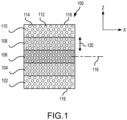
- each of the fabric layers 102, 104, 106, 108, and 110 can have consistent volumes of fibers 112 (e.g., carbon fibers). Stated differently, a fiber volume of the plurality of fibers 112 for each fabric-resin layer 102, 104, 106, 108, and 110 can be uniform throughout the plurality of fabric-resin layers 102, 104, 106, 108, and 110. In various embodiments, fiber volume is greater than 10% of the total volume of the preform 100.
- fiber volume is greater than 25% of the total volume of the preform 100. In various embodiments, fiber volume can be between 30% and 50% for carbon-carbon or ceramic matrix composites, and up to 60% for thermoset composites. In various embodiments, the fiber volume of the plurality of fibers 112 for each fabric-resin layer 102, 104, 106, 108, and 110 sequentially decreases with each fabric-resin layer from the center of the preform 100 toward the outer surfaces 118, 119 of the preform 100.
- a cure ply thickness of each fabric-resin layer 102, 104, 106, 108, and 110 is the same. In various embodiments, a cure ply thickness of each fabric-resin layer 102, 104, 106, 108, and 110 sequentially increases with each fabric-resin layer from the center of the preform 100 toward the outer surfaces 118, 119 of the preform 100. For example, a cure ply thickness of each fabric-resin layer 102, 104, 106, 108, and 110 can be varied to tailor a porosity of the fabric-resin layer, where increased cure ply thickness corresponds with increased porosity.
- each of the fabric layers 102, 104, 106, 108, and 110 can have varying weight ratio percentages of resin 114.
- each of the fabric layers 102, 104, 106, 108, and 110 can be referred to herein as fabric-resin layers.
- each of the fabric layers 102, 104, 106, 108, and 110 include a plurality of fibers 112 and a resin 114.
- Each of the fabric layers 102, 104, 106, 108, and 110 can include the plurality of fibers 112 pre-impregnated with the resin 114 (i.e., the fibers 112 can be wetted with the resin 114 prior to the layers being stacked).
- each of the fabric layers 102, 104, 106, 108, and 110 can be made of a composite prepreg ply.
- the resin 114 in accordance with various embodiments, can be a thermoset resin such as a phenolic resin, an epoxy resin, a vinyl ester resin, a polyester resin, a polyimide resin, a benzoxazine resin, a cyanate ester resin, or a bismaleimide (BMI) resin, among others.
- the type and/or composition of the resin 114 can be the same for each of the fabric-resin layers 102, 104, 106, 108, and 110.
- the resin 114 in each of the fabric-resin layers 102, 104, 106, 108, and 110 can have the same char yield.
- the resin 114 can have a char yield of 25% elemental carbon or greater by weight.
- the resin content (i.e., the weight ratio percentage of the resin 114) sequentially decreases in a direction from a centerline 116 of the preform 100 toward an outer surface 118 (and similarly toward an opposing outer surface 119) of the preform 100 along the thickness direction 120 to create a path through the porosity gradient fibrous preform for infiltration of a fluid, as described in further detail herein.
- a weight ratio percentage of the resin 114 sequentially decreases from a center of the porosity gradient fibrous preform 100 toward an outer surface (e.g., outer surface 118 and/or outer surface 119) of the porosity gradient fibrous preform 100.
- a porosity gradient in the porosity gradient fibrous preform corresponds with the weight ratio percentage of the resin (i.e., decreasing weight ratio percentage corresponds with increasing porosity).
- the weight ratio percentage of the resin 114 in fabric layer 106 is greater than the weight ratio percentages of the resin 114 in fabric layers 104 and 108.
- the weight ratio percentages of the resin 114 in fabric layers 104 and 108 are greater than the weight ratio percentages of the resin 114 in fabric layers 102 and 110.
- a porosity of the porosity gradient fibrous preform 100 increases-e.g., during or after a pyrolysis process as described herein-near the exterior of the porosity gradient fibrous preform 100 to thereby allow a fluid to infiltrate the interior of the porosity gradient fibrous preform 100 during a CVI process, as described herein, and thereby achieve more uniform and/or increased part density.
- the weight ratio percentage of the resin 114 is varied and the fiber volume remains uniform throughout the layers, by creating voids (e.g., air pockets) in the resin 114.
- a solvent e.g., toluene, xylene, methyl iso-butyl ketone, n-butyl acetate, or cellosolve acetate, or the like
- fabric-resin layer 106 can have a first solvent-resin ratio
- fabric-resin layer 104 and/or fabric-resin layer 108 can have a second solvent-resin ratio which is greater than the first solvent-resin ratio
- fabric-resin layer 102 and/or fabric-resin layer 110 can have a third solvent-resin ratio which is greater than the second solvent-resin ratio.
- the solvent can be evaporated (e.g., at room temperature (70° F) or in response to being heated to a temperature that is greater than room temperature (e.g., the resin cure temperature)), thereby leaving behind voids in the fibrous preform 100 to generate the porosity gradient fibrous preform 100.
- fabric layers 102, 104, 106, 108, and 110 may be joined through thickness reinforcement (TTR) via external needling, tufting, stitching, or z-pinning, among others.
- TTR thickness reinforcement
- the TTR utilizes a TTR fiber thread that includes fugitive fibers, fusible fibers, and/or carbon fibers.
- the TTR is performed in a uniform manner such that a number of needles, tufts, stiches, or z-pins are consistent along a length of the fabric layers 102, 104, 106, 108, and 110 in the x-direction.
- a transport depth in the z-direction of the TTR is through all the fabric layers 102, 104, 106, 108, and 110 of the porosity gradient fibrous preform for the length of the porosity gradient fibrous preform in the x-direction.
- generating a TTR fibrous preform in this manner takes advantage of random fiber placement for uniform densification in the through thickness direction, while maintaining high in-plane strengths.
- each fabric layer 102, 104, 106, 108, and 110 has a directionality that coincides with the direction of the fibers 112.
- the directionality of adjacent fabric layers e.g., fabric layer 106 and fabric layer 108) can be the same, in accordance with various embodiments.
- the directionality of adjacent fabric layers e.g., fabric layer 106 and fabric layer 108) can differ, in accordance with various embodiments
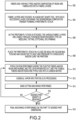
- a method of forming a porosity gradient fibrous preform for a high temperature composite is illustrated.
- fabric-resin layers using uniform fiber volume and varying percentages, by weight, of resin are fabricated into a fabric-resin layers of either woven fabric layers, non-crimp fabric layers, such as unidirectional or stitched unidirectional, or felt fabric layers.
- the fabric-resin layers are stacked, in a near net shape tool, with each successive layer containing the desired resin percentages thereby forming a porosity gradient fibrous preform.
- the various fabric layers may be joined through thickness reinforcement (TTR) via needling, tufting, stitching, or z-pinning, using a TTR fiber thread that includes fugitive fibers, fusible fibers, and/or carbon fibers. It should be understood that the TTR step at block 806 is optional and can be omitted in various embodiments.
- TTR thickness reinforcement
- the porosity gradient fibrous preform may be placed in a close die mold or vacuum bag tooling and subjected to heat and pressure to consolidate the porosity gradient fibrous preform.
- the resin 114 in the porosity gradient fibrous preform may be cured (e.g., during or after consolidation) by applying heat and pressure to the resin 114.
- the porosity gradient fibrous preform can be heated to a cure temperature of between 93 °C (200°F) and 121 °C (250°F); though the cure temperature can vary depending on the composition of the resin 114.
- various thermoset resins may have a cure temperature of between 260°C (500°F) and 371°C (700°F). In this regard, it should be understood that the cure temperate is chosen depending on the type of resin used.
- the porosity gradient fibrous preform can be heated to a cure temperature of between 93°C (200°F) and 371 °C (700°F), in accordance with various embodiments.
- the resin 114 can be polymerized (i.e., the resin includes monomers before being cured and includes polymers after being cured).
- the porosity gradient fibrous preform undergoes pyrolysis where a portion of the resin and/or fugitive fibers (if any fugitive fibers exist) in the porosity gradient fibrous preform are burned, melted, or evaporated, and the remaining portion of the resin and the fusible fibers are pyrolyzed into a carbon matrix and create a path through the thickness of the porosity gradient fibrous preform for infiltration of fluids.
- the weight ratio percentage of the resin 114 (which at this point is carbon char (i.e., carbon)) in fabric layer 106 can be between 30% and 50%, between 35% and 45%, between 37% and 43%, or between 35% and 50%, in accordance with various embodiments.
- the weight ratio percentage of the resin 114 (which at this point is carbon char (i.e., carbon)) in fabric layer 104 and/or fabric layer 108 is between 25% and 40%, between 28% and 38%, or between 30% and 35%, in accordance with various embodiments.
- the weight ratio percentage of the resin 114 (which at this point is carbon char (i.e., carbon)) in fabric layer 102 and/or fabric layer 110 is between 20% and 35%, between 20% and 30%, or between 20% and 28%, in accordance with various embodiments.
- the porosity gradient fibrous preform may undergo CVI densification.
- the porosity gradient fibrous preform may undergo skim cut machining where the surface of the porosity gradient fibrous preform modified to meet a set of standards for the porosity gradient fibrous preform.
- a determination is made as to whether a desired part density is reached. If at block 816 the desired part density has not been reached, the operation returns to block 812. If at block 816 the desired part density has been reached, then, at block 818, a final machining may be performed on the porosity gradient fibrous preform to meet desired porosity gradient fibrous preform dimensions.
- the illustrative embodiments provide for the creation of complex contour fibrous preforms, with a variety of thicknesses, which take advantage of porosity gradient created by varying resin content.
- the porosity gradient preform construction of the present invention tends to improve part quality and make the CVI process more effective.
- the porosity gradient tends to enable higher densification yields in thick sections or complex contour geometries.
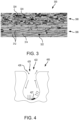
- Porosity gradient fibrous preform 300 includes a carbon or ceramic matrix 314 reinforced with carbon or reinforcement fibers 312.
- the carbon or ceramic matrix 314 can be the product of a resin (e.g., see resin 114 of FIG. 1 ) after undergoing curing and pyrolysis.
- the carbon fibers 312 can be the product of the fibers (e.g., see fibers 112 of FIG. 1 ) after undergoing pyrolysis.
- a porosity of a first carbonized fabric-resin layer 306 near a center of the preform is less than a porosity of a second carbonized fabric-resin layer 308 near an outer surface of the preform.
- layer 308 includes a first plurality of pores 324 that create one or more paths through the porosity gradient fibrous preform for infiltration of a fluid (e.g., a fluid used during CVI for densification).
- Layer 306 includes a second plurality of pores 322 that create one or more paths through the porosity gradient fibrous preform for infiltration of a fluid (e.g., a fluid used during CVI for densification).
- the pores 324 can be in fluid communication with the pores 322 whereby a network of paths are created for receiving a fluid used during CVI densification.
- a volume of the first plurality of pores 324 is greater than a volume of the second plurality of pores 322.
- the layer 306 is less porous than the layer 308. Accordingly, the network of paths creates the porosity gradient.
- a portion of a porosity gradient fibrous preform 400 is illustrated having a pore 422 defining a path 425 for a fluid-illustrated by the arrows 426-to infiltrate the porosity gradient fibrous preform 400.
- the pores are interconnected across the fabric-resin layers such that, in response to the resin being pyrolyzed, the path 425 is created through the fabric-resin layers to allow a fluid (e.g., a CVI gas) to infiltrate through the thickness (e.g., the entire thickness) of the porosity gradient fibrous preform 300.
- the fluid 426 can be a hydrocarbon gas configured to infiltrate the preform at elevated temperatures (e.g., approximately 1000°C (1832°F), wherein the term "approximately in this regard means ⁇ 200°C (between 1472°F-2192°F)), whereby carbon 427 from the hydrocarbon gases separate from the gas and is deposited on and within the porosity gradient fibrous preform 400.
- elevated temperatures e.g., approximately 1000°C (1832°F)
- approximately 200°C between 1472°F-2192°F
- the fluid continues to fill the pores located near the outside surface of the porosity gradient fibrous preform, similarly decreasing porosity near the exterior of the porosity gradient fibrous preform, thereby resulting in an overall uniformly higher density carbon-carbon component than if the porosity gradient did't existed in the first place.
- the pores 324 are not filled (or otherwise clogged from allowing CVI gasses to infiltrated the interior of the porosity gradient fibrous preform) with carbon deposited by the CVI fluid 426 until after the interior of the porosity gradient fibrous preform reaches a desired density.
- the porosity gradient fibrous preform allows for uniform densification by providing additional pathways for the CVI gasses to reach the interior of the porosity gradient fibrous preform.
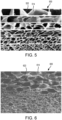
- a micro cross-section picture of a porosity gradient fibrous preform 500 manufactured using the systems and methods of the present invention (before undergoing CVI) is illustrated having uniform fiber volume and also having a porosity gradient.
- Preform 500 includes a plurality of layers of varying porosities.
- Preform 500 includes a carbon matrix 514 defining a plurality of pores 522.
- a micro cross-section picture of a porosity gradient fibrous preform 600 manufactured using the systems and methods of the present invention (before undergoing CVI) is illustrated having uniform fiber volume and also having a porosity gradient.
- Preform 600 includes a plurality of layers of varying porosities.
- Preform 600 includes a carbon matrix 614 defining a plurality of pores 622.
- references to "one embodiment,” “an embodiment,” “various embodiments,” etc. indicate that the embodiment described may include a particular feature, structure, or characteristic, but every embodiment may not necessarily include the particular feature, structure, or characteristic. Moreover, such phrases are not necessarily referring to the same embodiment. Further, when a particular feature, structure, or characteristic is described in connection with an embodiment, it is submitted that it is within the knowledge of one skilled in the art to affect such feature, structure, or characteristic in connection with other embodiments whether or not explicitly described. After reading the description, it will be apparent to one skilled in the relevant art(s) how to implement the invention in alternative embodiments.
- Numbers, percentages, or other values stated herein are intended to include that value, and also other values that are about or approximately equal to the stated value, as would be appreciated by one of ordinary skill in the art encompassed by various embodiments of the present invention.
- a stated value should therefore be interpreted broadly enough to encompass values that are at least close enough to the stated value to perform a desired function or achieve a desired result.
- the stated values include at least the variation to be expected in a suitable industrial process, and may include values that are within 10%, within 5%, within 1%, within 0.1%, or within 0.01% of a stated value.
- the terms “substantially,” “about,” or “approximately” as used herein represent an amount close to the stated amount that still performs a desired function or achieves a desired result.
- the term “substantially,” “about,” or “approximately” may refer to an amount that is within 10% of, within 5% of, within 1% of, within 0.1% of, and within 0.01% of a stated amount or value
Landscapes
- Chemical & Material Sciences (AREA)
- Engineering & Computer Science (AREA)
- Ceramic Engineering (AREA)
- Manufacturing & Machinery (AREA)
- Materials Engineering (AREA)
- Structural Engineering (AREA)
- Organic Chemistry (AREA)
- Chemical Kinetics & Catalysis (AREA)
- Inorganic Chemistry (AREA)
- Composite Materials (AREA)
- Dispersion Chemistry (AREA)
- Reinforced Plastic Materials (AREA)
Applications Claiming Priority (1)
| Application Number | Priority Date | Filing Date | Title |
|---|---|---|---|
| US18/356,953 US20250026690A1 (en) | 2023-07-21 | 2023-07-21 | Porosity gradient preform architecture for high temperature composites |
Publications (1)
| Publication Number | Publication Date |
|---|---|
| EP4501626A1 true EP4501626A1 (fr) | 2025-02-05 |
Family
ID=91959229
Family Applications (1)
| Application Number | Title | Priority Date | Filing Date |
|---|---|---|---|
| EP24189585.3A Withdrawn EP4501626A1 (fr) | 2023-07-21 | 2024-07-18 | Architecture de préforme à gradient de porosité pour composites à haute température |
Country Status (2)
| Country | Link |
|---|---|
| US (1) | US20250026690A1 (fr) |
| EP (1) | EP4501626A1 (fr) |
Citations (5)
| Publication number | Priority date | Publication date | Assignee | Title |
|---|---|---|---|---|
| US20110150663A1 (en) * | 2009-12-23 | 2011-06-23 | Paul Stephen Manicke | Process For Producing A Ceramic Matrix Composite Article And Article formed Thereby |
| EP3178637A1 (fr) * | 2015-11-30 | 2017-06-14 | Honeywell International Inc. | Préformes en fibres de carbone |
| US10822280B2 (en) * | 2017-12-15 | 2020-11-03 | Rolls-Royce High Temperature Composites Inc. | Method of making a fiber preform for ceramic matrix composite (CMC) fabrication utilizing a fugitive binder |
| US20230192561A1 (en) * | 2021-12-20 | 2023-06-22 | Raytheon Technologies Corporation | Controlled gradient of porosity in cmc |
| US20230193541A1 (en) * | 2021-12-20 | 2023-06-22 | Raytheon Technologies Corporation | Gradient tow ribbonizing for chemical vapor infiltration ceramic matrix composites |
Family Cites Families (3)
| Publication number | Priority date | Publication date | Assignee | Title |
|---|---|---|---|---|
| AU686122B2 (en) * | 1993-10-29 | 1998-02-05 | Foster-Miller Inc. | Translaminar reinforcement system for Z-direction reinforcement of a fiber matrix structure |
| US5536562A (en) * | 1994-03-14 | 1996-07-16 | The United States Of America As Represented By The Administrator Of The National Aeronautics And Space Administration | Low-density resin impregnated ceramic article having an average density of 0.15 to 0.40 g/cc |
| US9649793B2 (en) * | 2011-08-16 | 2017-05-16 | General Electric Company | Near net-shape panels and processes therefor |
-
2023
- 2023-07-21 US US18/356,953 patent/US20250026690A1/en active Pending
-
2024
- 2024-07-18 EP EP24189585.3A patent/EP4501626A1/fr not_active Withdrawn
Patent Citations (5)
| Publication number | Priority date | Publication date | Assignee | Title |
|---|---|---|---|---|
| US20110150663A1 (en) * | 2009-12-23 | 2011-06-23 | Paul Stephen Manicke | Process For Producing A Ceramic Matrix Composite Article And Article formed Thereby |
| EP3178637A1 (fr) * | 2015-11-30 | 2017-06-14 | Honeywell International Inc. | Préformes en fibres de carbone |
| US10822280B2 (en) * | 2017-12-15 | 2020-11-03 | Rolls-Royce High Temperature Composites Inc. | Method of making a fiber preform for ceramic matrix composite (CMC) fabrication utilizing a fugitive binder |
| US20230192561A1 (en) * | 2021-12-20 | 2023-06-22 | Raytheon Technologies Corporation | Controlled gradient of porosity in cmc |
| US20230193541A1 (en) * | 2021-12-20 | 2023-06-22 | Raytheon Technologies Corporation | Gradient tow ribbonizing for chemical vapor infiltration ceramic matrix composites |
Also Published As
| Publication number | Publication date |
|---|---|
| US20250026690A1 (en) | 2025-01-23 |
Similar Documents
| Publication | Publication Date | Title |
|---|---|---|
| JP4468015B2 (ja) | 繊維ブランクの製造方法、および繊維強化複合材料部品の製造方法 | |
| CA2115473C (fr) | Methode de fabrication d'une piece de materiau composite, en particulier d'un panneau sandwich, a partir d'une pluralite de preformes preassemblees | |
| EP2993016B1 (fr) | Fibres sacrificielles permettant de créer des canaux dans un matériau composite | |
| CN102099313B (zh) | 由复合材料制成的喷嘴或扩张喷嘴元件的制造方法 | |
| KR20100010023A (ko) | 열구조적 복합물 재료 부재의 제조 방법, 및 그에 의해 얻어지는 부재 | |
| CN102795872B (zh) | 在致密化之前多孔预成形体的刚性化 | |
| JP2019501849A (ja) | 炭素繊維強化炭化物‐セラミック複合部材 | |
| EP0877893A1 (fr) | Composite ablatif-isolant renforce suivant trois dimensions | |
| EP3971333B1 (fr) | Composites carbone/carbone et procédés de fabrication de composites carbone/carbone présentant une augmentation de volume des fibres | |
| US5985405A (en) | Three dimensionally reinforced ablative/insulative composite | |
| EP4494832A1 (fr) | Architecture de préforme à gradient de porosité pour composites à haute température | |
| CA2613789A1 (fr) | Fabrication d'articles composites en ceramique au moyen de plis minces | |
| EP4501626A1 (fr) | Architecture de préforme à gradient de porosité pour composites à haute température | |
| EP4494831A1 (fr) | Architecture de préforme à gradient de porosité pour composites à haute température | |
| EP4506161A1 (fr) | Architecture de préforme à gradient de porosité pour composites à haute température | |
| JP2005205902A (ja) | 向上した層強度を有するセラミックマトリックス複合材及びそのための方法 | |
| US12485645B2 (en) | Commingled fiber preform architecture for high temperature composites | |
| US12491701B2 (en) | Commingled fiber preform architecture for high temperature composites | |
| US20240391208A1 (en) | Commingled fiber preform architecture for high temperature composites | |
| CN115427219A (zh) | 中间复合元件、生产过程和复合零件 |
Legal Events
| Date | Code | Title | Description |
|---|---|---|---|
| PUAI | Public reference made under article 153(3) epc to a published international application that has entered the european phase |
Free format text: ORIGINAL CODE: 0009012 |
|
| STAA | Information on the status of an ep patent application or granted ep patent |
Free format text: STATUS: THE APPLICATION HAS BEEN PUBLISHED |
|
| AK | Designated contracting states |
Kind code of ref document: A1 Designated state(s): AL AT BE BG CH CY CZ DE DK EE ES FI FR GB GR HR HU IE IS IT LI LT LU LV MC ME MK MT NL NO PL PT RO RS SE SI SK SM TR |
|
| STAA | Information on the status of an ep patent application or granted ep patent |
Free format text: STATUS: REQUEST FOR EXAMINATION WAS MADE |
|
| 17P | Request for examination filed |
Effective date: 20250730 |
|
| RAP1 | Party data changed (applicant data changed or rights of an application transferred) |
Owner name: GOODRICH CORPORATION |
|
| STAA | Information on the status of an ep patent application or granted ep patent |
Free format text: STATUS: THE APPLICATION HAS BEEN WITHDRAWN |
|
| 18W | Application withdrawn |
Effective date: 20251209 |