EP4501664A2 - Reifen mit zweischichtiger lauffläche - Google Patents
Reifen mit zweischichtiger lauffläche Download PDFInfo
- Publication number
- EP4501664A2 EP4501664A2 EP24191078.5A EP24191078A EP4501664A2 EP 4501664 A2 EP4501664 A2 EP 4501664A2 EP 24191078 A EP24191078 A EP 24191078A EP 4501664 A2 EP4501664 A2 EP 4501664A2
- Authority
- EP
- European Patent Office
- Prior art keywords
- tread
- layer
- compound
- range
- pneumatic tire
- Prior art date
- Legal status (The legal status is an assumption and is not a legal conclusion. Google has not performed a legal analysis and makes no representation as to the accuracy of the status listed.)
- Pending
Links
Images


Classifications
-
- B—PERFORMING OPERATIONS; TRANSPORTING
- B60—VEHICLES IN GENERAL
- B60C—VEHICLE TYRES; TYRE INFLATION; TYRE CHANGING; CONNECTING VALVES TO INFLATABLE ELASTIC BODIES IN GENERAL; DEVICES OR ARRANGEMENTS RELATED TO TYRES
- B60C11/00—Tyre tread bands; Tread patterns; Anti-skid inserts
- B60C11/0041—Tyre tread bands; Tread patterns; Anti-skid inserts comprising different tread rubber layers
- B60C11/005—Tyre tread bands; Tread patterns; Anti-skid inserts comprising different tread rubber layers with cap and base layers
-
- B—PERFORMING OPERATIONS; TRANSPORTING
- B60—VEHICLES IN GENERAL
- B60C—VEHICLE TYRES; TYRE INFLATION; TYRE CHANGING; CONNECTING VALVES TO INFLATABLE ELASTIC BODIES IN GENERAL; DEVICES OR ARRANGEMENTS RELATED TO TYRES
- B60C11/00—Tyre tread bands; Tread patterns; Anti-skid inserts
- B60C11/0008—Tyre tread bands; Tread patterns; Anti-skid inserts characterised by the tread rubber
-
- B—PERFORMING OPERATIONS; TRANSPORTING
- B60—VEHICLES IN GENERAL
- B60C—VEHICLE TYRES; TYRE INFLATION; TYRE CHANGING; CONNECTING VALVES TO INFLATABLE ELASTIC BODIES IN GENERAL; DEVICES OR ARRANGEMENTS RELATED TO TYRES
- B60C1/00—Tyres characterised by the chemical composition or the physical arrangement or mixture of the composition
- B60C1/0016—Compositions of the tread
-
- B—PERFORMING OPERATIONS; TRANSPORTING
- B60—VEHICLES IN GENERAL
- B60C—VEHICLE TYRES; TYRE INFLATION; TYRE CHANGING; CONNECTING VALVES TO INFLATABLE ELASTIC BODIES IN GENERAL; DEVICES OR ARRANGEMENTS RELATED TO TYRES
- B60C11/00—Tyre tread bands; Tread patterns; Anti-skid inserts
-
- B—PERFORMING OPERATIONS; TRANSPORTING
- B60—VEHICLES IN GENERAL
- B60C—VEHICLE TYRES; TYRE INFLATION; TYRE CHANGING; CONNECTING VALVES TO INFLATABLE ELASTIC BODIES IN GENERAL; DEVICES OR ARRANGEMENTS RELATED TO TYRES
- B60C11/00—Tyre tread bands; Tread patterns; Anti-skid inserts
- B60C11/0041—Tyre tread bands; Tread patterns; Anti-skid inserts comprising different tread rubber layers
-
- B—PERFORMING OPERATIONS; TRANSPORTING
- B60—VEHICLES IN GENERAL
- B60C—VEHICLE TYRES; TYRE INFLATION; TYRE CHANGING; CONNECTING VALVES TO INFLATABLE ELASTIC BODIES IN GENERAL; DEVICES OR ARRANGEMENTS RELATED TO TYRES
- B60C11/00—Tyre tread bands; Tread patterns; Anti-skid inserts
- B60C11/0041—Tyre tread bands; Tread patterns; Anti-skid inserts comprising different tread rubber layers
- B60C11/005—Tyre tread bands; Tread patterns; Anti-skid inserts comprising different tread rubber layers with cap and base layers
- B60C11/0058—Tyre tread bands; Tread patterns; Anti-skid inserts comprising different tread rubber layers with cap and base layers with different cap rubber layers in the axial direction
-
- B—PERFORMING OPERATIONS; TRANSPORTING
- B60—VEHICLES IN GENERAL
- B60C—VEHICLE TYRES; TYRE INFLATION; TYRE CHANGING; CONNECTING VALVES TO INFLATABLE ELASTIC BODIES IN GENERAL; DEVICES OR ARRANGEMENTS RELATED TO TYRES
- B60C11/00—Tyre tread bands; Tread patterns; Anti-skid inserts
- B60C11/0008—Tyre tread bands; Tread patterns; Anti-skid inserts characterised by the tread rubber
- B60C2011/0016—Physical properties or dimensions
-
- B—PERFORMING OPERATIONS; TRANSPORTING
- B60—VEHICLES IN GENERAL
- B60C—VEHICLE TYRES; TYRE INFLATION; TYRE CHANGING; CONNECTING VALVES TO INFLATABLE ELASTIC BODIES IN GENERAL; DEVICES OR ARRANGEMENTS RELATED TO TYRES
- B60C11/00—Tyre tread bands; Tread patterns; Anti-skid inserts
- B60C11/0008—Tyre tread bands; Tread patterns; Anti-skid inserts characterised by the tread rubber
- B60C2011/0016—Physical properties or dimensions
- B60C2011/0025—Modulus or tan delta
Definitions
- the present invention relates to pneumatic tires comprising a dual-layer tread made of or comprising a first layer comprising a first tread compound having a first tread property and a second layer comprising a second tread compound having a second tread property.
- the properties of the tires are very specific in order to meet the different weather conditions.
- the shape of the tread of the pneumatic tire for racing is different than for passenger cars for example.
- the properties of interest for racing are wet traction, dry traction, tread wear, thermal conductivity and electrical conductivity.
- racing tires are heated via heating jacket for example, in order to be within their operating/performing temperature window. This permits to improve its performances such as grip on the track. For obvious environmental reasons, the use of such heating jacket should be diminished or even stopped.
- the invention relates to tire in accordance with claim 1.
- the present invention preferably relates to a pneumatic tire comprising a tread with a ground engaging surface, the tread being a dual-layer tread comprising or made of a first layer comprising a first tread compound having a loss compliance LC(1) and a second layer comprising a second tread compound having a loss compliance LC(2); wherein both of the loss compliance LC(1) and LC(2) are determined by a dynamic mechanical analysis system at a frequency of 10 Hz, under pre-strain of 10% and dynamic strain of 2.5% within a temperature sweep from 0 to 130 °C; wherein, when the tread temperature is in the range of from 5 to 50°C, LC(1) > LC(2); and wherein the volume ratio of the second tread compound relative to the first tread compound in the tread is in the range of from 0.5:1 to 10:1.
- the present invention preferably relates to a pneumatic tire comprising a tread with a ground engaging surface, the tread being a dual-layer tread comprising or made of a first layer comprising a first tread compound having a loss modulus E"(1) and a second layer comprising a second tread compound having a loss modulus E"(2); wherein both of the loss modulus E"(1) and E"(2) are determined by a dynamic mechanical analysis (DMA) system at a frequency of 10 Hz, under pre-strain of 10% and dynamic strain of 2.5%, within a temperature sweep from 0 to 130 °C; wherein, when the tread temperature is in the range of from 0 to 20°C, E"(1) > E"(2); and wherein the volume ratio of the second tread compound relative to the first tread compound in the tread is in the range of from 0.5:1 to 10:1.
- DMA dynamic mechanical analysis
- loss compliance or "LC” is the ratio of E” relative to (E*) 2 .
- LC E"/ (E*) 2 .
- a higher loss compliance value indicates that the material is more compliant and able to dissipate more energy, such as generating heat, when subjected to mechanical stress.
- E stands for the loss modulus
- E * E ′ + E " stand for Young's complex modulus
- E' stands for the storage modulus.
- the loss compliance LC is determined by a dynamic mechanical analysis (DMA) system at a frequency of 10 Hz, under pre-strain of 10% and dynamic strain of 2.5%, at a temperature sweep from 0 to 130 °C.
- the DMA system is a machine called EPLEXOR ® 150N from the company Netzsch.
- E is the loss modulus and is determined by a dynamic mechanical analysis (DMA) system at a frequency of 10 Hz, under pre-strain of 10% and dynamic strain of 2.5%, at a temperature sweep from 0 to 130 °C.
- the DMA system is a machine called EPLEXOR ® 150N from the company Netzsch.
- Tg glass-transition temperature
- a material in the present case a polymer
- Tg is the temperature region of the change from a rigid "glassy” state to a flexible “rubbery” state of said polymer.
- Tg is determined as a peak midpoint by a differential scanning calorimeter (DSC) at a temperature rate of increase of 20 °C per minute, according to ASTM D3418 or equivalent.
- DSC differential scanning calorimeter
- operating window refers to the optimum temperature range (not too cold and not too hot) for which pneumatic racing tires have ultimate grip without triggering excessive tire degradation and/or loss in ultimate grip.
- a pneumatic tire comprising a tread with a ground engaging surface, the tread being a dual-layer tread made of or comprising a first layer comprising a first tread compound having a loss compliance LC(1) and a second layer comprising a second tread compound having a loss compliance LC(2); wherein both of the loss compliance LC(1) and LC(2) are determined by a dynamic mechanical analysis system at a frequency of 10 Hz, under pre-strain of 10% and dynamic strain of 2.5% within a temperature sweep from 0 to 130 °C; wherein, when the tread temperature is in the range of from 5 to 50°C, LC(1) > LC(2); and wherein the volume ratio of the second tread compound relative to the first tread compound in the tread is in the range of from 0.5:1 to 10:1.
- the second tread compound is a polymeric compound having a glass-transition temperature Tg(2) in the range of from -10 to 15 °C, more preferably in the range of from -5 to 15 °C, more preferably of in the range of from -5 to 10 °C.
- the first tread compound is a polymeric compound having a glass-transition temperature Tg(1) in the range of from -25 to +10 °C, more preferably in the range of from - 20 to +5 °C, more preferably of in the range of from -18 to +3 °C.
- the dry traction of the second tread compound is higher than the dry traction of the first tread compound.
- the pneumatic tire has an operating window in the range of from 80 to 120 °C.
- the pneumatic tire is adapted for dry conditions.
- the pneumatic tire is to be used under dry conditions.
- the minimum ratio of LC(1) relative to LC(2) is 1.15:1, more preferably of 1.2:1.
- the maximum ratio of LC(1) relative to LC(2) is 4:1, more preferably of 3:1.
- a pneumatic tire comprising a tread with a ground engaging surface, the tread being a dual-layer tread made of or comprising a first layer comprising a first tread compound having a loss modulus E"(1) and a second layer comprising a second tread compound having a loss modulus E"(2); wherein both of the loss modulus E"(1) and E"(2) are determined by a dynamic mechanical analysis (DMA) system at a frequency of 10 Hz, under pre-strain of 10% and dynamic strain of 2.5%, within a temperature sweep from 0 to 130 °C; wherein, when the tread temperature is in the range of from 0 to 20°C, E"(1) > E"(2); and wherein the volume ratio of the second tread compound relative to the first tread compound in the tread is in the range of from 0.5:1 to 10:1.
- DMA dynamic mechanical analysis
- the second tread compound is a polymeric compound having a glass-transition temperature Tg(2) in the range of from - 20 to 0 °C, more preferably in the range of from - 15 to - 1 °C, more preferably of in the range of from - 10 to - 3 °C.
- the first tread compound is a polymeric compound having a glass-transition temperature Tg(1) in the range of from 0 to 10 °C, more preferably in the range of from 0 to 5 °C, more preferably of in the range of from 1 to 4 °C.
- Tg(1) Tg(2).
- the wet traction of the second tread compound is higher than the wet traction of the first tread compound.
- the pneumatic tire has an operating window in the range of from 20 to 70 °C.
- the pneumatic tire is adapted for wet conditions.
- the pneumatic tire is to be used under wet conditions.
- the ratio of E"(1) relative to E"(2), E"(1)/ E"(2) is in the range of from 1.3:1 to 3:1, more preferably in the range of from 1.5:1 to 2:1.
- the present invention thanks to the higher loss compliance or the higher loss modulus of the first layer compared to the second layer of the pneumatic tires according to the present invention, more heat is generated in the first layer compared to the second layer.
- the first layer of the pneumatic tires according to the present invention generating a lot of heat will help the second layer to reach its optimum temperature much quicker than usual, namely in the absence of the first layer.
- first tread compound and the second tread compound differ from each other in physical properties. Further, the first tread compound and the second tread compound differ chemically from one another.
- the tread is formed by extruding the first tread compound with the second tread compound forming a dual-layer strip.
- the dual-layer tread is formed by a continuous spiral winding of the dual-layer strip.
- the tread is formed from a continuous spiral winding of the dual-layer strip onto a tire building drum or a carcass.
- the width of the dual-layer strip corresponds to the width of the tread of the pneumatic tire.
- the dual-layer strip thickness is (or corresponds to) the thickness of the tread, the thickness of the dual-layer strip being determined by the maximum distance between the outermost surface of the dual-layer strip, namely the ground engaging surface of the tread, and the innermost surface of the dual-layer strip.
- the dual-layer strip has a thickness in the range of from 3 to 6 mm, preferably in the range of from 3.5 to 4.5 mm, the dual-layer strip thickness being the thickness of the tread, the thickness of the dual-layer strip being determined by the maximum distance between the outermost surface of the dual-layer strip, namely the ground engaging surface of the tread, and the innermost surface of the dual-layer strip.
- the width of the dual-layer strip ⁇ the width of the tread of the pneumatic tire.
- the dual-layer strip is preferably disposed to form a stack of layers which will form the tread. This alternative is illustrated in Fig. 1 and Fig. 2 for example.
- the dual-layer strip has a thickness in the range of from 1 to 3 mm, more preferably in the range of from 1.5 to 2 mm.
- the dual-layer strip has a width in the range of from 10 to 25 mm.
- the shape of the dual-layer strip is for example disclosed in US 2022/0063340A1 .
- the dual-layer tread is formed by extruding the first tread compound and the second tread compound one after the other. More preferably, the dual-layer tread is formed by extruding the first tread compound by spiral winding, forming the first layer of the tread, and then by extruding the second tread compound by spiral winding on the first layer, forming the second layer.
- the first layer consists of the first tread compound.
- the second layer consists of the second tread compound.
- the volume ratio of the second tread compound relative to the first tread compound in the tread is in the range of from 0.60:1 to 10:1, more preferably in the range of from 0.80:1 to 9:1, more preferably in the range of from 0.85:1 to 9:1, more preferably in the range of from 0.9:1 to 8:1.
- the volume ratio of the second tread compound relative to the first tread compound at the ground engaging surface of the tread is in the range of from 0.60:1 to 10:1, more preferably in the range of from 0.80:1 to 9:1, more preferably in the range of from 0.85:1 to 9:1, more preferably in the range of from 0.9:1 to 8:1.
- the pneumatic tires according to the present invention are racing tires.
- the cross-sectional shape of the first layer is substantially triangular, more preferably triangular.
- the second layer has an inverted substantially triangular cross-sectional shape compared to the first layer, more preferably an inverted triangular cross-sectional shape compared to the first layer.
- the volume ratio of the second tread compound relative to the first tread compound in the tread is in the range of from 0.6:1 to 1.5:1, preferably in the range of from 0.85:1 to 1.25:1, more preferably in the range of from 0.9:1 to 1.1:1, more preferably in the range of from 0.95:1 to 1.05:1.
- the outermost surface of the first layer is a first ground engaging surface and the outermost surface of the second layer being is a second ground engaging surface, the first ground engaging surface and the second ground engaging surface forming the ground engaging surface of the tread.
- This configuration is illustrated for example by FIG. 1 .
- the cross-sectional shape of the first layer is substantially trapezoidal, more preferably trapezoidal.
- the cross-sectional shape of the second layer is substantially trapezoidal, preferably trapezoidal.
- the volume ratio of the second tread compound relative to the first tread compound in the tread is in the range of from 2:1 to 9:1, more preferably in the range of from 3:1 to 8:1, more preferably in the range of from 4:1 to 5:1.
- the outermost surface of the first layer is a first ground engaging surface and the outermost surface of the second layer being is a second ground engaging surface, the first ground engaging surface and the second ground engaging surface forming the ground engaging surface of the tread. This configuration is illustrated for example by FIG. 2 .
- the outermost surface of the second layer is the ground engaging surface of the tread, the first layer not having a ground engaging surface. This configuration is illustrated for example by FIG. 3 .
- the tread has a width in the range of from 130 to 360 mm, more preferably in the range of from 160 to 320 mm.
- the tread has a thickness in the range of from 3 to 6 mm, preferably in the range of from 3.5 to 4.5 mm, the tread thickness being determined by the maximum distance between the outermost surface of the tread, namely the ground engaging surface of the tread, and the innermost surface of the tread.
- the tread comprises one or more circumferential grooves.
- the tread comprises no circumferential grooves.
- the present invention is further illustrated by the following set of embodiments and combinations of embodiments resulting from the dependencies and back-references as indicated.
- every embodiment in this range is meant to be explicitly disclosed for the skilled person, i.e. the wording of this term is to be understood by the skilled person as being synonymous to "The pneumatic tire of any one of embodiments 1, 2 and 3".
- the following set of embodiments represents a suitably structured part of the general description directed to preferred aspects of the present invention, and, thus, suitably supports, but does not represent the claims of the present invention.
- the pneumatic tire comprises a tread with a ground engaging surface, the tread being a dual-layer tread made of a first layer comprising a first tread compound having a loss compliance LC(1) and a second layer comprising a second tread compound having a loss compliance LC(2); wherein both of the loss compliance LC(1) and LC(2) are determined by a dynamic mechanical analysis system at a frequency of 10 Hz, under pre-strain of 10% and dynamic strain of 2.5% within a temperature sweep from 0 to 130 °C; wherein, when the tread temperature is in the range of from 5 to 50°C, LC(1) > LC(2); and wherein the volume ratio of the second tread compound relative to the first tread compound in the tread is in the range of from 0.5:1 to 10:1.
- Embodiment 2 The pneumatic tire of embodiment 1, wherein the second tread compound is a polymeric compound having a glass-transition temperature Tg(2) in the range of from -10 to 15 °C, preferably in the range of from -5 to 15 °C, more preferably of in the range of from -5 to 10 °C.
- Tg(2) glass-transition temperature
- Embodiment 3 The pneumatic tire of embodiment 1 or 2, wherein the pneumatic tire is adapted for dry running conditions, preferably the dry traction of the second tread compound is higher than the dry traction of the first tread compound.
- Embodiment 4 The pneumatic tire of any one of embodiments 1 to 3, wherein the minimum ratio of LC(1) relative to LC(2), at is of 1.15:1, preferably of 1.2:1; wherein the maximum ratio of LC(1) relative to LC(2) is of 4:1, preferably of 3:1.
- the pneumatic tire comprises a tread with a ground engaging surface, the tread being a dual-layer tread made of a first layer comprising a first tread compound having a loss modulus E"(1) and a second layer comprising a second tread compound having a loss modulus E"(2); wherein both of the loss modulus E"(1) and E"(2) are determined by a dynamic mechanical analysis (DMA) system at a frequency of 10 Hz, under pre-strain of 10% and dynamic strain of 2.5%, within a temperature sweep from 0 to 130 °C; wherein, when the tread temperature is in the range of from 0 to 20°C, E"(1) > E"(2); and wherein the volume ratio of the second tread compound relative to the first tread compound in the tread is in the range of from 0.5:1 to 10:1.
- DMA dynamic mechanical analysis
- Embodiment 6 The pneumatic tire of embodiment 5, wherein the second tread compound is a polymeric compound having a glass-transition temperature Tg(2) in the range of from - 20 to 0 °C, preferably in the range of from - 15 to - 1 °C, more preferably of in the range of from - 10 to - 3 °C.
- Tg(2) glass-transition temperature
- Embodiment 7 The pneumatic tire of embodiment 5 or 6, wherein the pneumatic tire is adapted for wet conditions, preferably the wet traction of the second tread compound is higher than the wet traction of the first tread compound.
- Embodiment 8 The pneumatic tire of any one of embodiments 5 to 7, wherein the minimum ratio of E"(1) relative to E"(2), E"(1)/ E"(2), is of 1.3:1, preferably of 1.5:1; wherein the maximum ratio of E"(1) relative to E"(2), E"(1)/ E"(2), is of 3:1, more preferably of 2:1.
- Embodiment 9 The pneumatic tire of any one of embodiments 1 to 8, wherein the tread is formed by extruding the first tread compound with the second tread compound forming a dual-layer strip.
- Embodiment 10 The pneumatic tire of embodiment 9, wherein the dual-layer tread is formed by a continuous spiral winding of the dual-layer strip.
- Embodiment 11 The pneumatic tire of embodiment 9 or 10, wherein the width of the dual-layer strip corresponds to the width of the tread of the pneumatic tire, wherein preferably, the dual-layer strip thickness is the thickness of the tread, the thickness of the dual-layer strip being determined by the maximum distance between the outermost surface of the dual-layer strip, namely the ground engaging surface of the tread, and the innermost surface of the dual-layer strip, wherein more preferably, the dual-layer strip has a thickness in the range of from 3 to 6 mm, preferably in the range of from 3.5 to 4.5 mm, the dual-layer strip thickness being the thickness of the tread, the thickness of the dual-layer strip being determined by the maximum distance between the outermost surface of the dual-layer strip, namely the ground engaging surface of the tread, and the innermost surface of the dual-layer strip.
- Embodiment 12 The pneumatic tire of embodiment 9 or 10, wherein the width of the dual-layer strip ⁇ the width of the tread of the pneumatic tire; wherein, preferably, the dual-layer strip has a thickness in the range of from 1 to 3 mm, more preferably in the range of from 1.5 to 2 mm; and/or wherein preferably the dual-layer strip has a width in the range of from 10 to 25 mm.
- Embodiment 13 The pneumatic tire of any one of embodiments 1 to 8, wherein the dual-layer tread is formed by extruding the first tread compound and the second tread compound one after the other.
- Embodiment 14 The pneumatic tire of any one of embodiments 1 to 13, wherein the first layer consists of (is made of) the first tread compound.
- Embodiment 15 The pneumatic tire of any one of embodiments 1 to 14, wherein the second layer consists of (is made of) the second tread compound.
- Embodiment 16 The pneumatic tire of any one of embodiments 1 to 15, wherein the volume ratio of the second tread compound relative to the first tread compound in the tread is in the range of from 0.60:1 to 10:1, preferably in the range of from 0.80:1 to 9:1, more preferably in the range of from 0.85:1 to 9:1, more preferably in the range of from 0.9:1 to 8:1; wherein, more preferably, the volume ratio of the second tread compound relative to the first tread compound at the ground engaging surface of the tread is in the range of from 0.60:1 to 10:1, more preferably in the range of from 0.80:1 to 9:1, more preferably in the range of from 0.85:1 to 9:1, more preferably in the range of from 0.9:1 to 8:1.
- Embodiment 17 The pneumatic tire of any one of embodiments 1 to 16, being a racing tire.
- Embodiment 18 The pneumatic tire of any one of embodiments 1 to 17, wherein the cross-sectional shape of the first layer is substantially triangular, preferably triangular.
- Embodiment 19 The pneumatic tire of embodiment 18, wherein the second layer has an inverted substantially triangular cross-sectional shape compared to the first layer, preferably an inverted triangular cross-sectional shape compared to the first layer.
- Embodiment 20 The pneumatic tire of embodiment 18 or 19, wherein the volume ratio of the second tread compound relative to the first tread compound in the tread is in the range of from 0.6:1 to 1.5:1, preferably in the range of from 0.85:1 to 1.25:1, more preferably in the range of from 0.9:1 to 1.1:1, more preferably in the range of from 0.95:1 to 1.05:1.
- Embodiment 21 The pneumatic of embodiment 20, wherein the outermost surface of the first layer is a first ground engaging surface and the outermost surface of the second layer being is a second ground engaging surface, the first ground engaging surface and the second ground engaging surface forming the ground engaging surface of the tread.
- Embodiment 22 The pneumatic tire of any one of embodiments 1 to 17, wherein the cross-sectional shape of the first layer is substantially trapezoidal, preferably trapezoidal.
- Embodiment 23 The pneumatic tire of embodiment 22, wherein the cross-sectional shape of the second layer is substantially trapezoidal, preferably trapezoidal.
- Embodiment 24 The pneumatic tire of embodiment 22 or 23, wherein the volume ratio of the second tread compound relative to the first tread compound in the tread is in the range of from 2:1 to 9:1, preferably in the range of from 3:1 to 8:1, more preferably in the range of from 4:1 to 5:1.
- Embodiment 25 The pneumatic of embodiment 24, wherein the outermost surface of the first layer is a first ground engaging surface and the outermost surface of the second layer being is a second ground engaging surface, the first ground engaging surface and the second ground engaging surface forming the ground engaging surface of the tread.
- Embodiment 26 The pneumatic of embodiment 22, wherein the outermost surface of the second layer is the ground engaging surface of the tread, the first layer not having a ground engaging surface.
- Embodiment 27 The pneumatic tire of any one of embodiments 1 to 26, wherein the tread comprises one or more circumferential grooves.
- Embodiment 28 The pneumatic tire of any one of embodiments 1 to 25, wherein the tread comprises no circumferential grooves.
- the tread of the pneumatic tire of the present invention can be prepared according to any method known in the art.
- the tread of the pneumatic tire of the present invention can be prepared according to a method as illustrated US 2011/0070325 A1 .
- the tread of the pneumatic tire of the present invention can be prepared according to a method as illustrated in US 2022/0063340 A1 .
- the present invention further relates to a method of forming a tread comprising the steps of: selecting a first tread compound having a first physical property, such as LC(1) or E"(1), and selecting a second tread compound having a second physical property, such as LC(2) or E"(2), respectively, forming a tread by winding a dual layer strip having a first layer formed of the first tread compound and a second layer formed of the second tread compound, wherein the volume ratio of the second tread compound relative to the first tread compound in the tread is in the range of from 0.5:1 to 10:1.
- the present invention further relates to a method of forming a tread comprising the steps of: selecting a first tread compound having a loss compliance LC(1), and selecting a second tread compound having a loss compliance LC(2), forming a tread by winding a dual layer strip having a first layer formed of the first tread compound and a second layer formed of the second tread compound, wherein the volume ratio of the second tread compound relative to the first tread compound in the tread is in the range of from 0.5:1 to 10:1, wherein both of the loss compliance LC(1) and LC(2) are determined by a dynamic mechanical analysis system at a frequency of 10 Hz, under pre-strain of 10% and dynamic strain of 2.5% within a temperature sweep from 0 to 130 °C; and wherein, when the tread temperature is in the range of from 5 to 50°C, LC(1) > LC(2).
- the present invention further relates to a method of forming a tread comprising the steps of: selecting a first tread compound having a loss modulus E"(1), and selecting a second tread compound having a loss modulus E"(2), forming a tread by winding a dual layer strip having a first layer formed of the first tread compound and a second layer formed of the second tread compound, wherein the volume ratio of the second tread compound relative to the first tread compound in the tread is in the range of from 0.5:1 to 10:1, wherein both of the loss modulus E"(1) and E"(2) are determined as described herein above; and wherein, when the tread temperature is in the range of from 0 to 20 °C, E"(1) > E"(2).
- an apparatus as illustrated in US 2022/0063340 A1 can be used.
- Such apparatus according to the present invention can form the coextruded dual-layer strip while instantaneously varying the volume ratio of the first compound to the second compound.
- the dual strip forming apparatus includes a first extruder and a second extruder, preferably arranged vertically in close proximity.
- the first extruder has an inlet for receiving a first tread compound
- the second extruder has an inlet for receiving a second tread compound.
- the first tread compound is extruded by the first extruder and then pumped by a first gear pump into a nozzle, while at the same time the second tread compound is extruded by the second extruder and then pumped by a second gear pump into the nozzle.
- the volume ratio of the second tread compound relative to the first tread compound in the tread may be changed by varying the ratio of the speed of gear pump of the first tread compound to the speed of gear pump of the second tread compound.
- the dual coextruded strip forming apparatus can adjust the speed ratios on the fly, and due to the small residence time of the co-extrusion nozzle, the apparatus has a fast response to a change in the compound ratios. This is due to the low volume of the co-extrusion zone.
- Pneumatic racing tires according to the present invention were prepared (inventive tires), in particular with a tread formed via an extrusion process of a dual-layer strip (having a bottom layer and a top layer - the top layer outer surface being the ground engaging surface of the tread) made of a second tread compound having a loss modulus E"(2), and the bottom layer being made of a first tread compound having a loss modulus E"(1), wherein, at a temperature of the tread of in the range of from 0 to 20 °C, E"(1) > E"(2).
- the volume ratio of the second tread compound relative to the first tread compound in the tread is of more than 3:1, the first tread compound is a polymeric tread compound having a Tg of + 3 °C, the second tread compound is a polymeric tread compound having a Tg of -3 °C.
- Pneumatic racing tires not according to the present invention were prepared, in particular with a tread formed via an extrusion process of a mono-layer strip made of a tread compound having a loss modulus of 5.3 MPa at a temperature of the tread of 10 °C.
- the tread compound is a polymeric tread compound having a Tg of -3 °C.
- the chemical composition of the tread compound of this comparative tire and the chemical composition of the second tread compound of the inventive tire are the same.
- the inventive tires and comparative tires were mounted on different motorcycles for testing and comparison. The testing was done by professional pilots on circuit under wet conditions. The rating goes from 1 (very bad) to 10 (excellent).
- Table 1 Reference tires Inventive tires Air Temp. 15 °C 19 °C Track Temp. 15 °C 21 °C Tire Tread Temp.* 48 °C 60 °C Tire pressure* 1.39 bar 1.49 bar Total laps 8 6 Fastest Lap 6th 4th Fastest Time 2:02.299 (6th lap) 1:52.911 (4th lap) Rear entry stability 5 7 Rear entry grip 5 7 Rear mid corner grip 5 7 Rear exit grip 5 7 Rear exit stability 5 7 Rear slide control 5 8 Rear confidence 5 7 Rear overall 5 7 *measured directly after the run
- the rating of the inventive tires is much better than the rating of the reference tires. Thanks to the tires of the present invention, the best performance is achieved faster. Indeed, already at the 4 th lap, the fastest time is achieved for the inventive tires while it is at 6 th lap that it is achieved with the reference tires, and on top the best lap time for the inventive tires being significantly faster than the best lap time for the reference tires . As may be taken from Table 1 above, the tires according to the present invention exhibits great stability and grip performance. Furthermore, the tire reaches the optimum operating window much quicker and is able to maintain this optimum window despite significant cooling effects due to the water on track.
- the bottom layer generates a lot of heat which helps the top layer to reach its optimum temperature much quicker than usual.
- the bottom layer permits to regulate properly the temperature of the tread to obtain the best performance in the operating window on wet circuit/track. This permits to be very flexible in terms of performance irrespective of the racing conditions.
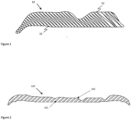
- FIG. 1 is a schematic representation of a portion of a dual-layer tread 10 comprised in the pneumatic tires according to the present invention, wherein said tread is made of a first layer 11 comprising a first tread compound having a first tread property (loss compliance LC(1) or loss modulus E"(1)) and a second layer 12 comprising a second tread compound having a second tread physical property ((loss compliance LC(2) or loss modulus E"(2)), the first layer and the second layer have been extruded together as a thin dual-layer strip which has been continuously spirally winding to form the dual-layer tread comprised in the pneumatic tires according to the present invention.
- first layer 11 comprising a first tread compound having a first tread property (loss compliance LC(1) or loss modulus E"(1))
- a second layer 12 comprising a second tread compound having a second tread physical property ((loss compliance LC(2) or loss modulus E"(2))
- the first layer and the second layer have been extruded together as a thin dual-layer strip which
- the cross-sectional shape of the first layer is triangular, and the second layer has an inverted triangular cross-sectional shape compared to the first layer.
- the volume ratio of the second tread compound relative to the first tread compound in the tread is preferably in the range of from 0.6:1 to 1.5:1.
- FIG. 2 is a schematic representation of a portion of a dual-layer tread 100 comprised in the pneumatic tires according to the present invention, wherein said tread is made of a first layer 101 comprising a first tread compound having a first tread property (loss compliance LC(1) or loss modulus E"(1)) and a second layer 102 comprising a second tread compound having a second tread physical property ((loss compliance LC(2) or loss modulus E"(2)), the first tread compound and the second tread compound have been extruded together as a thin dual-layer strip which has been continuously spirally winding to form the dual-layer tread comprised in the pneumatic tires according to the present invention.
- the cross-sectional shape of the first layer is trapezoidal, and the cross-sectional shape of the second layer is also trapezoidal.
- the volume ratio of the second tread compound relative to the first tread compound in the tread is in the range of from 2:1 to 9:1.
- FIG.3 is a schematic representation of a portion of a dual-layer tread 200 comprised in the pneumatic tires according to the present invention, wherein said tread is made of a first (bottom) layer 201 comprising a first tread compound having a first tread property (loss compliance LC(1) or loss modulus E"(1)) and a second (top) layer 202 comprising a second tread compound having a second tread physical property ((loss compliance LC(2) or loss modulus E"(2)).
- the first tread compound and the second tread compound have been coextruded to form a large dual-layer strip, the width of the strip being the width of the tread.
Landscapes
- Engineering & Computer Science (AREA)
- Mechanical Engineering (AREA)
- Tires In General (AREA)
Applications Claiming Priority (1)
| Application Number | Priority Date | Filing Date | Title |
|---|---|---|---|
| US18/362,497 US12285976B2 (en) | 2023-07-31 | 2023-07-31 | Tire comprising a dual-layer tread |
Publications (2)
| Publication Number | Publication Date |
|---|---|
| EP4501664A2 true EP4501664A2 (de) | 2025-02-05 |
| EP4501664A3 EP4501664A3 (de) | 2025-03-19 |
Family
ID=92106751
Family Applications (1)
| Application Number | Title | Priority Date | Filing Date |
|---|---|---|---|
| EP24191078.5A Pending EP4501664A3 (de) | 2023-07-31 | 2024-07-26 | Reifen mit zweischichtiger lauffläche |
Country Status (3)
| Country | Link |
|---|---|
| US (1) | US12285976B2 (de) |
| EP (1) | EP4501664A3 (de) |
| CN (1) | CN119428014A (de) |
Citations (2)
| Publication number | Priority date | Publication date | Assignee | Title |
|---|---|---|---|---|
| US20110070325A1 (en) | 2009-09-24 | 2011-03-24 | Choi Sung Hyun | Multiple-preformer die of extrusion mold for tire treads |
| US20220063340A1 (en) | 2020-09-01 | 2022-03-03 | The Goodyear Tire & Rubber Company | Tire with composite tread and method of making |
Family Cites Families (9)
| Publication number | Priority date | Publication date | Assignee | Title |
|---|---|---|---|---|
| US4478266A (en) | 1982-09-17 | 1984-10-23 | The Goodyear Tire & Rubber Company | Composite tread having good traction and reduced rolling resistance upon wear |
| JPS63134311A (ja) * | 1986-11-26 | 1988-06-06 | Yokohama Rubber Co Ltd:The | 二輪車用空気入りタイヤ |
| TW482732B (en) | 1998-12-21 | 2002-04-11 | Pirelli | Dual composition tread band for tire |
| JP5443072B2 (ja) * | 2009-06-22 | 2014-03-19 | 住友ゴム工業株式会社 | ベーストレッド用ゴム組成物及び空気入りタイヤ |
| BRPI1106827A2 (pt) | 2010-11-10 | 2014-08-19 | Goodyear Tire & Rubber | Pneumático de passageiros tendo baixa resistência ao rolamento com tração molhada e desgaste de banda de rodagem |
| JP5297485B2 (ja) | 2011-02-28 | 2013-09-25 | 住友ゴム工業株式会社 | 二輪自動車用ラジアルタイヤ |
| JP6144991B2 (ja) * | 2013-08-02 | 2017-06-07 | 住友ゴム工業株式会社 | 自動二輪車用タイヤ |
| US20220063343A1 (en) | 2020-09-01 | 2022-03-03 | The Goodyear Tire & Rubber Company | Tire with asymmetrical tread with reduced shoulder heat generation |
| JP7786072B2 (ja) * | 2021-08-11 | 2025-12-16 | 住友ゴム工業株式会社 | タイヤ |
-
2023
- 2023-07-31 US US18/362,497 patent/US12285976B2/en active Active
-
2024
- 2024-07-26 EP EP24191078.5A patent/EP4501664A3/de active Pending
- 2024-07-31 CN CN202411039503.XA patent/CN119428014A/zh active Pending
Patent Citations (2)
| Publication number | Priority date | Publication date | Assignee | Title |
|---|---|---|---|---|
| US20110070325A1 (en) | 2009-09-24 | 2011-03-24 | Choi Sung Hyun | Multiple-preformer die of extrusion mold for tire treads |
| US20220063340A1 (en) | 2020-09-01 | 2022-03-03 | The Goodyear Tire & Rubber Company | Tire with composite tread and method of making |
Also Published As
| Publication number | Publication date |
|---|---|
| US12285976B2 (en) | 2025-04-29 |
| CN119428014A (zh) | 2025-02-14 |
| EP4501664A3 (de) | 2025-03-19 |
| US20250042202A1 (en) | 2025-02-06 |
Similar Documents
| Publication | Publication Date | Title |
|---|---|---|
| CN110862523A (zh) | 一种液晶聚合物薄膜的制备方法 | |
| US8747713B2 (en) | Method and apparatus for manufacture of a polymer film, which is oriented under an angle to its longitudinal direction | |
| JPH06315964A (ja) | ゴム引したワイヤシートの製造方法および装置 | |
| CN110181829B (zh) | 一种液晶聚酯薄膜工业生产工艺 | |
| CN104220236A (zh) | 热塑性液晶聚合物薄膜及其制造方法 | |
| EP4501664A2 (de) | Reifen mit zweischichtiger lauffläche | |
| RU2384414C2 (ru) | Способ и устройство для производства многослойного полотна | |
| EP2707195A1 (de) | Verfahren zum kombinierten rollen und dehnen von bändern | |
| MXPA06014049A (es) | Metodo para fabricar neumatico y aparato usado para lo mismo. | |
| MXPA04003322A (es) | Orientacion longitudinal de una pelicula termoplastica tubular. | |
| EP1859959A1 (de) | Reifen für schwerlasten | |
| IE53904B1 (en) | Process and equipment for the extrustion of films of vinylidene fluoride polymers | |
| EP2771183B1 (de) | Mehrlagige folienstruktur mit materialien aus erneuerbaren quellen | |
| US2895171A (en) | Production of films from polymeric materials | |
| WO2003041941A1 (en) | Production method for unvulcanized rubber member and tire | |
| JP7702311B2 (ja) | 液晶ポリマーフィルム、積層体 | |
| CN101439581A (zh) | 一种易撕型塑料薄膜的制造设备 | |
| JP2932731B2 (ja) | ポリカーボネート単層シートの製造方法 | |
| JP2017514720A5 (de) | ||
| BR102024015101A2 (pt) | Pneu com banda de rodagem de camada dupla | |
| KR100769733B1 (ko) | 플라스틱 시트 제조 방법 | |
| KR102011104B1 (ko) | 에어홀 방지를 위한 플라스틱 수지 압출물 및 그의 제조방법 | |
| JPH09174667A (ja) | ポリエチレン多層フィルム | |
| WO2017082310A1 (ja) | チューブの製造方法およびチューブ | |
| CN113942281B (zh) | 一种三层共挤液晶高分子复合薄膜及其制备方法 |
Legal Events
| Date | Code | Title | Description |
|---|---|---|---|
| PUAI | Public reference made under article 153(3) epc to a published international application that has entered the european phase |
Free format text: ORIGINAL CODE: 0009012 |
|
| STAA | Information on the status of an ep patent application or granted ep patent |
Free format text: STATUS: THE APPLICATION HAS BEEN PUBLISHED |
|
| AK | Designated contracting states |
Kind code of ref document: A2 Designated state(s): AL AT BE BG CH CY CZ DE DK EE ES FI FR GB GR HR HU IE IS IT LI LT LU LV MC ME MK MT NL NO PL PT RO RS SE SI SK SM TR |
|
| PUAL | Search report despatched |
Free format text: ORIGINAL CODE: 0009013 |
|
| AK | Designated contracting states |
Kind code of ref document: A3 Designated state(s): AL AT BE BG CH CY CZ DE DK EE ES FI FR GB GR HR HU IE IS IT LI LT LU LV MC ME MK MT NL NO PL PT RO RS SE SI SK SM TR |
|
| RIC1 | Information provided on ipc code assigned before grant |
Ipc: B60C 11/00 20060101AFI20250210BHEP |
|
| STAA | Information on the status of an ep patent application or granted ep patent |
Free format text: STATUS: REQUEST FOR EXAMINATION WAS MADE |
|
| 17P | Request for examination filed |
Effective date: 20250919 |