EP4501832A1 - Aufzugsvorrichtung - Google Patents
Aufzugsvorrichtung Download PDFInfo
- Publication number
- EP4501832A1 EP4501832A1 EP22933514.6A EP22933514A EP4501832A1 EP 4501832 A1 EP4501832 A1 EP 4501832A1 EP 22933514 A EP22933514 A EP 22933514A EP 4501832 A1 EP4501832 A1 EP 4501832A1
- Authority
- EP
- European Patent Office
- Prior art keywords
- panel part
- main circuit
- control panel
- power receiving
- car
- Prior art date
- Legal status (The legal status is an assumption and is not a legal conclusion. Google has not performed a legal analysis and makes no representation as to the accuracy of the status listed.)
- Pending
Links
Images





Classifications
-
- B—PERFORMING OPERATIONS; TRANSPORTING
- B66—HOISTING; LIFTING; HAULING
- B66B—ELEVATORS; ESCALATORS OR MOVING WALKWAYS
- B66B1/00—Control systems of elevators in general
- B66B1/34—Details, e.g. call counting devices, data transmission from car to control system, devices giving information to the control system
- B66B1/3415—Control system configuration and the data transmission or communication within the control system
- B66B1/3423—Control system configuration, i.e. lay-out
-
- B—PERFORMING OPERATIONS; TRANSPORTING
- B66—HOISTING; LIFTING; HAULING
- B66B—ELEVATORS; ESCALATORS OR MOVING WALKWAYS
- B66B11/00—Main component parts of lifts in, or associated with, buildings or other structures
- B66B11/001—Arrangement of controller, e.g. location
- B66B11/002—Arrangement of controller, e.g. location in the hoistway
-
- B—PERFORMING OPERATIONS; TRANSPORTING
- B66—HOISTING; LIFTING; HAULING
- B66B—ELEVATORS; ESCALATORS OR MOVING WALKWAYS
- B66B1/00—Control systems of elevators in general
- B66B1/34—Details, e.g. call counting devices, data transmission from car to control system, devices giving information to the control system
-
- B—PERFORMING OPERATIONS; TRANSPORTING
- B66—HOISTING; LIFTING; HAULING
- B66B—ELEVATORS; ESCALATORS OR MOVING WALKWAYS
- B66B11/00—Main component parts of lifts in, or associated with, buildings or other structures
- B66B11/0035—Arrangement of driving gear, e.g. location or support
- B66B11/0045—Arrangement of driving gear, e.g. location or support in the hoistway
-
- B—PERFORMING OPERATIONS; TRANSPORTING
- B66—HOISTING; LIFTING; HAULING
- B66B—ELEVATORS; ESCALATORS OR MOVING WALKWAYS
- B66B5/00—Applications of checking, fault-correcting, or safety devices in elevators
- B66B5/02—Applications of checking, fault-correcting, or safety devices in elevators responsive to abnormal operating conditions
- B66B5/04—Applications of checking, fault-correcting, or safety devices in elevators responsive to abnormal operating conditions for detecting excessive speed
Definitions
- the present invention relates to an elevator device, and more particularly to the configuration of a control panel used in the elevator device.
- Patent Literature 1 discloses a machine room-less elevator device having a normal control panel (hereinafter referred to as the control panel) disposed on the inner wall surface at the top of the hoistway.
- the control panel has a vertically long structure extending in the vertical direction (see paragraph 0027 and FIG. 4 ) .
- Patent Literature 1 Japanese Unexamined Patent Application Publication No. 2018-52648
- the entire area from the top end to the bottom end may not fit within the range (hereinafter referred to as the overhead dimension: OH dimension) between the floor level of the top floor and the ceiling level of the hoistway.
- the lower part of the control panel is located below the ceiling of a car (hereinafter referred to as "car top").
- car top In machine room-less elevator devices, the car top is positioned at the floor level of the top floor, and periodic inspections of the control panel and the like are performed from the car top.
- the height position of the car top must be adjusted by moving the car.
- inspection-enabling height dimension the height dimension at which a worker can perform inspections without using a stepladder or the like.
- the object of the present invention is to provide an elevator device that allows easy inspection work such as the periodic inspections of a control panel.
- an elevator device of the present invention includes a car, a hoisting machine, and a control panel that controls operation.
- the control panel has a regenerative resistance panel part, a main circuit panel part, a power receiving panel part, a signal panel part, and a battery panel part, the main circuit panel part and the power receiving panel part are arranged in parallel in a horizontal direction, and the regenerative resistance panel part, the main circuit panel part and power receiving panel part, the signal panel part, and the battery panel part are arranged in an order of, from top to bottom, the regenerative resistance panel part, the main circuit panel part and power receiving panel part, the signal panel part, and the battery panel part.
- an elevator device that allows easy inspection work such as the periodic inspections of a control panel.
- FIG. 1 is a cross-sectional view parallel to the vertical direction, illustrating the configuration of the elevator device 100 according to an embodiment of the present invention.
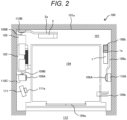
- FIG. 2 is a cross-sectional view parallel to the horizontal direction, illustrating the configuration of the elevator device 100 according to the embodiment of the present invention.
- the elevator device 100 includes: a car 104 and a counterweight 105 that move vertically within a hoistway 101; a hoisting machine 102 around which a main rope 107 connecting the car 104 and the counterweight 105 is wound; a guide rail 109 that is erected in the hoistway 101 and guides the vertical movement of the car 104 and the counterweight 105; a control panel 1 that controls the elevator device 100; and a governor 111 for detecting the elevating speed of the car 104.
- the car 104 and the counterweight 105 are provided inside the hoistway 101 in a building, and are suspended in a well-bucket manner by the main rope 107.
- the car 104 is electrically connected to the control panel 1 by a tail cord 108, receives power supplied through the tail cord 108, and exchanges control signals and various signals with the control panel 1.
- a buffer 106 is disposed on the bottom surface of the hoistway 101 below the car 104 and the counterweight 105 .
- the hoisting machine 102 is supported by a machine beam 102a and is disposed at the top of the hoistway 101, and the control panel 1 is disposed in the vicinity of the hoisting machine 102. That is, the control panel 1 is also disposed at the top of the hoistway 101.
- the hoisting machine 102 and the control panel 1 are arranged at the top of the hoistway 101, but the positions of the hoisting machine 102 and the control panel 1 are not limited to the top of the hoistway 101.
- the control panel 1 of the present embodiment has an effective configuration for cases where the hoisting machine 102 and the control panel 1 are arranged at the top of the hoistway 101. The configuration of the control panel 1 will be described in detail later.
- the guide rail 109 is fixed to an inner wall (hoistway wall) 101a of the hoistway 101 by rail brackets 110.
- a car door 104a is provided on the side surface of the car 104 facing an elevator hall 112, and a space for equipment, such as the hoisting machine 102 and the control panel 1, is provided between the side surfaces of the car 104, excluding the side surface thereof on which the car door 104a is provided, and the hoistway wall 101a.
- a PosiTector 104b for detecting the position of the car 104 is provided on the car 104 so as to protrude from one side surface of the car 104 toward the hoistway wall 101a.
- the elevator device 100 is of the traction type, in which the hoisting machine 102 frictionally drives the main rope 107 to move the car 104 vertically along a car guide rail 109A and move the counterweight 105 vertically along a counterweight guide rail 109B.
- the guide rail 109 is erected in the vertical direction along the hoistway wall 101a.
- the car guide rail 109A and the counterweight guide rail 109B are provided as the guide rail 109.
- the car guide rail 109A is a guide rail for the car 104 and has a pair of guide rails.
- the counterweight guide rail 109B is a guide rail for the counterweight 105 and has a pair of guide rails.
- the pair of car guide rails 109A are arranged separately on the hoistway walls 101A on both the left and right side of the car 104 when viewed from the elevator hall 112 side.
- One of the pair of car guide rails 109A is fixed to the hoistway wall 101a by a common rail bracket 110C, and the other is fixed to the hoistway wall 101a by a car rail bracket 110A.
- the common rail bracket 110C is a rail bracket that is shared between the car guide rail 109A and the counterweight guide rail 109B.
- the car rail bracket 110A is a dedicated rail bracket, which is provided for the car guide rail 109A.
- the pair of counterweight guide rails 109B are arranged in the space where the counterweight 105 is disposed. That is, the pair of counterweight guide rails 109B are arranged in the same space on either the left or right side of the car 104 when viewed from the elevator hall 112 side.
- One of the pair of counterweight guide rails 109B is fixed to the hoistway wall 101a by the common rail bracket 110C, and the other is fixed to the hoistway wall 101a by a counterweight rail bracket 110B.
- the common rail bracket 110C is fixed to the hoistway wall 101a that faces the left side surface of the car 104
- the counterweight rail bracket 110B is fixed to the hoistway wall 101a that faces the back side of the car 104.
- the car guide rail 109A and the counterweight guide rail 109B will be simply referred to as the guide rail 109 without "car” and “counterweight” when there is no need to distinguish therebetween.
- the car rail bracket 110A, the counterweight rail bracket 110B, and the common rail bracket 110C will be simply referred to as the rail bracket 110 without "common”, “counterweight”, and "car”, when there is no need to distinguish therebetween.
- the hoisting machine 102 is disposed in a space configured on the left side of the car 104 when viewed from the elevator hall 112 side.
- the governor 111 having a governor encoder 111a is disposed in a space on the same side as the hoisting machine 102.
- the hoisting machine 102 is fixed to the hoistway wall 101a by the machine beam 102a described in FIG. 1 , but the machine beam 102a is provided so as to hang across the car guide rail 109A and the counterweight guide rail 109B, so that the hoisting machine 102 is fixed to the hoistway wall 101a via the car guide rail 109A and the counterweight guide rail 109B.
- the control panel (first control panel) 1 is disposed in a space configured on the right side of the car 104 when viewed from the elevator hall 112 side.
- the control panel 1 is fixed to the hoistway wall 101a by a control panel bracket (first control panel bracket) 1a.
- the control panel bracket 1a is fixed to the car guide rail 109A
- the control panel 1 is fixed to the hoistway wall 101a via the car guide rail 109A.
- the tail cord 108 described in FIG. 1 is connected to the control panel 1, and a tail cord support 108b for supporting the tail cord 108 is provided near the control panel 1.
- the tail cord support 108b is fixed, by a tail cord support bracket 108a, to the car guide rail 109A to which the control panel bracket 1a is fixed.
- the elevator device 100 includes the control panel 1 as a standard control panel, and includes a second control panel 2 in addition to the control panel (first control panel) 1.
- the second control panel 2 is fixed to the hoistway wall 101a by a second control panel bracket 2a.
- the control panel bracket 2a is fixed to the counterweight guide rail 109B, and the control panel 2 is fixed to the hoistway wall 101a via the counterweight guide rail 109B.
- the second control panel (option panel) 2 implements control components required as customer optional functions in addition to the basic control functions of the elevator device 100. For this reason, the second control panel 2 may not be provided.
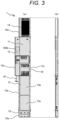
- FIG. 3 is an external view of the control panel 1 of the elevator device 100 according to the embodiment of the present invention.
- the control panel 1 has a main circuit panel part 11, a power receiving panel part 12, a signal panel part 13, a regenerative resistance panel part 14, and a battery panel part 15.
- the main circuit panel part 11 is a control panel part that implements the main circuit elements, control boards, and the like for controlling the motor and brake of the hoisting machine 102.
- the main circuit panel part 11 includes a power supply panel part 16.
- the power supply panel part 16 is a control panel part that implements a control power source for the operational control of the elevator device 100, including the speed and position of the car 104.
- the power receiving panel part 12 is a control panel part that implements a terminal block for receiving power supply for the hoisting machine 102, a circuit breaker and an electromagnetic contactor for turning on/off the power, a filter circuit for removing noise superimposed on the power lines, and the like.
- the signal panel part 13 is a control panel part that implements a control board and the like for the operational control of the elevator device 100, including the speed and position of the car 104.
- the regenerative resistance panel part 14 is a control panel part that implements a resistor for consuming, as thermal energy, the regenerative current generated when the elevator device 100 performs regenerative operation.
- the battery panel part 15 is a control panel part that implements a battery power source to operate the car 104 to the nearest floor in the event of a power failure, or to perform a "brake release" to rescue passengers by moving the car 104 by the weight imbalance between the car 104 and the counterweight in the event of a failure of the elevator device 100, or the like.
- the main circuit panel part 11 and the power receiving panel part 12 are arranged side by side in parallel.
- the regenerative resistance panel part 14 is disposed above the main circuit panel part 11 and the power receiving panel part 12, and the signal panel part 13 is disposed below the main circuit panel part 11 and the power receiving panel part 12.
- the battery panel part 15 is disposed below the signal panel part 13. That is, the control panel 1 has the regenerative resistance panel part 14, the main circuit panel part 11, the power receiving panel part 12, the signal panel part 13, and the battery panel part 15.
- the main circuit panel part 11 and the power receiving panel part 12 are arranged in parallel in the horizontal direction.
- the regenerative resistance panel part 14, the main circuit panel part 11 and power receiving panel part 12, the signal panel part 13, and the battery panel part 15 are arranged in the order of, from top to bottom, the regenerative resistance panel part 14, the main circuit panel part 11 and power receiving panel part 12, the signal panel part 13, and the battery panel part 15.
- the regenerative resistance panel part 14 is a control panel part that easily generates heat, and by placing the regenerative resistance panel part 14 at the uppermost part among the main circuit panel part 11, the power receiving panel part 12, the signal panel part 13, the regenerative resistance panel part 14, and the battery panel part 15, the thermal influence on other control panel parts can be reduced.
- the regenerative resistance panel part 14 is disposed above the main circuit panel part 11, and the signal panel part 13 is disposed below the main circuit panel part 11. That is, the regenerative resistance panel part 14, the main circuit panel part 11, the signal panel part 13, and the battery panel part 15 are aligned in a row (in series) in this order from the top to the bottom of the control panel 1. In other words, the regenerative resistance panel part 14, the main circuit panel part 11, the signal panel part 13, and the battery panel part 15 are aligned in a row (in series) in the vertical direction of the control panel 1.
- the power receiving panel part 12 is disposed so as to protrude horizontally (laterally) from the row of regenerative resistance panel part 14, the main circuit panel part 11, the signal panel part 13, and the battery panel part 15, which are aligned in series. Thus, a space is formed below the power receiving panel part 12.
- the space is formed below the power receiving panel part 12, wiring can be easily routed by using this space to connect a wiring member to the power receiving panel part 12 from below the power receiving panel part 12.
- the power receiving panel part 12 is connected to power supply lead-in wire 19 for the hoisting machine 102 through the space formed below the power receiving panel part 12, thereby facilitating the routing of the lead-in wire 19.
- the functions of the power receiving part 12 are distributed between the main circuit panel part 11 and the signal panel part 13.
- the functions of the power receiving part are integrated into the power receiving part 12.
- the power supply panel part 16 is disposed in the main circuit panel part 11.
- the power receiving panel part 12 is preferably disposed below the main circuit panel part 11. In this case, it is sufficient if the power supply panel part 16 is disposed closer to the lower end than the upper end of the main circuit panel part 11, but lower than the inspection-enabling height (1650 mm) as described below.
- Fixing parts 14a, 11a, 12a, 13a, and 15a for fixing the control panel 1 to the control panel bracket 1a as illustrated in FIG. 5 are provided on the horizontal side edges of the control panel parts, namely the regenerative resistance panel part 14, the main circuit panel part 11, the power receiving panel part 12, the signal panel part 13, and the battery panel part 15.
- the fixing parts 14a, 11a, 12a, 13a, and 15a are configured as flanges (control panel flanges) protruding to the side of the control panel 1.
- the fixing parts 14a, 13a, and 15a are provided on both side edges of the regenerative resistance panel part 14, the signal panel part 13, and the battery panel part 15.
- the fixing part 11a is provided on one side edge of the main circuit panel part 11 on the side opposite to the power receiving panel part 12 side.
- the fixing part 12a is provided on one side edge of the power receiving panel part 12 on the side opposite to the main circuit panel part 11.
- Each of the control panel parts is provided with a lid, and the lid of the signal panel part 13 is divided into two lid parts 13b and 13c.
- FIG. 4 is a perspective view of the main circuit panel part 11 and power receiving panel part 12 of the control panel 1 illustrated in FIG. 3 .
- the main circuit panel part 11 and the power receiving panel part 12 are housed within a single case 17 having two chambers 17d and 17e separated by a partition wall 17a, and are arranged separately in the two chambers 17d and 17e. Furthermore, the main circuit panel part 11 and the power receiving panel part 12 are covered with a single lid 17b. That is, the lid 17b is configured to cover both control panel parts of the main circuit panel part 11 and the power receiving panel part 12.
- the main circuit panel part 11 and the power receiving panel part 12 are each provided with coupling parts 17c for coupling to the regenerative resistance panel part 14 and the signal panel part 13 arranged above and below.
- Such coupling parts 17c are also provided to other control panel parts 14a, 13a, and 15a, so that the control panel parts 14a, 11a, 12a, 13a, and 15a are configured so as to be interconnectable.
- FIG. 5 illustrates the mounting structure of the control panel 1 illustrated in FIG. 3 .
- control panel 1 is fixed to the hoistway wall 101a by the car guide rail 109A fixed to the hoistway wall 101a by the car rail bracket 110A.
- control panel bracket 1a is fixed to the car guide rail 109A, and the control panel 1 is fixed to the car guide rail 109A via the control panel bracket 1a.
- the tail cord 108 from the car 104 is connected to the signal panel part 13 as illustrated in FIG. 5 .
- the vicinity of one end of the tail cord 108 connected to the signal panel part 13 is supported by the tail cord support 108b fixed to the tail cord support bracket 108a.
- the tail cord support bracket 108a is fixed to the car guide rail 109A, and the tail cord support 108b is fixed to the hoistway wall 101a via the tail cord support bracket 108a and the car guide rail 109A.
- the space formed below the power receiving panel part 12 is configured beside the signal panel part 13. This space allows the tail cord 108 connected to the signal panel part 13 to be disposed without protruding significantly to the side of the control panel 1.
- the control panel 1 is disposed near the top floor.
- FLt in FIG. 5 indicates the floor level of a floor on which a car top 104b of the car 104 is positioned during the inspection of the control panel 1.
- FLt is the floor level of the top floor.
- OH represents the distance between the floor level FLt of the top floor and an upper end (ceiling surface) 101b of the hoistway 101, that is, the height dimension of the hoistway space formed above the floor level FLt of the top floor.
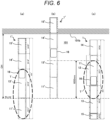
- FIG. 6 is a comparative diagram for explaining the features related to the placement of the control panel 1 illustrated in FIG. 3 in comparison with a comparative example.
- FIGS. 6(a) and 6(b) illustrate a control panel 1' in the comparative example.
- a battery panel part 15', a regenerative resistance panel part 14', a signal panel part 13', and a main circuit panel part 11' are arranged in order from the top.
- the power supply panel part 16 is included in the main circuit panel part 11 in the present embodiment, but is included in the signal panel part 13' in the control panel 1'.
- the power receiving part 12 of the present embodiment is arranged in a manner distributed between the main circuit panel part 11' and the signal panel part 13'.
- the main circuit panel part 11' is located lower than the floor level FLt of the top floor.
- the main circuit panel part 11' within the inspection area T is located below FLt.
- the car top 104b (see FIG. 1 ) of the car 104 is positioned at FLt, and a worker rides on the car top 104b to perform inspection work.
- the elevator device 100 is configured such that the control panel 1 and the hoisting machine 102 are disposed at the top of the hoistway 101, and the control panel 1 is inspected by the worker from the car top 104b while the car top 104b of the car 104 is positioned at the floor level FLt of the top floor.
- FIG. 6(b) illustrates an example where the main circuit panel part 11' is disposed above FLt so that the main circuit panel part 11' can be inspected from the car top 104b.
- the upper part (battery panel part 15') of the control panel 1' is located above the upper end 101b of the hoistway 101, and the control panel 1' does not fit in the top of the hoistway 101.
- the power supply panel part 16 included in the signal panel part 13' is located beyond the height (set at 1650 mm in the present embodiment) that enables inspection from the car top 104b without the use of a stepladder or the like.
- the inspection area T is located above the car top 104b and within the height range that enables inspection, as illustrated in FIG. 6(c) .
- the power receiving part 12 of the present embodiment is disposed in a manner as to be distributed between the main circuit panel part 11' and the signal panel part 13', and the power supply panel part 16 is included in the signal panel part 13'.
- the power receiving part on the signal panel part 13' side is integrated into the power receiving part 12 of the present embodiment, and the power supply panel part 16 is moved from the signal panel part 13' to the main circuit panel part 11, thereby collecting the inspection area in the signal panel part 13 at the upper part of the signal panel part 13.
- FIG. 6(c) although the lower part of the signal panel part 13 is located below FLt, this lower part is out of the scope of periodic inspection and does not affect the efficiency of work during periodic inspection.
- the power receiving part on the main circuit panel part 11' side is integrated into the power receiving part 12 of the present embodiment, and the power supply panel part 16 is disposed at the lower part of the main circuit panel part 11, thereby collecting the inspection area in the main circuit panel part 11 at the lower part of the main circuit panel part 11.
- the upper part of the main circuit panel part 11 is located above the inspection-enabling height (1650 mm), but this upper part is out of the scope of periodic inspection and does not affect the efficiency of work during periodic inspection.
- the inspection area of the main circuit panel part 11, the power receiving panel part 12, and the signal panel part 13 can be inspected while the car top 101b of the car 104 is positioned at FLt. This can reduce the complexity of inspection work and improve workability.
- FIG. 7 illustrates an example of equipment placement in the elevator device 100 according to the embodiment of the present invention. Note that in FIG. 3 , the control panel 1 is illustrated with the main circuit panel part 11 and power receiving panel part 12 within the control panel 1.
- FIG. 7(c) illustrates an example where the control panel 1, the hoisting machine 102, and the counterweight 105 are arranged as in FIG. 2 .
- the car guide rail 109A and the counterweight guide rail 109B are also arranged in the same manner as in FIG. 2 .
- FIG. 7 illustrates a rope end 107a on the car 104 side.
- the rope end 107a is disposed on a side of the hoistway wall that faces, with the car 104 therebetween, the hoistway wall on the side on which the hoisting machine 102 and the counterweight 105 are disposed.
- FIG. 7(a) illustrates an example of the modified placement of the control panel 1 from that in FIG. 2 ( FIG. 7(c) ).
- the control panel 1 is disposed in the space on the back side (opposite side to the car door 104a side) of the car 104.
- the control panel 1 is preferably disposed closer to the wall surface of the hoistway 101 on the side where the hoisting machine 102 is disposed, that is, the left-hand wall surface when viewed from the elevator hall 112 side.
- the wiring between the control panel 1 and the hoisting machine 102 can be shortened.
- the control panel bracket 1a for fixing the control panel 1 is preferably fixed to the counterweight guide rail 109B disposed near the control panel 1. Note that the rope end 107a is disposed in the same manner as in FIG. 7(c) .
- FIG. 7(b) illustrates an example of the modified placement of the hoisting machine 102 and the counterweight 105 from that in FIG. 7(a) .
- the hoisting machine 102 and the counterweight 105 are disposed closer to the right-hand hoistway wall when viewed from the elevator hall 112 side.
- the counterweight guide rail 109B is also disposed on the same side as the counterweight 105.
- the control panel 1 is also disposed closer to the right-hand hoistway wall when viewed from the elevator hall 112 side.
- the placement of the main circuit panel part 11 and the power receiving part 12 are interchanged from that in FIG. 7(a) .
- the placement of the common rail bracket 110C is also changed in accordance with the change in the placement of the counterweight guide rail 109B, so that the common rail bracket 110C is disposed on the same side as the counterweight 105.
- the control panel bracket 1a for fixing the control panel 1 is preferably fixed to the counterweight guide rail 109B disposed near the control panel 1.
- the rope end 107a is disposed on the hoistway wall side that faces the hoistway wall on the side on which the hoisting machine 102 and the counterweight 105 are disposed, and is disposed on the side opposite to the side on which the rope end 107a is disposed in FIG. 7(a) .
- FIG. 7(d) illustrates an example in which the control panel 1, the rope end 107a, the hoisting machine 102, and the counterweight 105 are interchanged from the arrangement in FIG. 7(c) .
- the counterweight guide rail 109B is also disposed on the same side as the counterweight 105.
- the common rail bracket 110A is disposed on the same side as the counterweight 105.
- the control panel bracket 1a for fixing the control panel 1 is fixed to the car guide rail 109A disposed near the control panel 1 as in FIG. 7(c) , but on a different side (opposite side) from in FIG. 7 (c) .
- the arrangement of the control panel 1, the hoisting machine 102, and the counterweight 105 can be changed from that in FIG. 2 .
- the arrangement of the car guide rail 109A, the counterweight guide rail 109B, the car rail bracket 110A, the counterweight rail bracket 110B, and the common rail bracket 110C is also changed as appropriate.
- the guide rail 109 that fixes the control panel bracket 1a is also changed as appropriate.
- FIG. 7 illustrates the arrangement of the main circuit panel part 11 and the power receiving panel part 12
- the arrangement of the main circuit panel part 11 and the power receiving panel part 12 is not limited to that in FIG. 7 , and the positions of the main circuit panel part 11 and the power receiving panel part 12 in FIG. 7 may be interchanged.
- the car door 104a can also be provided on the back side of the car 104.
- FIG. 8 illustrates the construction of the control panel 1 illustrated in FIG. 3 .
- the regenerative resistance panel part 14 When installing the control panel 1 in the hoistway 101, the regenerative resistance panel part 14, and the main circuit panel part 11 and power receiving panel part 12 are integrated into a single unit, which is lifted by a hanging hook 21 for work.
- the regenerative resistance panel part 14 can be coupled to the main circuit panel part 11 and the power receiving panel part 12 by the coupling parts 17c described in FIG. 4 to form a single unit. This allows the regenerative resistance panel part 14 to be lifted together with the main circuit panel part 11 and the power receiving panel part 12 by hanging the wire rope over the main circuit panel part 11. Even if sufficient clearance cannot be secured above the regenerative resistance panel part 14, a lifting allowance can be secured to lift the regenerative resistance panel part 14 together with the main circuit panel part 11 and the power receiving panel part 12.
- the lifted regenerative resistance panel part 14, main circuit panel part 11, and power receiving panel part 12 are attached to the control panel bracket 1a.
- shackles to prevent collapse are attached to the upper parts of both edges (control panel flanges) 11a and 12a of the main circuit panel part 11 and the power receiving panel part 12, and the wire rope is wrapped around the shackles.
- the signal panel part 13 and the battery panel part 15 may be attached to the control panel bracket 1a separately from the main circuit panel part 11 and the power receiving panel part 12, or may alternatively be integrated with the main circuit panel part 11 and the power receiving panel part 12 and attached to the control panel bracket 1a. That is, the signal panel part 13 and the battery panel part 15 may be separately attached to the control panel bracket 1a, or the signal panel part 13 and the battery panel part 15 may be integrated, and attached to the control panel bracket 1a separately from the main circuit panel part 11 and the power receiving panel part 12. Alternatively, the signal panel part 13, the battery panel part 15, the main circuit panel part 11, and the power receiving panel part 12 may be integrated and attached to the control panel bracket 1a. Note that in this case, the regenerative resistance panel part 14 is still integrated with the main circuit panel part 11 and the power receiving panel part 12, and attached to the control panel bracket 1a.
- FIG. 9 illustrates the periodic inspection of the control panel 1 illustrated in FIG. 3 .
- the drive devices such as the hoisting machine 102 and the control panel 1
- the drive devices are arranged collectively at the top of the hoistway 1, it is difficult to secure a suitable location for each piece of equipment, and the mounting height of each piece of equipment is also restricted.
- the inspection area for periodic inspections in the control panel 1 is disposed within the range above FLt and up to the inspection-enabling height (1650 mm).
- the governor 111 and the inspection area of the control panel 1 are arranged within the range above FLt and up to the inspection-enabling height (1650 mm).
- the elevator device 100 includes the governor 111 for detecting the elevating speed of the car 104, and the governor 111 is disposed below the upper end of the main circuit panel part 11 and the power receiving panel part 12. This allows maintenance and inspection work to be performed on the governor 111 and control panel 1 in parallel.
- the power switch 102b is provided to the power receiving panel part 12, thereby eliminating the need for providing a new power switch box to the hoisting machine 102.
- the hoisting machine 102 is disposed at the top of the hoistway 101, especially near the upper end 101b, often higher than the inspection-enabling height (1650 mm).
- the power switch 102b is provided to the power receiving panel part 12, thereby allowing the power switch 102b to be disposed within the range of the inspection-enabling height (1650 mm) and facilitating shutting off the power switch 102b of the hoisting machine 102.
- the drive devices such as the hoisting machine 102 and the control panel 1 are arranged at the top of the hoistway 1.
- the advantageous effects of the above embodiment can also be effectively utilized in a configuration in which the drive devices such as the hoisting machine 102 and the control panel 1 are arranged at locations other than the top of the hoistway 1.
- the control panel 1 is disposed at the level of the second floor of the hoistway 101
- FLt is set at the floor level of the second floor. In this case, depending on the size of the car 104, it may not be possible to lower the car top 104b to FLt.
- the inspection area of the control panel 1 can be disposed within the range from the car top 104b of the car 104 lowered to its lowermost part to the inspection-enabling height (1650 mm).
- the present invention is not limited to the embodiments described above, and includes various modification examples.
- the embodiments described above have been described in detail to simply describe the present invention, and are not necessarily required to include all the described configurations.
- part of the configuration of one embodiment can be replaced with the configurations of other embodiments, and in addition, the configuration of the one embodiment can also be added with the configurations of other embodiments.
- part of the configuration of each of the embodiments can be subjected to addition, deletion, and replacement with respect to other configurations.
Landscapes
- Engineering & Computer Science (AREA)
- Automation & Control Theory (AREA)
- Computer Networks & Wireless Communication (AREA)
- Civil Engineering (AREA)
- Mechanical Engineering (AREA)
- Structural Engineering (AREA)
- Elevator Control (AREA)
Applications Claiming Priority (1)
| Application Number | Priority Date | Filing Date | Title |
|---|---|---|---|
| PCT/JP2022/014539 WO2023181376A1 (ja) | 2022-03-25 | 2022-03-25 | エレベーター装置 |
Publications (2)
| Publication Number | Publication Date |
|---|---|
| EP4501832A1 true EP4501832A1 (de) | 2025-02-05 |
| EP4501832A4 EP4501832A4 (de) | 2025-12-10 |
Family
ID=88100287
Family Applications (1)
| Application Number | Title | Priority Date | Filing Date |
|---|---|---|---|
| EP22933514.6A Pending EP4501832A4 (de) | 2022-03-25 | 2022-03-25 | Aufzugsvorrichtung |
Country Status (5)
| Country | Link |
|---|---|
| US (1) | US20250145414A1 (de) |
| EP (1) | EP4501832A4 (de) |
| JP (1) | JP7689244B2 (de) |
| CN (1) | CN118647564A (de) |
| WO (1) | WO2023181376A1 (de) |
Family Cites Families (7)
| Publication number | Priority date | Publication date | Assignee | Title |
|---|---|---|---|---|
| JP2003020171A (ja) * | 2001-07-09 | 2003-01-21 | Hitachi Ltd | エレベータ装置 |
| JP4792798B2 (ja) * | 2005-04-13 | 2011-10-12 | 三菱電機株式会社 | エレベータの制御盤 |
| JP2010208764A (ja) | 2009-03-09 | 2010-09-24 | Toshiba Elevator Co Ltd | エレベータの制御装置 |
| JP6340050B2 (ja) | 2016-09-26 | 2018-06-06 | 東芝エレベータ株式会社 | マシンルームレスエレベータ用制御盤システム |
| JP6454388B1 (ja) * | 2017-09-04 | 2019-01-16 | 東芝エレベータ株式会社 | マシンルームレスエレベータ |
| JP6797101B2 (ja) * | 2017-11-20 | 2020-12-09 | 株式会社日立製作所 | エレベーター装置 |
| WO2020090858A1 (ja) * | 2018-10-31 | 2020-05-07 | 三菱電機株式会社 | エレベータ制御盤 |
-
2022
- 2022-03-25 WO PCT/JP2022/014539 patent/WO2023181376A1/ja not_active Ceased
- 2022-03-25 EP EP22933514.6A patent/EP4501832A4/de active Pending
- 2022-03-25 CN CN202280090390.9A patent/CN118647564A/zh active Pending
- 2022-03-25 JP JP2024509676A patent/JP7689244B2/ja active Active
- 2022-03-25 US US18/835,746 patent/US20250145414A1/en active Pending
Also Published As
| Publication number | Publication date |
|---|---|
| CN118647564A (zh) | 2024-09-13 |
| WO2023181376A1 (ja) | 2023-09-28 |
| JPWO2023181376A1 (de) | 2023-09-28 |
| EP4501832A4 (de) | 2025-12-10 |
| US20250145414A1 (en) | 2025-05-08 |
| JP7689244B2 (ja) | 2025-06-05 |
Similar Documents
| Publication | Publication Date | Title |
|---|---|---|
| KR100302557B1 (ko) | 엘리베이터 제어 시스템 | |
| US20140224591A1 (en) | Elevators and elevator arrangements with maintenance cabinet in landing wall | |
| CN107618959B (zh) | 卷扬机的安装方法及电梯 | |
| JP4323431B2 (ja) | エレベータ装置 | |
| KR20040105837A (ko) | 엘리베이터 | |
| JPWO2003020628A1 (ja) | エレベータ装置 | |
| US20250145414A1 (en) | Elevator device | |
| EP1346942B1 (de) | Oberes kabinengeländer für aufzug | |
| JP5516512B2 (ja) | エレベータ装置 | |
| JP2000053343A (ja) | エレベータ装置 | |
| JP2003020171A (ja) | エレベータ装置 | |
| JPH0737308B2 (ja) | エレベータの制御盤 | |
| JP2000159453A (ja) | エレベータの昇降路 | |
| JP2001097649A (ja) | エレベーター装置 | |
| CN105384017A (zh) | 电梯装置 | |
| JP2000226173A (ja) | エレベータの巻上機 | |
| WO2024100826A1 (ja) | エレベーター装置 | |
| WO2024100827A1 (ja) | エレベーター装置 | |
| JP2012184092A (ja) | テールコード配線構造 | |
| JP4161073B2 (ja) | エレベータ装置 | |
| JP2001058778A (ja) | エレベータ | |
| JPH0578059A (ja) | リニアモータ式エレベータ装置 | |
| JP6294252B2 (ja) | エレベータ装置 | |
| WO2005097656A1 (ja) | エレベータの機械室機器配置構造 | |
| JP2001080834A (ja) | エレベータ装置及びそのエレベータ制御装置の保守点検方法 |
Legal Events
| Date | Code | Title | Description |
|---|---|---|---|
| STAA | Information on the status of an ep patent application or granted ep patent |
Free format text: STATUS: THE INTERNATIONAL PUBLICATION HAS BEEN MADE |
|
| PUAI | Public reference made under article 153(3) epc to a published international application that has entered the european phase |
Free format text: ORIGINAL CODE: 0009012 |
|
| STAA | Information on the status of an ep patent application or granted ep patent |
Free format text: STATUS: REQUEST FOR EXAMINATION WAS MADE |
|
| 17P | Request for examination filed |
Effective date: 20240731 |
|
| AK | Designated contracting states |
Kind code of ref document: A1 Designated state(s): AL AT BE BG CH CY CZ DE DK EE ES FI FR GB GR HR HU IE IS IT LI LT LU LV MC MK MT NL NO PL PT RO RS SE SI SK SM TR |
|
| DAV | Request for validation of the european patent (deleted) | ||
| DAX | Request for extension of the european patent (deleted) | ||
| A4 | Supplementary search report drawn up and despatched |
Effective date: 20251110 |
|
| RIC1 | Information provided on ipc code assigned before grant |
Ipc: B66B 5/00 20060101AFI20251104BHEP Ipc: B66B 1/34 20060101ALI20251104BHEP |