EP4501844A1 - Procédé de préparation d'électrolyte solide à base de sulfure - Google Patents
Procédé de préparation d'électrolyte solide à base de sulfure Download PDFInfo
- Publication number
- EP4501844A1 EP4501844A1 EP23781271.4A EP23781271A EP4501844A1 EP 4501844 A1 EP4501844 A1 EP 4501844A1 EP 23781271 A EP23781271 A EP 23781271A EP 4501844 A1 EP4501844 A1 EP 4501844A1
- Authority
- EP
- European Patent Office
- Prior art keywords
- reaction product
- heat treatment
- solvent
- sulfide
- alkali metal
- Prior art date
- Legal status (The legal status is an assumption and is not a legal conclusion. Google has not performed a legal analysis and makes no representation as to the accuracy of the status listed.)
- Pending
Links
Images


Classifications
-
- H—ELECTRICITY
- H01—ELECTRIC ELEMENTS
- H01B—CABLES; CONDUCTORS; INSULATORS; SELECTION OF MATERIALS FOR THEIR CONDUCTIVE, INSULATING OR DIELECTRIC PROPERTIES
- H01B1/00—Conductors or conductive bodies characterised by the conductive materials; Selection of materials as conductors
- H01B1/06—Conductors or conductive bodies characterised by the conductive materials; Selection of materials as conductors mainly consisting of other non-metallic substances
- H01B1/10—Conductors or conductive bodies characterised by the conductive materials; Selection of materials as conductors mainly consisting of other non-metallic substances sulfides
-
- C—CHEMISTRY; METALLURGY
- C01—INORGANIC CHEMISTRY
- C01B—NON-METALLIC ELEMENTS; COMPOUNDS THEREOF; METALLOIDS OR COMPOUNDS THEREOF NOT COVERED BY SUBCLASS C01C
- C01B25/00—Phosphorus; Compounds thereof
- C01B25/14—Sulfur, selenium, or tellurium compounds of phosphorus
-
- C—CHEMISTRY; METALLURGY
- C01—INORGANIC CHEMISTRY
- C01D—COMPOUNDS OF ALKALI METALS, i.e. LITHIUM, SODIUM, POTASSIUM, RUBIDIUM, CAESIUM, OR FRANCIUM
- C01D15/00—Lithium compounds
-
- H—ELECTRICITY
- H01—ELECTRIC ELEMENTS
- H01M—PROCESSES OR MEANS, e.g. BATTERIES, FOR THE DIRECT CONVERSION OF CHEMICAL ENERGY INTO ELECTRICAL ENERGY
- H01M10/00—Secondary cells; Manufacture thereof
- H01M10/05—Accumulators with non-aqueous electrolyte
- H01M10/052—Li-accumulators
-
- H—ELECTRICITY
- H01—ELECTRIC ELEMENTS
- H01M—PROCESSES OR MEANS, e.g. BATTERIES, FOR THE DIRECT CONVERSION OF CHEMICAL ENERGY INTO ELECTRICAL ENERGY
- H01M10/00—Secondary cells; Manufacture thereof
- H01M10/05—Accumulators with non-aqueous electrolyte
- H01M10/056—Accumulators with non-aqueous electrolyte characterised by the materials used as electrolytes, e.g. mixed inorganic/organic electrolytes
- H01M10/0561—Accumulators with non-aqueous electrolyte characterised by the materials used as electrolytes, e.g. mixed inorganic/organic electrolytes the electrolyte being constituted of inorganic materials only
- H01M10/0562—Solid materials
-
- C—CHEMISTRY; METALLURGY
- C01—INORGANIC CHEMISTRY
- C01P—INDEXING SCHEME RELATING TO STRUCTURAL AND PHYSICAL ASPECTS OF SOLID INORGANIC COMPOUNDS
- C01P2002/00—Crystal-structural characteristics
- C01P2002/70—Crystal-structural characteristics defined by measured X-ray, neutron or electron diffraction data
- C01P2002/72—Crystal-structural characteristics defined by measured X-ray, neutron or electron diffraction data by d-values or two theta-values, e.g. as X-ray diagram
-
- C—CHEMISTRY; METALLURGY
- C01—INORGANIC CHEMISTRY
- C01P—INDEXING SCHEME RELATING TO STRUCTURAL AND PHYSICAL ASPECTS OF SOLID INORGANIC COMPOUNDS
- C01P2002/00—Crystal-structural characteristics
- C01P2002/80—Crystal-structural characteristics defined by measured data other than those specified in group C01P2002/70
- C01P2002/82—Crystal-structural characteristics defined by measured data other than those specified in group C01P2002/70 by IR- or Raman-data
-
- C—CHEMISTRY; METALLURGY
- C01—INORGANIC CHEMISTRY
- C01P—INDEXING SCHEME RELATING TO STRUCTURAL AND PHYSICAL ASPECTS OF SOLID INORGANIC COMPOUNDS
- C01P2004/00—Particle morphology
- C01P2004/51—Particles with a specific particle size distribution
-
- C—CHEMISTRY; METALLURGY
- C01—INORGANIC CHEMISTRY
- C01P—INDEXING SCHEME RELATING TO STRUCTURAL AND PHYSICAL ASPECTS OF SOLID INORGANIC COMPOUNDS
- C01P2004/00—Particle morphology
- C01P2004/60—Particles characterised by their size
- C01P2004/61—Micrometer sized, i.e. from 1-100 micrometer
-
- C—CHEMISTRY; METALLURGY
- C01—INORGANIC CHEMISTRY
- C01P—INDEXING SCHEME RELATING TO STRUCTURAL AND PHYSICAL ASPECTS OF SOLID INORGANIC COMPOUNDS
- C01P2006/00—Physical properties of inorganic compounds
- C01P2006/40—Electric properties
-
- H—ELECTRICITY
- H01—ELECTRIC ELEMENTS
- H01M—PROCESSES OR MEANS, e.g. BATTERIES, FOR THE DIRECT CONVERSION OF CHEMICAL ENERGY INTO ELECTRICAL ENERGY
- H01M2300/00—Electrolytes
- H01M2300/0017—Non-aqueous electrolytes
- H01M2300/0065—Solid electrolytes
- H01M2300/0068—Solid electrolytes inorganic
-
- H—ELECTRICITY
- H01—ELECTRIC ELEMENTS
- H01M—PROCESSES OR MEANS, e.g. BATTERIES, FOR THE DIRECT CONVERSION OF CHEMICAL ENERGY INTO ELECTRICAL ENERGY
- H01M2300/00—Electrolytes
- H01M2300/0017—Non-aqueous electrolytes
- H01M2300/0065—Solid electrolytes
- H01M2300/0068—Solid electrolytes inorganic
- H01M2300/008—Halides
-
- Y—GENERAL TAGGING OF NEW TECHNOLOGICAL DEVELOPMENTS; GENERAL TAGGING OF CROSS-SECTIONAL TECHNOLOGIES SPANNING OVER SEVERAL SECTIONS OF THE IPC; TECHNICAL SUBJECTS COVERED BY FORMER USPC CROSS-REFERENCE ART COLLECTIONS [XRACs] AND DIGESTS
- Y02—TECHNOLOGIES OR APPLICATIONS FOR MITIGATION OR ADAPTATION AGAINST CLIMATE CHANGE
- Y02E—REDUCTION OF GREENHOUSE GAS [GHG] EMISSIONS, RELATED TO ENERGY GENERATION, TRANSMISSION OR DISTRIBUTION
- Y02E60/00—Enabling technologies; Technologies with a potential or indirect contribution to GHG emissions mitigation
- Y02E60/10—Energy storage using batteries
Definitions
- the present disclosure relates to a method of preparing a sulfide-based solid electrolyte.
- Lithium secondary batteries have been applied to small devices such as mobile phones, laptops, and the like, but have recently been expanding to medium- to large-scale devices such as energy storage systems (ESSs) and electric vehicles (EVs). Since lithium secondary batteries use an organic liquid electrolyte to which a lithium salt is added, there is a problem of electrolyte leakage and subsequently a potential risk of ignition and explosion.
- ESSs energy storage systems
- EVs electric vehicles
- All-solid-state batteries have no risk of fire or explosion by using solid electrolytes, and have high energy density, and thus, as with lithium secondary batteries, all-solid-state batteries may be used in medium- to large-scale devices such as EVs and power storage systems.
- Solid electrolytes may be divided into oxide-based solid electrolytes and sulfide-based solid electrolytes.
- sulfide-based solid electrolytes have excellent lithium ion conductivity compared to oxide-based solid electrolytes, and have advantages of being stable over a wide voltage range.
- Sulfide-based solid electrolytes may be generally prepared by a melting method or a solid-phase method. In particular, in the case of a solid-phase method, starting materials and balls are placed in a milling container, pulverized, and then heat-treated by providing high energy.
- KR 2019-0079135 that has been published in the art discloses a method of manufacturing a sulfide-based solid electrolyte by mixing and grinding starting materials and heat-treating the same.
- a solid-phase method has problems in that starting materials are difficult to be uniformly dispersed and are limited in amorphization, and it has a difficulty of oversizing a milling container, which does not facilitate large-scale synthesis.
- One object of the present disclosure is to provide a method of preparing a sulfide-based solid electrolyte having high purity and high efficiency.
- a method of preparing a sulfide-based solid electrolyte includes: forming a mixture by mixing precursors and a solvent; producing a reaction product by undergoing a reaction on the mixture; and performing heat treatment on the reaction product, wherein the heat treatment includes first heat treatment and second heat treatment that is performed at a higher temperature than a temperature at which the first heat treatment is performed, and in the first heat treatment, carbon contained in the reaction product is modified to amorphous carbon.
- a sulfide-based solid electrolyte having high purity may be obtained.
- a method of preparing a sulfide-based solid electrolyte includes: forming a mixture by mixing precursors and a solvent; producing a reaction product by undergoing a reaction on the mixture; and performing heat treatment on the reaction product, wherein the heat treatment includes first heat treatment and second heat treatment that is performed at a higher temperature than a temperature at which the first heat treatment is performed, and in the first heat treatment, carbon contained in the reaction product is modified to amorphous carbon.
- the second heat treatment may be performed in an inert gas atmosphere.
- the method before the performing of the heat treatment on the reaction product, the method may further include remixing the reaction product, and accordingly, the performing of the heat treatment may include performing heat treatment on the reaction product that has been heat-treated.
- the reaction product that has been dried may be remixed.
- the remixing may be performed by wet ball milling.
- the method may further include purifying the reaction product that has been heat-treated.
- the purifying of the reaction product may be performed by wet ball milling.
- the method may further include drying the reaction product that has been purified.
- the precursors may include alkali metal sulfide, alkali metal halide, and phosphorus pentasulfide.
- the alkali metal sulfide and the alkali metal halide may be mixed firstly with the solvent, and the phosphorus pentasulfide may be additionally mixed secondly.
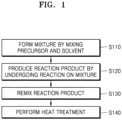
- FIG. 1 is a schematic flowchart explaining a method of preparing a sulfide-based solid electrolyte according to an embodiment of the present disclosure.
- the method of preparing a sulfide-based solid electrolyte includes: forming a mixture by mixing precursors and a solvent in a reactor (S110); producing a reaction product by undergoing a reaction on the mixture (S120); remixing the reaction product (S130); and performing heat treatment on the reaction product that has been remixed (S140).
- the mixing of the precursors and the solvent in the reactor (S100) may be performed by: adding the solvent first into the reactor and then adding the precursors; adding the precursors first into the reactor and then adding the solvent; or mixing the solvent and the precursors and adding the same into the reactor.
- the precursors may include alkali metal sulfide (A 2 S; A is alkali metal), alkali metal halide (AX; X is a halogen), and phosphorus pentasulfide (P 2 S 5 ).
- A is alkali metal
- AX alkali metal halide
- X is a halogen
- P 2 S 5 phosphorus pentasulfide
- the alkali metal may include lithium, sodium, potassium, or a combination thereof.
- the halogen may include fluorine, chlorine, bromine, iodine, or a combination thereof.
- the alkali metal sulfide, the alkali metal halide, and the phosphorus pentasulfide may be mixed at a molar ratio of 4.5 to 5.5 : 0.5 to 1.5 : 1.5 to 2.5.
- the alkali metal sulfide, the alkali metal halide, and the phosphorus pentasulfide may react at a stoichiometric molar ratio of 5 : 1 : 2.
- the solvent may include a first solvent that has low solubility in the alkali metal sulfide and the alkali metal halide.
- the solvent may further include a second solvent that at least partially dissolves the alkali metal sulfide and the alkali metal halide.
- the first solvent may include a nitrile-based solvent, an ether-based solvent, an ester-based solvent, etc.
- the nitrile-based solvent may include, for example, acetonitrile.
- the second solvent may include an alcohol-based solvent, a carboxylic acid-based solvent, an ester-based solvent, a ketone-based solvent, an amine-based solvent, a sulfoxide-based solvent, etc.
- the second solvent may include acetic acid, acetyl acetone, 2-aminoethanol, anisole, benzyl alcohol, 1-butanol, 2-butanol, 2-butanone, t-butyl alcohol, cyclohexanol, cyclohexanone, di-n-butyl phthalate, diethyl glycol, diglyme, dimethoxyethane, dimethylformamide, dimethyl phthalate, dimethyl sulfoxide, dioxane, ethanol, ether, ethyl acetate, ethyl acetoacetate, ethyl benzoate, ethylene glycol, glycerin, 1-heptanol, 1-hexanol, methanol,
- the second solvent may include acetone, 2-aminoethanol, anisole, benzyl alcohol, 1-butanol, 2-butanol, i-butanol, 2-butanone, t-butyl alcohol, cyclohexanol, cyclohexanone, dimethylformamide, ethanol, ether, 1-heptanol, 1-hexanol, methanol, methyl t-butyl ether, 1-octanol, 1-pentanol, 2-pentanol, 3-pentanol, 2-pentanone, 3-pentanone, 1-propanol, 2-propanol, tetrahydrofuran, etc., each of which contains one elemental oxygen.
- the second solvent may at least partially dissolve the alkali metal sulfide and the alkali metal halide, thereby effectively promoting a reaction of the alkali metal sulfide, the alkali metal halide, and the phosphorus pentasulfide to form a high-purity sulfide-based solid electrolyte.
- the alkali metal sulfide and the alkali metal halide may be mixed firstly in the first solvent, and the phosphorus pentasulfide may be additionally mixed secondly.
- the second solvent when the second solvent is additionally included, the second solvent may be mixed during the mixing done firstly.
- the alkali metal sulfide and the alkali metal halide may be pre-stirred in the first solvent.
- the alkali metal sulfide and the alkali metal halide may be dissolved in the first solvent, so that unreacted reactants used in synthesis of the sulfide-based solid electrolyte may be reduced and the purity of a synthesized product may be increased.
- the pre-stirring may be performed at 500 rpm or more, and may be performed for 0.5 to 10 hours, 0.5 to 5 hours, 0.5 to 3 hours, or 0.5 to 2 hours.
- the pre-stirring may be performed at room temperature to 100 °C. As the temperature at which the pre-stirring is performed increases, the quantity of impurities may decrease. Preferably, the pre-stirring may be performed at a temperature that does not exceed the boiling point of the first solvent and/or the second solvent, and for example, may be performed at 50 to 90 °C or 50 to 85 °C.
- the reaction product may be produced by wet ball milling.
- the reaction product may be formed by table ball milling, vertical-ball milling, planetary milling, bead milling, etc.
- the mixture inside the reactor may be stirred or ultrasonicated to cause a reaction.
- bubbles generated within the mixture by stirring or applying ultrasonic waves may continue to form until the end of the reaction.
- bulky bubbles may form.
- the mixing and contacting the reaction products may be promoted by the bubbles, thereby increasing the reaction rate.
- the solvent used in the formation of the mixture may be an organic solvent, such as heptane, n-heptane, toluene, etc., which does not contain oxygen.
- the reaction product is dried to remove the solvent therefrom. Drying may be done by various methods such as vacuum drying, hot-air drying, freeze-drying, spray drying, etc.
- the reaction product may be further mixed uniformly, the remaining solvent may be removed, and carbon which is an impurity contained in the solvent may be removed from the reaction product.
- the remixing may be performed by wet ball milling.
- the remixing may be performed by table ball milling, vertical-ball milling, planetary milling, bead milling, etc.
- the remixing may be performed by stirring, homogenizing, ultra-sonication, etc.
- a solvent used in the remixing may be the same as the solvent used in the formation of the mixture. That is, the solvent used in the remixing may include a nitrile-based solvent, an ether-based solvent, an ester-based solvent, etc. In an optional embodiment, the solvent used in the remixing may be an organic solvent, such as heptane, n-heptane, toluene, etc., which does not contain oxygen.
- the remixing may be performed for 10 minutes to 2 hours, may be performed multiple times if necessary, and may be performed by alternately repeating wet mixing and drying mixing.
- a high-purity sulfide-based solid electrolyte may be formed by completely mixing different precursors with low energy and by effectively removing impurities such as carbon and the like generated during wet synthesis.
- the heat treatment may be performed under an inert gas atmosphere, such as CO, H 2 , N 2 , Ar, He, Ne, etc., for 1 hour to 24 hours at a temperature of 450 °C to 600 °C.
- an inert gas atmosphere such as CO, H 2 , N 2 , Ar, He, Ne, etc.
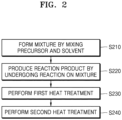
- FIG. 2 is a schematic flowchart explaining a method of preparing a sulfide-based solid electrolyte according to another embodiment of the present disclosure.
- the method of preparing a sulfide-based solid electrolyte includes: forming a mixture by mixing precursors and a solvent in a reactor (S210); producing a reaction product by undergoing a reaction on the mixture (S220); performing first heat treatment on the reaction product (S230); and performing second heat treatment on the reaction product (S240).
- the precursors may include alkali metal sulfide (A 2 S; A is alkali metal), alkali metal halide (AX; X is a halogen), and phosphorus pentasulfide (P 2 S 5 ).
- the alkali metal may include lithium, sodium, potassium, or a combination thereof.
- the halogen may include fluorine, chlorine, bromine, iodine, or a combination thereof.
- the alkali metal sulfide, the alkali metal halide, and the phosphorus pentasulfide may be mixed at a molar ratio of 4.5 to 5.5 : 0.5 to 1.5 : 1.5 to 2.5.
- the alkali metal sulfide, the alkali metal halide, and the phosphorus pentasulfide may react at a stoichiometric molar ratio of 5 : 1 : 2.
- the solvent may include a first solvent that has low solubility in the alkali metal sulfide and the alkali metal halide.
- the solvent may further include a second solvent that at least partially dissolves the alkali metal sulfide and the alkali metal halide, thereby effectively promoting a reaction of the alkali metal sulfide, the alkali metal halide, and the phosphorus pentasulfide to form a high-purity sulfide-based solid electrolyte.
- the first solvent may include a nitrile-based solvent, an ether-based solvent, an ester-based solvent, etc.
- the nitrile-based solvent may include, for example, acetonitrile.
- the second solvent may include an alcohol-based solvent, a carboxylic acid-based solvent, an ester-based solvent, a ketone-based solvent, an amine-based solvent, a sulfoxide-based solvent, etc.
- the second solvent may include acetic acid, acetyl acetone, 2-aminoethanol, anisole, benzyl alcohol, 1-butanol, 2-butanol, 2-butanone, t-butyl alcohol, cyclohexanol, cyclohexanone, di-n-butyl phthalate, diethyl glycol, diglyme, dimethoxyethane, dimethylformamide, dimethyl phthalate, dimethyl sulfoxide, dioxane, ethanol, ether, ethyl acetate, ethyl acetoacetate, ethyl benzoate, ethylene glycol, glycerin, 1-heptanol, 1-hexanol, methanol,
- the second solvent may include acetone, 2-aminoethanol, anisole, benzyl alcohol, 1-butanol, 2-butanol, i-butanol, 2-butanone, t-butyl alcohol, cyclohexanol, cyclohexanone, dimethylformamide, ethanol, ether, 1-heptanol, 1-hexanol, methanol, methyl t-butyl ether, 1-octanol, 1-pentanol, 2-pentanol, 3-pentanol, 2-pentanone, 3-pentanone, 1-propanol, 2-propanol, tetrahydrofuran, etc., each of which contains one elemental oxygen.
- the performing of the heat treatment may include performing of the first heat treatment (S230) and performing of the second heat treatment (S240) as shown in FIG. 2 .
- the reaction product When the reaction product is formed by wet synthesis, the residual solvent may remain even if the solvent is dried. Thus, when a heat treatment process is performed in the presence of the residual solvent remaining, carbon, nitrogen, etc. among the elements constituting the solvent may participate in the reaction and generate impurities.
- the most stable phase at a low temperatures is Li 3 PS 4 , which is synthesized at a temperature around 200 °C. This phase has a lower ionic conductivity than an argyrodite-based solid electrolyte having a crystalline structure, and thus it is treated as an impurity.
- the sulfide-based solid electrolyte may have low purity and low crystallinity as well as low ionic conductivity along with a large quantity of impurity phases.
- the performing of the heat treatment includes performing of the first heat treatment (S230) and the performing of the second heat treatment (S240), impurities may be additionally removed and a stable solid electrolyte crystal phase may be synthesized, resulting in high purity and high crystallinity.
- the performing of the first heat treatment may additionally induce volatilization of the solvent that may remain in the reaction product, may modify carbon among the elements of the remaining organic solvent to amorphous carbon having low electrical conductivity, and may maintain the stoichiometric ratio among the precursors, thereby inducing synthesis of structurally stable argyrodite.
- the performing of the first heat treatment (S230) may be done at a temperature of 100 °C, at which the solvent may sufficiently be volatilized, to 450°C at which amorphous carbon may be crystallized.
- the performing of the second heat treatment (S240) may be done at a higher temperature than the temperature at which the first heat treatment S230 is performed.
- the performing of the second heat treatment (S240) may be done under an inert gas atmosphere, such as CO, H 2 , N 2 , Ar, He, Ne, etc., for 1 hour to 24 hours at a temperature of 450 °C to 600 °C.
- an inert gas atmosphere such as CO, H 2 , N 2 , Ar, He, Ne, etc.
- the method may further include the remixing of the reaction product of FIG. 1 (S130 of FIG. 1 ), and as a result, impurities such as carbon generated during wet synthesis may be more effectively removed, thereby forming a high-purity sulfide-based solid electrolyte.
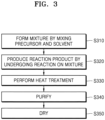
- FIG. 3 is a schematic flowchart explaining a method of preparing a sulfide-based solid electrolyte according to another embodiment of the present disclosure.
- the method of preparing a sulfide-based solid electrolyte includes: forming a mixture by mixing precursors and a solvent in a reactor (S310); producing a reaction product by undergoing a reaction on the mixture (S320); performing heat treatment on the reaction product (S330); purifying the reaction product that has been heat-treated (S340); and drying the reaction product that has been dried (S350).
- the precursors may include alkali metal sulfide (A 2 S; A is alkali metal), alkali metal halide (AX; X is a halogen), and phosphorus pentasulfide (P 2 S 5 ).
- the alkali metal may include lithium, sodium, potassium, or a combination thereof.
- the halogen may include fluorine, chlorine, bromine, iodine, or a combination thereof.
- the alkali metal sulfide, the alkali metal halide, and the phosphorus pentasulfide may be mixed at a molar ratio of 4.5 to 5.5 : 0.5 to 1.5 : 1.5 to 2.5.
- the alkali metal sulfide, the alkali metal halide, and the phosphorus pentasulfide may react at a stoichiometric molar ratio of 5 : 1 : 2.
- the solvent may include a first solvent that has low solubility in the alkali metal sulfide and the alkali metal halide.
- the solvent may further include a second solvent that at least partially dissolves the alkali metal sulfide and the alkali metal halide, thereby effectively promoting a reaction of the alkali metal sulfide, the alkali metal halide, and the phosphorus pentasulfide to form a high-purity sulfide-based solid electrolyte.
- the first solvent may include a nitrile-based solvent, an ether-based solvent, an ester-based solvent, etc.
- the nitrile-based solvent may include, for example, acetonitrile.
- the second solvent may include acetone, 2-aminoethanol, anisole, benzyl alcohol, 1-butanol, 2-butanol, i-butanol, 2-butanone, t-butyl alcohol, cyclohexanol, cyclohexanone, dimethylformamide, ethanol, ether, 1-heptanol, 1-hexanol, methanol, methyl t-butyl ether, 1-octanol, 1-pentanol, 2-pentanol, 3-pentanol, 2-pentanone, 3-pentanone, 1-propanol, 2-propanol, tetrahydrofuran, etc., each of which contains one elemental oxygen.
- the mixing of the precursors and the solvent in the reactor (3210), the producing of the reaction product by undergoing a reaction on the mixture (S320), and the performing of the heat treatment (S330) are the same as those described in connection with FIG. 1 , and thus will not be described again.
- the reaction product that has been heat-treated there may be a small quantity of impurities that have not been completely removed, and particularly, via the heat treatment, the reaction product may have a wide particle size distribution depending on a crystallization mechanism.
- the reaction product when the reaction product is mixed uniformly, aggregation may occur due to the surface energy so that, by additionally purifying the reaction product that has been heat-treated, aggregation of the reaction product may be eliminated, thereby preparing a solid electrolyte having high purity and uniform particle size distribution.
- the purifying of the reaction product (S340) may be performed by wet ball milling.
- the resulting reaction product may be purified by ball milling.
- impurities such as carbon on the surface of the reaction product may be removed, and the weak bonds between particles may be broken, thereby controlling the particle size of the reaction product.
- the reaction product that has been purified may be dried (S350).
- the reaction product that has been purified may be dried by using a centrifuge.
- the reaction product that has been purified is in a state of being free of impurities and having a controlled particle size through the purifying.
- the drying process may be performed by centrifugation .
- the drying process may be a general drying process such as hot-air drying, freeze-drying, spray drying, etc., and may include an eliminating process after the drying.
- the method may further include: the remixing of the reaction product as described in FIG. 1 (S130 of FIG. 1 ); and at least one of the performing of the first heat treatment described in FIG. 2 (S230 of FIG. 2 ) and the performing of the second heat treatment described in FIG. 2 (S240 of FIG. 2 ), and as a result, impurities such as carbon generated during wet synthesis may be more effectively removed to form a high-purity sulfide-based solid electrolyte.
- Li 7-x PS 6-x Ha x (1 ⁇ x ⁇ 2) was used, and in this example, Li 6 PS 5 Cl where Ha is chloride and x is 1 was synthesized.
- lithium sulfide (Li 2 S), phosphorus pentasulfide (P 2 S 5 ), and lithium chloride (LiCI) as precursors were mixed in acetonitrile as a solvent, and ball milling was performed thereon to form a mixture.
- reaction product was vacuum-dried, and then subjected to wet ball milling for 1 hour to produce a reaction product.
- first heat treatment was performed thereon at 200 °C for 5 hours to remove residual carbon, followed by second heat treatment at 550 °C for 12 hours in an argon (Ar) atmosphere, thereby growing crystals of the reaction product.
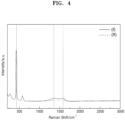
- FIG. 4 is a diagram showing the Raman spectroscopy results obtained from the Example and Comparative Example 1.
- (I) shows the Raman spectroscopy result obtained from the Example
- (II) shows the Raman spectroscopy result obtained from Example 1.
- Example (I) in which the remixing of the reaction product is performed after the formation of the mixture, there was no significant difference in the peaks at 470 cm -1 as compared to Comparative Example 1 (II), indicating that the intensity of PS 4 3- bonding was maintained and that the overall area of the peaks related to impurities including carbon presumed to originate from the solvent was relatively reduced. Accordingly, by performing the remixing after the formation of the reaction product, the sulfide-based solid electrolyte was confirmed to be structurally stable and effective in removing impurities.
- the three precursors could be completely mixed with low energy and impurities (carbon, etc.) generated during wet synthesis could be also effectively removed.
- Comparative Example 2 a sulfide-based solid electrolyte was prepared in the same manner as in the Example, except that a single heat treatment process was performed as compared to the Example.
- FIG. 5 is a diagram showing the X-ray diffraction (XRD) analysis results obtained from the sulfide-based solid electrolyte according to the present disclosure.
- XRD X-ray diffraction
- Comparative Example 3 a sulfide-based solid electrolyte was prepared in the same manner as in the Example, except that the purifying process and the drying process were not performed.
- FIGS. 6 and 7 are diagrams showing the XRD analysis and Raman spectroscopy results obtained from the sulfide-based solid electrolyte according to the present disclosure.
- (I) shows the XRD analysis and Raman spectroscopy results obtained from the Example
- (IV) shows the XRD analysis and Raman spectroscopy results obtained from Comparative Example 3.
- the resulting reaction product underwent the purifying by ball milling and the drying by centrifugation, and accordingly, impurities such as carbon on the surface of the reaction product were removed, and at the same time, aggregation of the sample was eliminated.
- impurities such as carbon on the surface of the reaction product were removed, and at the same time, aggregation of the sample was eliminated.
- Example (I) was found to have small values in the average particle size (D 50 ) and particle size distribution than those in Comparative Example 3 (IV), as shown in Table 1.
- D 50 Particle size distribution (width) Example (I) 4.47 6.47 Comparative Example 3 (IV) 10.37 19.32
- FIG. 8 is a diagram showing the electrochemical impedance spectroscopy (EIS) results obtained from the sulfide-based solid electrolyte according to the present disclosure.
- FIG. 8 shows the EIS results obtained from the sulfide-based solid electrolyte of the Example. Due to the nature of a battery, the electronic conductivity of an electrolyte itself must be minimized to maintain the performance of the electrolyte, and it is more advantageous to have higher ionic conductivity.
- EIS electrochemical impedance spectroscopy
- the slope of the EIS obtained from the Example was found to be 45° or more, indicating that the electronic conductivity is low and the ionic conductivity is excellent. Therefore, the sulfide-based solid electrolyte according to the present disclosure was confirmed to have excellent characteristics.
Landscapes
- Chemical & Material Sciences (AREA)
- Engineering & Computer Science (AREA)
- Inorganic Chemistry (AREA)
- Organic Chemistry (AREA)
- Chemical Kinetics & Catalysis (AREA)
- Manufacturing & Machinery (AREA)
- Electrochemistry (AREA)
- General Chemical & Material Sciences (AREA)
- Physics & Mathematics (AREA)
- Condensed Matter Physics & Semiconductors (AREA)
- General Physics & Mathematics (AREA)
- Materials Engineering (AREA)
- Secondary Cells (AREA)
- Conductive Materials (AREA)
Applications Claiming Priority (3)
| Application Number | Priority Date | Filing Date | Title |
|---|---|---|---|
| KR20220040577 | 2022-03-31 | ||
| KR1020230038261A KR20230141520A (ko) | 2022-03-31 | 2023-03-23 | 황화물계 고체 전해질의 제조 방법 |
| PCT/KR2023/004032 WO2023191416A1 (fr) | 2022-03-31 | 2023-03-27 | Procédé de préparation d'électrolyte solide à base de sulfure |
Publications (2)
| Publication Number | Publication Date |
|---|---|
| EP4501844A1 true EP4501844A1 (fr) | 2025-02-05 |
| EP4501844A4 EP4501844A4 (fr) | 2025-11-26 |
Family
ID=88202682
Family Applications (1)
| Application Number | Title | Priority Date | Filing Date |
|---|---|---|---|
| EP23781271.4A Pending EP4501844A4 (fr) | 2022-03-31 | 2023-03-27 | Procédé de préparation d'électrolyte solide à base de sulfure |
Country Status (4)
| Country | Link |
|---|---|
| US (1) | US20250226440A1 (fr) |
| EP (1) | EP4501844A4 (fr) |
| JP (1) | JP2025512129A (fr) |
| WO (1) | WO2023191416A1 (fr) |
Family Cites Families (9)
| Publication number | Priority date | Publication date | Assignee | Title |
|---|---|---|---|---|
| JP2014209430A (ja) * | 2012-11-28 | 2014-11-06 | 住友金属鉱山株式会社 | 硫化物系固体電解質スラリーの製造方法、硫化物系固体電解質粉末の製造方法、及びその製造方法で得られる硫化物系固体電解質スラリーと硫化物系固体電解質粉末 |
| KR101684130B1 (ko) * | 2015-06-16 | 2016-12-07 | 현대자동차주식회사 | 리튬 이온 전도성 황화물의 제조방법, 이에 의하여 제조된 리튬 이온 전도성 황화물, 및 이를 포함하는 고체전해질, 전고체 배터리 |
| KR20180055086A (ko) * | 2016-11-16 | 2018-05-25 | 현대자동차주식회사 | 습식공정을 통한 황화물계 고체전해질의 제조방법 |
| KR102417513B1 (ko) * | 2016-11-22 | 2022-07-05 | 현대자동차주식회사 | 광범위한 결정화 온도 범위에서 고이온전도도를 갖는 황화물계 고체전해질 및 이의 제조방법 |
| JP6686860B2 (ja) * | 2016-12-09 | 2020-04-22 | トヨタ自動車株式会社 | 硫化物固体電解質の製造方法 |
| HUE064016T2 (hu) * | 2017-09-01 | 2024-02-28 | Mitsubishi Gas Chemical Co | Eljárás LGPS-alapú szilárd elektrolit elõállítására |
| KR102452005B1 (ko) | 2017-12-27 | 2022-10-06 | 현대자동차주식회사 | 질소가 첨가된 전고체 전지용 황화물계 고체전해질 |
| JP7513014B2 (ja) * | 2019-03-05 | 2024-07-09 | 三菱瓦斯化学株式会社 | 硫化物系固体電解質の製造方法 |
| KR102342871B1 (ko) * | 2020-06-17 | 2021-12-24 | 한국전기연구원 | 리튬 이차전지용 고체 전해질의 제조 방법 |
-
2023
- 2023-03-27 WO PCT/KR2023/004032 patent/WO2023191416A1/fr not_active Ceased
- 2023-03-27 JP JP2025504026A patent/JP2025512129A/ja active Pending
- 2023-03-27 US US18/852,900 patent/US20250226440A1/en active Pending
- 2023-03-27 EP EP23781271.4A patent/EP4501844A4/fr active Pending
Also Published As
| Publication number | Publication date |
|---|---|
| US20250226440A1 (en) | 2025-07-10 |
| WO2023191416A1 (fr) | 2023-10-05 |
| EP4501844A4 (fr) | 2025-11-26 |
| JP2025512129A (ja) | 2025-04-16 |
Similar Documents
| Publication | Publication Date | Title |
|---|---|---|
| TWI440597B (zh) | 於水熱條件下合成LiFePO4 | |
| EP4620909A1 (fr) | Précurseur de phosphate et sa méthode de préparation, matériau d'électrode positive et sa méthode de préparation, feuille d'électrode positive et batterie secondaire | |
| JP5441307B2 (ja) | 電極活性化合物と炭素のような導電性化合物とを含む複合材料、特にリチウム電池用の複合材料の調製方法 | |
| JP2010140893A (ja) | 固体電解質の製造装置及び製造方法 | |
| WO2008077447A1 (fr) | SYNTHÈSE D'UNE POUDRE DE LiMnPO4 NANOMÉTRIQUE CRISTALLINE ÉLECTROACTIVE | |
| WO2021045025A1 (fr) | Matériau actif d'électrode positive pour batteries rechargeables au lithium-ion, son procédé de fabrication et batterie rechargeable au lithium-ion | |
| KR102673003B1 (ko) | 용해석출법에 의한 고이온전도성 황화물계 고체전해질의 제조방법 및 이에 사용되는 황화물계 고체전해질 제조용 조성물 | |
| EP3936473B1 (fr) | Procédé permettant de produire un électrolyte solide au sulfure | |
| CN116348427A (zh) | 硫化物固体电解质玻璃陶瓷及其制造方法 | |
| KR102396159B1 (ko) | 전고체 전지용 황화물계 고체전해질, 그 제조방법 및 이를 포함하는 전고체 전지 | |
| JP3579598B2 (ja) | リチウム2次電池電極用スラリーの製造方法 | |
| CN114245945A (zh) | 固体电解质的制造方法 | |
| JP2024542511A (ja) | ヘキサフルオロリン酸リチウムの調製方法 | |
| KR20230051800A (ko) | 황화리튬의 제조방법 | |
| KR20230141520A (ko) | 황화물계 고체 전해질의 제조 방법 | |
| EP4501844A1 (fr) | Procédé de préparation d'électrolyte solide à base de sulfure | |
| CN115385365B (zh) | 一种六氟磷酸盐溶液的制备方法及其产物和应用 | |
| KR20250006755A (ko) | 반응물의 제조 방법 | |
| US10450196B2 (en) | Process of fabrication of crystalline nanometric lithium transition metal phosphate | |
| KR102743846B1 (ko) | 황화물계 고체 전해질의 제조 방법 | |
| CN114203995B (zh) | 一种纳米杂化MoS2/Mo2CTx复合材料及其合成方法与应用 | |
| JPS5953216B2 (ja) | 無水ホウフッ化リチウムの合成方法 | |
| JP5310407B2 (ja) | 活物質の製造方法 | |
| CN118973956A (zh) | 硫化物类固体电解质的制备方法 | |
| EP3561925B1 (fr) | Précurseur de matériau actif d'électrode positive à électrolyte non aqueux |
Legal Events
| Date | Code | Title | Description |
|---|---|---|---|
| STAA | Information on the status of an ep patent application or granted ep patent |
Free format text: STATUS: THE INTERNATIONAL PUBLICATION HAS BEEN MADE |
|
| PUAI | Public reference made under article 153(3) epc to a published international application that has entered the european phase |
Free format text: ORIGINAL CODE: 0009012 |
|
| STAA | Information on the status of an ep patent application or granted ep patent |
Free format text: STATUS: REQUEST FOR EXAMINATION WAS MADE |
|
| 17P | Request for examination filed |
Effective date: 20241015 |
|
| AK | Designated contracting states |
Kind code of ref document: A1 Designated state(s): AL AT BE BG CH CY CZ DE DK EE ES FI FR GB GR HR HU IE IS IT LI LT LU LV MC ME MK MT NL NO PL PT RO RS SE SI SK SM TR |
|
| DAV | Request for validation of the european patent (deleted) | ||
| DAX | Request for extension of the european patent (deleted) | ||
| A4 | Supplementary search report drawn up and despatched |
Effective date: 20251024 |
|
| RIC1 | Information provided on ipc code assigned before grant |
Ipc: C01B 25/14 20060101AFI20251020BHEP Ipc: H01B 1/06 20060101ALI20251020BHEP Ipc: H01B 1/10 20060101ALI20251020BHEP Ipc: H01M 10/0562 20100101ALI20251020BHEP Ipc: H01M 10/052 20100101ALI20251020BHEP Ipc: C01D 15/00 20060101ALI20251020BHEP |