EP4501894A1 - Procédé de production de méthanol utilisant la chaleur perdue d'un électrolyseur - Google Patents
Procédé de production de méthanol utilisant la chaleur perdue d'un électrolyseur Download PDFInfo
- Publication number
- EP4501894A1 EP4501894A1 EP23188953.6A EP23188953A EP4501894A1 EP 4501894 A1 EP4501894 A1 EP 4501894A1 EP 23188953 A EP23188953 A EP 23188953A EP 4501894 A1 EP4501894 A1 EP 4501894A1
- Authority
- EP
- European Patent Office
- Prior art keywords
- medium
- heat
- methanol
- heat pump
- stream
- Prior art date
- Legal status (The legal status is an assumption and is not a legal conclusion. Google has not performed a legal analysis and makes no representation as to the accuracy of the status listed.)
- Pending
Links
Images
Classifications
-
- C—CHEMISTRY; METALLURGY
- C25—ELECTROLYTIC OR ELECTROPHORETIC PROCESSES; APPARATUS THEREFOR
- C25B—ELECTROLYTIC OR ELECTROPHORETIC PROCESSES FOR THE PRODUCTION OF COMPOUNDS OR NON-METALS; APPARATUS THEREFOR
- C25B9/00—Cells or assemblies of cells; Constructional parts of cells; Assemblies of constructional parts, e.g. electrode-diaphragm assemblies; Process-related cell features
- C25B9/17—Cells comprising dimensionally-stable non-movable electrodes; Assemblies of constructional parts thereof
- C25B9/19—Cells comprising dimensionally-stable non-movable electrodes; Assemblies of constructional parts thereof with diaphragms
- C25B9/23—Cells comprising dimensionally-stable non-movable electrodes; Assemblies of constructional parts thereof with diaphragms comprising ion-exchange membranes in or on which electrode material is embedded
-
- B—PERFORMING OPERATIONS; TRANSPORTING
- B01—PHYSICAL OR CHEMICAL PROCESSES OR APPARATUS IN GENERAL
- B01D—SEPARATION
- B01D3/00—Distillation or related exchange processes in which liquids are contacted with gaseous media, e.g. stripping
- B01D3/007—Energy recuperation; Heat pumps
-
- B—PERFORMING OPERATIONS; TRANSPORTING
- B01—PHYSICAL OR CHEMICAL PROCESSES OR APPARATUS IN GENERAL
- B01J—CHEMICAL OR PHYSICAL PROCESSES, e.g. CATALYSIS OR COLLOID CHEMISTRY; THEIR RELEVANT APPARATUS
- B01J8/00—Chemical or physical processes in general, conducted in the presence of fluids and solid particles; Apparatus for such processes
- B01J8/001—Controlling catalytic processes
-
- C—CHEMISTRY; METALLURGY
- C01—INORGANIC CHEMISTRY
- C01B—NON-METALLIC ELEMENTS; COMPOUNDS THEREOF; METALLOIDS OR COMPOUNDS THEREOF NOT COVERED BY SUBCLASS C01C
- C01B32/00—Carbon; Compounds thereof
- C01B32/50—Carbon dioxide
-
- C—CHEMISTRY; METALLURGY
- C07—ORGANIC CHEMISTRY
- C07C—ACYCLIC OR CARBOCYCLIC COMPOUNDS
- C07C29/00—Preparation of compounds having hydroxy or O-metal groups bound to a carbon atom not belonging to a six-membered aromatic ring
- C07C29/15—Preparation of compounds having hydroxy or O-metal groups bound to a carbon atom not belonging to a six-membered aromatic ring by reduction of oxides of carbon exclusively
- C07C29/151—Preparation of compounds having hydroxy or O-metal groups bound to a carbon atom not belonging to a six-membered aromatic ring by reduction of oxides of carbon exclusively with hydrogen or hydrogen-containing gases
- C07C29/1512—Preparation of compounds having hydroxy or O-metal groups bound to a carbon atom not belonging to a six-membered aromatic ring by reduction of oxides of carbon exclusively with hydrogen or hydrogen-containing gases characterised by reaction conditions
-
- C—CHEMISTRY; METALLURGY
- C07—ORGANIC CHEMISTRY
- C07C—ACYCLIC OR CARBOCYCLIC COMPOUNDS
- C07C29/00—Preparation of compounds having hydroxy or O-metal groups bound to a carbon atom not belonging to a six-membered aromatic ring
- C07C29/15—Preparation of compounds having hydroxy or O-metal groups bound to a carbon atom not belonging to a six-membered aromatic ring by reduction of oxides of carbon exclusively
- C07C29/151—Preparation of compounds having hydroxy or O-metal groups bound to a carbon atom not belonging to a six-membered aromatic ring by reduction of oxides of carbon exclusively with hydrogen or hydrogen-containing gases
- C07C29/1516—Multisteps
- C07C29/1518—Multisteps one step being the formation of initial mixture of carbon oxides and hydrogen for synthesis
-
- C—CHEMISTRY; METALLURGY
- C07—ORGANIC CHEMISTRY
- C07C—ACYCLIC OR CARBOCYCLIC COMPOUNDS
- C07C29/00—Preparation of compounds having hydroxy or O-metal groups bound to a carbon atom not belonging to a six-membered aromatic ring
- C07C29/15—Preparation of compounds having hydroxy or O-metal groups bound to a carbon atom not belonging to a six-membered aromatic ring by reduction of oxides of carbon exclusively
- C07C29/151—Preparation of compounds having hydroxy or O-metal groups bound to a carbon atom not belonging to a six-membered aromatic ring by reduction of oxides of carbon exclusively with hydrogen or hydrogen-containing gases
- C07C29/152—Preparation of compounds having hydroxy or O-metal groups bound to a carbon atom not belonging to a six-membered aromatic ring by reduction of oxides of carbon exclusively with hydrogen or hydrogen-containing gases characterised by the reactor used
-
- C—CHEMISTRY; METALLURGY
- C07—ORGANIC CHEMISTRY
- C07C—ACYCLIC OR CARBOCYCLIC COMPOUNDS
- C07C29/00—Preparation of compounds having hydroxy or O-metal groups bound to a carbon atom not belonging to a six-membered aromatic ring
- C07C29/74—Separation; Purification; Use of additives, e.g. for stabilisation
- C07C29/76—Separation; Purification; Use of additives, e.g. for stabilisation by physical treatment
- C07C29/78—Separation; Purification; Use of additives, e.g. for stabilisation by physical treatment by condensation or crystallisation
-
- C—CHEMISTRY; METALLURGY
- C07—ORGANIC CHEMISTRY
- C07C—ACYCLIC OR CARBOCYCLIC COMPOUNDS
- C07C29/00—Preparation of compounds having hydroxy or O-metal groups bound to a carbon atom not belonging to a six-membered aromatic ring
- C07C29/74—Separation; Purification; Use of additives, e.g. for stabilisation
- C07C29/76—Separation; Purification; Use of additives, e.g. for stabilisation by physical treatment
- C07C29/80—Separation; Purification; Use of additives, e.g. for stabilisation by physical treatment by distillation
-
- C—CHEMISTRY; METALLURGY
- C25—ELECTROLYTIC OR ELECTROPHORETIC PROCESSES; APPARATUS THEREFOR
- C25B—ELECTROLYTIC OR ELECTROPHORETIC PROCESSES FOR THE PRODUCTION OF COMPOUNDS OR NON-METALS; APPARATUS THEREFOR
- C25B1/00—Electrolytic production of inorganic compounds or non-metals
- C25B1/01—Products
- C25B1/02—Hydrogen or oxygen
- C25B1/04—Hydrogen or oxygen by electrolysis of water
-
- C—CHEMISTRY; METALLURGY
- C25—ELECTROLYTIC OR ELECTROPHORETIC PROCESSES; APPARATUS THEREFOR
- C25B—ELECTROLYTIC OR ELECTROPHORETIC PROCESSES FOR THE PRODUCTION OF COMPOUNDS OR NON-METALS; APPARATUS THEREFOR
- C25B1/00—Electrolytic production of inorganic compounds or non-metals
- C25B1/01—Products
- C25B1/23—Carbon monoxide or syngas
-
- C—CHEMISTRY; METALLURGY
- C25—ELECTROLYTIC OR ELECTROPHORETIC PROCESSES; APPARATUS THEREFOR
- C25B—ELECTROLYTIC OR ELECTROPHORETIC PROCESSES FOR THE PRODUCTION OF COMPOUNDS OR NON-METALS; APPARATUS THEREFOR
- C25B15/00—Operating or servicing cells
- C25B15/02—Process control or regulation
- C25B15/021—Process control or regulation of heating or cooling
-
- C—CHEMISTRY; METALLURGY
- C25—ELECTROLYTIC OR ELECTROPHORETIC PROCESSES; APPARATUS THEREFOR
- C25B—ELECTROLYTIC OR ELECTROPHORETIC PROCESSES FOR THE PRODUCTION OF COMPOUNDS OR NON-METALS; APPARATUS THEREFOR
- C25B15/00—Operating or servicing cells
- C25B15/08—Supplying or removing reactants or electrolytes; Regeneration of electrolytes
- C25B15/081—Supplying products to non-electrochemical reactors that are combined with the electrochemical cell, e.g. Sabatier reactor
-
- C—CHEMISTRY; METALLURGY
- C25—ELECTROLYTIC OR ELECTROPHORETIC PROCESSES; APPARATUS THEREFOR
- C25B—ELECTROLYTIC OR ELECTROPHORETIC PROCESSES FOR THE PRODUCTION OF COMPOUNDS OR NON-METALS; APPARATUS THEREFOR
- C25B9/00—Cells or assemblies of cells; Constructional parts of cells; Assemblies of constructional parts, e.g. electrode-diaphragm assemblies; Process-related cell features
- C25B9/60—Constructional parts of cells
- C25B9/67—Heating or cooling means
-
- Y—GENERAL TAGGING OF NEW TECHNOLOGICAL DEVELOPMENTS; GENERAL TAGGING OF CROSS-SECTIONAL TECHNOLOGIES SPANNING OVER SEVERAL SECTIONS OF THE IPC; TECHNICAL SUBJECTS COVERED BY FORMER USPC CROSS-REFERENCE ART COLLECTIONS [XRACs] AND DIGESTS
- Y02—TECHNOLOGIES OR APPLICATIONS FOR MITIGATION OR ADAPTATION AGAINST CLIMATE CHANGE
- Y02P—CLIMATE CHANGE MITIGATION TECHNOLOGIES IN THE PRODUCTION OR PROCESSING OF GOODS
- Y02P20/00—Technologies relating to chemical industry
- Y02P20/10—Process efficiency
- Y02P20/129—Energy recovery, e.g. by cogeneration, H2recovery or pressure recovery turbines
Definitions
- the invention relates to a process for producing methanol from a synthesis gas stream, wherein the synthesis gas stream comprises a hydrogen component and a carbon oxide component.
- the process is characterized in that at least one of the components is at least partially provided by an electrolyzer, and waste heat generated in the electrolyzer is used by a heat pump system for the thermal separation of methanol from the crude methanol generated in the methanol synthesis by distillation.
- Production plants for the manufacture of methanol include a distillation area for the thermal separation of the raw methanol produced during methanol synthesis into methanol, water and by-products. This requires heat at a temperature level of more than 90 °C, preferably more than 120 °C, or more than 150 °C.
- Part of this heat can be provided in the form of medium-pressure steam, which is generated in water-cooled methanol reactors on the shell side when the catalyst bed is cooled by boiler feed water.
- This medium-pressure steam can be expanded and saturated outside the reactor to a saturated steam pressure that corresponds to the temperature required for distillation.
- this steam only covers part of the heat requirement for distillation; the remaining heat requirement must be provided in another way.
- methanol plants based on fossil feedstocks use high-temperature heat, often more than 300 °C, from synthesis gas production, which is used in the form of steam to provide the missing heat for methanol distillation.
- synthesis gas production from fossil feedstocks are steam reforming of methane (SMR), autothermal reforming (ATR), partial oxidation (POx), and catalytic partial oxidation (CPO).
- SMR methane
- ATR autothermal reforming
- POx partial oxidation
- CPO catalytic partial oxidation
- the steam formed in synthesis gas production can also be expanded and saturated to a saturated steam pressure, which corresponds to the temperature required for distillation.
- a carbon dioxide stream for example from a carbon dioxide capture plant
- electrolytically generated hydrogen in this case, synthesis gas "production" is therefore simply the combination of the aforementioned streams. Waste heat at a high temperature level, which can be used as steam can therefore not be produced or only to a small extent. Since the synthesis gas produced in this way contains little or no carbon monoxide, the actual methanol formation reaction takes place with less heat (exothermicity) than would be the case if synthesis gas with a high carbon monoxide content were used. This means that less steam is produced on the shell side of the water-cooled reactor in question than would be the case with conventional methanol synthesis.
- heat must be imported from a source outside the plant in question. This is usually in the form of steam, which can come from a nearby utility network, an electric boiler, or from heat recovery within the plant producing the carbon dioxide stream.
- plants producing the carbon dioxide stream include power stations, cement plants, steel plants, and chemical production plants.
- Electrolysis plants generally release large amounts of waste heat, but at such a low temperature level that it is not possible to generate steam at a temperature that would heat a methanol distillation plant. This form of waste heat is often referred to as low grade heat .
- the waste heat from an electrolyzer is therefore often either discharged into the atmosphere or fed into a district heating network with or without a low-temperature heat pump at temperatures of less than 90 °C.
- Modern electrolyzers require a complex cooling system to release the waste heat generated during the electrochemical water splitting process into the environment. This is done, for example, by air coolers, cooling water-operated plate heat exchangers and/or cooling towers.
- the use of at least part of the waste heat from an electrolyzer would therefore reduce the operating costs (OPEX), the investment costs (CAPEX), and the space required by the electrolysis plant, especially its cooling system. This can be done, for example, by saving on make-up water for cooling towers or electricity for air coolers.
- US 11,247,955 B2 a process for producing methanol from a carbon dioxide stream and a hydrogen stream, in which the hydrogen stream is provided by electrolysis of water.
- the waste heat from the electrolysis system is used as a heat source for a heat pump system, and the heat emitted by the heat pump system is transferred to steam, which is used, for example, in an evaporator for the distillation of the crude methanol produced.
- a steam flow of a comparable quantity requires larger pipe diameters than a liquid because steam is many times less dense than water, for example 2.7 kg/m 3 (steam) compared to 915 kg/m 3 (water). Large pipe diameters increase the cost of the pipeline in question.
- a phase change of the heated liquid after a heat pump medium has transferred the heat to it with a specific enthalpy change of, for example, about 2100 kJ/kg for water, can be used to utilize a defined amount of waste heat under significantly lower mass flows or temperature differences in the heat transfer medium than with heat transfer from the heat pump medium to steam.
- An electrolyzer operated on the basis of PEM technology can, at full load, release several times the heat imports required for a methanol plant as waste heat, corresponding to the hydrogen production capacity of this electrolyzer required for methanol synthesis.
- the problem is that the waste heat is regularly available at temperatures of only 40 °C to 60 °C ( low grade heat ) .
- the difference between this electrolyzer waste heat temperature and the temperature required for methanol distillation, which is regularly over 120 °C, should therefore be overcome as efficiently as possible when using a heat pump system.
- a general object of the present invention is therefore to at least partially overcome the disadvantages of the prior art.
- the methanol-containing stream is a stream that is at least partially in the liquid phase, with the liquid portion of this stream being evaporated in the distillation evaporator, preferably completely evaporated. It does not matter whether the methanol-containing stream is partially or completely in the liquid phase. The only decisive factor is that at least part of the heat given off by the heat pump medium is used to evaporate the liquid portion of the methanol-containing stream.
- the distillation device comprises one or more distillation columns. If several distillation columns are included in the distillation device, these are preferably arranged in series. Preferably, each of the distillation columns produces an overhead product and a bottom product, the overhead product boiling at a lower pressure and/or at a lower temperature than the bottom product.
- the liquid crude methanol stream produced in step c) is treated in the distillation device with the purpose of separating methanol from the crude methanol stream.
- a stream of pure methanol is to be obtained.
- water and by-products are also separated from the crude methanol stream.
- the methanol-containing stream is the stream which is evaporated in the distillation evaporator of a distillation column.
- the stream fed to a distillation column differs in its composition from the methanol-containing stream, since the distillation evaporator forms a part of the bottom of the respective column.
- the feed stream to a distillation column can be referred to as the methanol-containing feed stream.
- the methanol-containing feed stream corresponds in terms of its composition to the liquid crude methanol stream.
- the methanol-containing feed stream can be referred to here as the first methanol-containing feed stream.
- low-boiling by-products are separated from a first methanol-containing feed stream in a first distillation column.
- the bottom product is fed to a second distillation column as a second methanol-containing feed stream.
- Essentially pure methanol is formed as the top product of this second distillation column, while the bottom product essentially contains water with a methanol content of up to one percent by volume.
- the bottom product of the second distillation column can be fed to a further, third distillation column as a third methanol-containing feed stream for further recovery of methanol.
- At least one of the distillation columns of the distillation apparatus may have a side draw for a methanol and water-containing stream.
- Suitable heat pump media are water, methanol, ethanol, hydrocarbons, oxygenates, halogenated or partially halogenated hydrocarbons, or hydrofluoroolefins.
- the compression of the heat pump medium increases its temperature.
- the temperature of the heat pump medium can be further increased by additional heating, for example by an external heat source.
- the external heat source can be an electrical heating device.
- the heat pump medium releases heat to a liquid medium through indirect heat transfer, as a result of which the heat pump medium at least partially condenses.
- the pressure of the heat pump medium is reduced after the heat has been transferred to the liquid medium. According to one embodiment, this is done by means of an expansion valve. The cycle then begins again, i.e. the heat pump medium absorbs waste heat from the electrolyzer, as a result of which it at least partially evaporates.
- the heat transferred from the heat pump system to the liquid medium is at least partially used for the evaporation of the methanol-containing stream in the distillation evaporator according to step d).
- the fact that this heat is used for the evaporation of the methanol-containing stream does not necessarily mean that the methanol-containing stream is completely evaporated by the transfer of the heat of the heat pump medium in the distillation evaporator.
- the transfer of the heat of the heat pump medium increases the enthalpy of the methanol-containing stream in the distillation evaporator, but the methanol-containing stream can at least partially remain in the liquid state.
- the complete evaporation of the methanol-containing stream can take place by a further distillation evaporator connected downstream or operated in parallel or by a further heat exchanger structure in the same distillation evaporator using a further heating medium, for example steam.
- Direct heat transfer in the sense of the invention means that no other auxiliary medium is used for the indirect transfer of heat.
- the direct, indirect transfer of heat takes place, for example, in a heat exchanger from one medium to the other.
- Indirect heat transfer in the sense of the invention means that the indirect transfer of heat from the heat pump medium to an auxiliary medium takes place, and then from the auxiliary medium to the liquid medium.
- the indirect transfer of heat from the heat pump medium to the auxiliary medium can take place by means of a first heat exchanger.
- the indirect transfer of the Heat from the auxiliary medium to the liquid medium can be transferred by means of a second heat exchanger.
- both steps can take place within a heat exchanger, which has two separate heat exchanger structures.
- An advantage of the first option is an inherently more efficient heat transfer through fewer and smaller heat exchangers due to the smaller number of heat transfer media used.
- a further advantage is the higher temperature differences in the heat exchangers, which result in lower flow rates of the heat pump medium within the heat pump circuit.
- the synthesis gas stream provided comprises at least one hydrogen component and one carbon oxide component.
- the synthesis gas stream comprises hydrogen as well as carbon monoxide and/or carbon dioxide.
- the hydrogen component is provided entirely by an electrolyzer through electrolysis of a water-containing electrolysis medium.
- electrolysis of a water-containing electrolysis medium.
- suitable processes are PEM electrolysis, alkaline electrolysis, AEM electrolysis, and high-temperature electrolysis with steam as the electrolysis medium.
- the process may also comprise several electrolyzers whose waste heat is transferred to a circulating heat pump medium of a heat pump system by indirect heat transfer.
- the hydrogen component is at least partially provided by an electrolyzer by electrolysis of a water-containing electrolysis medium
- the carbon oxide component is provided in the form of a high carbon dioxide content stream.
- the high carbon dioxide content stream contains at least 50 vol.% carbon dioxide, preferably at least 75 vol.% carbon dioxide, more preferably at least 90 vol.% carbon dioxide, more preferably at least 95 vol.% carbon dioxide, more preferably at least 99 vol.% carbon dioxide, more preferably at least 99.5 vol.% carbon dioxide.
- This type of methanol synthesis is also known as CO 2 -based methanol synthesis.
- the high carbon dioxide content stream can originate from a carbon dioxide separation plant, for example from an amine wash, a physical wash (e.g. methanol wash), a membrane separation plant, or from a cryogenic carbon dioxide separation plant.
- the carbon oxide component of the synthesis gas stream is provided at least partially by electrolysis of a carbon dioxide-containing stream.
- electrolysis of carbon dioxide this is at least partially reduced to carbon monoxide.
- the resulting carbon monoxide-containing gas can be used as a carbon oxide component for methanol synthesis.
- the synthesis gas stream is converted to a gaseous crude methanol stream using a suitable methanol synthesis catalyst, for example based on copper, in a reactor arrangement.
- the reactor arrangement can comprise one or more reactors connected in series and/or in parallel.
- the reactor arrangement comprises several reactors connected in series, with an intermediate condensation of the crude methanol stream taking place after each of the reactors, i.e. step c) is carried out downstream of a reactor in this reactor cascade.
- the reactors can in principle be water-cooled and/or gas-cooled reactors, regardless of their arrangement.
- the crude methanol stream contains at least methanol and water. Furthermore, undesirable by-products are regularly present in the crude methanol stream, which can be separated in the thermal separation step d).
- Non-condensed components can, for example, be unreacted components of the synthesis gas stream, which in the case of a conventional methanol synthesis with a synthesis loop are returned to the inlet of the reactor arrangement.
- the thermal separation step d) serves in particular to separate methanol from the liquid crude methanol stream.
- at least one pure methanol stream, at least one water stream and at least one by-product stream are produced.
- a methanol-containing stream is evaporated in a distillation evaporator of at least one distillation column.
- the distillation column or several distillation columns form part of the distillation device.
- the thermal separation according to step d) can thus comprise several separation steps connected in series.
- a preferred embodiment of the process according to the invention is characterized in that heat released by the heat pump medium is transferred in the distillation evaporator directly by indirect heat transfer to the methanol-containing stream, wherein the methanol-containing stream comprises the liquid medium.
- This preferred embodiment is an example of a direct transfer of the heat given off by the heat pump medium to a liquid medium.
- the liquid medium is the methanol-containing stream or is the liquid portion of the methanol-containing stream which is evaporated in the distillation evaporator.
- the methanol-containing stream is at least partially evaporated by the transfer of the heat of the heat pump medium in the distillation evaporator.
- the methanol-containing stream is not completely evaporated by the transfer of the heat of the heat pump medium in the distillation evaporator. According to the latter embodiment, the methanol-containing stream is partially evaporated by means of the heat supply by the heat pump medium and then (in series) completely evaporated by another heat transfer medium, such as steam.
- not all of the methanol-containing stream is evaporated by transferring the heat of the heat pump medium in the distillation evaporator.
- the portion of the methanol-containing stream not heated by means of the heat pump medium is evaporated in parallel by another heat transfer medium, such as steam, in another heat exchanger.
- the heat transferred by the heat pump medium can also be partially transferred to gaseous raw methanol. What is crucial is that the heat provided by the heat pump medium is at least partially transferred to the methanol-containing stream, which is thereby at least partially evaporated.
- the methanol-containing stream can be a liquid stream which has already been subjected to a distillation step.
- the only decisive factor is that the methanol-containing stream contains methanol as well as water and/or by-products, so that further distillation and thus evaporation in a distillation evaporator may be necessary in order to obtain a methanol stream with a higher purity in relation to the methanol content of this stream, or also in order to obtain a water stream with a higher purity in relation to the water content of this stream.
- the methanol-containing stream can be a stream with a high methanol content and a low water content.
- methanol-containing stream can also be a stream with a high water content and a low methanol content.
- further Distillation may be necessary to obtain a water stream with higher purity in relation to the water content of that stream.
- a preferred embodiment of the process according to the invention is characterized in that heat released by the heat pump medium is transferred to a first auxiliary medium by indirect heat transfer, wherein the first auxiliary medium comprises the liquid medium, and heat absorbed by the first auxiliary medium is transferred to the methanol-containing stream by indirect heat transfer in the distillation evaporator.
- the heat pump medium By transferring heat from the heat pump medium to the first auxiliary medium, the latter can either remain liquid or at least partially evaporate as a result of the heat transfer.
- the above applies to the transfer of heat from the first auxiliary medium in the distillation evaporator to the methanol-containing stream.
- the methanol-containing stream does not necessarily have to be completely evaporated.
- the only decisive factor for this embodiment is that at least part of the heat from the heat pump medium is transferred to the first auxiliary medium and at least part of this heat absorbed by the first auxiliary medium is transferred to the methanol-containing stream so that this heat can be used to evaporate the methanol-containing stream.
- the heat absorbed by the first auxiliary medium can also be transferred to several methanol-containing streams in several distillation evaporators.
- the first auxiliary medium is water with a pressure of at least 3 bar, preferably more than 5 bar, but not more than 90 bar.
- the water can either be heated and then fed to the distillation evaporator, or it can be evaporated in a pressure vessel to generate saturated steam. Steam generated in this way is then fed to the distillation evaporator.
- the saturated steam stream generated in this way can be compressed and re-saturated to increase its temperature and pressure.
- the first auxiliary medium is thermal oil.
- a preferred embodiment of the process according to the invention is characterized in that the reactor arrangement includes a water-cooled reactor, and a steam stream is generated in a cooling system of the water-cooled reactor, and the steam stream is at least partially combined with the first auxiliary medium before heat absorbed by the first auxiliary medium is transferred to the methanol-containing stream by indirect heat transfer in the distillation evaporator.
- the heat integration of the overall system is improved if the reactor arrangement has at least one water-cooled reactor.
- Boiling boiler feed water is usually used as a cooling medium for the indirect cooling of the catalyst bed in the methanol synthesis reactor in order to make use of the principle of evaporative cooling.
- the steam flow generated on the shell side of the reactor, in particular low-pressure steam flow, can be at least partially combined with the first auxiliary medium before the heat absorbed by the first auxiliary medium is transferred to the methanol-containing stream by indirect heat transfer in the distillation evaporator.
- the first auxiliary medium is supplemented by the aforementioned steam flow, and then the heat is transferred from the first auxiliary medium to the methanol-containing stream in the distillation evaporator.
- the first auxiliary medium is transferred, but also heat contained in the steam flow.
- a preferred embodiment of the method according to the invention is characterized in that waste heat generated in the electrolyzer is transferred directly by indirect heat transfer from an electrolysis medium to the heat pump medium.
- This preferred embodiment corresponds to an example in which waste heat generated in the electrolyzer is directly transferred to the heat pump medium, which is associated with the advantages explained above.
- the waste heat generated in the electrolyzer is stored in particular in the electrolysis medium, which exits the electrolysis cell stack of the electrolyzer after the electrolysis reaction has taken place. Waste heat from this medium is transferred directly or indirectly by indirect heat transfer to the heat pump medium, whereby the latter at least partially evaporates.
- the transfer of heat from the electrolysis medium i.e. at least part of the waste heat from the electrolyzer, can take place before or after the separation of product gases from the electrolysis medium, but should preferably take place before the electrolysis medium depleted of product gases re-enters the electrolysis cell stack.
- a preferred embodiment of the method according to the invention is characterized in that waste heat generated in the electrolyzer is transferred to a second auxiliary medium by indirect heat transfer, and heat absorbed by the second auxiliary medium is transferred to the heat pump medium.
- This preferred embodiment corresponds to an example in which waste heat generated in the electrolyzer is transferred indirectly to the heat pump medium by indirect heat transfer.
- the transfer of waste heat contained in an electrolysis medium is initially carried out indirectly to a second auxiliary medium, and then by indirect heat transfer from the second auxiliary medium to the heat pump medium.
- a preferred embodiment of the method according to the invention is characterized in that the reactor arrangement includes a water-cooled reactor, and a steam flow is generated in a cooling system of the water-cooled reactor, and the steam flow is at least partially combined with the second auxiliary medium before heat absorbed by the second auxiliary medium is transferred to the heat pump medium.
- the heat integration of the overall system is improved analogously to the embodiment described above if the reactor arrangement has at least one water-cooled reactor.
- this takes place with respect to the transfer of heat to the heat pump medium, so that this at least partially evaporates.
- the steam flow generated on the shell side of a water-cooled reactor, in particular low-pressure steam flow is at least partially combined with the second auxiliary medium before the waste heat absorbed by the second auxiliary medium from the electrolyzer is transferred to the heat pump medium by indirect heat transfer, so that this at least partially evaporates.
- the second auxiliary medium is supplemented by the aforementioned steam flow, and then the heat is transferred from the second auxiliary medium to the heat pump medium.
- the steam flow generated on the shell side of a water-cooled reactor in particular low-pressure steam flow
- a preferred embodiment of the method according to the invention is characterized in that the heat pump medium contains water, wherein a steam flow is used for compressing the heat pump medium.
- the reactor arrangement includes a water-cooled reactor, and in a cooling system of the water-cooled reactor a steam flow is generated, which is at least partially used for compressing the heat pump medium.
- the heat pump system for compressing the heat pump medium includes a propellant pump, wherein the propellant pump has a suction nozzle, a pressure nozzle, and a propellant medium connection, and wherein the heat pump medium to be compressed is supplied to the propellant pump via the suction nozzle, the steam flow is supplied via the propellant medium connection, and the compressed heat pump medium is discharged from the propellant pump via the pressure nozzle.
- a steam flow can be used to compress at least part of the heat pump medium.
- no or less electrical energy is required to compress this part of the heat pump medium, for example by means of a piston compressor or turbo compressor.
- At least part of the steam flow generated in the cooling system of a water-cooled reactor of the reactor arrangement is used for this purpose.
- the heat pump medium is compressed by means of the steam flow in a propellant pump.
- the propellant pump can alternatively also be referred to as a jet pump. Since the propellant pump according to this embodiment has a compressing effect, it can also be referred to as an injector.
- the propellant pump has a propellant medium connection, a suction nozzle, and a pressure nozzle.
- the steam flow is introduced into the propellant pump via the propellant medium connection, and the pressure-relieved heat pump medium is introduced via the suction nozzle. With the help of the steam flow, the pressure of the heat pump medium in the propellant pump is increased, and the heat pump medium is thus compressed by the steam flow. Compressed heat pump medium is discharged from the propellant pump via the pressure nozzle.
- the pressure at the propellant medium connection is higher than the pressure at the pressure nozzle, and the pressure at the pressure nozzle in turn is higher than the pressure at the suction nozzle. Since the amount of heat pump medium is increased by supplying the steam to the propellant pump's propellant connection, a partial flow of the heat pump medium is branched off from the heat pump medium circuit, preferably upstream of the position of heat transfer to the liquid medium. Since this is in particular condensed water, this is preferably supplied to the cooling system of the water-cooled reactor of the reactor arrangement as cooling water. This closes the circuit between the water-cooled reactor and the circulating heat pump medium.
- the compression of the heat pump medium can be achieved by combining a propellant pump and a compressor.
- the propellant pump and the compressor can be connected one after the other or in parallel.
- At least part of the steam flow generated in the cooling system of a water-cooled reactor of the reactor arrangement is used for this purpose.
- a preferred embodiment of the method according to the invention is characterized in that the heat pump system is designed as a high-temperature heat pump system in which the compressed heat pump medium has a temperature of at least 60 °C, preferably a temperature of at least 100 °C.
- the heat pump medium has a temperature of at most 200 °C, preferably at most 180 °C.
- a preferred embodiment of the process according to the invention is characterized in that the carbon oxide component of the synthesis gas stream comprises at least 50 mol% carbon dioxide, and at least part of the carbon oxide component is produced by a carbon dioxide separation process.
- the carbon oxide component of the synthesis gas stream comprises at least 75 vol.% carbon dioxide, more preferably at least 90 vol.% carbon dioxide, more preferably at least 95 vol.% carbon dioxide, more preferably at least 99 vol.% carbon dioxide, more preferably at least 99.5 vol.% carbon dioxide.
- a carbon dioxide separation process is understood to mean a process which more or less selectively separates carbon dioxide from a gas mixture stream.
- the separation can be carried out by a cryogenic process which comprises condensation and optionally cryogenic distillation of the carbon dioxide.
- a process can comprise one or more separation steps effected by membranes.
- the separation can comprise an absorptive process which comprises at least one physical or chemical absorption step and a desorption step followed by this.
- the separation can comprise an adsorptive process which comprises at least an adsorption step on a solid surface and a desorption step from this surface following this.
- the carbon dioxide itself does not necessarily have to be the species that binds adsorptively to the respective surface.
- the separation can comprise a membrane-based process which produces at least one retentate stream and one permeate stream, of which at least one stream has a higher carbon dioxide content than the feed stream fed to the membrane.
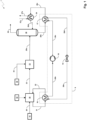
- Figure 1 shows a block flow diagram of a process 1 according to a first example of the invention.
- An electrolyzer 10 for example a PEM electrolyzer, is supplied with a water stream 20 via a water reservoir 11 and with electrical energy via a direct current source 12.
- the electrolyzer By electrochemically splitting water as an electrolysis medium, the electrolyzer generates an oxygen stream (not shown) and a hydrogen stream 23.
- the oxygen stream is released into the atmosphere. Alternatively, the oxygen stream could also be released to another process or to another location in the methanol plant.
- the hydrogen stream 23 is fed to a methanol synthesis reactor arrangement 13, which has at least one water-cooled methanol synthesis reactor, a cooler, a condenser, and a separator (details not shown).
- the methanol synthesis reactor arrangement 13 is also fed with a carbon dioxide stream 24 from a carbon dioxide source 14.
- the carbon dioxide source 14 is the regeneration column of an amine scrubbing unit.
- hydrogen from the hydrogen stream 23 and carbon dioxide from the carbon dioxide stream 24 are converted to a crude methanol stream on a methanol synthesis catalyst.
- the crude methanol stream which contains at least methanol and water, is first fed to a foreend column in which low-boiling components are removed as overhead product (not shown).
- the bottom product of the foreend column is fed as methanol-containing feed stream 25a to a distillation column 15 in which a methanol stream 26 is produced as overhead product and a water stream (not shown) as bottom product.
- the method further includes a heat pump system 9, which has a heat exchanger 16, a heat exchanger 17, a compressor 18, and a throttle valve 19.
- the aforementioned components are fluidically connected to one another by corresponding lines so that a heat pump medium can circulate between the aforementioned components.
- the heat exchanger 16 has the function of the evaporator of the heat pump system
- the heat exchanger 17 has the function of the condenser.
- a stream of a hot electrolysis medium 21 is discharged from the electrolyzer 10, the heat of which is partially transferred in the heat exchanger 16 to a liquid heat pump medium 28a entering this heat exchanger 16.
- the heat pump medium 28a is thereby evaporated.
- the hot electrolysis medium 21 is cooled accordingly, whereby a stream of a cooled electrolysis medium 22 is discharged from the heat exchanger 16 and returned to the electrolyzer.
- the evaporated heat pump medium 28b is fed to the compressor 18, whereby the temperature and pressure of the evaporated heat pump medium are increased.
- the compressed heat pump medium 28c is fed to the heat exchanger 17, in which the heat pump medium is in heat exchange is liquefied (condensed) with the methanol-containing stream 25b withdrawn from the distillation column 15.
- the heat exchanger 17 not only forms part of the heat pump system 9, but also part of the distillation evaporator of the distillation column 15.
- the methanol-containing stream 25b is partially, but not completely, evaporated by the transfer of the condensation heat of the heat pump medium.
- the partially evaporated methanol-containing stream 25c is fed to a further heat exchanger 39, which also forms part of the distillation evaporator of the distillation column 15.
- the heat exchanger 39 is supplied with a vapor stream 27a, by means of which the methanol-containing stream 25c is completely evaporated.
- the completely vaporized methanol-containing stream 25d enters the distillation column 15 to be thermally separated therein into a methanol stream 26 and a water stream (not shown).
- the vapor stream 27a condenses and leaves the heat exchanger 39 as condensate stream 27b.
- the flow of the condensed, cooled heat pump medium 28d is expanded via the throttle valve 19 and fed as a pressure-relaxed heat pump medium flow 28a to the heat exchanger 16 (evaporator), in which the heat pump medium is again evaporated by absorbing the waste heat of the electrolyzer 10.
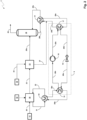
- Figure 2 shows a block flow diagram of a process 2 according to a second example of the invention.
- the transfer of the waste heat from the electrolyzer 10 initially takes place in a heat exchanger 32, to which a flow of a cooled second auxiliary medium 30b is fed. Heat from the flow of the hot electrolysis medium 21 is transferred in the heat exchanger 32 to the flow of the cooled auxiliary medium 30b. The flow of the auxiliary medium 30a heated thereby is discharged from the heat exchanger 32 and causes the evaporation of the heat pump medium 28a fed to this heat exchanger in the heat exchanger 16 (evaporator), which is then fed to the compressor 18 as evaporated heat pump medium 28b.
- a cooled stream of a first auxiliary medium 29a causes the condensation of the compressed heat pump medium stream 28c.
- the resulting heated auxiliary medium stream 29b is combined with a steam stream 37, which is taken from the cooling system of a water-cooled reactor of the methanol synthesis reactor arrangement 13.
- a correspondingly combined stream of steam and heated first auxiliary medium is fed to a heat exchanger 31, in which the evaporation of the methanol-containing stream 25b is effected.
- the evaporated methanol-containing stream 25e is fed to the distillation column 15 for thermal separation into the methanol stream 26 and water stream (not shown).
- the heat exchanger 31 is here the distillation evaporator of the distillation column 15 and does not form part of the heat pump system 9.
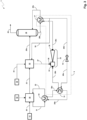
- Figure 3 shows a block flow diagram of a process 3 according to a third example of the invention.
- Water is used as the heat pump medium.
- the flow of the evaporated heat pump medium 28b is fed to a propellant pump 33 via a suction nozzle 34.
- a steam flow 37 is also fed to the propellant pump via a propellant connection 36.
- the steam flow 37 is taken from the cooling system of a water-cooled reactor of the methanol synthesis reactor arrangement 13.
- the steam flow 37 compresses the vaporous heat pump medium 28b in the propellant pump 33 and discharges it from the propellant pump 33 as a flow of a compressed heat pump medium 28c via a pressure nozzle 35.
- the compressed heat pump medium 28c condenses in the heat exchanger 17 and thereby heats a methanol-containing flow 25b, which evaporates and enters the distillation column 15 as a gaseous methanol-containing flow 25e.
- a partial stream 38 is branched off from the stream of condensed heat pump medium 28d for the purpose of mass balance compensation. This partial stream 38 is fed to the cooling system of the water-cooled reactor of the methanol synthesis reactor arrangement 13 for reuse as cooling water.
- a typical 100 MW PEM electrolyzer generates a heat quantity of approximately 20 to 25 MW at approximately 50 °C at full load.
- a methanol plant that produces methanol based on carbon dioxide and electrolytically generated hydrogen at a rate of approximately 220 t of methanol per day at full load has a heat import requirement of at least approximately 10 MW at at least approximately 130 °C.
- the electrolyzer transfers its waste heat directly to the heat pump medium of the heat pump system by means of a heat exchanger, and the compressed and heated heat pump medium transfers its heat directly to liquid crude methanol in the distillation evaporator by means of a heat exchanger.
- the savings from applying the present invention in this case are 10 MW (full power consumption for heating to produce saturated steam) minus 3.3 MW (power consumption of the heat pump system), which gives 6.7 MW of savings.
- This power is "saved", meaning that it is not consumed in the form of additional power, but can be made available by using the waste heat from the electrolyzer.
Landscapes
- Chemical & Material Sciences (AREA)
- Organic Chemistry (AREA)
- Chemical Kinetics & Catalysis (AREA)
- Engineering & Computer Science (AREA)
- Electrochemistry (AREA)
- Materials Engineering (AREA)
- Metallurgy (AREA)
- Inorganic Chemistry (AREA)
- Automation & Control Theory (AREA)
- Crystallography & Structural Chemistry (AREA)
- Organic Low-Molecular-Weight Compounds And Preparation Thereof (AREA)
Priority Applications (4)
| Application Number | Priority Date | Filing Date | Title |
|---|---|---|---|
| EP23188953.6A EP4501894A1 (fr) | 2023-08-01 | 2023-08-01 | Procédé de production de méthanol utilisant la chaleur perdue d'un électrolyseur |
| CA3248470A CA3248470A1 (fr) | 2023-08-01 | 2024-07-15 | Procédé de production de méthanol avec l’utilisation de la chaleur perdue à partir d’un électrolyseur |
| US18/790,862 US20250041757A1 (en) | 2023-08-01 | 2024-07-31 | Process for producing methanol with utilization of the waste heat from an electrolyser |
| CN202411039844.7A CN119431106A (zh) | 2023-08-01 | 2024-07-31 | 利用来自电解槽的废热生产甲醇的方法 |
Applications Claiming Priority (1)
| Application Number | Priority Date | Filing Date | Title |
|---|---|---|---|
| EP23188953.6A EP4501894A1 (fr) | 2023-08-01 | 2023-08-01 | Procédé de production de méthanol utilisant la chaleur perdue d'un électrolyseur |
Publications (1)
| Publication Number | Publication Date |
|---|---|
| EP4501894A1 true EP4501894A1 (fr) | 2025-02-05 |
Family
ID=87553893
Family Applications (1)
| Application Number | Title | Priority Date | Filing Date |
|---|---|---|---|
| EP23188953.6A Pending EP4501894A1 (fr) | 2023-08-01 | 2023-08-01 | Procédé de production de méthanol utilisant la chaleur perdue d'un électrolyseur |
Country Status (4)
| Country | Link |
|---|---|
| US (1) | US20250041757A1 (fr) |
| EP (1) | EP4501894A1 (fr) |
| CN (1) | CN119431106A (fr) |
| CA (1) | CA3248470A1 (fr) |
Citations (1)
| Publication number | Priority date | Publication date | Assignee | Title |
|---|---|---|---|---|
| US11247955B2 (en) | 2018-09-13 | 2022-02-15 | Haldor Topsoe A/S | Process for the preparation of methanol |
-
2023
- 2023-08-01 EP EP23188953.6A patent/EP4501894A1/fr active Pending
-
2024
- 2024-07-15 CA CA3248470A patent/CA3248470A1/fr active Pending
- 2024-07-31 CN CN202411039844.7A patent/CN119431106A/zh active Pending
- 2024-07-31 US US18/790,862 patent/US20250041757A1/en active Pending
Patent Citations (1)
| Publication number | Priority date | Publication date | Assignee | Title |
|---|---|---|---|---|
| US11247955B2 (en) | 2018-09-13 | 2022-02-15 | Haldor Topsoe A/S | Process for the preparation of methanol |
Also Published As
| Publication number | Publication date |
|---|---|
| CA3248470A1 (fr) | 2025-06-06 |
| CN119431106A (zh) | 2025-02-14 |
| US20250041757A1 (en) | 2025-02-06 |
Similar Documents
| Publication | Publication Date | Title |
|---|---|---|
| EP3491173B1 (fr) | Procédé et dispositif de fabrication du méthanol | |
| EP3491172B1 (fr) | Procédé et installaton de production de méthane | |
| EP3488028B1 (fr) | Procédé de production d'ammoniac par voie électrochimique | |
| EP0553125B1 (fr) | Procede et installation de generation simultanee d'energie electrique et d'energie mecanique | |
| AT517934B1 (de) | Anlage und Verfahren zur gaskompressionsfreien Rückgewinnung und Speicherung von Kohlenstoff in Energiespeichersystemen | |
| DE69901279T2 (de) | Verfahren zur Herstellung von Ammoniak | |
| EP3280512A1 (fr) | Procédé et installation pour la production de méthane/d'hydrocarbures gazeux et/ou liquides | |
| DE19908905A1 (de) | Brennstoffzellensystem mit zugeordneter Wassrstofferzeugungsanlage | |
| DE2608486A1 (de) | Verfahren und vorrichtung zur behandlung von kohlenwasserstoffen mit dampf und/oder kohlendioxid | |
| WO2017153304A1 (fr) | Procédé et installation pour la production d'un produit gazeux sous des conditions de charge variables | |
| DE3143161A1 (de) | "verfahren zur erzeugung von dampf aus dem feuchtigkeitsgehalt eines gasstroms" | |
| WO2013156558A1 (fr) | Procédé et dispositif d'électrolyse haute température | |
| DE60113457T2 (de) | Verfahren und vorrichtung zur herstellung von schwerem wasser | |
| EP1849747A2 (fr) | Procédé de production de vapeur d'export dans des réformages à la vapeur | |
| DE3028646A1 (de) | Verfahren zur verbesserung der gleichgewichtseinstellung und gleichzeitigen erzeugung von wasserdampf mit hohem druck bei der herstellung von methanol | |
| EP0361612A2 (fr) | Méthode pour la production d'électricité | |
| EP4392361B1 (fr) | Synthèse d'ammoniac avec de l'hydrogène neutre de co2 | |
| DE102021117030B4 (de) | Gasgemisch-Zerlegungsanlage sowie Verfahren zum Abtrennen von wenigstens einem Hauptfluid aus einem Gasgemisch | |
| BE1029714B1 (de) | Ammoniaksynthese mit CO2-neutralem Wasserstoff | |
| EP4286357A1 (fr) | Procédé et installation de production de méthanol | |
| DE102021125884A1 (de) | Verfahren und Vorrichtung zur Herstellung eines methanhaltigen Produktgases | |
| WO2025186011A1 (fr) | Procédé économe en énergie pour la régénération d'hydrogène brut | |
| EP4705543A1 (fr) | Procédé et installation de production d'un produit réactionnel | |
| WO2025186008A1 (fr) | Procédé économe en énergie pour la purification de gaz de synthèse brut | |
| DE102024001700A1 (de) | Hybridkraftwerk zur Bereitstellung von Wasserstoff und Verfahren zum Betreiben des Hybridkraftwerks |
Legal Events
| Date | Code | Title | Description |
|---|---|---|---|
| PUAI | Public reference made under article 153(3) epc to a published international application that has entered the european phase |
Free format text: ORIGINAL CODE: 0009012 |
|
| STAA | Information on the status of an ep patent application or granted ep patent |
Free format text: STATUS: THE APPLICATION HAS BEEN PUBLISHED |
|
| AK | Designated contracting states |
Kind code of ref document: A1 Designated state(s): AL AT BE BG CH CY CZ DE DK EE ES FI FR GB GR HR HU IE IS IT LI LT LU LV MC ME MK MT NL NO PL PT RO RS SE SI SK SM TR |
|
| STAA | Information on the status of an ep patent application or granted ep patent |
Free format text: STATUS: REQUEST FOR EXAMINATION WAS MADE |
|
| 17P | Request for examination filed |
Effective date: 20250805 |