EP4502102A1 - Wärmeleitende zusammensetzung, zweiteiliges wärmeleitendes material, abgabeform für wärmeleitende zusammensetzung, batteriemodul und verfahren zur herstellung - Google Patents
Wärmeleitende zusammensetzung, zweiteiliges wärmeleitendes material, abgabeform für wärmeleitende zusammensetzung, batteriemodul und verfahren zur herstellung Download PDFInfo
- Publication number
- EP4502102A1 EP4502102A1 EP23775052.6A EP23775052A EP4502102A1 EP 4502102 A1 EP4502102 A1 EP 4502102A1 EP 23775052 A EP23775052 A EP 23775052A EP 4502102 A1 EP4502102 A1 EP 4502102A1
- Authority
- EP
- European Patent Office
- Prior art keywords
- thermally conductive
- conductive composition
- viscosity
- composition according
- thermally
- Prior art date
- Legal status (The legal status is an assumption and is not a legal conclusion. Google has not performed a legal analysis and makes no representation as to the accuracy of the status listed.)
- Pending
Links
Images
Classifications
-
- C—CHEMISTRY; METALLURGY
- C09—DYES; PAINTS; POLISHES; NATURAL RESINS; ADHESIVES; COMPOSITIONS NOT OTHERWISE PROVIDED FOR; APPLICATIONS OF MATERIALS NOT OTHERWISE PROVIDED FOR
- C09K—MATERIALS FOR MISCELLANEOUS APPLICATIONS, NOT PROVIDED FOR ELSEWHERE
- C09K5/00—Heat-transfer, heat-exchange or heat-storage materials, e.g. refrigerants; Materials for the production of heat or cold by chemical reactions other than by combustion
- C09K5/08—Materials not undergoing a change of physical state when used
- C09K5/14—Solid materials, e.g. powdery or granular
-
- C—CHEMISTRY; METALLURGY
- C08—ORGANIC MACROMOLECULAR COMPOUNDS; THEIR PREPARATION OR CHEMICAL WORKING-UP; COMPOSITIONS BASED THEREON
- C08L—COMPOSITIONS OF MACROMOLECULAR COMPOUNDS
- C08L83/00—Compositions of macromolecular compounds obtained by reactions forming in the main chain of the macromolecule a linkage containing silicon with or without sulfur, nitrogen, oxygen or carbon only; Compositions of derivatives of such polymers
- C08L83/04—Polysiloxanes
-
- H—ELECTRICITY
- H01—ELECTRIC ELEMENTS
- H01M—PROCESSES OR MEANS, e.g. BATTERIES, FOR THE DIRECT CONVERSION OF CHEMICAL ENERGY INTO ELECTRICAL ENERGY
- H01M10/00—Secondary cells; Manufacture thereof
- H01M10/60—Heating or cooling; Temperature control
- H01M10/65—Means for temperature control structurally associated with the cells
- H01M10/653—Means for temperature control structurally associated with the cells characterised by electrically insulating or thermally conductive materials
-
- H—ELECTRICITY
- H01—ELECTRIC ELEMENTS
- H01M—PROCESSES OR MEANS, e.g. BATTERIES, FOR THE DIRECT CONVERSION OF CHEMICAL ENERGY INTO ELECTRICAL ENERGY
- H01M50/00—Constructional details or processes of manufacture of the non-active parts of electrochemical cells other than fuel cells, e.g. hybrid cells
- H01M50/20—Mountings; Secondary casings or frames; Racks, modules or packs; Suspension devices; Shock absorbers; Transport or carrying devices; Holders
- H01M50/289—Mountings; Secondary casings or frames; Racks, modules or packs; Suspension devices; Shock absorbers; Transport or carrying devices; Holders characterised by spacing elements or positioning means within frames, racks or packs
- H01M50/293—Mountings; Secondary casings or frames; Racks, modules or packs; Suspension devices; Shock absorbers; Transport or carrying devices; Holders characterised by spacing elements or positioning means within frames, racks or packs characterised by the material
-
- C—CHEMISTRY; METALLURGY
- C08—ORGANIC MACROMOLECULAR COMPOUNDS; THEIR PREPARATION OR CHEMICAL WORKING-UP; COMPOSITIONS BASED THEREON
- C08G—MACROMOLECULAR COMPOUNDS OBTAINED OTHERWISE THAN BY REACTIONS ONLY INVOLVING UNSATURATED CARBON-TO-CARBON BONDS
- C08G77/00—Macromolecular compounds obtained by reactions forming a linkage containing silicon with or without sulfur, nitrogen, oxygen or carbon in the main chain of the macromolecule
- C08G77/04—Polysiloxanes
- C08G77/12—Polysiloxanes containing silicon bound to hydrogen
-
- C—CHEMISTRY; METALLURGY
- C08—ORGANIC MACROMOLECULAR COMPOUNDS; THEIR PREPARATION OR CHEMICAL WORKING-UP; COMPOSITIONS BASED THEREON
- C08G—MACROMOLECULAR COMPOUNDS OBTAINED OTHERWISE THAN BY REACTIONS ONLY INVOLVING UNSATURATED CARBON-TO-CARBON BONDS
- C08G77/00—Macromolecular compounds obtained by reactions forming a linkage containing silicon with or without sulfur, nitrogen, oxygen or carbon in the main chain of the macromolecule
- C08G77/04—Polysiloxanes
- C08G77/20—Polysiloxanes containing silicon bound to unsaturated aliphatic groups
-
- C—CHEMISTRY; METALLURGY
- C08—ORGANIC MACROMOLECULAR COMPOUNDS; THEIR PREPARATION OR CHEMICAL WORKING-UP; COMPOSITIONS BASED THEREON
- C08K—Use of inorganic or non-macromolecular organic substances as compounding ingredients
- C08K3/00—Use of inorganic substances as compounding ingredients
- C08K3/18—Oxygen-containing compounds, e.g. metal carbonyls
- C08K3/20—Oxides; Hydroxides
- C08K3/22—Oxides; Hydroxides of metals
- C08K2003/2227—Oxides; Hydroxides of metals of aluminium
-
- C—CHEMISTRY; METALLURGY
- C08—ORGANIC MACROMOLECULAR COMPOUNDS; THEIR PREPARATION OR CHEMICAL WORKING-UP; COMPOSITIONS BASED THEREON
- C08K—Use of inorganic or non-macromolecular organic substances as compounding ingredients
- C08K2201/00—Specific properties of additives
- C08K2201/014—Additives containing two or more different additives of the same subgroup in C08K
-
- Y—GENERAL TAGGING OF NEW TECHNOLOGICAL DEVELOPMENTS; GENERAL TAGGING OF CROSS-SECTIONAL TECHNOLOGIES SPANNING OVER SEVERAL SECTIONS OF THE IPC; TECHNICAL SUBJECTS COVERED BY FORMER USPC CROSS-REFERENCE ART COLLECTIONS [XRACs] AND DIGESTS
- Y02—TECHNOLOGIES OR APPLICATIONS FOR MITIGATION OR ADAPTATION AGAINST CLIMATE CHANGE
- Y02E—REDUCTION OF GREENHOUSE GAS [GHG] EMISSIONS, RELATED TO ENERGY GENERATION, TRANSMISSION OR DISTRIBUTION
- Y02E60/00—Enabling technologies; Technologies with a potential or indirect contribution to GHG emissions mitigation
- Y02E60/10—Energy storage using batteries
Definitions
- the present invention relates to a thermally conductive composition, a two-part curable thermally conductive material, a supply form of a thermally conductive composition, a thermally conductive member, a battery module, and a method for producing the supply form of a thermally conductive composition.
- Cured products formed by filling a thermally conductive composition between a heating element and a heat sink and then curing the composition are used as a thermally conductive member that transfers the heat generated by the heating element to the heat sink.
- Thermally conductive compositions are flowable, and thus any gap between a heating element and a heat sink can be filled with the thermally conductive composition. Therefore, the thermally conductive member formed can reliably fill the gap between the heating element and the heat sink even if the gap is irregular, and thus is used as a thermally conductive spacer.
- thermally conductive members are known to be used in a battery module as a spacer.
- a thermally conductive member is placed between a battery cell, which is a heating element, and a module housing, which is a heat sink, and serves to discharge the heat of the battery cell to the outside.
- the thermally conductive member is also placed between battery cells to secure them and keep them apart.
- a thermally conductive composition including organopolysiloxane and a thermally conductive filler has been frequently used as a thermally conductive composition for forming a thermally conductive member.
- a thermally conductive composition for forming a thermally conductive member.
- the viscosity of the thermally conductive composition increases, and this worsens handling properties. For example, if the viscosity of the thermally conductive composition increases, it may be difficult to dispense it from a dispenser or the like.
- thermally conductive compositions in the operation of compressing coating formed by putting a thermally conductive composition in the space between a heating element and a heat sink, handling properties may be deteriorated and for example, load may be increased. For this reason, reducing the viscosity of thermally conductive compositions has been widely considered. Meanwhile, reduction in the viscosity of thermally conductive compositions may cause the problem of settle down of thermally conductive filler in long term storage.
- Patent Literature 2 discloses that a silica filler is mixed in a thermally conductive silicone grease composition comprising liquid organopolysiloxane, organopolysiloxane specified by a specific formula and a thermally conductive filler.
- an object of the present invention is to provide a thermally conductive composition comprising a liquid polymer and a thermally conductive filler, in which settle down of the thermally conductive filler is suppressed in storage and which has excellent handling properties in use.
- thermally conductive composition comprising a liquid polymer, a thermally conductive filler and a structural viscosity imparting agent, which has a viscosity ratio above a certain level measured by a rheometer under specific conditions.
- the present invention provides the following [1] to [22].
- the present invention can provide a thermally conductive composition which can suppress settle down of thermally conductive filler in storage and which has excellent handling properties in use.
- thermally conductive composition of the present invention will be described in detail.
- the thermally conductive composition of the present invention comprises a liquid polymer, a thermally conductive filler and a structural viscosity imparting agent, and has a viscosity ratio ( ⁇ 1/ ⁇ 3) between a viscosity ⁇ 1 measured by a rheometer under conditions of a measurement temperature of 25°C and a shear rate of 0.00158 (1/s) and a viscosity ⁇ 3 measured by a rheometer under conditions of a measurement temperature of 25°C and a shear rate of 0.0501 (1/s) of more than 8.
- the thermally conductive composition of the present invention has a viscosity ratio ( ⁇ 1/ ⁇ 3) measured by a rheometer of more than 8. When the viscosity ratio ( ⁇ 1/ ⁇ 3) is 8 or less, the thermally conductive filler is likely to settle down when the thermally conductive composition is stored, and handling properties tend to be deteriorated when used.
- the thermally conductive composition has a viscosity ratio ( ⁇ 1/ ⁇ 3) measured by a rheometer of preferably more than 10, more preferably 15 or more, and even more preferably 20 or more.
- the upper limit of the viscosity ratio ( ⁇ 1/ ⁇ 3) is not particularly limited, and for example 100.
- Both viscosity ⁇ 1 and viscosity ⁇ 3 represent a viscosity in the low shear rate region.
- a thermally conductive composition has a viscosity ratio ( ⁇ 1/ ⁇ 3) of more than 8, its viscosity changes significantly relative to the change in the shear rate in the low shear rate region.
- the slope in a graph illustrating the relation between the shear rate (the horizontal axis) and the viscosity (the vertical axis) increases. This means that in storage, i.e., when the shear rate is very small, the thermally conductive composition has high viscosity, and thus the settle down of the thermally conductive filler is suppressed.
- the shear rate is relatively increased, because, for example, the thermally conductive composition is discharged from a dispenser or coating is compressed. At that stage, the viscosity of the thermally conductive composition is effectively reduced as the shear rate is increased, and thus handling properties are improved.
- the thermally conductive composition has a viscosity ⁇ 1 of, for example, 3,000 (Pa ⁇ s) or more, preferably 5,000 (Pa ⁇ s) or more, more preferably 10,000 (Pa ⁇ s) or more, even more preferably 20,000 (Pa ⁇ s) or more.
- the upper limit of viscosity ⁇ 1 is not particularly limited, and for example is 100,000 (Pa ⁇ s).
- the viscosity ratio ( ⁇ 1/ ⁇ 2) is preferably 30 or more, more preferably 50 or more, even more preferably 60 or more, and even more preferably 70 or more from the viewpoint of the improvement in handling properties.
- the thermally conductive composition has a viscosity ⁇ 2 of preferably 350 (Pa ⁇ s) or less, more preferably 250 (Pa ⁇ s) or less and even more preferably 150 (Pa ⁇ s) or less from the viewpoint of the improvement in handling properties.
- the lower limit of viscosity ⁇ 2 is not limited, and for example, is 50.
- Viscosity ⁇ 1, viscosity ⁇ 2 and viscosity ⁇ 3 of the thermally conductive composition are measured by a rheometer at 25°C.
- the thermally conductive composition is heated and then cooled to room temperature (25°C) and then the viscosity is measured, in order to assess the viscosity while eliminating impact of shear when the sample is set on the measurement tool.
- the heating temperature is the melting point or more of the structural viscosity imparting agent, and is preferably the melting point +50°C or less.
- the heating temperature may be set in the range of 35 to 170°C. Details of measurement conditions of the rheometer will be described in Examples.
- Viscosity ⁇ 1, viscosity ⁇ 2 and viscosity ⁇ 3, the viscosity ratio ( ⁇ 1/ ⁇ 3) and the viscosity ratio ( ⁇ 1/ ⁇ 2) may be adjusted based on the type, the amount and the like of the structural viscosity imparting agent and the thermally conductive filler described later.
- the range written with “to” means a range from a numerical value equal to or more than the predetermined numerical value before the "to” to a numerical value equal to or less than the predetermined numerical value after the "to".
- the thermally conductive composition of the present invention comprises a liquid polymer.
- the liquid polymer is liquid at room temperature (25°C), and examples thereof include silicone rubber and polyurethane resin, which are a raw material for preparing polymer matrix.
- the liquid polymer may be a non-reactive compound having no reactive group or a reactive compound having a reactive group.
- reactive groups include an alkenyl group, a hydrosilyl group, a hydroxyl group and an isocyanate group.
- liquid polymers examples include organopolysiloxane, polyol and polyisocyanate.
- the liquid polymer may include one component or may be a mixture of two or more components.
- organopolysiloxane is preferred as the liquid polymer.
- Use of organopolysiloxane as the liquid polymer makes it easier to increase the filling ratio of the thermally conductive filler and improve the thermal conductivity of the thermal conductive member formed from the thermally conductive composition.
- Organopolysiloxane having a reactive group and organopolysiloxane having no reactive group may be used as organopolysiloxane.
- Organopolysiloxane having a reactive group is preferred.
- Organopolysiloxane having a reactive group refers to organopolysiloxane having a reactive group capable of forming a cross-linked structure.
- examples thereof include addition reaction-curable silicone, radical reaction-curable silicone, condensation reaction-curable silicone, ultraviolet light- or electron beam-curable silicone and moisture-curable silicone.
- addition reaction-curable silicone is preferred as the organopolysiloxane having a reactive group.
- the liquid polymer according to the present invention is addition reaction-curable silicone.
- addition reaction-curable silicones include those containing an alkenyl group-containing organopolysiloxane (base compound) and hydrogen organopolysiloxane (curing agent).
- the liquid polymer according to the present invention may be those containing either of the base compound or the curing agent constituting the addition reaction-curable silicone. More specifically, the liquid polymer included in the thermally conductive composition may be alkenyl group-containing organopolysiloxane, hydrogen organopolysiloxane, or may include both alkenyl group containing organopolysiloxane and hydrogen organopolysiloxane.
- thermally conductive composition of the present invention it is also preferable to use the thermally conductive composition of the present invention to form a two-part curable thermally conductive material.
- a two-part curable thermally conductive material may comprise a first part comprising a thermally conductive composition comprising alkenyl group-containing organopolysiloxane, a thermally conductive filler and a structural viscosity imparting agent and having a viscosity ratio ( ⁇ 1/ ⁇ 3) of more than 8 and a second part comprising a thermally conductive composition comprising hydrogen organopolysiloxane, a thermally conductive filler and a structural viscosity imparting agent and having a viscosity ratio ( ⁇ 1/ ⁇ 3) of more than 8.
- the first part and the second part are mixed and reacted upon use to form a thermally conductive member including a polymer matrix made of silicone rubber.
- the thermally conductive filler is less likely to be settled down in storage in both the first part and the second part, and handling properties are improved upon use in both the first part and the second part.
- the liquid polymer used in the above two-part curable thermally conductive material may be different from the addition reaction-curable organopolysiloxane.
- a liquid polymer that reacts when the first part and the second part are mixed may be included in the first part and the second part, respectively.
- polyol may be used instead of the alkenyl group-containing organopolysiloxane contained in the first part described above
- polyisocyanate may be used instead of the hydrogen organopolysiloxane contained in the second part described above.
- a thermally conductive member containing polymer matrix formed of polyurethane resin is formed.
- the thermally conductive composition of the present invention comprises a structural viscosity imparting agent.
- the structural viscosity imparting agent is a compound that is solid at room temperature (25°C), and by mixing this to the liquid polymer and leaving the mixture under specific conditions, viscosity can be increased. More specifically, the structural viscosity imparting agent has a function of increasing the viscosity in the low shear rate region by heating and cooling a mixture prepared by mixing the structural viscosity imparting agent into liquid polymer, compared to the viscosity before heating.
- a loose bond (inner structure) is formed in the mixture of the liquid polymer and the structural viscosity imparting agent.
- the loose bond is formed due to the cohesive force in the structural viscosity imparting agent and is not broken by gravity. For this reason, settle down of the thermally conductive filler can be suppressed in storage. Then, upon use, a certain level of shear is applied to the mixture, and thus the above loose bond is broken, and the viscosity is reduced to improve workability including coating properties and compressibility.
- the structural viscosity imparting agent forms the above inner structure due to the cohesive force, and this increases the viscosity in the low shear rate region.
- the cohesive force means the action of mutual adherence and bonding of compounds with a similar structure.
- the loose bond is formed in the process of heating at the melting point or more and cooling. Moreover, the loose bond is broken by shear stress. Therefore, the loose bond is broken when shear stress is generated after cooling, and the bond can be formed again by heating and cooling.
- the structural viscosity imparting agent is not separated from the liquid polymer for a predetermined time when the structural viscosity imparting agent is heated to liquid. More specifically, it is preferable that the compound has such compatibility that does not cause phase separation into two phases in the compatibility test described later.
- the compatibility test is carried out as described in the following (i) and (ii).
- the structural viscosity imparting agent is "a compound which has such compatibility that does not cause phase separation into two phases".
- a structural viscosity imparting agent having the above function may be used without limitation.
- the structural viscosity imparting agent when the liquid polymer is organopolysiloxane, the structural viscosity imparting agent is preferably a hydrocarbon compound that is solid at 25°C (hereinafter referred to as hydrocarbon compound X).
- the hydrocarbon compound X has a melting point of preferably more than 25°C, more preferably 30°C or more, and even more preferably 40°C or more.
- the hydrocarbon compound X has a melting point of preferably 120°C or less, more preferably 80°C or less, and even more preferably 75°C or less.
- the hydrocarbon compound X has a melting point of preferably more than 25°C and 120°C or less, more preferably 30°C or more and 80°C or less, and even more preferably 40°C or more and 75°C or less.
- the structural viscosity imparting agent is an hydrocarbon compound X with the above melting point
- the viscosity ratio ( ⁇ 1/ ⁇ 3) can be easily adjusted to the above desired range, and a thermally conductive composition which can suppress settle down of thermally conductive filler in storage and which has excellent handling properties in use can be easily obtained.
- hydrocarbon compounds X include paraffin wax, vaseline, polyalphaolefin (PAO), polyethylene wax and polypropylene wax. Of them, paraffin wax, vaseline, polyalphaolefin (PAO), polyethylene wax and polypropylene wax are preferred from the viewpoint of handling properties at room temperature.
- Vaseline is a semi-solid hydrocarbon compound, which is a mixture of hydrocarbon compounds such as isoparaffin, cycloparaffin and naphthene.
- Examples of vaseline include white vaseline specified in the Japanese Pharmacopoeia.
- Paraffin wax is a generic name for solid saturated hydrocarbon compounds, and is, for example, a mixture of hydrocarbon compounds having 20 to 50 carbon atoms, in which the content of oil is 1% by weight or less.
- the saturated hydrocarbon compound may be linear, branched or may be a mixture thereof.
- One hydrocarbon compound X may be used alone, or two or more of them may be used in combination.
- the content of the structural viscosity imparting agent in the thermally conductive composition is preferably 0.5 part by mass or more, more preferably 3 parts by mass or more, and even more preferably 6 parts by mass or more, and preferably 25 parts by mass or less, more preferably 20 parts by mass or less, even more preferably 15 parts by mass or less, and still more preferably 10 parts by mass or less based on 100 parts by mass of the liquid polymer.
- the content of the structural viscosity imparting agent in the thermally conductive composition is preferably 0.5 to 20 parts by mass, more preferably 3 to 15 parts by mass, and even more preferably 6 to 10 parts by mass based on 100 parts by mass of the liquid polymer.
- the viscosity ratio ( ⁇ 1/ ⁇ 3) of the thermally conductive composition can be easily adjusted to the above desired range, and a thermally conductive composition which can suppress settle down of thermally conductive filler in storage and which has excellent handling properties in use can be easily obtained.
- the thermally conductive composition of the present invention comprises a compatibilizer.
- the compatibilizer reduces the viscosity (in particular viscosity ⁇ 2 at high shear rate) of the thermally conductive composition, improves coating properties and compressibility, and achieves excellent handling properties.
- the compatibilizer is not particularly limited as long as it is a compound compatible with liquid polymer at room temperature (25°C), it is preferable that the compatibilizer is a hydrocarbon compound that is liquid at 25°C (hereinafter also referred to as a hydrocarbon compound Y).
- the compatibilizer may be a hydrocarbon compound Y having a melting point of 25°C or less.
- the method for reducing the viscosity of the thermally conductive composition using the hydrocarbon compound Y is capable of reducing the amount of low molecular weight siloxane formed by heating. Formation of low molecular weight siloxane may cause electrical malfunction.
- inclusion of the hydrocarbon compound Y in the thermally conductive composition usually facilitates settle down of thermally conductive filler in storage, by adjusting the viscosity ratio ( ⁇ 1/ ⁇ 3) as in the present invention, settle down of thermally conductive filler can be suppressed even if the hydrocarbon compound Y is included.
- the hydrocarbon compound Y is not particularly limited as long as it is liquid at 25°C. Examples thereof include liquid paraffin and polyalphaolefin (PAO), and liquid paraffin is more preferred.
- PAO polyalphaolefin
- a mixture of saturated hydrocarbons having 10 to 50 carbon atoms is preferred, and those with an average number of carbon atoms of 15 to 40 are preferred as the hydrocarbon compound Y to reduce the viscosity of the thermally conductive composition and to maintain the heat resistance of the thermally conductive composition.
- a compound having an average number of carbon atoms of 20 to 35 is preferred.
- the hydrocarbon compound Y has an average number of carbon atoms of preferably 15 or more, and more preferably 20 or more, and preferably 40 or less and more preferably 35 or less in order to improve the heat resistance of the thermally conductive composition and increase the compatibility with the liquid polymer to reduce the viscosity of the thermally conductive composition.
- the hydrocarbon compound Y has a viscosity at 25°C of preferably 5 to 50 mPa ⁇ s and more preferably 10 to 30 mPa ⁇ s in order to reduce the viscosity of the thermally conductive composition and to maintain the heat resistance of the thermally conductive composition.
- the viscosity is measured by using a rheometer MCR-302e made by Anton Paar setting the temperature of the sample to 25°C with a Peltier plate using a ⁇ 25 mm 1.997° cone plate under conditions of a shear rate of 100 (1/sec).
- the content of the compatibilizer is preferably 120 parts by mass or less, more preferably 80 parts by mass or less, even more preferably 50 parts by mass or less, and still more preferably 40 parts by mass or less based on 100 parts by mass of the liquid polymer from the viewpoint of the reduction of settle down of the thermally conductive filler in storage, and preferably 5 parts by mass or more, and more preferably 10 parts by mass or more from the viewpoint of the improvement in handling properties.
- the content of the compatibilizer is preferably not less than 1.5 times and not more than 20 times, more preferably not less than 1.8 times and not more than 12 times, and even more preferably not less than twice and not more than 10 times the content of the structural viscosity imparting agent in order to adjust the viscosity ratio ( ⁇ 1/ ⁇ 3) to a certain range and reduce viscosity ⁇ 2.
- the thermally conductive composition of the present invention comprises a thermally conductive filler. Inclusion of the thermally conductive filler improves thermally conductivity of the thermally conductive composition and the thermally conductive member prepared from the thermally conductive composition.
- thermally conductive fillers examples include metal, metal oxide, metal nitride, metal hydroxide, carbon materials, oxide, nitride and carbide of substances other than metal. Furthermore, examples of shapes of the thermally conductive filler include spherical powder and irregular shaped powder.
- Examples of metal for the thermally conductive filler include aluminum, copper and nickel.
- Examples of metal oxides include aluminum oxide, which is typically alumina, magnesium oxide and zinc oxide.
- Examples of metal nitrides include aluminum nitride.
- Examples of metal hydroxides include aluminum hydroxide.
- examples of carbon materials include spherical graphite and diamond.
- Examples of oxides, nitrides and carbides of substances other than metal include quartz, boron nitride and silicon carbide. Of them, aluminum oxide and aluminum hydroxide are preferred as the thermally conductive filler, and it is preferable to use aluminum oxide and aluminum hydroxide in combination.
- the thermally conductive filler has an average particle size of preferably 0.1 to 200 ⁇ m, more preferably 0.3 to 100 ⁇ m, and even more preferably 0.5 to 70 ⁇ m.
- thermally conductive filler having an average particle size of 0.1 ⁇ m or more and 5 ⁇ m or less and a large particle thermally conductive filler having an average particle size of more than 5 ⁇ m and 200 ⁇ m or less in combination.
- Use of the thermally conductive filler having a different average particle size increases the filling ratio.
- the average particle size of the thermally conductive filler may be measured in observation, for example, by an electron microscope. More specifically, the particle size of any 50 particles of the thermally conductive filler is measured using, for example, an electron microscope or an optical microscope and the average value (arithmetic mean value) may be determined as the average particle size.
- the content of the thermally conductive filler is preferably 150 to 3,000 parts by mass, more preferably 300 to 2,000 parts by mass, and even more preferably 600 to 1,600 parts by mass based on 100 parts by mass of the liquid polymer.
- thermally conductive filler By setting the content of the thermally conductive filler to the above lower limit or more, a certain level of thermal conductivity may be imparted to the thermally conductive composition and the thermally conductive member. By setting the content of the thermally conductive filler to the above upper limit or less, the thermally conductive filler can be dispersed in a good manner. This also prevents unnecessary increase in the viscosity of the thermally conductive composition.
- the thermally conductive composition of the present invention may comprise at least one silicon compound selected from the group consisting of an alkoxysilane compound and an alkoxysiloxane compound. Inclusion of such a silicon compound allows the viscosity of the thermally conductive composition to be reduced.
- alkoxy silane compounds include methyltrimethoxysilane, dimethyldimethoxysilane, diethyldimethoxysilane, trimethylmethoxysilane, methyltriethoxysilane, dimethyldiethoxysilane, ethyltrimethoxysilane, n-propyltrimethoxysilane, di-n-propyldimethoxysilane, di-n-propyldiethoxysilane, isobutyltrimethoxysilane, isobutyltriethoxysilane, isobutyltrimethoxysilane, isobutyltriethoxysilane, n-hexyltrimethoxysilane, n-hexyltriethoxysilane, methylcyclohexyldimethoxysilane, methylcyclohexyldiethoxysilane, n-octyltrimethoxysilane,
- n-decyltrimethoxysilane, dimethyldimethoxysilane and n-octyltriethoxysilane are preferred, and n-decyltrimethoxysilane is more preferred from the viewpoint of the reduction in the viscosity of the thermally conductive composition.
- alkoxysiloxane compounds include methylmethoxysiloxane oligomer, methylphenylmethoxysiloxane oligomer, methylepoxymethoxysiloxane oligomer, methylmercaptomethoxysiloxane oligomer and methylacryloylmethoxysiloxane oligomer.
- One or more silicon compounds may be used as the silicon compound.
- the content of the silicon compound is preferably 0.1 part by mass or more and more preferably 0.5 part by mass or more, and preferably 5 parts by mass or less, more preferably 3 parts by mass or less, and even more preferably 2 parts by mass or less based on 100 parts by mass of the liquid polymer.
- the content of the silicon compound is the lower limit or more, the viscosity of the thermally conductive composition is likely to be reduced. Meanwhile, when the content of the silicon compound is the upper limit or less, reduction in the heat resistance of the thermally conductive composition can be suppressed.
- the thermally conductive composition of the present invention may comprise a silicone oil from the viewpoint of the reduction in the viscosity.
- silicone oils include a straight silicone oil such as dimethyl silicone oil and methylphenyl silicone oil.
- the content of the silicone oil is preferably 5 parts by mass or less, more preferably 2 parts by mass or less, and even more preferably 0 parts by mass based on 100 parts by mass of the liquid polymer because low molecular weight siloxane is likely to be formed when a large amount of low viscosity silicone oil is mixed.
- the low viscosity silicone oil refers to silicone oil having a viscosity at 25°C of 50 cs or less, silicone oil having a viscosity at 25°C of 30 cs or less and silicone oil having a viscosity at 25°C of 20 cs or less.
- the thermally conductive composition does not include silicone oil having a viscosity at 25°C of 20 cs or less. This easily prevents the formation of low molecular weight siloxane.
- the viscosity of silicone oil is measured by using a rheometer MCR-302e made by Anton Paar setting the temperature of the sample to 25°C with a Peltier plate using a ⁇ 25 mm 1.997° cone plate under conditions of a shear rate of 100 (1/sec).
- additives may be included in the thermally conductive composition of the present invention.
- additives include a catalyst, a flame retardant, an antioxidant and a colorant.
- the method for producing a thermally conductive composition of the present invention comprises a step of preparing a mixture comprising a liquid polymer, a thermally conductive filler and a structural viscosity imparting agent; a step of heating the mixture; and a step of cooling the mixture.
- the step of cooling the mixture is a step of cooling the mixture to adjust the viscosity ratio ( ⁇ 1/ ⁇ 3) between a viscosity ⁇ 1 measured by a rheometer under conditions of a measurement temperature of 25°C and a shear rate of 0.00158 (1/s) and a viscosity ⁇ 3 measured by a rheometer under conditions of a measurement temperature of 25°C and a shear rate of 0.0501 (1/s) to more than 8.
- the method for producing a thermally conductive composition of the present invention comprises a step of preparing a mixture comprising a liquid polymer, a thermally conductive filler, a structural viscosity imparting agent and an additive mixed as necessary; a step of heating the mixture; and a step of cooling the mixture in that order.
- the thermally conductive composition of the present invention in which the viscosity ratio ( ⁇ 1/ ⁇ 3) is adjusted as described above can be obtained through the above steps.
- the method for producing a supply form of a thermally conductive composition described later involves the same steps as the method for producing the thermally conductive composition does.
- the method for producing a thermally conductive composition of the present invention may comprise a step of filling a container with a mixture, after the step of preparing a mixture described above. It is preferable that the step of heating the mixture and the step of cooling the mixture are performed after filling a container with the mixture.
- a known mixing method may be suitably used in the step of preparing a mixture, and for example, materials may be mixed by a known kneader, kneading roll or mixer.
- the heating temperature in the step of heating the mixture may be a temperature at which the structural viscosity imparting agent melts or more, and for example the heating temperature is the melting point of the structural viscosity imparting agent or more and the melting point +10°C to melting point +50°C.
- the upper limit of the heating temperature is not particularly limited, and for example is preferably 200°C or less from the viewpoint of the suppression of thermal degradation of the structural viscosity imparting agent.
- the heating temperature is kept as low as possible, and for example, is preferably 100°C or less, and particularly preferably 80°C or less.
- the heating time is not particularly limited, and is set to a period of time in which the whole mixture is heated depending on the volume of the mixture.
- the heating time is for example, 5 to 1,000 minutes, and preferably 10 to 500 minutes.
- the heating time is lower limit or more, even the inside of the mixture is sufficiently heated.
- the heating time is the upper limit or less, and when the mixture includes a volatile substance, a part of the volatile substance can be prevented from evaporating.
- the above mixture after heating is cooled to room temperature (25°C).
- the method of cooling is not particularly limited, and the mixture may be cooled by a cooler or may be naturally cooled.
- thermoly conductive material it is preferable to form a two-part curable thermally conductive material using the thermally conductive composition from the viewpoint of storage stability and the like.
- a two-part curable thermally conductive material comprising a first part comprising a thermally conductive composition comprising alkenyl group-containing organopolysiloxane, a thermally conductive filler and a structural viscosity imparting agent and having a viscosity ratio ( ⁇ 1/ ⁇ 3) of more than 8 and a second part comprising a thermally conductive composition comprising hydrogen organopolysiloxane, a thermally conductive filler and a structural viscosity imparting agent and having a viscosity ratio ( ⁇ 1/ ⁇ 3) of more than 8 is preferred as described above.
- the mass ratio between the first part and the second part is preferably 1, or a value closed to 1.
- the mass ratio is specifically preferably 0.9 to 1.1 and more preferably 0.95 to 1.05.
- a mass ratio between the first part and the second part of 1 or a value close to 1 allows a mixture of the first part and the second part to be easily prepared.
- the first part include a catalyst for the addition reaction and the second part does not.
- the first part and the second part have excellent storage stability before mixing, facilitate reaction after mixing and rapidly cures, and physical properties of the thermally conductive member obtained by curing can be improved.
- the catalyst for addition reaction such as platinum catalyst is coordinated with the alkenyl group, which is the site of the addition reaction in the alkenyl group-containing organopolysiloxane, allowing curing to proceed.
- the second part includes alkenyl group-containing organopolysiloxane.
- the second part includes alkenyl group-containing organopolysiloxane in addition to hydrogen organopolysiloxane, which is a curing agent, it becomes easier to adjust the mass ratio and the viscosity ratio of the second part in preparing the mixture of both parts, to the first part to 1 or a value close to 1.
- the first part does not include hydrogen organopolysiloxane which is a curing agent.
- the above first part and the second part are separately stored in a container such as a syringe, a cartridge, a pail can or a drum. More specifically, the two are stored in such a manner that the first part is put in the first syringe and the second part is put in the second syringe. In this case the first syringe and the second syringe are arranged in a row to prepare a dual syringe.
- the first part and the second part are stored preferably in such a manner that the first part is put in the first cartridge and the second part is put in the second cartridge. In this case as well the first cartridge and the second cartridge are arranged in a row to prepare a dual cartridge.
- the first part and the second part are stored preferably in such a manner that the first part is put in the first pail can or the first drum, and the second part is put in the second pail can or the second drum.
- the thermally conductive composition is prepared through a step of preparing a mixture, a step of heating the mixture, and a step of cooling the mixture.
- a mixture comprising, for example, alkenyl group-containing organopolysiloxane, a thermally conductive filler and a structural viscosity imparting agent is prepared, and the mixture is put in the first syringe, and through the heating step and the cooling step, the first syringe in which the first part is put is prepared.
- a mixture comprising, for example, hydrogen organopolysiloxane, a thermally conductive filler and a structural viscosity imparting agent is prepared, and the mixture is put in the second syringe, and through the heating step and the cooling step, the second syringe in which the second part is put is prepared.
- the first part put in the first syringe and the second part put in the second syringe are stored under excellent conditions.
- the first part and the second part are discharged from the first syringe and the second syringe, respectively, are mixed by a static mixer or the like, and cured to form a thermally conductive member.
- a static mixer or the like When the first part and the second part are discharged, a certain level of shear force is generated, resulting in reduced viscosity of the first part and the second part, and hence easy discharge.
- the coating formed after discharge has excellent workability as it can be easily compressed.
- This simplifies an operation of discharging a mixture of the first part and the second part into the space between a heating element and a heat sink to form a coating having a certain level of thickness and then stretching the coating into a thin member with a small load.
- the present invention also provides a supply form of a thermally conductive composition, comprising a container filled with the thermally conductive composition described above.
- the present invention also provides a supply form of a two-part curable thermally conductive material, comprising a first container filled with the above first part and a second container filled with the above second part.
- containers include a syringe, a cartridge, a pail can and a drum as described above.
- the supply form can suppress settle down of thermally conductive filler contained in the thermally conductive composition when the thermally conductive composition is stored in the container, and the supply form provides excellent workability when ejecting by, for example, discharging the thermally conductive composition from the supply form.
- the supply form of a thermally conductive composition and the supply form of a two-part curable thermally conductive material are used in such a manner that the thermally conductive composition or the two-part curable thermally conductive material is supplied to an application apparatus from a container.
- the application apparatus is not particularly limited as long as it has a function of application of the thermally conductive composition, and examples thereof include a dispenser.
- the present invention can also provide a thermally conductive member comprising a polymer matrix, a thermally conductive filler and a structural viscosity imparting agent having a melting point of more than 25°C.
- the present invention also provides a thermally conductive filler comprising a polymer matrix, a thermally conductive filler and a hydrocarbon compound solid at 25°C.
- the thermally conductive member is a cured product of the thermally conductive composition described above, or a cured product of the two-part curable thermally conductive material described above.
- polymer matrix examples include silicone rubber and polyurethane resin, and in particular, silicone rubber is preferred.
- thermally conductive filler The type of the thermally conductive filler is as described above.
- the structural viscosity imparting agent is preferably a hydrocarbon compound solid at 25°C, and is more preferably a hydrocarbon compound X having a melting point of more than 25°C and 120°C or less. Details of the hydrocarbon compound X are as described above.
- the amount of the thermally conductive filler relative to that of the polymer matrix is the same as the amount of the thermally conductive filler relative to the liquid polymer described above.
- the amount of the structural viscosity imparting agent relative to that of the polymer matrix is the same as the amount of the structural viscosity imparting agent relative to the liquid polymer described above.
- the thermally conductive member is obtained from the thermally conductive composition or the two-part curable thermally conductive material described above.
- the liquid polymer contained in the thermally conductive composition is a reactive compound having a reactive group
- a thermally conductive member is obtained by curing the thermally conductive composition.
- the two-part curable thermally conductive material is used, the first part and the second part are mixed as described above and cured to give a thermally conductive member.
- the thermally conductive composition which is the raw material
- the thermally conductive composition can be handled well because the structural viscosity imparting agent is used, and thus workability when forming the thermally conductive member is excellent. Furthermore, settle down of thermally conductive filler in the thermally conductive composition, i.e., the raw material, is suppressed in storage, and the thermally conductive composition has uniform formulation. Thus, the formulation of the resulting thermally conductive member is also uniform, and variation in properties is small.
- the thermally conductive member has a thermal conductivity of preferably 1.0 W/ m ⁇ K or more, more preferably 1.5 W/ m ⁇ K or more, and even more preferably 2.0 W/m ⁇ K or more.
- a thermal conductivity of the lower limit or more improves thermally conductive properties.
- the thermally conductive member when used, for example, as a spacer for a battery cell module, heat generated in the battery cell can be effectively transferred to the module housing through the spacer, and this suppresses excess increase in the temperature of the battery cell.
- the thermal conductivity is measured according to ASTM D5470.
- thermally conductive member of the present invention is not particularly limited, and the thermally conductive member may be used as a spacer in a battery module as described below.
- the battery module of the present invention comprises a spacer comprising the thermally conductive member, a plurality of battery cells, and a module housing that houses the plurality of battery cells, and the spacer is arranged in the module housing.
- the spacer made of the thermally conductive member is put between battery cells, and between the battery cell and the module housing, and the spacer put therein is closely attached to the battery cell and the module housing. Accordingly, the spacer between battery cells functions to keep the battery cells apart. Furthermore, the spacer between the battery cell and the module housing is closely attached to both the battery cell and the module housing, and functions to transfer heat generated in the battery cell to the module housing.
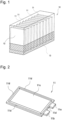
- Fig. 1 illustrates a specific structure of the battery module.
- Fig. 2 illustrates a specific structure of the respective battery cells.
- a plurality of battery cells 11 are arranged in the battery module 10.
- the battery cells 11 are sealed in flexible outer film by lamination, and the overall shape is flat and thin for the height and the width.
- the positive electrode 11a and the negative electrode 1 1b of the battery cell 11 are exposed, and the center part 11c of the flat surface is designed to be thicker than the pressure-bonded end portion 11d.
- the respective battery cells 11 are arranged so that their flat surfaces are faced with each other.
- the plurality of battery cells 11 that are housed in the module housing 12 are not entirely covered with the spacer 13 put therein.
- the spacer 13 is put in the module housing 12 so that part of the space in the module housing (the bottom part) is filled with the spacer 13.
- the spacer 13 is put between battery cells 11 and between the battery cell 11 and the module housing 12. In this part the spacer 13 is closely attached to the surface of the battery cell 11 and the inner surface of the module housing 12.
- the spacer 13 put between battery cells 11 is bonded to the surface of the battery cells 11, the spacer 13 itself is moderately elastic and soft, and even when an external force that changes the distance between battery cells 11 is applied thereto, the spacer 13 can alleviate distortion and deformation due to the external force. Thus, the spacer 13 functions to keep the battery cells 11 apart.
- the spacer 13 put between the battery cell 11 and the module housing 12 is also closely bonded to the surface of the battery cell 11 and the inner surface of the module housing 12. As a result, the heat generated in the battery cell 11 is transferred to the inner surface of the module housing 12 closely bonded to one surface of the spacer 13 through the spacer 13 bonded to the surface of the battery cell 11.
- the spacer 13 is formed in the battery module 10 by application of the thermally conductive composition or the two-part curable thermally conductive material which are in the form of liquid using an application apparatus such as a usual dispenser, and then curing the coating.
- an application apparatus such as a usual dispenser
- the thermally conductive composition may be supplied to the dispenser from the respective syringes and applied to materials.
- the method for supplying the thermally conductive composition is not particularly limited, and examples thereof include a method using air pressure, a servomoter or a Mohno pump.
- the two-part curable thermally conductive material is easily stored, and if mixed immediately before use, the material is less likely to be cured in the operation of application using a dispenser, and can be rapidly cured after the application. Furthermore, application by the dispenser is preferred because the material can be put relatively deep into the housing 12 of the battery module 10.
- the spacer 13 which covers the battery cell 11 preferably 20 to 100%, and more preferably 20 to 40% of one surface of the respective battery cells 11 is covered with the spacer 13.
- the battery cells 11 are held in a stable manner.
- sufficiently covering the battery cells which produce large amount of heat improves efficiency of heat dissipation.
- heat generated in the battery cells 11 can be efficiently released.
- covering 40% or less suppresses weight increase and the reduction in workability.
- the heat generated in the battery cells 11 can be released to the module housing 12 through the spacer 13.
- a battery pack generally has a plurality of battery modules 10 and a battery pack housing which stores the battery modules 10.
- a spacer 13 can be put between the battery module 10 and the battery pack housing. This allows the heat released to the module housing 12 as described above to be further released to the battery pack housing, enabling effective heat dissipation.
- thermally conductive member of the present invention is used for the spacer 13, workability in forming the spacer 13 is high.
- the viscosity of the first part and the second part, which were the thermally conductive composition was measured as follows.
- the viscosity of the first part and the second part, which were a sample, was measured at various shear rates by using a rheometer. Using Rheometer MCR-302e made by Anton Paar, the temperature of the sample was adjusted to 80°C with a Peltier plate, and the sample was left for 5 minutes. Then the sample was cooled to 25°C and left for 10 minutes. Subsequently, the viscosity was measured while continuously changing the shear rate using a ⁇ 20 mm parallel plate.
- the viscosities were measured under conditions of a shear rate of 0.00158 (1/s), 0.00631 (1/s), 0.0126 (1/s), 0.0251 (1/s), 0.0501 (1/s), 0.1 (1/s), 0.2 (1/s), 0.398 (1/s), 1.58 (1/s), 3.16 (1/s), 6.31 (1/s) and 12.6 (1/s), and the viscosity ratio ( ⁇ 1/ ⁇ 3) and the viscosity ratio ( ⁇ 1/ ⁇ 2) were determined.
- the melting point of the hydrocarbon compound X 20 mg was precisely weighed in an aluminum cell, and then the melting point was measured using DSC-60 made by Shimadzu Corporation under nitrogen flow at a temperature increase rate of 105°C/ minute from 25°C to 90°C. Then the temperature of the endothermic peak on the DSC curve measured was defined as the melting point. When the curve had multiple endothermic peaks, the temperature of the endothermic peak indicating the maximum endotherm was defined as the melting point.
- the viscosity of the hydrocarbon compound Y was measured by using a rheometer MCR-302e made by Anton Paar setting the temperature of the sample to 25°C with a Peltier plate using a ⁇ 25 mm 1.997° cone plate under conditions of a shear rate of 100 (1/sec).
- Fumed silica primary particles having an average particle size of 10 nm
- thermally conductive filler in storage is suppressed in the thermally conductive compositions of the present invention (the first part and the second part) which satisfy the viscosity ratio ( ⁇ 1/ ⁇ 3) of more than 8, and since the thermally conductive compositions have excellent compressibility, they can be handled well.
- the comprehensive evaluation for Examples in which the compatibilizer (the hydrocarbon compound Y liquid at 25°C) was mixed was higher than that for Examples in which the compatibilizer was not mixed. Furthermore, since the compound used as the compatibilizer is a hydrocarbon compound, generation of low molecular weight siloxane can be suppressed compared to the method for reducing viscosity using silicone oil or the like.
Landscapes
- Chemical & Material Sciences (AREA)
- Chemical Kinetics & Catalysis (AREA)
- Engineering & Computer Science (AREA)
- Organic Chemistry (AREA)
- General Chemical & Material Sciences (AREA)
- Electrochemistry (AREA)
- Manufacturing & Machinery (AREA)
- Health & Medical Sciences (AREA)
- Medicinal Chemistry (AREA)
- Polymers & Plastics (AREA)
- Physics & Mathematics (AREA)
- Combustion & Propulsion (AREA)
- Thermal Sciences (AREA)
- Materials Engineering (AREA)
- Compositions Of Macromolecular Compounds (AREA)
Applications Claiming Priority (2)
| Application Number | Priority Date | Filing Date | Title |
|---|---|---|---|
| JP2022048360 | 2022-03-24 | ||
| PCT/JP2023/011639 WO2023182459A1 (ja) | 2022-03-24 | 2023-03-23 | 熱伝導性組成物、2液硬化型熱伝導性材料、熱伝導性組成物の供給形態、熱伝導性部材、バッテリモジュール、及び熱伝導性組成物の供給形態の製造方法 |
Publications (2)
| Publication Number | Publication Date |
|---|---|
| EP4502102A1 true EP4502102A1 (de) | 2025-02-05 |
| EP4502102A4 EP4502102A4 (de) | 2026-04-08 |
Family
ID=88101693
Family Applications (1)
| Application Number | Title | Priority Date | Filing Date |
|---|---|---|---|
| EP23775052.6A Pending EP4502102A4 (de) | 2022-03-24 | 2023-03-23 | Wärmeleitende zusammensetzung, zweiteiliges wärmeleitendes material, abgabeform für wärmeleitende zusammensetzung, batteriemodul und verfahren zur herstellung |
Country Status (3)
| Country | Link |
|---|---|
| EP (1) | EP4502102A4 (de) |
| JP (1) | JPWO2023182459A1 (de) |
| WO (1) | WO2023182459A1 (de) |
Families Citing this family (2)
| Publication number | Priority date | Publication date | Assignee | Title |
|---|---|---|---|---|
| JP7838191B2 (ja) * | 2024-03-28 | 2026-03-31 | 積水化学工業株式会社 | 熱伝導性組成物 |
| CN120248846B (zh) * | 2025-06-03 | 2025-09-05 | 广西电网有限责任公司电力科学研究院 | 一种浸没式液冷电池用冷却液及其制备方法 |
Family Cites Families (8)
| Publication number | Priority date | Publication date | Assignee | Title |
|---|---|---|---|---|
| WO2006132253A1 (ja) * | 2005-06-07 | 2006-12-14 | Nihon Handa Co., Ltd. | 熱伝導性オイル組成物、放熱剤および電子機器 |
| KR20170127482A (ko) * | 2015-03-02 | 2017-11-21 | 신에쓰 가가꾸 고교 가부시끼가이샤 | 열 전도성 실리콘 조성물 |
| CN107043541A (zh) * | 2017-02-22 | 2017-08-15 | 厦门安耐伟业新材料有限公司 | 导热硅凝胶组合物及其制备方法 |
| KR102805936B1 (ko) | 2017-03-22 | 2025-05-09 | 세키수이 폴리머텍 가부시키가이샤 | 배터리 모듈 및 배터리 팩 |
| CN107815286B (zh) * | 2017-11-03 | 2020-09-01 | 航天特种材料及工艺技术研究所 | 一种基于相变微胶囊的导热灌封硅胶及其制备方法 |
| CN107868655A (zh) * | 2017-11-24 | 2018-04-03 | 东莞市弗勒特电子科技有限公司 | 一种导热储热硅凝胶组合物及其制备方法 |
| KR102917127B1 (ko) * | 2018-11-09 | 2026-01-26 | 세키수이 폴리머텍 가부시키가이샤 | 열전도성 조성물, 열전도성 부재, 열전도성 부재의 제조 방법, 방열 구조, 발열 복합 부재, 방열 복합 부재 |
| CN113355045B (zh) * | 2020-03-06 | 2023-08-04 | 富乐(苏州)新材料有限公司 | 具有储能功能的胶粘剂及其应用 |
-
2023
- 2023-03-23 JP JP2024509236A patent/JPWO2023182459A1/ja active Pending
- 2023-03-23 EP EP23775052.6A patent/EP4502102A4/de active Pending
- 2023-03-23 WO PCT/JP2023/011639 patent/WO2023182459A1/ja not_active Ceased
Also Published As
| Publication number | Publication date |
|---|---|
| WO2023182459A1 (ja) | 2023-09-28 |
| JPWO2023182459A1 (de) | 2023-09-28 |
| EP4502102A4 (de) | 2026-04-08 |
Similar Documents
| Publication | Publication Date | Title |
|---|---|---|
| EP4428199A1 (de) | Wärmeleitende zusammensetzung und wärmeleitendes element | |
| JP7422742B2 (ja) | 多成分型熱伝導性シリコーンゲル組成物、熱伝導性部材および放熱構造体 | |
| EP4410926A1 (de) | Wärmeleitende zusammensetzung und wärmeleitendes element | |
| TWI428395B (zh) | A thermally conductive silicone grease composition and a hardened product thereof | |
| EP3225662B1 (de) | One-pack-additiv für härtbare silikonzusammensetzung und verfahren zur lagerung davon sowie verfahren zur härtung davon | |
| KR20220159899A (ko) | 열전도성 실리콘 조성물 및 그 경화물 | |
| KR102298511B1 (ko) | 방열 접착제 조성물 | |
| EP4300569A1 (de) | Wärmeleitende zusammensetzung, wärmeleitendes element und batteriemodul | |
| EP3514188B1 (de) | Harzzusammensetzung, wärmeleitende flexible folie damit und wärmeableitungsstruktur | |
| EP3992252A1 (de) | Verpackung für wärmeleitende zusammensetzung und wärmeleitende zusammensetzung mit zweikomponenten-härtung | |
| EP3901998A1 (de) | Wärmeleitende silikonzusammensetzung und halbleiterbauelement | |
| EP4184564A1 (de) | Wärmeleitfähige zusammensetzung und gehärtetes produkt daraus | |
| KR102416096B1 (ko) | 열전도성 시트 | |
| WO2023182459A1 (ja) | 熱伝導性組成物、2液硬化型熱伝導性材料、熱伝導性組成物の供給形態、熱伝導性部材、バッテリモジュール、及び熱伝導性組成物の供給形態の製造方法 | |
| EP3722391B1 (de) | Wärmeleitfähige zusammensetzung | |
| EP4317322A1 (de) | Wärmeleitende zusammensetzung, wärmeleitendes element und batteriemodul | |
| WO2025065334A1 (en) | Thermally conductive silicone composition | |
| JP7698806B2 (ja) | 熱伝導性組成物、2液硬化型熱伝導性材料、2液硬化型熱伝導性材料の供給形態、及びバッテリモジュール | |
| EP4474429A1 (de) | Wärmeleitfähige silikonzusammensetzung und herstellungsverfahren dafür | |
| EP4660242A1 (de) | Wärmeleitende harzzusammensetzung und wärmeleitendes element | |
| WO2023120514A1 (ja) | 熱伝導性組成物、及び熱伝導性部材 | |
| US20260125535A1 (en) | Thermally conductive clay composition | |
| CN121057786A (zh) | 导热性构件、导热性组合物、结构体及结构体的再利用方法 | |
| EP4541867A1 (de) | Wärmeleitende zusammensetzung und wärmeleitendes element |
Legal Events
| Date | Code | Title | Description |
|---|---|---|---|
| STAA | Information on the status of an ep patent application or granted ep patent |
Free format text: STATUS: THE INTERNATIONAL PUBLICATION HAS BEEN MADE |
|
| PUAI | Public reference made under article 153(3) epc to a published international application that has entered the european phase |
Free format text: ORIGINAL CODE: 0009012 |
|
| STAA | Information on the status of an ep patent application or granted ep patent |
Free format text: STATUS: REQUEST FOR EXAMINATION WAS MADE |
|
| 17P | Request for examination filed |
Effective date: 20240709 |
|
| AK | Designated contracting states |
Kind code of ref document: A1 Designated state(s): AL AT BE BG CH CY CZ DE DK EE ES FI FR GB GR HR HU IE IS IT LI LT LU LV MC ME MK MT NL NO PL PT RO RS SE SI SK SM TR |
|
| DAV | Request for validation of the european patent (deleted) | ||
| DAX | Request for extension of the european patent (deleted) | ||
| A4 | Supplementary search report drawn up and despatched |
Effective date: 20260311 |
|
| RIC1 | Information provided on ipc code assigned before grant |
Ipc: C09K 5/14 20060101AFI20260305BHEP Ipc: C08K 3/01 20180101ALI20260305BHEP Ipc: C08K 5/01 20060101ALI20260305BHEP Ipc: C08L 83/04 20060101ALI20260305BHEP Ipc: C08L 101/00 20060101ALI20260305BHEP Ipc: C09K 5/10 20060101ALI20260305BHEP |