EP4502153A1 - Geneditierungssystem zur behandlung des usher-syndroms - Google Patents
Geneditierungssystem zur behandlung des usher-syndroms Download PDFInfo
- Publication number
- EP4502153A1 EP4502153A1 EP23781421.5A EP23781421A EP4502153A1 EP 4502153 A1 EP4502153 A1 EP 4502153A1 EP 23781421 A EP23781421 A EP 23781421A EP 4502153 A1 EP4502153 A1 EP 4502153A1
- Authority
- EP
- European Patent Office
- Prior art keywords
- sequence
- seq
- nucleotide sequence
- region
- guide rna
- Prior art date
- Legal status (The legal status is an assumption and is not a legal conclusion. Google has not performed a legal analysis and makes no representation as to the accuracy of the status listed.)
- Pending
Links
Images








Classifications
-
- C—CHEMISTRY; METALLURGY
- C12—BIOCHEMISTRY; BEER; SPIRITS; WINE; VINEGAR; MICROBIOLOGY; ENZYMOLOGY; MUTATION OR GENETIC ENGINEERING
- C12N—MICROORGANISMS OR ENZYMES; COMPOSITIONS THEREOF; PROPAGATING, PRESERVING, OR MAINTAINING MICROORGANISMS; MUTATION OR GENETIC ENGINEERING; CULTURE MEDIA
- C12N15/00—Mutation or genetic engineering; DNA or RNA concerning genetic engineering, vectors, e.g. plasmids, or their isolation, preparation or purification; Use of hosts therefor
- C12N15/09—Recombinant DNA-technology
- C12N15/10—Processes for the isolation, preparation or purification of DNA or RNA
- C12N15/102—Mutagenizing nucleic acids
-
- A—HUMAN NECESSITIES
- A61—MEDICAL OR VETERINARY SCIENCE; HYGIENE
- A61K—PREPARATIONS FOR MEDICAL, DENTAL OR TOILETRY PURPOSES
- A61K48/00—Medicinal preparations containing genetic material which is inserted into cells of the living body to treat genetic diseases; Gene therapy
- A61K48/005—Medicinal preparations containing genetic material which is inserted into cells of the living body to treat genetic diseases; Gene therapy characterised by an aspect of the 'active' part of the composition delivered, i.e. the nucleic acid delivered
-
- A—HUMAN NECESSITIES
- A61—MEDICAL OR VETERINARY SCIENCE; HYGIENE
- A61K—PREPARATIONS FOR MEDICAL, DENTAL OR TOILETRY PURPOSES
- A61K31/00—Medicinal preparations containing organic active ingredients
- A61K31/70—Carbohydrates; Sugars; Derivatives thereof
- A61K31/7088—Compounds having three or more nucleosides or nucleotides
-
- A—HUMAN NECESSITIES
- A61—MEDICAL OR VETERINARY SCIENCE; HYGIENE
- A61K—PREPARATIONS FOR MEDICAL, DENTAL OR TOILETRY PURPOSES
- A61K48/00—Medicinal preparations containing genetic material which is inserted into cells of the living body to treat genetic diseases; Gene therapy
-
- A—HUMAN NECESSITIES
- A61—MEDICAL OR VETERINARY SCIENCE; HYGIENE
- A61P—SPECIFIC THERAPEUTIC ACTIVITY OF CHEMICAL COMPOUNDS OR MEDICINAL PREPARATIONS
- A61P27/00—Drugs for disorders of the senses
- A61P27/02—Ophthalmic agents
-
- A—HUMAN NECESSITIES
- A61—MEDICAL OR VETERINARY SCIENCE; HYGIENE
- A61P—SPECIFIC THERAPEUTIC ACTIVITY OF CHEMICAL COMPOUNDS OR MEDICINAL PREPARATIONS
- A61P27/00—Drugs for disorders of the senses
- A61P27/16—Otologicals
-
- A—HUMAN NECESSITIES
- A61—MEDICAL OR VETERINARY SCIENCE; HYGIENE
- A61P—SPECIFIC THERAPEUTIC ACTIVITY OF CHEMICAL COMPOUNDS OR MEDICINAL PREPARATIONS
- A61P43/00—Drugs for specific purposes, not provided for in groups A61P1/00-A61P41/00
-
- C—CHEMISTRY; METALLURGY
- C12—BIOCHEMISTRY; BEER; SPIRITS; WINE; VINEGAR; MICROBIOLOGY; ENZYMOLOGY; MUTATION OR GENETIC ENGINEERING
- C12N—MICROORGANISMS OR ENZYMES; COMPOSITIONS THEREOF; PROPAGATING, PRESERVING, OR MAINTAINING MICROORGANISMS; MUTATION OR GENETIC ENGINEERING; CULTURE MEDIA
- C12N15/00—Mutation or genetic engineering; DNA or RNA concerning genetic engineering, vectors, e.g. plasmids, or their isolation, preparation or purification; Use of hosts therefor
- C12N15/09—Recombinant DNA-technology
- C12N15/11—DNA or RNA fragments; Modified forms thereof; Non-coding nucleic acids having a biological activity
- C12N15/111—General methods applicable to biologically active non-coding nucleic acids
-
- C—CHEMISTRY; METALLURGY
- C12—BIOCHEMISTRY; BEER; SPIRITS; WINE; VINEGAR; MICROBIOLOGY; ENZYMOLOGY; MUTATION OR GENETIC ENGINEERING
- C12N—MICROORGANISMS OR ENZYMES; COMPOSITIONS THEREOF; PROPAGATING, PRESERVING, OR MAINTAINING MICROORGANISMS; MUTATION OR GENETIC ENGINEERING; CULTURE MEDIA
- C12N15/00—Mutation or genetic engineering; DNA or RNA concerning genetic engineering, vectors, e.g. plasmids, or their isolation, preparation or purification; Use of hosts therefor
- C12N15/09—Recombinant DNA-technology
- C12N15/11—DNA or RNA fragments; Modified forms thereof; Non-coding nucleic acids having a biological activity
- C12N15/113—Non-coding nucleic acids modulating the expression of genes, e.g. antisense oligonucleotides; Antisense DNA or RNA; Triplex- forming oligonucleotides; Catalytic nucleic acids, e.g. ribozymes; Nucleic acids used in co-suppression or gene silencing
-
- C—CHEMISTRY; METALLURGY
- C12—BIOCHEMISTRY; BEER; SPIRITS; WINE; VINEGAR; MICROBIOLOGY; ENZYMOLOGY; MUTATION OR GENETIC ENGINEERING
- C12N—MICROORGANISMS OR ENZYMES; COMPOSITIONS THEREOF; PROPAGATING, PRESERVING, OR MAINTAINING MICROORGANISMS; MUTATION OR GENETIC ENGINEERING; CULTURE MEDIA
- C12N15/00—Mutation or genetic engineering; DNA or RNA concerning genetic engineering, vectors, e.g. plasmids, or their isolation, preparation or purification; Use of hosts therefor
- C12N15/09—Recombinant DNA-technology
- C12N15/63—Introduction of foreign genetic material using vectors; Vectors; Use of hosts therefor; Regulation of expression
- C12N15/79—Vectors or expression systems specially adapted for eukaryotic hosts
- C12N15/85—Vectors or expression systems specially adapted for eukaryotic hosts for animal cells
-
- C—CHEMISTRY; METALLURGY
- C12—BIOCHEMISTRY; BEER; SPIRITS; WINE; VINEGAR; MICROBIOLOGY; ENZYMOLOGY; MUTATION OR GENETIC ENGINEERING
- C12N—MICROORGANISMS OR ENZYMES; COMPOSITIONS THEREOF; PROPAGATING, PRESERVING, OR MAINTAINING MICROORGANISMS; MUTATION OR GENETIC ENGINEERING; CULTURE MEDIA
- C12N15/00—Mutation or genetic engineering; DNA or RNA concerning genetic engineering, vectors, e.g. plasmids, or their isolation, preparation or purification; Use of hosts therefor
- C12N15/09—Recombinant DNA-technology
- C12N15/63—Introduction of foreign genetic material using vectors; Vectors; Use of hosts therefor; Regulation of expression
- C12N15/79—Vectors or expression systems specially adapted for eukaryotic hosts
- C12N15/85—Vectors or expression systems specially adapted for eukaryotic hosts for animal cells
- C12N15/86—Viral vectors
-
- C—CHEMISTRY; METALLURGY
- C12—BIOCHEMISTRY; BEER; SPIRITS; WINE; VINEGAR; MICROBIOLOGY; ENZYMOLOGY; MUTATION OR GENETIC ENGINEERING
- C12N—MICROORGANISMS OR ENZYMES; COMPOSITIONS THEREOF; PROPAGATING, PRESERVING, OR MAINTAINING MICROORGANISMS; MUTATION OR GENETIC ENGINEERING; CULTURE MEDIA
- C12N15/00—Mutation or genetic engineering; DNA or RNA concerning genetic engineering, vectors, e.g. plasmids, or their isolation, preparation or purification; Use of hosts therefor
- C12N15/09—Recombinant DNA-technology
- C12N15/87—Introduction of foreign genetic material using processes not otherwise provided for, e.g. co-transformation
- C12N15/90—Stable introduction of foreign DNA into chromosome
- C12N15/902—Stable introduction of foreign DNA into chromosome using homologous recombination
- C12N15/907—Stable introduction of foreign DNA into chromosome using homologous recombination in mammalian cells
-
- C—CHEMISTRY; METALLURGY
- C12—BIOCHEMISTRY; BEER; SPIRITS; WINE; VINEGAR; MICROBIOLOGY; ENZYMOLOGY; MUTATION OR GENETIC ENGINEERING
- C12N—MICROORGANISMS OR ENZYMES; COMPOSITIONS THEREOF; PROPAGATING, PRESERVING, OR MAINTAINING MICROORGANISMS; MUTATION OR GENETIC ENGINEERING; CULTURE MEDIA
- C12N9/00—Enzymes; Proenzymes; Compositions thereof; Processes for preparing, activating, inhibiting, separating or purifying enzymes
- C12N9/14—Hydrolases (3)
- C12N9/16—Hydrolases (3) acting on ester bonds (3.1)
- C12N9/22—Ribonucleases [RNase]; Deoxyribonucleases [DNase]
-
- C—CHEMISTRY; METALLURGY
- C12—BIOCHEMISTRY; BEER; SPIRITS; WINE; VINEGAR; MICROBIOLOGY; ENZYMOLOGY; MUTATION OR GENETIC ENGINEERING
- C12N—MICROORGANISMS OR ENZYMES; COMPOSITIONS THEREOF; PROPAGATING, PRESERVING, OR MAINTAINING MICROORGANISMS; MUTATION OR GENETIC ENGINEERING; CULTURE MEDIA
- C12N2310/00—Structure or type of the nucleic acid
- C12N2310/10—Type of nucleic acid
- C12N2310/20—Type of nucleic acid involving clustered regularly interspaced short palindromic repeats [CRISPR]
-
- C—CHEMISTRY; METALLURGY
- C12—BIOCHEMISTRY; BEER; SPIRITS; WINE; VINEGAR; MICROBIOLOGY; ENZYMOLOGY; MUTATION OR GENETIC ENGINEERING
- C12N—MICROORGANISMS OR ENZYMES; COMPOSITIONS THEREOF; PROPAGATING, PRESERVING, OR MAINTAINING MICROORGANISMS; MUTATION OR GENETIC ENGINEERING; CULTURE MEDIA
- C12N2750/00—MICROORGANISMS OR ENZYMES; COMPOSITIONS THEREOF; PROPAGATING, PRESERVING, OR MAINTAINING MICROORGANISMS; MUTATION OR GENETIC ENGINEERING; CULTURE MEDIA ssDNA viruses
- C12N2750/00011—Details
- C12N2750/14011—Parvoviridae
- C12N2750/14111—Dependovirus, e.g. adenoassociated viruses
- C12N2750/14141—Use of virus, viral particle or viral elements as a vector
- C12N2750/14143—Use of virus, viral particle or viral elements as a vector viral genome or elements thereof as genetic vector
Definitions
- the present disclosure relates to the treatment of Usher syndrome using a CRISPR/Cas12f1 system. Specifically, the present disclosure relates to a gene editing system, composition, and therapeutic method based on the CRISPR/Cas12f1 system for the treatment of Usher syndrome.
- Usher syndrome is a rare genetic disorder that involves hearing loss and vision loss.
- the main symptoms of Usher syndrome are hearing loss and an eye disorder called retinitis pigmentosa, which causes night blindness and peripheral vision loss by progressive degeneration of the retina.
- many patients with Usher syndrome have severe balance problems.
- Usher syndrome is an autosomal recessive disorder characterized by congenital bilateral sensorineural hearing loss and retinitis pigmentosa, and three types thereof have been clinically reported to date.
- Type 1 is the most severe form, with bilateral severe to profound hearing loss and loss of vestibular function, and usually presents with night blindness, severe visual field constriction, and visual impairment before the teenage years.
- Type 2 has moderate to severe hearing loss and normal vestibular function, with onset of night blindness, visual field constriction, and visual impairment in the late teens or early 20s.
- Type 3 is rare and presents with progressive hearing loss and various vestibular dysfunctions.
- type 2 Usher syndrome is known to be caused by a mutation in the USH2A (Usherin) gene that expresses the Usherin protein which is a basement membrane protein expressed in the retina and inner ear. It is known that symptoms of type 2 (more specifically, type 2A) Usher syndrome are caused by the c.2276G>T and c.2299delG genetic mutations that occur in exon 13, which are the most common mutations in the USH2A gene.
- the CRISPR/Cas system has a problem in that it has little therapeutic effect due to significantly low intracellular gene editing activity, or in vivo delivery thereof is difficult due to its relatively large molecular weight. Therefore, there is a need to develop a gene editing system that has increased intracellular gene editing activity to exhibit sufficient therapeutic effects while being miniaturized so that delivery vehicles with proven efficiency and stability, such as adeno-associated virus (AAV), can be used.
- AAV adeno-associated virus
- the object of the present disclosure is to solve the above-mentioned problems of the prior art.
- an object of the present disclosure is to provide a gene editing technique for treating Usher syndrome, which exhibits improved gene editing efficiency and can be implemented as a hypercompact structure that is accommodatable in various delivery vehicles, including adeno-associated virus (AAV).
- AAV adeno-associated virus
- Another object of the present disclosure is to provide a CRISPR/Cas system-based gene editing technique for deleting a nucleic acid segment comprising exon 13 in the USH2A (Usherin) gene.
- Yet another object of the present disclosure is to provide a method for treating Usher syndrome or delaying onset or progression thereof using a CRISPR/Cas system-based gene editing technique.
- target sequence refers to a sequence located in a target nucleic acid or a target gene, which is recognized by a guide RNA, or a sequence that can be recognized or modified by the CRISPR/Cas12f1 system or the gene editing system of the present disclosure.
- the target sequence refers to a sequence complementary to a guide sequence included in a guide RNA or a sequence that binds complementarily to the guide sequence.
- the strand including the target sequence is referred to as a "target strand.”
- the strand may be a target strand.
- amino acid generally refers to a standard amino acid that occurs naturally, but the object referred to by the term should be appropriately interpreted depending on the context, and may include non-naturally occurring amino acids, artificial amino acids, modified amino acids, and the like, and all other meanings that may be recognized by a person skilled in the art.
- tracrRNA trans-activating crRNA
- CRISPR RNA CRISPR RNA
- scaffold region refers collectively to a portion of a guide RNA (gRNA) which can interact with a molecule called endonuclease, homology-directed repair protein, gene editing protein, nucleic acid degrading protein, or the like, and may be used to refer to the remaining portion of a guide RNA found in nature, excluding a spacer.
- gRNA guide RNA
- stem refers to a nucleic acid region having a secondary structure that comprises a nucleotide region capable of forming a double strand.
- a configuration in which a double strand is connected primarily by a region of single-stranded nucleotides (a loop region) is referred to as a "stem-loop.”
- the terms “stem” and “stem-loop” may be used interchangeably and should be interpreted appropriately depending on the context.
- guide sequence refers to a polynucleotide within the CRISPR/Cas system which is capable of interacting with (for example, hybridizing to, forming a complementary bond(s) with, or forming a hydrogen bond(s) with) a target sequence portion.
- the guide sequence or spacer sequence refers to 10 to 50 consecutive nucleotides linked directly or indirectly through a linker or the like to or near the 3'-end of crRNA, which constitutes a guide RNA, in a gene editing system.
- an “engineered endonuclease” means a nuclease obtained by applying an artificial modification to the configuration (for example, amino acid sequence) of a nuclease present in nature, and may also be referred to herein as a "variant” or “mutant.”
- the term “variant” should be understood to mean the expression of a characteristic having a pattern that deviates from the one which occurs in nature.
- the variant protein may mean a variant of (wild-type) Cas12f1.
- RNA a guide polynucleotide or a nucleic acid molecule
- the guide RNA, guide polynucleotide, or nucleic acid molecule is substantially free of at least one component that is found in nature or naturally occurring, or substantially contains at least one component that is not found in nature or non-naturally occurring.
- an "engineered guide RNA” means a gRNA obtained by applying an artificial modification to the configuration (for example, sequence) of a guide RNA (gRNA) present in nature, and may be referred to herein as an "augmented RNA.”
- wild-type is a term of the art understood by those skilled in the art and means a typical form of an organism, strain, gene, or characteristic as it occurs in nature to the extent that it is distinguishable from mutant or variant forms.
- variant or “mutant” should be understood to mean its expression of a characteristic having a pattern that deviates from the one which occurs in nature.
- Cas12f1 variant protein
- the variant protein may refer to a variant with respect to the wild-type Cas12f1.
- operably linked means, in the context of gene expression technology, that a particular component is linked to another component so as to permit the particular component function in the intended manner.
- a promoter sequence when operably linked to a sequence encoding a protein A, it means that the promoter is linked to the sequence encoding the protein A so as to transcribe and/or express the sequence encoding the protein A in a cell.
- the term includes all other meanings generally recognized by those skilled in the art and may be appropriately interpreted depending on the context.
- nucleotide and nucleic acid may be used interchangeably and refer to a polymeric form of nucleotides of any length, which may be either ribonucleotides or deoxynucleotides.
- the terms include, but are not limited to, single-, double-, or multi-stranded DNA or RNA, genomic DNA, cDNA, a DNA-RNA hybrid, or a polymer comprising purine and pyrimidine bases or other natural, chemically or biochemically modified, non-natural, or derivatized nucleotide bases.
- polynucleotide and “nucleic acid” should be understood to include single-stranded (such as sense or antisense) and double-stranded polynucleotides that are applicable to the embodiment described herein.
- nucleic acid construct refers to a structure that comprises, as components, a nucleotide sequence encoding an endonuclease, a nucleic acid editing protein, a nucleic acid degrading protein, or the like and/or a nucleotide sequence encoding a guide RNA, and if necessary, may further comprise nucleotide sequences encoding various types of (poly)peptides or linkers.
- the nucleic acid construct may be used as a component of the CRISPR/Cas system, vector system, or hypercompact gene editing system (hypercompact TaRGET system) for homology-directed repair of the present disclosure.
- NLS nuclear localization sequence or signal
- NES nuclear export sequence or signal
- NLS or NES are known in the relevant art and may be clearly understood by those skilled in the art.
- subject is used interchangeably with “individual” or “patient” and may be a mammal in need of prevention or treatment of Usher syndrome, such as primate (for example, human), companion animal (for example, dog and cat), domestic animal (for example, cow, pig, horse, sheep, and goat), and laboratory animal (for example, rat, mouse, and guinea pig).
- primate for example, human
- companion animal for example, dog and cat
- domestic animal for example, cow, pig, horse, sheep, and goat
- laboratory animal for example, rat, mouse, and guinea pig.
- the subject is a human.
- treatment generally refers to obtaining a desired pharmacological and/or physiological effect. Such an effect has a therapeutic effect in that it partially or completely cures a disease and/or harmful effects caused by the disease. Desirable therapeutic effects include, but are not limited to, prevention of occurrence or recurrence of a disease, improvement of symptoms, reduction of any direct or indirect pathological consequences of a disease, prevention of metastasis, reduction of disease progression rate, improvement or alleviation of disease state, and remission or improved prognosis.
- treatment may refer to medical intervention for an already manifested disease or disorder. More preferably, “treatment” may be deletion of a segment comprising exon 13 in the USH2A gene or restoration of the reading frame of the USH2A gene resulting therefrom.
- the term “about” refers to an amount, level, value, number, frequency, percent, dimension, size, amount, weight or length that varies by approximately 30, 25, 20, 15, 10, 9, 8, 7, 6, 5, 4, 3, 2, or 1% with respect to a reference amount, level, value, number, frequency, percent, dimension, size, amount, weight or length.
- the term “about” may mean x ⁇ 10% when used in relation to a value x expressed as a number or numerical value.
- the most common mutations in the USH2A gene that cause type 2 (more specifically, type 2A) Usher syndrome are the c.2276G>T and c.2299delG mutations that occur in exon 13 of the USH2A gene.
- the c.2276G>T mutation refers to a point mutation in exon 13 of the USH2A gene where the 2276th base guanine is replaced with thymine.
- the c.2299delG mutation refers to deletion of the 2299th base guanine in exon 13 of the USH2A gene.
- the present inventors increased efficiency of the CRISPR/Cas12f1 system, which is a new CRISPR/Cas system, through a previous study and named it TaRGET (Tiny nuclease augmented RNA-based Genome Editing Technology) system.
- the CRISPR/Cas12f1 system is a novel CRISPR/Cas system that was first reported in a previous study [see Harrington et al., Science, 362, 839-842, 2018 ], and despite the advantage of having a remarkably small effector protein, it has been reported that there is no or very low double-strand DNA cleavage activity, which limits its application in gene editing technology.
- dsDNA double-stranded DNA
- Korean Patent Application Nos. 10-2021-0051552 , 10-2021-0050093 , and 10-2021-0044152 and International Application Nos. PCT/KR2021/013898 , PCT/KR2021/013923 , and PCT/KR2021/013933 ).
- the TaRGET system Compared to the CRISPR/Cas9 system, the TaRGET system has a significantly smaller Cas protein, which makes it possible to solve the difficulties in loading most previously studied Cas proteins into adeno-associated virus (AAV) due to their size and the resulting difficulties in applying it as gene therapy.
- the TaRGET system has a feature of inducing dsDNA cleavage outside or distal to the protospacer sequence. This feature means that the dsDNA cleavage-NHEJ cycle may be repeatedly performed through additional attempts even after the first attempt of non-homologous end joining (NHEJ)-mediated indel mutation until the protospacer sequence is significantly altered.
- NHEJ non-homologous end joining
- the present inventors introduced a novel TaRGET system for the treatment of Usher syndrome.
- the introduction of the TaRGET system has advantages over the existing CRISPR/Cas9 system, such as ease of loading into AAV and reliable gene editing through multiple cleavage and repair processes. Accordingly, the present inventors have developed a therapeutic agent and a therapeutic method for Usher syndrome using the TaRGET system with the above-described advantages.
- An aspect of the present disclosure described herein relates to a CRISPR/Cas12f1 system for editing a USH2A gene (for example, a human USH2A gene) or for treating Usher syndrome.
- Usher syndrome is a disease caused by c.2276G>T, c.2299delG mutations occurring in exon 13 of the USH2A gene as described above.
- a viable strategy is to induce deletion of exon 13 containing the mutations that cause the disease, thereby allowing expression of a normally functioning USH2A protein.
- the CRISPR/Cas12f1 system or USH2A gene editing system comprises (i) an endonuclease comprising at least one Cas12f1 molecule (for example, Cas12f1 or a variant protein thereof) or a nucleic acid encoding the endonuclease; and (ii) at least one (for example, two) guide RNA or guide molecule, or nucleic acid encoding the same.
- the present disclosure provides an editing system for the USH2A gene comprising an endonuclease comprising Cas12f1 molecule (for example, Cas12f1 or a variant protein thereof) or a nucleic acid encoding the endonuclease; and guide RNAs comprising two or more guide sequences capable of hybridizing to target sequences in a USH2A gene, the guide RNAs being (i) a first guide RNA comprising a first guide sequence capable of hybridizing to a target sequence of contiguous 15 to 30 bp in length which is located in a region upstream of USH2A exon 13 and is adjacent to a protospacer-adjacent motif (PAM) sequence recognized by the Cas12f1 molecule, or a nucleic acid encoding the first guide RNA; and (ii) a second guide RNA comprising a second guide sequence capable of hybridizing to a target sequence of contiguous 15 to 30 bp in length, which is located in a region
- the CRISPR/Cas12f1 system or USH2A gene editing system may generate one or more cleavages (for example, single-stranded breaks or double-stranded breaks) near a target site of the USH2A gene (for example, a upstream region of exon 13, a downstream region of exon 13, or both regions).
- the one or more cleavages may occur outside the target sequence or inside the 3'-end (for example, 1 to 5 bp inward).
- the two or more types of guide RNA may target an upstream region and a downstream region of exon 13 in the USH2A gene, respectively.
- the two or more types of guide RNA may target the intron 12 and intron 13 regions in the USH2A gene, respectively.
- exon 13 located between the intron 12 and intron 13 regions comprises c.2276G>T, c.2299delG mutations.
- the guide RNA may target an adjacent region of exon 13 in the USH2A gene to generate a cleavage (for example, a single-stranded break or a double-stranded break).
- two guide RNAs may target the upstream and downstream regions of exon 13 in the USH2A gene, respectively, to generate one or more cleavages (for example, two single-stranded breaks or two double-stranded breaks).
- two or more guide RNAs may be used to generate two or more sets of cleavages (for example, two double-stranded breaks, one double-stranded break, and one single-stranded break; or two pairs of single-stranded breaks).
- the system disclosed herein may induce deletion of a segment comprising exon 13 in such a way that two guide RNA molecules, which target an upstream region and a downstream region of exon 13 of the USH2A gene, respectively, generate a cleavage within the regions together with an endonuclease comprising a Cas12f1 molecule (for example, Cas12f1 or a variant protein thereof).
- a Cas12f1 molecule for example, Cas12f1 or a variant protein thereof.
- the USH2A gene editing system or the endonuclease included therein may induce a double-strand break within or outside the target sequence.
- the USH2A gene editing system may exhibit highly efficient deletion through reliable cleavage of the target sequence (and protospacer sequence) with multiple cleavage and repair processes.
- the endonuclease comprising Cas12f1 molecule (for example, Cas12f1 or a variant protein thereof) and a guide RNA may be included in the form of a complex, for example, in the form of a ribonucleoprotein particle (RNP).
- the complex may comprise a guide RNA and two Cas12f1 proteins or variants thereof (see Satoru N. Takeda et al., Molecular Cell, 81, 1-13, (2021 )).
- the complex may be formed by an interaction between the guide RNA and the Cas12f1 molecule.
- Endonuclease comprising Cas12f1 molecule
- the USH2A gene editing system based on CRISPR/Cas12f1 of the present disclosure comprises an endonuclease having a Cas12f1 molecule (for example, Cas12f1 or a variant protein thereof) as an effector.
- the Cas12f1 molecule is a (small) endonuclease characterized by exhibiting excellent activity in cleaving a target site of a target nucleic acid and being significantly smaller in size by about 1/3 compared to the existing CRISPR/Cas9 system.
- the Cas12f1 protein is one of the effector proteins named Cas14 in a previous study (see Harrington et al., Science, 362, 839-842, 2018 ), and is also called Cas14a1 protein.
- the protein referred to as Cas12f1 molecule disclosed herein may refer to a wild-type Cas12f1 protein existing in nature.
- the Cas12f1 molecule may be a variant of the wild-type Cas12f1 protein.
- the variant may also be referred to as a "Cas12f1 variant.”
- the Cas12f1 variant may be a variant having the same function as the wild-type Cas12f1 protein, a variant of which some or all functions are modified, and/or a variant of which additional functions are added.
- the meaning of the Cas12f1 molecule may be appropriately interpreted depending on the context, and is interpreted in the broadest sense unless specified otherwise.
- Cas12f1 molecule including Cas12f1 and a variant protein thereof included in the USH2A gene editing system is described in detail.
- TnpB Transposon-associated transposase B protein derived from Candidates Woesearchaeota archaeon has an amino acid sequence similar to the Un1Cas12f1 protein, has a molecular weight that is about 1/3 smaller than that of an existing nucleic acid degrading protein including the Cas9 protein, which has been studied the most to date, and has a significantly higher nucleic acid cleavage efficiency for a target nucleic acid or target gene.
- the TnpB having an amino acid sequence similar to Un1Cas12f1 protein is referred to as CWCas12f1.
- CWCas12f1 may be collectively referred to as Cas12f1 protein together with Un1Cas12f1, and may belong to a variant of Cas12f1 in its relationship with Un1Cas12f1.
- engineered guide RNAs having a small size obtained by modifying the wild-type Cas12f1 guide RNA may induce excellent nucleic acid cleavage efficiency (for example, a double-strand break) together with the Cas12f1 protein such as CwCas12f1 or Un1Cas12f1.
- the entire contents described in International Application No. PCT/KR2020/014961, filed on October 29, 2020 , and International Application Nos. PCT/KR2021/013933 , PCT/KR2021/013898 , and PCT/KR2021/013923, which were all filed on October 8, 2021 are expressly incorporated herein by reference.
- the hypercompact gene editing system comprising an engineered guide RNA and a Cas12f1 molecule (for example, Cas12f1 or a variant protein thereof, such as CwCas12f1 or Un1Cas12f1) disclosed herein may be referred to as "CRISPR/Cas12f1 system” or “TaRGET system,” and these terms may be used interchangeably.
- a Cas12f1 molecule for example, Cas12f1 or a variant protein thereof, such as CwCas12f1 or Un1Cas12f1
- CRISPR/Cas12f1 system or “TaRGET system”
- the Cas12f1 protein forms a complex with a guide RNA such that two Cas12f1 protein molecules bind to a guide RNA in the form of a dimer, and that all or part of the domain of the Cas12f1 protein recognizes a specific part of the scaffold region of the guide RNA to form a CRISPR/Cas12f1 complex (see Takeda et al., Structure of the miniature type V-F CRISPR-Cas effector enzyme, Molecular Cell 81, 1-13, 2021 ; and Xiao et al., Structural basis for the dimerization-dependent CRISPR-Cas12f nuclease, bioRxiv, 2020 ).
- the Cas12f1 protein may generate a double-stranded or single-stranded break in a target nucleic acid or a target gene. Deletion of a desired gene segment may be induced by such a double-stranded or single-stranded break.
- the Cas12f1 molecule may be derived from a Cas14 family (see Harrington et al., Science 362, 839-842 (2018 ); and US 2020/0172886 A1 ).
- the Cas12f1 molecule may be a Cas14a1 or Un1Cas12f1 protein derived from a uncultured archaeon (see Harrington et al., Science 362, 839-842 (2018 ); and US 2020/0172886 A1 ).
- the Cas12f1 molecule (for example, Cas14a1 or Un1Cas12f1 protein) may comprise or consist of the amino acid sequence of SEQ ID NO: 364 (see Table 9).
- the Cas12f1 molecule may be TnpB (transposon-associated transposase B) protein derived from the Candidates Woesearchaeota archaeon.
- TnpB protein is a protein conventionally known as a transposase.
- the TnpB protein has been known only as a transposon-encoded nuclease, and it is not known whether the TnpB protein has Cas endonuclease activity.
- the TnpB protein may be referred to as a variant or the like of CWCas12f1 or Un1Cas12f1, and unless otherwise stated, a protein referred to as Cas12f1 comprises CWCas12f1.
- a guide RNA for the TnpB protein has also not been known.
- the present inventors have confirmed for the first time that TnpB variant or engineered TnpB, which is based on the TnpB protein sequence, has excellent endonuclease activity of recognizing a target nucleic acid or a target gene and cleaving a double-stranded DNA of the target site while having a similar size to a Cas12f1 protein, which belongs to the group with the smallest molecular weight among nucleic acid degrading proteins, and have constructed an engineered guide RNA that exhibits excellent gene editing activity when used together with the TnpB or variant protein thereof.
- engineered guide RNA see the entire contents disclosed in the following section "3. Engineered guide RNA.”
- the Cas12f1 molecule may be CWCas12f1 protein.
- the CWCas12f1 protein may comprise or consist of the amino acid sequence of SEQ ID NO: 360 (see Table 9).
- the Cas12f1 molecule (for example, Cas12f1 or a variant thereof) or an endonuclease comprising the same may comprise or consist of an amino acid sequence having at least 70% sequence identity to an amino acid sequence of Un1Cas12f1 consisting of the amino acid sequence of SEQ ID NO: 364 or CWCas12f1 protein consisting of the amino acid sequence of SEQ ID NO: 360.
- the Cas12f1 molecule may be Cas12f1 variant protein.
- the Cas12f1 variant may comprise at least one amino acid modification, such as deletion, substitution, insertion or addition, compared to the amino acid sequence of the wild-type Cas12f1 protein.
- the Cas12f1 variant may have a sequence in which at least one amino acid residue is deleted, substituted, inserted and/or added at the C-terminus, N-terminus or within the amino acid sequence of the wild-type Cas12f1 protein, and such a Cas12f1 variant may also be referred to as a "Cas12f1 mutant.”
- the present disclosure provides CWCas12f1-v1 protein (SEQ ID NO: 361), which further comprises 26 amino acids derived from the N-terminus of CasX at the N-terminus of the Un1Cas12f1 protein, CWCas12f1-v2 protein (SEQ ID NO: 362), which further comprises 28 random amino acid sequences at the N-terminus of the Un1Cas12f1 protein, and CWCas12f1-v3 protein (SEQ ID NO: 363), which further comprises 26 random amino acid sequences at the N-terminus of the Un1Cas12f1 protein.
- the specific amino acid sequences of the CWCas12f1-v1 protein (SEQ ID NO: 361), the CWCas12f1-v2 protein (SEQ ID NO: 362), and the CWCas12f1-v3 protein (SEQ ID NO: 363) are as follows:
- nucleic acid encoding the Cas12f1 variant protein may be codon optimized so that it can be expressed in a subject (for example, a human) to which the Cas12f1 variant protein is to be introduced.
- a subject for example, a human
- human codon optimized nucleotide sequences encoding the CWCas12f1-v1 protein, CWCas12f1-v2 protein, and CWCas12f1-v3 protein are provided below (see SEQ ID NOs: 366 to 368):
- the Cas12f1 variant protein may comprise an amino acid sequence in which 1 to 600 random amino acids are added to the N-terminus or C-terminus of the Cas12f1 protein.
- the Cas12f1 variant protein may further comprise an amino acid sequence consisting of 1 to 600 amino acids at the N-terminus or C-terminus of the amino acid sequence of the wild-type CWCas12f1 protein (for example, the amino acid sequence of SEQ ID NO: 360).
- the added sequence of 1 to 600 amino acids may be the amino acid sequence of SEQ ID NO: 378 or SEQ ID NO: 379.
- an NLS or NES sequence may further be included between the added sequence and the Cas12f1 variant protein. For details regarding the NLS or NES, see the entire contents described below.
- the Cas12f1 molecule may comprise an amino acid sequence having at least 70%, at least 75%, at least 80%, at least 85%, at least 90%, or at least 95% sequence identity to an amino acid sequence selected from the group consisting of SEQ ID NOs: 360 to 364.
- the Cas12f1 variant may be such that at least one amino acid in the amino acid sequence of the wild-type Cas12f1 protein is substituted with a different type of amino acid.
- the substitution may be substitution of one amino acid with one other amino acid.
- the substitution may be substitution of one amino acid with multiple other amino acids, substitution of multiple amino acids with one other amino acid, or substitution of multiple amino acids with multiple other amino acids. That is, the number of amino acids being substituted and the number of substituting amino acids may be the same as or different from each other.
- the Cas12f1 variant may be such that at least one amino acid residue within the RuvC domain included in the wild-type Cas12f1 protein is deleted or substituted.
- the RuvC (or RuvC-like) domain also referred to as an endonuclease domain, comprises a catalytic site that catalyzes nucleic acid cleavage, and is thus directly related to nucleic acid cleavage efficiency. Therefore, by mutating the RuvC domain, the Cas12f1 protein may be engineered to exhibit an equivalent or greater effect (for example, improved nucleic acid cleavage efficiency) while maintaining the same function (for example, nucleic acid cleavage function) as the wild-type Cas12f1 protein.
- the Cas12f1 variant may be such that it is engineered to recognize a PAM sequence other than 5'-TTTA-3' or 5'-TTTG-3'.
- the Cas12f1 variant may comprise substitution of at least one amino acid residue selected from the group consisting of amino acids at position 170 (serine), position 174 (tyrosine), position 184 (alanine), position 188 (serine), position 191 (arginine), position 225 (glutamine), position 230 (tyrosine), position 271 (valine), and position 272 (glutamine) with respect to the wild-type sequence of CWCas12f1 (for example, amino acid sequence of SEQ ID NO: 360).
- the Cas12f1 variant may comprise substitution of at least one amino acid residue selected from the group consisting of amino acids at position 170 (serine), position 188 (serine), position 191 (arginine), position 225 (glutamine), and position 272 (glutamine).
- the Cas12f1 variant may comprise one or more selected from the following substitutions with respect to the wild-type sequence (for example, the amino acid sequence of SEQ ID NO: 360): S170T, S188Q, S188H, S188K, R191K, Q225T, Q225F, and Q272K (wherein T is threonine, Q is glutamine, H is histidine, K is lysine, and F is phenylalanine).
- SEQ ID NO: 360 the amino acid sequence of SEQ ID NO: 360
- S170T for example, the amino acid sequence of SEQ ID NO: 360
- S188Q amino acid sequence of SEQ ID NO: 360
- S188Q amino acid sequence of SEQ ID NO: 360
- S188Q amino acid sequence of SEQ ID NO: 360
- S188Q amino acid sequence of SEQ ID NO: 360
- S188Q amino acid sequence of SEQ ID NO: 360
- S188Q amino acid sequence of SEQ ID NO: 360
- S188K amino acid sequence
- the Cas12f1 variant may further recognize 5'-TNTN-3', 5'-TTTN-3', 5'-TGTA-3', 5'-TCTG-3', 5'-TGTG-3', or 5'-TTTC-3' as a PAM sequence (wherein N is A, T, C, or G).
- the Cas12f1 variant may be such that some or all of the functions of the wild-type Cas12f1 protein are modified.
- the Cas12f1 variant may be a protein that is modified to cleave only one strand of a double strand of a target nucleic acid.
- the Cas12f1 variant may be a variant in which a domain, peptide, or protein having an additional function is added to the Cas12f1 protein or the variant thereof.
- the Cas12f1 variant in which the domain, peptide, or protein having an additional function is added may be referred to as a "Cas12f1 fusion protein.”
- the domain, peptide or protein having an additional function may be added to the N-terminus, C-terminus and/or within the amino acid sequence of wild-type Cas12f1 or a variant protein thereof.
- the domain, peptide, or protein having an additional function may be a domain, peptide, or protein having the same or different function compared to the wild-type Cas12f1 protein.
- the Cas12f1 fusion protein may comprise two or more heterologous polypeptide domains, wherein one polypeptide domain comprises Cas12f1 or a variant protein thereof, and the other domain comprises a (poly)peptide having another function or activity.
- the (poly)peptide having another function or activity may have methylase activity, demethylase activity, transcription activation activity, transcription repression activity, transcription release factor activity, histone modification activity, RNA cleavage activity, or nucleic acid binding activity.
- the (poly)peptide, which has a different function or activity from Cas12f1, in the Cas12f1 fusion protein may be a tag or reporter protein for separation and/or purification.
- the tag or reporter protein includes, but is not limited to, a tag protein such as a histidine (His) tag, a V5 tag, a FLAG tag, an influenza hemagglutinin (HA) tag, a Myc tag, a VSV-G tag, and a thioredoxin (Trx) tag; a fluorescent protein such as green fluorescent protein (GFP), yellow fluorescent protein (YFP), cyan fluorescent protein (CFP), blue fluorescent protein (BFP), HcRED, and DsRed; and a reporter protein (enzyme) such as glutathione-S-transferase (GST), horseradish peroxidase (HRP), chloramphenicol acetyltransferase (CAT), ⁇ -galactosidase,
- GST
- the Cas12f1 molecule may be such that it is fused with various enzymes that can be involved in gene expression processes within a cell.
- the Cas12f1 molecule fused with the enzymes may cause various quantitative and/or qualitative changes in gene expression within a cell.
- the additionally linked various enzymes may be DNMT, TET, KRAB, DHAC, LSD, p300, M-MLV (moloney murine leukemia virus) reverse transcriptase, or a variant thereof.
- Cas12f1 or a variant thereof protein fused with a reverse transcriptase may also function as a prime editor.
- the CRISPR/Cas12f1 system or USH2A gene editing system cleaves a nucleic acid at a target site of a target nucleic acid or target gene
- the target site may be located in the nucleus of a cell.
- the Cas12f1 molecule (for example, Cas12f1 or a variant protein thereof) included in the CRISPR/Cas12f1 system or USH2A gene editing system may comprise one or more nuclear localization signal (NLS) sequences that localize the molecule into the nucleus.
- NLS nuclear localization signal
- one or more nuclear localization signal sequences may have a sufficient amount or activity to induce the Cas12f1 molecule to be targeted or transported into the nucleus of a eukaryotic cell (for example, a mammalian cell) in a detectable amount.
- a eukaryotic cell for example, a mammalian cell
- differences in the strength of activity may result from the number of NLSs included in the Cas12f1 molecule, the type of specific NLS(s) used, or a combination of these factors.
- the NLSs included in the Cas12f1 molecule of the present disclosure may be variously selected from about 1, 2, 3, 4, 5, 6, 7, 8, 9, or 10 or more NLSs at or near the N-terminus, about 1, 2, 3, 4, 5, 6, 7, 8, 9, or 10 or more NLSs at or near the C-terminus, or combinations thereof.
- the Cas12f1 molecule may comprise 0 or at least one NLS sequence at the N-terminus and/or 0 or at least one NLS sequence at the C-terminus. When more than one NLS sequence is present, each NLS sequence may be selected independently of the others, such that a single NLS may be present in more than one copy, and may be present in combination with more than one other NLS present in more than one copy.
- the NLS sequence is heterologous to the Cas12f1 molecule and examples thereof include, but are not limited to, the following NLS sequences: An NLS from SV40 virus large T antigen having the amino acid sequence PKKKRKV (SEQ ID NO: 380); an NLS from nucleoplasmin (for example, a nucleoplasmin bipartite NLS having the sequence KRPAATKKAGQAKKKK (SEQ ID NO: 381)); a c-myc NLS having the amino acid sequence PAAKRVKLD (SEQ ID NO: 382) or RQRRNELKRSP (SEQ ID NO: 383); a hRNPA1 M9 NLS having the sequence NQSSNFGPMKGGNFGGRSSGPYGGGGQYFAKPRNQGGY (SEQ ID NO: 384); an IBB domain from importin-alpha having the sequence RMRIZFKNKGKDTAELRRRRVEVSVELRKAKKDEQILKRRNV (SEQ ID NO: 380); an
- the Cas12f1 variant having an NLS added to the wild-type Cas12f1 protein may comprise or consist of the amino acid sequence of SEQ ID NO: 396: "Un1Cas12f1 protein having an NLS added,"
- the Cas12f1 or the variant protein thereof may comprise NES (a nuclear export signal).
- the NES sequence refers to a peptide of a certain length or a sequence thereof that acts as a kind of "tag” by attaching to a protein to be transported when transporting a material inside the nucleus of a cell to the outside of the nucleus by nuclear transport.
- the following two conditions are required for the CRISPR/Cas12f1 system or USH2A gene editing system of the present disclosure to be located at a target site in a target gene or target nucleic acid and to accurately cleave a nucleic acid at the target site.
- the PAM sequence of the Cas12f1 molecule may be a T-rich sequence. More specifically, the PAM sequence may be 5'-TTTN-3', wherein N is one of deoxythymidine (T), deoxyadenosine (A), deoxycytidine (C), or deoxyguanosine (G).
- T deoxythymidine
- A deoxyadenosine
- C deoxycytidine
- G deoxyguanosine
- the PAM sequence of the Cas12f1 molecule may be different from the PAM sequence of the wild-type Cas12f1 protein.
- the Cas12f1 variant may be such that it is engineered to recognize a PAM sequence other than 5'-TTTA-3' or 5'-TTTG-3'.
- the CRISPR/Cas12f1 system or USH2A gene editing system comprises at least one engineered guide RNA or a nucleic acid encoding the same. Therefore, according to another aspect of the present disclosure, there is provided an engineered guide RNA comprising a guide sequence capable of hybridizing with a target sequence in a USH2A gene, wherein the guide RNA comprises a scaffold region and a spacer region (or a guide region), and the guide sequence is contained in the spacer region.
- the engineered guide RNA allows the USH2A gene editing system to target to a specific region in the USH2A gene.
- the guide RNA of the CRISPR/Cas12f1 system or USH2A gene editing system according to the present disclosure may be based on Cas12f1 guide RNA found in nature or an engineered Cas12f1 guide RNA.
- the Cas12f1 guide RNA found in nature or the engineered Cas12f1 guide RNA comprises tracrRNA (trans-activating CRISPR RNA) and crRNA (CRISPR RNA).
- the crRNA comprises a part of a scaffold region and a spacer region, and the spacer region comprises a guide sequence capable of complementarily binding to a target sequence.
- the tracrRNA comprises a part of a scaffold region and may hybridize with or be directly linked to the crRNA.
- the scaffold region of the Cas12f1 guide RNA comprises a function of interacting with a Cas12f1 molecule.
- a guide RNA comprising a spacer region, which comprises a guide sequence capable of hybridizing with a target sequence in a USH2A (Usherin) gene, and a scaffold region, wherein the guide RNA is (i) a first guide RNA comprising a first guide sequence capable of hybridizing to a target sequence of contiguous 15 to 30 bp in length, which is present in a region 5,000 bp upstream of USH2A exon 13 and is adj acent to a protospacer-adj acent motif (PAM) sequence recognized by the Cas12f1 molecule; or (ii) a second guide RNA comprising a second guide sequence capable of hybridizing to a target sequence of contiguous 15 to 30 bp in length, which is present in a region 14,500 bp downstream of USH2A exon 13 and is adjacent to a protospacer-adjacent motif (PAM) sequence recognized by Cas12f1 molecule.
- a first guide RNA comprising
- a guide RNA comprising a spacer region, which comprises a guide sequence capable of hybridizing with a target sequence in a USH2A (Usherin) gene, and a scaffold region, wherein the guide sequence comprises (i) a sequence of contiguous 15 to 22 nucleotides from a nucleotide sequence selected from the group consisting of SEQ ID NOs: 397 to 445, or a sequence that is different by 5 or fewer nucleotides from the contiguous nucleotide sequence, wherein thymine (T) in the contiguous nucleotide sequence is substituted with uracil (U), and/or (ii) a sequence of contiguous 15 to 20 nucleotides from a nucleotide sequence selected from the group consisting of SEQ ID NOs: 446 to 475, or a sequence that is different by 5 or fewer nucleotides from the contiguous nucleotide sequence, wherein
- the target gene of the guide RNA used in the USH2A gene editing system the spacer region of the guide RNA, the scaffold region, and engineering thereof are described in detail.
- Type 2 (more specifically, type 2A) Usher syndrome is known to be caused by the c.2276G>T mutation and/or the c.2299delG mutation that occur in the exon 13 region of the USH2A gene. These mutations cause expression of altered mRNA, resulting in expression of abnormal Usherin protein or inhibition of expression of normally functioning Usherin protein. Therefore, for the treatment of type 2 (more specifically, type 2A) Usher syndrome, the USH2A gene was selected as a target subject, that is, a target gene, of the gene editing system of the present disclosure.
- the USH2A gene may comprise the c.2276G>T mutation and/or the c.2299delG mutation.
- the "USH2A gene” targeted by the gene editing system of the present disclosure may be a USH2A gene comprising the c.2276G>T mutation and/or the c.2299delG mutation.
- the USH2A gene comprising the c.2276G>T mutation and/or the c.2299delG mutation is also referred to as an "abnormal USH2A gene," a "USH2A gene mutant” or a "USH2A gene (c.2276G>T and/or c.2299delG)," and these terms may be used interchangeably.
- a USH2A gene that does not contain the c.2276G>T mutation and/or the c.2299delG mutation, a USH2A gene that normally expresses the Usherin protein, or a USH2A gene that expresses the Usherin protein with normal function may be referred to as a "normal USH2A gene," a "normal functioning USH2A gene,” or a “functional USH2A gene,” and these terms may be used interchangeably.
- the target gene may be a human USH2A gene.
- the human USH2A gene is located at positions 215,622,891 to 216,423,448 on the reverse strand of chromosome 1.
- the reference sequence for the human USH2A gene is known in the art (see Ensembl: ENSG00000042781).
- target sequence a sequence present in a target gene (for example, USH2A gene) that can be targeted (or recognized) by the gene editing system of the present disclosure or hybridized with the guide RNA of the present disclosure is referred to as a "target sequence.”
- target region A specific region in a target gene that comprises at least one target sequence is referred to as a "target region.”
- the gene editing system of the present disclosure may target the USH2A gene. More specifically, the USH2A gene editing system may target a certain region in the USH2A gene.
- the certain region in the USH2A gene is referred to as a target region in relation to the gene editing system of the present disclosure, and the target region comprises a target sequence that hybridizes with or binds complementarily to a guide RNA constituting the gene editing system.
- the certain region of the USH2A gene may be an upstream region and/or a downstream region of exon 13 comprising the c.2276G>T mutation and/or the c.2299delG mutation.
- the "upstream region of exon 13" refers to a region located in the 5'-end direction of exon 13 based on the coding strand in the double-stranded DNA of the USH2A gene (the nucleotide sequence of the coding strand is based on the reference sequence of the human USH2A gene [Ensembl: ENSG00000042781]).
- the "downstream region of exon 13” refers to a region located in the 3'-end direction of exon 13 based on the coding strand in the double-stranded DNA of the USH2A gene.
- a region located in the 3'-end direction of exon 13 may be referred to as an upstream region of exon 13, and a region located in the 5'-end direction of exon 13 may be referred to as a downstream region of exon 13. That is, in this specification, the terms "upstream region” and "downstream region” are used as concepts including both the coding strand of a double-stranded DNA and the template strand that is a complementary sequence thereto (or antiparallel sequence).
- the upstream region of exon 13 may be a 5'-end region of the USH2A gene linked to the 5'-end of exon 13 of the USH2A gene.
- the upstream region of exon 13 may be a region between the 3'-end of exon 12 and the 5'-end of exon 13 of the USH2A gene.
- the downstream region may be a 3'-end region of the USH2A gene linked to the 3'-end of exon 13 of the USH2A gene.
- the downstream region may be a region between the 3'-end of exon 13 and the 5'-end of exon 14 of the USH2A gene.
- the target region may be intron 12 or a region comprising the same and/or intron 13 or a region comprising the same in the USH2A gene.
- the target region may be a region 5000bp, 4000bp, 3700bp, 3600bp, 3500bp, 3400bp, 3300bp, 3200bp, 3100bp, 3000bp, 2900bp, 2800bp, 2700bp, 2600bp, 2500bp, 2400bp, 2300bp, 2200bp, 2100bp, 2000bp, 1900bp, 1800bp, 1700bp, 1600bp, 1500bp, 1400bp, 1300bp, 1200bp, 1100bp, or 1000bp upstream of exon 13 of the USH2A gene.
- the target region is a region 15000bp, 14500bp, 14000bp, 13500bp, 13000bp, 12500bp, 12000bp, 11500bp, 11000bp, 10500bp, 10000bp, 9500bp, 9000bp, 8500bp, 8000bp, 7500bp, 7000bp, 6500bp, 6000bp, 5500bp, 5000bp, 4500bp, 4000bp, 3500bp, 3000bp, 2900bp, 2800bp, 2700bp, 2600bp, 2500bp, 2400bp, 2300bp, 2200bp, 2100bp, 2000bp, 1900bp, 1800bp, 1700bp, 1600bp, 1500bp, 1400bp, 1300bp, 1200bp, 1100bp, or 1000bp downstream of exon 13 of the USH2A gene.
- the target region is a double-stranded DNA, and the two strands may be referred to as the "target strand” and the “non-target strand,” respectively.
- the "target strand” is a strand that comprises a target sequence and interacts with (for example, hybridizes with) the guide RNA included in the gene editing system of the present disclosure.
- target strand refers to a strand comprising a target sequence.
- the strand may be a target strand.
- the target gene is double-stranded, one of the double strands may be a target strand, and a strand complementary to the target strand may exist.
- the strand complementary to the target strand is referred to as a "non-target strand.”
- the "non-target strand” is a strand complementary to the target strand, and comprises a "PAM (Protospacer Adjacent Motif) sequence” and a "protospacer sequence.”
- the PAM sequence is a sequence recognized by Cas12f1 or a variant protein thereof of the gene editing system of the present disclosure.
- the protospacer sequence is a sequence located adjacent to the PAM sequence, for example, located at the 5'-end or the 3'-end, and is a sequence complementary to the target sequence or a sequence that binds complementarily to the target sequence. Correlation between the protospacer sequence and the target sequence is similar to correlation between the target sequence and the guide sequence. Due to these characteristics, in general, a guide sequence may be designed using a protospacer sequence.
- the guide sequence when designing a guide sequence that binds complementarily to a target sequence, the guide sequence may be designed as a nucleotide sequence having the same nucleotide sequence as the protospacer sequence.
- the guide sequence is designed by replacing T with U in the protospacer sequence.
- a particular strand referred to as a non-target strand in a double-stranded DNA is not always a non-target strand and is relative in its relationship to the target strand.
- the other DNA strand may be referred to as a non-target strand; and when the other guide sequence can hybridize with the strand referred to as the non-target strand, the DNA strand referred to as the non-target strand is referred to as a target strand in relation to the other guide sequence, and thus the DNA strand referred to as a target strand is referred to as the non-target strand.
- a "protospacer sequence” is a sequence that has complementarity to a target sequence or a sequence that forms a complementary bond with a target sequence.
- the target region comprising the target sequence may comprise a protospacer sequence selected from the group consisting of SEQ ID NOs: 397 to 475.
- the target sequence may be a sequence complementary to a protospacer sequence selected from the group consisting of SEQ ID NOs: 397 to 475 within the target region.
- target sequence refers to a sequence present in a target gene or a target region, which is recognized by a guide RNA of the gene editing system of the present disclosure, or is to be modified by the gene editing system.
- the target sequence is a sequence present in the target region described above, which is complementary to a guide RNA included in the USH2A gene editing system or to a guide sequence included in the guide RNA or binds complementarily thereto.
- the target sequence may be a sequence of 15 to 40 nucleotides.
- the target sequence may be a sequence of 15 to 20, 15 to 25, 15 to 30, 15 to 35 or 15 to 40 nucleotides.
- the target sequence may be a sequence of 20 to 25, 20 to 30, 20 to 35 or 20 to 40 nucleotides.
- the target sequence may be a sequence of 25 to 30, 25 to 35 or 25 to 40 nucleotides.
- the target sequence may be a sequence of 30 to 35 or 30 to 40 nucleotides.
- the target sequence may be a sequence of 35 to 40 nucleotides.
- the target sequence may be a sequence of 15, 16, 17, 18, 19, 20, 21, 22, 23, 24, 25, 26, 27, 28, 29, 30, 31, 32, 33, 34, 35, 36, 37, 38, 39 or 40 nucleotides.
- the target sequence may be a sequence of 15 to 40 nucleotides present in an upstream region of exon 13 comprising the c.2276G>T mutation and/or the c.2299delG mutation.
- the target sequence may be a sequence of 15 to 40 nucleotides present in the region between the 3'-end of exon 12 and the 5'-end of exon 13 of the USH2A gene.
- the target sequence may be a sequence of 15 to 40 nucleotides present in the intron 12 region of the USH2A gene.
- the target sequence may be a sequence of 15 to 40 nucleotides present in a 5000bp, 4000bp, 3700bp, 3600bp, 3500bp, 3400bp, 3300bp, 3200bp, 3100bp, 3000bp, 2900bp, 2800bp, 2700bp, 2600bp, 2500bp, 2400bp, 2300bp, 2200bp, 2100bp, 2000bp, 1900bp, 1800bp, 1700bp, 1600bp, 1500bp, 1400bp, 1300bp, 1200bp, 1100bp or 1000bp region connected to the 5'-end of exon 13 of the USH2A gene.
- the target sequence may comprise a nucleotide sequence selected from the group consisting of SEQ ID NOs: 1 to 49.
- a specific example of the target sequence according to the present embodiment is provided in Table 2 below.
- the upstream region is referred to as the F region, which is an abbreviation for the front region. [Table 2] No.
- Target sequence (5' ⁇ 3') SEQ ID NO 1 GK-USH2A-F02 CATTCAAGATAGACGAGACA 1 2 GK-USH2A-F03 TACTGCAGATGATACGAACA 2 3 GK-USH2A-F05 TAGGGGGCCAATCTTACTCT 3 4 GK-USH2A-F06 GTTGTATATTAAAGCTAAAT 4 5 GK-USH2A-F07 CATCGCAAACAGTTGTATAT 5 6 GK-USH2A-F09 GGAGCTCTTTTTCTCTTTAA 6 7 GK-USH2A-F10 TTTTAACAAATGTGCTCATT 7 8 GK-USH2A-F12 TACTCAGCTTAACCTTTTAT 8 9 GK-USH2A-F13 TAATAAAAGGTTAAGCTGAGTA 9 10 GK-USH2A-F15 GATCTTAAATGTTCTCACCC 10 11 GK-USH2A-F16 TTTGATA
- the target sequence may be a sequence of 15 to 40 nucleotides present in a downstream region of exon 13 comprising the c.2276G>T mutation and/or the c.2299delG mutation.
- the target sequence may be a sequence of 15 to 40 nucleotides present in a region between the 3'-end of exon 13 and the 5'-end of exon 14 of the USH2A gene.
- the target sequence may be a sequence of 15 to 40 nucleotides present in the intron 13 region of the USH2A gene.
- the target sequence may be a sequence of 15 to 40 nucleotides present in a 15000bp, 14500bp, 14000bp, 13500bp, 13000bp, 12500bp, 12000bp, 11500bp, 11000bp, 10500bp, 10000bp, 9500bp, 9000bp, 8500bp, 8000bp, 7500bp, 7000bp, 6500bp, 6000bp, 5500bp, 5000bp, 4500bp, 4000bp, 3500bp, 3000bp, 2900 bp, 2800 bp, 2700 bp, 2600 bp, 2500 bp, 2400 bp, 2300 bp, 2200 bp, 2100 bp, 2000 bp, 1900 bp, 1800 bp, 1700 bp, 1600 bp, 1500 bp, 1400 bp, 1300 bp, 1200 bp, 1100 bp
- the target sequence may comprise a nucleotide sequence selected from the group consisting of SEQ ID NOs: 50 to 79.
- a specific example of the target sequence according to the present embodiment is provided in Table 3 below.
- the above downstream region is referred to as the R region, which is an abbreviation for the rear region. [Table 3] No.
- Target sequence (5' ⁇ 3') SEQ ID NO 1 GK-USH2A-R01 GGAGAAGTTACCTAAGTTAA 50 2 GK-USH2A-R02 GCTTCTACAAATTTTATTTC 51 3 GK-USH2A-R04 CCGATCGGCTGAGTTTTATC 52 4 GK-USH2A-R05 CTCAATTTCTACACTTGAAG 53 5 GK-USH2A-R07 CATTGTATGGATATTCAACT 54 6 GK-USH2A-R08 GTTGAATATCCATACAATGC 55 7 GK-USH2A-R09 TGATGAACTAAATCTCTGAA 56 8 GK-USH2A-R10 CAATTCTAGGTATTTCTATA 57 9 GK-USH2A-R11 GAATTGTTTCCACATGCCAT 58 10 GK-USH2A-R13 TCCACATGCCATCAAATTAA 59 11 GK-USH2A-R14 CTGTTTAATC
- the engineered guide RNA comprises a sequence portion that enables the gRNA to locate a target nucleic acid, that is, one or more guide sequences that recognize, bind to, or target a target sequence in the USH2A gene as described above. More specifically, the guide sequence may be a sequence that can hybridize with or bind complementarily to a target sequence. In this section, for the "target sequence,” see the entire contents described in the above section "(2) Target sequence.”
- a guide sequence portion of the crRNA may bind complementarily to a target gene (for example, the USH2A gene).
- a guide sequence portion of the crRNA may bind complementarily to a part of the target sequence in the target gene.
- the guide sequence may be a sequence complementary to a target sequence included in a target strand of the double-stranded DNA.
- the guide sequence may comprise a sequence homologous to a protospacer sequence included in a non-target strand of the double-stranded DNA.
- the guide sequence may have the same nucleotide sequence as the protospacer sequence, except that each of the thymine (T) residues included in the nucleotide sequence is replaced with uracil (U).
- the guide sequence may comprise an RNA sequence corresponding to the DNA sequence of the protospacer.
- the guide sequence may comprise an RNA sequence corresponding to the DNA sequence of one protospacer selected within the upstream region of USH2A exon 13 and/or an RNA sequence corresponding to the DNA sequence of one protospacer selected within the downstream region of USH2A exon 13.
- the guide sequence may be a sequence of 15 to 40 nucleotides.
- the guide sequence may be a sequence of 15 to 20, 15 to 25, 15 to 30, 15 to 35, or 15 to 40 nucleotides.
- the guide sequence may be a sequence of 20 to 25, 20 to 30, 20 to 35, or 20 to 40 nucleotides.
- the guide sequence may be a sequence of 25 to 30, 25 to 35, or 25 to 40 nucleotides.
- the guide sequence may be a sequence of 30 to 35 or 30 to 40 nucleotides.
- the guide sequence may be a sequence of 35 to 40 nucleotides.
- the guide sequence may be a sequence of 15, 16, 17, 18, 19, 20, 21, 22, 23, 24, 25, 26, 27, 28, 29, 30, 31, 32, 33, 34, 35, 36, 37, 38, 39, or 40 nucleotides.
- the guide sequence may be a sequence that forms a complementary bond with the target sequence, wherein the complementary bond may optionally include at least one mismatch bond.
- the guide sequence may be a sequence that forms a complementary bond with the target sequence, wherein the complementary bond may include 0 to 5 mismatches.
- the guide sequence may be a complementary sequence to the target sequence, wherein the complementary sequence may include a sequence of 0 to 5 mismatched nucleotides to the target sequence.
- the guide sequence may be a sequence having at least 70% sequence complementarity to the target sequence. Unless stated otherwise, "complementary" may mean including 0 to 5 mismatches or having at least 70% complementarity, and should be interpreted appropriately depending on the context.
- the target sequence is DNA
- the guide sequence may comprise a uridine (U) residue that can form a complementary bond to A.
- the guide sequence may be a sequence that is at least 70% to 75%, at least 70% to 80%, at least 70% to 85%, at least 70% to 90%, at least 70% to 95%, at least 70% to 100%, at least 75% to 80%, at least 75% to 85%, at least 75% to 90%, at least 75% to 95% or at least 75% to 100% complementary to the target sequence.
- the guide sequence may be a sequence that is at least 80% to 85%, at least 80% to 90%, at least 80% to 95%, at least 80% to 100%, at least 85% to 90%, at least 85% to 95%, or at least 85% to 100% complementary to the target sequence.
- the guide sequence may be a sequence that is at least 90% to 95%, at least 90% to 100%, or at least 95% to 100% complementary to the target sequence. Even more specifically, the guide sequence may be a sequence that is at least 70, 71, 72, 73, 74, 75, 76, 77, 78, 79, 80, 81, 82, 83, 84, 85, 86, 87, 88, 89, 90, 91, 92, 93, 94, 95, 96, 97, 98, 99, or 100% complementary to the target sequence.
- the guide sequence may be a sequence identical with or similar to the protospacer sequence.
- the guide sequence may be a sequence having sequence identity or sequence similarity to the protospacer sequence.
- the sequence identity or sequence similarity may be at least 70% or more.
- the guide sequence may comprise uridine (U) instead of thymidine (T).
- the guide sequence may be a sequence identical with or similar to the protospacer sequence.
- the guide sequence may have at least 70% sequence identity to the protospacer sequence.
- the guide sequence may comprise uracil (U) instead of thymine (T).
- the guide sequence may have at least 70% to 75%, at least 70% to 80%, at least 70% to 85%, at least 70% to 90%, at least 70% to 95%, at least 70% to 100%, at least 75% to 80%, at least 75% to 85%, at least 75% to 90%, at least 75% to 95%, or at least 75% to 100% sequence identity or similarity to the protospacer sequence.
- the guide sequence may have at least 80% to 85%, at least 80% to 90%, at least 80% to 95%, at least 80% to 100%, at least 85% to 90%, at least 85% to 95%, or at least 85% to 100% sequence identity or similarity to the protospacer sequence.
- the guide sequence may have at least 90% to 95%, at least 90% to 100%, or at least 95% to 100% identity or similarity to the protospacer sequence. Even more specifically, the guide sequence may have at least 70, 71, 72, 73, 74, 75, 76, 77, 78, 79, 80, 81, 82, 83, 84, 85, 86, 87, 88, 89, 90, 91, 92, 93, 94, 95, 96, 97, 98, 99, or 100% identity or similarity to the protospacer sequence.
- the USH2A gene editing system may comprise a first guide RNA comprising a first guide sequence, a second guide RNA comprising a second guide sequence, or the first guide RNA and the second guide RNA.
- the first guide sequence may be a sequence of 15 to 40 nucleotides that binds complementarily to a target sequence present in an upstream region of exon 13 in the USH2A gene comprising the c.2276G>T mutation and/or the c.2299delG mutation.
- the upstream region is a region 5000bp, 4000bp, 3700bp, 3600bp, 3500bp, 3400bp, 3300bp, 3200bp, 3100bp, 3000bp, 2900bp, 2800bp, 2700bp, 2600bp, 2500bp, 2400bp, 2300bp, 2200bp, 2100bp, 2000bp, 1900bp, 1800bp, 1700bp, 1600bp, 1500bp, 1400bp, 1300bp, 1200bp, 1100 bp, or 1000 bp upstream of the USH2A gene exon 13.
- the target sequence may comprise a nucleotide sequence selected from the group consisting of SEQ ID NOs: 1 to 49.
- the first guide sequence may be a sequence of 15 to 40 nucleotides that binds complementarily to a target sequence present in a region between the 3'-end of exon 12 and the 5'-end of exon 13 of the USH2A gene.
- the first guide sequence may be a sequence of 15 to 40 nucleotides that binds complementarily to a target sequence present in the intron 12 region of the USH2A gene.
- the first guide sequence may be a sequence of 15 to 40 nucleotides that binds complementarily to a target sequence present in a 5000bp, 4000bp, 3700bp, 3600bp, 3500bp, 3400bp, 3300bp, 3200bp, 3100bp, 3000bp, 2900bp, 2800bp, 2700bp, 2600bp, 2500bp, 2400bp, 2300bp, 2200bp, 2100bp, 2000bp, 1900bp, 1800bp, 1700bp, 1600bp, 1500bp, 1400bp, 1300 bp, 1200 bp, 1100 bp or 1000 bp region connected to the 5'-end of exon 13 of the USH2A gene.
- the first guide sequence may be a sequence of 15 to 40 nucleotides that binds complementarily to one or more target sequences selected from the group consisting of SEQ ID NOs: 1 to 49.
- the first guide sequence may comprise or consist of a sequence that is hybridizable with or complementary to a target sequence that is complementary to a nucleotide sequence selected from the group consisting of SEQ ID NOs: 397 to 445 within a region 5000 bp upstream of USH2A exon 13.
- the first guide sequence may comprise or consist of a nucleotide sequence selected from the group consisting of SEQ ID NOs: 80 to 128 and SEQ ID NOs: 159 to 164.
- the first guide sequence having any one of the nucleotide sequences of SEQ ID NOs: 80 to 128 is provided in Table 4 below, and the first guide sequence having any one of the nucleotide sequences of SEQ ID NOs: 159 to 164 is provided in Table 15.
- the upstream region is referred to as the F region, which is an abbreviation for the front region. [Table 4] No.
- the second guide sequence may be a sequence of 15 to 40 nucleotides that binds complementarily to a target sequence present in a downstream region of exon 13 in the USH2A gene comprising the c.2276G>T mutation and/or the c.2299delG mutation.
- the downstream region is a region 15000bp, 14500bp, 14000bp, 13500bp, 13000bp, 12500bp, 12000bp, 11500bp, 11000bp, 10500bp, 10000bp, 9500bp, 9000bp, 8500bp, 8000bp, 7500bp, 7000bp, 6500bp, 6000bp, 5500bp, 5000bp, 4500bp, 4000bp, 3500bp, 3000bp, 2900bp, 2800 bp, 2700 bp, 2600 bp, 2500 bp, 2400 bp, 2300 bp, 2200 bp, 2100 bp, 2000 bp, 1900 bp, 1800 bp, 1700 bp, 1600 bp, 1500 bp, 1400 bp, 1300 bp, 1200 bp, 1100 bp, or 1000 bp downstream of the USH2A gene
- the second guide sequence may be a sequence of 15 to 40 nucleotides that binds complementarily to a target sequence present in a region between the 3 '-end of exon 12 and the 5'-end of exon 13 of the USH2A gene.
- the second guide sequence may be a sequence of 15 to 40 nucleotides that binds complementarily to a target sequence present in the intron 13 region of the USH2A gene.
- the second guide sequence may be a sequence of 15 to 40 nucleotides that binds complementarily to a target sequence present in a 15000bp, 14500bp, 14000bp, 13500bp, 13000bp, 12500bp, 12000bp, 11500bp, 11000bp, 10500bp, 10000bp, 9500bp, 9000bp, 8500bp, 8000bp, 7500bp, 7000bp, 6500bp, 6000bp, 5500bp, 5000bp, 4500bp, 4000bp, 3500bp, 3000bp, 2900 bp, 2800 bp, 2700 bp, 2600 bp, 2500 bp, 2400 bp, 2300 bp, 2200 bp, 2100 bp, 2000 bp, 1900 bp, 1800 bp, 1700 bp, 1600 bp, 1500 bp, 1400 bp, 1300
- the second guide sequence may be a sequence of 15 to 40 nucleotides that binds complementarily to one or more target sequences selected from the group consisting of SEQ ID NOs: 50 to 79.
- the second guide sequence may comprise or consist of a sequence that is hybridizable with or complementary to a target sequence that is complementary to a nucleotide sequence selected from the group consisting of SEQ ID NOs: 446 to 475 that is within a region 5000 bp upstream of USH2A exon 13.
- the second guide sequence may comprise or consist of a sequence of contiguous 15 to 20 nucleotides selected from the group consisting of SEQ ID NOs: 446 to 475, wherein thymine (T) in the contiguous nucleotide sequence is substituted with uracil (U).
- the second guide sequence may comprise or consist of a nucleotide sequence selected from the group consisting of SEQ ID NOs: 129 to 158 and SEQ ID NOs: 165 to 174.
- the second guide sequence having a nucleotide sequence of any one of SEQ ID NOs: 129 to 158 is provided in Table 5 below, and the second guide sequence having a nucleotide sequence of any one of SEQ ID NOs: 165 to 174 is provided in Table 15.
- the downstream region is referred to as the R region, which is an abbreviation for the rear region. [Table 5] No.
- the guide sequence (the first guide sequence and/or the second guide sequence) may be present at the 5'-end of the crRNA.
- a U-rich tail may be added to the 5'-end of the guide sequence.
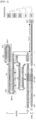
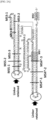
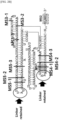
- MS2 Modification at modification site 2
- the guide RNA comprises a scaffold region and a spacer region as described above, wherein the scaffold region interacts with the Cas12f1 molecule (for example, Cas12f1 or a variant protein thereof) to contribute to formation of a CRISPR/Cas12f1 complex.
- the scaffold region may comprise a crRNA scaffold sequence and a tracrRNA scaffold sequence, and may be located at or bound to the 5'-end of the guide region.
- the scaffold region may be composed of a dual scaffold sequence or a single scaffold sequence.
- the scaffold sequence is composed of two different molecules, wherein the two molecules may comprise a crRNA scaffold sequence and a tracrRNA scaffold sequence, respectively.
- the guide RNA may also be composed of two molecules as a dual guide RNA. That is, the crRNA and tracrRNA in the dual guide RNA may exist independently of each other.
- the scaffold sequence may be composed of a single molecule, for example, it may include a tracrRNA scaffold sequence, a linker, and a crRNA scaffold sequence.
- the guide RNA may also be composed of a single molecule as a single guide RNA.
- the single guide RNA may be such that crRNA is linked directly or via a linker to tracrRNA.
- the single guide RNA may have a structure of 5'-(tracrRNA)-(linker)-(crRNA)-3'.
- the naturally occurring gRNA for CWCas12f1 protein may be a wild-type gRNA found in nature for wild-type Un1Cas12f1, which is similar in size to the CWCas12f1 protein. That is, in the present disclosure, the "wild-type" gRNA for Cas12f1 protein was used to mean "basic" or "canonical” gRNA.
- the wild-type gRNA includes two structures in which a part of tracrRNA (tracrRNA anti-repeat) and a part of crRNA repeat (crRNA repeat) are complementarily bound to form a duplex, which are conveniently referred to as R:AR1 (crRNA repeat-tracrRNA anti-repeat duplex 1) and R:AR2 (crRNA repeat-tracrRNA anti-repeat duplex 2) portions.
- the wild-type guide RNA may comprise (i) at least one stem-loop region, (ii) a tracrRNA-crRNA complementarity, and optionally (iii) a region comprising three or more, four or more, or five or more consecutive uracil (U) residues.
- the scaffold region of the wild-type guide RNA may sequentially comprise, from the 5'-end, a first stem-loop region, a second stem-loop region, a third stem-loop region, a fourth stem-loop region, and a fifth stem-loop region (or a fifth stem region or a tracrRNA-crRNA complementarity region).
- a first stem-loop region a second stem-loop region
- a third stem-loop region a fourth stem-loop region
- a fifth stem-loop region or a fifth stem region or a tracrRNA-crRNA complementarity region.
- the scaffold region of the wild-type dual guide RNA comprises five stem regions, that is, a first stem-loop region (stem 1), a second stem-loop region (stem 2), a third stem-loop region (stem 3), a fourth stem-loop region (stem 4), and a fifth stem region (stem 5 (including R:AR2)), from the 5'-end.
- stem 5 including R:AR2
- the region comprising stem 5 (R:AR2) is also referred to as a tracrRNA-crRNA complementarity region.
- the regions subdivided into stem or stem-loop region, tracrRNA-crRNA complementarity region, and the like do not encompass all regions of the scaffold sequence, and the scaffold sequence may further comprise other regions or sequences that do not correspond to the subdivided regions.
- the wild-type gRNA may comprise a wild-type tracrRNA having the nucleotide sequence of SEQ ID NO: 175, or a wild-type crRNA having the nucleotide sequence of SEQ ID NO: 176.
- the wild-type gRNA may be fused in the form of a single guide RNA to become a single guide RNA (sgRNA) having the nucleotide sequence of SEQ ID NO: 177.
- sgRNA single guide RNA having the nucleotide sequence of SEQ ID NO: 177.
- Representative sequences of the wild-type tracrRNA, crRNA, and sgRNA are presented in Table 6. [Table 6] Name Nucleotide sequence (5' ⁇ 3') SEQ ID NO Wild-type tracrRNA 175 Wild-type crRNA 176 Canonical sgRNA 177
- sequence indicated by 'NNNNNNNNNNNNNNNNNNNNNNNNNNNNNNNNNNNNNNNNNN' in Table 6 refers to a guide sequence (spacer sequence) having any length (for example, 15 to 40 nucleotides in length) that can hybridize with a target sequence within a target gene (for example, USH2A gene).
- the guide RNA for example, the first guide RNA and/or the second guide RNA
- the guide RNA for Cas12f1 or a variant protein thereof of the present disclosure is characterized in that it is an engineered guide RNA in which a new configuration is added to a wild-type guide RNA found in nature, or the canonical structure is modified (for example, deleted and/or substituted).
- the engineered gRNA (for example, the first gRNA and/or the second gRNA) is an engineered gRNA comprising a sequence having a wild-type gRNA sequence in which at least one nucleotide has been substituted, deleted, inserted, or added, and wherein the sequence excluding the guide sequence has at least 50%, 50%, 55%, 60%, 65%, 70%, 75%, 80%, 85%, 90%, 91%, 92%, 93%, 94%, 95%, 96%, 97%, 98%, 99% or 95% sequence identity to the wild-type Cas12f1 gRNA.
- sequence identity refers to a value determined by comparing two sequences that are optimally aligned over a comparison window, in which a sequence portion of RNA, nucleic acid, and the like within the comparison window may comprise insertions or deletions (that is, gaps) relative to the reference sequence to achieve optimal alignment.
- FIG. 1 illustrates modification sites MS1 to MS5 included in the engineered guide RNA according to an embodiment of the present disclosure on the wild-type guide RNA sequence.
- the first stem-loop region comprising modification site 3 (MS3), the second stem-loop region comprising modification site 5 (MS5), and the tracrRNA-crRNA complementarity region (the fifth stem region or the fifth stem-loop region) comprising modification site 1 (MS1) and modification site 4 (MS4) may be defined as corresponding to or included in regions marked by single dotted line boxes with different shades of color in FIG. 1 .
- the third stem-loop region may be defined as corresponding to or included in the G(-90)-C(-74) sequence in FIG. 1
- the fourth stem-loop region may be defined as corresponding to or included in the U(-68)-A(-35) sequence in FIG. 1 .
- the modifications applied to the engineered guide RNA (gRNA) of the present disclosure are ultimately intended to achieve high gene editing efficiency while deriving a gRNA that is shorter in length. That is, the modifications disclosed in the present disclosure are intended to produce an engineered gRNA of a shorter length having equal or improved recognition/cleavage efficiency for a target nucleic acid compared to the wild-type gRNA of a longer length, thereby allowing more space to be allocated to other components (for example, additional guide RNAs, shRNAs for suppressing specific gene expression, and the like) for various purposes or uses within the packaging limit (about 4.7 kb) of a delivery vehicle such as adeno-associated virus (AAV).
- AAV adeno-associated virus
- the engineered gRNA provided in the present disclosure basically comprises a sequence having the wild-type Cas12f1 gRNA sequence in which one or more nucleotides are substituted, deleted, inserted, or added.
- a portion thereof excluding the guide sequence may have a sequence identity of 50% or more, 60% or more, 70% or more, 80% or more, 85% or more, 90% or more, or 95% or more with the wild-type Cas12f1 gRNA.
- the engineered gRNA of the present disclosure may comprise at least one modification selected from the group consisting of (a) deletion of at least a part of the at least one stem-loop region; (b) deletion of at least a part of the tracrRNA-crRNA complementarity region; (c) replacement of one or more of uracil (U) residues when three or more, four or more, or five or more consecutive uracil (U) residues are present; and (d) addition of one or more uridine residues to the 3'-end of the crRNA sequence.
- the engineered guide RNA may comprise at least one modification selected from the group consisting of (a1) deletion of at least a part of the first stem-loop region; (a2) deletion of at least a part of the second stem-loop region; (b) deletion of at least a part of the tracrRNA-crRNA complementarity region; (c) replacement of one or more U with A, G or C in three or more, four or more, or five or more consecutive uracil (U) residues when the consecutive U residues are present in the tracrRNA-crRNA complementarity region; and (d) addition of a U-rich tail to the 3'-end of the crRNA sequence, wherein a sequence of the U-rich tail is represented by 5'-(U m V) n U o -3', wherein V is each independently A, C, or G, m and o are integers between 1 to 20, and n is an integer between 0 to 5.
- the engineered guide RNA may comprise a scaffold region comprising a (scaffold) sequence represented by Formula (I).
- X a , X b1 , X b2 , X c1 , and X c2 each independently consist of 0 to 35 (poly)nucleotides, and Lk is a polynucleotide linker of 2 to 20 nucleotides or is absent.
- the black solid line represents a chemical bond (for example, a phosphodiester bond) between nucleotides
- the gray thick line represents a complementary bond between nucleotides.
- X a , X b1 , X b2 , X c1 , or X c2 consists of 0 nucleotides or is absent, it is interpreted that if there are two or more nucleotides linked through X a , X b1 , X b2 , X c1 , or X c2 , these nucleotides are directly linked to each other in any way.
- nucleotide directly linked to the 5'-end of X b1 and the nucleotide directly linked to the 3'-end of X b1 may be directly linked, for example, by a phosphodiester bond.
- X a may be absent or a (poly)nucleotide having a stem-loop conformation. In another embodiment, X a may consist of 0 to 20 (poly)nucleotides.
- X b1 and X b2 may be (poly)nucleotides capable of complementary binding.
- X b1 may consist of 0 to 13 (poly)nucleotides, or X b2 may consist of 0 to 14 (poly)nucleotides.
- X c1 and X c2 may be (poly)nucleotides capable of complementary binding.
- X c1 may consist of 0 to 28 (poly)nucleotides, or X c2 may consist of 0 to 27 (poly)nucleotides.
- Lk is a polynucleotide linker of 2 to 20, 2 to 15, 2 to 10, or 2 to 8 nucleotides, or is absent.
- the scaffold region of the engineered gRNA may be a gRNA consisting of a scaffold sequence represented by Formula (I) or having at least 80%, at least 85%, at least 90%, or at least 95% sequence identity with the sequence.
- the sequence identity with Formula (I) is based on the sequence excluding the regions indicated by the symbols.
- the first stem-loop region of the scaffold sequence may be a region corresponding to or comprising X a in Formula (I).
- the second stem-loop region of the scaffold sequence may be a region corresponding to or comprising X b1 and X b2 in Formula (I).
- the second stem-loop region comprising X b1 and X b2 may be a region corresponding to the sequence 5'-CCGCUUCAC-X b1 -uuag-X b2 -AGUGAAGGUG-3'.
- the third stem region of the scaffold sequence may be a region corresponding to or comprising the sequence 5'-GGCUGCUUGCAUCAGCC-3' in Formula (I).
- the fourth stem-loop region of the scaffold sequence may be a region corresponding to or comprising the sequence 5'-UCGAGAAGUGCUUUCUUCGGAAAGUAACCCUCGA-3' in Formula (I).
- the tracrRNA-crRNA complementarity region (the fifth stem(-loop) region) of the scaffold sequence may be a region corresponding to X c1 and X c2 in Formula (I).
- wild-type tracrRNA for example, SEQ ID NO: 175
- gRNA naturally occurring guide RNA
- U uracil
- the engineered gRNA may be such that at least one uracil (U) of three or more, four or more, or five or more consecutive U residues, preferably four or five U residues, which are contained in the wild-type tracrRNA (for example, SEQ ID NO: 175), is artificially modified into another nucleotide such as A, C, T, or G.
- U uracil
- the engineered gRNA which comprises a modification in which at least one of three or more, four or more, or five or more consecutive U residues is substituted with a different type of nucleotide in a region containing three or more, four or more, or five or more consecutive U residues, referred to as MS1.
- the three or more, four or more, or five or more consecutive U residues may be present in the tracrRNA-crRNA complementarity region of the tracrRNA, wherein a modification may be made by substituting at least one of the three or more, preferably four or more, or five or more U residues with A, G, or C such that no sequence with three or more, preferably four or more, or five or more consecutive U residues exists.
- the sequence within the tracrRNA-crRNA complementarity region of crRNA which corresponds to the sequence to be modified, is also modified together.
- this sequence may be replaced with 5'-NGNNN-3'.
- N is each independently A, C, G, or U.
- the engineered gRNA of Formula (I) may comprise a modification in which one or more of the U residues are substituted with A, G, or C, when three or more, four or more, or five or more consecutive uracil (U) residues are present in the X c1 sequence.
- the sequence 5'-UUUUU-3' is present in the X c1 sequence, the sequence may be replaced with 5'-NNNCN-3', wherein N is each independently A, C, G, or U.
- the sequence 5'-UUUUU-3' in the X c1 sequence may be replaced by any one nucleotide sequence selected from the group consisting of the following sequences; however, the replacing sequence is not limited to the following sequences as long as it prevents appearance of a sequence containing three or more, preferably four or more or five or more consecutive U residues: 5'-UUUCU-3', 5'-GUUCU-3', 5'-UCUCU-3', 5'-UUGCU-3', 5'-UUUCC-3', 5'-GCUCU-3', 5'-GUUCC-3', 5'-UCGCU-3', 5'-UCUCC-3', 5'-UUGCC-3', 5'-GCGCU-3', 5'-GCUCC-3', 5'-GUGCC-3', 5'-UCGCC-3', 5'-GCGCC-3', and 5'-GUGCU-3'.
- the X c2 sequence comprises a region in which at least a part of the sequence forms a complementary bond with the X c1 sequence (also referred to as a tracrRNA-crRNA complementarity region), wherein a corresponding sequence in the X c2 sequence, which forms at least one complementary bond with 3 or more, 4 or more, or 5 or more consecutive U residues present in the X c1 sequence, may also be modified.
- the sequence 5'-ACGAA-3' is present in the X c2 sequence of Formula (I)
- the sequence may be replaced with 5'-NGNNN-3', wherein N is each independently A, C, G, or U.
- sequence 5'-ACGAA-3' in the X c1 sequence of Formula (I) may be replaced by any one nucleotide sequence selected from the group consisting of the following sequences; however, the replacing sequence is not limited to the following sequences: 5'-AGGAA-3', 5'-AGCAA-3', 5'-AGAAA-3', 5'-AGCAU-3', 5'-AGCAG-3', 5'-AGCAC-3', 5'-AGCUA-3', 5'-AGCGA-3', 5'-AGCCA-3', 5'-UGCAA-3', 5'-UGCUA-3', 5'-UGCGA-3', 5'-UGCCA-3', 5'-GGCAA-3', 5'-GGCUA-3', 5'-GGCGA-3', 5'-GGCCA-3', 5'-CGCAA-3', 5'-CGCUA-3', 5'-CGCGA-3', and 5'-CGCCA
- a sequence containing 3 or more, 4 or more, or 5 or more consecutive U residues in the X c1 sequence of Formula (I) is modified to another sequence
- it is preferred that the corresponding nucleotides in the X c2 sequence are modified so that they can form a complementary bond with the modified nucleotides.
- the sequence 5'-UUUUU-3' in the X c1 sequence is modified to 5'-GUGCU-3'
- the sequence 5'-ACGAA-3' in the X c2 sequence is modified to 5'-AGCAA-3'; however, complementary bonding is not necessarily required.
- the engineered guide RNA may be obtained by adding a new configuration to the gRNA found in nature, and may be such that one or more uridine residues are added to the 3'-end of the crRNA sequence, more specifically, the 3'-end of the spacer sequence included in the crRNA.
- the 3'-end of the crRNA sequence may be the 3'-end of the guide sequence (spacer).
- the one or more uridine residues added to the 3'-end are also referred to herein as a "U-rich tail.”
- the engineered gRNA comprising one or more uridines or a U-rich tail added to the 3'-end serves to increase nucleic acid cleavage or indel efficiency of the hypercompact CRISPR/Cas12f1 system for a target gene or target nucleic acid.
- U-rich tail may refer not only to an RNA sequence itself that is rich in uridine (U), but also a DNA sequence encoding the same, and this may be appropriately interpreted depending on the context.
- U uridine
- the present inventors have experimentally elucidated the structure and effects of the U-rich tail sequence in detail.
- the U-rich tail sequence will be described in more detail with specific embodiments.
- the U-rich tail sequence may be represented by Ux, wherein x may be 1, 2, 3, 4, 5, 6, 7, 8, 9, 10, 11, 12, 13, 14, 15, 16, 17, 18, 19, or 20.
- x may be an integer within a range of two numerical values selected from the numerical values listed above.
- x may be an integer between 1 and 6.
- x may be an integer between 1 and 20.
- x may be an integer of 20 or higher.
- the U-rich tail sequence is represented by 5'-(U m V) n U o -3', wherein V may be each independently A, C or G, m and o may be integers from 1 to 20, and n may be an integer from 0 to 5. As an example, n may be 0, 1, or 2. As an example, m and o may be each independently 1, 2, 3, 4, 5, 6, 7, 8, 9, or 10.
- the U-rich tail sequence may be a U-rich tail represented by 5'-(U m V) n U o -3', wherein (i) n is 0, o is an integer between 1 and 6, or (ii) V is each independently A or G, m and o are each independently an integer between 3 and 6, and n is an integer between 1 and 3.
- the U-rich tail may consist of any one sequence selected from the group consisting of 5'-U-3', 5'-UU-3', 5'-UUU-3', 5'-UUUU-3', 5'-UUUUU-3', 5'-UUUUUU-3', 5'-UUUUUU-3', 5'-UUURUUU-3', 5'-UUUURU-3', 5'-UUUURU-3', 5'-UUUURUU-3', 5'-UUUURUU-3', 5'-UUUURUUU-3', 5'-UUUURUUU-3', 5'-UUUURUUU-3', 5'-UUUURUUU-3', 5'-UUUURUUU-3', 5'-UUUURUUU-3', 5'-UUUURUUU-3', 5'-UUUURUUUU-3', 5'-U
- the U-rich tail may be a sequence consisting of or comprising the sequence 5'-UUUUUUUUUU-3' (SEQ ID NO: 351), 5'-UUAUUUAUUU-3' (SEQ ID NO: 352), 5'-UUUCUAUUUU-3' (SEQ ID NO: 353), or 5'-UUAUGUUUUU-3' (SEQ ID NO: 354).
- the U-rich tail sequence may comprise a modified uridine repeat sequence that contains a non-uridine ribonucleoside (A, C, or G) for every 1 to 5 repetitions of uridine.
- the modified uridine repeat sequence is particularly useful in a case of designing a vector that expresses an engineered crRNA.
- the U-rich tail sequence may comprise a sequence in which UV, UUV, UUUV, UUUUV, and/or UUUUUV are repeated one or more times.
- V is one of A, C or G.
- the U-rich tail sequence may be a combination of the sequence represented by Ux and the sequence represented by 5'-(U m ) n -3'.
- the U-rich tail sequence may be represented by (U)n1-V1-(U)n2-V2-Ux.
- V1 and V2 are each one of adenine (A), cytidine (C), and guanine (G).
- n1 and n2 may each be an integer between 1 and 4.
- x may be an integer between 1 and 20.
- the U-rich tail sequence may have a length of 1 nt, 2 nts, 3 nts, 4 nts, 5 nts, 6 nts, 7 nts, 8 nts, 9 nts, 10 nts, 11 nts, 12 nts, 13 nts, 14 nts, 15 nts, 16 nts, 17 nts, 18 nts, 19 nts, or 20 nts.
- the U-rich tail sequence may have a length of 20 nts or longer.
- the U-rich tail when the engineered gRNA is expressed in a cell, the U-rich tail may be expressed as one or more sequences due to premature termination of transcription.
- a gRNA intended to contain a U-rich tail of the sequence 5'-UUUUAUUUUU-3' is transcribed in a cell, four or more or five or more T residues may act as a termination sequences, and thus gRNAs containing a U-rich tail such as 5'-UUUAUUU-3', 5'-UUUUAUUUUU-3', or 5'-UUUUAUUUUU-3' may be produced simultaneously. Therefore, in the present disclosure, a U-rich tail containing four or more U residues may be understood to also include a U-rich tail sequence having a shorter length than the intended length.
- the U-rich tail sequence may comprise additional nucleotides other than uridine, depending on the environment where the gene editing system of the present disclosure is actually used and expression environment, such as the internal environment of a eukaryotic cell or a prokaryotic cell.
- MS3 refers to a region (which may be referred to as the first stem-loop region) that comprises at least a part of the nucleotides forming a stem-loop structure within a complex of the gRNA with an effector protein.
- the MS3 may comprise a region that does not interact with the effector protein when the gRNA and effector protein form a complex.
- the modification at MS3 involves removal of at least a part of first stem-loop region near the 5'-end of tracrRNA.
- the engineered gRNA comprises a modification in which at least a part of first stem-loop region (for example, the sequence of SEQ ID NO: 178) is deleted.
- the engineered gRNA comprises a modification in which at least a part of first stem-loop region on tracrRNA is deleted, wherein at least a part of the first stem-loop region to be deleted may consist of 1 to 20 nucleotides.
- at least a part of the first stem-loop region may consist of 2 to 20, 3 to 20, 4 to 20, 5 to 20, 6 to 20, 7 to 20, 8 to 20, 9 to 20, 10 to 20, 11 to 20, 12 to 20, 13 to 20, 14 to 20, 15 to 20, 16 to 20, 17 to 20, 18 to 20, 19, or 20 nucleotides.
- the MS3 or the first stem-loop region is a portion corresponding to the polynucleotide indicated by X a of Formula (I), wherein due to a modification in which at least a part of the first stem-loop region is deleted, X a may consist of 0 to 35 (poly)nucleotides, preferably 0 to 20, 0 to 19, 0 to 18, 0 to 17, 0 to 16, 0 to 15, 0 to 14, 0 to 13, 0 to 12, 0 to 11, 0 to 10, 0 to 9, 0 to 8, 0 to 7, 0 to 6, 0 to 5, 0 to 4, 0 to 3, 0 to 2, 1 or 0 (poly)nucleotides.
- X a may comprise the nucleotide sequence of SEQ ID NO: 178 or may comprise a nucleotide sequence having at least a part thereof, preferably a nucleotide sequence having the sequence of SEQ ID NO: 178 from which 1 to 20 nucleotides are deleted.
- the nucleotide deletion may involve random deletion of at least 1, 2, 3, 5, 6, 7, 8, 9, 10, 11, 12, 13, 14 15, 16, 17, 18, 19, or 20 nucleotides from the sequence of SEQ ID NO: 178.
- the nucleotide deletion may involve sequential deletion of at least 1, 2, 3, 5, 6, 7, 8, 9, 10, 11, 12, 13, 14 15, 16, 17, 18, 19, or 20 nucleotides from the 5'-end of the sequence of SEQ ID NO: 178.
- X a of Formula (I) may comprise or consist of 5'-CUUCACUGAUAAAGUGGAGA-3' (SEQ ID NO: 178), 5'-UUCACUGAUAAAGUGGAGA-3' (SEQ ID NO: 179), 5'-UCACUGAUAAAGUGGAGA-3' (SEQ ID NO: 180), 5'-CACUGAUAAAGUGGAGA-3' (SEQ ID NO: 181), 5'-ACUGAUAAAGUGGAGA-3' (SEQ ID NO: 182), 5'-CUGAUAAAGUGGAGA-3' (SEQ ID NO: 183), 5'-UGAUAAAGUGGAGA-3' (SEQ ID NO: 184), 5'-GAUAAAGUGGAGA-3' (SEQ ID NO: 184), 5'
- MS4 refers to a region spanning the 3'-end of tracrRNA and the 5'-end of crRNA, or, in a case of a single guide RNA form, a region where the sequence corresponding to tracrRNA and the sequence corresponding to crRNA form at least partial complementary bonding.
- MS4 may comprise at least a part of the sequence referred to as the tracrRNA-crRNA complementarity region (which may also be referred to as the fifth stem region).
- the tracrRNA-crRNA complementarity region may comprise both modification site 1 (MS1) and modification site 4 (MS4).
- the modification at MS4 comprises deletion of at least a part of the tracrRNA-crRNA complementarity region.
- the tracrRNA-crRNA complementarity region may comprise a part of tracrRNA and a part of crRNA.
- the tracrRNA-crRNA complementarity region may comprise nucleotides such that partial nucleotides contained in tracrRNA can form complementary bonds with partial nucleotides contained in crRNA within a complex of gRNA with the nucleic acid degrading protein, and may comprise nucleotides adjacent thereto.
- the tracrRNA-crRNA complementarity region of tracrRNA may comprise a region that does not interact with the nucleic acid degrading protein within a complex of gRNA with the nucleic acid degrading protein.
- the engineered gRNA comprises deletion of at least a part of the tracrRNA-crRNA complementarity region in tracrRNA, deletion of at least a part of the tracrRNA-crRNA complementarity region in crRNA, or deletion of at least a part of the tracrRNA-crRNA complementarity region in both the tracrRNA and the crRNA.
- the tracrRNA-crRNA complementarity region may comprise the nucleotide sequence of SEQ ID NO: 203 and/or the nucleotide sequence of SEQ ID NO: 222.
- the tracrRNA-crRNA complementarity region may further comprise a linker (for example, a polynucleotide) linking the 3'-end of the tracrRNA and the 5'-end of the crRNA.
- a linker for example, a polynucleotide
- the engineered gRNA comprises a modification in which a part of the tracrRNA-crRNA complementarity region is deleted, wherein the part of the complementary region to be deleted may consist of 1 to 54 nucleotides.
- the engineered gRNA comprises a modification in which the entire tracrRNA-crRNA complementarity region is deleted, wherein the entire complementary region to be deleted may consist of 55 nucleotides.
- the tracrRNA-crRNA complementarity region may consist of 3 to 55, 5 to 55, 7 to 55, 9 to 55, 11 to 55, 13 to 55, 15 to 55, 17 to 55, 19 to 55, 21 to 55, 23 to 55, 25 to 55, 27 to 55, 29 to 55, 31 to 55, 33 to 55, 35 to 55, 37 to 55, 39 to 55, or 41 to 55 nucleotides, preferably 42 to 55, 43 to 55, 44 to 55, 45 to 55, 46 to 55, 47 to 55, 48 to 55, 49 to 55, 50 to 55, 51 to 55, 52 to 55, 53 to 55, 54, or 55 nucleotides.
- MS4 or the tracrRNA-crRNA complementarity region is a region corresponding to the polynucleotide indicated by X c1 and X c2 in Formula (I), in which due to the modification where at least a part of the tracrRNA-crRNA complementarity region is deleted, X c1 and X c2 may each independently consist of 0 to 35 (poly)nucleotides.
- X c1 may consist of 0 to 28, 0 to 27, 0 to 26, 0 to 25, 0 to 24, 0 to 23, 0 to 22, 0 to 21, 0 to 20, 0 to 19, 0 to 18, 0 to 17, 0 to 16, 0 to 15, 0 to 14, 0 to 13, 0 to 12, 0 to 11, 0 to 10, 0 to 9, 0 to 8, 0 to 7, 0 to 6, 0 to 5, 0 to 4, 0 to 3, 0 to 2, 1, or 0 (poly)nucleotides.
- X c2 may consist of 0 to 27, 0 to 26, 0 to 25, 0 to 24, 0 to 23, 0 to 22, 0 to 21, 0 to 20, 0 to 19, 0 to 18, 0 to 17, 0 to 16, 0 to 15, 0 to 14, 0 to 13, 0 to 12, 0 to 11, 0 to 10, 0 to 9, 0 to 8, 0 to 7, 0 to 6, 0 to 5, 0 to 4, 0 to 3, 0 to 2, 1, or 0 (poly)nucleotides.
- X c1 may comprise the nucleotide sequence of SEQ ID NO: 203 or a nucleotide sequence having the sequence of SEQ ID NO: 203 from which 1 to 28 nucleotides are deleted.
- the nucleotide deletion may involve sequential removal of at least 1, 2, 3, 5, 6, 7, 8, 9, 10, 11, 12, 13, 14, 15, 16, 17, 18, 19, 20, 21, 22, 23, 24, 25, 26, 27, or 28 nucleotides from the 5'-end of the sequence of SEQ ID NO: 203.
- X c1 may comprise or consist of 5'-UUCAUUUUUCCUCUCCAAUUCUGCACAA-3' (SEQ ID NO: 203), 5'-UUCAUUUUUCCUCUCCAAUUCUGCACA-3' (SEQ ID NO: 204), 5'-UUCAUUUUUCCUCUCCAAUUCUGCAC-3' (SEQ ID NO: 205), 5'-UUCAUUUUUCCUCUCCAAUUCUGCA-3' (SEQ ID NO: 206), 5'-UUCAUUUUUCCUCUCCAAUUCUGC-3' (SEQ ID NO: 207), 5'-UUCAUUUUUCCUCUCCAAUUCUG-3' (SEQ ID NO: 208), 5'-UUCAUUUUUCCUCUCCAAUUCU-3' (SEQ ID NO: 209), 5'-UUCAUUUUUCCUCUCCAAUUC-3' (SEQ ID NO: 210), 5'-UUCAUUUUUCCUCU
- X c2 may comprise the nucleotide sequence of SEQ ID NO: 222 or a nucleotide sequence having the sequence of SEQ ID NO: 222 from which 1 to 27 nucleotides are deleted.
- the nucleotide deletion may involve sequential removal of at least 1, 2, 3, 5, 6, 7, 8, 9, 10, 11, 12, 13, 14, 15, 16, 17, 18, 19, 20, 21, 22, 23, 24, 25, 26, or 27 nucleotides from the 5'-end of the sequence of SEQ ID NO: 222.
- X c2 may comprise or consist of 5'-GUUGCAGAACCCGAAUAGACGAAUGAA-3' (SEQ ID NO: 222), 5'-UUGCAGAACCCGAAUAGACGAAUGAA-3' (SEQ ID NO: 223), 5'-UGCAGAACCCGAAUAGACGAAUGAA-3' (SEQ ID NO: 224), 5'-GCAGAACCCGAAUAGACGAAUGAA-3' (SEQ ID NO: 225), 5'-CAGAACCCGAAUAGACGAAUGAA-3' (SEQ ID NO: 226), 5'-AGAACCCGAAUAGACGAAUGAA-3' (SEQ ID NO: 227), 5'-GAACCCGAAUAGACGAAUGAA-3' (SEQ ID NO: 228), 5'-AACCCGAAUAGACGAAUGAA-3' (SEQ ID NO: 229), 5'-ACCCGAAUAGACGAAUGAA-3' (SEQ ID NO: 230), 5'-CCCGAAUAGACGAAUGAA-3' (SEQ
- the regions corresponding to X c1 and X c2 may each independently undergo the above-described modification.
- MS4 or the tracrRNA-crRNA complementarity region is a region where tracrRNA and crRNA form complementary bonds.
- the position and number of nucleotides to be deleted in each of X c1 and X c2 be identical with or similar to each other.
- deletion of the X c1 and X c2 nucleotide sequences may involve deletion of one or more complementary nucleotide pairs.
- the 3'-end of X c1 and the 5'-end of X c2 in the scaffold sequence of Formula (I) may be linked by a linker (Lk) so that the gRNA is modified into a single guide RNA (sgRNA) form.
- Lk is a sequence that physically or chemically connects tracrRNA and crRNA, and may be a polynucleotide sequence having a length of 1 to 30 nucleotides.
- Lk may be a sequence of 1 to 5, 5 to 10, 10 to 15, 2 to 20, 15 to 20, 20 to 25, or 25 to 30 nucleotides.
- Lk may be, but is not limited to, 5'-GAAA-3'.
- Lk may be a linker comprising or consisting of 5'-UUAG-3', 5'-UGAAAA-3', 5'-UUGAAAAA-3', 5'-UUCGAAAGAA-3' (SEQ ID NO: 240), 5'-UUCAGAAAUGAA-3' (SEQ ID NO: 241), 5'-UUCAUGAAAAUGAA-3' (SEQ ID NO: 242), or 5'-UUCAUUGAAAAAUGAA-3' (SEQ ID NO: 243).
- Lk linker
- sgRNA single guide RNA
- a case where X c1 and X c2 in the scaffold sequence of Formula (I) are linked by a linker may be indicated by 5'-X c1 -Lk-X c2 -3' as in Formula (I), and the 5'-X c1 -Lk-X c2 -3' may be any one nucleotide sequence selected from the group consisting of SEQ ID NOs: 244 to 250 and 5'-Lk-3' (a form in which both X c1 and X c2 are deleted), but is not limited thereto.
- MS5 corresponds to a region located toward the 3'-end of tracrRNA, which is referred to as the second stem-loop region.
- the second stem-loop region may comprise nucleotides that form a stem structure within a complex of the guide RNA (gRNA) with nucleic acid editing protein, and may comprise nucleotides adjacent thereto.
- the stem or stem-loop structure is distinct from the stem included in the above-described first stem-loop region.
- MS5 or the second stem-loop region is a region comprising a (poly)nucleotide (comprising a loop of 5'-UUAG-3') that is adjacent to the polynucleotide indicated by X b1 and X b2 in Formula (I), in which due to the modification where at least the part of the second stem region is deleted, X b1 and X b2 may each independently consist of 0 to 35 (poly)nucleotides.
- the engineered gRNA comprises a modification in which at least a part of the second stem-loop region is deleted.
- the engineered gRNA comprises deletion of at least a part of the second stem-loop region, wherein at least a part of the second stem-loop region to be deleted may consist of 1 to 27 nucleotides.
- the at least a part of the second stem region may consist of 2 to 27, 3 to 27, 4 to 27, 5 to 27, 6 to 27, 7 to 27, 8 to 27, 9 to 27, 10 to 27, 11 to 27, 12 to 27, 13 to 27, 14 to 27, 15 to 27, 16 to 27, 17 to 27, 18 to 27, 19 to 27, 20 to 27, 21 to 27, 22 to 27, 23 to 27, 24 to 27, 25 to 27, 26, or 27 nucleotides.
- X b1 in Formula (I) may consist of 0 to 13, 0 to 12, 0 to 11, 0 to 10, 0 to 9, 0 to 8, 0 to 7, 0 to 6, 0 to 5, 0 to 4, 0 to 3, 0 to 2, 1, or 0 (poly)nucleotides.
- X b2 may consist of 0 to 14, 0 to 13, 0 to 12, 0 to 11, 0 to 10, 0 to 9, 0 to 8, 0 to 7, 0 to 6, 0 to 5, 0 to 4, 0 to 3, 0 to 2, 1, or 0 (poly)nucleotides.
- X b1 may comprise the nucleotide sequence of SEQ ID NO: 189 or a nucleotide sequence having the sequence of SEQ ID NO: 189 from which 1 to 13 nucleotides are deleted.
- the nucleotide deletion may involve sequential removal of at least 1, 2, 3, 5, 6, 7, 8, 9, 10, 11, 12, or 13 nucleotide from the 5'-end of the sequence of SEQ ID NO: 189.
- X b1 may comprise or consist of 5'-CAAAAGCUGUCCC-3' (SEQ ID NO: 189), 5'-CAAAAGCUGUCC-3' (SEQ ID NO: 190), 5'-CAAAAGCUGUC-3' (SEQ ID NO: 191), 5'-CAAAAGCUGU-3' (SEQ ID NO: 192), 5'-CAAAAGCUG-3', 5'-CAAAAGCU-3', 5'-CAAAAGC-3', 5'-CAAAAAAG-3', 5'-CAAAA-3', 5'-CAAA-3', 5'-CAA-3', 5'-CA-3', or 5'-C-3', or X b1 may be absent.
- X b2 may comprise the nucleotide sequence of SEQ ID NO: 193 or a nucleotide sequence having the sequence of SEQ ID NO: 193 from which 1 to 14 nucleotides are deleted.
- the nucleotide deletion may involve sequential removal of at least 1, 2, 3, 5, 6, 7, 8, 9, 10, 11, 12, 13, or 14 nucleotides from the 5'-end of the sequence of SEQ ID NO: 193.
- X b2 may comprise or consist of 5'-GGGAUUAGAACUUG-3' (SEQ ID NO: 193), 5'-GGAUUAGAACUUG-3' (SEQ ID NO: 194), 5'-GAUUAGAACUUG-3' (SEQ ID NO: 195), 5'-AUUAGAACUUG-3' (SEQ ID NO: 196), 5'-UUAGAACUUG-3' (SEQ ID NO: 197), 5'-UAGAACUUG-3', 5'-AGAACUUG-3', 5'-GAACUUG-3', 5'-AACUUG-3', 5'-ACUUG-3', 5'-CUUG-3', 5'-UUG-3', 5'-UG-3', or 5'-G-3', or X b2 may be absent.
- the regions corresponding to X b1 and X b2 may be each independently modified.
- the position and number of nucleotides to be deleted in each of X b1 and X b2 be identical with or similar to each other.
- the deletion of the nucleotide sequences X b1 and X b2 may be deletion of one or more complementary nucleotide pairs.
- a sequence of the loop portion connecting X b1 and X b2 in the scaffold sequence of Formula (I) is indicated by 5'-UUAG-3', and this may be replaced with another sequence such as 5'-NNNN-3' and '5-NNN-3', if necessary.
- N is each independently A, C, G, or U.
- the 5'-NNNN-3' may be 5'-GAAA-3'
- the '5-NNN-3' may be 5'-CGA-3'.
- a sequence of the loop portion connecting X b1 and X b2 is 5'-UUAG-3'
- the sequence 5'-X b1 UUAG X b2 -3' in Formula (I) may comprise or consist of any one nucleotide sequence selected from the group consisting of SEQ ID NOs: 198 to 202 and 5'-UUAG-3' (a form in which both X b1 and X b2 are deleted).
- the engineered guide RNA (for example, the engineered first guide RNA and/or the engineered second guide RNA) included in the USH2A gene editing system of the present disclosure may comprise modifications at two or more of the above-mentioned modification sites 1 (MS1) to 5 (MS5).
- the engineered guide RNA may comprise one or more modifications selected from the group consisting of (a1) deletion of at least a part of the first stem-loop region; (a2) deletion at least a part of the second stem-loop region; (b) deletion of at least a part of the tracrRNA-crRNA complementarity region; (c) replacement of one or more uracil (U) residues with A, G, or C in three or more consecutive U residues when the consecutive U residues are present in the tracrRNA-crRNA complementarity region; and (d) addition of a U-rich tail to the 3'-end of the crRNA sequence.
- the U-rich tail sequence may be represented by 5'-(U m V) n U o -3', wherein V is each independently A, C, or G, m and o are integers between 1 to 20, and n is an integer between 0 to 5.
- the engineered guide RNA may comprise (d) addition of a U-rich tail to the 3'-end of the crRNA sequence and (c) replacement of one or more uracil (U) residues with A, G, or C in three or more, four or more, or five or more consecutive U residues when the consecutive U residues are present in the tracrRNA-crRNA complementarity region.
- U uracil
- the engineered guide RNA may comprise (d) addition of a U-rich tail to the 3'-end of the crRNA sequence, (c) replacement of one or more U with A, G or C in three or more, four or more, or five or more consecutive U residues when the consecutive U residues are present in the tracrRNA-crRNA complementarity region, and (a1) deletion of at least a part of first stem-loop region.
- the engineered guide RNA may comprise (d) addition of a U-rich tail to the 3'-end of the crRNA sequence, (c) replacement of one or more U with A, G or C in three or more, four or more, or five or more consecutive U residues when the consecutive U residues are present in the tracrRNA-crRNA complementarity region, and (a1) deletion of at least a part of first stem-loop region.
- the engineered guide RNA may comprise (d) addition of a U-rich tail to the 3'-end of the crRNA sequence, (a1) deletion of at least a part of the first stem-loop region, and (b) deletion of at least a part of the tracrRNA-crRNA complementarity region, wherein the engineered guide RNA may further comprise replacement of one or more U with A, G or C in three or more, four or more, or five or more consecutive U residues when the consecutive U residues are present in the tracrRNA-crRNA complementarity region containing partial deletion.
- the engineered guide RNA may comprise (d) addition of a U-rich tail to the 3'-end of the crRNA sequence, (a1) deletion of at least a part of the first stem-loop region, (b) deletion of at least a part of the tracrRNA-crRNA complementarity region, and (a2) deletion of at least a part of the second stem-loop region, wherein the engineered guide RNA may further comprise replacement of one or more U with A, G or C in three or more, four or more, or five or more consecutive U residues when the consecutive U residues are present in the tracrRNA-crRNA complementarity region containing partial deletion.
- an engineered tracrRNA comprising the nucleotide sequence of any one of SEQ ID NOs: 251 to 296.
- the engineered tracrRNA may comprise or consist of the nucleotide sequence of SEQ ID NO: 251 (MS1), SEQ ID NO: 252 (MS1/MS3-1), SEQ ID NO: 253 (MS1/MS3-2), SEQ ID NO: 254 (MS1/MS3-3), SEQ ID NO: 255 (MS1/MS4*-1), SEQ ID NO: 256 (MS1/MS4*-2), SEQ ID NO: 257 (MS1/MS4*-3), SEQ ID NO: 258 (MS1/MS5-1), SEQ ID NO: 259 (MS1/MS5-2), SEQ ID NO: 260 (MS1/MS5-3), SEQ ID NO: 261 (MS1/MS3-3/MS4*-1), SEQ ID NO: 262 (MS1/MS3-3/MS4*-2), SEQ ID NO: 263 (MS1/MS3-3/MS4*-3), SEQ ID NO: 264 (MS1/MS4*-2/MSS-1), SEQ ID NO: 265 (MS1/MS4*-2/MSS-2
- exemplary sequences of the engineered tracrRNA which has one or more modifications at any one or more of the modification sites selected from MS1, MS3, MS4, and MS5, are provided in Table 7 below.
- Such an engineered tracrRNA constitutes part of the scaffold sequence of the scaffold region.
- an engineered crRNA comprising the nucleotide sequence of any one of SEQ ID NOs: 297 to 312.
- the engineered crRNA of the present disclosure may comprise or consist of the nucleotide of SEQ ID NO: 297 (MS1), SEQ ID NO: 298 (MS1/MS4*-1), SEQ ID NO: 299 (MS1/MS4*-2), SEQ ID NO: 300 (MS1/MS4*-3), SEQ ID NO: 301 (mature form; MF), SEQ ID NO: 302 (MF/MS4-1), SEQ ID NO: 303 (MF/MS4-2), SEQ ID NO: 304 (MF/MS4-3), SEQ ID NO: 305 (MS1/MS2), SEQ ID NO: 306 (MS1/MS2/MS4M), SEQ ID NO: 307 (MS1/MS2/MS4*-2), SEQ ID NO: 308 (MS1/MS2/MS4*-3), SEQ ID NO: 309 (MF/MS2), SEQ ID NO: 310 (MF/MS2/MS4-1), SEQ ID NO: 311 (MF/MS2/MS4-2), or SEQ ID NO: 312 (MF/MS2)
- exemplary sequences of the engineered crRNA which has one or more modifications at any one or more modification sites selected from MS1, MS2, and MS4 are provided in Table 8 below.
- Table 8 tracrRNA Nucleotide sequence SEQ ID NO MS1 GUUGCAGAACCCGAAUAGAGCAAUGAAGGAAUGCAAC 297 MS1/MS4*-1 GAACCCGAAUAGAGCAAUGAAGGAAUGCAAC 298 MS1/MS4*-2 GAAUAGAGCAAUGAAGGAAUGCAAC 299 MS1/MS4*-3 AGCAAUGAAGGAAUGCAAC 300 MF GAAUGAAGGAAUGCAAC 301 MF/MS4-1 AUGAAGGAAUGCAAC 302 MF/MS4-2 GAAGGAAUGCAAC 303 MF/MS4-3 GGAAUGCAAC 304 MS1/MS2 305 MS1/MS2/ MS4*-1 306 MS1/MS2/ MS4*-2 307 MS1/MS2/ MS4*-3 308 MF/MS2 309 MF/MS2/M SEQ ID NO MS1
- indication of a guide sequence is omitted from all crRNA sequences omit unless necessary, and the sequence indicated by 'NNNNNNNNNNNNNNNNNNNNNN' indicates any guide sequence (spacer) that can hybridize with a target sequence in a target gene (for example, USH2A gene).
- the guide sequence may be appropriately designed by a person skilled in the art depending on a desired target gene and/or a target sequence in the target gene as described above, and therefore is not limited to a specific sequence of a particular length.
- the scaffold region of the engineered gRNA may comprise tracrRNA comprising or consisting of any one nucleotide sequence selected from the group consisting of SEQ ID NOs: 251 to 296; and crRNA comprising or consisting of any one nucleotide sequence selected from the group consisting of SEQ ID NOs: 297 to 304.
- the first guide RNA or the second guide RNA of the present disclosure may comprise a sequence of a scaffold region of a nucleotide sequence selected from the group consisting of SEQ ID NOs: 313 to 350.
- the scaffold region of the nucleotide sequence means the remaining region excluding the spacer region present at the 3'-end portion of crRNA (for example, the region indicated by 5'-NNNNNNNNNNNNNNNNNN-3' in the nucleotide sequence of any one of SEQ ID NOs: 313 to 350).
- the scaffold region of the engineered sgRNA may comprise or consist of any one nucleotide sequence selected from the group consisting of SEQ ID NOs: 313 to 350.
- the 5'-NNNNNNNNNNNNNNNNNNNNNNNNNN-3', 5'-NNNNNNNNNNNNNNNNNNNUUUUAUUUU-3', or 5'-NNNNNNNNNNNNNNNNNNNUUUUAUUUUU-3' sequence present at the 3'-end of SEQ ID NOs: 313 to 350 is excluded.
- the engineered sgRNA may be sgRNA of SEQ ID NO: 313 comprising a modification at MS1, sgRNA of SEQ ID NO: 314 comprising modifications at MS1/MS2, sgRNA of SEQ ID NO: 315 comprising modifications at MS1/MS2/MS3, sgRNA of SEQ ID NO: 316 comprising modifications at MS2/MS3/MS4, or sgRNA of SEQ ID NO: 317 comprising modifications at MS2/MS3/MS4/MS5.
- the sequence indicated by 5'-NNNNNNNNNNNNNNNNNNNNNNNN-3' refers to a guide sequence. For details regarding the guide sequence, see the entire contents described in section "2.2. Spacer region comprising guide sequence.”
- the engineered sgRNA may be sgRNA comprising or consisting of the nucleotide sequence of SEQ ID NO: 318 (MS1/MS3-1), SEQ ID NO: 319 (MS1/MS3-2), SEQ ID NO: 320 (MS1/MS3-3), SEQ ID NO: 321 (MS1/MS4*-1), SEQ ID NO: 322 (MS1/MS4*-2), SEQ ID NO: 323 (MS1/MS4*-3), SEQ ID NO: 324 (MS1/MS5-1), SEQ ID NO: 325 (MS1/MS5-2), SEQ ID NO: 326 (MS1/MS5-3), SEQ ID NO: 327 (MS1/MS2/MS4*-2), SEQ ID NO: 328 (MS1/MS3-3/MS4*-2), SEQ ID NO: 329 (MS1/MS2/MS5-3), SEQ ID NO: 330 (MS1/MS3-3/MS5-3), SEQ ID NO: 331 (MS1/MS4*-2/MS5-3), SEQ ID NO: 332
- sequence indicated by 5'-NNNNNNNNNNNNNNNNNNNNNNNNNNNN-3' in the nucleotide sequences of SEQ ID NOs: 318 to 336 refers to a guide sequence.
- Spacer region comprising guide sequence see the entire contents described in section "2.2. Spacer region comprising guide sequence.”
- the sgRNA may be sgRNA comprising or consisting of the nucleotide sequence of SEQ ID NO: 337, which is a mature form (abbreviated as MF) of sgRNA.
- the MF sgRNA may be sgRNA comprising or consisting of the nucleotide sequence of SEQ ID NO: 338 (MS3-1), SEQ ID NO: 339 (MS3-2), SEQ ID NO: 340 (MS3-3), SEQ ID NO: 341 (MS4-1), SEQ ID NO: 342 (MS4-2), SEQ ID NO: 343 (MS4-3), SEQ ID NO: 344 (MS5-1), SEQ ID NO: 345 (MS5-2), SEQ ID NO: 346 (MS5-3), SEQ ID NO: 347 (MS3-3/MS4-3), SEQ ID NO: 348 (MS3-3/MS5-3), SEQ ID NO: 349 (MS4-3/MS5-3), or SEQ ID NO: 350 (MS3-3/MS4-3/MS5-3).
- sequence indicated by 5'-NNNNNNNNNNNNNNNNNNNNNNNNNN-3' in the nucleotide sequences of the SEQ ID NOs: 337 to 350 refers to a guide sequence.
- sequence indicated by 5'-NNNNNNNNNNNNNNNNNNNNNNNN-3' in the nucleotide sequences of the SEQ ID NOs: 337 to 350 refers to a guide sequence.
- Spacer region comprising guide sequence see the entire contents described in section "2.2. Spacer region comprising guide sequence.”
- the engineered sgRNA may consist of the nucleotide sequence of SEQ ID NO: 315 (Cas12f1 ver3.0), SEQ ID NO: 316 (Cas12f1 ver4.0), or SEQ ID NO: 317 (Cas12f1 ver4.1).
- SEQ ID NO: 315 Cas12f1 ver3.0
- SEQ ID NO: 316 Cas12f1 ver4.0
- SEQ ID NO: 317 Cas12f1 ver4.1
- the sequence indicated by 5'-NNNNNNNNNNNNNNNNNNNNNN-3' refers to a guide sequence.
- 5'-NNNNNNNNNNNNNNNNNNNNNNNNNNNNNN-3' refers to a guide sequence.
- the engineered tracrRNA of the present disclosure may optionally further comprise an additional sequence.
- the additional sequence may also be located at the 3'-end of the engineered tracrRNA.
- the additional sequence may be located at the 5'-end of the engineered tracrRNA.
- the additional sequence may be located at the 5'-end of the first stem-loop region.
- the additional sequence may consist of 1 to 40 nucleotides.
- the additional sequence may be any nucleotide sequence or a randomly arranged nucleotide sequence.
- the additional sequence may be 5'-AUAAAGGUGA-3' (SEQ ID NO: 355).
- the additional sequence may be a known nucleotide sequence.
- the additional sequence may be a hammerhead ribozyme nucleotide sequence.
- the hammerhead ribozyme nucleotide sequence may be 5'-CUGAUGAGUCCGUGAGGACGAAACGAGUAAGCUCGUC-3' (SEQ ID NO: 356) or 5'-CUGCUCGAAUGAGCAAAGCAGGAGUGCCUGAGUAGUC-3' (SEQ ID NO: 357).
- the sequences listed above are merely examples, and the additional sequence is not limited thereto.
- the engineered tracrRNA or engineered crRNA included in the engineered gRNA may have chemical modification in at least one or more nucleotides, if necessary.
- the chemical modification may be a modification in various covalent bonds that may occur in a nucleotide base and/or sugar portion.
- the chemical modification may be methylation, halogenation, acetylation, phosphorylation, phosphorothioate (PS) linkage, locked nucleic acid (LNA), 2'-O-methyl 3'phosphorothioate (MS) or 2'-O-methyl 3'thioPACE (MSP).
- LNA locked nucleic acid
- MS 2'-O-methyl 3'phosphorothioate
- MSP 2'-O-methyl 3'thioPACE
- indel efficiency for a target gene or target nucleic acid in a cell is significantly improved compared to a case of using the guide RNA found in nature, so that a large-scale deletion effect may be exhibited.
- the engineered gRNA may involve optimized length for high efficiency and resulting cost reduction in gRNA synthesis, creation of additional space or capacity in a case of being inserted into a viral vector, normal expression of tracrRNA, increased expression of operable gRNA, increased gRNA stability, increased stability of complex of gRNA with gene editing protein, induction of formation of complex of gRNA with gene editing protein at high efficiency, increased cleavage efficiency of target nucleic acid by hypercompact USH2A gene editing system comprising complex of gRNA with gene editing protein, and increased deletion efficiency for a specific region in a desired gene by such a system.
- the engineered gRNA has a short length compared to gRNA found in nature, and thus has high applicability in the field of gene editing technology.
- the hypercompact gene editing system comprising a complex of the gRNA with gene editing protein has advantages of being very small in size and having excellent editing efficiency, which allows the system to be utilized in various gene editing technologies.
- the engineered guide RNA according to the embodiment of the present disclosure may be a single guide RNA or dual guide RNA.
- the dual guide RNA means that the guide RNA is composed of two RNA molecules: tracrRNA and crRNA.
- the single guide RNA (sgRNA) means that the 3'-end of tracrRNA and the 5'-end of crRNA are connected via a linker.
- a sequence of the single guide RNA is such that the tracrRNA sequence, the linker sequence, the crRNA sequence, and the U-rich tail sequence are sequentially linked in a 5' to 3' direction.
- a part of the tracrRNA sequence and at least a part of the CRISPR RNA repeat sequence included in the crRNA sequence have sequences complementary to each other.
- the engineered guide RNA according to the embodiment of the present disclosure may be a dual guide RNA in which tracrRNA and crRNA form separate RNA molecules.
- a part of the tracrRNA and a part of the crRNA may have sequences complementary to each other so that a double-stranded RNA is formed.
- a part containing the 3'-end of the tracrRNA and a part containing the CRISPR RNA repeat sequence of the crRNA may form a double strand.
- the engineered guide RNA may bind to Cas12f1 or a variant protein thereof to form a complex of the guide RNA with the protein. This complex recognizes a target sequence complementary to the guide sequence included in the crRNA sequence, which allows for editing of a target gene or target nucleic acid comprising the target sequence.
- the tracrRNA sequence may comprise a complementary sequence having 0 to 20 mismatches with the CRISPR RNA repeat sequence.
- the tracrRNA sequence may comprise a complementary sequence having 0 to 8 or 8 to 12 mismatches with the CRISPR RNA repeat sequence.
- the USH2A gene editing system may further comprise additional components for achieving the purpose (for example, deletion of exon 13 in the USHA2A gene) in addition to the engineered guide RNA and Cas12f1 molecule (for example, Cas12f1 or a variant protein thereof) as described above.
- the USH2A gene editing system may further comprise a factor capable of inhibiting or reducing non-homologous end joining (NHEJ) activity.
- the factor may be, for example, a molecule that inhibits expression of a gene involved in NHEJ, or a nucleic acid encoding the molecule.
- non-homologous end joining refers to a mechanism that repairs a double-strand break in a nucleotide sequence by direct ligation of the broken ends without the requirement for a homologous template (as opposed to homology-directed repair, which requires a homologous sequence to induce healing of a double-strand break in a nucleotide sequence). NHEJ often leads to loss (deletion) of a nucleotide sequence near the double-strand break site.
- the molecule that suppresses expression may be a small molecule or an inhibitory nucleic acid.
- the expression-suppressing molecule may be, for example, but is not limited to, an interfering nucleic acid (for example, short interfering RNA (siRNA), double-stranded RNA (dsRNA), micro-RNA (miRNA), short hairpin RNA (shRNA) specific for a gene transcript) or an antisense oligonucleotide.
- the expression-suppressing molecule may be targeted to enzymes involved in NHEJ, HDR, or upstream regulation thereof by post-translational modification, for example, via phosphorylation, ubiquitylation, and/or sumoylation.
- C-NHEJ In mammalian cells, the "canonical" or “classical” NHEJ pathway (C-NHEJ) requires several factors, including DNA-PK, Ku70-80, Artemis, ligase IV (Lig4), XRCC4, CLF, and Pol ⁇ , to repair double-strand breaks (see Kasparek & Humphrey Seminars in Cell & Dev. Biol. 22:886-897, 2011 ).
- the USH2A gene editing system of the present disclosure may be modified to reduce or eliminate expression or activity of a factor involved in the NHEJ pathway.
- the USH2A gene editing system may further comprise a factor capable of reducing or eliminating expression or activity of one or more selected from the group consisting of MRE11, RAD50, NBS1, DNA-PK, CtIP, Ku70, Ku80, Artemis (DCLRE1C), Ligase IV (Lig4), PNKP, XRCC4, XLF (XRCC4-like factor), ATM (ATM Serine/Threonine Kinase), CHK1/CHK2, CURLY LEAF (CLF), and Pol Mu (POLM).
- MRE11 MRE11, RAD50, NBS1, DNA-PK, CtIP, Ku70, Ku80, Artemis (DCLRE1C), Ligase IV (Lig4), PNKP, XRCC4, XLF (XRCC4-like factor), ATM (ATM Serine/Threon
- A-NHEJ alternative NHEJ pathway
- the USH2A gene editing system of the present disclosure may be modified to reduce or eliminate expression or activity of a factor involved in the NHEJ pathway.
- the USH2A gene editing system may further comprise a factor capable of reducing or eliminating the expression or activity of one or more selected from the group consisting of XRCC1, PARP (for example, PARP1), Lig1, and Lig3.
- the gene involved in non-homologous end joining may be one or more selected from the group consisting of ATM1, XRCC4, XLF, XRCC6, LIG4, and DCLRE1C.
- the gene involved in non-homologous terminal joining may be one or more selected from the group consisting of XRCC6 and DCLRE1C.
- the shRNA molecule may be a molecule that inhibits expression of one or more genes selected from the group consisting of XRCC6 and DCLRE1C.
- the shRNA molecule may be one or more selected from the group consisting of shXRCC6 and shDCLRE1C.
- nucleic acid or polynucleotide there is provided a nucleotide sequence encoding the nucleic acid editing protein (or endonuclease), the guide RNA (for example, the engineered guide RNA comprising a spacer region comprising a guide sequence capable of hybridizing with a target sequence in a USH2A gene and a scaffold region), and/or the molecule that inhibits expression of a gene involved in non-homologous end joining, included in the gene editing system to be expressed.
- the nucleic acid may be DNA or RNA (for example, mRNA).
- the nucleic acid or polynucleotide encoding each component of the gene editing system are disclosed herein as representative examples, or the nucleotide sequence thereof may be readily determined by a person skilled in the art by referring to the specific sequence of each component.
- the nucleic acid or polynucleotide may comprise a human codon-optimized nucleotide sequence encoding the Cas12f1 molecule (for example, Cas12f1 or a variant protein thereof).
- the term "codon optimization” refers to a process of modifying a native nucleic acid sequence for enhanced expression in a cell of interest by replacing at least one codon in the native sequence with a codon, which is used more frequently or most frequently in a gene of the target cell, while maintaining its native amino acid sequence.
- nucleic acid encoding the human codon optimized CWCas12f1 protein or a variant thereof may comprise or consist of a sequence selected from SEQ ID NOs: 365 to 368.
- nucleic acid encoding the human codon optimized Un1Cas12f1 protein may comprise or consist of the sequence of SEQ ID NO: 364.
- the nucleic acid or polynucleotide may be DNA or RNA that exists in nature, or may be a modified nucleic acid in which a chemical modification has occurred in at least a part of the nucleic acid or polynucleotide.
- the nucleic acid or polynucleotide may be one in which one or more nucleotides have been chemically modified.
- the chemical modification may include any modification of nucleic acids known to those skilled in the art.
- a vector system for editing or altering a USH2A gene for example, a human USH2A gene. Since the disclosed vector system allows each component of the above-described USH2A gene editing system (or CRISPR/Cas12f1 system) to be expressed in a cell, a nucleic acid construct (for example, a nucleotide sequence) included in the vector system comprises at least one nucleotide sequence encoding each component of the USH2A gene editing system. In addition, since the disclosed vector system allows each component of the USH2A gene editing system to be expressed in a cell, all effects and advantages that are achieved or can be achieved by the USH2A gene editing system are applied as is.
- each nucleic acid construct is capable of expressing each component of the USH2A gene editing system in a cell.
- the vector system enables editing of the USH2A gene (for example, deletion of a segment comprising exon 13) in a cell.
- a method may be used in which one or more vectors comprising nucleotide sequences encoding respective components of the USH2A gene editing system is introduced directly or through an appropriate delivery means such as a virus into a target cell and the respective components of the gene editing system are allowed to be expressed in the target cell.
- an appropriate delivery means such as a virus into a target cell
- the nucleotide sequences encoding respective components of the gene editing system described above may be operably linked and included in a single vector.
- the nucleotide sequences encoding one or more components of the USH2A gene editing system may be present in two or more vectors, wherein the two or more vectors may be the same or different vectors.
- nucleotide sequences encoding one or more components of the USH2A gene editing system may be present in a single vector.
- the vector system of the present disclosure may comprise, in addition to the components of the USH2A gene editing system, a nucleotide sequence encoding an additional expression element that is desired to be expressed as needed by a person skilled in the art.
- the additional expression element may be a tag.
- the additional expression element may be a herbicide resistance gene such as glyphosate, glufosinate ammonium, or phosphinothricin, an antibiotic resistance gene such as ampicillin, kanamycin, G418, bleomycin, hygromycin, or chloramphenicol.
- the vector system may comprise one or more regulatory and/or control components so that it is directly expressed in a cell.
- the regulatory and/or control components may include, but are not limited to, a promoter, an enhancer, an intron, a polyadenylation signal, a Kozak consensus sequence, an internal ribosome entry site (IRES), a splice acceptor, a 2A sequence, and/or a replication origin.
- the replication origin may be, but is not limited to, an f1 origin of replication, an SV40 origin of replication, a pMB 1 origin of replication, an adeno origin of replication, an AAV origin of replication, and/or a BBV origin of replication.
- a promoter sequence in order to express, in a cell, the nucleotide sequences encoding the gene editing system of the present disclosure included in the vector system, a promoter sequence is operably linked to the sequence encoding each component so that an RNA transcription factor can be activated in the cell.
- the promoter sequence may be designed differently depending on the corresponding RNA transcription factor or expression environment, and is not limited as long as it can properly express the components of the gene editing system of the present disclosure in a cell.
- the promoter sequence may be a promoter that promotes transcription of RNA polymerase RNA Pol I, Pol II, or Pol III.
- the promoter may be one of U6 promoter, EFS promoter, EF1- ⁇ promoter, H1 promoter, 7SK promoter, CMV promoter, LTR promoter, Ad MLP promoter, HSV promoter, SV40 promoter, CBA promoter, or RSV promoter.
- RNA transcription factor when a sequence of the vector comprises the promoter sequence, transcription of a sequence operably linked to the promoter is induced by an RNA transcription factor.
- the vector may comprise a termination signal that induces termination of transcription of the RNA transcription factor.
- the termination signal may vary depending on the type of the promoter sequence. Specifically, when the promoter is a U6 or H1 promoter, the promoter recognizes a TTTTT (T5) or TTTTTT (T6) sequence, which is a thymidine (T) repeat sequence, as a termination signal.
- the sequence of the engineered guide RNA provided in the present disclosure may comprise a U-rich tail sequence at its 3'-end. Accordingly, the sequence encoding the engineered guide RNA comprises a T-rich sequence corresponding to the U-rich tail sequence at its 3'-end. As described above, some promoter sequences recognize a thymidine (T) repeat sequence, for example, a sequence consisting of five or more consecutive thymidine (T) residues as a termination signal, and therefore, in some cases, the T-rich sequence may be recognized as a termination signal. In other words, when the vector sequence provided in the present specification comprises a sequence encoding the engineered guide RNA, a sequence encoding the U-rich tail sequence included in the engineered gRNA sequence may be used as a termination signal.
- T thymidine
- a sequence portion that encodes the U-rich tail sequence included in the guide RNA sequence may be recognized as a termination signal.
- the U-rich tail sequence may comprise a sequence consisting of five or more consecutive uridine (U) residues.
- the vector may be a viral vector.
- the viral vector may be one or more selected from the group consisting of a retrovirus vector, a lentivirus vector, an adenovirus vector, an adeno-associated virus vector, a vaccinia virus vector, a poxvirus vector, a herpes simplex virus vector, and a phagemid vector.
- the viral vector may be an adeno-associated virus vector.
- the viral vector includes, but is not limited to, a SIN lentivirus vector, a retrovirus vector, a foamy virus vector, an adenovirus vector, an adeno-associated virus (AAV) vector, a hybrid vector and/or a plasmid transposon (for example, the Sleeping Beauty transposon system), or an integrase-based vector system.
- the vector may be a non-viral vector.
- the non-viral vector may be one or more selected from the group consisting of, but not limited to, plasmid, naked DNA, DNA complex, mRNA (transcript), and amplicon.
- the plasmid may be selected from the group consisting of pcDNA series, pSC101, pGV1106, pACYC177, ColE1, pKT230, pME290, pBR322, pUC8/9, pUC6, pBD9, pHC79, pIJ61, pLAFR1, pHV14, pGEX series, pET series, and pUC19.
- naked DNA refers to DNA (for example, histone-free DNA) that encodes a protein, such as Cas12f1 or a variant thereof of the present disclosure, cloned into a suitable expression vector (for example, plasmid) in an appropriate orientation for expression.
- a suitable expression vector for example, plasmid
- the amplicon may be a nucleic acid molecule having a single copy of a particular nucleotide sequence (for example, a PCR product) or multiple copies of the nucleotide sequence (for example, a concatemeric product of RCA).
- the vector disclosed herein may be designed in the form of a linear or circular vector.
- RNA transcription is terminated at the 3'-end even if a sequence of the linear vector does not separately comprise a termination signal.
- RNA transcription is not terminated unless a sequence of the circular vector separately comprises a termination signal. Therefore, when using a circular vector, a termination signal corresponding to a transcription factor related to each promoter sequence has to be included in order for the vector to express an intended target.
- the viral vector or non-viral vector may be delivered by a delivery system such as liposomes, polymeric nanoparticles (for example, lipid nanoparticles), oil-in-water nanoemulsions, or combinations thereof, or in the form of a virus.
- a delivery system such as liposomes, polymeric nanoparticles (for example, lipid nanoparticles), oil-in-water nanoemulsions, or combinations thereof, or in the form of a virus.
- the viral vector may be, for example, one or more viral vectors selected from the group consisting of a retrovirus vector, a lentivirus vector, an adenovirus vector, an adeno-associated virus vector, a vaccinia virus vector, a poxvirus vector, a herpes simplex virus vector, and a phagemid vector.
- the viral vector may be an adeno-associated virus vector.
- the virus may be selected from the group consisting of retrovirus, lentivirus, adenovirus, adeno-associated virus, vaccinia virus, poxvirus, herpes simplex virus, and phage.
- the phage may be selected from the group consisting of ⁇ gt4 ⁇ B, ⁇ -Charon, ⁇ z1, and M13.
- a virus in particular, an adeno-associated virus (AAV)
- AAV adeno-associated virus
- composition comprising each component of the gene editing system, one or two or more vectors of the vector system, or the viru.
- the disclosed composition may be a pharmaceutical composition.
- the pharmaceutical composition may be used for the prevention or treatment of Usher syndrome.
- the pharmaceutical composition may be for editing the USH2A gene (for example, deleting a segment comprising exon 13 in the USH2A gene).
- the pharmaceutical composition may be for treating Usher syndrome or delaying onset or progression thereof.
- the pharmaceutical composition may be formulated according to the mode of administration to be used.
- an isotonic agent may generally include sodium chloride, dextrose, mannitol, sorbitol, and lactose.
- isotonic solutions such as phosphate buffered saline are preferred.
- a stabilizer may include gelatin and albumin.
- a vasoconstrictor is added to the formulation.
- the composition may further comprise a pharmaceutically acceptable excipient.
- the pharmaceutically acceptable excipient may be a functional molecule that acts as a vehicle, an adjuvant, a carrier, or a diluent.
- the pharmaceutically acceptable excipient may be a gene transfer enhancer (which may include a surfactant) such as an immune stimulating complex (ISCOMS), Freund's incomplete adjuvant, a LPS analogue (including monophosphoryl lipid A), a muramyl peptide, a quinone analogue, a vesicle such as squalene and squalane, hyaluronic acid, a lipid, a liposome, a calcium ion, a viral protein, a polyanion, a polycation, or a nanoparticle, or other known gene transfer facilitating agent.
- ISCOMS immune stimulating complex
- LPS analogue including monophosphoryl lipid A
- a muramyl peptide a quinone an
- the composition may comprise a gene transfer enhancer.
- the gene transfer enhancer may be a polyanion, a polycation (including poly-L-glutamic acid (LGS)), or a lipid.
- the gene transfer enhancer is poly-L-glutamic acid, and more preferably, the poly-L-glutamic acid may be present in the composition for genome editing of skeletal muscle or cardiac muscle at a concentration of less than 6 mg/ml.
- the gene transfer enhancer may also include a surfactant, such as an immune stimulating complex (ISCOMS), Freund's incomplete adjuvant, a LPS analogue (including monophosphoryl lipid A), a muramyl peptide, a quinone analogue and a vesicle, such as squalene and squalane; and hyaluronic acid may also be used.
- a surfactant such as an immune stimulating complex (ISCOMS), Freund's incomplete adjuvant, a LPS analogue (including monophosphoryl lipid A), a muramyl peptide, a quinone analogue and a vesicle, such as squalene and squalane; and hyaluronic acid may also be used.
- the composition comprising one or more vectors included in the above-described vector system may comprise a gene transfer enhancer, such as a lipid, a liposome (including lecithin liposomes, or other liposomes known in the art), a DNA-liposome mixture, a calcium ion, a viral protein, a polyanion, a polycation, or a nanoparticle, or other known gene transfer enhancer.
- a gene transfer enhancer is a polyanion, a polycation (for example, poly-L-glutamic acid (LGS)), or a lipid.
- An actual dosage of the (pharmaceutical) composition may vary greatly depending on various factors, such as the choice of vector, the target cell, organism, or tissue, the condition of the subject to be treated, the degree of transformation/modification sought, the route of administration, the method of administration, the form of transformation/modification sought, and the like.
- the administration may be performed by a route of administration selected from subretinal administration, subcutaneous administration, intradermal administration, intraocular administration, intravitreal administration, intratumoral administration, intranodal administration, intramedullary administration, intramuscular administration, intravenous administration, intralymphatic administration, and intraperitoneal administration.
- the pharmaceutical composition may further comprise a carrier (water, saline, ethanol, glycerol, lactose, sucrose, calcium phosphate, gelatin, dextran, agar, pectin, peanut oil, sesame oil, and the like), a diluent, a pharmaceutically acceptable carrier (for example, phosphate buffered saline), a pharmaceutically acceptable excipient, and/or other compounds known in the art.
- a carrier water, saline, ethanol, glycerol, lactose, sucrose, calcium phosphate, gelatin, dextran, agar, pectin, peanut oil, sesame oil, and the like
- a pharmaceutically acceptable carrier for example, phosphate buffered saline
- a pharmaceutically acceptable excipient for example, phosphate buffered saline
- a therapeutically effective dosage for in vivo delivery of AAV to a human may be a saline solution in a range of about 20 ml to about 50 ml containing about 1 ⁇ 10 10 to about 1 ⁇ 10 100 AAV per ml of solution. The dosage may be adjusted to balance the therapeutic benefit against any adverse effects.
- editing of a USH2A gene may involve inducing deletion of a segment comprising exon 13 in the USH2A gene.
- a length of the segment comprising exon 13 may be 640 bp to 19 kb.
- a length of the segment may be 640 bp to 18 kb, 640 bp to 17 kb, 640 bp to 16 kb, 640 bp to 15 kb, 640 bp to 14 kb, 640 bp to 13 kb, 640 bp to 12 kb, 640 bp to 11 kb, 640 bp to 10 kb, 640 bp to 9 kb, 640 bp to 8 kb, 640 bp to 7 kb, 640 bp to 6 kb, 640 bp to 5.5 kb, 640 bp to 5 kb, 640 bp to 4.5 kb, 640 bp to 4 kb, 640 bp to 3.5 kb, 640 bp to 3 kb, 640 bp to 3
- the disclosed method comprises bring, into contact with a cell, the USH2A gene editing system, vector system, composition or (recombinant) virus of the present disclosure.
- the cell may be a cell derived from a subject having Usher syndrome.
- the cell may be a stem cell or a mammalian eye or inner ear cell.
- the method of the present disclosure is not limited to the above-mentioned cells.
- the stem cells may be induced pluripotent stem cells (iPSCs) or dedifferentiated stem cells.
- the induced pluripotent stem cells refer to genetically initialized adult cells that exhibit a similar state (for example, similar differentiation potential) to pluripotent stem cells similar to embryonic stem cells (ESCs).
- the induced pluripotent stem cells may be, for example, stem cells produced by artificially dedifferentiating cells derived from a subject having Usher syndrome. The production of such dedifferentiated stem cells is well known in the art (see, for example, Ying Wang et al., Scalable Production of Human Erythrocytes from Induced Pluripotent Stem Cells, 2016, https://doi.org/10.1101/050021 ).
- a stem cell genetically modified by the method disclosed herein may be deletion of exon 13 in the USH2A gene in the stem cell.
- the genetically modified stem cell may be for treating type 2 (for example, type 2A) Usher syndrome.
- the disclosed method comprises bringing, into contact with a subject, the USH2A gene editing system, vector system, composition or (recombinant) virus, wherein the subject may be a subject having a disease associated with an exon 13 mutation of the USH2A gene.
- the bringing-into-contact with a cell may comprise delivering or introducing, into the cell, the USH2A gene editing system, vector system, composition, or virus of the present disclosure.
- nucleic acid or nucleic acid construct for example, a vector
- the nucleic acid or nucleic acid construct may be delivered or introduced, for example, by in vivo electroporation, liposomes, nanoparticles, or DNA injection or DNA vaccination, with or without a recombinant vector.
- the vector system of the present disclosure may be delivered or introduced by a virus, such as a retrovirus, a lentivirus, an adenovirus, an adeno-associated virus, a vaccinia virus, a poxvirus, a herpes simplex virus or a phage.
- a virus such as a retrovirus, a lentivirus, an adenovirus, an adeno-associated virus, a vaccinia virus, a poxvirus, a herpes simplex virus or a phage.
- the system may be contained in a packaging virus and delivered into a cell in the form of a virus produced by the packaging virus.
- the bringing-into-contact, delivery, or introduction may be made by a method of electroporation, gene gun, sonoporation, magnetofection, nanoparticles, and/or transient cell compression or squeezing method.
- the cell is a eukaryotic cell, cationic liposome method, lithium acetate-DMSO, lipid-mediated transfection, calcium phosphate precipitation, lipofection, polyethyleneimine (PEI)-mediated transfection, DEAE-dextran-mediated transfection, and/or nanoparticle-mediated nucleic acid delivery (see Panyam et al., Adv Drug Deliv Rev. 2012 Sep 13. pii: S0169-409X(12)00283-9 ) may be used.
- PEI polyethyleneimine
- the bringing-into-contact, delivery, or introduction may be performed in vitro, in vivo, or ex vivo.
- the cell may be a plant cell, a non-human animal cell, or a human cell.
- the cell may be a eukaryotic cell or a prokaryotic cell.
- the cell may be a cell of a patient with Usher syndrome.
- the cell can be a cell of a patient with type 2 (more specifically, type 2A) Usher syndrome.
- Usher syndrome type 2 for example, Usher syndrome type 2
- administering to a subject the USH2A gene editing system, vector system, composition, or virus of the present disclosure
- the subject may be a subject having Usher syndrome (for example, Usher syndrome type 2), such as a mammal including a human.
- Usher syndrome type 2 for example, Usher syndrome type 2
- the USH2A gene editing system, vector system, composition, or virus of the present disclosure may be administered directly to the eye or inner ear of a subject.
- An editing system for a USH2A gene comprising:
- the first or second guide RNA comprises a U-rich tail sequence linked to the 3' end of the guide sequence, in which the U-rich tail is represented by 5'-(U m V) n U o -3', wherein V is each independently A, C, or G, m and o are integers between 1 to 20, and n is an integer between 0 to 5.
- the first or second guide RNA comprises an engineered scaffold region
- the engineered scaffold region comprises a nucleotide sequence having at least 50% sequence identity to a scaffold region of a wild-type Cas12f1 guide RNA sequence, in which the scaffold region sequentially comprises, from the 5'-end, a first stem-loop region, a second stem-loop region, a third stem-loop region, a fourth stem-loop region, and a tracrRNA-crRNA complementarity region, and comprises at least one modification selected from the group consisting of the following (1) to (4) with respect to the wild-type Cas12f1 guide RNA sequence:
- wild-type Cas12f1 guide RNA comprises tracrRNA comprising the nucleotide sequence of SEQ ID NO: 175 and crRNA comprising the nucleotide sequence of SEQ ID NO: 176.
- the X c1 sequence comprises a modification in which at least one U residue thereof is replaced with A, G or C.
- deletion in the nucleotide sequence of X a comprises deletion of one or more pairs of complementary nucleotides.
- first or second guide RNA is a dual guide RNA or a single guide RNA.
- first or second guide RNA comprises a scaffold region sequence of a nucleotide sequence selected from the group consisting of SEQ ID NOs: 313 to 350.
- the Cas12f1 molecule comprises an amino acid sequence having at least 70% sequence identity with an amino acid sequence selected from the group consisting of SEQ ID NOs: 360 to 364 and SEQ ID NOs: 370 to 377.
- a vector system comprising at least one vector that comprises:
- the first or second guide RNA comprises a U-rich tail sequence linked to the 3' end of the guide sequence, in which the U-rich tail is represented by 5'-(U m V) n U o -3', wherein V is each independently A, C, or G, m and o are integers between 1 to 20, and n is an integer between 0 to 5.
- the first or second guide RNA comprises an engineered scaffold region
- the engineered scaffold region comprises a nucleotide sequence having at least 50% sequence identity to a scaffold region of a wild-type Cas12f1 guide RNA sequence, which sequentially comprises a first stem-loop region, a second stem-loop region, a third stem-loop region, a fourth stem-loop region and a tracrRNA-crRNA complementarity region from the 5'-end, and wherein the system comprises at least one modification selected from the group consisting of the following (1) to (4):
- the wild-type Cas12f1 guide RNA comprises tracrRNA comprising the nucleotide sequence of SEQ ID NO: 175 and crRNA comprising the nucleotide sequence of SEQ ID NO: 176.
- deletion in the nucleotide sequence of X a comprises deletion of one or more pairs of complementary nucleotides.
- the Lk comprises a nucleotide sequence selected from the group consisting of 5'-GAAA-3', 5'-UUAG-3', 5'-UGAAAA-3', 5'-UUGAAAAA-3', 5'-UUCGAAAGAA-3' (SEQ ID NO: 240), 5'-UUCAGAAAUGAA-3' (SEQ ID NO: 241), 5'-UUCAUGAAAAUGAA-3' (SEQ ID NO: 242), and 5'-UUCAUUGAAAAAUGAA-3' (SEQ ID NO: 243).
- first or second guide RNA comprises a scaffold region sequence of a nucleotide sequence selected from the group consisting of SEQ ID NOs: 313 to 350.
- the Cas12f1 molecule comprises an amino acid sequence having at least 70% sequence identity with an amino acid sequence selected from the group consisting of SEQ ID NOs: 360 to 364 and SEQ ID NOs: 370 to 377.
- the promoter is U6 promoter, EFS promoter, EF1- ⁇ promoter, H1 promoter, 7SK promoter, CMV promoter, LTR promoter, Ad MLP promoter, HSV promoter, SV40 promoter, CBA promoter, or RSV promoter.
- the vector is selected from the group consisting of a retrovirus vector, a lentivirus vector, an adenovirus vector, an adeno-associated virus vector, a vaccinia virus vector, a poxvirus vector, a herpes simplex virus vector, and a phagemid vector.
- vector system of any one of the above-described embodiments, wherein the vector is selected from the group consisting of plasmid, naked DNA, DNA complex, mRNA (transcript), and amplicon.
- composition comprising the system of any one of the above-described embodiments, the vector system of any one of the above-described embodiments, or the recombinant virus of any one of the above-described embodiments.
- composition of any one of the above-described embodiments, wherein the composition is a pharmaceutical composition.
- a method for inducing deletion of a segment comprising exon 13 in a USH2A gene in a cell comprising bringing, into contact with the cell, the system of any one of the above-described embodiments, the vector system of any one of the above-described embodiments, or the recombinant virus of any one of the above-described embodiments.
- a method for modifying a gene of a cell comprising bringing, into contact with the cell, the system of any one of the above-described embodiments, the vector system of any one of the above-described embodiments, or the recombinant virus of any one of the above-described embodiments.
- adeno-associated virus AAV
- the guide RNA of any one of the above-described embodiments wherein the guide RNA comprises a U-rich tail sequence linked to the 3' end of the guide sequence, in which the U-rich tail is represented by 5'-(U m V) n U o -3', wherein V is each independently A, C, or G, m and o are integers between 1 to 20, and n is an integer between 0 to 5.
- the scaffold region comprises a nucleotide sequence having at least 50% sequence identity to a scaffold region of a wild-type Cas12f1 guide RNA sequence, which sequentially comprises, from the 5'-end, a first stem-loop region, a second stem-loop region, a third stem-loop region, a fourth stem-loop region and a tracrRNA-crRNA complementarity region, and at least one modification selected from the group consisting of the following (1) to (4) with respect to the wild-type Cas12f1 guide RNA sequence:
- the guide RNA of any one of the above-described embodiments wherein in a case where three or more consecutive uracil (U) residues are present in the X c1 sequence, the X c1 sequence comprises a modification in which at least one U residue thereof is replaced with A, G or C.
- the guide RNA of any one of the above-described embodiments, wherein the deletion in the nucleotide sequence of X a , the deletion in the nucleotide sequences of X b1 and X b2 , and/or the deletion in the nucleotide sequences of X c1 and X c2 comprises deletion of one or more pairs of complementary nucleotides.
- the guide RNA of any one of the above-described embodiments, wherein the sequence 5'-X b1 UUAGX b2 -3' in Formula (I) is selected from the group consisting of SEQ ID NOs: 198 to 202 and 5'-UUAG-3'.
- the guide RNA of any one of the above-described embodiments, wherein the sequence 5'-X c1 -Lk-X c2 -3' in Formula (I) is selected from the group consisting of SEQ ID NOs: 244 to 250 and 5'-Lk-3'.
- composition comprising at least one guide RNA of any one of the above-described embodiments.
- composition comprising at least one guide RNA of any one of the above-described embodiments and an endonuclease comprising a Cas12f1 molecule.
- composition of any one of the above-described embodiments wherein the composition comprises two or more guide RNAs, of which (i) at least one guide RNA comprises a sequence of contiguous 15 to 22 nucleotides from a nucleotide sequence selected from the group consisting of SEQ ID NOs: 397 to 445, or a sequence that is different by 5 or fewer nucleotides from the contiguous nucleotide sequence, and/or (ii) at least one other guide RNA comprises a sequence of contiguous 15 to 20 nucleotides from a nucleotide sequence selected from the group consisting of SEQ ID NOs: 446 to 475, or a sequence that is different by 5 or fewer nucleotides in the contiguous nucleotide sequence.
- Example 1.1 Wild-type Cas12f1 protein and human codon-optimized nucleic acid encoding thereof
- the gene editing system of the present disclosure comprises, as one component, an endonuclease comprising a wild-type Cas12f1 (CWCas12f1 or Un1Cas12f1) protein or a variant protein thereof.
- the gene editing system comprises an engineered guide RNA (gRNA) which is combined with the endonuclease and exhibits high gene editing efficiency.
- the engineered gRNA is artificially modified to exhibit improved gene editing efficiency while being shorter than the wild-type gRNA.
- the Cas12f1 protein may be a protein comprising or consisting of the amino acid sequence of SEQ ID NO: 360 or SEQ ID NO: 364 as presented in Table 9.
- SEQ ID NO: 360 or SEQ ID NO: 364 as presented in Table 9.
- nucleotide sequences of human-codon optimized nucleic acids for CWCas12f1 and Un1Cas12f1 proteins are as follows:
- the exemplified sequence was used as a nucleic acid encoding the endonuclease (gene editing protein) in the gene editing system to test the indel efficiency according to the modification of gRNA.
- the nucleic acid construct expressing each component of the gene editing system was prepared by the following method:
- the nucleic acid construct used in this example comprises a gene sequence of human codon-optimized Cas12f1.
- PCR amplification was performed using the gene sequence as a template, and cloning was performed according to a desired cloning sequence for a vector having a promoter capable of expression in a eukaryotic system and a poly(A) signal sequence by the Gibson assembly method.
- the sequence of a plasmid vector obtained after cloning was finally identified by the Sanger sequencing method.
- Example 1.2 Engineering of guide RNA and selection of optimal guide RNA
- the engineered guide RNA for Cas12f1 or a variant protein thereof used in the USH2A gene editing system of the present disclosure is a gRNA found in nature with a new configuration added thereto or a part of its structure or sequence modified.
- the engineered gRNA may comprise a sequence in which one or more nucleotides are substituted, deleted, inserted, or added to the wild-type Cas12f1 guide RNA sequence.
- FIG. 1 illustrates a wild-type guide RNA for wild-type Cas12f1 and MS1 to MS5, which are sites (modification sites (MS), hereinafter abbreviated as MS) to which various modifications can be applied based on a wild-type gRNA sequence existing in nature for production of a gRNA that allows the USH2A gene editing system of the present disclosure to have highly efficient gene editing activity.
- FIGS. 2A and 2B illustrate exemplary modification sites for producing an engineered single guide RNA (engineered sgRNA) in which various modifications in MS1 to MS5 are combined (for example, exemplary modification sites corresponding to MS3 are indicated by MS3-1, MS3-2, and MS3-3, respectively).
- FIG. 2A illustrates modification sites of a canonical sgRNA for Cas12f1
- FIG. 2B illustrates modification sites of a mature form sgRNA for Cas12f1.
- engineered gRNAs exhibiting highly efficient gene editing ability for the endonuclease comprising Cas12f1 or a variant protein thereof were produced, and exemplary sequences thereof are provided in Table 10.
- the gRNAs disclosed herein are representative examples of engineered gRNAs used in the USH2A gene editing system of the present disclosure, and the gRNAs that can be used in the gene editing system of the present disclosure are not limited to the exemplified sequences.
- a mature form gRNA was produced by removing a portion of the sequence corresponding to MS4, which is one of the modification sites, from the canonical sgRNA.
- Exemplary sequences of the mature form gRNA are shown in Table 11. [Table 11] gRNA Sequence (5' ⁇ 3') SEQ ID NO Mature form gRNA 337 MS3-1 338 MS3-2 339 MS3-3 340 MS4-1 341 MS4-2 342 MS4-3 343 MS5-1 344 MS5-2 345 MS5-3 346 MS3-3/MS4-3 347 MS3-3/MS5-3 348 MS4-3/MSS-3 349 MS3-3/MS4-3/MS5-3 350
- the sequence indicated by 'NNNNNNNNNNNNNNNNNNNNNNNNNNNNNNNNNNNNNNNNNNNNNNNNNNNNNNNN' in Tables 10 and 11 refers to a guide sequence (spacer sequence) having any length that can hybridize with a target sequence in a target gene (for example, USH2A gene).
- the guide sequence can be appropriately designed by a person skilled in the art depending on a desired target gene and/or a target sequence in the target gene, and therefore is not limited to a specific sequence of a particular length.
- Example 1.2.2 Comparison of indel activity of engineered guide RNAs
- Target sequences for comparing the indel efficiency two types of human endogenous DNA target sites comprising the PAM sequence recognized as the cleavage site by the CWCas12f1 protein were identified and used, and the specific nucleotide sequences are provided in Table 12 below.
- Table 12 Name Target sequence (5' ⁇ 3') SEQ ID NO Target-1 [TTTG]CACACACACAGTGGGCTACC 358 Target-2 [TTTG]CATCCCCAGGACACACACAC 359
- gRNAs to which MS1/MS2/MS3, MS1/MS2/MS4*-2, MS1/MS3-3/MS4*-2, and MS1/MS2/MS3-3/MS4*-2 modifications were applied exhibited high indel efficiency of about 50% to 65%
- gRNAs to which MS1/MS3-3, MS1/MS2/MS5-3, MS1/MS2/MS3-3/MS5-3, MS1/MS2/MS4*-2/MS5-3, and MS1/MS2/MS3-3/MS4*-2/MS5-3 modifications were applied exhibited indel efficiency of about 30% to 40% ['slash (/)' means 'and'; see FIG. 3A ].
- gRNAs to which MS1/MS2/MS3, MS1/MS2/MS3-3/MS4*-2, MS1/MS2/MS3-3/MS5-3, and MS1/MS2/MS3-3/MS4*-2/MS5-3 modifications were applied exhibited indel efficiency of about 35% to 45%
- gRNAs to which MS1/MS2/MS4*-2, MS1/MS3-3/MS4*-2, MS1/MS2/MS5-3, MS1/MS3-3/MS5-3, MS1/MS4*-2/MSS-3, MS1/MS2/MS4*-2/MSS-3, and MS1/MS3-3/MS4*-2/MSS-3 modifications were applied exhibited indel efficiency of about 15% to 20%. (see FIG. 3B ).
- Example 1.2.3 Comparison of indel activity of engineered RNA based on mature form sgRNA
- type 2 (more specifically, type 2A) Usher syndrome can be effectively treated by deleting exon 13 of the USH2A gene (for example, exon 13 skipping).
- target regions which may compri se target sequences, were set as a region 3600 bp upstream of and a region 14440 bp downstream of exon 13, respectively, and protospacer sequences were selected for the entire double strand of USH2A DNA in the corresponding regions.
- the upstream region was referred to as the F region, which is an abbreviation for the front region
- the downstream region was referred to as the R region, which is an abbreviation for the rear region.
- PAM Protospacer sequence (5' ⁇ 3') SEQ ID NO F 1 PS-USH2A-F02 TTTG TGTCTCGTCTATCTTGAATG 397 F 2 PS-USH2A-F03 TTTG TGTTCGTATCATCTGCAGTA 398 F 3 PS-USH2A-F05 TTTG AGAGTAAGATTGGCCCCCTA 399 F 4 PS-USH2A-F06 TTTA ATTTAGCTTTAATATACAAC 400 F 5 PS-USH2A-F07 TTTA ATATACAACTGTTTGCGATG 401 F 6 PS-USH2A-F09 TTTG TTAAAGAGAAAAAGAGCTCC 402 F 7 PS-USH2A-F10 TTTA AATGAGCACATTTGTTAAAA 403 F 8 PS-USH2A-F12 TTTA ATAAAAGGTTAAGCTGAGTA 404 F 9 PS-USH2A-F13 TTTA TACTCAGCT
- the guide sequence (or spacer sequence) of the guide RNA was designed based on the selected protospacer sequence.
- the guide sequence is a sequence that binds complementarily to a target sequence, and such a guide sequence can be designed using the protospacer sequence. Since the protospacer sequence is a sequence complementary to the target sequence, correlation between the target sequence and the protospacer sequence is similar to correlation between the target sequence and the guide sequence. Due to these characteristics, in general, a guide sequence may be designed using a protospacer sequence. That is, a guide sequence that binds complementarily to a target sequence may be designed as a nucleotide sequence having basically the same nucleotide sequence as the protospacer sequence. Here, the guide sequence is designed by replacing T with U in the protospacer sequence. The guide sequence was designed using the selected protospacer sequence. Specific sequence information of the guide sequence, and the like, are presented in Tables 4 and 5 of the section "2.2. Spacer region comprising guide sequence.”
- Example 2.2 Optimization of combination of guide sequence and scaffold sequence of guide RNA
- a nucleotide sequence encoding the guide RNA designed based on the protospacer sequence selected in Example 2.1 was constructed into an expression cassette, which was immediately transfected to confirm indel efficiency by next generation sequencing (NGS) without the T7E1 assay.
- NGS next generation sequencing
- the guide RNA was designed to include a U-rich tail sequence (for example, 5'-U 4 AU 6 -3') at the 3'-end.
- Cas12f1 ver. 4.1 was selected as the scaffold sequence for the guide sequences GUIDE-USH2A-F03, -F16, and -FA12
- Cas12f1 ver4.0 was selected as the scaffold sequence for the guide sequences GUIDE-USH2A-R19 and -R40 ( FIGS. 5A and 5B , and Table 14). Using the thus selected guide sequences, indel efficiency was measured again.
- deletion bands were observed in all combinations of guide sequences, as shown in FIG. 7 . Specifically, the deletion bands were observed at 2004 bp for the combination of F16 and R19, at 1167 bp for the combination of F16 and R40, at 1302 bp for the combination of FA12 and R19, and at 465 bp for the combination of FA12 and R40. Taking the results of the main band amplification and the deletion bands together, it was confirmed that the combination of F16 and R19 and the combination of FA12 and R19 showed high deletion efficiency ( FIG. 7 ).
- optimization of the guide sequence was performed to further improve the deletion efficiency obtained so far.
- Each guide sequence (F16, FA12, R19, R40) selected through Examples 2 and 3 was modified to have a guide sequence of 19- to 25-mer length based on the PAM adjacent to the protospacer sequence, and vectors expressing the same were produced, respectively, to compare the indel efficiency depending on a length of the guide sequence.
- the scaffold sequence Cas12f1 ver4.1 was used for F16 and FA12, and Cas12f1 ver4.0 was used for R19 and R40, as selected in Example 2.2. Information on each guide sequence used in this experiment is presented in Table 15 below.
- the guide sequence F16 showed the highest indel efficiency of 73% in 22mer (see FIG. 10A ), and the guide sequence FA12 showed the highest indel efficiency of 72.19% in 20mer (see FIG. 10B ).
- the guide sequence R19 showed the highest indel efficiency of 83% in 24mer (see FIG. 10C ), and the guide sequence R40 showed the highest indel efficiency of 73.99% in 20mer (see FIG. 10D ).
- U-rich tail containing multiple uridine residues at the 3'-end of the guide RNA can contribute to stabilization of the guide RNA and improvement of indel efficiency.
- U 4 AU 6 or U 6 was added as a U-rich tail to the 3'-end of the guide RNA, respectively, and indel efficiency thereof was evaluated. The results are disclosed in Table 16 below.
- U 4 AU 6 showed a significantly higher effect of improving the indel efficiency in all of F16, FA12, R19, and R40 (see FIGS. 11 and 15 ). According to the experimental results, U 4 AU 6 was selected as a U-rich tail sequence.
- the effect of the USH2A gene editing system of the present disclosure was confirmed in the 661W-USH2A cell line.
- the cell line is a USH2A humanized 661W cell line in which intron 12, exon 13, and intron 13 (a part thereof) of the wt661W USH2A locus have been replaced with intron 12, exon 13 (including c.2276G>T and c.2299delG mutations) and intron 13 (a part thereof) of the human USH2A gene.
- the production method therefor is schematically illustrated in FIG. 15 .
- two guide RNAs targeting the target sequences in the F region and the R region were used in combination, respectively.
- EDIT102 which is a therapeutic agent for type 2 Usher syndrome from Editas, was used as a positive control.
- the nucleotide sequences of the guide sequences included in EDIT102 is as follows: 321 guide sequence, 5'-GAAATTAAATGATATGCCTTAG-3'; 322 guide sequence, 5'-GTGTGATTTGCTTGCCAGAGA-3' .
- the effect of the USH2A gene editing system of the present disclosure was confirmed in ARPE19/HPV16-USH2A cell line.
- the cell line is such that exon 13 of the wtARPE19/HPV19 USH2A gene locus has been converted to have c.2276G>T and c.2299delG mutations.
- two guide RNAs targeting the target sequences in the F region and the R region were used in combination, respectively. Specifically, for the guide sequences, a combination of F16 and R19, a combination of F16 and R40, a combination of FA12 and R19, and a combination of FA12 and R40 were used.
- EDIT102 was used as a positive control.
- DNAs encoding the guide RNAs which comprise F16 (SEQ ID NO: 90), FA12 (SEQ ID NO: 110), R10 (SEQ ID NO: 136), and R22 (SEQ ID NO: 144), respectively, as guide sequences, and the Cas12f1 molecule were packaged into adeno-associated virus (AAV; Serotype 5) to produce AAVs expressing the USH2A gene editing system.
- AAV adeno-associated virus
- three vectors including a vector containing a nucleotide sequence encoding each guide RNA and Cas12f1 protein, a pHelper vector required for AAV virus production, and a REP/CAP vector, were transfected into HEK293T cells to produce AAV, and AAV particles were obtained through iodixanol gradient purification.
- the produced AAV was injected into the tail vein of mice at a dose of 5 ⁇ 10 10 VG/g, and then liver tissues were extracted therefrom at intervals of 4, 6, and 12 weeks to analyze the editing efficiency for the target gene.
- the USH2A gene editing system of the present disclosure consisting of the guide RNA comprising the selected guide sequence and the Cas12f1 protein, exhibited significant indel activity in vivo, as shown in FIG. 13 .
- the USH2A gene editing system of the present disclosure which comprises two guide RNAs with optimized guide sequences and Cas12f1 or a variant protein thereof that recognizes a target sequence, can recognize target sequences present in the upstream and downstream regions of exon 13 in the USH2A gene, cleave the same, and delete exon 13 (that is, exon skipping), thereby inducing the production of Usherin protein capable of performing a normal function.
- This highly efficient exon 13 deletion effect was achieved by engineering of the scaffold region of the guide RNA, which enhances gene editing efficiency, and the optimized guide sequence.
- a delivery vehicle such as AAV
- Example 1.1 The gene produced in Example 1.1 was expressed and the protein was purified by the following method. First, the nucleic acid construct was cloned into the pMAL-c2 plasmid vector and transformed into BL21 (DE3) E. coli cells. The transformed E. coli colonies were grown in LB broth at 37°C until the optical density reached 0.7. The transformed E. coli cells were cultured overnight at 18°C in the presence of 0.1 mM isopropylthio- ⁇ -D-galactoside.
- the cultured cells were collected by centrifugation at 3,500 g for 30 minutes, and the collected cells were resuspended in a buffer containing 20 mM Tris-HCl (pH 7.6), 500 mM NaCl, 5 mM ⁇ -mercaptoethanol, and 5% glycerol.
- the cells were lysed in a lysis buffer and then disrupted by sonication.
- the sample containing the disrupted cells was centrifuged at 15,000 g for 30 minutes, and the supernatant obtained was filtered through a 0.45 ⁇ m syringe filter (Millipore).
- the filtered supernatant was loaded onto a Ni 2+ -affinity column using an FPLC purification system (KTA Purifier, GE Healthcare).
- KTA Purifier KTA Purifier, GE Healthcare.
- the bound fractions were eluted with a gradient of 80-400 mM imidazole, 20 mM Tris-HCl (pH 7.5).
- the eluted proteins were cleaved by treatment with TEV protease for 16 hours.
- the cleaved proteins were purified on a heparin column with a linear gradient of 0.15-1.6 M NaCl.
- the recombinant Cas12f1 protein purified on the heparin column was dialyzed against a solution of 20 mM Tris pH 7.6, 150 mM NaCl, 5 mM ⁇ -mercaptoethanol, and 5% glycerol.
- the dialyzed protein was purified by passing it through an MBP column, and then repurified on a monoS column (GE Healthcare) or EnrichS with a linear gradient of 0.5-1.2 M NaCl.
- the repurified proteins were collected and dialyzed against a solution of 20 mM Tris pH 7.6, 150 mM NaCl, 5 mM ⁇ -mercaptoethanol, and 5% glycerol to purify the gene editing protein (endonuclease) used in the present disclosure.
- concentration of the produced gene editing protein was quantified by the Bradford quantitative method using bovine serum albumin (BSA) as a standard and measured electrophoretically on a coomassie blue-stained SDS-PAGE gel.
- BSA bovine serum albumin
- the guide RNA (gRNA) and engineered gRNA used in Example 1.2 were prepared by the following method. First, the gRNA or engineered gRNA was chemically synthesized from the pre-designed gRNA for its production, and then a PCR amplicon containing the synthesized gRNA sequence and the T7 promoter sequence was prepared. The ligation of the U-rich tail to the 3'-end of the engineered gRNA was performed using Pfu PCR Master Mix (Biofact) in the presence of a sequence-modified primer and a gRNA plasmid vector. The PCR amplicon was purified using the HiGene TM Gel & PCR Purification System (Biofact).
- Modification of the second stem region and the tracrRNA-crRNA complementarity region in the scaffold sequence of the engineered gRNA was performed by cloning synthetic oligonucleotides (Macrogen), which deliver the modified sequences, into the gRNA encoding vector linearized using ApoI and BamHI restriction enzymes.
- modification of the first stem region in the scaffold sequence of the engineered gRNA was performed by PCR amplification of the canonical or engineered template plasmid vector using a forward primer targeting the 5'-end portion of tracrRNA and a reverse primer targeting the U6 promoter region.
- the PCR amplification was performed by Q5 Hot Start high-fidelity DNA polymerase (NEB), and the PCR products were ligated using KLD Enzyme Mix (NEB).
- the ligated PCR products were transformed into DH5 ⁇ E. coli.
- the mutagenesis was confirmed by Sanger sequencing analysis.
- the modified plasmid vectors were purified using the NucleoBond ® Xtra Midi EF kit (MN). 1 ⁇ g of the purified plasmid was used as a template for mRNA synthesis using T7 RNA polymerase (NEB) and NTPs (Jena Bioscience). The engineered gRNA was purified against the above-prepared Cas12f1 protein using the Monarch ® RNA cleanup kit (NEB), aliquoted into cryogenic vials, and stored in liquid nitrogen.
- MN NucleoBond ® Xtra Midi EF kit
- amplicons of the canonical gRNA and engineered gRNA were prepared.
- the template DNA plasmids of the canonical gRNA and the engineered gRNA were subjected to PCR amplification using a U6-complementary forward primer and a reverse primer complementary to the protospacer sequence using KAPA HiFi HotStart DNA polymerase (Roche) or Pfu DNA polymerase (Biofact).
- the PCR amplification products were purified using the Higene TM Gel & PCR purification system (Biofact), and the amplicons of the canonical gRNA and engineered gRNA were obtained.
- PCR amplicon Using the PCR amplicon as a template, in vitro transcription was performed using NEB T7 polymerase. The in vitro transcription product was treated with DNase I (NEB), and then purified using the Monarch RNA Cleanup Kit (NEB) to obtain gRNA. Thereafter, a plasmid vector containing the pre-designed gRNA sequence and T7 promoter sequence was prepared according to the T-blunt plasmid (Biofact) cloning method.
- NEB DNase I
- NEB Monarch RNA Cleanup Kit
- the guide RNA sequence comprising the T7 promoter sequence in the vector was purified by double cutting both ends of the guide RNA, and the resultant product was subjected to in vitro transcription using T7 polymerase (NEB).
- the in vitro transcription product was treated with DNase I (NEB), and purified using the Monarch RNA Cleanup Kit (NEB) to obtain gRNA.
- the gene editing system of the present disclosure may be a ribonucleoprotein (RNP) formed by interaction between one gene editing protein (endonuclease) and a guide RNA (gRNA) or a RNP formed by interaction between two gene editing proteins and gRNA.
- RNP ribonucleoprotein
- gRNA guide RNA
- the gene editing protein purified by the method of Experimental Example 1 and the gRNA or engineered gRNA prepared by the method of Experimental Example 2 were co-incubated at concentrations of 300 nM and 900 nM, respectively, for 10 minutes at room temperature to obtain ribonucleoprotein particles (RNPs).
- RNPs ribonucleoprotein particles
- the gene editing proteins CWCas12f1, Un1Cas12f1, and variant proteins thereof were human codon-optimized for expression in human cells, and oligonucleotides of the codon-optimized Cas12f1 genes were produced.
- an oligonucleotide comprising the nucleotide sequence of the produced Cas12f1 gene while comprising a nuclear localization signal (NLS) sequence and a linker sequence at each of the 5'-end and 3'-end, respectively, was synthesized (Bionics), and a polynucleotide of a human codon-optimized Cas12f1 or Cas12f1 variant nucleic acid construct for cleavage of a target gene or target nucleic acid was synthesized.
- NLS nuclear localization signal
- the polynucleotide of the codon-optimized Cas12f1 nucleic acid construct was operably linked to a plasmid comprising a sequence encoding eGFP linked to a chicken ⁇ -actin (CBA) promoter and a self-cleavage T2A peptide (2A), and then cloned.
- CBA chicken ⁇ -actin
- template DNA for the canonical guide RNA used in this experiment was synthesized (Twist Bioscience) and cloned into the pTwist Amp plasmid vector for replication.
- Template DNA for the engineered guide RNA was produced using the enzyme cloning technique and cloned into the pTwist Amp plasmid for replication.
- a U6-complementary forward primer and a protospacer sequence complementary reverse primer were used to prepare the amplicon of the canonical guide RNA or engineered guide RNA.
- the prepared amplicon was cloned into a T-blunt plasmid (Biofact) for replication.
- oligonucleotides encoding the engineered tracrRNA and engineered crRNA were digested with restriction enzymes BamHI and HindIII (NEB) and cloned into the pSilencer 2.0 vector (ThermoFisher Scientific).
- Engineered gRNAs showing relatively high efficiency for Cas12f1 were selected and named "Cas12f1 ver3.0,” “Cas12f1 ver4.0,” and “Cas12f1 ver4.1,” respectively. Template DNAs encoding them were synthesized and cloned into the pTwist Amp plasmid vector (Twist Bioscience). As needed, the vector was used as a template for amplification of the gRNA encoding sequence using a U6-complementary forward primer and a protospacer-complementary reverse primer.
- the vector expressing components of the gene editing system of the present disclosure was prepared by cloning a polynucleotide encoding the wild-type Cas12f1 gRNA or the engineered gRNA into the vector comprising the human codon-optimized Cas12f1 gene or a nucleic acid construct comprising the same using the Gibson assembly method.
- an adeno-associated virus (AAV) inverted terminal repeat plasmid vector was produced in which 1) a sequence encoding eGFP linked to a chicken ⁇ -actin (CBA) promoter and a self-cleaving T2A peptide (2A), 2) a polynucleotide of the human codon-optimized nucleic acid construct encoding the Cas12f1 protein or the engineered Cas12f1 protein, and 3) the gRNA for the wild-type Cas12f1 or the engineered gRNA of the present disclosure are operably linked to each other.
- AAV adeno-associated virus
- the transcription of the nucleic acid construct encoding the Cas12f1 variant protein or a homologous protein thereof and the guide RNA was promoted by the CBA and U6 promoters, respectively.
- the AAV plasmid vector (AAV vector) may be appropriately altered in terms of eGFP, the number of engineered gRNAs, and/or addition of effector proteins, and the like, depending on the purpose of gene editing or modification.
- the AAV vector and helper plasmid were transduced into HEK 293T cells.
- the transduced HEK293 T cells were cultured in DMEM medium containing 2% FBS.
- Recombinant pseudo-typed AAV vector stocks were generated using PEI coprecipitation with PEIpro (Polyplus-transfection) and triple-transfection of plasmids at equal molar ratios. After 72 hours of incubation, the cells were lysed, and the AAV vectors were purified from the lysate by iodixanol step gradient ultra-centrifugation.
- HEK293T (ATCC CRL-11268), HeLa (ATCC CLL-2), U-2 OS (ATCC HTB-96), and K-562 (ATCC CCL-243) cells were cultured in DMEM medium supplemented with 10% heat-inactivated FBS, 1% penicillin/streptomycin, and 0.1 mM nonessential amino acids under a 5% CO 2 condition at 37°C.
- a vector comprising the same, or DNA encoding the engineered guide RNA For cell transfection of a nucleic acid construct for cleavage of a target gene or target nucleic acid, a vector comprising the same, or DNA encoding the engineered guide RNA, 1.0 ⁇ 10 5 HEK293T cells were seeded 1 day before transfection. Cell transfection was performed by electroporation or lipofection. In a case of electroporation, 2-5 ⁇ g each of the nucleic acid construct, the plasmid vector comprising the same, or DNA encoding the engineered guide RNA was transfected into 4 ⁇ 10 5 HEK293T cells using the Neon transfection system (Invitrogen). Electroporation was performed under the conditions of 1300 V, 10 mA, and 3 pulses.
- human HEK293T cells were transfected with the AAV vector at different multiplicity of infection (MOI) of 1, 5, 10, 50 and 100 as determined by quantitative PCR.
- MOI multiplicity of infection
- the transfected HEK293T cells were cultured in DMEM medium containing 2% FBS. The cells were harvested for isolation of genomic DNA at different time points, for example, on day 1, day 3, day 5, and day 7.
- ribonucleoprotein (RNP) particles produced according to Experimental Example 3 were transfected into cells using electroporation or lipofection, and 1 day later, the engineered guide RNA was transfected into cells using electroporation.
- HEK293T cells which had been grown in 24-well plates to 80-90% confluency (based on 100cp dishes), were diluted 1/100 and passaged to prepare a volume of 500 ⁇ l.
- a transfection mixture was prepared which contains 1.5 ⁇ g of plasmid encoding the wild-type Cas12f1 or the engineered Cas12f1, 0.5 ⁇ g of the sgRNA transcription cassette, 200 ⁇ l of DMEM (excluding FBS and antibiotics), and 6 ⁇ l of FuGENE (Promega) reagent.
- DNA and DMEM containing FuGENE reagent were mixed and vortexed, and then incubated for 15 minutes. 200 ⁇ l of the thus prepared transfection mixture was used to treat the cells prepared in a 24-well plate, and incubated at 37°C. After 72 hours, the supernatant was removed and cell lysis was performed.
- the region comprising the protospacer in the genomic DNA isolated from HEK293T cells was subjected to PCR using target-specific primers in the presence of KAPA HiFi HotStart DNA polymerase (Roche).
- the amplification method was performed according to the manufacturer's instructions.
- the PCR amplicon which is the amplification product comprising Illumina TruSeq HT dual indexes, was subjected to 150-bp pair-end sequencing using Illumina iSeq 100.
- Indel frequency was calculated using MAUND provided at ⁇ https://github.com/ibs-cge/maund ⁇ .
- the PCR products were obtained using BioFACT TM Lamp Pfu DNA polymerase.
- the PCR products (100-300 ⁇ g) were allowed to react with 10 units of T7E1 enzyme (NEB) in a 25 ⁇ g reaction mixture at 37°C for 30 minutes. 20 ⁇ l of the reaction mixture was directly loaded onto a 10% acrylamide gel, and the cleaved PCR products were run in a TBE buffer system.
- the gel image was stained with ethidium bromide solution and digitized using a Printgraph 2 M gel imaging system (Atto). The digitized result was analyzed to evaluate the gene editing efficiency.
- the adeno-associated virus (AAV) vector produced by the method according to Experimental Example 4 was transfected into HEK293T cells. After 3, 5, and 7 days, genomic DNA was obtained from the transfected HEK293T cells and purified using a Genomic DNA prep kit (Cat No.: 69504, QIAGEN). The target site of the target gene or target nucleic acid was amplified from the purified products by PCR, and the final PCR products were analyzed using targeted deep sequencing. For library generation, the target site was amplified using the KAPA HiFi HotStart PCR kit (Cat No.: KK2501, KAPA Biosystem). The library was sequenced using MiniSeq of the TruSeq HT Dual Index system (Illumina).
- gDNA was extracted using a Genomic DNA Prep Kit (GCBL200, Nanohelix).
- the medium of the transfected cells in the 24-well was removed, 200 ⁇ l of trypsin was added to the well to detach the cells from the bottom, and then placed in a 1.5 ml tube. The centrifugation was performed at 300 ⁇ g for 5 minutes, and the supernatant was removed. 300 ⁇ l of NGD1 buffer and 2 ⁇ l of RNase A (50 mg/ml) were added to the tube, vortexing was performed for 1 minute. 8 ⁇ l of Proteinase K (10 mg/ml) was added thereto, and then the reaction was allowed to occur at 60°C for 10 minutes.
- GCBL200 Genomic DNA Prep Kit
- the column was prepared, 200 ⁇ l of HelpB buffer was added to the column, and centrifugation was performed at 13,000 rpm for 30 seconds. Then, the filtered solution was discarded. The reaction solution was added to the column, and centrifugation was performed at 7,000 rpm for 1 minute. Then, the filtered solution was discarded. 750 ⁇ l of 80% EtOH was added thereto, and centrifugation was performed at 13,000 rpm for 30 seconds. Then, the filtered solution was discarded. After repeating the process twice, centrifugation was performed at 13,000 rpm for 3 minutes.
- the centrifuged column was placed in a 1.5 ml tube, 30 ⁇ l of EB buffer was added dropwise to the center, and the reaction was allowed to occur at room temperature for 1 minute. Centrifugation was performed at 13,000 rpm for 1 minute. The DNA collected in the 1.5 ml tube was quantified and stored at 4°C.
- a cassette containing the U6 promoter, scaffold sequence, guide sequence, and U-rich tail sequence was amplified by PCR and used. The process was performed as follows.
- the spacer was selected from the 20mer sequence followed by TTTA or TTTG, which are PAM of Cas12f1, and spacers whose sequences end with T were excluded.
- the spacers were designed using CRISPR RGEN TOOL by classifying them with less than 2 mismatches.
- the reverse complement sequence comprising a DR (direct repeat) and U-rich sequence was used as an R primer.
- 1% agarose gel was prepared, and the size marker and PCR products were added to the gel. Electrophoresis was performed to confirm the amplified size.
- the gel was purified according to Experimental Example 9 to quantify the PCR products.
- Cas12f1 dual gRNA vector Cas12f1 ver4.0-GFP vector ( FIG. 14A ) or Cas12f1 ver4.1-GFP ( FIG. 14B ) was used as a backbone vector, and the procedure was carried out as follows.
- the restriction enzyme ends of the vector to be cloned were confirmed, and dual gRNA oligos suitable for cloning into the Bbs I restriction enzyme site of the vector were designed and custom-made.
- the custom-made oligos were each diluted to a concentration of 100 pmol. 4.5 ⁇ l each of the diluted forward and reverse primers were placed into a PCR tube, and 1 ⁇ l of 10X annealing buffer was added thereto to adjust the total volume to 10 ⁇ l. Then, annealing was performed under the conditions of 95 °C for 5 minutes and -1 °C/min from 95 °C to 4 °C.
- Cas12f1 ver4.0 orver4.1 dual gRNA vector was prepared and incubated at 500 rpm, 37°C for 2 hours under the digestion conditions in Table 18 below.
- Table 18 Reagent Volume NEB 10X 3.1 buffer 5 ⁇ l Cas12f1 ver4.0 or ver4.1 vector 5 ⁇ g BbsI 5 ⁇ l Distilled water Amount to make total volume of 50 ⁇ l Total 50 ⁇ l
- transformation was performed on DH5 ⁇ . After incubation on an LB plate, positive colonies were confirmed through colony PCR and then incubated in 3 ml LB medium. After miniprep, sequencing was performed to confirm whether the final sequences matched.
- the vector produced in Experimental Example 11 was transformed into E. coli to produce the vector.
- DH5 ⁇ competent cells were taken out and thawed on ice.
- the ligated vector was added up to 1/10 of the amount of DH5 ⁇ , and the incubation was performed on ice for 30 minutes. After heat shock at 42°C for 30 s, cooling was performed on ice for 2 minutes. Incubation was performed using 100 ⁇ l of LB medium or S.O.C medium at 37°C for 1 hour.
- the cells were spread on LB plates warmed to room temperature (containing ampicillin or kanamycin depending on the vector) and incubated at 37°C for 14 to 16 hours.
- the vector-transformed DH5 ⁇ was used for transfection or Sanger sequencing. Plasmid Mini prep kit (PM105-200, Biofact) was used according to the manufacturer's instructions. The culture medium of the vector-transformed DH5 ⁇ was placed in a 1.5 ml tube, and centrifuged at 13,000 rpm for 5 minutes. After centrifugation, the supernatant was discarded, and the pellet was sufficiently dispersed by vortexing. 350 ⁇ l of B1 buffer was added thereto, and the tube was shaken to ensure sufficient reaction. Next, 350 ⁇ l of A1 buffer containing RNase A was added thereto, and the tube was inverted until the blue color disappeared. Then, centrifugation was performed at 13,000 rpm for 5 minutes.
- Plasmid Mini prep kit PM105-200, Biofact
- the column was prepared, 200 ⁇ l of HelpB buffer was added thereto, and the solution was centrifuged at 13,000 rpm for 30 seconds. Then, the filtered solution was removed. 750 ⁇ l of the centrifuged supernatant was added to the prepared column, centrifugation was performed at 7,000 rpm for 1 minute, and the filtered solution was discarded. 750 ⁇ l of 80% EtOH was added thereto, centrifugation was performed at 13,000 rpm for 30 s, and the filtered solution was discarded. This process was repeated twice. After repeating the process twice, centrifugation was performed at 13,000 rpm for 3 minutes.
- the centrifuged column was placed into a 1.5 ml tube, 30 ⁇ l of EB buffer was added dropwise to the center, and the reaction was allowed to occur at room temperature for 1 minute. Centrifugation was performed at 13,000 rpm for 1 minute, and the plasmid vectors collected in the 1.5 ml tube were quantified and stored at -20°C.
- the 661W-USH2A cell line is a USH2A humanized 661W cell line in which intron 12, exon 13, and part of intron 13 of the wt661W USH2A locus have been replaced with intron 12, exon 13 (including c.2276G>T and c.2299delG mutations) and intron 13 (a part thereof) of the human USH2A gene by the inducing homology directed repair (HDR) method (see FIG. 15 ).
- HDR homology directed repair
- the ARPE19/HPV16-USH2A cell line is a cell line produced to include c.2276G>T and c.2299delG mutations in exon 13 of the wtARPE19/HPV19 USH2A locus by the HDR method.
- HEK293T cells were cultured in DMEM medium containing 10% FBS and 1% penicillin-streptomycin, and AREP-19/HPV-16 cells were cultured in DEME/F12 medium containing 10% FBS and 1% penicillin-streptomycin. When the cell confluency reached 80% or more, HEK293T cells were passaged at a ratio of 1/15, and AREP-19/HPV-16 cells were passaged at a ratio of 1/4.
- HEK293T and ARPE19-HPV cells (80% confluency) cultured in 100 mm dishes were treated with trypsin to detach from the bottom of the dish.
- the detached cells were placed in 50 ml of pre-warmed medium (see Experimental Example 15 for its composition) and slowly dissolved with a pipette.
- 24-well plates were prepared according to the number of samples and repetitions, and 500 ⁇ l of cell suspension medium was added to each well (1/100 dilution). Then, incubation was performed overnight in a CO 2 incubator at 37°C until transfection.
- the nucleic acid mixture and FuGENE HD were added at a ratio of 1:3, and reaction was allowed to occur at room temperature for 20 minutes (that is, in a case where the nucleic acid mixture was 2 ⁇ g, 6 ⁇ l of FuGENE HD was administered).
- the 24-well plate was taken out from the incubator, and 200 ⁇ l of the solution containing the nucleic acid mixture and FuGENE HD was gently added along the well wall. After shaking the plate sufficiently in an S shape, it was incubated in a CO 2 incubator at 37°C for 72 hours. After 72 hours, the cells were harvested and gDNA was extracted therefrom according to Experimental Example 8.
- the first PCR resulted in a band of approximately 450 to 500 bp, and the second PCR was performed using this PCR product as a template.
- the conditions for performing the second PCR are disclosed in Table 29 below.
- USH2A 2nd PCR PCR condition PCR mixture composition Volume Concentration 2X KAPA HiFi PCR mix 5 ⁇ l 1X 95°C 5 min - Forward primer (10 pmol) 0.5 ⁇ l 0.5 ⁇ M 98°C 20 s 33 cycles Reverse primer (10 pmol) 0.5 ⁇ l 0.5 ⁇ M 60°C 15 s Template (1st PCR product) 1 ⁇ l - 72°C 30 s Distilled water 3 ⁇ l - 72°C 3 min - Total 10 ⁇ l - -
- the sample was loaded onto a 2% agarose gel to confirm whether the band was properly displayed within 250 bp. If the band was not properly displayed, the cause was determined. Then, the process was restarted from the first PCR. If the correct band was confirmed, the third PCR was performed using the second PCR product as a template. Here, if the concentration of the second PCR product was high, distilled water was added to adjust the concentration. The conditions for the third PCR are disclosed in Table 30 below.
- the sample was loaded onto a 2% agarose gel to identify the bands.
- the completed PCR products were pooled in equal amounts (5 ⁇ l each) and then subjected to PCR purification.
- PCR purification was performed using the GEL & PCR Purification System (GP 104-200, Biofact). UB buffer equivalent to 5 times the volume of the PCR products was added to the PCR products and thorough mixing was performed. The column was prepared, 200 ⁇ l of HelpB buffer was added to the column, centrifugation was performed at 13,000 rpm for 30 seconds, and the filtered solution was discarded. The reaction solution was added to the column, centrifugation was performed at 7,000 rpm for 1 minute, and the filtered solution was discarded. 750 ⁇ l of 80% ethanol was added thereto, centrifugation was performed at 13,000 rpm for 30 seconds, and the filtered solution was discarded.
- centrifugation was performed at 13,000 rpm for 3 minutes.
- the centrifuged column was placed into a 1.5 ml tube, 100 ⁇ l of EB buffer was added dropwise to the center, and the reaction was allowed to occur at room temperature for 1 minute. Centrifugation was performed at 13,000 rpm for 1 minute.
- the DNA collected in the 1.5 ml tube was quantified to obtain a concentration of 15 ng/ ⁇ l and stored at 4°C until NGS analysis.
- the target cassette or PCR product was cloned into T-vector according to the manufacturer's instructions using the All in one PCR cloning kit (VT202-020, Biofact). Cloning was performed using the product or cassette DNA that was designed so that a length of DNA did not exceed 2 kb. A mixture having the composition disclosed in Table 32 below was prepared and the ligation reaction was performed. [Table 32] Reagent Volume 6X All in one buffer 1 ⁇ l All in one vector 1 ⁇ g PCR product or cassette 4 ⁇ l Total 6 ⁇ l
Landscapes
- Health & Medical Sciences (AREA)
- Life Sciences & Earth Sciences (AREA)
- Genetics & Genomics (AREA)
- Engineering & Computer Science (AREA)
- Chemical & Material Sciences (AREA)
- Bioinformatics & Cheminformatics (AREA)
- Organic Chemistry (AREA)
- Biomedical Technology (AREA)
- Molecular Biology (AREA)
- Biotechnology (AREA)
- Wood Science & Technology (AREA)
- Zoology (AREA)
- General Engineering & Computer Science (AREA)
- General Health & Medical Sciences (AREA)
- Biochemistry (AREA)
- Microbiology (AREA)
- Medicinal Chemistry (AREA)
- Biophysics (AREA)
- Physics & Mathematics (AREA)
- Plant Pathology (AREA)
- Pharmacology & Pharmacy (AREA)
- Veterinary Medicine (AREA)
- Public Health (AREA)
- Animal Behavior & Ethology (AREA)
- Epidemiology (AREA)
- Nuclear Medicine, Radiotherapy & Molecular Imaging (AREA)
- General Chemical & Material Sciences (AREA)
- Chemical Kinetics & Catalysis (AREA)
- Cell Biology (AREA)
- Mycology (AREA)
- Virology (AREA)
- Crystallography & Structural Chemistry (AREA)
- Ophthalmology & Optometry (AREA)
- Micro-Organisms Or Cultivation Processes Thereof (AREA)
- Medicines That Contain Protein Lipid Enzymes And Other Medicines (AREA)
- Medicines Containing Material From Animals Or Micro-Organisms (AREA)
Applications Claiming Priority (3)
| Application Number | Priority Date | Filing Date | Title |
|---|---|---|---|
| KR20220039723 | 2022-03-30 | ||
| KR20220065600 | 2022-05-27 | ||
| PCT/KR2023/004330 WO2023191570A1 (ko) | 2022-03-30 | 2023-03-30 | 어셔 증후군 치료를 위한 유전자 편집 시스템 |
Publications (1)
| Publication Number | Publication Date |
|---|---|
| EP4502153A1 true EP4502153A1 (de) | 2025-02-05 |
Family
ID=88203200
Family Applications (1)
| Application Number | Title | Priority Date | Filing Date |
|---|---|---|---|
| EP23781421.5A Pending EP4502153A1 (de) | 2022-03-30 | 2023-03-30 | Geneditierungssystem zur behandlung des usher-syndroms |
Country Status (5)
| Country | Link |
|---|---|
| US (1) | US20250222136A1 (de) |
| EP (1) | EP4502153A1 (de) |
| KR (1) | KR20230142365A (de) |
| CA (1) | CA3255146A1 (de) |
| WO (1) | WO2023191570A1 (de) |
Families Citing this family (1)
| Publication number | Priority date | Publication date | Assignee | Title |
|---|---|---|---|---|
| CN115843746B (zh) * | 2022-10-10 | 2025-09-19 | 广州瑞风生物科技有限公司 | Ush2a基因人源化小鼠模型及其建立方法和应用 |
Family Cites Families (10)
| Publication number | Priority date | Publication date | Assignee | Title |
|---|---|---|---|---|
| AU2018358051B2 (en) | 2017-11-01 | 2025-01-09 | The Regents Of The University Of California | CasZ compositions and methods of use |
| AU2018370588B2 (en) * | 2017-11-21 | 2022-09-08 | Genkore Co. Ltd. | Composition for Genome Editing Using Crispr/CPF1 System and Use Thereof |
| AU2018393050A1 (en) * | 2017-12-21 | 2020-06-18 | Bayer Healthcare Llc | Materials and methods for treatment of Usher Syndrome Type 2A |
| BR112020019079A2 (pt) * | 2018-03-23 | 2020-12-29 | Massachusetts Eye And Ear Infirmary | Abordagem de salto de éxon mediada por crispr/cas9 para síndrome de usher associada a ush2a |
| BE1027157B9 (fr) | 2019-08-01 | 2020-11-03 | Dendrogenix | Composition de dérivés de stérols pour son utilisationdans le traitement d’une pathologie neuronale liée à une hypoxie et/ou à une hypoglycémie et composition correspondante |
| KR20210044152A (ko) | 2019-10-14 | 2021-04-22 | 삼성전자주식회사 | 다중 연결을 지원하는 이동통신 시스템에서 단말의 발열 관련 정보를 제공하는 방법 및 장치 |
| KR20210050093A (ko) | 2019-10-28 | 2021-05-07 | 한국광기술원 | 미세 led 및 그의 제조방법 |
| CN114846146B (zh) * | 2019-10-29 | 2024-04-12 | 基恩科雷有限责任公司 | 用于增加CRISPR/Cas12f1系统的效率的工程化引导RNA及其用途 |
| KR20210051552A (ko) | 2019-10-30 | 2021-05-10 | 황경준 | 지능형 대중교통 승하차 |
| KR102654899B1 (ko) | 2020-11-13 | 2024-04-03 | 주식회사 엘지에너지솔루션 | 배터리 활성화를 위한 직류 배전 기반의 충방전 시스템 |
-
2023
- 2023-03-30 US US18/853,023 patent/US20250222136A1/en active Pending
- 2023-03-30 CA CA3255146A patent/CA3255146A1/en active Pending
- 2023-03-30 KR KR1020230042379A patent/KR20230142365A/ko active Pending
- 2023-03-30 EP EP23781421.5A patent/EP4502153A1/de active Pending
- 2023-03-30 WO PCT/KR2023/004330 patent/WO2023191570A1/ko not_active Ceased
Also Published As
| Publication number | Publication date |
|---|---|
| KR20230142365A (ko) | 2023-10-11 |
| CA3255146A1 (en) | 2025-03-28 |
| US20250222136A1 (en) | 2025-07-10 |
| WO2023191570A1 (ko) | 2023-10-05 |
Similar Documents
| Publication | Publication Date | Title |
|---|---|---|
| US12545912B2 (en) | CRISPR/Cas-related methods and compositions for treating usher syndrome and retinitis pigmentosa | |
| EP3126497B1 (de) | Crispr/cas-bezogene verfahren und zusammensetzungen zur behandlung von hsv-1 infektionen | |
| EP3116997B1 (de) | Crispr/cas-assoziierte verfahren und zusammensetzungen zur behandlung von kongenitaler leberscher amaurose 10 (lca10) | |
| EP3540061A1 (de) | Verfahren und zusammensetzungen in zusammenhang mit crispr/cas zur behandlung eines primären offenwinkelglaukoms | |
| KR20240023081A (ko) | CRISPR/Cas12f1(Cas14a1) system 효율화를 위한 engineered guide RNA 및 이의 용도 | |
| EP4314265A2 (de) | Neuartige crispr-enzyme, verfahren, systeme und verwendungen davon | |
| EP4491720A1 (de) | Zusammensetzungen und verfahren zur erhöhung der deletionseffizienz eines nukleinsäuresegments durch modulation des nhej-reparaturwegs | |
| EP4502153A1 (de) | Geneditierungssystem zur behandlung des usher-syndroms | |
| KR102703683B1 (ko) | 유전자 편집을 위한 TaRGET 시스템 및 이의 용도 | |
| EP4342986A1 (de) | Zusammensetzung und verfahren zur behandlung von lca10 unter verwendung von rna-geführter nuklease | |
| US20250215457A1 (en) | Target system for homology-directed repair and gene editing method using same | |
| KR102638799B1 (ko) | CRISPR/Cas12f1(Cas14a1) system 효율화를 위한 engineered guide RNA 및 이의 용도 | |
| WO2024137767A1 (en) | Compositions and methods for modifying dux4 | |
| WO2023185231A1 (en) | Engineered adar-recruiting rnas and methods of use for usher syndrome | |
| KR20240034661A (ko) | 캄필로박터 제주니 유래 Cas9의 가이드 RNA 구조변화를 통한 유전자교정 향상 시스템 | |
| WO2024091907A1 (en) | Compositions and methods for modifying the hpv16 genome | |
| WO2024196741A2 (en) | Crispr systems targeting the braf gene relating to the treatment of melanoma | |
| WO2024173699A2 (en) | Compositions for the treatment of spinal muscular atrophy | |
| WO2024263707A1 (en) | Compositions for the treatment of amyotrophic lateral sclerosis | |
| WO2025024285A1 (en) | Compositions for the modification of the human c9orf72 gene | |
| TW202523841A (zh) | Ⅱ型Cas蛋白、CRISPR-Cas系統及其用途 | |
| HK40014437A (en) | Crispr/cas-related methods and compositions for treating primary open angle glaucoma | |
| HK40018113A (en) | Crispr/cas-related methods and compositions for treating leber's congenital amaurosis 10 (lca10) | |
| HK1233299B (en) | Crispr/cas-related methods and compositions for treating usher syndrome and retinitis pigmentosa |
Legal Events
| Date | Code | Title | Description |
|---|---|---|---|
| STAA | Information on the status of an ep patent application or granted ep patent |
Free format text: STATUS: THE INTERNATIONAL PUBLICATION HAS BEEN MADE |
|
| PUAI | Public reference made under article 153(3) epc to a published international application that has entered the european phase |
Free format text: ORIGINAL CODE: 0009012 |
|
| STAA | Information on the status of an ep patent application or granted ep patent |
Free format text: STATUS: REQUEST FOR EXAMINATION WAS MADE |
|
| 17P | Request for examination filed |
Effective date: 20241018 |
|
| AK | Designated contracting states |
Kind code of ref document: A1 Designated state(s): AL AT BE BG CH CY CZ DE DK EE ES FI FR GB GR HR HU IE IS IT LI LT LU LV MC ME MK MT NL NO PL PT RO RS SE SI SK SM TR |
|
| DAV | Request for validation of the european patent (deleted) | ||
| DAX | Request for extension of the european patent (deleted) |