EP4502608A2 - Verfahren zum nachweis von vitamin-d-metaboliten durch massenspektrometrie - Google Patents
Verfahren zum nachweis von vitamin-d-metaboliten durch massenspektrometrie Download PDFInfo
- Publication number
- EP4502608A2 EP4502608A2 EP24220170.5A EP24220170A EP4502608A2 EP 4502608 A2 EP4502608 A2 EP 4502608A2 EP 24220170 A EP24220170 A EP 24220170A EP 4502608 A2 EP4502608 A2 EP 4502608A2
- Authority
- EP
- European Patent Office
- Prior art keywords
- vitamin
- hydroxyvitamin
- sample
- ion
- ions
- Prior art date
- Legal status (The legal status is an assumption and is not a legal conclusion. Google has not performed a legal analysis and makes no representation as to the accuracy of the status listed.)
- Pending
Links
Images


Classifications
-
- G—PHYSICS
- G01—MEASURING; TESTING
- G01N—INVESTIGATING OR ANALYSING MATERIALS BY DETERMINING THEIR CHEMICAL OR PHYSICAL PROPERTIES
- G01N33/00—Investigating or analysing materials by specific methods not covered by groups G01N1/00 - G01N31/00
- G01N33/48—Biological material, e.g. blood, urine; Haemocytometers
- G01N33/50—Chemical analysis of biological material, e.g. blood, urine; Testing involving biospecific ligand binding methods; Immunological testing
- G01N33/82—Chemical analysis of biological material, e.g. blood, urine; Testing involving biospecific ligand binding methods; Immunological testing involving vitamins or their receptors
-
- G—PHYSICS
- G01—MEASURING; TESTING
- G01N—INVESTIGATING OR ANALYSING MATERIALS BY DETERMINING THEIR CHEMICAL OR PHYSICAL PROPERTIES
- G01N30/00—Investigating or analysing materials by separation into components using adsorption, absorption or similar phenomena or using ion-exchange, e.g. chromatography or field flow fractionation
- G01N30/02—Column chromatography
- G01N30/62—Detectors specially adapted therefor
- G01N30/72—Mass spectrometers
- G01N30/7233—Mass spectrometers interfaced to liquid or supercritical fluid chromatograph
-
- G—PHYSICS
- G01—MEASURING; TESTING
- G01N—INVESTIGATING OR ANALYSING MATERIALS BY DETERMINING THEIR CHEMICAL OR PHYSICAL PROPERTIES
- G01N30/00—Investigating or analysing materials by separation into components using adsorption, absorption or similar phenomena or using ion-exchange, e.g. chromatography or field flow fractionation
- G01N30/02—Column chromatography
- G01N30/88—Integrated analysis systems specially adapted therefor, not covered by a single one of the groups G01N30/04 - G01N30/86
- G01N2030/8809—Integrated analysis systems specially adapted therefor, not covered by a single one of the groups G01N30/04 - G01N30/86 analysis specially adapted for the sample
- G01N2030/8813—Integrated analysis systems specially adapted therefor, not covered by a single one of the groups G01N30/04 - G01N30/86 analysis specially adapted for the sample biological materials
-
- G—PHYSICS
- G01—MEASURING; TESTING
- G01N—INVESTIGATING OR ANALYSING MATERIALS BY DETERMINING THEIR CHEMICAL OR PHYSICAL PROPERTIES
- G01N30/00—Investigating or analysing materials by separation into components using adsorption, absorption or similar phenomena or using ion-exchange, e.g. chromatography or field flow fractionation
- G01N30/02—Column chromatography
- G01N30/88—Integrated analysis systems specially adapted therefor, not covered by a single one of the groups G01N30/04 - G01N30/86
- G01N2030/8809—Integrated analysis systems specially adapted therefor, not covered by a single one of the groups G01N30/04 - G01N30/86 analysis specially adapted for the sample
- G01N2030/8813—Integrated analysis systems specially adapted therefor, not covered by a single one of the groups G01N30/04 - G01N30/86 analysis specially adapted for the sample biological materials
- G01N2030/8822—Integrated analysis systems specially adapted therefor, not covered by a single one of the groups G01N30/04 - G01N30/86 analysis specially adapted for the sample biological materials involving blood
-
- G—PHYSICS
- G01—MEASURING; TESTING
- G01N—INVESTIGATING OR ANALYSING MATERIALS BY DETERMINING THEIR CHEMICAL OR PHYSICAL PROPERTIES
- G01N2458/00—Labels used in chemical analysis of biological material
- G01N2458/15—Non-radioactive isotope labels, e.g. for detection by mass spectrometry
-
- G—PHYSICS
- G01—MEASURING; TESTING
- G01N—INVESTIGATING OR ANALYSING MATERIALS BY DETERMINING THEIR CHEMICAL OR PHYSICAL PROPERTIES
- G01N2560/00—Chemical aspects of mass spectrometric analysis of biological material
-
- G—PHYSICS
- G01—MEASURING; TESTING
- G01N—INVESTIGATING OR ANALYSING MATERIALS BY DETERMINING THEIR CHEMICAL OR PHYSICAL PROPERTIES
- G01N30/00—Investigating or analysing materials by separation into components using adsorption, absorption or similar phenomena or using ion-exchange, e.g. chromatography or field flow fractionation
- G01N30/02—Column chromatography
- G01N30/62—Detectors specially adapted therefor
- G01N30/72—Mass spectrometers
-
- H—ELECTRICITY
- H01—ELECTRIC ELEMENTS
- H01J—ELECTRIC DISCHARGE TUBES OR DISCHARGE LAMPS
- H01J49/00—Particle spectrometers or separator tubes
-
- H—ELECTRICITY
- H01—ELECTRIC ELEMENTS
- H01J—ELECTRIC DISCHARGE TUBES OR DISCHARGE LAMPS
- H01J49/00—Particle spectrometers or separator tubes
- H01J49/004—Combinations of spectrometers, tandem spectrometers, e.g. MS/MS, MSn
-
- Y—GENERAL TAGGING OF NEW TECHNOLOGICAL DEVELOPMENTS; GENERAL TAGGING OF CROSS-SECTIONAL TECHNOLOGIES SPANNING OVER SEVERAL SECTIONS OF THE IPC; TECHNICAL SUBJECTS COVERED BY FORMER USPC CROSS-REFERENCE ART COLLECTIONS [XRACs] AND DIGESTS
- Y10—TECHNICAL SUBJECTS COVERED BY FORMER USPC
- Y10T—TECHNICAL SUBJECTS COVERED BY FORMER US CLASSIFICATION
- Y10T436/00—Chemistry: analytical and immunological testing
- Y10T436/20—Oxygen containing
-
- Y—GENERAL TAGGING OF NEW TECHNOLOGICAL DEVELOPMENTS; GENERAL TAGGING OF CROSS-SECTIONAL TECHNOLOGIES SPANNING OVER SEVERAL SECTIONS OF THE IPC; TECHNICAL SUBJECTS COVERED BY FORMER USPC CROSS-REFERENCE ART COLLECTIONS [XRACs] AND DIGESTS
- Y10—TECHNICAL SUBJECTS COVERED BY FORMER USPC
- Y10T—TECHNICAL SUBJECTS COVERED BY FORMER US CLASSIFICATION
- Y10T436/00—Chemistry: analytical and immunological testing
- Y10T436/20—Oxygen containing
- Y10T436/203332—Hydroxyl containing
-
- Y—GENERAL TAGGING OF NEW TECHNOLOGICAL DEVELOPMENTS; GENERAL TAGGING OF CROSS-SECTIONAL TECHNOLOGIES SPANNING OVER SEVERAL SECTIONS OF THE IPC; TECHNICAL SUBJECTS COVERED BY FORMER USPC CROSS-REFERENCE ART COLLECTIONS [XRACs] AND DIGESTS
- Y10—TECHNICAL SUBJECTS COVERED BY FORMER USPC
- Y10T—TECHNICAL SUBJECTS COVERED BY FORMER US CLASSIFICATION
- Y10T436/00—Chemistry: analytical and immunological testing
- Y10T436/24—Nuclear magnetic resonance, electron spin resonance or other spin effects or mass spectrometry
Definitions
- the invention relates to the detection of vitamin D metabolites.
- the invention relates to methods for detecting vitamin D metabolites by mass spectrometry.
- Vitamin D is an essential nutrient with important physiological roles in the positive regulation of calcium (Ca ⁇ 2+>) homeostasis. Vitamin D can be made de novo in the skin by exposure to sunlight or it can be absorbed from the diet. There are two forms of vitamin D; vitamin D 2 (ergocalciferol) and vitamin D 3 (cholecalciferol). Vitamin D 3 is the form synthesized de novo by animals. It is also a common supplement added to milk products and certain food products produced in the United States. Both dietary and intrinsically synthesized vitamin D 3 must undergo metabolic activation to generate bioactive metabolites.
- the initial step of vitamin D 3 activation occurs primarily in the liver and involves hydroxylation to form the intermediate metabolite 25-hydroxyvitamin D 3 (25-hydroxycholecalciferol; calcifediol; 25OHD 3 ).
- Calcifediol is the major form of vitamin D 3 in the circulation. Circulating 25OHD 3 is then converted by the kidney to 1,25-dihydroxyvitamin D 3 (calcitriol; 1,25(OH) 2 D 3 ), which is generally believed to be the metabolite of vitamin D 3 with the highest biological activity.
- Vitamin D 2 is derived from fungal and plant sources. Many over-the-counter dietary supplements contain ergocalciferol (vitamin D 2 ) rather than cholecalciferol (vitamin D 3 ). Drisdol, the only high-potency prescription form of vitamin D available in the United States, is formulated with ergocalciferol. Vitamin D 2 undergoes a similar pathway of metabolic activation in humans as vitamin D 3 , forming the metabolites 25-hydroxyvitamin D 2 (25OHD 2 ) and 1 ,25-dihydroxyvitamin D 3 (1,25(OH) 2 D 2 ).
- Vitamin D 2 and vitamin D 3 have long been assumed to be biologically equivalent in humans, however recent reports suggest that there may be differences in the bioactivity and bioavailability of these two forms of vitamin D ( Annas et. al., (2004) J. Clin. Endocrinol. Metab. 89:5387-5391 ).
- vitamin D the inactive vitamin D precursor
- 25OHD total 25-hydroxyvitamin D
- 25OHD total 25-hydroxyvitamin D
- 25OHD total 25-hydroxyvitamin D
- the measurement of 25OHD is commonly used in the diagnosis and management of disorders of calcium metabolism.
- low levels of 25OHD are indicative of vitamin D deficiency associated with diseases such as hypocalcemia, hypophosphatemia, secondary hyperparathyroidism, elevated alkaline phosphatase, osteomalacia in adults and rickets in children.
- elevated levels of 25OHD distinguishes this disorder from other disorders that cause hypercalcemia.
- 1,25(OH)2D is also used in clinical settings, however, this metabolite has a more limited diagnostic usefulness than 25OHD.
- Factors that contribute to limitations of the diagnostic values of 1,25(OH)2D as an index of vitamin D status include the precision of the endogenous regulation of renal production of the metabolite and its short half-life in circulation.
- certain disease states such as kidney failure can be diagnosed by reduced levels of circulating 1,25(OH)2D and elevated levels of 1,25(OH)2D may be indicative of excess parathyroid hormone or may be indicative of certain diseases such as sarcoidosis or certain types of lymphoma.
- Detection of vitamin D metabolites has been accomplished by radioimmunoassay with antibodies co-specific for 25-hydroxyvitamin D 3 and 25-hydroxyvitamin D 2 . Because the current immunologically-based assays do not separately resolve 25-hydroxyvitamin D 3 and 25-hydroxyvitamin D 2 , the source of a deficiency in vitamin D nutrition cannot be determined without resorting to other tests. More recently, reports have been published that disclose methods for detecting specific vitamin D metabolites using mass spectrometry. For example Yeung B, et al., J Chromatogr. 1993, 645(1):115-23 ; Higashi T, et al., Steroids.
- the present invention provides methods for detecting the presence or amount of a vitamin D metabolite in a sample by mass spectrometry, including tandem mass spectrometry.
- the methods of the invention do not include derivatizing the vitamin D metabolites prior to the mass spectrometry analysis.
- the invention provides a method for determining the presence or amount of a vitamin D metabolite in a sample.
- the method may include: (a) ionizing the vitamin D metabolite, if present in the sample; and (b) detecting the presence or amount of the ion by mass spectrometry and relating presence or amount of the detected ion to the presence or amount of the vitamin D metabolite in the sample.
- the ionization step (a) may include (i) ionizing the vitamin D metabolite, if present in the sample, to produce an ion of the vitamin D metabolite; (ii) isolating the ion of step (i) by mass spectrometry to provide a precursor ion; and (iii) effecting a collision between the precursor ion and an inert collision gas to produce at least one fragment ion detectable in a mass spectrometer.
- at least one of the fragment ions is specific for the vitamin D metabolite of interest.
- the fragment ions to be detected include at least one fragment ion other than that which results solely by a dehydration or deamination of the precursor ion.
- the precursor ion is a protonated and dehydrated ion of the vitamin D metabolite.
- the vitamin D metabolite is one or more vitamin D metabolites selected from the group consisting of 25-hydroxyvitamin D 3 ; 25-hydroxyvitamin D 2 ; 1,25-dihydroxyvitamin D 2 ; and 1,25-dihydroxyvitamin D 3 .
- the invention provides a method for determining the presence or amount of a vitamin D metabolite in a sample by tandem mass spectrometry.
- the method may involve (a) generating a protonated and dehydrated precursor ion of the vitamin D metabolite if present in the sample; (b) generating one or more fragment ions of the precursor ion; and (c) detecting the presence or amount of one or more of the ions generated in step (a) or (b) or both and relating the detected ions to the presence or amount of the vitamin D metabolite in the sample.
- the method is used to detect the presence or amount of two or more vitamin D metabolites in a single assay.
- the method does not involve derivatizing the samples or the vitamin D metabolites prior to analysis by mass spectrometry.
- the vitamin D metabolite is one or more vitamin D metabolites selected from the group consisting of 25-hydroxyvitamin D 3 ; 25-hydroxyvitamin D 2 ; 1,25-dihydroxyvitamin D 2 ; and 1,25-dihydroxyvitamin D 3 .
- the invention provides a method for determining the presence or amount of two or more vitamin D metabolites in a sample in a single assay.
- the method includes ionizing the vitamin D metabolites, if present in the sample, to generate ions specific for each of the vitamin D metabolites of interest, detecting the presence or amount of the ions by mass spectrometry, and relating the presence or amount of the ions to the presence or amount of the vitamin D metabolites in the sample.
- the mass spectrometry analysis of the method is tandem mass spectrometry.
- vitamin D metabolite refers to any chemical species that may be found in the circulation of an animal which is formed by a biosynthetic or metabolic pathway for vitamin D or a synthetic vitamin D analog.
- Vitamin D metabolites include forms of vitamin D that are generated by a biological organism, such as an animal, or that are generated by biotransformation of a naturally occurring form of vitamin D or a synthetic vitamin D analog.
- a vitamin D metabolite is formed by the biotransformation of vitamin D 2 or vitamin D 3 .
- the vitamin D metabolite is one or more compounds selected from the group consisting of 25-hydroxyvitamin D 3 , 25-hydroxyvitamin D 2 , 1,25-dihydroxyvitamin D 3 and 1,25-dihydroxyvitamin D 2 .
- purification refers to a procedure that enriches the amount of one or more analytes of interest relative to one or more other components of the sample. Purification, as used herein does not require the isolation of an analyte from all others.
- a purification step or procedure can be used to remove one or more interfering substances, e.g., one or more substances that would interfere with the operation of the instruments used in the methods or substances that may interfere with the detection of an analyte ion by mass spectrometry.
- biological sample refers to any sample from a biological source.
- body fluid means any fluid that can be isolated from the body of an individual.
- body fluid may include blood, plasma, serum, bile, saliva, urine, tears, perspiration, and the like.
- derivatizing means reacting two molecules to form a new molecule.
- Derivatizing agents may include isothiocyanate groups, dinitro-fluorophenyl groups, nitrophenoxycarbonyl groups, and/or phthalaldehyde groups.
- chromatography refers to a process in which a chemical mixture carried by a liquid or gas is separated into components as a result of differential distribution of the chemical entities as they flow around or over a stationary liquid or solid phase.
- liquid chromatography means a process of selective retardation of one or more components of a fluid solution as the fluid uniformly percolates through a column of a finely divided substance, or through capillary passageways. The retardation results from the distribution of the components of the mixture between one or more stationary phases and the bulk fluid, (i.e., mobile phase), as this fluid moves relative to the stationary phase(s).
- Liquid chromatography includes reverse phase liquid chromatography (RPLC), high performance liquid chromatography (HPLC) and high turbulence liquid chromatography (HTLC).
- HPLC high performance liquid chromatography
- gas chromatography refers to chromatography in which the sample mixture is vaporized and injected into a stream of carrier gas (as nitrogen or helium) moving through a column containing a stationary phase composed of a liquid or a particulate solid and is separated into its component compounds according to the affinity of the compounds for the stationary phase
- MS mass spectrometry
- MS technology generally includes (1) ionizing the compounds to form charged compounds; and (2) detecting the molecular weight of the charged compound and calculating a mass-to-charge ratio (m/z).
- the compound may be ionized and detected by any suitable means.
- a “mass spectrometer” generally includes an ionizer and an ion detector. See, e.g., U.S. Patent Nos.
- electron ionization refers to methods in which an analyte of interest in a gaseous or vapor phase interacts with a flow of electrons. Impact of the electrons with the analyte produces analyte ions, which may then be subjected to a mass spectrometry technique.
- chemical ionization refers to methods in which a reagent gas (e.g. ammonia) is subjected to electron impact, and analyte ions are formed by the interaction of reagent gas ions and analyte molecules.
- a reagent gas e.g. ammonia
- fast atom bombardment refers to methods in which a beam of high energy atoms (often Xe or Ar) impacts a non-volatile sample, desorbing and ionizing molecules contained in the sample.
- Test samples are dissolved in a viscous liquid matrix such as glycerol, thioglycerol, m-nitrobenzyl alcohol, 18-crown-6 crown ether, 2-nitrophenyloctyl ether, sulfolane, diethanolamine, and triethanolamine.
- field desorption refers to methods in which a non-volatile test sample is placed on an ionization surface, and an intense electric field is used to generate analyte ions.
- ionization refers to the process of generating an analyte ion having a net electrical charge equal to one or more electron units. Negative ions are those having a net negative charge of one or more electron units, while positive ions are those having a net positive charge of one or more electron units.
- operating in negative ion mode refers to those mass spectrometry methods where negative ions are detected.
- operating in positive ion mode refers to those mass spectrometry methods where positive ions are detected.
- desorption refers to the removal of an analyte from a surface and/or the entry of an analyte into a gaseous phase.
- the method involves ionizing the vitamin D metabolite(s), detecting the ion(s) by mass spectrometry, and relating the presence or amount of the ion(s) to the presence or amount of the vitamin D metabolite(s) in the sample.
- the method may include (a) purifying a vitamin D metabolite, if present in the sample, (b) ionizing the purified vitamin D metabolite and (c) detecting the presence or amount of the ion, wherein the presence or amount of the ion is related to the presence or amount of the vitamin D metabolite in the sample.
- the ionizing step (b) may include (i) ionizing a vitamin D metabolite, if present in the sample, to produce an ion; (ii) isolating the vitamin D metabolite ion by mass spectrometry to provide a precursor ion; and (iii) effecting a collision between the isolated precursor ion and an inert collision gas to produce at least one fragment ion detectable in a mass spectrometer.
- the precursor ion is a protonated and dehydrated ion of the vitamin D metabolite.
- the invention provides a method for determining the presence or amount of a vitamin D metabolite in a test sample by tandem mass spectrometry.
- the method may involve (a) generating a protonated and dehydrated precursor ion of the vitamin D metabolite; (b) generating one or more fragment ions of the precursor ion; and (c) detecting the presence or amount of one or more of the ions generated in step (a) or (b) or both and relating the detected ions to the presence or amount of said vitamin D metabolite in the sample.
- At least one fragment ion is detected, wherein the presence or amount of the precursor and/or at least one fragment ion is related to the presence or amount of the vitamin D metabolite in the sample.
- Preferably at least one fragment ion is specific for the vitamin D metabolite of interest.
- the methods of the invention can be used to detect and quantify two or more vitamin D metabolites in a single assay.
- the vitamin D metabolite is one or more vitamin D metabolites selected from the group consisting of 25-hydroxyvitamin D 3 ; 25-hydroxyvitamin D 2 ; 1,25-dihydroxyvitamin D 2 ; and 1,25- dihydroxyvitamin D 3 .
- Suitable samples include any sample that might contain the analyte of interest and/or one or more metabolites or precursors thereof.
- samples obtained during the manufacture of an analyte can be analyzed to determine the composition and yield of the manufacturing process.
- a sample is a biological sample; that is, a sample obtained from any biological source, such as an animal, a cell culture, an organ culture, etc.
- samples obtained from a human such as a blood, plasma, serum, hair, muscle, urine, saliva, tear, cerebrospinal fluid, or other tissue sample.
- Such samples may be obtained, for example, from a patient seeking diagnosis, prognosis, or treatment of a disease or condition.
- the vitamin D metabolites may be derivatized prior to mass spectrometry, however, in certain preferred embodiments, sample preparation excludes the use of derivitization.
- Samples may be processed or purified to obtain preparations that are suitable for analysis by mass spectrometry.
- Such purification will usually include chromatography, such as liquid chromatography, and may also often involve an additional purification procedure that is performed prior to chromatography.
- Various procedures may be used for this purpose depending on the type of sample or the type of chromatography. Examples include filtration, extraction, precipitation, centrifugation, dilution, combinations thereof and the like.
- Protein precipitation is one preferred method of preparing a liquid biological sample, such as serum or plasma, for chromatography.
- Such protein purification methods are well known in the art, for example, Polson et al., Journal of Chromatography B 785:263-275 (2003 ), describes protein precipitation methods suitable for use in the methods of the invention.
- Protein precipitation may be used to remove most of the protein from the sample leaving vitamin D metabolites soluble in the supernatant.
- the samples can be centrifuged to separate the liquid supernatant from the precipitated proteins.
- the resultant supernatant can then be applied to liquid chromatography and subsequent mass spectrometry analysis.
- the protein precipitation involves adding one volume of the liquid sample (e.g. plasma) to about four volumes of methanol.
- the use of protein precipitation obviates the need for high turbulence liquid chromatography ("HTLC”) or on-line extraction prior to HPLC and mass spectrometry.
- HTLC high turbulence liquid chromatography
- the method involves (1) performing a protein precipitation of the sample of interest; and (2) loading the supernatant directly onto the HPLC-mass spectrometer without using on-line extraction or high turbulence liquid chromatography ("HTLC").
- HTLC high turbulence liquid chromatography
- the purification step may include chromatography, preferably liquid chromatography, more preferably high performance liquid chromatography (HPLC).
- HPLC high performance liquid chromatography
- the chromatography is not gas chromatography.
- the methods of the invention are performed without subjecting the samples, or the vitamin D metabolites of interest, to gas chromatography prior to mass spectrometric analysis.
- the chromatographic column typically includes a medium (i.e., a packing material) to facilitate separation of chemical moieties (i.e., fractionation).
- the medium may include minute particles.
- the particles include a bonded surface that interacts with the various chemical moieties to facilitate separation of the chemical moieties such as vitamin D metabolites.
- One suitable bonded surface is a hydrophobic bonded surface such as an alkyl bonded surface.
- Alkyl bonded surfaces may include C-4, C-8, or C-18 bonded alkyl groups, preferably C-18 bonded groups.
- the chromatographic column includes an inlet port for receiving a sample and an outlet port for discharging an effluent that includes the fractionated sample.
- the sample (or pre-purified sample) is applied to the column at the inlet port, eluted with a solvent or solvent mixture, and discharged at the outlet port.
- solvent modes may be selected for eluting the analytes of interest.
- liquid chromatography may be performed using a gradient mode, an isocratic mode, or a polytyptic (i.e. mixed) mode.
- HPLC is performed on a multiplexed analytical HPLC system with a C18 solid phase using isocratic separation with 100% methanol as the mobile phase.
- HTLC high turbulence liquid chromatography
- Traditional HPLC analysis relies on column packings in which laminar flow of the sample through the column is the basis for separation of the analyte of interest from the sample. The skilled artisan will understand that separation in such columns is a diffusional process.
- HTLC high turbulence liquid chromatography
- samples may be extracted using an HTLC extraction cartridge which captures the analyte, then eluted and chromatographed on a second HTLC column or onto an analytical HPLC column prior to ionization. Because the steps involved in these chromatography procedures can be linked in an automated fashion, the requirement for operator involvement during the purification of the analyte can be minimized.
- samples are subjected to protein precipitation as described above prior to loading on the HTLC column; in alternative embodiments, the samples may be loaded directly onto the HTLC without being subjected to protein precipitation.
- the invention also provides methods of detecting the presence, absence and/or amount of a specific epimer of one or more vitamin D metabolites, preferably vitamin D 3 metabolites, in a sample by (1) separating one or more specific vitamin D metabolites by chiral chromatography, preferably chiral HPLC; and (2) detecting the presence and/or amount of one or more vitamin D metabolites using mass spectrometry methods as described herein.
- chiral chromatography procedures described in Kamao et al. are suitable for the methods of the invention, however, one of ordinary skill in the art understands that there are numerous other chiral chromatography methods that would also be suitable.
- the method includes, separating 25(OH)D 3 from 3-epi-25(OH)D 3 , if present in a sample, using chiral chromatography; and detecting the presence and/or amount of the 25(OH)D 3 and the 3-epi-25(OH)D 3 in the sample using mass spectrometry.
- the method includes separating 1 ⁇ ,25(OH) 2 D 3 from 3-epi-1 ⁇ ,25(OH) 2 D 3 , if present in a sample, using chiral chromatography; and detecting the presence and/or amount of the 1 ⁇ ,25(OH) 2 D 3 and the 3-epi-1 ⁇ ,25(OH) 2 D 3 in the sample using mass spectrometry.
- chiral chromatography is used in conjunction with the HTLC methods described above.
- Mass spectrometry is performed using a mass spectrometer which includes an ion source for ionizing the fractionated sample and creating charged molecules for further analysis.
- ionization of the sample may be performed by electrospray ionization (ESI), atmospheric pressure chemical ionization (APCI), photoinonization, electron ionization, fast atom bombardment (FAB)/liquid secondary ionization (LSIMS), matrix assisted laser desorption ionization (MALDI), field ionization, field desorption, thermospray/plasmaspray ionization, and particle beam ionization.
- ESI electrospray ionization
- APCI atmospheric pressure chemical ionization
- FAB fast atom bombardment
- LIMS liquid secondary ionization
- MALDI matrix assisted laser desorption ionization
- field ionization field desorption
- thermospray/plasmaspray ionization and particle beam ionization.
- the positively charged or negatively charged ions thereby created may be analyzed to determine a mass-to-charge ratio (i.e., m/z).
- Suitable analyzers for determining mass-to-charge ratios include quadropole analyzers, ion traps analyzers, and time-of-flight analyzers.
- the ions may be detected using several detection modes. For example, selected ions may be detected (i.e., using a selective ion monitoring mode (SIM)), or alternatively, ions may be detected using a scanning mode, e.g., multiple reaction monitoring (MRM) or selected reaction monitoring (SRM).
- SIM selective ion monitoring mode
- MRM multiple reaction monitoring
- SRM selected reaction monitoring
- the mass-to-charge ratio is determined using a quadropole analyzer.
- quadrupole or “quadrupole ion trap” instrument ions in an oscillating radio frequency field experience a force proportional to the DC potential applied between electrodes, the amplitude of the RF signal, and m/z.
- the voltage and amplitude can be selected so that only ions having a particular m/z travel the length of the quadrupole, while all other ions are deflected.
- quadrupole instruments can act as both a “mass filter” and as a “mass detector” for the ions injected into the instrument.
- a precursor ion also called a parent ion
- the precursor ion is subsequently fragmented to yield one or more fragment ions (also called daughter ions or product ions) that are then analyzed in a second MS procedure.
- fragment ions also called daughter ions or product ions
- the MS/MS technique can provide an extremely powerful analytical tool.
- the combination of filtration/fragmentation can be used to eliminate interfering substances, and can be particularly useful in complex samples, such as biological samples.
- MS/MS mass spectrometry
- the mass spectrometer typically provides the user with an ion scan; that is, the relative abundance of each ion with a particular m/z over a given range (e.g., 100 to 1000 amu).
- the results of an analyte assay can be related to the amount of the analyte in the original sample by numerous methods known in the art. For example, given that sampling and analysis parameters are carefully controlled, the relative abundance of a given ion can be compared to a table that converts that relative abundance to an absolute amount of the original molecule. Alternatively, molecular standards can be run with the samples, and a standard curve constructed based on ions generated from those standards.
- an internal standard is used to generate a standard curve for calculating the quantity of the vitamin D metabolite.
- Methods of generating and using such standard curves are well known in the art and one of ordinary skill is capable of selecting an appropriate internal standard.
- an isotope of a vitamin D metabolite may be used as an internal standard, in preferred embodiments the vitamin D metabolite is a deuterated vitamin D metabolite, for example 6 D-25OHD 3 .
- Numerous other methods for relating the presence or amount of an ion to the presence or amount of the original molecule will be well known to those of ordinary skill in the art.
- One or more steps of the methods of the invention can be performed using automated machines.
- one or more purification steps are performed on line, and more preferably all of the purification and mass spectrometry steps may be performed in an on-line fashion.
- vitamin D metabolites are detected and/or quantified using LC-MS/MS as follows.
- the samples are subjected to liquid chromatography, preferably HPLC, the flow of liquid solvent from the chromatographic column enters the heated nebulizer interface of a LC-MS/MS analyzer and the solvent/analyte mixture is converted to vapor in the heated tubing of the interface.
- the analytes i.e. vitamin D metabolites
- contained in the nebulized solvent are ionized by the corona discharge needle of the interface, which applies a large voltage to the nebulized solvent/analyte mixture.
- the ions i.e.
- Quadrupoles 1 and 3 are mass filters, allowing selection of ions (i.e., "precursor” and “fragment” ions) based on their mass to charge ratio (m/z).
- Quadrupole 2 is the collision cell, where ions are fragmented.
- the first quadrupole of the mass spectrometer (Q1) selects for molecules with the mass to charge ratios of the specific vitamin D metabolites to be analyzed.
- Precursor ions with the correct m/z ratios of the precursor ions of specific vitamin D metabolites are allowed to pass into the collision chamber (Q2), while unwanted ions with any other m/z collide with the sides of the quadrupole and are eliminated.
- Precursor ions entering Q2 collide with neutral Argon gas molecules and fragment. This process is called Collision Activated Dissociation (CAD).
- CAD Collision Activated Dissociation
- the fragment ions generated are passed into quadrupole 3 (Q3), where the fragment ions of the desired vitamin D metabolites are selected while other ions are eliminated.
- the methods of the invention may involve MS/MS performed in either positive or negative ion mode.
- one of ordinary skill is capable of identifying one or more fragment ions of a particular precursor ion of a vitamin D metabolite that can be used for selection in quadrupole 3 (Q3).
- at least one fragment ion of the method is specific for the particular vitamin D metabolite of which detection is desired.
- a specific fragment ion for a particular vitamin D metabolite is one that will not be formed in significant amounts by other molecules with similar molecular structures.
- a non-specific fragment ion is one that is formed by related molecules other than the desired analyte.
- Specific fragment ions of a particular vitamin D metabolite can be identified by testing various molecular standards (e.g. vitamin D metabolites other than the metabolite to be detected) to determine whether fragment ions formed by the vitamin D metabolite of interest are also formed by other molecules with similar structures or features.
- a specific fragment ion is identified by testing at least one molecular standard that forms a precursor ion with the same m/z as the vitamin D metabolite to be detected.
- fragment ions are commonly formed that represent a dehydration or deamination of the precursor ion, respectfully.
- precursor ions that include an alcohol group such fragment ions formed by dehydration are caused by a loss of one or more water molecules from the precursor ion (i.e., where the difference in m/z between the precursor ion and fragment ion is about 18 for the loss of one water molecule, or about 36 for the loss of two water molecules, etc.).
- precursor ions that include an amine group such fragment ions formed by deamination are caused by a loss of one or more ammonia molecules (i.e.
- precursor ions that include one or more alcohol and amine groups commonly form fragment ions that represent the loss of one or more water molecules and/or one or more ammonia molecules (e.g., where the difference in m/z between the precursor ion and fragment ion is about 35 for the loss of one water molecule and the loss of one ammonia molecule).
- fragment ions that represent dehydrations or deaminations of the precursor ion are not specific fragment ions for a particular analyte.
- MS/MS performed to detect 25OHD 2 by selecting for a precursor ion at 413 m/z (i.e. the protonated and hydrated ion) and detecting a fragment ion of 395 m/z (representing a dehydration of the 413 m/z precursor ion) would not be able to distinguish 25OHD 2 from 1 ⁇ (OH)D 2 which would form the same precursor and fragment ions. Therefore a 395 m/z fragment ion is not a specific fragment ion for 25OHD 2 or 1 ⁇ (OH)D 2 .
- MS/MS is performed such that at least one fragment ion of a vitamin D metabolite is detected that does not represent only a loss of one or more water molecules and/or a loss of one or more ammonia molecules from the precursor ion.
- ions collide with the detector they produce a pulse of electrons that are converted to a digital signal.
- the acquired data is relayed to a computer, which plots counts of the ions collected versus time.
- the resulting mass chromatograms are similar to chromatograms generated in traditional HPLC methods.
- the areas under the peaks corresponding to particular ions, or the amplitude of such peaks, are measured and the area or amplitude is correlated to the amount of the analyte (vitamin D metabolite) of interest.
- the area under the curves, or amplitude of the peaks, for fragment ion(s) and/or precursor ions are measured to determine the amount of a vitamin D metabolite.
- the relative abundance of a given ion can be converted into an absolute amount of the original analyte, i.e., vitamin D metabolite, using calibration standard curves based on peaks of one or more ions of an internal molecular standard, such as 6 D-25OHD 3 .
- the quantity of various ions is determined by measuring the area under the curve or the amplitude of the peak and a ratio of the quantities of the ions is calculated and monitored (i.e. "daughter ion ratio monitoring").
- the ratio(s) of the quantity of a precursor ion and the quantity of one or more fragment ions of a vitamin D metabolite can be calculated and compared to the ratio(s) of a molecular standard of the vitamin D metabolite similarly measured.
- the ratio(s) for different fragment ions may be determined instead of, or in addition to, the ratio of the fragment ion(s) compared to the precursor ion.
- the ratios are monitored, if there is a substantial difference in an ion ratio in the sample as compared to the molecular standard, it is likely that a molecule in the sample is interfering with the results. To the contrary, if the ion ratios in the sample and the molecular standard are similar, then there is increased confidence that there is no interference. Accordingly, monitoring such ratios in the samples and comparing the ratios to those of authentic molecular standards may be used to increase the accuracy of the method.
- MS/MS is performed in positive ion mode with the first quadruple (Q1) tuned to select for precursor ions with a mass charge ratio corresponding to protonated and dehydrated ions of vitamin D metabolites.
- the mass/charge ratio (m/z) for the protonated and dehydrated precursor vitamin D metabolite ions is about 383.16 m/z for 25-hydroxyvitamin D 3 and about 395.30 m/z for 25-hydroxyvitamin D 2 .
- the mass/charge ratio (m/z) of the protonated and dehydrated 6 D-25OHD 3 precursor ion is about 389.20.
- the mass/charge ratio (m/z) for the 25-hydroxyvitamin D 3 precursor ion is about 383.16 and the m/z for at least one 25-hydroxyvitamin D 3 fragment ion is about 211.35.
- the m/z for the 25-hydroxyvitatnin D 2 precursor ion is about 395.30 and the 25-hydroxyvitamin D 2 fragment ion(s) include one or more ions selected from the group consisting of ions with mass/charge ratios (m/z) of about 179.10, about 209.20 and about 251.30.
- the mass/charge ratio (m/z) for the protonated and dehydrated 6 D-25OHD 3 precursor ion is about 389.20 and the fragment ion(s) may include a fragment ion with a m/z of about 211.30.
- MS/MS is performed in positive ion mode with the first quadruple (Q1) tuned to select for precursor ions with a mass charge ratio corresponding to protonated and hydrated ions of vitamin D metabolites.
- the mass/charge ratio (m/z) for the protonated and hydrated precursor vitamin D metabolite ions are about 401 m/z for 25-hydroxyvitamin D 3 and about 413 m/z for 25-hydroxyvitamin D 2 .
- the mass/charge ratio (m/z) for the 25-hydroxyvitamin D 3 precursor ion is about 401 and the 25-hydroxyvitamin D 3 fragment ion(s) include one or more ions selected from the group consisting of ions with mass/charge ratios (m/z) of about 365 and about 383 m/z; more preferably the fragment ions include an ion with a m/z of about 365.
- the m/z for the protonated and hydrated 25-hydroxyvitamin D 2 precursor ion is about 413 m/z
- the 25-hydroxyvitamin D 2 fragment ion(s) include one or more ions with mass/charge ratios (m/z) of about 377 and about 395; more preferably the fragment ions include an ion with a mass charge ratio of about 377.
- the presence or absence or amount of two or more vitamin D metabolites in a sample are detected in a single assay using the above described MS/MS methods.
- Mass spectrometry instruments can vary slightly in determining the mass of a given analyte.
- the term "about” in the context of mass of an ion or the m/z of an ion refers to +/- 0.5 atomic mass unit.
- Example 1 Determination of 25-hydroxyvitamin D 3 and 25-hydroxyvitamin D 2 by LC-MS/MS
- human serum samples were first extracted using a protein precipitation method by adding 42.5 ⁇ l of serum to170 ⁇ l of methanol (1:4 ratio of serum:methanol) in a 96-well plate format.
- the methanol was spiked with hexadeuterated 25OHD 3 ( 6 D-25OHD 3 ) as an internal standard.
- the 96 well plates were centrifuged to remove precipitated protein, leaving the vitamin D metabolites in the supernatant.
- the supernatants were then transferred to an HPLC autosampler for loading to the LC-MS/MS analyzer.
- LC-MS/MS was performed using a Thermo Finnigan LC-MS/MS analyzer (Thermo Finnigan Quantum TSQ (S/N: TQU00655)) with an atmospheric pressure chemical ionization (APCI) source as the detector.
- An autosampler was used to inject 50 ⁇ L of extracted sample supernatant onto an HPLC column.
- Liquid chromatography was performed with a Cohesive Technologies Aria TX-4 (S/N: SJCTX409) LC system with Waters Symmetry C18 5 ⁇ m 4.6x50mm columns using 100% methanol as the mobile phase.
- the flow of liquid solvent exiting the HPLC column entered the heated nebulizer interface of the Thermo Finnigan LC-MS/MS analyzer.
- the solvent/analyte mixture was first converted to vapor in the heated tubing of the interface.
- the analytes, contained in the nebulized solvent were ionized (a positive charge added) by the corona discharge needle of the interface, which applies a large voltage to the nebulized solvent/analyte mixture.
- the ions pass through the orifice of the instrument and enter the first quadrupole.
- Quadrupoles 1 and 3 are mass filters, allowing selection of ions based on their mass to charge ratio (m/z).
- Quadrupole 2 (Q2) is the collision cell, where ions are fragmented.
- the first quadrupole of the mass spectrometer (Q1) selected for molecules with the mass to charge ratios of (protonated and dehydrated) 25OHD 2 , 25OHD 3 and 6 D-25OHD 3 . Ions with these m/z ratios (see table below) were allowed to pass into the collision chamber (Q2), while unwanted ions with any other m/z collide with the sides of the quadrupole and are eliminated. Ions entering Q2 collide with neutral Argon gas molecules and fragment. The fragment ions generated are passed into quadrupole 3 (Q3), where the fragment ions of 25OHD 2 , 25OHD 3 and 6 D-25OHD 3 were selected (see table below) and other ions are eliminated.
- Mass transitions for selected vitamin D metabolites Compound Precursor Ion (m/z) Fragment Ions (m/z) 25OHD 2 395.30 179.10,251.30,209.20 25OHD 3 383.16 211.35 6 D-25OHD 3 389.20 211.30
- ions collide with the detector they produce a pulse of electrons that are converted to a digital signal.
- the acquired data is relayed to a computer, which plots counts of the ions collected versus time.
- the resulting mass chromatograms are similar to chromatograms generated in traditional HPLC methods.
- Example 2 Intra-assay and Inter-assay Precision.
- Example 3 Analytical Sensitivity: Limit of Detection and Limit of Quantitation Studies.
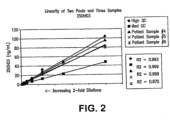
- a MultiProbe automated liquid handler robot independently constructed two standard curves by serially diluting a stock solution containing 128 ng/mL 25OHD 2 and 128 ng/mL 25OHD 3 in 25OHD with a solution of 5% Bovine Serum Albumin Fraction V dissolved in 0.01M PBS.
- the standard curve samples were analyzed using the LC-MS/MS protocols described in Example 1. This process routinely produced standard curves with R 2 values of 0.99 or higher for each analyte for the range of 4-128 ng/mL.
- the stock solutions of 25OHD 2 and 25OHD 3 were quantified based upon the absorbance of the concentrated (10-50 ⁇ g/mL) stock solutions in the ultraviolet spectrum.
- the cis-triene chromophore present in all vitamin D compounds has a peak absorbance of 264 nm, which is dependent upon the analyte concentration.
- the molar extinction coefficient of 18.3 mM -1 cm -1 was determined using purified, dessicated ergocalciferol and cholecalciferol and was used to determine the concentration of stock solutions for 25OHD 2 and 25OHD 3 .
- Example 6 Comparison LC-MS/MS vitamin D metabolite assay and RIA procedures.
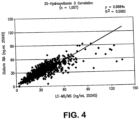
- FIG. 4 shows the correlation between detection of total 25-hydroxyvitamin D using the LC-MS/MS assay and a commercially available radioimmunoassay kit; the R 2 value was 0.5082 with a slope of 0.9684.
- Example 7 Selectivity of the LC-MS/MS assay.
- a first further preferred embodiment of the present invention is a method for determining the presence or amount of a vitamin D metabolite in a sample by tandem mass spectrometry, comprising:
- said sample is subjected to a purification step prior to ionization.
- said purification step comprises chromatography
- Said chromatography preferably comprises high performance liquid chromatography (HPLC).
- HPLC high performance liquid chromatography
- said purification step comprises protein precipitation.
- Said purification step preferably does not include high turbulence liquid chromatography (HTLC).
- HTLC high turbulence liquid chromatography
- said purification step comprises chiral chromatography.
- said sample or said vitamin D metabolite is not subjected to gas-chromatography prior to said ionization step.
- said vitamin D metabolite is one or more vitamin D metabolites selected from the group consisting of 25-hydroxyvitamin D 3 , 25-hydroxyvitamin D 2 , 1,25-dihydroxyvitamin D 3 and 1,25-dihydroxyvitamin D 2 .
- said vitamin D metabolite is 25-hydroxyvitamin D 3 .
- said precursor ion has a mass/charge ratio (m/z) of about 383.16.
- Said precursor ion preferably has a mass/charge ratio (m/z) of about 383.16, and said one or more fragment ions comprise a fragment ion with an m/z of about 211.35.
- said vitamin D metabolite is 25-hydroxyvitamin D 2 .
- said precursor ion has a mass/charge ratio (m/z) of about 395.30.
- said precursor ion has a mass/charge ratio (m/z) of about 395.30
- said one or more fragment ions comprise one or more ions selected from the group consisting of ions with am/z of about 179.10, about 209.20, and about 251.30.
- Said one or more fragment ions preferably comprise two or more ions selected from the group consisting of ions with a m/z of about 179.10, about 209.20, and about 251.30.
- said vitamin D metabolite is 1 ,25-dihydroxyvitamin D 2 .
- a second further preferred embodiment of the present invention is a method for determining the presence or amount of two or more vitamin D metabolites in a sample in a single assay, said method comprising:
- said sample subjected to a purification step prior to said ionization step.
- said purification step comprises chromatography
- Said chromatography preferably comprises high performance liquid chromatography (HPLC).
- HPLC high performance liquid chromatography
- said purification step comprises protein precipitation and does not include high turbulence liquid chromatography.
- said sample or said two or more vitamin D metabolites are not subjected to gas-chromatography prior to said ionization step.
- said vitamin D metabolites comprise 25- hydroxyvitamin D 3 and 25-hydroxyvitamin D 2 .
- the precursor ion of 25-hydroxyvitamin D 3 has a mass/charge ratio (m/z) of about 383.16 and the precursor ion of 25-hydroxyvitamin D 2 has a mass/charge ratio (m/z) of about 395.30.
- the one or more fragment ions for 25- hydroxyvitamin D 3 preferably comprise an ion with an m/z of about 383.16.
- the one or more fragment ions for 25- hydroxyvitamin D 2 preferably comprise one or more ions selected from the group consisting of ions with a m/z of about 179.10, about 209.20, and about 251.30.
- said two or more vitamin D metabolites comprise one or more vitamin D metabolites selected from the group consisting of 25-hydroxyvitamin D 3 , 25-hydroxyvitamin D 2 , 1,25-dihydroxyvitamin D 3 and 1,25-dihydroxyvitamin D 2 .
- said two or more vitamin D metabolites comprise 1,25-dihydroxyvitamin D 3 and 1,25-dihydroxyvitamin D 2 .
Landscapes
- Life Sciences & Earth Sciences (AREA)
- Health & Medical Sciences (AREA)
- Engineering & Computer Science (AREA)
- Chemical & Material Sciences (AREA)
- Immunology (AREA)
- Molecular Biology (AREA)
- Biomedical Technology (AREA)
- Hematology (AREA)
- Urology & Nephrology (AREA)
- Analytical Chemistry (AREA)
- Physics & Mathematics (AREA)
- Biochemistry (AREA)
- General Health & Medical Sciences (AREA)
- General Physics & Mathematics (AREA)
- Pathology (AREA)
- Microbiology (AREA)
- Cell Biology (AREA)
- Food Science & Technology (AREA)
- Medicinal Chemistry (AREA)
- Biotechnology (AREA)
- Other Investigation Or Analysis Of Materials By Electrical Means (AREA)
Applications Claiming Priority (7)
| Application Number | Priority Date | Filing Date | Title |
|---|---|---|---|
| US11/101,166 US7745226B2 (en) | 2005-04-06 | 2005-04-06 | Methods for detecting vitamin D metabolites |
| US11/386,215 US7972867B2 (en) | 2005-04-06 | 2006-03-21 | Methods for detecting vitamin D metabolites by mass spectrometry |
| EP11184151.6A EP2405273B1 (de) | 2005-04-06 | 2006-04-05 | Verfahren zum Nachweis von Vitamin-D-Metaboliten durch Massenspektrometrie |
| EP18194579.1A EP3432001B1 (de) | 2005-04-06 | 2006-04-05 | Verfahren zum nachweis von vitamin-d-metaboliten durch massenspektrometrie |
| EP16154623.9A EP3032262B1 (de) | 2005-04-06 | 2006-04-05 | Verfahren zum nachweis von vitamin-d-metaboliten durch massenspektrometrie |
| PCT/US2006/012539 WO2006107992A2 (en) | 2005-04-06 | 2006-04-05 | Methods for detecting vitamin d metabolites by mass spectrometry |
| EP06749272A EP1866633B1 (de) | 2005-04-06 | 2006-04-05 | Verfahren zum nachweis von vitamin-d-metaboliten durch massenspektrometrie |
Related Parent Applications (5)
| Application Number | Title | Priority Date | Filing Date |
|---|---|---|---|
| EP11184151.6A Division EP2405273B1 (de) | 2005-04-06 | 2006-04-05 | Verfahren zum Nachweis von Vitamin-D-Metaboliten durch Massenspektrometrie |
| EP18194579.1A Division EP3432001B1 (de) | 2005-04-06 | 2006-04-05 | Verfahren zum nachweis von vitamin-d-metaboliten durch massenspektrometrie |
| EP18194579.1A Division-Into EP3432001B1 (de) | 2005-04-06 | 2006-04-05 | Verfahren zum nachweis von vitamin-d-metaboliten durch massenspektrometrie |
| EP06749272A Division EP1866633B1 (de) | 2005-04-06 | 2006-04-05 | Verfahren zum nachweis von vitamin-d-metaboliten durch massenspektrometrie |
| EP16154623.9A Division EP3032262B1 (de) | 2005-04-06 | 2006-04-05 | Verfahren zum nachweis von vitamin-d-metaboliten durch massenspektrometrie |
Publications (2)
| Publication Number | Publication Date |
|---|---|
| EP4502608A2 true EP4502608A2 (de) | 2025-02-05 |
| EP4502608A3 EP4502608A3 (de) | 2025-05-07 |
Family
ID=37083612
Family Applications (1)
| Application Number | Title | Priority Date | Filing Date |
|---|---|---|---|
| EP24220170.5A Pending EP4502608A3 (de) | 2005-04-06 | 2006-04-05 | Verfahren zum nachweis von vitamin-d-metaboliten durch massenspektrometrie |
Country Status (2)
| Country | Link |
|---|---|
| US (12) | US7745226B2 (de) |
| EP (1) | EP4502608A3 (de) |
Families Citing this family (35)
| Publication number | Priority date | Publication date | Assignee | Title |
|---|---|---|---|---|
| DE602004029710D1 (de) * | 2003-12-09 | 2010-12-02 | Dsm Ip Assets Bv | Verfahren zur bestimmung von 25-hydroxycholecalciferol in futter |
| US7700365B2 (en) | 2004-10-29 | 2010-04-20 | Mayo Foundation For Medical Education And Research | Vitamin D deficiencies |
| US7745226B2 (en) * | 2005-04-06 | 2010-06-29 | Quest Diagnostics Investments Incorporated | Methods for detecting vitamin D metabolites |
| US7972867B2 (en) * | 2005-04-06 | 2011-07-05 | Quest Diagnostics Investments Incorporated | Methods for detecting vitamin D metabolites by mass spectrometry |
| DK1875401T3 (da) * | 2005-06-30 | 2014-04-07 | Biocrates Life Sciences Ag | Indretning til kvantitativ analyse af en metabolitprofil |
| SI3095447T1 (sl) | 2006-02-03 | 2022-02-28 | Opko Renal, Llc | Zdravljenje pomanjkanja vitamina D s 25-hidroksivitaminom D2 in 25-hidroksivitaminom D3 |
| HUE037309T2 (hu) | 2006-06-21 | 2018-08-28 | Opko Ireland Global Holdings Ltd | Terápia D-vitamin telítési szer alkalmazásával és D-vitamin hormon helyettesítõ szer |
| PT3335712T (pt) | 2007-04-25 | 2025-10-23 | Opko Renal Llc | Método de tratamento e prevenção seguro e eficaz do hiperparatiroidismo secundário na doença renal crónica |
| DK2148684T3 (da) | 2007-04-25 | 2013-04-22 | Cytochroma Inc | Fremgangsmåde til behandling af vitamin D-insufficiens og -deficiens |
| PL2148661T3 (pl) | 2007-04-25 | 2013-07-31 | Cytochroma Inc | Doustne kompozycje o kontrolowanym uwalnianiu zawierające związek będący witaminą D i woskowy nośnik |
| US7972868B2 (en) | 2007-11-28 | 2011-07-05 | Quest Diagnostics Investments Incorporated | Methods for detecting dihydroxyvitamin D metabolites by mass spectrometry |
| CN102046812A (zh) | 2008-04-02 | 2011-05-04 | 赛特克罗公司 | 用于维生素d缺乏症和相关障碍的方法、组合物、用途和试剂盒 |
| WO2010019566A2 (en) * | 2008-08-11 | 2010-02-18 | Mayo Foundation For Medical Education And Research | Methods for determining levels of 1,25 dihydroxy vitamin d2 and d3 |
| US9201079B2 (en) * | 2009-10-26 | 2015-12-01 | Georgetown University | Methods for quantifying vitamin D metabolites by mass spectrometry |
| EP4410303A1 (de) * | 2009-11-05 | 2024-08-07 | Quest Diagnostics Investments Incorporated | Quantifizierung von insulinähnlichem wachstumsfaktor i und insulinähnlichem wachstumsfaktor ii mittels hochauflösender massenspektrometrie |
| US7977117B2 (en) | 2009-12-03 | 2011-07-12 | Quest Diagnostics Investments Incorprated | Vitamin D metabolite determination utilizing mass spectrometry following derivatization |
| US8034627B2 (en) | 2009-12-03 | 2011-10-11 | Quest Diagnostics Investments Incorporated | Methods for detecting dihydroxyvitamin D metabolites by mass spectrometry |
| CN102812356B (zh) | 2009-12-11 | 2017-08-08 | 奎斯特诊断投资公司 | 多重样品中的甾族化合物的质谱法 |
| US20110240840A1 (en) | 2009-12-11 | 2011-10-06 | Quest Diagnostics Investments Incorporated | Mass spectrometric determination of cookson-derivatized, non-metabolized vitamin d |
| PT2552484T (pt) | 2010-03-29 | 2020-04-03 | Opko Ireland Global Holdings Ltd | Métodos e composições para redução dos níveis de parafróides |
| WO2012058614A1 (en) | 2010-10-29 | 2012-05-03 | Cohesive Technologies Inc. | Lc-ms separation and detection of vitamin d metabolites |
| EP3570036A1 (de) | 2010-10-29 | 2019-11-20 | Cohesive Technologies Inc. | Lc-ms-konfiguration für die reinigung und den nachweis von analyten mit verschiedensten hydrophoben eigenschaften |
| WO2012136720A1 (de) | 2011-04-04 | 2012-10-11 | Immundiagnostik Ag | Bestimmung von vitamin-d-metaboliten in trockenblut |
| US9244083B2 (en) | 2012-11-30 | 2016-01-26 | Siemens Healthcare Diagnostics Inc. | Compositions and methods for detecting vitamin D |
| US9618523B2 (en) | 2013-02-28 | 2017-04-11 | Siemens Healthcare Diagnostics Inc. | Methods and reagents for determining isomeric analytes |
| KR101847947B1 (ko) | 2013-03-15 | 2018-05-28 | 옵코 아이피 홀딩스 Ⅱ 인코포레이티드 | 안정화되고 변형된 비타민 d 방출 제형 |
| EP3038552B1 (de) * | 2013-09-01 | 2020-08-12 | Carbofix In Orthopedics LLC | Verbundwerkstoff-wirbelsäulenimplantat |
| US10220047B2 (en) | 2014-08-07 | 2019-03-05 | Opko Ireland Global Holdings, Ltd. | Adjunctive therapy with 25-hydroxyvitamin D and articles therefor |
| MY198547A (en) | 2016-03-28 | 2023-09-04 | Opko Ireland Global Holdings Ltd | Methods of vitamin d treatment |
| CN108709942B (zh) * | 2018-08-06 | 2021-03-19 | 通标标准技术服务(上海)有限公司 | 一种测定奶粉中维生素a,e的方法 |
| CN109613277B (zh) * | 2018-12-14 | 2022-02-18 | 汤臣倍健股份有限公司 | 一种同时检测维生素d和维生素k的方法 |
| US11536733B2 (en) * | 2019-04-16 | 2022-12-27 | Laboratory Corporation Of America Holdings | Methods and systems for the detection of 11-oxo androgens by LC-MS/MS |
| CN113906293A (zh) * | 2019-05-31 | 2022-01-07 | 株式会社新日本科学 | 使用色谱质谱分析装置的质谱分析方法 |
| CN111380976A (zh) * | 2019-12-31 | 2020-07-07 | 卓和药业集团有限公司 | 度骨化醇注射剂的分析方法 |
| JP7413624B2 (ja) * | 2020-07-21 | 2024-01-16 | 株式会社ファンケル | 血清ビタミンd代謝物の濃度の推定方法 |
Citations (6)
| Publication number | Priority date | Publication date | Assignee | Title |
|---|---|---|---|---|
| US5772874A (en) | 1995-11-02 | 1998-06-30 | Cohesive Technologies, Inc. | High performance liquid chromatography method and apparatus |
| US5795469A (en) | 1996-01-19 | 1998-08-18 | Cohesive Technologies, Inc. | High performance liquid chromatography method and apparatus |
| US6107623A (en) | 1997-08-22 | 2000-08-22 | Micromass Limited | Methods and apparatus for tandem mass spectrometry |
| US6124137A (en) | 1993-05-28 | 2000-09-26 | Baylor College Of Medicine | Surface-enhanced photolabile attachment and release for desorption and detection of analytes |
| US6204500B1 (en) | 1998-01-23 | 2001-03-20 | Analytica Of Branford, Inc. | Mass spectrometry from surfaces |
| US6268144B1 (en) | 1995-03-17 | 2001-07-31 | Sequenom, Inc. | DNA diagnostics based on mass spectrometry |
Family Cites Families (61)
| Publication number | Priority date | Publication date | Assignee | Title |
|---|---|---|---|---|
| US4332591A (en) | 1978-01-19 | 1982-06-01 | Sumitomo Chemical Company, Limited | Analytical method and apparatus for the determination of total nitrogen contents in aqueous systems |
| US5030772A (en) | 1990-02-14 | 1991-07-09 | Deluca Hector F | Process for preparing vitamin D2 compounds and the corresponding 1 α-hydroxylated derivatives |
| JPH06341980A (ja) | 1993-02-24 | 1994-12-13 | Kureha Chem Ind Co Ltd | ビタミンd3誘導体の定量法 |
| JP2968910B2 (ja) | 1993-07-14 | 1999-11-02 | ヤマサ醤油株式会社 | 1α,25(OH)2ビタミンD3に対する抗体及びその用途 |
| WO1995033279A1 (en) | 1994-05-31 | 1995-12-07 | University Of Warwick | Tandem mass spectrometry apparatus |
| DE19531152A1 (de) | 1994-12-15 | 1996-06-20 | Bayer Ag | Substituierte N-Aryl-Stickstoffheterocyclen |
| US5614408A (en) | 1995-10-18 | 1997-03-25 | The United States Of America As Represented By The Secretary Of Agricultural | Monoclonal antibodies to potato, tomato, and eggplant glycoalkaloids and assays for the same |
| DE69738206T2 (de) | 1996-11-06 | 2008-07-17 | Sequenom, Inc., San Diego | DNA-Diagnostik mittels Massenspektrometrie |
| US5916523A (en) | 1996-12-04 | 1999-06-29 | Antek Instruments, Inc. | Methods for near simultaneous chemiluminescent sulfur and nitrogen detection |
| AU7497798A (en) | 1997-05-16 | 1998-12-08 | F. Hoffmann-La Roche Ag | 3-epi compounds of vitamin d3 and uses thereof |
| GB9719187D0 (en) * | 1997-09-09 | 1997-11-12 | Glaxo Group Ltd | Compounds |
| WO1999067211A1 (de) | 1998-06-25 | 1999-12-29 | Immundiagnostik Gesellschaft Für Produktion Und Vertrieb Von Labordiagnostika Mbh | FUNKTIONELLE VITAMIN-D-DERIVATE UND VERFAHREN ZUR BESTIMMUNG VON 25-HYDROXY- UND 1α,25-DIHYDROXY-VITAMIN-D |
| US20020045606A1 (en) | 1999-12-02 | 2002-04-18 | Reddy Satyanarayana G. | Esters of vitamin D3 and uses thereof |
| GB0029729D0 (en) | 2000-12-06 | 2001-01-17 | Ids Ltd | Method for detection of vitamin D metabolites |
| US7087395B1 (en) | 2001-01-16 | 2006-08-08 | Quest Diagnostics Investments Incorporated | Vitamin D assay |
| WO2003046148A2 (en) | 2001-11-29 | 2003-06-05 | Thermo Finnigan Llc | Polypeptide quantitation |
| WO2004002996A1 (ja) | 2002-06-27 | 2004-01-08 | Chugai Seiyaku Kabushiki Kaisya | フェロセン化合物およびその用途 |
| US7632686B2 (en) | 2002-10-03 | 2009-12-15 | Anderson Forschung Group | High sensitivity quantitation of peptides by mass spectrometry |
| EP2186879B1 (de) | 2002-10-03 | 2016-11-23 | Norman Leigh Anderson | Hochempfindliche Quantifizierung von Peptiden mittels Massenspektrometrie |
| CA2519626C (en) | 2003-04-14 | 2013-06-18 | Georgetown University | Thyroid hormone analysis by mass spectrometry with minimal sample preparation |
| WO2004090525A1 (en) | 2003-04-14 | 2004-10-21 | Georgetown University | Steroid hormone analysis by mass spectrometry |
| US6977143B1 (en) | 2003-09-08 | 2005-12-20 | Quest Diagnostics Investments Incorporated | Determination of testosterone by mass spectrometry |
| CA2545685A1 (en) | 2003-11-14 | 2005-06-02 | Irm Llc | Fluorous labeling for selective processing of biologically-derived samples |
| JP4555994B2 (ja) | 2003-12-19 | 2010-10-06 | 日立化成工業株式会社 | バックライト装置及び液晶表示装置 |
| BRPI0418756A (pt) | 2004-05-19 | 2007-09-11 | Merck & Co Inc | composições e métodos para inibir a reabsorção óssea |
| CA2480549A1 (fr) | 2004-09-15 | 2006-03-15 | Phytronix Technologies Inc. | Source d'ionisation pour spectrometre de masse |
| US20060094039A1 (en) | 2004-09-20 | 2006-05-04 | Ron Rosenfeld | Diagnosis of fetal aneuploidy |
| US7700365B2 (en) | 2004-10-29 | 2010-04-20 | Mayo Foundation For Medical Education And Research | Vitamin D deficiencies |
| US20070037286A1 (en) | 2005-02-09 | 2007-02-15 | Subhasish Purkayastha | Thyroxine-containing compound analysis methods |
| WO2006107339A2 (en) | 2005-03-31 | 2006-10-12 | Georgetown University | Free thyroxine and free triiodothyronine analysis by mass spectrometry |
| EP1886112B1 (de) | 2005-04-06 | 2014-07-09 | Washington University St. Louis | Verfahren zur messung des metabolismus natürlich abgeleiteter biomoleküle in vivo |
| US7972867B2 (en) | 2005-04-06 | 2011-07-05 | Quest Diagnostics Investments Incorporated | Methods for detecting vitamin D metabolites by mass spectrometry |
| US7745226B2 (en) * | 2005-04-06 | 2010-06-29 | Quest Diagnostics Investments Incorporated | Methods for detecting vitamin D metabolites |
| US20060236886A1 (en) | 2005-04-20 | 2006-10-26 | Agfa-Gevaert | Process for the offset printing of a catalytic species via a hydrophilic phase |
| JP2009509992A (ja) | 2005-09-29 | 2009-03-12 | エフ.ホフマン−ラ ロシュ アーゲー | 25−ヒドロキシビタミンdに対する抗体 |
| US20070105179A1 (en) | 2005-11-09 | 2007-05-10 | Dionex Corporation | Methods of detecting N-and O-linked oligosaccharides in glycoproteins |
| US7855057B2 (en) | 2006-03-23 | 2010-12-21 | Millipore Corporation | Protein splice variant/isoform discrimination and quantitative measurements thereof |
| US7989760B2 (en) | 2006-05-24 | 2011-08-02 | SWCE Inc. | Extraction detection system and method |
| US7935921B2 (en) | 2006-05-26 | 2011-05-03 | Laboratory Corporation Of America Holdings | Methods and systems for the quantitative analysis of biomarkers |
| CA2649338C (en) | 2006-06-06 | 2011-07-12 | F.Hoffman-La Roche Ag | Improved measurement of vitamin d |
| US7906341B2 (en) | 2006-06-30 | 2011-03-15 | Dh Technologies Development Pte, Ltd. | Methods, mixtures, kits and compositions pertaining to analyte determination |
| WO2008027861A1 (en) | 2006-08-30 | 2008-03-06 | Ge Healthcare Bio-Sciences Corp. | System and method for characterizing membranes and membrane filtration devices |
| US7999084B2 (en) | 2007-05-16 | 2011-08-16 | Agilent Technologies, Inc. | Devices and methods for reducing matrix effects |
| US7807172B2 (en) | 2007-06-13 | 2010-10-05 | University Of Washington | Methods and compositions for detecting thyroglobulin in a biological sample |
| JP4883540B2 (ja) | 2007-06-21 | 2012-02-22 | 国立大学法人福井大学 | 同位体化合物を標識として使用するタンパク質の分析方法 |
| JP5080945B2 (ja) | 2007-11-09 | 2012-11-21 | 株式会社日立ハイテクノロジーズ | 質量分析装置および質量分析方法 |
| US7972868B2 (en) | 2007-11-28 | 2011-07-05 | Quest Diagnostics Investments Incorporated | Methods for detecting dihydroxyvitamin D metabolites by mass spectrometry |
| US8030084B2 (en) | 2007-12-06 | 2011-10-04 | Quest Diagnostics Investments Incorporated | Thyroglobulin quantitation by mass spectrometry |
| US20090317916A1 (en) | 2008-06-23 | 2009-12-24 | Ewing Kenneth J | Chemical sample collection and detection device using atmospheric pressure ionization |
| WO2010019566A2 (en) | 2008-08-11 | 2010-02-18 | Mayo Foundation For Medical Education And Research | Methods for determining levels of 1,25 dihydroxy vitamin d2 and d3 |
| WO2010099108A2 (en) | 2009-02-24 | 2010-09-02 | Mayo Foundation For Medical Education And Research | Multiplexing derivatized anayltes using mass spectroscopy |
| US8034627B2 (en) | 2009-12-03 | 2011-10-11 | Quest Diagnostics Investments Incorporated | Methods for detecting dihydroxyvitamin D metabolites by mass spectrometry |
| US7977117B2 (en) | 2009-12-03 | 2011-07-12 | Quest Diagnostics Investments Incorprated | Vitamin D metabolite determination utilizing mass spectrometry following derivatization |
| CN102812356B (zh) | 2009-12-11 | 2017-08-08 | 奎斯特诊断投资公司 | 多重样品中的甾族化合物的质谱法 |
| US20110240840A1 (en) * | 2009-12-11 | 2011-10-06 | Quest Diagnostics Investments Incorporated | Mass spectrometric determination of cookson-derivatized, non-metabolized vitamin d |
| EP2528443B1 (de) | 2010-01-25 | 2017-01-11 | DH Technologies Development Pte. Ltd. | Quantitative analyse von vitamin d3, vitamin d2 und metaboliten davon |
| EP2548015A1 (de) | 2010-03-15 | 2013-01-23 | Anderson Forschung Group, Inc. | Verbesserte massenspektrometrische assays für peptide |
| WO2012058614A1 (en) | 2010-10-29 | 2012-05-03 | Cohesive Technologies Inc. | Lc-ms separation and detection of vitamin d metabolites |
| JPWO2012111249A1 (ja) | 2011-02-14 | 2014-07-03 | 学校法人麻布獣医学園 | 質量分析法における質量変化を検出する方法及び安定同位体標識タンパク質の絶対量の定量方法 |
| US9140695B2 (en) | 2012-01-18 | 2015-09-22 | University Of Utah Research Foundation | Methods for analysis of free and autoantibody-bound biomarkers and associated compositions, devices, and systems |
| WO2014047316A1 (en) | 2012-09-20 | 2014-03-27 | Quest Diagnostics Investments Incorporated | Thyroglobulin quantitation by mass spectroscopy |
-
2005
- 2005-04-06 US US11/101,166 patent/US7745226B2/en active Active
-
2006
- 2006-04-05 EP EP24220170.5A patent/EP4502608A3/de active Pending
-
2011
- 2011-05-25 US US13/115,916 patent/US8101427B2/en active Active
- 2011-12-15 US US13/327,650 patent/US8431411B2/en not_active Expired - Lifetime
-
2013
- 2013-04-26 US US13/871,457 patent/US8936943B2/en not_active Expired - Lifetime
-
2014
- 2014-02-14 US US14/180,722 patent/US9244084B2/en not_active Expired - Lifetime
-
2016
- 2016-01-25 US US15/005,801 patent/US9529004B2/en not_active Expired - Lifetime
- 2016-12-22 US US15/388,844 patent/US9880180B2/en not_active Expired - Fee Related
-
2017
- 2017-12-20 US US15/848,325 patent/US10267810B2/en not_active Expired - Lifetime
-
2019
- 2019-04-22 US US16/390,989 patent/US10935558B2/en not_active Expired - Lifetime
-
2021
- 2021-03-01 US US17/188,969 patent/US11579154B2/en not_active Expired - Lifetime
-
2023
- 2023-02-09 US US18/107,947 patent/US11921122B2/en not_active Expired - Lifetime
-
2024
- 2024-01-30 US US18/426,835 patent/US12287346B2/en not_active Expired - Lifetime
Patent Citations (8)
| Publication number | Priority date | Publication date | Assignee | Title |
|---|---|---|---|---|
| US6124137A (en) | 1993-05-28 | 2000-09-26 | Baylor College Of Medicine | Surface-enhanced photolabile attachment and release for desorption and detection of analytes |
| US6268144B1 (en) | 1995-03-17 | 2001-07-31 | Sequenom, Inc. | DNA diagnostics based on mass spectrometry |
| US5772874A (en) | 1995-11-02 | 1998-06-30 | Cohesive Technologies, Inc. | High performance liquid chromatography method and apparatus |
| US5919368A (en) | 1995-11-02 | 1999-07-06 | Cohesive Technologies, Inc. | High performance liquid chromatography method and apparatus |
| US5795469A (en) | 1996-01-19 | 1998-08-18 | Cohesive Technologies, Inc. | High performance liquid chromatography method and apparatus |
| US5968367A (en) | 1996-01-19 | 1999-10-19 | Cohesive Technologies, Inc. | High performance liquid chromatography method and apparatus |
| US6107623A (en) | 1997-08-22 | 2000-08-22 | Micromass Limited | Methods and apparatus for tandem mass spectrometry |
| US6204500B1 (en) | 1998-01-23 | 2001-03-20 | Analytica Of Branford, Inc. | Mass spectrometry from surfaces |
Non-Patent Citations (12)
| Title |
|---|
| ANNAS, J. CLIN. ENDOCRINOL. METAB, vol. 89, 2004, pages 5387 - 5391 |
| HIGASHI T ET AL., BIOL PHARM BULL, vol. 24, no. 7, 2001, pages 738 - 43 |
| HIGASHI T ET AL., J PHARM BIOMED ANAL, vol. 29, no. 5, 2002, pages 947 - 55 |
| HIGASHI T ET AL., STEROIDS, vol. 65, no. 5, 2000, pages 281 - 94 |
| KAMAO ET AL., J. BIOL. CHEM., vol. 279, 2004, pages 15897 - 15907 |
| MERCHANTWEINBERGER, ELECTROPHORESIS, vol. 21, 2000, pages 1164 - 67 |
| POLSON ET AL., JOURNAL OF CHROMATOGRAPHY B, vol. 785, 2003, pages 263 - 275 |
| SALM ET AL., CLIN. THERAPEUTICS, vol. 22, 2000, pages 71 - 85 |
| TAYLOR ET AL., THERAPEUTIC DRUG MONITORING, vol. 22, 2000, pages 608 - 12 |
| WRIGHT ET AL., PROSTATE CANCER AND PROSTATIC DISEASES, vol. 2, 1999, pages 264 - 76 |
| YEUNG B ET AL., J CHROMATOGR, vol. 645, no. 1, 1993, pages 115 - 23 |
| ZIMMER ET AL., J. CHROMATOGR. A, vol. 854, 1999, pages 23 - 35 |
Also Published As
| Publication number | Publication date |
|---|---|
| US8101427B2 (en) | 2012-01-24 |
| US20210231689A1 (en) | 2021-07-29 |
| US9880180B2 (en) | 2018-01-30 |
| US12287346B2 (en) | 2025-04-29 |
| US20240168039A1 (en) | 2024-05-23 |
| EP4502608A3 (de) | 2025-05-07 |
| US20060228808A1 (en) | 2006-10-12 |
| US9244084B2 (en) | 2016-01-26 |
| US7745226B2 (en) | 2010-06-29 |
| US20180156828A1 (en) | 2018-06-07 |
| US10267810B2 (en) | 2019-04-23 |
| US11579154B2 (en) | 2023-02-14 |
| US20170102400A1 (en) | 2017-04-13 |
| US8431411B2 (en) | 2013-04-30 |
| US20190250175A1 (en) | 2019-08-15 |
| US20130236979A1 (en) | 2013-09-12 |
| US20140162371A1 (en) | 2014-06-12 |
| US8936943B2 (en) | 2015-01-20 |
| US10935558B2 (en) | 2021-03-02 |
| US20160139157A1 (en) | 2016-05-19 |
| US20110220785A1 (en) | 2011-09-15 |
| US20230184790A1 (en) | 2023-06-15 |
| US11921122B2 (en) | 2024-03-05 |
| US20120085902A1 (en) | 2012-04-12 |
| US9529004B2 (en) | 2016-12-27 |
Similar Documents
| Publication | Publication Date | Title |
|---|---|---|
| US12287346B2 (en) | Methods for detecting vitamin D metabolites by mass spectrometry | |
| EP3432001B1 (de) | Verfahren zum nachweis von vitamin-d-metaboliten durch massenspektrometrie | |
| EP3524958B1 (de) | Verfahren für den nachweis von dihydroxyvitamin-d-metaboliten mittels massenspektrometrie | |
| US20230146212A1 (en) | Mass spectrometric determination of non-derivatized, non-metabolized vitamin d | |
| US20200241018A1 (en) | Vitamin d metabolite determination utilizing mass spectrometry following derivatization | |
| HK40123086A (en) | Methods for detecting vitamin d metabolites by mass spectrometry | |
| HK40109081A (en) | Methods for detecting dihydroxyvitamin d metabolites by mass spectrometry |
Legal Events
| Date | Code | Title | Description |
|---|---|---|---|
| PUAI | Public reference made under article 153(3) epc to a published international application that has entered the european phase |
Free format text: ORIGINAL CODE: 0009012 |
|
| STAA | Information on the status of an ep patent application or granted ep patent |
Free format text: STATUS: THE APPLICATION HAS BEEN PUBLISHED |
|
| AC | Divisional application: reference to earlier application |
Ref document number: 1866633 Country of ref document: EP Kind code of ref document: P Ref document number: 2405273 Country of ref document: EP Kind code of ref document: P Ref document number: 3032262 Country of ref document: EP Kind code of ref document: P Ref document number: 3432001 Country of ref document: EP Kind code of ref document: P |
|
| AK | Designated contracting states |
Kind code of ref document: A2 Designated state(s): AT BE BG CH CY CZ DE DK EE ES FI FR GB GR HU IE IS IT LI LT LU LV MC NL PL PT RO SE SI SK TR |
|
| REG | Reference to a national code |
Ref country code: DE Ref legal event code: R079 Free format text: PREVIOUS MAIN CLASS: G01N0033680000 Ipc: G01N0033820000 |
|
| PUAL | Search report despatched |
Free format text: ORIGINAL CODE: 0009013 |
|
| AK | Designated contracting states |
Kind code of ref document: A3 Designated state(s): AT BE BG CH CY CZ DE DK EE ES FI FR GB GR HU IE IS IT LI LT LU LV MC NL PL PT RO SE SI SK TR |
|
| RIC1 | Information provided on ipc code assigned before grant |
Ipc: H01J 49/00 20060101ALI20250403BHEP Ipc: G01N 30/88 20060101ALI20250403BHEP Ipc: G01N 30/72 20060101ALI20250403BHEP Ipc: G01N 33/68 20060101ALI20250403BHEP Ipc: G01N 33/82 20060101AFI20250403BHEP |
|
| REG | Reference to a national code |
Ref country code: HK Ref legal event code: DE Ref document number: 40123086 Country of ref document: HK |
|
| STAA | Information on the status of an ep patent application or granted ep patent |
Free format text: STATUS: REQUEST FOR EXAMINATION WAS MADE |
|
| 17P | Request for examination filed |
Effective date: 20251105 |
|
| RAP3 | Party data changed (applicant data changed or rights of an application transferred) |
Owner name: QUEST DIAGNOSTICS INVESTMENTS LLC |