EP4502682A1 - Fibre optique à âmes multiples - Google Patents
Fibre optique à âmes multiples Download PDFInfo
- Publication number
- EP4502682A1 EP4502682A1 EP23774822.3A EP23774822A EP4502682A1 EP 4502682 A1 EP4502682 A1 EP 4502682A1 EP 23774822 A EP23774822 A EP 23774822A EP 4502682 A1 EP4502682 A1 EP 4502682A1
- Authority
- EP
- European Patent Office
- Prior art keywords
- cladding
- cores
- optical fiber
- mcf
- marker
- Prior art date
- Legal status (The legal status is an assumption and is not a legal conclusion. Google has not performed a legal analysis and makes no representation as to the accuracy of the status listed.)
- Pending
Links
Images


Classifications
-
- G—PHYSICS
- G02—OPTICS
- G02B—OPTICAL ELEMENTS, SYSTEMS OR APPARATUS
- G02B6/00—Light guides; Structural details of arrangements comprising light guides and other optical elements, e.g. couplings
- G02B6/02—Optical fibres with cladding with or without a coating
- G02B6/02042—Multicore optical fibres
-
- G—PHYSICS
- G02—OPTICS
- G02B—OPTICAL ELEMENTS, SYSTEMS OR APPARATUS
- G02B6/00—Light guides; Structural details of arrangements comprising light guides and other optical elements, e.g. couplings
- G02B6/02—Optical fibres with cladding with or without a coating
- G02B6/036—Optical fibres with cladding with or without a coating core or cladding comprising multiple layers
- G02B6/03616—Optical fibres characterised both by the number of different refractive index layers around the central core segment, i.e. around the innermost high index core layer, and their relative refractive index difference
- G02B6/03622—Optical fibres characterised both by the number of different refractive index layers around the central core segment, i.e. around the innermost high index core layer, and their relative refractive index difference having 2 layers only
-
- G—PHYSICS
- G02—OPTICS
- G02B—OPTICAL ELEMENTS, SYSTEMS OR APPARATUS
- G02B6/00—Light guides; Structural details of arrangements comprising light guides and other optical elements, e.g. couplings
- G02B6/02—Optical fibres with cladding with or without a coating
- G02B6/036—Optical fibres with cladding with or without a coating core or cladding comprising multiple layers
- G02B6/03616—Optical fibres characterised both by the number of different refractive index layers around the central core segment, i.e. around the innermost high index core layer, and their relative refractive index difference
- G02B6/03622—Optical fibres characterised both by the number of different refractive index layers around the central core segment, i.e. around the innermost high index core layer, and their relative refractive index difference having 2 layers only
- G02B6/03627—Optical fibres characterised both by the number of different refractive index layers around the central core segment, i.e. around the innermost high index core layer, and their relative refractive index difference having 2 layers only arranged - +
Definitions
- MCF multicore optical fiber
- a marker having a refractive index different from a refractive index of a cladding is introduced into the cladding. It is known that each of a plurality of cores can be identified in a cross-section of the MCF cut at any position along a longitudinal direction.
- the marker in the cladding is arranged at a position at which distances to the plurality of cores are not uniform.
- the marker has a diameter smaller than a diameter of the core or the refractive index lower than a refractive index of the core. This reduces coupling between a mode propagating in the core and a mode propagating in the marker, and reduces noise mixing with a signal light propagating in the core.
- each of the plurality of cores is identified by observing an end face of the MCF cut at any position along the longitudinal direction, end face observation by illumination from side surface is performed.
- a side surface of the MCF near the cutting position is irradiated with illumination light.
- the illumination light propagates in the MCF, the illumination light is confined in a high refractive index region and propagates with low propagation loss, whereas the illumination light propagates with high propagation loss while leaking out in a low refractive index region.
- the high refractive index region is displayed brighter and the low refractive index region is displayed darker in an end face image of the MCF.
- Patent literature 1 Japanese Unexamined Patent Application Publication No. 2011-170099
- An MCF according to the present disclosure includes a glass optical fiber and a resin coating.
- the glass optical fiber has a plurality of cores each extending along a central axis (hereinafter, referred to as a "fiber axis"), a marker extending along the plurality of cores, and a cladding surrounding the plurality of cores and the marker.
- the resin coating is provided over an outer peripheral surface of the glass optical fiber.
- the cladding includes an inner cladding and an outer cladding.
- the inner cladding surrounds the plurality of cores and the marker in a state of being in contact with the plurality of cores and the marker.
- the outer cladding is provided over an outer peripheral surface of the inner cladding and has a refractive index higher than a refractive index of the inner cladding.
- the inventors have studied the above-described conventional technique and have found the following problems. That is, in the above-described conventional technique, when performing the end face observation of the MCF by the illumination from side surface, the brightness of the marker and the core in the end face changes depending on which side surface of the fiber the illumination light enters, and core identification may become difficult.
- the present disclosure has been made to solve the above-described problem, and an object of the present disclosure is to provide an MCF having a structure for enabling stable core identification.
- core identification can be stably performed.
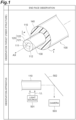
- FIG. 1 is a diagram showing an example of a structure of an MCF and an example of an observation apparatus of an MCF end face according to the present disclosure (in FIG. 1 , referred to as "end face observation”).
- An upper part of FIG. 1 (in FIG. 1 , referred to as "observation target (fiber structure)") shows an example of a representative structure of an MCF 100 according to the present disclosure.
- a lower part of FIG. 1 (in FIG. 1 , referred to as "observation apparatus”) shows a schematic structure of the observation apparatus for performing the end face observation of the MCF according to the present disclosure.
- MCF 100 which is the observation target shown in the upper part of FIG. 1 , includes a glass optical fiber 110 and a resin coating 140 provided over an outer peripheral surface of glass optical fiber 110.
- Glass optical fiber 110 has two cores 111, 112, a cladding 120, and a marker 130. Three or more cores may be applied to MCF 100.
- Two cores 111, 112 extend along a fiber axis AX which is a central axis of MCF 100.
- Marker 130 extends along two cores 111, 112.
- Cladding 120 surrounds two cores 111, 112 and marker 130. Marker 130 has a refractive index different from a refractive index of cladding 120.
- Cladding 120 includes an inner cladding 121 surrounding two cores 111, 112 and marker 130, and an outer cladding 122 provided over an outer peripheral surface of inner cladding 121 and having a refractive index higher than a refractive index of inner cladding 121.
- a part of resin coating 140 covering a tip portion of glass optical fiber 110 including the end face is removed as shown in the upper part of FIG. 1 .
- the end face observation of MCF 100 having the above-described structure is performed by the observation apparatus shown in the lower part of FIG. 1 . That is, the observation apparatus includes a light source 501, a mirror element 502, and a camera 503 as an end face imaging camera.
- the observation apparatus includes a light source 501, a mirror element 502, and a camera 503 as an end face imaging camera.
- a side surface of the tip portion of glass optical fiber 110 including the end face is irradiated with an observation light LL from light source 501.
- Observation light LL incident in glass optical fiber 110 is emitted from the end face of glass optical fiber 110 toward mirror element 502 and is reflected by mirror element 502. Further, observation light LL reflected by mirror element 502 reaches an imaging surface of camera 503.
- observation light LL When observation light LL propagates in glass optical fiber 110, observation light LL is confined in the high refractive index region such as two cores 111, 112 and propagates with a low propagation loss, whereas observation light LL propagates with a high propagation loss while leaking to the outside in the low refractive index region such as cladding 120. Thus, by providing a sufficient propagation distance, the high refractive index region is displayed brighter and the low refractive index region is displayed darker in an end face image of glass optical fiber 110.
- the high refractive index region may be displayed darker and the low refractive index region may be displayed brighter in the end face image of glass optical fiber 110.
- Two cores 111, 112 and marker 130 are identified based on the end face image displaying light and dark areas, and thus it is possible to identify each of two cores 111, 112.
- FIG. 2 is a diagram showing a cross-sectional structure of the MCF according to the present disclosure (in FIG. 2 , referred to as "double cladding structure").
- An upper part of FIG. 2 (referred to as “cross-sectional structure” in FIG. 2 ) shows a cross-sectional structure of MCF 100 according to the present disclosure along the line I-I shown in the upper part of FIG. 1 .
- a middle part of FIG. 2 (referred to as “refractive index profile” in FIG. 2 ) shows a refractive index profile 150 indicating the refractive index of each position along a line L shown in the upper part of FIG. 2 .
- a lower part of FIG. 2 (referred to as "observation light propagation" in FIG.
- FIG. 2 shows a diagram for explaining a propagation state of observation light in glass optical fiber 110 from which resin coating 140 is removed in MCF 100.
- a fiber cross-section shown in the lower part of FIG. 2 is a cross-section of glass optical fiber 110 from which resin coating 140 is removed in MCF 100, and corresponds to a part of the fiber cross-section along the I-I line shown in the upper part of FIG. 1 .
- glass optical fiber 110 of MCF 100 includes cladding 120, and cladding 120 has a double cladding structure constituted by inner cladding 121 having a diameter 2B and outer cladding 122 having a diameter 2A.
- inner cladding 121 having diameter 2B two cores 111, 112 and marker 130 are arranged along the longitudinal direction of MCF 100.
- the arrangement of the centers of two cores 111, 112 and the center of marker 130 has no rotational symmetry because it forms a plane figure of 1-fold rotational symmetry with respect to a center of the cross-section. That is, an element arrangement including only two cores 111, 112 has rotational symmetry because it forms a plane figure of 2-fold rotational symmetry, but the element arrangement further including marker 130 loses rotational symmetry.
- MCF 100 includes refractive index profile 150 as shown in the middle part of FIG. 2 . That is, two cores 111, 112 are positioned across fiber axis AX, and each has a refractive index n1.
- Inner cladding 121 has a refractive index n2 that is lower than refractive index n1 of two cores 111, 112.
- Outer cladding 122 has a refractive index nc that is lower than the refractive index n1 of two cores 111, 112 and higher than the refractive index n2 of inner cladding 121.
- the "refractive index of cladding 120" means the refractive index nc of outer cladding 122.
- a refractive index of marker 130 need only be different from the refractive index n2 of inner cladding 121.
- the refractive index of marker 130 may have a relative refractive index difference of 0.25% or more with respect to the refractive index n2 of inner cladding 121. This allows for a reliable identification.
- marker 130 may have the refractive index higher than the refractive index n2, and a product of the relative refractive index difference and a marker radius may be 1.0 [% ⁇ m] or less. This reduces loss caused by coupling of a mode propagating through the core to a mode in the marker.
- Each of cores 111, 112 of MCF 100 has at least one mode for guiding light of a wavelength of 1550 nm that is a typical communication wavelength.
- a guided mode of one core has sufficiently low inter-core crosstalk with a guided mode of another core.
- any inter-core crosstalk should be -60 dB/km or less.
- noise due to crosstalk can be reduced to a negligible level.
- crosstalk between signal lights propagating in opposite directions may be -60 dB/km, or crosstalk between signal lights propagating in the same direction may be -60 dB/km. In this case, noise due to crosstalk can be reduced to a negligible level by appropriately selecting the propagation direction.
- the center-to-center distance between adjacent cores may be 30 ⁇ m or more.
- the center-to-center distance between adjacent cores may be 50 ⁇ m or less.
- an effective refractive index of the guided mode may differ by 0.01% or more between adjacent cores.
- a core diameter may be 8 ⁇ m to 15 ⁇ m, and a relative refractive index difference between cores 111, 112 and inner cladding 121 may be 0.3% to 0.5%. This makes it possible to reduce crosstalk and noise due to higher order modes.
- observation light LL shown in the lower part of FIG. 1 , emitted from light source 501 and reached to a side surface of glass optical fiber 110 enters glass optical fiber 110, and then, as shown in the lower part of FIG. 2 , a part of observation light LL propagates in outer cladding 122. That is, observation light LL propagates in outer cladding 122 while leaking into inner cladding 121, and reaches to the backside of glass optical fiber 110 irradiated with observation light LL. As described above, observation light LL incident in glass optical fiber 110 is partially reflected at an interface between inner cladding 121 and outer cladding 122, and the partially reflected observation light LL is multiply reflected in outer cladding 122.
- observation light LL is coupled to cores 111, 112 and marker 130 while being uniformly dispersed and/or uniformly diffused in outer cladding 122, and thus light amount of observation light LL coupled to cores 111, 112 and marker 130 is stabilized regardless of an incident direction of observation light LL.
- a ratio B/A which is a ratio of a radius B of inner cladding 121 to a radius A of outer cladding 122 is preferably 1/3 to 2/3.
- the ratio B/A is smaller than 1/3, outer cladding 122 becomes too thick, and thus arrangement flexibility of cores 111, 112 and marker 130 in inner cladding 121 is limited.
- an absolute value of a relative refractive index difference of inner cladding 121 with reference to the refractive index nc of outer cladding 122 is preferably 0.02% to 0.3%.
- the part of observation light LL can propagate in outer cladding 122 while being partially coupled to a mode in inner cladding 121.
- FIG. 3 is a diagram for explaining an example of the cross-sectional structure of each of the MCF according to the present disclosure and the MCF according to a comparative example (in FIG. 3 , referred to as "cross-sectional structure").
- An upper part of FIG. 3 (referred to as “two-core” in FIG. 3 ) shows the cross-sectional structures of an MCF 600A according to the comparative example and an MCF 100A (100) according to the embodiment.
- a lower part of FIG. 3 (referred to as "four-core” in FIG. 3 ) shows the cross-sectional structures of an MCF 600B according to the comparative example and an MCF 100B according to the embodiment.
- Each of the fiber cross-sections shown in FIG. 3 corresponds to a part of the fiber cross-section along the line I-I shown in the upper part of FIG. 1 .
- MCF 600A according to the comparative example shown in the upper part of FIG. 3 is a two-core MCF.
- MCF 600A includes a glass optical fiber 610A and a resin coating 640.
- Glass optical fiber 610A has two cores 611, 612 extending along fiber axis AX, a cladding 620, and a marker 630.
- cladding 620 in glass optical fiber 610A has a single structure.
- MCF 600B according to the comparative example shown in the lower part of FIG. 3 is a four-core MCF.
- MCF 600B includes a glass optical fiber 610B and resin coating 640.
- Glass optical fiber 610B has four cores 611, 612, 613, and 614 extending along fiber axis AX, cladding 620, and marker 630.
- cladding 620 in glass optical fiber 610B has a single structure, as in MCF 600A.
- MCF 100A corresponds to MCF 100 shown in the upper part of FIG. 1 and the upper part of FIG. 2 , and is a two-core MCF.
- MCF 100A includes a glass optical fiber 110A corresponding to glass optical fiber 110 shown in the upper part of FIG. 1 and the upper part of FIG. 2 , and resin coating 140.
- Glass optical fiber 110A has two cores 111, 112 extending along fiber axis AX, cladding 120, and marker 130.
- cladding 120 of glass optical fiber 110A has a double cladding structure including inner cladding 121 surrounding two cores 111, 112 and marker 130, and outer cladding 122 provided over the outer peripheral surface of inner cladding 121 and having a refractive index higher than inner cladding 121.
- MCF 100B according to the embodiment shown in the lower part of FIG. 3 is a four-core MCF.
- MCF 100B includes a glass optical fiber 110B and resin coating 140.
- Glass optical fiber 110B has four cores 111, 112, 113, and 114 extending along fiber axis AX, cladding 120, and marker 130.
- cladding 120 in glass optical fiber 110B has a double cladding structure in MCF 100B.
- Both of MCF 600A and 600B according to the comparative example have cladding 620 of a single structure.
- the brightness of two cores 611, 612 and marker 630 in the cross-section is also changed by the incident direction of observation light LL, and core identification may be difficult.
- Such a problem may also occur in the comparative example having four cores 611,612, 613, and 614.
- observation light LL enters glass optical fiber 110A, 110B, propagates in outer cladding 122 while leaking into inner cladding 121, and reaches the opposite side of glass optical fiber 110A, 110B.
- observation light LL is uniformly dispersed and/or uniformly diffused in outer cladding 122 and then coupled to two cores 111, 112 and marker 130, and thus the light amount of observation light LL coupled to two cores 111, 112 and marker 130 is stabilized regardless of the incident direction of observation light LL.
- Such an effect can be obtained in the embodiment having four cores 111, 112, 113, and 114.
Landscapes
- Physics & Mathematics (AREA)
- General Physics & Mathematics (AREA)
- Optics & Photonics (AREA)
- Mechanical Coupling Of Light Guides (AREA)
Applications Claiming Priority (2)
| Application Number | Priority Date | Filing Date | Title |
|---|---|---|---|
| JP2022048368 | 2022-03-24 | ||
| PCT/JP2023/010691 WO2023182227A1 (fr) | 2022-03-24 | 2023-03-17 | Fibre optique à âmes multiples |
Publications (2)
| Publication Number | Publication Date |
|---|---|
| EP4502682A1 true EP4502682A1 (fr) | 2025-02-05 |
| EP4502682A4 EP4502682A4 (fr) | 2025-06-25 |
Family
ID=88101019
Family Applications (1)
| Application Number | Title | Priority Date | Filing Date |
|---|---|---|---|
| EP23774822.3A Pending EP4502682A4 (fr) | 2022-03-24 | 2023-03-17 | Fibre optique à âmes multiples |
Country Status (5)
| Country | Link |
|---|---|
| US (1) | US20250216595A1 (fr) |
| EP (1) | EP4502682A4 (fr) |
| JP (1) | JPWO2023182227A1 (fr) |
| CN (1) | CN119013594A (fr) |
| WO (1) | WO2023182227A1 (fr) |
Family Cites Families (10)
| Publication number | Priority date | Publication date | Assignee | Title |
|---|---|---|---|---|
| JP5267481B2 (ja) | 2010-02-18 | 2013-08-21 | 住友電気工業株式会社 | マルチコア光ファイバ |
| JP2013033865A (ja) * | 2011-08-02 | 2013-02-14 | Mitsubishi Cable Ind Ltd | 光ファイバおよび光ファイバの製造方法 |
| JP2014197094A (ja) * | 2013-03-29 | 2014-10-16 | 住友電気工業株式会社 | マルチコア光ファイバ |
| CN104035166A (zh) * | 2014-05-23 | 2014-09-10 | 武汉锐科光纤激光器技术有限责任公司 | 基于多芯光纤的高功率激光合束器 |
| JP7240771B2 (ja) | 2018-08-31 | 2023-03-16 | 株式会社ユニバーサルエンターテインメント | 遊技機 |
| JP6715372B1 (ja) * | 2019-04-25 | 2020-07-01 | 日本電信電話株式会社 | マルチコア光ファイバ及び設計方法 |
| JP7501019B2 (ja) * | 2020-03-19 | 2024-06-18 | 住友電気工業株式会社 | マルチコア光ファイバ |
| US11733449B2 (en) * | 2020-08-10 | 2023-08-22 | Corning Incorporated | Ultra-low-loss coupled-core multicore optical fibers |
| JP7816159B2 (ja) * | 2020-10-23 | 2026-02-18 | 住友電気工業株式会社 | マルチコア光ファイバ |
| US20240176063A1 (en) * | 2021-04-01 | 2024-05-30 | Sumitomo Electric Industries, Ltd. | Multi-core optical fiber and core identification method |
-
2023
- 2023-03-17 WO PCT/JP2023/010691 patent/WO2023182227A1/fr not_active Ceased
- 2023-03-17 US US18/848,561 patent/US20250216595A1/en active Pending
- 2023-03-17 EP EP23774822.3A patent/EP4502682A4/fr active Pending
- 2023-03-17 JP JP2024510135A patent/JPWO2023182227A1/ja active Pending
- 2023-03-17 CN CN202380019968.6A patent/CN119013594A/zh active Pending
Also Published As
| Publication number | Publication date |
|---|---|
| JPWO2023182227A1 (fr) | 2023-09-28 |
| WO2023182227A1 (fr) | 2023-09-28 |
| EP4502682A4 (fr) | 2025-06-25 |
| US20250216595A1 (en) | 2025-07-03 |
| CN119013594A (zh) | 2024-11-22 |
Similar Documents
| Publication | Publication Date | Title |
|---|---|---|
| EP3761088B1 (fr) | Fibre optique multinoyau | |
| US11828978B2 (en) | Multi-core optical fiber and multi-core optical fiber cable | |
| CN1277137C (zh) | 光学互连组件及相应方法 | |
| CN110161622B (zh) | 多芯光纤、光缆及光连接器 | |
| EP3985420B1 (fr) | Fibre optique multinoyau et câble de fibre optique multinoyau | |
| US4252403A (en) | Coupler for a graded index fiber | |
| EP3640692B9 (fr) | Module de connecteur optique | |
| US6823120B2 (en) | Transmit/receive optical cables | |
| US8699838B2 (en) | Fiber optic furcation module | |
| CN114384626B (zh) | 多芯光纤及多芯光缆 | |
| US11604312B2 (en) | Multi-core optical fiber and multi-core optical fiber cable | |
| US12360309B2 (en) | Multi-core optical fiber and multi-core optical fiber cable | |
| US20250076569A1 (en) | Multicore optical fiber | |
| EP4502682A1 (fr) | Fibre optique à âmes multiples | |
| US11125943B2 (en) | Optical modulator and optical measurement apparatus | |
| JP3680565B2 (ja) | モードコンディショナ | |
| JP2000147334A (ja) | モードコンディショナ付き光送信器 | |
| RU2153690C2 (ru) | Одномодовое оптическое волокно | |
| US20250189717A1 (en) | Multicore optical fiber, optical combiner, and method of measuring fiber characteristics | |
| Kajikawa et al. | 16-core MCF with standard-coating-diameter for 1,600 Gbps data center communication | |
| EP4560283A1 (fr) | Dispositif d'observation de face d'extrémité de fibre optique, et procédé d'observation de face d'extrémité de fibre optique | |
| EP4471399A1 (fr) | Dispositif de détermination, procédé de détermination et programme | |
| WO2023055553A1 (fr) | Couplage à faible perte entre des fibres à âme unique et à âmes multiples |
Legal Events
| Date | Code | Title | Description |
|---|---|---|---|
| STAA | Information on the status of an ep patent application or granted ep patent |
Free format text: STATUS: THE INTERNATIONAL PUBLICATION HAS BEEN MADE |
|
| PUAI | Public reference made under article 153(3) epc to a published international application that has entered the european phase |
Free format text: ORIGINAL CODE: 0009012 |
|
| STAA | Information on the status of an ep patent application or granted ep patent |
Free format text: STATUS: REQUEST FOR EXAMINATION WAS MADE |
|
| 17P | Request for examination filed |
Effective date: 20240807 |
|
| AK | Designated contracting states |
Kind code of ref document: A1 Designated state(s): AL AT BE BG CH CY CZ DE DK EE ES FI FR GB GR HR HU IE IS IT LI LT LU LV MC ME MK MT NL NO PL PT RO RS SE SI SK SM TR |
|
| A4 | Supplementary search report drawn up and despatched |
Effective date: 20250522 |
|
| RIC1 | Information provided on ipc code assigned before grant |
Ipc: G02B 6/036 20060101ALI20250516BHEP Ipc: G02B 6/02 20060101AFI20250516BHEP |
|
| DAV | Request for validation of the european patent (deleted) | ||
| DAX | Request for extension of the european patent (deleted) |