EP4502745A1 - Procédé de détermination d'un état d'un système technique - Google Patents
Procédé de détermination d'un état d'un système technique Download PDFInfo
- Publication number
- EP4502745A1 EP4502745A1 EP24173995.2A EP24173995A EP4502745A1 EP 4502745 A1 EP4502745 A1 EP 4502745A1 EP 24173995 A EP24173995 A EP 24173995A EP 4502745 A1 EP4502745 A1 EP 4502745A1
- Authority
- EP
- European Patent Office
- Prior art keywords
- behavior
- comparison
- damage
- damage mechanisms
- wear
- Prior art date
- Legal status (The legal status is an assumption and is not a legal conclusion. Google has not performed a legal analysis and makes no representation as to the accuracy of the status listed.)
- Pending
Links
Images

Classifications
-
- G—PHYSICS
- G01—MEASURING; TESTING
- G01M—TESTING STATIC OR DYNAMIC BALANCE OF MACHINES OR STRUCTURES; TESTING OF STRUCTURES OR APPARATUS, NOT OTHERWISE PROVIDED FOR
- G01M5/00—Investigating the elasticity of structures, e.g. deflection of bridges or air-craft wings
- G01M5/0033—Investigating the elasticity of structures, e.g. deflection of bridges or air-craft wings by determining damage, crack or wear
-
- G—PHYSICS
- G05—CONTROLLING; REGULATING
- G05B—CONTROL OR REGULATING SYSTEMS IN GENERAL; FUNCTIONAL ELEMENTS OF SUCH SYSTEMS; MONITORING OR TESTING ARRANGEMENTS FOR SUCH SYSTEMS OR ELEMENTS
- G05B23/00—Testing or monitoring of control systems or parts thereof
- G05B23/02—Electric testing or monitoring
- G05B23/0205—Electric testing or monitoring by means of a monitoring system capable of detecting and responding to faults
- G05B23/0218—Electric testing or monitoring by means of a monitoring system capable of detecting and responding to faults characterised by the fault detection method dealing with either existing or incipient faults
- G05B23/0224—Process history based detection method, e.g. whereby history implies the availability of large amounts of data
- G05B23/0227—Qualitative history assessment, whereby the type of data acted upon, e.g. waveforms, images or patterns, is not relevant, e.g. rule based assessment; if-then decisions
- G05B23/0237—Qualitative history assessment, whereby the type of data acted upon, e.g. waveforms, images or patterns, is not relevant, e.g. rule based assessment; if-then decisions based on parallel systems, e.g. comparing signals produced at the same time by same type systems and detect faulty ones by noticing differences among their responses
-
- G—PHYSICS
- G01—MEASURING; TESTING
- G01M—TESTING STATIC OR DYNAMIC BALANCE OF MACHINES OR STRUCTURES; TESTING OF STRUCTURES OR APPARATUS, NOT OTHERWISE PROVIDED FOR
- G01M13/00—Testing of machine parts
-
- G—PHYSICS
- G05—CONTROLLING; REGULATING
- G05B—CONTROL OR REGULATING SYSTEMS IN GENERAL; FUNCTIONAL ELEMENTS OF SUCH SYSTEMS; MONITORING OR TESTING ARRANGEMENTS FOR SUCH SYSTEMS OR ELEMENTS
- G05B23/00—Testing or monitoring of control systems or parts thereof
- G05B23/02—Electric testing or monitoring
- G05B23/0205—Electric testing or monitoring by means of a monitoring system capable of detecting and responding to faults
- G05B23/0218—Electric testing or monitoring by means of a monitoring system capable of detecting and responding to faults characterised by the fault detection method dealing with either existing or incipient faults
- G05B23/0243—Electric testing or monitoring by means of a monitoring system capable of detecting and responding to faults characterised by the fault detection method dealing with either existing or incipient faults model based detection method, e.g. first-principles knowledge model
- G05B23/0254—Electric testing or monitoring by means of a monitoring system capable of detecting and responding to faults characterised by the fault detection method dealing with either existing or incipient faults model based detection method, e.g. first-principles knowledge model based on a quantitative model, e.g. mathematical relationships between inputs and outputs; functions: observer, Kalman filter, residual calculation, Neural Networks
-
- G—PHYSICS
- G05—CONTROLLING; REGULATING
- G05B—CONTROL OR REGULATING SYSTEMS IN GENERAL; FUNCTIONAL ELEMENTS OF SUCH SYSTEMS; MONITORING OR TESTING ARRANGEMENTS FOR SUCH SYSTEMS OR ELEMENTS
- G05B23/00—Testing or monitoring of control systems or parts thereof
- G05B23/02—Electric testing or monitoring
- G05B23/0205—Electric testing or monitoring by means of a monitoring system capable of detecting and responding to faults
- G05B23/0259—Electric testing or monitoring by means of a monitoring system capable of detecting and responding to faults characterized by the response to fault detection
- G05B23/0283—Predictive maintenance, e.g. involving the monitoring of a system and, based on the monitoring results, taking decisions on the maintenance schedule of the monitored system; Estimating remaining useful life [RUL]
-
- B—PERFORMING OPERATIONS; TRANSPORTING
- B60—VEHICLES IN GENERAL
- B60F—VEHICLES FOR USE BOTH ON RAIL AND ON ROAD; VEHICLES CAPABLE OF TRAVELLING IN OR ON DIFFERENT MEDIA, e.g. AMPHIBIOUS VEHICLES
- B60F1/00—Vehicles for use both on rail and on road; Conversions therefor
- B60F1/005—Vehicles for use both on rail and on road; Conversions therefor with guiding elements keeping the road wheels on the rails
-
- B—PERFORMING OPERATIONS; TRANSPORTING
- B60—VEHICLES IN GENERAL
- B60W—CONJOINT CONTROL OF VEHICLE SUB-UNITS OF DIFFERENT TYPE OR DIFFERENT FUNCTION; CONTROL SYSTEMS SPECIALLY ADAPTED FOR HYBRID VEHICLES; ROAD VEHICLE DRIVE CONTROL SYSTEMS FOR PURPOSES NOT RELATED TO THE CONTROL OF A PARTICULAR SUB-UNIT
- B60W50/00—Details of control systems for road vehicle drive control not related to the control of a particular sub-unit, e.g. process diagnostic or vehicle driver interfaces
- B60W50/0097—Predicting future conditions
Definitions
- the invention relates to a method for determining a state of a technical system, wherein a behavior of the system is measured when subjected to a load and this behavior is used to assess a state of the system.
- the object of the invention is to provide a method of the type mentioned at the beginning, which can be implemented with particularly little effort and thus increased efficiency.
- This object is achieved according to the invention by a method of the type mentioned at the outset, in which a temporal course of the behavior of the system and a comparison instance, which has at least one, preferably several, equivalent comparison systems, is measured, after which a difference is formed between the behavior of the system and the behavior of the comparison instance, after which a state assessment of the system is carried out on the basis of the difference.
- the comparison instance has at least one comparison system that is identical in construction to the system.
- the behavior of the door to be assessed can be compared with the behavior of all other doors on the same train that are identical in construction. If this assessment shows, for example, that the door being examined closes more slowly than the comparison doors or requires more energy when opening or closing, this can be used to conclude that the condition is not correct.
- wear on a first rail on a track can be compared with wear on a second rail on the same track. Even without exact knowledge of the number and load of the individual crossings, uneven wear can be used to conclude that the condition is worse, a remaining service life can be estimated and, if necessary, an underlying error, such as a one-sided worse level bed, can be identified.
- the comparison instance has at least one comparison system that is loaded or controlled in the same and synchronous way as the system.
- the system should therefore behave essentially the same as the comparison system of the comparison instance, which is why a different state can be concluded directly from a difference in behavior between the system and the comparison system of the comparison instance.
- Corresponding comparison systems that are loaded or controlled in the same and synchronous way as the system can, for example, be brakes on Axles of a rail vehicle that are always controlled simultaneously and with the same intensity. If one of these brakes has a higher temperature than the comparison systems or requires a longer period of time to move from or to the zero position, this can be used as an indicator that this brake is in a state that deviates from a normal state.
- the comparison instance has at least one comparison system that is loaded or controlled in the same way as the system and asynchronously to the system. For example, the state of a compressor in one train can be assessed based on a similar compressor in another train instance, which other compressor is controlled with the same intensity and frequency but at different times. The behavior of the two systems can then be easily compared using the different times at which the control takes place.
- a digital model of the system is created, in particular by creating a digital twin, and the behavior of the system when damage mechanisms are at work is determined by simulation on the digital model, in particular on the digital twin.
- the behavior of the system when damage mechanisms are at work is determined by simulation on the digital model, in particular on the digital twin.
- system analysis can reliably predict which damage mechanism could be at work on the respective system. How this damage mechanism will affect the system can be calculated on the digital twin.
- the digital twin can be used to determine how the system behaves when the damage mechanism of abrasive wear acts on a specific element of the system or on several elements, and a difference in the behavior of the system to the behavior of the comparison system or the comparison instance can be checked in terms of similarity to the calculated behavior in the case of abrasive wear. If the expected behaviour in the case of abrasive wear corresponds to the difference between the system to be tested and the comparison system, it can be concluded that the damage mechanism of abrasive wear is acting on the system under investigation, while this does not work on the comparison system. Based on this, maintenance can be planned precisely before a failure occurs.
- condition-based maintenance can be planned particularly precisely so that maintenance is neither carried out too early nor so late that component failure occurs.
- a damage mechanism it is generally possible to predict relatively well how long the system can continue to function without failure, so that maintenance can be planned accordingly.
- Chemical ageing is usually understood as the change in chemical and physical structure, mostly related to polymers.
- Electrical aging is usually understood as the formation of vacancies and microcracks in a dielectric due to forces in the electric field.
- Thermal ageing is usually understood as the long-term irreversible changes in the structure, composition and morphology of materials exposed to temperatures.
- Cavitation is usually understood as the static pressure falling below the local vapor pressure limit, resulting in vapor bubble formation, followed by vapor bubble implosion and jet formation which can lead to erosion.
- Corrosion is usually understood as the reaction of a material with its environment, which causes a transformation into a measurable change in the material, usually to a more stable oxide.
- Electrochemical corrosion is usually understood as oxidation due to current flow.
- Hot gas corrosion is commonly understood to be the type of accelerated oxidation of surfaces exposed to high gas temperatures; gases become contaminated with sulfur or alkali metals.
- Crack growth in a corrosive environment is usually understood to mean crack growth in a corrosive environment.
- Creep is usually understood as a time- and temperature-dependent viscoelastic or plastic deformation under constant load. Detachment is usually understood as the detachment of component layers.
- Deposition is usually understood as the formation of deposits (reversible or irreversible).
- Warpage is usually understood to mean permanent structural deformation.
- HCF high cycle fatigue
- Low cycle fatigue is usually understood to mean fatigue due to cyclic plastic deformation.
- Thermomechanical fatigue is usually understood to mean LCF fatigue, in which plastic deformation is caused by temperature cycling.
- Freezing is usually understood to mean the formation of ice.
- Electrical overload is usually understood to mean a high electrical load above the permissible maximum load.
- Mechanical overload is usually understood to mean a high mechanical load above the permissible maximum load.
- Thermal overload is usually understood to mean a high thermal load above the permissible maximum load.
- Oxidation is usually understood as a loss of electrons or an increase in the oxidation state.
- Abrasive wear is usually understood as a loss of material from the surface of a solid body, caused by mechanical causes, i.e. by contact and relative movement with a solid counter body.
- Adhesive wear is usually understood as the shearing off of surface layer particles during relative movement after the previous formation of an adhesive bond.
- Erosive wear is usually understood as a loss of material from the surface of a solid body caused by the impact of solid or liquid particles on the surface of an object.
- Fretting wear is usually understood to mean friction rust caused by frictional movements in the highly stressed contact between two components.
- Hydrodynamic wear is usually understood as wear due to local lack of lubrication and tip-to-tip contacts.
- Wear due to galling is usually understood as micro-welding (e.g. due to insufficient lubrication) with subsequent material removal.
- Micropitting is usually understood to be a wear phenomenon in areas close to the surface of highly stressed metallic components, for example on gears.
- Temporal courses of these damage mechanisms are known from the literature, which can be compared with a difference between a behavior of the system and a behavior of systems of the comparison instance, as detected in the method according to the invention, in order to easily identify a damage mechanism acting on the system but not on the comparison instance.
- drivers are identified in relation to the individual damage mechanisms and probabilities with which the individual damage mechanisms act are assessed based on expected intensities with which the drivers act when the system is in operation. For example, a probability of the damage mechanism chemical corrosion can be assessed as very low if the driver of chemical corrosion, a chemically aggressive environment, is not present or only with a vanishingly small probability when the system is in operation. Information about an expected operation of the system can thus be incorporated into an assessment of the probability that certain damage mechanisms will occur, which enables a status assessment with particularly high accuracy.
- a pitting corrosion damage mechanism can be driven by a period of time when the temperature falls below the dew point, and an indicator of the progression of pitting corrosion in a compressed air system can be, for example, a reduction in the pressure gradient during compression.
- an indicator of the progression of pitting corrosion in a compressed air system can be, for example, a reduction in the pressure gradient during compression.
- substitute quantities can also be measured as indicators.
- the temperature of an electric motor could be used as an indicator to assess whether a certain damage mechanism is at work, but the motor temperature itself is not measured because no sensors are provided for this.
- the motor current is measured, this can be used as a substitute quantity for the motor temperature, especially since there is a known correlation between the motor temperature and the motor current.
- future behavior is predicted based on the condition assessment and a detected change in condition.
- Known damage mechanisms have a known damage progression, usually dependent on time and/or stress, so that with a known damage mechanism and known stress, it is easy to predict how the system will subsequently behave or when a system failure would occur, so that maintenance can be planned based on this.
- maintenance is planned based on the condition assessment carried out.
- the threshold probability for assessing whether a damage mechanism SM is relevant can, for example, be a probability of occurrence of 1%.
- a model of the system S is created, in particular a digital twin, which model generally has at least such a high level of detail that damage effects SE on individual components C and effects on the system behavior when the damage mechanism SM occurs can be derived for the damage mechanisms SM determined to be relevant in the first process step.
- the creation of a model can include the creation of a finite element network of the system or of parts or components C thereof, the creation of an analytical model of the system or of parts or components C thereof, or the like, so that mechanical, electrical and/or chemical effects of one of the damage mechanisms SM identified as relevant, which acts on one or more components C of the system, on the behaviour of the system C can be assessed.
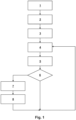
- a third step 3 the effects of the individual damage mechanisms identified as relevant on the behavior of the system are analyzed mathematically. To do this, the elements or components C of the system that are at risk of the occurrence of damage mechanisms SM are mathematically exposed to the damage mechanism SM and the behavior of the model is assessed, which can, for example, result in concrete damage effects SE on individual components that occur due to the respective damage effect.
- those observables O can also be identified that can be used to assess whether a damage mechanism SM is active and leads to a damage effect SE and should therefore be monitored on the real system S. This can be, for example, a pressure gradient, a battery capacity, a current, a voltage or another physical or chemical quantity.
- a fourth step 4 the behavior of the system S and the behavior of systems of a comparison instance are observed, in particular based on the observables O determined in the third step 3.
- the measured observables O can be, for example, pressures, temperatures, currents, deformations and the like.
- an observable O that is relevant and to be measured for assessing whether a door on a train is OK could be the time that the corresponding door needs to close. This time can be measured on the door of interest as well as on the other doors on the same train that are operated at the same time. The time course over time that the door of interest needs to close can then be compared with the time course over time that the other doors on the train, i.e. the comparison systems of the comparison instance, need on average for the closing process in order to obtain a statement about the state of the door of interest, even if no exact data on the number of closing processes is available.
- a difference is therefore determined between a temporal course of a behavior of the system measured in the third step and a temporal course of a behavior of the comparison instance, i.e. an average value of all comparison systems contained in the comparison instance.
- this difference or a temporal progression of the difference between the behavior of system S and the behavior of the comparison instance is used to assess whether and, if so, which damage mechanisms are at work and trigger this behavior of the system.
- the temporal progression of the difference is compared with the temporal progressions of the effects of the individual damage mechanisms determined on the model in order to identify the damage mechanism at work over the course, similar to pattern recognition.
- damage to a bearing on a train door due to abrasive wear can result in the door being closed for a progressively longer period over time, which is the result of the calculation or simulation carried out on the model in the third step.
- the other possible damage mechanisms SM result in a linear or degressive increase in the closing period
- a progressive course of the difference in the closing period of the observed door compared with the other doors on the train which form the comparison instance, can be used to conclude that there is bearing damage to the door due to abrasive wear and, if necessary, a remaining service life can be predicted, based on which maintenance can be planned and carried out.
- a possible damage mechanism SM is identified, which can subsequently be used to predict a remaining service life or to plan maintenance.
- an eighth process step 8 the maintenance is finally carried out according to the planning in the seventh process step, after which the system state is again monitored and compared with the state of the comparison instance.
- step 5 shows that no damage mechanism is at work or that the damage is so minor that no maintenance or repair is required, no maintenance or repair is carried out, but only the system state is monitored again and compared with the state of the comparison instance.
- Fig. 2 shows an example of a result of a system analysis of a system S to be assessed, which is a result of steps 1 to 3 of the Fig. 1 process shown.
- the system S has several components C1, C2.
- Possible damage mechanisms SM1, SM2, SM3, SM4 are assigned to the components C1, C2, which result in concrete damage or effects of the damage mechanisms or damage effects SE11, SE12, SE13, SE21, SE24, SE23, to which damage effects SE11, SE12, SE13, SE21, SE24, SE23 are in turn assigned drivers T1, F2, T3, T4, which are causal for the occurrence of the respective damage mechanism SM1, SM2, SM3, SM4, and on the other hand observable indicators or observables O11, O12, O13, O21, O24, O25, which can be used to determine whether the damage mechanism SM1, SM2, SM3, SM4 is acting on the respective component C1, C2 and leads to a progression of the damage effect SE11, SE12, SE13
- the damage mechanism corrosion SM1 can take effect, which manifests itself specifically as pitting SE11.
- This damage mechanism can be driven by a period of time when the temperature falls below the dew point T1 and can be observed by a reduction in a pressure gradient during compression O11.
- Another possible damage mechanism in the compressed air system C1 could be LCF fatigue or low cycle fatigue SM2, which leads to crack formation due to pressure cycling SE12.
- This damage SE12 is driven by pressure cycling at a high pressure level as driver T2 and could also be observed by a pressure gradient during compression 012 as an observable, which pressure gradient is reduced. The different damage mechanisms can thus possibly be observed by the same observables.
- Another possible damage mechanism in a compressed air system C1 could be abrasive wear SM3, which causes screw rotation in mixed friction as damage effect SE12.
- This damage mechanism SM12 is driven by the starts as driver T3 and can also be observed by a reduction in the pressure gradient during compression as observable 013.
- the further component C2 of the system S can, for example, be a Li-ion battery on which the damage mechanisms LCF fatigue SM2, deformation SM3 and deposition SM5 act, which in turn result in concrete damage effects SE221, SE24, SE222 and SE25, to which drivers T21, T4, T22 and T5 are assigned.
- the LCF fatigue damage mechanism can have different damage effects on the same component C2, namely, for example, on the one hand, crack formation due to cyclic strain gradients in the cathodes as the first damage effect SE221 and a loosening of contacts due to vibration loading as the second damage effect SE222.
- the first damage effect SE221 can be driven by high current density at low temperature as the first driver T21 and the second damage effect SE222 by vibration and impact load T22.
- the observables for the damage effects SE221 and SE222 can also be different, for example decreasing capacity of the battery on the one hand as the first observable 0221 and on the other hand via an intermittent voltage as the observable O222.
- a damage mechanism such as LCF fatigue can therefore have different damage effects SE221 and SE222 and be driven by different drivers T21 and T22 and be observable by different observables 0221 and O222.
- These relationships usually arise from a model of the system and the computational loading of the model with the known damage mechanisms, which are selected from the above list according to possible probabilities of occurrence, so that the temporal courses of the differences between the observed observables in the system and the temporal courses of the observables in the comparison instance do not have to be compared with the temporal courses of all possible 27 damage mechanisms in order to identify the effective damage mechanism, but only those which act with a certain probability.
- Equivalent comparison systems are usually used as a comparison instance. These can be identically loaded systems of the same design or asynchronously loaded similar systems, so that the actual target behavior of the system can be determined based on the behavior of the comparison instance, against which deviations can then be easily identified. In many cases, it is not possible to calculate a target behavior, especially since there are too many influencing factors that are not known or not fully known.
- component C damage mechanism SM damage effect SE Drivers of Damage T observable indicators or Observable t7 compressed air system corrosion pitting corrosion duration of the dew point undershoot Reduction of the pressure gradient during compression fatigue LCF cracking due to pressure cycling pressure cycling at high pressure levels Reduction of the pressure gradient during compression wear, abrasive screw rotation in mixed friction start Reduction of the pressure gradient during compression plain bearings wear, abrasive mixed friction due to collapse of the hydrodynamic lubricating film high bearing load, low speed and high oil temperature progressive bearing heating cavitation Impulse transfer through collapse of gas bubbles on the bearing surface high pressure gradients and high oil temperature oil pressure fluctuation, reduced mass flow erosion Abrasion due to particle load in the lubricating oil high flow rate Reduction of oil pressure due to increasing leakage Li-
- the method according to the invention therefore makes it particularly easy to assess whether a system is OK or whether a certain damage mechanism is at work, so that maintenance can be well planned and unplanned downtimes avoided, without it being necessary to know the exact target state of the system in advance. Rather, it is sufficient to compare the behavior of the system with the behavior of equivalent systems of a comparison instance, if necessary only with the behavior of a single comparison system.
Landscapes
- Physics & Mathematics (AREA)
- General Physics & Mathematics (AREA)
- Engineering & Computer Science (AREA)
- Automation & Control Theory (AREA)
- Artificial Intelligence (AREA)
- Evolutionary Computation (AREA)
- Mathematical Physics (AREA)
- Aviation & Aerospace Engineering (AREA)
- Testing Of Devices, Machine Parts, Or Other Structures Thereof (AREA)
Applications Claiming Priority (1)
| Application Number | Priority Date | Filing Date | Title |
|---|---|---|---|
| ATA50627/2023A AT527442B1 (de) | 2023-08-04 | 2023-08-04 | Verfahren zur Bestimmung eines Zustandes eines technischen Systems |
Publications (1)
| Publication Number | Publication Date |
|---|---|
| EP4502745A1 true EP4502745A1 (fr) | 2025-02-05 |
Family
ID=91022955
Family Applications (1)
| Application Number | Title | Priority Date | Filing Date |
|---|---|---|---|
| EP24173995.2A Pending EP4502745A1 (fr) | 2023-08-04 | 2024-05-03 | Procédé de détermination d'un état d'un système technique |
Country Status (2)
| Country | Link |
|---|---|
| EP (1) | EP4502745A1 (fr) |
| AT (1) | AT527442B1 (fr) |
Citations (4)
| Publication number | Priority date | Publication date | Assignee | Title |
|---|---|---|---|---|
| EP0895197B1 (fr) * | 1997-07-31 | 2006-01-11 | Sulzer Markets and Technology AG | Procédé pour surveiller des installations avec des composants mécaniques |
| US20100155634A1 (en) * | 2008-12-23 | 2010-06-24 | Embraer - Empresa Brasileira De Aeronaulica S.A. | Performance monitoring and prognostics for aircraft pneumatic control valves |
| US10964130B1 (en) * | 2018-10-18 | 2021-03-30 | Northrop Grumman Systems Corporation | Fleet level prognostics for improved maintenance of vehicles |
| US20210381928A1 (en) * | 2018-10-26 | 2021-12-09 | Flender Gmbh | Improved operating method for transmissions |
Family Cites Families (3)
| Publication number | Priority date | Publication date | Assignee | Title |
|---|---|---|---|---|
| US10606254B2 (en) * | 2016-09-14 | 2020-03-31 | Emerson Process Management Power & Water Solutions, Inc. | Method for improving process/equipment fault diagnosis |
| US11574238B2 (en) * | 2019-03-04 | 2023-02-07 | Accenture Global Solutions Limited | Machine learning (ML)-based auto-visualization of plant assets |
| WO2022132907A1 (fr) * | 2020-12-15 | 2022-06-23 | University Of Cincinnati | Système de surveillance d'état d'outil |
-
2023
- 2023-08-04 AT ATA50627/2023A patent/AT527442B1/de active
-
2024
- 2024-05-03 EP EP24173995.2A patent/EP4502745A1/fr active Pending
Patent Citations (4)
| Publication number | Priority date | Publication date | Assignee | Title |
|---|---|---|---|---|
| EP0895197B1 (fr) * | 1997-07-31 | 2006-01-11 | Sulzer Markets and Technology AG | Procédé pour surveiller des installations avec des composants mécaniques |
| US20100155634A1 (en) * | 2008-12-23 | 2010-06-24 | Embraer - Empresa Brasileira De Aeronaulica S.A. | Performance monitoring and prognostics for aircraft pneumatic control valves |
| US10964130B1 (en) * | 2018-10-18 | 2021-03-30 | Northrop Grumman Systems Corporation | Fleet level prognostics for improved maintenance of vehicles |
| US20210381928A1 (en) * | 2018-10-26 | 2021-12-09 | Flender Gmbh | Improved operating method for transmissions |
Also Published As
| Publication number | Publication date |
|---|---|
| AT527442A1 (de) | 2025-02-15 |
| AT527442B1 (de) | 2025-04-15 |
Similar Documents
| Publication | Publication Date | Title |
|---|---|---|
| CN108037378B (zh) | 基于长短时记忆网络的变压器运行状态预测方法及系统 | |
| DE10106508A1 (de) | Verfahren und Anordnung zur Bestimmung der Leistungsfähigkeit einer Batterie | |
| WO2020216530A1 (fr) | Procédé servant à définir des cycles d'utilisation restante, circuit de définition de cycle d'utilisation restante, dispositif de définition de cycle d'utilisation restante | |
| CN118260564B (zh) | 一种基于贝叶斯算法的零件寿命抽样检验方法及系统 | |
| DE102022000970B3 (de) | Verfahren zur Bestimmung des Verschleißvolumens einer Gleitringdichtung bei singulären Verschleißereignissen mittels zeitlich hochaufgelöster Temperaturmessung | |
| DE102017100130B4 (de) | Automatisiertes stochastisches Verfahren zum Erkennen von Eigenschaften und Verwenden desselben in einem wiederholbaren Verfahren | |
| Wei et al. | Remaining useful life estimation based on gamma process considered with measurement error | |
| AT527442B1 (de) | Verfahren zur Bestimmung eines Zustandes eines technischen Systems | |
| CN106845826A (zh) | 一种基于PCA‑Cpk的冷连轧生产线服役质量状态评估方法 | |
| CN118818407B (zh) | 一种基于人工智能的高压电压互感器性能监测系统及方法 | |
| CN1945269A (zh) | 高温构件材料的寿命及寿命消耗的预测方法 | |
| EP3771827A1 (fr) | Procédé de fonctionnement d'un compresseur de réfrigérant et système de compresseur de réfrigérant | |
| Ye et al. | Dynamic prediction of the performance reliability of high-speed railway bearings | |
| WO2019086160A1 (fr) | Procédé de surveillance de l'état d'une installation de fabrication | |
| EP3783448B1 (fr) | Procédé de tester d'un processus de production destiné à la fabrication de composants | |
| CN109299844A (zh) | 一种电力设备状态静态阈值评估方法 | |
| EP3959571A1 (fr) | Procédé servant à définir des cycles d'utilisation restante, circuit de définition de cycle d'utilisation restante, dispositif de définition de cycle d'utilisation restante | |
| Zhang | Research on the reliability of the drive motor of the scraper conveyor | |
| Safonov et al. | The predictive diagnosis method of electric drive state via an artificial neural network | |
| CN118655168B (zh) | 一种扫描电镜用高温测试系统 | |
| Mu et al. | Reliability analysis of vacuum circuit breaker with permanent magnet material actuator based on competitive failure model | |
| CN114896801B (zh) | 一种考虑状态增量的关节轴承剩余寿命预测方法 | |
| Han et al. | Accelerated Life Test and Life Prediction of an Electromechanical Actuator | |
| Xie et al. | Application of Grey Correlation Analysis in Effective Utilization of Similarity-based Remaining Useful Life Prediction Methods | |
| CN113902282B (zh) | 一种面向小样本数据条件的航班运行风险评价方法 |
Legal Events
| Date | Code | Title | Description |
|---|---|---|---|
| PUAI | Public reference made under article 153(3) epc to a published international application that has entered the european phase |
Free format text: ORIGINAL CODE: 0009012 |
|
| STAA | Information on the status of an ep patent application or granted ep patent |
Free format text: STATUS: THE APPLICATION HAS BEEN PUBLISHED |
|
| AK | Designated contracting states |
Kind code of ref document: A1 Designated state(s): AL AT BE BG CH CY CZ DE DK EE ES FI FR GB GR HR HU IE IS IT LI LT LU LV MC ME MK MT NL NO PL PT RO RS SE SI SK SM TR |
|
| STAA | Information on the status of an ep patent application or granted ep patent |
Free format text: STATUS: REQUEST FOR EXAMINATION WAS MADE |
|
| 17P | Request for examination filed |
Effective date: 20250801 |