EP4502897A1 - Système de suivi de colis - Google Patents
Système de suivi de colis Download PDFInfo
- Publication number
- EP4502897A1 EP4502897A1 EP24179612.7A EP24179612A EP4502897A1 EP 4502897 A1 EP4502897 A1 EP 4502897A1 EP 24179612 A EP24179612 A EP 24179612A EP 4502897 A1 EP4502897 A1 EP 4502897A1
- Authority
- EP
- European Patent Office
- Prior art keywords
- parameter
- sensor
- tracking system
- electronic device
- representative
- Prior art date
- Legal status (The legal status is an assumption and is not a legal conclusion. Google has not performed a legal analysis and makes no representation as to the accuracy of the status listed.)
- Pending
Links
Images

Classifications
-
- G—PHYSICS
- G06—COMPUTING OR CALCULATING; COUNTING
- G06Q—INFORMATION AND COMMUNICATION TECHNOLOGY [ICT] SPECIALLY ADAPTED FOR ADMINISTRATIVE, COMMERCIAL, FINANCIAL, MANAGERIAL OR SUPERVISORY PURPOSES; SYSTEMS OR METHODS SPECIALLY ADAPTED FOR ADMINISTRATIVE, COMMERCIAL, FINANCIAL, MANAGERIAL OR SUPERVISORY PURPOSES, NOT OTHERWISE PROVIDED FOR
- G06Q10/00—Administration; Management
- G06Q10/08—Logistics, e.g. warehousing, loading or distribution; Inventory or stock management
- G06Q10/083—Shipping
- G06Q10/0833—Tracking
Definitions
- the present invention relates to a parcel tracking system, viz., a system for tracking individual load units in logistics.
- the main application of the present invention is therefore in the field of logistics and transport, particularly in the area of monitoring the status of shipments of valuable products.
- the detection device comprises a containment body, a processing unit housed in said containment body, a transceiver connected to the processing unit and a battery pack and/or a power supply unit connectable to a an electrical network housed in the containment body.
- the detection device further comprises a first, brightness, sensor, connected to the processing unit, housed in the containment body and facing outside it to detect a first parameter representative of the brightness of an environment in which the device is immersed, in order to know whether or not the parcel has been opened during transport.
- a first, brightness, sensor connected to the processing unit, housed in the containment body and facing outside it to detect a first parameter representative of the brightness of an environment in which the device is immersed, in order to know whether or not the parcel has been opened during transport.
- the detection device further comprises one or more second sensors, for the detection of environmental parameters, connected to the processing unit, housed in the containment body and configured to measure one or more second parameters representative of at least a temperature and of a degree of humidity of the environment in which the device is immersed.
- one or more second sensors for the detection of environmental parameters, connected to the processing unit, housed in the containment body and configured to measure one or more second parameters representative of at least a temperature and of a degree of humidity of the environment in which the device is immersed.
- the detection device further comprises a third, acceleration, sensor configured to detect a third parameter representative of lateral acceleration (preferably in three-dimensional space) to which said detection device is subjected.
- a third, acceleration, sensor configured to detect a third parameter representative of lateral acceleration (preferably in three-dimensional space) to which said detection device is subjected.
- the detection device further comprises a fourth, localization, sensor, housed in the containment body and configured to detect a fourth parameter representative of an instantaneous geographical position of the containment body.
- the detection device is configured to send to said server and/or to said electronic device one or more signals having an informative content representative of the values of said first, second, third and fourth parameter.
- the remote electronic device e.g., smartphone, notebook, tablet, etc.
- the user interface module is provided with a user interface module.
- the electronic device is preferably connected to the detection device by means of said remote server and through a wireless communication network (2G, 3G, 4G, 5G and subsequent).
- the electronic device or remote server is configured to perform a processing cycle which envisages a succession of steps.
- the data processing can be performed remotely, server-side, or possibly locally, by the electronic device itself.
- the processing is performed server-side.
- the processing cycle envisages receiving said one or more signals.
- the processing cycle envisages comparing the first, second and third parameter values with respective alarm thresholds (or alarm threshold values).
- the processing cycle envisages recording, in a specific memory space, at least an identification data, representative of an adverse event, upon each exceedance of the alarm threshold by the relative first, second or third parameter, where said identification data has an informative content containing at least the value of the first, second or third parameter correlated to a corresponding value of the fourth parameter.
- the electronic device is configured to display, to a remote user and through said user interface module, a list of said data.
- a user can monitor the status of the parcel during delivery and at the same time identify possible hazardous situations (adverse events) which can be addressed both in real time and ex post, in a verification step due to a complaint by the recipient.
- a parcel tracking system in accordance with the present invention is indicated overall with 100.
- 'parcels' is understood in the present text to mean a single load unit or a separate package/packaging unit of one or more items which can be transported independently.
- the term parcel therefore identifies packages, boxes, cartons which are used to contain and transport goods from a place of departure to a place of delivery.
- the parcel tracking system 100 is preferably provided with at least one detection device 1, a remote server 11 and an electronic device 21.
- the electronic device 21 comprises a user interface module 22.
- the electronic device 21 is defined by a smartphone, tablet or notebook or personal computer.
- the system 100 comprises a plurality of detection devices 1, each configured to communicate with said remote server 11 and one or more electronic devices 21.
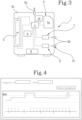
- the detection device 1 comprises a containment body 2 inside which the electronics are housed.
- the containment body 2 is preferably defined by a moulded plastic case delimiting an internal housing volume 2a of one or more electronic boards and at least one battery pack 3.
- the containment body 2 has a box-like shape and a volume of less than 320 cm 3 in order to be easily insertable into any parcel or package.
- a containment body 2 is also provided with at least one window 2b which is permeable to light, such as to allow light radiation to pass inside the volume 2a.
- the containment body 2 has two substantially polygonal, preferably rectangular, half-shells (with rounded corners) joined together and provided with one or more supports at a respective lower edge. Said supports are shaped to hold the containment body 2, hence the device, in an upright position, viz., with the polygonal faces of the half-shells oriented vertically.
- reversible coupling systems configured to allow the stable placement of the containment body inside a parcel can be provided.
- a section is also provided for housing the battery pack 3 and/or a power supply unit which can be connected to an electrical network.
- both options are envisaged, with the housing for the battery pack 3 connected in parallel (or sometimes in series) to the power supply unit.
- all the electronics of the device are housed inside the containment body 2, including a processing unit 4 and a transceiver 5.
- the transceiver 5 is connected to the processing unit 4 and is provided with a housing portion 5a for a smart-card SC and at least one antenna 5b for long-range wireless data transmission.
- the transceiver is defined by an NB loT (Narrow Band Internet of Things) module configured to exploit the LPWAN (Low Power Wide Area Network) radio technology standard such as to enable a low data flow communication with a broad category of devices.
- NB loT Near Band Internet of Things
- LPWAN Low Power Wide Area Network
- the smart-card SC is defined by a specific NB loT SIM.
- this allows to have broad coverage while maintaining very low power consumption, ideal for monitoring systems which need to ensure continuous functionality for long intervals of time even in the absence of network power (not necessarily available).
- the processing unit 4 is selectively switchable between a first resting and low energy consumption mode and a second, measurement and high energy consumption mode.
- the processing unit 4 is normally in the first mode and configured to switch from the first to the second mode only to perform a measurement procedure at pre-established time intervals (as will be better explained below).
- the device 1 works almost all the time in the first mode (sleep mode), 'waking up' at regular, pre-established intervals only for the time needed to collect environmental parameters.
- the processing unit 4 is integrated in the transceiver 5.
- the detection device 1 is further provided with an electricity consumption meter (not illustrated), configured to detect the electricity consumption continuously over time.
- a further, optional characteristic of the device 1 is that of providing one or more visual interface elements, such as LEDs or similar, facing outside the containment body 2 and configured to provide coloured information representative of the operating status of the device 1, making it advantageously monitorable also from a distance.
- one or more visual interface elements such as LEDs or similar
- the detection device 1 further comprises a first, brightness, sensor 6, connected to the processing unit 4, housed in containment housing 2 and facing it outside through the window 2b.
- Such a first sensor 6 is configured to detect a first parameter representative of the brightness of the environment in which the device is immersed.
- the first sensor 6 is thus configured to assess the brightness in a given environment, detecting values within a scale preferably ranging from a minimum of 600ms to a maximum of 4800ms.
- the presence of the first sensor allows to detect the opening of the parcel/package in which the detection device 1 is placed, identifying an increase in brightness with respect to a transport condition, in which the brightness is low (the interior of the parcel is normally devoid of light).
- the presence of one or more second sensors 7 is envisaged, for the detection of environmental parameters, housed in the containment body 2, connected to the processing unit 4 and configured to measure a plurality of quantities representative of environmental parameters, respectively.
- sensors configured to each measure a respective second parameter.
- such second parameters are representative of one or more of the following aspects:
- such a second sensor 7 integrates at least the temperature and humidity detection.
- the second sensor 7 integrates all the functions listed above.
- the second sensor 7 comprises a single chip, known per se, capable of detecting a plurality of quantities of interest; in more detail, the signal related to air quality is sent to the processing unit and then processed by means of a particular algorithm which takes into account the various concentrations provided by the sensor, and four types of measurement can be made.
- the device 1 comprises a third sensor 8, housed in the containment body 2, connected to the processing unit 4 and configured to detect a third parameter representative of a lateral acceleration (preferably three-dimensional) to which said containment body is subjected.
- the third sensor 8 is selectively switchable between a first mode of operation, semi-alert, and a second mode of operation, fully operational, and is configured to switch from the first mode to the second mode as soon as an oscillation occurs which exceeds a certain activation threshold.
- the third sensor 8 is calibrated to always remain in semi-alert mode (first mode) ready to enter full power mode (second mode) as soon as an oscillation exceeding a certain threshold occurs. From that instant on, the third sensor switches to the second mode of operation to sample at its maximum performance (about 1000 samples per second) so as to record the event in question.
- such a third sensor 8 is configured to generate an oscillation signal representative of said oscillation detection and to send said oscillation signal (along one or more, preferably three, directions) to the processing unit 4.
- such a third sensor 8 is defined by an accelerometer.
- the device 1 further comprises a fourth, localization, sensor 9, housed in the containment body 2 and configured to detect a fourth parameter representative of an instantaneous geographical position of the containment body 2.
- the fourth sensor 9 preferably comprises a satellite receiver (not illustrated) configured to detect a (geographical) position of the detection device 1.
- a satellite receiver is provided with a GPS module (or similar) and a GPS antenna (or similar) connected together.
- the third communication means could be defined by any receiver capable of processing satellite or other signals to determine the geographical position of the detection device 1.
- the processing unit 4 of the detection device 1 is therefore configured to send to said server 11 and/or to said electronic device 21 one or more signals having an informative content representative of the values of said first, second, third and fourth parameter.
- the detection device 1 comprises a memory card 10 housed in said containment body 2, preferably (but not necessarily) a flash-type memory.
- the processing unit 4 of the detection device 1 is thus configured to maintain the first (rest) mode, therefore to assume a 'normally' inactive condition, and to switch from the first to the second (operational) mode with a first pre-set time frequency.
- the first sensor 6 and said one or more second sensors 7 detect the values of said first and second parameters in real time.
- the processing unit 4 is therefore configured to store the detected values of said first, second parameter within said memory card 10.
- the processing unit 4 of the detection device 1 is configured to switch from the first to the second mode when the third sensor 8 detects a value of the third parameter above an activation threshold.
- the processing unit 4 of the detection device 1 is configured to switch from the first to the second mode when the third sensor 8 is in the second mode.
- the third sensor 8 detects an oscillation or acceleration exceeding the activation threshold, it preferably switches from the first to the second mode and sends an activation signal representative of this exceedance to the processing unit 4, which then switches from the first to the second mode.
- the processing unit 4 having activated the second mode in response to the activation signal, is configured to store the values of said first, second and third parameters detected by the first 6, by the second 7 and by the third 8 sensors within said memory card 10.
- the processing unit 4 is thus configured to start a measurement procedure with the remaining sensors (first 6 and second 7) upon receipt of said oscillation signal.
- the device 1 is thereby capable of monitoring the environment inside the parcel/package at predefined intervals, but can also intervene with appropriate measurements in the event of unpredictable events such as falls or sudden shocks.
- the activation threshold is set so as to activate the sensor when the parcel is transferred from one transport unit (e.g., plane, ship, train, lorry, van) to the next, in the moment when the same is necessarily moved and subjected to lateral accelerations (preferably three-dimensional).
- one transport unit e.g., plane, ship, train, lorry, van
- the processing unit 4 of the detection device 1 is configured to detect the value of said fourth parameter (viz., the location) at a second, predetermined time frequency by means of the fourth sensor 9.
- the processing unit 4 is configured to send (by means of the transceiver 5) and with said second pre-set time frequency, said one or more signals to said server 11 and/or to said electronic device 21. Therefore, in the absence of lateral accelerations exceeding the activation value, therefore in the moments when the parcel tends to be in the hold or in transit within a cargo bay, the detections are performed in accordance with the first pre-set frequency and the sending of said one or more signals with the second pre-set frequency.
- the detection device 1 is configured to activate itself automatically in response to the exceedance of the activation threshold by the third parameter, thus detecting in real time the most critical steps of the transport, which cannot be set a priori.
- the second time frequency is lower than the first time frequency, preferably a sub-multiple of the first time frequency.
- the first time frequency is preferably comprised in the range of 3-20 times/hour, while the second time frequency is preferably comprised in the range of 0.2-2 times/hour.
- the electronic device 21 and/or remote server 11 is configured to perform a processing cycle which envisages receiving and processing the one or more signals generated by the detection device 1.
- the CPU of the electronic device 21 and/or the remote server 11
- the CPU is configured to perform a processing cycle which envisages receiving and processing the one or more signals generated by the detection device 1.
- the processing cycle first envisages receiving said one or more signals from the detection device 1 (transmitted by means of the transceiver 5).
- the CPU is configured to compare the value of the first, second and third parameters with respective alarm thresholds, viz., pre-set values which detect the occurrence of an adverse event.
- Said CPU is thus configured, within the processing procedure, to record, in a specific memory space, at least one identifying datum, representative of an adverse event, upon each exceedance of the alarm threshold by the relative first, second or third parameter.
- said identification data has an information content which correlates at least the value of the first, second or third parameter with a corresponding value of the fourth parameter.
- each piece of identification data has an informative content containing:
- the processing procedure envisages that said identification data are made available and accessible by means of the user interface module 22 to a remote user.
- the electronic device 21 is configured to display a list of said identification data to the user.
- the electronic device 21 is further configured to display to the user, through the user interface module 22, the trend of the first, second and third parameter over time and in correlation with said fourth parameter and the respective alarm threshold.
- the user be it the sender, the recipient or a logistics operator, can thereby easily and immediately identify the presence of any adverse events, their magnitude and the geographical and temporal location.
- the electronic device 21 is configured to record a plurality of data identifying a plurality of adverse events of a different nature.
- the electronic device 21 is configured to record at least:
- the present invention achieves the proposed aims and obtains important benefits.
- a detection device provided with sensors adapted to detect numerous parameters of the parcel and an electronic device configured to process the data highlighting the presence of adverse events allows to maximise the efficiency of shipment management, allowing anyone in the logistics chain to verify and identify the transport conditions of the parcel and any anomalies.
Landscapes
- Business, Economics & Management (AREA)
- Engineering & Computer Science (AREA)
- Economics (AREA)
- Quality & Reliability (AREA)
- Entrepreneurship & Innovation (AREA)
- Human Resources & Organizations (AREA)
- Marketing (AREA)
- Operations Research (AREA)
- Development Economics (AREA)
- Strategic Management (AREA)
- Tourism & Hospitality (AREA)
- Physics & Mathematics (AREA)
- General Business, Economics & Management (AREA)
- General Physics & Mathematics (AREA)
- Theoretical Computer Science (AREA)
- Alarm Systems (AREA)
Applications Claiming Priority (1)
| Application Number | Priority Date | Filing Date | Title |
|---|---|---|---|
| IT102023000016239A IT202300016239A1 (it) | 2023-08-01 | 2023-08-01 | Sistema di tracciamento colli |
Publications (1)
| Publication Number | Publication Date |
|---|---|
| EP4502897A1 true EP4502897A1 (fr) | 2025-02-05 |
Family
ID=88413060
Family Applications (1)
| Application Number | Title | Priority Date | Filing Date |
|---|---|---|---|
| EP24179612.7A Pending EP4502897A1 (fr) | 2023-08-01 | 2024-06-03 | Système de suivi de colis |
Country Status (2)
| Country | Link |
|---|---|
| EP (1) | EP4502897A1 (fr) |
| IT (1) | IT202300016239A1 (fr) |
Cited By (1)
| Publication number | Priority date | Publication date | Assignee | Title |
|---|---|---|---|---|
| CN121481558A (zh) * | 2026-01-12 | 2026-02-06 | 深圳市明心数智科技有限公司 | 一种跨境物流客服冲突智能调解方法及装置 |
Citations (6)
| Publication number | Priority date | Publication date | Assignee | Title |
|---|---|---|---|---|
| WO2012045182A1 (fr) * | 2010-10-05 | 2012-04-12 | Die Schweizerische Post | Procédé de suivi d'une localisation de produits transportés |
| US20200027058A1 (en) * | 2015-12-17 | 2020-01-23 | Tive, Inc. | Sensor device having configuration changes |
| US20210012590A1 (en) * | 2014-01-31 | 2021-01-14 | Cambridge Consultants Limited | Monitoring device |
| EP4033273A1 (fr) * | 2021-01-20 | 2022-07-27 | H&S Engineering S.r.l. | Dispositif et systeme de surveillance environnementale |
| US20230110148A1 (en) * | 2018-08-08 | 2023-04-13 | Package, Inc. | Shipping package tracking or monitoring system and method |
| US20230237892A1 (en) * | 2018-06-01 | 2023-07-27 | Stress Engineering Services, Inc. | Systems and methods for monitoring, tracking and tracing logistics |
-
2023
- 2023-08-01 IT IT102023000016239A patent/IT202300016239A1/it unknown
-
2024
- 2024-06-03 EP EP24179612.7A patent/EP4502897A1/fr active Pending
Patent Citations (6)
| Publication number | Priority date | Publication date | Assignee | Title |
|---|---|---|---|---|
| WO2012045182A1 (fr) * | 2010-10-05 | 2012-04-12 | Die Schweizerische Post | Procédé de suivi d'une localisation de produits transportés |
| US20210012590A1 (en) * | 2014-01-31 | 2021-01-14 | Cambridge Consultants Limited | Monitoring device |
| US20200027058A1 (en) * | 2015-12-17 | 2020-01-23 | Tive, Inc. | Sensor device having configuration changes |
| US20230237892A1 (en) * | 2018-06-01 | 2023-07-27 | Stress Engineering Services, Inc. | Systems and methods for monitoring, tracking and tracing logistics |
| US20230110148A1 (en) * | 2018-08-08 | 2023-04-13 | Package, Inc. | Shipping package tracking or monitoring system and method |
| EP4033273A1 (fr) * | 2021-01-20 | 2022-07-27 | H&S Engineering S.r.l. | Dispositif et systeme de surveillance environnementale |
Cited By (1)
| Publication number | Priority date | Publication date | Assignee | Title |
|---|---|---|---|---|
| CN121481558A (zh) * | 2026-01-12 | 2026-02-06 | 深圳市明心数智科技有限公司 | 一种跨境物流客服冲突智能调解方法及装置 |
Also Published As
| Publication number | Publication date |
|---|---|
| IT202300016239A1 (it) | 2025-02-01 |
Similar Documents
| Publication | Publication Date | Title |
|---|---|---|
| CN101669151B (zh) | 监测包裹的方法,哨兵指示系统及物流系统 | |
| US8392339B2 (en) | Cargo tracking apparatus, system and method | |
| EP3507762B1 (fr) | Systèmes et procédés de surveillance de vibrations pendant le transport de marchandises | |
| US8973835B2 (en) | Systems and methods for collecting primary and secondary data associated with shipping containers | |
| US20170372262A1 (en) | System and Method for In-Transit Cargo Monitoring Utilizing Sensor Device and Telematics | |
| US20160148440A1 (en) | Real-Time Cargo Condition Management System and Method Based on Remote Real-Time Vehicle OBD Monitoring | |
| US20050236479A1 (en) | Recording of location event information in RFID tags | |
| US20100066501A1 (en) | Method and system for monitoring a container | |
| US7538670B2 (en) | Method for detecting objects separated from a group | |
| US20170372260A1 (en) | Environmental parameter monitor with machine readable display | |
| US20180039940A1 (en) | Environmental parameter monitor with wide area communication | |
| CN112262415A (zh) | 用于监测货物运输期间的振动的系统和方法 | |
| WO2002007014A1 (fr) | Enregistreur de donnees servant a controler une expedition de marchandises | |
| IT202300016239A1 (it) | Sistema di tracciamento colli | |
| US20090307000A1 (en) | Method and system for globally monitoring aircraft components | |
| JP7020817B2 (ja) | 車載器および荷物管理システム | |
| Ubik et al. | Monitoring of Sensitive Transports Using the Internet of Things | |
| CN206344836U (zh) | 车载监控终端及铁路运输安全监控系统 | |
| CN113168614A (zh) | 跟踪对象的集合体 |
Legal Events
| Date | Code | Title | Description |
|---|---|---|---|
| PUAI | Public reference made under article 153(3) epc to a published international application that has entered the european phase |
Free format text: ORIGINAL CODE: 0009012 |
|
| STAA | Information on the status of an ep patent application or granted ep patent |
Free format text: STATUS: THE APPLICATION HAS BEEN PUBLISHED |
|
| AK | Designated contracting states |
Kind code of ref document: A1 Designated state(s): AL AT BE BG CH CY CZ DE DK EE ES FI FR GB GR HR HU IE IS IT LI LT LU LV MC ME MK MT NL NO PL PT RO RS SE SI SK SM TR |
|
| STAA | Information on the status of an ep patent application or granted ep patent |
Free format text: STATUS: REQUEST FOR EXAMINATION WAS MADE |
|
| 17P | Request for examination filed |
Effective date: 20250714 |