EP4503021A1 - Verfahren und vorrichtung zur sprachkodierung, verfahren und vorrichtung zur sprachdekodierung, computervorrichtung und speichermedium - Google Patents
Verfahren und vorrichtung zur sprachkodierung, verfahren und vorrichtung zur sprachdekodierung, computervorrichtung und speichermedium Download PDFInfo
- Publication number
- EP4503021A1 EP4503021A1 EP23862111.4A EP23862111A EP4503021A1 EP 4503021 A1 EP4503021 A1 EP 4503021A1 EP 23862111 A EP23862111 A EP 23862111A EP 4503021 A1 EP4503021 A1 EP 4503021A1
- Authority
- EP
- European Patent Office
- Prior art keywords
- subband
- excitation signal
- signal
- speech
- subband excitation
- Prior art date
- Legal status (The legal status is an assumption and is not a legal conclusion. Google has not performed a legal analysis and makes no representation as to the accuracy of the status listed.)
- Pending
Links
Images




Classifications
-
- G—PHYSICS
- G10—MUSICAL INSTRUMENTS; ACOUSTICS
- G10L—SPEECH ANALYSIS TECHNIQUES OR SPEECH SYNTHESIS; SPEECH RECOGNITION; SPEECH OR VOICE PROCESSING TECHNIQUES; SPEECH OR AUDIO CODING OR DECODING
- G10L19/00—Speech or audio signals analysis-synthesis techniques for redundancy reduction, e.g. in vocoders; Coding or decoding of speech or audio signals, using source filter models or psychoacoustic analysis
- G10L19/02—Speech or audio signals analysis-synthesis techniques for redundancy reduction, e.g. in vocoders; Coding or decoding of speech or audio signals, using source filter models or psychoacoustic analysis using spectral analysis, e.g. transform vocoders or subband vocoders
- G10L19/0204—Speech or audio signals analysis-synthesis techniques for redundancy reduction, e.g. in vocoders; Coding or decoding of speech or audio signals, using source filter models or psychoacoustic analysis using spectral analysis, e.g. transform vocoders or subband vocoders using subband decomposition
-
- G—PHYSICS
- G10—MUSICAL INSTRUMENTS; ACOUSTICS
- G10L—SPEECH ANALYSIS TECHNIQUES OR SPEECH SYNTHESIS; SPEECH RECOGNITION; SPEECH OR VOICE PROCESSING TECHNIQUES; SPEECH OR AUDIO CODING OR DECODING
- G10L19/00—Speech or audio signals analysis-synthesis techniques for redundancy reduction, e.g. in vocoders; Coding or decoding of speech or audio signals, using source filter models or psychoacoustic analysis
- G10L19/02—Speech or audio signals analysis-synthesis techniques for redundancy reduction, e.g. in vocoders; Coding or decoding of speech or audio signals, using source filter models or psychoacoustic analysis using spectral analysis, e.g. transform vocoders or subband vocoders
- G10L19/0204—Speech or audio signals analysis-synthesis techniques for redundancy reduction, e.g. in vocoders; Coding or decoding of speech or audio signals, using source filter models or psychoacoustic analysis using spectral analysis, e.g. transform vocoders or subband vocoders using subband decomposition
- G10L19/0208—Subband vocoders
-
- G—PHYSICS
- G10—MUSICAL INSTRUMENTS; ACOUSTICS
- G10L—SPEECH ANALYSIS TECHNIQUES OR SPEECH SYNTHESIS; SPEECH RECOGNITION; SPEECH OR VOICE PROCESSING TECHNIQUES; SPEECH OR AUDIO CODING OR DECODING
- G10L19/00—Speech or audio signals analysis-synthesis techniques for redundancy reduction, e.g. in vocoders; Coding or decoding of speech or audio signals, using source filter models or psychoacoustic analysis
- G10L19/02—Speech or audio signals analysis-synthesis techniques for redundancy reduction, e.g. in vocoders; Coding or decoding of speech or audio signals, using source filter models or psychoacoustic analysis using spectral analysis, e.g. transform vocoders or subband vocoders
- G10L19/032—Quantisation or dequantisation of spectral components
-
- G—PHYSICS
- G10—MUSICAL INSTRUMENTS; ACOUSTICS
- G10L—SPEECH ANALYSIS TECHNIQUES OR SPEECH SYNTHESIS; SPEECH RECOGNITION; SPEECH OR VOICE PROCESSING TECHNIQUES; SPEECH OR AUDIO CODING OR DECODING
- G10L19/00—Speech or audio signals analysis-synthesis techniques for redundancy reduction, e.g. in vocoders; Coding or decoding of speech or audio signals, using source filter models or psychoacoustic analysis
- G10L19/04—Speech or audio signals analysis-synthesis techniques for redundancy reduction, e.g. in vocoders; Coding or decoding of speech or audio signals, using source filter models or psychoacoustic analysis using predictive techniques
- G10L19/08—Determination or coding of the excitation function; Determination or coding of the long-term prediction parameters
- G10L19/083—Determination or coding of the excitation function; Determination or coding of the long-term prediction parameters the excitation function being an excitation gain
-
- G—PHYSICS
- G10—MUSICAL INSTRUMENTS; ACOUSTICS
- G10L—SPEECH ANALYSIS TECHNIQUES OR SPEECH SYNTHESIS; SPEECH RECOGNITION; SPEECH OR VOICE PROCESSING TECHNIQUES; SPEECH OR AUDIO CODING OR DECODING
- G10L19/00—Speech or audio signals analysis-synthesis techniques for redundancy reduction, e.g. in vocoders; Coding or decoding of speech or audio signals, using source filter models or psychoacoustic analysis
- G10L19/04—Speech or audio signals analysis-synthesis techniques for redundancy reduction, e.g. in vocoders; Coding or decoding of speech or audio signals, using source filter models or psychoacoustic analysis using predictive techniques
- G10L19/08—Determination or coding of the excitation function; Determination or coding of the long-term prediction parameters
- G10L19/09—Long term prediction, i.e. removing periodical redundancies, e.g. by using adaptive codebook or pitch predictor
-
- G—PHYSICS
- G10—MUSICAL INSTRUMENTS; ACOUSTICS
- G10L—SPEECH ANALYSIS TECHNIQUES OR SPEECH SYNTHESIS; SPEECH RECOGNITION; SPEECH OR VOICE PROCESSING TECHNIQUES; SPEECH OR AUDIO CODING OR DECODING
- G10L21/00—Speech or voice signal processing techniques to produce another audible or non-audible signal, e.g. visual or tactile, in order to modify its quality or its intelligibility
- G10L21/02—Speech enhancement, e.g. noise reduction or echo cancellation
- G10L21/0208—Noise filtering
- G10L21/0264—Noise filtering characterised by the type of parameter measurement, e.g. correlation techniques, zero crossing techniques or predictive techniques
-
- G—PHYSICS
- G10—MUSICAL INSTRUMENTS; ACOUSTICS
- G10L—SPEECH ANALYSIS TECHNIQUES OR SPEECH SYNTHESIS; SPEECH RECOGNITION; SPEECH OR VOICE PROCESSING TECHNIQUES; SPEECH OR AUDIO CODING OR DECODING
- G10L25/00—Speech or voice analysis techniques not restricted to a single one of groups G10L15/00 - G10L21/00
- G10L25/03—Speech or voice analysis techniques not restricted to a single one of groups G10L15/00 - G10L21/00 characterised by the type of extracted parameters
- G10L25/21—Speech or voice analysis techniques not restricted to a single one of groups G10L15/00 - G10L21/00 characterised by the type of extracted parameters the extracted parameters being power information
-
- G—PHYSICS
- G10—MUSICAL INSTRUMENTS; ACOUSTICS
- G10L—SPEECH ANALYSIS TECHNIQUES OR SPEECH SYNTHESIS; SPEECH RECOGNITION; SPEECH OR VOICE PROCESSING TECHNIQUES; SPEECH OR AUDIO CODING OR DECODING
- G10L19/00—Speech or audio signals analysis-synthesis techniques for redundancy reduction, e.g. in vocoders; Coding or decoding of speech or audio signals, using source filter models or psychoacoustic analysis
- G10L19/04—Speech or audio signals analysis-synthesis techniques for redundancy reduction, e.g. in vocoders; Coding or decoding of speech or audio signals, using source filter models or psychoacoustic analysis using predictive techniques
- G10L19/26—Pre-filtering or post-filtering
-
- G—PHYSICS
- G10—MUSICAL INSTRUMENTS; ACOUSTICS
- G10L—SPEECH ANALYSIS TECHNIQUES OR SPEECH SYNTHESIS; SPEECH RECOGNITION; SPEECH OR VOICE PROCESSING TECHNIQUES; SPEECH OR AUDIO CODING OR DECODING
- G10L19/00—Speech or audio signals analysis-synthesis techniques for redundancy reduction, e.g. in vocoders; Coding or decoding of speech or audio signals, using source filter models or psychoacoustic analysis
- G10L2019/0001—Codebooks
- G10L2019/0013—Codebook search algorithms
Definitions
- This application relates to the field of speech processing technologies, and in particular, to a speech encoding method and apparatus, a computer device, a storage medium, and a computer program product, and to a speech decoding method and apparatus, a computer device, a storage medium, and a computer program product.
- Speech encoding is widely applied in daily communication. While ensuring high-quality speech transmission, speech encoding reduces channel bandwidths required for speech transmission.
- a transmit end collects speech data, encodes the speech data, and transmits encoded data to a receive end, so that the receive end can regenerate the speech data through decoding and change the speech data into sound.
- a waveform encoding technology processes speech data as general waveform data, so that reconstructed speech waveforms are in original waveform shapes.
- a parametric encoding technology ensures, through extraction and encoding of feature parameters of speech data, that reconstructed speech data retains semantics of original speech.
- a hybrid encoding technology combining a waveform encoding technology and a parametric encoding technology, includes both feature parameters of speech and encoded data of waveforms.
- current speech encoding methods are inefficient in encoding.
- a speech encoding method and apparatus a computer device, a computer-readable storage medium, and a computer program product
- a speech decoding method and apparatus a computer device, a computer-readable storage medium, and a computer program product.
- this application provides a speech encoding method.
- the method is performed by a first device and includes:
- this application further provides a speech encoding apparatus.
- the apparatus includes:
- this application further provides a computer device.
- the computer device includes a memory and a processor.
- the memory stores computer-readable instructions.
- the processor when executing the computer-readable instructions, implements operations of the speech encoding method.
- this application further provides a computer-readable storage medium.
- the computer-readable storage medium has computer-readable instructions stored therein.
- the computer-readable instructions when being executed by a processor, implement operations of the speech encoding method.
- this application further provides a computer program product.
- the computer program product includes computer-readable instructions.
- the computer-readable instructions when being executed by a processor, implement operations of the speech encoding method.
- this application provides a speech decoding method.
- the method is performed by a second device and includes:
- this application further provides a speech decoding apparatus.
- the apparatus includes:
- this application further provides a computer device.
- the computer device includes a memory and a processor.
- the memory stores computer-readable instructions.
- the processor when executing the computer-readable instructions, implements operations of the speech decoding method.
- this application further provides a computer-readable storage medium.
- the computer-readable storage medium has computer-readable instructions stored therein.
- the computer-readable instructions when being executed by a processor, implement operations of the speech decoding method.
- this application further provides a computer program product.
- the computer program product includes computer-readable instructions.
- the computer-readable instructions when being executed by a processor, implement operations of the speech decoding method.
- Speech encoding means converting analog speech signals into digital signals, and compressing speech data through leveraging of redundancy in the speech data and auditory characteristics of humans. Encoded data is transmitted. Speech decoding means decoding encoded data after the encoded data is received, to regenerate digital speech signals. Finally, a loudspeaker changes the digital speech signals into sound. Speech encoding and decoding effectively reduce bandwidths required for transmission of speech signals, and play a decisive role in reducing storage and transmission costs of speech information and ensuring integrity of speech information during transmission over a communication network.
- a speech encoding method and a speech decoding method provided in the embodiments of this application may be used on a system that includes a first device and a second device. After performing speech encoding to obtain encoded data, one of the first device and the second device may transmit the encoded data to the other device. After receiving the encoded data, the other device may perform decoding for restoration, to obtain speech signals that may be used for playing.
- the first device and the second device are connected by using a wired or wireless network.
- the first device and the second device may be computer devices.
- a computer device may be a terminal or a server.
- a terminal may be but is not limited to any desktop computer, notebook computer, smartphone, tablet computer, internet of things device, or portable wearable device.
- An internet of things device may be a smart speaker, a smart TV, a smart air conditioner, a smart vehicle-mounted device, or the like.
- a portable wearable device may be a smart watch, a smart band, a head-mounted device, or the like.
- a server may be implemented by a standalone server or a server cluster that includes a plurality of servers.
- FIG. 1 is a diagram of an application environment of a speech encoding method and a speech decoding method according to an embodiment of this application.
- a first device 102 is a terminal corresponding to a first user
- a second device 104 is a terminal corresponding to a second user.
- the terminal corresponding to the first user and the terminal corresponding to the second user can communicate through a network.
- the first device 102 may pre-process an initial speech signal obtained through recording, perform speech encoding to obtain encoded speech data, and then transmit the data.
- the second device 104 receives the data, performs speech decoding on the received encoded speech data, post-processes speech data obtained through decoding, and performs playing.
- the first device 102 may perform subband decomposition on the speech signal to obtain at least two subband excitation signals, perform auditory perception analysis on the subband excitation signals, and allocate different quantities of quantization bits to different subbands based on auditory perception strength. For a subband excitation signal with weak auditory perception, only a gain relative to a reference excitation signal needs to be transmitted to describe an audio feature. Thus, subband encoding may be performed by using an extremely small quantity of bits.
- the second device 104 may generate a restored excitation signal by multiplying the gain of the subband excitation signal by the reference excitation signal, implementing excitation reconstruction and related decoding processing in the decoding process. In this application, an encoding bit rate can be effectively reduced, bandwidths can be effectively utilized, and an effective compression ratio of signals can be increased while encoding efficiency is improved.
- a speech encoding method is provided.
- An example is used for description in which the method is used on the first device in FIG. 1 .
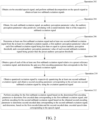
- the method includes the following operations: Operation 202: Obtain a to-be-encoded speech signal, and perform subband decomposition on the speech signal to obtain at least two subband excitation signals.
- a to-be-encoded speech signal is a speech signal that needs to be encoded.
- a to-be-encoded speech signal may be a residual signal obtained by pre-processing an initial speech signal.
- An initial speech signal is a digital signal obtained by converting an analog signal collected by a microphone.
- Subband decomposition is a process of decomposing a signal into a plurality of subbands. Subband decomposition may be performed based on a frequency range of a to-be-encoded speech signal. Subband excitation signals obtained through the decomposition are in different frequency intervals in the frequency range. A subband excitation signal obtained through the decomposition has a narrower bandwidth than the to-be-encoded speech signal.
- a first device blocks the initial speech signal into a plurality of frames of speech sub-signal.
- a plurality of frames mean at least two frames.
- the first device may perform pre-processing to obtain an initial excitation signal of the frame of speech sub-signal.
- the initial excitation signal is a to-be-encoded speech signal.
- the first device may perform signal subband decomposition to obtain at least two subband excitation signals.
- the excitation signal can be preferably configured as a signal used for exciting a vocoder or a speech codec to perform acoustic modelling and synthesis.
- pre-processing each frame of speech sub-signal by the first device may include signal analysis and filtering, specifically including: determining, by using voice activity detection (VAD), whether the frame of speech sub-signal is a speech frame or a non-speech frame; performing high-pass filtering on a non-speech frame; further performing pitch analysis, linear prediction analysis, noise shaping analysis, and gain calculation; and performing calculation to obtain an initial excitation signal of the frame of speech sub-signal.
- VAD voice activity detection
- the voice activity detection analysis is to determine a boundary between a voice segment and a non-voice segment by analyzing features such as energy and spectrum of a voice signal. This helps the system to accurately identify and process voice signals.
- the pitch analysis is to determine a basic frequency of a voice signal, that is, a speaker's voice tone, by analyzing a basic frequency component in the voice signal.
- Linear prediction analysis is a mathematical model, which is used for analysing a resonant peak and a harmonic component in a voice signal, so as to reconstruct the voice signal.
- Noise shaping analysis is to analyze and process noise in a voice signal, so as to improve quality and definition of the voice signal.
- Gain calculation adjusts the volume and intensity of a voice signal by calculating a gain value in the voice signal.
- the way in which the first device acquires the initial speech signal to be encoded may be a to-be-encoded initial speech signal that is obtained after an analog-to-digital conversion circuit converts original speech that is collected by a microphone provided with the first device, or may be a speech signal that is obtained through analog-to-digital conversion and that is transmitted from another speech processing device, or may be a speech signal that is obtained through analog-to-digital conversion and that is obtained from a network. This is not limited in this application.
- the performing subband decomposition on the speech signal to obtain at least two subband excitation signals includes: determining a frequency range in which the speech signal is; and performing at least one level of subband decomposition on the speech signal based on the frequency range in which the speech signal is, to obtain at least two subband excitation signals, each level of subband decomposition implementing decomposition of a signal that needs to be decomposed into two signals in different frequency intervals.
- the first device may specifically use a quadrature mirror filter (QMF) to perform at least one level of symmetric subband decomposition on the to-be-encoded speech signal.
- QMF quadrature mirror filter
- Each level of subband decomposition implements decomposition of a signal that needs to be decomposed into two signals in different frequency intervals. After the decomposition is completed, at least two subband excitation signals are obtained.
- the low-frequency decomposition signal in each of the divided levels may be further decomposed, so as to obtain a plurality of sub-band excitation signals (taking a high-frequency decomposition signal determined in each level directly as a determined sub-band excitation signal),
- the high-frequency decomposed signals in each level after the decomposition may also be further decomposed to obtain a plurality of sub-band excitation signals (the low-frequency decomposed signals determined in each level are directly used as one determined sub-band excitation signal).
- the performing at least one level of subband decomposition on the speech signal based on the frequency range in which the speech signal is, to obtain at least two subband excitation signals includes: performing, at the first level of subband decomposition, subband decomposition on the speech signal based on the frequency range in which the speech signal is, to obtain a high-frequency decomposition signal and a low-frequency decomposition signal of the current level, and determining the low-frequency decomposition signal as a subband excitation signal, an arbitrary frequency in a frequency interval in which the high-frequency decomposition signal is being higher than an arbitrary frequency in a frequency interval in which the low-frequency decomposition signal is; performing, at each of the second level and following levels, and based on a frequency interval in which a high-frequency decomposition signal obtained through subband decomposition of a previous level is, subband decomposition on the high-frequency decomposition signal
- a quantity of levels of subband decomposition may be set depending on a requirement. Three levels of decomposition are used as an example.
- subband decomposition is performed on a speech signal based on a frequency range in which the speech signal is, to obtain a high-frequency decomposition signal and a low-frequency decomposition signal of the first level; and the low-frequency decomposition signal of the first level is determined as a subband excitation signal.
- the high-frequency decomposition signal of the first level continues to be decomposed based on a frequency interval in which the high-frequency decomposition signal of the first level is, to obtain a high-frequency decomposition signal and a low-frequency decomposition signal of the second level; and the low-frequency decomposition signal of the second level is determined as a subband excitation signal.
- the low-frequency decomposition signal of the second level continues to be decomposed based on a frequency interval in which the high-frequency decomposition signal of the second level is, to obtain a high-frequency decomposition signal and a low-frequency decomposition signal of the third level; and the high-frequency decomposition signal and the low-frequency decomposition signal of the third level are both determined as subband excitation signals.
- the high-frequency decomposed signals in each level are further decomposed to obtain a plurality of sub-band excitation signals, and a frequency bandwidth of a to-be-encoded speech signal is 8 kHz.
- a high-frequency subband decomposition signal exc1_high with a frequency bandwidth of 4 kHz and a low-frequency subband decomposition signal exc1_low with a frequency bandwidth of 4 kHz may be obtained by using a quadrature mirror filter.
- the high-frequency subband decomposition signal exc1_high with the frequency bandwidth of 4 kHz may be further decomposed to obtain two signals, each with a frequency bandwidth of 2 kHz: exc2_low and exc2_high.
- a frequency of exc2_high is higher than a frequency of exc2_low.
- exc2_high may continue to be decomposed to obtain two signals, each with a frequency bandwidth of 1 kHz, that is, exc3_low and exc3 _high.
- a frequency of exc3_high is higher than a frequency of exc3_low.
- the to-be-encoded speech signal with the frequency bandwidth of 8 kHz is decomposed to obtain four subband excitation signals: exc1_low, exc2_low, exc3 _high, and exc3_low.
- Operation 204 Obtain, for each subband excitation signal, an auditory perception parameter value, the auditory perception parameter value positively correlating with a sound intensity that is of the respective subband excitation signal.
- An auditory perception parameter value may represent overall energy of an entire subband, and is configured for describing auditory perception strength of a subband excitation signal.
- An auditory perception parameter value is positively correlating with a sound intensity that is of a respective subband excitation signal.
- a larger auditory perception parameter value represents stronger auditory perception of the subband excitation signal.
- a smaller auditory perception parameter value represents weaker auditory perception of the subband excitation signal.
- the auditory perception parameter value may represent an auditory perception contribution of the subband excitation signal to an entire initial speech signal.
- a subband excitation signal with a larger auditory perception parameter value makes a larger auditory perception contribution; on the contrary, a subband excitation signal with a smaller auditory perception parameter value makes a smaller auditory perception contribution.
- a subband excitation signal making a smaller auditory perception contribution has less impact on subjective auditory quality that exists after speech is encoded and then decoded.
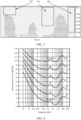
- FIG. 3 shows an example of a spectrogram according to an embodiment.
- a horizontal coordinate in the spectrogram indicates a time, and a vertical coordinate indicates a frequency.
- Lines in FIG. 3 represent areas in which energy fluctuates.
- an area with darker lines represents stronger auditory perception
- an area with lighter lines represents weaker auditory perception.
- 302, 304 and 306 in FIG. 3 are all areas with weaker auditory perception. It can be learned from FIG. 3 that areas with weaker auditory perception may be distributed in various frequency bands, and have no direct relationship with a frequency. Based on this, this embodiment of this application provides the following: to quantize auditory perception strength of a subband excitation signal by determining an auditory perception parameter value.
- the first device transforms the subband excitation signal from time domain to frequency domain, obtains a feature value of each frequency point in frequency domain, and then determines, based on the feature value of each frequency point, the auditory perception parameter value that corresponds to the subband excitation signal.
- Each frequency point may correspond to a frequency or a frequency band.
- a subband excitation signal may include frequency points 0, 1, 2, ..., and K-1, K frequency points in total, where K is a positive integer and indicates a total quantity of frequency points.
- a quantity of frequency points in a subband excitation signal, and a frequency or a frequency band corresponding to each frequency point may be set depending on an actual need.
- a feature value of a frequency point is configured for describing an energy magnitude of the frequency point.
- a feature value of a frequency point may be, for example, an absolute power of the frequency point.
- the first device may obtain, for each subband excitation signal, a feature value of each frequency point in the subband excitation signal; and perform a statistical operation on the feature values of the frequency points, to obtain the auditory perception parameter value that corresponds to the subband excitation signal.
- the statistical operation herein may be one of calculating a sum, calculating a weighted sum, calculating a mean, or calculating a median.
- Operation 206 Determine at least one first subband excitation signal and at least one second subband excitation signal from the at least two subband excitation signals, a first auditory perception parameter value of each first subband excitation signal being less than or equal to a preset auditory perception threshold, and a second auditory perception parameter value of each second subband excitation signal being greater than the preset auditory perception threshold.
- An auditory perception threshold is configured for defining a threshold of an auditory perception parameter value.
- the voice signal can be perceived and heard by an object with hearing ability, when an auditory perception parameter value of the speech signal is greater than an auditory perception threshold.
- An auditory perception threshold may be set based on experience. During actual application, different auditory perception thresholds may be set for different quantities of FFT points. For example, in a case of a sampling rate of 16 kHz, if there are 512 FFT points, an auditory perception threshold may be set to 1000.
- the first device may compare an auditory perception parameter value of each subband excitation signal with a preset auditory perception threshold. If an auditory perception parameter value is less than or equal to the preset auditory perception threshold, a subband excitation signal corresponding to the auditory perception parameter value is determined as a first subband excitation signal. If an auditory perception parameter value is greater than the preset auditory perception threshold, a subband excitation signal corresponding to the auditory perception parameter value is determined as a second subband excitation signal. There may be one or more first subband excitation signals, and likewise, there may also be one or more second subband excitation signals. More means at least two.
- Operation 208 Obtain a gain of each of the at least one first subband excitation signal relative to a preset reference excitation signal, and determine the gain as a first encoding parameter that corresponds to the first subband excitation signal.
- a reference excitation signal is a signal configured for performing signal restoration for a corresponding first subband excitation signal in a decoding process.
- An amplitude of a reference excitation signal is small.
- a reference excitation signal may be a unit excitation signal.
- a unit excitation signal is a signal whose absolute value of a maximum amplitude is 1, that is, a possible amplitude of the unit excitation signal is 1, 0, or -1.
- the first device and a second device may agree to set a fixed reference excitation signal. In some other embodiments, the first device and the second device may agree to set a plurality of reference excitation signals.
- a reference excitation signal with a minimum error may be selected from the plurality of reference excitation signals to calculate a corresponding gain, and an identifier of the reference excitation signal is encoded into encoded data.
- the reference excitation signal used in the encoding process can be found based on code, and restoration is performed by using the found reference excitation signal. Because the reference excitation signal used is the signal with the minimum error, distribution of the first subband excitation signal in the encoding process can be restored as much as possible, so that a signal obtained through restoration is more authentic. This improves accuracy of speech decoding.
- the first device and the second device usually set a small quantity of reference excitation signals. For example, four reference excitation signals may be set.
- the second device when performing decoding, may multiply a reference excitation signal by a gain that is obtained based on the reference excitation signal, to obtain a restored excitation signal corresponding to a first subband excitation signal.
- the gain refers to a gain coefficient used when pre-emphasis processing is performed on the subband excitation signal.
- the pre-emphasis is a signal processing technology, which is used for compensating the problem that a high frequency part of a voice signal is greatly attenuated in a transmission process, so as to improve the quality and reliability of the voice signal.
- the gain coefficient can be adjusted according to characteristics and requirements of a signal, and the gain coefficient is generally optimized in a voice encoding/decoding algorithm, so as to achieve a better encoding/decoding effect.
- the first device may obtain an energy value of the first subband excitation signal, and then divide the energy value of the first subband excitation signal by an energy value of a reference excitation signal, to obtain a gain of the first subband excitation signal.
- a first subband excitation signal is a subband excitation signal whose auditory perception parameter value is less than an auditory perception threshold. In other words, an auditory perception contribution of a first subband excitation signal to an entire initial speech signal is small or even may be ignored.
- a gain of a first subband excitation signal relative to a preset reference excitation signal may be directly determined as an encoding parameter corresponding to the first subband excitation signal.
- the first device does not quantize the first subband excitation signal, but only encodes the gain corresponding to the first subband excitation signal and transmits the encoded gain to the second device.
- Operation 210 Obtain a quantized excitation signal by respectively quantizing the at least one second subband excitation signal, and obtain a second encoding parameter corresponding to the at least one second subband excitation signal by using the excitation quantized signal.
- Operation 212 Perform encoding for the first subband excitation signal based on the determined first encoding parameter to determine first encoded data corresponding to the first subband excitation signal, and perform encoding for the second subband excitation signal based on the obtained second encoding parameter to determine second encoded data corresponding to the second subband excitation signal, and determine, based on the first encoded data and the second encoded data, encoded speech data corresponding to the speech signal.
- the first device may quantize each second subband excitation signal to obtain a quantized excitation signal of each second subband excitation signal.
- the first device may further determine an encoding parameter of the second subband excitation signal based on the quantized excitation signal.
- the quantized excitation signal may be directly determined as an encoding parameter, or a value that can identify the quantized excitation signal may be used as an encoding parameter.
- an encoding parameter of a second subband excitation signal may further include a gain of the second subband excitation signal.
- the first device may further compress and encode the encoding parameter of each subband excitation signal and another encoding parameter that is obtained through calculation during pre-encoding processing, and encapsulate the encoded data into a data packet.
- the data packet is the encoded data corresponding to the to-be-encoded speech signal.
- the another encoding parameter that is obtained through calculation is different.
- the another encoding parameter may include a gain of a second subband excitation signal, a VAD parameter, a linear spectral frequency, a pitch parameter, or the like.
- each subband excitation signal is independently quantized, i. e., the subband excitation signal is converted into discrete digital values, such as a process of mapping successive values in the signal into a plurality of discrete amplitudes.
- the quantization processing includes:
- a second subband excitation signal may be quantized by using vector quantization.
- a preset codebook may be searched for a codebook vector with a minimum quantization error, and the codebook vector is used as a quantized excitation signal of the second subband excitation signal.
- a codebook address configured for identifying the quantized excitation signal, in the codebook may be used as a corresponding encoding parameter of the second subband excitation signal.
- a codebook address may be a specific value. For example, it is assumed that 32 codebook vectors exist in a preset codebook. Values 0 to 31 may be used as codebook addresses to identify the codebook vectors, respectively.
- a subband excitation signal may be alternatively quantized in another quantization mode. For example, quantization may be alternatively performed in a scalar quantization mode. A specific quantization mode is not limited in this application.
- the first device may quantize the various second subband excitation signals differently.
- a subband excitation signal with a larger auditory perception parameter value is quantized with higher quantization precision, whereas a subband excitation signal with a smaller auditory perception parameter value may be quantized with lower quantization precision, so as to allocate encoding bandwidths properly.
- the first device may perform value interval division for auditory perception parameter values in advance, and set a corresponding gain for each value interval obtained through division.
- a gain corresponding to a value interval in which an auditory perception parameter value corresponding to a second subband excitation signal is is determined as a gain corresponding to the second subband excitation signal. Then, quantization encoding is performed on the second subband excitation signal based on the gain. A value interval with smaller values corresponds to a larger gain.
- the at least one first subband excitation signal and the at least one second subband excitation signal are determined from the at least two subband excitation signals. Because the auditory perception parameter value of each first subband excitation signal is less than or equal to the preset auditory perception threshold, a sound intensity perceived via the first subband excitation signal is weak. Whether the first subband excitation signal is accurately encoded is not obviously perceived. Therefore, the first subband excitation signal may not be quantized, and the gain relative to the preset reference excitation signal is obtained and used as an encoding parameter, so as to reduce a quantity of subbands that need to be quantized in the encoding process, and improve encoding efficiency.
- the feature value of a frequency point is an absolute power
- the performing a statistical operation on the feature values of the frequency points, to obtain the auditory perception parameter value that corresponds to the subband excitation signal includes: obtaining an auditory perception coefficient of each frequency point in the subband excitation signal, the auditory perception coefficient being positively correlated with an auditory loudness level, and the auditory loudness level being configured for describing a loudness level of sound; and calculating a weighted sum of absolute powers of the frequency points in the subband excitation signal based on the auditory perception coefficients of the frequency points, to obtain the auditory perception parameter value that corresponds to the subband excitation signal.
- a main basis of psychological auditory perception is an auditory loudness level.
- An auditory loudness level is also referred to as a loudness level for short, and is configured for indicating how loud sound sounds.
- a sound intensity is referred to as a loudness level.
- a loudness level is configured for describing a loudness level of sound and indicates a subjective perception of the sound by a human ear.
- a loudness level varies with a sound intensity, but is also affected by a frequency. To be specific, for sound of the same intensity but at different frequencies, a human ear has different auditory perceptions.
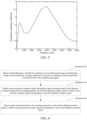
- FIG. 4 is a diagram of acoustic equal-loudness level contours determined by an international organization for acoustics standards.
- the diagram of the acoustic equal-loudness level contours is used for illustrating relationships between sound pressure levels and sound wave frequencies for a condition of equal loudness levels.
- curves that illustrate relationships between sound pressure levels and sound wave frequencies for a condition of equal loudness levels are referred to as equal-loudness level contours, which are one of important auditory features.
- the diagram of the acoustic equal-loudness level contours shows sound pressure levels that pure tones at different frequencies need to reach to achieve an equal auditory loudness level for a human ear.
- an equal-loudness level contour is a curve formed by connecting sound pressure levels at which pure tones at various frequencies are when reaching an equal loudness level.
- a horizontal coordinate represents frequencies of the pure tones
- a vertical coordinate represents sound pressure levels that need to be reached to achieve each loudness level.
- an auditory perception parameter value may be calculated by obtaining an auditory perception coefficient.
- An auditory perception coefficient is positively correlated with an auditory loudness level. Therefore, an auditory perception coefficient of each frequency point in frequency domain may be configured for describing a degree to which is sensitive to sound at each frequency point.
- the first device may transform each subband excitation signal from time domain to frequency domain by using fast Fourier transform, to obtain a Fourier transform result, that is, a corresponding spectrum graph. After that, an absolute power of each frequency point can be calculated based on an amplitude corresponding to the frequency point in the spectrum graph.
- An absolute power is an absolute power of a frequency point.
- the first device may multiply the absolute powers of the frequency points by different auditory perception weighting coefficients, and add the products together to obtain an auditory perception parameter value of the subband excitation signal.
- EBP is an auditory perception parameter value
- i is a frame number
- k is a frequency point number
- m is a subband number
- kbup(m) and kbdw(m) respectively represent numbers of upper- and lower-limit frequency points in an m th subband
- conf(k) is an auditory perception coefficient of a k th frequency point.
- auditory perception is quantized by calculating a weighted sum of the absolute powers of the frequency points based on the auditory perception coefficients, where the auditory perception coefficients are positively correlated with auditory loudness levels. Therefore, the obtained auditory perception parameter value can more accurately describe auditory perception strength.
- the obtaining an auditory perception coefficient of each frequency point in the subband excitation signal includes: obtaining preset acoustic equal-loudness level contours data, the acoustic equal-loudness level contours data being configured for describing relationships between sound pressure levels and frequencies for a condition of equal loudness levels; performing, for each frequency point in the subband excitation signal, linear interpolation on the preset acoustic equal-loudness level contours data based on a frequency of the frequency point, to obtain a sound pressure level of the frequency point; and determining a loudness level of the frequency point based on the sound pressure level of the frequency point and according to preset mapping relationships between sound pressure levels and loudness levels, and determining the auditory perception coefficient of the frequency point based on the loudness level, the auditory perception coefficient being positively correlated with the loudness level.
- an auditory perception coefficient may be determined with reference to acoustic equal-loudness level contours data.
- an auditory perception coefficient may be calculated based on acoustic equal-loudness level contours data in BS 3383 Specification for normal equal-loudness level contours for pure tones under free-field listening conditions (BS3383 specification).
- the first device may perform interpolation on the acoustic equal-loudness level contours data by using a linear interpolation method, so as to obtain an auditory loudness level of each frequency point.
- afy af j ⁇ 1 + freq ⁇ ff j ⁇ 1 ⁇ af j ⁇ af j ⁇ 1 / ff j ⁇ ff j ⁇ 1
- bfy bf j ⁇ 1 + freq ⁇ ff j ⁇ 1 ⁇ bf j ⁇ bf j ⁇ 1 / ff j ⁇ ff j ⁇ 1
- cof(freq) is an auditory perception coefficient corresponding to the frequency point for which an auditory perception coefficient needs to be calculated.
- FIG. 5 is a diagram of auditory perception coefficients. FIG. 5 shows correspondences between frequencies and auditory perception coefficients of frequency points.
- the auditory loudness level of each frequency point is obtained by performing linear interpolation on the acoustic equal-loudness level contours data. Then, the auditory perception coefficient of each frequency point is determined based on the auditory loudness level of each frequency point. Because the acoustic equal-loudness level contours data is configured for describing relationships between sound pressure levels and sound wave frequencies for a condition of equal loudness levels, accurate auditory perception coefficients can be obtained.
- the obtaining a gain of each of the at least one first subband excitation signal relative to a preset reference excitation signal includes: obtaining, for each first subband excitation signal, an energy value corresponding to the first subband excitation signal, the energy value being positively correlated with amplitudes of sampling points of the first subband excitation signal in time domain; obtaining an energy value corresponding to the preset reference excitation signal; and determining the gain of the first subband excitation signal relative to the reference excitation signal based on a ratio of the energy value corresponding to the first subband excitation signal to the energy value corresponding to the reference excitation signal.
- the first device may calculate a sum of squares of the amplitudes of the sampling points of the first subband excitation signal to obtain the energy value corresponding to the first subband excitation signal, further obtain the energy value corresponding to the reference excitation signal, and divide the energy value corresponding to the first subband excitation signal by a preset energy value to obtain the gain of the first subband excitation signal relative to the reference excitation signal. Then, in the decoding phase, the second device may multiply the gain by the reference excitation signal to restore the first subband excitation signal.
- the gain of the first subband excitation signal is determined by calculating the ratio of the energy value corresponding to the first subband excitation signal to the energy value corresponding to the reference excitation signal. In this way, the gain can be calculated quickly, improving efficiency of gain calculation.
- the obtaining a quantized excitation signal by respectively quantizing the at least one second subband excitation signal, and obtaining a second encoding parameter corresponding to the at least one second subband excitation signal by using the excitation quantized signal includes: sorting the plurality of second subband excitation signals in descending order of the corresponding auditory perception parameter values, to obtain a sorting result; and quantizing the plurality of second subband excitation signals differently based on their respective ordinal positions in the sorting result, to obtain the respective quantized excitation signals, and obtain the second encoding parameters corresponding to the plurality of second subband excitation signals.
- Quantization precision is accuracy of quantizing an excitation signal to obtain a quantized signal.
- Quantizing a subband excitation signal is a process of using discrete values to represent a subband excitation signal, so as to reduce bits required for transmitting the subband excitation signal.
- Higher quantization precision indicates a smaller error between the obtained quantized signal and the excitation signal, and also indicates higher accuracy of the obtained quantized signal.
- quantization precision may be represented in different ways. For example, quantization precision may be represented by a quantization error in a quantization process. A larger quantization error indicates lower quantization precision.
- a quantization error is a cost that is caused or a distortion that occurs when a subband excitation signal is restored based on a quantized excitation signal.
- the first device may sort the second subband excitation signals in descending order of the auditory perception parameter values, to obtain the sorting result; and quantize the plurality of second subband excitation signals differently based on their respective ordinal positions in the sorting result, to obtain the encoding parameters corresponding to the plurality of second subband excitation signals.
- Quantization precision with which the plurality of second subband excitation signals are quantized separately to obtain quantized signals decreases in the sorting order in the sorting result.
- a frame of speech sub-signal is decomposed into four subband excitation signals, which are a subband excitation signal A, a subband excitation signal B, a subband excitation signal C, and a subband excitation signal D.
- the subband excitation signal D is a first subband excitation signal.
- An auditory perception parameter value of the subband excitation signal A is X
- an auditory perception parameter value of the subband excitation signal B is Y
- an auditory perception parameter value of the subband excitation signal C is Z. It is assumed that X>Y>Z.
- quantization precision for the subband excitation signal A is the highest
- quantization precision for the subband excitation signal B is the second highest
- quantization precision for the subband excitation signal C is the lowest.
- quantization precision for at least one of the second subband excitation signals is lower than quantization precision for the other second subband excitation signals, and the second subband excitation signal follows the other second subband excitation signals.
- the subband excitation signal A and the subband excitation signal B have the same quantization precision, which is higher than the quantization precision for the subband excitation signal C.
- the first device may control quantization precision in different ways. In all embodiments, the first device may control quantization precision by adjusting a gain. A larger gain indicates lower quantization precision. In another embodiment, the first device may alternatively control quantization precision by using different sizes of codebooks. A selected codebook of a larger size indicates higher quantization precision, and a selected codebook of a smaller size indicates lower quantization precision. When a codebook is of a smaller size, a codebook address corresponding to each codebook vector in the codebook is a smaller value. Therefore, a smaller quantity of bits may be used for encoding. For example, the first device and the second device may set three codebooks.
- the codebooks are: a codebook 1 with a codebook size of 50, a codebook 2 with a codebook size of 100, and a codebook 3 with a codebook size of 150.
- the subband excitation signal A may be quantized by using the codebook 3
- the subband excitation signal B may be quantized by using the codebook 2
- the subband excitation signal C may be quantized by using the codebook 1.
- Codebook addresses for the codebook 1 are values from 1 to 50
- codebook addresses for the codebook 2 are values from 1 to 100
- codebook addresses for the codebook 3 are values from 1 to 150.
- the quantity of bits required by the codebook 3 is the largest, that required by the codebook 2 is the second largest, and that required by the codebook 1 is the smallest.
- a subband excitation signal with a larger auditory perception parameter value may be encoded with higher quantization precision, and a subband excitation signal with a smaller auditory perception parameter value may be encoded with lower quantization precision.
- quantization precision is lower, there are a few signal details, and therefore, the signal details may be described by using a fewer bits. This further improves encoding efficiency, and better implements proper allocation of encoding bandwidths.
- the obtaining a quantized excitation signal by respectively quantizing the at least one second subband excitation signal includes: determining, for the plurality of second subband excitation signals, their respective corresponding gains based on their respective ordinal positions in the sorting result, the gains respectively corresponding to the second subband excitation signals increasing in the sorting order in the sorting result; and quantizing each second subband excitation signal based on the gain corresponding to the second subband excitation signal, to obtain the quantized excitation signal of the second subband excitation signal, the gains respectively corresponding to the second subband excitation signals increasing in the sorting order in the sorting result.
- the first device may adjust quantization precision by controlling the gains of the second subband excitation signals. For example, if a gain is increased, quantization precision is decreased; on the contrary, if a gain is decreased, quantization precision is increased.
- a gain is increased, a dynamic range of a signal is narrowed, resulting in that a small signal change cannot be accurately measured and signal details are reduced. Therefore, during encoding, a smaller quantity of bits may be used for description.
- the first device may quantize each second subband excitation signal based on the gain of each second subband excitation signal, to obtain the quantized excitation signal of each second subband excitation signal.
- Quantization includes but is not limited to vector quantization or scalar quantization. Vector quantization is used as an example.
- the first device may search, for each second subband excitation signal, one or more preset codebooks for a codebook vector. Every time a codebook vector is found, the codebook vector is multiplied by the gain of the second subband excitation signal, to calculate a quantization error. A codebook address corresponding to a codebook vector with a minimum quantization error is used as a quantized excitation signal of the second subband excitation signal.
- quantization encoding with different quantization precision can be implemented accurately and quickly in a quantization process, further improving encoding efficiency.
- the determining, for the plurality of second subband excitation signals, their respective corresponding gains based on their respective ordinal positions in the sorting result includes: obtaining an initial gain, the initial gain being determined based on a to-be-encoded initial speech signal, and the to-be-encoded speech signal being obtained after the initial speech signal is processed before being encoded; determining the initial gain as the gain of the second subband excitation signal that is in the first position in the sorting result; and performing increasing based on the initial gain, to determine the gains corresponding to the second subband excitation signals that are in the second and following positions in the sorting result, the initial gain being configured for being encoded into the encoded data, so that the gain corresponding to each second subband excitation signal is determined based on the initial gain during decoding.
- the first device may directly use a gain obtained through calculation based on the initial speech signal, as the initial gain; or use a gain that is obtained by slightly adjusting the gain obtained through calculation, as the initial gain.
- the first device and the second device may agree on a gain increasing mode.
- the gain increasing mode may be, for example, differential increasing.
- second subband excitation signals include three subband excitation signals.
- a first preset increasing mode is shown in Table 1.
- Serial numbers 1, 2, and 3 respectively represent the three subband excitation signals included in the second subband excitation signals.
- a larger serial number indicates that a subband excitation signal represented by the serial number is in a lower position.
- a gain multiple corresponding to a serial number is configured for representing a multiple of a gain of a subband excitation signal represented by the serial number relative to an initial gain.
- the first device may allocate the initial gain to the subband excitation signal A, allocate (the initial gain ⁇ 1.1) to the subband excitation signal B, and allocate (the initial gain ⁇ 1.2) to the subband excitation signal C.
- Table 1 Serial number Gain multiple 1 1 2 1.1 3 1.2
- the gain multiples in Table 1 may alternatively be other values, for example, may be 1, 1.2, 1.4, and 1.6.
- the increasing mode in this embodiment may alternatively be another increasing mode, provided that a specific difference rule is met. This is not limited in this application.
- the gains of the second subband excitation signals sequentially increase in a preset gain increasing mode. Therefore, in the encoded data that is obtained after the first device performs encoding, the encoding parameters of the second subband excitation signals may be sorted based on the ordinal positions of the corresponding second subband excitation signals. In addition, for the encoded data, only the initial gain is transmitted. In the decoding process, the second device may calculate, based on the ordinal positions and the initial gain, a gain required for each quantized excitation signal, to restore the speech signal. In this way, because only the initial gain needs to be transmitted, a quantity of bits required for encoding is further reduced, and encoding bandwidths are significantly decreased.
- the subband excitation signal A is decoded first, and a gain of the subband excitation signal A is determined as the initial gain; then the subband excitation signal B is decoded, and a gain of the subband excitation signal B is determined as the initial gain ⁇ 1.1; finally, the subband excitation signal C is decoded, and a gain of the subband excitation signal C is determined as the initial gain ⁇ 1.2.
- the first device may alternatively encode serial numbers of the second subband excitation signals in the encoding process.
- the second device can determine gains based on correspondences between the serial numbers and gain multiples.
- the at least two subband excitation signals include at least one first subband excitation signal and at least one second subband excitation signal.
- An auditory perception parameter value of each first subband excitation signal is less than or equal to a preset auditory perception threshold.
- An auditory perception parameter value of each second subband excitation signal is greater than the auditory perception threshold.
- the auditory perception parameter value is positively correlated with a sound intensity that is of the corresponding subband excitation signal.
- the encoded data herein is obtained after a first device performs encoding.
- a first device performs encoding.
- Operation 606 Perform signal restoration based on the encoding parameter of each second subband excitation signal, to obtain a second restored excitation signal corresponding to each second subband excitation signal.
- a reference excitation signal may be a unit excitation signal.
- a reference excitation signal is obtained by randomly combining 1, 0, and -1, and may be, for example, (1, -1, 0, 1, 0).
- a quantity of sampling points included in a reference excitation signal is the same as a quantity of sampling points included in a subband excitation signal.
- a second device multiplies a reference excitation signal by a gain to implement signal restoration and obtain a first restored excitation signal.
- the second device may also perform signal restoration based on a quantized excitation signal, to obtain a second restored excitation signal.
- the encoded data may alternatively be parsed to obtain a gain corresponding to a quantized excitation signal.
- the second device may search a codebook for a corresponding codebook vector based on the quantized excitation signal, and multiply the codebook vector by the gain corresponding to the quantized excitation signal, to obtain a second restored excitation signal through restoration.
- Operation 608 Perform signal subband synthesis based on each first restored excitation signal and each second restored excitation signal, to obtain a restored speech signal.
- Signal subband synthesis is a reverse process of signal subband decomposition.
- the second device may perform signal subband synthesis by using a quadrature mirror filter.
- the second device performs signal subband synthesis based on the first restored excitation signal and the second restored excitation signal, to obtain the restored speech signal.
- the second device further continues to perform subsequent post-processing on the restored speech signal, for example, long-term filtering and short-term filtering, to obtain a speech signal that can be used for playing.
- signal restoration may be performed based on a reference excitation signal and a gain, to obtain a first restored excitation signal; signal restoration may be performed based on a quantized excitation signal, to obtain a second restored excitation signal; and signal subband synthesis may be performed based on the first restored excitation signal and the second restored excitation signal. Therefore, an accurate speech signal can be restored through decoding.
- the encoding method in this application may be used on a coding technology that is based on code excited linear prediction (CELP).
- CELP code excited linear prediction
- the CELP coding technology is an effective technology for compressing and coding speech at low and medium bit rates.
- This technology uses a codebook as an excitation source, and has advantages such as a low bit rate, high-quality synthesized speech, and a strong anti-noise capability.
- This technology is widely used on bit rates from 4.8 kbps to 16 kbps.
- speech encoders using the CELP technology include G.723, G.728, G.729, and G.722.2 encoders, and the like.
- FIG. 7 is a flowchart of encoding by using a CELP coding technology. With reference to FIG.
- LPC linear predictive coding
- the LPC parameters are a group of linear predictive filtering coefficients.
- the LPC parameters are converted into LSP parameters and quantized.
- Predictive filtering is performed based on the LPC parameters.
- a difference between the initial speech signal and an LPC predictive filtering result is an initial excitation signal.
- the initial excitation signal is a residual signal.
- An adaptive codebook parameter of the residual signal is obtained based on an adaptive codebook and through analysis and search of open-loop pitch and closed-loop pitch.
- quantization encoding is performed based on a fixed codebook by using the speech encoding method provided in this embodiment of this application, to obtain a fixed codebook parameter.
- one level or a plurality of levels of subband decomposition are performed on the residual signal, to obtain a plurality of subband excitation signals in different frequency ranges.
- An auditory perception parameter value of each subband excitation signal is calculated based on an absolute power of each frequency point in the subband excitation signal.
- a gain of the first subband excitation signal relative to a reference excitation signal is determined, and the gain is determined as an encoding parameter corresponding to the first subband excitation signal.
- the second subband excitation signals are sorted in descending order of the auditory perception parameter values. Based on ordinal positions, quantization is performed by using fixed codebooks of different sizes, to obtain corresponding encoding parameters.
- a codebook of a smaller size may be used for a second subband excitation signal with a smaller auditory perception parameter value, whereas a codebook of a larger size may be used for a second subband excitation signal with a larger auditory perception parameter value.
- the second subband excitation signal with a larger auditory perception parameter value can be quantized with higher quantization precision
- the second subband excitation signal with a smaller auditory perception parameter value can be quantized with lower quantization precision.
- the first device further calculates a gain parameter of the adaptive codebook and a gain parameter of each fixed codebook, encapsulates and packages the encoding parameters obtained in the encoding process, and transmits the encoding parameters to a decoding end through a channel.
- a size of a codebook is configured for indicating a quantity of codebook vectors included in the codebook.
- a larger size of a codebook indicates a larger quantity of codebook vectors included in the codebook. Therefore, corresponding quantization precision is higher.
- a codebook Y includes five codebook vectors: Y1, Y2, Y3, Y4, and Y5. In this case, a size of the codebook is 5.
- FIG. 8 is a flowchart of decoding by using a CELP coding technology.
- received encoded data packets are parsed to obtain all encoding parameters, interpolation is performed on LSP parameters to obtain LPC filtering coefficients, each quantized excitation signal in fixed codebook parameters is multiplied by a fixed codebook gain of the quantized excitation signal to implement signal restoration, a gain is multiplied by a reference excitation signal to implement signal restoration, and then signal subband synthesis is performed on restored excitation signals obtained through restoration, to obtain a synthesized excitation signal.
- An adaptive codebook parameter is multiplied by an adaptive codebook gain to generate an adaptive codebook excitation signal.
- a sum of the adaptive codebook excitation signal and the synthesized excitation signal is filtered by an LPC synthesis filter, and post-processing is performed, to obtain a final speech signal that is used for playing.
- the encoding method in this application may be used on a SILK-based coding technology.
- a SILK speech encoder is a variant of a CELP model.
- a main improvement of the SILK speech encoder is that noise shaping is introduced to make a frequency spectrum of a residual excitation signal smoother, further increasing a quantization signal-to-noise ratio of excitation.
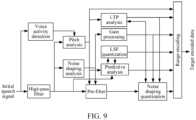
- FIG. 9 is a diagram of an encoding process of a SILK encoder. First, VAD processing and high-pass filtering are performed on an input speech signal. Noise shaping analysis is performed on an output signal of high-pass filtering. A gain and a filter coefficient that are to be used in a pre-filter and noise shaping quantization are obtained through noise shaping analysis.
- Pitch analysis is performed on an output signal of VAD processing, to make an unvoiced/voiced decision.
- a pitch period of a voiced signal is estimated to obtain a pitch autocorrelation coefficient and a pitch delay.
- LTP analysis is performed an output signal of pitch analysis.
- Pre-filtering is performed on an output of noise shaping analysis.
- Predictive analysis is further performed on the signals obtained through pitch analysis and noise shaping analysis, and the speech signal obtained after high-pass filtering. Then, LSF parameters are extracted, feature parameters are extracted by using a plurality of levels of vector quantization, and then quantized parameters are converted into LPC coefficients. Synchronization of encoding and decoding is implemented through this conversion. Based on this, noise shaping quantization is performed.
- Noise shaping quantization herein is to quantize a noise-shaped excitation signal.
- one level or a plurality of levels of subband decomposition may be performed on the excitation signal to obtain a plurality of subband excitation signals in different frequency ranges.
- An auditory perception parameter value of each subband excitation signal is calculated based on an absolute power of each frequency point in the subband excitation signal. Then, for a first subband excitation signal whose auditory perception parameter value is less than or equal to an auditory perception threshold, a gain of the first subband excitation signal relative to a reference excitation signal is determined, and the gain is determined as an encoding parameter corresponding to the first subband excitation signal.
- the second subband excitation signals For a plurality of second subband excitation signals whose auditory perception parameter values are greater than the auditory perception threshold, the second subband excitation signals are sorted in descending order of the auditory perception parameter values to obtain a sorting result. Gains respectively corresponding to the second subband excitation signals are determined based on respective ordinal positions of the second subband excitation signals in the sorting result. The gains respectively corresponding to the second subband excitation signals increase in the sorting order in the sorting result. The second subband excitation signals are quantized based on the respective gains of the second subband excitation signals, to obtain encoding parameters respectively corresponding to the second subband excitation signals. Finally, range encoding is performed on all the obtained parameters. In this way, the entire encoding process is implemented.
- this application further provides a speech encoding method and a speech decoding method.
- subband encoding may be used to implement encoding in an encoding process.
- a basic idea of speech subband encoding is that a group of band-pass filters (BPFs) is used to divide a frequency band of an input audio signal into several contiguous small bands. Each of the small bands is referred to as a subband.
- An audio signal in each subband is encoded by using a separate encoding scheme. Code of the subbands is combined when being transmitted over a channel. During decoding at a receiving end, the code of each subband is decoded separately, and then decoded code is combined to restore an original audio signal.
- BPFs band-pass filters
- subband encoding bits can be properly allocated to each subband based on auditory characteristics, so as to achieve better subjective auditory effect and reduce storage resources and transmission bandwidths.
- an Opus encoder internally implements division into high-frequency and low-frequency subbands.
- a SILK encoder is used for the low-frequency subbands
- a CELT encoder is used for the high-frequency subbands.
- subband encoding is mainly a process of performing encoding for various subbands separately by using different encoders or different encoding parameters. Based on signal characteristics of different subbands, proper encoding schemes are chosen for encoding.
- a subband encoding scheme can effectively improve encoding efficiency of an encoder.
- a subband encoder in the related art ignores an auditory perception contribution of each subband in a frame.
- This application provides the following: An encoding scheme with an extremely low bit rate is used for a subband with weak perception energy based on analysis of auditory perception energy. Encoding is performed for the subband by using an extremely small quantity of bits, so as to further improve efficiency of subband encoding.
- bits to be used for encoding are allocated to each subband based on an auditory perception contribution. More bits to be used for encoding may be allocated to a subband with a large auditory perception contribution, whereas an extremely small quantity of bits may be directly used for encoding of a subband with weak auditory perception.
- encoding bandwidths are allocated efficiently and properly.
- the speech encoding method is as follows: A collected speech signal is used as an initial speech signal.
- a first device first performs frame blocking and windowing on the initial speech signal, to obtain a plurality of frames of speech sub-signal. For each frame of speech sub-signal, the first device performs pre-processing such as voice activity detection, high-pass filtering, pitch analysis, linear predictive coding, noise shaping, and gain calculation, to obtain an initial excitation signal.
- the initial excitation signal is used as a to-be-encoded speech signal.
- Subband decomposition is performed on the to-be-encoded speech signal.
- a group of quadrature mirror filters is used to perform symmetric subband decomposition to obtain a high-frequency subband decomposition signal and a low-frequency subband decomposition signal with an equal frequency bandwidth.
- decomposition may continue to be performed, by using the QMFs, on the high-frequency subband decomposition signal obtained through decomposition, to obtain more finer subband signals.
- three levels of decomposition may be performed, by using the QMFs, to obtain four subband excitation signals: exc1_low, exc2_low, exc3 _high, and exc3_low.
- the first device may perform subband auditory perception analysis on each subband excitation signal, to classify the subband excitation signals into subband excitation signals with strong perception and subband excitation signals with weak perception. Specifically, an auditory loudness level of each frequency point is calculated by using the foregoing formula (2) to formula (5); then an auditory perception coefficient of each frequency point is calculated by using the foregoing formula (6); and finally a weighted sum of absolute powers of the frequency points is calculated by using the foregoing formula (1), to obtain an auditory perception parameter value of a subband excitation signal. An auditory perception parameter value of each subband excitation signal is compared with an auditory perception threshold.
- a subband excitation signal whose auditory perception parameter value is less than or equal to the auditory perception threshold is determined as a subband excitation signal with weak perception (that is, the foregoing first subband excitation signal).
- a subband excitation signal whose auditory perception parameter value is greater than the auditory perception threshold is determined as a subband excitation signal with strong perception (that is, the foregoing second subband excitation signal).
- quantization encoding does not need to be performed. Only a sum of squares of amplitudes of sampling points of the subband excitation signal is calculated to obtain an energy value corresponding to the subband excitation signal.
- the energy value is divided by a preset energy value corresponding to a reference excitation signal, to obtain a gain corresponding to the subband excitation signal.
- the subband excitation signals are sorted in descending order of auditory perception parameter values to obtain a sorting result.
- different quantization is performed based on respective ordinal positions of the subband excitation signals with strong perception in the sorting result to obtain corresponding quantized excitation signals. Quantization precision with which the subband excitation signals with strong perception are quantized separately to obtain the quantized signals decreases in the sorting order in the sorting result.
- the gain of the subband excitation signal with weak perception, the quantized excitation signals of the subband excitation signals with strong perception, and another encoding parameter are compressed and encapsulated to obtain encoded data.
- the encoded data is transmitted to a second device.
- the quantized excitation signals of only the subband excitation signals with strong perception are transmitted.
- the subband excitation signals with strong perception are quantized with different quantization precision, more bits to be used for encoding can be allocated to the subband excitation signals with strong perception and with larger auditory perception parameter values. In this way, an encoding bit rate can be further reduced, with little impact on subjective auditory quality that exists after speech is encoded and then decoded.
- a speech decoding process is as follows: After receiving the encoded data, the second device first parses the encoded data to obtain all encoding parameters.
- the subband excitation signals with strong perception in the encoding process can be parsed to obtain quantization gains and the quantized excitation signals.
- the quantization gains of the subbands are multiplied by the quantized excitation signals to obtain restored excitation signals of the subbands.
- the subband with weak auditory perception is parsed to obtain only the gain.
- the gain is multiplied by the preset reference excitation signal (an excitation amplitude of the signal is 1) to obtain a restored excitation signal of the subband with weak perception.
- subband reconstruction is performed on the restored excitation signals of all the subbands.
- the subband reconstruction process is a reverse process of the subband decomposition process.
- subband synthesis is performed by using a group of quadrature mirror filters (QMFs). For example, if three levels of subband decomposition are performed in the encoding process, three levels of subband synthesis need to be performed.
- QMFs quadrature mirror filters
- synthesis is performed, by using the QMFs, on exc3_high and exc3_low to obtain exc2_low; then synthesis is performed, by using the QMFs, on exc2_high and exc2_low to obtain exc1_low; and finally synthesis is performed, by using the QMFs, on exc1_high and exc1_low to obtain a complete (a spectral bandwidth is 8 kHz) excitation signal output.
- post-processing is performed by following a normal decoding process, including processing such as long-term predictive filtering and short-term predictive filtering.
- a target speech signal that is generated after decoding and that can be used for playing is obtained.
- the first device and the second device may agree that when the quantized excitation signals of the subband excitation signals with strong perception are multiplied by the respective gains in the decoding process, the used gains increase based on an initial gain in a preset increasing mode. Each ordinal position corresponds to a gain multiple.
- the initial gain is a gain that a decoding end obtains by parsing an encoded data packet. Because the first device and the second device agree on the preset increasing mode, the first device only needs to transmit the initial gain to the second device. In this way, encoding efficiency can be further improved, and bandwidths can be effectively reduced.
- This application further provides an application scenario.
- the speech encoding method and the speech decoding method are used.
- a first user and a second user make a voice call in the application scenario.
- encoding, transmission, and decoding may be performed for speech signals of the first user and speech signals of the second user by using the speech encoding method and the speech decoding method provided in this application.
- the voice call between the first user and the second user is implemented.
- a terminal of the first user is a first device
- a terminal of the second user is a second device.
- the terminal of the first user is a vehicle-mounted terminal
- the terminal of the second user is a mobile phone.
- the vehicle-mounted terminal of the first user may serve as the first device to collect speech signals of the first user, encode the speech signals to obtain encoded data, and transmit the encoded data to the mobile phone of the second user; and the mobile phone of the second user may serve as the second device to decode the encoded data to regenerate speech signals and perform playing.
- the mobile phone of the second user may also serve as the first device to transmit encoded data to the vehicle-mounted terminal of the first user; and the vehicle-mounted terminal of the first user may also serve as the second device to decode the encoded data, generate speech data, and perform playing.
- This application may also be applied to a video calling scenario.
- a social communication application may be installed on both a terminal of a first user and a terminal of a second user. The first user and the second user make a video call by using the social communication application.
- encoding, transmission, and decoding may be performed for speech signals of the first user and speech signals of the second user by using the speech encoding method and the speech decoding method provided in the embodiments of this application. In this way, the speech signals in the video call between the first user and the second user are transmitted.
- a first device may be a terminal of an anchor.
- a second device may be a terminal of a viewer.
- a client may be installed and run on the terminal of the anchor and the terminal of the viewer. The client may be configured for logging in to an account of the anchor or an account of the viewer. If the account of the anchor is logged in to on the client, the terminal on which the client is run may be configured to encode, by using the speech encoding method provided in the embodiments of this application, speech signals collected in real time during live streaming, and then upload post-encoding encoded data to a server.
- the terminal on which the client is run may be configured to obtain the encoded data from the server, then decode the encoded data by using the speech decoding method provided in the embodiments of this application to obtain target speech signals, and perform playing.
- the speech encoding method and the speech decoding method provided in the embodiments of this application may also be used in other application scenarios, such as audio/video conferencing and audio broadcasting.
- the embodiments of this application further provide a speech encoding apparatus that is configured to implement the foregoing related speech encoding method or a speech decoding apparatus that is configured to implement the foregoing related speech decoding method.
- a problem-solving implementation solution provided by the apparatus is similar to the implementation solution described in the foregoing method. Therefore, for specific limitations in one or more embodiments of the speech encoding apparatus and the speech decoding apparatus provided below, refer to the limitations on the speech encoding method and the speech decoding method in the foregoing descriptions. Details are not described herein again.
- a speech encoding apparatus 1100 including:
- the speech encoding apparatus determines the at least one first subband excitation signal and the at least one second subband excitation signal from the at least two subband excitation signals. Because the auditory perception parameter value of each first subband excitation signal is less than or equal to the preset auditory perception threshold, a sound intensity perceived via the first subband excitation signal is weak. As such, the first subband excitation signal may not be quantized, and the gain relative to the preset reference excitation signal is obtained and used as an encoding parameter, so as to reduce a quantity of subbands that need to be quantized in the encoding process, and improve encoding efficiency.
- a feature value of a frequency point is an absolute power
- the auditory perception determining module is further configured to: obtain an auditory perception coefficient of each frequency point in a subband excitation signal, the auditory perception coefficient being positively correlated with an auditory loudness level, and the auditory loudness level being configured for describing a loudness level of sound; and calculate a weighted sum of absolute powers of the frequency points in the subband excitation signal based on the auditory perception coefficients of the frequency points, to obtain the auditory perception parameter value that corresponds to the subband excitation signal.
- the auditory perception determining module is further configured to: obtain preset acoustic equal-loudness level contours data, the acoustic equal-loudness level contours data being configured for describing relationships between sound pressure levels and frequencies for a condition of equal loudness levels; perform, for each frequency point in the subband excitation signal, linear interpolation on the preset acoustic equal-loudness level contours data based on a frequency of the frequency point, to obtain a sound pressure level of the frequency point; and determine a loudness level of the frequency point based on the sound pressure level of the frequency point and according to preset mapping relationships between sound pressure levels and loudness levels, and determine the auditory perception coefficient of the frequency point based on the loudness level, the auditory perception coefficient being positively correlated with the loudness level.
- the gain determining module is further configured to: obtain, for each first subband excitation signal, an energy value corresponding to the first subband excitation signal, the energy value being positively correlated with amplitudes of sampling points of the first subband excitation signal in time domain; obtain an energy value corresponding to the preset reference excitation signal; and determine the gain of the first subband excitation signal relative to the reference excitation signal based on a ratio of the energy value corresponding to the first subband excitation signal to the energy value corresponding to the reference excitation signal.
- the quantization module is further configured to: sort the plurality of second subband excitation signals in descending order of the corresponding auditory perception parameter values, to obtain a sorting result; and quantize the plurality of second subband excitation signals differently based on their respective ordinal positions in the sorting result, to obtain the encoding parameters corresponding to the plurality of second subband excitation signals, quantization precision with which the plurality of second subband excitation signals are quantized separately to obtain quantized signals decreasing in the sorting order in the sorting result.
- the quantization module is further configured to: determine, for the plurality of second subband excitation signals, their respective corresponding gains based on their respective ordinal positions in the sorting result, the gains respectively corresponding to the second subband excitation signals increasing in the sorting order in the sorting result; and quantize each second subband excitation signal based on the gain corresponding to the second subband excitation signal, to obtain a quantized excitation signal of the second subband excitation signal.
- the quantization module is further configured to: obtain an initial gain, the initial gain being determined based on a to-be-encoded initial speech signal, and the to-be-encoded speech signal being obtained after the initial speech signal is processed before being encoded; determine the initial gain as the gain of the second subband excitation signal that is in the first position in the sorting result; and perform increasing based on the initial gain, to determine the gains corresponding to the second subband excitation signals that are in the second and following positions in the sorting result, the initial gain being configured for being encoded into the encoded data, so that the gain corresponding to each second subband excitation signal is determined based on the initial gain during decoding.
- the subband decomposition module is further configured to: determine a frequency range in which the speech signal is; and perform at least one level of subband decomposition on the speech signal based on the frequency range in which the speech signal is, to obtain at least two subband excitation signals, each level of subband decomposition implementing decomposition of a signal that needs to be decomposed into two signals in different frequency intervals.
- the subband decomposition module is further configured to: perform, at the first level of subband decomposition, subband decomposition on the speech signal based on the frequency range in which the speech signal is, to obtain a high-frequency decomposition signal and a low-frequency decomposition signal of the current level, and determine the low-frequency decomposition signal as a subband excitation signal, an arbitrary frequency in a frequency interval in which the high-frequency decomposition signal is being higher than an arbitrary frequency in a frequency interval in which the low-frequency decomposition signal is; perform, at each of the second level and following levels, and based on a frequency interval in which a high-frequency decomposition signal obtained through subband decomposition of a previous level is, subband decomposition on the low-frequency decomposition signal obtained through subband decomposition of the previous level, to obtain a high-frequency decomposition signal and a low-frequency
- the quantization module is further configured to: search, for each second subband excitation signal, a preset codebook for a codebook vector with a minimum quantization error; and determine a codebook address corresponding to the found codebook vector as the corresponding encoding parameter of the second subband excitation signal.
- a speech decoding apparatus 1200 including:
- the speech decoding apparatus may perform signal restoration based on a reference excitation signal and a gain, to obtain a first restored excitation signal; may perform signal restoration based on a quantized excitation signal, to obtain a second restored excitation signal; and may perform signal subband synthesis based on the first restored excitation signal and the second restored excitation signal. Therefore, an accurate target speech signal can be obtained through decoding.
- All or some of the modules in the speech encoding apparatus and the speech decoding apparatus may be implemented by software, hardware, or a combination thereof.
- the modules may be built in or stand alone from a processor in a computer device in a form of hardware, or may be stored in a memory in a computer device in a form of software, so that a processor can invoke and execute operations corresponding to the modules.
- a computer device is provided.
- the computer device may be a first device or a second device.
- An internal structure of the computer device may be shown in FIG. 13 .
- the computer device includes a processor, a memory, an input/output interface, a communication interface, a display unit, and an input apparatus.
- the processor and the memory are connected to the input/output interface by using a system bus.
- the communication interface, the display unit, and the input apparatus are connected to the system bus by using the input/output interface.
- the processor of the computer device is configured to provide computing and control capabilities.
- the memory of the computer device includes a nonvolatile storage medium and an internal memory.
- the nonvolatile storage medium stores an operating system and computer-readable instructions.
- the internal memory provides an environment for operation of the operating system and the computer-readable instructions in the nonvolatile storage medium.
- the input/output interface of the computer device is configured to exchange information between the processor and an external device.
- the communication interface of the computer device is configured to communicate with an external terminal in a wired or wireless mode.
- the wireless mode may be implemented by using Wi-Fi, a mobile cellular network, near field communication (NFC), or another technology.
- the computer-readable instructions implement a speech encoding method or a speech decoding method.
- the display unit of the computer device is configured to form visually visible pictures, and may be a display, a projection apparatus, or a virtual reality imaging apparatus.
- the display may be a liquid crystal display or an electronic ink display.
- the input apparatus of the computer device may be a touch layer covering a display, or may be a button, trackball, or touchpad disposed on a housing of the computer device, or may be an external keyboard, touchpad, mouse, or the like.
- FIG. 13 is merely a block diagram of a partial structure related to the solutions in this application, and does not constitute a limitation on a computer device on which the solutions in this application are used.
- a specific computer device may include more or fewer components than those shown in the figure, or combine some components, or have different component arrangements.
- a computer device including a memory and a processor.
- the memory stores computer-readable instructions.
- the processor when executing the computer-readable instructions, implements operations of the speech encoding method or the speech decoding method.
- a computer-readable storage medium having computer-readable instructions stored therein.
- the computer-readable instructions when being executed by a processor, implement operations of the speech encoding method or the speech decoding method.
- a computer program product including computer-readable instructions.
- the computer-readable instructions when being executed by a processor, implement operations of the speech encoding method or the speech decoding method.
- User information including but not limited to user device information and user personal information
- data including but not limited to data used for analysis, stored data, and displayed data
- related data needs to be collected, used, and processed in compliance with related laws, regulations, and standards in related countries and territories.
- a person of ordinary skill in the art may understand that all or some of procedures in the methods in the foregoing embodiments may be implemented by computer-readable instructions instructing related hardware.
- the computer-readable instructions may be stored in a nonvolatile computer-readable storage medium. When the computer-readable instructions are executed, the procedures in the embodiments of the methods can be implemented. Any reference to a memory, a database, or another medium used in the embodiments provided in this application may include at least one of a nonvolatile memory and a volatile memory.
- a nonvolatile memory may include a read-only memory (ROM), a magnetic tape, a floppy disk, a flash memory, an optical memory, a high-density embedded nonvolatile memory, a resistive random access memory (ReRAM), a magnetoresistive random access memory (MRAM), a ferroelectric random access memory (FRAM), a phase change memory (PCM), a graphene memory, or the like.
- a volatile memory may include a random access memory (RAM), an external cache, or the like.
- a RAM may be in a plurality of forms, such as a static random access memory (SRAM) or a dynamic random access memory (DRAM).
- a database used in the embodiments provided in this application may include at least one of a relational database and a non-relational database.
- a non-relational database may include a blockchain-based distributed database or the like, but is not limited thereto.
- a processor used in the embodiments provided in this application may be a general-purpose processor, a central processing unit, a graphics processing unit, a digital signal processor, a programmable logic device, a quantum computing-based data processing logic device, or the like, but is not limited thereto.
Landscapes
- Engineering & Computer Science (AREA)
- Physics & Mathematics (AREA)
- Computational Linguistics (AREA)
- Signal Processing (AREA)
- Health & Medical Sciences (AREA)
- Audiology, Speech & Language Pathology (AREA)
- Human Computer Interaction (AREA)
- Acoustics & Sound (AREA)
- Multimedia (AREA)
- Spectroscopy & Molecular Physics (AREA)
- Quality & Reliability (AREA)
- Compression, Expansion, Code Conversion, And Decoders (AREA)
Applications Claiming Priority (2)
| Application Number | Priority Date | Filing Date | Title |
|---|---|---|---|
| CN202211076921.7A CN115171709B (zh) | 2022-09-05 | 2022-09-05 | 语音编码、解码方法、装置、计算机设备和存储介质 |
| PCT/CN2023/111042 WO2024051412A1 (zh) | 2022-09-05 | 2023-08-03 | 语音编码、解码方法、装置、计算机设备和存储介质 |
Publications (2)
| Publication Number | Publication Date |
|---|---|
| EP4503021A1 true EP4503021A1 (de) | 2025-02-05 |
| EP4503021A4 EP4503021A4 (de) | 2026-01-21 |
Family
ID=83482209
Family Applications (1)
| Application Number | Title | Priority Date | Filing Date |
|---|---|---|---|
| EP23862111.4A Pending EP4503021A4 (de) | 2022-09-05 | 2023-08-03 | Verfahren und vorrichtung zur sprachkodierung, verfahren und vorrichtung zur sprachdekodierung, computervorrichtung und speichermedium |
Country Status (4)
| Country | Link |
|---|---|
| US (1) | US12555588B2 (de) |
| EP (1) | EP4503021A4 (de) |
| CN (1) | CN115171709B (de) |
| WO (1) | WO2024051412A1 (de) |
Families Citing this family (2)
| Publication number | Priority date | Publication date | Assignee | Title |
|---|---|---|---|---|
| CN115171709B (zh) | 2022-09-05 | 2022-11-18 | 腾讯科技(深圳)有限公司 | 语音编码、解码方法、装置、计算机设备和存储介质 |
| CN118018745A (zh) * | 2022-11-08 | 2024-05-10 | 维沃移动通信有限公司 | 触觉信号编码方法、触觉信号解码方法、装置及设备 |
Family Cites Families (31)
| Publication number | Priority date | Publication date | Assignee | Title |
|---|---|---|---|---|
| US5235671A (en) * | 1990-10-15 | 1993-08-10 | Gte Laboratories Incorporated | Dynamic bit allocation subband excited transform coding method and apparatus |
| US5682463A (en) * | 1995-02-06 | 1997-10-28 | Lucent Technologies Inc. | Perceptual audio compression based on loudness uncertainty |
| US5956674A (en) * | 1995-12-01 | 1999-09-21 | Digital Theater Systems, Inc. | Multi-channel predictive subband audio coder using psychoacoustic adaptive bit allocation in frequency, time and over the multiple channels |
| JP3092653B2 (ja) * | 1996-06-21 | 2000-09-25 | 日本電気株式会社 | 広帯域音声符号化装置及び音声復号装置並びに音声符号化復号装置 |
| US6363338B1 (en) * | 1999-04-12 | 2002-03-26 | Dolby Laboratories Licensing Corporation | Quantization in perceptual audio coders with compensation for synthesis filter noise spreading |
| US6298322B1 (en) * | 1999-05-06 | 2001-10-02 | Eric Lindemann | Encoding and synthesis of tonal audio signals using dominant sinusoids and a vector-quantized residual tonal signal |
| US7260523B2 (en) * | 1999-12-21 | 2007-08-21 | Texas Instruments Incorporated | Sub-band speech coding system |
| US6950794B1 (en) * | 2001-11-20 | 2005-09-27 | Cirrus Logic, Inc. | Feedforward prediction of scalefactors based on allowable distortion for noise shaping in psychoacoustic-based compression |
| JP4414705B2 (ja) * | 2003-09-17 | 2010-02-10 | パナソニック株式会社 | 音源信号符号化装置、及び音源信号符号化方法 |
| US20060200346A1 (en) * | 2005-03-03 | 2006-09-07 | Nortel Networks Ltd. | Speech quality measurement based on classification estimation |
| US8280728B2 (en) * | 2006-08-11 | 2012-10-02 | Broadcom Corporation | Packet loss concealment for a sub-band predictive coder based on extrapolation of excitation waveform |
| JP4871894B2 (ja) * | 2007-03-02 | 2012-02-08 | パナソニック株式会社 | 符号化装置、復号装置、符号化方法および復号方法 |
| JP5403949B2 (ja) * | 2007-03-02 | 2014-01-29 | パナソニック株式会社 | 符号化装置および符号化方法 |
| US8392198B1 (en) * | 2007-04-03 | 2013-03-05 | Arizona Board Of Regents For And On Behalf Of Arizona State University | Split-band speech compression based on loudness estimation |
| US8352279B2 (en) * | 2008-09-06 | 2013-01-08 | Huawei Technologies Co., Ltd. | Efficient temporal envelope coding approach by prediction between low band signal and high band signal |
| CN101989428B (zh) * | 2009-07-31 | 2012-07-04 | 华为技术有限公司 | 比特分配方法、编码方法、解码方法、编码器及解码器 |
| CN101710489B (zh) * | 2009-11-09 | 2011-11-30 | 清华大学 | 可分级音频编码、解码的方法和装置以及编解码系统 |
| US9008811B2 (en) * | 2010-09-17 | 2015-04-14 | Xiph.org Foundation | Methods and systems for adaptive time-frequency resolution in digital data coding |
| KR101747917B1 (ko) * | 2010-10-18 | 2017-06-15 | 삼성전자주식회사 | 선형 예측 계수를 양자화하기 위한 저복잡도를 가지는 가중치 함수 결정 장치 및 방법 |
| WO2013002623A2 (ko) * | 2011-06-30 | 2013-01-03 | 삼성전자 주식회사 | 대역폭 확장신호 생성장치 및 방법 |
| JP5997592B2 (ja) * | 2012-04-27 | 2016-09-28 | 株式会社Nttドコモ | 音声復号装置 |
| US9589570B2 (en) * | 2012-09-18 | 2017-03-07 | Huawei Technologies Co., Ltd. | Audio classification based on perceptual quality for low or medium bit rates |
| US9666202B2 (en) * | 2013-09-10 | 2017-05-30 | Huawei Technologies Co., Ltd. | Adaptive bandwidth extension and apparatus for the same |
| US9276544B2 (en) * | 2013-12-10 | 2016-03-01 | Apple Inc. | Dynamic range control gain encoding |
| CN103813253B (zh) * | 2014-03-11 | 2017-11-21 | 深圳市微纳集成电路与系统应用研究院 | 助听器声音处理方法 |
| US9953660B2 (en) * | 2014-08-19 | 2018-04-24 | Nuance Communications, Inc. | System and method for reducing tandeming effects in a communication system |
| WO2021113416A1 (en) * | 2019-12-05 | 2021-06-10 | Dolby Laboratories Licensing Corporation | A psychoacoustic model for audio processing |
| CN111462764B (zh) * | 2020-06-22 | 2020-09-25 | 腾讯科技(深圳)有限公司 | 音频编码方法、装置、计算机可读存储介质及设备 |
| CN113259827A (zh) * | 2021-06-28 | 2021-08-13 | 北京百瑞互联技术有限公司 | 基于音频编解码的助听方法、系统、耳机、介质及设备 |
| CN114333893B (zh) * | 2021-10-22 | 2025-06-24 | 腾讯科技(深圳)有限公司 | 一种语音处理方法、装置、电子设备和可读介质 |
| CN115171709B (zh) * | 2022-09-05 | 2022-11-18 | 腾讯科技(深圳)有限公司 | 语音编码、解码方法、装置、计算机设备和存储介质 |
-
2022
- 2022-09-05 CN CN202211076921.7A patent/CN115171709B/zh active Active
-
2023
- 2023-08-03 WO PCT/CN2023/111042 patent/WO2024051412A1/zh not_active Ceased
- 2023-08-03 EP EP23862111.4A patent/EP4503021A4/de active Pending
-
2024
- 2024-04-08 US US18/629,780 patent/US12555588B2/en active Active
Also Published As
| Publication number | Publication date |
|---|---|
| US12555588B2 (en) | 2026-02-17 |
| WO2024051412A1 (zh) | 2024-03-14 |
| CN115171709A (zh) | 2022-10-11 |
| EP4503021A4 (de) | 2026-01-21 |
| US20240274143A1 (en) | 2024-08-15 |
| CN115171709B (zh) | 2022-11-18 |
Similar Documents
| Publication | Publication Date | Title |
|---|---|---|
| JP5165559B2 (ja) | オーディオコーデックポストフィルタ | |
| RU2439718C1 (ru) | Способ и устройство для обработки звукового сигнала | |
| US8391212B2 (en) | System and method for frequency domain audio post-processing based on perceptual masking | |
| CN101223576B (zh) | 从音频信号提取重要频谱分量的方法和设备以及使用其的低比特率音频信号编码和/或解码方法和设备 | |
| US12555588B2 (en) | Speech encoding and decoding methods and apparatuses, computer device, and storage medium | |
| JPWO2005004113A1 (ja) | オーディオ符号化装置 | |
| CN114550732B (zh) | 一种高频音频信号的编解码方法和相关装置 | |
| US12300253B2 (en) | Phase reconstruction in a speech decoder | |
| US10762912B2 (en) | Estimating noise in an audio signal in the LOG2-domain | |
| US10950251B2 (en) | Coding of harmonic signals in transform-based audio codecs | |
| WO2006018748A1 (en) | Scalable audio coding | |
| US10847172B2 (en) | Phase quantization in a speech encoder | |
| CN116631418B (zh) | 语音编码、解码方法、装置、计算机设备和存储介质 | |
| HK40074926B (en) | Speech encoding, decoding method, device, computer equipment and storage medium | |
| HK40074926A (en) | Speech encoding, decoding method, device, computer equipment and storage medium | |
| Gunjal et al. | Traditional psychoacoustic model and Daubechies wavelets for enhanced speech coder performance | |
| HK40070387A (en) | Method for encoding and decoding high-frequency audio signal, and related apparatus | |
| HK40070387B (en) | Method for encoding and decoding high-frequency audio signal, and related apparatus | |
| Yan | Audio compression via nonlinear transform coding and stochastic binary activation | |
| Chaudhari et al. | A New Algorithm for Voice Signal Compression (VSC) & Analysis Suitable for Limited Storage Devices Using Matlab |
Legal Events
| Date | Code | Title | Description |
|---|---|---|---|
| STAA | Information on the status of an ep patent application or granted ep patent |
Free format text: STATUS: THE INTERNATIONAL PUBLICATION HAS BEEN MADE |
|
| PUAI | Public reference made under article 153(3) epc to a published international application that has entered the european phase |
Free format text: ORIGINAL CODE: 0009012 |
|
| STAA | Information on the status of an ep patent application or granted ep patent |
Free format text: STATUS: REQUEST FOR EXAMINATION WAS MADE |
|
| 17P | Request for examination filed |
Effective date: 20241029 |
|
| AK | Designated contracting states |
Kind code of ref document: A1 Designated state(s): AL AT BE BG CH CY CZ DE DK EE ES FI FR GB GR HR HU IE IS IT LI LT LU LV MC ME MK MT NL NO PL PT RO RS SE SI SK SM TR |
|
| DAV | Request for validation of the european patent (deleted) | ||
| DAX | Request for extension of the european patent (deleted) | ||
| A4 | Supplementary search report drawn up and despatched |
Effective date: 20251218 |
|
| RIC1 | Information provided on ipc code assigned before grant |
Ipc: G10L 19/02 20130101AFI20251212BHEP Ipc: G10L 19/083 20130101ALI20251212BHEP |