EP4503218A2 - Verfahren und vorrichtung zum falten von beuteln - Google Patents
Verfahren und vorrichtung zum falten von beuteln Download PDFInfo
- Publication number
- EP4503218A2 EP4503218A2 EP24192753.2A EP24192753A EP4503218A2 EP 4503218 A2 EP4503218 A2 EP 4503218A2 EP 24192753 A EP24192753 A EP 24192753A EP 4503218 A2 EP4503218 A2 EP 4503218A2
- Authority
- EP
- European Patent Office
- Prior art keywords
- wing
- folding
- heater
- pouch
- heat
- Prior art date
- Legal status (The legal status is an assumption and is not a legal conclusion. Google has not performed a legal analysis and makes no representation as to the accuracy of the status listed.)
- Pending
Links
Images



Classifications
-
- B—PERFORMING OPERATIONS; TRANSPORTING
- B29—WORKING OF PLASTICS; WORKING OF SUBSTANCES IN A PLASTIC STATE IN GENERAL
- B29C—SHAPING OR JOINING OF PLASTICS; SHAPING OF MATERIAL IN A PLASTIC STATE, NOT OTHERWISE PROVIDED FOR; AFTER-TREATMENT OF THE SHAPED PRODUCTS, e.g. REPAIRING
- B29C66/00—General aspects of processes or apparatus for joining preformed parts
- B29C66/01—General aspects dealing with the joint area or with the area to be joined
- B29C66/03—After-treatments in the joint area
- B29C66/032—Mechanical after-treatments
- B29C66/0324—Reforming or reshaping the joint, e.g. folding over
-
- H—ELECTRICITY
- H01—ELECTRIC ELEMENTS
- H01M—PROCESSES OR MEANS, e.g. BATTERIES, FOR THE DIRECT CONVERSION OF CHEMICAL ENERGY INTO ELECTRICAL ENERGY
- H01M50/00—Constructional details or processes of manufacture of the non-active parts of electrochemical cells other than fuel cells, e.g. hybrid cells
- H01M50/10—Primary casings; Jackets or wrappings
- H01M50/102—Primary casings; Jackets or wrappings characterised by their shape or physical structure
- H01M50/105—Pouches or flexible bags
-
- B—PERFORMING OPERATIONS; TRANSPORTING
- B29—WORKING OF PLASTICS; WORKING OF SUBSTANCES IN A PLASTIC STATE IN GENERAL
- B29C—SHAPING OR JOINING OF PLASTICS; SHAPING OF MATERIAL IN A PLASTIC STATE, NOT OTHERWISE PROVIDED FOR; AFTER-TREATMENT OF THE SHAPED PRODUCTS, e.g. REPAIRING
- B29C35/00—Heating, cooling or curing, e.g. crosslinking or vulcanising; Apparatus therefor
- B29C35/02—Heating or curing, e.g. crosslinking or vulcanizing during moulding, e.g. in a mould
- B29C35/08—Heating or curing, e.g. crosslinking or vulcanizing during moulding, e.g. in a mould by wave energy or particle radiation
- B29C35/0805—Heating or curing, e.g. crosslinking or vulcanizing during moulding, e.g. in a mould by wave energy or particle radiation using electromagnetic radiation
-
- B—PERFORMING OPERATIONS; TRANSPORTING
- B29—WORKING OF PLASTICS; WORKING OF SUBSTANCES IN A PLASTIC STATE IN GENERAL
- B29C—SHAPING OR JOINING OF PLASTICS; SHAPING OF MATERIAL IN A PLASTIC STATE, NOT OTHERWISE PROVIDED FOR; AFTER-TREATMENT OF THE SHAPED PRODUCTS, e.g. REPAIRING
- B29C53/00—Shaping by bending, folding, twisting, straightening or flattening; Apparatus therefor
- B29C53/02—Bending or folding
- B29C53/04—Bending or folding of plates or sheets
- B29C53/06—Forming folding lines by pressing or scoring
- B29C53/063—Forming folding lines by pressing or scoring combined with folding
-
- B—PERFORMING OPERATIONS; TRANSPORTING
- B29—WORKING OF PLASTICS; WORKING OF SUBSTANCES IN A PLASTIC STATE IN GENERAL
- B29C—SHAPING OR JOINING OF PLASTICS; SHAPING OF MATERIAL IN A PLASTIC STATE, NOT OTHERWISE PROVIDED FOR; AFTER-TREATMENT OF THE SHAPED PRODUCTS, e.g. REPAIRING
- B29C53/00—Shaping by bending, folding, twisting, straightening or flattening; Apparatus therefor
- B29C53/36—Bending and joining, e.g. for making hollow articles
- B29C53/38—Bending and joining, e.g. for making hollow articles by bending sheets or strips at right angles to the longitudinal axis of the article being formed and joining the edges
- B29C53/382—Bending and joining, e.g. for making hollow articles by bending sheets or strips at right angles to the longitudinal axis of the article being formed and joining the edges using laminated sheets
-
- B—PERFORMING OPERATIONS; TRANSPORTING
- B29—WORKING OF PLASTICS; WORKING OF SUBSTANCES IN A PLASTIC STATE IN GENERAL
- B29C—SHAPING OR JOINING OF PLASTICS; SHAPING OF MATERIAL IN A PLASTIC STATE, NOT OTHERWISE PROVIDED FOR; AFTER-TREATMENT OF THE SHAPED PRODUCTS, e.g. REPAIRING
- B29C53/00—Shaping by bending, folding, twisting, straightening or flattening; Apparatus therefor
- B29C53/80—Component parts, details or accessories; Auxiliary operations
- B29C53/84—Heating or cooling
-
- B—PERFORMING OPERATIONS; TRANSPORTING
- B29—WORKING OF PLASTICS; WORKING OF SUBSTANCES IN A PLASTIC STATE IN GENERAL
- B29C—SHAPING OR JOINING OF PLASTICS; SHAPING OF MATERIAL IN A PLASTIC STATE, NOT OTHERWISE PROVIDED FOR; AFTER-TREATMENT OF THE SHAPED PRODUCTS, e.g. REPAIRING
- B29C66/00—General aspects of processes or apparatus for joining preformed parts
- B29C66/01—General aspects dealing with the joint area or with the area to be joined
- B29C66/03—After-treatments in the joint area
- B29C66/034—Thermal after-treatments
-
- B—PERFORMING OPERATIONS; TRANSPORTING
- B29—WORKING OF PLASTICS; WORKING OF SUBSTANCES IN A PLASTIC STATE IN GENERAL
- B29C—SHAPING OR JOINING OF PLASTICS; SHAPING OF MATERIAL IN A PLASTIC STATE, NOT OTHERWISE PROVIDED FOR; AFTER-TREATMENT OF THE SHAPED PRODUCTS, e.g. REPAIRING
- B29C66/00—General aspects of processes or apparatus for joining preformed parts
- B29C66/40—General aspects of joining substantially flat articles, e.g. plates, sheets or web-like materials; Making flat seams in tubular or hollow articles; Joining single elements to substantially flat surfaces
- B29C66/41—Joining substantially flat articles ; Making flat seams in tubular or hollow articles
- B29C66/43—Joining a relatively small portion of the surface of said articles
- B29C66/433—Casing-in, i.e. enclosing an element between two sheets by an outlined seam
-
- B—PERFORMING OPERATIONS; TRANSPORTING
- B29—WORKING OF PLASTICS; WORKING OF SUBSTANCES IN A PLASTIC STATE IN GENERAL
- B29C—SHAPING OR JOINING OF PLASTICS; SHAPING OF MATERIAL IN A PLASTIC STATE, NOT OTHERWISE PROVIDED FOR; AFTER-TREATMENT OF THE SHAPED PRODUCTS, e.g. REPAIRING
- B29C66/00—General aspects of processes or apparatus for joining preformed parts
- B29C66/90—Measuring or controlling the joining process
- B29C66/91—Measuring or controlling the joining process by measuring or controlling the temperature, the heat or the thermal flux
- B29C66/914—Measuring or controlling the joining process by measuring or controlling the temperature, the heat or the thermal flux by controlling or regulating the temperature, the heat or the thermal flux
- B29C66/9141—Measuring or controlling the joining process by measuring or controlling the temperature, the heat or the thermal flux by controlling or regulating the temperature, the heat or the thermal flux by controlling or regulating the temperature
-
- H—ELECTRICITY
- H01—ELECTRIC ELEMENTS
- H01M—PROCESSES OR MEANS, e.g. BATTERIES, FOR THE DIRECT CONVERSION OF CHEMICAL ENERGY INTO ELECTRICAL ENERGY
- H01M10/00—Secondary cells; Manufacture thereof
- H01M10/04—Construction or manufacture in general
- H01M10/0404—Machines for assembling batteries
-
- H—ELECTRICITY
- H01—ELECTRIC ELEMENTS
- H01M—PROCESSES OR MEANS, e.g. BATTERIES, FOR THE DIRECT CONVERSION OF CHEMICAL ENERGY INTO ELECTRICAL ENERGY
- H01M10/00—Secondary cells; Manufacture thereof
- H01M10/04—Construction or manufacture in general
- H01M10/0436—Small-sized flat cells or batteries for portable equipment
-
- H—ELECTRICITY
- H01—ELECTRIC ELEMENTS
- H01M—PROCESSES OR MEANS, e.g. BATTERIES, FOR THE DIRECT CONVERSION OF CHEMICAL ENERGY INTO ELECTRICAL ENERGY
- H01M50/00—Constructional details or processes of manufacture of the non-active parts of electrochemical cells other than fuel cells, e.g. hybrid cells
- H01M50/10—Primary casings; Jackets or wrappings
- H01M50/183—Sealing members
- H01M50/184—Sealing members characterised by their shape or structure
-
- H—ELECTRICITY
- H05—ELECTRIC TECHNIQUES NOT OTHERWISE PROVIDED FOR
- H05B—ELECTRIC HEATING; ELECTRIC LIGHT SOURCES NOT OTHERWISE PROVIDED FOR; CIRCUIT ARRANGEMENTS FOR ELECTRIC LIGHT SOURCES, IN GENERAL
- H05B6/00—Heating by electric, magnetic or electromagnetic fields
- H05B6/02—Induction heating
-
- B—PERFORMING OPERATIONS; TRANSPORTING
- B29—WORKING OF PLASTICS; WORKING OF SUBSTANCES IN A PLASTIC STATE IN GENERAL
- B29C—SHAPING OR JOINING OF PLASTICS; SHAPING OF MATERIAL IN A PLASTIC STATE, NOT OTHERWISE PROVIDED FOR; AFTER-TREATMENT OF THE SHAPED PRODUCTS, e.g. REPAIRING
- B29C35/00—Heating, cooling or curing, e.g. crosslinking or vulcanising; Apparatus therefor
- B29C35/02—Heating or curing, e.g. crosslinking or vulcanizing during moulding, e.g. in a mould
- B29C35/08—Heating or curing, e.g. crosslinking or vulcanizing during moulding, e.g. in a mould by wave energy or particle radiation
- B29C35/0805—Heating or curing, e.g. crosslinking or vulcanizing during moulding, e.g. in a mould by wave energy or particle radiation using electromagnetic radiation
- B29C2035/0811—Heating or curing, e.g. crosslinking or vulcanizing during moulding, e.g. in a mould by wave energy or particle radiation using electromagnetic radiation using induction
-
- B—PERFORMING OPERATIONS; TRANSPORTING
- B29—WORKING OF PLASTICS; WORKING OF SUBSTANCES IN A PLASTIC STATE IN GENERAL
- B29L—INDEXING SCHEME ASSOCIATED WITH SUBCLASS B29C, RELATING TO PARTICULAR ARTICLES
- B29L2031/00—Other particular articles
- B29L2031/712—Containers; Packaging elements or accessories, Packages
- B29L2031/7146—Battery-cases
-
- Y—GENERAL TAGGING OF NEW TECHNOLOGICAL DEVELOPMENTS; GENERAL TAGGING OF CROSS-SECTIONAL TECHNOLOGIES SPANNING OVER SEVERAL SECTIONS OF THE IPC; TECHNICAL SUBJECTS COVERED BY FORMER USPC CROSS-REFERENCE ART COLLECTIONS [XRACs] AND DIGESTS
- Y02—TECHNOLOGIES OR APPLICATIONS FOR MITIGATION OR ADAPTATION AGAINST CLIMATE CHANGE
- Y02E—REDUCTION OF GREENHOUSE GAS [GHG] EMISSIONS, RELATED TO ENERGY GENERATION, TRANSMISSION OR DISTRIBUTION
- Y02E60/00—Enabling technologies; Technologies with a potential or indirect contribution to GHG emissions mitigation
- Y02E60/10—Energy storage using batteries
Definitions
- the disclosed technology relates to a method for folding a pouch of a secondary battery.
- Rechargeable secondary batteries have been widely used as power sources for wireless mobile electronic devices.
- secondary batteries are widely employed in electric vehicles (EVs) and hybrid electric vehicles (HEVs) as a solution to the air pollution problems associated with conventional gasoline and diesel vehicles that use fossil fuels.
- Patent Document 1 Korean Patent Laid-Open Publication No. 10-2022-0127144 (filed on February 25, 2022 )
- the disposed technology can be implemented in some embodiments to provide pouch folding methods and devices for minimizing pouch damage occurring when folding a pouch, by heating and softening wings of the cell pouch before folding the wings.
- a pouch folding method for folding a wing of a cell pouch may include an operation of heating the wing before an operation of folding the wing.
- the wing In the operation of heating the wing, the wing may be heated using a heater, and the heater may be installed away from the wing and heat the wing in a non-contact manner.
- the heater may be an induction heating heater, and induction heat the wing.
- the heater may heat the wing while a cell is transferred along a transfer line.
- the heater may heat the wing for a surface temperature of the wing to be a maximum of 220 degrees or less.
- the operation of folding the wing may include a first folding operation of folding the wing by 180 degrees along a first folding line, and a second folding operation of folding the 180-degree folded wing by an additional 90 degrees along a second folding line
- the operation of heating the wing may include a first heating operation of heating the wing before the first folding operation, and a second heating operation of heating the 180-degree folded wing before the second folding operation.
- the wing may be heated in the non-contact manner by using a first heater, and the first heater may locally heat a sealing part of the wing and its periphery on the first folding line.
- the wing may be heated in the non-contact manner by using a second heater, and the second heater may locally heat a sealing part of the wing and its periphery on the second folding line.
- a pouch folding device for folding a wing of a cell pouch may include: a transfer line for transferring a cell; a folding unit installed on the transfer line, and folding the wing; and a heater installed on the transfer line and heating the wing, wherein the heater is installed in front of the folding unit, and heats the wing before the wing is folded by the folding unit.
- the heater may be installed away from the wing, and heat the wing in a non-contact manner.
- the heater may be an induction heating heater that induction heats the wing.
- the heater may heat the wing while the cell is transferred along the transfer line.
- the folding unit may include a first folding unit folding the wing by 180 degrees along a first folding line, and a second folding unit folding the 180-degree folded wing by an additional 90 degrees along a second folding line
- the heater may include a first heater installed in front of the first folding unit and heating the wing, and a second heater installed in front of the second folding unit and heating the 180-degree folded wing.
- the first heater may heat the wing in the non-contact manner, and locally heat a sealing part of the wing and its periphery on the first folding line.
- the second heater may heat the wing in the non-contact manner, and locally heat a sealing part of the wing and its periphery on the second folding line.
- the heater may heat one end and the other end of the folding line on the wing, and heat the one end and the other end simultaneously.
- the manufacturing process may include folding a joint part (or sealing part) of the exterior material of the battery cell, for example, folding the sealing part of the exterior material toward the body of the battery cell. Since the area of the sealing part of the battery cell can be very small compared to the overall size of the battery cell, it may be difficult to fold the sealing part to the desired position, and the cell may be damaged during the folding process, resulting in a battery cell defect.
- FIG. 1 is a diagram showing a fold part of a pouch-type secondary battery.
- the pouch may be a multilayer film made of polyethylene terephthalate (PET)/nylon/aluminum (Al)/polypropylene (PP).
- PET polyethylene terephthalate
- Al aluminum
- PP polypropylene
- the disclosed technology can be implemented in some embodiments to provide pouch folding methods and devices for folding a pouch that can minimize damage occurring during the folding process by heating and softening the wings of the cell pouch before folding them.
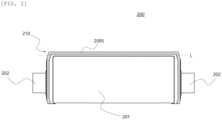
- FIG. 2 is a diagram showing an example of a pouch-type battery cell.
- a pouch-type battery cell 200 may have an electrode assembly disposed in a pouch, which is an exterior material, and sealed edges of three or four sides of the pouch.
- the pouch-type battery cell 200 may have electrode tabs 202 disposed on one end and the other end, respectively, in the longitudinal direction.
- wings 210 are disposed on one end in the short axis where the electrode tab 202 is not formed (a side part of the pouch-type battery cell 200 in a long axis of the pouch-type battery cell 200).
- the wings 210 extend from a main room 201 where the electrode assembly is disposed and protrude outward by a predetermined size, and a sealing part 200S is formed by sealing an outer portion of a pouch.
- the wings 210 may be folded to improve the robustness of the battery cell and the energy density of a battery module.
- the above-discussed process can be referred to as a folding process of the cell or the pouch.
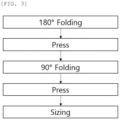
- FIG. 3 is a flow chart of an example pouch folding process.
- the process may include folding the wing of the pouch by 180 degrees, pressing the wing to fix a shape of the 180-degree folded wing, further performing additional 90 degree-folding (also referred to as 270-degree folding), pressing the wing to fix a shape of the additional 90-degree folded wing, and then adhering the folded wing to the main room of the battery cell by using a sizing roller.
- the pouch may be a multilayer film, and thus may be directly or indirectly damaged when physically folded by an external force.
- the sealed part 200S and unsealed part of the pouch may be folded simultaneously due to the cell structure.
- a boundary between the sealed part 200S and unsealed part of the pouch may be most vulnerable to damage, and may act as a starting point where cell quality abnormalities begin.
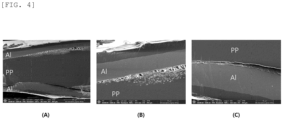
- FIGS. 4A to 4C are cross-sectional images of a pouch fold part folded by the example pouch folding process shown in FIG. 3 .
- FIG. 4A is a cross-sectional scanning electron microscope (SEM) image of the pouch folding part
- FIG. 4B is an enlarged image of an aluminum (Al)/polypropylene (PP) interface
- FIG. 4C is an enlarged image of a PP/Al interface.
- SEM scanning electron microscope
- a heat can be applied to the wing before being folded.
- the pouch folding method may include various operations as will be discussed below.
- FIG. 5 is a flow chart of a pouch folding method based on an embodiment of the disposed technology.
- the method may include applying heat to the wing of the pouch before folding the wing.
- the method may include a first heating operation (S10) of heating the wing before folding the wing by 180 degrees, a 180-degree folding operation (S20) of folding the heated wing by 180 degrees, a first press operation (S30) of pressing the 180-degree folded wing, a second heating operation (S40) of heating the wing before folding the 180-degree folded wing by the additional 90 degrees after performing the first press (S30), a 90-degree folding operation (S50) of folding the heated wing by an additional 90 degrees, a second press operation (S60) of pressing the wing folded by the additional 90 degrees, and a sizing operation (S70) of adhering the folded wing to the main room of the battery cell by using the sizing roller.
- the wing may be heated using a heater in the first heating operation (S10) or the second heating operation (S40), that is, the operation of heating the wing before folding the wing.
- the heater may be spaced away from the wing, and heat the wing in a non-contact manner.
- the heater may be an induction heating heater, and may induction heat the wing.
- the induction heating may be one method of performing electrical heating, and may be a heating method using a principle that an eddy current is generated in a metal to be heated when a current is supplied to an induction heating coil, and a temperature of the metal is increased due to Joule heat generated by resistance of the metal.
- the induction heating heater may include an electromagnet and the induction heating coil, and may be operated by a high-frequency alternating current applied to this coil.
- the wing may be heated in the non-contact manner using the induction heating heater or other types of heater to reduce or minimize the pouch damage, compared to a conventional method of using a press to form the folding line on the wing.
- the pouch may be stretched by the heating before folding the wing, and the above-mentioned defect in the pouch may thus be reduced when folding the wing.
- FIG. 6 is a cross-sectional image of a pouch fold part folded by the folding method implemented base on some embodiments of the disposed technology. Referring to FIG. 6 , the pores or the delamination, occurring at the Al/PP interface, are reduced compared to the process of FIG. 4 .
- the method of heating the pouch may be performed in the non-contact manner, thereby performing the heating simultaneously while transferring the cell without stopping the cell transfer. That is, in some examples, the cell transfer may be required to be stopped in order to press the wing.
- the pouch in some embodiments of the disposed technology, the pouch may be heated in a non-contact manner without requiring the cell transfer to stop. As a result, it is possible to reduce a cell manufacturing time and improve an overall folding process.
- the method based on some embodiments of the disposed technology may be easily applied to conventional pouch folding equipment already installed.
- the wing In the operation of heating the wing, that is, in each of the first heating operation (S10) and the second heating operation (S40), the wing may be heated for a surface temperature of the wing to reach a maximum of 220 Celsius degrees. Thermal deformation of a polyethylene terephthalate (PET) layer, which is an outer layer of the pouch, may occur when the surface temperature of the pouch is 220 degrees Celsius or more.
- PET polyethylene terephthalate
- these issues can be addressed by, for example, appropriately adjusting the output or heating time of the heater, a separation distance between the heater and the pouch, or others.
- the sealing part in the pouch, may have higher rigidity than the unsealed part. Accordingly, the sealing part may be stretched for smooth folding. On the other hand, the unsealed part may have relatively low rigidity, and therefore, there is no need to separately stretch the sealing part. That is, in some implementations, the sealing part of the pouch is intensively heated. In some implementations of the disposed technology, the sealing part and its periphery may be locally heated. The periphery may refer to a predetermined region adjacent to the sealing part, and locally heating the sealing part and its periphery may refer to heating a heating region on the wing that has a width and a length wider and longer than the sealing part. In one example, the folding line on the sealing part, and the folding line of the sealing part may be included in the heating region.
- FIG. 7 is a diagram for explaining a first folding line.
- the first folding line when a line where the wing is folded by 180 degrees is referred to as a first folding line L1, the first folding line may be formed ( ⁇ ) along the sealing part of the wing, or formed ( ⁇ ) along the unsealed part of the wing.
- heating may be achieved along the entirety of the first folding line L1 when the first folding line is formed ( ⁇ ) along the sealing part of the wing.
- the sealing part at the side part of the short axis and its periphery may be locally heated without heating the unsealed part of the wing when the first folding line is formed ( ⁇ ) along the unsealed part of the wing.
- FIG. 8 is a diagram for explaining a second folding line.
- the second folding line L2 when the line where the wing is folded by the additional 90 degrees is referred to as a second folding line L2, the second folding line L2 may be generally formed along the unsealed part of the wing. Accordingly, the sealing part at the side part of the short axis and its periphery may be locally heated without heating the unsealed part of the wing.
- Limiting the heating region in this way may minimize unnecessary damage, in more detail, the unnecessary damage to the unsealed part, and unnecessary heating to the pouch that occurs due to the heating, and simultaneously reduce wasted output of the heater by optimizing the heating region.
- the pouch folding device may be implemented as follows.
- FIG. 9 is a schematic diagram of a pouch folding device based on some embodiments of the disposed technology.
- the device may include: a transfer line 110 for transferring the cell, a folding unit 120 installed on the transfer line, and folding the wing 210 of the pouch in the cell 200; and a heater 130 installed on the transfer line, and heating the wing 210 of the pouch in the cell 200.
- the heater 130 may be installed in front of the folding unit 120, and heat the wing 210 before the wing 210 is folded by the folding unit 120.
- the heater 130 may be installed away from the wing 210, and heat the wing 210 in the non-contact manner.
- the heater 130 may be an induction heating heater that induction heats the wing 210.
- the heater 130 may heat the wing 210 while the cell 200 is transferred along the transfer line 11.
- the folding unit 120 may include a first folding unit 121 folding the wing 210 by 180 degrees along the first folding line L1, and a second folding unit 122 folding the 180-degree folded wing 210 by the additional 90 degrees along the second folding line L2.
- the heater 130 may include a first heater 131 installed in front of the first folding unit 121 and heating the wing 210, and a second heater 132 installed in front of the second folding unit 122, and heating the 180-degree folded wing 210.
- the first heater 131 may heat the wing 210 in the non-contact manner, and locally heat the sealing part and its periphery on the first folding line L1 of the wing 210.
- the second heater 132 may heat the wing 210 in the non-contact manner, and locally heat the sealing part and its periphery on the second folding line L2 of the wing 210.
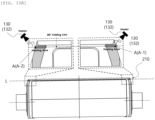
- FIGS. 10A and 10B are diagrams each schematically showing a heating process by the heater.
- FIG. 10A is a front view of the cell
- FIG. 10B is a side view of the cell.
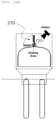
- the heater 130 may be installed away from the wing 210 of the cell 200, heat the wing 210 in the non-contact manner, and locally heat the sealing part and its periphery A on the wing 210.
- two or more heaters 130 may be installed, and simultaneously heat one region A-1 and the other region A-2 of the wing 210, that is, the sealing part at one end of the wing 210 and its peripheral region A-1 and the sealing part at the other end of the wing 210 and its peripheral region A-2.
- installing two or more heaters may indicate a heating part of the heater that is divided into two parts rather than two physically separate devices. That is, installing two or more heaters may include the case where of installing a single heater device including two or more heating parts.
- one heater 130 may be provided, and heat one region of the wing, that is, the sealing part at one end of the wing 210 and its peripheral region A-1 that the heater first meets in a transfer direction of the cell 200, and then heat the sealing part at the other end of the wing 210 and its peripheral region A-2 that the heater sequentially meets in accordance with the transfer of the cell 200.
- FIG. 10 shows a structure of the second heater 132, and the first heater 131 may also include the same structure.
- the first folding line L1 may be formed along the sealing part of the wing 210 as described above.
- the first heater 131 may also have a long bar shape corresponding thereto, and be installed to be parallel to the wing 210, thus simultaneously heating the entire sealing part of the wing 210.
- the wings may be heated to be soft before folding the wings of the cell pouch to thus reduce the pouch damage caused by the folding.
- the wing may be heated in the non-contact manner by using the induction heating heater or the like, thus not requiring the cell transfer stop.
- the induction heating heater or the like it is possible to improve the work time and the overall process, and some embodiments of the disposed technology may thus be easily applied to the conventional pouch folding equipment.
- the method of heating the pouch is performed in the non-contact manner. Accordingly, it is possible to perform the heating simultaneously with the cell transfer without requiring the cell transfer stop. As a result, it is possible to reduce the cell manufacturing time and improve the overall folding process, thus allowing some embodiments of the disposed technology to be easily applied to the conventional pouch folding equipment.
Landscapes
- Engineering & Computer Science (AREA)
- Mechanical Engineering (AREA)
- Chemical & Material Sciences (AREA)
- General Chemical & Material Sciences (AREA)
- Chemical Kinetics & Catalysis (AREA)
- Electrochemistry (AREA)
- Physics & Mathematics (AREA)
- Thermal Sciences (AREA)
- Manufacturing & Machinery (AREA)
- Health & Medical Sciences (AREA)
- Electromagnetism (AREA)
- Toxicology (AREA)
- Oral & Maxillofacial Surgery (AREA)
- Package Closures (AREA)
- Lining Or Joining Of Plastics Or The Like (AREA)
- Making Paper Articles (AREA)
- Auxiliary Devices For And Details Of Packaging Control (AREA)
Applications Claiming Priority (1)
| Application Number | Priority Date | Filing Date | Title |
|---|---|---|---|
| KR1020230102010A KR20250020810A (ko) | 2023-08-04 | 2023-08-04 | 파우치 폴딩 방법 및 장치 |
Publications (2)
| Publication Number | Publication Date |
|---|---|
| EP4503218A2 true EP4503218A2 (de) | 2025-02-05 |
| EP4503218A3 EP4503218A3 (de) | 2025-04-16 |
Family
ID=92214301
Family Applications (1)
| Application Number | Title | Priority Date | Filing Date |
|---|---|---|---|
| EP24192753.2A Pending EP4503218A3 (de) | 2023-08-04 | 2024-08-04 | Verfahren und vorrichtung zum falten von beuteln |
Country Status (4)
| Country | Link |
|---|---|
| US (1) | US20250042063A1 (de) |
| EP (1) | EP4503218A3 (de) |
| KR (1) | KR20250020810A (de) |
| CN (1) | CN119447626A (de) |
Citations (1)
| Publication number | Priority date | Publication date | Assignee | Title |
|---|---|---|---|---|
| KR20220127144A (ko) | 2021-03-10 | 2022-09-19 | 에스케이온 주식회사 | 배터리 셀 제조 장치 |
Family Cites Families (5)
| Publication number | Priority date | Publication date | Assignee | Title |
|---|---|---|---|---|
| EP2476156B1 (de) * | 2009-09-08 | 2017-04-05 | Powergenix Systems, Inc. | Selektive abscheiderheissiegelung für nickel-zink-akkus |
| US20140109397A1 (en) * | 2012-10-22 | 2014-04-24 | Apple Inc. | Heated folding of seals in battery cells |
| US11695177B2 (en) * | 2019-09-30 | 2023-07-04 | Sk On Co., Ltd. | Apparatus and method of folding pouch case of battery cell |
| KR102851209B1 (ko) * | 2021-01-19 | 2025-08-26 | 주식회사 엘지에너지솔루션 | 전지 모듈, 이를 포함하는 전지팩 및 전지 모듈의 제조 방법 |
| JP7694871B2 (ja) * | 2021-08-20 | 2025-06-18 | エルジー エナジー ソリューション リミテッド | パウチ型電池セルおよびパウチ型電池セルのパウチ翼折り曲げ装置 |
-
2023
- 2023-08-04 KR KR1020230102010A patent/KR20250020810A/ko active Pending
-
2024
- 2024-07-31 US US18/790,970 patent/US20250042063A1/en active Pending
- 2024-08-01 CN CN202411050009.3A patent/CN119447626A/zh active Pending
- 2024-08-04 EP EP24192753.2A patent/EP4503218A3/de active Pending
Patent Citations (1)
| Publication number | Priority date | Publication date | Assignee | Title |
|---|---|---|---|---|
| KR20220127144A (ko) | 2021-03-10 | 2022-09-19 | 에스케이온 주식회사 | 배터리 셀 제조 장치 |
Also Published As
| Publication number | Publication date |
|---|---|
| KR20250020810A (ko) | 2025-02-11 |
| EP4503218A3 (de) | 2025-04-16 |
| CN119447626A (zh) | 2025-02-14 |
| US20250042063A1 (en) | 2025-02-06 |
Similar Documents
| Publication | Publication Date | Title |
|---|---|---|
| KR102403858B1 (ko) | 배터리 셀의 파우치 케이스 폴딩 장치 및 방법 | |
| US11695177B2 (en) | Apparatus and method of folding pouch case of battery cell | |
| EP3063801B1 (de) | System und verfahren zur wärmeverwaltung von batteriezellen mit kohlenstoffbasierten thermofolien | |
| EP3358586B1 (de) | Folienkondensator, koppelkondensator, wechselrichter und elektrofahrzeug | |
| US20230411582A1 (en) | Electrode plate extension device and electrode plate manufacturing apparatus | |
| EP4503218A2 (de) | Verfahren und vorrichtung zum falten von beuteln | |
| JP4208007B2 (ja) | 集電体の製造方法及び蓄電装置の製造方法 | |
| KR102264654B1 (ko) | 탭 정렬부가 구비되어 있는 초음파 용접 어셈블리 및 이를 이용한 초음파 용접 방법 | |
| CN115088094A (zh) | 电极轧制装置和电极轧制方法 | |
| CN104051679B (zh) | 电化学电池以及电化学电池的制造方法 | |
| US20250273818A1 (en) | Method for producing electrode | |
| CN113396505A (zh) | 形成用于折叠二次电池袋的设备的密封部 | |
| US11936033B2 (en) | Electrode tab-feeding device including guide for positioning electrode tab at correct point | |
| US20230369632A1 (en) | Apparatus and Method of Folding Pouch Case of Battery Cell | |
| US20240356055A1 (en) | Electrode Assembly Manufacturing Apparatus and Electrode Assembly Manufactured Using the Same | |
| JP2024068447A (ja) | 電極の製造方法 | |
| EP4207411A2 (de) | Elektrodenanordnung für sekundärbatterie und verfahren zur herstellung davon | |
| US12620616B2 (en) | Electrode assembly for secondary battery and method of manufacturing same | |
| JP2024176187A (ja) | 蓄電モジュールの製造方法 | |
| KR20260033180A (ko) | 파우치형 이차전지 제조장치 및 방법 | |
| JP2017135198A (ja) | フィルムコンデンサ、連結型コンデンサ、インバータおよび電動車輌 | |
| CN216451562U (zh) | 加热器 | |
| US20260088325A1 (en) | Secondary Battery Manufacturing Equipment and Secondary Battery Manufacturing Method | |
| US20260031382A1 (en) | Apparatus for forming folding guide line, manufacturing method of battery cell, and battery cell | |
| US20220293903A1 (en) | Apparatus for manufacturing battery cell |
Legal Events
| Date | Code | Title | Description |
|---|---|---|---|
| PUAI | Public reference made under article 153(3) epc to a published international application that has entered the european phase |
Free format text: ORIGINAL CODE: 0009012 |
|
| STAA | Information on the status of an ep patent application or granted ep patent |
Free format text: STATUS: REQUEST FOR EXAMINATION WAS MADE |
|
| 17P | Request for examination filed |
Effective date: 20240804 |
|
| AK | Designated contracting states |
Kind code of ref document: A2 Designated state(s): AL AT BE BG CH CY CZ DE DK EE ES FI FR GB GR HR HU IE IS IT LI LT LU LV MC ME MK MT NL NO PL PT RO RS SE SI SK SM TR |
|
| PUAL | Search report despatched |
Free format text: ORIGINAL CODE: 0009013 |
|
| AK | Designated contracting states |
Kind code of ref document: A3 Designated state(s): AL AT BE BG CH CY CZ DE DK EE ES FI FR GB GR HR HU IE IS IT LI LT LU LV MC ME MK MT NL NO PL PT RO RS SE SI SK SM TR |
|
| RIC1 | Information provided on ipc code assigned before grant |
Ipc: B29C 53/06 20060101ALN20250310BHEP Ipc: B29C 53/38 20060101ALI20250310BHEP Ipc: H01M 50/105 20210101ALI20250310BHEP Ipc: H01M 10/04 20060101AFI20250310BHEP |