EP4503408A1 - Procédé de fabrication de stator - Google Patents
Procédé de fabrication de stator Download PDFInfo
- Publication number
- EP4503408A1 EP4503408A1 EP23774522.9A EP23774522A EP4503408A1 EP 4503408 A1 EP4503408 A1 EP 4503408A1 EP 23774522 A EP23774522 A EP 23774522A EP 4503408 A1 EP4503408 A1 EP 4503408A1
- Authority
- EP
- European Patent Office
- Prior art keywords
- resin member
- mold
- stator
- case
- resin
- Prior art date
- Legal status (The legal status is an assumption and is not a legal conclusion. Google has not performed a legal analysis and makes no representation as to the accuracy of the status listed.)
- Pending
Links
Images









Classifications
-
- H—ELECTRICITY
- H02—GENERATION; CONVERSION OR DISTRIBUTION OF ELECTRIC POWER
- H02K—DYNAMO-ELECTRIC MACHINES
- H02K15/00—Processes or apparatus specially adapted for manufacturing, assembling, maintaining or repairing of dynamo-electric machines
- H02K15/12—Impregnating, moulding insulation, heating or drying of windings, stators, rotors or machines
- H02K15/121—Impregnating, moulding insulation, heating or drying of windings, stators, rotors or machines of cores
-
- B—PERFORMING OPERATIONS; TRANSPORTING
- B29—WORKING OF PLASTICS; WORKING OF SUBSTANCES IN A PLASTIC STATE IN GENERAL
- B29C—SHAPING OR JOINING OF PLASTICS; SHAPING OF MATERIAL IN A PLASTIC STATE, NOT OTHERWISE PROVIDED FOR; AFTER-TREATMENT OF THE SHAPED PRODUCTS, e.g. REPAIRING
- B29C45/00—Injection moulding, i.e. forcing the required volume of moulding material through a nozzle into a closed mould; Apparatus therefor
- B29C45/14—Injection moulding, i.e. forcing the required volume of moulding material through a nozzle into a closed mould; Apparatus therefor incorporating preformed parts or layers, e.g. injection moulding around inserts or for coating articles
- B29C45/1418—Injection moulding, i.e. forcing the required volume of moulding material through a nozzle into a closed mould; Apparatus therefor incorporating preformed parts or layers, e.g. injection moulding around inserts or for coating articles the inserts being deformed or preformed, e.g. by the injection pressure
- B29C45/14262—Clamping or tensioning means for the insert
-
- B—PERFORMING OPERATIONS; TRANSPORTING
- B29—WORKING OF PLASTICS; WORKING OF SUBSTANCES IN A PLASTIC STATE IN GENERAL
- B29C—SHAPING OR JOINING OF PLASTICS; SHAPING OF MATERIAL IN A PLASTIC STATE, NOT OTHERWISE PROVIDED FOR; AFTER-TREATMENT OF THE SHAPED PRODUCTS, e.g. REPAIRING
- B29C45/00—Injection moulding, i.e. forcing the required volume of moulding material through a nozzle into a closed mould; Apparatus therefor
- B29C45/14—Injection moulding, i.e. forcing the required volume of moulding material through a nozzle into a closed mould; Apparatus therefor incorporating preformed parts or layers, e.g. injection moulding around inserts or for coating articles
- B29C45/14065—Positioning or centering articles in the mould
-
- B—PERFORMING OPERATIONS; TRANSPORTING
- B29—WORKING OF PLASTICS; WORKING OF SUBSTANCES IN A PLASTIC STATE IN GENERAL
- B29C—SHAPING OR JOINING OF PLASTICS; SHAPING OF MATERIAL IN A PLASTIC STATE, NOT OTHERWISE PROVIDED FOR; AFTER-TREATMENT OF THE SHAPED PRODUCTS, e.g. REPAIRING
- B29C45/00—Injection moulding, i.e. forcing the required volume of moulding material through a nozzle into a closed mould; Apparatus therefor
- B29C45/14—Injection moulding, i.e. forcing the required volume of moulding material through a nozzle into a closed mould; Apparatus therefor incorporating preformed parts or layers, e.g. injection moulding around inserts or for coating articles
- B29C45/1418—Injection moulding, i.e. forcing the required volume of moulding material through a nozzle into a closed mould; Apparatus therefor incorporating preformed parts or layers, e.g. injection moulding around inserts or for coating articles the inserts being deformed or preformed, e.g. by the injection pressure
-
- B—PERFORMING OPERATIONS; TRANSPORTING
- B29—WORKING OF PLASTICS; WORKING OF SUBSTANCES IN A PLASTIC STATE IN GENERAL
- B29C—SHAPING OR JOINING OF PLASTICS; SHAPING OF MATERIAL IN A PLASTIC STATE, NOT OTHERWISE PROVIDED FOR; AFTER-TREATMENT OF THE SHAPED PRODUCTS, e.g. REPAIRING
- B29C45/00—Injection moulding, i.e. forcing the required volume of moulding material through a nozzle into a closed mould; Apparatus therefor
- B29C45/14—Injection moulding, i.e. forcing the required volume of moulding material through a nozzle into a closed mould; Apparatus therefor incorporating preformed parts or layers, e.g. injection moulding around inserts or for coating articles
- B29C45/14336—Coating a portion of the article, e.g. the edge of the article
- B29C45/14377—Coating a portion of the article, e.g. the edge of the article using an additional insert, e.g. a fastening element
-
- B—PERFORMING OPERATIONS; TRANSPORTING
- B29—WORKING OF PLASTICS; WORKING OF SUBSTANCES IN A PLASTIC STATE IN GENERAL
- B29C—SHAPING OR JOINING OF PLASTICS; SHAPING OF MATERIAL IN A PLASTIC STATE, NOT OTHERWISE PROVIDED FOR; AFTER-TREATMENT OF THE SHAPED PRODUCTS, e.g. REPAIRING
- B29C45/00—Injection moulding, i.e. forcing the required volume of moulding material through a nozzle into a closed mould; Apparatus therefor
- B29C45/14—Injection moulding, i.e. forcing the required volume of moulding material through a nozzle into a closed mould; Apparatus therefor incorporating preformed parts or layers, e.g. injection moulding around inserts or for coating articles
- B29C45/1459—Coating annular articles
-
- B—PERFORMING OPERATIONS; TRANSPORTING
- B29—WORKING OF PLASTICS; WORKING OF SUBSTANCES IN A PLASTIC STATE IN GENERAL
- B29C—SHAPING OR JOINING OF PLASTICS; SHAPING OF MATERIAL IN A PLASTIC STATE, NOT OTHERWISE PROVIDED FOR; AFTER-TREATMENT OF THE SHAPED PRODUCTS, e.g. REPAIRING
- B29C45/00—Injection moulding, i.e. forcing the required volume of moulding material through a nozzle into a closed mould; Apparatus therefor
- B29C45/14—Injection moulding, i.e. forcing the required volume of moulding material through a nozzle into a closed mould; Apparatus therefor incorporating preformed parts or layers, e.g. injection moulding around inserts or for coating articles
- B29C45/14639—Injection moulding, i.e. forcing the required volume of moulding material through a nozzle into a closed mould; Apparatus therefor incorporating preformed parts or layers, e.g. injection moulding around inserts or for coating articles for obtaining an insulating effect, e.g. for electrical components
-
- H—ELECTRICITY
- H02—GENERATION; CONVERSION OR DISTRIBUTION OF ELECTRIC POWER
- H02K—DYNAMO-ELECTRIC MACHINES
- H02K15/00—Processes or apparatus specially adapted for manufacturing, assembling, maintaining or repairing of dynamo-electric machines
- H02K15/02—Processes or apparatus specially adapted for manufacturing, assembling, maintaining or repairing of dynamo-electric machines of stator or rotor bodies
- H02K15/021—Magnetic cores
- H02K15/022—Magnetic cores with salient poles
-
- H—ELECTRICITY
- H02—GENERATION; CONVERSION OR DISTRIBUTION OF ELECTRIC POWER
- H02K—DYNAMO-ELECTRIC MACHINES
- H02K3/00—Details of windings
- H02K3/46—Fastening of windings on the stator or rotor structure
- H02K3/52—Fastening salient pole windings or connections thereto
- H02K3/521—Fastening salient pole windings or connections thereto applicable to stators only
- H02K3/522—Fastening salient pole windings or connections thereto applicable to stators only for generally annular cores with salient poles
-
- B—PERFORMING OPERATIONS; TRANSPORTING
- B29—WORKING OF PLASTICS; WORKING OF SUBSTANCES IN A PLASTIC STATE IN GENERAL
- B29C—SHAPING OR JOINING OF PLASTICS; SHAPING OF MATERIAL IN A PLASTIC STATE, NOT OTHERWISE PROVIDED FOR; AFTER-TREATMENT OF THE SHAPED PRODUCTS, e.g. REPAIRING
- B29C45/00—Injection moulding, i.e. forcing the required volume of moulding material through a nozzle into a closed mould; Apparatus therefor
- B29C45/14—Injection moulding, i.e. forcing the required volume of moulding material through a nozzle into a closed mould; Apparatus therefor incorporating preformed parts or layers, e.g. injection moulding around inserts or for coating articles
- B29C2045/1486—Details, accessories and auxiliary operations
- B29C2045/14934—Preventing penetration of injected material between insert and adjacent mould wall
-
- B—PERFORMING OPERATIONS; TRANSPORTING
- B29—WORKING OF PLASTICS; WORKING OF SUBSTANCES IN A PLASTIC STATE IN GENERAL
- B29L—INDEXING SCHEME ASSOCIATED WITH SUBCLASS B29C, RELATING TO PARTICULAR ARTICLES
- B29L2031/00—Other particular articles
- B29L2031/748—Machines or parts thereof not otherwise provided for
- B29L2031/7498—Rotors
Definitions
- the present disclosure relates to a stator manufacturing method.
- Resin molding for heat dissipation and insulation is performed to an inner face of a stator configuring a rotary electrical machine, for example an induction motor (see, for example, Japanese Patent Application Laid-Open ( JP-A) No. S60-002044 ).
- a stator assembly that contains a stator core wound with coils and a case covering the outer periphery of the stator core inside a mold, and injecting an insulating resin composition (hereafter referred to as a "molding resin”) inside the mold in a state pressed against both axial direction end portions of the stator assembly.
- an object of the present disclosure is to provide a stator manufacturing method capable of suppressing variation in product height and resin leakage without demanding a high dimensional accuracy during component manufacture.
- a stator manufacturing method includes a step of providing a stator assembly including a stator core having coils wound on plural teeth projecting from a yoke, and a case surrounding an outer periphery of the stator core, a step of arranging a ring-shaped resin member at least at one end portion in an axial direction of the case such that at least part of the resin member is crushed when pressed by a mold, a step of clamping the stator assembly inside the mold with the resin member arranged at the at least one end portion in a state in which the resin member is pressed, and a step of injecting a molding resin into the mold.
- the resin member is pressed and clamped by the mold prior to injecting the molding resin to proper locations on the stator assembly, with this meaning that a gap does not develop between the mold and the resin member, and the molding resin does not leak to the stator assembly outside.
- the dimension of the stator assembly after molding resin injection can be matched to the desired product dimension merely by forming the mold to match the desired product dimension, and variation in product dimension can be suppressed.
- a stator manufacturing method is the stator manufacturing method according to the first aspect of the present disclosure, wherein the resin member is configured from a thermoplastic resin, and a step is further included of pre-heating at least part of the mold including a portion that will contact the resin member.
- the crush portion can be softened and crushed using a simple method of causing the pre-heated mold to contact the resin member.
- a stator manufacturing method is the stator manufacturing method according to the first aspect or the second aspect of the present disclosure, wherein the resin member is a bus-bar unit, and the stator assembly includes plural bus-bars having one end portions electrically connected to end portions of the coils, with the bus-bars having other end portions that extend outside the stator assembly through the resin member.
- part of the bus-bar unit can be reused as the resin member, with this enabling the number of components to be reduced.
- a stator manufacturing method is the stator manufacturing method according to any one of the first aspect to the third aspect of the present disclosure, wherein the resin member includes a first ring-shaped projection formed at least at one or other face from out of a face that contacts the case or a face on the opposite side to the face that contacts the case.
- a liquid-tight state can be reliably achieved at least at one out of the contact portion between the resin member and the mold, or the contact portion between the resin member and the case, thereby enabling resin leakage to be more reliably suppressed.
- a stator manufacturing method is the stator manufacturing method according to any one of the first to fourth aspects of the present disclosure, wherein the case includes a second ring-shaped projection at a face that contacts the resin member.
- the second ring-shaped projection provided to the case actively deforms the resin member, thereby enabling a liquid-tight state to be reliably achieved between the case and the resin member.
- a stator manufacturing method is the stator manufacturing method according to any one of the first aspect to the fifth aspect of the present disclosure, wherein the resin member includes a tongue piece that extends along an inner peripheral face of the case, and an indentation able to accommodate entry of a leading end portion of the tongue piece is provided to an inner peripheral face of the case, and a step is further included of using the mold to press the resin member against the case and to fit a leading end of the tongue piece into the indentation.
- the stator manufacturing method as described above is configured to enable fixing between the case and the resin member to be performed at the same time as the stator assembly is being clamped by the mold.
- a stator manufacturing method is the stator manufacturing method of any one out of the first aspect to the sixth aspect of the present disclosure, wherein the case is configured from a resin, and the resin member is part of the case.
- the resin member forms part of the case, and so there is no need to separately prepare the resin member.
- the stator manufacturing method includes a step of providing a stator assembly including a stator core having coils wound on plural teeth projecting from a yoke, a step of arranging a ring-shaped resin member at least at one end portion in an axial direction of the stator core such that at least part of the resin member is crushed when pressed by a mold, a step of clamping the stator assembly inside the mold with the resin member arranged at the at least one end portion in a state in which the resin member is pressed, and a step of injecting a molding resin into the mold.
- the resin member is pressed and clamped by the mold prior to injecting molding resin to proper locations on the stator assembly, with this meaning that a gap does not develop between the mold and the resin member, and the molding resin does not leak to the stator assembly outside. Moreover, the resin member is crushed, and so the dimension of the stator assembly after molding resin injection can be matched to the desired product dimension merely by forming the mold to match the desired product dimension, and variation in product dimension can be suppressed.
- a stator manufacturing method is the stator manufacturing method according to the eighth aspect of the present disclosure, wherein the mold includes an upper mold and a lower mold, and the resin member includes a ring-shaped rib that is provided on an outer peripheral face of the resin member and that is directly clamped between the upper mold and the lower mold when clamped inside the mold.
- stator manufacturing method as described above, a structure is adopted in which the ring-shaped rib is directly clamped by the upper mold and the lower mold, with this meaning that a liquid-tight state can be achieved between the mold and the resin member without separate preparation of a case to cover the stator core.
- the stator manufacturing method of the present disclosure is configured so as to enable variation in product height and resin leakage to be suppressed without demanding high dimensional accuracy during component manufacture.
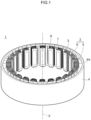
- Fig. 1 is a perspective view illustrating an example of a stator assembly employed in the stator manufacturing method according to a first exemplary embodiment of the present disclosure.
- the stator manufacturing method according to the present exemplary embodiment may mainly be employed to execute resin molding on part of a stator assembly 1 configuring part of an inner rotor type motor, as illustrated in Fig. 1 .
- the stator assembly 1 includes, as illustrated in Fig. 1 , at least a stator core 2, coils 3, and a case 4.
- the stator assembly may configure part of a motor other than an inner rotor type motor such as, for example, an axial type motor.
- the inner rotor type motor may, for example, be a three-phase motor.
- the stator core 2 may be configured by stacking plural sheets of iron core pieces (core pieces) each configured from an electromagnetic steel sheet.
- the stator core 2 may be configured as a ring-shaped member having a center axis X, and may include a yoke 5 formed in a ring shape, for example a circular cylinder shape, and plural (24 in Fig. 1 ) teeth 6 that project toward the inside from the inner peripheral face of the yoke 5.
- the plural teeth 6 are formed at a substantially uniform spacing from each other in a row along the circumferential direction of the stator core 2, and slots 7 may be respectively formed between adjacent of the teeth 6.
- the number of poles and the number of slots of the stator assembly 1 illustrated in Fig. 1 is merely an example thereof, and there is no limitation thereto.
- an extension direction of the center axis X will sometimes simply be referred to as "axial direction" below.
- the coils 3 may be spirally wound around the plural teeth 6.
- An insulator 8 may be interposed between each of the coils 3 and each of the teeth 6.
- the coils 3 may, for example, be configured from a wire made from a wire member of copper, aluminum, silver, or an alloy thereof, covered by an insulating covering film of enamel or the like.
- the wire is illustrated for an example of a round wire in Fig. 1 , however a fattened angular wire, a hexagonal wire, or the like may be employed.
- the same number of coils 3 may be included as coils for each of the three-phases (specifically the U-phase, V-phase, and W-phase).
- these coils 3 are wound around the periphery of the teeth 6 so as to form substantially elongated rectangular shapes having long sides along the axial direction of the stator core 2 when viewed along a radial direction of the stator core 2.
- a coil end 3A configuring and end portion of each of the coils 3 may be pulled out from one axial direction end of each of the slots 7 toward the slot 7 outside.
- the coils 3 are illustrated for an example configured by winding a single strand of electric wire, however plural strands of the electric wire may be wound.
- another insulating member may be employed therefor, such as for example insulating paper or wax.
- the case 4 is a member for surrounding the outer periphery of the stator core 2, and may be configured from a high rigidity material such as, for example, a metal plate having a specific thickness.
- a high rigidity material such as, for example, a metal plate having a specific thickness.
- Various shapes may be adopted for the external profile of the case 4, such as a completely tubular shape without a bottom at either axial direction end, a bottomed tube shape having a bottom at one axial direction as illustrated in Fig. 1 , or the like.
- the case 4 in the example of the present exemplary embodiment may be a bottomed tube shape set with an inner diameter to match an outer diameter of the stator core 2.
- a support projection 4B see Fig.
- an axial direction length of the case 4 may be set shorter than the axial direction length of the manufactured stator.
- Fig. 2 is a perspective view illustrating a state in which a resin member has been attached to the stator assembly illustrated in Fig. 1 .
- Fig. 3 is a cross-section sectioned along line A-A of Fig. 2 .
- a ring-shaped resin member 10 is arranged at least at one of the two axial direction ends of the stator assembly 1 having the above configuration, as illustrated in Fig. 2 .
- an example is illustrated in which the resin member 10 is arranged at one axial direction end of the stator assembly 1.
- the resin member 10 can be configured from a resilient resin formed in a circular ring shape so as to at least cover an axial direction one end portion 4A of the case 4.
- a case contact face 10A that opposes an end face of the case 4 may be configured as a substantially flat face on the circular ring-shaped resin member 10 so as to contact the entire periphery of the end face of the case 4.
- a step portion 10B to fit inside the one end portion 4A of the case 4 may be provided at the inside of the case contact face 10A of the resin member 10, and the resin member 10 may be attached by fitting this step portion 10UB inside the case 4.
- case 4 and the resin member 10 do not necessarily have a fitting structure using the step portion 10B as described above.
- an adhesive or the like may be employed to fix the one end portion 4A of the case 4 and the case contact face 10A together, or a structure may be adopted in which the resin member 10 is simply placed on the one end portion 4A of the case 4 without being fixed thereto.
- the resin member 10 of the present exemplary embodiment is illustrated for a circular ring-shaped example, there is no limitation to being a perfectly circular ring shape.
- the resin member 10 may be matched to the shape of the stator assembly 1 or the like and, for example, may have an elliptical shape, may be a ring shape having a projection and a recess that extend in a radial direction at respective parts of the outer peripheral face and the inner peripheral face thereof, or may be ring shape formed with an indentation or a through hole at a freely selected position thereon.
- a resilient insulating resin and in particular a thermoplastic resin, may be employed in the resin member 10.
- Polyphenylene sulfide (PPS) is, for example, preferably adopted as such a thermoplastic resin.
- the thermoplastic resin include not only PPS, but also polyethylene terephthalate (PET), polypropylene (PP), polyether ether ketone (PEEK), polybutylene terephthalate (PBT), a liquid crystal polymer (LCP), polyphthalamide (PPA), polyether ketone (PEK), polysulfone (PSU) / polyethersulfone (PES), polyether imide (PEI), polyamide-imide (PAI), modified polyphenylene ether (m-PPE), polyamide (PA), and combinations thereof, and in some cases fibers such as glass fibers may be added thereto.
- PET polyethylene terephthalate
- PP polypropylene
- PEEK polyether ether ketone
- PBT polybutylene ter
- resins such as polyimide (PI), fluororesins, polycarbonate (PC), polybutylene terephalate (PBT), polyethylene (PE), polyoxymethylene (POM), polystyrene (PS), polyarylate (PAR), polysulfone (PSF), ABS resins, polyethylene terephthalate (PET), and the like employed either singly or in a combination thereof.
- PI polyimide
- PC polycarbonate
- PBT polybutylene terephalate
- PE polyethylene
- POM polyoxymethylene
- PS polystyrene
- PAR polyarylate
- PSF polysulfone
- ABS resins polyethylene terephthalate (PET), and the like employed either singly or in a combination thereof.
- a crush portion 11 which is a portion mainly crushed when pressed by a mold 20, described later, may be provided to the face of the resin member 10 on the opposite side to the case contact face 10A.
- the crush portion 11 may, for example as illustrated in Fig. 3 , be a zone that extends in an axial direction by a specific length H (for example from 0.1 mm to 0.5 mm) on a face of the resin member 10 on the opposite side to the case contact face 10A.
- H for example from 0.1 mm to 0.5 mm
- the crush portion 11 is defined as being the portion of the resin member 10 where the maximum pressing force acts when pressed by the mold 20.
- the portion of the resin member 10 crushed when pressed by the mold 20 is not limited to only the portion indicated as the crush portion 11 and, for example, the present disclosure also encompasses the resin member 10 as a whole in cases in which resin member 10 is crushed substantially evenly.
- the length H of the crush portion 11 may be set in consideration of axial direction undulations and variation that might be present in the case 4 and the resin member 10.
- the length H of the crush portion 11 is set to a value larger than the sum thereof and may, for example, be set to 0.3 mm. Leakage of resin and variation in product dimension can be suppressed even when there is some undulations and variation in the case and the resin member 10 by adjusting the length H of the crush portion 11 in this manner.
- the axial direction length of the resin member 10 excluding the crush portion 11 is a length that may be adjusted such that a length when added to the axial direction length of the case 4 when attached to the one end portion 4A of the case 4 is the same as the axial direction length of the stator being manufactured.
- the stator assembly 1 may further include plural bus-bars 12 for performing electrical connection of the coils 3.
- the bus-bars 12 may be configured including one end portions 12A electrically connected to the coil ends 3A that extend out from the slots 7, and other end portions 12B on the opposite side to the one end portions 12A and extending outside the stator assembly 1. At least part of intermediate portions of the bus-bars 12 may be guided inside the resin member 10.
- the bus-bars 12 and the resin member 10 may accordingly be integrally formed as a bus-bar unit 13.
- the resin member 10 according to the present exemplary embodiment may be formed by utilizing part of the bus-bar unit 13.
- the bus-bars 12 of the present exemplary embodiment may be plural substantially circular arc shaped wiring to match the phases of the coils 3.
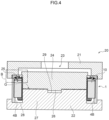
- Fig. 4 is a schematic cross-section illustrating an example of a device to execute the stator manufacturing method according to the first exemplary embodiment of the present disclosure.
- resin molding can be implemented using the mold 20.
- the mold 20 may include an upper mold 21 and a lower mold 22.
- the resin molding may be executed by clamping the stator assembly 1 including the above described resin member 10 in the axial direction using the upper mold 21 and the lower mold 22.
- the upper mold 21 may be configured from a substantially circular plate shaped member having an injection pathway 23 provided inside, and may have an outer diameter dimension that is larger than an outer diameter of the stator assembly 1.
- the upper mold 21 may be provided with a substantially circular pillar shaped upper projection 24 provided at a central portion of a face opposing the lower mold 22, and with an upper indentation 25 that is formed in substantially circular ring shape so as to surround the outer periphery of positions where the upper projection 24 is provided and that is capable of housing part of the stator assembly 1 including the above described resin member 10.
- the injection pathway 23 may be formed inside the upper mold 21 so as to connect between a face of the upper mold 21 on the opposite side to the face thereof opposing the lower mold 22, and one or plural locations inside the upper indentation 25.
- a surface on the leading end side of the upper projection 24 is configured by a substantially flat face, and a positioning projection 26 for performing positioning in a direction intersecting with the axial direction of the upper mold 21 and the lower mold 22 may be provided to a substantially central portion of the upper projection 24.
- the lower mold 22 may be configured from a substantially circular plate shaped member having an external dimension about the same as the upper mold 21.
- the lower mold 22 may be provided with a lower projection 27 provided at a center portion of the face opposing the upper mold 21 and having a leading end portion capable of contacting a leading end portion of the upper projection 24, and a lower indentation 28 that is formed in a substantially circular ring shape so as to surround the outer periphery of positions where the lower projection 27 is provided and that is capable of housing part of the stator assembly 1 including the above described resin member 10.
- a surface on the leading end side of the lower projection 27 is configured by a substantially flat face similar to the surface on the leading end side of the upper projection 24, and a positioning indentation 29 into which the positioning projection 26 of the upper mold 21 fits may be provided to a substantially central portion of the lower projection 27.
- the external profile of the upper mold 21 and the lower mold 22 is not limited thereto, and they may, for example, be formed as square shaped members.
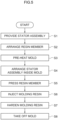
- Fig. 5 is a flowchart illustrating an example of the stator manufacturing method according to the first exemplary embodiment of the present disclosure.
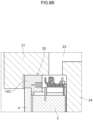
- Figs. 6 are expanded views on arrow B of Fig. 4 , with Fig. 6A illustrating a state prior to the mold pressing the resin member and Fig. 6B illustrating a state in which the mold has pressed the resin member.
- Explanation follows regarding an example of the stator manufacturing method according to the present exemplary embodiment for performing resin molding on the above described stator assembly 1 using the same mold 20 as above described.
- Cast molding and injection molding may be adopted as specific resin molding methods.
- a thermoset resin such as an epoxy resin or phenolic resin or a thermoplastic resin may be employed as a molding resin MR (see Fig. 7 ) employed in the resin molding.
- a stator assembly 1 such as illustrated in Fig. 1 is provided (step S1).
- the resin member 10 is arranged at one axial direction end portion of the stator assembly 1 (step S2).
- the case contact face 10A of the resin member 10 may be contacted against the one end portion 4A of the case, and the resin member 10 may be substantially fixed to the stator assembly 1 by a step portion 10B being fitted inside the case 4.
- pre-heating of the mold 20 is performed either after steps S1 and S2, or in parallel to these steps.
- This pre-heating may be executed at least on part of the mold 20 including at least the portion thereof for contacting against the resin member 10.
- the entire upper mold 21 is pre-heated.
- step S4 the upper mold 21 may, as illustrated in Fig. 6A , be in a state in which part of the upper indentation 25 is contacted against the crush portion 11 of the resin member 10. In such cases a slight gap G (see Fig. 4 ) is formed between the leading end of the upper projection 24 of the upper mold 21 and the leading end of the lower projection 27 of the lower mold 22 (see Fig. 4 ).
- step S5 When the stator assembly 1 has been arranged in the mold 20, next the crush portion 11 of the resin member 10 is pressed by the upper mold 21 (step S5) by at least one of the upper mold 21 or the lower mold 22 being moved in the direction such that both members are brought relatively closer to each other.
- the gap G is filled by this movement, the upper projection 24 and the lower projection 27 make contact, and the stator assembly 1 arranged between the upper mold 21 and the lower mold 22 is clamped at a specific pressure inside the mold 20.
- the gap G and the axial direction length H of the crush portion 11 are substantially the same as each other and, for example, may be 0.3 mm.
- the upper mold 21 is accordingly moved such that the entire crush portion 11 is crushed.
- the crush portion 11 crushed by the upper mold 21 is softened by heat from the upper mold 21, and moves toward the inner peripheral side or the outer peripheral side of the resin member 10.
- a ring-shaped space D1 to allow the softened resin member 10 to move toward the outside may be set in the upper indentation 25 of the upper mold 21 at an outer peripheral portion of the resin member 10. This means that most of the crush portion 11 pressed at step S5 thereby moves toward the outer peripheral side of the resin member 10 so as to fill the space D1 portion, as illustrated in Fig. 6B .
- the crush portion 11 may be softened before the stator assembly 1 is arranged in the mold 20, or a mode may be adopted in which the crush portion 11 is plastically deformed by pressing pressure of the upper mold 21 alone.
- the axial direction length between the upper indentation 25 and the lower indentation 28 in a state in which the upper projection 24 and the lower projection 27 have been brought into contact may be set so as to be the same as a setting length of the stator to be manufactured.
- the stator assembly 1 clamped between the upper indentation 25 and the lower indentation 28 is thereby clamped by the mold 20, enabling adjustment to a desired height.
- the axial direction length of the stator manufactured by the method according to the present exemplary embodiment is able to be decided based on the dimensions of the mold 20.
- next injection of the molding resin MR starts (step S6).
- Injection of the molding resin MR is performed by actuating a feed source connected to the injection pathway 23, for example a plunger, and injecting the molding resin MR via the injection pathway 23 mainly into the slots 7. Due to the upper mold 21 being pressed against the resin member 10 at step S5, these portions are placed in liquid-tight contact by the resilient force of the resin member 10, and so the molding resin MR that has been injected does not leak outside.
- a feed source connected to the injection pathway 23, for example a plunger
- step S7 When injection of the molding resin MR has been completed, the injected molding resin MR is hardened (step S7). Hardening of the molding resin MR may be performed by heating the molding resin MR using a known heating means (for example, by actuating a heater arranged inside the mold 20). When hardening of the molding resin MR has been completed, the mold 20 is taken off the stator assembly 1 (step S8), with this completing one cycle of manufacturing steps.
- Fig. 7 is a cross-section illustrating a state after resin molding has been performed on the stator assembly illustrated in Fig. 3 .
- the stator assembly 1 that has been subjected to resin molding through the cycle of steps described above is in a state in which all faces at the peripheral inside of the case 4 and the resin member 10 are covered by the molding resin MR, as illustrated in Fig. 7 .
- the dimensional accuracy of the product after resin molding can be raised, while suppressing the dimensional accuracy demanded in other members to a low level.
- resin can be prevented from leaking out when resin molding is performed by the resin member 10 having a specific resilience being contacted against the mold 20.
- stator manufacturing method of the present disclosure and the resin member 10 and the like illustrated in the first exemplary embodiment described above, may also be modified.
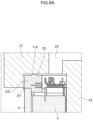
- Figs. 8 are expanded diagrams corresponding to Figs. 6 and illustrating a first modified example of the method according to the first exemplary embodiment, with Fig. 8A illustrating a state prior to the mold pressing the resin member, and Fig. 8B illustrating a state in which the mold has pressed the resin member.
- the crush portion 11 of the resin member 10 was formed so as to extend the entire face on the opposite side to the case contact face 10A by the specific length H, with this end face formed as a flat face.
- a configuration including a ring-shaped projection 11A as illustrated in Fig. 8A is adopted in place thereof.
- the ring-shaped projection 11A is an example of a first ring-shaped projection, and may be configured by part of the resin member 10C, and may be formed in a circular ring shape around the entire periphery of the face on the opposite side to the case contact face 10A.
- the ring-shaped projection 11A in Fig. 8A is illustrates an example of which only one is formed thereof, however plural may be formed thereof, spaced apart at a specific spacing.
- the height of the ring-shaped projection 11A is not necessarily uniform around the circumferential direction. Similar applies to a ring-shaped projection 11B and a ring-shaped projection 4C described later.
- the resin member 10C serves as a crush portion, and by adopting a configuration including the ring-shaped projection 11A on the face on the opposite side to the case contact face 10A, the volume of the portion crushed by the mold 20 can be made smaller than the crush portion 11 described above.
- the ring-shaped projection 11A portion is preferentially crushed when the resin member 10C is pressed by the mold 20, and so the ring-shaped projection 11A is reliably crushed around the entire periphery, enabling the liquid-tightness of this portion to be predictably secured.
- Fig. 9 is an expanded diagram corresponding to Figs. 6 and illustrates a second modified example of the method according to the first exemplary embodiment.
- a resin member 10D of the second modified example employs a ring-shaped projection 11B that projects downward on the case contact face 10A of the resin member 10D as another example of a first ring-shaped projection.
- the ring-shaped projection 11B is preferentially crushed when the stator assembly 1 is clamped inside the mold 20.
- the height direction length of the resin member 10D may be adjusted such that this contact face is also crushed when clamped in the mold 20, or this contact face may be surface machined in advance so as to match the face of the upper mold 21 being contacted.
- Fig. 10 is an expanded diagram corresponding to Figs. 6 and illustrates a third modified example of the method according to the first exemplary embodiment.
- a ring-shaped projection 4C may be provided to the one end portion 4A of the case 4 as an example of a second ring-shaped projection.
- the projection 4C presses the case contact face 10A of a resin member 10E when the resin member 10E is pressed by the upper mold 21, enabling a function in which the case contact face 10A is preferentially crushed.
- the case contact face 10A portion of the resin member 10E functions as a crush portion 11C.
- the resin member 10E of the present modified example may include configuration substantially similar to that of the resin member 10 according to the above exemplary embodiments.
- Adopting the configurations illustrated for the second and third modified examples enable liquid-tightness between the case 4 and the resin members 10D and 10E to be predictably secured.
- the ring-shaped projection 4C serving as an example of the second ring-shaped projection may be adopted irrespective of whether or not there is a ring-shaped projection 11A or 11B serving as an example of the first ring-shaped projection.
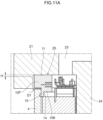
- Figs. 11 are expanded diagrams corresponding to Figs. 6 and illustrate a fourth modified example of the method according to the first exemplary embodiment, with Fig. 11A illustrating a state prior to the mold pressing the resin member, and Fig. 11B illustrating a state in which the mold has pressed the resin member.
- the first exemplary embodiment described above is an example illustrated in which, when arranging the resin member 10 in the stator assembly 1, the step portion 10B provided to the resin member 10 is fitted together with the inner peripheral face of the case 4 and both parties fixed together, however a fixing structure described in the following fourth modified example may be employed in place thereof.
- a fixing structure described in the following fourth modified example may be employed in place thereof.
- a tongue piece 14 that extends along the inner peripheral face of the case 4 is formed to the leading end of the step portion 10B of a resin member 10F, and an indentation 15 is formed at a position on the inner peripheral face of the case 4 near to the one end portion 4A of the case.
- the resin member 10F provided with the tongue piece 14 is attached to the case 4, in order to make contact between the leading end of the tongue piece 14 and an end face of the stator core 2, attachment is made in a state in which there is a gap formed between the one end portion 4A of the case 4 and the case contact face 10A.
- the tongue piece 14 may be formed in a ring shape similar to the step portion 10B, and may be formed in a form in which plural arms extend downward from the step portion 10B.
- the indentation 15 may be arranged to match the position of the tongue piece 14.
- a step as illustrated in Fig. 11B is executed to press the resin member 10F against the case 4 using the upper mold 21, and to fit the leading end of the tongue piece 14 inside the indentation 15.
- the resin member 10F is moved in the direction to approach the case 4 either before or at the same time as the crush portion 11 is being crushed.
- the leading end portion of the tongue piece 14 moves so as to escape from this end face toward the indentation 15 and fits into the indentation 15.
- the leading end of the tongue piece 14 is fitted together with the indentation 15 and the resin member 10F and the case 4 are fixed together during the course of performing resin molding, and so there is no longer a need to execute a separate step to fix the resin member 10F and the case 4 together.
- the two parts can be firmly fixed even in cases in which there is low cohesion between the resin member 10F and the case 4 due to the effects of undulations or the like.
- the case 4 is formed from a high rigidity member, for example metal, and the resin member 10, 10C to 10F is brought into contact with the case 4, however the case 4 may be formed with a resin, for example with a resin similar to that of the resin member 10, 10C to 10F described above.
- the resin members 10, 10C to 10F may each form part of the case 4. Configuring the resin members 10, 10C to 10F as part of the case 4 enables a reduction in the number of components and manufacturing man-hours.
- the axial direction length of the case 4 may be set longer than the product dimension, similarly to the resin member 10, 10C to 10F described in the above exemplary embodiment and each of the modified examples.
- a projection may also be provided to an end portion of the resin member configured by part of the case 4, similarly to the projection 11 A provided to the resin member 10C of the first modified example.
- the resin members 10, 10C to 10F illustrated above in the first exemplary embodiment and each of the modified examples each include the case contact face 10A that contacts the one end portion 4A of the case 4, and are configured such that at least part thereof is crushed when pressed by the mold 20.
- the resin member utilized in the method of the present disclosure does not necessarily contact an end portion of the case.
- a stator manufacturing method employing a resin member that does not contact the one end portion 4A of the case 4 as a second exemplary embodiment of the present disclosure.
- the second exemplary embodiment illustrated below may employ each configuration described above in the method according to the first exemplary embodiment described, except for in the shape of the resin member, and specifically the same overall configuration may be employed for a stator assembly and for a device to execute the stator manufacturing method.
- the same reference numerals will be appended to similar portions to those described in the first exemplary embodiment and explanation thereof will be omitted, with description focusing only on the portions modified from the first exemplary embodiment described above.
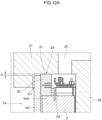
- Figs. 12 are expanded diagrams corresponding to Figs. 6 and illustrate an example of a device to execute the stator manufacturing method according to the second exemplary embodiment of the present disclosure, with Fig. 12A illustrating a state prior to the mold pressing the resin member, and Fig. 12B illustrating a state in which the mold has pressed the resin member.
- a resin member 30 prepared for such manufacture differs from that of the first exemplary embodiment in that the structure employed does not contact a one end portion 4A of a case 4D, but contacts an axial direction one end portion 2A of the stator core 2.
- the resin member 30 can be configured from a resilient resin formed in a circular ring shape so as to cover an axial direction one end portion 2A of the stator core 2.
- a stator core contact face 30A of the circular ring-shaped resin member 30 for contacting the stator core 2 is able to contact the stator core 2 mainly around the entire periphery of a portion configuring a yoke 5.
- the case 4D included in a stator assembly 1A may include a one end portion configured with part thereof extending to as to partially cover the outside of the resin member 30.
- the inner peripheral face of the case 4D and the outer peripheral face of the resin member 30 may be in a closely adhered state.
- the resin member 30 having at least part thereof covered at the outside by the case 4D is able to be supported by the one end portion 2A of the stator core 2 and the inner peripheral face of the case 4D.
- the face of the resin member 30 on the opposite side to the stator core contact face 30A is able to function as a crush portion 31 that is a portion mainly crushed when pressed by the mold 20.
- a length H of the crush portion 31 may be set in consideration of axial direction undulations and variation that might be present in the stator core 2 and the resin member 30. As a specific example, for example in a case in which the axial direction dimensional tolerances of the stator core 2 and the resin member 30 are each respectively set to ⁇ 0.1 mm, then the length H of the crush portion 31 is set to a value larger than the sum thereof and may, for example, be set to 0.3 mm.
- step S1 When resin molding the stator assembly 1A having one axial direction end portion supporting the resin member 30, the cycle of steps illustrated in Fig. 5 may be executed similarly to in the first exemplary embodiment.
- step S2 the stator assembly 1A is provided (step S1).
- step S2 the resin member 30 is arranged at the axial direction one end portion of the stator assembly 1A (step S2).
- step S2 the stator core contact face 30A of the resin member 30 is contacted against the one end portion 2A of the stator core 2.
- the stator assembly 1A including the resin member 30 is arranged inside the mold 20 (step S4).
- part of the upper indentation 25 of the upper mold 21 may arranged so as to be in a state of contact with the crush portion 31 of the resin member 30.
- at least one of the upper mold 21 or the lower mold 22 is moved so as to fill the gap G between the two, and to press the crush portion 31 of the resin member 30 (step S5).
- step S5 The crush portion 31 pressed by the upper mold 21 at step S5 is crushed in the axial direction and becomes in a state of close adhesion to the upper mold 21, as illustrated in Fig. 12B . A liquid-tight state is thereby achieved between the resin member 30 and the upper mold 21.
- injection of molding resin MR is performed (step S6), the injected molding resin MR is hardened (step S7), and when hardening of the molding resin MR has been completed, the mold 20 is taken off the stator assembly 1 (step S8), thereby completing a cycle of the manufacturing steps.
- the dimensional accuracy of the product after resin molding can be raised, while suppressing the dimensional accuracy demanded in each member to a low level due to employing the resin member 30.
- resin can be prevented from leaking out when resin molding is performed due to the resin member 30 having a specific resilience being contacted against the mold 20.
- the stator assembly 1A includes the case 4D that covers part of the outer peripheral face of the stator core 2 and the outer peripheral face of the resin member 30, however in the stator manufacturing method according to the present exemplary embodiment, the resin molding may be executed even for a stator assembly without a case.
- an example is accordingly illustrated below in which resin molding is performed to a stator assembly 1B without a case.
- Fig. 13 is a schematic cross-section corresponding to Fig. 4 and illustrates a device to execute the stator manufacturing method according to a modified example of the second exemplary embodiment of the present disclosure.
- the stator assembly IB provided in the method according to the present modified example may, as illustrated in Fig. 13 , not include the cases 4, 4D respectively illustrated in the first and second exemplary embodiments, and as a result thereof have an outer peripheral face that includes an exposed stator core 2.
- a resin member 30B arranged on an axial direction one end portion 2A of the stator core 2 of the stator assembly 1B may be arranged so as to contact part of the one end portion 2A.
- the resin member 30B may, similarly to the resin member 30 explained in the second exemplary embodiment, be configured including a stator core contact face 30A that contacts the one end portion 2A of the stator core 2 and is provided at one end portion thereof.
- a ring-shaped rib 32 may be provided to the resin member 30 so as to extend toward the outside from an outer peripheral face.
- a mold 20A employed in the stator manufacturing method according to the present modified example may include a upper mold 21A and a lower mold 22A as illustrated in Fig. 13 .
- the upper mold 21A thereof may be configured with a structure substantially the same as the upper mold 21 described in the first exemplary embodiment.
- the lower mold 22A may be configured as a substantially circular plate shaped or square shaped member having an external dimension about the same as the upper mold 21A. Similarly to the lower mold 22 described above, the lower mold 22A may include a lower projection 27 including a positioning indentation 29.
- the lower mold 22A may include a lower indentation 28A that is formed in a substantially circular ring shape so as to surround the outer periphery of positions where the lower projection 27 is provided and that is able to house part of the stator assembly 1B described above, a side wall portion 28B upstanding from an outer edge of the lower indentation 28A toward the upper mold 21A, and plural support projections 28C for supporting the other end of the stator core 2 that rise from proper locations of the lower indentation 28A.
- a lower indentation 28A that is formed in a substantially circular ring shape so as to surround the outer periphery of positions where the lower projection 27 is provided and that is able to house part of the stator assembly 1B described above
- a side wall portion 28B upstanding from an outer edge of the lower indentation 28A toward the upper mold 21A
- plural support projections 28C for supporting the other end of the stator core 2 that rise from proper locations of the lower indentation 28A.
- the molding resin MR can be injected around the entire periphery of the stator core 2.
Landscapes
- Engineering & Computer Science (AREA)
- Manufacturing & Machinery (AREA)
- Mechanical Engineering (AREA)
- Power Engineering (AREA)
- Manufacture Of Motors, Generators (AREA)
Applications Claiming Priority (2)
| Application Number | Priority Date | Filing Date | Title |
|---|---|---|---|
| JP2022049064 | 2022-03-24 | ||
| PCT/JP2023/008678 WO2023181923A1 (fr) | 2022-03-24 | 2023-03-07 | Procédé de fabrication de stator |
Publications (2)
| Publication Number | Publication Date |
|---|---|
| EP4503408A1 true EP4503408A1 (fr) | 2025-02-05 |
| EP4503408A4 EP4503408A4 (fr) | 2025-07-23 |
Family
ID=88100793
Family Applications (1)
| Application Number | Title | Priority Date | Filing Date |
|---|---|---|---|
| EP23774522.9A Pending EP4503408A4 (fr) | 2022-03-24 | 2023-03-07 | Procédé de fabrication de stator |
Country Status (5)
| Country | Link |
|---|---|
| US (1) | US20260001262A1 (fr) |
| EP (1) | EP4503408A4 (fr) |
| JP (2) | JP7358683B1 (fr) |
| CN (1) | CN118923027A (fr) |
| WO (1) | WO2023181923A1 (fr) |
Family Cites Families (8)
| Publication number | Priority date | Publication date | Assignee | Title |
|---|---|---|---|---|
| JPS602044A (ja) | 1983-06-15 | 1985-01-08 | Mitsubishi Electric Corp | モ−ルド水中電動機 |
| US5306459A (en) * | 1992-04-09 | 1994-04-26 | Illinois Tool Works Inc. | Insert molding method using a crush rib |
| US5939102A (en) * | 1996-03-11 | 1999-08-17 | George, Jr.; Francis L. | Apparatus for encapsulating field windings of rotary electric machines |
| JP2002262501A (ja) * | 2001-03-01 | 2002-09-13 | Mitsubishi Electric Corp | モールドモーター |
| US7015619B2 (en) * | 2003-10-31 | 2006-03-21 | Nidec Shibaura Corporation | Molded motor |
| WO2014115255A1 (fr) * | 2013-01-23 | 2014-07-31 | 株式会社 日立製作所 | Machine électrique tournante à entrefer axial |
| JP6790783B2 (ja) * | 2016-12-12 | 2020-11-25 | 日本電産株式会社 | ステータユニット、モータ、およびステータユニットの製造方法 |
| JP2022049064A (ja) | 2020-09-16 | 2022-03-29 | ミネベアミツミ株式会社 | 液状部材の吐出装置及び回転電機 |
-
2023
- 2023-03-07 US US18/849,461 patent/US20260001262A1/en active Pending
- 2023-03-07 CN CN202380029033.6A patent/CN118923027A/zh active Pending
- 2023-03-07 EP EP23774522.9A patent/EP4503408A4/fr active Pending
- 2023-03-07 WO PCT/JP2023/008678 patent/WO2023181923A1/fr not_active Ceased
- 2023-03-07 JP JP2023533722A patent/JP7358683B1/ja active Active
- 2023-09-06 JP JP2023144736A patent/JP2023164969A/ja active Pending
Also Published As
| Publication number | Publication date |
|---|---|
| JP2023164969A (ja) | 2023-11-14 |
| EP4503408A4 (fr) | 2025-07-23 |
| CN118923027A (zh) | 2024-11-08 |
| JP7358683B1 (ja) | 2023-10-10 |
| JPWO2023181923A1 (fr) | 2023-09-28 |
| US20260001262A1 (en) | 2026-01-01 |
| WO2023181923A1 (fr) | 2023-09-28 |
Similar Documents
| Publication | Publication Date | Title |
|---|---|---|
| JP7344807B2 (ja) | コイルボビン、分布巻ラジアルギャップ型回転電機の固定子コア及び分布巻ラジアルギャップ型回転電機 | |
| JP6044488B2 (ja) | コイルインシュレータの固定方法および固定構造、ステータ、ならびに、回転電機 | |
| JP5533285B2 (ja) | 絶縁部材、ステータの製造方法 | |
| CN107534343A (zh) | 汇流条单元、具备该汇流条单元的旋转电机以及汇流条单元的制造方法 | |
| KR20150077443A (ko) | 전기 모터 또는 발전기를 위한 치부 | |
| JPWO2020017133A1 (ja) | 分布巻ラジアルギャップ型回転電機及びその固定子 | |
| JP6287976B2 (ja) | 回転電機のステータの製造方法 | |
| US11355989B2 (en) | Bus bar and motor comprising same | |
| CN103779979A (zh) | 定子或转子 | |
| JP6818900B2 (ja) | 回転電機の固定子および固定子の製造方法 | |
| JP6621056B2 (ja) | リアクトル、およびリアクトルの製造方法 | |
| JP5233630B2 (ja) | ステータ、回転電機、ステータの製造方法および回転電機の製造方法 | |
| JP4291789B2 (ja) | ステッピングモータ | |
| EP4503408A1 (fr) | Procédé de fabrication de stator | |
| JP2015019505A (ja) | 回転電機ステータ及び回転電機ステータの製造方法 | |
| JP6090044B2 (ja) | 回転電機ステータの製造方法及び回転電機ステータ | |
| JP5991011B2 (ja) | モータの固定子構造及びその製作方法 | |
| WO2024004510A1 (fr) | Stator, machine tournante électrique, procédé de fabrication de stator et procédé de fabrication de machine tournante électrique | |
| JP2015084629A (ja) | 回転電機用ステータ | |
| JP2025050457A (ja) | ステータの製造方法 | |
| JP2025050456A (ja) | ステータの製造方法 | |
| JP2016010277A (ja) | 回転電機用ステータ | |
| WO2023062868A1 (fr) | Machine électrique rotative et machine industrielle | |
| JP2015116014A (ja) | 回転電機用ステータ | |
| CN113141077A (zh) | 绝缘面罩单元、用于缠绕电机的基体的方法和电机 |
Legal Events
| Date | Code | Title | Description |
|---|---|---|---|
| STAA | Information on the status of an ep patent application or granted ep patent |
Free format text: STATUS: THE INTERNATIONAL PUBLICATION HAS BEEN MADE |
|
| PUAI | Public reference made under article 153(3) epc to a published international application that has entered the european phase |
Free format text: ORIGINAL CODE: 0009012 |
|
| STAA | Information on the status of an ep patent application or granted ep patent |
Free format text: STATUS: REQUEST FOR EXAMINATION WAS MADE |
|
| 17P | Request for examination filed |
Effective date: 20240920 |
|
| AK | Designated contracting states |
Kind code of ref document: A1 Designated state(s): AL AT BE BG CH CY CZ DE DK EE ES FI FR GB GR HR HU IE IS IT LI LT LU LV MC ME MK MT NL NO PL PT RO RS SE SI SK SM TR |
|
| DAV | Request for validation of the european patent (deleted) | ||
| DAX | Request for extension of the european patent (deleted) | ||
| A4 | Supplementary search report drawn up and despatched |
Effective date: 20250623 |
|
| RIC1 | Information provided on ipc code assigned before grant |
Ipc: H02K 15/12 20250101AFI20250616BHEP Ipc: B29C 45/14 20060101ALI20250616BHEP |